RGL e-Book Cover
Based on an image created with Microsoft Bing software
Roy Glashan's Library
Non sibi sed omnibus
Go to Home Page
This work is out of copyright in countries with a copyright
period of 70 years or less, after the year of the author's death.
If it is under copyright in your country of residence,
do not download or redistribute this file.
Original content added by RGL (e.g., introductions, notes,
RGL covers) is proprietary and protected by copyright.
RGL e-Book Cover
Based on an image created with Microsoft Bing software

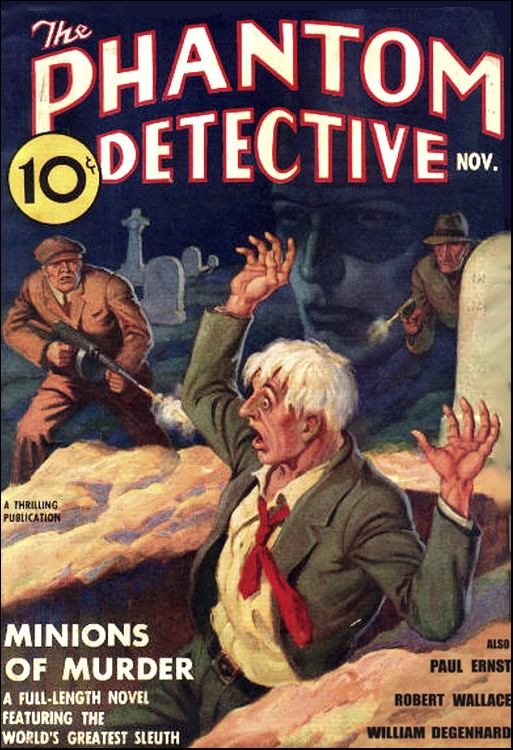
The Phantom Detective, November 1937, with "Minions of Murder"
Wild, laughing maniacs, recruited to further the heinous plans of an arch-fiend, terrorize a great city as crime follows crime in a blood-curdling procession of horror!
IT was the hour when Broadway becomes one of Manhattan's loneliest and most desolate thoroughfares.
The gaudy, eye-dazzling display signs had blinked off their million dollar lights one after another. The last night club had closed its reluctant doors. A heavy mist, chill and gloomy, swept up the celebrated "Main Stem," now an empty canyon walled by dark theater marquees and garish store fronts.
Along the avenue which would, within a few hours, be snarled with traffic, an occasional sanitation truck or milk truck rolled by on quiet rubber tires. On the sidewalks soon to be pounded again by surging, pushing crowds, by sandwich men, by advertising "freaks" of all sorts, there were only isolated groups of people—last of the "hot spot" customers.
Shivering women whose evening wraps afforded them little protection against the chill air. Red-eyed men in stiff white shirt-fronts, already suffering hangovers. Their voices, their tired laughter, their querulous bickering echoed along the silent street.
Cabs, sliding out of the gloom mist, picked up these belated convivials. At an all-night hack-stand in a side street, several idling machines were lined, waiting. Here drivers dozed fitfully behind wheels; others, crammed into one vehicle, played poker from their laps.
BEYOND the hack-stand, the side street stretched west like a dark gloomy pocket of the avenue, eventually disappearing in the mist which obscured even the street lamps.
But the eyes of taxi-men who keep their cabs out all night, are unusually keen. Keen to any movement on the sidewalk which might mean another fare.
Now, suddenly, some of the dozing drivers jerked to attention. One or two began gassing their idling engines. The poker players paused in their game. All leaned out, peered down the gloomy, dark block. One, backing out of the open poker cab, stood to get a better view, and it was his voice which rose in hard surprise.
"Say—what th' hell!" he said abruptly.
The others stared with him at the movement which had attracted their eyes.
Out of the gloomy mist, moving up the street in this direction, was a vague, blurred shape. It moved with snail-like slowness, with a sort of swaying, lurching motion. Even from this distance, there was something strange, something unnatural, about that figure. Somehow it did not look quite human; it seemed to move like some dark, vague figment of the mist itself!
Some of the cabbies shivered involuntarily, seemed to become aware of the unnaturally heavy fog, the loneliness of the hour. But with others, seasoned, tough New Yorkers, the first reaction was one of hard-boiled skepticism.
"It's a drunk!" one insisted huskily. "You can see from the way he walks—"
He broke off, stiffening with the rest. For now, even as the blurred shape approached inexorably closer, there came the sound of heavy metal weights falling, at slow intervals, upon the pavement! Slow, measured, it rose—rose at each lurching step of the oncoming shape!
Somehow that banging tread froze the blood of the staring cabbies. Their hard faces all gave way to pallor now, to uncanny wonderment. Clump! Bang! Closer and closer, but still with snail-like slowness, came the shape from the gloom. And, incongruously, the closer it came the more it seemed to lose human semblance!
An alcoholic group of the nightclub exodus, had come to the Broadway corner now, were waving and shouting in efforts to hail a cab. But the usually alert cabbies did not even notice them. And in the next instant the couples froze where they stood; a woman, pointing, gave a drunken shriek.
For the approaching shape had come under the nearest street lamp. The mist-halo'd light was enough to reveal the figure, dimly but sufficiently for all eyes to take in its incredible dimensions!
"Gee! Do you guys see what I see?" croaked one of the cabbies, while another, in his shocked fear, reached beneath his cab-seat for a wrench—the taxi-man's weapon of defense.
There, revealed under that street lamp, was a monstrous grotesquerie! A figure which, in the dim-lit mist, suggested some imagined conception of a visitor from another planet, or some nightmare of either a prehistoric or future age!
There was an enormous, spherical-shaped head which glinted with a metallic sheen—and which showed one huge, glistening orb in its colter of the forehead!
The body beneath the head, though seemingly pygmy-sized in comparison, was bulky, nearly shapeless. Two arms swayed cumbersomely on either side. Two immense feet, like great lumps, dragged and clumped in a staggering forward walk!
Stupefied, the cabbies and the group on the corner—who must have thought themselves in the grip of D.T.'s—could only stare at that dim but incredible monstrosity! Had they seen it at any other time, when Broadway was teeming with life, they might have dismissed it, horrible though it was, as some freak advertising stunt; or even some actor from a horror drama, whimsically taking the air between scenes.
But now, at this dead hour, with every theater long since closed, the grotesque figure looming in the midst, the big bulbous head swaying, the reverberating tread coming closer, closer—it was too much for the little group of watchers!
THEN, dispelling any last fleeting hope of illusion or make-believe, there came a familiar sound.
Shrill and piercing, the blurred staccato of a submachine gun rattled suddenly in the side-street. The horrified cabbies glimpsed the livid spurts of flame, coming from the darkness to one side of the lumbering figure. Flame which leaped and gibbered tremulously!
As the clatter rose in a crescendo, the grotesque figure with the bulbous head came to an abrupt, lurching halt. Slowly, that figure stiffened, seeming to rise to an almost gigantic height. For a long moment it stood there, immobile amid the rattling din, like a ghastly statue.
Then, with the clatter subsiding but still echoing, the figure slowly toppled forward. Stiffly, horribly, it fell full length, crashed to the pavement with a clanging impact that shook the street!
On the Broadway corner a woman fainted in the arms of a goggle-eyed escort. A man, drink driven from his very stomach, yelled: "Police! Police!" The cabbies, still staring at the pavement where the crumpled shape had fallen, cursed with affrighted profanity.
As a few, more courageous than the rest, started to leap from their cabs with a thought of reaching the scene, a dark, long shape suddenly hurtled out of the misty side-street—a touring car, displaying no lights. Gears grinding raucously, it shot past the hack-stand with desperate, accelerating speed—too fast for anyone to see inside it.
Careening around the corner down Broadway, the dark car whizzed off into the gloom.
A running beat cop appeared on the corner in the next instant. Even before he could appraise the shooting that had attracted him, his whistle blasted shrilly. One of the cabbies, eager for action, sent his cab veering from the line, yelling as he drew abreast of the bluecoat:
"Hey, copper! That car that turned down Broadway without lights—I think it did the shootin'!"
The cop half-whirled, alert but hesitant, for others were pointing down the street where the monstrous shape had fallen. Then a second patrolman appeared on the run. The first officer saw his partner running down the street towards the heap. He hesitated no longer, leaped on the running board of the cab.
The driver eagerly stepped on the gas. His roaring cab raced as only cabs can, took the corner on two wheels, sped down Broadway with the cop holding on, his night-stick wedged under one arm.
"A shootin' from the car, ye say, lad?" his hoarse Celtic voice rose in the rush of wind. "Anyone see who was on the receivin' end?"
Behind the wheel the cabby shivered. "I'm not sayin' what I saw because I ain't dumb enough to believe it myself! Look—" he broke off, jamming down the accelerator.
In the mist of the desolate avenue ahead, the dark rear of the unlighted car had loomed into view. It was racing down Broadway at breathtaking speed. The cab leaped ahead, gaining. The patrolman squirmed, pulled out his .38 Positive revolver, cocking as he drew.
He squeezed out two low shots at the car ahead. The shots missed any mark, but they served as a signal to a radio patrol car that had just turned onto the avenue. The speedy green prowl-car joined the chase, the cab remaining ahead of it.
The revolver of the cop on the running board blazed a second time. For answer the touring car abruptly veered again, careened west into a one-way eastbound street, once more going out of view.
"Step on it, lad!" The cop yelled the needless urge to the cabby, who literally sent the machine flying around that corner, the radio car close behind.
Again the fugitive, dark vehicle, appeared in front of them racing down the block. But now, strangely, it was zigzagging! Its course was erratic, as if it was suddenly out of control!
"Now what can that be meanin'?" the cop boomed. "I'm shure my bullets didn't hit them!"
The cab gained swiftly now as the touring car weaved giddily from side to side. The daring cabby sent his machine spurting ahead again, "cow-boying" in to one side of the fugitive now while the prowl-coupé leaped behind.
The cop, squeezing to the running board, was momentarily right opposite the touring car. His gun raised, froze, and then an exclamation ripped from his lips.
IN the front seat of the touring car, which was uncurtained though hooded, a single figure—the only occupant—jumped from side to side of the seat like a monkey. He ignored completely the steering wheel or the pedals. His hands waved crazily above him, his feet kicked up. Evidently the hand-accelerator of the car was opened wide, for he wasn't pressing his feet on the gas.
Now, as the cab pulled abreast of the weaving, zigzagging car, the lone occupant turned. In the darkness the patrolman and cabby glimpsed a white face—a face grinning horribly, two eyes glaring with a mad, crazed light. A shock of disheveled snow-white hair bobbed atop the grinning features!
"Gawd! What divil from hell can that be?" the cop gasped, paling beneath his ruddy complexion, while the cabby cursed at this fresh horror. Then the patrolman yelled frantically across space at the gesticulating, leering occupant of the amok car:
"Hey, you damn nut! Take hold of that wheel before you—"
His voice trailed off in a cry, and he pressed his whole big body into the tonneau of the cab. For at that moment the uncontrolled touring car lurched drunkenly, swayed toward the cab!
The cabby used all his skill; dexterously he wriggled the cab through a fast narrowing gap. As it was, the bumper of the touring car grazed the cab's rear fender.
Then, even as the cab shot past, and the radio car screamed to an abrupt stop behind, the touring car careened up the curb, jumping to the deserted pavement. The sound of a maniacal, crazed laugh ripped from the front seat. Then—
Cr-assh! Head-on, the touring car smashed into a dark plate-glass store-front. The glass shattered, raining out in all directions. The touring car hit an inner upright support, seemed to keep moving though its front had been stopped dead. Actually it had telescoped, the body crumpling up from sheer momentum.
Piling up, the wreckage settled, came horribly still.
The cop leaped off the cab as it rolled to a stop. The two bluecoats from the prowl-car joined him, the cabby following dazedly behind.
Their flashlights probed the wreck, came to a stop upon a bloody, glaze-eyed face that was grinning up at them with a mad leer, even in death!
"Holy muther!" the cop from the cab crossed himself. "I've seen many queer nuts in my day, but this beats 'em all!"
BUT he might have taken back that statement had he seen the sight back on the side-street further uptown where the chase had begun.
That side-street, so empty and desolate a moment before, was now teeming with life and noise such as it didn't know even in its busiest hour!
The curb and a good part of the pavement, was lined with police cars that had come with screaming sirens—prowl-cars, and detective cruisers, one limousine bearing the shield of a Chief Inspector.
The headlights from the cars overwhelmed even the mist, lighting the whole end of the street.
From the little group of cabbies and night-club couples, a crowd had grown to huge proportions. Night-workers, truck drivers, night clerks, derelicts—all surged against blue-coats who pushed them back.
And in the very center of this open-air stage, a smaller group of patrolmen and men in plainclothes gathered around the object of attraction, their bulky bodies screening it from view.
In front of them stood the owner of the limousine with the big shield: Inspector Gregg, Chief of Manhattan's Division of Detectives, active head of the crack Homicide Squad. To those who did not know him, the inspector looked like a slow, placid man, with a gruff but perennially weary tone. To the men who served under him he was a veteran who knew crime better than any other man in the department, and who tackled it with a bull-dog tenacity.
"Well!" the inspector's gruff voice rose. "What are you standing around for, men? You'd think this were some kind of monster, the way you act!" His own face showed just a little pallor. "It's a dead man—a stiff, that's all. Just because he's dressed in a deep-sea diving suit—" He broke off, brow furrowing at the incongruity of his own words.
HE spoke the truth. At close range and in the light, the strange dimensions of that figure from the mist were explained. The big head proved to be a bronze-domed helmet; the single orb was the glass window in it. Bulky, rubber-fabric material, and a shield breastplate, gave the body its shapeless proportions. And the immense, lumpy feet which had clumped so metallically, were regulation, weighted lead shoes which divers wear to help keep them standing upright under the sea.
Yet, with the supernatural aura removed, the thing was more an object of horror than ever. A pool of crimson blood lay beneath it, splotched the suit, for they had turned the heavy-weighted figure over. And on all sides of the breastplate, which itself was dented in several places, were bloody perforations in the rubber. The suit had been riddled by machine-gun slugs, which had entered at an oblique angle.
"Go on!" Inspector Gregg ordered in a weary, patient voice. "Get that thing off his head—those screws there, on the outside. Take 'em off! Let's have a look at it, while we're waiting for the Medical Examiner."
Bluecoats bent to obey. The inspector turned inquiringly as a lieutenant of detectives came hurrying up to him.
"Got all the witnesses rounded up, Inspector," the man reported. "One cabby went off with a patrolman, chasing some car. Some think the shots came from the car. Nobody got the license number."
THE inspector's eyes gleamed grimly beneath their deceptively heavy lids. "Phone the radio patrol with whatever description you have of that car. Have them—"
He broke off, and his order was automatically withdrawn. A bright young bluecoat who had remained on duty at the nearest post-phone had appeared, saluting.
"Call from the Eighteenth Precinct, sir! Officer O'Toole reported that, aided by a cab, and with the aid of a prowl-car, he overhauled a touring car which had left this street, immediately after the shooting. A man O'Toole believes to have been insane was the only person in the car. He lost control of the car and it crashed into a store. The man carried no identification and his pockets were empty. They couldn't find any weapon in the car, either. They checked the license and found the vehicle was stolen from in front of a Broadway hotel; the owner didn't know it."
The young cop got it all out in one breath. Though the inspector took the news phlegmatically, grim surprise showed in his eyes.
"A good report, officer," he praised. "That'll do."
As the officer rushed off, the inspector turned to one of the Homicide Squad men. "Go down there, Ryan, see about that unidentified stiff. Look for a weapon; maybe he threw it out of the car." He raised his voice. "Scour the block, men. Look for a submachine-gun."
"Be nice if you could pin it on a dead man, eh, Inspector? Save a lot of trouble."
The new voice, a hard-boiled yet friendly voice, made the detective chief whirl. He glared as he recognized the youthful, wiry man who, with a red press card stuck in a pearl-grey fedora, had somehow edged unobtrusively into the group.
"Huston!" the inspector growled. "Say, where did you bob up from anyway? Any statements—"
"Will have to come from the Commissioner's office," finished Steve Huston, with a tight knowing grin. "And to answer your first question, I came from the Clarion, America's greatest newspaper, which happens to be not far from this vicinity. I was up doing a special feature. Luck, eh? Ah, now we can have a real look."
This as the policemen, working at the thumb-screws in the diving helmet, at last unloosed the big bronzed dome, lifted it carefully off.
HIDEOUS in its frozen grimace of death, a white face was revealed; its lips flecked with blood, its eyes glazed. Only the high forehead, greying hair, gave that bloody visage some semblance of dignity.
"I've seen that face before!" Huston said abruptly. Beneath the youthful reporter's cynical, hard-boiled manner there was a grim tension, a feverish interest.
They took off the top of the suit too, and the breast-plate. The dead man was wearing an expensive looking business suit; his body was big, and of robust build.
A quick search of the clothes revealed a wallet. The inspector expelled a short breath as he came upon a roll of bills which had been untouched. There were identifications in the wallet.
"Banning," the inspector read. "George Banning."
Steve Huston gave a whistle. "No kidding! Hell, no wonder I spotted his face! He's a big shot—the biggest man in the rayon business! Say!" The little reporter was suddenly so excited that his cynicism dissolved into boyish eagerness. "This is George Banning, one of the big business men of the town, killed in a diving suit! Can you tie that?"
THE inspector was too troubled to deny his feelings. "I couldn't tie it, even if this bird was a real deep-sea diver!" he groaned. "Why should anyone in a diving suit take a walk in the dead of night, on Broadway? Tell me that and you can have my badge—" He broke off as he saw a figure approaching, called: "Come on through, Doc!"
The stocky city Medical Examiner, sleepy-eyed but ready for work, was pushing through the crowd dangling a black bag in one hand.
He, too, was a veteran, whose job was to view violent death in any form. But the diving suit seemed to shock him, too. Nevertheless his report, after a swift examination, was terse and to the point:
"Death from internal hemorrhage; two bullets in the heart, I'd say. Fully conscious when shot—Funny. Isn't that helmet air-proof? You'd think he'd have suffocated—"
Examination showed that there was a hole in the helmet, where, in diving, an airline would ordinarily be.
"He got air through that," the doctor stated. "But from his face I'd say he was struggling, going through great exertion."
"So would you if you carried that gear on you!" Steve Huston put in. "It weighs close to two hundred pounds! Say!" Again he exclaimed as a fresh thought struck him. "Does it occur to you that a man couldn't put that suit on by himself, or take it off, either? Somebody must have put the suit on him before he walked up the street and got plugged!"
"By God, you're right there!" the inspector admitted, his hard eyes sharp. "Maybe that guy in the touring car—" He cursed. "We've got to find the tommy gun! Got to find where the hell this man walked from in the first place!"
One of his men reported that a scouring of the street had not produced the gun. Presently other reports came from all along the route the touring car had taken—no weapon had been found.
The inspector, Huston at his elbow, went to question the witnesses now—the group of cabbies, the night-club couples, all thoroughly sober and white-faced.
As was all too common, the stories of the witnesses varied, even conflicted. Some were certain the shots had come from the touring car; others were certain that they had not, though none could locate them.
The morgue wagon came for the gruesome corpse, even as the furtive dawn seeped through the mist. The corpse was removed from the scene, but the stage it had left bustled more than ever.
Detectives and patrolmen were still scouring the block. Steve Huston joined them, his keen little eyes watchful and alert.
And it was the dapper crime reporter who caught sight of a suspicious movement in the largest building on the street—a tall, modern office structure which towered darkly into the mists—the New Broadway Building.
Huston saw a dim figure crawling out of the front door, moving crablike on the sidewalk!
The reporter yelled to the inspector, pointed. Followed by others, they dashed to the crawling figure.
It proved to be the night watchman of the building. A terrific welt bulged crimsonly from his scalp. Dazedly he looked up at the policemen as they administered first aid. Then he was blurting his story:
"—don't know what happened. Just came to a minute ago—crawled out here—I was sitting by the freight elevator, when something hit me on the head—"
"When was that?" the inspector demanded.
"I think it was around three-thirty a.m. Just a little while ago, guess—"
"Little while! It's after four-thirty now!"
Cursing, the inspector dashed, with Huston and his men at his heels, into the building. The freight elevator, they soon found, was on the third floor.
They walked up the three flights. There they found the elevator, empty and lit. Huston glanced up and down a corridor. A wide-open, frost-glass door, without any tenant's name on it, showed a dim-lit office at one end of the hall. Huston pointed it out. All hurried there, crossed the threshold.
And then, again, they came to a dead stop. This time even the phlegmatic inspector let out a gasp, and Steve Huston gave a cry.
One dim ceiling bulb—the other sockets were empty—burned in the huge office, which was bare of any furniture. And in that dim, eerie light, against the wall, stood two motionless, monstrous shapes!
Two figures in diving gear and bronzed helmets! With bulky, rubber suits riddled; with pools of blood oozing around each pair of leaden shoes! With white, dead faces and sightless-staring eyes behind the helmet window's.
Utterly paralyzed by the unexpected sight, the entire group of men stood frozen, pale.
Then their pounding entry or some other vibration of the building must have caused it—
One of the two gruesome figures tilted slowly, horribly, out from the wall. Stiffly, it toppled forward and, as the men leaped back with recoiling horror, it crashed deafeningly to the floor at their feet!
BEFORE the echo of that crash had died, another sound came—a sound which cascaded upon the affrighted ears of the men, which rasped like a file against nerves already stretched taut!
Wild and blood-curdling, a maniacal laugh rang out! A laugh as of some creature from hell! Crazily it rose, filling the gruesome death chamber!
Inspector Gregg and Steve Huston were the first to move. Both whirled in the direction whence the crazed laughter came—an anteroom just off this office.
The inspector, as if to show that a veteran cop feared no ghosts, drew his service pistol and rushed forward. Huston was right at his elbow. The others, fighting off muscular paralysis, followed, also drawing guns.
They burst into the anteroom, which was also dim-lit.
The first thing they saw was a Thompson submachine-gun, lying on the bare floor. And then—
Huddled like some animal in one corner, leering out at them, was a thin-haired, scrawny man, unshaven and disheveled. His body was trembling from head to foot; yet, crazily, he laughed out at them—laughed shriekingly, a drool of saliva decking his lips, with his eyes looking as no sane eyes could possibly look.
The inspector's next words revealed how wrought up he was. For, to that cowering, mad-eyed creature, who showed not even a semblance of sanity or understanding he bawled out, hoarsely:
"You're under arrest!"
THE towering New York Clarion Building jutted forty stories into the low-hanging fog of clouds, a fog which completely enveloped its spire, obscuring it from visibility on all sides. Within the building, the pounding rotary presses occupying two floors hurled out extras with funereal black headlines. Copy boys scurried in and out breathlessly, relaying from pressrooms to copy room, where editors and make-up men with eyeshades waved wet proofs, and rewrite men in up-tilted hats banged on their typewriters.
High above all this clamor, in a luxuriant office where the mist pressed opaque against the windows, Frank Havens, the man who owned this mighty paper and a string of others throughout the nation, paced the carpeted floor, his rugged face tense in every line, his eyes haggard and grim with a worry that almost approached panic.
The elderly but vigorous publisher moved in his pacing to a French casement window with an outer balcony.
He pulled it open, strode out into the chill grey mist which floated weirdly on space, screening off the great city far below. Ignoring the penetrating chill of the air, Havens turned his eyes upwards, following the building wall into the enveloping clouds. Faintly, ever so faintly, where the spire thrust up there, he could detect a tiny glimmer of red, blinking spasmodically on and off, on and off.
He gave a weary, inchoate sigh, went back inside to his desk, to an inter-office telephone.
"Give me the tower again," he spoke heavily.
And when a response came:
"Brady? That light up there! Can't you make it stronger?" He gripped the phone fiercely. "That red light must be seen, fog or no fog!"
"Sorry, Mr. Havens, but even ten lights like that couldn't pierce this mist! Have to wait until it lifts."
Havens shook his head, said, "Well, keep it going! Keep repeating the flashes I gave you."
He hung up, reached for another phone—a special phone with a private wire that ran straight from this office to an apartment on Park Avenue. When he picked it up, he heard the telephone at the other end automatically ring at once. He was not surprised when there was no answer—this was the third time he had tried.
He moved back to a regular outside phone. Called several numbers, spoke to several people in all walks of society. But each conversation terminated with his weary: "No? Well, if you do see him tell him to call Frank Havens."
Again he rose to pace the floor, helpless lines struggling with the determination in his face, the responsibility he felt weighing down his shoulders.
It was not an imaginary responsibility. As the biggest publisher in the country, Frank Havens had a power which could affect the lives of millions! He felt that it was his duty to society to use that power to benefit mankind, to turn it as a weapon against crime and corruption, to point the way towards an ideal of law and order.
But words alone, hurled out by his presses, were not enough. The fight against crime had to be waged actively, the criminals ferreted out and matched in their evil cunning by brilliant skill and courage.
And now a fresh crime, of staggering proportions, had broken! A crime in which Frank Havens already felt personally involved, for his ace reporter, Steve Huston, had phoned him in a lead that was as yet not even in possession of the police!
Frank Havens was fervently anxious to place that lead in the hands of the one man who could really cope with a case of such bizarre and baffling complications.
The publisher continued to pace, helpless, agitated. That red blinking beacon on top of the Clarion Building had hitherto been a signal which had never failed to bring the mail he sought. But now the fog had defeated the code-blinking light—futilely, it winked unseen in the surrounding clouds. And the telephone calls to every place Havens could think of had proved equally fruitless.
"If only I knew where he was!" the publisher gritted now, shaking his head, raising his hands in a helpless gesture. But the determination had not left his eyes. "I must get word to him, somehow, while the trail is still fresh!"
sRICHARD CURTIS VAN LOAN, immaculately attired in full evening dress, silk top hat set at a decorous angle on his young head, strode weariedly out of one of Fifth Avenue's swank hotels.
Dismal mist, grey with the furtive light of dawn, engulfed the wealthy young socialite and man-about-town.
As he strode leisurely down the avenue, his listless manner belying his lithe, athletic build. Van lifted a parting glance towards lighted windows of the hotel—the huge windows of the Grand Ballroom. Faintly, from within, came the strains of an exhausted swing band, the saxophone moaning hollowly. There was a feeble tinkle of glasses, a few convivial voices—
"Poor Mrs. Rensaler!" Van murmured, with a slightly ironic smile. "Still struggling to keep her all-night party going! I'm lucky to have got off so soon!"
He could still see the disappointed expression on the face of his matronly, buxom hostess. "Dick!" she had fluttered. "You're leaving me stranded! The party will go to pieces without you!"
Dick Van Loan had almost been tempted to tell her that the party had gone to pieces long ago, that he had spent most of it sleeping on his feet, moving boredly like an automaton among the thronging guests; all members of the social register.
Now, out on the street, even the chill, damp air was a welcome relief. Van peered upward into that swirling fog. That mist was thick, so thick that building tops were lost in it. Van Loan, in his top hat, was a lonely figure on the avenue, walking slowly, almost aimlessly and—
Of a sudden his body tensed; he slowed almost to a stop. Nor was it his eyes that had detected anything; the fog was as thick as ever.
But fog, over a city at its most hushed hour, is a powerful conductor of sound. And it was Van's ears that had brought him suddenly tense.
To those ears, through the quiet mist, came the moan of river sirens from all the surrounding waters of Manhattan. River sirens!
Van, still walking, listened now with absorbed concentration.
In the chorus of those moaning whistles, the siren was louder, clearer than all the rest. It was so distinct in its powerful note that Van believed he recognized it as the siren of the S.S. Queen Anne, England's huge, transatlantic superliner. The Queen Anne! Couldn't be sailing now, at this hour; it must be sounding its siren from the pier where it was docked.
And what made Van tense in every muscle, so that the last vestige of weariness dropped from him, was the strange rhythm of that superpowerful siren whose voice carried over the misty city.
There were short blasts; then prolonged ones. Dots and dashes! Code! Not Morse code, but a special secret code! A code which Van Loan quickly translated, as each letter was blasted out:
"P—H—A—N—T—O—M."
Just that one word, that eerie call blasted out by the diapason siren into the fog. Blasted out, over and over:
"Phantom—Phantom—Phantom—"
And as he listened, a change came over Richard Curtis Van Loan, wealthy young idler. His shoulders squared forward, purposefully; his eyes gleamed tense, suddenly wide awake. Quickly, with that resonant siren still continuing, he hurried around the corner, to the nearest phone booth in an all-night drug store.
He squeezed his broad-shouldered frame into a booth, deposited a nickel, worked the dial with a long, dexterous finger.
"New York Clarion," came a smooth, feminine voice.
"Mr. Van Loan calling Mr. Frank Havens," Van said in a casual drawl which did not reveal his tension. "Is he there?"
For answer there was a swift click of switches. And then, eager, fervently relieved, came the voice of the Clarion's publisher.
"Van! Thank God! At last you got my message." Even in his relief Havens spoke guardedly over the public wire. "I must see you to discuss that trip we are to take—"
Van knew there was no such "trip," understood the implication. He spoke briefly. "Suppose I pick you up—say, in about ten minutes—in front of your building, Frank. And, by the way, that suit I left in your office—you might bring that along."
A swift, grateful assent from Havens terminated the brief conversation.
When Van Loan emerged from the store, day had broken. The mist was lifting from the streets, but it still floated overhead, sending down a dank, chill drizzle.
And though the mournful sound of sirens still rose from all sides, the most powerful of those had ceased in the next moment!
VAN hurried down a side-street. He came to a small, modest-looking coupé. Its lights burned dimly.
Unlocking the door, he climbed in, inserted the ignition key. Another instant and a powerful motor hummed, the coupé slid from the curb. It swung into early morning avenue traffic and, as swiftly as lights permitted, headed downtown.
Hardly had the car reached the towering Clarion Building when, hurrying across the sidewalk to meet it, carrying a bulky package, the rugged-faced figure of Frank Havens came abreast of the slowing car.
Wordlessly, as Van Loan moved from behind the wheel, the publisher climbed in, taking over the wheel and immediately starting the car downtown.
Van Loan, meanwhile, ducked down, half-crouching on the floor. He opened the bulky package Havens had brought. Within it was a slouch business suit—a suit that either a poor or wealthy man could wear and still look normally dressed.
In the dimness Van Loan proceeded to strip off his own formal dress clothes, to get into the slouch suit.
"I guess you can talk now, if it won't interfere with your driving, Frank," he clipped, as he worked and the car proceeded downtown.
There was a haggard sigh from Havens. "Van!" he cried. "I hardly know where to begin! It's the most fantastic story I've ever heard! Van, the most ghastly crime I have ever heard of, has just been committed. Three prominent business men—all of them big in their respective lines—have been murdered in an unbelievable fashion!"
Swiftly he told the story sent in by his ace reporter.
Van tensed as he listened, but made no comment, waiting to hear all the facts. He had gotten into the slouch suit now, and from the pocket of his discarded dress clothes he had taken out a flat, leather-covered kit. Even as Havens talked, Van snapped open the kit. Within the cover a tiny bulb illumined a mirror, beneath which lay an array of jars and vials.
Van Loan's fingers moved rapidly from the jars to his face. In seconds the handsome features of Dick Van Loan were gone and another face was growing in their stead.
"George Banning, the big rayon manufacturer, was the first victim found," Havens was saying, in his horror-threaded tone. "He was shot down on the street, where he was walking in a diving suit! The others were found in a vacant office on the same block; they were James Kendricks and W.B. Harrison."
Van Loan's eyes went grim even as he continued to apply make-up beneath them. Those names were familiar to him. Kendricks, he knew, was a gigantic power in the industrial world, head of a vast tetraethyl gasoline corporation. Harrison, equally big, was a manufacturer of shatter-proof glass.
"And you say they were all three dressed in diving suits?" he was prompted to question now.
"Yes, that's the amazing thing, isn't it?" Havens shuddered at the wheel. "The police are attempting to pin the crime on two madmen, one of whom died when the auto he was escaping in crashed. The other, found alive in that office. I thought you'd want to see this madman first; he's the only suspect—"
Havens was already slowing the car.
Van Loan, deftly putting finishing touches on his face, glanced out, saw that they were on Centre Street. In the mist ahead the domed, ornate building of Manhattan Police Headquarters loomed.
"Steve Huston should be here. He was right in on the case, Van. And it was he who turned in a lead to me which the police haven't yet found—a lead which made me feel that this was a case for the Phantom!"
"Yes?" Van nodded, folding his kit now. "A good lad, that Huston! He's proved invaluable in more than one case. What did he turn up, Frank?"
SPEAKING rapidly, Havens said, "Huston happened to look into one of the diving helmets found on the dead men. He found a company name: Apex Company. He got in touch with them, in Brunswick, New Jersey. He learned there that diving suits like that are made to order. And the Apex people thought these particular suits might be part of an order they delivered a couple of months back to the American Salvage Company which is a government-owned concern, with offices down on the Battery.
"But when Huston went down there to see them, he learned that there'd been a robbery of their storeroom just a week ago. Among other expensive and valuable gear in the storeroom there had been two dozen of these new diving suits. The robbers—who must have used a truck and worked at night —took exactly ten suits and accessories!"
And at this news, Van Loan gave an involuntary gasp.
"Ten suits!" he echoed, grimly. "That does sound bad, Frank."
"Can you blame me for calling for the Phantom?" Havens spoke heavily, as he jockeyed the car into a parking space. "Apparently, the fiend behind this thing planned ten such ghastly murders!" He shook his head, as he brought the car to a stop. "Well, here we are, Van and—"
He broke off as he turned towards his companion, a look of mingled astonishment and admiration spreading over his face.
"Your disguises will always be a marvel to me!" he said.
For now, Van Loan was to every appearance an elderly mild-looking man, with an obvious secretarial demeanor. His face, long and sharp-featured, was topped by thin grey hair, made by a special cream-dye rubbed into his scalp.
No one outside of Havens, who had witnessed the change, would have believed that this elderly man who climbed from the car with the publisher, strode with him towards the imposing entrance of Police Headquarters, was Dick Van Loan, wealthy young playboy.
But no one could have guessed either that both Dick Van Loan and this elderly man were—the Phantom!
The Phantom! Scourge of the underworld throughout the nation, guiding angel to every law enforcement agency from local police to the Federals of Washington! The Phantom, who, as Richard Curtis Van Loan found life dull and meaningless—who enjoyed life only when he played some role other than the one to which he had been born.
For Frank Havens, at whose side the Phantom now walked, had brought Van Loan up to virile manhood when, as a child, he was orphaned, though left with a vast fortune. Havens had taught him to despise idleness, to feel that unless one contributed usefully, one was a social parasite, regardless of inherited wealth or position.
The World War had completed the training Havens had started. Van had served in the Flying Corps, and when he had come out of the red battle skies, he had suddenly found his peace-time existence unendurable.
Then Havens had shown him that there was another, greater war—a war which went on at all times: the war against crime. He had suggested that Van anonymously tackle a murder-case which had baffled the police.
The result was that a murderer, confessing under the damning evidence against him, went cringingly to the chair. And as that murderer died, his strapped body convulsing under the lethal shocks—the Phantom was truly born, became overnight a byword of terror throughout the underworld.
From that time on Van Loan had given himself to his new-found career. He had studied criminology. He had mastered the art of disguise, both of feature and voice. Physically and mentally he had equipped himself with every possible weapon for the fight against criminals. He had become a crack marksman with all fire-arms, an expert at boxing, jiu-jitsu; even mastered the subtle, psychic weapon of hypnotism.
NOW, having answered the summons to a new case, the Phantom followed Frank Havens into the Headquarters building. Up a flight of stairs, past a growing throng of grim-jawed detectives, to a glass door marked: Deputy Chief Inspector—Division of Detectives.
An attendant in the anteroom stopped them, but when Havens identified himself, his influential name proved an open sesame.
"This is my secretary," he introduced Van. So now, as Havens' secretary, Van followed the publisher into the adjoining office.
There they came upon a strange, tense scene.
The huge room, bare-looking despite its elaborate corner desk, was filled with men. Van recognized Inspector Gregg, detective chief, whose placid face looked haggard, greyish. He saw the dapper little Steve Huston turn with a grin towards Havens, as if inwardly gloating over the fact that he had beaten the police to the tracing of the diving suits. Another man, stocky, heavy-set, with thick-lensed glasses which gave him a seemingly perpetual, probing stare, Van also recognized. He was the head psychiatrist of Bellevue Hospital!
His reason for being here was all too apparent. For now Van's eyes went to the sight which had first attracted them—the man who occupied the center of this grim stage.
Out on the floor, stripped to the waist, a grinning, leering, sparse-haired man stood. His eyes stared out dully; his lips drooled with saliva. He was going through a strange and repeated motion. Monotonously, his right arm would circle back, he'd rise to his toes, then hurl the arm forward, as if throwing an unseen ball. He seemed oblivious to the audience watching him.
A man who was a stranger to Van, a tall man with a thatch of grey hair and a short, bristly beard, spoke slowly.
"No," he was saying. "I can't understand those motions. But as for removing him to Bellevue—"
The stocky psychiatrist from that hospital broke in. "Obviously it's the only thing to do, Dr. Hugo. I appreciate the fact that you offered your services, and your pathologic experience, to help the police here. But trying to make this man talk is futile! Besides, his heart is bad, as you know. We must get him to the hospital, put him under observation."
Dr. Hugo seemed angered at these remarks. But he shrugged. Inspector Gregg said:
"I'll bet he's putting on an act! I've got a mind to take him downstairs and give him a workout. Bet he'd talk some sense then. Hell, if only we knew who he was. But, just like the other one we got in the morgue, there wasn't a thing on him. The only thing we know is that the tommy gun we found near him was the one that killed Kendricks and Harrison in that office—the ballistics men have that."
"But," it was the voice of Steve Huston that put in now, "the same ballistics men have the slugs from Banning's body, and they don't match that tommy. You never found the other machine-gun, so your case against the two maniacs isn't so hot, is it, Inspector?"
The inspector cursed and made no reply.
ALL this time the creature on the floor had been silently making his invisible "pitches." But now, he stepped back suddenly. A chortle, as of glee burst from his lips, changed abruptly to a piercing scream. Whirling, he leaped across the floor, towards the nearest window.
Detectives, and two men whom Van realized were attendants from the hospital, leaped forward. The attendants were quicker and more deft than the detectives. They caught the madman, pinioned his arms back, held him while he screamed.
"That's enough!" the stocky psychiatrist from Bellevue spoke then. "I demand that he be taken to the hospital immediately!"
Havens flashed a tacit glance at the Phantom, who stood unobtrusively behind him. Van gave an imperceptible nod to show that he agreed with the Bellevue doctor.
The madman was taken out, police following the attendants who led him.
Dr. Hugo, the tall spare man who was a visiting psychiatrist, drew himself up then. "Well," he said, in a tone that held a certain hostility, "it seems I cannot be of much service here after all. I'm a busy man—so I'll bid you good day, gentlemen."
Whereupon, he turned on his heel, strode out.
The Bellevue psychiatrist gave a grunt at his departure. "Sore, eh?" he said, his thick glasses glaring. "Just because he's used to catering to a wealthy practice doesn't mean everyone should kow-tow to him."
IT was Havens who voiced the question then, prompted by another tacit glance from Van Loan. "How did he happen to come down here, anyway?"
The inspector gave the answer. "He just popped in. Said he'd heard about the arrest. I had him trying to make the lunatic talk, but no dice. Wish to hell we knew who that maniac is!" he repeated. "We've checked all asylums, of course. But he isn't any known escaped lunatic. It beats me!"
Again the Phantom flashed a glance at Havens. The publisher understood that he wanted to speak to him alone. Now the Bellevue psychiatrist was taking his leave; Inspector Gregg was busy giving orders to detectives.
Unobtrusively, Havens and Van Loan moved off to a corner of the big room. Here they seemed engaged in casual talk, with Van Loan looking the part of a secretary listening to orders.
But actually low and terse, the Phantom was saying:
"Frank, I'm worried about that 'maniac'. Think you'd better persuade the Bellevue people to keep him in a very quiet place, and not allow anyone to reach him—or see him even. You can use the name of Dr. Bendix in this connection,"
Havens nodded. "Dr. Bendix" was another role of the Phantom. It was the name which covered his arduous research work in science and medicine.
"Also, suggest to them that they check the Army and Navy registration files, which contain fingerprints of every man in the service."
Havens nodded. "A good idea. I doubt if that's yet occurred to them."
"Another thing," Van Loan added. "That other maniac—the one that's dead. Suggest to them that a brain specialist participate in the autopsy, and pay particular attention to the outer brain cells."
Havens looked puzzled, but did not ask any questions. Now the Bellevue psychiatrist was leaving the room, but the publisher knew already it would be wiser to contact him at the hospital later on.
"Finally," the Phantom ordered, "look thoroughly into the backgrounds of Kendricks, Harrison and Banning, the three murdered men. See if diving, or diving suits, connects with them in any way, even remotely—And get a line on Doctor Hugo, who went off in such a lather—"
Here Van Loan broke off, quickly, for dapper little Steve Huston had crossed the room, grinning at Havens. He did not recognize the "secretary."
"Say, Boss!" the reporter spoke in his rapid-fire voice. "I better hop up to the office to write out my story now, eh? Did you tell the City Desk to give me plenty of elbow room?"
Havens nodded. "Yes, Huston. Go ahead."
The little reporter turned, hurried from the room.
But, almost on his heels, the unobtrusive figure of Haven's secretary followed.
VAN LOAN'S long legs overtook the dapper, hard-boiled Steve Huston, fell into step alongside the reporter.
"I understand you were right on the scene of the crime, Mr. Huston," he said guardedly, though his voice was low enough not to be heard by the few detectives in the hall. "That was fortunate—"
"Yeah, wasn't it—Say!" Huston's eyes rose suspiciously to his elderly companion. "Who the hell are—"
For answer, Van made what seemed merely a nervous gesture; he tugged at the lobe of his left ear.
The effect on Steve Huston was startling. The reporter's mouth dropped; his eyes opened wide with awe. His lips formed the word he was careful not to utter: "The Phantom!"
To Steve Huston the Phantom was as mysterious an identity as to the rest of the world. Yet there were times, glorious times, when the Phantom used the clever, courageous little reporter to help him with his perilous work. The sign of identification had been arranged between them.
Now, as both men continued walking toward the stairs that descended to the main lobby, Steve Huston, speaking swiftly, proceeded to give the Phantom a detailed account of the scene of the crimes. His bright eyes had evidently missed nothing.
Van Loan was at once grateful and frustrated. He himself had intended to visit that scene, but now he doubted he could, find anything Huston had overlooked.
Together, the two men reached the base of the stairs, started across the wide foyer, with its little information booth, its bronze wall-plates bearing the names of policemen killed in the line of duty.
And then Van Loan's eyes were drawn across the floor.
The psychiatrist from Bellevue was standing there, shifting as if impatient to go on. And facing him was a modishly dressed woman.
The Phantom's eyes were drawn to her at once. Her appearance was striking; she was handsome rather than beautiful, and because of this her age was hard to determine. There was a proud hauteur in her manner, in the way she held her head. Her features were fine-chiseled and aristocratic, in the profile view Van Loan had of her.
She was obviously high-strung, nervous. Her gloved hands tugged at her bag, and even as the Phantom paused with the surprised Huston in the shadow of the information booth, her voice drifted to them, liquid clear but with a strange undertone of tenseness in it.
"Fortunate meeting you, Doctor. I had heard of the arrest of that poor, unfortunate creature, whoever he is. I feared the police would not realize his condition."
"Madame," the psychiatrist sighed. "For the fourth time, I tell you I do not know you. I have never had the honor of meeting you."
"That is because I prefer to keep my activities, my social work, anonymous," she replied. "I have always been willing to give what financial aid I can to unfortunate sufferers of mental diseases. They are so much worse than diseases of the body, don't you think, Doctor? I thought—" she drew a breath, plunged on, "perhaps I could do something for this—this poor unfortunate man."
"Sorry, Madame," said the blunt stocky doctor, adjusting his glaring glasses. "But the man is already on the way to Bellevue. And you'd have to see the Commissioner himself before I can let you visit him. I'm waiting to see him myself."
"The Commissioner?" The title seemed to startle her, and her eyes swept around, as if for the first time becoming aware of her surroundings. Van Loan, still in the shadows with Huston, saw her aristocratic face grow pale, saw her hands jerk at the bag again. Then, even as the Phantom started to move out onto the foyer, she gave a little sigh. "Well, I'm afraid it is too complicated. I merely wanted to see if I could be of help—"
And with a few more words, she walked hurriedly out of the building, her high heels clicking across the marble floor.
VAN LOAN gave Huston's arm a nudge, and with the reporter following, also headed for the front door. The Phantom did not tarry to talk to the psychiatrist from Bellevue; the conversation had revealed that the man didn't know the woman's name.
But Van Loan was grimly interested in the woman who had come to "do something" for the unfortunate maniac!
With Huston silent but keeping pace at his side, he pushed out through the glass doors, out onto Centre Street where now the morning was in its full bustle.
Van saw her haughty figure walking rapidly up the street, even now reaching the corner. At that moment a light changed red; traffic stopped. The woman hurried across Centre Street.
The Phantom, walking with Huston, saw her reach the opposite pavement. She paused at the first store she came to, then started on again as if she had changed her mind.
Van Loan spoke low to Huston. "She's looking for a phone, or I miss my guess. That drug store up the block's the nearest place. Come on, Steve, you can help here!"
With Huston eagerly lending himself to the adventure, the two made a quick, diagonal dash across the street, dodging cars.
The dash brought them directly to the drug store, with its blue phone-sign outside. Van darted a glance up the street. The woman was coming—
He fairly pushed Huston into the store, which was well filled with customers. There were five phone-booths in a row, in the rear. One, at the extreme left end, was occupied.
The other four were vacant.
The Phantom gave a quick backward glance at the woman. She was heading toward the store's entrance. Van darted ahead, ducked into the booth at the extreme right end.
Huston followed him.
"Steve!" he whispered. "Go into the booth next to that occupied one. Hurry! Wait until I signal you, then dial operator and ask for the Traffic Superintendent. Say it's police business. Say you want to know the party connected to Cave 3-0925."
Huston looked baffled, but he darted to the booth.
Three booths now were left, two on the left end occupied. The woman was entering the store, coming towards the rear.
Van Loan calmly but swiftly squeezed into the next booth in the row from the left—the one next to Huston's.
There he waited, watching through the glass door.
The woman came across the floor. Her eyes, grey, wide eyes, at once cold and yet showing a trace of panic, swept the booths.
Then, as Van Loan held his breath, she walked towards the two unoccupied booths. And, to his grim satisfaction, she took the one at the other end!
He had figured correctly. She would want as much privacy as possible—would take the booth most removed from any occupied one.
The telephone number the Phantom had given to Huston was the number of that end booth. After the woman called her number he would give Huston the sign to trace the call.
Faintly, he heard the click of the dial from that end booth. Still more faintly, he heard her voice.
He squirmed out of his own booth, waved his arm at Huston in the booth behind, saw Huston nod. Then, unobtrusively, Van Loan slipped into the booth next to the woman's.
He took the receiver off the hook, but did not hold it directly against his ear, or make any call. Instead he strained his ears to catch the voice beyond the thin partition wall.
"—I tried, but I couldn't see him, I tell you! If I had said anything more they would have become suspicious—"
Her voice, so liquid and clear before, was now jerky, distraught. Van stood motionless, trying not to miss a word.
"—How do I know?" she said, obviously in answer to a question. "Why do you plague me like that? Didn't I take enough of a risk?" Suddenly her edged tone seemed almost menacing. "If I were you I'd keep quiet. You're raising too much fuss. It's dangerous—I won't talk any more now. I won't tell you my plans."
The panic had grown in her voice. Was some womanly intuition warning her? For now, abruptly, she clicked up the receiver, hurried from the booth, rushed from the store.
Van Loan was out of his own eavesdropping booth now, and he found a grinning Steve Huston waiting.
"Samuel Quayne," the reporter said promptly, quoting a telephone number. "290 Wall Street."
Van Loan's eyes went sharp. Samuel Quayne, a big financier, and a manufacturer of sound-proof windows.
"Good work, Steve," he praised briefly. They were already hurrying toward the door. Reaching the street, both saw the woman step into a cab up the block. The Phantom spoke again in his low voice:
"Steve! Follow that cab. You can attend to your news yarn later. Find out who that woman is and—"
He broke off sharply.
The cab had already started, swinging into downtown traffic. Steve Huston, in swift obedience, was stepping forward towards the curb.
At that instant a dark sedan seemed to swerve giddily from the traffic. It swung in towards the curb, passing right opposite the figures of Huston and Van Loan.
Its side windows were open, but curtains were pulled on them. That, and some innate sixth sense, warned the Phantom, caused him to duck down and yell, all in a breath: "Down, Steve! Down!"
HUSTON whirled. At the same moment the passing sedan commenced backfiring from its exhaust, in deafening detonations. Van leaped forward, his long arm shot out. He literally pulled Huston off his feet, down to the pavement.
Simultaneously, the backfiring of the car seemed to deepen. Each detonation was joined by an undertone—a gibbering, rattling sound.
The backfiring all but drowned that gibbering note. But Van, pulling Huston prone, saw the flash of livid flame from beneath a rear curtain, saw the snout of the tommy gun, belching viciously!
A whine as of an army of wasps shrilled in the ears of both prone men.
Slugs ricocheted from the paving around them, chipping stone. Only the fact that they were both flattened down saved them from being surely riddled! And, fortunately, they were alone in front of the store at the moment.
Both lay as if dead now, as another burst came. Then Van Loan sneaked out his .45, thumbing back the catch. With a gritted curse, he aimed at the passing sedan. The big gun leaped in his hand, flaming, though its roar was drowned in the backfiring bedlam.
He snaked out three futile shots at the swift moving target from his disadvantageous position. Another burst came from the tommy, this time Van Loan yanked Huston across the paving, as the bullets danced hideously close.
Then, as swiftly as it had come, the sedan which had made this brazen attack almost opposite Police Headquarters, was gone—careening around the next downtown corner. Van Loan had made a futile effort to read its license plates, which were cleverly dirt-grimed beyond recognition.
Now a crowd was gathering swiftly at the spot, unmindful of any shooting, but having seen the two men hurled prone. As they arrived little Steve Huston picked himself up, dusted his mussed suit ruefully, glanced around—and gasped. For the Phantom was gone. He had simply vanished!
Huston ran to give a description of the murderous sedan to cops who had run from Headquarters building at sound of the gunfire. Then remembering the Phantom's last instructions, the reporter jutted out his jaw determinedly. "Got to find that woman!" he told himself. "And if the Phantom disappeared, guess he had a reason."
At that moment Richard Curtis Van Loan was driving downtown in his own coupé, to which he had hurriedly rushed after the commotion.
He had changed his disguise, enough to make him a different person from the "secretary." Now he was a younger man, but still he bore no resemblance to Richard Van Loan. He didn't think anyone would recognize the coupé since Havens had parked it well away from the scene previously.
He had abandoned any hope of pursuing the sedan which had made such a swift, murderous attack. If the car weren't safely away, the police he assumed Huston would send after it, would catch it. He had no doubt that its occupants were hired killers.
But whom had they intended to kill? Could anyone have suspected that he was the Phantom? Perhaps someone overheard him giving those instructions to Havens up in the Headquarters building. Or had he and Huston been attacked because they had been looking at that woman?
THESE were his conjectures as he drove down into Manhattan's busy financial center, turning into Wall Street. Number 290, Huston had said, was the office address of Samuel Quayne. His keen eyes had already picked it. A corner building, low-storied, and of white granite; a large brokerage house.
Van Loan swung his coupé out of the heavy traffic, slowing towards the front of the building. Then, just as suddenly, his foot slammed down the accelerator, his eyes going to sharp slits!
Rounding the corner ahead, disappearing from sight even as he glimpsed it, was a dark sedan.
He couldn't be sure, but it certainly looked like the same sedan that, minutes ago, had made that machine-gun attack opposite Bellevue.
Van Loan's coupé leaped ahead, took the corner swiftly. But as he glanced down the street lined with several parked cars, he saw that the other vehicle had again eluded him. It was gone, probably into one of the many side-streets in this zigzag, congested vicinity.
Then, even as he passed a side of the brokerage building, something else caught his keen eye.
There was a cellar entrance here, a small open door, with steps leading down. Beyond that he could see only darkness. He stopped the coupé some distance ahead. On speedy legs, he reached the cellar entrance to the building. His hand moved to the Colt in his pocket, fully loaded again, its hammer cocked on safety.
Darkness engulfed him as he went deeper into the cellar. He hugged the wall, descending cautiously, eyes alert.
Then suddenly he froze, came to a sudden halt. A dull, heavy thud had broken the silence of that darkness.
Gun held ready, the Phantom began to creep forward.
In the dim light of a bulb, he caught a sudden glimpse of four shadowy figures and tensed to a halt once more. One, a huge shape of a man, stood with a blackjack still upraised. The others grouped around a horribly still, inert figure in denim, that lay on the stone flagging.
The Phantom stood there, thinking fast. Should he go and get help? Or should he stay and gamble on remaining undetected long enough to find out the secret of this gloomy cellar? He decided, finally, to stay.
He raised his gun, moving catlike behind them. Certainly his feet made no sound. And yet—
Some furtive watchfulness must have caused one of the group to whirl suddenly. Van Loan saw the move, saw a rat-like face in the dim light, go livid with alarm.
"Hey guys—Look out!"
The Phantom's Colt spat at the same instant, roaring in the confines of the cellar. A scream broke from the thug as an automatic clattered from his hand. He staggered, fell in a groaning heap to the floor.
Simultaneously, the big man with the blackjack whirled, dropping the blackjack, jerking up an automatic. Guns snapped into the hands of the two others.
Van ducked behind a concrete support as their guns crashed and flamed red. Slugs ripped against the concrete, whined all around the Phantom, he raised his gun to fire back, determined to shoot it out with the thugs then and there: But as he squeezed the trigger there was a dull click! A jam!
With his gun temporarily useless, he stood tense behind the pillar while they charged towards him with their leveled weapons. Another instant and they'd blaze him out!
But in that instant, Van Loan, his brain working with cool, lightning speed, raised his voice, gave it a booming bass with a slight Celtic accent.
"Where are ye? We're comin' in!" he yelled.
From every sound of it, that voice came not from the cellar entrance stairs. The Phantom, master of ventriloquism, had "thrown" his voice!
The effect was instantaneous. The men, hearing what they believed to be the voice of the law, turned on their heels, plunged towards the opposite side of the cellar with a parting volley of shots at the concrete pillar.
Van Loan leaped out, working with his gun even as he ran. He saw now that there was an exit on that side, heard a door banging open, one of their voices yelling: "This way, Sprayer! We got it waitin' outside. Who followed you?"
Van Loan was close behind them as their shadowy shapes—two of them carrying the groaning wounded man—plunged out upon the street. Even as he followed, the Phantom heard the roar of a powerful engine.
He gained the street—another part of the same street on the side of the building.
A small closed truck, the kind used for private delivery service was swinging from the curb in that same instant, gaining surprising speed in a second.
Van Loan had the jam out of his Colt by then. He fired at the rear of the truck. Passersby stopped, whirled, ran for cover. The nearest traffic cop came running, blowing his whistle. A prowl-car with two policemen came from around the corner, attracted by the sound of shots.
Van Loan pointed to the truck, careening around the corner. "After that! Get it!" he called to the prowl-car cops in a tone of grim, crisp authority. "There's been a murder!"
The cops automatically obeyed, gave chase. The traffic officer followed the Phantom as he leaped back into the cellar.
THE inert heap in denim on the floor proved to be a building engineer. His skull had been crushed like an egg-shell. Blood oozed slowly from it, over the stone floor, while the man's eyes stared up, glazed and sightless.
While the policeman stared at the body, Van Loan moved to a nearby, open freight elevator. Something there had attracted his eye. It was a huge package wrapped in burlap.
He dragged at it, and the weight required all his strength. He got the burlap off, finally.
A gasp of horror burst from the cop, while Van Loan's own breath sucked in sharply.
Tumbling across the floor of the freight elevator rolled a bronzed, domed shape. The rest of the contents remained in a heap—a heap of heavy rubber, lead-weighted belts, and leaden shoes.
A deep-sea diving suit! Empty and unused, but waiting there in the elevator.
Quickly Van grasped the terrible significance of it. That truck must have brought it here, with some of the thugs. The other man—the one called Sprayer—had evidently come in the sedan, joining the rest after that attack in the cellar on the Phantom. By their precipitate flight they had left the diving suit behind.
"Say!" The bluecoat moved towards Van menacingly now. "This don't look so good for you! We've heard about them diving suits—"
"Never mind that!" Van Loan clipped, a grim haste in his tone. "I've got to get upstairs—"
"Oh, you do?" sneered the blue-coat. "Well now, ain't that too bad! Ain't—"
He broke off, stared at something which the Phantom held in his palm. For Van Loan's hand had flecked from an inner pocket, opened long enough to show the policeman a flash of diamond chips arranged to form a domino mask on a shield of platinum.
"The Phantom!" The awed whisper burst from the cop's lips, for throughout the nation, every law agent had been taught to recognize that scintillating emblem.
Another breathless cop rushed in now. "They got a radio alarm after that truck!" he announced. "It oughtn't to get far!"
Van Loan's eyes narrowed dubiously. Somehow he did not feel that the capture of the men in that car would bring the case much nearer solution. He felt they were hired thugs, even though they had brought the diving suit, killed the engineer. Somewhere there must be a brain—or more than one brain—behind them. Mad brains, perhaps. For he hadn't forgotten those maniacs.
"Call Inspector Gregg," the Phantom said crisply. "Get him down here, with a Homicide Squad. I'll be up in Quayne's office."
With their assent, given in voices as respectful as they had been belligerent a moment ago, the Phantom dashed for the building stairway.
Emerging on the ground floor, he found himself in a large, teeming chamber which resembled the Stock Exchange in miniature. On great blackboards, clerks kept chalking up the latest stock market quotations. Over counters men sold and bought stocks, keeping a line of telephones busy.
Van Loan hurried through all this, to a balcony where his keen eyes had seen offices. The freight elevator, only one in the building, had a shadowy door up here.
CLOSE by Van Loan saw a frost-glass door, and the legend: "Samuel Quayne."
He opened it, pushed into a reception room. A yellow-haired girl at a switchboard looked up inquiringly.
"I want to see Mr. Quayne," the Phantom told her, as she looked with wide blue eyes at his rather disheveled, but still disguised figure. "Is he in?"
"Have you an appointment, sir?"
Before he could answer, the door of the inner office opened. A hard, rugged face peered out. Van Loan recognized Samuel Quayne from newspaper pictures.
"I'm expecting some people, Miss Davis—" Quayne began in a strangely tense voice, then his eyes swept to the Phantom, became hostile. He barked, "Who are you?"
"Someone who wishes to speak to you—alone!" Van Loan clipped.
The same commanding tone which had impressed the police seemed to take a similar effect upon Samuel Quayne.
"Well, come in," he invited gruffly, his beetle-browed eyes shifting uneasily.
The Phantom followed him into an expansive, luxuriant office, and as Quayne closed the door, the Phantom became aware of the utter hushed stillness of the room. At first this struck him as strange, for windows were open and traffic teemed only two floors below. Then he saw the peculiar, box-like shapes on the window, and swift comprehension came. Sound-proofing.
Quayne, in addition to his financial dealings, was head of the largest sound-proofing concern in the country, he remembered.
"WELL, sir?" The hard-faced magnate confronted him, eyes glaring. "What do you want to sxee me about?"
Van Loan spoke quietly, "Mr. Quayne, last night three men were murdered in a strange and ghastly fashion. They were dressed in deep-sea diving suits—and riddled with bullets."
His keen, trained eyes watched Quayne, saw a scarcely perceptible stiffening in the man's rugged body.
"Yes. I read about it in the papers," Quayne answered. "Tragic—I'd met those men, all three of them. Didn't know them well, of course but—"
"You're sure that you didn't have any deeper connection with them?" the Phantom broke in.
Again that stiffening. Then the man's eyes flashed angrily.
"Who are you anyway?" he demanded roughly. "What do you mean, coming in here and cross-examining me?"
Van Loan spoke levelly. "I am the Phantom. Perhaps you've heard of me?"
Quayne's eyes went wide, stared at Van Loan's disguised face. "The Phantom!" he echoed. "Yes, of course I've heard of you! But why have you come to me? What have I to do—"
Van Loan held up his hand. "Why I came doesn't matter just at present. But perhaps it is fortunate I did. It may interest you to know, Mr. Quayne, that a diving suit was brought into the cellar of this building a little while ago—the same sort of suit that was found on the three men killed last night. And the engineer of this building was found murdered beside the suit.
Samuel Quayne looked stunned. His whole body seemed to deflate. The blood drained from his features. Utter horror and an expression of dread such as Van had seldom seen, leaped from his eyes.
"No!" Hoarsely his cry rose in the sound-proofed room. "No! It isn't true! God!" The realization seemed to fill him with panic. "Then they mean to kill me too!" He glanced around like a trapped animal. "I've got to get out of here!" He clutched at Van Loan's sleeve, convulsive, his voice a sob. "I don't want to die, I tell you!"
The Phantom spoke reassuringly. "The police are on hand. You have nothing to fear now—"
"But I do!" the man cried. "You don't understand! Even you couldn't save me from—" He broke off, the unspeakable horror again in his eyes.
"You believe an attempt will be made on your life?" Van Loan stated rather than asked. "In that case, don't you think it would be wise to tell me everything you can—everything you know that can shed some light on this case?"
Quayne stared at him helplessly. He was trembling violently.
"Tell? What is there to tell?" He wrung his hands. "It's some mad plot against industrialists like those others—and myself! Anyone can see that!"
"Did you ever do any salvage work, you or those men who were killed?"
Quayne laughed harshly. "I don't know about the others, but I never did! Don't even know anything about that line!"
Was he lying? Van Loan did not press the question, but asked another. "You received a phone call about an hour ago, from a woman. Who was she?"
Quayne had obviously acquired a modicum of self-control now. "I prefer not to speak of that," he said. "It has no bearing on this case."
Again Van Loan went on to another question. "You told your secretary you expected some 'gentlemen.' Perhaps you'll tell me who they are?"
This time Quayne showed no reluctance; instead, seemed eager to reply.
"Yes," he said, "that's right. They'll be here within the next hour or so. Some big industrialists who, like myself, fear an attack may be made on them."
"Who are they?" Van Loan pressed.
"We thought we'd meet to discuss those incredible murders. To safeguard ourselves. Perhaps we would even have decided to try to call you in—But now—well, I don't even want to see them. I want to get out of here!"
QUAYNE broke off with a gasp, as the door leading from the reception room flung open and a gruff voice, which Van Loan at once recognized, said: "It's all right, sister! This shield says I go in!"
Inspector Gregg, his face looking placid as ever, but a little grey, strode in. His eyes swiveled from Van Loan to Quayne. "I was told—" he began.
Van Loan identified himself, briefly flashing his emblem again.
"You!" the Inspector gasped. "So you're in with us? I guess we can use your help all right," he admitted, a little grudgingly, for like all policemen, he retained a mild resentment of any authority outside the department. "We found that truck you sent my men after."
"You did?" Van's voice crisped sharply, eagerly.
"Yeah! Abandoned four blocks away, on Nassau Street," the Inspector added. "The thugs must have scattered among the crowds. But we got the diving suit they left."
A stricken cry came from Samuel Quayne. "There, you see!" he burst out. "They're still loose, whoever they are! They can come back!"
The Inspector looked at him. "You are Quayne, aren't you? Don't worry. If they come back we'll have a reception committee waiting for them."
"No you won't, Inspector," came the crisp voice of the Phantom now, his eyes gleaming with decision. "You're going to withdraw your cordon, leave this place unprotected."
Quayne's fresh cry drowned the Inspector's surprised ejaculation. "What? You expect me to stay unguarded here?"
"No," said the Phantom. "I expect you to be taken secretly out of here, by Inspector Gregg and some other trusted detectives. Where do you live?"
"Washington Square North. I have a house—" Quayne blurted.
"That's as good a place as any," Van decided. "You can wait there, under police guard."
"But what's the point of that?" the Inspector demanded. "If the killers don't find Quayne here they'll assume he's somewhere else and—"
"Quayne will be here!" came the seemingly contradictory statement of the Phantom. As he spoke he took from his pocket the make-up kit he always carried.
A few minutes later he emerged from a private washroom adjoining the office. He had stripped off his shirt, and his face, at present, was a ghastly smudge of grease; an unidentifiable base he had put on, like so much sculptor's clay.
Quayne, pacing the floor, shook his head. "It won't work! It's no use! How can you fool these men who know me? The ones I am expecting—"
"I think I can convince them, no matter how well they know you," Van Loan said. "However, you'd better give me their names—" He broke off, said:
"Sit in that chair near the window there—not so you can be seen outside, but so the light can fall on your face. That's right—" As the sound-proofing magnate obeyed, the Phantom commenced to work at his own face, using his make-up mirror, deftly sculpting his features from the living model.
"John Harkness will be one of them. And Philip Worthing, Floyd Benson—" Quayne counted. "Yes, and Kenneth Raymond promised, too."
Van suppressed an awed breath. Every one of those men was a well-known public figure, a captain of a mighty industry!
"I'll know them on sight," he said. "That should help!"
A FEW more minutes passed, then Van turned to show his face to the others. The inspector gave an amazed whistle.
"By God, you're his dead ringer!"
"Ringer—but not dead, I hope!" Van said, and now his voice had taken on the deep, tense tone of Quayne, as well as his features.
Quayne shook his head. "I'm no judge, of course, but I'm afraid—"
"You need have no fear," Van told him. "The police will guard you in any event. Now, Quayne, we change clothes!"
Quayne began to peel off his coat, stopped, and took belongings from its pockets. While he was doing this, Van Loan pretended to look elsewhere, but from the corner of his eye he saw Quayne, who had openly taken out his wallet, now surreptitiously snatch an envelope from another pocket.
Taking the Phantom's own preferred coat, Quayne transferred his belongings, including that envelope, into it. He had to lay the coat over a chair temporarily while making the change of trousers and shirt, and in that moment Van moved swiftly, but unobtrusively. Near the chair, the Phantom seemed to trip, lose his balance for an instant.
But in that instant, letting his body lunge against his own coat, his quick hand snaked into the pocket where Quayne had put that envelope. His body screening the move from the Inspector as well as Quayne, he had possession of the envelope, had it hidden beneath his own undershirt when he recovered his footing.
The changing of clothes proceeded. Quayne was soon dressed in the Phantom's slouch suit. Van Loan watched him tensely. If he looked for that envelope—but he didn't, evidently assuming it was there, it wouldn't matter if he missed it later, he could not be sure then that he had not lost it himself.
The Inspector loaned Quayne his own overcoat. With its collar turned up and the brim of a borrowed hat pulled down to conceal his face, he would not be recognized as he left.
Then the Inspector hurried out to fetch some of his men. Quayne paced, as they filed in, past the protesting secretary. Quickly, briefly, they were apprised of the situation.
"You can get him out one of the back exits," the Phantom said. "No one will recognize him."
"That may be true," Quayne protested. "But I still don't see how you hope to play my part."
"We'll see," Van Loan went to the desk. "Which buzzer calls your secretary?"
"The one on the left."
Van Loan pressed it, stood there behind the desk. Quayne, muffled up, stood with the detectives.
The yellow-haired secretary came in. Her eyes swept the group of detectives, the muffled Quayne, hostilely. Then they went to the man behind the desk.
"You rang for me, Mr. Quayne?"
"Yes, Miss Davis," Van Loan said in Quayne's gruff voice. "I won't be needing you any more today. You can leave at once."
She seemed a little surprised, but said, "Thank you, Mr. Quayne," and went out.
Even Quayne seemed awed when the door had closed, and Inspector Gregg gasped, "By heaven, Phantom, I don't know how you do it! I guess if you fooled his own secretary you can fool anyone and—" He broke off, suddenly stunned by the significance of his own words. "Look here now! If we leave you here unguarded, and the killers come—"
The Phantom grinned tightly. "You begin to get the idea, Inspector!"
Later, seated behind his desk, the Phantom in his role of Samuel Quayne busied himself with an envelope before him. The door of the office was open so he could view the anteroom the secretary had long since left.
Outside the windows the city still showed chill and grey. From the door beyond the anteroom, which was not soundproofed, came the hum and bustle from the great brokerage chamber below where fortunes continued to be made and lost.
The police had obeyed the Phantom's instructions. Unnoticed, the muffled man who was the real Samuel Quayne had been sneaked out a fire exit and driven away to his home with his grim, trusted escort.
And now, while the Phantom awaited developments, he had before him the envelope which Quayne had handled so furtively.
A plain envelope with Quayne's name and office address written on it in a jerky, childish penciled scrawl. It bore a Manhattan postmark—yesterday's date.
The Phantom pulled out a folded sheet. He opened it. Again the scrawled penciled writing, and the words, though scarcely legible, nevertheless brought a chill to Van Loan's heart. There was no salutation; just this brief, strange message:
Even lost souls can find themselves. We know the truth. We have ferreted you out and I overheard it. Our vengeance shall be twofold. All will be exposed—and the penalty paid.
Van Loan's eyes were grim. A threat of vengeance! Written in a scrawly childish hand! Did the answer to the gruesome murders lurk in those weird words?
Suddenly the Phantom tensed. He heard a sound, outside the anteroom. Quick as a flash he had the letter tucked away in his pocket. His hand moved unobtrusively to another pocket, the side pocket, where his Colt nestled, once more loaded and ready. At the same time he assumed, in every way he could, the demeanor of Samuel Quayne.
THE door of the anteroom opened. A large, hatless man, blond-haired, hard-featured, strode in. He glanced around. Then, seeing the open office door, he came toward it, even as the Phantom rose to his feet behind the desk.
"Oh, good morning, Quayne!" the man said. For a big man he had a rather high-pitched, rapid, nervous voice. "The others haven't come yet?"
"Not yet!" gruffed Van Loan. He had already recognized the man as Phillip Worthing who manufactured a cellulose wrapping material. But, since he did not know how intimate Quayne was with him, he did not even address him by name. "Well—take a seat," he invited.
The blond man pulled up one of the upholstered chairs, settled in it with a sigh. "Look here," he said in that nervous voice, "I can't spare much time, Quayne. Business is rushing." He shifted around, and now, in his eyes, Van Loan saw that same haunted look he had seen in Quayne's eyes.
There was something pent-up, constricted, in Phillip Worthing. He seemed to be holding himself in with an effort.
Van Loan took a chance then, spoke in the tense, deep voice of Quayne again. "Well, you know what we have to discuss," he said.
"Yes." Worthing shuddered. He leaned toward the Phantom. "Do you really think our lives are endangered? That we're doomed?" His voice rose, became shrill. "That this is some mad plot against industrialists—"
He broke off, stiffening, his hand darting suddenly toward his coat pocket, where Van Loan saw a bulge similar to the one in his own coat.
But Phillip Worthing did not draw the gun he so obviously carried. For now, with the opening of the anteroom door which had startled him, he relaxed at the sight of two men who entered together.
One was stout, baldish. A pince-nez dangled at his vest. Van Loan recognized him as Kenneth Raymond, known as the "Ammonia King," the biggest maker and distributor of ammonia products in the nation.
THE other man, almost a head taller, was lean, long-jawed, with deep furrows in his face. It was he who spoke first, in a low, drawling voice:
"Hello, Quayne—Oh, hello Worthing."
" 'Lo Benson," Worthing nodded without rising. Van Loan too, nodded, having identified Floyd Benson, who was in the dye-stuff industry, and whose dyes had supplanted those formerly imported at exorbitant prices.
The two newcomers pulled up chairs. They, too, seemed hurried, anxious to cut the meeting short. Raymond adjusted his pince-nez glasses now.
"Well, as I told Benson when I met him on the way up," the corpulent ammonia king said, in a tone at once mild and protesting, "I hardly see what this meeting can accomplish. Just because three men of—shall I say—equal prominence in the business world, were murdered doesn't imply—"
"I don't agree with you!" Worthing put in nervously. His eyes showed again that note of horror and dread. "We'd be fools not to take some measures to safeguard our lives! I, for one, intend to do just that. Perhaps I shall even ask for police protection—"
Benson's long face looked grim. "Maybe you're right at that," he put in. "What do you think, Quayne?"
"I don't know what to think!" Van Loan made the remark that could cover everything, speaking now in the fearful tone he had heard Quayne use. "As for going to the police—"
"It would be sheer nonsense!"
The new voice, a strong, resonant voice, coming from the open doorway, made all the men jerk up. The pince-nez fell from Raymond's nose. Benson seemed to tense as if a spring were in his spare body. Worthing again moved a hand toward his pocket.
Then, all relaxed simultaneously.
John Harkness—Van Loan recognized him as readily as he had recognized the others—stood in the doorway. He was the country's biggest power in the automobile-finishing business, supplying lacquer to all the major motor corporations. Well-built, he had a strong, jutting chin, dark hair, hard eyes.
"Call the police—humph!" He came in snorting, nodding cursorily to the others. There was something dominating about him—Van Loan felt rather than saw it, and he noticed that the others squirmed a little now in Harkness' presence. "What's the matter with you—are you weaklings? You're letting these crimes unbalance you! I think this idea of a meeting was stupid!" His eyes flashed to Quayne now. "No sense to it at all!"
THE Phantom was discreetly silent. Harkness pulled up a chair. Benson shifted, lit a cigar. The Phantom's eyes went from face to face. It was strange, but already he began to feel a sense of letdown. He had thought something would come of this meeting—something vital, significant. Yet all the men acted as though the thing were peremptory, Harkness showing open scorn.
Nevertheless, Van Loan felt, something else lurked beneath this atmosphere. Some invisible current which bound these totally different men together—perhaps a current of fear. Even in Harkness' hard eyes he saw, at moments, that look of haunting dread, which he had deliberately kept in his own features.
Worthing rose, spoke impatiently. "We're not getting anywhere. Perhaps we're all under the weather. I'm in somewhat of a rush; got to get to business. I—I'm still too upset to suggest what should be done. But if you arrive at anything satisfactory, let me know."
Whereupon he took his departure, virtually walking out on them.
Harkness smiled, scornfully. "Didn't like my remarks, I guess," he rapped. "Well, I still say that men in our position would be foolish to go running to the police just on some vague notion—"
Raymond nodded. "That's my opinion too, Harkness. I think we might as well call this whole thing off. Maybe you can convince Quayne that measures aren't to be taken. As for me—I'd like to go downstairs awhile, look at the stocks quotations. Benson, didn't you say you wanted to see them too?"
Benson puffed on his cigar, his long face thoughtful. "Yes, of course," he drawled. "But I'm not so sure I'm convinced about the police—"
Nevertheless, the tall, dye-stuff man rose. And he and Raymond also deserted the party, leaving only Van Loan and Harkness.
Harkness settled back, gave a grim laugh. "Funny, how quickly I clear a room!" he remarked. Van Loan studied him; he had never seen a harder looking man. "Well now, Quayne! I've just a few words to add to what I've said. If you've got some personal reason to fear for your life, that's your affair. I haven't. Take whatever measures you want, but none of this getting a body of us to go to the police!"
"But I thought—" Van Loan blurted, being careful not to commit himself.
"If you'd thought, you would have seen the whole idea was ridiculous!" Harkness snapped. "Nothing to be alarmed over. Nothing—"
He stopped in mid-sentence, even as Van Loan felt his own nerves tense.
"What's that?" Harkness' voice cracked out.
The Phantom, too, had heard it—a sound as of faint movement in the anteroom to which the connecting door was ajar. A furtive sound—
Harkness leaped to his feet. His hard face suddenly showed a surprising pallor, fear, open now, leaped into his eyes. Van Loan, figuring that Quayne would undoubtedly have shown even greater fear, jumped up too.
Harkness jerked out a pistol then; a small, squat automatic. He yanked the connecting door wide with one hand.
Simultaneously Van Loan's keen eyes glimpsed the figure ducking out of the anteroom door, onto the balcony. A brief glimpse, but enough to tell him that the man was a stranger, whom he had never seen before. A tall, dark man with peculiarly high cheek bones, and dark burning eyes. That much Van Loan saw before the figure whirled to the door, ducked out.
Harkness, who had seemed almost in a murderous frenzy for a moment, now lowered his gun with a grunt which might have been perplexity or relief.
"WHO was that?" he demanded. "Know him, Quayne?" He was suddenly calm, hard, again.
"Maybe I'd better see—" Van Loan said, with deliberate uncertainty.
Leaving Harkness standing in the anteroom, the Phantom walked out as hurriedly as he could. He emerged onto the balcony, over the teeming brokerage floor. His keen eyes glanced in both directions, caught a stir of movement near one shadowy wall, some distance away.
He moved there, every nerve tense now, ready, his right hand hovering above his weapon. If the time had come—
Then he saw that the movement came from one of the building attendants who was cleaning a wall there. The mysterious stranger had vanished! Had he gone down onto the brokerage floor? The Phantom's eyes swept the bustling crowd, saw no sign of the man; on the other hand, he didn't see Benson and Raymond either. But the crowd was large now, almost impossible to distinguish individuals among it.
The Phantom walked back to the office of Samuel Quayne. His nerves were tingling strangely. The presentiment he had felt when he assumed this risky role was stronger than ever now. He entered the anteroom, stopped short.
Harkness was gone! Not in the anteroom or the office. He must have slipped out, gone around the balcony the other way, to the stairs there. He, too, would be quickly lost in the crowd.
Alone, grim-eyed, the Phantom moved back into the office. Although nothing had come of this meeting he did not feel that his time was entirely wasted. For if he had not taken Quayne's place here he would not have that scrawled letter which he felt would, sooner or later, prove a vital clue.
Yet, something was wrong, his keen brain told him, even if that meeting had misfired, not come off right. Certainly he had played the role to perfection, had refrained from saying anything that might betray him as an impostor. It couldn't be that they saw through his disguise.
He stiffened suddenly, as one of the telephones—obviously a personal phone not connected to the switchboard—shattered the silence with its raucous, insistent ring.
Eyes apprehensive again, he moved to the instrument, picked it up.
"Hello—" he said in the voice of Samuel Quayne.
"Hello, is this Quayne?" a voice said over the wire.
Van Loan gave a fresh start for he had recognized the gruff voice of Inspector Gregg!
"Yes," he said, feeling it was lucky the call had come while he was alone. "Hold the wire, please."
He closed the sound-proofed door.
"All right—Inspector!" he crisped, low now.
"Phantom! I called because I wanted to verify something; don't want to take chances. You did phone me five minutes ago to take away the guard from Quayne, didn't you?"
Van Loan went rigid. "No!" he snapped. "I made no such call!" His heart went cold now, with a tightening apprehension.
"All right, don't worry," the Inspector said reassuringly. "I'll keep the guard right here then and—"
His voice broke off. Like some frightful mockery, bringing the awful corroboration to Van Loan's cold apprehension, came another sound over the wire.
IT was faint, apparently distant from the phone, his keen ears heard it distinctly.
A long, rattling staccato—the gibber of a tommy gun, blazing its lethal message!
"Almighty!" came the Inspector's horrified shout. "Phantom, wait—"
And then, even as the Inspector was obviously leaving the open phone, there came still another sound—blood-freezing, hideous.
A maniacal shriek of laughter, echoed over the wire!
The Phantom had heard enough, did not wait for the Inspector to come back to the phone. His every nerve stretched taut, he fairly dashed from the office.
He hurried down the stairs to the first floor. As he rushed through the crowd, his eyes again swept them. He didn't see any of the men from the meeting, or the mysterious stranger, either.
Reaching the front doors, he pushed out, hurried down the street, his ears still ringing with the sounds he had heard over that telephone. He started towards the corner, around which he had left his coupé.
Even though, in his absorbed state, he was totally unprepared and off his guard, he saw the attack an instant before it came, glimpsed the dark sedan. It swerved to the curb, its rear door swung open and three men jumped out. They raced directly toward the Phantom.
In a flash he recognized all three as the thugs from the cellar. Again a huge man was in their lead, swinging a blackjack while the others gripped automatics.
The Phantom, with a curse, whipped out his own Colt. But, despite his lightning speed, he saw that he was not going to have a chance to use it. The blackjack arced towards him viciously. In that last split second he ducked back.
That probably saved his skull from being split. As it was, the blow, grazing the side of his head, stunned him, jarred him down to his knees.
He gave a shout for help; the side street was deserted but he could see people passing along Wall at its end. But then, roughly, the three thugs seized him. Showering blows on him, they literally dragged him into the car.
Disarmed now, he was forced down to the floorboards. The others climbed over him, feet jabbed heavily against his body. Realizing that resistance would only make things worse now, he lay relaxed, taking the punishment, feigning insensibility.
He heard the grind of gears. He had already seen a fourth thug at the wheel—a man he had not seen in the cellar. The one he had wounded was missing.
The sedan shot away from the curb. It rounded a corner, and only then did Van hear a traffic police whistle. But he had no hope of police rescue now. He himself had ordered the police withdrawn from the building. Inwardly he cursed. Until he had gotten that phone call, he had been prepared for just such an attack. Now, he had been surprised, while rushing in a haste to get to Quayne's house.
His body, under their brutal feet, jounced with the swift motion of the car. By raising his head a trifle, unobtrusively, Van Loan could see that they were heading east through a dismal factory section of the city. He lay still, fighting to recover strength.
"NEAT work, boys, neat work!" the leader was saying. "Just like I promised, I'm gonna pass out the dough to you right now. Nick, you got some comin'—"
"Yeah, Sprayer," this from the man with the pallid, nervous face, squinting eyes. "Half a century."
Van Loan, who they must have believed was "out," watched as he lay on the floor. He saw Sprayer pull out a fat wad of bills. They were new and crinkly.
"Say, where did you get that stuff, Sprayer? I don't like brand new money." This from a man with a long, wide-nosed face.
"Don't worry, Horseface," said Sprayer, reassuringly. "This ain't queer." He lowered his voice. "I got it changed from that big bill that come from higher up. O' course the rent come out of it—"
He passed off new crinkly bills to the men, including the driver, who Van Loan learned was called Charlie.
Nick, the man on the right, was stuffing the money into his trouser pocket, looking down at Van Loan.
His automatic poked down, menacingly.
"Hadn't we better let him have it right now!"
"Hold it!" Sprayer rasped. "We'll bump him in an empty street, roll him in a gutter and give him the works. But first—"
Suddenly, viciously, he yanked at Van Loan's collar, his huge, powerful hand jerking the Phantom half-up.
"I'm gonna get that phony face off him!"
He had a handkerchief in his other hand. "If this don't work, a knife will!" he rasped. He shook Van Loan roughly.
Van Loan was silent, which seemed to enrage Sprayer. Cursing, he rubbed the handkerchief roughly over the Phantom's disguise. Van Loan could feel the stuff smearing, knew that once this thug got it off, the face of Dick Van Loan would be seen—the Phantom's disguise would be penetrated for the first time and the Phantom's career, depending as it did on the secrecy of his identity, would be doomed—even if he should, by some miracle, escape the death that was even now hovering over him.
Again the handkerchief smeared over his face. From the corner of his eye, Van Loan glanced out to the passing street—an empty, dismal street, a few old buildings, not a soul in sight.
And while Sprayer worked on his face, Nick and Horseface held their guns trained unwaveringly on his body. But all their eyes were intent on the Phantom's face.
Then Van Loan's eyes lowered. Moved down to the legs of Horseface, who sat on the extreme left, the nearest side to the Phantom.
Then slowly his hand rose; cautiously stealing to that nearby pocket of Nick, which was still exposed where the thug had twisted it around to shove in the new bill.
The car gave a rough jolt, passing onto a cobblestoned street now. That gave Van Loan his chance. His hand darted into Nick's pocket, clutched the bill, withdrew it, got it into his own coat pocket which had already been frisked.
Even as he finished, one of the thugs—Horseface—evidently noticed that he had moved.
"Hey, Quayne's comin' to, Sprayer!" he yelled.
Sprayer laughed, scornfully. "You dope, that ain't Quayne! Quayne's dead! And this bird is the Phantom!"
EVEN as oaths of surprise, not unmixed with fear, rose from the others, Van's own heart stopped in its beat. For the first time in his career, he felt a baffled sense of defeat.
The same brain which had evidently figured that the real Quayne was at his house under that police guard, must have discovered also that the supposed Quayne, at the office, was the Phantom! But how? Only Quayne himself, the Inspector, and a few trusted men knew the secret. When, throughout that meeting, Van Loan had not done anything that could possibly betray himself as an impostor!
The Phantom moved his hands unobtrusively, keeping them low. He knew a few more swipes of that rag would reveal his true features. So he acted!
With a backward lurch, he yanked his head from the dabbing handkerchief. Simultaneously, his two hands shot forward, gripped the left leg of Horseface! Gripped it like two vises of steel, around the ankle, and near the knee cap.
A curse broke from Sprayer, drowned in a painful yell from Horseface. Guns snapped down.
With a swift, seemingly effortless flip, Van Loan sent Horseface flying out of the seat, his body twisting full around, sprawling virtually across the laps of the amazed Sprayer and Nick!
Again the Phantom had brought to good use his knowledge of jiu-jitsu, the Japanese art that relied for all its tricks on finding leverage in the human body.
Momentarily, the gangsters were thrown into a confusion of flying arms and legs. Then the driver, Charlie, jerked around. He began cursing but kept the car going, whipping up his gun.
But before Charlie had a chance to aim, the Phantom, moving with lightning-like speed, catapulted across the floor, to the left door. His fingers grasped the handle, pushed the door open. His legs doubled beneath his stomach and, feet first, he leaped from the swift-moving car!
He landed, sprawling, on the ill-paved street, rolling with the momentum of the fall, bruised, shaken but otherwise unhurt.
The sedan had gone on several hundred feet before its surprised driver could stop. Its brakes squealed now, as the Phantom began looking for shelter. Over his shoulder, he saw Sprayer leap from the car, gripping a tommy gun. Horseface and Nick followed with their automatics.
The Phantom saw that the nearest house entrance was too far away. There was only a board fence here. He scaled the fence, literally vaulting over it, jumping to a lot on the other side. Junk and debris, dumped here, afforded him quick concealment.
While he heard them looking for him, he wriggled his way to the opposite side of the lot. There was so much junk that keeping out of sight was an easy matter.
Gaining a more occupied street, he saw a police radio car cruising at the corner. He rushed towards it, at the same time reaching into a pocket, slipping his hand inside the lining of which he had slit and into which he had hidden the tiny platinum, diamond-studded badge, and a black domino mask. These two things he always carried. And when he changed clothes with Quayne, he had slit the pocket and hidden them.
The radio car stopped with a lurch, two bluecoats gaping out at the masked man who approached them in the open street, in broad daylight. Then the platinum badge hashed briefly at them, and even as they stared, the Phantom leaped on the running board of the coupé.
Without a word, the coupé speeded up. It raced to find that the sedan had made its disappearance; the thugs were gone.
The Phantom dispatched one of the two bluecoats to phone his station and launch a fresh search for the gangsters in the black sedan.
MEANWHILE, taking that officer's place beside the driver of the prowl-car, Van Loan sped through the city. Siren screaming, the coupé hurtled up West Broadway, and in scant minutes swung into Washington Square.
Close to the arch on the north side of the little park, the coupé came to a stop near several other coupés and cruisers, all lined before a red-brick house with neat white-trimmed windows, and private grounds—Quayne's house.
The crowded events that had delayed the Phantom had seemed long because of their intensity. Actually he had reached the scene here just about twenty-five minutes from the time he had received that interrupted phone call from Inspector Gregg.
Now, eyes grim behind his domino mask, the Phantom entered the house. He found it in a turmoil. Detectives and patrolmen bustled about the high-ceilinged, well-furnished rooms.
In a hallway he found Inspector Gregg, his placid face drooping in greyish folds, weariness and bafflement in his eyes.
"Phantom!" the detective chief faced the domino mask, "Glad you got here!"
"Where's the body?" Van Loan asked crisply.
The Inspector moaned. "What do you think we're looking for?" came his amazing answer. "Of all the damned queer happenings in this screwy case—look!"
As he spoke, he led the grim-eyed, masked Phantom into a book-lined library, pointed to a portion of the rich carpet.
That portion had become virtually a sponge—a sponge soaked with glistening, wet crimson! A frightful amount of blood had spilled there.
But there was no corpse!
In a still dazed voice, Inspector Gregg told the story. Quayne had insisted on being left alone in the library. There were two doors to the room, one opening into the hall, the other connecting to a drawing room. A detective had remained at the one in the hall; the Inspector himself had occupied the drawing room.
"Then came a phone call. The telephone was in the drawing room," said the Inspector. "A voice said, "This is the Phantom. You can remove your guard. Quayne is safe. Yep, the very words!" The thorough police official had drawn out a memo book and consulted it.
"What did the voice sound like?" Van Loan demanded.
The Inspector's brow furrowed. "Come to think of it, it's damned hard to describe. Kinda low. I couldn't even swear it was a man now. I thought it must be you, Phantom, because who else, outside of Quayne, me and my men, knew anything about this?"
That was what Van Loan was recalling now.
"Then, I decided I'd better check," continued the Inspector. "I took the chance and called you. While I was talking I heard the tommy gun! I'd swear it came from the library! So does Detective Neal who was in the hall, and who then saw a wild, laughing maniac come out of that room!
"Another maniac!" He cursed. "Seems they're running loose all over! And this one got away, ran out the front door, fighting his way past the man on guard with superhuman strength! I've got an alarm and description out, but we haven't found a trace of him yet!"
"He came out of this library?" Van broke in again, his eyes narrow slits, in the holes of his mask.
"Yes. At about the same time, while Neal was chasing him, I barged into the library. I found it just as you see it now. Not a sign of Quayne. No corpus delicti, no tommy gun—just that blood!"
The Phantom's grim eyes swept the library. They swept to a small phone stand—another phone here, evidently an annex. Van glanced over the book-lined walls.
"If you're looking for secret panels, you're wasting time," the Inspector said decisively. "We tapped every inch of these walls for 'em—and you know those things can fool coppers only in the movies."
The Phantom accepted his word for this. Then Neal, the detective, was summoned and Van questioned him.
"You were watching the library all the time?" he asked.
"I didn't go out of the hall until that maniac came by," Neal replied; he was a veteran officer, obviously an earnest, trustworthy man.
"You got a good look at this maniac?"
Neal gave a grim smile. "I get your drift, sir. No, it wasn't Quayne himself that ran out—it was a much smaller man, first of all, and wild-looking as the devil!"
"Then he must have got in despite your watch. You sure you never took your eyes off that library door?"
"I'm telling you, I was in the hall. The Inspector called to me something about maybe we'd be leaving. Said a call had just come through. Maybe I sort of relaxed a little then, but even if I wasn't watching the library for a minute, I was right there in the hall."
Van Loan's eyes narrowed. He moved to the library door. A stairway rose close to the side. In the shadows there he found a wooden door, unlocked. It led to the cellar.
"You searched the cellar?" be clipped at the Inspector.
"Yes." He looked puzzled. "But if the maniac ran through the hall, why—"
But, the Phantom had whipped open the cellar door. Followed by the Inspector and other men, he dashed downstairs.
He found the cellar dim-lit. His keen eyes darted in all directions. He examined the furnace; it was cold. Nothing there. He looked at coal-bins: empty.
By sheer elimination, he finally came to a tool closet, its door padlocked, clothes bulging out. The detectives, finding it locked, had not searched it.
At the Phantom's command, the lock was ripped off. Van Loan pulled at the door. It was stuck. He gave it another yank, felt it yielding sluggishly. There was a peculiar hissing noise then, and an acrid smell of something burning!
The Phantom, his every nerve taut, yelled even as he pulled open the door, "Back! Get back, everybody!"
He himself leaped backwards, yanking the dazed Inspector with him. And just in time, too.
Everyone glimpsed the monstrous, ghastly shape swaying from the closet. They saw the familiar bronze-domed helmet, the single orifice of glass, the bulky, belted clothes—another diving suit!
But only for an instant did they see that toppling corpse in the diving suit.
"Down!" Van's voice came once more. "Hug the floor!"
And at that instant, a hissing detonation shook the cellar. Horrified detectives, lying prone now, saw—flame gush from the diving suit in several places. Flame which rose in a livid, blazing heat, enveloping the entire ghastly figure.
One detective, who had not heeded Van's timely warning, was badly scalded as the fire whipped out. Then, even as it seemed the thing must set fire to the house itself, the flames subsided, the ghastly shape they had enveloped stretched on the floor.
Minutes later the stunned men lifted off a bronze helmet, the only thing which remained intact. Even the lead shoes had become a molten mass. The rubber-fabric of the suit was reduced to ashes, its stench unbearable.
And amid all this, burned to a charred skeleton, blackened and horrible, lay the corpse for which they had been searching!
"Another murder! And again—a maniac! Good Lord, Van, what does it mean?"
Frank Havens, haggard, his eyes red-rimmed with the horror and shock, looked up at Van Loan from behind his desk in the Clarion Building office.
A cheerless afternoon showed outside the French windows.
THE Phantom had taken the time only for a shower, food, and a clean change of clothes. Unmasked now, but with the features of Richard Van Loan disguised nevertheless, he paced the floor, his eyes grim, impatient.
"For just a little while, Frank," he said, in grim tones, "I thought I had pulled a complete boner. That's the way it looked. Only the Inspector, Quayne, and the other detectives knew of my posing as Quayne. Yet the murder took place—meaning the criminal knew it too. I must have betrayed myself as an impostor to the men at that Wall Street office. There doesn't seem to be any other way in which they could have found me out."
"But good Lord, you don't suspect that one of those men who came to Quayne's office is the criminal? Besides, they had hardly left the place, according to you, before Quayne was killed."
"All of them would have had ample time to get to Washington Square from Wall Street, by auto," Van Loan replied. "Including the mysterious stranger whom I'd still give a lot to know about! At any rate, someone who knew I was the Phantom and knew Quayne was at his home, phoned the Inspector. The rest you know. We found one entrance to the cellar well out on the grounds; it hadn't been guarded. The detective, Neal, wasn't watching the library door and the adjacent cellar door in the hall just after that fake phone call came. Naturally he couldn't watch them as he chased the maniac."
"—And while the maniac went out," Havens finished, "someone took the corpse to the cellar, to that closet, and got out the unguarded cellar exit on the grounds. But that doesn't mean the maniac wasn't the killer. The other person might have just moved the corpse. Lord!" the baffled publisher sighed. "It doesn't make sense! How was there time to put on that diving suit and then shoot Quayne? And that explosion—lucky you weren't all killed!" He gave his only sigh of relief.
"Not just lucky, Frank. I don't think the explosion was meant to kill us. The explosive, some highly inflammable stuff apparently, was inside the diving suit, which partially screened it from us. I heard a fuse ignite as I opened the door—"
The grim look grew in his eyes. "Anyway, Frank, I didn't pull any boner. That's really what bothers me. If I'd been outsmarted, I'd be the first to acknowledge it. But the criminal—or criminals—actually got a break. A break which was sheer luck! Yes, that is where luck does come in!"
"What do you mean, Van? You talk as if you really have a line on the killer. Have you?"
Van Loan's eyes became veiled. "I'm still not ready to jump to any conclusions. The clues point in too many conflicting directions. Take this, for example—I managed to filch, it from Quayne's pocket."
He showed Havens the strange, scrawled note with its threat of vengeance.
Havens gasped. "Lost souls!" he echoed aloud. "All will be exposed." Van, that sounds like a motive. But the handwriting—it looks like that of a child who can hardly hold a pencil!"
"—or a maniac reduced to the mental state of a child," Van Loan mused aloud.
"Van! Then you think—"
But again a veiled look came into Van Loan's eyes. "I don't know, Frank. A sane criminal would, of course, disguise his handwriting. And this may be disguised. Nor have I found any prints on it except Quayne's." He tucked it away. "But, as I said, the criminal got a break, and—"
HE broke off, as a discreet knock sounded on the door. Van Loan assumed a nonchalant, unobtrusive pose as, at Havens' invitation, a weary-eyed woman secretary entered. "I've called every hotel in town; had three switchboard girls working, Mr. Havens," she said. "But I haven't gotten any results."
Havens glanced at Van Loan. The Phantom nodded. The publisher sighed. "Keep trying, Miss Evans." And when the girl went out, "Aren't you working on a pretty slim basis there, Van?"
"I don't think so. It's my one hope of locating those gangsters—Sprayer and the others," Van Loan replied.
Now, from his wallet, he drew out the crisp crinkly fifty-dollar bill that he had filched from the pocket of the thug named Horseface, during that wild ride.
"I heard Sprayer say," Van Loan explained, "that he had changed a big bill to get these brand new ones. He mentioned something about rent. I figure he changed it at some hotel—hotels, and banks deal out new currency. If they don't keep a record of the serial numbers, the chances are, nevertheless, that fifty-dollar bills, coming in large stacks, would last them awhile, the stacks being in series order. If the check-up reveals any hotel whose present fifty-dollar currency corresponds, in the first numbers, to this bill, we'll have the lead I want.
"That gang, obviously working for the brains, mad or sane, behind all this, is my best lead at present. Another is the madman they took to Bellevue. Did you give my suggestions to the psychiatrist regarding his treatment?"
Havens nodded. "Yes, I told him 'Dr, Bendix' had heard a full report of the case, and suggested that the patient be kept in utter quiet for a while. Of course he was anxious to meet Dr. Bendix—"
He smiled briefly at this little joke, for no one had ever met 'Dr. Bendix', the mythical man of science which the Phantom always played off the scene of any crime.
Then Havens' smile vanished, his face becoming grimly serious again, as now he told the Phantom something else he had to report:
"Steve Huston phoned in some time ago, Van. Says he's been searching for the trail of the mysterious woman, checking up on the cab company. He says, as far as he can make out, that her name is Peears—a Mrs. Peears, a wealthy widow."
Van Loan grinned. "Good for Steve! That kid always comes through. But we'll have to wait until he really gets more information on her. Did you check up on the other men? On that specialist who came to Headquarters to see the maniac, and left in a huff—Dr. Hugo, I believe his name was? And on the first murder victims—Banning, Kendricks, and Harrison?"
"Yes." Havens sighed bitterly. "No luck at all there, Van. Hugo's been in practice in New York for many years. The others all came to New York from different cities, made good in their respective fields during these last years of the depression—a surprising success. All are bachelors, by the way, and their bodies were claimed by their own firms. And nothing even remotely connects them with diving suits! I'll get files on Quayne and the others you've named—Harkness, Benson, Raymond, and Worthing. Perhaps—"
He was interrupted by the ringing of his desk phone. He scooped it up, said wearily. "Havens talking—" His face went surprised. "Oh, hello, Doctor—"
Van Loan quickly picked up another extension phone, switched it into this line. He recognized the voice of the head psychiatrist of Bellevue Hospital.
"Mr. Havens, I thought you'd be interested, in view of your suggestions. That patient—"
"Yes?" Havens spoke eagerly and Van Loan tensed with cold apprehension.
"He's dead," came the blunt statement then. "Died about ten minutes ago. That bad heart of his—too much strain—unfortunate, because the treatment your friend Dr. Bendix suggested, seemed to be getting results—"
Havens spoke bitterly. "But did you at least learn who he was?"
"No. We tried the Army and Navy as you suggested. They consulted their fingerprint files, too. Obviously the man wasn't ever in the service."
Havens was surprised then to see Van Loan start, a puzzled look came into his eyes. The publisher spoke dazedly. "I see," he said.
"But listen, Mr. Havens," the voice at the other end was more hopeful now. "That autopsy your friend suggested be performed on the other maniac, in the morgue. Very interesting results. When the brain-cells were dissected it was found that several had been destroyed by internal rupture, which couldn't have come from the automobile crash. I wish you'd have this Bendix tell us what he thinks this means."
"I'll ask him about it," Havens promised. With a few more words, he hung up—faced Van, who had replaced the phone in its cradle. "There goes one of your leads, Van!" the publisher shook his head. "But that brain stuff—what does it mean? Do you think somebody did that to the man's brain, to make him—" He broke off, shuddering at the grisly thought. "Good Lord!"
AT this moment, with another knock, the woman secretary entered, this time smiling, excited.
"We found it—you were right after all, Mr. Havens!" she cried, consulting a pad in her hand. "The Piermont Hotel, up on Forty-ninth Street. They had a remainder of fifties which corresponded in all but the last numbers to the serial number you gave us!"
And, when the door had closed on her once more, Havens turned his astonished eyes to the Phantom.
"It worked, Van! You were right!"
A gleam had come now into the Phantom's eyes—a gleam of renewed hope and purpose. He took out the bill.
"Unless I'm wrong'," he said, with grim conviction, "this bill has put us on the master criminal's trail, at last!"
Night was falling when a young, flashily dressed man strode into the lobby of the Piermont Hotel, took a seat on one of the worn leather lounges, behind an artificial shrub where he could have a clear view of all entrances and exits, and the bank of elevators as well.
Again, no one could have possibly recognized Richard Van Loan. And in this environment, the very flashiness of his appearance made him inconspicuous, where it would have attracted notice elsewhere.
Now he looked like any typical Broadway character of the gambling or "floater" species, and the Piermont's lobby abounded with such people. Flashily dressed men, reading racing sheets. Ham actors. Heavily-rouged, peroxide—or henna haired women; small-time vaudevillians arriving with their labeled grips, or rushing out to an evening performance.
And, blending among them, the Phantom sat, smoking cigarettes in quick succession. Having ascertained by phone that the clerks here did not remember which guest had received the new fifty-dollar bills—and certainly the name "Sprayer" did not appear on the register, Van Loan had decided upon this vigil as the best strategy.
From behind puffs of cigarette smoke, his keen eyes kept both the lobby doors and the elevators constantly in view. Otherwise his body relaxed on the lounge, getting the rest it needed.
Time passed. Ceaselessly, the crowds circulated in and out of the lobby. Another man would doubtless have wearied of the wait, grown discouraged. The Phantom was coolly patient. He was confident that his deductions had put him on the right trail, and that sooner or later his vigil would be rewarded.
And he was right! After almost two hours it happened.
Of a sudden, his eyes sharpened, though his relaxed body showed no indication of his tensing nerves. The glass revolving door, turning rapidly, had just swept a newcomer into the lobby.
A flashy-dressed man with a long, wide-nostrilled face, topped by a well-kept pearl-grey fedora.
It was Horseface!
Boldly, the gangster entered the lobby, only his eyes showing, at least to the keen-visioned Phantom, a certain furtiveness. Van Loan's own eyes slitted grimly. Here was a perfect example of the flagrant lawlessness he had pledged himself to eradicate. Though police were hunting for him, a thug like Horseface could, nevertheless, openly walk into a public hotel, in the midst of busy Manhattan.
The Phantom's muscles were tensed now, but he retained his lazy posture on the lounge, his eyes following Horseface. The thug moved rapidly across the lobby, pushing through the crowd. He went straight to the bank of elevators.
Van Loan rose then, crushing out his cigarette in a nearby ashtray. He seemed to move at a leisurely pace, yet as an elevator opened and Horseface and others crowded in, the Phantom had reached the same car and entered it before the gates closed.
He squeezed to the rear, past an alcoholic man and a perfume-saturated woman. The elevator slid noiselessly upward. The Phantom watched Horseface who was scarcely two feet in front of him. The thug was supremely at ease.
The car stopped twice as people called out floor numbers. Then, when just a few passengers were left, Horseface barked out: "Sixteen."
The car jittered to a stop an instant later, doors sliding open. Horseface pushed out. As the thug stepped out, Van unobtrusively moved forward. He waited an instant.
The uniformed operator commenced closing the doors. Only then did the Phantom take a quick stride to them. "Just a moment, bo," he said in a quick, Broadwayese voice.
The operator gave him a dirty look for being so tardy, then re-opened the doors.
Van Loan stepped out onto a carpeted corridor, stepped out cautiously and glanced quickly in both directions.
The lank back of Horseface was moving down the corridor. The thug had not suspected that anyone else had gotten out on this floor. Cleverly, the Phantom had given him plenty of time, though not enough time for him to get out of sight.
THE corridor was empty, though from room transoms the noise of radios blared. The Phantom, moving swiftly but silently on the carpeted floor, followed Horseface, keeping at a safe distance.
But Horseface, apparently feeling safe, did not glance back. He rounded a corner of the hall, the Phantom still behind. Then, at a door near the extreme end, separated from other rooms by a fire-exit, the thug came to a halt.
The Phantom halted near the turn in the corridor, where he could swiftly duck out of sight.
Horseface rapped on the door, softly, insistently.
A second passed. Then the Phantom heard a vague, gruff voice from within the room.
"Open up!" Horseface's voice came then. "It's me—Horseface!"
Van Loan's eyes strained to watch the door. It opened partially, finally.
A big, sleepy-eyed face peered out. The face of Sprayer, the leader of the gang! He had evidently been sleeping; Van Loan could see that he had on a dressing gown, and that his mat of thick hair was mussed. "Yeah?" Sprayer demanded now.
"We got the car downstairs, waitin', Sprayer," Horseface said. "I thought I better come up—better than usin' the phone."
"Okay! Okay!" Sprayer growled, rubbing his eyes with a big paw. He considered a moment. "Go on down—I'll be outa here in 'bout ten minutes. Guess I overslept—"
THE door slammed, unceremoniously. Horseface shrugged, turned away, started coming back down the corridor.
The Phantom, eyes gleaming with the plan he had already formed, stepped around the corridor, out of sight. His Colt .45—a new one now, substituted for the one he had lost to the gangsters—snaked out, the safety catch clicking down. Gripping the gun, he waited.
He heard Horseface coming, his shoes creaking slightly with his heavy stride. The Phantom's grip tightened on his gun. Then—
Around the turn the thug's figure loomed. And at the same instant that he appeared, Van Loan, gun leveled, snapped: "Reach, guy! Fast!"
Horseface froze in his tracks. His long features drained of blood as he stared into the muzzle of the gun. Instinctively, his hands started up.
Perhaps if he had dreamed that the flashily-dressed man who menaced him was the Phantom, he never would have attempted the next move. And only the Phantom would have been swift enough to see that move coming!
When both his hands were halfway up, Horseface's right hand moved with the sudden, darting precision of a leaping snake. Into his coat it moved, towards an armpit holster. At the same time, knowing that aid was close, his mouth opened, obviously to yell for Sprayer.
He never accomplished either move.
The Phantom's Colt rose like a club. In a split second, Van Loan leaped forward on the balls of his feet, brought that heavy pistol down, barrel first.
The well-aimed blow landed flush to one side of the man's soft hat. There was an awful impact of metal crunching through felt and flesh, striking bone.
Van Loan could literally see that impact going down the whole length of the man's body, like a coursing, convulsive wave.
With a hissing sigh, Horseface toppled. The Phantom caught his falling body, which otherwise would have shaken the hall with its thud.
For an instant he stood, holding the limp, inert thug over his left arm, while he pocketed his unfired gun. His eyes darted around the corridor turn. It was all right; no one had heard. But he must work fast. Must get out of sight with this thug before any door opened, or anyone appeared.
Swiftly, he dragged Horseface across the carpet, to the red-lighted fire-doors. He pushed them open with his back, got to the fire-landing. Here he felt reasonably safe, the possibility of anyone using these stairs was remote.
He lowered his inert burden to the floor, stooped over him. Then his eyes went grim. For there was a dull, glazed stare in the eyes of Horseface. There was an utter stillness in the thug's body. Van Loan removed the hat, saw the ugly welt his Colt had made there, saw an open crack under blood-matted hair.
He hadn't intended to kill. But there had been no time to temper the force of that blow. It had split the skull of Horseface, brought instant death!
The Phantom felt little remorse about it, society was rid of one more ruthless, preying criminal.
He wasted no further time. He must hurry. Though scarcely a minute had passed since Horseface had turned from Sprayer's door, the big-gang leader would soon be coming out.
QUICKLY, the Phantom pulled out his flat make-up kit, snapped it open. This time he had to summon all his artistry of disguise, for Horseface, because of his peculiarly long face, was a difficult model to simulate.
With the corpse posing for him, Van worked as swiftly as he could. Into his nostrils he stuffed bits of wax, until they flared in the equine manner of the thug's. Beneath his chin he put soft wax, moulded it into a false chin, to lengthen his face. He matched the gangster's swarthy complexion, now fast going—pale with the coldness of death, flawlessly.
Once he stopped, moving furtively to the fire-doors, peering out. Sprayer had said ten minutes—
He stripped off his flashy suit, substituted the equally flashy clothes of the dead man, found them a little tight, but pulled them in place. The pearl-grey hat wasn't stained with the brief ooze of blood that had come from that broken skull. He got it on, having fixed his hair to look identical with Horseface's.
Then his eyes went to the half-stripped corpse, to his own discarded clothes and Colt—he had taken Horseface's .38 automatic. Couldn't leave the corpse here—
Then, across the landing, he saw several large wooden packing boxes, evidently stored here for the time being, their contents having been emptied. Certainly they wouldn't be moved tonight; probably not until the following morning.
Another moment and the Phantom strode across an empty landing. The corpse had disappeared; it lay doubled in one of those packing boxes, with the loose boards on top put down to form a cover.
Horseface was dead—yet Horseface lived! Lived in the person of the Phantom, who now hurried his stride as his keen ears heard the sound of a key in a door, from the direction of Sprayer's room.
Simulating Horseface's bold manner but furtive look, Van was out in the corridor, stopping the swing door with a quick hand.
The door of Sprayer's room opened at that same instant. Fully dressed, in overcoat and slouch hat, the big gang leader emerged, patting the bulge in his left breast.
Then Sprayer stopped, eyes narrowing with grim surprise—as he saw Horseface still out here in the corridor.
"Hey! Thought I told you I'd meet you downstairs!" the big man rasped. "Are you crazy, hangin' around here? Want to have my room spotted?"
The voice of Horseface—the gruff, unmistakable voice—spoke apologetically.
"I didn't think you'd take so long," he said. "Geeze, I was just gonna knock and see what was keepin' you."
Actually he had abandoned any idea of meeting Sprayer downstairs because he knew he would not be able to locate the car Horseface had said was waiting. Now he waited, inwardly tense, knowing that his disguise was already receiving its first severe test from the evil eyes of Sprayer.
"Okay!" the big gangster shrugged. "Come along. And don't act too chummy."
Together, the two stepped into an elevator, were whisked down to the ground floor. Together, they walked out the lobby, Sprayer pushing ahead through the revolving doors.
Out on the side-street, the Phantom let Sprayer actually do the leading, walking by his side, acting as if he knew where they were going. He knew that Sprayer would know where to find the car, otherwise he wouldn't have dismissed Horseface originally.
Nor had he been wrong in any of his calculations. The car proved to be parked around the corner, on the next dim side-street, evidently the agreed meeting place.
It was a touring car this time, hood down. The sedan had been abandoned, no doubt, as being too hot.
Behind the wheel, keeping the motor idling, sat the thug driver, Charlie. In the rear, waiting, sat the squinty-eyed, pallid-faced Nick. Nodding a greeting to Sprayer, he opened the door.
The big gangster climbed in, the Phantom ducking in behind him.
"Okay, let's go, Charlie!" Sprayer rapped, consulting a watch. "We just got about enough time!"
Promptly, the touring car slid from the curb, gears meshed. Another moment and the machine was coursing through the city, its lawless occupants being shrewd enough to obey all traffic laws! Often they passed right by traffic policemen and cruising radio coupés, without receiving a second glance.
BUT the Phantom sat in their midst, rode among these murderous gangsters who, earlier in the day, had tried to kill him. Now he was one of their own number, and he was living for the time being the role he had assumed—the role of an underworld thug.
"Say," Nick, the squinty-eyed, broke into conversation now as the car headed west, passing under the Ninth Avenue elevated. "You know that fifty you give me, Sprayer? Well, I ain't got it no more!"
"So what?" Sprayer rapped. "Expect me to cry because you blow your dough like a big shot?"
"Blow it, hell!" Nick complained. "I lost it, see! And it's funny about that, too." His eyes showed a suspicious light. "I'm sure I put it in my pocket, but after I broke up from you guys it was gone!"
"Yeah?" Sprayer's tone was suddenly nasty now, as he spoke with unconscious humor. "You ain't hintin' that one of us is a crook?"
Nick shifted uncomfortably. "Now don't get sore, Sprayer. I'm just tellin' you. I'm broke, see. And I thought maybe—"
"Didn't I tell you thinkin' was unhealthy for a guy like you? And if you got any idea of makin' a beef about it where we're goin'—well, you know what happens to guys who beef there!"
Nick's pallid face seemed to go a full shade paler. He sat back, suddenly very much subdued. And inwardly Van felt a grim thrill. Not only had he learned that his clever filching of that fifty dollar bill was unsuspected, but from Sprayer's last words he was confident that the trail starting from that bill was going to lead far indeed!
Now the touring car had swung into West Street, was riding the rough paving one side of the new overhead express highway. The damp chill of the Hudson River, screened behind many bulking piers, swept beneath the hood of the machine. And then, where the downtown streets took on names instead of numbers, Charlie slowed the vehicle.
Van Loan's eyes peered out of his disguised face, keen despite their seemingly casual glance. Ahead, rearing behind a small, squat building on the corner, was an immense warehouse, which he knew belonged to a big, well-reputed storage company.
But that warehouse was not the goal of these gangsters. For now the touring car turned the corner, into the east-bound side street. It stopped here, on a desolate, tumble-down block—stopped opposite the smaller, squat building on the corner.
"Okay, let's go!" Sprayer rapped again, as they parked on the curb. Further up the block, at intervals, Van Loan saw a few other parked cars. "Open the door, Horseface."
"Sure!" Van opened the door, alighted. The others piled out after him, making a shadowy foursome.
SPRAYER led the way straight to the corner building. Van Loan saw now that it was of old, faded brick, had apparently once been a factory of some sort. Most of its windows were boarded up: others showed darkly broken.
Sprayer walked to what seemed to be a boarded up door. He tugged at it, and it swung out on hinges. The whole party filed in, walked through a broken, ramshackle corridor. A flashlight had appeared in Sprayer's hand; its beam picked out rickety steps.
He led the way up one flight, past a cob-webbed loft, then another. And here Van was surprised to see progress blocked by a door of steel, cleverly hidden behind other fake boarding. Sprayer rapped on this, sharply, in an obviously arranged tattoo.
An inner bolt clicked back; the door opened, an evil-faced, alert-eyed man in a cap nodding, his hand on his gun, as Sprayer and his followers passed in.
The Phantom had all he could do to conceal his surprise now. Here, hidden on the third story of the abandoned factory, was a big, well-lighted chamber, its walls whitewashed clean. And, standing around or seated on wooden chairs and stools, were fully a dozen men, all obviously underworld characters.
Gang headquarters! Here was where they all met! Again the Phantom was momentarily astonished by their flagrant boldness. This hide-out was right next to one of Manhattan's busiest thoroughfares—the river edging West Street. Moreover, it was right next door to that big warehouse, where night and day there must have been a vigilant protection!
Then the Phantom noticed that the hum of gruff, hard voices which filled the chamber had a peculiar unechoing quality. Grim comprehension came to him. The room was sound-proofed; outside not a single noise of any activity would be heard.
Sound-proof! His mind went back at once to Samuel Quayne. Quayne had been in the sound-proofing business!
The Phantom's grim eyes continued to take in the chamber.
Bold, this hideout. Perhaps more clever than bold! For again, its very location made it a place the police would overlook, They'd be more apt to expect a hideout to be in some out-of-the-way, forsaken spot.
"Sit down, guys. It's almost time." Sprayer strode with a commanding swagger, to the center of the floor. Others took seats, Van taking a chair near Nick and Charlie. And now the Phantom's keen eyes, peering from behind the mask of Horseface, followed the eyes of the others to one end of the room.
There, to the left, with a clear space of floor in front of it all the way down the length of the chamber, a portion of the wall threw off the glint of metal.
Steel! A steel partition, like some great shield, standing there. And in it a few louvres, which gave the thing a resemblance to the side of an armored car.
It was armored all right! Protruding from the louvre in the metal, which Van Loan had already surmised was bullet-proof, was an ugly, black snout!
The snout of a submachine gun which, from that vantage point, could cover the entire chamber! Just now it pointed only down the empty side of the room. And on the far wall opposite it, Van saw a heavy soft boarding, its surface almost entirely covered with holes! That gun had fired there, obviously—sending bullets into that absorbing material which caught them!
Sprayer walked close to the louvered shield now, stood to one side of it, waiting. A few other gangsters came into the meeting, silently took seats. The silence deepened to a hush; a tense, expectant hush, a fearful stillness in which Van felt his own heart pounding. Then—
"Attention—men!"
Abruptly, like a harsh grating file which shattered the silence, the voice rang out from behind that louvered shield!
It was a blighting voice, with a fanatical quality to its rasping timbre. Yet, as it filled the room, it seemed to have a strangely unnatural quality—an artificial tone. The Phantom, grimly straining forward now, racked his memory, recalling the voices of all the people concerned in the case, save that of the mysterious, strange man whom he had never heard speak. Could this disguised voice belong to any of them?
"Sprayer, you have taken the attendance? Are all accounted for in here?" the voice of the unseen speaker came again.
Sprayer, standing there, spoke quick assent. "Yes, Boss. Guess we're all here okay."
"Good! And now to business! For, as usual, my time is brief! Thus far, save for a few blunders on the part of some of you, my plans have carried with absolute success! But remember, the work is not yet done! Only four have died as I planned for them to die!" The voice rose now, in its fanatical malice. "The others must go too! All—all must die!"
Evilly, the rasped words swept over the gathering. And Van Loan had all he could do to suppress a surge of grim fury now. His hand hovered close to his borrowed automatic. At that moment he would have gladly given his life for a possible crack at the unseen owner of that voice!
For no doubt now but that the speaker was the guiding brain behind the whole bloody pattern of grisly crime which had not yet ended! Others were to die—to be dressed in the fantastic costume of murder: a deep-sea diving suit. But what about the maniacs, so actively involved in the crime? The voice behind the shield sounded fanatical, perhaps mad. Was there then a supreme madman, a leader of other madmen?
"All of you who work for me know that I pay well; your pockets are never empty." At these words of the invisible speaker, Nick, beside the Phantom, shifted uncomfortably, said something in an undertone about his "fifty bucks."
"Yes, I pay well now. But it's chicken feed compared to what you'll get later, do you understand? Stick behind me, do my bidding, and we'll have the whole world at our feet! All will bow to me; no man on earth shall have more power!"
The rasping voice seemed to have whipped itself to a near frenzy now. Mad! Certainly these were the gloating words of an insane ego! Yet, withal, something in that tone brought a cold feeling to the Phantom, as if the unknown leader actually might be speaking the truth!
Again Van strained forward, wishing he could see through that steel portion of wall, wishing also that it was not armored. He had already abandoned the impulse to try to sneak out, get police, surround the criminal in his lair. The exits were all guarded well. He would surely be stopped if he tried to leave.
The voice was saying:
"But I will not waste time repeating my promises! I mention them only because I understand some of you are restless, dissatisfied. I don't like that!" There was an awful, veiled menace in the voice now. "No, I do not like it." Suddenly the voice called, "Curly!"
Simultaneously, Sprayer, turning from his stance at one side of the steel shield, made a beckoning gesture towards the gathering with his revolver.
A GANGSTER with a shock of unruly hair rose slowly, reluctantly. His shoulder and arm were in a sling, showing bloody, dirty bandage. His eyes looked agonized and feverish; his face, a rat-like face, was drawn and white.
In a sudden flash of remembrance the Phantom recognized him. Back in that Wall Street cellar, when he had first been attacked by the gangsters!
This was the same thug he had wounded!
Now, hesitant, the wounded man shuffled forward, his footsteps sounding loud in the silent, soundproofed room.
Curly stepped in front of the shield, directly beneath an overhead light that bathed him as if he were in the police line-up instead of before a criminal chief.
"Go on!" Sprayer commanded the white-faced thug. "Speak up, Curly. The Boss ain't got all night!"
Curly wet his almost bloodless lips, faced the shield fearfully. "Geeze, Boss—I—I—" Speech failed him.
"I know!" came the rasping voice now. "You got yourself wounded and you've been crying ever since! Didn't I tell you to let the boys fix you up and later I'd get you medical attention? But no, you didn't trust me—"
Curly looked pitiful now, so pitiful that Van Loan could not help feeling sorry for him, thug though he was. "Hell, Boss! I just wanted to go to a sawbones I know. He could help me, and I can trust him. The wound—it's all festered and sore!" His voice, fearful, rose to a shrill cry.
Suddenly the words poured from him in a rush, as the pain loosened his tongue. "What the hell? I'm human, ain't I? I can't go around in agony like this!"
"You won't!"
The words, spoke with a hideous emphasis, brought a cry from the stricken gangster.
"No!" Curly burst out. "No, Boss, please! For the love of—" His knees started to buckle from the weakness of pain and fright.
Sprayer yelled, "Stand up there, rat!"
"No!" Curly screamed. "No! Give me another chance, Boss! Give me—"
The room was filled suddenly with sound as the protruding machine gun in the shield leaped to sudden, gibbering life. Flame, livid and blinding, spat from its black muzzle. Horrified gangsters ducked, but the path before the gun was clear; only one obstacle stood between the spraying bullets and the absorbing bullet-riddled wall opposite.
That obstacle was Curly! Nor was the screaming man there long.
As the burst rose in a gibbering crescendo, the wounded thug's body seemed to leap clear of the floor, then it pitched to the floor, lay still.
"That'll stop his beefing!" Sprayer who seemed to have enjoyed the spectacle, rasped out.
Even when the stuttering gun went black, the echoes of the clatter continued to ring through the room.
Even hardened-looking gangsters turned away from the sight of the corpse, their eyes sick. And Van Loan, utterly revolted, again felt a surge of rage that made him long to come to grips with the fiendish criminal.
"Let that be a warning!" came the rasping voice. "You are all playing for high stakes and the penalty of failing me will be high, too! Now—is there anybody else here dissatisfied?"
There was a fearful silence.
"Very well," the voice went on. "I'm ready for reports. And make them fast. Sprayer, I am getting impatient with you. I told you there was one man I wanted definitely removed. You've failed—"
IT was Sprayer's turn to look frightened; yet the big thug did not altogether lose his confident swagger.
"I told you, Boss, it wasn't my fault the Phantom got away!"
At the mention of that dread name, the already tense gathering stiffened anew.
"The Phantom must die!" came the fanatical voice. "Already, he has interfered with me! If you let him escape the next time he's in your hands—"
"I'm telling you it wasn't my fault!" Sprayer protested. "It was Horseface; he pulled that move on in the car—" And, as Van's heart again jumped coldly, the big lieutenant nudged at him, passing the buck. "Go up and tell the Boss, Horseface."
The Phantom steeled his nerves. He rose, all eyes on him now. He stepped obediently where gangsters hailed to the "carpet" were evidently accustomed to step—under that bright light, close to the body of Curly which had pitched to one side.
In front of him he saw the grim shield, the black muzzle of the machine gun. He stood, outwardly feigning awe and fear, inwardly holding every muscle in readiness. He had no intention of being shot down like a dog.
"Go on, Horseface!" Sprayer commanded.
VAN LOAN thought swiftly. His knowledge of psychology told him the best card to play.
"Boss, I admit the Phantom outsmarted me. He did some flukey trick with my legs, threw me over on Sprayer and Nick. I know it seems dumb to you, Boss, but remember the Phantom's pretty smart—and though you could out-smart him easy, you can't expect a poor mug like me to do it."
He paused then, waiting to see how this shrewd appeal to the vanity of an egocentric criminal would take effect.
There was a slight pause. Then the voice rasped:
"I don't like excuses! You have one more chance, Horseface! Another offense will be your last!" And, concealing his triumph, the Phantom returned to his seat. The criminal now began a conversation with Sprayer, who went closer to the louvre. The others couldn't catch the words now.
Sprayer turned soon, barked an order. "All right, gang. Get going. Some of you take Curly out to the hall—we'll hide the stiff some place."
The Phantom moved with the men who took Curly's body. He waited until they carried the body out to the hall, followed them. He sent a wary glance along the hallway, searching for an entrance to the room from which the voice had come. There was one other door in the hall—another metal door.
The Phantom grimly determined to investigate that door. He glanced at the gangsters who were bent over Curly's riddled body, saw that no one was paying him the slightest attention.
Swiftly, he slipped down the hall, into shadows there. Darkness shrouded the door. It hid him as he approached it, alert to his fingertips now.
He found a handle, tried it. Locked. The keyhole was empty, he found in the next instant. For from an inner pocket he had taken out a small, flexible bit of steel wire—part of the equipment he never failed to carry. He poked it through the hole, found no obstacle.
Now, swiftly, boldly, he commenced to pick the lock! He had mastered that art to a degree which would have made him an expert burglar. The piece of wire was his only tool, but it proved sufficient!
Another moment and he had the door unlocked! Cautiously, making sure he was still unobserved, he pulled at it, felt it give. He opened the door slowly.
Soundlessly, he slipped into a musty smelling darkness. His hand was on his gun as his eyes, cat-like, probed the gloom.
He was in a small chamber, he calculated, apparently windowless. He felt the walls—brick. Solid all around. No outlet here.
For a moment he paused, hesitating. Then, closing the door through which he had come, from his pocket he pulled a flashlight the size of a thick pencil, but with an extremely powerful beam. Knifelike it sliced the blackness.
Dust covered the floor, covered shelves too. It was evident that no one had been in here for some time. This, then, was certainly no access to the big shot criminal's secret chamber.
Suddenly his eyes sharpened. On the floor, to one side, lay a gleaming shape—a tommy gun!
He picked it up, with a handkerchief under his hand. No drum in it, but it was still wet with oil, apparently having been recently used. Yet the heavy layer of dust justified that no one had recently entered this chamber! That would mean the gun had been tossed in here.
He moved to the steel door, listened, Horseface had not been missed. Leaving the tommy gun momentarily, he continued to scan this strange little chamber. He moved about the wall.
And then, at the far wall, his fingers, running down the rows of bricks, felt a loose brick, then another. Mortar fell, dustily, as he pulled at them.
The Phantom bent low, every nerve tingling now, pulled out several bricks. Underneath, more gave. Someone had loosened them. It was obviously not just decay in the building. On the other hand, the dust clinging about showed they had not been moved for a long time.
He pulled out more bricks. As far as he could estimate, this wall of the building was adjacent to that big warehouse on West Street!
Faster now, Van Loan worked. A large aperture soon appeared. Within now he found broken woodwork. About a foot deep the hole came to a jagged stop, close to other bricks.
He sent his beam into the hole. Strange! It seemed as if someone, a long time ago, had tried to make an opening from here into the warehouse as if—
He broke off from the thought, heart jumping, as now the light beam fell on something else.
A jagged, torn paper. He picked it up, looked at it.
There was an embossed seal on one edge. It showed a peculiar design. There was a breast-plate, a pike sticking up with a cap on top. There were two flags, tilted at oblique angles. Below all this was a cannon, some cannon-balls, and two bombs. Above was the legend:
THIS WE'LL DEFEND!
A bizarre design, but all too familiar to the Phantom, who had once been a soldier!
This was the seal of the United States War Department!
EYES wide, Van Loan glanced at the paper. He saw typewritten words:
This will identify, to all and sundry, and will serve as credentials for the undersigned, by authority of United States Department of Military Intelligence—
Here the paper was torn off; the signature gone! Van looked for it in vain in the brick hole. Looked while a grim picture was shaping in his brain—a picture of a man, imprisoned here, frantic, pulling out bricks, struggling to make an opening to escape, failing by a margin, failing—
And at the same time, another picture came to Van's mind, rising from the recesses of his keen, retentive memory. A boisterous reunion of veterans of the World War which he had attended some months ago as the ex-Captain Richard Curtis Van Loan. There he had met one of his former flying comrades, a chubby man named Lucius B. Peters who, since the World War, had held down a job as an under-secretary in the War Department.
Van Loan recalled that Peters used to be inseparably associated with still another veteran, Jim Allen, who was absent from that reunion. And when Van had asked Peters about it, he had become dejected, his eyes had misted.
"Didn't you know, Captain?" even now Van could hear him explaining. "Jim Allen went into Military Intelligence after the war. About two years ago his body was found in an East Side gutter, in New York, riddled by machine-gun bullets. Never could learn what mission he was on or why he met with foul play."
But now, here in this grim hideout, he was thinking of Jim Allen, reminded of his mysterious death by this old paper here—
Abruptly, the Phantom was jerked out of his grim musings.
For at that instant, as he bent over the hole in the brick wall, the steel door of the chamber burst open!
STARING right in at him, holding a gun, was one of the thugs. His evil eyes were bright with alarm.
"Hey, guys!" he yelled. "I was right! Someone broke in this place the Boss said nobody's to go near!" Even as he yelled, as Van Loan heard other alarmed voices down the hall, the thug's gun blazed.
The Phantom ducked, getting out the stream of light, as a bullet zipped past him. But at that same instant he saw the thug's eyes light with recognition!
"Hey, guys!" he yelled, aiming his gun again. "It's Hor—"
The Phantom fired from his hip then, and the report shattered the silence, drowned out the voices.
The thug, before he could finish the name of Horseface froze where he stood. A blank look came over his twisted face. Slowly, he sagged down to the floor.
The Phantom leaped to the door. No chance of getting out, his glance told him at once. For now, from the big meeting chamber, gangsters were pouring in answer to the alarms and shots, their guns out. And out of the open chamber rolled the voice of the criminal-chief, rasping, savage: "What's happening out there?"
The Phantom, still unseen, grabbed the open door with one darting hand. He yanked it closed. His keen eyes had seen an inside, rusty bolt. Grunting with effort, he forced the bolt home.
They pounded and yanked at the bolted door now. Outside Van Loan heard Sprayer's voice.
"Get somethin'! We'll break it in! He can't get outa there, whoever he is, and I'm beginnin' to think I know who he is!"
And again, still from the chamber beyond, Van heard the savage rasp of the criminal-leader's voice:
"Who is he? Did you get him? You blundering fools!"
Gun-butts were shaking the door now. The Phantom stood, knowing that in a short time they'd break in, that he'd be trapped, doomed.
With lightning haste, his eyes accustomed enough to see in this darkness now, he leaped again to the aperture in the wall, where he knew another man had once tried to escape.
A pen-knife came out from his pocket, a special, strong-bladed knife. He kneeled to the opening. The knife worked, twisted at the mortar within.
He heard metal crunch now, in the steel door. Crowbars!
Another brick. Another, as the door shook. Plaster now, wooden slats! The warehouse wall!
The crowbars were working at the steel door. It was beginning to strain. The old bolt shivered, creaking more and more.
The Phantom stepped back now. His foot kicked, went through the aperture. Wooden slats splintered; he heard plaster tumbling. Light appeared suddenly, dim but comparatively dazzling light.
The Phantom darted back across the floor, grabbed up the empty tommy gun he had found here. He had already pocketed the War Office paper. Cradling the tommy under one arm, he ducked through the aperture he had made between the double wall.
ALMOST simultaneously, he heard the steel door give, heard the gangsters pounding into the room.
He squirmed through the aperture. Ducked out on the other side, saw the dim floor of the warehouse—large, with bulky-filled storage cages.
The floor was empty. No one had heard, then.
Then his eye fell on molding on the wall, on this side. Wires! He had loosened them partially as he broke through, but hadn't broken them.
He grabbed one up, snapped it with a jerk. There was a brief spark.
Then—
Shrill, and piercing, came the moan of sirens throughout the gloomy warehouse! The wires, as he had thought, were part of a burglar-alarm system.
The night became a bedlam now.
Gangsters stopped in their pursuit, falling back on the other side of the aperture as they heard the sirens.
Van Loan, still carrying the now useless tommy gun, dashed across the warehouse floor, headed for a stairway.
Even as he neared it, uniformed private police appeared with flashlights and guns.
The Phantom darted behind storage boxes for shelter. He reached a high, iron window, saw the big room filling behind him, and got open the iron window-sides.
Outside, a ledge three stories over West Street, afforded the only foothold, but the Phantom, tommy gun under his arm, vaulted out, got on that ledge, holding on to upper stone-work with one hand.
With the agility of a monkey, he worked his way along the building, not looking at the sheer drop below. He came to the cornice of the hide-out building. The roof was some two feet above. Now the burglar-sirens had been joined by other sirens.
The police, coming in response to the alarm!
Van Loan still hugged the warehouse wall, but he knew he couldn't stay here long without discovery. Nor did he want to be caught in his gangster disguise. No one, except the thug he had killed, knew it was Horseface who had caused the commotion.
He saw the headlamps of oncoming radio coupés now. He lifted the tommy, tossed it to the roof. Then his own long arms shot up, grabbed the roof-ledge.
He chinned himself up and over, onto graveled roofing.
He dashed across to a corner where he could command a view of both West Street and the side street on which this building also looked.
He saw figures pouring out the door. Gangsters—running, breaking up. Some of them already in cars which were whisking away. The meeting had ended precipitately!
He saw police coupés arriving; bluecoats, summoned to the warehouse, had evidently found the hole in the wall, and entered the hideout, putting the gang in full flight.
The Phantom went from this roof to another. He knew the police would break into that louvre-shielded chamber. But he was pretty certain that they wouldn't find the criminal leader.
"THANK God! You're safe!"
It was Havens who cried out the relieved greeting. Inspector Gregg who echoed it as, striding grimly into the Inspector's office down at Centre Street, Van Loan, his disguise changed, arrived, just some fifteen minutes after that raid on the hideout.
A phone call to the Clarion had told him Havens would be here.
Nor was Havens the only visitor.
For, seated in chairs near the Inspector's desk, were two of the men Van had met, while in the role of Samuel Quayne, down in Quayne's Wall Street brokerage house.
Philip Worthing, the big blond-haired cellophane manufacturer. And the baldish Kenneth Raymond, ammonia king.
Both looked worried, tense, haunted.
The Inspector introduced Van Loan as an assisting criminologist, told the men to go on with their story.
Worthing spoke in his high-pitched voice.
"Even if John Harkness refuses to do so, we have decided to bring this problem to the police."
Inspector Gregg motioned the Phantom to a chair, hunched forward from his desk. "These men came here just about fifteen minutes ago. They seem to think something's happened to Floyd Benson."
Benson, Van Loan remembered, was the long, lean-jawed dye-stuff's manufacturer. His eyes narrowed slightly.
So these two men had been here fifteen minutes; not enough time for any man to come from that West Street hideout, even if he had set out when the commotion began.
"What about Benson?" he demanded, crisply.
"He's disappeared!" Worthing cried. "He was to have been at his house, up in White Plains, but he's gone! His servants didn't know anything about it. I met Raymond in his office down at Murray Street—" Raymond nodded, looking haggard as he adjusted his pince nez. "Yes, and I suggested that we take this matter to the police. You see, we fear, with all these ghastly murders—"
He shifted.
The Phantom faced the two men. "Perhaps," he suggested, bluntly, "you men can give us your idea of what is behind these murders, so that the police can co-operate—"
Worthing broke in nervously. "Idea? But we haven't any idea! It's just some maniac let loose on us!" He shifted, then rose, his overcoat on his arm. "We've told you all we know. I have to run along. Coming, Raymond?"
The baldish ammonia king, his lips tight now, rose irresolutely. "You—you'll try to find Benson, Inspector?" he demanded. "You know how to get in touch with me if you do."
The Inspector nodded. "Naturally, we'll do our best," he gruffed.
And Worthing and Raymond took their departure.
"Well!" the Inspector said to the Phantom as the door closed, "you sure scared 'em both away. But I've got news for you. We found the gang hideout; at least that's what we think it was. The Fifth Precinct boys raided a joint after an alarm from the Star Warehouse. Found a couple of stiffs, one machine-gunned, the other shot by a .38 automatic. And there were other things. A strange kind of closet-room behind an armored shield and a machine gun. Had to break into it; no entrance except the armored shield, which was a locked door! Machine gun was there, but the light wires were all pulled away."
The Phantom listened attentively, gave no indication that he knew of the raid.
"Gang all got away, eh?" he said.
"Yes, confound them! But, by God, we'll catch up to them soon now!"
The Phantom shifted impatiently. "Inspector," he said, "has there been any police call from the Piermont Hotel?"
The Inspector looked surprised, shook his head.
Van Loan was relieved. "In that case, I suggest that you send a couple of men up there. On the sixteenth floor, out on the firing landing, there are some packing cases. The largest one contains a corpse—"
As the Inspector jumped half out of his chair, Van quickly added, "—one of the gangsters, whose skull was broken in a scuffle." As usual, the Phantom refrained from mentioning that he had done the killing. Though he felt no guilt in the matter, he did not deem it wise to openly acknowledge the toll he had grimly taken among the underworld.
"A gangster?" the Inspector echoed. "In the Piermont Hotel?"
"Yes. And whatever you do, remove the body secretly—it's important to this murder case. Also you might investigate Room 1602. Though I'm quite sure the man named Sprayer, who occupied it, will have checked out by now."
The fact that the hideout was discovered, and the gangsters had guessed it was the Phantom who had discovered it, would make all move fast from their present addresses.
"One more item," the Phantom said then, as the Inspector was already reaching for a phone. "Your Ballistics department has the slugs that were taken out of the body of Banning, the victim first killed on the street?"
"Yeah. And they don't match the tommy gun we found in that office—the gun which killed Kendricks and Harrison."
"I'd like to borrow those slugs," Van said simply.
FIVE minutes later, in the inconspicuous coupé which had brought him here from his own garage—where he had also made his change of disguise—the Phantom drove away from the ornate, domed Police Headquarters building, the slugs, safely wrapped and tagged, in his pocket. Frank Havens was seated at his side.
"Van!" Once more the publisher dropped pretense as they drove, alone, through night traffic. "I was worried sick about you. What really happened at the Piermont Hotel?"
"I killed the gangster named Horseface," Van Loan answered simply. "I then took his place and went with the rest to the hideout where the criminal gave his orders from that shielded chamber the Inspector mentioned."
Havens gasped in shocked amazement. "Good Lord! Then the brain behind all this was there. You saw—"
"No, I couldn't see him," Van Loan answered. "But I can tell you this. He's the most devilish criminal I've ever encountered. If he's mad, his madness is the kind which is more cunning than sanity. He seems to envision himself as a mighty power, a dictator—"
Abruptly, the Phantom broke off. His strong arm grabbed Havens, literally yanked the surprised publisher from the open right-hand window, down to the floor of the coupé.
Even as Van Loan pulled him low, standing on the brake at the same time, a soft whistle was audible, then a shrill c-r-ack!
Three spider webs appeared on the half-upraised, left-hand window.
The Phantom lifted his head then, glanced at the crush of cars, weaving, turning off and on to the avenue.
"All right, Frank," he said grimly. "It was a desperate try—but it failed!"
Dazedly Havens sat up. The Phantom started the car to moving again.
"What—who shot at us, Van? Why don't you stop the car, tell the police—"
"Because whoever did it is among that crush of cars," Van said. "We would never find him. I had a feeling we might be followed, even though we were careful going to the coupé from Headquarters. But someone was watching. It appears," he concluded, almost with satisfaction, "that I must be getting hot on the trail!"
ON A squalid East Side street, an ugly, drab building rose amid dirty tenements. It had been rented, some time ago, by Dr. Bendix.
In this building the Phantom had set up a crime laboratory which rivaled those of the local and government police of any country. He had gathered a library which contained books on every conceivable subject. He had a work shop, tools for all sorts of mechanical and scientific work.
Now, having deposited a dazed Frank Havens safely at the Clarion, and himself taken a devious route here, the Phantom, unmasked, and in a dressing gown, sat at a telephone in his laboratory.
He had put in a long distance call to Washington, D.C. Despite the hour, he knew someone must be on duty at the office he was calling.
He was right. "War Department," came a dry, secretarial male voice.
The Phantom spoke now in the voice of Richard Curtis Van Loan.
"Can you tell me if a man named Peters—Lucius Peters—one of the under-secretaries, is in Washington? I wish to contact him on a very important matter."
"Yes, he is with us," came the slightly guarded answer. "But he's at his home just now. Do you wish to leave a message?"
"Will you please phone him," Van drawled. "Tell him to go down to his office, set up equipment for receiving a telephoto. Tell him that Richard Curtis Van Loan will phone him there in an hour."
There was a surprised gasp from the other end. Van Loan hung up, satisfied that his message would be relayed.
Now the Phantom moved to a desk, carefully laid out the torn War Department paper he had found in that hideout. With a magnifying glass he looked at several smudges; vague fingerprints.
"Better use the nitrate process," he told himself.
With a small brush he painted the stuff over the smudges on the paper. Then, taking the paper to a bright thousand-watt light, he held it to the glare for a full minute.
He drew it away, looked at it with grim satisfaction. As if by magic, the vague smudges had turned into clear, bold black outlines—several good fingerprints!
In a matter of minutes, he had transferred these to a special film, which he placed on a hanging clip to dry.
Then, leaving this for the time being, he gave his attention to another matter—the tommy gun he had also brought from the hideout.
Downstairs, in a special rifle range, the Phantom loaded the tommy with regulation bullets. He aimed the gun at a box, stuffed with cotton wadding. Then he squeezed the trigger.
The room resounded with the shrill, rapid staccato as flame belched from the gun, as the weapon leaped in the Phantom's hands. He fired a short burst, then put the smoking gun aside. He went to the cotton wadding; his fingers plucked out several slugs.
These he took up to his laboratory, to another table. Here he had a special ballistics microscope, two little trays beneath. He took the best specimen of one of the slugs he had just fired, placed it on the left.
On the right he placed a slug that had been taken from the body of George Banning, first murder victim.
Now he looked through the glass. Because of the arrangement of mirrors, both bullets, greatly magnified, showed superimposed. Carefully Van Loan manipulated the focusing handle, also the handle which turned the slugs around, so that both would be in an identical position.
And when he did so—both those superimposed bullets matched perfectly! The unmistakable marks from the rifling of the gun—marks that were never alike in any two guns—coincided with one another in every angle!
With a gleam in his eyes, the Phantom rose. He had found the tommy gun which had killed George Banning.
"And I'm pretty sure now," he murmured, "that the criminal leader himself does the killing!"
The hour margin he had given himself was almost over when he hurried back to the photograph of the fingerprints, found it dry. From a room full of every type of machinery, he brought out a strange, box-like apparatus, plugged it into a regular electric outlet, close to the telephone.
There was a roller on this machine; into it he carefully fitted the photograph. He was ready now.
He moved to the telephone, again got long distance, and gave his Washington number.
"War Department—" came the same secretarial voice from the National Capital.
"This is Richard Curtis Van Loan—"
"Oh, yes, just a moment!"
And in the next instant, tense with astonishment and surprise, came a voice Van Loan had last heard at the war veterans' reunion.
"Captain Van Loan! What has happened? What is the meaning—"
"Listen, Peters," Van drawled. "Maybe I've turned up a false alarm, but I have a document here, containing fingerprints, some of which I believe to be of an officer of military intelligence. Are the files at your disposal in which all names and prints are registered?"
"Why yes, of course. But I'm afraid I don't get all this—"
"Have you got a photo-electric receiver set up?"
Another bewildered assent.
"All right," Van Loan said. "Tune it in. I'll explain later."
He put the receiver of the telephone down on the table. Then he went to the box-like instrument.
HE turned a switch.
A hum commenced in the box. A light went on. Then, slowly, the roller with the transparent photograph on it began to move. The light, going through the portions that were not opaque, struck a sound-impulse coil. The result was a shrill series of squeals, loud and clear.
Those sounds, Van Loan knew, went into the open telephone, across two hundred and fifty miles of wire to Washington, D.C., to the office where Peters had another phone open, its receiver transmitting the sounds to another box-like instrument similar to this.
A sensitized negative was in the roller of Peters' box. The sound impulses again were turned into light, which struck the negative.
All without tapping any wires, with two unconnected boxes, a photograph was being sent from New York to Washington in split seconds! The squeals stopped.
"Okay. See how fast you can develop it and check!" Van called into the phone, when Peters' voice came on again. "I'll hold the wire."
Five tense minutes went by. And then:
"Captain Van Loan!" Peters' gasp came now. "Where did you turn up those prints? Do you know whose they are?"
Van Loan spoke grimly. "Jim Allen's."
"Yes! They're Jim's!" The other voice choked a little.
"I thought they would be," Van Loan said quietly. "They were on a torn identification paper, minus a signature, that was found in an old building. Since it was pretty old, that paper, it struck me it might be Jim Allen. You told me he was working in New York at the time he was killed. I know he was your best friend, I liked him a lot myself. We both want to see his death cleared up. A friend of mine, Frank Havens, the publisher, has interested the chap they call the Phantom."
"The Phantom!" came the awed voice of Peters, who little dreamed that his erstwhile war comrade was the owner of that feared name. "You mean he's going to look into Jim Allen's case?"
"Yes, if we give him something to work with. I remember you told me the thing was mysterious, that you had no idea on what secret mission Jim was engaged. Didn't you find anything, on the body or in his effects—"
"The body had been frisked. Nothing there. As for his effects—some stuff he had in a New York hotel, mostly personal belongings, was shipped to us as a matter of course—no papers."
"Suppose you ship that stuff to New York, right away. Send it by plane, by an army man—or men. Have them bring it to my apartment, on Park Avenue," he gave the address. "I'll turn it over to the Phantom personally. There's a chance, if we co-operate, that he'll turn up something big—something that will make us feel better about Jim Allen!"
His grim conviction seemed to inspire Peters with hope.
"You'll have the stuff before dawn!" he promised.
It was then that Van Loan absorbed in his conversation, was interrupted by the ringing of the other phone on the table beside him. It rang with a peculiar, long ring. He spoke hastily on the Washington connection.
"Well, send along the stuff, old man! And let's hope for the best! I'll keep you posted. And, thanks—"
QUICKLY then, he hung up and grabbed the other instrument. Havens—it had to be Havens because this other phone ran by direct, private wire straight to the office of the Clarion—spoke in a voice breathless, strained:
"Van! I was afraid I wouldn't get you! Listen! Steve Huston just phoned in and, Van, I've never heard him speak so strangely! If I didn't know he stays away from liquor—"
The Phantom tensed. "What did he report, Frank? Where did he call from!"
"He said he was calling from a drug store, the corner of Greene and Williams Streets, up in the Bronx. He spoke so strangely I could not follow him, but it was Huston all right, of that I'm sure. Van—" uncanny now came the voice of the publisher, "he said he had just heard someone talking to the dead!"
"Talking to the dead?" Van echoed, eyes widening.
"His very words. Talking to the dead! I haven't had time to check on the streets he gave. He said he'd wait in his car, he had to stay on watch. But the abrupt way he hung up, Van! And his voice—"
The Phantom's eyes were grim with swift decision. "I'll go there immediately, Frank! This sounds important. Sit tight until you hear from me."
GREENE and Williams Streets. Hunched over the wheel of his racing coupé, the tense-eyed Phantom had no difficulty finding the way. Greene Street was a well-known, long thoroughfare, and somewhere along it must be the intersection he sought. He had sped as fast as possible from his laboratory—fortunately traffic was scant at this late hour, and traffic lights up here out of operation.
Now, he peered out at passing street corners. The strange phone call from Steve Huston had alarmed him. His every instinct told him to hurry, that speed was vital! But that same instinct warned him to be careful.
He was slowing, directly on one side of a huge, iron railed expanse of grounds. A sign carried the words "Williams Street" in white letters.
A gibbous moon, straining through mists, illumined those grounds weirdly—threw out into ghostly relief the white jutting monuments of stone.
"A cemetery!" Van Loan gasped. And then cursed. "Of course, I should have remembered the address of this place—one of the biggest cemeteries up here!"
Of a sudden the words of Steve Huston took on a chilling significance. Talking to the dead!
The Phantom saw the all-night drug store then. It was just across the street from the cemetery. A car was parked there.
Even as he pulled up, some distance behind, and leaped out to hurry to that car, he had identified it.
A press card was stuck in its windshield. This was Steve Huston's battered Ford roadster!
But Steve Huston wasn't in the car.
A cold icy wire seemed to constrict around Van's heart. His keen eyes had gone to the seat, behind the wheel.
On the worn leather cushion were several stains. They were wet, and in the light of the nearest street lamp they threw off a crimson sheen.
Blood!
What had happened to the dapper little crime reporter? Eyes fierce now, Van Loan looked on the pavement, but found no more blood there. He glanced up and down the street. Empty. Turning, he hurried to the drug store.
A sleepy-eyed clerk, who soon believed him to be a newsman, answered his questions. Yes, a little feller had been in here not long ago. No customer, just making a phone call. He had gone out. That was all the clerk knew. He had seen nothing, heard nothing, except a car, passing. It had back-fired.
Van Loan waited to hear no more. Again he dashed out, scanning the street. Strange, but the thought of something happening to Steve Huston was enough to send a panic into his otherwise cool brain. If Havens was a father to him, he regarded that little, courageous reporter almost as a brother.
On a sudden impulse, he turned, crossed the street, walked to the nearest gate to the cemetery. It was open.
He pushed in, eyes narrow now, alert. The weird graveyard engulfed him as he moved past the tombstones. He found his nerves going taut. A ghastly silence lay over the place—a silence that, at this gloomy hour, would have brought tremors even to the staunchest man. Death all around. White, ghostly tombstones, in the weird, faint moonlight—
And then, as if the silence had been a winding spring which had to burst, out of the gloom, the hush of death, came a sound which froze Van's very blood and sent the hair rising on his scalp!
A maniacal laugh ringing through the cemetery! The mad, insane gibber of some creature in hell!
IT cascaded through the gloom, trailed off. The Phantom yanked out his gun, catapulted in the direction whence that hideous laugh had come. An involuntary cry broke from his lips; his eyes went wide.
Like the supreme climax to this nightmarish horror, a dreadful form loomed in front of him, up from behind one of the tombstones. Monstrous, bulky, it rose, moving slowly, lurchingly across the ground. A huge rounded head, glistening in the moonlight, a bulky, smaller body, gigantic, draggy feet.
Only Van Loan's sheer will enabled him to look at that thing for what it was—a diving suit!
He dashed forward, eyes grim now, reached the figure.
He leaped forward, caught the falling thing in his arms.
The sheer weight of it almost bowled him over. It took all his strength to ease it to the ground.
With fiercely hasty fingers, he reached for the thumbscrews which closed down the imprisoning helmet. He got the heavy bronze helmet off, finally. He fully expected to find the body of the little reporter inside.
Dark, long locks of hair tumbled down in his hands. A white, agonized face stared up at him.
A woman's face! The woman whose trail Steve Huston had been following.
Van Loan lifted her head gently. She was still breathing, but her breath came in spasmodic gasps, and a ghastly rattle was sounding in her throat. The Phantom knew she was almost gone.
He bent down. His voice pleaded with her.
"Who did this? Where did they go? Answer me! Who shot you?"
Her dulling eyes stared up in the gloom. Her lips moved; her voice came in a gasp, scarcely articulate.
"Blood!" she gasped out, and now her eyes showed momentarily wide, stark with some terrible emotion. "Blood! Water! Water!" she repeated, with a horrible, gurgling laugh. "Fiendish—rob my own—"
Her voice trailed off. A convulsive shudder coursed beneath the riddled diving suit. Her eyes went dull, closed.
Slowly the Phantom lowered her to the ground. The shock of finding her had driven his worry about Steve Huston momentarily away.
The murderer had struck again! This time his fiendish doom had been dealt to a woman!
The Phantom straightened to his feet, only then remembering the maniacal laugh that had brought him to this corpse.
With every nerve telegraphing the sudden warning to his brain, Van Loan hurled himself prone.
His eyes had seen the flash, somewhere to the side, red, livid, like a licking tongue in this nightmarish gloom! In the same instant the cemetery's silence was shattered anew, rent asunder by the shrill, blurred staccato clatter of a tommy gun!
The turf leaped right behind the prone Phantom, as a fusillade of slugs whistled over his head. Then he heard running steps. A sudden fierce rage sent him catapulting recklessly forward.
A figure suddenly appeared in a gap of tombstones off to another side, running heavily. Moonlight illumined the man, and Van Loan sucked in a sharp gasp.
John Harkness! The grim-jawed auto-lacquer manufacturer who had dominated that Wall Street meeting, who had refused to go to the police with Worthing and Raymond, when Benson had disappeared.
HARKNESS? Could it be possible that Harkness was the killer? Then, as Van Loan leaped in pursuit, he saw that Harkness carried no tommy gun—and that the man was panting with exertion. In the same instant a second running figure appeared! Another man, apparently in pursuit of Harkness—both of them well ahead of the Phantom! And again, in the moonlight, Van Loan's keen eyes got another surprise.
The second figure was a man he had seen but once during this case. That tall, mysterious stranger who had ducked out of Quayne's Wall Street office!
Leaping over grassy mounds, the Phantom gained on both men swiftly. His gun was out, but he did not shoot.
But even as his voice rose to shout to them, he heard a sudden chorus of gruff yells behind him.
"Get him! Don't let him get away! Get him!"
The voice of Sprayer, the gang leader!
The Phantom ducked with lightning speed even as he whirled around.
Out of the darkness, from behind other tombstones, surged a whole mob of gangsters, the big form of Sprayer in their lead!
The Phantom leaped backwards, ducking behind a tombstone as the bullets banged, ricocheted against it. He shoved a fresh clip of cartridges into his spent Colt, thinking of Steve Huston, wondering if this gang had killed him.
Then, as he darted now from this stone to another, as the gang guns pursued him, he heard a familiar, blood-chilling sound. A laugh—gibbering, insane! And it was close by!
Again he heard Sprayer's voice. "It's the nut, guys! We didn't get him! He's in there, too!"
At the same instant, Van Loan's widening eyes saw a figure cowering on his knees between two tombstones. A scrawny, white-faced man with a shock of white hair! Shaking, laughing madly.
The Phantom leaped forward, grabbed at the man, yanked him behind a tombstone even as Sprayer's machine gun barked again and a fusillade of lead whizzed through the space the creature had filled an instant before.
The cowering man did not make resistance. He was utterly passive in his grip.
The Phantom half-lifted, half-dragged the gurgling maniac across the ground, his eyes fell on a gaping grave, dug but unfilled. He might have chosen another place for refuge but now, in this hectic instant, he dragged the scrawny man to that grave, lowered himself down, managed to bring the maniac in with him.
He ducked down into the damp hole just as Sprayers' tommy gun cut loose anew.
Then Van Loan bent down, spoke to the cowering maniac. Spoke strange words—
"It's all right, buddy! They can't hit us! We're in a trench! Look! A trench!"
It was a wild gamble he was taking, Yet all his deductions, plus all his knowledge of psychology, had gone into those words.
The scrawny maniac lifted his head. He still trembled, but now his hands felt the damp earth of this gaping grave, gave a short, jagged laugh. Then that mad glare in his eyes seemed to fade a little. He was rising, feeling the earth of the grave.
"The attack We've got to go through there!" he whispered. "We got to go through No Man's Land, glory or no glory!"
"Right!" Van clipped, elated at his success. For now the white-haired man would relive a page from his past. A past when he used cunning to fight under these same circumstances in war-torn France.
Now the Phantom would be better able to get him out of this trench improvised from a grave in a New York cemetery.
"Hal will lead!" the scrawny man said quietly, seeming saner with each moment. "He isn't afraid. Neither are the rest of us!" A hoarse sob shook his voice. "Hell! Maybe we shouldn't go through with it, guys! We're not going to get credit—like soldiers! We have no rank! We're mercenaries—mercenaries—"
Van Loan heard a shrill wail of sirens. The police! Hearing the shots, probably, they had come to investigate.
"There! I think I see somethin' moving!" came Sprayer's voice. "Hurry!"
Van Loan poked up his head, his gun snaking out. He fired, as the first gangster loomed up before the grave. A whole fusillade of shots answered. Then the maniac jumped up. "My rifle! It's gone!" he yelled.
"Down! You'll be hit!" Van Loan crisped at him.
But even as he spoke he saw the impact of a slug twist the man half-around.
For the second time tonight, in this ghastly place, he saw life going out of a human being. Yet, the shock of that bullet, added to Van Loan's own bizarre play-acting, had done something. The eyes of the maniac were clear now, for one last lucid moment.
The gangsters had retreated after this blast and were now in mad retreat to elude the oncoming police. Van Loan could hear them crashing through the distant darkness even as he bent over the dying man in the grave.
"Talk fast!" he urged. "Who are you?"
The man gasped, "Crestwood! Getting well—we thought we were getting out but—"
His voice trailed off in a last soughing gasp. And the madman died—died sane, dropping down into the bottom of a gaping grave!
Swarms of policemen were filling the eerie cemetery now. Van Loan saw them, in the moonlight, gathering around the diving-suited form of the dead woman. Evidently Harkness and the stranger as well as the gang—had made another successful getaway.
Then did he remember, with a cold pang, Steve Huston.
A TRUNK, a very large one, stood in the living room of the luxuriant, penthouse apartment of Richard Curtis Van Loan. Morning sunlight was just coming through the windows, high above exclusive Park Avenue.
The trunk had come all the way from Washington, D.C. Lucius Peters had been as good as his word. A big airliner had set the cargo down at Newark Airport just before dawn; two grim-faced army men had brought it the rest of the way by taxi.
And now, with a tagged key, Van Loan was bent over the trunk, opening it.
Grim lines were etched in his face. He had not yet had time for rest. When the police had taken charge in that cemetery, the Phantom had quietly slipped out. Contacting Inspector Gregg by phone, he had given orders to have the body of the maniac secretly removed from that open grave, taken to the morgue just as Horseface's body had been taken.
Then he had called Frank Havens, told him the news he had known would hit that publisher hard—that Steve Huston had disappeared.
THE police, of course, were hunting for Huston. Also they were hunting for Benson, the dye-stuff magnate who still remained missing. As for Mrs. Peears, the murdered woman—her home had been found and searched, without any result.
Sprayer and the gang were still at large. A raid at the Piermont Hotel room had proved, as Van Loan had said it would, that the bird had flown—or rather, failed to return to his nest.
And now, in his penthouse apartment, the Phantom bent over the trunk that contained Jim Allen's things. The lock clicked open, he lifted the lid.
Neatly packed, but musty from the confinement, lay the effects of Jim Allen, of Military Intelligence. Clothes—suits, shirts, underclothing. A few books. A couple of pipes, well-used. A portable phonograph and a stack of dusty records—
Van Loan took them all out and made an intensive examination of them. He eliminated the clothing after he had been through every piece. The pipes, with Allen's teeth-marks still in the stem, also proved of no use. The phonograph records now absorbed him.
He glanced through their titles. Popular song titles, current two years ago—I'm not the Kind of a Girl for a Boy Like You—I'm Headin' for the Last Round-up—He adjusted the phonograph, wound it, began playing them. The tunes which New York had danced to but now almost forgotten, floated tinnily out in the penthouse apartment yet the Phantom sat listening to this light music intently.
He didn't play all of them through—just listened enough to prove that they actually contained songs.
Maybe the titles would contain a hidden clue. He got out a magnifying glass, began to scrutinize them, one after the other.
Suddenly he stiffened, stared at a disc entitled: The Object of My Affections. Something about grooves! Near the center of the record they looked strangely out of pattern, as if they had been disturbed.
He put the disc back on the phonograph, set the needle some distance from the beginning. A throaty crooner sang:
—has changed my whole complexion,
From pink to rosy red—
Oh, the object of my affections—
Suddenly, the crooner's voice trailed off as if someone had gagged him. A series of eerie scratches sounded, the needle wavered, leaping now to those other grooves.
Van Loan had been leaning forward, tense, eager. But now a cloud of grim disappointment came over his face. For, out of the phonograph came a high-pitched, wavering squeal—apparently meaningless. Squeakily, spasmodically, it continued—until, near the very end of the record, it lapsed back into the crooner's voice again.
Van Loan repeated it, listened, trying to make some sense out of the squeals. Code? They didn't sound like it, didn't make any definite pattern. Rather, they seemed like something utterly confused, like a motion picture so speeded up that it had become just a blur.
The Phantom stopped on that thought, eyes suddenly sharp. Was it possible? With renewed hope, he moved to the phonograph, lifted the needle. His hand turned the speed regulator lever all the way to the "slow" side. The record began turning at a snail's pace.
Again he set the needle down near those other grooves. The crooner's voice came lugubrious now, unintelligible—a dragging deep pitched growl. Then:
"Jim Allen, Agent 21, Military Intelligence, speaking—"
THE crisp, manly voice, coming clear and at normal pitch, made Van Loan tense with a thrill of mingled triumph and awe.
The voice of a man two years dead was speaking, as if from the grave! The voice of a man who had fought with Van Loan, and Peters, in France many years before! No wonder the brief cursory search had yielded nothing to the War Department! This message had been subtly hidden!
Not only had Jim Allen scraped the grooves in the middle of a regular jazz disc to record his voice, but he had worked another trick as well. First he must have recorded his voice on another record. Then he had played this other record at a terrific speed—so that it gave forth only squeals. These had been recorded anew on the jazz record revolving at an ordinary rate. And only by making it revolve extremely slow would the voice again come at normal speed and pitch.
All this Van Loan comprehended even as the voice of Jim Allen came off the slowly turning record.
In the event anything happens to me, I'll briefly outline my progress. I happened to be here on the 28th of May, when the tragedy happened. Because of my war-aviation experience I was interested. Observing on the scene of the disaster, I found some conclusions I dare not yet reveal, until I can ascertain them. Tonight I shall go to the movies—
And with this digression, the voice of Jim Allen stopped. The record ended with the crooner again, as a complete cover-up!
Again, and yet once more, Van Loan played it, listening to that report.
Then, grim-eyed, he seized hat and coat, put a hasty disguise on his features, and left the apartment.
Fifteen minutes later he was in the Clarion's newspaper morgue. It was a large room, with shelves of bound newspapers, with alphabetic files, in the basement of the big Clarion Building. By his side, grim and wondering, and still worried about Steve Huston, stood Frank Havens, who had cleared the room of all other attendants.
"This must be it," Van said even then. On one of the big tables, he had opened the evening papers of May 28, two years ago. The headlines leaped out, bold, startling.
BAKER FAMILY DIES IN TEST-PLANE CRASH AT SEA!
Revolutionary Bomber Falls Off Sandy Hook
Havens gasped, "I remember that tragedy. The Baker family!"
The Phantom nodded grimly. "Yes. They used to be the biggest munitions makers in the country. Get all the files you have on them, Frank."
While Havens hurried to the files, Van Loan read the grim story beneath the headlines:
In one of the most shocking aviation disasters, the eight men who comprise the last of the Baker family, as well as two pilots, a crew, and several aeronautical experts, lost their lives today.
The tremendous new-type bombing plane, being flown for its test flight, crashed for unknown reasons into the sea, five miles off Sandy Hook. It sank immediately, being of metal construction and loaded to capacity. Before rescuers could lower a dredge or get to it, the plane exploded beneath the surface, due, no doubt, to the war-materials it carried for the test.
Behind this shocking disaster lies a strange story of a stubborn, proud American family staking all on this new craft, which the experts with them had pronounced as revolutionary. To prove its worth, they had insisted on manning the huge ship with the crew and the cargo. Private interests were believed to have given them great financial backing in the enterprise.
The eight of the family comprised Henry Baker, head of the great munitions dynasty, his four sons, Emil, Paul, Robert, and Walter, and his three nephews, sons of his deceased brother, Ralph, David, and Eli. Their deaths leave no survivors to the family.
THE Phantom swept his eyes over pictures now. Pictures of the immense plane, before the take-off, with the eight Bakers lined up in front of it, the crew nearby. He looked at the family, identifying the members by captions. All had similar features—Henry Baker, head of the dynasty, old and white-haired; his sons and nephews, younger, all dark-haired.
Other pictures showed the scene of disaster. The sea, with coastguard boats and dredges standing by.
Now Havens produced a copy of the national business magazine that contained special articles on the Baker family, and their munitions dynasty.
A strange family, passing down their strange business from generation to generation. Living in retirement, scorning the limelight, elusive and mysterious—until they had come out to make that test. Then, for a brief moment, their faces had become familiar to every newspaper reader in the country.
During the early part of the World War, they had furnished munitions particularly to Russia, Romania, and other Balkan countries. Later on, they had put on a terrific high-pressure campaign to sell their stuff to the American armies in France.
It was this campaign that had later brought about a Senatorial investigation. But the Bakers had been cleared by attorneys. Actually, they had done something which seemed at once brazen and criminal.
They had sent agents to France, to serve with various army corps, to wear army uniforms, yet like other private organizations such as the Salvation Army, to have no definite army standing or rank. On fronts which were virtually test grounds, these salesmen-soldiers—who were virtually "mercenaries"—had gone through terrific fire to prove the effectiveness of the various Baker weapons.
IT was at this point that Van stopped his brief research. Into his eyes leaped a gleam of grim victory. He turned to Havens.
"Frank, this, added to what the maniac told me in the cemetery, has cleared up one of the biggest questions in this case! Now we know who those maniacs are—and were." His voice was gripping in its convictions. "They were the 'mercenaries', here described who went to France for the Baker family!"
"What?" Havens gasped. "But how on earth—"
"I have absolute proof of it," Van Loan insisted. "Here it says they went through terrific fire. Probably most of them were killed. And the maniacs we've had to deal with are shell-shock cases! That much I guessed from the start!"
And as Havens stared with wonder, he went on: "That first captured maniac in the hospital—you remember how he went through pitching motions which made the doctors believe he might be a baseball player? Well, from my own war experience, I interpreted those motions as the unmistakable gestures of a man throwing a hand grenade.
"That's why I asked for army and navy records to be checked; also for the brain autopsies. The concussion causing shell-shock usually ruptures brain cells. When the army and navy records failed to have these men on their files, I was stumped.
"Yet, in the cemetery, still banking on my hunch that the madmen were shell-shocks from the War, I put on some play-acting, with a grave as a trench, for one of them. In dying, he mentioned 'fighting without glory' and the word 'mercenaries'. Also, he mentioned Crestwood—"
"Why, that's Doctor Hugo's private sanitarium!" Havens broke in.
"Yes, I remember your telling me of it," Van Loan said. "And it would seem these shell-shocks were there—at least at one time."
GRIMLY, he glanced at the article about the mercenaries. "So there you are, Frank. There are the soldiers who yet have no record, no official military standing."
Havens was stunned by the revelations. "But Lord, Van," he protested then. "What have the mercenaries of the Baker family got to do with the big group of business men involved in these killings? Is it—" he shuddered, "that, being escaped madmen, they are just going around killing at random, and for some mad reason using those diving suits?"
"No. There is a sane reason, I'm sure, behind those murders. And the criminal leader himself is sane, whoever he is."
"Suppose, then, he is one of them, sane and leading the rest, and a gang," Havens went on with his logic. "Certainly if he or the others had any motive, it would be against the Baker family, who wronged them by making human wrecks of them. But the Baker family are dead. Besides," he added, "you said the gangsters actually killed that maniac in the cemetery. How would you explain that?"
"That," Van Loan said grimly, "is something I soon hope to discover, along with the other questions that still remain unanswered."
Eager to get back into action, he spoke crisply now. "Frank, I've got to follow the next logical lead. Meanwhile, I want you to get hold of all the newsreel motion picture companies. See if they have any films of the Baker disaster. Anything." A fierce conviction showed in his eyes. "This case is clearing up! We're going to solve it!"
It was late afternoon when a closed coupé, with curtains drawn, swept off the Boston Post Road a mile from the city limits, and entered a tree-shaded, private highway.
Here the coupé stopped, turning off the road, parking in a gap of trees.
The man who climbed out would have frightened anyone by his appearance. He was scrawny, disheveled, with a white face and eyes that now took on a mad, glassy stare.
In every detail of feature he was the shell-shocked maniac who had died in the cemetery beside the Phantom!
The Phantom was playing one of his strangest roles, perhaps his riskiest. He had banked on the deduction that the criminal and the gang didn't know that the maniac had died. And at a room in Bellevue, where the body had secretly been removed, Van Loan had once more used a corpse as his model.
Now, already living the role he played, he moved up the graveled path, slinking, keeping the glare in his eyes.
Presently, a large, trim house, nested among trees, appeared. A sign swung from the porch-roof.
CRESTWOOD SANITARIUM
The name the dying maniac had cried, and which Van knew to be the private sanitarium of Dr. Hugo.
Just a few minutes later Van Loan faced the grim psychiatrist!
He had come to a window, one of the few windows of the building that had no bars on it.
It was just on the level with the Phantom's head. Crouching next to it, he peered in.
Dr. Hugo stood, his profile showing to Van Loan, with its short, stubby beard, the aquiline nose. And facing Hugo was a man whose face was entirely covered with bandage; whose head was just a white, bulky shape.
His ears alert, the Phantom strained to hear what the doctor was saying.
"—I don't know why I'm letting myself in for more trouble, but I'll do it—" his gruff voice was saying.
The man with the bandaged face, who seemed to be in no physical distress, turned, walked out of the room. Hugo stood there, his face grim and white, looking after him.
The Phantom pushed up the window then, vaulted into the room. And as he landed on the floor he gave a gibbering laugh.
The long figure of Hugo whirled as if jerked on a string. The doctor's face drained of blood, his eyes became panic-stricken.
"You! How—" The half-formed questions gasped from him. His hand moved to his pocket. Van Loan, outwardly cowering and passive, watched the move. Concealed in his own clothes was a small, flat automatic.
Hugo was obviously in a state of terrible agitation. He darted to the door, looked out in the corridor. Then, he came back.
He seized the Phantom by the arm, in a grip strong with desperation. Van Loan followed him quietly as the doctor rushed down the corridor, into a large room, with bars on the windows. There were several cots in it, the walls had cloth padding on them.
Doctor Hugo shoved Van Loan onto a cot. Then he went to the door, called out into the corridor: "Bring me a morphine hypo!"
The Phantom tensed. He didn't want any morphine shot into his system—didn't want to be knocked out! He must act fast!
HE came to life with a jerk that brought a cry from the doctor. With a gibbering laugh he leaped upright, off the cot. He waved his arms.
Then, with a wild cry, he slumped to the floor, apparently in a dead faint.
The doctor went to the door then, opened it a crack, called, "Never mind that hypo!"
He lifted the Phantom from the floor, showing amazing strength, carried him to a cot.
He glanced around the padded room, looked at the barred window. Then, noiselessly, he crept out.
A key turned in the door, from the outside.
The Phantom made sure that the big solid door afforded no possible observation of the room from without.
Then he slipped off the cot.
He gave his attention to the room. Under one of the cots he found clothing—underclothing. Several pieces of different sizes. Recently worn.
This room had been occupied by others—several others—and not long ago. He went to the window. The bars glistened with shiny newness. The frame holding them showed a recent coat of paint.
The afternoon was deepening into dusk outside the barred window.
Then Van Loan's nerves tensed as he heard hurried footsteps, the key turning in the lock.
He lay back on the cot, still apparently sound asleep. His eyes were slitted enough to see that Dr. Hugo was followed in now by another man.
And the other man was Kenneth Raymond, bald ammonia king! His face looked white, strained.
"Still sleeping—" the doctor's voice rose in a whisper. "But you can see—"
"Yes. But why ask me?" the other said in a hushed tone. His eyes were fearfully on the cot.
"The others said they couldn't come—"
"Wait! I'll have to speak to them over the phone."
Hugo remained in the room as Raymond went out. The Phantom did not move. The doctor stared down at him, his eyes looking haggard, grim.
Raymond entered, more pale than ever. Now he drew the doctor to one side of the room. They talked in low, hushed voices. The Phantom strained his ears, caught snatches:
"—in view of what's happened—Harkness thinks maybe it would be better—" Raymond said.
Dr. Hugo gasped. "What? Good God, do you think I want to go to the chair?"
From his slitted eyes Van Loan saw Raymond's lips work, his voice rose. "I'm afraid, too. But—but perhaps he would be better off. What do you call it in your profession—a mercy killing?"
A mercy killing! This was what the seemingly mild Raymond was suggesting! Then both men left the room.
The Phantom waited, tense, expectant—for the next move. Darkness was falling fast outside.
And then, this time furtively, the door opened. The Phantom lay still, every nerve tense, ready.
"All right, guys! Grab him!"
Surprise almost made Van Loan open his eyes. For this curt order was rasped out in the voice of Sprayer!
He might have pulled his gun then, even as he saw the big gang leader, followed by Nick and others, pouring into the room. But he saw their intentions were not to kill him now, saw Sprayer coming towards him with both hands empty. None of them had a gun showing.
Recklessly, he decided to continue to play a passive role, to see it through until death actually threatened!
SPRAYER grabbed him, yanked him up in a vise-like, crushing grip. One paw clapped over Van Loan's mouth.
The big thug literally carried him out, the others following. Down the corridor, out a rear door.
They had a touring car waiting down the graveled road some distance from where the Phantom had hidden his own machine. The capped driver, Charlie, was once more behind the wheel.
The car started. Sprayer held Van Loan pinned back against the seat, hand still on his mouth.
"Hurry up! This is somethin' we weren't countin' on!" Sprayer commanded.
"Why not throw the nut in the road here and let him have it?" Nick asked.
"Gotta do it right, this time. The Boss was sore enough we missed him in the cemetery last night."
DOWN the Boston Post Road the car whizzed. Thence onto upper Broadway, crossing the Van Cortlandt Bridge. Darkness was closing on the city as the machine rolled downtown.
On a shabby street on the East Side, the car slowed. It turned abruptly into a small, one-story garage.
Van Loan was dragged from the car by Sprayer. He was pushed to the rear of the garage, into a bare rear room.
"Okay, push him against the wall! I'll finish 'em both!" Sprayer's voice rasped, his eyes alight now with evil murder. He was cradling a tommy gun in his big hands!
And at that instant, even as the Phantom was being thrust roughly towards the stone wall, his eyes went wide in his disguised face.
Another figure stood against that wall—a disheveled figure with coat stained with blood from a shoulder wound, whose face was white but defiant.
Steve Huston!
The dapper crime reporter here! Doomed to be shot in a double execution! But still alive, and apparently not seriously wounded.
Even now Sprayer was taking a stance, waiting only for Van Loan to be pushed closer to the reporter.
The Phantom glanced towards Huston, saw the defiant eyes of the reporter look at him, surprised, repulsed by the makeup he wore. Then Van Loan managed to get one arm up, tugged at his left ear-lobe!
He saw Huston's frame stiffen! But admirably, then, the reporter controlled his emotions, showed no sign he had seen that unmistakable signal of identity!
The Phantom, acting his role of maniac throughout this, steeled his muscles now, even as he neared the wall. And then, fiercely, he acted!
In a split second he changed from a cowering maniac to a dynamic, fighting man of action!
With a wrench, he tore free from the grip of his surprised captors. Before they could grasp what was happening, he snaked out the automatic concealed in his clothes. It blazed even as it appeared, shooting a thug trying to pull up his weapon. The thug dropped with a scream. Others whirled. Sprayer cursed, came running forward with his tommy gun! All attention was now upon the "maniac" who had gone berserk.
And then, with a curse, Steve Huston acted. His fist shot out—a puny but courageous fist. It knocked one of the gangsters aside.
Huston got to the light switch, turned it out even as the Phantom shot another gangster who had tried to take aim at the reporter.
Gloom filled the chamber. The gangsters milled around. Van Loan raised his voice then.
"Steve! Get out—there's a window!"
He used ventriloquism to throw his voice so they could not locate him with their guns. Shots rang out, flame leaping livid in the gloom.
The Phantom made his way swiftly towards the door of the room. He reached it, slipped through and into the dim lit garage proper. As he went into the light he was seen, cries rose, more shots rang out. But the Phantom ducked behind a car. Safely hidden for the moment, he awaited his chance.
Now the lights went on again in the rear chamber. He heard Sprayer's roar of anger.
"Gun—both of 'em got guns. Somethin' cockeyed about—"
"We better clear out, Sprayer!" came Nick's voice. "They'll be gettin' the cops!"
Sprayer gave orders, "Nick! Charlie!" he called. "Bring half a dozen of them guys and follow me. We just got time to pick up Frenchy on that job. The rest of you scatter!"
As he spoke he headed for that delivery truck, followed by those he had chosen. Van Loan moved, unseen, from his hiding place. In the mill of gangsters, he slipped unnoticed among them. In the gloom of the garage and the darkness inside the truck he passed unnoticed.
The truck swerved as it turned out of the garage. Through the rear windows, and the cab window in front, Van Loan saw that they were headed west. As they turned a corner he thought he heard the wail of police sirens at the garage. Steve Huston must have summoned the police there, but already this truck was safely away.
NOW, as he stood half-crouched against the low ceiling, Van Loan watched anxiously the direction in which they were moving. The vehicle turned again, went up Fifth Avenue.
The night-shrouded greenery of Central Park soon loomed to the left. And then the truck slowed down. Van Loan glanced out through the cab window in front.
Across the avenue reared the expansive buildings, old and new, of the Metropolitan Museum of Art. A puzzled frown clouded his face.
What could these gangsters be stopping here for?
Sprayer moved to the doors now, glancing at his watch. He leaned out, raised a low, cautious whistle.
A few minutes passed, with the truck idling at the curb, ready to take flight at a moment's warning.
Then Sprayer gave a relieved exclamation. Simultaneously Van saw a man running across the street—a man dressed in the blue of a museum attendant! Under his arms were two bulky rolls. They hastily helped the man into the truck. Charlie shifted gears and the truck started again, heading downtown now.
"You got 'em, Frenchy? Let's see?" Sprayer spoke eagerly, while the others crowded close around, holding onto the sides of the swaying truck for support.
The newcomer was panting. He spoke with a faint Gallic accent. "Yes! Frenchy never fail!" he boasted. " Dieu, did I not once help steal the Mona Lisa from the Louvre? This job, it was for a baby! I stayed in, dressed like a guard, hiding in a sarcophagus when the museum closed. Then I cut the burglar alarms. One guard, I put to sleep! Here—" He broke off, his voice became sharper. "Remember the promise. I am to keep for my work the paintings—"
"Yeah!" Sprayer said carelessly. "You can have 'em, all exceptin' the two I want!"
Sprayer took the two bundles, began unrolling one of them. Others edged close, including the Phantom. In the dim light he caught a glimpse of a picture of an elderly lady of the Eighteenth Century, dark-eyed, aristocratic of bearing. Sprayer put it aside, unrolled the other. It was of a man with a shock of iron-grey hair, also of the Eighteenth Century. He had piercing eyes, hard, aggressive features.
"Okay!" Sprayer rapped. "Guess we'll stop somewhere an' do away with these pictures like the Boss wants!"
Do away with them! The Phantom, knowing now that the gang wasn't headed for their "Boss," feeling that those pictures were vital evidence, sought eagerly for a way out. The car was turning off Fifth Avenue, eastward again.
And then, behind the truck rose the wail of a radio coupé! The gangsters stiffened. Sprayer leaped to the rear doors; Van Loan was close behind him.
Through the window he saw a police prowl-car. And on the running board of that car stood Steve Huston! As it passed beneath a street lamp the Phantom recognized the little reporter.
Huston! He had gotten police quickly enough to follow the truck!
From one side of its windshield, one of the bluecoats was poking a riot gun.
"Step on it, Charlie!" Sprayer roared.
The truck leaped ahead. But the police car gained. Sprayer grabbed his tommy gun, pushed open the rear doors. With a snarl he raised the weapon.
BUT even as flame belched from the clattering gun, the Phantom lurched against the gangster, pushed the muzzle high, so that the rain of lead passed safely over Huston and the two bluecoats in the coupé.
"Hey, what's the idea?" Sprayer yelled, suspicion leaping into his eyes. Van Loan murmured an apology.
Sprayer wrenched around, again aiming the gun, just as the riot gun from the coupé cut loose with a blast. The shot tore beneath the truck, trying for the tires.
Van Loan saw Sprayer raise his gun once more. In that split second, the Phantom's own automatic came out. He did not hesitate; he raised it and fired point-blank at Sprayer.
A yell of enraged alarm broke from the other gangsters as Sprayer tottered, dropping the tommy, grabbing amazedly at his chest.
Then the big thug toppled out of the truck, fell to the pavement, where the pursuing coupé almost ran over his inert body.
Simultaneously the Phantom turned his gun on the other gangsters.
A fusillade of lead came from the police car then, and all in the truck ducked. Van Loan cursed. Steve Huston evidently had no idea the Phantom was in here with the gang!
In the confusion of the next instant, the Phantom leaped across the truck flooring, grabbed up those two rolled paintings Sprayer had left aside from the others. Then, madly, he leaped for the opening at the rear.
Gangster guns broke loose, then. Slugs whined past his face.
He fell to the pavement, paintings under one arm. He saw the headlamps of the coupé looming, managed to scramble aside as that car shot past.
Even as he darted for the dark shelter of the nearest building, he heard the police riot gun shatter the night again. The truck burst a tire, skidded crazily down the block, crashed into a lamp-post. The two bluecoats and Huston dashed towards it. The block became a bedlam then as gangsters piled out, tried to escape, and were shot down in their tracks.
The Phantom slipped away, then, carrying the paintings that he knew must be a valuable clue.
"YES, the king pin of the gang is gone, Frank, with the death of Sprayer."
In the laboratory of Dr. Bendix, a grim-faced Van spoke to Frank Havens, who had arrived here, breathless, bringing with him several tin boxes containing newsreels. The hour was close to dawn.
"But there are plenty of the gang still at large," Van Loan continued, "including the master criminal himself. I have the two Stewart paintings here; the museum got back the rest. Before we go over the newsreels, which you say seem to reveal nothing, I want to show you those two paintings."
He led the way towards a table, asking as they crossed the room, "What did Steve Huston tell you about his experience?"
"He had been following the Peears woman," Havens replied. "She went to the cemetery, stood before a tomb and started talking as if to the dead. That was enough for Huston, who left and phoned you, then went out to his car to wait for you. The gang kidnapped him then; he was wounded in the scuffle. I made him go to the hospital, though he—"
The publisher broke off as he glanced down at the table where Van Loan had unfurled the two Stewart canvases. He looked at the aristocratic Eighteenth Century man and woman.
"Now look at these—" Van Loan pointed to an array of photographs. They were snapshots of all the men, save Doctor Hugo and the mysterious stranger, involved in the case. One was of Mrs. Peears.
Havens looked from paintings to photographs, and slowly his eyes widened.
"Good Lord, Van!" he said. "These men—that woman—when you compare each of them to those two paintings, you can see physical characteristics of both the painted man and woman in all their faces! Why—" the bewildered publisher cried, "what can it mean, Van? How—"
"Stewart was a realist, whose paintings were virtually photographic," Van Loan seemed to digress for a moment. "Haven't you ever come across a family, Frank, where the members all bear no resemblance to each other, yet all bear a resemblance to ancestral portraits of the family? How often doesn't a great grandchild resemble his great grandfather more than his own father, or brother?"
Havens stared at him. "Then, you mean these murdered men, these others, and that woman—all are actually related? And the paintings—"
"—were identified for me by the museum curator. They are a picture of George Baker and his wife painted when they first settled in America in the Eighteenth Century. They were the founders of the Baker dynasty!"
"The Bakers!" Havens gasped, stunned. "Then these men, and the woman, are actually the Baker family! But wait, it's impossible—" Even now his eyes went to other pictures. Pictures of the eight Baker men who had gone out in that airplane, to doom.
"But these men here, Van! They died in that crash—all of them! Why, if the Baker family lived after that, then they couldn't have gone on the airplane! These other men, so obviously a family, who were killed in the airplane, must have been impostors—posing as the Bakers—"
VAN smiled grimly. "Frank, let's take stock of what we know to be certain. That the Baker family never died in that crash. That the news of their death was a hoax of some kind. And now members of them have been murdered. The woman, of course, must be Amelia Baker, Henry Baker's reputedly deceased daughter, actually alive until her murder as Mrs. Peears. And although I can't identify the rest by name, I think that Henry Baker is the man we know as John Harkness."
"Harkness?"
"Frank, it's all pretty clear! No wonder these men acted as though a great but secret bond was between them! They are all a family!"
"The Baker family!" Havens repeated again, and now his eyes lighted with a sudden flash. "Van! Then that would explain the motive for the mercenaries! It makes the set-up for the murders perfect! That note you showed me early in the case—you remember?"
Van nodded grimly. "I have it right here." Once more he pulled out that scrawled missive he had taken from the man known as Quayne. Once more he and Havens read the chilling words:
Even lost souls can find themselves. We know the truth—we have ferreted you out and overheard it. Our vengeance shall be twofold. All will be exposed—and the penalty paid.
"Why, it could well mean that the maniacs, led by one saner than the rest, had found out that these men were the Bakers, and were taking revenge, exposing the fact that they were alive. But," bafflement returned to the publisher, "that still doesn't explain the diving suits!"
"No. And it doesn't explain a great many other things either," Van Loan confessed. "There is much that still must be unearthed. Suppose we look at those newsreels you collected."
MINUTES later, in a dark room, these two-year-old movies were being flashed on a small, hanging screen. Havens, who had already seen them, sat patiently while the Phantom concentrated on the flickering shadows.
There were numerous scenes that showed the family climbing into the monstrous bomber. They showed the take-off of the enormous ship. They showed the scene of the disaster; the choppy waters off Sandy Hook, scouring boats, dredges.
It was by these last scenes that the Phantom was most absorbed. In the earliest shots of the disaster, his keen eyes fastened on one boat that looked different from the rest—a large, graceful speed-boat. It seemed to be anchored off the shore, and was visible through most of the commotion. Then, in later shots, while other boats still scurried about the scene, it was gone.
The Phantom ran the newsreel over several times. When the lights went on, Havens, blinking, sighed. "Nothing there, is there, Van?"
"I think there is, Frank," the Phantom said slowly. "But I'm going to find out for certain! I've got some errands to do. In the meantime, I want you to arrange to have Harkness, Raymond and Worthing—I'll still call them by those names—at a meeting in your office late this afternoon. Benson, of course, is missing."
"You're going to confront them with the fact that we know they are the Bakers?" Havens demanded.
"Yes. But I'll have to back that contention with more facts than we now have. By the way, get Dr. Hugo there, too."
When Havens had departed, the Phantom again studied the paintings and photographs. Once more he ran off the newsreel. By now it was full morning.
About eight o'clock, the Phantom, having disguised his face, left the laboratory.
He visited three foreign consulates in Manhattan. At each one he spoke enigmatic words to the consul general: "I was promised a reward for some information on the Baker family."
At the first and second a blank stare met him. At the third, the consul general, looking darkly at him, gave him a hotel address and a room number.
Van Loan went there. The hotel was a small but neat place, inconspicuous on a downtown side-street. The Phantom went to the room, listened outside the door.
After a moment, with the bit of wire that he could use so deftly, he picked the lock. Light-footed he entered the room, his domino mask over his face now.
The room was small, clean. In a closet hung a few suits. A desk, unlocked, yielded nothing except hotel stationery. The Phantom turned his eyes to an upright wardrobe trunk, of foreign make. He picked its lock, got it open, searched with lightning haste.
And his search was rewarded! In the false bottom of one drawer he found some crinkling blueprints.
He took them to the light. His eyes saw them for what they were: the plans of an airplane. Across the top of the first sheet was a bold scrawl in foreign writing which the Phantom translated.
"Stolen design, copied by Baker."
If the Phantom was surprised, his eyes did not show it through the holes of his mask. He took the blueprints to the light of the window, studied them hastily, listening all the time for any footsteps. A plan of the cabin of the plane held his attention.
It was divided into compartments. He glanced at their titles, also in foreign language:
1. Control Room
2. Quarters for crew
3. Emergency water-locked compartment for sea work
4. Wireless room
5. Bombing compartment
Eyes gleaming now, the Phantom replaced the plans exactly as he had found them. As swiftly as he had entered, he slipped out, made his getaway. It was not yet noon. He still had one more thing to do before he was ready to confront the men he had asked Havens to assemble.
Disguised, but using the open-sesame of his Phantom badge, he next visited the offices of the Apex Salvage Company, down at the Battery; the big corporation whence the diving suits used for the murders had been stolen.
TWO hours later, from his apartment this time, Van Loan again phoned Frank Havens.
"Van! I've been waiting for you!" Havens said quickly. The distraught tone of the publisher's voice brought a cold apprehension to the Phantom. "Those men you wanted me to call to a meeting—Harkness, Worthing and Raymond—they've disappeared! All of them, except Hugo, who is still at his Crestwood sanitarium. Lord, Van, what does it mean?"
"It means," Van Loan said grimly, "that the criminal has played his last, desperate card! But unless we find them soon, I'm afraid—" He broke off, brows furrowed, "I'll pick you up in ten minutes, Frank, in my car. Don't worry, the end is close now!"
But it was a baffled Havens who sat beside Van Loan in a powerful roadster, minutes later, parked on a street in the upper Sixties, just off Fifth Avenue.
"What are we waiting for, Van?" the publisher demanded, tensely. "If those men are in danger, if there are to be more murders—"
He stopped, for at that instant the Phantom suddenly leaned forward, stared with bright eyes at the entrance of a towering office building down the block. A man was emerging hurriedly from the opening.
And he recognized the tall, mysterious stranger with the high cheekbones who had twice appeared in this baffling case!
The man crossed the pavement, climbed into a large, powerful foreign-make car, and drove off.
Van Loan's own roadster followed immediately, trailing at a discreet distance, never losing sight of that other car.
The foreign car proceeded first across town, to the west. It reached the Queensboro Bridge, whisked onto it. The Phantom followed. Night fell before they reached the other side, but the Phantom kept on the grim trail.
Into factory-crowded Long Island City the quarry turned. It rolled through wide, cobblestoned streets—towards a desolate locality.
And then, suddenly, it stopped, its lights switching off, abruptly.
Van Loan stopped his own car in the gloomy shadow of a warehouse. He climbed out and Havens followed suit on the other side.
"Better stay back, Frank," Van Loan whispered. "There may be trouble ahead!"
Havens' rugged jaw jutted in the gloom. "I've got a gun," was his simple answer.
The Phantom grinned tightly as both moved ahead.
They came within sight of the foreign car, saw that it was empty. But almost opposite, isolated and lonely, reared a squat, ugly building of brick.
It was Havens who gasped as he pointed to letters visible in the dim moonlight—faded letters across the brick wall:
HARKNESS LACQUER CORPORATION
"That's Harkness' old plant; he moved to a bigger one," the publisher whispered. "Harkness—the man you say is Henry Baker."
Van Loan nodded, then spoke grimly: "Frank, I'm going to slip in. Stay outside and if anything happens—"
"I'm going with you."
"No. I may need help—police help. You'll have to be free to get it for me."
The publisher did not argue then; the Phantom's orders were law to him.
The Phantom moved to the open door of the building, on silent, catlike feet, he slipped in, his Colt automatic held ready. He found himself in a large corridor, with covered machinery bulking in the gloom.
Then, even as he stood peering around, hell itself broke loose!
There was an alarmed yell, followed by scampering feet. Somewhere Van Loan heard a sound as of shattering glass.
Simultaneously, flooding the entire room, a whole group of dazzling lights went on!
The Phantom tried to duck for cover as the illumining glare fully revealed his masked figure. Before he could, however, yells burst from the other side of the room. From behind machinery near a big window, the remainder of the gang charged straight for him, their guns leveling.
THE Phantom ducked. At the same instant that he pulled his Colt, he gave a sudden shout—a strange shout, in a tongue not his own; all his lungs behind it.
Then he fired into the charging thugs, his Colt vibrating as it crashed in the big factory room. One he dropped cold, another he sent stumbling, wounded. Then he was surrounded by their overwhelming number, pummeled across the room. He was shoved down dim stairs, into darkness, into a cellar. Even as he struggled to his feet in the blackness, bruised and shaken, he heard the door open again. Another form was pushed in, falling limp close by the Phantom.
The door clanged shut, there was the sound of a bolt being shot. "Van!"
A dazed whisper that made the Phantom's blood congeal. Havens! Havens was the man they had thrown into the cellar with him! "Frank! Good God! What—"
"I was outside. Heard the commotion," Havens gasped. "I started for the car. They appeared suddenly, at sound of the motor, I guess. If only I had been quicker—"
"Well, gentlemen—so you both are trapped at last!"
Eerie and reverberating, that voice—a voice infuriatingly familiar to the Phantom—crashed into their gloomy prison. A tiny chink of dim light had appeared in the bolted door now, but the thickness of the door itself prevented them from seeing the speaker on the other side.
"The Phantom—my men told me you wore a mask—and Frank Havens! This is a catch indeed!" Gloating and diabolical came the voice. "You, Phantom, met your match when you tried to outsmart me! It was a fatal mistake—" There was an evil, satanic chuckle. "Now you and Havens will both pay! As for the others—I have them prisoner in this factory! They will all die and my murders shall be completed! Only now I am forced to abandon my amusing method involving the use of diving suits.
"Are you listening? Well, you two are to test my means of killing the others. You cannot escape. The place you are in is fool-proof! Soon you will feel warm, very warm! Can you imagine a temperature of over a thousand degrees, Fahrenheit?" The voice trailed off into a weird, horrible laugh.
A moment passed. Then, suddenly a sound became audible—a gushing, faintly hissing sound.
"Van, what's that?" Havens whispered.
For answer, Van Loan groped through the darkness, reached the door, found it was lined inside with brick! The walls were brick, too. And as he touched them, he felt those bricks growing warm."
In the gloom he turned to Havens. "This is a kiln, no doubt used formerly to bake lacquer from this factory onto cars. The noise we heard are oil-burners which surround this room. They are heating the bricks. Stay away from them, Frank; keep in the center of the floor."
"We are doomed then?" The realization seemed, strangely, to bring a calm to the publisher.
"I knew you would take it like that," the Phantom said. "But I'm sorry I let you come with me just the same."
He broke off suddenly. Then said, "I wonder—" He groped in his pockets. "I have some matches, I think—"
"What good will a light do us here?" Havens said grimly. "Look!"
ONE wall was beginning to glow, casting a faint light over the now glistening faces of the two men.
But now the Phantom moved once more close to the walls, shielding his eyes with his hand from the heat. He moved to a corner where the glow from the walls had revealed a metallic gleam.
He stared with watering eyes at a thermostat apparatus. It was the device which took the temperature in the kiln, and, when that temperature reached the set degree, automatically turned off the oil-burners!
Van Loan worked with hands that soon began to blister. He got off the metal cover of the thing by sheer strength. Then he examined the interior, saw the special metallic substance that operated the thing. This substance expanded from the heat, rose—and turned off, by its pressure against a lever, the burners.
The Phantom had known already that he could not get at that lever himself, could not make the thing work until the substance rose, from the heat!
But his hope rose now. "Hold on, Frank," he said low, having peeled off his own coat. "We're not through yet!"
The Phantom pulled out the matches then. With fierce haste, he lit several of them, held the flame directly beneath the tube of metal.
He lit more matches, got a stronger flame, held it directly under the bulb of the metal thermometer.
Seconds passed.
Then, to his grim relief, the hissing noise outside the brick walls died off!
His trick had worked! By holding that flame against the thermostat, he was making it register the temperature which otherwise would have had to come from the room itself, making it rise and turn off the oil-burners.
But no sooner had the brief flame gone out, letting the thermometer cool off than again the hissing started, and the chamber once more continued to grow in its already excruciating heat!
"It's the end," Van Loan admitted, in grim, weary defeat. "Sorry I only prolonged the agony after all."
But Havens seemed not to have heard. He said, "Listen!" in a tense hushed voice. In the same instant Van Loan heard them, too.
Sounds somewhere above of pounding feet, of sharp, staccato reports! Of yells, alarmed and frightened, as if an army had suddenly invaded the factory!
"It's come!" Van Loan cried, exultantly. "We've won out! Yell, Frank! Yell for help with all your breath!"
He himself shouted towards the single, small crack in the heavy door. Havens joined him, dazedly. The walls grew redder, the two men felt their bodies beginning to blister—
Then, suddenly, pounding steps came outside the door! Van Loan yelled again.
The bolt on the door grated, it whipped open. And in the dim light out there, a whole swarm of bluecoated policemen made a welcome sight indeed!
MINUTES later, Van Loan with his strength restored—though Havens still looked worn and haggard from the dreadful experience—stood in the lighted floor of the factory, listening to a grim-jawed police captain from the Long Island City precinct.
"Yeah, we got an anonymous tip to come here and raid the joint—to save the Phantom," he said, and Havens gasped at the words. "We got most of the gang, I think. And we found kidnapped men, all locked in separate rooms—"
Even as he spoke, other cops ushered in three haggard, white-faced men.
John. Harkness—Phillip Worthing—Kenneth Raymond. Confusedly, with little urging, they blurted their stories. They had been called to this place, each thinking the call came from one of the others. They had been set upon by a gang, locked in rooms.
As they were finishing their stories, a white-faced cop rushed in, told of having just found four gibbering creatures in another locked room.
Inspector Gregg arrived then with his Homicide Squad from Manhattan. One of his men soon found, in a basement room, two diving suits.
"But the master criminal. He must have made his getaway! That man we followed here in the car—"
The Phantom seemed too busy to give answer; had just made several telephone calls. He paced the floor nervously, apparently waiting for something. He seemed relieved when men arrived, bringing what proved to be a motion picture film, projector, and screen. The screen was set up in a cleared space in the machine-covered chamber.
At this point, Dr. Hugo, the tall bearded specialist arrived, demanding as he strode in:
"What's the meaning of this? Why was I ordered to come here?"
"Take a seat, Doctor," Van Loan commanded crisply. Looking startled, the doctor sat down beside Harkness, his dark eyes flashing.
They were seated opposite the screen, which was of the "Translux" type so the lights of the room could be retained, the projector throwing its pictures through the screen from behind.
"All right, gentlemen!" Van Loan now gave a signal to the man operating the projector. "Your attention, please, everybody. You are about to witness some newsreels of a disaster that occurred two years ago—"
AS he spoke, the pictures leaped on the screen. They were the shots of the Baker family, the big plane in its take-off, that Havens and the Phantom had looked at earlier that day.
But now, accompanying those pictures like some dramatic commentator, came the ringing voice of the Phantom, speaking words which made the publisher gasp.
"Here, gentlemen, you see the famous Baker family—Henry Baker and his four sons and three nephews. They look like a family, don't they? And they are—a most ruthless, grasping family! A family that was notoriously camera-shy—and still are! Because," came his ringing voice, "the faces you see here are not their real faces at all! These are the Bakers all right—but every one of them wears a disguise! Actually they all look different, and each of them does not bear a resemblance to the other! But here they have made up to look as alike as any typical family. And they did not die in the plane disaster.
"And meanwhile, a year previous to this, these same Bakers came out of their retirement to assume roles in public life, not as a family, but as a group of business men, all in different businesses—with different names! Why? Because already they had planned an amazing deception—a devilish scheme!"
The screen was now showing the plane, readying for the take-off.
"The fortunes of the Bakers had not fared so well on account of the World War. In checking the countries they armed, before they put through an unusually lurid campaign to sell to our country abroad, I found that they had dealt with nations that lost out, and couldn't pay their debts.
"The Bakers were heavily in debt as a result of these unpaid munitions bills. So they schemed to recoup their fortunes. How? Look at that plane—" Even now the big ship was seen taking off, like an immense gull. "The Bakers produced that ship, which was revolutionary enough to get millions of dollars in backing. Enough money to pay their debts and leave them clear. But they had no intention of paying those debts. They wanted the money. Moreover, the plane itself was a stolen model!"
Somewhere amid the audience came gasps, but Van Loan went on grimly. "It was stolen from a foreign country and palmed off as an original invention by the Bakers! If it hadn't crashed, the fact would have surely come out eventually. So they had to see to it that the ship crashed, became completely destroyed."
Even as he spoke, the movie shots showed the surging scene of the disaster, the dredges and boats around.
"Now the big plane has gone down. It has exploded under water before any rescue was possible. Its crew have perished. But I want you to notice that speedboat anchored off to the left of the scene. Watch it!"
HAVENS leaned forward, eyes wide. For now, suddenly, came scenes which he had not witnessed before!
The speedboat had leaped into close view. It was a large, open motor launch. And in it was a lone figure—a vague figure, but unmistakably that of a woman!
"There you see Amelia Baker, supposedly dead daughter of Henry Baker!" crisped the Phantom. "The tainted, ruthless blood of the family coursed through her veins too. Now watch closely! Watch the waters around the boat!"
He paused. The silence at that moment became ghastly in the big factory. No one moved. All eyes focused on the rocking speedboat and the surrounding waves. And then—
Havens gave an incredulous cry which drowned out other gasped intakes. For, out of the water to one side of the speedboat, rose a vague, bulbous shape! A spherical head. A figure in a diving suit!
"There is a sand bar there—I saw it myself," the Phantom's tones rang out. "It is there the plane sank and the diver has climbed from under the sea—Now the woman in the boat bends, she helps the man in the diver's suit into the boat. Then another comes, and yet another—" Bulbous heads surged up, until eight in all had appeared, and were crowded into the boat.
As the picture was finishing, Van Loan crisped: "Now you see the deception of the Bakers. I saw the plans of that plane not long ago. In them I found provision for a water-tight compartment, for sea flights. The Bakers locked themselves in that compartment and caused that ship to crash—by sabotage! Hidden in the big compartment were diving suits with oxygen equipment. The Bakers got out in those suits, then caused the sunken plane to explode. They stayed under water until the searching boats left and the woman could come to rescue them.
"The Bakers meant to die legally, yet live in the other roles they had created for themselves! Clever roles, for though each had gone into a different business now, all those businesses use the same basic materials that are used in making explosives—cellophane, ammonia, dyes, ethyl-gas—all are derivatives from picric acid, the base of all explosives!
"The Bakers, who actually all looked different from each other, would be considered dead; yet actually they were alive and in possession of the fortune which had backed the wrecked airplane!
"Before their 'deaths' the Bakers had already converted that fortune, through the brokerage house run by the one who became Quayne, into joint stock controlling their new interests. That stock has been found intact in the tomb in the cemetery where Amelia Baker, alias Mrs. Peears, died.
"The tomb, under another name, was secured so the family could all be buried in the same place in the end. The Bakers used it as a treasure vault because they wanted a place where all could get at the stock without attracting suspicion, and they had made this place as safe as any bank-vault.
"Of course, the way the stock was registered, only the family with their new names could ever use it. In event of death, the survivors would automatically inherit the joint fortune, could use it either to take over the deceased's business, or convert it into cash again."
No one seemed to realize that the picture had stopped. The ringing voice of the Phantom filled the room. Now he strode forward, to face three white-faced men who had risen to their feet.
HARKNESS gave a strangled sob.
"I will not deny it, Phantom!" he said harshly. "It is the truth—all you have said!"
"You are Henry Baker?" Van Loan stated grimly.
"Yes! Yes—" And now he seemed suddenly old, his head bowed wearily.
The blond Worthing stood speechless. But Raymond, the other of the trio, broke out nervously, fidgeting with his pince-nez. "Wait! Wait! This is absurd! He can't prove—"
Henry Baker, alias Harkness, shook his head. "It's no use, Ralph. I'm tired of the whole thing anyway. You, my nephew, and Robert—" he nodded at the blond Worthing, "my only surviving son—are all that are left. My family—" Scorn showed in his face. "Why did I listen to them? Ruthless I might be, but never weak, and this was not my idea. I had to bow to a generation that had evidently represented only the decay of the Bakers."
"But what of the murders, Phantom?" Inspector Gregg broke out now. "The diving suits—it's clear now what they mean, but who—"
Frank Havens spoke then. "You've already proved that the shell-shocks were mercenaries who worked for the Bakers during the World War and who would have every reason for revenge! Why, even that threat note is clear now! The shell-shocks, by following the family and listening into conferences, learned of their escape from that plane, their duplicity! They used the diving suits to gain, as the note says, a 'twofold revenge'—death and exposure!"
But now, the Phantom shook his head.
"No. Those shell-shocks, I'm afraid, were just dupes. All of them are incapable of planning or executing any crime. And what you have just offered is exactly what the real criminal wanted to seem true. Dr. Hugo, perhaps you will explain your part in the affair now."
All eyes jerked to the bearded specialist, who had jumped up, hot denial on his lips.
"Are you accusing me?" he roared. "I'm innocent of this ghastly crime! I was blackmailed by the whole family into keeping my silence! They sent those shell-shocks to me after the War, threatened to expose private indiscretions of my past, unless I kept them secretly at my sanitarium. Then, two weeks ago, the maniacs escaped, the crimes began—"
Van Loan nodded. "I believe you, Doctor. But the maniacs didn't escape. They were kidnapped. The firing of a gun will, as you know, unbalance, sometimes for years to come, even a partially cured shell-shock victim. At the scene of each of the crimes was found one of the maniacs.
"Yes, they were dupes—dupes planted on the murder scenes to fool the Baker family and the police. And the note Mr. Havens mentioned—it was written by the master criminal, to further convince the family that the shell-shocks were behind the killings, and—"
Suddenly the Phantom broke off, darted across the floor, pointed his gun at one of the covered machines. "Come out!" he crisped, and added something in a little-known foreign tongue.
Grim-faced, the tall, mysterious stranger whom Havens and Van Loan had followed here, emerged.
"Allow me to introduce this anonymous gentleman," the Phantom said.
"He's an intelligence agent for the foreign government whose plans for the airplane were stolen by the Bakers. I suspected such a connection when I first began to wonder about that disaster. I called up three foreign consulates, for I was not sure as to which of the nations it was.
"I then pretended I had news of the Bakers. At the third consulate I was referred to this gentleman's hotel. There I found the plans of the plane, and the notation that it had been stolen."
SPEAKING flawless English, the tall man smiled tightly. "So it was you who ransacked my room?" he said.
Inspector Gregg lumbered over, face grim. "Then that's the answer! He's been getting revenge for his country, trying to expose the family while killing them—"
"Not so hasty, Inspector," the Phantom soothed. "It happens this man summoned the police to this place, saving the lives of myself and Mr. Havens. We followed him here from his consulate office. When I came into the factory, he was proceeding cautiously in the dark just ahead of me. Accidentally he made a noise, rousing the gang. They turned on the lights as he fled. They saw me and not him. I shouted to him in his own tongue to fetch the police, that I was the Phantom, that I would clear the case up. The gang did not know what I was saying or to whom I said it."
"But who is it then? Everyone except Floyd Benson, who's missing, is accounted for; these three members of the Baker family were all prisoners," Havens said.
"Yet," said the Phantom, with grim conviction, "One of the family is the murderer!"
"What!" Harkness—Henry Baker—seemed staggered. "That is going too far, Phantom! After all, we are bound by blood—"
"So were Cain and Abel," said the Phantom. "And there is the biblical example of Abraham who was willing to sacrifice his son. You, in your feeling that the family had gone bad, might have made a similar sacrifice."
"Preposterous!" Worthing put in, as Raymond gasped: "An accusation like that—"
"Look here," Havens put in. "If it was one of the family, would he be foolish enough to expose, by his murder method, the very thing that in the end would incriminate him as much as the rest?"
"Ah, but that's just it. He only made it appear to the family that they were being publicly exposed. That was his subtlety in using the shell-shocks, and the diving suits. The family, with the past on their consciences, could only form one conclusion: that the shell-shocks were responsible; that, as the threat note hinted, they had overheard the family mentioning their escape from the plane—and that they were gaining revenge for their own previous suffering by killing and exposing with the diving suits the members of the family. But to the police, who knew nothing of either the shell-shocks or the airplane escape, all this was utterly baffling—not an exposure at all!
"In short, the criminal didn't want the Baker family to suspect he was one of them. If they ever suspected such a thing, certainly between them they could have ferreted out the guilty member.
"But they blamed outsiders—the shell-shocks. And the criminal knew too they would keep silent, as best they could to keep the Baker family secret. He knew they would not call in the police.
"Finally, to bear out my contention here, the criminal worked to cover that past he seemed, in the family's eyes, to be exposing! His last move was to steal those museum pictures of his ancestors. That move clinched this case.
"Nor was that all the criminal did to cover up. He captured, and killed, a military intelligence officer—" his eyes were grim, "a splendid chap named Jim Allen!"
As he spoke his eyes again went to the three Bakers. All three seemed stunned. Then Worthing cried: "David must have killed him! But we only planned to keep him prisoner!"
"David was my nephew—known to you as Samuel Quayne," Harkness, or Henry Baker supplied.
"Say!" the Inspector's eyes lighted now. "Do you remember, Phantom, how the corpse we assumed was Quayne, burnt up before we could see it? How do we know Quayne died at all?"
HIS police-trained mind worked with swift logic. "Remember, we couldn't understand how anyone knew Quayne was at his home, and you were taking his place, because only my men and myself, and Quayne knew it? Suppose he lured another man—Benson, the missing Benson—to his house, killed him, let loose a maniac—and then destroyed the corpse by fire and got away!
"By God, I'll bet Quayne is still alive! And he was in the soundproof business. That hideout of the gang had sound-proofing in it and—"
He stopped. For as he had spoken, Van Loan had gone to an anteroom door. He beckoned, now, to someone outside.
A man came out, his face was swathed in bandages.
He was the bandaged man the Phantom had seen at the Crestwood Sanitarium.
"This man went to Crestwood," said the Phantom, "in the hope of having his face changed so he would be able to stop being a Baker because he thought the family was to be exposed."
"Take off those bandages!" Inspector Gregg rasped. "I'll eat my badge if that isn't Quayne!"
Van Loan glanced at Hugo. The doctor shrugged. "You can take them off. The salve put on to prepare his face has already dried. And of course now the operation won't be performed."
Van Loan began to unwrap the bandage, the man offering no resistance.
A cry broke from darkness, or Henry Baker, as they came off.
"Paul!" he cried. "Not you! My own son!"
The Inspector's face went blank. For the man who stood revealed now was the one they had known as Floyd Benson!
"God, I'm not a murderer!" Benson burst out as soon as he could speak. "I wanted my face changed so the murderer couldn't ferret me out, that's all—"
The Phantom said:
"Inspector, now that we've accounted for everyone, you can arrest—" his arm shot out, his finger pointing with grim finality—"Robert Baker—alias Phillip Worthing!" A choked cry burst from the lips of the other surviving son of Henry Baker.
But before he could make a move the gun of the Inspector covered him.
"It's ridiculous!" he blurted then, in his high-pitched voice. "Why pick on me?"
"Save your breath, Robert Baker!" the Phantom broke in. "The fact that you pretended to be a prisoner here like the others was your last clever act!
"The greed in your family was strongest in you. You planned all along, that when the airplane stunt went through you would eventually get the gains from it all to yourself! You couldn't lay your hands on the cash because it had been turned into stock before your plans were ready. To get legal ownership of that stock you simply had to eliminate the rest of the family!
"From your own words—I heard them in the hideout—you were aiming at great power. How, I can easily guess. When you killed your relatives, got control of all their manufacturing plants, you could turn them all back to their original purposes, use all of them to manufacture explosives again. You would become a mighty Merchant of Death, selling war for millions in gold, with the aid of your gang!"
"Wait a minute, Phantom!" Inspector Gregg protested. "You mentioned the hideout. How do you account for Worthing being there when he and Raymond were both in my office at Police Headquarters, before anyone could have made such a trip from the time the hideout was raided?"
THE Phantom said, "Worthing wasn't at the hideout! With Sprayer he had arranged a clever contrivance behind that metal shield. From some place, probably Raymond's office, he simply phoned the hideout; an amplified sending apparatus at the other end gave him all the answers from the gang. Sprayer himself explaining in a subtle way what was going on.
"The machine gun, which had only a direct line of fire, was probably operated by Sprayer from some control on the floor under his feet. I knew the criminal leader wasn't there because I hadn't seen any but known gangsters escape—and the fact that Worthing had an air-tight alibi made me suspect him, as well as Raymond.
"But to start at the beginning," Van Loan said, while the criminal stood there, sullen, silent. "It was Worthing—I shall keep calling him that for the time being—who killed Jim Allen. His accusing Quayne, who is really dead, was just a lie. Worthing laid his plans, organized his gang, as far back as two years ago. Then he waited for the opportune time. He had the gang kidnap the shell-shocks, secreted them here.
"Then he lured the men we knew as Kendricks, Harrison, and Banning to an empty office on Broadway. It was easy to get the members of the family to meet secretly anywhere, because any personal thing had to be discussed in secrecy. He forced them into diving suits, killed Kendricks and Harrison. Banning managed to escape to the street. Worthing left a maniac in the office, took another with him to a waiting car, shot Banning, fled—and then left the maniac, who couldn't drive, in the speeding car when he, Worthing, jumped out with the other tommy gun he had used.
"Worthing got a break when I masqueraded as Quayne. It was Quayne himself who tipped off all the others of the family that I was playing his part. A telephone in his library showed he could have done so without the Inspector's knowledge. Why? Because he feared they'd act like the family when they were in my presence, believing me to be one of them. That would have given away the Baker family secret.
"Worthing was the first to leave the meeting, one of the reasons I suspected him even then. He had plenty of time to get to Quayne's house, first making that fake phone call in my name. He got into the cellar with the maniac and a diving suit, sneaked up to the library, shot Quayne, and scared the maniac into fleeing out the front door, where some of the gang whisked him away.
"Then Worthing sneaked Quayne's body down to the cellar, dressed it in the diving suit. The reason he exploded it was because he didn't want it to be known that, unlike the others, Quayne had been dressed after the shooting, not before.
"Worthing was really alarmed about Benson's disappearance. He had to kill all the family to leave himself clear title to the fortune. Next, he called a secret meeting at the cemetery, and there killed his own sister, Amelia. No one heard the shots because he killed her in a tomb. Harkness, the father, came a little later, saw that there'd been a murder and fled—the foreign agent here trailing him. Worthing shot at me, when I came, then had his gang attack me."
"But look here, Phantom!" the Inspector put in, while Worthing still stood sullen, "No doubt that Worthing is the man. But how did you know, for sure?"
"I knew as soon as I learned that he was Robert Baker," Van Loan said. "And it was his sister, in the cemetery, who put the final finger of guilt upon him. She said something about blood and water—she was trying to say that blood had not proved thicker than water. Then she said, 'Rob my very own—' Rob—she meant, of course, Robert Baker!"
And at those crushing words, a scream of maddened rage burst from Robert Baker, alias Phillip Worthing. Sheer frenzy and desperation seemed to lend him momentary, lightning strength. Unexpectedly, he leaped to one side, snatched one of the detective's guns trained on him!
ALL right, damn you!" he rasped in a blighting voice different from his former high-pitched one. "You've got me! I'm through! But, by God, I'm taking the Phantom to hell with me!"
As he spoke the criminal's gun swiveled towards the Phantom, frenzy and hate on his face.
Crack!
A single shot rang out—but not from Worthing's gun, not from the gun of the Phantom or the police either.
And as Worthing, or Robert Baker, stiffened, slumped slowly to the floor, all eyes turned from the dying criminal to Henry Baker—alias George Harkness.
The father of the ruthless munitions dynasty stood, eyes dull, a smoking revolver in hand, murmuring in a toneless voice:
"The Phantom was right. A father can kill a son—a son like that."
IN A car, headed back to Manhattan, the Phantom slumped beside Havens, who was driving. Utter exhaustion and weariness showed in the Phantom's body.
Havens said, "I heard the three remaining Bakers promise the Inspector they would leave forever the country they have blemished with their grim careers."
Van Loan said, "Well, Jim Allen did not die in vain. It was he who had furnished the big lead in this case—those original newsreels."
"But why didn't you show me that part showing the men in divers suits climbing into the speedboat?" Havens demanded.
Van Loan grinned wearily. "Because," he said, "I directed and filmed that part myself. I hired a boat and crew from the Apex Company. Got an actress I know to double for Amelia Baker. Got professional divers to act the parts of the Baker family—"
And so another baffling mystery had been solved by the Phantom's skill, resourcefulness and superhuman courage.
Yet he knew there would be but brief respite before some fresh case would summon the Phantom forth, once more to battle against a ruthless master criminal!
Roy Glashan's Library
Non sibi sed omnibus
Go to Home Page
This work is out of copyright in countries with a copyright
period of 70 years or less, after the year of the author's death.
If it is under copyright in your country of residence,
do not download or redistribute this file.
Original content added by RGL (e.g., introductions, notes,
RGL covers) is proprietary and protected by copyright.