RGL e-Book Cover
Based on an image created with Microsoft Bing software
Roy Glashan's Library
Non sibi sed omnibus
Go to Home Page
This work is out of copyright in countries with a copyright
period of 70 years or less, after the year of the author's death.
If it is under copyright in your country of residence,
do not download or redistribute this file.
Original content added by RGL (e.g., introductions, notes,
RGL covers) is proprietary and protected by copyright.
RGL e-Book Cover
Based on an image created with Microsoft Bing software

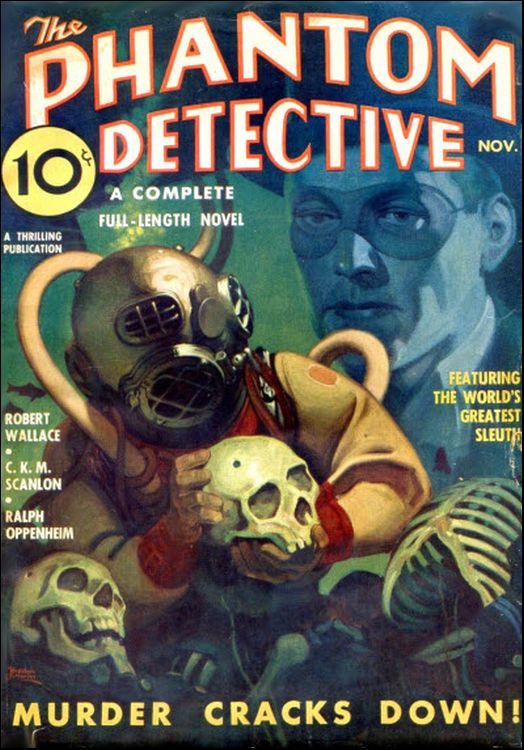
The Phantom Detective, November 1935, with "Murder Cracks Down"
The grisly trail of pillage, piracy and death led straight to Public Enemy X!
IT WAS exactly four o'clock when the Phantom stepped into the private elevator that ran express to the Eighty-fifth floor of the National State Building—the offices of Andrew Quincy, President of the National State Bank.
A glance in the elevator mirror showed Dick Van Loan that his disguise was perfect. The face of a middle-aged man reflected in the mirror, a ruddy-skinned, round-faced man in the early fifties, whose hair was beginning to show silver at the temples. The clever make-up had added twenty years to Van's age.
The aging business man had not the least resemblance to the Phantom.
At the eighty-fifth floor, Van was shown to the office of Andrew Quincy's secretary.
"Are you the gentleman Mr. Havens phoned about?" the pleasant-faced woman smiled.
"Yes," Van nodded. "I've a four o'clock appointment.
"I'll announce you," said the secretary, proceeding toward the door marked, "Mr. Quincy." As she reached out for the knob, a sudden scream froze both of them. A high-pitched, hysterical scream of a man in mortal pain!
It came from Andrew Quincy's private office.
The secretary was petrified with terror. Both hands at her throat, her face bloodless, she stared mutely at Van.
With three tigerish strides Van reached Quincy's door, threw it open, and then stopped short, a hard, grim expression twisting his lips.
He was staring at the slumped body still writhing in the chair in front of the flat-topped, mahogany desk.
It was the body of Andrew Quincy, President of the National State Bank, the greatest institution of its kind in the city.
A knife blade had been plunged into Quincy's breast. Blood seeped from the wound around the blade of the knife, spreading an ugly stain down the banker's shirt.
A grisly, almost incredible scene. One of the country's most powerful financiers, a great financial genius of the nation, struck down by an assassin in a closely guarded office on the eighty-fifth floor of a skyscraper!
Quincy, like most men in his position, was closely guarded against the attacks of cranks and fanatics. No one could visit the financial wizard's office except by a special appointment.
Yet a daring and ruthless killer had slipped through the barriers.
These thoughts flashed through Van's mind as his eyes whipped around the empty room. There was no place where the killer might hide. And only one entrance and exit—the door from the secretary's office.
Yet that knife had entered Quincy's body less than thirty seconds ago. The scream still echoed in Van's ears. A scream which must have burst from the banker's throat even as that murderous blade was plunging into his body.
Where could the killer have disappeared to?
Quincy's lips were moving now. Van leaped to the dying man, stooped over him. The face below his was twisted with pain. The eyes rolled until the whites showed.
The thin lips were drawn back over tightly clenched teeth. Then the dying man spoke again—words that seemed to be torn out of his lungs. But so low were they now, so muffled by the blood gushing from his mouth, that Van was able to catch only a few words.
"—Ship—Viking—Harbor of—"
Suddenly Quincy stiffened, his body arched. For perhaps five seconds, he held the position, a horrible gurgling sound now coming from his throat. Then he slumped back into the chair.
Eyes now glazed with death stared up vacantly at Van.
VAN cursed under his breath. A slight thumping sound jerked his eyes to the window. A section of heavy Manila rope, whipped to and fro by the strong March wind, swung across the open window.
In three seconds Van was at the window. Recklessly, he threw his lithe body over the sill, standing a moment later on the narrow ledge which ran around the building at the eighty-fifth floor level. The tower of the building, topped by an observation platform, reared twenty stories farther into the clouds.
The swaying rope had solved for Van the mystery of the killer's disappearance. And even as his eyes jerked upward, he saw a pair of trousered legs vanishing through a window four stories above.
Van grabbed the rope as it swung by again. Quickly, he went up, hand over hand. The strong wind whipped him across the side of the building like a giant pendulum, threatening to tear loose his grip on the rope and hurl him to the street eighty-five stories below.
But Van's trained muscles grimly propelled him upward. Higher, higher.
Now he was already two stories above Quincy's office. He gave no thought to the terrible danger he was exposing himself to.
The picture Quincy had made, blood gushing from his mouth, spurred Van on after the murderous devil above.
A face, masked with a black cloth, suddenly peered down at him. The eyes appraising him through the slits of the mask had the cruel cold glitter of a cobra. Unhurriedly, the man withdrew his head and shoulders inside the window. But Van had interpreted the triumphantly malevolent expression in those glittering eyes.
His jaw set as he desperately tried to speed up his upward climb on the rope.
He was still one full story below the window where the murderer had disappeared, when the masked face peered out again. Rays of the late afternoon sun reflected on the blade of a heavy jackknife in his right hand.
Cold sweat dotted the Phantom's brow. Once that rope was severed, he would plunge down into the shadowy abyss that marked Fifth Avenue.
He might strike the narrow ledge—yes; but the very impact of the fall would swerve him off.
Frantically, Van's eyes jerked upward.
He caught the mocking glint in the killer's eyes. The knife blade was raised above the rope, as the murderer sadistically sought to prolong the agony of his victim. Glancing downward instinctively, Van felt a sinking sensation at the pit of his stomach when he saw the tiny figures so far, far below him. In a second or two he would be hurling toward them—to crash in a bloody mangled heap on the pavements of Fifth Avenue.
He glanced at the window to his right, and a gleam of hope suddenly leaped into his eyes. He had one desperate chance, if he could only delay the murderer four or five seconds longer.
Again he lifted his eyes to the masked killer's face.
His voice was a scream of terror as he shouted: "Wait! For God's sake, wait a minute!"
The killer's eyes lighted sardonically.
Slowly, the knife blade moved an inch or two nearer to the rope. Van now seemed to be struggling desperately. His body swung away from the wall. As it returned, he shoved out his feet as if to stop himself from crashing against the granite face of the building. Instead, he kicked hard against the granite blocks.
Once again his body swung out.
Suddenly the murderer understood Van's maneuver. As Van's body reached the end of the outward swing, and now hurled back toward the building, the knife blade jerked downward to the rope.
VAN'S heart seemed to be suddenly arrested by some giant hand. How long would it take the other to saw that heavy rope? Desperately, he guided his in-rushing body to the left.
His outstretched feet crashed into the glass pane of the window. He released his grip on the rope, and lifted his arms to shield his face, as his body went hurling through the shattered glass.
And even in that split second, one question burned in his mind. Had he attained enough momentum to carry him into the room, or would he drop and the back of his neck be horribly slashed by the broken glass still remaining in the window?
His breath left his lungs in a rush as his body cleared the window frame. He crashed to the floor. His clothing was ripped and slashed by the glass.
There were at least three places where he bled from minor cuts—blood that mixed with perspiration now bathing his body.
But there was grim exultation in his eyes. He had made it!
Life—when a few seconds ago he had faced a certain and horrible death.
NOW Van scrambled to his feet. Glancing at the window, he saw that the rope was no longer visible. Vanished. He had cheated the Grim Reaper by perhaps three seconds. The office he had come hurtling into was bare, untenanted.
Swiftly, he crossed the room, glanced at the number painted on the window of the door and then ran out into the corridor.
The exit to the stairs was halfway down the hall. Van plunged through the door. He took the steps three at the time. Reaching the floor above, his eyes raked the corridor—just in time to see a running figure disappear around the far corner.
Drawing his gun, Van raced grimly after the fleeing killer. His footsteps echoed hollowly on the marble floor of the corridor. He knew now the murderer's object; the elevators were just around the bend there. The bend was only forty feet away. Van's long legs cut it down to twenty, to ten.
With every fiber of his body, Van was aware of the grim fact that a murderer probably crouched with a drawn gun just around that bend, waiting there to pump hot lead the moment he appeared. Van's jaw set grimly. It was a chance he had to take.
Just as he rounded the bend, he heard the metallic clang of an elevator door opening. A grim tableau now met his eyes. The masked killer had yanked the colored elevator operator out of the car.
Using the boy's body as a shield, an ugly brown Luger protruding over the boy's shoulder, he was now backing into the cage. Backing slowly, obviously waiting for Van, whose running feet he must have heard behind him, to appear around the bend.
The Luger now cracked viciously—once, twice, three times. There was a splintering of glass as one of the bullets found an office door. Van crouched against the wall. He didn't dare to return the other's fire for fear of hitting the boy. And remaining there another three seconds was suicide.
The boy himself decided the issue. Mad with terror, his eyes rolling wildly, he tore himself loose from the masked killer's grip. Before Van had a chance to fire, the other leaped out of sight into the cage. A moment later, the door snapped shut and the car plummeted downward.
Cursing, Van watched the dial indicator. He saw that the killer had stopped the car at the forty-sixth floor. Van knew precisely what the man would do now: simply remove his mask, walk out and lose himself in the great office building. If no one saw him get out of the elevator, it would be practically impossible to trace him.
Van turned on his heels and approached the office from which the rope had been lowered. The entrance to it was locked. Van whipped out a ring of skeleton keys, fumbled with them, and in ten seconds had the door open. A section of the severed rope, one end secured to a radiator, was the only clue the murderer had left behind him.
Swearing softly under his breath, Van walked out.
A frightened cluster of clerks had gathered in the corridor when the Phantom returned to Andrew Quincy's office. Van found the banker's secretary, red-eyed, still scared almost out of her wits, in her office. Her hands moved nervously as the Phantom began questioning her.
"Who was the last person in Mr. Quincy's office before I came?"
"I was."
"When was that? Shortly before I came?"
"No, at least a half hour earlier."
"And that's the only entrance into his office?"
"Yes," the woman nodded. "Mr. Quincy had it arranged that way so that no one could get to see him without going through my office."
"Did you leave your office at any time during the half hour that elapsed since you saw Mr. Quincy?" The woman hesitated.
"Only for a minute or two," she confessed. "Just to get some stationery.
"All right," Van said shortly, "telephone the police. Tell 'em what happened. Then round up all the employees in your office."
Returning to Quincy's office, Van stared at the open window. The killer might have climbed down the rope, hid on the balcony until Quincy's back was turned, then slipped in. Van shrugged and moved closer to Quincy's slumped body in the chair.
HE APPRAISED the bony hilt of the knife protruding from the dead man's chest. It was an ordinary knife, practically impossible to trace. Its duplicate could easily be purchased by the dozen in any store.
Then Van's eyes narrowed. There was a dark fleck near the hilt of the knife. He stooped, examined it curiously. It was a minute, triangular bit of black leather, caught between the wooden haft and the hilt. Must have been gouged out of the palm of the murderer's glove when the blade was driven into Quincy's breast.
Van slipped it between the pages of a notebook. A tiny clue, but it might prove the means of sending the cold-blooded murderer to the chair.
Voices now came from the next office. Van glanced through the open door and saw that a half dozen or more of Quincy's employees were gathering in the other room. As their startled eyes saw the grisly figure in the swivel chair, every voice went still. Van could see faces blanching. One girl screamed and fainted. A man cursed hoarsely.
Van stepped into the other room, softly closing the communicating door behind him. Without further preliminaries, he began questioning the employees, seeking one who might throw some light on the murder. But he drew an absolute blank.
As he finished, a tall, wide-shouldered man pushed his way through the group.
"What's happened?" he asked curtly. "Why aren't these people working?"
"Mr. Quincy has been murdered!" the secretary blurted out. "This gentleman is questioning the people in the office." She turned to Van, adding, "This is Mr. Ainslee, the first vice president."
The Phantom had recognized Hubert Ainslee from the pictures of him he had seen in newspaper rotogravure sections. Ainslee's mouth opened a little. Staring wide-eyed at the secretary, he gasped:
"What's that you're saying, Mrs. Sweetland. Quincy—murdered?"
"That's right, Mr. Ainslee," Van cut in levelly.
He nodded to the secretary to dismiss the office workers, then he led the Vice President into Quincy's office. Ainslee cursed in a low, bitter voice as he stared at the crumpled figure in the chair. Then his eyes flicked to the Phantom.
"Any clues as to who could have done this horrible thing?" he asked sharply.
Van told him briefly what had happened. Ainslee listened, his face set, grim. Then he asked abruptly: "You're from the Department of Justice, aren't you?"
Van's face went blank.
"What gave you that idea?" he asked quietly.
"Well," said Ainslee, "I know that Andrew Quincy had been working with the Department of Justice on the Great Gold Swindle case. I guessed that you came here to speak to him about it."
Van nodded.
"That's true. How did Quincy get mixed up in the Great Gold Swindle?"
"THAT," Ainslee said slowly, "is something I haven't been able to find out. I know that our bank has loaned big sums of money to several Government-licensed syndicates who have hundreds of representatives traveling the country buying up old gold. This gold is, of course, turned over to the Government.
"Well, as you know, some sinister organization has for several months now been waging a campaign of terrorism, demanding that the gold be turned over to them. In at least four cases now, the penalty for refusing the demands of these supercriminals has been—"
"Murder!" the Phantom concluded grimly. "Their leader, whom the Department of Justice has labeled Public Enemy Number X, is proving himself to be one of the master criminals of the world. A threatening note, a short lapse of time—and murder! A perfect murder—no loose ends, no clues, nothing for the police to work on."
Ainslee swore under his breath. "Lord knows how many gold dealers have already secretly complied with his demands. The fiend must have amassed by now millions in gold."
"He has," Van declared evenly. "The State Department has definite information that millions in gold bullion, the original source of which is America, has been trickling into the hands of certain small European and South American countries. Countries which always had—and still have—avaricious, selfish, crooked governments.
"He is fiendishly clever, this Public Enemy Number X. Actual currency is dangerous. It can easily be traced through serial numbers, and so on. No, he demands gold. And then he turns over this gold—which cost him nothing—to these crooked little countries. Why shouldn't they take it off his hands for half the value they can resell it for right here in the United States? Where, by the way, it can get right back to him through further intimidation of gold dealers.
"There is another important angle to this thing. These little countries, now having an unexpected source of income, can afford to indulge in their favorite pastime. Internal revolution and war with each other. At least three major world powers—France, Great Britain and Japan—all having heavy interests in these countries, and all knowing perfectly well that the manipulation of this American gold is direct cause of the war clouds even now gathering over those countries—are raising hell with the State Department.
"This smuggling out of gold," Van concluded savagely, " must be stopped, or it will mushroom into serious international complications. To stop it, we've got to capture this Public Enemy Number X. Andrew Quincy had some clue to the fiend's identity. And so Quincy's lips were silenced—permanently."
A timid knock sounded on the door of Quincy's office. Van opened the door. The secretary stood there. With a shudder she ignored Van's invitation to enter.
"The police are coming up now," she announced. Then she added to Hubert Ainslee:
"Don't you think you should go home, sir? You know what the doctors said after your accident—that you shouldn't exert yourself too much."
Ainslee smiled faintly and thanked her. Glancing at Van, he said apologetically:
"I got smashed up a bit in an auto accident about a year ago." Van nodded.
"I recall reading about your accident in the newspapers. You had a pretty close call."
"Yes." said Ainslee, "I came mighty close to being killed. Was in the hospital six weeks. Still haven't completely got over it. My physician is always warning me to take it easy."
VAN grinned. "You're not exactly obeying his orders. I hope this excitement won't put you on your back again."
"It was a shock," Ainslee admitted soberly, "but I'll be all right, I guess. I want to be of any help I possibly can. Andrew Quincy was a dear friend of mine. Please don't hesitate to call on me if there's anything I can do."
Van lighted a cigarette, and dragged the blue smoke deep into his lungs.
"You're quite sure," he asked abruptly, "that you've no idea what sort of information Quincy had unearthed—and which prompted his murder? Think now! Had he told you anything, hinted at anything?" Ainslee shook his head.
"No, he hadn't. In his way, Quincy was a close-mouthed person." Van shrugged.
"All right, look around anyway, will you? The information Quincy had run across is probably associated somehow with your business. You're the head of it now. It is very possible that you might also stumble over it. Keep your eyes open."
"I will," Ainslee promised sincerely. "The moment I run across anything which looks suspicious, I'll get in touch with the Department immediately."
"Or," Van suggested, "Frank Havens' office. Mr. Havens is working with the Department on this case. Contact him."
Ainslee again promised to do all he could. They shook hands, and Van went out to meet the police in the other office. A grey-haired inspector was in charge of the half dozen patrolmen and plainclothes men prowling about the office. The inspector whirled when Van entered.
"I was waiting for you," he said curtly. "You discovered the body, eh?"
"Yes," said Van. "Perhaps thirty seconds after the murder had been committed."
"Then," the inspector said slowly, "the killer must have been still in this office. The secretary outside said no one passed her office after Quincy's scream. And how did you manage to return from the corridor when she saw you enter this office?"
"Not a great mystery, that," Van smiled. "The murderer had escaped by climbing up a rope he had lowered from an empty office four stories above. I saw the rope still dangling outside the window, and climbed up after him. He almost got me before he got away."
"A courageous thing to do," the inspector commented. "The killer might have cut the rope before you were halfway up."
"He did," Van said grimly. Briefly, he recounted his narrow escape.
"When I finally reached that office above," he concluded simply, "the killer was gone." Van lowered his voice. "Now I'm going to show you something, Inspector. I want you to make no comments about it, for it is essential that my real identity be kept secret."
He reached to a secret pocket beneath his vest. Five seconds later, the familiar platinum—and—jeweled badge of the Phantom glittered in his cupped right palm.
Respect that bordered on obsequiousness crept into the inspector's eyes.
"I feel honored meeting you, sir," he murmured. "Is there anything I can do—in accordance with your plans?"
Van shrugged.
"I'd like permission to leave immediately."
"You have it," the inspector said.
Van thanked him and walked out of the office. His brow was corrugated in thought as he rode down the express elevator to the main lobby. He was now definitely embroiled in a case which would call on all of the talents of the Phantom.
For he was matching wits with a clever and unscrupulous foe. An evil genius who had daringly murdered one of the nation's outstanding figures. A master criminal who had ruthlessly taken a grim toll on the lives of innocent men who had defied his extortion levies. A man who now even threatened world peace.
Van knew it would be a trail fraught with danger, the slightest slip meaning certain death. His mouth set in grim, hard lines. There would be no quarter asked or given. Either he would unmask this genius of crime—or the Phantom would cease to exist.
THIRTY minutes later, Van stepped into Frank Havens' office on the fifteenth floor of the Clarion building. The publisher rose from behind his desk when Van entered.
"Well, Van," he asked tersely, "how did you make out with Quincy? Has he told you anything of importance regarding this—"
A glance at Van's set, grim face checked Havens.
"I got there too late, Frank," Van said quietly.
Havens gripped the top of his desk.
"You mean—"
"Andrew Quincy had been murdered thirty seconds before I entered his office!"
The publisher sank back in his chair. He mopped his face with a handkerchief. Van dropped his weary body in a chair near the desk. Briefly, he told Havens of Quincy's murder, and his own close shave. For perhaps a minute, neither man spoke.
"Quincy give you any hint of the information he had in mind?" Van asked finally.
Havens shook his head.
"No. He simply told me that he had some information of great importance concerning the Great Gold Swindle. He wanted the Phantom to contact him immediately—and knew I was the only man who could get hold of the Phantom. I agreed, got in touch with you, told you to go to his office. That's about all I know about it, Van. Did Quincy say anything before he died? You claim you were on the scene thirty seconds after he had been stabbed?"
Van crashed his fist on the table.
"Yes," he said tersely. "I almost forgot about it. Quincy said something about a ship, the Viking . Try to get some information for me about it—from your shipping editor, perhaps."
HAVENS nodded, picked up a telephone receiver, spoke a few terse words into the mouthpiece. Five minutes later, an inter-office amplifier buzzed on the publisher's desk. Havens threw a switch, and a metallic voice sounded through the diaphragm:
"Information you asked for, Mr. Havens. Viking chartered by Captain Ole Jorgensen, salvage expert, docked this afternoon. Among those on board the boat are Leon Rinaldo, former purser of the Aztec, a ship that sank off Hatteras three months ago, and Horace Manton, the cleverest locksmith and deep-sea diver in the country. Manton has opened many safes on sunken ships.
"Looks like a salvaging expedition to save Aztec's cargo. Grace De Hand has picked up a rumor that another salvaging expedition is outfitting to go after the Aztec cargo, in competition with Viking ."
Havens spoke into the instrument, told the editor to keep working on the Viking angle.
"Who is Grace De Hand?" asked the Phantom.
"A smart girl reporter who's been working on the Great Gold Swindle case almost since its very beginning."
The Phantom spoke with Havens a few minutes longer, then got up to leave.
"Washington's badly worried over this thing, Van," the publisher said seriously. "It's apt to cause very grave international complications. Europe being an armed camp, and under terrific tension, not much is needed to set all hell breaking loose."
"I'm taking up the trail of Public Enemy Number X the moment I leave here," Van replied grimly. "A trail I won't abandon until this devil is brought to justice—or until I'm listed as one of his victims. I don't know what connection there is between him and this salvaging expedition. But I intend to ferret it out. Tonight, perhaps."
The door closed softly behind Dick Van Loan. Worry shadowed Frank Havens' blue eyes as he stared at the door. Once again the Phantom ventured out on one of his perilous missions. For Frank Havens was responsible for the career of the Phantom.
He alone knew that Richard Curtis Van Loan, whom the social world regarded as a wealthy young clubman, was the man whom the denizens of the underworld feared and hated as—the Phantom!
Orphaned at an early age, his parents leaving him quite a bit of money, Richard Curtis Van Loan's youth had been spent traveling the shallow and superficial grooves of bored Park Avenue. Life to the wealthy young idler was a succession of parties and innocuous social functions.
But with the coming of the World War, the whole course of Dick Van Loan's life was changed. He enlisted, went across with one of the flying units. In facing death almost daily, above the clouds, he had learned how futile and parasitical his former existence had been. He learned of death and famine, of hatred and friendship. He learned the thrill of danger, of combat, pitting his skill, wits and courage against the enemy.
After the war, he was like a lost soul. He felt he was stagnating, rotting. The rounds of his social set were meaningless and vapid. And just when it seemed that his jangled nerves would crack under the strain of ennui, relief had come in the form of an offer from Frank Havens, the millionaire publisher of a string of newspapers which stretched from coast to coast.
In order to obtain a scoop for his papers, Havens had suggested that Richard Curtis Van Loan try his hand at solving a mystery which had completely baffled the police.
The young clubman had eagerly undertaken the task, and proved so singularly successful that he was convinced he had at last found his true vocation. In matching his wits against the brains of the underworld he found not only a panacea for his nerves, but also an opportunity to devote a hitherto empty and futile life to the service of humanity.
And thus was the Phantom born.
With characteristic thoroughness, he set about mastering every subject which he thought would be of use to him in his new career. He studied the arts of mesmerism, histrionics, make-up and disguise, until he could successfully impersonate any living person, not only in exterior appearance but in the inflections of voice and the characteristic mannerisms. He became a master of criminology. The latest and newest methods of crime deduction were at his fingertips.
His mastery of these subjects, coupled with his tremendous physical strength and his keen, deductive brain had enabled him to solve crimes which police had given up as unsolvable.
Now the Phantom was embarked on another of his dangerous missions, taking up the trail of the arch-fiend known as Public Enemy Number X.
THICK fog hung over the waters of Erie Basin, in South Brooklyn. Golden slivers of light pierced the fog from the portholes and cabins of a long, rakish yacht riding at anchor off Pier 17. Through the fog came the sound of creaking davits as a boat was being lowered. A motor coughed, sputtered, and then took up an even hum of power. The tender cut the water toward the dock.
Three figures showed in the tender as it slipped alongside the dock. A uniformed sailor stood at the wheel. The other two were obviously passengers. The latter now stepped to the dock, and the smaller of the two waved his hand to the sailor. Then the motor roared again, and the tender headed back toward the yacht.
The little man was slim and wiry. Bright brown eyes peered from under the shock of brown hair beneath the vizor of a pea-cap. His face and hands were deeply tanned from outdoor living and salt air.
The other man was big, wide-shouldered, square-jawed. One of his ears were puffed and misshapen. The bridge of his nose had once been broken and had never set properly. His eyes darted suspiciously about the pier, and his right hand was never very far from the pocket of his coat. Obviously, he was acting as bodyguard for the smaller man.
When the tender had pulled away, the big fellow asked gruffly:
"Where do we go from here, Manton?"
Horace Manton, the diminutive king of locksmiths and salvage divers, jerked his head in the direction of the lighted street. His voice was a deep basso, in startling contrast to his slight build.
"We'll pick up a cab out there, Borden," he said. "I want to go up to my apartment over in Washington Square."
Ed Borden grunted. Their footsteps echoed loudly on the boards of the dock as they started toward the street.
Manton and his bodyguard had covered half the distance to the street, when the big man stopped in his tracks. A low curse grated from his lips. His eyes were riveted on three figures which had materialized from the dark shadows of a warehouse—three menacing figures, even now moving toward them.
Borden's hand darted toward his coat pocket. His voice was harsh as he snapped: "Back pedal, mugs, or I'll blast you!"
For a second or two, the men paused. Then, as if by an unspoken command, they separated, two men moving sideward and flanking Manton and his bodyguard.
Borden's lips flattened against his teeth. His shoulders hunched forward as he watched the maneuver. Through clenched teeth he grated: "Take it on the lam, Manton. They won't drop you—they want you alive."
But the little man was edging toward one of the menacing figures, his chin thrust forward, his dark eyes burning brightly.
"I'll stick, Ed," he said softly.
Borden swore. A second later, his gun belched flame as the three figures closed in simultaneously.
One man staggered back, Borden's bullet smashing into his shoulder. Another gun roared. The big bodyguard's gun dropped from his limp fingers as a bullet ploughed through his forearm. He stooped swiftly, clawing at the fallen gun with his left hand. And then the men were upon them.
Horace Manton's deep voice roared in defiance as he locked in a furious tangle with one of their assailants. His opponent tried to shake him off, tried to club down with a gun, but the little man was like a terrier, swarming all over his foe, flailing at him with his free hand while he clung one arm around the thug's neck.
UNEXPECTEDLY a gun cracked viciously. Manton, swung around by his burly opponent, saw Borden go down, two of the thugs standing over him.
Then another sound cut through the fog—the sound of running footsteps. Five seconds later, a tall, wide-shouldered young man in a pea-jacket and cap projected himself into the fray. It was Van, his face stained to the color of old mahogany. Fiery red hair showed beneath his cap. He had been watching the yacht, and the two men who had come ashore, when that murderous trio had attacked them.
One of the men standing over Borden's body whirled. He jerked up his automatic. Van's gun cracked out. The killer spun about. A short, hoarse scream lingered for a few seconds, finally choked off as the man crumpled to the ancient timbers of the dock.
The third thug, who had been grappling with Manton, now shouted: "Take care o' this other guy, here. Because I got Manton."
Van's eyes whipped around. He saw a man running along the dock, a limp figure slung over his shoulder. And as Van hesitated, withholding his fire for fear of hitting Manton, someone threw himself on Van's back. A fourth man who had been lurking in the shadows somewhere.
Strangling, gouging fingers clawed at Van's throat. Van half-turned to grapple with the man—and then another man cracked a gun butt across his knuckles. Van's gun thudded to the dock. Someone grated:
"Let's take him alive—find out who the hell he is. Don't like the way he came barging on the scene." Something crashed against the side of Van's head, a glancing blow, but sufficient strength behind it to send him down on one knee. The man behind him no longer tried to throttle him. He was pounding at Van's head, at the back of his neck. Again a gun butt grazed his skull.
His head reeling, blood trickling from a cut in his forehead, Van desperately lunged forward, his outstretched arms locked about a man's thighs. The other went crashing at the boards.
"Blast him!" the man shouted. "I hear cops' whistles now!"
Van jerked around—and in that precise instant a gun cracked viciously. So close had the muzzle of the automatic been to his body that powder burns singed the side of his pea-jacket. Only that violent sideward twist of his body saved him from a slug tearing through his vitals.
Van's left hand whipped out. It caught the killer's gun wrist, jerked it aside—just as the gun once more vomited flame and lead. A scream of a man mortally wounded came from behind Van. The other thug must have got up—and stopped the second bullet from that automatic. Van now heard his body thrashing on the boards.
Savagely, Van twisted the sweat-slippery wrist which still clutched the automatic.
"Drop it!" he gritted. "Come on—"
THE thug's beefy, broad face was now twisted in agony. Another sharp wrench of the wrist, and, cursing, he dropped the automatic. Then Van's right fist crashed out. In the foggy silence, the sharp crack of bone striking bone was distinctly audible. The thug's head jerked to the left. He was unconscious when he struck the boards of the dock.
Quickly, Van scooped up the automatic. Scrambling to his feet, he raced after the fleeing thug escaping with Manton's unconscious body. The other heard the pounding footsteps behind him. He glanced over his shoulder, saw the grim figure bearing down upon him—and promptly dropped Manton. Van's gun blazed as the thug swung around with his revolver.
The killer threw up his hands and crumpled to the rough boards of the dock.
Van ran up to Manton's slumped body, rolled him over to see how badly the little man was hurt. He breathed a sigh of relief when the diminutive salvage expert stirred and opened his eyes.
For a moment Manton stared vacantly at the strange face above him, then he sat up quickly.
"Thanks for the help, mister," he said weakly. "You showed up just in the nick of time. My name is Manton—Horace Manton. If there's anything I can do—by way of paying you—"
"That's all right, buddy," Van said easily. "What was it—a holdup?"
Manton shrugged.
"I don't know. A holdup or—a kidnapping. But you certainly busted it up."
He tried to rise, succeeded finally, and swayed unsteadily on his feet. Out of the corner of his eye, Van now saw two uniformed patrolmen rushing toward them.
Catching sight of Van, their service revolvers swung around, centered. Van's brain raced. The police obviously took him for one of the thugs who had been doing the shooting. He knew he could flash the Phantom badge in his pocket—a badge which would be recognized by police throughout the country. But he didn't want Manton to know that the man who had saved him was the Phantom.
VAN believed he could learn something about the mysterious expedition of the Viking from Manton, now that he had ingratiated himself by saving the safe-expert's life. But if the expedition was crooked, and Manton was tied up with the crooks, the knowledge of Van's identity would seal the little man's lips. On the other hand, there was the chance that the patrolman might shoot first, and ask questions afterwards. Even now one gun inched toward him, in a menacing gesture.
"Stick 'em up, feller," the policeman rasped.
Van straightened slowly, lifted his hands shoulder-high. Manton's deep voice growled:
"You're making a mistake, officers. This man saved me from getting knocked off."
The policeman appraised Van from head to foot, taking in his shabby clothes.
"Maybe you're right, mister," the cop growled to Manton. "But maybe this bird's pulling a fast one on you. We'll take a look at those bodies there. You two come along—and don't try any tricks!"
They walked down the dock to Ed Borden's crumpled body. A single glance was sufficient. One of the gangster's bullets had found a target in Borden's heart. Manton swore under his breath.
"Who was he?" Van asked curiously.
"Ed Borden," said Manton. "He was supposed to be my bodyguard. Jorgensen—he's the captain of the Viking out there—has hired me to do a salvaging job with him. He was afraid someone might kidnap me—so Borden was hired as my bodyguard.
Van's eyes brightened. Fate had been kind to him tonight. He had already picked up an interesting bit of information. Horace Manton must be an important cog in the mysterious salvaging expedition, or Captain Jorgensen wouldn't have hired a bodyguard. Van meant to find out more about Jorgensen and the Viking.
His brain clicked fast, as one ol the policemen started to speak.
"All right, you birds," the cop growled. "You're going to Headquarters. Tell your story to the dicks there."
Manton began protesting, and Van moved a couple of steps away from Borden's body. As he had expected, one of the cops sidled toward him, eyeing him suspiciously.
Van's hand dropped into the pocket of his pea-jacket. When it came out there was a platinum badge cupped in his palm. The policeman's eyes widened as he stared at the jeweled crest. His mouth sagged for a moment, then he started to utter an apology. The Phantom spoke swiftly, in a low voice:
"Don't tip this Manton bird off. Fake some excuse to let us go. And don't let any news of these killings trickle out. Tell the police commissioner I requested that."
The policeman nodded, stepped back toward his partner and said gruffly: "I guess we won't have to take these fellers to Centre Street. Just get their names and addresses."
The other cop looked surprised, but kept his mouth shut when he saw the look in his partner's eye. "Okay, feller," he said.
He whipped out his report book, and took down Manton's address. Van gave him a fake name and address, calling himself Bill Flynn and giving the Seaman's Haven as his address. The policeman walked to the end of the dock with them, then went on to the nearest patrol box to call the morgue wagon.
"Where were you headed for when you were attacked?" Van asked Manton when the patrolmen left them.
"I was going to my apartment to start packing for my trip on the Viking," Manton answered. "I've a studio near Washington Square. How about coming along with me? I want to thank you properly for saving my life."
"Swell," said Dick Van Loan easily. "I was going to try to get a job on the Viking myself. Maybe you can help me by putting in a good word with the skipper."
"I'll do everything I can," Manton promised enthusiastically. "And it shouldn't be difficult. I think we could find a use for a first-class fighting man."
HORACE MANTON chatted volubly on their taxi ride to the Village. He related to Van some of the difficult jobs he had been on, and of the many and interesting adventures he had encountered in the course of his peculiar profession. But on the subject of the Viking and Captain Jorgensen, he was close-mouthed.
By subtle questioning at intervals, Van did succeed worming out the information that the Viking had been on a salvaging expedition off Cape Hatteras where the steamship Aztec had gone down in a terrific storm.
Van acted mildly interested and expressed his wonder at the fact that a high-priced specialist like Manton should be called in on a regular salvaging job. Manton's eyes fixed on the bland, guileless face of the man he knew as Bill Flynn, able-bodied seaman. Then:
"This isn't a regular salvaging expedition, Flynn," he said slowly. "I can't tell you what's behind it, but Jorgensen expects to find something in the safes of the Aztec which will make it worth his while to pay me a big price for going down there with him."
Van's pulse beat faster, but he changed the subject, mentioning again his desire to get a job on the Viking. A few minutes later their cab pulled up to the curb, and they got out.
Horace Manton's apartment proved to be a combination museum and workshop, on the top floor of an old studio building just off the square.
As Van's eyes roamed around the collection of curios and mechanical equipment that was scattered around the big studio room, he gained a deeper insight into the character of the dynamic little man he had rescued. Manton had evidently made a complete and exhaustive study of locks and their mechanism. His work had taken him to the far corners of the globe.
With all the pride of a connoisseur, Manton pointed out his collection. Van saw a set of grisly torturers' shackles fitted with steel spikes, which Manton had brought from an Austrian castle where his skill had been called upon to open a treasure vault.
He showed him an enormous padlock called "Ivan the Terrible," which had choked the life from many a political prisoner in old Russia. There were locks made entirely of hardwood that came from ancient Egypt, in addition to a complete collection that portrayed the history of locks from their earliest forms.
As Van went through the strange collection, he was plying the little expert with deft questions. His keen analytical brain was sifting the answers as he tried to characterize the man he had rescued.
Manton had an exact and almost intuitive knowledge of locks. He boasted cheerfully that he had never encountered one that would not open to his deft touch or through the use of the scientific instruments that had been developed to register the falling of the tumblers of the modern locks.
Van felt, instinctively that Manton was not a crook. Jorgensen and his associates on the Viking might be involved with the murder of Andrew Quincy, and with the other mysterious killings interwoven with the Great Gold Swindle, but the little safe-expert was an innocent figure in the mystery.
An important figure, though; for Van realized that without Manton's skill, there was little hope of ever salvaging the treasure that Jorgensen sought in the Aztec, now lying at the bottom of the sea. Manton might be just a pawn in the game, but he was the most important figure in the scheme at that moment.
When they had finished their tour of the studio, Manton insisted on mixing a drink for Van whom he seemed to like and trust. Over their drinks, Van resumed his questions. Manton grew more communicative.
Van learned that Jorgensen and a man called Rinaldo who had been the steward on the Aztec, and Manton had made a secret trip on the Viking, and had succeeded locating the position of the ill-fated Aztec. And now Jorgensen had returned to outfit an expedition to salvage a fortune in gold from the sunken ship.
"Have you ever heard of the Great Gold Swindle?" Van asked bluntly.
Manton's eyes wrinkled shrewdly. For a few seconds he appraised silently the tanned face of his rescuer. He seemed to decide to take Van into his confidence.
"Yes," he said soberly. "I've heard about it—and I believe the Aztec had been carrying millions of dollars in gold smuggled out by the swindlers. But—that doesn't concern me. I'm not committing any crime in helping Jorgensen salvage that gold. I get a fee of ten thousand dollars for risking my life down there."
"I agree with you," Van said earnestly. "You're in the clear, of course. But behind this gigantic swindle is a fiend who has hesitated at nothing in the pursuit of his ill-gotten wealth. His hands are dripping with the blood of his murdered victims. I'm working on the case and I've got to find the brains of that organization. I need your help."
Manton's eyes had a startled look as he learned that his rescuer was a law officer. He hesitated for a minute, then said: "Naturally, I heard quite a few things while I was aboard the Viking. From what I gathered there was foul play on the Aztec just before she sank. Rinaldo certainly hinted at it."
"Have you any idea who's behind this nefarious scheme, Manton?"
"Jorgensen and Rinaldo spoke of 'The Syndicate'—a sinister organization apparently trying to block their attempt to salvage the gold. They never mentioned names, but I reasoned that it must be a powerful syndicate of rum-runners working a two-way racket. They run arms down to the Latin-American countries, and bring back contraband liquor. There's still a big market for imported liquor in spite of the repeal of the prohibition laws."
"Do you think it's possible," Van asked slowly, "that Jorgensen and Rinaldo might be the brains behind this Great Gold Swindle?"
MANTON'S eyebrows raised in surprise. He stared at Van. "Jorgensen's the best known salvage expert in the country," he stated curtly. "He's no crook. In fact, he's a bit worried by actual crooks, who, he believes, are organizing a secret expedition to try to beat us to that gold. That's why he hired Borden. He was afraid that this syndicate might kidnap me; first, because I know where the ship is located; second, because I'm about the only man in the game who can get that gold to the surface."
Van shrugged and promptly changed the subject. He now questioned Manton about the position of the ship, showing a technical knowledge of diving that completely won the little man over. The Phantom learned that the safes of the Aztec were going to be hard to open. The ship was lying on its side, and currents had banked up the sand around the hull, making it extremely difficult to force an entrance.
Their conversation was interrupted by an abrupt knocking on the door.
Van's hand crept to the gun in his pocket. Silently, he signaled Manton to answer the knock. This might be another attempt on the part of the syndicate to kidnap Manton. In which case, the rats would find a hot reception awaiting them.
But as Manton inched the door open, surprise and incredulity spread over his face. Glancing over his shoulder, Van found himself looking at a trim figure in rough tweeds. The girl smiled at them coolly. Certainly she did not look dangerous.
Manton glanced back at the Phantom. At the almost imperceptible nod from Van, he said: "Won't you come in?"
THE girl stepped into the room. Hard suspicion crept into her eyes when she saw Van.
"I didn't know you had company, Mr. Manton."
Van glanced at Manton. From the expression on his face, he saw that the girl was a stranger to the little safe cracker.
"This is a friend of mine." Manton said coldly. "Who are you and what do you want?"
"I came for an interview," the girl informed him. "My name is Grace De Hand, and I'm on the staff of the Clarion. I wanted to get some first-hand information about the Viking, and the expedition Captain Jorgensen is organizing."
She handed Manton her press card, then seemed offended when Manton glanced at it and passed it to Van.
"Why don't you see Jorgensen for the story on the Viking?" Van asked evenly.
The girl's cool glance measured him from head to foot. She said sharply:
"You weren't asked for any suggestion. I was talking to Mr. Manton."
A slow smile creased Van's face. "Spoken like a real reporter, Miss De Hand. But if you want to ask Manton any questions about the Great Gold Swindle case, don't let my presence stop you. I'm interested in the same case."
The girl's eyes widened.
"Oh, a Department of Justice agent, eh?"
Van reached in his pocket, and produced the credentials that Frank Havens had obtained for him. The girl glanced at them.
"Sorry," she said, "if I've been rude." She turned to Manton. "Do you know Dot Gwyn and Captain Nielsen?"
Manton's face had a startled look as he stared back at the girl.
"Sure I know them," he said flatly. "Dot Gwyn is an internationally known adventuress—a regular female pirate. Nielsen is not so well known in this country, but I understand he's got a reputation for gun-running, smuggling and other illicit occupations. Why do you ask?"
"Because," the girl replied grimly, "I've learned that Dot Gwyn is outfitting Captain Nielsen's ship, the Stavangar, for some mysterious expedition. It may not have any connection with the secret mission of the Viking —or it may be a plan to hi-jack your expedition."
Manton's eyes became round and bright.
"It does sound like a sweet little stunt Gwyn and Nielsen might try to pull off," he said excitedly. He glanced at Van. "Say I'll bet they're the brains of your murder syndicate!"
Van's face was thoughtful as he drawled:
"Perhaps you're right, Manton. They certainly rate an investigation, along with Jorgensen and Rinaldo. Perhaps one brain is behind the two outfits—the brain responsible for the murder of Andrew Quincy, and the murders of the gold dealers who failed to comply with his demands." Grace De Hand cut in abruptly, her words slightly tinged with sarcasm.
"Speaking of murders in the Great Gold Swindle," she said, "do you know that J. Franklin Draper, one of the largest gold dealers in the country, has been threatened by this fiendish ring? It looks to me as if you Department of Justice agents spend too much time running down unessential details, while nationally important men are being killed under your noses."
Van appraised her steadily.
"You don't seem to have a very high opinion of the D.J. agents, Miss De Hand."
"I've good reason for my attitude," she retorted bitterly. Turning to Manton she concluded:
"I expect an exclusive story on the Viking's expedition as a reward for that tip on Dot Gwyn and Nielsen. But I won't ask for it until you're ready to sail, so it won't spoil your plans."
Manton thanked her and escorted her to the door. Van's eyes were thoughtful as they followed the girl reporter's trim figure. Why had she displayed such bitterness toward the Department of Justice agents? Was she on the level—or was she a spy? He wished he knew more about the girl.
But her tip on J. Franklin Draper was too important to be overlooked. He would have a talk with Draper immediately. And even as he reached for his hat, a scream came from somewhere outside.
Van leaped to his feet. It was a woman's scream. Had someone waylaid the girl outside? Van whirled and dashed for the door, Manton at his heels.
He growled an order to the little safe-expert to remain in his apartment, but it was useless. Manton was like a scrap-eager little terrier as he pounded down the stairs behind Van.
Crossing the vestibule in three strides, Van jerked open the door. He saw Grace De Hand struggling in the grasp of two men. They were trying to drag her toward an alley between two buildings. Van threw over his shoulder to Manton:
"This may be a ruse! Wait here in the vestibule."
AT THE sight of the tall, wide-shouldered figure bearing down on them, one man released the girl. She continued struggling furiously and silently with the other. The free thug's hand now darted to his pocket. As Van closed in with him, something swished through the air.
But the Phantom had anticipated the move. His lithe body swayed sideward out of the path of the blackjack. A second later, his right fist crashed out, catching the man behind the left ear. The thug staggered backward. And then the other man suddenly released the girl and rushed Van.
Desperately, Van whirled to meet the new attack. But he was somewhat off balance. The force of the man's rush drove him backward, toward the mouth of the alley. Hard fists smashed against his ribs. The thug, a heavy-set, ugly-faced gorilla, continued weaving in.
Van's shoulders went back against the wall. His feet were planted firmly. Then, his own fists whipped out in pile-driver blows, rocking his opponent back on his heels. Another shadow darkened the mouth of the alley. Out of the corner of his eyes, Van saw that the man with the blackjack was on his feet again, rushing toward him.
But Grace De Hand threw herself into the path of the other man, grabbing for the up-lifted arm that swung the leather missile. It gave Van a few seconds leeway.
His mouth twisted grimly, his eyes blazing, he charged into the barrage of blows which the barrel-chested man was pounding at him. His arms and shoulders deflected most of the blows. Then, weaving aside from a furious uppercut, his left fist shot out. It clipped the other on the side of the head. Van's right followed through in a perfectly timed cross.
THE big bruiser threw up his hands. He crashed into the wall, then slid to the pavement.
Van whirled. He leaped toward the thug with the blackjack. But the other didn't wait for that grim figure to close in with him. He turned jerkily and raced out the alley. Van followed him into the street, then paused and glanced toward the vestibule. He cursed savagely. As he thought, it was a ruse! For he could see, through the glass in the door, four figures—one of them fighting, kicking and squirming in the grip of the other three. Van instantly recognized Horace Manton's polo shirt. The three men were dragging him toward the rear door of the ground floor corridor.
"Got a gun?" Van snapped at the girl.
She nodded, and reached into the handbag that hung by a strap over her arm.
"All right," Van grated, "get into the vestibule. If those kidnappers try to come out that way, let 'em have it!"
Her face went white but she ran swiftly up the steps to the vestibule.
Van turned and raced around the corner of the apartment house. He darted down the areaway that led to the rear door, where, he reasoned, the kidnappers would try to make their getaway with Manton. A single bulb showed over the rear door. As Van plunged around the corner, the door jerked open.
Without decreasing his speed, Van's hand whipped to his armpit. His automatic snapped out and the roar of the gun split the stillness of the night. A heavy slug smashed into the door-jamb.
A smile flattened Van's lips against his teeth as the door was slammed shut hastily. The kidnappers were penned in the apartment house—unless they could rush past Grace De Hand. In five seconds, he reached the rear door. As he turned the knob and threw his shoulder against the panel, he heard a sharp, staccato bark of a small caliber gun at the front of the house. The girl reporter was on the job, driving the kidnappers back from the front exit.
Heavy feet pounded on the stairs. The kidnappers were at the second landing when Van reached the bottom of the stairs. A gun roared from above, and a bullet glanced off Van's hat. His own automatic snarled a vicious reply. A man's figure toppled down the stairs toward him.
Van wasted no time scrutinizing the fallen man. He had shot to kill, and knew his bullet had gone true. He leaped over the body, raced along the hall toward the next flight of stairs.
He was gaining now.
The men ran down the hall past Manton's studio. Van's breath pounded as he drove his muscles to further speed. Cold suspicion gripped at his heart—a sinister suspicion that the kidnappers, realizing that they now had little chance of getting away with their victim, might murder Manton, to make sure that the safe-expert would help no one if they themselves couldn't have him.
And his suspicion crystallized into stark reality as he reached the upper hall. One of the men had slammed Manton against the wall. The other was even now lifting his gun. His object was grimly obvious.
Van's jaw muscles stood out in hard little knots. The man with the gun was almost completely shielded by Manton's body.
There was but one desperate chance. Van took it. His gun roared. Manton's head jerked back against the wall as the bullet whined past his face, and buried itself in the brain of the man about to murder him.
For a split second, consternation and fear twisted the ugly face of the remaining kidnapper. He released Manton, whirled. A gun spat savagely in his hand.
Van recoiled as a searing pain burned his left shoulder. His own gun muzzle swerved to cover the killer.
Before his finger could squeeze the trigger, the fear-crazed kidnapper uttered a shrill scream. Evidently his automatic had jammed. He turned and hurled himself through the window at the end of the hall.
Van raced down the hall, past the white and shaking safe-expert, to the shattered window. Three stories below, he saw a crumpled figure sprawled on the asphalt pavement. From the peculiar position of the man's back and neck, Van knew that the last of the kidnappers had paid the extreme penalty for the unsuccessful attempt to kidnap Horace Manton.
Van shoved his automatic back into its spring-clip holster, ran back to Manton.
"Are you all right?" he asked sharply.
The little man grinned feebly, rubbed his throat.
"Aside from having been nearly choked to death," he said hoarsely, "and beaten up a little—I'm still okay."
Van smiled, and ran downstairs to the vestibule to make sure Grace De Hand was all right.
He found the girl talking with two patrolmen. Van briefly explained the attempted kidnapping and displayed his D.J. credentials. He asked the police to call a morgue wagon to pick up the bodies of the dead men. Then he turned to the girl and said quietly:
"This is just a sample of what you can expect, Miss De Hand, if you get yourself involved in the Great Gold Swindle case. It's no job for a girl. You would be wise to ask your city editor for a different assignment."
The girl's face was still pale, but her chin thrust forward belligerently.
"Don't worry about me," she declared evenly. "I'm sticking with this case. I've got more at stake than you, perhaps. It isn't just a job with me."
Van eyed her curiously. The kid certainly had plenty of nerve.
"It isn't just a job with me, either, Miss De Hand," he drawled. "Anyway, I intend to follow up your tip on J. Franklin Draper. In the meantime, if you learn any more about Gwyn and Nielsen, you will help the Department by letting us know about it through Frank Havens."
"All right, I'll do that!"
She flagged a cab, climbed in and drove off without a backward glance. Van's eyes were still thoughtful as he watched her cab turn the corner.
Here was no business, Van knew, in which a girl—any girl—should be taking a part. But this girl had capably demonstrated her ability to take the part of a man.
If she had personal reasons for her interest, Van decided he would not interfere.
DRAPER'S home was on West End Avenue, one of the few remaining private homes which had not given way to modern apartment buildings. Van had left Manton with definite instructions to remain in his apartment until he returned.
He caught a cab, and rode to a corner a block away from Draper's home. Paying the driver, he walked swiftly toward the brownstone house set some thirty feet back from the sidewalk. A high stucco wall surrounded the house—a defiant gesture on the part of one of New York's oldest families to shut themselves away from the nouveaux riches who had invaded their domain. The family character was revealed by that fact.
Reaching for the knob in the iron-grilled gate. Van found it locked. There was a bell button set in the iron grille-work. Van pressed it, stepped back.
Casually at first, then with a sharp intake of breath, he stared at the lighted window. Shades were drawn over the windows, but the figures inside made sharply etched silhouettes against them.
There were figures, both wearing hats. One man now turned, and his silhouette showed in profile. A shadow blurred the outline of the lower part of the man's face, and two sharp angles showed. Obviously, that face was masked.
Stabbed by an ugly premonition, Van reached in his pocket, yanked forth his skeleton keys and with swift fingers singled out a master-key that would fit the lock of the gate!
He was cursing under his breath as the gate swung back. For he had seen a shadowy arm lift and fall in a brutal, stabbing motion. Then the shadows disappeared from the window.
Van's feet pounded up the flagged walk. He bounded up on the veranda, dropped to his knees at the window, where a chunk of light showed. A single glance showed him that he had come too late to save J. Franklin Draper. A knife hilt protruded from the still, lifeless form slumped in a chair in the huge living room. Public Enemy No. X had struck again!
Van's eyes raked the rest of the room, but there was no sign of the murderers. He jerked erect, started for the door, then suddenly changed his mind. Running across the veranda, he vaulted to the lawn below, and sped around the corner of the house, heading for the rear entrance. The murderers must have gone to the back of the house, making their escape that way.
HE ROUNDED the rear corner of the house—saw a running figure darting through an open gate in the rear of the house.
Van's hand snapped to his shoulder holster. In the dead silence, the crack of the .45 was deafening. But Van knew he had missed even as he squeezed the trigger. For the man plunged out of sight beyond the wall.
An automobile motor now roared into life outside the gate. Van put on an additional burst of speed. His anxiety nearly cost him his life. For, as he darted through the gate, a gun cracked from the window of the limousine that was speeding away from the curb.
The Phantom felt the pluck of the bullet as it whipped through the cloth of his coat. He threw himself sideward, blazing a shot at the tires of the car, then dropped flat on the sidewalk. But the car was moving like a bullet now. For just a split second Van caught a glimpse of an evil, leering face, marked with a scar which ran from mouth to chin, pressing against the rear window. Then the car roared out of sight around the corner.
As Van climbed to his feet, a long-nosed cab—a Cadillac—rolled down the street. He raced to the curb, flagged the taxi and dove in.
"Make it fast to the next corner. Then turn right!" he barked.
The driver stared at him. Then the denomination of the bill Van had thrust at him spurred him into swift activity. The big Cadillac sped around the corner. The limousine was nearly two blocks ahead, turning another corner. Van snapped to his taxi-driver:
"Tail that green car, but don't let them suspect they're being followed!"
The driver's head nodded briskly. His foot jammed down on the accelerator, and the Cadillac leaped forward. They picked up the green car on the next block. The killers had cut down their furious speed, evidently certain that there was no pursuit.
The green car went west to the Drive, then turned south, Van's cab unostentatiously slipping in and out of the traffic line a half block behind. The chase continued for the length of the drive, and on into Eleventh Avenue. Then, in the lower Fifties, the green car turned away from the waterfront.
The Phantom's heart began to pound faster as he noticed the street into which the murder car had turned. For Frank Havens' reporters, digging up all available information, had reported that Captain Jorgensen, of the Viking, was listed in the Marine directories as maintaining his home address on that very street.
Van left the cab at the corner. As he stepped into the shadows of an apartment building, he saw the green limousine disgorge three passengers. The men moved swiftly across the sidewalk and entered an apartment house.
Van crossed the street, approaching the house which the killers had entered. A little frown furrowed his forehead, as he noted the number on the door. It did not coincide with Jorgensen's; his apartment house was next door.
VAN shrugged, drew his ring of keys again. In five seconds the apartment house door swung open. Pausing in the vestibule, Van checked the names under the letter boxes. At first glance, none of the names conveyed any significance to him. Then, as his eyes went over them a second time, they halted at a card marked:
Nielsen.
Something clicked in Van's brain. Grace De Hand, the Clarion reporter, had mentioned Dot Gwyn and Captain Nielsen to Manton. It looked like a long chance—there might be absolutely no connection between the Nielsen who occupied an apartment on the third floor of the building, and the rum-runner. But it was worth investigating. He could see no other lead which might indicate where the murderers of J. Franklin Draper had gone.
But how could he get into that apartment? There was no time to leave the building to assume some disguise that might at least permit him to get a glimpse of the occupants.
Then an idea struck him.
He turned and walked down the short corridor toward the back of the apartment house. Here he found a flight of stairs leading to the basement. He ran down quickly.
In the darkness of the basement, he risked a beam from the pocket flash he always carried. The double columns which housed the dumbwaiter were at his left. Flashing his light along the buttons for the apartments, he noted that the right dumbwaiter ran to Apartment 3D, the one he wanted to enter.
It was a tight squeeze, fitting his big bulk into the narrow confines of the wooden casing of the dumbwaiter, but he managed it. Then, hauling on the rope, he raised the platform to the third floor. Shielding the light with his hand, he located the door marked "D." It was fastened by a thumb bolt on the inside. His little packet of tools came into play again. A few seconds later, he succeeded in noiselessly working the bolt back.
Pushing the door open a fraction of an inch he saw that the kitchen of the apartment was dark, empty. He slid his feet out through the opening, jackknifed his body out, and dropped without sound into the room.
The kitchen was dark. Van edged to the door leading from the kitchen into a small dinette. Opening it, he saw light streaming from beneath a door on the other side of the dinette. His fists clenched as he suddenly heard a gruff voice boasting:
"That old Draper went out like a light!"
Grim exultation possessed Van. His hunch had been correct. He had trailed the killers to their lair. They were probably now reporting to their leader.
Like a dark shadow, Van slipped into the dinette. His right hand jerked to his left armpit, fingers clutching eagerly the heavy brown butt of the automatic cradled there. His eyes were hard as they narrowed on the door between himself and the killers.
He had no set plans. He simply intended to walk through that door. If the evil genius of the Great Gold Swindle was there, Van meant to get him. Get him—dead or alive!
ANOTHER stride—and Van stood near the door. As his right foot came down, he reached out for the knob. And suddenly an unearthly shriek filled the room—a sound which was like nothing he had ever heard before. He had stepped on something soft and yielding—something which instantly galvanized into a hissing, spitting, yowling fury.
Something sharp ripped Van's leg. Startled, he stepped back, then lashed out with his foot. Again it struck something soft. And then the door flew open.
Two big forms came hurtling toward him. His finger started to tighten on the trigger—just as something slashed across his gun wrist.
It was a blackjack, and the impact of the leaded weapon instantly paralyzed his entire arm. The automatic dropped from his nerveless fingers. Desperately, Van stooped and clawed for it with his left hand. But the bulk of the two men swept him against the table.
He crashed to the floor, the table and the two thugs piling on top of him. A voice now snarled from the other room somewhere:
"No shooting. Take him alive!" Savagely, Van lashed out with his left fist. He felt his knuckles graze a cheekbone, heard a grunt of pain. And then a hard fist smashed squarely between his eyes. Another crashed against the side of his head. Gouging, strangling fingers clawed at his throat.
And now someone at his right began kicking at him with heavy boots—kicking with a savage, merciless persistence.
Van's head reeled. Gritting his teeth, he jerked himself backward. His back now braced the wall. Then, like twin catapults, his both feet shot out. The man kicking at him received a dose of his own medicine as Van's right foot crashed into his chest. Van heard him stagger across the room; heard the crash as his body smashed into the wall.
"All right, you rats," he grated, "come and get it!"
The man strangling him jerked sideward as Van's hard fist caught him in the darkness. The eager fingers at his throat relaxed. A moment later, Van was on his feet, crouching against the wall.
Complete darkness now blanketed the room, as whoever had snapped orders from the next room had switched off the lights there. Van felt a sinister presence. Sensed the men around him closing in for another attack. Audible breathing here, the scraping of feet there—at least three men crouched ahead of him in the darkness.
Desperately, Van tried to judge where the front door was. He was in the dinette. To reach the front door, he had to go through the living room where the men had held their meeting. Where their sinister leader was at this very moment.
Van shrugged. That front door was his only chance. Cautiously, he began moving left along the wall. And then the beam of a powerful searchlight flashed full into his eyes. Blinded by the light, Van instinctively threw up his hands. And in that split second, a black-jack again swished through the air, now slashing across Van's head.
Something suddenly seemed to have exploded in Van's skull. He hadn't lost consciousness, but a paralysis of a sort froze his muscles. Rough hands caught him as he began falling, jerked him back to his feet. Then lights flashed on in the room.
"Bring him in here!"
Van's captors dragged him across the dinette. He heard the spitting noise again, and out of the corner of his eye he saw a big Persian cat perched on the window sill.
Groggily, Van damned the cat for picking a spot directly in front of the door as a sleeping place. It was the cat which had betrayed him.
Inside the room, Van's eyes opened wide. His stare took in the tall figure of the man who stood in the middle of the room. A black, soft hat hid the top of the man's face. A black, silk handkerchief masked the lower part of his features. He wore a long, black coat which extended almost to his ankles. Black gloves covered his hands.
AS VAN appraised the man, his pulse began to beat faster. He had seen those dark, piercing eyes before, that straight black hair which showed beneath the hat. This was the man who had murdered Andrew Quincy! The masked killer who had so nearly dropped the Phantom to his death at the National State Building. Was he Public Enemy No. X?
"Who is this man?" grated the leader. "Any of you ever seen him before?"
"He's the guy that came busting through Draper's yard," growled the man at Van's left.
A sidelong glance showed Van that the last speaker was the man with the scar he had seen in the murder car.
"I thought I plugged him," the thug added. "But I guess I was wrong."
"You damned fool, Lipp!" the leader rasped. "You've let a dick trail you here!"
"I couldn't help it, boss," Lipp answered lamely.
"Search him! See who he is." Van uttered a silent prayer that the searcher wouldn't find the platinum-and-jewel badge he carried in a pocket in the lining of his coat. He submitted weakly to the search, weaving drunkenly on his feet. He was still groggy from the blow of the blackjack. He heard a little gasp of satisfaction from Scarface Lipp, as the latter found Van's Department of Justice card.
"He's a Government dick, boss. Name's Flynn."
The masked leader swore again, softly, viciously.
"It's okay, Chief," Lipp whined. "I'll plant a slug in his heart and drop him in the gutter."
"There isn't time to take him for a ride," muttered the masked man. "And we don't dare to risk shooting him here. The cops might hear the noise."
For a long minute, Van felt those livid, glowing eyes burning into his face. A cold chill went down his spine, for he knew that Public Enemy No. X was plotting an ingenious way to murder him and dispose of his body. Then an evil, gloating light showed in the black eyes.
"I've got it," the leader snapped. "Olsen! You lug the damned snoop up to the fifth floor. Get out of the elevator there and walk down a flight. All the apartments of the fourth floor, except two at the far end of the building, are vacant. Slug this dick again, and make sure that he's unconscious, then jimmy open the elevator shaft door and toss him down. He'll break his damned neck in the basement, and it will look as if he fell into the shaft."
The man at Van's right growled: "That's slick, chief. I'll fix his clock for him."
"Better let me go along with them," Lipp argued. "This dick looks groggy now, but he may be just shamming."
"Like hell, Lippie," snarled the little man. "When I sap them, they stay sapped."
"I need you here, Lipp," the masked leader put in curtly. "I've got some things to talk over with you before I take that trip."
Van felt Lipp's grip on his shoulder slacken, and he started to lurch to the left, sinking to the floor. Olsen's big fist gripped his collar, jerking him erect. Then his arm was pulled over the big thug's shoulder, and he was dragged out of the room.
The elevator was at the third floor. Van was unceremoniously dumped into the corner, while the big Swede ran the car to the fifth floor. Behind his drooped lids, the Phantom's brain was carefully planning. He sized up the big thug, and felt a sinking sensation at the pit of his stomach.
Olsen was a tough man to handle at any time. But now, weakened as Van was from the blow of the blackjack, he knew that he would be no match for the blond giant.
The car stopped at the fifth floor. Olsen first stepped into the hall and made sure that no tenants were in sight. Then he grabbed his prisoner, slammed him to his feet, tucked a big arm under the Phantom's arm-pit and started down the hall toward the stairs. Van let his feet drag, while Olsen carted him down a flight, his brain frantically searching some avenue of escape. But none came to his mind.
At the fourth floor, Olsen started back along the hall. Desperation gripped Van now. His hands started to sweat, and his heart pounded madly against his ribs, as Olsen propped him up against the side of the elevator cage. He saw the big man's hand reach back toward his pocket, and knew that the Swede was groping for his blackjack to deal him the smashing blow that would probably be his last sensation in life.
Like a punch-drunk fighter on the verge of a knockout, Van stiffened his legs. His shoulder hunched and then his right fist lashed out in a wild haymaker. Every ounce of force that he could muster went behind that punch. It was a last effort of a doomed man, for Van knew that unless it landed squarely, his body would, thirty seconds later, be hurtling down through space, to be crushed against the hydraulic pressure engines four floors below.
An insane frenzy of rage had impelled that punch. Through a red mist of anger, Van felt his knuckles crash against Olsen's jaw. He saw the big man topple back.
Fierce exultation gave him added strength as he lurched forward drunkenly, hammering a second and third punch at Olsen's jaw. The giant wavered on his feet, then crashed heavily to the floor.
Van fell on top of the prostrate man, grabbed viciously at the blackjack the Swede still clutched in his hand. He jerked it away from the thug, lifted the lead-tipped weapon and crashed it down on Olsen's skull. The Swede went limp on the floor.
The terrific exertion had sent the blood pounding to Van's brain. The walls and floor of the apartment hall swam dizzily in front of him. He got to his knees, sweat trickling down his face.
For a minute or more he knelt there motionless, waiting for the dizziness to leave, waiting for strength to seep back into his body. Then, as he stared at the square, ugly face of the unconscious guard, fierce resentment filled his heart. His eyes moved toward the elevator shaft, and for a second or two he was tempted to hurl the big Swede down the shaft.
He shrugged, grinned, and stood up. Olsen was only a henchman of the murder king. The genius of the Great Gold Swindle gang was on the floor below, plotting other nefarious crimes. He was the man Van wanted, the man he had sworn to get.
CROSSING the hall, Van opened the door ahead with a skeleton key. He wedged his foot in the door, reached out and grabbed Olsen's collar. Then he dragged the Swede inside the vacant apartment, and let the door slam shut.
Dropping Olsen on the floor, Van went into the bathroom, and turned on the cold water in the washbowl. He let the water run on his head. Almost instantly, the water turned red. For a moment he thought it was caused by blood from the blackjack blow, then he remembered that he had dyed his hair red in the disguise of Bill Flynn.
After a second or two, his head cleared and most of the dull ache departed. Working swiftly and methodically, Van unstrapped a flat waterproof packet that he wore around his waist, next to his skin, and took out the compact make-up kit. With deft fingers he started to mould his face into a different shape using plumpers for his cheeks, and thin strips of wax and collodion to build out the lines of his chin and jaw.
Now and then he glanced at the unconscious figure on the floor. In the short space of ten minutes, Van had performed a miracle. Gone were the features of Bill Flynn. In their place a replica of the square, ugly features of Olsen smirked at him in the bathroom mirror.
He let a few drops of a certain liquid fall into a bowl of water and rinsed the red dye from his hair. Rubbing his hair dry with his flannel shirt, he mixed another solution in the bowl and dipped his head again. Instantly the color faded from his naturally brown, curly hair leaving it a bleached blond that matched Olsen's straw-colored thatch.
It was the work of but a few minutes to change clothes with the unconscious man. Olsen's coat hung loosely on Van's shoulders. Stuffing his own and the guard's handkerchiefs inside the shoulders, he managed to make the coat fit fairly smoothly.
There was no time to bind Olsen. Van dragged the Swede into the bathroom.
As Olsen's eyes fluttered open, he cracked him over the head again with the blackjack. The blow would have crushed the skull of an ordinary man, but the big thug merely groaned a little, then went limp again. He should be unconscious fifteen or twenty minutes. Enough time for Van to carry out his plan.
He took the key from the inside of the lock, went out and locked the door, leaving the unconscious Swede a prisoner in the bathroom. A minute later he was rapping at the door of Apartment 3D.
A little thug opened the door, grinned and said:
"Did you bump him?"
"He's bumped," Van growled laconically.
He followed the little man into the living room. Public Enemy No. X shot him a questioning glance. Van nodded his head in answer to the silent question, then leaned up against the door jamb, at the edge of the circle of light from the single floor lamp which illuminated the room.
The masked leader was telling Lipp something in a low, guarded voice. Van could catch only a few words now and then. He wanted to move closer, but realized it was too dangerous. Lipp was evidently a lieutenant of the gang, while Olsen probably rated only as a muscle man. Van saw that the little man made no effort to listen to the conversation, but thumbed a magazine at the opposite corner of the room.
For nearly ten minutes, Public Enemy No. X talked in a low, flat monotone. Though Van still continued to strain his ears, all he could make of the conversation was that it related to certain deposits of money.
Then the masked leader got up from his chair. Lipp stood up, too, and asked:
"When will I get instructions from you, chief?"
Van's heart skipped a beat as the leader said:
"Not till the Viking gets into port. I'll get in touch with you in the usual way then."
As the masked leader spoke, Van studied him through slitted eyes, taking in every detail of the man's disguise, from the top of his black felt hat, down to the bottom of the navy blue trousers that showed beneath the black coat. He tried to puzzle out the man's identity.
Then he grinned to himself. He was giving himself a lot of unnecessary brain-work. For, the moment Public Enemy No. X was through talking about his plans, he would be under the muzzle of the gun that Lipp had taken from Van—the gun that was now lying on the table in front of the masked leader.
Van didn't intend to let Public Enemy No. X leave the room alive, unless as a prisoner.
HIS thoughts came back with a jerk as the masked man said: "Things are getting too hot around here, Lipp. I'll have to figure out a new meeting place. I'll let you know what I decide upon—"
The quiet of the room was shattered by a mad splintering of glass. Everyone whirled in the direction of the sound. A strange and fearful sight met their startled eyes.
A big figure clad in a singlet and shorts was lurching in through the broken window. It crashed to the floor. Then a bloody, straw-colored head lifted, and a pair of blue eyes blazed venomously at Van.
For perhaps thirty seconds, no one moved in the room. Even Van was startled into immobility. Olsen had escaped. Must have climbed out onto the fire-escape, through the bathroom window. Where had the brute found the strength to accomplish the incredible deed?
Public Enemy No. X now said shrilly:
"Get him, Lipp. The damned Federal dick—blast him down."
Lipp's teeth bared in a vicious snarl as his hand whipped toward his back pocket. Van's eyes jerked to the table. He saw there was no chance to get to the gun. Lipp would drive a bullet through his heart before he could take two steps to the table. And he couldn't make the door, either. He was cornered like a rat in a trap.
The little man now leaped out of the chair, a murderous, long-bladed knife held high in his right hand. He threw himself on Van. And, paradoxically enough, he thus saved Van's life.
With one lightninglike motion, Van's left hand whipped out. It caught the little man's knife wrist. Van spun him around, and then jerked the little thug's body between himself and Lipp.
The gunman was about to squeeze the trigger. He now hesitated, for chances were greater that he would hit the little man rather than Van. And that instant's hesitation gave Van the chance he wanted. His hands slipped down to the little man's hips. He lifted him, then hurled him away from him.
Vainly had the scarred killer attempted to sidestep the human projectile. The little man, frantic with fear, clutched at Lipp's gun arm, hampering any movement.
"Don't shoot!" he screamed.
Cursing savagely, Lipp managed to shake him off. But by this time Van was already at the front door. His hand was on the door knob when Lipp's automatic finally belched flame. The bullet smashed into the plaster. The second shot flattened itself in the door-jamb as Van's lithe body whipped through.
Then Van was racing down the hall toward the stairs. He heard the door open, heard pounding footsteps behind him. And then the masked leader's voice called out sharply:
"Let him go, Lipp! Follow me through the secret passage. The cops will be up here in a minute."
Van grated a savage curse as he pounded down the second flight to the lobby. Should he retrace his steps with the police, he knew perfectly well the men would be gone. They had some secret avenue of escape. His enemy had slipped through his fingers again. Once more, Public Enemy No. X had eluded justice.
IMMEDIATELY after his escape, Van went directly to an unpretentious rooming house on West 8th Street, a convenient spot he sometimes employed for changing disguises.
He removed the Olsen make-up, and for the next twenty minutes he worked with deft fingers, effecting another complete change of disguise.
With the aid of the wax and collodion, Van's straight, aquiline nose spread out at the bridge, became crooked, broken. In the same way, his left ear was broadened, made to resemble the cauliflower ear of an old pug. He widened his chin with tiny bits of wax shoved inside his lower lip, and clever shading of a make-up pencil brought a heavy set to his jaw. Next he darkened his hair and brows.
When he had finished, he glanced in the mirror. A grin of satisfaction flickered on his lips. Feature for feature, he had duplicated the face of Ed Borden, the slain bodyguard of Horace Manton.
Manton's place was only a few blocks away. Ten minutes later, Van was ringing the door of the safe expert's apartment. Manton came to the door, opened it an inch or two and stared at the Phantom with sleep-laden eyes. For a second or two he looked blank, then his jaw dropped open.
"My God, Borden!" he cried. "Is it really you?"
"Not exactly," the Phantom answered, with a grin.
Manton recognized the voice of the man he knew as Bill Flynn, the Department of Justice agent. He gasped and said slowly, shaking his head:
"I wouldn't believe it could be done. Why, it's perfect!"
"All but the voice," said the Phantom. "You'll have to help me with that. I never heard Borden speak."
In a few minutes, by changing the inflection of his voice for Manton, Van's voice became a hoarse, bass rumble.
"Borden never spoke much, anyway," Manton said. "Out of one side of his mouth, mostly. That's near enough, I'd say."
Van nodded.
"All right, get dressed, Manton. We're going back to the Viking."
Manton's brows lifted.
"Are you going to tip Jorgensen off to the deception?"
Van's thoughts flashed back to the apartment where Public Enemy No. X had held his meeting. The tall, masked leader might have been Jorgensen, whose apartment was in the next building. He also might be the mysterious Captain Nielsen who was hooked up with Dot Gwyn. In either case, the trip of the Viking was definitely linked with the plans of the criminal genius.
Van shook his head.
"Absolutely not," he said flatly. I'm going aboard as Ed Borden. I want to make that trip to Hatteras on the Viking as your bodyguard."
His eyes were narrowed on Manton's face as he spoke, watching for some sign which would betray that the little man objected to having an agent of the Department of Justice on the mysterious expedition to the sunken Aztec. But Manton's smile of pleasure seemed sincere.
"That'll be swell, Flynn. After that second attempt, it looks like the syndicate was certainly set on having me do some diving and safecracking for them. I'll feel a lot safer with you along."
They went out through a rear door leading into an alley, skirted along the wall of an adjoining apartment house, and emerged on West 9th. Here they hailed a cab and started across the bridge to Pier 17.
Van's second rescue of Manton had completely won the little fellow's confidence.
On the trip to the Erie Basin, Van picked up a valuable bit of information. Manton told him that he had overheard Rinaldo, the ex-steward of the Aztec, telling Jorgensen that Lewis Fink, who was reputed to be one of the big shots in the Great Gold Swindle, had been sailing on the Aztec under an assumed name. Fink had gone down with the ship.
VAN asked Manton how Captain Brower of the Aztec, who was a capable and experienced navigator, had lost his ship in the storm. Records showed that Brower had brought other vessels through worse blows than the one in which the Aztec had foundered. But this was something Manton couldn't answer.
On board the Viking, they headed directly for Jorgensen's cabin. Manton knocked, then stepped in, Van close behind him. Three men were seated at the table. As Van stepped swiftly past the door and slouched against the wall, his eyes flicked over their faces.
The broad-shouldered, wind-tanned man, with full, reddish beard which matched his flaming hair, was obviously Jorgensen. His companion was tall, slim, olive-skinned, with glittering black eyes. That must be Rinaldo. Van's breath sucked in sharply at the sight of the third man.
It was Lipp, the lieutenant of Public Enemy No. X!
Jorgensen had been raising a glass to his lips as Manton stepped through the door. Staring at the little safe-expert, Jorgensen swallowed fast, coughed and choked. Then his big voice boomed:
"Manton, you little ape, you sure gave me a start! I came back to the boat and got a report of fighting on the dock. Right away, I figured that those blasted murderers of the syndicate had snatched you. I called up your apartment and got no answer. Hell, I've got men out now, combing the sailor hangouts, trying to pick up the trail of your kidnappers.
"Borden saved my hide, Skipper," Manton said easily. "Burned down those gorillas just before they were going to let me have it. They had tried twice to kidnap me."
Van was conscious of a cold, probing quality in Jorgensen's eyes as the latter appraised him coolly.
"Well," Jorgensen said gruffly, "that's what we hired him for. He was the best bodyguard we could get for you. I'll see that you get a bonus for that, Ed."
"Skip it, Captain," rasped the psuedo-Borden. "It's all in a day's work for me. Them punks wasn't hot. They couldn't take it, and they didn't know how to dish it out, either."
HE LAPSED into silence. Jorgensen poured two drinks from the bottle on the table. Accepting a drink, Van found it to be excellent Scotch.
"How did you make out, Manton?" asked Jorgensen. "Have you all the equipment you need at your place?"
"Just a few things in my diving tackle I'll have to replace tomorrow," Manton said. "But have you made arrangements for the dredge? We'll need a sand-sucker to pull the sand away from the side of the Aztec, before I could blast a hole in her."
Rinaldo's face clouded with anger.
"A dredge will slow us up too much," he snapped. "We've got wind that someone—and we figure it's the syndicate—is outfitting another ship. Looks like they're trying to beat us to the Aztec's cargo."
Manton shook his head stubbornly.
"What can they do?" he argued. "I'm the only man in the country—and I'm not bragging when I say that—who can salvage the Aztec in the peculiar position it's lying now. That's why they tried to kidnap me. The dredge goes—or I stay here in New York."
The scar-faced man had taken no part in the argument. His dark eyes had flicked over the face of Manton's bodyguard in a casual, disinterested glance. Beyond that, he paid no attention to Van.
Finally Jorgensen agreed, and left it to Manton to select a dredge which was to meet them off Sandy Hook, at the turn of the tide, two mornings later, when the Viking would weigh anchor.
Lipp got up and muttered something about having to go back to shore. As he did so, Van drawled: "Manton's sold me on the idea of going along on the trip, if you ain't got any objections. We've just been talking about it."
Jorgensen frowned for a moment, then he shrugged indifferently.
"Might be a good idea. If it's the syndicate that's outfitting the Stavangar, there'll be more trouble."
"Thanks," said Van. "Manton will be safe on board here tonight. I gotta do a couple things early in the morning. I'll go ashore with this feller, and be back in the morning." Jorgensen's eyes flicked to Lipp's face. The scarred man grinned.
"It's all right with me," he murmured. "I don't need a bodyguard, though."
They both laughed. Two minutes later the motor tender took them ashore.
At the entrance to the dock, Van said:
"Goin' north or south, brother?"
"Over the bridge, Lipp said brusquely.
"Well, I live in Brooklyn," volunteered the fake bodyguard. "Think I'll grab a cab to Borough Hall, then get the subway. So long. Be seeing you again sometime, maybe."
"Maybe," grunted Lipp.
He turned and started up the street. Van crossed swiftly and flagged a cruising taxi. Climbing in, he ordered the driver to circle the block fast and then to pick up the trail of the scar-faced man who was striding toward an all-night garage.
Van was weary as he sank back against the cushions of the cab. A glance at his watch showed him that it was 2 A.M. It seemed that years had rolled by since four o'clock that afternoon when he had entered Andrew Quincy's office.
As the cab rounded the block again, Van saw Lipp driving a dark blue coupe out of the garage. He crouched low in the cab, told the driver to trail the coupe, then proceeded swiftly to alter his disguise of Borden. In less than two minutes, he no longer resembled the burly bodyguard.
They crossed the bridge, went down Canal Street a while, then headed north on West. Van was beginning to wonder whether Lipp was returning to Nielsen's apartment, when he saw the coupe suddenly swing to the curb.
A dark figure stepped out of the shadows of a doorway, quickly crossed the sidewalk and climbed into the coupe beside Lipp.
Now the blue car went eastward, and then north on Park Avenue. Van's cab was fully two blocks behind, for there was very little traffic on the avenue at that early morning hour. In the upper Eighties, he saw the coupe turn east again, and his pulse began to beat faster.
The coupe's destination now seemed to be the home of Hubert Ainslee, vice-president of the National State Bank. Sure enough, the car stopped in front of the Ainslee house.
A frown furrowed Van's forehead as he tried to interpret the significance of this move on the part of Public Enemy No. X.
Was Ainslee listed as one of the victims of the Great Gold swindle? Or was there some other sinister reason for the visit of the murderers?
AND then Van thought he had an answer to his questions when he now saw three dark figures emerge from the shadows of the wall beyond the Ainslee home. The lurking figures joined Public Enemy No. X and Lipp. As Van's cab drew closer, all five men had disappeared in the vestibule of the house.
Van curtly ordered the driver to pull over to the curb. He shoved a bill at him, jerked open the door. He had seen a light show on the second floor of the house. One of the killers must have rung the bell and aroused someone inside.
Van hit the sidewalk on the run. His hand jerked to his armpit, fingers closing on the butt of the automatic cradled there. His feet were pounding across the street when the stillness of the night was suddenly shattered by the roar of a heavy gun.
Van swore under his breath. He took the three front steps in a single bound, found the front door ajar and hurled his body into the vestibule. There was murder in his eyes as they fixed on the four men spread fanwise in the living room, off the front hall. For, like vultures, the killers were surrounding a crumpled white form, in an old-fashioned nightshirt, sprawling on the floor. There was a blue-barreled automatic still clutched in the dead man's hand.
Sweat poured down Van's face and neck. Was that man on the floor Ainslee? Had he arrived too late to save him? All of this passed through his mind like a swiftly-moving picture flashing across a screen.
Then he saw the killers whirl as one of them shouted an alarm. He saw a gun lifting in the hand of Scar Lipp. His own gun snarled its message of death. The scarred man pitched forward on his face.
As he fired, Van hurled his body sideward. Two more of the murderers were now blazing away. He felt the air one of the bullets had displaced, so closely had it passed his left cheek. With unhurried deliberation, he squeezed the trigger again. Another gunman went clawing to the floor. Then Van dove behind a big chair.
Bullets tore down the plaster of the wall behind him. The two remaining gunmen were firing as quickly as they could squeeze the triggers.
THE thick chair cushion was no protection against the bullets, but served to screen Van's movements. He bent low, peered out around the leg of the chair and fired again.
A third gunman staggered back, cursing as he clutched his shoulder. But now Van felt a hot, burning pain in his own shoulder. One of the gunmen's bullets had found its target.
Van moved his fingers spasmodically. They seemed limp, and lifeless. He cursed savagely, dropped his gun to the floor, picked it up with his left hand, and then suddenly rose from behind the chair, pushing it forward with his shoulder.
The unexpected movement caught the fourth gunman by surprise. Van's finger tightened on the trigger even as the gunman swung around the muzzle of his own automatic. Both guns blazed away in mad synchronization. Another hornet sting flicked Van's left shoulder. The killer's gun hand was limp now. He swayed slowly, a puzzled, incredulous look in his eyes. Then he fell flat on his face.
A silence, startling in its abruptness, now hung over the room. The room itself was thick with gun smoke, and its sharp, acrid stench tore at Van's throat. Something hot and sticky ran down his sleeve. His entire right hand was bathed in blood.
Suddenly he heard feet pounding down the stairs at the back of the house. He moved toward the sound, and then whirled again, as he saw, out of the corner of his eyes the man whose shoulder had been smashed by the Phantom's third bullet, now picking up his gun.
Van jerked up his own gun. Once more the room reverberated with gunfire. Van's had been a split second faster, for a round hole abruptly appeared like a huge black beetle in the middle of the murderer's forehead. The killer fell with a peculiar lurching motion, as if his feet had suddenly been jerked out from under him.
The splintering sound of crashing glass now came from the back of the house, and Van swore again. The question of the Public Enemy No. X's whereabouts during the battle seemed to be answered now. While his henchmen had guarded the floor below, and murdered the man in the nightgown, who was probably Ainslee's servant, the master criminal sneaked upstairs to Ainslee's bedroom.
Was the vice-president of the National State Bank now another victim of the Great Gold Swindle?
Van ran for the stairs. As he began climbing them, he heard a shuffling of feet on the floor of the hall above. A moment later, he saw Ainslee at the top of the stairs, clad in pajamas and clutching at his chest.
The banker's face was white and pallid. The shoulder of his pajamas was stained crimson. As Ainslee caught glimpse of the man coming up the stairs, terror leaped into his eyes. He turned and started back, running with weak, staggering steps.
"Wait, Ainslee!" Van yelled. "I'm not one of the killers. I'm the man you spoke with in Quincy's office yesterday."
Ainslee's shuffling steps halted. As Van reached the top of the stairs the banker was leaning weakly against the wall.
"Thank God you came!"
Ainslee's white lips barely sounded the words. He reeled on his feet, seemed about to pitch forward in a faint. Van reached out and steadied him.
"Take it easy, old man," he said quietly. "Everything's all right now. Are you hurt badly?"
Ainslee gritted his teeth, pulled back the shoulder of his pajamas and Van saw blood welling from a knife gash in the banker's shoulder.
"Better put a compress on that. You're losing a lot of blood."
"You're bleeding yourself," Ainslee pointed out weakly.
They went down to the bathroom. With his left hand, Van awkwardly managed to strap a pad of gauze over the wound in Ainslee's shoulder. It was a deep gash, but apparently no muscles or arteries had been severed.
Then Van peeled off his own coat. Ainslee helping clumsily, he bathed the flesh wound in his right shoulder, and crudely bandaged it. The bullet had gone clean through. Van knew that although the wound would be painful for a few days, it would not seriously hamper him.
They completed their first-aid treatments, when they suddenly heard heavy feet pounding on the floor below. A loud voice bellowed:
"Is there anyone alive in this house?"
Van nodded to Ainslee, slipped into his coat, then they both went downstairs. A police siren now moaned outside.
As they reached the bottom of the stairs, two more patrolmen burst in, to join the uniformed man who stood in the center of the living room. One of the policemen recognized the banker and asked tersely:
"For God's sake, Mr. Ainslee, what's happened here?"
"An attempt to murder me," Ainslee replied grimly. "It was foiled by this Department of Justice agent."
Briefly, without any attempt to dramatize it, Ainslee told how his butler had come down to answer the bell. Since Quincy's murder, Ainslee feared that an attempt might be made on his own life. So he had armed Grew, his butler. The servant had carried a gun when he answered the door bell, but had evidently been herded into the living room and shot before he had a chance to use it.
Then the masked leader of the mob had come running up the stairs. Almost before Ainslee knew what was happening, the masked man was in his bedroom, wielding a long-bladed knife. Ainslee had been just getting out of bed when the killer stabbed at him.
The banker had managed to jerk his body out of the path of the knife, so the blade lodged in his shoulder instead of his heart. The shock had robbed him of his senses, Ainslee said; he must have fainted. That had probably saved his life. For the killer had turned and ran down the stairs as the rattle of gunfire in the living room warned him that his men were having trouble.
Van took the tale up from that point.
HE TOLD of his fight with the thugs in the living room, and of the man who ran down the stairs. They went out to the kitchen, where a shattered window showed how Public Enemy No. X had escaped. Recent rain had obviously jammed the window, forcing him to smash the glass.
Van went out with the police while they examined the footprints beneath the window, leading across the garden to the wall in the rear. He studied them, frowning slightly. Returning to Ainslee's living room, he said bitterly:
"It looks as if Public Enemy Number X has slipped through our fingers again, Ainslee."
"The man is diabolically clever," Ainslee grated. "I brought this attack on myself by trying to ferret out information that Quincy must have stumbled over, and for which he had been murdered. I suppose this devil had found out about my efforts, fruitless as they were, so far. Or maybe he feared that Quincy might have told me something. Anyway, I probably would have been murdered if you hadn't arrived on the scene so promptly."
"Too bad I didn't arrive promptly enough to trap the devil," Van rasped. "You're right about his being diabolically clever. Three times I've almost had him. And three times he's escaped—to go on with his crimes. But I'll get him. And soon!"
Ainslee's face frightened.
"Do you mean," he asked eagerly, "the department has finally made some progress?"
"Yes," said Van, "I mean precisely that. Have you ever heard of Captain Ole Jorgensen, the salvage expert?"
Ainslee's eyes widened. "Jorgensen? Is he involved in this chain of crimes?"
"Then you have heard of him?" Van pressed the question.
"Yes—to my sorrow," Ainslee said harshly. "I financed one of his projects. Then I learned that it was a gun-running expedition, and that he was smuggling dope back in exchange for the guns. He managed somehow to slip through the fingers of the Federal agents, and nearly left me holding the bag. Guess it was only my reputation as an honorable business man which kept me out of a bad mess."
Van shrugged. "As I see it now, there are two separate gangs in operation. Jorgensen is definitely connected with one. But whether he is Public Enemy Number X, or whether the man I seek is the head of the rival organization, still remains to be seen."
"Jorgensen is a clever and ruthless devil," Ainslee grated. "I wouldn't be surprised if this attack might have been inspired by his hatred of me, since I was instrumental in breaking up his smuggling racket."
"You might be right, at that," Van said grimly. "At any rate, you've had a narrow escape. For a man who's supposed to avoid excitement, you've certainly bumped into a lot of it. Hope it doesn't bring on any repetition of the illness you suffered after your accident."
"The wound is painful, but I don't think it's serious," Ainslee said. "I'll be all right."
Van spoke with the banker for a few minutes longer. The police had accepted Ainslee's word that Van was a Department of Justice agent. They readily agreed to take charge of the routine work of disposing of the bodies of the killers. Ten minutes later, Van walked out. He took a cab to his Park Avenue apartment for a few hours of much needed rest.
EARLY that afternoon, a tall, lean-jawed young man with brown curly hair and eyes which were slightly shadowed with fatigue, sat in the private office of Frank Havens.
To the few employees who had seen him come in, the perfectly tailored young man was Richard Curtis Van Loan, a wealthy young idler who was a friend of the publisher.
Only a slight stiffness in his right shoulder and circles of fatigue under his eyes marked the strenuous twenty-four hours that the Phantom had gone through since he had received Havens' telephone call to visit Andrew Quincy. But Havens' face grew pale and worried as he listened to the curt recital of his young friend.
"God, it's a mess, Van," the publisher groaned. "The State Department is badly worried. Washington is banking on you to capture Public Enemy Number X. It's the only way to avoid an international complication that's beginning to look pretty ugly."
"I think I can promise his capture," Van said levelly. "But not until I've come back from the salvaging trip the Viking is making." Havens' mouth sagged.
"You mean you're actually going to Hatteras, Dick—while this criminal genius is free to carry on his schemes?"
"I need more evidence to prove his guilt," Van said tersely. "And I believe that the evidence I need is at the bottom of the ocean, in the hold of the sunken Aztec."
"THEN you have an idea who this devil is?" Havens asked eagerly.
"I've several ideas, Frank. He could be Captain Jorgensen, or Rinaldo, or Dot Gwyn's partner, Captain Nielsen. Or he may be an outside person, managing the whole program of the Great Gold Swindle. Right now, I think there are two different gangs working. That's why I've got to go with the Viking. I expect to find some startling developments on that trip."
"Speaking of Dot Gwyn," Havens said, "Grace De Hand sent up word that the adventuress had established headquarters over Levinson's chandlery on the East River. They've had a couple of meetings there, attended by the crew from the Stavanger, and some outside people. She said that a Department of Justice agent would contact me for the information. I suspected that she had crossed your path. Of course, I didn't tell her she had met the Phantom."
"Fine," said Van. "I'll check up on that lead. It may furnish me with the clue I want. How much do you know about this De Hand girl, Frank?"
Havens stared at Van blankly.
"I know all about her, Dick," he stated definitely. "You need not be afraid to trust her, if that's what you mean."
"I don't exactly distrust her," said Van, "but there's something about her that I can't quite put my finger on. She doesn't ring true to me, somehow. But I'll take your word for her reliability."
They spoke fifteen or twenty minutes longer, while Van outlined some things he wanted Havens to do. Then he left.
For the next few hours, he was busy doing some investigating on a theory of his own—a theory so bizarre and fantastic that he had refrained from even mentioning it to Frank Havens.
His investigation took him in strange places. He had covered nearly the width of Manhattan, going over the perilous trail that he had followed the night before from the apartment house where he had nearly lost his life in the elevator pit, right up to the home of Hubert Ainslee.
There he found the police still working in the dark as to the identity of the man who had governed the operations of the four criminals killed by the Phantom.
It was night before Van returned to his West Eighth Street room, where he again assumed the identity of Ed Borden. He stayed there perhaps thirty minutes, then he crossed to the East River. He had no trouble locating the warehouse in the gas house district where the De Hand girl had said Dot Gwyn's headquarters was located.
Van knew the location. Knew very well that the supposedly innocent ship chandlery had long been suspected as being headquarters of a huge gun-running ring. And he was more convinced than ever that Dot Gwyn and Nielsen were going to play important parts in the solving of the mystery of the Great Gold Swindle.
Banks of clouds dimmed the light of the stars as Van's dark figure slipped into the gloomy alley that separated the chandlery on the street floor of a three-story warehouse from its neighboring building. For a second his face was revealed in the light of the corner street lamp, jaw hard and set. For he knew that he was undertaking a dangerous task. Instant death would be the penalty of detection.
For more than thirty minutes, Van had been reconnoitering the building where Dot Gwyn had established her headquarters. He had circled the building once. From the dock in the rear of the warehouse he had seen faint chinks of light coming through the boarded windows of a room on the second floor.
The entire lower floor was in darkness. Though he had watched carefully, he saw no one either entering or leaving the building. If there was a meeting of the hi-jacking crew inside it must be in full swing by now.
Silent as a flitting shadow, Van moved along the alley to a door he had spotted on his previous tour of inspection around the building. From his pocket he drew a bunch of skeleton keys. The third key he tried opened the door.
There was a quick blurring of shadows, and he was inside the warehouse, softly closing the door behind him.
For a second or two he stood motionless, his keen ears attuned for the slightest sound that would betray another human presence on the lower floor. From above, he could hear the hum of voices. Satisfied that no guard had been left below, Van risked a tiny beam from the fountain pen flashlight he carried in his pocket.
The lower floor of the warehouse showed a scattered profusion of bulky packing cases, strange and powerful machinery, electric cranes, hoists and tackles, the latter evidently used in loading and unloading boats at the dock.
Van had no time to waste in an examination of the packing cases, but he was willing to wager that some of them contained arms or munitions, and that the machinery was used principally in loading contraband on smuggling ships which pulled alongside of the dock between darkness and dawn.
GUIDED by the ray of his flash, he moved to the stairs leading to the second floor.
Step by step, he maneuvered his way upward, carefully placing his feet and trying his weight on the stairs to eliminate creaking. The voices grew more distinct as he neared the top, though they were still indistinguishable.
Obviously, the men were in a room of some sort on the second floor.
His guess was verified as his eyes stabbed at the darkness from the door at the top of the steps. At the rear corner of the floor was a walled section which looked like an office. Light streamed from under the door. It was from this walled enclosure that the sound of voices came.
Van moved swiftly through the darkness, his rubber-soled shoes sliding noiselessly across the boards. And as he drew closer, he could make out the voice of a woman.
A tiny chink of light caught his eyes. Van slipped along the roughly partitioned wall until he found a place where he could peer into the room. His pulse beat faster as he scanned as much of the room as was in his line of vision. Directly in front of him was a table around which four persons were seated.
Van's eyes centered on a big, heavy-set, henna-haired woman whose back was turned to him. She wore a black slouch hat and a pea-jacket, collar turned up. He had never seen Dot Gwyn, but from descriptions of her in Havens' files, he had no difficulty in placing the woman as the red-headed adventuress who was supposedly commanding the Stavangar.
A man sat to the left of her. It was the sight of this man's back which sent a thrill through the Phantom's veins.
Dot Gwyn's companion wore a shapeless black felt hat and a black coat. And Van could see the knotted ends of a black scarf just under the brim of his hat.
A second later the masked man spoke. At the sound of his voice Van's jaw hardened and his hand crept toward the gun in his shoulder holster. It was the hoarse, rumbling voice of the man who had condemned him to death at the apartment—the voice of Public Enemy Number X.
TENSE and alert, Van listened to that rumbling voice as it said: "Lewis Fink, the brains of the Great Gold Swindle, went down with the Aztec. With him was sunk five million dollars in gold that he was smuggling out of the country. Jorgensen is going after that gold—but the Viking will never get away with it. You men will take your orders from Dot—and your share will make you wealthy for life."
Silently, the Phantom shifted his feet, tried to get a better view of the other two men, seeking a clue to the identity of the masked speaker. Was he Captain Nielsen, Dot Gwyn's partner on the Stavangar? Or was he Rinaldo, the ex-purser of the Aztec? Or was the criminal genius who supplied the brainwork for these cutthroats a person not yet been identified with the scheme?
But Van found it was impossible to get a good look at the other men.
The single candle which lighted the room failed to reveal their faces. His glance moved toward the door. For a second, he contemplated the thought of stepping into the room and throwing a gun on the masked man.
Then Van stiffened. His sharp ears caught a sound from the floor below. He listened, and the sound became more distinctly audible.
Someone was coming in through the door he had entered. More than one person, he judged, from the stealthily guarded sounds now emanating beyond the stairway door.
Van crouched, his eyes darting for a place where he might hide. He decided to slip through the darkness and to flatten himself along the wall beyond the door. But as he straightened, something hard and rough whipped around his neck. It tightened mercilessly—a powerfully muscled arm that was like a vise around his windpipe.
Van was jerked backward, off balance, while that steel-sinewed arm slowly choked him into insensibility. Caught unawares, there was no opportunity to use his strength. He was like an infant in the grasp of the guard who had evidently been lurking in the shadows beyond the office wall.
Half-conscious, struggling feebly, Van was half-dragged, half-carried around to the door, then pitched into the room. For a moment, Dot Gwyn stared at him with wide, surprised eyes. Then the masked figure swore, softly and malevolently.
"It's a damned spy!" he snarled. "Go ahead, Nels, choke him to death, then pitch him in the river."
Van rocked on his feet, his strained lungs sucking in great mouthfuls of air. He whirled at the grating command of the masked leader to face the big, blond giant who had captured him. The man called Nels was advancing toward him, big, hairy hands stretched forward, thick fingers extended and splayed, ready to encircle Van's windpipe.
Dick Van Loan's blood turned cold at the basilisk stare in the eyes of the blond giant. There was no light in those eyes, only the gleam of cold ferocity.
Suddenly the people in the room stiffened, as the sound of footsteps creaked the floor outside.
Dot Gwyn's eyes whipped toward the masked man.
"The syndicate," she said tersely, "or this damned spy has help coming."
"Lock that door," thundered Public Enemy Number X.
But his order came too late. The door kicked open, and Van had a hurried glimpse of four masked figures out there in the semi-darkness.
One of the figures lifted a gun. Van threw himself sideward as an orange flash stabbed at the darkness.
With the sound of the shot, someone brushed the candle off the table, plunging the room into darkness. Van got to his knees. He heard feet scraping across the floor in the opposite direction from the door. Dot Gwyn and her conspirators must have had a secret exit there.
Two more shots cracked in the darkness, then Van heard a stifled groan.
He crouched on his toes, bent low like a sprinter, and dove around the table in the direction of the hurried footsteps he had heard.
As he rounded the table, the rays of a flashlight lighted the room. Van's gun roared once, and the flashlight crashed to the floor. Two shots answered, but Van was now halfway through a sliding door in the wall beyond the table.
But the masked attackers had also spotted the door. As Van raced up the steps, he could hear heavy bodies crashing into the room below, bumping against the chairs and the table below.
He reached the third and top floor of the warehouse. Dot Gwyn and the others must have fled through the secret door ahead of him, but he heard no sound from them now—no footstep echoed from the roof.
AN OPEN skylight, with a flight of stairs leading up to it, explained how Public Enemy Number X and his minions had made their escape.
Van whirled and drove a couple of shots down the stairs. Instantly a cry of pain echoed his shots. Van felt that he could stay there and pick off the attackers as they came up the stairs. But in so doing, he would only cover the escape of the masked leader who had gone on ahead.
Van raced along the floor of the warehouse toward the stairway which led to the roof. He threw himself up the stairs, and plunged out through the skylight onto the flat roof of the building. As his body catapulted out into the roof, an automatic cracked sharply, the bullet flicking tar and gravel a foot from his face.
Instantly, Van realized that he had blundered into a trap. Instead of making good their getaway by means of one of the fire-escapes, his hated enemy, Public Enemy Number X, and at least one of his men had taken shelter behind one of the wide chimneys.
In the cold starlight, Van had glimpsed the cloth-masked face peering around the corner of the chimney as bullets whined past his ears. Van rolled twice, landed on his knees and hands. His gun answered the masked killers' shots. One slug clipped the corner of the chimney where the masked face had shown a split second before.
Desperately, Van's eyes whipped around the roof. In a second or two, the mysterious attackers would be piling up the stairs. He'd be caught between two fires. Both groups of enemies would concentrate their attack on him first—and fight it out among themselves later.
In the meanwhile, Van would be the first target for their lethal bullets.
He was hopelessly trapped. Public Enemy Number X and his men blocked his chance of escape by leaping to the roof of the adjoining warehouse.
AND to his left was a sheer drop of three stories to the ground. Directly in front of him he knew was the front of the warehouse, with the dock below it. And now he saw a wide slot cut in the three-foot wall which ran around the warehouse roof. Fixed in this slot was a chute of galvanized iron. There was a steel pole and arm with a block and tackle in front of the chute.
Van's agile brain instantly interpreted the significance of that chute. It was used for loading, from the roof, ships at the dock. As his eyes lingered on it, another shot rang out. Van felt the pluck of the bullet from one of the killers behind the chimney as it slithered through the cloth of his coat.
He lunged to his feet. Snapping a second shot in the direction of the chimney, he drove the killers out of sight. Then his feet pounded across the gravel-covered roof toward the chute.
One of the masked attackers from below must have reached the roof just at the time, or else the men in back of the chimney had discovered his desperate plan.
For, as the Phantom darted in a zigzag line across the fifty feet that separated him from the chute, the mad staccato of guns rang in his ears. Like angry hornets, bullets pursued him.
Somehow, he managed to escape the deadly barrage. His feet went up, and he hurled himself at the chute, lead smashing bricks and tile almost beside his head as he shot downward.
He tried to brace himself with his hands against the sides of the corrugated chute. But the projecting edges lacerated the flesh before he had gone ten feet. He plunged downward, hoping against hope that the end of the chute cleared the dock. Otherwise the force of his meteoric descent would smash every bone in his body when he crashed against the cement dock.
Down, down he slid with breathtaking swiftness, until suddenly the chute ended and he was catapulted out into the black void. For a second or two he held his breath, then his feet struck the icy water of the river.
His blood seemed to congeal in his veins as the water closed over him. The shock all but paralyzed his muscles. It seemed as though his heart had stopped beating.
Frantically his brain telegraphed a message of self-preservation. His numbed arms beat against the downward rush of his body. His rapid descent halted, then he shot up toward the surface. The violent thrashing of his arms started the blood circulating through his veins again. The knotted muscles of his legs loosened, and he kicked furiously.
Suddenly his head cleaved the surface of the water. He sucked in great lungfuls of air. His eyes lifted to the roof of the warehouse. Deep, black silence wrapped it in a murky pall. He listened for the crack of automatics, or the sound of struggling men. But the warehouse roof was as still as a mausoleum.
The chill waters of the river still clutched at him with an icy grip. The end of the dock seemed interminably far. Somehow he forced his numbed arms and shoulders to the task of propelling his body through the water until he could grasp the end of the dock.
His fingers grasped at the edge of the dock. He tried to pull himself up. But the cold had sapped strength from his fingers. They slipped and he plunged down beneath the surface of the river again. Again he tried it, and once more he went down. Desperate thoughts beat against his brain. Had he escaped the bullets of the assassins on the warehouse roof, then battled his way against the icy current of the river, only to drown within easy reach of safety?
He dared not call for help for some of the killers might still be within earshot. A yell now might only sound his own death-knell. Drowning was preferable to making himself a target for the bullets of Public Enemy Number X and his minions.
At the thought of his hated enemy, a wave of anger seared through the Phantom's brain. He couldn't die. He still had work to do; had to hunt down the foul fiend who had murdered Andrew Quincy—the master-criminal who was in back of the Great Gold Swindle and the holocaust of death which followed his gigantic plundering scheme.
Van's teeth gritted as he made a last desperate attempt to extricate himself from the paralyzing grip of that icy water. This time his grip held long enough for him to get one arm and elbow up over the edge. The sharp edge of the concrete cut into his arm as he levered himself up. Now his head was above the edge of the pier.
Somehow—Van himself didn't know how he accomplished the almost impossible feat—he managed to raise his other numbed arm and throw it forward until it was flat on the dock. His hooked fingers found a crack in the cement.
Slowly and desperately he pulled himself upward, ignoring the pain that shot through his lacerated hands, cut and raw from the corrugated chute. Blood seeped from beneath his broken fingernails when he finally got his chest across the edge of the dock, squirmed forward and rolled onto the hard, cement flooring.
FOR a few minutes he lay there, exhausted, then forced himself up on his feet. Beating his arms against his chest, he began running in short, staggering steps, until the blood started to tingle again in his veins.
In ten minutes he fought off the paralyzing chill.
Stealthily, he made his way past the entrance to the warehouse out to the avenue. A night-hawk cab rattled toward him, and Van flagged the driver. The taxi-man looked dubious as he surveyed the dripping figure. But a wet, crumpled bill from the Phantom's pocket wiped away his doubts.
A minute later Van was leaning back against the cushions of a heated cab, headed for his Park Avenue apartment, a warm bath and dry clothes. Once again, the Phantom had cheated the Grim Reaper.
The Nemesis of crime was still on the grim trail of Public Enemy Number X. And now with the added advantage that they would almost certainly believe that he was dead—a cold corpse in the icy river.
TWO hours after his immersion in the waters of the East River, Van, once more in the guise of Ed Borden, rapped sharply at Manton's door. The door inched open, and a look of relief spread over the diminutive safe-expert's face when he saw Van.
"I was afraid something had happened to you," he said. "I didn't know what to do. It's only about two hours to sailing time."
"I've got a cab outside," Van said tersely. "Got your stuff ready?"
Manton nodded.
"I sent my equipment over by express yesterday afternoon. Just have my personal things here."
He picked up a big suitcase and followed Van down the stairs. Inside the cab, Manton's eyes twinkled as they appraised the battered suitcase that evidently contained the personal effects of his self-appointed bodyguard. They settled finally on a steel box that was almost a miniature safe.
"Looks like you were planning to bring home a good slice of the gold," he grinned.
Van smiled, but his eyes were narrowed thoughtfully as they fixed on the steel box. Though the other was itching with curiosity, Van gave Manton no hint as to the contents or purpose of the strong-box.
Another taxi had pulled onto the dock as they reached Pier 17 in the Erie Basin. Van's eyes stabbed at the tall, lean figure getting out of the first cab. His muscles tensed. For, as the man turned to pay the driver, Van recognized him as Rinaldo, the ex-purser of the Aztec.
Manton and his bodyguard stood by, while their driver unloaded the bags onto the dock. Van had lifted the steel box out personally. There was a puzzled look in Manton's eyes as he noticed the precaution, but he said nothing.
Rinaldo nodded to Manton, and showed his white teeth in a smile.
"I'm glad you two are also late," he drawled. "Ole Jorgensen will be gnashing his teeth because we are not aboard. With three of us to growl at, his anger will be distributed, anyway."
Dick Van Loan's eyes moved quickly over the dark-skinned partner in the salvaging expedition. Rinaldo gave him a brief nod, but scarcely favored him with another glance. But Van's eyes were still on Rinaldo as the tender pulled up to the dock, and the men and baggage were taken aboard.
There was a vivid picture in Van's memory as the tender backed from the dock and started out to the Viking. The picture of the room, in the warehouse, where Dot Gwyn and Public Enemy Number X had met; the four masked men who had crept quietly up the stairs to rush that room. The leader of those men had been tall and lean, with black eyes that glinted through the holes of a mask, and the fleet glance that Van had obtained of the face below the mask had shown it to be dark, swarthy.
He might have been mistaken in his hasty inspection, but Van determined to watch Rinaldo. The swarthy Latin was almost as important a figure in the expedition as Manton. For it was Rinaldo who had the key to the mystery of the sinking of the Aztec.
The purser must know the real reason why Captain Brower had lost his ship in the storm off Hatteras—and why Lewis Fink, the accredited ex-leader of the Great Gold Swindle had gone to the bottom of the ocean with the gold he had been trying to smuggle out of the country.
Rinaldo's prophecy, fear of Captain Jorgensen's anger, proved to be entirely wrong, for the big skipper was much too busy getting things shipshape to pay much attention to his partners in the hazardous venture. Shortly after daybreak, Jorgensen, standing on the bridge, motioned to his mate to weigh anchor. The winches creaked, and a few minutes later, the Viking was cutting the waters of Brooklyn harbor, bound for Hatteras and a fortune in sunken gold.
Now Van felt that he could relax his vigilance as a bodyguard. He had succeeded in breaking up three attempts to kidnap Manton before the Viking sailed. For a while, anyway, the little safe expert was free from danger—unless their enemies had succeeded in planting some spies in the crew of the Viking.
VAN and Manton spent a few minutes arranging their belongings. Then Van told the other:
"I'm going to turn in for a couple of hours' rest. We ought to pick up the dredge off Sandy Hook. Call me when we sight it, will you?"
Manton nodded. Five minutes later, Van, spent and weary after a night of strenuous adventure and physical exertion, was dead to the world.
It seemed to Van that he had hardly closed his eyes, when Manton pounded on the door partitioning their cabins.
"We're picking up the dredge now," he called out. "It's the Mary Ann, owned by Captain O'Brien. Jorgensen is wigwagging instructions to O'Brien from the bridge." Van rolled out of bed, pulled on his shoes and a heavy sweater coat and followed Manton to the deck. There he saw the Mary Ann ploughing through the water faster than he had ever seen a dredge move before. Van lifted the glasses he had taken from his bag and focused them on the deck of the dredge.
"She's making pretty good speed, isn't she?" he commented over his shoulder.
"The Mary Ann can do ten to twelve knots," Manton answered. "She's the fastest boat in her class on the East Coast. That's why I selected her."
When Jorgensen had completed his instructions to the captain of the dredge, he called the first officer to the bridge, then joined Manton and Van at the rail. His hard blue eyes showed a little warmth as he said: "That's a good boat you picked, Manton. Her skipper knows how to take orders. She's pretty fast, too. Faster than I thought she would be."
"She won't slow us up much, will she?" asked Manton.
Jorgensen nodded glumly.
"Oh, yes! She'll cut our speed down a lot. Not that it matters much now. Those damned pirates of the Stavangar can't beat us to the wreck with enough leeway to start salvaging—even if we are slowed down by the sand-sucker."
"Seen anything of the Gwyn dame and her outfit?" Van asked soberly. "I been looking around but I don't see any other ships."
"They'll probably map another course, Borden," the big captain growled profanely. "It'll be a race to see who gets there first—and then maybe a battle after we get there. You're going to find this a different job from any that you've ever had before."
The bodyguard grinned mirthlessly, patted his armpit and said: "Old Betsy here, barks on water the same as she does on land, Skipper. You don't have to worry none about me. I'm a good sailor." Jorgensen's stained teeth showed in a smile. Manton was now looking over the deck.
"Looks like you've got a new crew aboard, Ole," he said abruptly. "I don't see any of the men who went to Hatteras with us before."
"Most of them are new hands," Jorgensen explained. "The swabs that I had aboard got wind of the fact that we were going on a treasure hunt, and that there might be trouble getting it. They tried to put the screws on me for more pay. So I paid them all off and shipped a new crew."
Manton thoughtfully rubbed the stubble of beard on his chin.
"Sure that you haven't any spies from Dot Gwyn's outfit on board with us?" he asked quietly. "They could raise hell with our plans." Captain Jorgensen rapped out a swift oath.
"Can't be sure about nothing these days, Manton," he replied curtly. "But I'm keeping a weather eye peeled on all the scum aboard. The first one who pulls off a funny move gets thrown into irons."
Footsteps sounded on the deck. They turned to see Rinaldo approaching. His dark face was twitching with excitement as he rubbed his hands.
"So—the race is on, my friends," he drawled. "It's like a story-book adventure, racing with a shipload of pirates for a sunken treasure."
Jorgensen nodded.
"There's some things we'd better talk over with Manton," he said abruptly. "Let's go down to my cabin."
Van stayed on deck while the three men went below for a final discussion of their plans. His mouth was grim and hard as he stared out over the blue water. Rinaldo was right. The race was on! A race which would be fraught with thrills and danger. A race which, he hoped, would lead to the capture of Public Enemy Number X.
VAN'S eyes opened wide. For a few seconds he lay perfectly quiet, his agile brain seeking the reason for his sudden awakening from a sound sleep. Instinctively his head turned toward the door that led to Manton's cabin, for his first thought of danger was for Manton and not for himself.
Then he realized that danger lurked in his own cabin. For his keen ears now caught an almost indistinguishable rustling sound, indicating that someone was moving stealthily through his cabin.
Every nerve, every muscle of his big body tense and alert, Van tried to identify the faint sound. A second later he heard a sharp sucking sound, as if someone had drawn in a quick forced breath. Van's spine crawled, for the sound seemed only inches away from his head.
Still without moving, Van's eyes whipped to the left. In the pale light of the stars that shone through the porthole in his cabin, he now caught a glimpse of a man's menacing figure.
He sensed rather than actually saw an uplifted arm swinging down at him. Then he caught the glitter of steel in the starlight.
NO TIME to grab that descending arm. It seemed that the knife blade must pierce his chest before he could move a muscle. Van's body, tensed like a coiled spring, snapped into smooth, co-ordinated action.
He jerked the upper part of his torso to the left, toward the midnight assassin. His shoulder crashed into the man's legs, just as the knife slashed downward, grazing the flesh over his ribs. The sharp point buried itself in the mattress.
Now Van's right hand jerked out. Steel fingers caught the other's wrist. Jerking savagely on the wrist, Van snapped himself up to a sitting position. A moment later, he pulled the man's arm across his shoulder in a lightning-like and deadly jiu-jitsu hold.
The knife wielder flew through the air, catapulting over Van's bent back. A groan of pain burst from his lips, as Van suddenly clamped the arm and wrist he held close to his own side—even while the assassin was still flying through the air.
The man's shoulder cracked audibly, and Van knew it must be dislocated. He released his grip, and started to swing his feet over the edge of the bed.
At last he had one of the murderers alive!
A definite, tangible chance to get some information about the master criminal, Public Enemy Number X, had at last presented itself!
THE man on the floor groaned again. His shadowy bulk changed shape as he tried to get up. Van reached for the switch button over his bed, clicked it on, and at the same time crouched over the dark form beyond the bed.
The room was now flooded with light, and Van saw a masked face peering up at him. Suddenly a blinding, searing pain clutched at his eyeballs. He coughed, choked, his throat and lungs filled with powerful fumes of ammonia.
Too late Van realized that the killer was armed with another weapon, an ammonia gun which probably had been concealed in his sleeve.
The effect of the ammonia was terrific. Van staggered back, bumped into the bed, and sat down abruptly, coughing, strangling, almost blind. He heard the other moving about, but could only catch a dim, blurred outline of his figure.
Desperately, Van threw himself forward, hands outstretched. If he could only get his hands on the rat! But the killer was too fast. He sidestepped, and Van crashed into the wall. Scrambling to his feet, Van whirled blindly in the direction of the door. He heard it open and slam shut as he staggered toward it.
It took him a couple of seconds to find the door. When he finally got it open, the corridor was empty and deserted. For a long minute, Van stood in the doorway, rubbing at his tortured eyes, and trying to free his lungs from the suffocating fumes.
As his vision cleared, his throbbing eyes moved along the doors that led off the corridor. The first one in line was Manton's, followed by Jorgensen's, Rinaldo's and the cabin of the first officer. Had the killer darted through one of those doors? Or had he been acting on orders from someone not aboard the Viking?
Bitter, savage thoughts ran through Van's mind. For a minute he was tempted to rap at each of those doors—to check up on the occupants of each of the cabins.
He decided against it.
Too early in the game yet to demand a showdown. There were still several strands in the tangled skein of extortion and murder which had to be unraveled. He must for a while longer maintain in the minds of everyone aboard, with the exception of Manton, the illusion that he was Ed Borden—a gunman acting as Manton's bodyguard.
Yet—had one of the other men penetrated his disguise? For was it likely that a murderous attack in the dead of night would be launched against simply Manton's bodyguard? No, someone aboard evidently knew that Ed Borden was dead, and that an impostor was taking his place. Someone who didn't dare to raise a general alarm, but sneaked in with a murderous knife.
Who was that man?
The question still remained unanswered in Van's brain as he went back to bed. He dropped off into a troubled sleep.
DAYLIGHT brought no solution to his problem. Though Van managed unobtrusively to wander through the boat, shrewdly appraising every man in the crew, he found none who appeared to be suffering from a lame shoulder.
Neither Jorgensen nor Rinaldo were in the tiny mess-room for the morning meal. The sun had almost reached the meridian when the big Captain finally showed up on deck, relieving the officer on watch. Rinaldo waved to Manton, as Jorgensen went forward, and the two went into the saloon for another of their conferences.
Van remained on deck a few minutes longer, then he returned to his cabin. For perhaps thirty minutes he busied himself with the steel box he had brought aboard, killing time until the steward had finished his work in the officers' and passengers' cabins.
Then, strolling out into the corridor, he paused for a second outside of the cabin of Captain Jorgensen.
Unobtrusively, he tried the door-knob. The door was locked. His eyes ever raking the length of the corridor, Van slipped a bunch of skeleton keys from his pocket. It took him but ten seconds to find one which opened the door.
During the next ten minutes, Van swiftly but thoroughly searched the captain's cabin. As he slipped out through the door, he glanced back over his shoulder. A faint smile twitched at his lips. He doubted whether even a neat, methodical seaman like Jorgensen would be able to detect the fact that his personal belongings had been subjected to a careful scrutiny.
In the same manner, Van went through Rinaldo's cabin, carefully hiding all evidence of his search. There was a light of excitement in his eyes when he stepped out into the corridor again, softly closing the door behind him. Then his face relaxed to its usual stolid expression, as he heard footsteps at his left.
Someone was coming down the short companionway from the deck.
Swiftly, Van moved across the hall. His hand was on the knob of Manton's door, when Rinaldo stepped into the hallway.
For a fraction of a second, a look of suspicion showed in the dark eyes of the ex-purser. His voice was silky as he said:
"I thought you were up on deck, Borden. Manton is up there, if you are looking for him."
"I was taking a little bunk-fatigue, as we used to say in the army," the pseudo-bodyguard said blandly. His eyes were fixed on Rinaldo's face in a blank, enigmatic stare as he added: "I didn't sleep very well last night."
Rinaldo's eyebrows lifted.
"Not used to ocean travel, eh? Though it was a calm night. It shouldn't have kept you awake."
"Guess it was a bad dream," Van grinned.
He nodded fatuously to Rinaldo, then went past him, up the companionway to the deck. Van was conscious of Rinaldo's long, level look as he brushed past him. Yes, the ex-purser certainly bore watching.
The rest of the trip proved to be uneventful, though Van never relaxed his vigilance during the day, and slept with automatic under his pillow at night.
Slowed down by the labored progress of the sand-sucker, it was not until the morning of the third day that the Viking had at last anchored at the buoy which marked the spot where the Aztec had sunk.
Jorgensen and Rinaldo seemed to be in good humor. There was no sign of the Stavangar. They immediately began making way for Manton to commence his task of raising the gold in the Aztec's vitals.
The little safe expert crisply directed Captain O'Brien precisely where he wanted the Mary Ann anchored. Then Manton ordered his equipment to be brought on deck, so that it might be transferred to the dredge.
While the work of assembling Manton's diving equipment was going on Van went below. A few minutes later he appeared on deck again. Jorgensen's and Rinaldo's eyes went wide with surprise as they saw that Van was carrying an additional diving suit; a modern outfit made of duralumin—an aluminum alloy, which was light in weight and yet had the tensile strength of steel.
"What the devil's that for?" growled Jorgensen. "You ain't a diver, are you, Borden?"
"Sure thing, Captain," grinned Van. "I used to be in caisson work, and I put a hitch in the navy on a mine-planter. Know all about this racket. When Manton told me he was goin' to spend a lot of time below, I kinda thought I'd go down with him and maybe give a hand. No objections, is there?"
Jorgensen frowned. But before he had a chance to speak, Rinaldo cut in smoothly:
"Five hundred feet below, with air and life lines in our control, is a sort of dangerous place to try to pull off something crooked. Just bear that in mind, Borden!"
Van glared at him.
"What the hell are you hintin' at?" he growled. "You're gettin' two divers for the price of one, and you're still bellyachin'. Listen, palooka, if I wanted to pull off somethin' crooked—"
"All right, enough of that!" Jorgensen interrupted sharply. "If you want to go down, Borden—why, it's okay with me. Both of us'll go over to the dredge now with your equipments. We're wasting too much time as it is."
Five minutes later, a motor tender took Van and Manton aboard the Mary Ann. He was introduced to Captain O'Brien, a squat, leather-faced little Irishman. Van liked the way O'Brien shook hands. The steady-eyed little Irishman was no crook. Van knew men too well.
"I'll go down alone, first," Manton told Van as he began climbing into his diving suit, "and see just how the situation is down there. You can follow me on the next trip."
VAN nodded, waved his hand indifferently. Three minutes later bubbles marked Manton's progress on the bottom of the ocean. He was down perhaps ten minutes, then his signal rope jerked three times as he asked to be hauled up again. Dripping, resembling some undersea monster, Manton climbed up the ladder aboard the dredge again.
He spoke to O'Brien a while, then the mechanics aboard the dredge went to work, coupling long lengths of pipe that would suck the sand away from the Aztec, and then spill it out a hundred feet away from the wreck on the other side of the dredge.
Manton went down again, to superintend the placing of the suction pipe and to make the underwater couplings. This time Van donned his suit, slipped down the sea ladder and then started sinking slowly to the ocean bottom.
Strange thoughts flashed through his mind as he felt himself slipping downward, water rushing past him, with strange, finny creatures swimming close, their glassy bulging eyes staring at the apparition that was invading their world. It was a similar feeling to the one which had hammered through his veins when he found himself in the cockpit of an airplane, rising from the earth in a swift, breath-taking spiral.
His leaden feet struck the firm sand of the ocean bottom. He signaled on his life rope, then started after Manton toward the huge bulk of the wreck, fifty feet ahead.
While Manton was busy with the mechanical details of the pipe-laying, Van began climbing the tilted side of the boat, on an exploring trip. He turned to wave at Manton, and saw the little safe expert making vehement signals which Van readily translated.
He was being warned that it was dangerous to try to go below the decks of the sunken ship. His life rope or air line might foul—and he would have no way of signaling his predicament.
BUT Van grimly decided to risk it.
He wanted to do some investigating by himself—to check up on certain theories that he had formed. He flipped his hand in a parting salute, and continued his climb up the side of the ship.
Van was gone for nearly a half hour. When he returned, his eyes behind the glass in his diving helmet were somber and thoughtful. Carefully, he picked his way back to Manton's side.
When the last length of pipe had been coupled in place, they signaled the dredge.
Instantly they were hauled up. Two minutes later, Captain O'Brien put the dredging pumps into operation. Van and Manton got out of their diving suits, and went below for a hot cup of coffee.
Returning on deck, they found Jorgensen and Rinaldo at the port rail with Captain O'Brien. A feeling of tense excitement seemed to grip the men. All eyes were focused on the trim yacht that was cutting through the water, heading directly for the sand-sucker dredge. A single glance was sufficient to identify the yacht.
Dot Gwyn and her hi-jacking crew had arrived on the scene!
The Stavangar headed straight for the Mary Ann. For a minute or two it seemed as though the pirates had the insane plan of running the dredge amidships.
Jorgensen growled deep in his throat, while Rinaldo swore excitedly. Their hands slid into their pockets and squat, ugly outlines of automatics pressed against the cloth of their coats.
Van could clearly distinguish faces now on the Stavangar. An evil, sardonic smile twisted the face of Dot Gwyn, the henna-haired adventuress. Her head jerked toward the wheel-house of the yacht.
"Hard about, Nielsen!" she called out.
Van's eyes went to the big figure at the wheel of the yacht. He saw a bearded man with a hooked nose and thin lips. The man's eyes were shielded by the patent leather vizor of his cap. Then the Stavangar swung about sharply, almost grazing the pipes that ran from the deck of the dredge.
At a command from Nielsen, the anchor dropped.
For a minute or two Jorgensen stared with bleak eyes, while Dot Gwyn mocked him with a smile. Then Jorgensen rasped a curse under his breath.
"We'll go back to the Viking," he snapped, turning to Rinaldo. "You, O'Brien, go ahead with the dredging. If you're bothered by any of that scum, give us a signal."
His cold eyes glittered balefully as he passed Van. There was a harsh note in his voice as he said:
"Keep your eyes open, Borden. Manton's life won't be any too safe while that devilish crew is around."
Van nodded soberly, and watched Jorgensen run down the gangway to his tender.
That night, Van and Manton stayed aboard the dredge. Daylight found the Stavangar still riding serenely nearby while the sand pumps worked steadily.
AFTER breakfast, Manton got into his diving suit. Later a string of bubbles marked his progress as he moved along the bottom, arranging for the blast that would tear a hole in the side of the Aztec. At a signal from the safe-expert, a long coil of specially insulated wire was lowered to him along with a water-proofed packet of explosives.
When Manton was hauled up again, the wires were attached to a battery box. O'Brien himself pushed down the plunger. An underwater earthquake suddenly seemed to rock the Mary Ann. The dredge pitched and rolled as water spouted beyond the buoy.
Then the dredge settled on an even keel.
Manton turned his eager eyes toward Van.
"That ought to do the trick. We'll be able to go down in about ten minutes."
Van nodded. There was a thoughtful frown on his face as he stared out at the water. His head jerked toward the Stavangar. Nielsen and Dot Gwyn were still at the rail of their boat—just as they were all morning, silently watching the preparations for the blasting.
Now their heads were close together. Obviously they were making some sort of plans.
Van's frown deepened, and his eyes darkened. He said nothing, standing at the rail like a figure of stone. When he judged that ten minutes had elapsed, he jerked his chin at Manton and reached for his diving helmet.
He signaled for one of the men to adjust the clamps. A minute later he was slipping down through the blue water. This time, as he descended, he carried a heavy canvas bag, clutched tightly in his right hand. Manton had noticed the satchel earlier, but had asked no questions. Nor had Van volunteered any information as to what use he intended to make of the waterproof bag.
Reaching the bottom, they walked clumsily toward the hulk of the Aztec. Van nodded in approval as Manton pointed out the great gap which had been blown in the side of the ship. The plates were ripped back, clear to the forward deck, Manton obviously knew his business.
The safe-expert pointed toward the stern of the ship. Following the direction of the outstretched hand, Van saw the three huge safes that contained the prize Jorgensen sought.
He stepped back as Manton moved toward the opening in the side of the ship, and proceeded clumsily in the direction of the safes.
This time, Van did not follow his diving partner. Instead, he moved off at an oblique angle, entered the ship and moved toward its bow. There, where the deck plates had been ripped asunder, his wide, staring eyes fixed on water-soaked bodies—the grisly remains of Captain Brower, of Lewis Fink and the unfortunate passengers and crew.
Van's heart pounded against his ribs. Here before him was the secret he had come so far to get. He continued his labored progress toward the huddled group of bodies.
When he finally returned to the spot where Manton was working at the safes, the sides of his bag bulged. The little locksmith was working feverishly, yet his touch was so sure and deft that there was not a single lost motion. His sensitive fingers played with the dial of the safe, while a delicate instrument, like the stethoscope of a surgeon, betrayed to him the falling of the tumblers.
In five minutes he had the first door open. A few minutes later the inside door responded to his special instruments. It swung open. And then both stared at a fortune in gold!
Gold in heavy canvas sacks. Gold in bullion bars, and loose gold pieces. The ill-gotten fortune of the Great Gold Swindle that Lewis Fink had been smuggling out of America.
Manton went to work opening the other safes, each revealing more of the contraband wealth. Van estimated that nearly five million dollars in gold were in those safes. There was a roaring sound now in Van's ears. Time to return to the surface. Three minutes later, Manton emerged through the hole. Both jerked simultaneously on their signal ropes and were promptly hauled up to the surface.
A startling scene greeted their eyes when their helmets emerged from the ocean. Dot Gwyn and Nielsen had struck while they were below—had struck swiftly and efficiently. Now Van found himself staring into the muzzle of an automatic in Dot Gwyn's right hand.
On the deck beside her ranged the crew of the Stavangar, each man heavily armed. The Mary Ann was in the hands of the pirates!
Under the menace of the guns of the pirate crew, Van climbed slowly on deck. Inside his helmet, his eyes moved to the Viking. He saw that other members of Gwyn's crew were patrolling Jorgensen's yacht.
The woman now ordered, two of the men to remove Van's helmet. When this was done, she said very curtly:
"Your job is all washed up, Borden. Manton is working for me now. Get into your cabin and stay there—if you want to live. Cut up—and you'll become fish-food."
Two armed men prodded the Phantom into his cabin, slammed the door on him and turned the key in the lock. Glancing through the round hole in the door, Van saw one of the men remain on guard outside.
HE STILL clutched the canvas bag under his left armpit. Van wriggled out of his suit. Then he crossed the room, and unlocked the green steel box which had been brought aboard the Mary Ann. He dropped the bag into it and promptly relocked the box.
With slow deliberation, Van sat on the edge of the bed, changed his enormous leaded diving shoes for the ones he regularly wore, and put on his jacket. His thoughts were busy as he dressed. While it might be possible that Dot Gwyn regarded him merely as Manton's bodyguard, certain death nevertheless awaited him, as soon as the pirate crew had forced Manton to bring up the gold.
He could even now hear the creak of the winches outside. From the shouts that followed a minute later, he knew that one of the safes had been hauled up on deck. Like a caged jungle beast, Van began pacing the floor, trying to figure a way out of the hopeless trap.
An abrupt crackling of the Mary Ann's wireless now sounded in the cabin. Van halted in his tracks, listening intently. Then he reached in his pocket for a pencil. As the Wireless message was flashed from above his head, he jotted down the dots and dashes. A scowl deepened on his forehead. The message he had taken down was in code.
Then his face cleared suddenly. The staccato crackling of the wireless set had given him an idea.
For the second time, he swiftly unlocked the steel box. He drew from it a leather case, opened it and propped up a mirror on the box.
With sure, quick fingers, he began altering his make-up. Once, as the guard thrust his head through the round, glassless opening in the door, Van let his shoulders slump wearily. His arched back and lowered head were a picture of dejection. He heard the guard chuckle sardonically as the latter resumed his pacing outside the door.
Never had the Phantom's fingers worked more rapidly. His face changed swiftly under the deft touches.
At last the mirror reflected an ugly face with a great, hooked nose and heavy, jutting eyebrows.
Reaching within the steel box again, Van took out a heavy beard, which he cut and shaped with a pair of tiny scissors. He applied spirit gum to the beard, clamped it over his chin and smiled grimly at the reflection. One of the officers' caps hung on the wall.
When Van pulled it down over his forehead, the picture was complete. He had duplicated the features of the man Dot Gwyn had addressed as Captain Nielsen.
In the meantime, his ear cocked for progress on the deck outside. A muffled cheer told him that the second safe had been brought up. The third one must be on its way up now. Then Manton would come on deck, and probably would be herded into a cabin as a prisoner until Dot Gwyn decided it was time to murder both of them.
Now was the time to strike. For if his desperate venture was to succeed, it would have to be accomplished before the last of the gold reached the deck.
Softly, Van approached the door. He peered out through the hole and saw that his guard was just returning from the companionway leading on deck from the corridor. Evidently the man couldn't resist the temptation to sneak up on deck to take a look at the gold.
Had he noticed the real Nielsen out there? Or had the gold claimed all of his attention? It was a chance Van had to take.
He waited until the guard resumed his pacing again, then he rushed to the door, shoved his face up to the aperture and growled hoarsely:
"Let me out of here!"
The guard's eyes nearly popped out of his head. His mouth sagged.
"My God!" he gasped. "How did you get locked up in there, Captain?"
"I came in to question that damned bodyguard. He shammed weakness, and when I bent over him he damn near strangled me. Took my keys and locked me in—while you were up there gawking at that gold. A hell of a guard you are!"
VAN'S rasping explanation was made while the guard was frantically fumbling with the key in the stateroom lock. From the man's evident fear, the Phantom knew that Nielsen must be more than a figurehead on board the Stavangar. The door swung open, and the guard rushed in, muttering apologies. But his apology was never completed. As soon as his head and shoulders had moved past the door, Van's hard fist crashed against his jaw.
The man went down like a poled steer. The Phantom wasted no time trying to tie him up. He knew he could hope to succeed in his deception no longer than a minute or two—until someone discovered that there were two Captain Nielsens aboard the Mary Ann.
Quickly, Van walked down the corridor and climbed up the companionway. Here he paused a few seconds and surveyed the deck of the dredge. He saw Dot Gwyn at the starboard rail. Beside her was the tall figure of the real Captain Nielsen. Both were bending over one of the safes, while Manton was on his knees working the combinations again.
Obviously, he had relocked the safes before he had them hauled up.
As unobtrusively as he could possibly manage it, Van slipped out onto deck, wheeled sharply and darted toward the port side. His eyes took in the ugly red stains on the deck, and his jaw hardened as he wondered how many of Captain O'Brien's crew had gone down before the guns of the pirates.
He walked forward swiftly, nodded to a sailor from the Stavangar on watch at the port rail near the bow, then started up another companionway to the pilot house where the wireless set was installed.
HIS heart was in his mouth as he climbed the stairs. Each second he expected a shout of alarm.
But his stride was unhurried as he continued up the steps to the pilot house. He dared not look back to see what Nielsen was doing.
Halfway up the stairs, he heard a shout. His heart skipped a beat, for someone had called Nielsen's name. Cold sweat dotted his forehead. It seemed as if the pilot house was miles away instead of only a few yards above him.
But he climbed on up, then strode swiftly into the pilot house. One of Gwyn's men was at the receiving set, evidently waiting for a reply to the message he had just sent.
"Get down below," the Phantom growled, "I'll take the message."
"But—" the man started to protest.
His protest was cut short by a coarse burst of profanity from the Phantom. The operator jerked off his headset.
"Okay, chief," he muttered, "I'm on my way."
When the man had gone, Van slammed the door shut, turned the key in the lock, and whirled to the instrument dials. He threw on a switch, pressed the key and a sharp crackling sound followed.
His eyes were on the group by the starboard rail, as his expert finger tapped an S.O.S. call. With the first staccato burst from the wireless room, all heads lifted. For a long second, Van found himself staring into the eyes of the real Nielsen, down on the deck below.
Amazement and stupefaction was mirrored on the face of Dot Gwyn and her bearded partner. Then he saw their lips open in a shout. He could not hear their words, for he was now repeating his call for help.
Wild excitement spread on the deck below. Van saw Nielsen jerk up his automatic. He threw himself to the floor—a split second before a slug crashed through the window of the pilot house. Splinters of glass showered Van. The bullet buried itself in the woodwork where Van's head had been a fraction of a second ago.
Grimly, Van lifted the gun he had taken from the guard. On his knees now, he swung to the companionway leading up from the deck. He had a box of cartridges in his pocket; there were seven shots in the magazine clip of the automatic—and another loaded clip lay on the floor beside him.
The rats would find a warm reception awaiting them!
It would be a question of how long he could hold them off—if his S.O.S. had been heard.
FACE hard and grim, Van coolly waited for the pirates to rush the wireless room. He was determined to hold his position until the bitter end—to drive as many of those murderous devils to hell as he could. For recapture meant death.
A minute dragged by. Another.
The silence, the apparent inactivity of the men below, began to worry Van. What were they up to now? And just as he was about to get up and look down through the shattered windows at the deck below, heavy feet pounded up the companionway.
The charge at last!
Van swung the snout of the automatic a few inches to the left. Now it was centered waist-high on the door. He waited a few seconds longer, until the pounding of feet became louder, more distinct, until he knew that the charging men must now be just outside the door. Then, savagely, his forefinger began jerking the trigger—once, twice, three times.
The door panel splintered as the heavy slugs tore through it. Gun smoke tainted the sea air in the room. Someone screamed hoarsely just outside the door—a high—pitched, hysterical scream of a man mortally wounded. Another man cursed fiercely. Footsteps again—but now retreating. The rats couldn't stomach the hail of lead meeting them through the door.
Van leaped to his feet. With two strides he was at the window, the muzzle of his automatic swinging downward. He emptied the gun at the figures grouped near the foot of the companionway. One of the men crumpled to the deck, his fingers clawing at the planks, his body thrashing like that of a wounded snake. The others scattered wildly, scurrying like rats for cover.
Van dropped to the floor again. Quickly, he slipped a fresh clip into the automatic. And in the precise instant, the door behind him stealthily swung in. A high-cheeked, ugly face looked in. And then the killer's gun vomited flame and lead. A bullet touched the lobe of Van's left ear. Blood trickled down the side of his face and neck.
There was no time to take aim. Trusting to luck, Van rolled over and jerked the trigger.
The killer spun about. He dropped his gun, tottered for a moment in the doorway, then fell flat on his face. Crawling toward him on his hands and knees, Van retrieved the dead thug's automatic. Taking his life in his hands as he did so, he stood up, grabbed the killer by the back of his collar and unceremoniously hurled him down the companionway, slamming the door shut.
A moment later he was flat on the floor again, holding his breath as a terrific hail of lead came crashing through the windows and walls of the pilot house. At least a dozen men were firing as quickly as they could squeeze the triggers of their guns.
Van wondered how long would he be able to cheat death if that hail of lead continued. Sooner or later, one of those bullets would find its target. Only a matter of time. Death had a merry time aboard the Mary Ann that afternoon!
Van's eyes jerked to the patch of sky he could see through one of the windows. Slate-grey it was now. Darkness in perhaps thirty minutes. He might have a chance then, he reasoned vaguely. Launch one of the lifeboats, maybe.
And then he grinned crookedly. Swell chance of getting away with that—while that murderous pack was hot at his heels!
The firing died out abruptly. And now Van again heard stealthy footsteps creeping up the companionway. This time he ignored caution. His mouth twisted savagely, he leaped to his feet, reached the bullet-scarred door, jerked it open. His automatic spewed a stream of lead. Two figures rolled crazily down the companionway, one man screaming shrilly.
A burst of gunfire from the deck sprayed the pilot house as Van slammed the door shut. Blood trickled down his face where a piece of metal from the door jamb had torn a gash in his cheek. Death had missed him by a hair's breadth.
Cursing, Van backed away from the door. Again he pounded on the wireless key, flashing the signal of distress—S.O.S.—S.O.S. He uttered a silent prayer that the message might reach some vessel in the neighborhood.
HIS second attempt brought another savage volley from the deck, but Van was now out of the chair, crawling toward the window again.
Suddenly, the shots were stilled—a silence stunning in its abruptness after the almost continuous blasting of the pirate guns. Slowly and cautiously, Van raised his head to the window.
His eyes widened when he saw Nielsen and Dot Gwyn at the port rail, staring out to sea. Something curious about their hunched and strained attitudes. And then Van saw what held their attention—a spiral of black smoke. A ship was responding to his S.O.S.
The prisoner in the wireless room was instantly forgotten, as the pirates snapped into feverish activity at a command from Nielsen. Covers were jerked off two of the lifeboats. The crew started piling the gold taken from the safes into one of the boats. Van fingered the trigger of his automatic, lined the muzzle on the tall figure of Captain Nielsen, then changed his mind.
He knew that he could drop the Stavangar's skipper in his tracks—but to do so probably meant signing his own death warrant. Dot Gwyn would never allow the man who killed her partner to escape with a whole skin.
And Van wanted to live—wanted to finish the job that he had started. His evidence was all lined up. He felt certain that he could now not only unmask, but also convict Public Enemy Number X—if the ship on the horizon arrived on time.
For even before the hull of the approaching vessel was visible, Van thought he knew what ship was now steaming toward them. He had arranged with Frank Havens to be cruising in the vicinity of Cape Hatteras forty-eight hours after the Viking sailed. And it had been to Havens' yacht that he had flashed the S.O.S. signal.
A motor tender now put off from the Mary Ann, heading toward Jorgensen's ship. A few minutes later, lifeboats were lowered on the Viking as the members of Dot Gwyn's crew who had been in charge of the captured Viking returned to their own ship.
Then, before Van's startled eyes, the Viking started to sink. Now Van realized the enormity of the pirates' scheme. The rats were scuttling Jorgensen's ship! A shudder went through Van's body. What about the crew—were they prisoners below deck? If so, would they go down with the ship—trapped, doomed men—or would the pirates take them with them?
And then Van saw the men below smashing the remaining lifeboats on the Mary Ann.
Cold beads of sweat dotted Van's forehead. Gwyn and Nielsen were also going to scuttle the Mary Ann. Desperately, Van's eyes jerked back to the horizon. Only the smokestacks of the approaching vessel were visible.
Van's heart sank. Before the ship arrived on the scene, the Mary Ann would be resting at the bottom of the ocean.
The life-boats finally lowered, Nielsen, Dot Gwyn and their cutthroat gang were on their way to their vessel with the gold from the Aztec. The Mary Ann's stern was already settling. Only a matter of minutes before she sank.
Quickly, Van removed his disguise of Nielsen—the beard, the bushy eyebrows, remolded the wax on his nose so that it resembled Borden's again. He jerked open the door of the pilot house, and took the stairs to the deck in a rushing leap. A loud, jeering laugh came across the water from the Stavangar, as the lifeboats of the Mary Ann unloaded their passengers.
He ducked toward the cabins, shouting at the top of his lungs. He heard a muffled shout echo his own, rushed through the narrow hall and down the steps to the forecastle where the crew was quartered. Fists were pounding on the door as Van crashed his shoulder against the panel. But the door was solid and resisted his savage thrust.
Van grabbed for his pocket, found his skeleton keys, and after what seemed to be an interminable time, found one that would fit. He threw open the door. Captain O'Brien staggered out, followed by three of his men. A crude, bloodstained bandage was wrapped around O'Brien's forehead. Two of his men were wounded, the other had a livid bruise across his forehead. Manton was the only prisoner who hadn't been wounded.
"Where are they?" swore O'Brien.
Leading him to the rail, Van pointed to the Stavangar slowly steaming out of sight. O'Brien glanced at the smashed lifeboats, at the slowly sinking stern of the dredge. He cursed savagely.
"We'll fool 'em yet," he grated. "They forgot the life rafts."
Van's eyes whipped to the top of the cabin structure. Two life rafts were lashed in place, completely overlooked by the pirate crew.
"Get them down, O'Brien," Van snapped. "I'll be right back."
HE DOVE down the companionway, reappearing almost at once with his green steel box. O'Brien stared at him.
"What in hell's in that box that you want to save it for?" he said roughly. "The rafts are small. They will be crowded as it is."
"This box goes along," Van said evenly. "Get the rafts in the water." O'Brien looked ugly, but Manton told him something in a low voice. The skipper of the Mary Ann muttered:
"Sorry. Didn't know you were a Federal man. Okay, men, let's go!" Five minutes later, the two life rafts were moving across the water propelled by short, broad paddles. They had barely covered a hundred yards when the bow of the Mary Ann abruptly shot up into the air. There was a loud, sucking sound, and the dredge disappeared out of sight, joining the Viking and the Aztec at the bottom of the sea.
O'Brien cursed with a terrible intensity. He said slowly, looking at Van:
"One gets to love the ship one commands—even if it's only a dredge—"
Van understood how the little Irishman felt.
"Was the Mary Ann insured?" he asked quietly.
"Yes," said O'Brien. "Thank God I've kept my premiums up to date. But I never dreamed she'd be deliberately scuttled—" He cursed again, his gnarled fists clenched, his blue eyes blazing.
Van looked out on the horizon. Visibility was now limited to perhaps a hundred yards; the approaching ship totally out of sight. And it was swiftly becoming darker with the passing of every second.
The two rafts rode easily on the long, rhythmic swell of the ocean. O'Brien looked back to three of his men on the raft twenty yards behind.
"Keep close behind us, laddies," he called out. "No sense separating." A grizzled old seaman on the other raft waved to attract O'Brien's attention.
"Don't you think we oughta paddle a few miles eastward, Skipper?" he asked. "We'll hit the shipping lane to Bermuda. More chances o' bein' picked up."
O'Brien turned to Van. He said thoughtfully, rubbing his chin: "Might be a good idea, at that! Strong current here. By the time that rescuing ship gets to where the Mary Ann sank, we'll be quite a bit off. They'll never find us in the dark."
Van smiled grimly.
"Oh, yes, they will," he said confidently. "I've still another ace in the hole."
"What do you mean?"
"I'll show you—soon enough," Van said laconically.
Minutes dragged. Then O'Brien suddenly leaped to his feet. The raft beneath them lurched wildly. The little Irishman recovered his balance.
"Look!" he shouted wildly, pointing to his right. "Lights!"
Van followed the direction of his outstretched hand. Green, white and red lights glowed like suspended jewels far to the right—the running lights of the rescuing ship.
"We're way off her course," O'Brien groaned. "And there isn't a damn thing we can do about it."
"No?" Van drawled. "I told you I still have an ace in the hole." Quickly, Van unlocked the green steel box. He brought forth a foot-long, brown tube, touched a match to it. A moment later, a lurid red flare lighted up the life raft. They waited. Would the lookout on the rescuing vessel sight the flare?
Three hoarse blasts of a horn drifted faintly across the heaving floor of the ocean. They were seen! The ship's running lights winked as it abruptly changed its course. Twenty minutes later, a beautiful, brilliantly lighted yacht made a huge semicircle about the raft. Frank Havens' yacht! Engine bells clanged, someone shouted terse orders. Then a lifeboat swung out from its davits.
Van's face did not reflect the jubilation on the faces of the other men. It was grim, strained. Public Enemy Number X had outwitted him. Innocent men had been murdered on the Mary Ann. And even now the murderer with his bloody gold aboard the Stavangar was steaming away somewhere in the darkness—loose, free!
Van cursed softly, beating his hands helplessly on his knees. Was he to lose now, after success had seemed so near?
"I'll get him yet," he said savagely. "I'll get him yet!"
HAVENS, in a trim yachting outfit, impulsively threw an arm about Van's shoulder when the latter climbed the rope ladder of the yacht. The publisher's face was haggard. "Thank God you're safe, Van!" he said. "My wireless operator had reported that the set sending the S.O.S. had abruptly been put out of commission. Knowing it must be you who had sent the message, I feared the worst."
"A bullet must have disabled the set," said Van. "Other slugs came mighty close to disabling me. But he got away, Frank—damn him! Don't be gaping at the blood on my face," he added impatiently. "A bullet nicked my ear. I'll wash it off later. In the meanwhile, we've work to do."
Havens gestured to one of the uniformed officers.
"See to it that these other men are well taken care of." He glanced at Van. "All right, come on down to the saloon."
His weary body relaxed in an upholstered chair, Van briefly related to Havens the bloody termination of the salvaging expedition."
"We timed it wrong, Frank," he concluded bitterly. "But through no fault of ours. When I told you to cruise near the scene of the wreck, I had no idea Dot Gwyn and Nielsen would strike as soon as they did." Havens sighed.
"So the Stavangar had made a clean getaway, eh? No idea where it might dock, have you?"
"I've one lead," Van replied curtly—"and one only. I took down a coded message flashed to the Mary Ann just before I had escaped from the cabin where they held me prisoner. Let's see if I can decode it now."
Havens watched with eager eyes while Van applied code after code to the cryptic message, trying to decipher it. Thirty minutes later, he looked up at the newspaper publisher and said quietly:
"Tell your captain to head for Charleston, South Carolina, Frank. This message is an order for the members of the Great Gold Swindle gang to assemble there. If we can trap the Stavangar there before it picks up the men and the loot, we'll have one more chance at Public Enemy Number X."
Havens picked up a speaking tube and transmitted Van's orders to the bridge. The engines of the yacht picked up speed, as the boat changed its course and started for Charleston.
The Phantom spoke with Havens a few minutes longer, then he stood up, yawning.
"I've got to get a few hours' sleep before we land, Frank. See you later."
TEN minutes later, he was fast asleep in the owner's cabin, while the trim yacht was slipping through the water, bound for the new rendezvous of Public Enemy Number X and his minions of death.
It was daylight when the yacht tied up at a dock in Charleston. The engines had hardly ceased their rhythmic beat when Van was back on deck, scanning the harbor with a pair of marine glasses and searching for the familiar lines of the Stavangar. But there was no sign of the pirate craft. Van's fists clenched slowly. Were they too late?
He shrugged and went below. Havens, coming out of the mess room, ran into him. The publisher announced that breakfast was ready. When they were seated at the table, he asked:
"Well, any sign of them, Van?"
"Not in the harbor," Van replied soberly. "But they probably landed somewhere along the coast near here. You publish a newspaper here, don't you, Frank?"
"Yes. The Charleston Star."
"All right, let's go over there. You can send some of your reporters scouting for the ship."
"Also the local police and the coast guard," Havens suggested eagerly. "I've quite a bit of influence in this town. I can get things humming quickly enough."
"You'd better," Van said grimly. "We've got to locate that vessel, Frank."
A limousine awaited them on the pier twenty minutes later. They were driven to the offices of the Star, one of Havens' largest southern newspapers. Havens had a hurried conference with the managing editor in the latter's office.
"Get every man you can spare," he concluded briefly, "to comb the harbor. You've heard the description of the vessel from this Department of Justice agent"—pointing to Van. "If it's in the harbor, I want it found."
"I'll have a dozen men on the job immediately," the managing editor promised.
TWO hours later, a chubby-faced reporter burst into the managing editor's office, where Van and Havens tensely awaited some news from the searchers.
"I believe I've found the ship, Mr. Havens," the reporter announced breathlessly. "It doesn't completely answer the description of the Stavangar; the name I read on the stern was the Dolphin."
"Then what makes you think it's the Stavangar?" Van asked sharply.
"Because," said the reporter, "its hull had been newly painted—and it's too sloppy and hurried a job for a vessel as expensive as that one obviously is. I also noticed that the name had been changed recently—in fact, the scroll paint isn't dry yet. And carpenters are even now at work changing the shape of the superstructure. It looks darn suspicious to me. Even the place where it's docked now is very much out of the way; certainly not the sort of place where such a ship would ordinarily dock."
Van stood up jerkily.
"All right, let's run down and take a look at it."
"And if your suspicions are correct," Havens added to the reporter, "you'll be well rewarded."
The big black limousine drove the three of them almost the entire length of the waterfront.
"Slow up here," the reporter called to the driver. "It's the next dock."
A dreary, dingy coal dock now jutted out on the right. As they slowly drove past it, Van peered through the window, his sharp eyes appraising the ship moored to the dock.
"That's the Stavangar, all right!" he said.
"You sure, Van?"
"Positive. Let's go back."
Havens spoke to the driver. The limousine made a wide U-turn. In a few minutes, they were back at Havens' yacht.
Aboard, Van strode swiftly to Havens' cabin. He brought forth his make-up kit, planted himself before a mirror. The publisher watched him remove the disguise he had worn since he boarded the Viking. Ed Borden, Manton's bodyguard, disappeared. In his place now stood a bleary-eyed, dirty old derelict, with an alcoholic tinge to his complexion.
"I'm going back to the Stavangar," Van announced curtly.
"Stavangar?" Havens echoed. "Why?"
"Because," Van said grimly, "I want to pick up the trail of Public Enemy Number X. I've an idea I'll be able to do it if I loaf around there."
"But why not have the police do that?" Havens objected. "There's no need of your risking your life again. If that mob gets an idea you're spying on them—God, I hate to think what will happen to you."
"I started this job—and I have to finish it, Frank," Van said flatly. "If Public Enemy Number X should even get a suspicion that police are watching his ship, he'll give us the slip. I do not say the police will be inefficient. I simply don't care to take any chances. I've sworn to get him—and I will, by God!"
A minute later, Van staggered down the gangplank, shaking his fist at Havens and muttering drunken threats. The sailors stared. Several of them moved toward Van, ready to throw him off the dock.
"Never mind, men," Havens said flatly. "He used to work on one of my papers. Come to me for money to buy liquor, and I turned him down."
The publisher turned on his heel and walked back to his cabin, while the frowsy derelict shuffled out of sight along the dock. A half hour later, the tramp was basking in the sun on the pier that adjoined the coal dock, where the Stavangar was being overhauled.
For nearly two hours he sat there sleepy-eyed and comatose. But his slitted eyes were ever on the pirate ship.
His eyes flicked wide open involuntarily when he saw a big woman come out on the deck. She was a brunette, with coal-black hair and dark eyebrows. But it took more than a change of hair-dye to disguise Dot Gwyn.
She moved to the forward deck, spoke to the men at work there. While she talked, her eyes were busy scanning the shore. Then she went below.
Van's blood pounded wildly in his veins when she appeared a few minutes later accompanied by Captain Nielsen.
The pair left the boat, walked along the dock and then turned left into a water-front street. Thirty seconds later, the derelict got up, yawned and stretched.
He shuffled down the street, stopping now and then to beg the price of a cup of coffee from some passer by. He whined and cursed under his breath at the refusals, grinned and bowed ingratiatingly whenever a nickel or a dime was dropped into his grimy palm.
HIS eyes were never far from the couple ahead. Nielsen and the woman seemed to be interested in real estate. Twice they stopped to look at vacant stores. Finally they halted in front of a two-story building which had a rental sign in the window. For a minute or so, they had a hurried consultation, then Nielsen pointed to the sign and jerked his head back in the direction from which they had come.
Van was busy staring in the window of a coffee shop as the pair retraced their steps. He saw them enter an office which had a real estate sign in the window. Van hesitated, then walked into the shabby lunchroom. From his place at the dirty counter, he could see almost the whole length of the street.
A brawny hash-slinger back of the counter glared suspiciously at Van.
"No handouts here," he growled. Van slapped a dime on the counter.
"Coffee and some o' them crullers," he whined.
Across the street, he saw that Nielsen and Gwyn now came out, accompanied by the real estate dealer. The trio entered the vacant building. When they emerged a few minutes later, Van saw from the broad smile on the agent's face and the way he shook hands with Nielsen that the deal had been completed.
Van's lips curled in a grim smile. His eyes hardened. He knew now the new headquarters of Public Enemy Number X!
Finishing the coffee and crullers he had ordered, Van shuffled out into the street. He followed it until he came to a cheap lodging house. Here again suspicious eyes appraised him.
"Sure, I got a room," the greasy landlord informed him. "But it's one dollar—payable in advance."
Van handed him a dollar bill. The moment he was left alone in the narrow hall bedroom, Van cautiously locked the door. Approaching the mirror over the dresser, he brought forth a flat make-up kit he carried strapped around his waist. With quick, deft fingers he began altering his disguise.
A half hour later, an alert, dark-skinned young fellow, dressed in shabby clothes, strolled out of the room. The sailors aboard Havens' yacht had seen the old derelict come off the yacht; their suspicions would be aroused if they should suddenly see the old bum return—and be received by Havens.
It was the end of the trail. Van did not want his trap prematurely sprung by a loose tongue.
Havens was impatiently pacing the deck when Van approached the yacht. The publisher paid no attention to him—until Van touched his chin with his thumb and forefinger.
Havens paused abruptly. Van could see his body relax, and he grinned to himself. The publisher's concern over Van's safety had caused him more than one grey hair.
Quickly, Havens came off the boat to meet Van. Five minutes later, they were closeted in the publisher's cabin.
"Well?" Havens asked tersely.
Van replied:
"Success, Frank. I've located their new headquarters. It won't be long before I'll have that devil's back to the wall—and this time he isn't slipping through my fingers."
"What do you propose to do, Van?"
"Trap 'em there," Van said grimly, crashing his fist on the table. "Trap everyone of those rats in their hangout. I'll want the co-operation of the local police here."
"You'll get it," Havens replied promptly. "As a matter of fact, the chief of police should be in my newspaper office now. I had made an appointment with him while you were gone."
Van stood up.
"Good," he said. "I'll want to have a long talk with him. Come on!"
AGAIN the big limousine, its motor purring softly, took them to the Star's offices. A square-jawed, burly man stood up to meet them when they entered the managing editor's office. He was Harkness, Charleston's chief of police. Havens introduced Van to him as a Department of Justice agent.
Harkness gripped Van's hand in his own hamlike hand.
"Always glad to co-operate with the department men," he said bluffly. "What can we do for you?"
Van lighted a cigarette and sat on the edge of a desk.
"You've heard of this devil known as Public Enemy Number X and his organization, haven't you?" he asked quietly.
The chief's eyes widened.
"Of course, I heard of him. Who hasn't?"
Van's next announcement sent Harkness hurtling off his chair.
"He and his gang are in Charleston now!"
"What!"
"Yes," Van said grimly. "We'll raid them tonight. You realize, of course, that this will be a capture of national significance—something that will blaze across the front pages of every newspaper in the country. There must be no slip-ups, no false moves. We've got to get 'em! Now here are my plans—"
He leaned closer to the police official. For the next three minutes, he spoke crisply, tersely.
"That ought to do the trick," he concluded curtly. "Sure you've got everything straight?"
Harkness nodded, his eyes snapping.
"Yes. Oh, we'll get them all right!"
He walked out, his massive lower jaw bulging.
"A bulldog," Van smiled. "Just the type of policeman I want on this thing."
Someone knocked on the door.
"Come in," said Havens.
It was the managing editor's secretary, with the message for Havens that a young lady wished to see him.
"Oh, yes," Havens said quickly. "Send her in."
A FEW seconds later, the door opened again and Grace De Hand walked into the office. She greeted the publisher, then her eyes flickered curiously to Van, who gave no sign of having recognized her. He was wondering what the devil she was doing in Charleston. Had Havens sent for her? Why should he have? Again he couldn't stifle the feeling that something about the girl eluded him. She wasn't merely a reporter.
Havens was now smiling at the girl.
"You got down here pretty fast, Grace."
"As fast as I could catch the first plane south," she replied briefly. "Has anything been done yet? Have they—caught the murderers?"
"Not yet," said Havens. "But we expect to get them tonight."
The girl's face intrigued Van. Why was she so concerned over the capture? He heard her say now, her voice low and hard:
"That's fine! I want to be in—on the finish!"
Frank Havens spread out his hands helplessly, then glanced at Van.
"No," Van said curtly, replying to the mute question in the publisher's eyes. "It'll be no place for a girl—not even for a star reporter such as Miss De Hand seems to be."
The girl's eyes blazed as they interlocked with Van's.
"I am going with you," she said evenly, "but not as a reporter. I want to be present when my father's murderer is caught."
Van jerked forward.
"Your father?" he repeated sharply.
"Yes. Andrew Quincy was my father."
Van looked steadily at her. Her cold, blunt statement had explained many things to him.
"So that's why you're so interested in the Great Gold Swindle!" he said slowly. "I suspected you had some deep personal reason, though I didn't know exactly what it was."
There was pain in the girl's eyes now.
"Yes," she explained quietly, "I've been interested in this case ever since my father received threatening letters, warning him that he would be murdered if he didn't drop his investigation. That's why I applied for and got a job on one of Mr. Havens' newspapers. I wasn't able to—to prevent father's murder. But I have been of some help, I think, in tracking down the killers. That's why I want to be in on the finish."
"Your life will be in danger," Van pointed out.
"I'll risk it," she snapped.
Van shrugged.
"All right, if you insist. I suppose you've earned the privilege." He glanced at Havens. "I should like to go back to the yacht for a few hours, Frank. You needn't come along. Mind if I make use of your limousine?"
"Of course not."
He nodded, waved to the girl and walked out. Returning to the yacht, he proceeded promptly to Havens' cabin where he had left his green steel box.
Locking the door, Van kept himself busy the remainder of the afternoon. He knew it would be quite late before the henchmen of Public Enemy Number X had all assembled in their new headquarters. In fact, he doubted whether the meeting would be held much before midnight, especially since there was a train which came in from New York at about ten o'clock. Some members of the gang were bound to be on it.
In the meanwhile, he wanted to piece together the evidence which he had collected—evidence which would send the murderer of Grace De Hand's father to the electric chair.
VAN'S wrist-watch showed eleven-thirty as he stood crouching in a doorway opposite the building which Nielsen and Dot Gwyn had rented. He had been there over thirty minutes now. Wearing black clothes, jacket pinned over his shirt, a black mask concealing his face, black gloves on his hands, he was just a shadow among the shadows, invisible even if someone stared point-blank at him from six feet away.
The district was deserted—dingy, dreary, desolate. Faint in the distance somewhere, he could hear the mournful bellow of a ship's horn. A crescent moon rode high in the sky.
For the tenth time during the past half hour, footsteps echoed hollowly on the paving stones. A man's dark figure materialized out of the blackness, approaching the side door of the building.
He knocked on the door, and was admitted a few seconds later. Another of Public Enemy Number X's henchmen reporting to the meeting! Van had seen over a dozen men go in there now.
He waited fifteen minutes longer, but there were no new arrivals. Obviously, they were all in there now. Reaching into his left pocket, Van drew forth a tiny lighter. He snapped it on, then blew it out instantly. Only sharp eyes ever trained on that doorway would have seen that tiny split-second flicker of flame.
Now Van's right hand darted under his coat. His gloved fingers closed about the heavy brown butt of the automatic cradled there. Moving with the stealthy silence of a stalking jungle cat, Van crossed the street. He edged along the wall of the building until he reached the little side door through which the others had vanished.
Van went past the door, flattened himself against the wall. His left arm reached out at right angles with his body. Sharply, his knuckles rapped against the panel.
Two quick raps, then a pause; two more, and another pause; then a single knock. It was the signal he had overheard the others use.
Now he heard the scraping sound of a key being turned in the lock. Slowly, the door inched open. Van stiffened against the wall as the guard peered out to appraise the belated arrival. The guard still failing to see anyone, the door opened wider. A second later, a head was thrust turtle-like through the opening.
Van's arm whipped up and down in a quick, savage motion. The butt of his automatic crashed down on the guard's skull.
Van caught the man as he fell dragged him out into the alley. The police would pick him up when they made their entrance five minutes from the time they saw his signal with the lighter.
Van had deliberately planned it so. He felt that if the police tried to raid the headquarters of the mob, the man he wanted to get—Public Enemy Number X—would slip through his fingers again. That murderous devil was sure to have made provisions for a possible police raid—a secret exit out of the building, perhaps.
Van meant to forestall that possibility; nail him before the criminal knew what was happening. That's why he had insisted on entering alone first.
His fingers gripping tightly the butt of the automatic, Van slipped into the building.
The huge, bare room downstairs was dark, but light showing beneath the door of a room at the top of a narrow wall staircase was the tiny beacon which guided him to the lair of Public Enemy Number X.
Cautiously, Van catfooted across the floor. Once his toe snubbed against the cover of an empty packing case. Van's strained nerves exaggerated the slightest sound. He froze, heart pounding, his eyes and ears straining in the darkness.
Had anyone heard that noise? Would a shout of alarm now transform the quiet of the building into a bedlam of roaring guns?
He waited perhaps thirty seconds, then breathed easier and began sneaking toward the stairs again.
A rat rustled somewhere, and its tiny claws pattered across the planks. The room was musty, rank with the close air of a building unused for years. From above him, Van could now hear the low murmur of voices.
Careful to stick to the wall, where the steps were least apt to creak, Van slowly ascended to the story above, to that pencil-line of light showing from beneath the door. Grim exultation possessed him as he climbed. He was nearing the end of a long trail.
A showdown, at last, with the cold-blooded killer whose hands were crimson with the blood of innocent men! The end of the trail.
Now Van was on the tiny landing before the door. His left hand reached out, closed on the knob. He took a deep breath, raised the automatic. Then, with one quick gesture, he turned the knob, threw open the door and stepped into the room.
It was as if some strange power had suddenly transformed the ten men and the woman around the long table into statues of stone. Van's voice was low, unhurried as he drawled:
"You will raise your hands, every one of you! First person who tries to reach for a weapon will die!"
Van felt their eyes on him—staring, incredulous eyes. Jorgensen's and Rinaldo's eyes—men who, he thought, had gone down with the Viking; the blue, wide eyes of Dot Gwyn; the eyes of those half-dozen other thugs—and the cruel, glittering black eyes of the masked man at the head of the table.
CAPTAIN NIELSON was missing, but Van knew he'd find his bearded face beneath the black silk scarf which masked the man at the head of the table. The man who was—Public Enemy Number X.
Seconds ticked by, the deep, incredible silence still blanketing the room. Then a low curse burst from the lips of Public Enemy Number X.
"Get him, you fools!" he grated. "Can't you see he's alone?"
Van shook his head gently. The muzzle of his automatic swept back and forth, back and forth, the little black hole grim reminder of the swift death which could instantly spew from it.
"I'm alone in this room—yes," he said evenly. "But the police are just outside, and the building is surrounded. You haven't a chance. Of course, if any of you insist on cheating the State of an execution—"
He shrugged.
For a second it looked as if they were going to take his word for it, that the capture might be effected without firing a single shot. Then one of the killers rasped an oath. His right hand jerked to his shoulder holster.
"Don't, you fool!" Van snapped. "You can't make it!"
But the other was either mad with fear, or stupidly thought he could draw and fire before Van could squeeze the trigger. His hand jerked out from beneath his jacket. It came up and around, holding an ugly brown Luger. Van shot him as he might have shot a mad dog—coldly, deliberately. The man sagged forward across the table.
And then hell broke loose. The others, desperate, terrified, also went for their guns. Van fired just once more, then lurched sideward. A half-dozen slugs smashed into the wall where he had stood a moment ago.
But the men were not so much concerned with Van. The one thought uppermost in their minds was escape. Like stampeding cattle they made a mad rush for the door. Van let them go. Shrill police whistles below indicated that Harkness and his men had already entered the building. The crooks would either be mowed down by police bullets or captured.
Something else occupied Van's attention as he crouched against the wall. Public Enemy Number X, Dot Gwyn, Rinaldo and Jorgensen did not follow the stampede to the door. In a compact little group, they were moving toward another door—a smaller door at the right wall of the room.
Van beat them to it, clubbing a man who had got in his way. He had guessed correctly when he had reasoned that the master criminal would make provisions for a secret exit in the event of a raid.
His back to the door, Van suddenly found himself face to face with Jorgensen, the seaman's big body exaggerated in the thick gunsmoke that now hung over the room.
A hoarse bellow of rage came from Jorgensen when he saw Van. Insane hatred flamed in the burly captain's eyes. Now a heavy revolver jerked upward in his big paw. Death's bony claw was close to Van's shoulder as his own automatic belched flame in perfect synchronization with Jorgensen's gun.
Tiny particles of plaster sprayed Van's left cheek. The seaman's bullet whined eerily as it ricocheted off the wall an inch from Van's head. The red-headed giant's body arched, amazed incredulity in his eyes. He crashed to the floor.
ANOTHER gun was blazing away from Van's right. He whirled, snapped a shot from the hip. Rinaldo dropped his gun. Blood spewed between his fingers as he grabbed his right forearm. And then Van leaped in to the left. The masked man crouched against the wall there.
Van's eyes were blazing with a deadly invitation as he grated: "Well, do we swap 'em?"
Public Enemy Number X straightened to his full height.
"We would," he said bitterly, "if this thing hadn't jammed!"
And he threw his useless automatic away from him.
The mad staccato of gunfire from the lower floor—police shooting it out with the escaping killers—ceased abruptly. A few seconds later, heavy feet pounded up the stairs. Chief Harkness, followed by a half-dozen patrolmen, burst through the door.
It was all over!
"Okay, Chief," Van said quietly, "put the bracelets on them."
Two patrolmen eagerly leaped to obey. Public Enemy Number X stood quietly while shining bracelets were clamped over his wrists. His glittering black eyes were on the mask over Van's face.
"Who are you, anyway?" he asked impulsively.
"I," said Van with a mock bow, "am the Phantom."
Chief Harkness whirled toward Van. "You're what?" he shouted.
"The Phantom."
At that moment, Frank Havens, Horace Manton and Grace De Hand—Quincy entered the smoke-filled room. The publisher carried a black bag in his right hand.
"Where is he?" the girl asked tensely. "Where is the fiend who murdered my father?"
Van jerked his thumb to the manacled man at the wall.
"Not a pleasant introduction, Miss Quincy," he said quietly, "but there's your father's murderer. He will pay for it in the electric chair."
Public Enemy Number X shrugged derisively.
"Can you prove it?" he sneered. "It takes evidence to press a murder charge."
"It does," Van agreed evenly. "And I've got it."
RICHARD CURTIS VAN LOAN smiled as he took the satchel from Frank Havens, opened it. It contained the canvas bag he had taken down to the wreck of the Aztec. Quietly he loosed the string. His hands reached inside the bag. When they came out, a gasp of horror burst from the girl's lips.
Manton, too, uttered a quick exclamation of surprise. The little safe expert now understood the reason why Van had snooped about the interior of the wreck, and his secrecy regarding the green steel box.
Balanced in the palms of Van's hands were two skulls. Not ordinary skulls, but the reconstructed heads of two men—reconstructed so graphically and scientifically that they looked like two severed heads one might have picked up out of a guillotine basket immediately after an execution. A bullet hole showed in each skull, and blood seemed to be oozing from the wounds. Gruesome, mute evidence of murder!
For perhaps thirty seconds, Van held up his weird exhibits. The eyes of every person in the room were centered on them with a horrible sort of fascination.
Then Frank Havens burst out, his voice strangely shrill:
"For heaven's sake, what—what have you got there?"
"This," Van said softly, "is the evidence which I went to Hatteras to collect, salvaging it from the bottom of the ocean. They're the skulls of Captain Brower of the Aztec —and Lewis Fink. I reconstructed them with a special scientific preparation so that—Rinaldo would be sure to recognize the men he had murdered!"
He took a quick step toward the ex-purser, who watched him with the hypnotic stare of a bird watching the approach of a snake.
"Take a good look at them, Rinaldo," Van grated. "The men you shot down in cold blood. That's why you pulled off that midnight attack on me aboard the Viking. You had searched my cabin, and saw that I had a diving suit. You feared my reason for using that suit might be to unearth this evidence—for which Public Enemy Number X himself would have murdered you had he discovered you'd tried to double-cross him. So you tried to get me out of the way. I found the ammonia gun in your cabin. Look at 'em, damn you!"
The last savage command was unnecessary.
RINALDO could no more help staring at the grim things than he could help breathing. His eyes bulged from their sockets. Sweat poured down his greyish, twisting face. Then he screamed, covering his face with his hands.
"Take 'em away," he babbled. "I'll confess! I shot them! For God's sake, don't make me look at those—" He suddenly crumpled to the floor in a dead faint.
The police chief swore softly.
"So that fellow is the big shot, eh?" he asked, turning to Van.
Van shook his head.
"No," he replied quietly. "Rinaldo was only a pawn in the game. He and Fink had planned to steal the gold that the Aztec had been smuggling for Public Enemy Number X out of the country. But Rinaldo had double-crossed Fink and murdered him, wanting all the gold for himself. Captain Brower must have caught Rinaldo red-handed at the murder. So Rinaldo murdered Brower too, then scuttled the ship to hide the evidence of the double crime. This is the only logical way that the thing can be reconstructed; I am sure it'll be corroborated by Rinaldo's confession as soon as he comes to.
"Rinaldo, of course, reasoned that he could organize a salvaging expedition and recover the gold which had gone down with the ship. He teamed up with Jorgensen on the salvaging deal. In the meanwhile, however, Public Enemy Number X had organized an expedition under Dot Gwyn to go after the gold himself. He had committed too many crimes to obtain those millions in gold, and he wasn't going to let it slip through his fingers.
"When he learned that Jorgensen and Rinaldo were about to beat him to it, Public Enemy Number X and his mob tried to spike Jorgensen's trip by kidnapping Manton. Failing in that, he sent Scar Lipp aboard the Viking and asked Jorgensen and Rinaldo to pay him a call at the warehouse so that they might talk things over. He had to have Jorgensen's and Manton's salvaging skill in order to recover the gold.
"At the time, however, Jorgensen did not know that Nielsen was really Public Enemy Number X, who must have adapted Nielsen's identity only recently, probably after murdering him. Jorgensen, Rinaldo and their men did come to that warehouse, but with the grim intention of wiping the opposing gang off the face of the earth.
"Some time during the fight, Nielsen must have identified himself to Jorgensen as the world's master criminal, the head man in the Great Gold Swindle, Public Enemy Number X. Now Jorgensen realized that he was hopelessly outclassed.
"He was glad to accept a small share of the profits, for he knew that the murderous devil would kill him and get the gold anyway if he didn't agree. That hi-jacking stunt had been faked, of course. The Viking and the Mary Ann had been scuttled to cover up the murder of both crews. They wanted no witnesses to recovery of that gold. Jorgensen and Rinaldo planned to claim that they were the only survivors of a storm which sank both ships. Fortunately, I succeeded in freeing Captain O'Brien and several of his men, as well as Manton, before the dredge had sunk."
Grace De Hand's eyes were burning on the masked leader.
"Take off his mask," she said fiercely. "I want to see what he looks like."
One of the patrolmen, at the sign from Van, jerked down the black silk scarf. Captain Nielsen's hook nosed, bearded face now glared at the group.
"There's your murderer," Van grated. "Captain Nielsen—alias Hubert Ainslee, the vice president of the National State Bank!"
Frank Havens' eyes went wide. He stared at Van.
"Are you crazy, man?" he gasped. "This isn't Ainslee. Why, I know Hubert Ainslee as well as I know you."
Van approached the manacled man at the wall. He grabbed hold of the beard, yanked on it. It came off, showing beneath it a smooth-shaven, angular face. Then Van's fingers tore off the cleverly constructed false hump on the bridge of Ainslee's nose.
"Recognize him now?" he asked grimly. "Hubert Ainslee, the brains of the Great Gold Swindle, the fiend who murdered Andrew Quincy—and God knows how many other people!" The girl's face went chalky white. Her lips were pale and bloodless as she said:
"It—it can't be true. Mr. Ainslee was my father's partner. He was a wealthy man—and an honest one. He had no reason to do these things. There is a horrible mistake somewhere."
Van shook his head.
"No, Miss Quincy, I've checked up pretty thoroughly. It started after the accident that Ainslee had been in. He was out of his head for four days at the hospital, then seemed to recover. But immediately afterward, he began speculating secretly in the market. He lost quite a bit of money.
"His brain, warped by the accident, turned to criminal activities to recoup those losses. Among them was the smuggling deal he got into with Jorgensen. Instead of Jorgensen fleecing an innocent man, as Ainslee made it appear—Ainslee was the brains in that deal. Then, when it went wrong, he used his reputation and his standing in business circles as a shield, and almost succeeded in having Jorgensen sent to prison. This is one reason Jorgensen had been so willing to capitulate on the salvaging deal. Jorgensen had had one example of the cleverness and ruthlessness of Public Enemy Number X."
Ainslee spoke for the first time. "Very clever," he said harshly. "But how are you going to prove all of these wild statements?"
"YOU yourself have proved most of them, Ainslee," the Phantom said grimly. "I suspected you from the first. In the first place, Quincy had been murdered by someone he knew intimately. Otherwise when the murderer first stepped into Quincy's office, Quincy would have shouted for help. The rope was a clever ruse—but you overlooked the fact that Quincy's desk faced the window. The murderer couldn't have got in without Quincy seeing him.
"You slipped into Quincy's office through the door from the secretary's office when she stepped out for some stationery, and murdered Quincy. You murdered him because he had unearthed evidence which would tie you up with the Great Gold Swindle. You made your escape by the rope, to carry out the deception that an outsider had killed Quincy."
Ainslee's lips curled in a sneer, but his eyes blazed venomously on Van's face.
"Go on," he said softly. "It's a swell build-up."
"You slipped up again, the night you faked the attack at your own home," Van continued. "When you discovered that I was trailing Public Enemy Number X, you thought it might be wise to throw me completely off the trail should I begin to suspect that you were tied up with the Great Gold Swindle. Your butler wasn't in on the game, and he sacrificed his life for a worthless master.
"You left your men to fight me off, while you ran upstairs and stabbed yourself in the shoulder. Then you ran down the back stairs, and smashed the window, returning back up the stairs again, so you would appear to be the victim of an attack by Public Enemy Number X.
"The escape through the window didn't fool me, though. The footprints that you had faked outside the window, for precisely such deception, were all right—except for one detail. If a man had jumped six feet from that window, as you tried to make me believe, the first set of prints would have been deeper where the man had landed after the jump. But all the footprints beneath that window were the same depth."
AINSLEE'S face was like chiseled marble. Only his eyes were alive—glittering, burning eyes. His voice was flat as he spoke:
"Even with all the circumstantial evidence you've tried to pile up, I'm warning you that you'll be the laughing stock of the country if you try to convict me of any of these crimes."
"There's just one other bit of evidence that will send you to the chair, Ainslee," Van said evenly. "When you stabbed Quincy, the loose plate on the handle of the knife gouged a piece of leather out of one of your gloves. I've got that piece of black leather. Under a microscope, it will exactly fit that scarred spot near your right thumb!"
The Phantom made a swift movement toward the accused man and grabbed up Ainslee's gloved hand. The master criminal stared down at the scarred spot in the glove. A tiny white patch showed against the black of the glove.
And now Public Enemy Number X realized that further bluffing was useless.
His eyes lifted. Guilt, murderous rage and insane hatred flamed in them. He hurled himself at Van, his manacled hands lifted high over his head.
Van lithely swerved out of his way. A single glance at Ainslee's face told Van what had happened. The brain that had been partially unbalanced since Ainslee's accident was now utterly devoid of sanity. Ainslee was a raving maniac. He was determined to murder everyone in his path. "Stand still!" Van shouted, "or I'll shoot!"
The madman was now plunging toward Grace De Hand, mouthing furious curses of vengeance against the daughter of his murdered partner. A second's delay, and those murderous hands would be around the girl's throat. His mouth twisting grimly, Van jerked the trigger of his automatic.
Hubert Ainslee took a short step forward. He crashed to the floor. His outstretched hands almost touched the girl's shoes. She re-coiled involuntarily.
Van straightened, and stared grim-faced and silent at the criminal genius who had so long, succeeded in outwitting the forces of the Department of Justice. Public Enemy Number X was dead!
And once again the Phantom had emerged victorious—to continue on perilous trails in his crusade against the criminal forces of the underworld.
Roy Glashan's Library
Non sibi sed omnibus
Go to Home Page
This work is out of copyright in countries with a copyright
period of 70 years or less, after the year of the author's death.
If it is under copyright in your country of residence,
do not download or redistribute this file.
Original content added by RGL (e.g., introductions, notes,
RGL covers) is proprietary and protected by copyright.