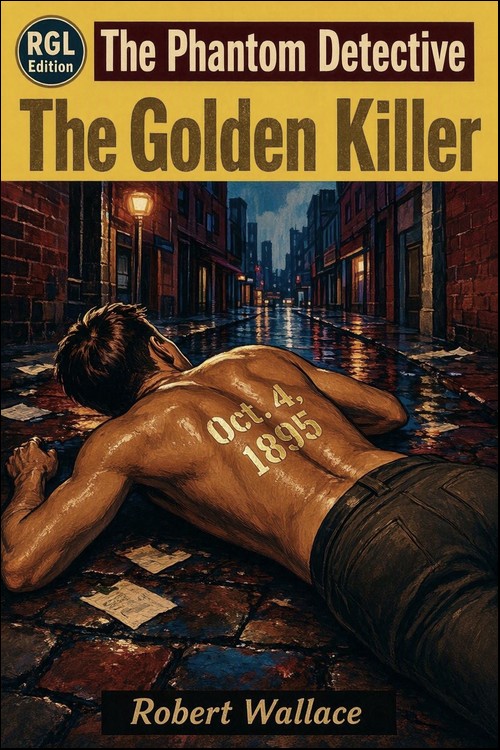
RGL e-Book Cover
Based on an image created with Microsoft Bing software
Roy Glashan's Library
Non sibi sed omnibus
Go to Home Page
This work is out of copyright in countries with a copyright
period of 70 years or less, after the year of the author's death.
If it is under copyright in your country of residence,
do not download or redistribute this file.
Original content added by RGL (e.g., introductions, notes,
RGL covers) is proprietary and protected by copyright.
RGL e-Book Cover
Based on an image created with Microsoft Bing software

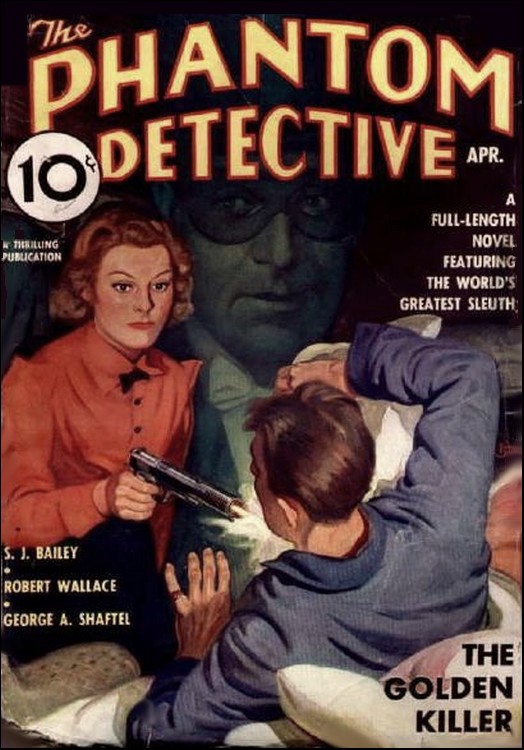
The Phantom Detective, April 1937, with "The Golden Killer"
The brand of murder is burned in gilded letters on the foreheads of the fated Corbin family—guardians of a buried secret that has left a grim heritage of slaughter and crime!
FRANCIS B. CORBIN stepped down off the trolley as it came to a grinding stop. Light grey topcoat nestling across one arm, his commanding figure and erect bearing were those of a man who should step out of an expensive private car rather than a city-owned, squeaky shambles.
His firm tread brought him to a plain, unpretentious wood frame boarding house. Now belief grew large that here was a set of remarkable inconsistencies. The man, the conveyance, the destination, were entirely out of character.
And as the man turned a key in the old-fashioned lock he justified suspicions of menace to his person, for he cast a quick glance to the right, a quick glance to the left, and as he disappeared within the house he glanced rapidly up and down the pavement. There was no one in sight who might either suspect his actions or give him cause for immediate alarm.
Inside, Francis B. Corbin's erect bearing sagged a trifle. Mounting the dimly illumined and poorly carpeted stairwell, his movements became more and more those of a man lagging on what he fears to be his last lap. Also, the movements of a man who is hiding—a man who rides in trolleys because he is expected to ride in imported phaetons, a man who rooms in a clapboard house because he is expected to dwell in a mansion attended by uniformed lackeys.
More and more he became the figure of a man with whom an ugly fate is racing but has not yet caught up.
Then something greeted Francis B. Corbin as he entered his room and switched on the light—something that made the eyeballs grow large and constricted the steel muscles around the lungs. It was a simple, sealed envelope. His name was typed on it. And it lay propped against the pillow coverlet.
UNHURRIED, with no suggestion of the panic that would seize a man of lesser fortitude, Francis B. Corbin closed the door, set his topcoat neatly on a chair, and walked to the window. Wonderingly, he noted that it was closed and latched, as he had left it, and that it had been undisturbed. The bearer of the letter must have gained entry by a pass key. Then, as a man without fear in the world, Corbin unlatched and opened the window. A man must have his fresh air when he comes home late of an evening; that a hidden gun may blaze at him through the black of night is a chance that every soldier takes.
Returning to the bed, Francis B. Corbin picked up the envelope. He looked at the typing, but that told him nothing. Calmly, he opened it and withdrew the message. He smoothed it out, held the sheet to the light, and read the neatly typed note. There was no salutation, no signature. Only half a dozen short sentences.
They were sentences of doom. His hiding place was now discovered!
Give up? Why? To whom? Corbin smiled ironically. If he only knew whom to fight, he would fight back. The only availing tactic against an unknown menace is flight, Corbin reminded himself. Maybe he could get away—and this time, hide successfully. There was nothing better to try than just that.
Francis B. Corbin got down a brown leather suitcase and proceeded to fill it with all his belongings. They were not many. Again laying the grey topcoat across an arm, he put on his fedora and left by the way he had come. His bearing was erect, his tread was firm, his mind was clear and well ordered, and he had no gun.
Far up the lighted street a policeman was lumbering along, nightstick swinging back and forth on the end of the thong. Corbin felt a momentary relief, gripped his suitcase tighter and trotted down the steps to the sidewalk. But, before he could turn in the policeman's direction, two slim, flashily dressed men stepped out from behind a parked car and slid up close to him, one on either side.
Beady eyes bored into his. Tight lips slid back in a smirk.
"Going away, buddy?" a rasping voice grunted. "Swell! We'll give you a lift to the station. Come on, in the car."
Corbin made up his mind instantly. He knew this type. If he showed fight, if he showed courage, they would kill him. But if he showed a yellow streak, they would feel sure of their ground and hold back. Besides, Corbin did have some interest in this game. He did not yet know what he was being murdered for; and before he died, he felt that he'd like to know why he was dying.
His mind made up, Francis B. Corbin played his part like a finished actor.
Corbin froze, words forming solid lumps in his throat. He started to shake his head, and draw back. Beady gunman eyes flashed, a hand whipped up quickly, and Corbin felt the tightness of his vest slacken. He looked down, wheezed air through his teeth. A needle-pointed knife was resting lightly against his shirt front. Two buttons of his vest were missing. Through glazed eyes he saw them on the sidewalk.
"Over to the car, buddy! We don't want to miss the train, you know!"
Corbin glanced helplessly up the street. The policeman was two short blocks away lumbering slowly along. But, suddenly Corbin's heart leaped. He scented an important delay. The door of the next house to his opened. A man came out and trotted down the steps. Corbin recognized him as George Travers, with whom he'd struck up an acquaintanceship. Travers saw him, waved a hand in greeting, and came swinging over.
"Taking a trip, Mr. Corbin? Lucky fellow! Wish I could get away for a—"
Travers stopped short, stared wide-eyed at the two slim men.
"Say? What's the matter here?"
"Take him, Duke!"
Gleaming steel flashed out, streaking up and down in two swift, short strokes. Corbin's lips parted, and a wild scream of frenzied fear burst from between them. Travers swayed on his feet, gurgled horribly and clutched at the pit of his stomach. Blood gushed out between his fingers. Then his knees buckled. He fell face down on the sidewalk, spraying out crimson foam as he struck.
Steel fingers grabbed Corbin, jerked him off his feet, and dragged him bodily out to the curb. A sedan door was opened, and he was flung roughly inside. Two blurred, cursing figures clambered in on top of him.
"Speed, Joe! Swing close to that copper. He's coming on the run. We've got to use the heat on him!"
"No! The boss said—"
"Shut up! Swing in close! Think I'm going to let him report a description of this heap? He's sticking his nose in, so he gets it!"
"Hey, you in that car! Stop!" There was a sharp sound like metal shingles being ripped from a roof. Acrid smoke filled Corbin's nostrils. He heard a harsh laugh, and saw one of the flashily dressed men toss a sub-machine-gun on the seat, and drop down beside it.
"There! That's another one gone! Speed her up, Joe! Take the short cuts!"
As the last was spoken, Corbin was jerked up and slammed back on the seat. A hatchet face grinned at him.
"Sit up, buddy. Look pleasant. If we have to stop in traffic, we're pals, see? Be stupid, and you get the knife."
CORBIN trembled so violently that his teeth rattled.
"I—I don't understand!" he babbled out. "Why are you kidnapping me? I haven't any money."
The other leaned close to him. "You're Francis B. Corbin, ain't you?"
"Yes, yes! But—"
"Then everything's okay. Pipe down and you won't get hurt."
"But, I tell you—"
A stinging pain in Corbin's side stopped his words short. Harsh laughter filled his ears.
"That's better, buddy."
Body numb with fear, brain swirling so fast that everything was but a murky blur in front of his eyes, Francis B. Corbin sat riveted to the seat as the car rushed forward through the deepening twilight. At times it slowed up for a turn, and twice it stopped completely as the slim youth behind the wheel waited for a traffic light. Eventually, though, it weaved out into open country, tore forward, made three turns, and finally pulled up to a slithering stop in the backyard of a dilapidated farmhouse.
No sooner had it stopped, than steel fingers grabbed Corbin again, hauled him out onto the ground, and dragged him over to the rear door of the building. It opened in his face, and he was sent flying forward into pitch darkness. Instinctively he flung out his hands to save himself. But he was a second too late. The top of his head thudded dully against something, and millions of comets and colored stars raced madly around in his brain.
When the comets and stars finally faded away, he was sitting bolt upright in a chair. Coarse ropes held the upper part of his body lashed to the chair. His arms and legs were free. Directly above him a single, powerful light shed down a burning, merciless glare. It seemed to burn right through the top of his skull and sear his eyeballs. He closed his eyes, but it only intensified the glaring heat from above, so he opened them again.
Slowly he became conscious of a figure standing in front of him. Through burning eyes he peered at it, let out a strangled gasp of terror. A plain black robe, more like a cape, covered the figure from the shoulders to the feet. A cap was pulled down over the head, and where the face would be, there was a golden mask. A mask made of draped golden cloth, with just two small slits for the eyes.
As Corbin stared at it out of terror-stricken eyes it moved slightly and a deadly, calm voice spoke from in back of it.
"You received my letter, Corbin, and you tried to run away! So you must be the one I've been wanting to meet. Tell me what I wish to know, and life will continue to remain in your body!"
Corbin stretched out his hands imploringly.
"I don't know anything, anything!" he cried. "I swear it! I know I tried to run away. But it was because I don't know anything, and I was afraid you would not believe me!"
"I don't believe you, Corbin!" said the voice behind the golden mask. "Just before Paul died he shouted your name. Come, tell me, and you will go on living!"
Corbin's hands shook violently.
"In the name of God, I swear I know nothing!" he shrilled. "Why did you kill Paul? Why do you torture me this way? What have we done?"
AS Corbin's words were lost in the echo, the robed figure moved forward, and a hand holding a yellow-stained sheet of paper appeared out of the voluminous folds.
"Here, read this, Corbin! Perhaps it will refresh your memory. But I do not think that even twenty-five years could make you forget!"
The robed figure shoved the paper into Corbin's trembling hands. With a mighty effort the roped man held his hands steady long enough to read the words on the paper. Suddenly, he uttered a sharp cry. The paper slipped from his fingers and fluttered to the floor. He raised wide, fear-tinted eyes to the golden mask.
"Where did you get this?" he shrilled. Then after he had gagged for a moment, "You—you must be—"
A hand shot out, and fingers dug cruelly into his throat.
"I am what the newspapers call me—the Golden Killer! Speak to me the truth! Tell me that message locked in your brain, or you shall die in indescribable agony. Yes, just as Paul died. Now, speak!"
Corbin struggled for words that would not come. His face changed from a chalky hue to a dirty grey. The veins at his temples stood out like blue-red cords, and his fingers, entwined in each other, twisted and crushed this way and that.
"I swear it—I swear it!" he shouted. "I do not know. For God's sake, let me go!"
He hurled himself upward, and clawed out with both hands. The chair, lashed tightly to his chest, permitted him only to rise up to a half crouch. But it was enough. His clawing fingers grasped the bottom folds of the silken mask. The voice behind it hissed a vile curse. Steel fingers clamped down over Corbin's wrists, and wrenched frantically. But his own fingers were locked tightly in the silken folds, and as his body was flung violently to the side, there was a rip of cloth and the golden mask came off in his hands.
Crashing to the floor, Corbin lay limp and breathless, staring dully up at the rage-twisted face.
"You!" he choked out. "My own—"
"Yes!" the robed figure hissed down at him. "And now, you die!" he snarled.
With a quick movement the robed figure stepped back. His right hand flashed down under his robe, and almost instantly flashed into view again. Corbin realized he had made a deadly mistake. He flung out both hands as though warding off a blow. Then suddenly he gasped, and clawed madly at the side of his neck. His fingernails drew streams of blood.
Then, as though a mighty weight had crashed into him he fell back limp, groaning and gurgling for breath. Little by little his groaning grew weaker and weaker. Finally, he arched his body, clawed madly at thin air, and collapsed, motionless.
In two long strides the robed figure went over to him, bent down and pried the golden mask from the stiffened, clawing fingers. In a quick movement he slipped it back in place over his face, and stood up. For a long second the figure stood motionless. Then the mask moved, and the voice behind it spoke again.
"There are still others left. It has got to be one of them! This one spoke the truth—he did not know."
Turning, the figure walked over to a door, jerked it open.
"Come in here!" he snapped out angrily.
The two flashily dressed men sidled into the room, cast fearful glances at the golden mask. The robed figure reached out a hand and touched the taller of the two on the chest.
"Take him upstairs and strip him!" the voice behind the mask said. "When I have finished, you will take the body to where I direct. Understand?"
"Yes! Sure, boss!"
THE robed figure moved his hand to the chest of the other man. "And you," said the voice, "will keep yourself in readiness to deliver a third letter I shall write. This time, however, it will be more difficult. If you blunder, you will die. You understand?"
The man couldn't speak. He simply bobbed his head up and down vigorously. The robed figure nodded shortly, half turned and stared across the room at the corpse that had once been Francis B. Corbin.
"I will have it, yet! It has got to be one of them!"
The words were little more than a muttered whisper. Then, the robed figure turned sharply on his heel, shoved the two flashily dressed men aside, and stalked from the room, leaving behind swift, hellish death limp on the floor.
GREY fedora set at a jaunty angle on his head, malacca cane hooked in the crook of his arm, Richard Curtis Van Loan smiled at the sweating customs inspector, and snapped a little salute with his free hand.
"Thank you very much, Inspector," he said. "I certainly appreciate your giving me such speedy attention."
The customs man smiled, half shrugged.
"Glad to do it, Mr. Van Loan. It's not your kind that we fellows have to keep our eyes on. Have a nice crossing?"
Van Loan half turned and stared up at the tremendous hulk of the Normandie hawsered fast to the pier.
"A perfect crossing, Inspector," he said. "They certainly attached propellers to a hotel when they made her. Thank you again for everything." Van Loan's words concealed the searching glances that he shot from side to side, glances that were looking for somebody.
Another salute and Van Loan nodded at a waiting steward, and then moved down the pier to the elevators. On the street he waited while the steward piled his bags into a taxicab, then tipped the man, and climbed in himself. Settling back, he gave his Park Avenue address to the driver, and breathed a long sigh of joyful relief.
"Back in little old New York again!" he murmured. "Am I glad!"
A thoroughly contented smile on his face, he stared out at heartwarming, familiar scenes whipping past the taxi windows. Not for four long months had his eyes rested upon those familiar scenes, and it was almost with the eagerness of a returning convict that he drank them in.
Four long months on the other side of the Atlantic! Four months of intensive study of foreign methods in the dangerous, yet highly exciting and society-benefiting work to which he had pledged himself for a long, long time—and if the goddess of good fortune would permit, to which he would pledge his every effort for a long, long time to come.
It was in pursuance of this very pledge that he had cut short by two months his stay in Europe.
"You have work to do here," Havens had written to him. And in proof, Havens had sent to him some selected newspaper headlines. The Phantom, therefore, was back home again on his native shores. When another menace had loosed itself in his homeland, home was the place for the Phantom.
Hardly had the Phantom, comfortably ensconced in the taxi, delivered himself of this truistic reflection, than the press of his home town drove it suddenly deep into his consciousness.
"Extra! Extra! Read all about it! All about the Golden Killer! Extra! Extra!"
The shrill voice of a newsboy cut into the Phantom's thoughts. The taxi had pulled up for traffic, and at that moment Richard Curtis Van Loan ceased to be; instead, there was seated in his cab another identity, another being—the Phantom. It was the Phantom who called out from the taxicab:
"Let me have a paper, son. Snappy!"
The cab began to move again, as the Phantom unfolded the paper and riveted his eyes to it.
A look of concern furrowed his brow as black type announced:
GOLDEN KILLER STRIKES AGAIN
That was the headline. The Golden Killer! The very reason for the Phantom's hurried return to his native land. The news story was only a few sticks of type in length, containing only the important details, for the story had broken only minutes ago:
At an early hour this morning the half-naked body of Francis B. Corbin, 35, of 2356 Husted Avenue, was found dead in the gutter of upper Amsterdam Avenue by Patrolman Johnston, of the 16th Precinct. Several cuts and abrasions on the body lead the police to believe that it had been tossed out of a passing car. Whether it has any connection with the murder of Travers and the policeman, whose bodies were found late last night, is a matter of conjecture on which the department is not committing itself.
That it was the work of the mysterious Golden Killer was plainly obvious, however. Stenciled in gold across the middle of Corbin's back was the date of Oct. 4, 1895. The weird lettering is an exact duplicate of the lettering found on the back of the present victim's brother, Paul Corbin, whose dead body was found ten days ago near the home of Francis B. Corbin.
The reason for the mysterious twin killings has yet to be explained. Police experts attest, however, that the strange date was undoubtedly placed upon the bodies after death, and are attaching utmost importance to it. Further details will be contained in an early edition.
The story was clear enough. It required no re-reading. The Phantom's eyes sought out other items, and caught upon "Late Flash" notices in a conspicuous position. He stiffened to attention again. One flash was the following:
CORBIN POISONED
Police Surgeon Harrigan has stated that Francis B. Corbin died as a result of a mysterious poisoning that virtually caused the heart to explode. In Harrigan's opinion it was either curare, or some other more deadly extract.
As this flash was being prepared, a mysterious telephone call came to the offices of this newspaper, requesting us to direct specifically, the attention of the Phantom to the Corbin killing. The call was traced to a private booth, and no further.
We are moved to editorialize here on the matter, and in the interest of the unknown telephoner, who undoubtedly has motives of genuine merit, to call the sensational and uncanny Phantom to arms. We hope that he will emerge from his retirement of the past few months, and respond to the appeal which we herewith transmit for the hapless telephoner, whose call sounded like a genuine call for help. We assure the Phantom, if he has not yet acquainted himself with the Affair Corbin, that in the Golden Killer he will meet game worthy of the hunt, and which may tax the hunter's last resources. It would be a matter of great interest to see the Master of Crime Detection pitted against this Master of Crime.
Eyes hard, lips pressed together in a thin line, the Phantom leaned forward and rapped his knuckles sharply on the glass panel in back of the driver.
"Step on it, cabbie," he ordered.
THE driver nodded and the cab instantly picked up speed. Ten minutes later, as it whirled into the curb, the Phantom tossed the driver a bill and entered the lobby of the building where he maintained a luxurious penthouse apartment. The gaping doorman had time only to half nod as Richard Curtis Van Loan flung him a greeting and jerked a thumb backward toward the bags in the car.
Hurrying down to the rear end of the lobby he popped into a private elevator, shut the doors and stabbed a signal button. Fifty-six stories up, he stepped out of the elevator and unlocked the door of his penthouse. There he stopped short, grinned, and thrust out a hand.
"So you're here," he exclaimed. "I was looking for you down at the pier."
An elderly man with kindly grey eyes had risen from a chair and was walking toward him. He was Frank Havens, owner and publisher of a chain of newspapers. More important, though, the man was his closest friend, and the one person in all the world who knew that Richard Curtis Van Loan was the Phantom.
"Van, my boy! Welcome home! You're looking fine," declared the publisher, proceeding at once to explain his absence from the pier. "I was at the office till the last moment, to see what might come through on this latest Corbin angle. I can see in your face that you've read the papers on the way up here. It got so late I was afraid I'd miss you at the pier, so I came directly up here. Sit down, we might as well get this right over with. I know you're wondering why I should be all in a lather about some despicable, misguided murderer who fancies gold stenciling."
THE Phantom arched his eyebrows, tossed his hat and gloves on a chair.
"What's the latest angle?" he asked.
"If you've read the latest editions," Havens assured him, "you know as much as I do about what happened this day."
"I did," was the Phantom's reply. "But what do you make of that stick of type about me? I mean, who do you think telephoned for me to come into the picture?"
"Oh, that?" Havens smiled sadly. "All the newspapers received that call. It was a woman, but she begged not to be identified as such in the papers. That's why the newspapers don't say so. They're all wondering about it. However, I know who the caller was. Nobody else does."
Van Loan sat up straight, placed his drink on an end table.
"Who was she?"
"I'll come to that later, Van. Let me tell it my own way."
"Shoot," agreed Van Loan.
"I'll be brief as I can," nodded the publisher, talking rapidly. "The Corbins are quite important people, as you may know. They are all 'first citizens' and I have recently found that they have donated liberally, within their means, to many charities—and in every case the donation was anonymous. They're not publicity seekers. For instance, when an appeal was published recently for a blood donor for an injured little ragamuffin from the water-front, it was an anonymous Corbin who stepped forward and paid for the blood.
"It developed that the lad's father was in prison, while the family were on relief. The Corbins have since taken care of the family, and found some kind of employment for the mother, who hated charity. I'm pledged to secrecy on all this stuff, so it never found print. Anyway, I give it to you for what it's worth—a sidelight on the Corbin character, although it's not close to the point. Prescott, the attorney, gave me the information, so it's on the up-and-up."
"Okay, go ahead." Van was impatient.
"The first known victim of the Golden Killer was Paul Corbin. He was missing from his Westchester place for three days. That was less than two weeks ago. Then one morning he was found in the street, about two blocks from the house of his brother, Francis Corbin. The date, October 4th, 1895, was stenciled in gold ink on his back. It had been done after death, and the newspapers coined the name, Golden Killer."
"I know all that," the Phantom said impatiently. "But why did this one killing stir up so much excitement? Others had been killed by this same killer, before Paul Corbin."
"I'm coming to that," Havens nodded. "The police think so, but there's no proof. Paul Corbin's wife and his eight-year-old son mysteriously disappeared a month ago. That was about two weeks ago, before Paul's murder. No trace of either has been found. However, they were obviously kidnapped by this Golden Killer."
"And why?"
"After Paul's death, notes were found in his desk. There were three of them. Each was the same. A demand for Paul to be at a certain place—one of the entrances to the Yankee Stadium—at eight o'clock on three different nights. He was to come alone. And the note was signed October 4th, 1895."
TINY wrinkles furrowed the Phantom's brow. He leaned forward, fingers spread fan-shaped on his knees.
"I think I can guess," he said slowly. "Being a law-abiding citizen, Corbin went to the police. And he never saw his wife and child again."
"Exactly!" Frank Havens nodded. "Commissioner Crowley gave me the whole story only this morning. I went down to see him right after I received the phone call, and—"
"Phone call, Frank?"
"I'm coming to that, in a minute. As I was saying, Crowley said that Corbin had come to them, and asked that plainclothes detectives accompany him on a visit. He refused to give any explanation. Anyway, Crowley assigned him two men. On three different nights they went to the grandstand entrance of the Yankee Stadium. That is, the two detectives trailed Corbin there. But nothing happened. Then suddenly, Corbin disappeared. He was found dead two blocks from his brother's house. This morning, Francis Corbin was found dead one block from the house of his widowed sister, Mrs. Mary Corbin Wright.
"She called me on the phone at ten o'clock this morning. She was terribly frightened. Said she didn't dare say anything over the phone. But she begged me to get the Phantom to help her. She said that she had heard that I was the only one who could get in touch with you, and begged that I do so. I promised that I would, Van."
The newspaper publisher spoke the last in an even, toneless voice, and looked straight at the man who had saved so many unfortunates from death, or worse. The Phantom stared for a long time down at his hands, then slowly raised his head.
"I get it now," he murmured. "This widow, Mrs. Wright, is the one who called all the newspapers to get the Phantom egged into the picture. It fits together. She appealed to you personally before this—that's why you rushed me back home. She must be a good-looking widow," he said facetiously.
"This is no joking matter," Havens cautioned. "Blood has been spilled. More will flow, mark my word. A blight seems to have spread itself out on this worthy Corbin lot. Mary Corbin Wright is a woman who has suffered much already. She lost a husband in the war. A child was born to her after the official notification of her husband's death in action. That child died, an infant, during the influenza epidemic. Then she adopted a baby whose father had also been killed in action, and whose mother died in the epidemic. That child is as her very own, and grown to a fine young manhood. She fears for him, too. He's away at college now."
"I didn't mean anything disrespectful," Van quickly apologized. "I'm interested. Does anybody else know that she consulted you—to get me into the case?"
"Only the attorney for the Corbins, Gregory Prescott. Prescott advised it. To me, he confided that he did so only to soothe the poor, frantic woman. Prescott says that if you do enter the case, you should do so secretly—without fanfare of the press. He's afraid that the Golden Killer might go after the rest of the Corbins at once and finish them off with quick strokes."
"Why?" demanded Van Loan.
"Why?" repeated Havens. "I don't know. It does sound reasonable, though. The Golden Killer so far has obviously set himself—"
"We're wasting time," interrupted the Phantom. "You know better than to believe anything 'obvious' in any business like this. I want to see Prescott. He seems to have opinions. He must have reasons for them. If he has good ones, then he has something that we have not."
Van Loan hastily flung off his outer garments and grasping a make-up kit, he applied himself before a mirror.
"Phone Prescott, Frank," he said meanwhile. "Tell, him that you'll be right over. Important."
Havens did so, and cradled the receiver.
"Okay," the publisher said. "He's waiting. And after you see Prescott, I'd like you to see Mary Corbin Wright—in utter secrecy. I got Commissioner Crowley to station a couple of men in front, of her house just in case. She doesn't dare leave her house before seeing you, she says; so she must have something big. She won't even tell it to the police."
"ALL right, come on." As the two men left the building, it was not Van Loan who got into a cab with the publisher. It was a tall, young man, hard-mouthed, rough-cheeked, who looked for all the world like a hard-boiled New York dick.
Prescott received them in surprise. He had been expecting only one guest, Havens.
"I've brought along a friend," explained the publisher. "He is interested in the Corbin affair, and wants to talk to you. Mr. Prescott, meet the Phantom."
Prescott snapped as though struck by a bomb.
"Why didn't you tell me, on the phone?"
"We never know who may be listening in," the Phantom explained. "We've all agreed to keep my part secret, I believe. It was your own wise suggestion, if I'm not mistaken."
"Yes, yes; sit down. What can I do for you?" Prescott was excited in acting as host to so world-famed a character as the Phantom, and showed it.
"You are afraid that the Golden Killer may wipe out all the Corbins in a hurry," the Phantom struck directly to the point, "if he learns of my entry into the case—which may be a left-handed flattery to me, but I'd like to hear your reasons."
"Reasons?" Prescott repeated. "Mrs. Paul Corbin and her child were kidnapped. Paul was murdered. Francis was murdered. All within two weeks. And there's a cryptic date involved that looks like a reminder of something. It looks to me like the Golden Killer, acting out of some as yet unknown motive of vengeance, is out to do away with every member of the Corbin family."
"That's under the assumption that the motive is vengeance," interpolated the Phantom. "But we aren't sure. That's why I'm here. Vengeance is the simplest explanation. It is too simple for us to believe. Let's assume that vengeance is obvious—and therefore untrue, because the Golden Killer would strive to make the untruth obvious, to give us a bum steer. Let's go back to the beginning."
"I have a hunch you've got something from your approach," agreed Prescott, a sparkle of admiration in his eyes.
"Okay. Mrs. Paul Corbin and her child were abducted," continued the Phantom, "and Paul received communications from the culprit. Did he speak to you about them or go direct to the police?"
"He spoke to me. Together, we decided on going to the police. I went with him."
"Did you receive any threats as a result of your participation?"
"No—not yet," Prescott said. A dark furrow of fear crossed his features and shadowed his eyes.
"And now Francis Corbin," resumed the Phantom, thoroughly understanding the grave fears that Prescott should entertain for himself—"Francis Corbin was threatened. He hid out. You knew?"
"Francis came to me, too," Prescott spoke sadly. He threw up his hands in a gesture of futility. "We talked it over at length. Decided he could do only one of three things—report to the police, as Paul did, or meet with the menace as directed, in secret, or run away and hide. I had advised recourse to the law, to Paul. In a way, I felt as though my advice had a part in the fatal results. So I refused to advise Francis. He decided everything for himself. He was murdered. Now I have the feeling that if I had advised him better, he might still be alive. Going or coming, active or silent, I seem to be between the devil and the deep blue sea!" Prescott's hands shook as he poured himself a drink of water at the cooler.
"There's a loophole here some place," declared the Phantom. "Vengeance? Then the Golden Killer would kill, and no more. But he tried to contact first Paul, then Francis, before killing. Why? It seems he wanted to get something from them. Ransom? Hardly. He had both men in his clutches and elected to kill without ransom rather than liberate for pay. It appears he wanted something other than ransom. To him, therefore, more important than ransom. Maybe, information leading to something much bigger than ransom. Paul did not furnish it. He died. Francis came next. Either he did furnish it, and died—or did not furnish it, and died. As attorney for the Corbins, what do you think the Corbins knew that the Golden Killer would like to find out?"
Gregory Prescott bit his lip.
"I should be chagrined at my stupidity," he said. "I never thought of it that way. Of course, now that you put it that way, I see that I should have reasoned the same way. No, it no longer looks like vengeance. But, as attorney for the Corbin's, I can truthfully say I know absolutely nothing that the Corbins can have—aside from ransom money—valuable to the Golden Killer."
The Phantom nodded.
"I expected as much," he said. "There is a secret that the Corbins keep from their lawyer. It has no blackmail significance in this case, because blackmail was not threatened. Now, what is it that is of more importance than ransom or blackmail values to the Golden Killer? That remains to be found out. If it is money, and that seems most likely, then it is in such a great amount that a mere ransom of blackmail payment couldn't match it."
PRESCOTT suddenly nodded a dissatisfied negative.
"There's a deep mystery in it," he declared. "If money is at the bottom of it, is it all the money of all the Corbins at one fell swoop? That's fantastic. Kill off all the Corbins till only one is left, and collect the works from that one? Then where does that gold-stenciled date fit in? And it's stenciled in gold! Why not silver, or ink, or paint, or gum-paper?"
"Good!" exclaimed the Phantom. "Now you've struck it." He slapped his knee hard with the palm of a hand. "The date itself means something. That it's done in gold has a meaning of its own. And that the secret belongs to the Corbins and is shared only in an unsatisfactorily small measure by the Golden Killer seems to stand out like a sore thumb. How long have you represented the Corbins?"
"Since their childhood," answered the lawyer. "When their mother died, I took care of their interests till they each attained their majority. They have all retained me."
"And little wonder." Havens spoke for the first time.
"All of them?" asked Van Loan. "Are there any Corbins you know of that aren't with you?"
"Yes—Harold. Harold Corbin lives in Detroit," Prescott explained. "He wasn't reared with the others. He needed a local attorney, in Detroit, of course, where he's in business. I hardly know Harold at all. Of the New York family, Mary Wright is the only one who corresponds with him. On his visits here he'd see little of any of them, excepting Mary."
Havens and Van Loan glanced at each other. Harold was the unknown Corbin. Mary Corbin Wright knew him best. Mary had something important to tell the Phantom. There seemed to be a pattern here. The visit to Prescott, before speaking to Mary Wright, seemed after all to be bearing fruit.
"All right." The Phantom arose. He addressed the lawyer. "You have an angle to work on—and you have been with the Corbin interests longer than anybody else. Study all your records and try to emerge with anything at all that ties up gold with stenciling, with the cryptic date of October 4th, 1895, and with the Corbins. We have to—"
The telephone rang. Prescott took the receiver.
"Yes—b-but," he stammered. His face became chalk. When he cradled the receiver his hand shook with palsy. He tried to speak to Van Loan, but could not. Havens hurriedly brought a glass of water to the stricken lawyer.
"It—it was—him!" gasped Prescott, when he could get himself together enough. "He—how does he know that the Phantom is on the case?" Prescott's eyes widened. "You told nobody?"
AGAIN Van Loan and Havens exchanged glances. This time, uncomprehending.
"Nobody knows I'm in New. York," spoke the Phantom.
"But he does—the Golden Killer does!" cried the lawyer in alarm. "This call was from him—he said: 'Prescott, you're committing suicide. First you took Paul to the cops. Right now you're talking with the Phantom, in your office. Get out of New York within twenty-four hours and stay out—or else!' That's almost verbatim."
"Did he say he's the Golden Killer himself?" asked the Phantom.
Prescott looked blankly about. "No—no," he answered. "I just assumed—I don't know —who else could it be?"
"Try to trace the call," snapped the Phantom. "It won't do you any good, though. It's probably a dial station at a corner cigar store. But try it anyway. We have to go. I'll be seeing you—within twenty-four hours."
"Never fear," called back the lawyer. "I'll not leave town!"
When they were outside, the Phantom turned to Havens.
"I'm going to your office," he said. "I'll change this disguise up there and phone Mary Corbin Wright. Let's hurry."
At the office of the publisher, Van Loan applied thorough alterations to his features. There was a change of suits for him—Havens always had a couple of Van Loan's suits locked up in his private wardrobe.
"And now what?" asked the publisher.
"Call Mary Wright."
The telephone rang just as Havens reached for it to put through the call. "Mary Wright," said the girl at the switchboard.
"Mr. Havens?" cried a hysterical feminine voice at the other end of the wire.
Havens acted on impulse. An urgent imperative note sounded in Mary's tone. He thrust the hand-set toward the Phantom.
"It's she," exclaimed the publisher.
Van Loan grabbed the instrument. "Hello."
"Mr. Havens!" again came the cry. "This is Mary Wright—something terrible is happening up here! You must tell the Phantom to help me. I've got to see him immediately. I've got to see—"
"Wait!" Van Loan cut her off. "This is the Phantom speaking. What's wrong? What do you want?" Strange sounds came over the wire in answer to his question. He pressed the receiver hard against his ear, thought he heard sounds like someone gasping for breath.
"Mary Wright!" he roared. "Speak up! This is the Phantom! What's the matter? Are you—"
A shrill scream of utter terror caused his heart to skip a beat. Then, as though cut by a knife, the scream was stopped off short. A second later he heard the sound of a crashing fall. The phone crackled loudly, and went dead. On impulse he reached out to signal the operator, but checked his movement and slapped the instrument back into the cradle and whirled around toward Havens.
"What's Mary Wright's address, Frank?" he barked.
Havens quickly jotted it down on a scrap of paper and handed it to Van Loan.
"What did she say?" he asked.
"She didn't!" the Phantom flung back over his shoulder as he dived through the private door and into Havens' private elevator.
HUNCHED forward over the wheel of a long sleek black roadster, the Phantom shot north through Central Park at breakneck speed. A dozen motorcycle cops came racing after him in turn. But each snapped a half salute and fell back as the Phantom pressed a hidden button that made a set of Police Department plates pop up into view just long enough to be seen.
One cycle cop, more curious than the others, thundered up alongside and stared hard at the man behind the wheel. The Phantom grinned at him, then waved him back with an angry gesture. He knew full well the reason for the cop's curiosity. The lad wanted to look at the Phantom's face. Well, he had had his look, and a lot of good it would do him.
Richard Curtis Van Loan was not crouched over the wheel of the roaring roadster. That is, not in appearance. The expert job of lightning-like make-up had taken care of that. Dye had changed the hair, and adhesive paste, waterproof and foolproof, had altered the nose and the lips, and the cheeks. As a matter of fact, not even Frank Havens, had he not already seen the Phantom's latest metamorphosis, would recognize him now.
A crooked smile on his lips, his entire body tingling with the thrill of being back in harness again, and hot on the trail, of new mystery and new danger and excitement, the Phantom streaked out of the Park at One Hundred and Tenth Street, shot west, slammed around into Amsterdam Avenue, and roared north again. Three blocks from the address Havens had given him, he slowed down. Two blocks from the place, he pulled into the curb, shut off his engine and got out.
A crowd was collected in front of the house where Mary Wright lived. The Phantom hesitated a moment, frowned, then walked swiftly along the sidewalk. As he reached the group he saw two men stretched out stiff and motionless on the curbing. The eye of one was nothing but a glistening red hole. And the shirt front of the second man was stained a deep crimson. Each man still clutched a police service pistol in his stiff fingers. A red-faced, angry eyed patrolman was keeping the morbid gathering back.
"Stand back there, all of you!" he bawled out. "Don't none of you touch them 'til the ambulance arrives!"
The Phantom moved close to an old man.
"What happened?" he grunted out of the corner of his mouth. "Them gangsters, huh?"
Watery blue eyes stared at him scornfully.
"Certainly not! They're detectives. Shot down in cold blood. They say a car raced past, and men in it shot them down. They pulled their own revolvers, but died before they could use them."
The Phantom moved back, glanced up at the house. It was a ten-story apartment building of the better type. Heads were sticking out of practically every front window. Swinging around on his heel, the Phantom walked into the lobby. It was vacant, the doorman being among those out in front. Sliding into an elevator, the Phantom closed the doors, and jabbed one of the many buttons.
On the ninth floor he stepped out, walked along a carpeted hall and stopped in front of apartment Number 916. On a little brass framed card tacked to the jamb was the name, "Mary C. Wright."
Sliding his hand into his pocket, the Phantom took out a small bunch of keys. Bending over, he squinted at the lock, smiled to himself, and selected a key. Three seconds later the door swung softly inward under his touch. Wriggling into a four by five foyer, he stood perfectly still, keen ears tuned to the slightest sound.
FROM beyond a half closed door to his left, and just ahead of him, he heard the faint sounds of papers being rustled. Closing the main door, he glided forward, pressed himself through the opening, and stood motionless.
He was looking at a small living room, comfortably furnished. The very instant he entered the room his eyes became fixed upon a slim man bending over a Governor Winthrop desk in the far corner of the room.
Every drawer had been either pulled or pried open, and countless papers were strewn about. At the moment the thin man was ripping through the pages of an old worn leather diary. He presently completed his search, and tossed the diary over his shoulder with a curse.
The Phantom snaked out his hand, caught the diary in midair and lightly tossed it back. It landed plop on the desk at the slim man's elbow. He jerked his head to the side, gaped at it, then slowly turned all the way around. As his eyes met the Phantom's they contracted to gleaming pin-points.
Beady eyes widened, flickered down to the Phantom's hands hanging loosely at his sides. Instantly, the man started to stiffen.
"Don't!"
The Phantom's voice was like the crack of a gun. The slim man's right hand froze rigid, halfway to his jacket pocket. It froze because his beady eyes had seen a miracle performed. They saw a man raise his right hand, snap his fingers, and make a small, flat automatic appear out of nowhere.
"I'll show you the hat trick, some time, maybe," the Phantom smiled, as he leveled the gun at a point directly between the slim man's eyes. "This sleeve gun stunt is old stuff. I can do it in my sleep. What are you looking for, anyway?"
"Nothing. I live here."
"Really? Nice little place. By the way, when did Mary Wright move out? About ten minutes ago? Just after she called me?"
THE slim man's pinched face seemed to shrivel up visibly. He unconsciously raised a hand to his shirt collar, and tugged at the band.
"Gee!" he gulped out hoarsely. "I heard you yelling into the phone. You're—you must be—"
The Phantom chuckled, as words failed the man.
"The Phantom!"
The slim fellow spoke the words like a man trying to force himself to believe something he didn't want to. Van Loan chuckled, gave him a half nod. Then, with an edge to his voice, "Up with your hands, Slim. Turn around."
The slim man obeyed instantly. In three swift strides the Phantom moved over to him, jerked an ugly looking automatic from the man's jacket pocket and dropped it in his own.
"Now we can be more sociable," he murmured, stepping back. "Turn around again, and tell me all about it. Where is Mary Wright?"
Sullen, gleaming eyes looked into his.
"I don't know no Mary Wright."
The Phantom stepped close. "What a shame! I'm so anxious to meet her."
The movement was little more than a flash of light. The slim man didn't even see it. He only felt the barrel of the small automatic rasp down his right cheek. He howled with pain, and grabbed at his face.
"That help the memory?" the Phantom purred. "I said I was very anxious, you know!"
"God, don't do it no more!" moaned the slim man. "I don't know nothing! I just seen the place was empty, and come in to see if I could pick up some change!"
Van Loan laughed softly.
"What a punk liar!" he grunted. "If the place was empty, how come you heard me on the phone? Mary was here then. I wasn't talking to the wall."
The slim man shivered, and the glint of a cornered rat came into his beady eyes.
"I ain't saying a thing!" he snarled.
The Phantom moved forward, but checked himself. He knew that he could whip some truth from the man's lips. But the screams and howls of pain would naturally attract attention. And for the present he didn't want others to know that the Phantom was working on the case. Plenty of time, later, for him to come out into the open.
"Well," he smiled coldly, "if you won't talk here, I guess I'll have to take you where you will talk."
The slim man twisted his lips back in a dogged smirk.
"You ain't scaring me none!" he grated. "Do anything you damn well want to."
As the man spoke he carefully lowered his hands, linked his fingers on the back of his head, and held them there. The Phantom shrugged.
"You're only making it harder for yourself," he said, and moved toward the door. "Let's go."
Deliberately he turned his back for an instant, but his eyes flew to a small mirror on the wall. In the glass he saw the slim man's right hand dart down to the back of his neck, and streak up with something gleaming. But, in that same split-second the Phantom dived to the right, spun around and jerked the trigger of his gun. But he didn't fire at the slim man. He fired straight at the half opened window on the other side of the room.
There was a howl of mortal pain, and a grey-suited figure slumped down, and fell half across the sill. The Phantom snapped his eyes around and darted a quick glance at the thin tapering knife quivering in the wall just over his head. He grinned and snapped his eyes back to the slim man, who was frozen in a half crouch, terror and anger flaming in his eyes.
"Bad marksmanship, my friend," the Phantom murmured. "And your pal should have thought of his big feet. I could see the toes of them too plainly. The only way to get him to come out and join us was to make him think he could shoot me in the back. Boys like you can never resist opportunities like that. So Mary Wright was taken down the fire-escape, eh? Taken down and whisked away during the shooting excitement out front? Not a bad plan. But it's turned out rather tough for you, hasn't it?"
THE slim man didn't answer. He simply remained motionless, save for his eyes. They darted about the room as though he were seeking some secret hole to dive into. The Phantom moved over to him, and reached out a hand and spun him around.
"Out onto the fire-escape!" he snapped. "We're going up to the roof for some air. Move!"
The other needed no second order. He went over to the window, pushed the body of the dead man to one side, and flung a leg over the sill. At that exact moment the phone bell rang shrilly. Van Loan stiffened, then motioned the slim man back into the room with his gun. Keeping his eyes on him, he moved over to the instrument, picked it up.
"Yes?"
"Did you find anything?" snapped a harsh voice.
Van Loan frowned, thought fast. "Sure!" he answered. "Can't tell you over the phone, though. Where can I meet you? It's important!"
The wire was silent for a second, but the Phantom thought he heard a soft intake of breath.
"Come to the usual place," said the voice presently. "And bring it with you!"
The line clicked and went dead. Van Loan cursed inwardly, and dropped the instrument into the cradle. For several seconds he stared at the slim man. Then, suddenly, a tiny smile tugged at the corners of his mouth. He nodded toward the dead man.
"Drag him inside and stick him in that closet over there!" he ordered. "And don't stick your hands in his pockets. That is, not unless you want to join him. Snap it up!"
Half a minute later the dead man was slumped down on the closet floor. Going over to the desk, the Phantom picked up a ball of parcel twine, and motioned to the slim man to turn around.
"We'll talk later," he grunted. "In the meantime, you can keep him company."
Before the other had a chance to move, the Phantom lashed his wrists behind his back, slammed him into the closet and shut the door. For a second he gazed meditatively at the key in the lock, but shook his head, and went out into the foyer. His free hand was on the knob of the front door, when he suddenly heard running footsteps outside. They stopped in front of the door. There was a grunt and the apartment bell tinkled.
Van Loan made a wry face, released his grip on his gun and let the trick mechanism snap it up out of sight in his sleeve. Then he calmly turned the knob and opened the door. Four startled faces confronted him. The one with his finger near the bell button was a ruddy-faced, shaggy-browed man. Behind him stood a tall, pink cheeked man of elderly appearance. And at his side were two heavy-set men whom the Phantom instantly recognized as police officers. The ruddy-faced man found his tongue first.
"Who—who are you?" he demanded.
The Phantom smiled.
"Suppose I ask that question of you?" he said quietly.
Before the ruddy-faced man could answer, a door at the end of the hall popped open, and a lean man with flaming red hair came out. He paused for a second, then came down the hall quickly, stopped at the door of Mary Wright's apartment. Piercing eyes, like those of a cobra bored into Van Loan's face. Then thick lips parted.
"I saw this man take a key and let himself into your sister's apartment, Mr. Corbin!" he exclaimed. "And later I heard a shot—I'm sure of it!"
The man pointed his finger at the Phantom, but he directed his words at the ruddy-faced man. Van Loan turned quickly to him.
"Corbin?" he snapped. "Which Corbin are you?"
HIS tone carried a note of authority that made the ruddy-faced man jump.
"I'm William Corbin!" he jerked out. "My sister called me, said she was in trouble. She—Wait, damn you! Who are you, anyway? What are you doing here?"
"Trying to find your sister," Van Loan said quickly. "She's been kidnapped!"
For a moment the ruddy man's face didn't change expression. Then his eyes widened with horror. It struck the Phantom that they widened just a bit too much.
"Mary kidnapped?" Corbin shouted. "Who—why—where? Oh, my God!" he exclaimed.
The elderly man in back of Corbin placed a quieting hand on his shoulder.
"There, there, William!" he said. "Get hold of yourself."
"Paul and Francis killed—now Mary kidnapped!"
Something clicked inside of Van Loan's head. He sucked in his breath sharply and played the card he had been wanting to save.
"Take it easy, Corbin," he said. "I promise to find your sister. I am the Phantom."
Had lightning slashed through the hallway, the group in front of the open door would not have been more stunned. They stood like five statues gaping at him out of dumfounded eyes. Then the elderly man whistled out a gasp.
"The Phantom?" he breathed. "But—How do I know you're the Phantom?"
"By the fact that I can tell you who you are. You're Gregory Prescott. This is a new disguise." Van Loan smiled, and moved his eyes to the red-headed man. "You've got keen ears, Mister—"
"Dwyer," the redhead said as Van Loan paused. "Charles Dwyer. I live here. I am a friend of Mrs. Wright."
Van Loan nodded, started to speak, but didn't. At that moment there came the crash of a door flying open in the apartment. William Corbin dashed into the foyer, brushing Van Loan to one side.
"She's here!" he cried. "Mary! I'm coming, I'm coming!"
As though ropes were attached to the others they all dashed in like a stampeding herd of cattle. Pressing himself flat against the door, the Phantom let them pass. Then he darted out into the hall, yanked the door shut, and raced toward the elevator stairs, grim anger glittering in his steel grey eyes. He had wanted "Slim" to break away and lead him to the "usual place." But he hadn't counted on this mob here.
Whirling past the elevators, he tore up the stairs toward the roof, two flights above. And with each step he took he cursed bitterly. A snap judgment plan had been knocked into a cocked hat by the sudden appearance of William Corbin. He had purposely tied up the slim man so that he could wriggle free in a short time. And like the type of rat that he was he would immediately go scurrying for his hole. Yes, and he would lead the Phantom to that hole—to the Golden Killer, perhaps.
There was no question in his mind that the voice on the phone had been that of the Golden Killer. One of his brood had been left behind to search for something in the vanished woman's apartment. And the Golden Killer had been so impatient for news that he had phoned.
Fragments of thought flashing through his brain, Van Loan ran up the last flight of stairs, raced down the short hall, and scrambled up the roof ladder. As he shoved back the heavy weather cover, and hoisted himself out, a grunt of joy burst from his lips.
There, two apartment house tops away, the slim man was just disappearing through a skylight door. The Phantom whipped up his arm, snapped his hidden gun into his hand, and took aim at the slim man's legs. But before he could jerk the trigger, the other dropped out of sight.
EXACTLY one minute later Van Loan was sliding behind the wheel of his parked roadster. A police ambulance and a large crowd were now in front of Mary Wright's apartment house. But the Phantom didn't even give them a glance. His eyes were fastened on the second apartment house door, down from the crowd.
As each second ticked by, a cold finger of dread poked at his heart. Had he guessed wrong? Had the slim killer made his escape out the back way?
He tightened his grip on the wheel. The slim man had appeared at the doorway. For a second he stood there, head twisting first up the street, then down. And then with the casual air of one who is not in a hurry, the man came down to the sidewalk, swung in the opposite direction from the crowd, and started walking jauntily along.
At the second corner he paused, slid over to a waiting taxi and climbed inside. With a roar of exhaust the taxi whirled away from the curb and shot down the street. Van Loan allowed it to get three blocks ahead, then he meshed gears and slid out into traffic.
Driving with a veteran's skill he followed the cab downtown for several blocks, then crosstown to a garage way over by the river. In front of the garage the slim man climbed out, handed the driver a bill, and dismissed him with a wave of his hand. His own car weaving into the curb, behind a big truck, Van Loan kept his engine running and watched the slim man go into the garage.
Five minutes dragged by, and then a powerful Lincoln slid out into the street, turned in Van Loan's direction and purred by. Head bent to hide his face, the Phantom snapped a quick side glance, and smiled grimly. The figure behind the wheel of the Lincoln was his man.
Deft movements of the wheel turned him out into the street, and around and off in continued pursuit of the slim man. At First Avenue the Lincoln turned north, and rolled forward at an ordinary pace. In fact the same pace was maintained for the next twenty minutes. Until the car swung off the Grand Concourse on to Fordham Road. Then it began to pick up speed, and went whirling along toward the outskirts of Westchester County.
By then twilight had fallen, and to prevent losing track of the Lincoln, Van Loan was forced to close up to within seventy-five yards of the gleaming red tail light. There he stuck, taking turn for turn with the other car, yet always trying to keep two or three other cars in between.
Just this side of Pelham, the Lincoln turned sharp right, and went up a long dirt road that twisted this way and that through heavy woods. Van Loan frowned in annoyance, hesitated a second, then made up his mind. He had to risk it. He could not afford to lose the Lincoln now. Its driver was nearing his destination. Of that he was positive.
PUTTING on speed, he swung into the dirt road, and snapped off his lights as he made the turn. Instantly the blanket of twilight engulfed him, and it took every ounce of concentration to keep his sleek roadster on the road and guide it safely forward. Three times he caught a flash glimpse of the Lincoln's tail light far up ahead. And each time he smiled with grim satisfaction.
Presently, though, as he rounded a sharp turn, he slammed on his brakes and brought his car to a jerky halt. The dirt road had suddenly widened out into a driveway that made a complete circle and doubled back. At the far end of the loop, some sixty to seventy yards distant, the looming shadow of a house towered upward. At its base, the Lincoln was sliding through wide open garage doors. The doors closed softly, and for a second or two the car's lights reflected in the door windows. Then they winked out, and all became shrouded in darkness.
For perhaps half a minute the Phantom sat perfectly still at the wheel, his keen eyes sweeping the darkened house from top to bottom, and from side to side. Then he softly meshed the gears into reverse, and slowly backed his car along the dirt road. At the end of a hundred yards or so, he swung the rear end sharply to the left, and deliberately backed the car off the road and behind a huge clump of scraggly bushes.
SNAPPING off the ignition, he paused long enough to take off his shoes and put on a light rubber-soled pair he carried in the door pocket of the car. Then he slid out to the ground, pushed through the bushes to the dirt road, and ran swiftly and stealthily back toward the darkened house. As it came into view, he didn't even check his pace. The method of gaining entrance had already been decided upon. On the south side there was a tall fir tree, the topmost branches of which overhung the dormer window.
Five minutes later, hands sticky with fir gum, his breath coming in long, silent gasps, he was crouched beside one of the dormer windows. Taking from his pocket a thin-bladed knife, he carefully inserted it up through the crack where the two window sections met, and then pried gently but firmly to the left.
At the faint sound of a click, he grinned, withdrew the knife and dropped it into his pocket. A quarter of a minute and he was inside and stealthily feeling his way across the floor of a dusty room. Eventually, his groping fingers touched door paneling, found the knob. He twisted, moved the door open, and stepped out into a pitch black hallway.
But he stopped instantly and stood motionless as groaning, half mumbling sounds came drifting up to him from somewhere downstairs. There came the glow of light ahead of him, and down; the scuffing of feet, and a harsh voice speaking in anger.
"When's he coming, anyway? Cripes, the noise that dame makes is enough to give a guy the creeps!"
"Ah, to hell with you!" snarled a second voice. "Me, I've been listening to it ever since he made her drink that stuff. Say, do you suppose there's any rye in this dump?"
"I dunno!" came the grumbled reply. "After seeing that Phantom guy plug Duke, I don't want nothing but to get away. I wish the boss would snap it up. I got a funny feeling—"
"Save it! Here, park a while. I'm going to have a look around. Cripes, but my throat's dry!"
Footsteps sounded along the hall below. Then they speeded up, signifying that the man was trotting downstairs. In the faint glow of light reflected upward, Van Loan had spotted the head of the top floor stairs. Gun ready in his hand, he crept softly toward it, reached the top step, and froze motionless. Something cold and round and hard was suddenly pressed against the back of his neck.
"Drop the gun and stick up your hands!"
The voice was low and grating. Van Loan hesitated, then took a wild chance. He moved his hand outward and down so that his gun banged against the stair post. Then he snapped the gun back up into his sleeve and slowly raised both hands over his head. The voice behind him grunted.
"That's better! Now down the stairs, where we can have a look at you!"
Hands above his head, the Phantom went down two steps. As he took the third step he moved his hands close to each other, and with his right little finger worked the release spring that snapped his gun out of his sleeve. No sooner had it snicked into his palm than he twisted it back and jerked the trigger. Even as the deadly slug ripped out of the gun's muzzle, he hurled himself to the side. The echo of the shot was drowned out by a gurgling cry and the roar of a heavier caliber gun.
Bouncing back off the wall against which he had hurled himself, Van Loan snapped out his free hand and caught a blurred form tumbling down the stairs. With a mighty heave he hoisted the man up onto his shoulder, moved over to the rail and dumped it over and down the stairwell. The body hit the landing railing, bounced off and went slithering up against the wall.
Bedlam had broken loose. A shouting figure, gun in hand, came racing out of an open doorway. He skidded to a halt as he saw the crushed figure on the floor.
"It's Monk!"
"Hold it!"
THE Phantom's voice cut like a knife. A fear-twisted, freckled face snapped around and up. Hidden behind the stair railing, Van Loan was little more than a shadow blending in with the side wall.
"Drop your gun and lie on your face!" the Phantom ordered in a hard voice.
Even as he spoke the words he knew that he had given his exact position away to the other man who had gone downstairs. As a matter of fact, two guns roared out sound in the very next instant. One came booming up the stairwell from down below. And the other banged out of an open doorway.
Unseen wasps droned into the wall inches from the Phantom's head. And bits of plaster stung his cheek as he dropped like a flash of light. Had it not been for the stair railing the bullets would have plowed right through his skull.
But he didn't even give that a thought. The freckle-faced man was jerking up his gun. And a thin face with beady eyes was poking around the corner of the door jamb. The two shots from Van Loan's gun were as one single sound. The freckle-faced man fell back, grabbed at his neck and spilled down onto the floor. The beady-eyed man walked stiffly out into the hall, a dazed expression on his face. His movements were like those of a sleep-walker; legs like two sticks, both hands out in front of him.
The Phantom started to tighten his finger on the trigger again, but didn't. The slim man seemed suddenly to walk into an invisible brick wall. He fell back a step, then dropped over to the floor like a log. As he fell, the Phantom saw the stream of blood running down from the small hole in the left temple. He knew that no second shot was necessary.
Hugging the wall, he moved swiftly down the stairs, gun ready to return any fire that blazed up from below. But none came, and as he reached the landing he heard a door swing open downstairs, and slam heavily shut. A moment later there came, from outside, the muffled whine of gears and the roar of an engine. Another moment and it had faded out and was gone.
Van Loan grinned, nodded his head in approval.
"Thanks!" he chuckled softly. "That saves us both a lot of time."
Stepping over the dead bodies he moved down the hall to the open doorway. Hesitating a second, he braced himself, then leaped inside and to the left in a whirlwind movement. It was unnecessary, however. No guns blazed in his face. He found himself in a richly furnished room, obviously a dressing room.
On the far side was a silk-covered lounging divan. And stretched out limp upon it, an auburn-haired woman in her late thirties or early forties. Her eyes were closed, but she kept moving her head from side to side, and brushing the sides of the divan with her hands. Faint mumblings were coming from between her twisted lips.
In three quick strides Van Loan reached her side, bent over and peered down at her intently. Memory of a newspaper picture clicked in his brain, and he knew that he was looking down at Mary Corbin Wright. Reaching out his free hand he picked up one of her hands. But before he could speak the hand was pulled away.
"A lie—no gold, no gold—lies, lies! Don't—go away—no gold—lies—it burns—my throat—who are you? I know—you're—lies, lies—you're not gold—my throat. I want Paul—give me Francis Havens! William—you're the Phantom! Yes you are! That's what the gold says! There are no lies—it's all gold—my throat!"
THE mumbling voice trailed off into inaudible sounds. The woman arched her back, clawed at the sides of the divan, and then fell back limp and silent. Van Loan sighed, knew that it was useless to try and revive Mary Wright. He'd heard enough to know that she had been given something that had rendered her helpless, both mentally and physically. She needed a doctor's care instantly.
Letting his gun snap back up into his sleeve, he started to slide his hands under her and lift her up, when his eyes suddenly noticed the opened locket fastened about her neck by a thin gold chain. It had been wrenched open, and was empty. Frowning, he took it between his fingers, turned it over and looked at the engraved initials set in a small ruby studded plaque. The initials were "M.B."
Turning the locket back he peered closely at both empty sides, saw faint scratches indicating that the small frames for holding pictures into place had been torn out. Impulsively he turned around and ran keen, eyes over the room. Oft a table in the corner he spotted two small brown-paper discs.
Instantly he darted over, and picked them up. They were sepia print photographs, almost blurred completely by age. One was of a long-haired stern-faced man, with a big walrus mustache. The other was of a rather sweet-looking woman. On her lap she held a pinched-faced little girl with buck teeth. There was nothing written on the back of either.
Slipping them into his pocket, the Phantom went back to the woman, scooped her up in his arms and went out into the hall. Stepping carefully over one of the dead men, he went along the hall and started down the stairs. With each step it grew darker, as the only light came through the open door above him. Presently, he was forced to move slowly, rubbing one elbow along the stair wall.
When he reached the bottom, his elbow touched what he knew was a light switch. But, he ignored it. Undoubtedly all the shades had been drawn; it had appeared that way when he had made his outside inspection. Nevertheless, with his burden, it was not worth the risk to make light. He still had to get out of the house and to his car. Had to get to it before the one he had heard called "the boss" arrived.
As he thought of the last, he hesitated. The boss? Would that be the Golden Killer? Was this the Golden Killer's hideout?
Van Loan grunted, hefted his burden to a more comfortable position and started making his way forward in the pitch darkness. Half a dozen times he barked his shins on pieces of furniture. Once he knocked over a vase, which crashed to the floor with a thunderous noise.
Finally he reached the front door, fumbled for the knob and twisted it open. Cool night air rushed in upon him, and drove away the dusty dry smell that had seemingly filled his nostrils for hours. He sucked in great lungfuls and stepped out onto a wide veranda. Halfway to the veranda steps, the headlights of a car suddenly shot around the bend into the driveway, and blinded him with their dazzling light. Instantly there was a savage squeal of brakes. A voice bellowed a challenge. Another took up the echo in a cry of frenzied alarm.
"That ain't Joe! It must be the cops! Back out of here, quick!"
Then a third voice roared out.
"Don't, you fool! Use your gun! Kill him. Shoot, blast you! It's the Phantom!"
The voice was drowned in the savage yammer of a tommy-gun. But Van Loan hadn't waited for triggers to be pulled. At the sound of the first voice he had whirled and dived head first back into the dark interior of the house, kicked the door shut as he went sprawling. And now, flat on the floor, shielding Mary Wright with his own body, he lay motionless while messengers of death twanged through the wood paneling of the heavy door and plunked into plaster at the far end of the hall.
However, the very instant the fire ceased for a second, he shoved up onto his knees, scooped the mumbling woman into his arms and raced across the hall, now dimly illuminated by the car headlights out in front, and went darting through a door into a large and well furnished drawing room. Not once checking his pace he veered to the right and across the room to a faintly silhouetted set of French doors. A quick twist of the knob and he was outside, running madly for the cover of the bushes. A wild cry smote against his ears, and a blast of tommy-gun shots smacked into the soft ground less than a yard behind him.
"There he is! Heading for the hill! Up the hill, you fools! Smoke him out! Get him, damn you, get him!"
Hugging the ground for a split-second to catch his breath the Phantom grinned tightly. Then twisting sharply around, he bolted back over his steps and darted into the house again. As he recrossed the drawing room to the hall, he shifted the woman up over his left shoulder so that his gun hand would be free for action.
Then, when he reached the hall, he turned sharply toward the rear of the house, presently stumbled through the pantry into the kitchen, and finally reached the back door. Easing it open an inch or two he held his breath and listened intently.
FROM the other side of the house he heard men slapping through the woods, calling out bitter words to each other. And from the same direction came a harsh, rasping voice cursing them on.
A wait of a few seconds and then the Phantom slid out into the open again, and streaked silently down a long, sloping lawn to some bordering woods. He breathed more freely now, slowed his pace, and made a wide detour to the spot where he had hidden his car.
Voices came to him from far off by the time he reached the car, and he gently put the mumbling Mary Wright in the front seat. He dropped in behind the wheel, stepped on the starter. The engine caught instantly. He let out the clutch.
Then, without warning, it happened. His finger was just touching the headlight switch, when a shout smote the night air right behind him.
"Halt, or I'll plug you!"
FOR one infinitesimal fraction of a second Van Loan hesitated. Then he jammed down the gas pedal with every ounce of his strength, ducked down in the seat and hung onto the wheel for dear life.
A gun crashed out sound right in back of his head, and an unseen wasp zipped into the rear of the car and went twanging off into space. Again the gun crashed, but Van Loan didn't hear the second bullet strike.
Like a roaring juggernaut the roadster leaped forward, crashed through the bushes, rammed a fender into a tree trunk, careened crazily off and slithered out onto the dirt road. With a mighty effort the Phantom pulled down hard on the wheel, swerved the car to the left and shot forward in the utter darkness.
He had not traveled more than a dozen yards when twin shafts of dazzling light sprang up in back of him and flooded the woods on both sides of the road with a golden glow. With the coming of the light there came also the yammering snarl of guns, and a shower of hissing slugs zipped past the roadster, or smacked into its rear end. In the shadow cast by his own car, the Phantom lost track of the dirt road for a second, and came within an ace of streaking off and slamming into a tree. Only lightninglike action on his part saved him in the nick of time.
Whipping out his free hand he snapped on his lights, shifted the car into high. Inch by inch he pulled away from the glaring lights and the snarling guns in back. And with each passing second he gave thanks for the day he had equipped each of his many cars with tire guards of braced steel, far enough rearward to make the angle unapproachable by bullets, save from a marksman lying prone on the ground.
But that was no cause for the Phantom to dally along. Bullets were bullets, and the Golden Killer's pack were out for his blood. Though only time would tell, he had the wild belief that the secret of the whole Golden Killer mystery was locked up in the brain of Mary Wright at his side. If he could only get her to a hospital and put her under medical care—
A fork in the road flashed into view and came rushing toward him. He hadn't seen it when he had trailed the Lincoln up the road. Which way to go, he had only a split-second in which to choose. On impulse he chose the fork to the right, dragged down on the wheel and went skidding and sliding off to the right.
Seconds later he knew that he had not traveled that strip of road before. It was but a crazy crisscross jumble of turns, one right after the other. But there was nothing he could do about it. No time to turn around and go back. He could only follow it out to its end, and pray that it opened out onto a main thoroughfare.
Grunting, puffing with every savage effort to take each turn at top speed, he weaved forward through the night like some weird metal monster with glowing eyes. And then, as he whirled around a U-turn and straightened out, he saw sudden devastating defeat before him. To his left, across a strip of shrub-covered field, another car was streaking forward practically parallel to his own course.
One glance in that direction and he knew that it was the killer's car, and that it was on the dirt road up which he had tagged the Lincoln. But, more than that, he realized, as he cast his eyes ahead again, that the other road converged with his road some fifty yards in from the main highway. It was a race to that short fifty-yard strip of road. Fifty yards of road that meant life or death!
Tires whining a high note as the car spun along, Van Loan veered around a slight bend in the road, and went rocketing down the last hundred yards. The other car was about equal distance away, and as it streaked forward a stream of jetting flame zipped out from the rear side window, and invisible hornets zinged past over the Phantom's head. Not once, though, did he twist around to glance that way. He had only eyes for the fifty-yard strip of highway lead-off sweeping up toward him in the glare of his headlights.
He reached the intersection. Out of the corner of his eye he saw the glaring headlights of the other car. They seemed virtually to melt in with his own. For one horrible second he thought his bluff had been called. Then there came a wild screaming and howling of skidding tires. The headlights glaring into the side of his face, swerved off to the opposite side. A chorus of frightened cries echoed out from inside the car as it went jouncing off the road and plowed across a soggy strip of field, finally bogged down to the hubs, and came to a lurching stop.
Whether swerving momentum carried it over on its side, Van Loan did not know. He didn't dare look back. Like a plane shot off a catapult his sleek roadster roared down the fifty yards of lead-off and careened around on screaming rubber into the main highway. Cars were already beginning to slow up to a stop, proof to Van Loan that the crazily swerving lights of the killers' had been seen. But, as a few people shouted questions at him, he simply shook his head, and kept right on banging down the main highway. Not until he reached the fringes of Fordham did he slow up his pace. And then, only enough to avoid traffic cops.
Half an hour later he swung into the driveway entrance of a private hospital in the East Nineties, and braked in front of the door. Getting out he ran around to the other side, opened the door and lifted Mary Wright up in his arms. The woman was still mumbling, but as Van Loan noticed with a sudden twinge of dread, the mumblings were considerably weaker than they had been before. And the woman's face had turned ashen grey.
RUNNING up the steps, he pushed in through the revolving doors, and confronted the startled face of a floor nurse.
"Emergency case!" Van Loan snapped at her. "I want a room and the head doctor at once. Doctor Carver, isn't he?"
"Yes, but—"
"At once, please! I'll explain to Doctor Carver!"
"Yes, certainly. This way, please. You'll have to carry her, unless you want to wait until I ring for an orderly?"
Van Loan answered her by walking over to the elevator and stepping inside. The floor nurse followed at his heels, eyes wide with curiosity, and a slight glint of annoyance. On the fourth floor she stopped the elevator, got out and led the way to a room at the far end of the corridor. As the Phantom lowered Mary Wright to the bed, the nurse went over to the wall phone, and made a call.
"Doctor Carver will be right up," she announced tartly, hanging the receiver on the hook.
The Phantom simply nodded absently. He stood at the edge of the bed staring down at the Wright woman. She had ceased her mumbling altogether, and lay limp and motionless, like a person who has passed on into the world of the dead.
The door opened, and a man in white entered. Keen black eyes swept from the floor nurse to Van Loan's face, clouded with faint puzzlement.
"I'm Doctor Carver. Miss Jackson said that you insisted upon seeing me personally."
"That's correct, Doctor," the Phantom said quietly. Looking at the floor nurse, "If Miss Jackson will be good enough to excuse us, I'd like to talk to you, Doctor."
THE floor nurse's upper lip stiffened, then with a pert toss of her white-capped head she swept out of the room and closed the door. "Well, what is it all about?" Van Loan slid a hand into a secret inside pocket, pulled it out, fist doubled.
"I looked different the other time, Doctor," he smiled. "It was quite a while ago. You helped me on the Bradberry case. Remember this?" As Van Loan spoke the last he held out his hand, opened his fingers. Resting in his palm was a small platinum disc. Upon the polished surface was a cluster of glittering diamonds shaped perfectly in the form of a mask. Doctor Carver looked down at it, started violently, and raised wide eyes to Van Loan's face.
"You?" he gasped. "The Phantom! Why—why I thought you'd given up your work for good. Haven't heard mention of you in months!"
"I've been busy on some other matters," the Phantom said. Then, nodding down at Mary Wright, "This is my job for you this time, Doctor. I'll not tell you her name, and then you won't have to lie later on. Call her Jane Brown. I don't know what's wrong. I understand she has been given something to drink that has affected her brain. I want you to bring her around to normal. And—"
"Just a minute, Phantom," Doctor Carver cut in. "Suppose I make a preliminary examination first." Motioning Van Loan to one side, the doctor went over to the bed and bent over the prostrate figure on top of it. With deft fingers he felt the pulse, rolled the eyelids back, and stared long and hard at the woman's tongue. When he finally straightened up and turned around, a tiny frown wrinkled the center section of his forehead.
"A powerful opiate in liquid form, obviously," he muttered. "And a very strange and unusual one, too. The heart beat is not near what it should be in this stage. Have you any idea when the drug was administered?"
Van Loan glanced at his watch, and was dumfounded to see that almost seven hours had passed since Mary Wright had called Frank Havens.
"Say six hours," he replied. "I couldn't be sure, though. You can bring her around, though, can't you? I'll wait."
Doctor Carver pursed his lips, puffed out his cheeks.
"That, I can't say for sure," he murmured. "If I can diagnose the drug, perhaps I can determine the antidote needed. Frankly, I believe that she was drugged to stay in this condition for a considerable length of time. Naturally, sir, I won't ask you for details. But whatever you can tell me will help."
The Phantom gestured with a shrug of his shoulders.
"There is nothing I can tell you, Doctor," he said. "I found her this way. At the time she was mumbling a lot of meaningless words. Mumbling them over and over again, until she was actually reversing them."
"I see," nodded the other. "That may help a bit. Obviously, she was under terrific mental strain when she was given the drug. Whoever did it, did so in order that she wouldn't talk sense to anyone who should chance to find her."
As the medical man spoke the last he looked Van Loan meaningly in the eye. The Phantom smiled.
"That's not exactly it, Doctor," he said quietly. "There seems to be some gold at the bottom of this. And, in view of the murders, it is probably a great deal of gold. The boss, himself, was not in the car that bore this woman away. With all that gold, she might bribe her abductors away from the big shot. So they slipped her the needle and drugged her—so that she couldn't go to work on his accomplices en route. But she has a lot to say—of importance to me—and for that reason I want you to do your damnedest to bring her round. It's mighty important that I hear what she has to say—if she will say it," he emphasized.
"I'll do my best, Phantom. But as I said, it may be a long wait. I've heard of cases of this type remaining under for as much as four and five days. Why not call yourself John Brown, and phone me at regular intervals? I'll let you know the minute she can talk rationally."
Van Loan stared thoughtfully down at the woman. At the moment she represented a key that could unlock a secret door. He was reluctant to let her out of his sight, yet he knew that he could not wait there in the hospital for four or five days. In fact, he couldn't wait five hours even. One or two stray strands of the mystery web had broken loose. He held the ends in the fingers of his mind, and he wanted to try and unravel them, if he could. This was a tough break. Had his ship docked two hours earlier, Mary Wright might have broken the case for him.
Finally, he sighed softly, nodded. Back in the recesses of his mind he knew that this delay would cost human lives. But he said only:
"Very well. Tell your switchboard operators to put all John Brown calls through to you instantly. And by the way, I want a trusted nurse in this room all of the time. If you've got a couple who know shorthand, so much the better. If she starts mumbling again, I want every word, crazy as it may be, taken down on paper. Will you attend to it?"
Doctor Carver smiled. "Certainly, with pleasure!"
"Thank you, Doctor. I'll call you later, then."
A smile and a nod, and he went outside, took the elevator to the first floor, and went out to his car. Sliding in behind the wheel, he sat motionless for a moment, gazing meditatively at the instrument board. Then with a sudden emphatic nod of his head, he meshed gears and rolled out onto the street. Two blocks down the street he parked in front of a drug store long enough to look up the address of William Corbin in the phone book. The elder Corbin lived in Jackson Heights.
Half an hour later, the Phantom parked his car three blocks from the house, and got out. Corbin, himself, opened the door in answer to the Phantom's ring. His eyes became wide in amazement. With a faint quickening of his pulse, Van Loan noticed that Corbin acted as though he had just arrived at his home. And in breathless haste, too. The man's face was flushed, and tiny beads of sweat dotted his upper lip.
THE Phantom smiled. "Invite me in, Mr. Corbin. I want to talk to you for a moment."
Corbin hesitated for the fraction of a second, made as though to glance back over his shoulder, but checked himself before he had completed the movement. With a short nod he stepped back from the doorway.
"Certainly," he said in a tight voice. "Come in. We can talk in the study."
Hands hanging loosely at his sides, the Phantom stepped inside, kept his eyes on Corbin, and waited for him to close the door and lead the way down the hall. As they entered the study the Phantom paused for a second, and darted a keen glance about the room.
"Where is your visitor?" he asked quietly.
Corbin, on his way to a chair, stiffened, and turned slowly around. "Visitor?" he gulped.
The Phantom pointed at two burning cigarettes in the tray on the table.
"You smoke them two at a time?" he murmured.
Corbin stared at the cigarettes, frowned, then laughed shortly.
"You must excuse my nerves," he said. "I'm very much upset about my sister. I must have lighted another one without thinking."
"Quite natural under the circumstances," the Phantom murmured and dropped into one of the chairs. "I won't keep you long, Mr. Corbin. Can you identify these?"
As he spoke he withdrew the two photographs from his pocket, and held them out. Corbin glanced at them, gasped, and snatched them from his hand.
"Where did you get these?" he cried, his eyes suddenly blazing up.
"I found them," the Phantom said quietly. "The little girl, I believe, is your sister Mary. The man and woman are your father and mother, aren't they?"
Corbin's hands were trembling violently. He tried desperately to hold them still, and failed completely.
"Yes, yes," he finally gulped out. "But where did you find them? Has Mary—"
"Your sister is safe, Mr. Corbin," the Phantom interrupted and looked straight at the man. Then suddenly, "Tell me, what do the initials, 'M.B.' on her locket stand for?"
As the last word left Van Loan's lips, he suddenly snapped up his right hand, sprung his gun into his palm, and pointed it straight at Corbin.
"Hold it, Corbin! Keep your hand away from your pocket!"
RAGE and fear twisted William Corbin's face. His right hand creeping toward his upper pocket froze motionless halfway toward its goal. Holding his gun steady, the Phantom leaned forward, stretched out his free hand, and with a quick movement snaked a small pearl-handled revolver out of Corbin's pocket. The other watched him, face white, eyes glittering.
"Damn you!" he suddenly burst out. "What have you done with my sister? Tell me or I'll—I'll—"
"You'll do nothing, Corbin!" the Phantom clipped him off. "What do the initials 'M.B.' mean?"
Sullen defiance swept over Corbin's face.
"I don't know what you're talking about!" he grated.
"All right," the Phantom shrugged. "But perhaps you can tell me the significance of the date, October 4th, 1895?"
"I haven't the faintest idea," was the angry reply.
"All right, too," the Phantom smiled. "Now another question. What did your sister say her trouble was when she phoned you?"
"She didn't tell me. She just begged me to get Mr. Prescott and come over to her apartment at once. Then she hung up. Prescott happened to be here with me, so we went right over."
"Prescott seems to be keeping close herd on you," the Phantom declared. "You may have him to thank that it was Paul and Francis—and not you—who got the works so far. Prescott is in a position of great trust in your family. He knows you Corbins better than anybody else in the world knows the Corbins. He was here with you when Mary phoned. I've learned that he was in Atlantic City with you the week after Paul was murdered."
"He is my lawyer," interrupted Corbin. "It's none of your business—but it might strike you that a lawyer may accompany his client on a business trip."
"To a resort place?" the Phantom put in. "All right. He was riding herd on you again at the time you learned of the murder of your other brother, Francis. You had so much business? Or—"
Corbin cut in again. His features worked with rage.
"Are you implying that I'm a coward?" he demanded. "I'm not paying him any extra fees. If I wanted a bodyguard, I guess I could hire one with experience in that line—and not an old man."
The Phantom waved the thought away with a gesture of deprecation.
"Frankly," he said, "I had something entirely different in mind. Answer me this, Corbin!" The Phantom grew hard and stern: "Why does Prescott keep you so well in sight?"
Corbin stiffened.
"You mean to—"
AT that moment the front doorbell rang. Corbin started violently, looked from the Phantom's gun up to his face. Van Loan let it snap up his sleeve, nodded.
"Go answer it," he said. "I'll wait here."
Corbin hesitated, got slowly up from his chair, and went over to the door. He placed his hand on the jamb seemingly to steady himself, as he passed out into the hall. And at that instant, the room was plunged into darkness. In a flash the Phantom dived from his chair, threw himself flat on the floor. As he hit, gun out and ready, he thought he heard something whistle softly through the darkness over his head. A moment later an unseen voice laughed quietly. Then came words.
"Your cleverness is at an end, Phantom! Prepare to die!"
Breath clamped in his lungs, Van Loan didn't move. Like a man dead, he lay perfectly still, ears strained for the slightest sound of movement. But none came. Stealthily he slipped a hand into his pocket and closed his fingers over a small flashlight. Taking it out, he rested his thumb lightly against the catch button, and moved his hand way out to the side. Then bracing himself, he snapped on the catch button, and with a side movement tossed the light in the direction of the study door leading out into the hall. And in a continuation of the general movement he rolled quickly to the right.
The pencil beam of light described an arc through the pitch darkness, hit the floor with a thud, and bounced out into the hall. But the Phantom's straining eyes saw no lurking shadow in the side glow. The doorway was empty, and so was the hallway beyond.
"A waste of time, Phantom! You are finished!"
With a sudden twinge of alarm, Van Loan realized that the voice seemed to float down upon him from all directions. A faint, acrid smell was in his nostrils, and his eyes began to smart and burn. Added to that, a sensation of clammy numbness was slowly stealing over his body. He could no longer feel his gun in his hand. Both arms were like lead bars. In sheer desperation he tried to push himself up off the floor, but his muscles would not obey the orders from his brain. He gasped aloud from the effort, and tried again. But, it was no use. And then as though the voice was speaking from the far end of a long tunnel, mocking words came to him again.
"You see, Phantom? It is hopeless. I am coming in there, and you will be helpless to even pull the trigger of your gun."
As the last was spoken the lights of the room suddenly sprang into life. Through a blur Van Loan saw a robed figure appear in the doorway. Over the face was a mask made out of gold cloth.
The Golden Killer!
The Phantom's heart pounded in his chest, and the blood racing through his veins was like fire. With every ounce of his energy he tried to raise his gun and pull the trigger. But not a single muscle of his hand so much as even quivered.
Utterly and completely helpless he lay flat on the floor as the robed figure walked over to him, bent down, twisted his gun from his fingers and jerked it loose from the concealed holster fitted to his forearm. The Golden Killer also picked up the small pearl-handled revolver.
"A very clever way to carry a gun, Phantom. But I'm afraid that it will be of no further use to you. No, I'm afraid not. And what a shame, too. Frankly, I rather admire you, Phantom. That was quite a neat bit of work, rescuing Mary Corbin the way you did. Fortunately, she was unable to tell you anything."
"Or you either!"
Van Loan was startled by the sudden sound of his own voice. Up to that moment the only things about him that seemed to be still functioning were his brain and his eyes. The gold-masked figure laughed tonelessly, went over to a side window and opened it an inch or so. He came back, and seated himself comfortably in a chair some distance from Van Loan.
The Phantom watched him, saw him reach up under his draped golden mask and remove a midget gas mask, and put it out of sight under his black robes.
"Ah, that is better!" he said with ringing clearness. "I hate to wear the thing, but that paralysis gas is very dangerous for the first few moments. However, it soon dissipates itself and leaves no bad after effects."
A soft chuckle emphasized the words. The Phantom, felt cool night air blowing along the floor. Some of the logginess left his body, and he found that he could breathe more easily. However, his body in general still felt as though a tremendous weight were pressing it against the floor. And, at that moment, as though the man had read his thoughts, the Golden Killer spoke again.
"But it leaves you still helpless, Phantom. I shall kill you long before you recover from it."
"A lot of good that will do you!" the Phantom grated. "You still won't have Mary Corbin—or the gold!"
For reasons he couldn't explain to himself at the moment, he shot out the last. And his heart leaped as he saw the Golden Killer start violently. His remark had struck home. A moment later, though, the Golden Killer shook with silent laughter.
"No, Phantom?" he echoed. "You are mistaken. I shall soon have both. And you, my blundering friend, are going to help me. In fact, before I leave this room, you are going to tell me where you have hidden Mary Corbin!"
THERE was a deadly tone in the voice, but the Phantom forced his lips back in a tight grin.
"That's what you think, Killer!"
"Really? I think we can make you change your mind."
Getting up from the chair, the masked figure moved forward. For a moment his right hand disappeared under his robes, but reappeared holding a coil of picture wire.
"As they say of you, Phantom," the Golden Killer murmured sinking to his knees, "I always travel about fully prepared for any emergency. Now, we'll just move the hands behind the back, like this!" For the first time in what seemed hours, Van Loan experienced a sensation other than clammy numbness. Pains shot up his arms, as the Golden Killer jerked them roughly behind his back and lashed them tightly with the picture wire.
The Phantom's brain blurred for a moment as he was lifted quickly up off the floor and slammed backward. The next thing he realized he was sitting slumped down in a chair, numbed legs resting on the small end table. Bending over, the Golden Killer yanked off Van Loan's shoes and stockings, then stepped back and gave a short nod of his hidden head.
"There, my friend. Perhaps now you can guess what I am about to do. It will be very painful, I can promise you. Would you care to tell me where you have hidden Mary Corbin—and save us both a lot of trouble?"
VAN LOAN stared steadily at the clip of matches that the Golden Killer took out from underneath his robe.
"In your own words, Killer," he said between taut lips, "you're just wasting your time. Burn my feet off, and the devil with you!"
"My, such courage! But wait. Perhaps we had better close the window. We'll turn on the radio to blanket your cries."
A minute or so later, dance music blared out from the radio speaker in the corner. The Golden Killer seemed to listen to it for a couple of seconds, and then he came back across the room and bent over Van Loan's feet. Slowly he opened the match clip, twisted one off and scraped it into flame.
"A crude method, I admit, Phantom," he said with a soft chuckle. "But most effective. I understand that gangsters employ it quite often. And that it never fails to work—" The gold mask was directly in front of the Phantom's face. He stared hard at it, tried to see the eyes behind the two small slits. But in the shadow cast he could see nothing but two slits of blurred light. Then suddenly he gasped aloud, and sank his teeth deep into his lower lip. The Golden Killer had lowered the match, and the tiny flame was searing the instep of his right foot. It was with a tremendous effort that he refrained from crying out in pain.
"Most unpleasant, isn't it?" came the chuckling voice behind the mask. "Do you wish more, or will you tell me where Mary Corbin Wright is?"
The Phantom stared down at his foot. The Golden Killer's hand held the match a bare inch from the flesh.
"Sure, I'll tell you!" the Phantom said evenly. "She's where you'll never know to look for her!"
Instantly the white hot pains engulfed his left foot as well as his right. Then they abated for a moment, as the Golden Killer dropped the burnt match to the floor, and lighted another one.
"Why be a fool, Phantom? I really don't enjoy this. Listen, suppose we make a bargain? Tell me where you have hidden Mary, and I may even spare you your life."
The Phantom grimaced—not in pain, but in derision.
"I might be tempted to talk," he said, "if you could impress me with some novel or superior treatment. But your methods are no better than those of a thug of the lowest intelligence. You admitted as much yourself. A man of your standing in your profession should be far too ashamed of himself to use such a crude, moronic method as the simple burning of feet."
"You flatter yourself, Phantom," said the Golden Killer. "I dislike you too much to give you the benefits of my superior originalities. You see, I'm in the mood to add insult to injury—and if there were any other method more common and still cruder than this, I would use that."
The Phantom inwardly exulted.
In an effort to stall for time, he had appealed to the most vulnerable point in the criminal's armor. The Phantom knew that there is no point on which an artist in crime will spend more time and will boast about and elaborate at greater length than vanity. His ruse was now working on the Golden Killer.
Ever since he had been propped up in this chair, the Phantom's mind had been working fast. No less skilled in science than his tormentor, he had divined the workings of this paralytic gas. Since it affected the musculature of arms and legs and not of the neck, tongue and breathing apparatus, he knew that the effect of the gas was limited to only two cervicles of the voluntary system. The gas, therefore, was a toxin made effective on getting into the blood stream through the lungs, and through the blood to the spinal column. The best and most available anti-toxin for it was also the lungs.
Under guise of recoil from pain, the Phantom had been drawing intensely deep breaths. Infiltration of fresh air into the blood stream, fast and concentrated, would serve to neutralize the toxin—which must be of weak dosage and rapidly dissipated, or the Golden Killer himself could not have so soon removed his own gas mask without suffering ill results.
"I'm getting deathly nauseous," said the Phantom, with a contortion of features. "Get me some water."
The Golden Killer handed him a glass of water. The Phantom drank and then in a sudden spasm, he knocked against the glass and sent the remaining half of the cold water between his collar and his neck.
The chill liquid coursed downward and brought on an involuntary spasm of the muscles of the back. It seemed that this was just about all that was necessary. With sudden elation, the Phantom became aware that, though sluggish for the present, he could definitely move his toes, his ankles, and even his knees. The arms, being the upper cervicle, were responding a little more slowly.
"And now," declared the Golden Killer with a sudden decisiveness, "it's about time we got some place. You're strong enough to talk. Where is Mary Wright?"
The Phantom hung his head and remained silent as though in deep deliberation.
"Must I remind you that I have not run out of matches?" prompted the Golden Killer.
"All right, you win," the Phantom yielded. "I'll talk. Put on my socks and shoes."
"You're talking, not walking," declared the Golden Killer. "It will be some little time before you can use your legs."
"I said I'll talk, and I'll talk," returned the Phantom. "Unless you have all kinds of time to spare, you will do as I say. Mary Wright is exceedingly well taken care of, I assure you. There is only one way of getting her without the use of the Marines. If I can't walk, you'll carry me."
THE Golden Killer paused a moment.
"I'll call your bluff," he said. "But first I warn you; if this is not on the level, if you try any double-crossing, you are right here and now signing your death warrant. Is that clear?"
"It is," said the Phantom.
The Golden Killer none too carefully restored Van Loan's socks and shoes to their proper place. As he did so, the Phantom felt excruciating pains, for which he was boundlessly grateful. For he knew, by exaggerating the muscular twinges that they caused, that the added stimulation was restoring the power to move. He could move now, he knew, but he must stall for more time in order to attain anything near normal efficiency. Another ruse suggested itself.
"Now get yourself a pad of paper and copy carefully what I tell you."
Again reminding him of his peril, the Golden Killer did as he was told by the Phantom. He withdrew a fountain pen and prepared to write, as he seated himself at the desk.
The Phantom's eyes roamed the desk. He saw several loose quills upon it, and a glass of red ink. It would take longer to write dipping a quill into ink than by using a fountain pen.
"You have blue ink in your pen?" asked Van Loan.
"Yes," was the Golden Killer's answer.
"No good! This must be written in red ink. Is there any around?"
The Golden Killer produced the glass of red ink and selected a quill.
"Our host is very obliging," he said, a cruel laugh in his voice. "I'm ready."
"This message is going to be written in code," warned the Phantom. "Put the figures 907101 at the top. Write the date in European style—the date first, then the month."
VAN LOAN won eight precious minutes by dictating a message purporting to be a coded release for Mary Wright, but which meant nothing, was in reality addressed to nobody, and could serve no purpose other than that purpose intended by its dictator—gaining time.
There was now no doubt, and the Phantom was entirely aware of it, that the effects of the gas had worn off. The Golden Killer had not bargained on Van Loan's wide knowledge. Very deep breathing had reduced by more than fifty per cent the duration of effectiveness of the gas. Pain, the retching of the stomach, the drink and the cold water down the back had assisted materially.
"Where do I take this?" asked the Golden Killer.
"We take it," corrected the Phantom, stressing the first word.
"I take it," countered the Golden Killer. "This whole business looks fishy to me." He stood up. "And if it is—" He rounded the desk and advanced leisurely toward the Phantom, while shaking the paper in his hand. "If it is—"
In rounding the desk, he was at this moment passing Van Loan's feet.
It was the exact instant for which the Phantom had inwardly tensed himself. And he hurled himself into action with chain-lightning swiftness. He flung out his legs, using every ounce of his strength. Too late, the Golden Killer realized what was taking place. With a sharp intake of breath he flung up his hands to ward off Van Loan's charging feet. But the Phantom had timed his movements perfectly.
His feet caught the Golden Killer squarely on the chest, and sent the robed figure flying backward. Frantically the man tried to save himself, but the momentum was too great. He crashed into the window.
Glass shattered. The shade was ripped down from its fastenings, and like a sack of meal the Golden Killer went sprawling down, half in and half out of the smashed window.
The Phantom did not wait to see what happened next. With his arms lashed behind his back, he was helpless to follow up any advantage. His only salvation lay in making his escape from the house before the Golden Killer could recover from his unexpected spill.
Whirling, he pounded down the hall to the front door, twisted around and fumbled with his fingers on the knob. Just then he heard running footsteps on the floor above. Feet pounded along to the head of the stairs, started down. In the dim glow from the hall light, the Phantom saw a bull-necked figure appear on the stairs. Startled eyes met his. Then a hand flashed down and came up holding a gun. But in the last split-second, Van Loan jerked open the door and flung himself headlong through it.
Behind him, the gun roared. A bullet whistled through the open doorway just over his head and buried itself in one of the porch posts.
Tumbling and rolling, Van Loan went bumping down the front steps to the sidewalk. No sooner had he reached the sidewalk than he leaped up on his feet and went racing forward, keeping close to a high hedge.
For three blocks he scooted up the street. When he came to a dark alley, he ducked down into it, halted there for a moment's rest. The reaction from the Golden Killer's gas was taking effect. From head to foot he trembled like a leaf.
Presently the roar of a racing automobile engine roused him. He turned and moved quickly out to the mouth of the alley. As he reached it, he pressed himself flat against the side wall and held his breath. A car was coming up the street at breakneck speed, coming from the direction of William Corbin's house. It raced past where he hid, skidded around the next corner, and disappeared from view. Exhaling his breath slowly, Van Loan smiled and nodded with evident relief.
A moment later he moved out onto the sidewalk, and went along it to his parked car. Half a dozen people were grouped in front of the Corbin house. And in the glow of the street lights, Van Loan could see the glistening buttons of a policeman's uniform.
He hesitated, then shook his head doggedly, wriggled into his roadster, and began fumbling in the door pocket for a pair of pliers. It was a couple of minutes before he could get hold of them and start to work on the picture wire about his wrists.
BANDAGED feet resting on a little footstool, Van Loan lighted a cigarette and gazed across his penthouse study at the anxious expression on Frank Havens' face.
"Don't worry so much, Frank!" he exclaimed. "They'll be tender for a few days, of course. I've received worse than this in times gone by."
The publisher grunted.
"I'm not worrying," he said. "Not about your feet. I know how tough you are. It's the whole blasted mess that's got me thinking in circles. I can't make head or tail of it!"
Van Loan turned and stared through the French windows at the dawn tinted man-made peaks of Manhattan. A thoughtful frown wrinkled his forehead.
"And neither can I, so far," he murmured. "I still hold the ace card, though: Mary Corbin. If Doctor Carver can only revive her from her trance, I feel sure that all will be cleared up in no time. However, I'm not going to waste time waiting for her to come around."
As he spoke the last, Van Loan tossed his half smoked cigarette into the fireplace, stood up, and started peeling off his purple silk dressing gown. Havens looked at him questioningly.
"You aren't going out again, with those feet, are you?"
"That's just what I am going to do," the other nodded. "And, in case you want to know, I'm going back to the original starting point of all this business."
"Eh?"
"Mary Corbin's apartment, Frank. It's intrigued me ever since I left in such a hurry. The Golden Killer expected his men to find something there. I interrupted the search. I think I'll do a little searching, myself. Also, I'm going to try and find that place out in Westchester where I was last night. I'm anxious to know who owns it. It won't be difficult to find. I won't forget that dirt road for a long time."
Frank Havens sighed.
"I wish I could do something!" he grunted. Then, giving Van Loan a shrewd look, "Why don't you get Commissioner Crowley to help hunt for William Corbin?"
"Because I have other ideas," Van Loan cut in with a smile. "One of them is that William Corbin will be very, very difficult to find."
"You mean—" Havens started.
"You'll have to pardon me now, Frank. I'm going to get fixed up."
A little under an hour later, looking like nothing more than a lawyer in late middle-age, the Phantom entered the lobby of Mary Wright's apartment building, and stepped into the elevator. His disguise was entirely different from what he had hitherto used, since taking the trail of the Golden Killer.
"Nine, please," he said to the sleepy eyed operator.
The youth arched an eyebrow, looked at the newspaper photographer's camera that the Phantom carried under his arm.
"You're late, buddy," he grunted. "Every newshawk in town's been up here. Mulligan won't even let you in."
"Mulligan?"
"Yeah. He's the cop on guard outside the door. Whatcha think happened to her, anyway?"
The Phantom shrugged, made a face.
"Don't know," he said. "And care less. I'm here to get some pictures of the place, that's all. A guy was plugged, wasn't he?"
"Three of 'em. Two out front. They was dicks. Well, go tell it to Mulligan."
The operator had slid to a stop at the ninth floor, and jerked the doors open. The Phantom stepped out and walked down the hall to Mary Wright's door. A big, red-faced cop was leaning against it. He gave the Phantom a hard look as he approached.
"And what do you want?" he growled.
For an answer the Phantom slipped his secret means of identification from his pocket, and gave the policeman a flash glance at it.
"I want to go inside and take some pictures," he said in a voice loud enough to carry back to the elevators. "How about giving a guy a break, huh? I'll get bounced if I don't get them. Be a good fellow, will you?"
The policeman blinked, then instantly caught on to the Phantom's play.
"All right!" he growled. "It's okay with me, but you'll have to ask Mr. Corbin. He's inside."
Van Loan stiffened. "Corbin?"
"Yeah!" the policeman nodded. "Her brother. Come here about an hour ago. He identified himself, so I let him go in. Heck, he's her brother. Shouldn't I have done it, huh?"
The Phantom shrugged, pressed a forefinger against the bell button.
"If he was her brother, Mulligan!" he murmured.
The policeman gulped but didn't have time to say anything. The door opened and a sandy-haired man with greenish eyes was framed in the doorway. He saw Van Loan's camera, scowled.
"Beat it!" he snapped, starting to close the door. "There's nothing for you here."
Van Loan blocked the door with his foot, slid inside and closed it before the man had a chance to do anything about it.
"Which Corbin are you?" Van Loan demanded.
"Which—am I—Say, what the devil do you mean? Get out, and get out fast!"
A HAND grabbed at Van Loan's arm. He brushed it away.
"We're starting off wrong," Van said quietly. "Let's talk it over. If you really are a Corbin, I can help you."
The other was so amazed for the moment that he offered no resistance as the Phantom gently pushed him into the living room. Once inside, he pulled up short and glared.
"Damn you, what do you think you're doing?" he shouted. "You've no right to—"
Van Loan nudged him into silence. "Just because the policeman outside is stupid, don't think that I am. A man was killed here yesterday, and a woman kidnapped."
"I know that. She's my sister. They told me about it when I arrived."
"Arrived from where?" Van Loan asked.
"From Detroit, where I live. Say, what is this, a cross-examination? Who are you to question me? I'm going to have that policeman throw you out."
Van Loan caught hold of him as he tried to brush past. With a quick movement that made the sandy-haired man's teeth click he spun him into a chair.
"I happen to be the Phantom," he said. "And I'm here in the interests of Mary Wright. Now, you show me proof who you are!"
GREENISH-tinted eyes gaped up at him in blank amazement. "The Phantom?" the man mumbled. "I've—I've heard of you! Why, I'm Harold Corbin, Mary's my sister. Here, here's proof. I received this letter from her the day before yesterday. Here, read it." The man fumbled in his pocket, pulled out a letter and handed it over. The Phantom took it in his left hand, kept one eye on the man and read the neatly penned words with the other.
Dear Harold:
If you can possibly do so, I wish you'd come to New York to see me. I mean come right away. I'm terribly frightened about something, and I don't know to whom to turn. You were always closer to me than any of the others, so I'm writing you this appeal.
Please come on just as soon as you can. What I have to talk over with you is most important. Part of it is about poor Paul's death. Incidentally, why didn't you come on for his funeral? Surely, you could have taken a day or so off!
Anyway, I beg of you, come this time please. In case I happen to be out when you arrive, I'm enclosing a key to my apartment. Just make yourself at home, and wait for me.
Your loving sister,
Mary.
Van Loan glanced through it twice, pursed his lips.
"Any other proof?" he murmured.
The sandy-haired man flushed, pulled out his wallet, and displayed a car owner's license and three or four Detroit club membership cards. They were all in the name of Harold Corbin. Van Loan smiled and handed the letter back.
"Thank you," he said. "And now I suppose you have no idea why your sister wanted to see you?"
"None," was the instant reply. "Absolutely none. I haven't even the slightest idea why she was kidnapped—if she was kidnapped. Paul might have been able to explain it to me. Or even Francis. But William—I don't know—I don't expect him to be of much help."
Van Loan pricked up his ears. "Just what do you mean by that?" he asked.
"I don't know about my brother William," the other replied after a long moment of hesitation. "We stopped speaking to each other years ago. We never did get along together."
Van Loan nodded thoughtfully, and let his eyes wander about the room. It was pretty much in the same disordered state as when he had first seen it. Harold Corbin, obviously, had picked up most of the papers from the floor. But they, and others, were piled helter-skelter on the desk. At one side of the desk, however, three newspaper clippings were spread out, and the position of the chair indicated to Van Loan that Corbin had been sitting at the desk reading the clippings prior to his entrance.
He walked over and stared down at them. All three had been clipped out of New York papers. One of them was dated three weeks before. He glanced at the headline of that one, bent over and swiftly read the item.
FAMOUS LIFER DIES
Leavenworth Prison, (July 10) "Bullet" Baker, famous all-around highwayman of the 90's drew his last breath yesterday morning still penned in by cold grey walls. For twenty-five long years Bullet firmly believed that he would sometime be released from the barred windowed cell where a Kansas City judge sent him "for life" for his part in the holding up of the Transcontinental Limited on November 7, 1904. During this daring daylight robbery two railroad express clerks were shot to death. Some twenty-five thousand dollars in cash was looted from the express car strong box. Baker, and one other accomplice were captured two days later. The three others who made up the Baker gang were never apprehended.
It has always been the belief of police and Federal authorities that Baker took part in the spectacular "Gold Brick" robbery at Denver on October 4, 1895. On that day three masked men held up a coach that was transporting one million dollars in gold bars from the railroad station to the Denver Federal Bank. The driver and two guards were killed. However, Baker steadfastly denied any part in the crime when he was finally arrested and sent away for life eleven years later. None of the stolen gold has ever been recovered, insofar as is known. Nor has anyone ever been convicted of the crime.
For a long minute after he had finished reading, the Phantom continued to stare down at the clipping. The date, October 4, 1895, stood out as brightly as though it were printed in electric lights. Suddenly he turned to Harold Corbin.
"Why would your sister save these clippings?" he asked.
CORBIN started to speak, checked himself.
"I really don't know," he said slowly. "All three are the same."
"I think you do," Van Loan said evenly. "This date was stenciled in gold ink on the back of each of your brothers, shortly after they were murdered. It was also the signature used on mysterious letters sent to your brother Paul."
Brows furrowed, perplexed amazement in his green eyes, Harold Corbin gaped at Van Loan.
"What is that you say?" he exclaimed. " Brothers? Do you mean that another of my brothers has—" He stopped short at the Phantom's nod.
"That's right, Corbin. You must have missed it in the Detroit papers. Two nights ago your brother Francis was killed in the same manner as Paul was killed. Now what does this date mean to you Corbins? Wait! What was your mother's maiden name?"
The sandy-haired man seemed not to hear. He had buried his face in his hands, and was sitting motionless in the chair into which Van Loan had shoved him. The Phantom watched him for a moment, then walked over and touched him on the shoulder.
"The truth might make things a bit clearer," the Phantom said quietly. "I'll make a guess. Was it Corbin? And your father was Baker—Bullet Baker?"
As he spoke Van Loan forced the other's hands away from his face; made him look up at him. With a vicious movement Corbin jerked himself back.
"I won't tell you a thing!" he cried. "Why should I? I don't know you. Go away! Leave me alone!" he cried.
"Don't you want your sister found?" the Phantom murmured in a soothing voice. "Don't you want the murderer of your brothers brought to justice? Be sensible, man! If you force me to, I can find out elsewhere."
A look of bitterness, almost hatred twisted the other's face. Then: "Yes," he said hoarsely. "Bullet Baker was our Father. I don't remember him very clearly. I was just a kid when he was sent to prison. The shock killed my Mother. She died a year after—after he was sent away. She had taken her maiden name. The kids were brought up as Corbins. Brought up by an aunt and uncle, out in St. Louis. All except me; I was taken by my maternal grandparents, to Detroit. I've always wanted to forget that I ever had a father. I've—I've hated him for what he did to my Mother. Now you know!"
The Phantom patted him on the shoulder. "Take it easy, Corbin," he said. "I promise you that your secret is safe with me. But it helps, just the same. Tell me, do you know if your father did take part in that Gold Brick robbery?"
Corbin shook his head. "I don't know," he said.
The Phantom was not convinced. There were some holes in Harold Corbin's story that needed plugging. Either Corbin was telling a whopper when he said that he didn't know of his brother Francis' murder, or—or, well, now here was something to go by! A man like Harold Corbin doesn't ordinarily find out about his brother's violent death days after everybody else in the nation knows of it, and with the newspapers all over the country emblazoning the terrible deeds of the famed Golden Killer! Still—
"Look here!" The Phantom's voice took on an authoritative edge. "All you Corbins, with the exception of your sister Mary—who was anxious to give me important information, but didn't get the opportunity—seem determined to commit suicide by concealing exactly the things that might save you. You've already told me by far the hardest thing for you to say—that your father was a criminal. After that, everything else should be easy! Now, I'm asking questions and you're answering them as an intelligent man, and as a man who would stop at nothing to save the life of a sister he loves dearly."
Harold Corbin looked up, then turned his gaze painfully away to a blank wall. "You're right," he admitted. "Ask me."
"Did you hear of your father's death," shot the Phantom in incisive tones, "only after he died—or did you know beforehand that he was dying?"
HAROLD CORBIN snapped into stiffness. His eyes flew to the Phantom in astonishment, and hardened on him.
"You're uncanny, Mr. Phantom!" he exclaimed, his voice now that of a strong man of the world. "Yes—I chanced, by the sheerest accident, to run across a small item that told me that Bullet Baker was near death in the penitentiary. It was a Kansas paper. The newspaper was sent to me to Detroit because, in my business, I had run an ad in it," he exclaimed.
The Phantom saw big light being thrown on Harold Corbin's peculiar claims now.
"And," he hurried to fill in between the lines for Corbin, "you dropped everything and flew out to Leavenworth. It had taken a couple of days for the Kansas paper to reach you. So by the time you got to Leavenworth it was too late—or, was it?"
"Yes, that was the way of it—almost. It was almost too late. He died within the hour that I got to him. I'd gone incognito, of course; couldn't afford to let out to the world that I, a respectable business man, was the son—of—"
"I understand," the Phantom spared Corbin by interrupting. "That was a noble act on your part, Corbin. I admire you for it. You had spent all of your lives, all you Corbins, living down your father's name, concealing your true identity. Yet when the man was dying, you felt that he was nevertheless your father, that you could show him one last gracious act that would make his passing easier, and you risked all the successful concealment of all the years by going to him. That certainly was fine!
"But," the Phantom hurried his words, "of course you did not give your right name at Leavenworth. There was red tape convincing the authorities that they should allow you to break through to see a dying inmate. You got away with it—just in time to see your father before he died. But he didn't know you, even if he was conscious at the last. Twenty-five years in the penitentiary, and he had never seen you in all that time, and meanwhile you had grown to manhood. He might have suspected that you were a spy sent to trap him into making some last moment revelation. Did he finally grasp the real truth—and recognize you to be his real son?" Again Harold Corbin stiffened in amazement.
"It's almost useless to tell you things," he declared. "You know them before you're told. Could it be possible that you were—"
"No, I wasn't there," cut in the Phantom; "nor have I communicated with the officials. Frankly, I was guessing—and merely phrased my guesses in such a manner to get you to admit to me what I hoped was the truth. I've got all that I want from you, now—except one thing! I know, now, that your father spoke to you before he died! One thing more I must know: What did he say?"
FOR a moment Harold Corbin shrunk into himself. But before he could slip out of the Phantom's mental grasp, before he could escape the sway of the powerful will in which his questioner held him, the Phantom made a direct hit.
"Tell it!" he almost shouted. "There's no way out, Corbin—you've got to tell it! I've almost got it now, without your telling me, but I want it straight. You claimed that you didn't know of the murder of your brother Francis. There can be only one reason—you were not in a position to get the daily paper to read, nor to hear radio—news flashes. What's more, you failed to attend the funeral of your other brother Paul. If you were big-hearted enough to go see your dying father, then you weren't the kind of man who wouldn't go to your own brother's funeral, especially at a time when your sister needed you so much! There was something keeping you from it; something your father told you! You went off somewhere, in the wilds, to search for something—where your father sent you!"
All the while that he struck to the heart with his bludgeoning words, the Phantom saw that Harold Corbin's eyes were growing large, that Corbin was drawing backward stiffly, almost cataleptic in the great emotional strain to which he was being put.
"You didn't tell me the real truth before," the Phantom continued his pile-driving blows, "when you said you don't know whether your father took part in the Gold Brick robbery. You do know. Bullet Baker did take part in that robbery—and as a result of what he told you on his death-bed, you went off into the wilds to make a hasty search for the cache. That was why you couldn't get all the news—you were looking for the gold, the gold that already cost the lives of two of your brothers, the gold that may cost you your life. Come across, Corbin—your father told you where that gold was hidden!"
All the stiffness suddenly went out of Harold Corbin. He resisted no longer.
"You have the right of it, Phantom," he confessed. "Except in one respect. My Father was barely conscious, barely able to speak to me. His voice was almost inaudible. As events turned out, I didn't get enough information to enable me to recover the treasure all alone. Maybe if I could organize a small expedition, a few trusted helpers, a small party of us might be able to uncover the gold. I recognized that fact after some days. When I returned to civilization, I found a telegram that had been forwarded instructing me to attend Paul's funeral. But by that time it was all over. So I went directly to Detroit. I—I didn't feel so good!"
"But how could you miss finding out about Francis' death?"
"I was all shot, I tell you!" snapped Corbin. "I didn't turn on the radio at all. I wouldn't look at newspapers. I was afraid that I'd read in them a sensational story about the Corbins being the offspring of Bullet Baker. I had a morbid dread that in spite of all my precautions my identity had leaked out at Leavenworth—I was afraid that by my act of softness for my Father, I had betrayed all the Corbins, my sister Mary!
"I shut myself up in seclusion for a while. I was sick—only my doctor was allowed to see me. And he—he must have known about Francis but decided I wasn't in shape to be told. He didn't know that I was leaving for New York. I made up my mind suddenly, and slipped away without telling anybody. I have not yet looked at a newspaper. But I can tell, by your questioning, that the world hasn't got our story. Fortunately, I got away with my incognito at the penitentiary!"
The Phantom rose to his feet. "Thanks, Corbin," he said. "You are every inch a man. I can't ask you any more now. It isn't my business to ask where the gold is—although this Golden Killer is on almost an open rampage after it. I know his motive, definitely, now. And I can guess, quite accurately, at a good deal more than I could prove that I know. But that'll come out in the wash. You're quite spent now, so I won't question you about your brother William. You don't like him. I'll find out why later. I don't like him, either. You'll find out why later.
"And now," continued the Phantom, again toning his words as commands, "you're taking orders from me. You are a sick man, I can see that. This apartment is a deathtrap to you. As the one Corbin who admittedly knows just about where the gold lies hidden, your life is not worth your shadow! So you are going directly to Commissioner Crowley. Tell him I sent you. Tell him he is to place you in hiding—in a cell, if need be—and I'll know how and where to reach you at any time through him."
"I will not!" Corbin flatly refused. "With my sister in danger? I'll—"
"You'll do exactly as I say! And as a reward, I'll bring your sister back alive. You have my word on it. But mix into this mess, and you'll get yourself killed and spoil everything. I guarantee to deliver your sister safe and sound."
THEY were interrupted by the barely audible sound of a door in opening. In a flash, the Phantom was in a crouch, one hand pushing Corbin behind him, shielding him with his body. In the other hand there jumped up a revolver, one which had replaced the weapon earlier removed by the Golden Killer.
But a sigh of relief escaped the Phantom when he saw who the intruder was. It was Mulligan, the officer stationed at guard outside.
"Hey, you, put that squirt-gun away," thundered Mulligan. "That's right. Everything all right in here? I just came in to make sure; you been here a long time. Thought mebbe I could run you guys in for holding a crap game or somethin'."
The Phantom suddenly ducked. In spite of Mulligan's thunderous talking, he had kept every sense alert. The Phantom's left foot snapped out instantaneously and tripped Corbin, throwing him to the floor. And at one and the same moment, a gun popped into the Phantom's right hand and a scream tore out of the mouth of Officer Mulligan.
It had all happened with the speed of light. Mulligan had walked into the room, stupidly leaving the front door slightly ajar. By the direction his feet had taken, he had probably been intending to get himself a drink of water. In the darkened hallway, a small tube had suddenly projected through the crack in the door. Something had whizzed by the Phantom as he ducked. He had been the target.
Instinctively, the Phantom had tripped Corbin down, and surely enough another something whizzed by Corbin—only to imbed itself in the neck of the hapless Officer Mulligan, who had shuffled around in such a position as to be in the direct line of flight of the missile.
By the time the Phantom could raise his gun from his awkward position, there was nothing to shoot at. He darted for the door—and as suddenly stopped. Because at that instant a warning tremor streaked through him. Countless times, in days gone by, had a similar premonition of impending danger signaled its alarm.
Sliding behind the half opened door, he stood perfectly motionless, ears strained for the slightest sound of movement. From outside down the street, he heard the dull rumble of traffic. But from the hall there came nothing but tingling silence. Slipping out his gun, he took his hat with the other hand. Sliding the gun barrel under the brim, and holding it in position by pressing the brim down on the barrel with his thumb, he slowly edged the hat around the door jamb, the front tilted slightly.
There came a soft sound, like a man starting to whistle but stopping suddenly. Something whispered into the crown of Van Loan's hat, knocked it slightly to the side. Quick as a flash he pulled it in, squinted at it narrow-eyed. Sticking out of the felt was a thin, black needle. Had the Phantom been wearing the hat, the tiny dart would have punctured his scalp. With pincers he extracted the dart and ground it under his heel.
VAN LOAN closed and locked the door, and ran to Mulligan. Corbin was kneeling beside the stricken officer.
The prone figure was stiff as a log. A tiny thread of blood ran down his cheek. His eyes were like glass marbles on either side of his nose. And his face was slowly turning a murky, almost gun-metal blue.
Even as the Phantom dropped to his knees, felt for the man's pulse, he knew beyond all doubt that Officer Mulligan was stone dead. At the point in the fat neck, where the trickle of blood started and rolled to the cheek, there was sticking out a thin black needle no more than half an inch or so in length. Van Loan didn't attempt to touch it. He had seen poison-tipped darts before, and he recognized this one.
"Well," he said, rising and pulling Corbin up, "do you believe that this is a death-trap for you? I'm in a hurry; have to get after the poison artist. I'll send someone up here after you. Stay put till you're called for."
He was already opening the window, about to ease himself out to the fire-escape.
"I'm going with you!" Corbin hurried after him.
The Phantom halted.
"Corbin, you do as I say!" commanded Van Loan.
"Like a coward? Not I! If you have already got Mary safe, tell me where she is, then I'll do as you say. Otherwise—"
"Do you promise?" demanded the Phantom, in a desperate hurry to get away and in pursuit.
"I promise."
Because he was so desperately hurried, and because he meant at all costs to save the life of Harold Corbin, the Phantom spoke against his better judgment and gave out the information.
"But you're not to tell a soul—not even the commissioner," he cautioned. "Lock this window after me."
As he eased out to the fire-escape, Corbin closed and locked the window behind him. The Phantom went quickly up to the tenth floor. By a trick of acrobatic work he was able to swing over the railing and force up the hallway window, thus saving him the delay of making his way through an apartment that might perhaps be occupied. Once inside the hall, he glided over to the stairs and started down them. His gun was in his hand, and his finger was curled around the trigger.
But he was destined to disappointment. The hallway was empty.
As his eyes flew to the floor dial, over each of the three elevators, he saw the arrow of the one farthest from him swing down past the second floor marking, and come to a stop at the lobby marking. He hesitated, then stabbed the signal button. A few seconds later he saw the arrow of the first elevator dial start moving.
Presently the doors slid open, and the same sleepy operator looked at him questioningly.
"Mulligan let you in, huh?" he mumbled. "You must have a drag. Mulligan's a crabby guy. Been on this beat for most a year."
"You just took a passenger down!" the Phantom shot at him. "Who was it?"
"Sure! A guy on this floor. So what?"
VAN LOAN slipped a five-dollar bill from his pocket, curled it about his fingers, and leaned forward confidentially.
"I'm after something big, brother," he said. "Five bucks for that guy's name."
Some of the sleep left the operator's eyes. He nodded abruptly.
"A deal!" he said, and grabbed at the money. "It was Mr. Dwyer. He lives in nine-eleven. And here's something you can have for nothing, pal. He was sweet on the Wright dame. They used to go out, plenty."
"Thanks," Van Loan nodded, his eyes thoughtful. "Have you taken anybody else down in the last few minutes?"
"Nope, just Dwyer. But here's something, if it helps. A while back, Dwyer had a hell of a fight with Mulligan. He wanted to get into the apartment, but Mulligan said no. I saw them going at it hot and heavy, as I let a couple of guys off at Number Nine. Seems like nine is the only floor in this joint since all the shooting started."
The Phantom walked swiftly out to the street, went down to a corner drug store and called Frank Havens' apartment.
"This is the Phantom," he said curtly, as his friend answered. "I want you to do something for me."
"Certainly, Phantom," Havens replied quietly, abiding by the rule never to address the Phantom otherwise unless they were absolutely alone. "What do you want me to do?"
"Have Commissioner Crowley wire to the warden of Leavenworth for the complete file on Bullet Baker. Remember the name—Bullet Baker. I want all the names of his former associates, pictures, if possible—the whole business, understand? Have the warden send it to Crowley by air mail. Got it?"
"Yes," the receiver murmured. "Anything else?"
THE Phantom hesitated, frowned at the phone.
"Yes," he said after a long pause. "Slip this into the very next New York editions. Say that it has been learned from a very high authority that a man by the name of Dwyer, a close friend of Mary Wright, is believed to be connected with her sudden disappearance. Make it sound as though it came from a very secret source."
"It'll be on the streets in an hour," Havens said in his quiet voice. "Making progress?"
"I undoubtedly will, after that news item appears," the Phantom said, and hung up.
Looking up a number in the telephone book, and fishing out another coin, he next dialed Gregory Prescott, attorney for the Corbins.
"Mr. Prescott is in conference. Who's calling, please?" came the answer.
Van Loan slammed down the receiver, pushed a third five-cent piece into place, and called Dr. Carver at the hospital.
"He's busy on another wire," was this response. "Who is calling, please?"
"This is—never mind!" the Phantom again severed the connection. If he didn't give the name John Brown, he wouldn't get the doctor. If he did, he might cause Dr. Carver to be cut off summarily from some other very important call. This call could wait.
Van Loan's last nickel produced Commissioner Crowley. To him the Phantom briefly reported the murder of Officer Mulligan.
"And don't let Harold Corbin get out of sight," he cautioned the commissioner. "He's the Golden Killer's Number One candidate for the morgue. And just for a little checkup: the man Dwyer, in nine-eleven at Mary Wright's place, is out. This is a good time to get some fingerprints in his apartment—his, or anybody's, all around the rooms—and compare them with what you find in the Wright apartment."
Fifteen minutes later, the Phantom was smiling disarmingly at Gregory Prescott's secretary, and saying to her: "Just tell him I'm a prospective client, from a family of clients."
Mystified, the young lady obeyed, and soon ushered the visitor into Prescott's private office. The lawyer, a man of about five feet ten, lean, with iron-grey hair that was not yet sparse, was rising from the chair behind his desk. As his eyes encompassed his guest, he seemed startled by surprise momentarily, but in another moment explained himself.
"At the first glance," he said, "I thought you were an old acquaintance of mine—an attorney I'd battled in court some fifteen years ago, and beaten, and haven't seen since. But now that I recall him better, I remember that he didn't have nearly your altitude." He laughed.
"No—I haven't been beaten yet," asserted Van Loan with a laugh. "And worse means than legal have been tried on me. But I must introduce myself to you. I am a recently acquired friend of the Corbins. You may have heard of me. I am the Phantom."
He stretched out his hand.
Gregory prescott staggered back a pace in his astonishment and confusion.
"No, you wouldn't recognize me," Van Loan assured him. "The Phantom cannot afford to keep the same disguise for long."
"To be sure, to be sure," agreed Prescott. He drew up two chairs and both men seated themselves.
"I've come to you for a new line on the Corbins," began the Phantom. "You dutifully held out on me last time I was up here. Now I fully understand why—and I respect your attitude. But that's water under the bridge. I am much wiser now than I was then. You will see that at once, by the nature of my questions. What do you know, Mr. Prescott, about the father of these Corbins?"
"Their father? Why—er—" Prescott was ill at ease. "You see, I know I should co-operate to the fullest extent with you, but as attorney for the Corbins, there are certain—"
"I respect the ethics of your profession," interrupted the Phantom. "But this is no time to split hairs. I'll make it easy for you by telling you that I already know the history of your connection with the Corbins. They owe you a great deal. Had they fallen into the hands of a less scrupulous lawyer, they would have paid dearly. Even lawyers have been known to resort to blackmail. You've kept Bullet Baker's identity a secret all these—"
Prescott caught his breath. "What has this—what's his name—Baker—got to do with us?" he gasped, though striving to appear casual.
"Check!" snapped the Phantom. "You're a regular of the old school, Prescott. I admire your sincerity, your adherence to principle and your devotion to your clients. Only, it's lost this time. Don't be old-fashioned; you'll only be delaying me. I already know too much. One of the Corbins has told me. Look here, Prescott—you saved Bullet Baker from the noose."
Prescott's hands shook. For a brief moment it seemed that tears were about to come into his eyes. But quickly and strongly he mastered himself.
"What on earth has William been telling you?" he exclaimed.
"You've been keeping William as much under your eye as you possibly could," Van Loan said. "If you won't talk about Baker, tell me about William. Are you having any private detectives on his trail?" Prescott jerked stiffly upright.
"It is true that I have been keeping near him," he affirmed, "but I would not do a thing like that! After all, I am William's lawyer, and I—"
"Good! Excellent!" declared the Phantom. "That's all I want to know. You have told me more than you intended. Because, if your special interest in William Corbin was for his own good, you certainly would do a thing like that! If you feared for his life and acted to save him from a fate like his brother's—you would have had him trailed. But by not doing so, you are telling me that you are not satisfied with the man's conduct. And that, although you want to keep him under close observation, you are too well principled to stoop to the act of placing your own client in a suspicious light by putting professional snoopers on his heels. It may interest you to know that now, if you should change your mind and decide to have him shadowed, it is already too late."
"What do you mean?" Prescott staggered to his feet, his face going a chalky white.
"I mean that he has gone. Nobody knows how or where."
PRESCOTT sank back into his chair. He mopped his damp forehead with a handkerchief.
"Do the police know?" he asked.
"They don't. We must give the other Corbins the benefit of the doubt. After all, we haven't got a thing on William. And it would be crucifying the Corbin name, at this late date, to broadcast a suspicious search for William. The newspapers would be calling him the Golden Killer in their very next editions. After all these years of silence on your part, keeping the Corbin name honorable, it would be tragic to blacken it now."
"After all these years. What do you mean?" feebly asked the lawyer.
"You know what I mean!"
There was a long silence. Prescott offered no further remonstrance.
"And now I'll make a disclosure to you," said the Phantom at last. "You must keep this under your hat, or it may result in another fatality. Harold Corbin is in town," he said abruptly.
"Harold Corbin!" Prescott exclaimed. "So that's who has been talking to you. I don't know him; haven't seen the man more than once or twice since his childhood. But now I know all about him! He is a scoundrel, a rat, a traitor!" Prescott's voice rose to a fever pitch of anger. "He would sell his own flesh and blood for—for what! He's afraid for his own skin. He would betray all that—"
"Now you're far wide of the mark," the Phantom said. "You think that Harold blabbed to me because of cowardice? Why—if the man were a coward, he would never have come here from Detroit! He'd have gone, preferably, to Siam, or Tahiti. He spoke because he's every inch a man—and because, as I've come to think, he's the smartest of the Corbins. Unlike the others, he knew quickly the right thing to say and the right person to say it to, and what he had to say required courage! You should really get to know him better. Would you like to?"
Prescott showed a momentary indecision.
"You may be right, at that," he declared at last. "Yes, I certainly would like to see him—after all this. But I still will need a lot of explaining from him! He failed to come to Paul's funeral. There was no word from him when Francis was murdered. I quite naturally, therefore, suspected Harold to be a black sheep. And now he shows up—and William is gone." The lawyer drummed four fingers on his desktop. "I wonder how long Harold has really been in town?" he muttered, almost inaudibly.
"I'll take you to him in a day or two—and you'll find out," said the Phantom. "He's in hiding. I put him there against his will. And I think I'll be able to give you a line on Mary Corbin Wright, too, in a day or two."
"You—you've found out something about Mary?" Prescott's eyes grew wide.
"Yes. I can't tell you more now. I have to go." The Phantom was already edging to the door.
"You're a magician," declared Prescott emphatically, playing host all the way to the outer office. "Phone me here at any time. I'll be waiting for your call."
Ten minutes after that, Van Loan was at a police court, in a magistrate's private chamber, alone, all doors locked. He had come only to effect a quick change of front. Identifying himself by means of his badge, he was allowed privacy to alter his disguise.
THE next step in the Phantom's schedule was a call at the hospital, to see Dr. Carver and Mary Wright. Failure to change his appearance could easily prove to be a fatal mistake. The one precaution to take, above all others at this juncture of the game, was to keep Mary Wright safely and secretly hidden in the hospital. He was sorry that haste had made necessary a disclosure of the woman's hiding place to Harold Corbin—but with Harold practically in police custody, no harm could develop from that snap-judgment disclosure.
A half hour later, the Phantom swung through the hospital doors and confronted the same floor nurse. His change of disguise fooled her completely. She looked up at him with patient interest.
"Yes?"
"Doctor Carver, please," the Phantom said.
"He is busy now. What do you wish?"
"I am John Brown. I want to see the doctor right away."
"Oh!" the nurse gasped. As she went to the desk phone, Van Loan could see that she remembered her instructions on the name John Brown. A connection was put through and in another moment she hung up and turned to him.
"The nurse will lead you to him," she said, motioning to an assistant and giving her instructions.
Doctor Carver was startled when the door opened, then subsided into a smile, recollecting that Phantom John Brown would not present the same face on his second visit. But twice as startled as Doctor Carver was the Phantom himself. For, flushed of face and perspiring, Harold Corbin was seated opposite the doctor's desk.
Almost ignoring Doctor Carver, the Phantom hurried to Corbin and stopped before him.
"What does this mean?" he snapped.
Corbin looked up quizzically.
"And who are you?" he demanded.
"I'm the man whom you promised that you would remain in Mary Wright's apartment and accompany the police when they called for you."
Corbin almost toppled from his chair.
"I wouldn't have recognized you in a million years," he exclaimed.
"How did you get here?" the Phantom demanded.
"Well," Corbin hedged, "as soon as you left I phoned the hospital and asked after my sister. They denied that she was here, and they denied any knowledge of her. Doctor Carver himself got on the phone and he, too, claimed to know absolutely nothing of Mary Wright or her whereabouts. That failed to check with your information. After all, I did have a right to check up on you—and my promise meant nothing when your information seemed false. Consequently, to make sure, I ran right out of the apartment and came here.
"Doctor Carver persisted in denying any knowledge of my sister, but he told me to remain here and wait; that if you had said she was here, you might have been intending to bring her here, and in any event he expected to hear from you shortly. Here I am—waiting." An accusing light kindled in Harold Corbin's frustrated eyes. The Phantom met his look unflinchingly.
"You hurried right over here," the Phantom spoke fast, "and asked for Mary Wright at the desk. Then you asked for Doctor Carver. You were disgusted and a little argument took place, during which the name Mary Wright was spoken aloud several times and you disclosed your identity as Harold Corbin. Is that right?"
"What else would you expect?" shot back Corbin.
"Was anybody else there?" the Phantom demanded. "Did anybody enter after you, or did you fail to notice what was going on about you in the heat of your excitement?"
"I can answer that," Doctor Carver broke in. "A man had walked in, and I grabbed Mr. Corbin by the arm and hurried him up here. He's been here ever since."
"Get me the nurse down at the reception desk," the Phantom nodded to Doctor Carver, who hastened to comply.
The Phantom spoke into the mouthpiece.
"You were on duty when Doctor Carver took Mr. Harold Corbin upstairs?" he asked.
"Yes," came the answer.
"There was a man down there at the time—a stranger who had entered after Corbin and heard much of what went on. After Doctor Carver disappeared with Corbin, did this man speak to you, or did he walk right out, or what did he do?"
"Come to think of it—I recall that there was a man. He didn't come up to me, so I thought he had been up in one of the rooms visiting a patient and had come down. He walked out of the building directly after Doctor Carver disappeared. I thought he had just been hanging around to listen to the argument for a few minutes on his way out. That was about an hour ago."
The Phantom slammed down the receiver.
"I told you that you would spoil everything if you messed into this," he flung at Harold Corbin. "One of the Golden Killer's men trailed you here from your sister's house. Our secret is out. Do I have to hit you on the head and chain you, or will you do as I say before you get us all blotted out?"
Corbin turned white. He had been catching the drift of the Phantom's telephone conversation and realized now that he had caused much trouble.
"I'm sorry," Corbin apologized, "but I still must see my sister."
"If she still is to be seen," shot the Phantom, jumping to his feet. "Call in your guard," he instructed Doctor Carver.
A minute later a heavy-set man, ruddy-cheeked, middle-aged, in grey uniform, made his appearance.
"Hold this man here," the Phantom commanded him, jerking a thumb at Corbin. "And turn him over to the police when they get here—and get them here at once. Never mind the charge. Just tell the cops that this man was in the room when Officer Mulligan was killed."
The Phantom was already at the door, pulling Doctor Carver after him.
"Have you got his sister to talk yet?" asked the Phantom when they were in the elevator.
"No," answered the doctor; "that is, nothing that we could understand. I gave her a mild sleeping potion. Rest is the only thing that can help her now. We've been using a stomach pump and a counteracting injection. I believe she will come around sooner than we had expected at first."
They got out at the fourth floor and walked to Mary Wright's room. Doctor Carver was first, pushing open the door.
"Don't move! These things hurt plenty."
At that instant the doctor and the Phantom found themselves confronted by the ugly muzzles of two guns.
A WAVE of bitterness welling up inside of him, the Phantom entered slowly and gazed at a hard-eyed man who had two revolvers trained for instant action. A middle-aged nurse, standing beside Mary Wright's bed, swayed on her feet. As he cast a glance in her direction, the Phantom noted for the first time and to his great chagrin, that the bed of Mary Wright was vacant.
That meant that they had already gotten away with the patient. Mary Wright had been carried downstairs, and this armed thug had been left behind as a guard—to stop anybody who might drift into the room, discover the abduction, and give a swift alarm.
But that also meant that Mary Wright could not at that moment be far away. They were probably just at this moment carrying her out of the building. There would probably be a signaling honk of a horn, and then this thug would conk his three captives very ungently and leave them unconscious.
The Phantom was in no mood to get himself conked and laid out of action, while Mary Wright was taken away. But at the same time, he had no intention to start anything that might lead to the death or injury of Doctor Carver, a man less given to violent battle and fighting than was Van Loan. There was the nurse, too.
Something had to be done, and quickly. He couldn't just stand there with his hands up and wait till his plans failed and his enemies' plans succeeded. Fortune was with him in that he had changed his disguise—for, had the armed captor recognized him as the Phantom, this whole scene might immediately have taken a different and more fatal turn.
The Phantom felt that the present situation called for one of his special resources. There was a ring on the fourth finger of his left hand. It looked like a simple birthstone memento. It was not. A twitch of the fingers turned the "birthstone" quarter way around. An imperceptible rub by the third finger of the same hand snapped a tiny spring which released the forks holding the stone.
The bogus birthstone fell down the back of Van Loan's head and arm. His back, against the wall, checked the sudden descent. Edging slightly, as though in unrest, the Phantom caused the stone to slide noiselessly lower and lower. When he knew it would hit the floor at his heel, he began to cough violently, thereby drowning the slight clack against the floor. The "birthstone" in reality was of powder consistency, though highly polished on its outer face, and it had almost no weight. It could not bounce.
Another restless movement and the stone was under his right heel. A slight grinding of the heel, and the operation was over. From that point on the Phantom was careful to breathe only through the mouth. Ground to a pulp the stone was now filling the room with a special and invisible tear gas. It worked only on people breathing through the nose. Contact of the gas with the sinus, through the nose, caused an immediate swelling and a painful stimulation of the tear ducts.
"Hey, what's this?" suddenly demanded the armed captor, his eyes welling over while he grimaced. Doctor Carver and the nurse also were suffering. "Who—kerchoo—what's coming on the—kerchoo!"
Violent sneezing seized three occupants of the room. The Phantom alone did not react to the gas. He dared not simulate sneezing or suffering, for fear of nasal contact with the gas. But by this time all the others were so far gone that none of them could see well enough to notice the Phantom's exemption.
THE thug delivered himself of one particularly violent sneeze that shook his frame from head to foot. On the instant, Van Loan leaped aside. The captor shot at only the huge blot that his blurred eyes could not grasp.
The gunman's bullet plowed through the plaster of the wall, carrying with it a shred off the Phantom's coat collar. The Phantom had already snapped his concealed gun from his sleeve. He, too, fired. The Phantom's bullet found a sudden obstruction in the form of a gorilla's skull.
"Get out of here at once—and breathe only through your mouth," Van Loan shouted to his suffering companions. "A dose of chlorine will fix you up fast."
The Phantom stepped over to his victim, took one flash glance, and dived out of the room. He could run down four flights of stairs faster than he could summon an elevator. At the bottom of the stairwell he shot toward the front of the long hall. A hundred voices were now shouting. Doors banged in frenzied confusion. But not for a single instant did he check his mad flight.
Out the front door he raced. As he went leaping down the front steps, one of the hospital ambulances streaked out of the side drive. Its siren froze nearby pedestrians in their tracks. A whine of rubber, and the ambulance whirled around into the street and streaked away.
Van Loan choked out a groan of helpless rage. His own car had mysteriously disappeared and there wasn't a taxi in sight. Then suddenly, as he ran out to the sidewalk, his heart bounced with mad hope. A long black sedan with drawn rear blinds, moved slowly out of a parking space on the opposite side of the street, and started weaving its way forward through traffic. It was a Lincoln, and sight of it made things click in the Phantom's head.
In spite of his aching feet, and heart heavy with past disappointments, he grinned tightly and went sprinting along the sidewalk. Several people, passing by, stared at him in curious amusement. But he didn't give them a look. His eyes he kept fixed on the black Lincoln with the drawn rear blinds. Its driver seemed in no particular hurry. At least he was taking no chances of incurring the wrath of the traffic cop on the corner who swung his stop signal.
Blessing the traffic cop under his breath, the Phantom cut diagonally across the street to a taxi stand. For the first time in hours he felt as though he were at last getting a break. Just how much of a break it would be, depended upon what the driver of the black Lincoln did in the next ten or fifteen minutes.
"Just drive on," he snapped at the taxi driver, who turned questioningly. "I'll tell you when to turn as we go along."
The driver mumbled something, turned front and waited for the traffic cop to swing the "Go" signal. Slumped down in the seat Van Loan stared through the window at the black Lincoln two cars ahead. In his brain's eye he pictured the figure undoubtedly sitting in the rear seat, and a tiny smile tugged at the corners of his mouth. He gave a little shake of his head.
"You might be wrong, you know," he murmured softly. "Besides, you haven't got real proof. No, that was a clever move—letting his thugs do the dirty work, while he just watched and waited. Yes, I think you are taking less chances, my killer friend."
Never taking his eyes off the Lincoln, and ordering his cab driver to make every turn it made, he followed it over a roundabout course to the upper end of Manhattan. But as it neared the Fifth Avenue Bridge over the Harlem River, the Lincoln suddenly put on speed, and went whirling around a street corner and roared eastward. Van Loan instantly ordered more speed of his driver. The man replied, and twisted his head around.
"You're tagging that Lincoln, ain't you?" he demanded, eyes narrowed shrewdly.
"Right!" the Phantom snapped at him. "Police work. Don't lose it."
HUNCHED forward, the Phantom stared through the windshield of the Lincoln. The big car had opened up a two block gap. As a matter of fact, he had only a flash glimpse at it before it whirled around another corner and became momentarily lost to view. His own driver swore and jammed his gas pedal to the floor. Van Loan pursed his lips, furrowed his brow in thought.
Van Loan found time, during this game of hide-and-seek, to put all his pieces together in a pattern. He knew that he would have to make a vital decision in a few minutes. Instinctively, he knew that it would be the most vital of all—the make-or-break point of the works. And this required a hasty patterning of all the patch-views in his Corbin album.
Mrs. Paul Corbin and her child, still unheard from. Likely they had been merely pawns to get at Paul. Were they dead or alive? If dead, the Golden Killer would have stenciled his trade-mark on them and ditched them for discovery, to throw further terror into Corbin hearts. But they did not fit into the Killer's picture—and, besides, alive, they might be once again used as pawns if other means failed.
Paul Corbin and Francis had been tortured for information—which they apparently had not divulged, or the attacks on the Corbins would not continue. The Golden Killer would not be trying to get his neck into a noose for nothing. And, if Paul and Francis had not divulged anything, they very likely had known nothing.
The location of the million-dollar gold haul of Bullet Baker was a secret known only by Harold Corbin—and possibly also by Mary Wright. There were several reasons for the supposition that William Corbin did not know it, and it wasn't necessary to delve further into that angle just now. Harold and Mary were the "keys"—and the Golden Killer now had Mary again.
She was in that ambulance that had shot away from the hospital, undoubtedly. A stolen ambulance would not get too far. The abductors, therefore, would not point it immediately toward their true destination; they would first zigzag crazily to throw off pursuit and would transfer Mary Wright at some prearranged intersection to another waiting car. The latter, unknown to pursuit, would thereupon angle over to the Golden Killer's lair.
Where would this be? The Phantom felt almost certain that it would not be the house already known to him. The Golden Killer was too resourceful for that! At the same time, it would be up somewhere in that general direction—for his base of operations was established in that locale. The Killer did not tenant that old house, which had probably constituted his gang's hideout. He likely had quarters of his own—and they would be within a reasonable radius of the old house.
And that would determine the activities of this Lincoln! In the car which he was now pursuing rode the Golden Killer in person—of that the Phantom was sure.
THE action of the Lincoln was at present obvious. Having spotted the tailing taxi, it was attempting to shake it off. Success in the procedure was ultimately certain, for the taxi could not long compete with the powerful sedan. But they still were deep within the city's heavier traffic sectors.
An inspiration came to the Phantom. It was a hundred to one shot that the Lincoln, in ultimately scooting out of the city, would at some juncture emerge upon the road that he had already traversed when effecting Mary's first escape. The ideal thing to do—and the safest, if he were not to lose the Lincoln—would be to get out ahead of it and pick it up after it came along!
How? Certainly, the Golden Killer would lose much time in trying to elude the tailing taxicab—and would veer away from the truly intended route until he definitely had dropped the tailing car. If the cab, in this denser traffic, could stay with the Lincoln another quarter hour, the Phantom could pull a fast one—a trick utterly unsuspected. He leaned forward.
"Think you can keep it in sight another fifteen minutes?" he asked the driver.
"In this part of town, sure!" came the shouted reply. "But not more'n twenty minutes on the outside. That guy's going to lead me where my rubber won't turn as fast as his. Then I'll lose sight of him for sure."
"Okay," shot back the Phantom. "Here's a twenty for you." He tossed a bill to the driver's seat. "Keep after him as long as you can. You'll be delaying him that way. I know where I can pick him up again soon myself. You'll be gaining me time to get there ahead of him while he's busy shaking you. See that point?"
"I gotcha!"
"Fine. Drop me off at the next subway entrance—end of this block!" ordered the Phantom. "I have your license number. There's an extra twenty in it for you if this works out right."
The cab had already careened toward the curb, and the Phantom bolted out. He slammed the door forcibly. Exhaust snorted loudly and the taxi darted away even as the Phantom's running feet touched the sidewalk. The taxi driver was certainly going to try to earn his extra twenty dollars. And the Lincoln could not possibly know that its principal pursuer had slipped out of the taxicab.
Van Loan tore down the steps to the uptown platform. He had no sooner dropped his nickel in the box and shoved through the turnstile than an express came thundering into the station. He stepped into it, smiled tightly as the doors rolled shut and the train moved on.
LESS than fifteen minutes later, when the subway express rolled to a stop at the East 180th Street station, Van Loan got out, went down to the street, and walked two blocks to a private garage. It was one of the many places throughout the metropolitan district where he kept a car for just such emergencies as this one. Selecting a key from his ring, he let himself inside, and climbed into a dark brown sedan fitted with a special high-speed engine.
Working swiftly, he slipped out of his clothes, tossed them to one side and climbed into a slightly rumpled suit he took out from under the rear seat. From the side door pocket he took out a wrist and an ankle gun, and fitted them into place. Then, leaning toward the rear-view mirror, which was three times the ordinary size, he took out his disguise kit, dumped its contents on the seat.
Exactly three minutes later, an entirely changed man looked back at him from the mirror. There wasn't a trace of his former appearance. He grinned, gave a slight jab at a bit of adhesive paste, and nodded approval.
"At least you won't slip up that way!" he grunted, and replaced his "war" tools in the kit.
Backing out of the garage, he swung around on the street and headed eastward toward the Boston Post Road. When he reached it, he swung north, throttled his speed and went loafing along. In the next ten minutes countless trucks and pleasure cars swept by him, horns blaring. To each, though, he gave but a casual glance, and sufficient road room.
Another ten minutes dragged by, and a faint frown creased his forehead. Driving with one hand, he absently rapped the doubled knuckles of the other against the top of the gear shift lever. And with each rap of his knuckles the same dreaded question flashed through his head. Had he guessed wrong, after all?
In answer to the unspoken question he shook his head doggedly. No! He was willing to stake everything that he was right. That Lincoln had been headed for Westchester just before his trailing taxi had been spotted. Instead of continuing across the bridge and out the Grand Concourse, the driver of the Lincoln had tried to shake the taxi. It was then that the Phantom had taken a long chance, leaped from the taxi and grabbed that uptown express subway train. And now—now he was on the fringes of Westchester waiting for the Lincoln to come rolling along.
WITHOUT warning, a car swung out to pass a truck some twenty yards or so behind him. It was the black Lincoln!
It came sweeping along just under the speed limit for the highway. No sooner had he spotted it, than the Phantom shoved down on the gas pedal, sent his car zipping forward. This time he'd take no chances. There was entirely too much at stake.
Heart tingling with the thrill of the chase, he weaved past slower vehicles, always matching his pace close to that of the Lincoln's, yet never getting more than two hundred yards or so ahead of it. Straight out through Mount Vernon toward the Pelhams he led the way. Presently he spotted the side road ahead, and he eased off the gas. However, he caught himself quickly, and continued on at the same pace, waiting for the moment when the Lincoln would swing up the side road.
But it didn't. It continued right on past the side road, and Van Loan breathed a prayer of thankfulness that he had not slowed up and thus permitted the other car to get ahead of him before he realized that it was not turning.
Vaguely wondering just where the Lincoln was headed and knowing full well in his heart that it was unquestionably following the same course as the ambulance with its helpless prisoner, Mary Wright, he drove onward until he came to the intersection of the Post Road and the Hutchinson River Parkway.
It was the first big fork that he had encountered since picking up the Lincoln, and doubt assailed him. Should he continue along the Post Road, or swing off onto the Parkway? A second or two for thought, and he quickly made up his mind. He'd take a guess on the Parkway. If he was wrong he still had a chance of cutting back onto the Post Road at the North Pelham turnoff.
His mind made up, he gripped the wheel firmly with both hands, made the turn and went sweeping along the four car thoroughfare. Eyes glued to the mirror, he held his breath. And presently expelled it in a long soft sigh. The Lincoln turned into the Parkway.
There was considerably less traffic on the Parkway, and keeping a safe distance ahead of the Lincoln was but child's play after the truck-clogged Post Road. For some five or six miles he spun merrily forward. But, suddenly, he jammed on his brakes and swung over to the side. The Lincoln had disappeared from his rear view mirror. Without slowing down it had swung off onto the Tuckahoe Road.
Swinging the wheel over hard, the Phantom turned around in the width of the road, to the consternation of a passing motorist, and went racing back toward the turn-off and overhead bridge. He was just in time to see the Lincoln swing back over the bridge and go rolling up a steep hill to the west. Halfway up the hill, it swung sharply to the right and became lost to view behind some heavy woods.
Thirty seconds later, the Phantom had parked his car off the main road at the top of the hill, and was walking down the hill. In his left hand he carried a small suitcase he had taken out of the baggage compartment of his car. As he had driven up the hill, his keen eyes had studied the road behind the woods, up which the Lincoln had disappeared. There were hundreds like it throughout the surrounding countryside. They usually led to small back country farmhouses, many of which were long ago abandoned for more suburban dwellings.
HENCE the suitcase in his hand. It was filled with soap and perfume samples, and a fake order book. He smiled as he glanced down at it. Quite some time since he'd last used the old traveling salesman ruse.
Favoring his aching feet as much as possible, he swung along the road that wound through the woods, and approached the first house. It was a weatherbeaten affair. Two little girls were playing in the side yard with a white and black puppy. There was a chicken coop at the rear. No garage, however, and no sign of any Lincoln. As he passed, he smiled at the little girls and kept on going.
A hundred yards farther on, as he started down a steep dip in the road, he suddenly leaped quickly to the side, and flung himself in among some bushes. In the nick of time he had spotted the Lincoln swinging around a slight bend ahead, coming back along the road. It was about a quarter of a mile away, and coming fast.
With a sudden change of mind, he cut back over the rise and stepped out into the road again. Straw hat set on the back of his head, a handkerchief in one hand, and his suitcase in the other, he waited tensely, heart pounding against his ribs.
It seemed years before the Lincoln came purring up over the rise. The instant it appeared, the Phantom waved his handkerchief wildly. Brakes groaned and the big car slowed down, came to a halt. Wiping his forehead, the Phantom ran up to the running board, smiled at the flat-faced man in chauffeur's livery behind the wheel.
"Say, buddy," the Phantom said, "maybe you can save a poor guy some steps. Any other houses up this road? I'm peddling soaps and perfumes, and I don't want to waste—"
"Naw, there ain't none up here!" was the half-snarled reply. "This is just a short cut from Port Chester. There's one dump back a ways, but it ain't been occupied for years."
As the man talked the Phantom had taken a flash glance out the corner of his eye toward the rear seat. The window shades were still drawn, but the seat was empty. He nodded his thanks, and made as though to wipe perspiration from his forehead.
"I see," he said. "Now—back up and off the road!"
The chauffeur gulped hoarsely, and stared goggle-eyed at the automatic in the Phantom's hand.
"Say? What's the big idea?"
The Phantom was already in the seat and prodding the man's ribs with the muzzle of his gun.
"Your speech is terrible for the chauffeur of so expensive an automobile," he smiled. "In fact, I think you must be a gangster. I don't like gangsters, you know. Whom did you take to that deserted house?"
Van Loan punctuated each word with a sharp jab of his gun against the man's ribs. The chauffeur tore his eyes from his face, glanced hopefully ahead. He was disappointed, however. There were only woods and the winding road. The Phantom caught the look, reached out his free hand, locked his fingers over the man's wrist, and twisted quickly. The chauffeur groaned with pain.
"Back slowly down the hill—into that little clearing!" the Phantom ordered. "We can chat better, there." The man at the wheel didn't even hesitate. Shifting gears he backed slowly along the road, then twisted the car in under the overhanging branches of some trees, that completely hid it from view. The Phantom grinned his approval.
"Splendid!" he murmured. "Now, as to my question: who is at that house?"
"I tell you—"
Van Loan rapped him across the bridge of the nose with the barrel of his gun. Tears leaped to the man's eyes. He groaned.
"The ambulance took a woman there, right?" the Phantom snapped.
The other shook his head. "No! The boys switched cars. Ditched the meat wagon and—" He caught himself quickly, as though realizing that he had said too much. Van Loan smiled.
"But she is there at the house?" he questioned. "There—with the Golden Killer?"
At the mention of the name, the chauffeur shivered.
"No, no!" he gasped in a frightened voice. "What are you talking about—Golden Killer?"
"You know!" the Phantom said softly.
"No! I never heard of him!"
Van Loan laughed.
"I was going to say," he murmured, "that you are the only one who knows his identity—except myself! Surprises you? Oh, he's not so clever, though he does have his moments. But let's skip that. How many are there back at that house? Speak up! It will be to your advantage!"
Fear glazed eyes became riveted on the Phantom's gun. But Van Loan knew that it was not the gun that put fear in the man. No! It was the chauffeur's thoughts of what the Golden Killer might do—later, should he find out.
IN A second or two words rushed from the man's lips to confirm the Phantom's surmise.
"Go ahead, shoot!" the man said hoarsely. "I won't tell you a thing! I—I don't dare. He would—"
The chauffeur broke off with the whining groan of a wounded animal. He twisted sharply, and his left hand streaked under his coat front. But the Phantom was far from asleep. As a matter of fact he had been waiting for the man to break. Van Loan ripped up his gun and smacked him a crushing blow under the jaw. The other blinked just once, and then slumped forward over the wheel, out cold.
Unsnapping the door, Van Loan kicked it open, grabbed hold of the unconscious man, and dragged him out onto the ground. Kneeling down beside him, he stripped off the chauffeur's livery, shed his own outer garments, and slipped into the other's uniform. Then he rolled the man over on his back, and peered intently down at his bloodless face. A few seconds later, he gave a short nod of his head.
"Quite ordinary features," he murmured, slipping out his makeup kit. "Only the nose will give me trouble."
Sliding back into the car, he adjusted the rear view mirror, and went to work. From time to time he glanced from the mirror down at the face of the unconscious chauffeur, then returned his gaze and continued with his disguise. Five minutes later he grinned at his reflection in the mirror, touched a finger to the vizor of his peak cap.
"Home, James!" he chuckled.
Jumping up, he removed the front seat, fished around in the tool box until he had found some wire. Then he lashed the chauffeur's arms and legs, dumped the man in back and threw the tonneau robe over him. Going forward to the engine, he jerked up the hood and smeared pan grease on his hands. With a finger he put a couple of smudges of it on his face.
Leaving the hood up, he slid out under the tree branches to the road, and started trotting along. Increased pain came to his burning feet, but he simply gritted his teeth, and continued doggedly onward.
At the end of about three-quarters of a mile the road turned sharply to the right, traveled straight ahead for a distance of fifty yards or so, and came to an abrupt end in the front yard of an old, weather-beaten farmhouse.
The Phantom's keen eyes noted several things, almost at the same time, and his heart looped over in his chest. All of the lower floor windows were boarded up, and the shades drawn on the second floor and attic. At the back of the house there was an old barn. The doors were shut, but tire tracks in the mud led straight up to them.
Most important of all, telephone wires led into the house from the other side. Van Loan grinned as he noticed them. The very appearance of the place indicated quite clearly that its condition had forced out its former occupants quite some time before the telephone wires had been strung.
Continuing his trot, he covered the last fifty yards, went up the rotted front steps, and across the porch to the front door. There he stopped short, held his breath, listened intently. Not a single sound came from within. To all imports the house was just as it looked—completely deserted and abandoned long, long ago. For several seconds he stood motionless. Then he sucked in his breath, softly reached up his left hand and rapped sharply on the chipped paint door panels. His right hand he let hang limp at his side.
TEN, fifteen—twenty seconds ticked by, and there was not a single sound from within. The Phantom raised his hand again to rap, but didn't. A shadow slid around the corner of the house to his left. A harsh voice cut the silence.
"Oh, it's you? What's wrong?" The Phantom had turned, and was looking into the hard-eyed face of a man who held a Luger in his hand. Van Loan grimaced, put out his grease-smeared hands and walked over to the end of the porch.
"The damn heap up and died on me!" he growled. "I can't fix the thing. I gotta see the boss and find out what he wants me to do now." The other had lowered his gun, but a scornful look glittered in his eyes.
"Dope!" he snapped. "What the hell are you banging on the front door for? It's a wonder I didn't plug you. Where did the boss pick you up, anyway? Come on in the back way. But you can't see him for a while. He's busy. Said we're not to bother him. He's down cellar going to work on 'em. And he's plenty mad, too. Got that damn blow-gun in his mouth, like he was smoking a cigarette. Cripes, it gives me the creeps. Say, where was you headed, anyway?"
The man was shooting the words out of the corner of his mouth as the Phantom vaulted over the rickety railing and joined him. Van Loan smirked crookedly at the man.
"That's my business," he grunted. "The big boss gives me my orders, see?"
The other snorted again, and moved along the side of the house toward the rear.
"Well, don't get tough about it!" he grated. "Me, I wish the hell he'd finish this lousy business and pay us off. I'm getting tired taking so many chances."
The man paused in front of the rear door, one hand on the knob. He twisted the knob and pushed the door open.
A dank, musty-smelling kitchen greeted Van Loan as he stepped in through the door. Flashing a quick glance ahead he saw that the door leading to the front of the house was closed. The kitchen was empty, and the gunman, his back turned, was less than two feet to his left, in the act of closing the rear door and sliding a heavy bolt into place.
In a lightninglike movement the Phantom rose up on the balls of his feet, swiveled around, flicked out his left hand and locked his fingers on the man's throat. The gunman did not even have time to gasp, much less put up any struggle. Van Loan snapped the man's head back against his chest, flashed up his right hand and swung hard with the muzzle of his sleeve gun. There was a dull thud as the muzzle struck bone. The man collapsed instantly.
Holding the upper part of the body with one hand, the Phantom swept the legs clear of the floor with the other, then carried the man over to a broom closet, worked open the door and gently deposited the limp figure among the cobwebs and dust.
Swinging up his gun he brought it down once more on the gunman's head, at a point an inch or so behind the left ear. The gunman did not even move.
Closing the door and sliding a thin bolt into place, the Phantom snapped his gun back up under his sleeve and moved across the kitchen to the door leading toward the front of the house. As he reached it, he heard the murmur of voices beyond. Footsteps started to come his way. He hesitated, then parted his lips.
"All right, smart guy!" he snarled loudly. "So, you're a mechanic? Okay, it's up the road about a mile. I'm waiting, see?"
A pause of a second or two, and he pulled open the door and stepped into a front hall. Two figures, walking toward him, slowed up, cast keen looks at him in the dim light. One spoke.
"What's up? Didn't Jake come in with you?"
THE Phantom sauntered forward, surly anger on his face. "Wiseacre, he is!" he snapped. "My heap broke down, and he thinks he's a mechanic. Well, let him bust his nails off! He'll learn. Where's the boss? Maybe he wants me to take the other car. The one you guys came in."
The Phantom's sentence was punctuated by a muffled high-pitched quavering scream that came from below the floor at his feet. It instantly trailed off into a moan. The Phantom stiffened inwardly, kept his eyes on the other two. Feet shuffled on the floor above, and two men came running downstairs.
The Phantom checked himself from snapping his gun into play. Much as he wanted to use it, he didn't dare, just yet. The four men who now stood in front of him were just pawns. His real quarry was down in the cellar. Shots would give the alarm—his prey might flee—and another mad chase start all over again.
Mike's shaky laugh broke in on his thoughts. Mike was the gunman directly at his left.
"Guess she doesn't like the boss, huh?" he mouthed. "But, a lot of good that will do her. He—he ain't human, that's all."
"Hell!" grated a hawk-nosed man, one of the two who had come running downstairs. "He's got plenty sugar. That's all I give a damn about. Come on, Ike, let's go finish the game."
A short, chunky man at his side nodded. Together they turned and went shuffling up the stairs. The Phantom made a face, gestured angrily.
"How long's he going to be?" he growled. "I want to know what I'm to do. I'm going down to see him. Where the hell's the cellar door, anyway?"
He half turned, glanced along the opposite wall, started toward a door built in under the second floor stairs. Mike reached out a hand and stopped him.
"Don't be a mug!" he snapped. "He'll tear your heart out! Didn't you hear him tell us to drift? Besides, the door's locked. I heard him slam the bolt. Be smart, pal, and wait."
The Phantom frowned, leaned forward, shot a quick glance up the stairs toward the second floor, then lowered his voice.
"For cripe's sake!" he breathed softly. "Don't you know? You were there with Jake! You heard him!" He had already picked up some of their names from the hushed whisperings.
Mike blinked, gaped stupidly.
"We were where?" he grunted. "Heard what?"
Van Loan raised a finger to his lips, then pointed it upstairs.
"Soft pedal, dope!" he breathed. "Come on! Out back in the kitchen!"
Deliberately he turned his back on them and tiptoed through the door into the kitchen. The other two followed him, waited wide-eyed while he softly closed the door.
"Well?" Mike presently whispered eagerly. "What's it all about?"
The Phantom raised his right hand, twitched his little finger. His sleeve gun slid into his palm, and he swung it from one man's startled face to the other's.
"This!" he breathed. "One sound and you both go out of the picture for good! On the floor, on your faces!"
STARK terror glazed the eyes of both men. Like solid granite statues they stood rooted in their tracks, the only signs of movement being the blood receding from their sunken cheeks, and drops of clammy sweat oozing out on their foreheads. Mike's mouth sagged open, but he snapped it shut as the Phantom's gun darted forward.
"Down!" Van Loan whispered tersely. "Down, or you'll both be dead men, regardless of what happens!"
The two gunmen needed no further urging. They had both seen the shadow of death lurking in the agate eyes that bored into theirs. Slowly, desperately, careful not to make a sound, they sank to the floor, lay flat.
No sooner had they touched the floor, however, than the Phantom bent over them, belted Mike on the base of the skull first, then slammed his gun against Dip's head. Then quickly he ripped off their belts and lashed their limp arms behind their backs. Hefting Mike up first, he carried him over to the broom closet, opened the bolted door and dumped him down on top of the still unconscious occupant. Then he went back, picked up Dip and wedged his body in between the two.
Bolting the door, he paused for a few seconds to catch his breath.
Memory of the quavering scream, however, made him hurry. In swift silent strides he moved over to the front door, slipped through it into the hall, and glided over to the cellar door under the second floor stairs. From above came the faint murmur of voices, a curse or two, and the noise of Ike and the hawkfaced man engaged in their game, whatever it was.
For a moment the Phantom hesitated, cast a speculative glance up toward the second floor, then shook his head abruptly. Crouching down on his haunches in front of the cellar door, he peered hard at the lock. A single glance told him that it was of ancient vintage, and little more than a baby's job to open. But as he stared at it, Mike's remark flashed through his brain. Mike had heard "him" slam the bolt home.
He could smash it down of course. But that would cause noise, plenty of noise. It would warn whoever was in the cellar, and it would bring the pair upstairs rushing down with thundering guns. He couldn't risk it. A helpless woman was down in that cellar—Mary Wright. There was too much of a chance that she might be killed in the gun-fight that would surely follow his smashing of the door. Another very important factor smothered the idea, too. He did not know how many others were down in the cellar.
No, smashing the door was out! This time it would be the final showdown with the Golden Killer. The fiend was in his own web. A web that the Phantom would use to his own advantage. The end of the trail—success, or failure and certain death, right here in this ancient farmhouse.
Scattered scraps of thought flickering through his brain, the Phantom slipped his fingers into his arm-pit kit, took out the strong thin-bladed pinchers and began to wedge them into the crack between the edge of the door and the side jamb. At the same time he gripped the handle with his other hand and pulled steadily to the right in an effort to make use of any hinge slack, due to loose and old hinge screws.
HE WAS able to force the door over a small fraction of an inch. It creaked once—just faintly, but to his strained senses it was like the crack of a rifle. Sweat popped out on his brow, trickled down over the bridge of his nose. But his fingers holding the pinchers were steady as rock, yet he guided them with silent, swift deftness.
Presently his sensitive fingers felt the tapering ends touch something hard and immovable. He ceased the forward movement, slowly pried the ends apart. He felt the top end slide up over a rounded object, and a soft sigh of satisfaction slid off his lips. Gently he moved the pinchers as far to the left as possible, then closed the ends down on the bolt on the other side of the door, and began working it to the right, a hair line at a time.
His heart thumped against his ribs, sweat poured down off his face, and the fingers of both hands ached from the slow, painstaking efforts. From beyond the door there came nothing but silence, and realization of it made his heart skip a beat. What was happening to Mary Wright? Had the Golden Killer succeeded in his mad quest?
He blotted out the rest of the thought, and went at his delicate task with fierce, renewed energy. A fraction of an inch at a time; often, no more than the width of a dog's hair. The bolt groove, obviously, had not been oiled or greased in years, and the bolt offered stubborn resistance.
Then his heart leaped with joy. Tension on the door relaxed, and it moved inward a bit. Lips drawn back in a grin, he slowly withdrew the pinchers and slipped them back into his kit. Using both hands he gently but firmly turned the knob of the door, and eased it slowly open. A faint glow of light met his gaze first. Then he saw the wooden steps leading down for half the cellar wall height, and then turning sharp left. At that instant a muffled, droning sound came to his ears. He recognized it instantly as the voice of a man coming through thick walls.
GLIDING down the first few steps until he was clear of the swing of the door, he turned around, softly closed the door, and, on second thought slid the bolt into place. Then, gun in hand, but hidden by his body, he went stealthily down the stairs to the cellar floor.
A frown of consternation creased his brows. The cellar was really two cellars, divided in the center by a thick brick wall. At the far side of the section, in which he stood, bulkhead stairs led up to the ground level. Most of them were broken, however, and piled up debris made access to the yard outside impossible. Two windows, high up on the wall, were heavily boarded over.
The soft glow of light came through a single ventilating window just to the left of a heavy door in the dividing wall. The bottom of the window was just about on a line with the Phantom's eyes. He knew that by standing on tiptoe he could look inside. He started to glide over toward it, but stopped dead in his tracks as a faintly muffled voice came to him from beyond the wall.
"Two minutes left, Mary Wright! If you are sensible and wish him no harm, you will tell me the entire contents of your father's last letter." The words were followed by a sobbing groan.
"You beast! There is no letter!"
"Perhaps not now!" the first voice cut in. "Perhaps you have destroyed it, and its message is only in your mind. If so, I shall make you speak it. Don't try to lie to me! I shall keep you here until I have made sure. One last chance. What did your father write? Where did Bullet Baker bury one million dollars in gold?"
A choking sob was the only reply. The Phantom moved swiftly over to the window, and slowly raised himself up on his toes so that he could put an eye to the corner of the window. At first he could see only a rough wood table, with a candle set in a dish in the middle.
Then, as his vision cleared, he saw the figure of Mary Wright, bound hand and foot, in a chair on the far side. She sat with profile to the peering Van Loan, and her tear-brimming eyes were fixed on something to his right. Silently he worked his way to the left, trying to see the far end of the room, but huge storage bins built against the inside wall cut off most of his view.
Just past the near corner he could see the lower part of the black robe of the Golden Killer. The man seemed to be sitting in a chair. The bin walls hid the rest of him.
A few feet beyond was the body of a man, stretched out flat on his back on the floor. But the storage bin walls also hid the figure from the knees upward. The Phantom, however, could clearly see the ropes that bound the ankles fast. Straining himself to the left, he peered hard through chicken wire re-enforced glass in an effort to see more. But his only reward was to see a hand holding a four-inch blow-gun appear out from behind the corner of the wall. The blow-gun was wiggled at Mary Wright.
"Just one minute left. I assure you that it will not be pleasant to see him die this way. Paul's death was not pleasant, nor was Francis'. Why be such a fool?"
The Phantom's eyes switching back to Mary Wright, saw her strain forward against the ropes.
"Who are you?" the woman cried. "Why have you come into my life? I don't know you. Father didn't—" From behind the storage bins came an exclamation of triumph.
"Ah! Your father did not tell you! That was what you were going to say, eh? I was right. It was you who received the letter. Who am I, you ask? Hah. For forty years I have called myself a fool. A fool that I ever trusted Bullet Baker. We were all fools. We let him go ahead with the gold, while we led the posse in another direction. For ten years I never saw him again. Ten years, long years! Then I met him again, and learned that he had not touched any of that one million dollars in gold. No, he said he had buried it in country he didn't dare enter alone."
The voice suddenly stopped for a second, then continued:
"You see, I know everything. Yes, I am the one your father spoke of in his last letter to you. I am the man who would be known as '1895'. It was all arranged the day they took him to prison. Like a fool I had trusted him again—agreed to one more robbery, and then we would go after the gold he had buried. Only the two of us were still alive. And then he was caught, and sent to prison. Bullet Baker was clever, damn his soul! He refused to reveal to me where the gold was hidden. Instead, he made me a proposition."
The voice paused again. The blow-gun came into view, and the hand whipped the air with it.
"Yes!" the Golden Killer went on, dripping venom in his tone. "A proposition that has lasted forty long years. Bullet Baker believed that he would some day be set free. But he told me that if he died in prison, the day he died a map of where the gold was hidden would be sent to his wife or one of his children. There would also be a letter saying that half the gold should be turned over to a man who identified himself by a certain date—October 4th, 1895. But he would not tell me to whom that letter would be sent. That was where Bullet Baker was clever—it was his hold over me. Thirty years I have waited for that letter to be sent. And it has been sent. I, too, received a note from him; a note written on his death bed, saying that it had been sent. You were the one who received it. Speak or you'll join Bullet Baker in hell!"
A HALF strangled cry burst from Mary Wright's throat. She threw back her head, and a proud, defiant gleam came into her eyes.
"Very well!" she cried, "I will speak. I'll tell you this, you murdering beast. I did receive my Father's letter. My Father kept his promise to you. But I shall never tell you. My Father is dead and buried—and I am burying his sinful past with him. That gold is going back where it belongs—now that you've removed my last shreds of doubt that it was the Denver robbery! His sins killed my Mother and they have killed others. But they shall kill only one person more, and then never touch a living soul again. One more person—me! Do you hear? Me! Kill, then, kill—I shall not tell you a single thing!" The last was a shrill scream. The woman's face turned white. Tears coursed down her face, but she kept her head up and looked straight across the room at her torturer. Harsh laughter boomed out from beyond the storage bins.
"Fine talk. But—I shall not kill you, Mary Wright! I want your secret, and I intend to have it. There is another here with us. We shall see if you can stand watching him die. Look! This little needle I hold in my hand. It is a blow-dart tipped with poison—curare. Poison and gases have been a hobby of mine for years. I have only to prick the skin of his face—just draw one tiny drop of blood. When I do it, you will see—"
The harsh words were suddenly cut off by the jangle of a phone bell. The Phantom, backing away and bracing himself to charge at the heavy door, stopped dead, listened. The Golden Killer's voice boomed out.
"Yes?" A pause, then, "What? What's that you say? A man tied you up—took your uniform? A wrist gun? You blasted fool—it's the Phantom! Come down here quickly—watch outside. If he escapes I'll kill you—kill you with my own hands!"
There was the crash of the receiver being slammed back on the hook. Then the rush of feet, a stifled scream from Mary Wright's lips—and then the candle light was snuffed out and the entire cellar plunged into inky darkness.
SWIFT thought flashed through the Phantom's brain as he froze motionless in the darkness. The Golden Killer's one-sided conversation had been clear as a picture to him. The voice at the other end of the wire had unquestionably been that of the black Lincoln's chauffeur. He had recovered consciousness. But he couldn't have worked himself free. He must have been liberated by some chance passerby who heard his yells. Then he fled to the nearest phone to warn the Golden Killer, rather than risk coming to the farmhouse himself. Loyalty, perhaps, but a far cry from courage.
Shrugging aside the thought, Van Loan moved stealthily over to the center wall again, weaved close to the heavy door, and snaked out his hand for the knob. But he only touched smooth wood, and it was then that he realized what his previous quick glance had missed. The door was without handle or lock on that side.
As he stood there debating his next move, he suddenly heard the sounds of footsteps hurrying down the stairs above him. Feet clumped down onto the ground floor; the front hall just over his head. Then a voice called out in tensed excitement.
"Mike! Dip! Where the hell are you guys? Mike!"
The last faded away to the echo. Then heavy, tingling silence enveloped the entire house. The Phantom leaned close to the door, pressed an ear against it. Not a single whisper came from beyond. He smiled grimly in the darkness. It was kismet for fair. The Golden Killer was trapped in his own trap.
"Mike! Dip!"
The voice on the floor above roared out with the fury of rolling thunder. Immediately afterward, the Phantom heard the scurrying of running feet. They headed toward the rear of the house, in the direction of the kitchen. There they paused a second, then came back into the hall again.
"Ike, come down here! They've gone! They ain't here! Something's wrong. I'm getting to hell out of this place!"
Sounds of other feet thumped down the stairs, came to an abrupt halt. The murmur of excited voices came to the Phantom. The thickness of the ceiling prevented him from distinguishing separate words. He widened his grin, chuckled inwardly. Perfect! Let Ike and his pal beat it. They were small fry! Cheap, five-dollar killers. He had the Golden Killer penned up within four stout stone walls. The others could make their escape, if they wanted to. But the Golden Killer was his! No blow-darts, and no trick paralysis gas could help him now! His finish was in the cards!
At that instant the roaring voice of the Golden Killer himself shattered the silence. It came through the thick center wall so clearly, that for a fleeting instant Van Loan wondered if the door against which he pressed his ear had suddenly been flung open and he didn't know it.
"Stop, you fools! I command you to remain. Search the house—find him! Find him—the Phantom! He must not escape!"
Feet scuffed on the floor overhead. The Phantom's heart thumped wildly. The voice had been clear. It had been too clear! It had sounded as though the speaker had been standing at his elbow. On impulse he half whirled, and moved swiftly through the darkness to his right. Frozen in a half crouch, gun in his hand, finger curled about the trigger, he tried to pierce the surrounding darkness with his eyes.
But he saw nothing, heard nothing, save the pounding of running feet on the floor above. Then, from somewhere out of the darkness ahead of him came a low laugh; the sound of a purring voice.
"The last laugh is mine, Phantom! Again I congratulate your cleverness. But what has it availed you? Nothing! Nothing but death, my friend!"
THE Golden Killer's voice faded away to the echo. Van Loan strained every one of his senses in a desperate effort to place the exact location of the voice. It seemed to come from his left, and slightly above him. Then, in a flash, he realized. The window of the wall partition between the main part of the cellar and the section that had once been a vegetable cold-cellar, had been opened, and the Golden Killer's voice was coming through the opening.
The Phantom swept up his gun, aimed it in the direction of the window, but checked tightening his finger on the trigger. The Golden Killer was only surmising that his Nemesis was nearby. For a moment, he knew that he held the upper hand. If those above burst down the cellar door, he had two guns with which to drive them back. If the Golden Killer attempted a reckless dash out of his own trap—well, he still had two guns!
As though the other had read his thoughts, the Golden Killer spoke again.
"You are trapped, Phantom! Remain silent, if you wish. It will make no difference in the end. You will not escape me this time. In a moment you will hear the screams of Mary Wright begging you to surrender yourself!" came the diabolical threat.
Van Loan clamped his lips shut, but the temptation was too great. Rather, he thought of Mary Wright, beyond that wall, and fire leaped through his brain. It was a wild chance, a fool's—but the only way to try to save Mary Wright from immediate torture. With calm deliberation he pointed his gun, jerked the trigger twice in rapid succession. Twin spurts of flame leaped from the muzzle. The two reports bounded about the walls. He heard glass shatter, heard his bullets twang away, and smack into immovable stone. And then he heard grating laughter.
"I thought so, Phantom! You have now sealed your doom. Here is death, Phantom!"
HIS brain functioning split-seconds ahead of his movements, the Phantom darted forward as his keen ears heard a soft hissing whispering sound, and the dull plop of something striking the stone flooring. Breath locked in his lungs, he dived forward and down onto his hands and knees. Frantically, he swept his hands over the rough stone. It seemed years before the fingers of his right hand touched a small, two-inch metal cylinder and snatched it up. Heart pounding, lungs at the bursting point, he leaped to his feet and plunged forward through the darkness toward the cellar stairs.
His shin hit the bottom step, tripped him and flung him forward. But with a mighty effort he saved himself, and tore up the stairs.
The small cylinder he clutched in his right fist felt white-hot, and pains shot clear up to his shoulder. But he hung onto it desperately, streaking up the stairs, jerked back the bolt and flung the door open. No sooner had it swung back than he hurled the hot cylinder from him, dropped prone, and sucked cool air into his aching lungs.
It was only a second's respite. A wild cry galvanized him into instant action. He saw the kitchen door slam open; saw the rage twisted face of the gunman called Mike sweep into his vision.
For a fraction of a second their eyes met. Then the Phantom's gun spat flame and sound. A tiny blue hole appeared in Mike's forehead, just over the bridge of his nose. His heavy automatic thundered sound, and the slug chewed into the ceiling as he flung up both arms and went toppling through the kitchen doorway.
At that instant a racing shadow appeared around the corner of the stair landing. A gun boomed, and a white-hot spear streaked across the top of the Phantom's left shoulder. But with the crash of the gun he threw his body to the side, jerked up his own gun and fired blindly. Through a swimming blur he saw the chunky figure of Ike double over. The man's hands clawed at his stomach, and gurgling gasps gushed from his throat as he fell to the floor.
The Phantom didn't wait to see if the man died, or not. On the floor of the hall, some ten yards in front of him, a small copper cylinder was spewing out a thin thread of blue-grey vapor. Like a weaving cobra it swayed from side to side, slowly spiraled upward and mushroomed outward as it hit the ceiling. One glance at it, and Van Loan grinned tightly. An upward draft of air through the opened cellar door was causing the heavy gas to drift upward instead of spreading out at its own escape level.
In other words, so long as the cellar stairs door remained open, the up-draft would suck all gas fumes up from the cellar. The Golden Killer could hurl a thousand of them, and they wouldn't gain him a thing.
Rising to his feet, so that his head would be well above the stairs, the Phantom went down into the cellar again. When he reached the stone flooring, he moved swiftly and silently over to a far corner, and cupped a hand to his mouth so that his voice would seem to come from yards away.
"You lose, Killer!" he called out. "It's just between the two of us now!"
SILENCE, heavy and sinister, greeted his words. That is, silence from beyond the center wall. Above him he heard groans and hoarse gasps; the sound of running feet, then the thump of a body stumbling to the floor. The Golden Killer's paralysis gas was taking toll of his own hired murderers!
Body pressed back in the darkness, the Phantom stood perfectly motionless, ears strained for the slightest sound. From where he stood, the center wall window, and door, were some twenty feet in front of him, and half that distance to his left. At right angles to his left were the stairs leading up to the first floor. In the faint light that filtered down through the cellar door they were little more than a blur.
Yet if the Golden Killer stole out of his self-made trap, and tried to sneak up them, the Phantom knew that he would be able to spot the moving shadow. So far so good. Or was it?
The question was answered at that moment by the harsh voice of the Golden Killer.
"Your victory is small, Phantom! You will still die! I swear it!"
For an answer the Phantom darted quickly to his left, fired two quick shots in the direction of the center wall window, and then leaped back into the corner. A split-second later, he heard a soft whistle; heard a faint snick made by something hitting the wall to his left. He realized full well what had made the sound. One of the Killer's deadly curare blow-gun darts had dug into the stone wall. His heart skipped a beat, and for a second a clammy tremor raced through him.
On sudden impulse he sank softly to his knees, stretched himself out prone on the stone floor. No sooner had he done so than he heard the snick of another dart smacking into the stone wall a foot or so above him.
Hands outstretched, he pressed them against the floor and slowly snaked his way forward toward the center wall. Halfway there he froze motionless, and held his breath. Something whizzed through the air above him, hit against the far wall and bounced back onto the floor. A soft hissing turned his heart to a lump of ice. The Golden Killer had thrown another one of his secret paralysis gas bombs.
Instinctively the Phantom clamped air in his lungs, and rolled himself over and over to the right until he bumped softly against the side wall. And there he lay as a man dead, holding his breath until his aching lungs seemed ready to burst his chest wide open. Gently he expelled the air from his lungs. Then he sucked in air slowly.
A burning sensation drifted through his lungs; his entire body suddenly felt light and airy. For one second he felt as though he were floating on air. Then the sensation abated, and he knew that his original guess had proved correct. The up-draft through the open cellar door reduced the effect of the Golden Killer's paralysis gas bombs to practically nil. The last had landed dangerously close to him, but the up-draft had done the trick. It had swept the hellish fumes away in time.
Moving forward an inch at a time, he wiggled and wormed his way along until he was pressing his body into the angle formed by the floor and the center section wall. A sudden twitch of pain in his left shoulder told him that the bullet crease was bleeding. He could feel the warm trickle of blood running down inside his sleeve. For a moment he felt weak all over. His stomach rolled, and dots of glittering light floated and drifted about in front of his eyes. Steeling himself, he fought desperately, beat back the wave of oblivion that strived to engulf him.
"That was the end, yes, my friend!"
The harsh voice of the Golden Killer drifted down to him from above and straight ahead. He remained motionless, not a muscle of his body so much as even quivering. Then he heard the voice again.
"Yes, I think so. But perhaps you lead a charmed life, Phantom. Perhaps you have still escaped me. So I tell you these words:
"I will make a bargain with you, my friend. I know now that you have been down here for some time. Perhaps you heard much. If not, then listen to what I say. There is a woman here with me, Phantom. A woman, you understand? Once you stole her from me. Then I stole her back again. We both are men, Phantom. Must our troubles be settled by the killing of a woman?"
The Phantom's heart contracted. Sweat oozed out on his brow, and cold chills of morbid dread rippled up and down his spine. It was the one thing he had expected and dreaded. The merciless fiend was endeavoring to make a bargain. Van Loan guessed the next words, even as they came to him in the murky darkness.
"You are not fooling me, Phantom! As I said, you lead a charmed life, it seems. But let us each enjoy a victory. I shall leave here, and you shall save the life of a woman. You think I am not serious? Then listen to this, my clever friend!" There followed a few seconds of silence, and then the Phantom's blood ran cold in his veins. The murky, shadowy cellar was shattered by the half gurgled scream from Mary Wright's lips. A harsh laugh drowned out the echo, and the voice of the Golden Killer spoke again.
"You do not like that, Phantom, do you? My fingers are curled about her throat. It would be a shame to squeeze the life out of it. What is your answer, Phantom?"
For a long, lingering second Van Loan battled with a whirling conglomeration of conflicting thoughts. Grim, savage determination was in his heart. Yet there also was almost overwhelming pity and sorrow for Mary Wright. The daughter of the famous outlaw had already suffered so much—almost too much.
THE Phantom cupped a hand to his mouth again and sent his voice reverberating across the cellar floor.
"State your terms, Killer!" he called out.
His answer was not in words. Instead it was a flash of fire and the booming report of a heavy automatic. It came from the head of the cellar stairs. An unseen messenger of death whistled through the darkness and crashed into the stone wall a few feet from him. Even as the echo died away, he heard the Golden Killer chuckle.
"Let us remain as we are, Phantom! It seems that my men are anxious to handle the situation for me!"
The Phantom hardly heard the words. At the crack of the gun, his eyes had swiveled quickly around and up toward the cellar stairs. Pale light and shadows were all that met his glance. The shadows might be cast by the stairs themselves, and for that reason he checked a sudden mad desire to blast away with his gun.
Instead, he started wriggling forward, executing each movement of his body as silently and stealthily as possible. The blast of the gun had told him that the Golden Killer's paralysis bomb had not rendered all those above stairs helpless. Perhaps it had nailed only one or two of them. And by now, its telling effects had drifted away, and he was hemmed in by a double death—one from above, and one from below.
Death? The very thought of the word curled his lips back in a hard smile. Too often had he met death face to face. He was not afraid.
He reached the far wall, turned, and slowly made his way toward the foot of the stairs. Two feet or so from them, he stopped and pressed himself back in the darkness. A voice growled at the head of the stairs.
"I think I got him with that one!"
The Phantom smiled, twisted his head around, muffled his mouth on his shoulder, and groaned faintly. There was an instant shout of elation from above.
"I did! I plugged him! Hey, boss, are you okay?"
"Yes!" came the booming reply of the Golden Killer. "But don't be fools! He may be tricking you. Search him out—but be careful! Toss a light down onto the floor. Perhaps I shall have the joy of killing him myself."
Van Loan's heart thumped, and he unconsciously tightened his grip on the gun he held in each hand. The darkness was his greatest protection. It blotted out his movements, and—
The raging voice of the Golden Killer cut off his thoughts.
"Hurry with that light, you fools! Use anything—make a torch of something and throw it down!" Footsteps thumped across the floor over the Phantom's head. They moved back into the kitchen. In the darkness, close to him, rasping laughter echoed to his ears.
"You may be already dead, Phantom! But if you are not, you soon will be!"
Guns ready, the Phantom dived swiftly toward the bottom of the cellar stairs, a wild, reckless plan of action taking place in his brain.
UP the stairs he swept, and darted into the front hall. A voice roared out in alarm. He caught a flash glimpse of the Golden Killer's chauffeur. The man was desperately trying to swing his gun around. Van Loan beat him to it with split-seconds to spare. He jerked both triggers, and the chauffeur bounced over backward as though hit in the chest by the Twentieth Century Limited.
Even as the slugs zipped out from his guns, Van Loan leaped nimbly to the side and called out in a harsh nasal voice.
"There he goes! Into that room! Ike—let him have it!"
He plowed a shot into the hall wall, and plunged through the open doorway into the kitchen. At that instant he crashed into a blurred figure. A voice screamed in terror, and a gun boomed out flame and sound right square in front of his eyes. Terrific heat raced across his cheek. He slammed forward with his right gun, and jerked the trigger at the same time. The blurred figure sagged, and went toppling down to the floor.
Quick as a flash, the Phantom dropped with it, hugged the limp figure to him. Across the kitchen, on the far side, a hawk-faced gunman was crouching behind a set of washtubs. A gun in his hand roared sound, and a chip of floor wood ripped up into the Phantom's face. He twisted sharply, and laid a slug across the corner of the washtubs. The hawk-faced gunman cursed, and darted back.
"Got him cornered, Ike!" Van Loan called out hoarsely in a perfect imitation of the chauffeur's voice. "Come around the other side and we'll both get him!"
The man crouching behind the washtubs fired again, but he had not dared to stick his head around and take aim. Consequently, the bullet ripped into the wall to Van Loan's left. He grinned, shoved the dead body of Ike away from him, lunged to his feet, took one step and hurled himself through the air.
HIS timing was perfect. He hit the top of the washtubs on his stomach, and slid forward. A wild cry of alarm blasted the air. The figure of the hawk-faced man loomed up in front of him. Fear glazed eyes were flashed his way.
At that instant, he jerked the trigger of the gun in his left hand. The hawk-faced man died even as he was trying to straighten up. His gun wasn't even pointed at Van Loan. Like a rain-soaked log the man fell heavily back against the corner wall, slid down to the floor in a limp heap, the look of wild fear still glazed in his eyes.
"That's the idea, Ike!" the Phantom called out. "You winged him that time! Here, you—take this!" He plowed a bullet up into the ceiling, yelled with pain, and slid quickly off the washtubs. Wheeling over the dead body of Ike, he tore off his chauffeur's uniform, and started peeling off Ike's clothes. Then he paused for a second, made a few thumping sounds on the floor, and called out again. This time in a different voice.
"Toss out your guns, bum! You haven't got a chance! Watch that rear door, Jake!"
As he spoke the words he wriggled into Ike's clothes, buttoned them on in mad haste. Then, not caring how much sound he made, he yanked and jerked the chauffeur's uniform over the corpse in front of him. For a split-second he paused, scooped up Ike's gun and drilled a bullet out into the front hall toward the cellar door.
No sooner had he done that than he slammed out an answering shot from one of his own guns. He was about to press the trigger again but a quick glance downward showed that both of his guns were empty. He tossed them away and scooped up Ike's gun again.
"Ike!" he roared. "Watch out! He's making for the door!"
The last he punctuated by jerking the trigger, and leaping to his feet, and running heavily toward the back door. He let himself slam into it and fired again.
"Got him!" he bellowed hoarsely. "I got him—right through the neck. He's through!"
Turning around, he walked out into the hall, and over to the cellar door.
"Okay, boss!" he shouted. "We got him! Want me to toss him down?"
His voice echoed and re-echoed, faded off into silence, heavy and somber. For long seconds he waited, but no reply came up from the pitch dark cellar. A frown creased his brows, and his heart contracted slightly with a sudden sense of dread. He parted his lips to call out again, but snapped them shut as an impulse took charge of his movements.
With no thought for the noise he made, he charged straight down the stairs, whirled around at the bottom and darted, body hunched, to the center wall. He crashed into it in the darkness, and swiftly worked his way to the left, both hands running along the stone surface.
Suddenly he came to an opening, and due to his weight being on his hands, he almost pitched forward on his face. In the nick of time he saved himself, darted to the right. The opening was where the heavy wooden door should be. It had been swung open. A trick—or had the Golden Killer taken advantage of the fight upstairs to sneak out of his self-made trap?
Questions whirling through his head, he stood there a second or two, body pressed back against the wall. And then there came to him a sound that brought a startled oath to his lips, and sent him racing headlong over to the cellar stairs. The sound had been that of doors banging open—heavy doors outside, at the rear of the house.
The instant he heard it, the bitter truth flashed home. His switching of clothes, in a last chance hope of drawing the Golden Killer out into the open, had been a waste of time. The Killer had fled during the battle in the kitchen—sneaked out of his trap, slipped up the stairs and made his exit from the house through the front door. And now he was taking the car parked in the barn to continue his flight.
Boiling with rage at himself, the Phantom tore up the stairs, bolted along the hall into the kitchen, and over to the back door. The roar of an engine's exhaust greeted him as he yanked the door open, and bounded outside. A green sedan shot out of the barn, spun to the left and went dashing down the side yard to the street. Hunched over the seat was a blurred form wearing a gold cloth mask and a black robe.
His feet hardly touching the ground, the Phantom pivoted, threw up his gun and jerked the trigger. The side window of the swerving car splintered into oblivion as though by magic. A sharp cry echoed back above the exhaust, and the car careened crazily toward a tree. Violent wrenching down on the wheel by the driver averted a crash in the last split-second. Spinning tires spewed mud and dirt, and the green sedan leaped out to the front yard.
BUT the Phantom was also in motion. Racing like a madman, he cut diagonally across the back yard, hurdled over a fence and tore across the corner of a field. As he skidded to a stop and whirled, the green sedan swerved out of the front yard into the road. The Phantom's gun, rock steady in his hand, spat flame and sound twice. He saw dust puff up from the road, inches in front of the left tire. He pulled the trigger again.
There was a loud bang. The car careened crazily to the left, seemed on the very point of hurtling over, end over end. It tore off the road, thundered into the field, then swerved back to the road again. Like a flash the Phantom raced forward. As he did so, flame and sound streaked out from the forward side window of the green sedan, and whispering messengers of death snicked through the air above his head. He ducked, answered them by taking quick yet steady aim at the rear left tire. It went flat a split-second after his gun roared.
The green sedan, half on and half off the road, swerved around in the length of its own wheel base. A scream knifed the air, as the car plowed into a tree and went bouncing over on its top.
As the Phantom closed in on it fast, the door on the wheel side burst open, and a black-robed figure spilled out onto the ground.
"Hold it!" the Phantom thundered.
The Golden Killer started scrambling madly to his feet, clawed at a gun that had dropped out of the car, as the door opened. Van Loan leaped and jerked the trigger of his gun. A metallic click was the only result. He had fired the last shot seconds before. His body practically clear of the ground, he snapped back his hand and hurled the gun straight at the Golden Killer. Through blurred eyes he saw it bounce off a clawing hand, dully heard a roar of pain. Then he crashed down on top of the robed figure.
A stunning blow on the side of his head set comets and colored stars swirling around. Crooked fingers hooked at his eyes, and clawed painfully down his cheeks. He half rolled over, swung his right fist with every ounce of his strength.
Brain on fire with rage, he smashed yielding flesh with both fists, ignoring the blows that rained against his head and shoulders. Berserk exultation raced through him. He felt no pain. Felt nothing but his fists piling sledge hammer blows into soft yielding flesh.
Suddenly, the squirming figure under him howled with pain and went limp. In a flash, Van Loan leaped up to his feet and stood staring down at his capture. The golden mask was smeared with dirt and spattered blood. But it still covered the face under it. Van grinned.
"Well, Killer," he panted, "it looks as if the curtain has dropped on the last act. Just one more thing left to do—to get a look at your face!"
Taking a second or two out to catch his breath, the Phantom crouched down, and reached out his hand for the bottom of the gold cloth mask. And then it happened.
The shrill laugh of a madman burst out from underneath the gold mask. A hand shot up and clawed at the Phantom's neck. The other arm and hand came sweeping up and over in a half circle. The fingers were pressed together, and in that second Van Loan saw the tiny black needle that was held in the fingers.
FOR one hellish moment certain death streaked toward his face. Then it rushed by as his backward lunge carried him clear. But no sooner had it raced by, than the Golden Killer shouted with mad fury, whipped the hand straight outward.
The movement was a split-second too late. The Phantom had whirled to the side as he lunged backward. He flung out his left arm and swung his right fist. His arm smashed down on the Killer's hand.
In a frantic effort the Killer tried to bring his hand in under the Phantom's arm. But Van Loan's forward motion forced the other to bend his arm at the elbow. He grunted, twisted violently to the left. And at that exact instant the Phantom's right fist caught the Killer a crushing blow on the side of the head. The man lunged over on his side, then suddenly screamed.
Flinging himself away from the man, Van Loan lunged to his knees and dived for the gun lying on the ground close to the wrecked car. He grabbed it and whirled. "Now—" He froze. The Golden Killer was on his side on the ground. His right arm was crooked under him, the hand jammed up under the jaw. His left arm was flung out on the ground, lifeless.
Slowly Van Loan stepped forward, peered down at the still figure. It was then that he saw the little drop of blood on the side of the neck. Sticking out of it was a black dart.
A sigh escaped the Phantom's lips.
"As you killed so many others," he murmured, "so you killed yourself. Perhaps it is best this way." Crouching down beside the motionless figure, he reached out and in a quick motion ripped the mask off. For a long moment he stared at the face revealed. Then a grim smile tugged at the corners of his mouth. "So I was right!" he grunted. Dropping the mask to the ground, he started toward the farmhouse.
A REFRESHING drink on the end table by his chair, a glowing cigarette between his lips, Richard Curtis Van Loan smiled dreamily at the opposite wall of his penthouse studio, then picked up the newspaper and read the "Late Flash" item for the second time.
GOLDEN KILLER FOUND SLAIN
At three thirty-five this afternoon, the Police Department received a phone call from that mysterious opponent of crime, the Phantom Detective, that sent prowl car squads racing out to an old farmhouse close to the junction of the Hutchinson River Parkway, and the Tuckahoe Road.
There they found the remains of what undoubtedly must have been a terrific gun battle between the Golden Killer's mobsters, and the Phantom. Six dead men in all were found on the ground floor of the old house. On the road leading into it, however, and close by a wrecked automobile, was the body of a seventh man. He wore a black robe, and on the ground near him was a mask made of gold cloth. Commissioner Crowley identified the body as—
The sudden opening of the studio door jerked Van Loan's eyes up from the paper. Frank Havens, his face flushed from wild haste, and a late edition clutched in his hand, came racing into the room. He waved the paper in front of him.
"Good Lord, Van!" he cried. "Why didn't you let me know?"
Van smiled, motioned to a chair. "I was busy, Frank," he said. "Besides, I knew you'd come here." The publisher dropped into the chair, mopped his brow.
"Gregory Prescott, the attorney, was the Golden Killer?" he mumbled. "It's almost unbelievable!"
"On the contrary," Van Loan murmured, "it was quite believable."
"But how?" Havens demanded.
"On my very first visit to Mary Wright's apartment," Van began, "I told six persons who I was—a gunman, two policemen, William Corbin, Charles Dwyer, and Gregory Prescott. Shortly afterward, as I've already told you, I killed the gunman in that house where I found the Wright woman. But, as I left that house, and stood for a moment in the headlights of a car, a person, who couldn't be anybody else but the Golden Killer, identified me as the Phantom. In other words, my disguise, which I had not yet changed at that time, was identified. Barring the two policemen, and the dead gangster, only three others had seen that disguise. You see?"
"Yes, yes, of course. But, did you know it was Prescott, then?"
"No, naturally not. But strange as it may sound, at that stage, the identity of the Golden Killer was not the important thing. It was the motive for the killings. Eventually, when I did unearth the motive, I knew that Prescott had to be the Golden Killer."
Havens leaned forward on the edge of his chair.
"How so?" he asked.
"Prescott wanted all of the million dollars in gold bars that Bullet Baker stole out in Denver on October 4th, 1895," Van Loan smiled, "not only his own share of it. Prescott had waited all these years for it. And considering the time element, it was logical to believe that a man of close to Baker's age must be the Killer. Both William Corbin and Dwyer are many years shy of that. So, that left only Prescott. On top of that—when I called on Prescott immediately after Mulligan's murder, Prescott was startled at first sight of me.
"Why?" the Phantom continued. "He recognized me again, that's why. Mulligan had been killed by a blow-dart only a half hour earlier. The Golden Killer had seen me and tried for me at the same time. When I phoned Prescott within a few minutes, the secretary, acting under instructions, said he was in conference. But he must have been out—hadn't yet returned. It was only a few minutes after that when I found him in—and he failed to conceal a shock of alarm at seeing my face. He tried to explain it away by saying he mistook me for an old legal acquaintance."
"How do you explain that telephone threat he got in his office?"
"Pure hokum," the Phantom laughed. "Stage play. The call was really probably only an inter-office communication that Prescott converted for our benefit. The fellow at the other end got an excuse right after we left, I suppose."
"But—but why didn't you have him arrested at once?"
"I had no proof—just guesses. The only way to nail the Golden Killer was to nail him while he was posing as the Golden Killer."
"But—Dwyer?" Havens said. "Why did you have me put that item in the paper?"
"Just a side play," Van Loan replied. "I wanted the Golden Killer to see it and think he was clear. But events moved too fast immediately on the heels of that idea to make it useful. It did serve the purpose of instituting a search for him by the police—thereby giving me more room in my own direction."
Frank Havens had so many questions to ask that they muddled him up. However one did pop to mind.
"What was itching this William Corbin all the while, to make him behave so suspiciously?"
"He's a disagreeable, suspicious sort of person," was Van Loan's answer. "William got it into his head to suspect that the Golden Killer himself was posing to him as the Phantom. William knew nothing, and didn't know what information the Golden Killer wanted. Not knowing what would be important to the Killer, or what would not, William was in a quandary and confused himself all the more. His confused state of mind, plus actual fear for his own welfare, made him act very unintelligently. He almost did get his, when the Golden Killer interrupted us at William's house, paralyzed me and played with my feet, while his men kidnapped William."
"Where are Mary Wright and her brother William?" Havens asked.
"They are safe," Van Loan smiled. "Mrs. Paul Corbin, too, and her son. I found them at the old farmhouse." He went on to explain the Corbin paternity, and Bullet Baker's map and letter, sent to Mary Wright.
"This Prescott person had a history," continued the Phantom. "He was a lawyer out West; acted as a 'mouthpiece' for Bullet Baker. Baker let him in on one big job—that Denver gold bullion affair, in which Prescott participated personally. After that, Prescott succeeded in worming his way into Mrs. Baker's confidence. She knew him only as the legal defender of her husband in the courts. As a result, the Baker children, growing up as Corbins, all trusted him and used him as their attorney. All except Harold, who had been reared in Detroit and did not know Prescott."
HAVENS looked disgusted. But the disgust was not for Prescott. "At this point," declared the publisher, "I am beginning to see that you double-crossed me, Van. You made promises to all and sundry that not a word of this stuff would reach print. And so, instead of my grabbing up this phone and spilling the biggest crime scoop of the decade, I must sit here and twiddle my thumbs while you tell me what's to become of a million dollars' worth of gold bullion. Right?"
The Phantom laughed.
"Doubly right." He grew suddenly serious. "Nothing can be printed that will tend to disclose that the Corbins are Bakers. The need for secrecy on this score put Mary Wright in a difficult position. She hates that cache of gold worse than poison, and she doesn't want a cent. To her it represents her father's shame—and several murders.
"MURDER was committed in its acquisition. Two of her brothers were murdered in an attempt to take it away from the Corbins. She wanted to return it to the rightful owner at once, the United States Government. Then I pointed out that return of the gold at this time would amount to public disclosure of the true identity of the Corbins. Leave it to the press to put two and two together—everything happening within a short period after the death of Bullet Baker, suspect in the robbery, and then the attacks on the Corbins, coupled with the very date of the robbery stenciled on the murder victims, plus the final return of the loot to the government just now."
"That's how Mary Corbin Wright feels about the gold," put in Frank Havens. "But how do Harold and William feel about it?"
"Harold wants no part of it. William tried to get his two cents in, though. He chimed in with, 'I guess I ought to be consulted on what's to be done,' but he got no further. I told him that I'm on the side of the law; that that money was stolen from the U.S. Government, and it was my duty to see it restored to the U.S. Government, and that it would be restored! However, I proposed a plan whereby, in order to keep everything secret, an anonymous restoration will take effect fifteen months from now. The map, and all else pertaining to the matter, are accordingly in my possession—they are locked up in my private vault down at the National City Bank. And that's that."
A shrill voice sounded far below, eddying above the slight hum of traffic. Havens rose and threw the window wide open. He leaned out. A moment later he smiled to Van.
"They're out already," he said.
Barely audible, there floated through the window: "Wuxtra, wuxtra! Golden Killer found dead. Read all about the Phantom! Wuxtra!"
Roy Glashan's Library
Non sibi sed omnibus
Go to Home Page
This work is out of copyright in countries with a copyright
period of 70 years or less, after the year of the author's death.
If it is under copyright in your country of residence,
do not download or redistribute this file.
Original content added by RGL (e.g., introductions, notes,
RGL covers) is proprietary and protected by copyright.