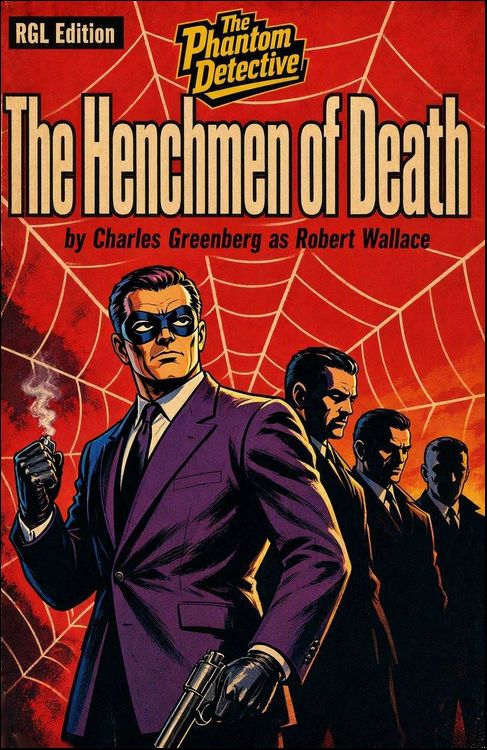
RGL e-Book Cover
Based on an image created with Microsoft Bing software
Roy Glashan's Library
Non sibi sed omnibus
Go to Home Page
This work is out of copyright in countries with a copyright
period of 70 years or less, after the year of the author's death.
If it is under copyright in your country of residence,
do not download or redistribute this file.
Original content added by RGL (e.g., introductions, notes,
RGL covers) is proprietary and protected by copyright.
RGL e-Book Cover
Based on an image created with Microsoft Bing software

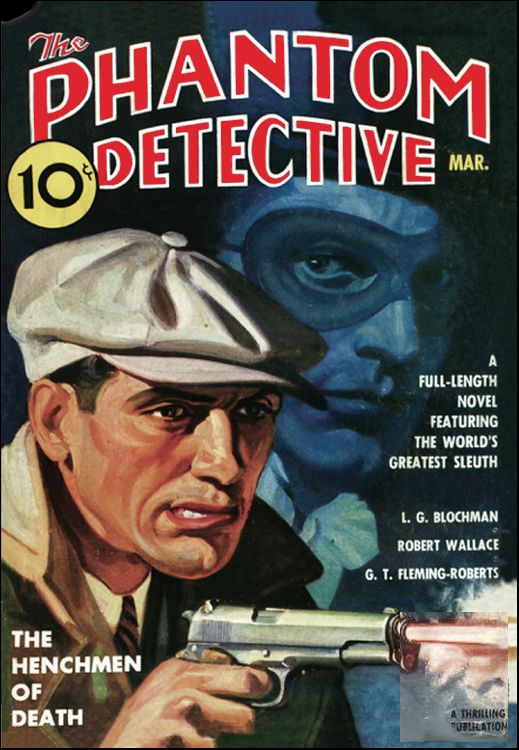
The Phantom Detective, March 1937, with "The Henchmen Of Death"
Crime's recruits, salvaged from death row, join forces in a fiendish slaughter conspiracy! Follow the world's greatest sleuth on a perilous trail of desperate lawbreakers!
THERE was a sudden lull in conversation when Chris Moreno's plump little attorney entered the cell block at exactly eight o'clock.
"Sorry, Chris," he said. "But the governor—"
"Wouldn't grant a reprieve," Moreno concluded casually. "Okay, Straus, you did your best."
A tall, swarthy convict, with the eyes of a predatory beast, a wide-nostrilled, hooked nose, a thin gash of a mouth, he was leaning nonchalantly against the bars. There was a cigar in his mouth, and he puffed on it with leisurely contentment.
The little attorney was going to say something else, gulped, wiped his moist, red face. He looked far more than his client like a man scheduled for electrocution in an hour.
"Well, Chris," he muttered, "I'll say—good-by."
Moreno waved carelessly with the cigar the warden had given him, and the attorney made a choking sound and half trotted on his stubby little legs to the outside door. It was an exhibition of sentiment somewhat absurd in the face of the fact that Mr. Straus knew perfectly well Chris Moreno was a brazen criminal, guilty of perhaps a dozen cold-blooded killings.
Moreno's reddish little eyes passed down the rows of cells facing him. There were eleven of them. The twelfth, the one in which Moreno stood, was at the opposite wall, and much larger than the others. It was here that a prisoner about to be electrocuted spent his last twenty-four hours.
Each of the men in the opposite cells would eventually have his turn in the twelfth cell, which was only six feet from the narrow green door leading into the execution chamber. All had already been condemned to death.
No menagerie had ever held more dangerous beasts of prey than those eleven convicted killers watching Chris Moreno through the bars of their cells. Like Moreno, each was strictly big-time. There were the three members taken alive of the notorious Dutch Gorman gang. The Kellerman brothers, ruthless, deadly killers. Red Munson, Butcher Malloy. Honeyboy Clinton.
Public enemies—all of them. Human wolves who still snarled and sneered even though they stood in the shadow of death. They watched Moreno. They watched the big clock on the south wall. For each in his mind was seeing himself in Chris Moreno's shoes a day, a week, a month from today. Each would visualize himself in that twelfth cell, trouser legs slit, hair clipped, awaiting the brief journey to the execution chamber.
MORENO, aware of the audience, relighted his cigar, holding the lighted match away from it for a few seconds. Just to show the boys that his hands were steady. A Big Shot, he must go out like a Big Shot—
Thus minutes dragged. Eight-thirty. The solitary guard, yawning and bored near the outside door, stood up as it swung inward. Red-faced, burly Warden Thomas entered first. A tall man wearing the black robes of a priest followed him. Two guards brought up the rear.
"If the sky pilot's for me, Warden," Moreno drawled, "you'd better send him home again. I thought I told Father Ryan that I ain't interested in my soul."
"Now, son," the priest said in a solemn, low voice, "you mustn't speak that way. Father Ryan is ill. He sent me here in his place to make a final plea with you."
He was a peculiar-looking man, that priest. A very fair woman frozen to death might have the dead whiteness of his face. Utterly bloodless, immobile. His eyes were veiled, sleepy. In fact, as he began a slow, measured approach to Moreno's cell he gave the impression of a somnambulist. The redness of his too full mouth contrasted oddly with his white skin.
"A final plea," he repeated softly.
He was three feet from Moreno's cell when his hands, hitherto folded across his stomach, began fumbling with voluminous folds of his cassock. Chris Moreno's swarthy face suddenly greyed, and an incredulous expression widened his reddish little eyes.
For Moreno was the first to see the amazing spectacle of the priest separating a three-foot slit on the left side of the cassock. Blue metal glinted there for a moment—the blue metal of a tommy-gun, held supported by bands of elastic against the priest's side.
Moreno's teeth bit through the cigar as he saw the priest jerk the weapon loose from the bands. The black-robed figure now spun about to face the warden and three guards. No longer were his eyes veiled and sleepy now. Greenish, slightly slanted eyes, they had the cruel glitter of a panther crouching to pounce on its kill.
"Put up your hands!" he clipped.
Stunned amazement froze the warden and the guards.
"Up, I said!" the man repeated, and made a vicious little stabbing motion with the tommy-gun.
Automatically, like puppets operated by the same control string, the four prison officials jerked up their arms. The priest, in a crouch with the gun, backed slowly closer to Moreno's cell. Without taking his greenish eyes for an instant from the four men near the outside door, he reached his left hand through the slit in the cassock again.
Moreno's hand, fingers hooked talonlike, darted between the bars to receive the .45 automatic the priest had sneaked out. The metallic click as he pushed down the safety catch was distinctly audible in the silence.
The man in black backed still further—to the cell adjoining Moreno's. And a second automatic was pressed into the experienced, eager hand of one of the Kellerman brothers. A third gun found its way through the bars to another killer awaiting electrocution in the death row of the Lamont Penitentiary.
"Open the cells, Warden," the pseudo-priest commanded harshly. "All of 'em!"
Sweat stood out in tiny globules on Warden Thomas massive red face. He looked at the menacing muzzle of the machine-gun. Glanced at the three killers the priest had armed, each covering him with a .45 from his respective cell.
"All of 'em?" he repeated incredulously.
"Right. And make it snappy." Thomas took down the heavy ring of keys hanging on a hook to the left of the outside door. His hands trembling, his eyes straying involuntarily to the muzzle of the machine-gun, he began opening the cells.
The first man released—a burly, red-headed killer called Red Munson—promptly slugged the warden the moment he stepped out.
"What's the idea?" the man in black said softly. "I'm giving orders here."
"It's kinda been pilin' up in me," said Munson. And something in those greenish eyes made the redheaded killer add hastily: "Okay, buddy, okay!"
Warden Thomas, blood trickling from the corner of his mouth, was now on his hands and knees.
"Take the warden's gun," the priest commanded Munson. "Then disarm the three guards there. And don't try any more ideas of your own. The only way you mugs will crash out of here is by following my orders implicitly—go ahead, Warden; continue opening the cells."
THOMAS lurched to his feet. One after another, cell doors clanged open. When all were empty, the priest ordered the warden and the three guards to be herded and locked into one of the cells.
"Now listen, men," he said, his voice low, tense, his slanted eyes darting from face to face. "We've a minute yet before we get out of here. You're all condemned men, your lives already legally forfeited. You've nothing to lose. Whatever I offer you is still better than electrocution. Just forget that you've brains of your own. I'm doing all the thinking for you from now on."
"That's okay with me," said Moreno. "But who the hell are you, brother?"
"I know," Red Munson guffawed, a gun in each of his hairy fists. "The devil got tired of waitin' for us. So he come up from hell to escort us personal."
The laughter died in his throat when the greenish eyes of the fake priest glanced in his direction.
"You might be right, at that!" he said softly. "Well, let's go. Stick close behind me."
The black folds of the cassock trailing after him, he ran to the outside door. Jerked it open. Perhaps a score of men crowded the corridor outside the death cells. Witnesses for Moreno's electrocution. The prison doctor. Guards. The lanky, leather-faced executioner himself.
Like the warden and the guards in the cell block, they froze into stunned silence at the sight of a priest brandishing a machine-gun emerging from the death house. Then Moreno and Red Munson leaped out into the corridor, and someone screamed shrilly:
"A break! They're crashin' out!"
Two guards at one end of the corridor reached almost simultaneously for their guns. The machine-gun in the priest's hands began jerking like a live thing, vomiting smoke, flame, hot lead. The guard on the left crumpled. The other made a desperate leap for the angle in the wall, planning obviously to use it as a barricade.
HE reached it—yes; but it was a stream of machine-gun lead which had propelled him the last foot or two. Flattened against the wall, arms extended, motionless for a moment, he looked as if he'd suddenly been crucified. He fell with a curious sideward jerk.
Red Munson was laughing his throaty, brutal laugh as, in a wrestler's crouch, he was emptying his twin automatics at the guards at the opposite end of the corridor. Other guns in the hands of the escaping killers joined him. In ten seconds that corridor was bloody shambles.
The fake priest, firing another short burst, now leaped to the door leading out into the courtyard. It was drizzling outside, grey, misty. To the left were the huge steel penitentiary gates, electrically controlled by a guard in a small booth.
Those massive gates were opening now—to admit the regular prison van. If the gate guard became suspicious at the strange face now at the wheel of the van, he did not have much time to wonder about it. A .45 slug, fired from one of the side loopholes in the van, caught him between the eyes, and the top of his head was a bloody horror as he slumped down to the floor of the booth.
The van made a slithering U-turn on the wet, black stones of the courtyard, so that its hood faced the open gates again. Its twin rear doors flew open. The priest was first to reach them. He scrambled inside. Munson followed him. Within three seconds, the other killers were also inside the van.
All but Chris Moreno. Moreno paused as he was about to climb inside. With the unhurried deliberation of a marksman on a target range, he raised his automatic, waited a moment, jerked the trigger. The guard on top of the thirty-foot penitentiary wall, frantically trying to adjust his machine-gun down on the van, threw up his arms. He dropped out of sight over the far edge of the wall.
Then the van—Moreno hanging onto it desperately until someone dragged him inside, the rear doors flapping like the wings of an excited hen—roared through the penitentiary gates. It swerved left into the broad State highway running past the prison.
And in that moment the prison siren went off, bellowing like some monster in mortal agony. Far and wide to the peaceful countryside it proclaimed sinister information—a break at the Lamont Penitentiary!
Other agencies began screaming the alarm during the next few minutes: telephone, telegraph, radio State police cars, motorcycles careened out of barracks and outposts within a radius of a hundred miles of the penitentiary, closing in a radio-controlled dragnet.
A half dozen cars set out in wild pursuit from the prison itself. Grim-eyed, armed men guarded bridges and road crossings. The hunt was on—a hunt that was destined to be the greatest in the history of the nation.
"We'll get 'em," the superintendent of the state police told perspiring, jittery Warden Thomas over the telephone, twenty minutes after the break. "They can't get away, since each is a marked man. We'll have 'em all back in the death cells or in the morgue within the next twelve hours."
"We'd better," said Thomas. "They'll be bloody hell to pay so long as those human wolves are loose."
Some of the cars which had set off in immediate pursuit from the penitentiary began returning. Profiting by the grey mist and the two-minute start it had, the van had got away. As it hadn't been seen crossing the first little town which the State highway bisected twelve miles from the penitentiary, it must have turned off and lost itself in the maze of country roads branching from the highway.
"Get 'em!" the state police superintendent broadcast to his men. "And shoot first! As you would a pack of mad dogs. Get 'em, men!"
The first clue, oddly enough, did not come from a police official. Two frightened farmers with a huge chicken truck lumbered up to the penitentiary. They reported having found the van, abandoned, on a little-used road. Police cars immediately verified the discovery.
The killers had transferred there from the van to two automobiles—automobiles which must have awaited the van at that point quite a while, judging by the oil marks in the road between the tracks of fat balloon tires.
At just about this time, the murdered bodies of the regular driver of the prison van and his assistant were discovered in a clump of bushes not far from the prison. The van, which had left to pick up several new prisoners, had been high-jacked there.
And Father Ryan, the prison chaplain, was found blackjacked in his cottage. Two masked men, he explained when he regained consciousness, forced him at the point of a gun to telephone Warden Thomas and say that sudden illness made it necessary for him to send a substitute clergyman to administer the final rites to Chris Moreno.
"We'll get 'em!" the head of the state police vowed. "They're bound to separate. Then we'll pick 'em up one by one. A weasel couldn't sneak through the cordon we've thrown around that entire territory. Local constabularies and sheriffs' posses are cooperating with us. They're a thousand men on the lookout now for those devils. Every road is blocked and guarded. We'll get 'em!"
A dozen killers, already condemned to death by law, armed and loose somewhere! Residents in that part of the state, who'd learned of the break through their radios, knew the terror of a native village in India when a man-eating tiger was reported prowling in the vicinity. They did not go to bed that night.
And the hunt went on. A dozen killers—armed—loose!
NOTHING quite rivals in drab ugliness, a once flourishing waterfront abandoned for commercial reasons. The last blocks of the side streets which cut to the Manhattan waterfront might have been streets from some deserted western ghost-town. Tumbledown warehouses, now only playgrounds for rats; old factories, most of their windows broken; ancient tenements.
Such was the last block of MacHenry Street. Surely no one traversing it would pay any attention to a certain sagging wooden door, sandwiched between a factory and a warehouse, both ostensibly abandoned. Even if one should lift the rusty latch on that door and enter the rubbish-littered, narrow passageway between the two buildings, chances were he wouldn't even notice another door—a greenish door set into the wall of the warehouse on the left.
A dirty, nondescript sort of door—who would suspect that it was really made of quarter-inch steel which nothing short of blasting could have broken down? And through no flight of imaginative fancy could one have guessed what lay beyond that door.
AN unlimited pocketbook, and intelligent planning had done an Aladdin's Lamp trick with the interior of that old warehouse. Rich oaken panels lined its walls. Oriental rugs lay on the floor. Yet one could see instantly that this wasn't merely the luxurious retreat of some eccentric recluse. A unique personality made itself manifest in this remodeled warehouse.
There was that grim array of weapons in the rack on the wall to the left of the door. Not the odd weapons of a collector, but revolvers, rifles, machine-guns of the latest model and design, the deadliest lethal weapons ever invented.
Perhaps the finest crime library ever assembled occupied the rest of that wall. Hundreds of volumes, many in foreign languages, written by men who had devoted their lives to the study of criminology.
The open door of one of the side rooms led to a small yet completely equipped chemical laboratory, its walls lined with white tile. The room adjoining it was puzzling—until one investigated the three huge steel cases it contained. He would find in them complete outfits for scores of disguises.
And no professional makeup artist had ever had the amazing equipment lining the shelves at either side of the huge vanity table in the center of that room.
A strange and fascinating place, truly; but not any more so than the man responsible for it. It was the hidden lair of the mysterious, internationally renowned personality who called himself the Phantom! The sleuth who had the respect and admiration of Scotland Yard, the Paris Surete, the Berlin Police Headquarters, the F.B.I. in Washington. The grim Nemesis of crime who was feared in the underworld more than the combined might of every law-enforcing agency in the world.
There were scores of people who could have recognized the bronzed, broad-shouldered young man sitting at the desk in one corner of the main room—Richard Curtis Van Loan, a wealthy Park Avenue clubman. Those people knew him as an easy-going young idler who, having inherited a fortune from his father, chose to drift from day to day, charming, sometimes amusing, always ineffectual.
It was an illusion that Van deliberately fostered, for it served to protect the anonymity of the Phantom. Sometimes it taxed even his sense of humor; most of the time he could grin about it.
But there was nothing humorous about his eyes and mouth as he now leaned over the desk. A number of newspaper clippings were spread out upon it. All concerned one story—a story which now held front-page headlines for four days: the break at the Lamont Penitentiary. And the last three clippings he had cut out from this evening's newspapers carried practically the same headline: "Escaped Killers Still at Large."
There it was, amazing, alarming, inexplicable. A dozen killers are rescued by some sinister agency from the death house of a modern penitentiary. They are hidden in some place of concealment that defies the most intense man-hunt in the history of the state. Four days later—and the police still fail to find a single clue of their whereabouts. A dozen convicts, plus the man who helped them escape, simply vanish into thin air!
Several newspapers printed photographs of the escaped killers. For perhaps the tenth time Van studied those vicious, criminal faces. He shook his head. Lord help anyone who crossed their path! There was no conceivable crime that they would hesitate to commit. For everyone already sentenced to death, they were beyond fear of further punishment.
He was brooding over it, his eyes grim, narrowed, when his telephone rang abruptly. Van swung jerkily in its direction. A private wire, only Frank Havens, the millionaire publisher of the Clarion, knew its number—even as only Havens knew the Phantom's true identity. Van had told the publisher that he would spend several days in his laboratory, working on certain chemical experiments.
He scooped up the receiver.
"Hello?"
"Hello, is this Schmidt's Bakery?" A voice which Van instantly recognized as Havens' came over the wires.
"No," Van growled. "You've got the wrong number."
But his heart pounded with excitement as he replaced the receiver. According to the carefully prepared code he had with Havens, the publisher's casual words might, in effect, be translated to: "Vitally urgent. Come to my office immediately."
Vitally urgent! A case? Van forgot the clippings on the desk. He stood up, walked swiftly into his make-up room. The two curved rubber objects which he picked up from one of the shelves near the vanity case would have defied identification if someone hadn't seen Van slip them beneath his cheeks along the jawbone. One on either side, they instantly gave him a pugnacious, massive lower jaw, transforming the entire appearance of his face.
A skillfully applied shading pencil gave the illusion of unhealthy blue pouches below his eyes. Tiny balls of wax distended his nostrils; and a waxlike substance from a small tube, rubbed into his skin, substituted a swarthiness for his bronzed complexion.
The entire process took less than a minute, yet no one would dream now of associating the clean-cut, handsome Dick Van Loan with the thug-like fellow reflected in the mirror. Such was Van's uncanny genius at disguise.
HE had proof of its effectiveness when, thirty minutes later, he walked into Frank Havens' huge, magnificently furnished office. The grey-haired, chunky little publisher, who had known Van since he was a child, looked blankly at the man facing him across his desk.
He suspected that his visitor was Van, because the latter was due there, and Havens knew no one of the name Van had given the secretary in the ante-office, but he was utterly unable to penetrate Van's disguise.
"Okay, Frank," Van grinned. "Stop gaping and let's have it. What's up?"
"I guess I'll never quite get used to you, you young devil!" Havens grinned back. But Van noticed that the grin was forced, and tension shadowed the publisher's kindly eyes. "I had a call from an old friend of mine just before I phoned you. You know him—Joshua Hendricks."
"The banker?"
"Right. He asked me to contact you and send you to his home immediately. His suburban home out in Westchester; you've been there with me once. He said it was something damnably important. Wouldn't commit himself further."
"The proverbial banker's caution," said Van. "Yet from what I know personally about Joshua Hendricks, he isn't the sort of man who's easily flustered. A pretty cold-blooded fish."
"Exactly. And he was excited, Van—shouting into the telephone, asking me twice if I was dead certain I could send the Phantom to his home within the next two hours." Van pursed his lips, shrugged.
"Okay, I'll shoot out there right away."
A NASTY drizzle prompted Van to throw up the collar of his topcoat when he emerged from the revolving doors of the Clarion Building. He crossed to a blue coupe awaiting him at the curb, slid behind the wheel.
Weaving uptown through the evening traffic, he searched his mind for some conceivable reason that could have got a phlegmatic, unemotional banker like Joshua Hendricks panicky to the extent of clamoring for the Phantom. But there, was no sense guessing. He'd know the answer soon enough.
Out on the Westchester Pike finally, Van put on gas, and the big car surged ahead like a thoroughbred feeling the jockey's whip, the speedometer needle now quivering on seventy. A private road, Van knew, branched off the Pike to Hendrick's estate.
Twenty minutes later, Van sighted it, and tires shrieked on the macadam as he swerved in sharply. To turn off the ignition now, thus permitting the coupe to coast the rest of the driveway, was simply a driving habit with Van. He did it automatically, a silent approach to the house not at all his motive. But it enabled him to witness a strange scene only a few seconds later.
As the big coupe rolled down the last turn in the driveway, its powerful headlights for an instant brushed the hunched figure of a man crouching at one of the windows of Hendricks' home. He was standing inside the hedge which ran below that French window, peering apparently through the knifelike chink of light marking a slight separation in the otherwise drawn curtains.
Instantly, Van jammed on the brakes, twisted in the seat. But the man was no longer at the window. In the dead silence, Van could hear the sound of a body crashing through the hedge. Then—and for a moment only—he saw the blur of the man's body, crouched as he ran across the driveway. Shrubs and trees of the heavily wooded estate absorbed him an instant later.
Van was wrenching the handle of the door, intending to pursue the man, when he realized the futility of it. The other had had sufficient start, and it would take a dozen men several hours to search the grounds thoroughly. Besides, the apparent urgency of the banker's phone call forbade further waste of time.
He started the coupe again and swung around to the front of the mansion, parking behind another car there. Getting out, he glanced curiously at that car. It was a flashy, tan limousine, bordered with shiny chromium. Hendricks'? No, a conservative banker wasn't likely to own anything as ostentatious as this glittering creation. It looked more like the property of a Broadway gambler or a Hollywood screen star. Probably someone was paying him a visit.
A wooden-faced butler responded to the ringing of the front doorbell.
"Mr. Havens sent you?" he asked, before Van had a chance to speak.
"Yes," Van responded.
"Follow me, sir. Mr. Hendricks is expecting you."
HE led the way through the vestibule, the magnificent, high living room, then the library. Reaching a little study off the library, barren of furniture except for heavy red draperies hanging over the French windows and a huge office desk, he announced mechanically: "The gentleman you're awaiting from Mr. Havens' office, sir."
The man sitting behind the desk lifted himself ponderously off the swivel chair. A ludicrous figure was Joshua Hendricks, with his cherubic face set atop an immense body; his fringe of brick-red hair running above his ears and along the back of his head, the rest of his scalp completely bald; his absurd piping voice as he told the butler:
"Very well, Judson. Bring the others in here the moment they arrive."
The servant withdrew, and Van, appraising the banker, wondered what he meant by his last few words. Others! A conference of some sort to be held here?
Hendricks waddled around the desk. His little eyes were studying Van. Cold, hard, blue eyes, they suddenly made one forget the physical absurdity of the man. Hendricks was respected as the shrewdest brain in the banking business. As president of the Union National Bank, he controlled one of the most powerful financial institutions in the country.
"So you," he said, "are the Phantom."
"If you don't mind," Van cut in, "let's skip the preliminaries. Why have you asked Havens to send me here?"
Hendricks, himself a man of a few words, nodded with approval.
"All right, we won't waste time. I've sent for you to help me stop what threatens to be the most gigantic swindle in the history of the banking business. Not my bank alone, but four others are involved in it."
"When did you learn of it?"
"An hour ago. The complete expose is on that dictaphone there. I don't know who is directing it, but I do know where the whole bloody crew of them can be trapped if we move quickly.
"I meant to have my secretary type it and send it tonight by special courier to the Department of Treasury in Washington, so that the Federal people can make the arrests. Then I thought I'd consult you first—because the thing must be handled with the utmost delicacy, and I am not at all certain whether summoning Federal agents on the case at this stage is our best initial move."
"Do you suppose," Van said dryly, "it might be a good idea if you explained what the devil this is all about?"
Hendricks indicated the dictaphone on the desk.
"Put on the ear phones and run off the disk that's on it now. It'll save me some breath—and you may as well hear it as I got it."
Van took a step to the desk, when a flat, metallic voice came behind him:
"No, you don't!"
Van swung around just in time to see a man step from behind one of the heavy red portieres. He was a slight, thin-lipped, dark-skinned man, with high cheekbones which gave his face a triangular, cobra-like aspect. The abnormally dilated pupils of his eyes instantly betrayed him as a drug addict.
The grey chauffeurs uniform he wore hung loosely on him, obviously fitted for a much larger man. One of his clawlike nicotine-stained hands held a big blue .38, its long barrel grimly steady on Van's broad chest.
But it was neither the gun nor the man's dramatic appearance which held Van frozen there, even his iron control of himself shaken for a moment.
He had looked at that irregular, cobra-like face earlier in the evening—when he had studied the newspaper pictures of the escaped killers. The man menacing him with that big .38 was Eddie Marlow, one of the captured trio of Dutch Gorman's gang sentenced to die in the Lamont Penitentiary!
TOMBLIKE silence reigned for a few seconds in that little study. Marlow grinned, showing broken black teeth. A grin that was not reflected in his eyes.
"You forgot something, didn't you, Mr. Hendricks?" he murmured.
Van glanced at the banker. There was no alarm on that cherubic face, in those cold blue eyes. Annoyance, rather. Had Hendricks known all along that the killer had been concealed behind those draperies?
He was about to reply when Van, still looking at him, suddenly saw the banker's lower jaw sag. Saw swift terror leap into his eyes. Marlow noticed it too, for his voice now rasped:
"What's the matter? You seeing a ghost?"
Swinging to Marlow, Van had abrupt explanation of what was frightening Hendricks. A door immediately behind the gunman was swinging slowly open. And the man opening it might indeed have been a ghost with the cadaver-like pallor of his face. But there was sinister significance in the .45 automatic in his right hand.
"Easy!" Marlow snarled. "I'll blow you apart before you could reach that gat! What's come over you two mugs?"
Marlow had snarled that when Van made an instinctive motion for the gun in his shoulder holster.
"Behind you!" Hendricks screamed suddenly. "Look behind you!"
"That gag," Marlow snapped back, "was old before you was born. So you called the Phantom here to pinch me, eh, you double-crossin' slob!"
The man behind him, his automatic raised now, obviously to smash Marlow over the head, was creeping closer and closer. It was an incredible situation when any effort on Van's part to save Marlow would have brought a swift bullet from Marlow's own gun. The stalking man seemed to realize the grim humor of it, for there was savage mockery in his slanted, greenish eyes.
With a strangled scream, Hendricks darted to the communicating door into the library. And in that instant some premonition must have warned Marlow of the stalking menace behind him. He whirled suddenly—just as the other smashed down with the automatic.
A glancing blow, it only partly stunned Marlow. He lurched into the other man. So swiftly had that bit of action taken place that only now Van had his first chance to draw his gun. But the first shot fired came neither from Van nor the pair across the study.
Behind him, from the library into which Hendricks had just escaped, two shots cracked out, almost blending into one so quickly had they been fired. A scream followed on their heels—a high-pitched, horrible scream of pain and terror.
Three tigerish leaps took Van to the library door. He was crossing its threshold when a bullet furrowed the wood in the jamb, inches from his head. One of the men he was leaving in the study had blazed away after him. Even in that instant, without glancing back, he realized which one of that pair was firing. That shot unmistakably had come from a .45 automatic.
HE didn't dare to turn, however. For a red-headed, burly man crouched dead ahead of him in the library—crouched with a gun which suddenly belched flame and hot lead. That bullet passed his cheek so closely that Van felt the air it displaced.
He didn't bother replying to that shot. Terribly aware of the killer with the .45 in the study behind him, his spine already crawling as he anticipated the burning impact of hot lead plowing into his back, he threw his lithe body in a long dive to the left of the door, where a low-slung, leather chair stood in the library.
The redhead's gun cracked again as Van's body cleared that chair. He heard the thud of the bullet plowing into it. He fell on his shoulder, rolled over, came up to his knees. Now, at least, he had a chance!
And then the hair on which Van's life had been hanging during the past mad seconds, came closest to snapping than at any other time in the Phantom's career. Focused as his mind had been on the redheaded gunman, forced into lightning-like action, he hadn't time to look around the huge library when he had shot up to his knees.
Shot up and swung right so that he faced the red-headed killer.
Yet another man stood at the book-lined wall less than six feet away from him. One of the effeminate, curly-haired Kellerman brothers whose tongue was thrust between his lips and whose eyes were soft and moist with pleasure as he gently began squeezing the trigger of his automatic—trained at the base of Van's skull.
Then Joshua Hendricks' ridiculous piping voice came with startling clarity after the roar of the shots. A voice now curiously absent of fear, curiously calm and steady.
"Glance left, Phantom!"
A specific instruction, coming from an unexpected source, it did the trick when any wild shout of alarm would have failed. Van could no more help obeying it than he could help breathing. He jerked to the left—just as lead spewed from Kellerman's gun.
The .45 slug churned plaster out of the wall where his head had been an instant ago. Without actually being aware that he did so, Van jerked the trigger of his own gun.
As if lifted by a fist blow, the other's head snapped back. A head that had suddenly mushroomed into bloody horror. For Van's bullet had entered at Kellerman's lower lip, smashing teeth, bone, cartilage as it plowed upward. The man was falling to the heavily-carpeted floor when Red Munson's revolver picked up the mad thread of gunshots.
Twice the red-headed killer drove hot lead toward Van's kneeling body. The first bullet flicked Van's right sleeve. The second summoned a wild echo of splintering glass as it found one of the French windows behind him.
Then the snout of Van's automatic swung right, centered on Munson's broad chest. Van's lips were drawn back over his teeth as he savagely jerked the trigger. Jerked the trigger for the shot which would have sent Munson to hell.
But no crash of gun followed the command of his trigger finger. The cartridge shell of the bullet which almost decapitated Kellerman had not been ejected from Van's automatic. It had jammed, rendering the gun useless. And for the second time in the past ten seconds, Death reached bony claws for the Phantom!
Munson saw the slight forward jerk of Van's gun hand. Realized instantly why the shot hadn't followed. And a slow, sadistic grin twisted the red-headed killer's lips.
"All right, mug, watch it comin'! One, two—"
The ability to think clearly, swiftly, in the face of certain death, was the real explanation of the supposedly charmed life attributed to the Phantom. Panic never clouded the swift functioning of his brain. Infinitely quicker than it would take to relate it, Van summed up the deadly spot he was in now.
Empty gun in his fist. A killer a dozen feet away, who certainly couldn't miss with a deliberately trained, unhurried shot. There was a gun near Kellerman's body—true; but, six feet away, he could never reach it before stopping a bullet from Munson.
He had one chance—a long, desperate chance. While in the study he'd heard two shots fired here in the library. He knew that Munson had fired three more from his revolver. If the red-headed killer was responsible for those first two shots—if they hadn't come from Kellerman's gun—then, and then only, Van had a chance for his life. For it would mean that Munson had only one shot left in his gun.
"— Three!" the redhead concluded, and laughed as his finger whitened on the trigger.
What Van did then was the trained athlete's trick of beating by a fraction of a second, the starter's gun. He was lurching to the left, his body twisting, when flame darted from the muzzle of Munson's gun. Something hot flicked the lobe of his ear.
EVEN as he was falling now, carrying a bridge lamp down with him, the question on which his life depended sent his heart pounding madly. Would another shot crash now from Munson's gun? A shot heralding death, which Van could no longer cheat!
The metallic click of the hammer falling on an empty shell, a muffled curse, gave him the answer. Running footsteps now pounded across the library. Munson escaping. Escaping because Van, throwing himself to the left, was within reach now of Kellerman's automatic. Which reversed the situation.
Eagerly Van scooped up the automatic. Rolled over. Snapped a shot across the library. But he was a moment too late. Munson's burly, brutish body had already darted through the doorway.
Leaping to his feet, Van was racing toward that door when he was brought short by a moan of pain behind him. There, sitting on the floor, his immense body swaying slowly like that of a praying Buddhist, was Joshua Hendricks.
No longer pink and cherubic was the banker's face. Drawn with pain, it was the color of ashes. His hands were clasped across his stomach, and crimson oozed between his stubby fingers. He was still conscious, however, his eyes staring with horrible fixation at Van.
Van approached him swiftly, dropped to his knees. To hell with pursuing those murderous rats now! Not while there was a chance to save Hendricks. For Van hadn't forgotten that he owed his own life to the banker's warning when Kellerman was about to fire.
He gently unclasped Hendricks' bloody hands, and was about to unbutton his vest to ascertain how badly he was hurt, when the banker's head jerked back suddenly. Bloody froth crimsoned his ashen lips. Then the tension went out of his body. His head lolled to one side.
No need now to unbutton that vest. Joshua Hendricks was dead.
VAN'S eyes matched in hardness the blue steel of the gun he still gripped when he straightened up. He found himself staring at the butler who had just entered, no longer wooden-faced and supercilious, but a badly frightened old man.
"They—they got away in a black sedan, sir!" he babbled. "Saw them through the window!" And he added irrelevantly, tears now streaming down his face: "He was a fine master, Mr. Hendricks was. I—"
Van was already running to the door. He crossed the living room, the vestibule adjoining it, fumbled with feverish haste at the lock of the outside door. Those devils had less than a minute's start, and his blue coupe had been especially geared to do well over a hundred miles an hour. He might overtake them!
He jerked the door open, leaped out on the broad, columned porch. And received another stunning surprise of this mad evening. The flashy, tan limousine was parked almost flush with the porch steps, only a dozen feet away. Its inside lights had been turned on. They revealed a woman sitting at the wheel.
The driver's door was open, so that Van had a clear view of her, from the small grey pumps on the clutch and brake pedals to the tight little turban which framed her face. A face that was strikingly exotically beautiful as it looked up at him. Long, curved lashes, white skin, vivid red mouth. Green jade earrings lent it an Oriental touch. A face, once seen, not easily forgotten.
The limousine's motor throbbing rhythmically, Van's first thought was that she awaited him to join her before pursuing the getaway car. Then her red mouth curved in a smile, and she waved with a slim white hand. Both the smile and the gesture might have been the casual farewell of a guest leaving a bridge party. The door slammed shut as the limousine lurched forward.
And Van felt like a fool when he yelled: "Hey, hold on there!"
At reckless speed, its gears grinding, the limousine disappeared around the first turn in the driveway. With one leap, Van cleared the six steps to the porch. Two more brought him to his powerful coupe. He was about to get in when another discovery forced a savage curse to his lips. His front left tire was flat. Hopeless now to attempt pursuit.
Standing there in the dark, silent driveway, the cold, drizzle caressing the back of his neck, Van wondered if all this wasn't some macabre nightmare. For the sequence of events of the past few minutes certainly had all the crazy illogicality of a nightmare. Hendricks' story of a gigantic swindle threatening five banks. Eddie Marlow's abrupt appearance—the first of the escaped killers from the Lamont Penitentiary. The attack. Hendricks' murder—and the bloody scene in the library. And then the casual farewell gesture of the beautiful woman in the tan limousine.
He touched something sticky on the side of his neck. It was blood from the bullet nick at the lobe of his ear. And that blood was a grim reality—real as the blood that oozed between Joshua Hendricks' clasped hands. Blood defined the crimson trail now opening before the Phantom!
RETURNING to the living room, Van did the next best thing to immediate pursuit. He telephoned the Westchester police. The bored desk sergeant who received the call became wide awake as Van said tersely:
"This is the Phantom speaking, from Joshua Hendricks' estate. Mr. Hendricks has just been murdered—by men I've identified as the escaped killers from the Lamont Penitentiary. They got away in a black sedan. Send someone here, and flash a general alarm for the killers."
As he hung up, Van had the uncomfortable feeling that he'd forgotten something. Telling the police to stop the tan limousine in which the woman had escaped? No, that wasn't it, though he should have—He remembered suddenly. The dictaphone! Hendricks had said that the expose of the bank swindle he'd been trying to check was recorded on it, as well as the location of the gang's hangout. Did the killers know about that? If not, then the recording disk should still be on the machine.
And it was—as Van saw when he burst into the study five seconds later. The cylinder hadn't been removed from the dictaphone. With fingers that trembled with excitement, Van put on the earphones, turned the switch. A whirring sound, then a voice. A voice which made Van jerk forward. For it was the voice of a woman. Soft, musical, slightly accented, it said: "The record you want is in my possession, Phantom. I shall turn it over to you if you meet me at the Alhambra Club in Harlem at midnight tomorrow. It is essential that you keep the police out of this."
The message ended there. Van stopped the dictaphone, jerked off the earphones.
"Judson!" he shouted, recalling the name by which Hendricks had addressed the butler.
The servant came in from the library.
"Mr. Hendricks had a woman visitor here tonight?"
"Yes, sir. I was just wondering what became of them."
"Them?" Van repeated sharply. "She came with someone else?"
"Her chauffeur followed when I led her to this study here. It's rather unusual for a—"
"You left the two of them here with Mr. Hendricks?" Van cut in impatiently.
"Yes, sir. They were with Mr. Hendricks quite some time. Over an hour, I should say. I saw them here again when Mr. Hendricks rang and asked me to bring him a telephone directory."
"Do you know why he asked for it?"
"Oh, yes, sir. I helped him look up four telephone numbers. You'll find them jotted down on that pad to the left of the dictaphone."
Van reached swiftly for the pad. Four names, with a telephone number next to each, had been scribbled on it: Henry C. Richman, Roger Blaine, Wilbur Kennedy and John Stuart. Van recognized these instantly as names of men prominent in financial circles, each president or owner of a powerful bank.
"Mr. Hendricks telephoned these men in your presence?" he asked, looking up at the servant.
"Yes sir."
"What did he tell them?"
"That he wanted them to drive down here immediately to discuss something of vital importance. Those were almost his exact words, sir."
"To all of them?"
"Yes, sir."
Van nodded, drummed his fingers on the desk.
"Getting back to the woman and her chauffeur—why did you say that you were wondering what became of them?"
"Because I didn't see them in this room when I led you here after your arrival. And I knew they had not left yet."
"Have you ever seen the woman before?"
"Oh, yes! She's Miss Sally's friend—Mr. Hendricks' daughter. Has been here a number of times during the past two years. Miss Sally told me once that she's a well known dancer."
"Dancer?" Van repeated. "What's her name?"
"Nina La Mar."
Van's eyes widened. The name held instant significance for him, and he realized now why her face was vaguely familiar to him. His mind flashed back several years—to a certain Park Avenue party. A stiff-shirted sort of thing, politely inane, boring. Boring, that is—until the hostess introduced her surprise guest entertainer.
It was, she had said, a young interpretive dancer she'd picked up somewhere. And then Nina La Mar entered the drawing room. Nina La Mar, whose flashing, exotic beauty made weak pastels of the debutantes there. Whose passionate, sensual dancing brought the jungle into that Park Avenue Salon.
She had made a profound impression on Van. Later, he had begun to notice press reviews of her sensational success as a dancer. Some wealthy man apparently had backed her debut, and her very first performance had rocketed her into fame.
AND now he saw Nina La Mar again—at the conclusion of the bloody deviltry that took place in Joshua Hendricks' home. What was her connection with it?
Lighting a cigarette, Van began pacing the small study. A number of things that had puzzled him were now falling into a relatively sane pattern. Eddie Marlow had worn a chauffeur's uniform. Obviously it was in this disguise that Nina La Mar had brought him here. Why? So that Marlow could expose what Hendricks had described as "gigantic bank swindle."
Marlow did that. Told his story into the dictaphone—a direct confession Hendricks had meant to send to Washington. Then Hendricks had telephoned the four other men whose banks were involved in the swindle. He'd also phoned Havens—to send the Phantom to his home.
What had been Marlow's purpose in stepping out with a drawn gun from behind those portieres, Van had no idea. Even as he couldn't conceive what possible connection there might be between the escaped killer and Nina LaMar. But there was no doubt now Hendricks knew that both Marlow and the girl had been hiding behind the portieres.
From the descriptions in the newspapers of the substitute chaplain who had directed the escape, Van knew he was the chalk-faced, green-eyed man who'd opened the door behind Marlow. The obvious implication from this, was that the Lamont killers and the sinister organization which had rescued them were involved in whatever threat hung over those five banks; that Eddie Marlow was going to squeal on his pals, who'd caught up with him here in Hendricks' home.
Then puzzling, baffling contradictions began to show jagged edges in the jigsaw Van had reconstructed. If Eddie Marlow had been double-crossing those men, why wasn't he made to suffer the usual fate of a cornered squealer? They hadn't hesitated murdering Joshua Hendricks; why, then, did the chalk-faced man go to the trouble of slugging Marlow, when he might easily have blown his brains out from that doorway?
Apparently they did not want to kill him. Only to capture him—as they must have done, for Van did not find his body when he returned to the study. And why had Nina La Mar snatched that dictaphone record, substituting another to make the Harlem appointment with the Phantom? What was her motive?
There was a draft in the study. Van saw its source a moment later. One set of portieres billowed before an open window. Van approached it, drew aside the portieres, stuck his head out. A beam from his pocket flashlight showed footprints in the soft flower bed below the window.
They were clear imprints of high-heeled woman's shoes, leading diagonally left from the window—to where the tan limousine had been parked. That was how Nina La Mar had escaped from the study. But there was also another set of footprints below the next window—the window, Van realized suddenly, where he had seen that spying figure upon his approach to the house. As that window was slightly open for ventilation, the man must have overheard, not only seen, what was happening in the study between Hendricks, Marlow and Nina La Mar.
A valuable witness, whoever he was. One of those Lamont killers? The chalk-faced man? Van Loan shrugged. Enough of speculation. From the crazy jumble of facts that he had, any weird interpretation might be made.
HE left the window, walked back to the library—just as a man entered it from the living room. He was a dried-up, stoop-shouldered, lanky men, whose face had the brown gauntness of a mummy, parchmentlike skin stretched tightly over his cheekbones.
He saw Van, was about to speak, when something else he had just noticed brought a choked exclamation to his lips.
"Merciful heaven!" The newcomer's eyes, wide with horror, were staring at Joshua Hendricks' body. "Who," he gasped, "did that?"
Van ignored the question.
"Who're you?" he demanded. Only partly aware that he was replying, his eyes still glued with horrible fascination on Hendricks' body, the lanky man muttered:
"Kennedy's my name. Have an appointment here with—" His voice rose. "In the name of heaven, what's happened here?"
A new terror now in the man's eyes. Terror born from the sight of the gun in Van's fist—from the abrupt realization that he might be speaking with the actual murderer. Van dissipated that fear a second later, when he extended his left hand, a hand on the open palm of which glittered a tiny jeweled object. Platinum, studded with precious stones, it was in the shape of a tiny mask. The insignia of the Phantom, known the world over! Kennedy jerked up his eyes.
"The Phantom!" he whispered.
"Yes," said Van. "Now please return to the living room, Mr. Kennedy, and wait there. I don't know whether you're aware of it, but Mr. Hendricks had also made appointments with three other men in the banking business. They should show up any minute. Hold them in the living room until I join you. I'll give you the details of what has happened here when they arrive."
The banker was about to demur, when he suddenly noticed the bloody horror of Kellerman's practically decapitated body. His face livid, he stumbled into the other room.
Van glanced at the dead gunman, and again those baffling, inexplicable questions began pounding at him. Who had supplied Kellerman those civilian clothes for his prison uniform? And why? How were those killers intended to be utilized in the threat against the five banks that Eddie Marlow had exposed to Hendricks?
He shook his head, and approached the grotesquely twisted body. There might be something of significance in Kellerman's pockets. Some clue, perhaps, of where the killers were hiding out.
With swift, deft fingers, he began searching the body. A murderous-looking spring knife, cigarettes and matches, a handkerchief were the sole contents of his trouser pockets. Nail-file and comb in his vest. Nothing in the side pockets of his jacket, but in the inside breast pocket Van found a square grey envelope. Blank and unsealed, it seemed to contain a card of some sort.
He was about to open it, when voices reached him from the living room. Wilbur Kennedy's nasal voice, yelling shrilly:
"Yeah, murdered. And I would not be surprised if you had plenty to do with it. Why else should Hendricks call this conference if not to smash down on you—as I warned him to do two years ago?"
A voice, the cold, murderous intensity of which brought Van to his feet, replied:
"Damn you, Kennedy, I've always wanted to wring that skinny neck of yours! I'll—"
A terrified scream drowned out the rest of his words.
Stuffing the envelope in his pocket, Van raced to the other room. A grim spectacle met his eyes when he crossed the threshold. Wilbur Kennedy's lanky body was arched across the back of an easy chair. A heavy-set man in grey tweeds was towering over him, his hands at Kennedy's throat, one knee rammed into the banker's stomach.
A horrible gurgling sound replaced Kennedy's screams. His eyes were popping out of their sockets. And still the man in grey tweeds drove Kennedy's head back, back over the chair, his fingers imbedded in his victim's throat.
IF MURDEROUS lust ever raged in human eyes, it was in the eyes of the man in tweeds. A maniacal fury twisted, distorted his beefy red face. "If I burn for it," Van heard him pant, "I'll choke the—" He never concluded the sentence. Van, darting up behind him, threw a muscular arm about his neck. Tightened it. Jerked back. Now the situation was abruptly reversed. It was the man in the grey suit who was gasping for breath, his head thrown back, as Van's arm continued tightening mercilessly.
The man released his hold on Kennedy, began flailing helplessly with his arms. Van tripped him with a clever jui-jitsu trick, sent him crashing into the wall. The other slid along it, regained his balance, swung around. He was about to charge at Van, hell in his bloodshot eyes, when he noticed the big automatic in Van's right fist.
"Yes," Van nodded coolly, "it might go off."
Sanity began to creep back into the man's eyes. He straightened from his crouched position, glared at Kennedy. But it was neither he nor Van who spoke next. A cool, mocking voice came from the outside door of the living room:
"Quite a lovely scene, really, gentlemen. Some of your depositors should witness it. They'd be so interested to learn what quaint little games bankers play in their leisure hours."
The speaker's appearance went well with that mocking voice. A tall, thin man immaculately dressed, he stood leaning indolently on a silver-knobbed cane, his long, saturnine face nodding pleasantly at the three men staring at him now. There was intelligence and sophistication in his black eyes, and a certain ruthlessness in the lines of his thin-lipped mouth. The sort of man, Van thought instantly, who'd make a dangerous enemy.
The short, chunky man behind him, chewing a black cigar, had a hawklike face, a beaked nose, bushy grey eyebrows, a steel trap for a mouth. It was he who spoke now, in a dry, rasping voice:
"What the hell were you trying to do, Richman?"
"Just what you saw," the man in grey tweeds replied surlily; "trying my best to strangle that ugly devil."
"All right," Van snapped, "I'll take the floor now."
"By what authority, may I ask?" drawled the man with the cane. "Who the devil are you?"
"He's the Phantom!" Kennedy supplied before Van had a chance to reply.
"THE—the Phantom!" the man with the cane repeated. The expression of mocking amusement left his eyes now as he appraised Van. "Well! I'm certainly honored to meet you, sir. I'm Roger Blaine."
"And I," said the man behind him, "am John Stuart. I've an appointment here with Mr. Hendricks."
"You'll never keep it," Van said grimly. "Mr. Hendricks has been murdered."
"Murdered!" Stuart half shouted, stepping forward. "Why? By whom?"
"I'm the killer—according to Kennedy," the man Stuart had addressed as Richman said belligerently. "Why, he actually had the nerve to accuse me of it when I walked in here. That's what made me go berserk. For years I've tolerated being hounded by him financially, but to be bluntly accused of being a murderer—"
"I," said Kennedy, "had excellent reason for saying what I did. And what's more, Richman, you damn well know it!"
The beefy-faced man looked as if he was ready to throw himself at Kennedy again, when Van's voice cut in coldly:
"What is that reason, Mr. Kennedy?"
There was a brief pause. Kennedy drew a package of cigarettes, lighted one. Deliberately, it occurred to Van. Playing for time. When he spoke, his voice was steady, composed:
"I spoke hastily. There's no reason, really."
Which, Van knew, was a lie.
"Do you expect me to swallow that?" he asked angrily.
Kennedy shrugged. Then Blaine put in smoothly:
"Oh, Hendricks and Richman were always quarreling at the club. Over minor things, you know. But it's hardly motivation for murder."
Yes, Blaine was now helping Kennedy to cover up. Cover up what, damn it! What new mystery was further complicating matters now? Van knew it would be useless to question Kennedy further about it. Then he saw something which forced his thoughts into another channel. There were tiny particles of mud on Blaine's shoes. In the seam where the soles joined the top of the shoes. At the back of one of the heels. Peculiar, reddish little particles of mud.
Then Van remembered—and it sent his heart pounding with excitement. The flower bed below the window had been sprinkled with loam. The drizzle had softened the earth, the resultant mixture forming what looked like reddish clay.
Van even saw now faint greenish smudges on Blaine's topcoat; caused by the wet hedge when he had torn through it? Was Roger Blaine the man who had spied through that window?
Van controlled the impulse to ask the pointblank question that was on his lips. Blaine would certainly deny it—and Van did not want to forewarn him that he was suspected.
"You promised," Kennedy spoke up now, "to give the details of what took place here when these gentlemen arrived. Don't you suppose now—"
"Yes," Van said wearily.
Briefly he sketched the mad sequence of events up to Kennedy's arrival, omitting, however, the part Nina La Mar had played. He did not want a police alarm out for her. There was a short silence when he finished; then, as he had expected, the quartet of bankers began hurling questions at him.
What, did he think, was the threat hanging over their banks? What precautions could be taken against it? Van cut them short with a gesture.
"Right now," he said, "I know as little about it as you do. I've one lead—but I do not care to expose it. I believe I'll have the key to the whole baffling mystery at midnight—that's two hours from now. Be close to your telephones, and I'll give each of you a ring the moment something breaks. Until we learn precisely what we have to fear, there are mighty few precautionary measures we can take."
"I may point out," Kennedy said soberly, "that the bank failures of several years ago are still fresh in the public's mind. If news gets out that a sinister organization, having as henchmen those escaped Lamont killers, is planning some gigantic coup against our banks, it might easily precipitate panic among our depositors, with subsequent runs on the banks. Which, very frankly, would be disastrous."
Van nodded. He saw Kennedy's point, but it would be next to impossible to clamp down on the publicity of the murder of a man like Hendricks. That in itself meant front-page headlines. But the link with the escaped killers—to which Kellerman's body attested—certainly would supply the most sensational story of years. Yes, he'd have to work fast.
However, there wasn't a move he could make now, not a single lead where he could even begin an investigation—unless he kept his rendezvous with Nina La Mar. The very thought of the dancer made Van coldly furious. What had been her object in enforcing that delay? Deliberately escaping with the dictaphone record which would have exposed the motivating forces behind this evening's deviltry, as well as the very location of the gang's hangout.
The arrival of the police now supplied an unwelcome diversion. For Van again had to go through the weary business of identifying himself, of explaining what had happened. Again there were those incredulous questions, wild theorizing.
When he escaped finally, walking out to the comparative quiet of the porch, his nerves were jangling. He slipped his hand in his pocket for his cigarettes, and suddenly felt the grey envelope he had found on the dead gunman. Richman's attack on Kennedy had delayed the examination of its contents, and he'd almost forgotten it.
Stepping closer to the porch light, Van opened the envelope, extracted the card it contained. And then he received what was perhaps the most stunning surprise of this mad evening. He was staring at an engraved invitation:
Mr. and Mrs. Hugh Weber
cordially invite you to attend
the masquerade ball held
on Thursday, September, Ninth, 1936,
at their Long Island estate,
the Casa Villa.
Hardly believing his own eyes, Van kept staring at that invitation card. The Webers, he knew, were the leaders in that Long Island society.
And an invitation to their masquerade ball, held this evening and a yearly social event second in importance to none, was in the pocket of a condemned murderer escaped four days ago from the Lamont Penitentiary!
The very incongruity of it made it seem like some macabre joke. The crowning fantastic, nightmarish touch to what had already happened here!
FIFTEEN minutes to eleven, exactly thirty minutes later, Van's powerful coupe roared across the Queensboro Bridge. He had changed the flat tire on his car, made a whirlwind trip to his laboratory, and was now driving at furious speed toward the Weber estate.
The brown monk's gown over his clothes explained his trip to his laboratory. Weber's guests would all come masked and in costume, their invitation cards only proof that they were really legitimate guests. Van had recalled that from having attended Weber's last year's masquerade ball; even at that moment, ironically enough, there was an invitation similar to the one Kellerman had, in Van's Park Avenue penthouse.
The reason for arriving masked was to lend a pleasant element of suspense, until the unmasking time at midnight.
The invitation in Kellerman's pocket suddenly ceased being absurd and undertook a sinister significance. For it would have offered the gunman, safely masked, undisputed entry into Weber's home. It was for this reason, undoubtedly, that the forged or stolen invitation had been given Kellerman.
As Kellerman was only one member of the gang, similar invitations had probably been supplied to the others too. Some deviltry had been planned to take place during the masquerade ball; Van fervently hoped he'd be in time to check it.
Crouching grimly over the wheel, the speedometer needle now quivering on ninety, Van wondered what should be his course of action when he reached Weber's estate. He knew there would be a score of private detectives employed by Weber in the house itself and on the grounds, so there was no necessity to telephone for police reinforcements.
And a telephone warning, without being able to supply any further specific information, would, Van feared, only be jeered at as a joke. Behind all this rationalization, the maddening question still persisted: why this new lead to Hugh Weber, a millionaire oil man, who, so far as Van knew, had no connection with those five banks? Why should those killers want to be present at the masquerade ball?
Van was no nearer to the solution, nor to what plan of action he should take, when the two stone lions marking the entrance to Weber's fenced estate flashed into view. He slowed up, threw the hood of his monk's costume over his head, adjusted a black felt mask over his eyes.
TWO men stopped him when he swerved through the massive iron gates. Hard-eyed, tough-looking men who, Van knew instantly, weren't servants. Private dicks guarding the ball!
"Your invitation card, sir?"
"What," asked Van, "if I hadn't brought it with me?"
"Then you'll have to be identified by Mr. Weber's secretary. Nobody's crashing this party, brother." Van laughed, produced the invitation card.
"I hope you're right about that," he said grimly.
The detective examined the card, waved him to drive on. Yes, thought Van, those killers would have had no difficulty getting in. He continued up the driveway, now lined with glittering town cars and limousines.
Joshua Hendricks' estate, pretentious enough, was a squatter's shack in comparison to the breath-taking magnificence of Hugh Weber's million-dollar home. It was the exact replica of a famous French chateau.
Lights flooded from the enormous windows of the main hall. Strains of waltz music drifted out into the grounds. As Van parked the coupe and walked toward the house, he could see colorful figures dancing past the windows.
He shook his head at the servant offering him a cocktail when he entered the main hall, discouraged a fat Cleopatra who began sidling up to him coquettishly, and, edging quietly to the wall, watched what perhaps is the most colorful scene imaginable—a masquerade ball in full swing.
Streamers of confetti hung from the lofty ceiling. A half dozen colored spotlights threw moving beams of red, green, blue and yellow across those dancing figures. Figures in every conceivable costume—from those drawn from the colorful past and mythology to modern uniforms of sailor, policeman and cowpuncher.
They streamed past Van. The Roman centurion. The pirate. The Venetian gallant. The Moor and the Crusader, contrasted incongruously with doughboy and the man in the brass hat of a fireman. A fantastic, exciting array.
THEN Van spied a couple that made him jerk forward involuntarily. The man wore the regular striped uniform of a convict. Van grinned to himself, relaxed. A convict's costume should be no more startling here than, for instance, that grotesque-looking skinny man in a leopard's skin. Common enough at any masquerade ball. It was just that he had those damn killers on his mind.
That couple was approaching Van now, and he would have paid no further attention to the pair if the girl hadn't stopped abruptly and swung away from the man. Slim, gracefully built, she wore the tiny skirt and blouse of a Degas ballet dancer.
"I think I've had enough," Van heard her say.
The man jerked her close to him again.
"What's the matter, Babe—ain't my steppin' good enough for you?" Even the tough, illiterate voice did not arouse Van's suspicions. At a masquerade ball one was supposed to act in character with the disguise he wore. The girl's answer, however, sent his heart pounding with sudden excitement.
"It isn't your dancing," she snapped back. "But I've had enough of the conversation that is quite in keeping with your costume—but decidedly out of place in a drawing room."
Van didn't catch the man's reply, but he did hear the girl say, again struggling to disengage herself from the man's arms:
"And now you're being ridiculous. I've no desire to leave the ball with you."
Van stepped forward as the convict, with clumsy playfulness, began to urge the girl toward the outside door. Another man, however, reached them first. A tall man, majestic in an Arab chieftain's flowing white robes, he grabbed the convict's arm.
"Look here," he said angrily, "I didn't mind you cutting in when I was dancing with the young lady, but I do think you're rather carrying things too far now."
"Oh, yeah?" the other snarled. And, swinging the girl to one side, the convict floored the Arab with a single vicious uppercut. The girl screamed. A round little man, ludicrous in Cossack's uniform, now tried to grapple with the convict. Again that hamlike right fist swung back. But the blow never reached the little man.
Van caught the convict's wrist—twisted it. Jerked the man toward him. Then he flexed his knees, and, half turning, using the other's arm as leverage, hurled him over his shoulder. A clever jiu-jitsu trick, lightning-like in its execution, it sent the convict crashing against the wall a dozen feet away.
Van was sure of the grim truth he had suspected. From several directions in the hall, other men dressed as convicts began plunging through the crowd. Screams of women and men's curses followed their progress. Screams and curses which an instant later intensified into wild bedlam as guns appeared in the convicts' hands. They were literally slashing their way through, gun butts flaying left and right, to Van and the man he'd just slammed against the wall.
That man was lurching to his feet now. His right hand darted beneath his convict's blouse. Van did not give him a chance to draw the weapon. He leaped in. The blue steel of the other's automatic slid into view as Van smashed his fist into the man's masked face.
Crimson rivulets of blood instantly trickled from beneath the mask. For the second time he lurched back into the wall, went down. Van was on top of him like a tiger pouncing on its kill. Again his fists pounded that blood-soaked mask.
A guttural curse, then a vicious blow below the belt which sent hot prongs of agony clawing through Van's vitals. But Van's primary concern now was the man's right fist. A fist that was still trying to swing that blue automatic.
It wasn't fear for himself that prompted Van's desperate lunge for the other's gun wrist. Any shot fired in this crowded hall was bound to find a victim. Feeling instinctively that he couldn't catch that wrist in time to prevent a shot, Van simply slashed downward with the edge of his hand.
It caught the man across the forearm, two inches above the wrist—a blow paralyzing in its effect. The man's arm sagged. And as the hand holding the gun touched the floor, Van's knee came down on it.
Cursing savagely, the man then writhed like a snake, with a broken back. Van's right fist was drawing back for a blow that would have terminated this brief, savage deadlock, when something crashed behind his left ear. It was a heavy boot directed by one of the other convicts who now reached them at the wall. The vicious kick drained strength from Van as if all his arteries had suddenly been opened.
He fell away from the convict beneath him. Felt that boot toe slam into his ribs. The next kick would bash his face in. Desperately, summoning the last ounce of strength remaining in his body, he rolled over, jerked up his arms to protect his face.
THE kick was not delivered. A voice which somehow made itself audible above the general bedlam now shouted:
"Freeze, everybody!"
Separating his arms, Van saw the speaker, standing over the body of the unconscious band leader on the orchestra dais. A tall, masked man wearing the black robes of a priest, he was hugging a machine-gun beneath his right armpit. A machine-gun whose black muzzle was swaying slowly like the venomous head of a snake.
"I know that the dicks among you," he continued, now in deathlike silence, "are itching for their guns. First gun that shows up, first man who makes a funny move—and the whole joint gets a bath of lead!" The next few words were obviously addressed to his men: "Get the dame and her old man, and scram. Quick!"
Van saw one of the convicts grab the girl. Another slugged the little man in the Cossack's costume. He caught his body as it was falling, slung it over one shoulder. Then in a compact little group, they plunged toward the exit door.
The machine-gunner leaped off the orchestra dais. As he edged along the wall, he might have been the scourge of death itself, terrified silence freezing the several hundred men and women watching his departure.
VAN controlled the overpowering impulse to draw his gun. He knew only too well the bloody horror that would result from a single burst of that tommy-gun.
Silence still hung over the hall—until the convicts, their two prisoners, and the machine-gunner disappeared through the exit door. Then, as if by prearranged signal, a dozen women began screaming simultaneously. Van scrambled to his feet. Half staggering, still weak from those brutal kicks, he ran to the exit door.
He was just in time to see a heavy black sedan lurch away from the mansion, hurling cometlike down the driveway. The savage hammering of a machine-gun now came from it. Van did not know whom they were firing at, but a scream attested to the accuracy of that murderous spray.
His own gun lanced vicious streaks of orange into the night. Then the rear red light of the sedan winked out of sight around a curve in the driveway. Van looked around wildly. It was a hundred yards from here to his own coupe. Running toward it would mean a waste of precious seconds.
A huge, town car near the house, its liveried chauffeur at the wheel and gaping after the getaway sedan, caught Van's attention. He ran toward it, hopped on the running board.
"Chase that sedan, quick!" he snapped to the chauffeur.
The man obeyed automatically. Van still on the running board, the big car catapulted down the driveway. It skidded the first sharp turn, grazed a tree trunk rounding the second. A straight stretch here to the gates of the estate. Then the chauffeur yelled something, and reached frantically for the emergency brake.
The massive iron gates were closed. Through the bars, Van caught a glimpse of the black sedan, swinging right into the road that crossed there. Cursing under his breath, Van jumped off as the town car was still skidding to a stop.
A chain, he saw a moment later, secured the joining inside bars of the gates. A chain as heavy as the padlock which joined the last two links. Van was reaching for his ring of skeleton keys, when he noticed that it was a cylinder combination padlock. Impossible to pick it. And the sturdiness of the brass lock defied any attempt to shoot it off.
He pulled off his awkward monk's robe, jammed the gun back into his holster. With the swift agility of a monkey, he climbed over the gate. As he dropped on the other side, a roadster, containing two men and two women in costume, late arrivals to the ball, stopped abreast of the gate.
"What's happening here?" the man at the wheel asked. "We heard shots..."
"Get out!" Van cut in curtly. "All of you."
"What's the idea?"
There was no time for explanations then. Van jerked out his gun, made a threatening gesture with it. "I said —get out!"
In ten seconds, the roadster was vacated. Sliding behind the wheel, Van made a slithering U-turn and roared down the highway after the getaway sedan. From the way the expensive car responded to Van's pressure on the accelerator pedal, he was grimly confident that he would overtake the killers.
It was a tricky road to maintain the terrific speed at which Van was now hurling the roadster. Sharp curves, with an embankment on one side, and a thirty-foot drop to a muddy creek on the other. Only an inadequate wooden fencing protected that edge.
"Danger—Drive Slowly," warned the road signs; nevertheless Van whizzed by them at close to a hundred miles an hour. His powerful hand held the wheel firmly; his entire body was attuned to the mechanics of driving.
IT was a flirtation with death as dangerous, perhaps, as facing that tommy-gun. But Van was desperately anxious to sight the getaway sedan before it had a chance to roar beyond sight. A half dozen highways crossed and joined at a hub further on, and it was impossible to foresee which of those roads the sedan might swing into.
No intersecting roads, however, crossed the ten-mile stretch to the hub. No possible way for the killers to confuse pursuit. It was this knowledge which had forced Van to take the attitude he did with the owner of the roadster. Every second was precious.
Another hairpin turn—and now a rear red light winked dead ahead. Van jerked his foot off the gas pedal. His right hand groped for the automatic he had left on the seat beside him. But he had just seen something that—was perhaps even more significant than the rear red light ahead.
Skidding that last and particularly vicious turn, his swerving headlights revealed a huge gap in the wooden fencing at the edge. It certainly looked as if a car, failing to make the turn, had crashed through at that point.
That suspicion was strengthened when he now noticed with what speed he was overtaking the winking light ahead of him. The getaway sedan would certainly travel faster than that. Several seconds later, he saw that the vehicle he was nearing wasn't even an automobile. It was a loaded chicken truck, lumbering along serenely in the middle of the road.
It swerved to one side as Van pressed his horn. Jamming down the gas pedal again, Van roared by. He didn't dare to return to investigate the break in the fence. If caused by an accident possibly earlier in the day, returning to it would surely give the getaway car an opportunity to run the gauntlet of that stretch of road.
Still maintaining that suicidal speed, Van passed several other cars, none even faintly resembling the black sedan. His heart sank as he recognized the last lap of a mile or two to the road hub. Another minute or so would determine whether the killers had a reasonable chance of escaping. If he did not sight that sedan—
Then the huge, landscaped circle flashed into view. Like the spokes of a wheel, five roads branched from it. Van jammed on the brakes, looked around quickly. All of these roads seemed deserted at the moment, so far as he could see. No distant glare of headlights, no flash of a tail-light.
The getaway car might have taken anyone of those five roads. Impossible to determine which. Savagely, Van swung the roadster around the circle, careening back into the road to Weber's estate. The break in the fence—had he interpreted it correctly, after all? The sedan had plunged through there?
And Van was certain he was right when he neared that turn several minutes later. Three automobiles were parked there now, their headlights crisscrossing. A number of men, some in costume from the masquerade ball, were peering over the edge. Stopping the roadster, Van hopped out, ran to join them.
The very first comment he heard tipped him off to what had really happened. It came from a burly state trooper, yelling to someone below:
"What d'you mean there's nobody in it? You're crazy, man! They couldn't have had time to hop out before that bus went over. And from the way it smashed, no one inside could've escaped with a whole neck. Why, it's—"
"You're wasting mighty precious time, brother," Van cut in curtly. "There was no one in that car when it went through the fence."
"You mean," the trooper growled, appraising Van suspiciously, "they wrecked it just for the fun of it, eh?"
VAN grinned wryly. "They wrecked it so that you—or anyone else pursuing them—should pause here and go into a huddle about it, while they, in another car which met them here, get sufficient start to insure safe getaway. You'd better get to the nearest phone and start burning the wires."
"Somebody already flashed the alarm to the barracks," the trooper replied shortly. He took a step closer to Van. "You seem to know a lot about this, buddy. What else can you tell me? And suppose you take off that mask."
His hand darted to his holster as Van suddenly reached beneath his coat.
"No, you don't! Put up—"
Then his lower jaw dropped. He was staring at the small glittering object on Van's palm. Moonlight reflected on the platinum and jewels of the Phantom's badge. The trooper's swift change of attitude was a tribute to the Phantom's reputation.
"Sorry, sir," he said apologetically. "I had no idea, of course, that you—"
Van checked him with a curt gesture. "Never mind that. That little fat man and the girl snatched by those killers—have you found out who they are?"
"No."
"I can answer that," someone spoke up now.
Turning, Van found himself looking at the tall man in Arab's white robes whose interference with the convict dragging the girl had started that swift sequence of action. Unmasked now, his handsome young face was grey beneath its tan.
"She was Ruth Hollis, my fiancee," he went on.
"The man?"
"Her father—Gregory Hollis. "I—I don't see why they picked on them. There were much wealthier people present there."
"Tell me," Van asked quietly, "what is Mr. Hollis' business?"
"He's a manufacturer."
"Has he any connection that you know of with these banks?" Van named the five banks involved in whatever Hendricks had feared.
The young man shook his head. "No. I've an executive position in Mr. Hollis' firm. We haven't even an account in any of the banks you've mentioned."
Another maddening mystery was now added to the already long list. Why the kidnapping of Hollis and his daughter? Van felt morally certain that it must have some bearing on the unknown menace overshadowing those five banks. It couldn't be merely a snatch job for a money ransom.
And again he found himself plunging into the aimless cross-current of wild speculation. Futile guessing. Coldly angry, he snapped out of it, glanced at his wrist-watch. After eleven. Less than an hour to his appointment with Nina La Mar. She could supply the key to this baffling riddle. Until then—
"Would you do me a favor?" he asked the trooper.
"Anything you say."
"I'd like transportation to the Clarion Building in Manhattan. Immediately. I'll pick up my own car later; that roadster doesn't belong to me. Its owner is one of Weber's guests."
Five minutes later Van was hunched on the rear seat of a police car bearing him to the city. He couldn't help marveling now at the boldness of those devils. Wearing their actual prison clothes to Weber's masquerade ball!
And why not—when faced with the necessity of arriving in costume? The one place on earth where a carful of convicts could drive up without arousing any alarm was a masquerade ball!
The fake priest had even worn the same black robes which had gained him entrance into the death cells. In a way, it had been a reenactment of what had happened at the Lamont Penitentiary.
A brilliant brain was directing those killers. A brain which had already proved itself capable of planning and successfully executing coups which taxed credulity. Toward what smashing climax was all this deviltry leading to?
FRANK HAVENS repeated Van's unspoken question in the publisher's office an hour later. Van had outlined, as briefly as he could, the bloody sequence of events since his arrival at Hendricks' home.
"But what conceivable connection," Havens wondered, "could the kidnapping of Hollis and his daughter have with the threat hanging over those banks?"
Van shrugged.
"That La Mar woman," he said savagely. "She holds the answer to this riddle! I still don't know whether I should have a police alarm flashed for her. The cops would probably pick her up, but she had insisted—Oh, hell!"
The poison of frustration eating at his vitals, Van began pacing the office. There was one incident from that wild kidnapping scene which kept returning to him. The loaded chicken truck he'd passed not far above the place where the killers had run their car off the road to delay pursuit!
Farmers in a chicken truck had reported the discovery of the prison van. Was it merely a coincidence that on the two occasions when the Lamont killers had abandoned cars to transfer to others, a loaded chicken truck had been conveniently nearby?
Van also recalled now that there had been something in the newspaper accounts of the prison break over which he had been puzzling when Havens' call came in. Hadn't it something to do with that damn chicken truck?
HE paused in his pacing, glanced at Havens.
"Could you get me the clippings on the Lamont prison break?"
For answer, Havens picked up his telephone, murmured something into it. Less than two minutes later, a copy boy handed Van a bulky envelope.
Slowly, Van ruffled through the clippings. Then he found the one small paragraph which had interested him earlier. A Clarion reporter had interviewed the two farmers. He quoted them as saying that they were returning to their farm when they ran across the van. Why, Van was asking himself now, should farmers bring a load of chickens to their poultry farm? Wasn't it logical to suppose that they would load on chickens only to bring them to a city market —notthe other way around?
That one discrepancy unleashed other exciting conjectures. Wasn't it possible that the Lamont killers had really transferred to the chicken truck from the van? That the killers had actually been concealed in the truck parked outside the penitentiary gates while a thousand law officers combed the highways for them?
So logical was that probability that Van decided to investigate it immediately. Eagerly he scanned the accounts until he found one giving the location of the chicken farm—on route 11A, south of the penitentiary, and three miles off the main highway.
"I'm driving out to look into something, Frank," he told Havens. "It might be a false alarm, and then again—" He shrugged.
Five minutes later, Van was driving another of his inconspicuous yet deceptively powerful coupes out of a nearby garage. Grimness of purpose set his jaw, lent a flinty hardness to his eyes. If his reasoning had been sound, if that farmhouse was the killers' hideout, hell would flame. And every fiber of the Phantom's body thrilled at the thought of ferreting out those murderous vermin. If his reasoning had been sound—
AT two o'clock Van neared his objective. He swung the coupe off the muddy country road. Overhanging branches scraped it as he headed the car into an unfenced pasture maneuvering it so that it would be out of sight behind a clump of trees.
He slid out from behind the wheel and warily made his way toward the oblong of light some two hundred yards ahead. There was no moon in the sky. A handful of stars twinkled coldly above. An enveloping blackness flowed like a liquid over the countryside.
Van thought he sensed something sinister in the darkness, something menacing in its very density. The night seemed an ebony mantle designed to cloak unspeakable evil.
Cautiously, he approached the house. It was a squat two-story building, standing some distance from the edge of the road. At the rear, a shapeless barn loomed eerily in the darkness.
Skirting the house itself, Van began circling toward its rear. He walked on silent feet, every nerve, every muscle of his body tense and alert. A wild excitement pounded in his blood. Was this the house that hid the murderous secret of the death cell? What concealed the answer to this crimson riddle?
The oblong of light expanded as he came closer. His keen eyes were fixed on the pane of the window. Then he saw a shadowy figure pass in front of it. His hand tightened on the cold butt of his automatic. Within twenty yards of the house, he dropped to his knees, keeping out of the beam of light which shone frostily through the night.
Closer, closer he crept, until at last his fingers touched the cracked paint of the shingled wall. For a long time he knelt there, motionless. From the room within, a trickle of voices came to his ears. He removed his cap and cautiously thrust his head above the window sill.
Two men were inside the room, clad in the conventional blue denim of the farmer. They sat on either side of a plain wooden table, a checkerboard between them. Van Loan frowned as he watched them now. The scene certainly seemed innocent enough.
The room in which the pair sat engrossed in their checker game was a huge, old-fashioned kitchen. A tremendous stove was set in a stone niche of the far wall. A friendly fire glowed in the grate.
Thoughtfully, Van studied the faces of the pair. Tanned by the sun, burned by the wind, their hands gnarled and calloused by hard work in the fields, it was impossible to believe that these two men were not exactly what they appeared to be.
Van looked beyond them to the great stove. A huge pot rested on top of it, wisps of steam trickling from beneath its lid. Something was being cooked in it. Even as he was looking at it, marveling at its huge size, the younger of the two farmers rose and approached the stove. He lifted the lid of the pot and stirred its contents. Then calmly he resumed the checker game.
Van glanced at the barn in the rear, a rambling, roomy structure, gaunt and shapeless in the darkness. He frowned. The building was certainly large enough to house a score of men. Were the killers secreted there?
Softly, he retreated from the house. He had no illusions about the risk he ran as he stole noiselessly toward the barn. If this dark, sinister structure concealed the escaped convicts, it was a desperate, vicious crew. Men whose lives society had already declared forfeit. Men without scruple, without fear. One more murder could not increase their punishment, one more killing could not put them in greater jeopardy than they were now. And the odds were—a dozen to one!
Yet there was no hesitation in his swift approach. No fear in his eyes. Reaching the wall, he flattened his body against it, edged his way slowly toward the sliding doors in the center.
They were partly ajar, the crack between their edges black as the night itself. He insinuated his body into the opening, took a first cautious step. His foot struck a piece of rotten wood. The plank broke, making a dull, heavy sound.
Van froze, his eyes peering into the darkness, his automatic leveled directly ahead of him. If hidden there, surely the killers had heard that noise.
FOR a long tense moment he stood there. In the distance he heard the eerie cry of an owl. Somewhere an insect chirped. But that was all. Within the barn—silence; an overpowering, brooding silence.
Van stepped further inside the doors. He stood still a moment, his back now against the wall, while his left hand fumbled in his pocket for his flashlight. A second later his finger flicked the torch to life. A thin groping beam of yellow streaked out across the rotten flooring of the barn.
The place was ancient. A rat scurried from the revealing light of the flash. The stench of rotten hay assailed Van's nostrils from the loft over his head.
But standing in the center of the floor was a truck. A huge truck along the sides of which were stacked wire-covered chicken coops. Van appraised it carefully. Yes, this undoubtedly must be the truck which had driven up to the prison, spreading the alarm.
Van walked toward it. He examined it thoughtfully from the side, then opening the door leading to the driver's cubicle, he climbed inside. The beam of light swept the compartment. There was nothing odd about the dashboard. The driving mechanism was normal enough.
But as Van turned and cast his light over the panel at the rear, his heart picked up a beat. Above the seat, in the center of the panel, was a square door—a trapdoor!
Van studied it for a few seconds, then his hand reached out and touched the tiny knob on the left—a knob which would be concealed by the driver's back, when the seat was occupied. The trap-door clicked open.
Van lifted the flash. The beam danced through the door, boring a yellow hole in the darkness of the truck's interior. Van frowned. Slowly he nodded his head. At least one of the enigmas which had puzzled him had been completely solved.
Inside that truck was a hollow space large enough to hide a score of men. The coops on the outside were mere camouflage, calculated to give the impression that the truck was completely loaded with them. Actually, of course the coops merely ran along the outer length of the square exterior.
The tremendous boxlike apartment built in the center of the vehicle was completely covered by the chicken coops. No casual observer would have suspected that the truck was anything other than what it appeared to be.
While the police had searched the entire terrain for some clue to the whereabouts of the escaped dozen, they had been concealed in the bowels of the truck that had driven up to the very gates of the prison. The twelve doomed men had lain within the very shadow of the penitentiary walls.
A daring, brazen scheme. The brain which had conceived it must be equally bold and daring. But the Phantom's keen mind has discovered the trick, and his very presence here now proved that his rationalization was correct.
Then, as he stood there looking into the secret interior of the truck, he heard, in the distance, the throbbing of a heavy motor. Nearer and nearer it grew. Two headlights suddenly split the night outside, sending their rays through the open doors of the barn.
Van's finger released the button of the flashlight. Now he stood in the abysmal darkness of the barn. The headlights neared closer and closer, casting eerie shadows across the floor. The throbbing of the motor sounded louder in his ears.
Then brakes squealed shrilly. For an instant a figure was silhouetted before those gleaming headlights. The sliding doors of the barn creaked as they were pulled open.
Van did not hesitate. Swiftly, silently, he stepped through the trapdoor into the secret compartment of the truck. Once inside, he pulled the door shut behind him. His ear pressed against the panel, his automatic gripped firmly in his hand, he waited for whatever might develop.
He heard the incoming truck's motor roar as the vehicle started up again. He heard its wheels rumble on the rotten wood of the barn's floor. Then, as the engine was shut off, he heard the sound of human voices.
"Unload it—and make it snappy! Them's the orders. That truck's got to be miles away from here by dawn."
The tone held a rustic note, the nasal twang of upper New York State. Undoubtedly it was one of the farmers Van had seen through the window.
"Don't worry," someone replied. "We'll get it out in time. Say, we might as well put it in that chicken truck. He's moving the stuff in that, ain't he?"
Van held his breath in the darkness. His grip on the handle of the automatic tightened imperceptibly. There were at least three of them out there. If the suggestion of the last speaker was acted upon, it would mean a desperate battle.
Van had noted that the voice of the second man differed from the accents of the farmer. His words had been influenced by the city's teeming East Side. Undoubtedly, the farmer had met the truckmen outside the barn, had accompanied them here to superintend the unloading.
The farmer spoke again now.
"Naw. Better leave the stuff right there on the floor. Those were all the orders I got, and I ain't going to do nothing on my own responsibility. The man who gives our orders is mighty particular about being obeyed exactly."
THE man grunted. Silence for a moment. Van breathed a sigh of relief. At least he would not be discovered yet. He moved up nearer the little trapdoor at the rear of the driver's seat, and tried to find a crack in the paneling which would enable him to observe what the men were doing.
But the door had been contrived too cleverly for that. Impossible to see through the seam where the hinges were screwed on. From the barn beyond, he heard thumping sounds; sounds of tramping feet, of grunting men who appeared to be performing arduous physical labor.
The noises ceased finally. The truck's motor roared to life again, and its heavy wheels rumbled over the wooden floor. The chugging of its exhaust grew fainter in the distance.
Van waited a full five minutes after the last audible sound of the truck before he opened the door of his prison. A moment later, he guardedly relighted his flash and examined a huge tarpaulin-covered bale stacked in a corner of the barn.
He jerked one end of the tarpaulin aside. Beneath it was a huge roll of paper. He frowned as his fingers felt its dense texture. He drew a knife from his pocket, cut off a small piece from the end of the roll.
Holding it up to his flashlight, he examined it carefully. It was heavy bond paper. Paper which might be used in the manufacture of forged bonds, other securities, counterfeit money.
Counterfeit money! Van drew in his breath sharply. Counterfeit—was this the answer? Was this the final motivation behind this deviltry? A counterfeiting ring! Yet why—why did it need marked and desperate men as those escaped killers for henchmen? This still remained a baffling, maddening enigma!
CAUTIOUSLY, Van climbed out of the truck and padded softly through the barn doors. Thus far his investigation had been fruitful. Now he very quietly sneaked toward the farmhouse again.
Halfway to his objective, he suddenly threw himself flat on the ground and lay there motionless. For a rectangle of light had appeared from the building as the kitchen door was flung open. Two silhouetted figures passed his vision.
The overalled farmers walked out through the light into the night beyond. One of them carried the huge pot which had been cooking on the stove. An excitement engendered by a sense of impending triumph beat in the Phantom's breast.
It had been that pot which had first aroused his suspicions that these rustics were not as simple as they appeared. It had seemed odd to him that such a tremendous cooking utensil should be used to prepare a meal for two people. Now, it was even odder that they should carry the pot out into the night.
There was but one answer. The food in that pot was intended for someone else—intended for more than two men. Intended, in all probability, for the dozen killers who, the state had decreed, must die!
Van strained his eyes in the darkness. The two men walked through the field to the left of the house. Crouching, moving slowly along the ground like a stalking Apache, Van followed them. They disappeared into a clump of bushes some three hundred yards from the house. Tensely, Van watched the spot where they had vanished. They did not appear again.
He rose to his feet and advanced toward the clump of foliage. He moved forward some half dozen paces, then suddenly flung himself to the ground again as a pair of stabbing headlights thrust through the darkness of the road.
A car was coming up the road. Its motor roared a song of power. The headlights bored through the night with tremendous speed. For an instant they illuminated the farmhouse, throwing it into sharp relief, flinging a saffron halo about it.
The twin rays of light flicked across the field and barn as the car turned into the dirt road at the side of the house. Metal grated on brake bands. The car stopped abruptly.
Overhead the wind cleared the moon's face of the clouds which had obscured her silver radiance all night. A grey light fell upon the earth, duskily illuminating the motionless car.
It was a huge, black limousine, its metal gleaming with an evil radiance in the soft moonlight. It resembled some sinister hearse from the netherworld bringing its carrion back to the world.
Van pressed his body closer against the ground. Yet his head was raised slightly and his eyes never left the body of the black car. A chauffeur clambered down from behind the wheel, stood at attention as he opened the door. Then—an apparition stepped out!
Van stared at the thing which had emerged from the car, which even now was moving in the direction taken by the two farmers with short, purposeful strides. The man—if it was a man—was a giant. A good six inches over six feet.
He was clad in a single garment, black and shroud-like, which hung in voluminous folds from his neck to his feet. In the distance the figure appeared as some grotesque nightmarish figment whose only existence was in the murky depths of a tortured mind.
Then, as the figure came closer, Van saw its face. The head was as incongruous as the rest of it. Mounted on those broad shoulders, was the tiny, cherubic face of a midget.
But it was cherubic only in size, not in expression. The skin was yellowish, like ancient parchment. The eyes were tiny and glazed. There seemed to be an incarnate and emotionless evil in their depths.
Van was close enough to hear the rustle of the man's garment as he strode past, followed by the chauffeur of the car. His eyes followed the two, until they disappeared into the same clump of bushes which had marked the vanishing point of the two farmers.
Van waited for a moment after they had disappeared. Then, boldly, he rose. His automatic ready, he approached the mysterious foliage that seemed to swallow whomever passed through its greenery.
Half an acre of sumac surrounded him. A soft wind rustled the leaves about him. Almost in its mathematical center stood a sturdy grey rock, half the size of a man. Van stopped in his tracks. His ears strained to pick up the slightest sound.
He saw nothing. He heard nothing. There was no sign of the four men who had entered the half acre less than three minutes ago. Cautiously, Van came closer to the rock. He stooped, placed his ear against the grey stone.
A THIN dribble of sound came to him. It was a murmuring hum, the volume of which rose and fell almost imperceptibly as he listened. Undoubtedly it was the sound of human voices. Yet they were so distant, or so well masked by natural insulation, that he could make out none of the words.
There was but one solution to that sound. It must come from underground. The rock itself conducted the hum of voices from some subterranean chamber below. Again Van leaned against the rock and placed his ear against it.
Then, to his amazement, the great stone moved slightly. Despite its size, its obvious weight, it had moved beneath the pressure of his hands. Gently, he pushed it again. Slowly it swung over to the left.
Directly beneath the point where its base had rested, there was a black hole in the earth. The hole was a good four feet in diameter, and as Van peered into it, he saw a distant crack of light flicker like some spark from hell, deep down in the bowels of the earth.
A sense of exultation surged through him. The Phantom had come to the end of the trail! At this moment he was certain the murderous mystery was almost unraveled.
HIS reasoning had been correct. Somewhere down in that Stygian darkness, down in that hole of Pluto, were the murderers who had broken the iron bars which held them doomed at the Lamont Penitentiary.
There, too, was the weird apparition he had seen emerge from the car. Some psychic sense told him that the key to the mystery lay with that sinister personality. To close in on them all, to clear up the entire avernal plot, needed only the assistance of a single ally—time.
It was, of course, out of the question to attempt to take this underground bastion single-handed. Even the Phantom's redoubtable courage, even his wit and strength could not prevail over a dozen desperate men.
But if they remained there long enough for him to drive to the nearest telephone, to sound the alarm, State police could be here well within a half hour. With a fragment of luck, the Phantom would score another victory.
He turned on his heel, about to head for the car he had concealed down the road. Then he stopped jerkily. He had heard something. Not the humming trickle of voices in conversation. Not the sound of crickets in the night. It was a faint moaning noise, high-pitched and full of suffering, a woman's voice.
And it was more than that to Van. It was a sharp reminder of the one thing he had forgotten. The girl! Ruth Hollis and her father!
She—or both—were still held captives by this bloody gang of killers.
Again he was aware of that groan which came out of the depths of the earth like some cry of a damned soul deep in hell itself. And as he heard it, he knew he could not immediately pursue his original plan of seeking help.
He could not leave the girl here. It was one thing to gamble on the apprehension of the gang, to gamble that they would probably remain here long enough for him to obtain help. But he could not gamble with a woman's life.
He could not leave her here to whatever hellish fate this diabolical gang had in store for her. No matter at what cost, he must bend every effort to snatch her from her subterranean prison and take her off with him. There was no other course. For that was the Phantom's way.
He drew a deep breath and thrust his legs into the black hole in the surface of the earth. Slowly he lowered himself into the pit. He knew at that moment that he might never return to the earth's surface again. He might literally be lowering himself into his own grave. Yet he neither paused nor hesitated.
He discovered that steps had been cut into the earth along the side of the hole. Down, down he went. As the light of the moon grew fainter above, the volume of the voices below increased. The crack of light he had seen below became clearer. And from time to time when he heard the groaning of the captive girl, their intensity had expanded.
Eventually, he found himself standing on level ground some twenty feet below the surface of the earth. Though he was in complete darkness, he saw, some distance ahead of him, an oval of light where the underground cave became larger. It was as if he stood in a small black foyer which formed the anteroom of the larger chamber in the distance.
He saw several figures in the lighted opening. Now their conversation came more articulately to his ears. But at the moment it was not these men that he was interested in. Once more that groaning agony murmured from somewhere near him.
He dared not use his flashlight now. He remained motionless for a moment, until his eyes grew accustomed to the darkness which enveloped him. Then, as he cast his eyes about the cave, he saw a huddled figure lying prone against the earthen wall opposite him. With a silent motion he moved toward her, knelt down at her side. She was bound hand and foot with cruelly tight bonds. A gag which had been placed in her mouth was partly out of position. He leaned over her and even in that underground gloom he saw the terror in her eyes.
He placed his lips close to her ear and whispered softly:
"Don't be alarmed. I am the Phantom. Can you hear me?"
She inhaled deeply. Fresh hope seemed to come to her. She nodded emphatically.
Van untied her gag. Whipping his knife from his pocket, he slashed expertly at her bonds. In a moment she was free. She stretched her cramped muscles luxuriously. Van helped her to her feet.
"Steady," he whispered. "The slightest noise and we're both in for it. It's a tough climb to the surface. Are you strong enough to make it?"
She put her face, an oval of white in the blackness, close to his. Her eyes were gaunt and haggard.
"I can do anything to get out of here," she said. "But for God's sake, let's hurry!"
Van nodded. He put his arm around her waist and led her cautiously toward the pit which formed the entrance to the cave. They stood for a moment at its bottom, staring up into the cold starry sky that seemed miles above them.
"All right," said Van, "you go first. I'll be behind in case you slip."
Gingerly she thrust her soiled dancing slipper onto the first step, aided by his guiding arm. Then, as she began to ascend, he climbed slowly behind her.
THEY had progressed about six feet when it happened. How, Van never precisely knew. Perhaps that incongruously dainty slipper rolled over a loose pebble; perhaps the muscles of her legs, so long constricted by the cords which held her captive, refused to function under this unwonted activity.
Her right foot shot back suddenly, striking Van Loan full in the face. For a moment, he staggered back, striving to keep his balance. Then he fell heavily to the earthen floor. Ruth Hollis uttered a little cry as she came crashing down beside him.
Before Van could spring to his feet again, a shout of alarm rang out from the lighted room in the distance. A voice, sinister and sibilant, spoke sharply.
"What's that? See to it. All of you. Now!"
The oval of light from the larger chamber was darkened by the black figures of many men running toward the entrance of the cave. Van was aware of a flickering sense of frustration in his breast. With his left arm he thrust the girl behind him. With his right he snatched his automatic from his pocket.
His finger tensed upon the trigger as the charging mob was upon them. The man in the lead spun around, cursing. He clapped his hand to his shoulder. But the rest of the pack came on. Two bullets whined through the air. Van heard the steel slugs bury themselves in the soft earth of the wall behind him.
Again his finger constricted on the trigger of the automatic. But even as the next shot passed viciously from the barrel, the cursing mob was on him.
Above the frightful din of battle he again heard that sinister voice from the rear:
"Take them alive and bring them here!"
It seemed as if the speaker had uttered the words in a low purring tone, yet their carrying power was amazing. Each syllable burned itself in Van Loan's ears with the venom of a hissing snake.
Like tireless pistons, his fists hammered into ugly faces. Knuckles smashed into the side of his nose.
A ring scraped the flesh and drew blood.
Van lashed out, using the barrel of his automatic as a club. It crashed heavily against a skull, and a silent man fell at his feet. The mob milled over the prostrate body.
Despite the fury of the defense he conducted, Van Loan knew in his heart that he was on the losing end of the struggle. Ten men flailed with their fists about him. Already he would be dead had it not been for that commanding voice who had ordained that he be taken alive.
In his breast was a sense of defeat, rendered the more bitter because he had been so confident of swift victory. On the verge of victory, he had fallen into the hands of the foe.
But these things did not lessen the fury with which he fought. Again and again his automatic crashed against human flesh and bone. Again and again his left rammed itself into an ugly face.
Then a swift hand shot out and seized his right wrist. Other hands clawed at his jugular. Strength flowed through those cruel fingers on his throat, putting a murderous pressure on his windpipe. The blows from his free arm grew weaker.
The remainder of the thugs milled about him like the waters of a dirty river in which he was drowning. His arms were pinioned at his sides. He heard Ruth Hollis shriek as she was seized. Then the pair of them were dragged unceremoniously into the lighted room ahead.
THE room in which Van stood was a huge circular chamber. Obviously, the place was a natural cave, whose original entrance had been concealed. A long wooden table was in the center of the room. Upon its top a score of candles flickered eerily.
Ruth Hollis stood deep in the shadows of the cave's wall, two captors on either side of her. Van, the cold muzzle of a gun pressing hard into the small of his back, faced the table. The air of the chamber was dank and unwholesome, as the faces of the dozen men who surrounded him.
Yet those faces were not unfamiliar to Van. Each of them was indelibly imprinted on his memory. A replica of each of them was pictured on those prints in his laboratory back in New York. Even in this hour of trial, he had the satisfaction of knowing that his theory had been correct.
He had found the hideout of the killers. He alone, of all the law enforcement agencies on the trail of the escaped slayers, had tracked them down.
He looked around the room. On the east side of the chamber, he observed a huddled figure of a man. He sat uncomfortably upon a straight-backed wooden chair. His hands were tied loosely to its back. His ankles were secured to its rungs.
It was Eddie Marlow. Van's face remained expressionless as he looked at the man; nothing of his puzzled surprise showed in his face. Yet, for the second time, a question propounded itself to his brain. Why had not the killers, who slew Hendricks, also slain Marlow? Why had they merely taken him prisoner?
Van's gaze left Marlow. He looked around the room again. There was death and evil in the eyes glaring back at him. The effeminate features of Kellerman looked like some ghastly combination of a seraph and Medusa herself. The cold green eyes, the pallid expressionless face of the man who had impersonated the chaplain held an ineffable mockery.
Beyond the table, standing motionless outside the dubious light cast by the candles, was the apparition Van had seen disembark from the limousine. It was difficult to make out the man's features in the dim light.
Yet Van could see his immobile waxen face. Two unwinking eyes stared at him. It was as if the creature lacked facial muscles. No sinew moved beneath that dead flesh. No eyelid blinked as he stood there. He was a veritable thing of stone, resembling some ancient graven image who demanded blood sacrifices from those he ruled.
Then, as Van looked at him, he spoke. Spoke in that soft, hissing voice that had the timbre of a cobra's whisper, and possessed the venom of that reptile as well.
"Men," he said, "this deed was well done. You caught the Phantom!"
For an instant there was a deadly silence in the room. A smoldering triumph lighted those evil eyes as they stared at Van Loan. Then a low murmur of surprise ran through the ranks of the killers.
Van, too, experienced a shock. Of course, he knew that his disguise had not been penetrated. Then in the same instant, he realized that, pressed for time as he had been, he was wearing the same make-up as he had originally worn when he called at Hendricks' home.
Something clicked in his mind. The first real clue he had uncovered in this case was illuminated with the bright light of his intellect. Yet that fact failed to encourage him.
IN his long, hazardous career, he had come face to face with death many times. But never had it been such a certainty that he would lose to the fleshless one. He was literally surrounded by killers, unscrupulous killers, who were forced to slay or be slain.
He could expect no mercy here. He could expect nothing save death. Yet there was no expression of fear upon his face. His features were as composed as those of the graven thing that faced him from the shadows of the cave.
"Men," the waxen face went on, "we shall succeed once more where others have failed. Many have attempted to slay the Phantom, to rid the world of this man-hunter. It is given to us to perform the task." He paused. Van noted the sadistic gleam in Kellerman's little eyes. Then the voice went on again:
"But first there are other things to be considered. You already have your orders for what is to happen next. Machine-guns have been issued to you. You have enough ammunition. You are all completely armed. There are enough of you to perform tomorrow's task. Those people are to be killed, do you understand? I do not want them to live. They shall be shot down like cattle. Not one must escape. Is that clear?"
A low murmur of assent ran through the room. Behind his cool grey eyes, Van's brain worked rapidly, desperately. People to be slaughtered in this mad game of life and death! What in God's name lay behind the diabolical plan in the mind of the waxen-faced man?
ONCE more words came from those apparently unmoving lips. This time Van heard his own death sentence.
"There is yet another thing. I have some things to attend to. The matter of loading; the matter of settling with our hosts. I shall return here later. In the meantime, I leave the Phantom to you."
The chalk-faced henchman took a step toward the leader. His green eyes glittered like the fires of an emerald hell.
"And what are we to do with him?"
A laugh broke from the waxen face; a laugh that was as mirthless as it was cold. The hissing voice spoke again.
"Must I teach you your trade, Hugo? Every man in this room has blood on his hands. Every man in this room has had murder in his heart. Must I tell you what to do with the Phantom?"
Hugo nodded slowly.
"I understand," he said. "It shall be done before you return."
The waxen-faced leader turned abruptly and made his way toward the exit of the cave. Hugo faced the mob of killers.
"Tie that girl up again. Keep Marlow here. The rest of you bring the Phantom over against the wall here."
Kellerman watched Van with slightly parted lips. In his eyes was a distant abstract expression which reflected the evil in his heart. Rough hands seized Van, dragged him roughly over against the wall. The green-eyed killer licked his lips and took an automatic from his hip pocket.
Van faced him, no flicker of fear in his eyes. The killers stared, fascinated, as Hugo released the safety catch on his weapon.
Then: "Wait a moment," said Kellerman.
Hugo turned to look at him.
"What are you going to do?" asked Kellerman.
"Do?" the other repeated. "I'm going to blow his damned heart out."
"Wait!" said Kellerman softly. "Wait!"
A burly Italian thrust himself forward.
"Wait for what?" he snarled. "That's the Phantom. Every minute he lives we're in a tougher spot. Kill him, Hugo! Kill him and get it over!"
Kellerman smiled softly, his red lips parting, revealing perfect teeth. It was the smile of a woman; the smile of a gloating Gorgon.
"Wait," he said for the third time. "You've little imagination. That's the Phantom. It is he who was responsible for more than one of us being doomed to the chair. Shall he die so easily?"
"He's right," some agreed. "Dead right. Let him die slowly."
"Better still," said Kellerman, "let him die as he expected us to die!"
A hush fell over them. Slowly Kellerman's grimly ironic idea permeated their heads. The green eyes of Hugo lighted up.
"You mean," he said slowly, "that we'll electrocute him?"
"Of course," said Kellerman. "What else?" He turned to the others, his eyes aflame with the lust for killing. "Come on, some of you mugs. We'll fix the Phantom's death chair. Hugo, bring him along, will you?"
Five of the killers followed Kellerman to the earthen steps which led out into the night. Several others laid rough hands on Van and ushered him out of the lighted cave.
To judge from Van's face, it seemed that he was the least interested person in that chamber. Alone of them all, he betrayed no emotion. He walked steadily up the earthen steps. The pressure of a revolver was in the small of his back, yet still no fear reflected on his face. His mind was functioning at top speed. Yet he could see no possible solution to the deadly spot in which he now found himself.
Too well he understood Kellerman's plan. For the Phantom there was to be reserved the doom to which he had sent so many others—electrocution.
HE breathed deeply of the cool night air as once more he found himself in the open. As they gained the surface, Kellerman's voice called out from the distance: "Hugo! Over here! Under the wires!"
Van looked across the moonlit field in the direction of the voice. There he saw half a dozen figures engaged in some manual work directly beneath the power wire which was threaded upon poles over on the south end of the field.
As he marched steadily toward his doom, he saw the details of Kellerman's plot. In some way the killer was contriving some device which would eventually be attached to the deadly live wire overhead. In a short time that current would course through the Phantom's veins, would still his gallant heart forever.
The little cavalcade of death came upon Kellerman's party working frantically in the light of an electric torch. The green-eyed man stared at what he saw. Then an ugly grin broke over his white face and he uttered an admiring oath.
Kellerman, his face aglow with savagery, chuckled as he directed the men. Van stood still before them, watching the preparations for his own doom.
Kellerman had placed an ordinary kitchen chair directly beneath the high tension wire. Before it stood a tub half filled with water. One of his aides stood by holding a few feet of chicken wire. Then another came up dragging a garden hose behind him.
The green-eyed man observed the hose with a puzzled air.
"And what the hell's that for?" he asked.
Kellerman's cherubic smile grew broader.
"That's the switch," he said. "That's what'll send that rat to hell. Bring him here."
Van was forced down in the chair. Eager hands bound the chicken wire about his body, securing his arms and ankles firmly to the chair. Before his ankles were attached to the bottom rung, his feet were placed in the tub of water.
Hugo looked still more puzzled. But Van understood. He had divined Kellerman's plan almost immediately. He saw the fiendish cleverness of the killer's plan to bring that lethal electric current down to the Phantom's body.
The hose was perhaps the most ingenious part of the entire plan. Once strapped into the chair, Van's hands were bound across his breast. Then Kellerman approached and thrust the hose between Van's wrists and his body so that the metal part of the nozzle touched his flesh.
"What the hell are you doing?" Hugo demanded curiously. "What's the idea of that hose?"
Kellerman laughed softly.
"You may not know," he said in his high pitched voice, "but water is the finest conductor of electricity known. When the faucet is turned on, a stream of water will travel up and hit that tension wire. The juice will travel down that stream of water just as fast as it burns through the wires of the hot seat. And the Phantom—"
He made an expressive gesture with his hands.
"But wait!" he went on. "That's not all. We don't want him to die too quickly. Half the agony of a death sentence, as you all know, is the damned suspense. Waiting, waiting for the reprieve that never comes. I'm going to treat the Phantom to a little of that as well. Here, London!"
A MAN stepped forward from the grinning mob. He handed something black and malleable to Kellerman. Kellerman stretched it out before Van's eyes.
"This, Phantom," he said, his voice now a feline purr, "is a hood, a black cap, the symbol of a death sentence. I'm not going to let you see what's going on. You can sit in that chair and wait. Wait as so many of your victims have waited. Perhaps you'll wait five, six hours, perhaps six minutes. You won't know. You'll just sit there and wait for that damned juice to burn the life out of your body."
He moved forward and jammed the black hood down over Van's head. Through the muffling fabric, Van heard him laugh as he spoke once more to the green-eyed man.
"Now, we can just sit back and take our time. Let the mug worry. We'll turn that hose on whenever we're ready. First, let's get a drink. You, Munson, stand by here, and keep an eye on him."
Van heard their retreating footsteps in the night. In another moment all was silent. He sat there, tensed in the darkness, rendered completely impenetrable by the folds of cloth which covered his eyes. He was aware that his heart was beating at high speed.
Kellerman had indeed conceived a fiendish plan for murder. The psychological torture involved was diabolically clever. Van knew quite well that Kellerman had spoken the truth when he said that the electricity would travel down that stream of water in a fraction of a second. And the fact of the Phantom's feet being submerged in water would provide a perfect ground for the devastating flood of current.
And at any moment he might die. Even now Kellerman and the others might be at the faucet, ready to turn the cock to release the flow of water which would burn out the Phantom's life, which would put an end to a gallant and redoubtable career.
But even so, Van Loan felt no sensation of despair. His lion heart pumped courage into his blood. He still had a chance, a long fighting chance.
He flexed the muscles of his arms tentatively against the wire bonds. They gave slightly, yet he knew that he could not burst those bonds through sheer physical strength. Furthermore, even if that were possible, Red Munson stood nearby ready to end the Phantom's life with a bullet if he should manage to escape the searing death prepared for him.
Cautiously; he wriggled his wrists beneath the wire. He was forced to be extremely careful. If his movement dislodged the hose nozzle that was tucked against his chest, Munson would be certain to notice it. The wire cut deeply—into his wrists, causing a sharp, burning pain to rasp across his nerves.
He discovered that he was able to insert the fingers of his left hand into his lower vest pocket. There was little encouragement in that fact. For a moment he sat perfectly still, relaxed after his efforts to maneuver his hands through the wire. His brain was functioning rapidly, smoothly.
Then, of a sudden, an idea came to him. If he could reach his vest pocket! Perhaps with a little more effort he could reach the secret pocket in the lining of the vest where was concealed the diamond emblem of the Phantom! And once that was accomplished, he had an excellent chance of escape!
Desperately he renewed his efforts. He could feel the warm blood trickling down his wrists as the cruel wire cut deeply into his flesh. The agony was excruciating. Yet he kept on. Then, at last, he succeeded. The first two fingers of his left hand groped into the secret pocket. An instant later they closed about the badge.
Slowly, he managed to extract the emblem. His heart pounded excitedly within him. Now he had a firm grip on the diamond and platinum badge of office. One of these diamonds was chisel-edged, so that it would act as a cutting instrument.
He was forced to pause for a moment and relax. A painful cramp had developed in his wrist as a result of his maneuvering. Finally, he managed to touch the diamond of his badge against the chicken wire. He inhaled deeply as he exerted his superhuman leverage against the thin wire. If he could but apply the proper amount of pressure, it was possible that the hardness of the diamond would cut through the wire.
But he must make haste. Even now the killers might be preparing to turn the tap which would send him into eternity. The suspense was maddening. Desperately he concentrated on the task in hand. He sawed away with all the force in his strong fingers. His muscles were flexed against the wire, so that when it was sufficiently cut through the force of his own strength would tend to break the bonds.
Furthermore , he knew that the moment he was free he would be compelled to move with incredible celerity. He would have to spring from the chair and close with Munson before the startled guard had time to fire. For even though the Phantom should manage to evade the shot, the sound would spread the alarm immediately.
Van felt the wire give beneath the pressure of his arms. His heart picked up a beat. He sensed himself. Now he was ready, physically and mentally.
There was a faint twanging sound as the slender wire suddenly snapped. At the same instant, Van sprang to his feet, ignoring the ache of his cramped muscles. The chair fell behind him.
He leaped from the tub of water, and swung his eyes around, seeking the location of Munson. On his left he heard a startled oath, and turned to see Munson's hand drop down toward his hip pocket. Like a tiger springing upon its prey, Van leaped at the killer.
His left hand grasped Munson's right wrist. His right hammered hard into the man's face. Munson staggered backward, but as he did so he had wit enough to fling his left arm out and encircle Van's neck with it. He fell heavily to the ground, dragging Van down on top of him.
Even as they fell in deadlocked embrace, Van was aware of a sense of relief flooding him. Undoubtedly the others had not yet returned. His struggle with Munson had not been observed. Yet he knew he must dispose of the killer swiftly. At any moment now the remainder of the gang might return.
They rolled over on the ground, Van's right hammering again and again into Munson's face, his left never releasing its grasp on the other's wrist. Then, for a moment, Munson released Van with his left arm. His hand flashed toward his belt before Van could prevent it.
It flashed into sight again, and in his fingers something glittered cold in the moonlight. The knife blade hissed savagely through the air. Van jerked his body to one side. The keen point ripped the fabric of his coat.
He swung his right fist around hard, smashing a blow on Munson's knuckles. The killer grunted with pain and again endeavored to sink the blade of the knife home. This time Van seized his wrist. Deftly he twisted Munson's muscles. For a single instant the knife's point was aimed at the heart of its owner.
Van's body pressed against Munson's arm with all its weight. The killer uttered a strangled sound. His lips twisted in tortured pain as his own knife buried itself to the hilt in his heart.
Van felt the other's body grow still beneath him. Munson's blood ran from an ugly wound in his breast, staining Van's own coat. Swiftly now, the Phantom rose. Whatever he did must be done with all possible speed. At any second the killers would be returning, returning to carry out the sentence of death that had been imposed upon the Phantom.
He jerked the body of Munson to its feet. Hastily he dragged the corpse along the grass toward the chair where, a moment ago, he had been bound. Swiftly he exchanged coats with the dead man. Then he propped Munson's body in the death chair, bound it with the chicken wire, covered the blank face, the sightless eyes, with the hood that he himself had worn.
THEN he jerked his make-up kit from the secret pocket of his trousers. Deftly the grease pencils maneuvered over his face. Gradually, the features of the disguise he was already wearing disappeared. In their place appeared the ugly features of Red Munson.
It was not a perfect job, Van knew; for perfection he had no time. But it would suffice. It would serve if he played his cards carefully, if he kept to the background when the others appeared.
For even though he had just escaped a fiendish death as a result of his invasion of the underground chamber, it was his intention to return there. Hollis' daughter remained prisoner, a prisoner whose life might end at any moment. Above all else he must see the girl to safety before he could pursue his own plans.
Van Loan had taken up his position some few feet to the rear of the chair which held the bound corpse. Now, in the distance, he saw a number of black figures approaching; the killers returning to perform their murder!
For a moment their wary approach, their utter silence, puzzled Van. Then a grim smile twisted itself about his mouth as he understood their motive.
Believing that the Phantom was still firmly secured to their makeshift electric chair, they were approaching quietly, in order not to warn him that death was nigh. Executing Kellerman's scheme to the letter, they had no intention of letting their victim know exactly at what moment he was to die.
As they came up closer to Van, Kellerman made a gesture of silence. Van nodded. The pale, effeminate killer moved like a cat. He came forward alone toward the farmhouse where the other end of the hose which Van had thrust through the corpse's arms, was attached to the water tap.
For a moment Kellerman stood there, the faucet in his hands. The others watched him, fiendish glee mirrored on their faces. Then Kellerman twisted his slim, graceful fingers. The hose wriggled convulsively like a dying snake. There was a quick hiss as the stream of water burst from the nozzle.
Straight and true that stream traveled. It struck squarely in the center of the high tension wire. The hissing sound increased. A spark flickered in the night. Unseen, invisible, death traveled down that narrow stream of water, suffused the metal of the hose nozzle, then spread like a plague through the body secured to the chair.
To Van it was a ghastly and ironic sight. Death had been frustrated. The murderous scheme of Kellerman had merely served to slay a man who had already died.
Van glanced from the hooded figure of Munson to the faces of the others. Cruel triumph lighted their eyes. A sadistic hatred gleamed in their faces.
Kellerman raised his voice in triumph.
"He's dead!" he cried. "We've done what has been tried unsuccessfully for years. But we did it! We, who were condemned to death, have killed the Phantom!"
They laughed. It was a hollow, evil sound in Van's ears. A sound which recalled to him the gigantic task that was his. He must somehow prevent these beasts of prey from consummating whatever evil thing the waxen-faced man had devised.
"Come," said the man with the green eyes. "Leave the corpse there until we're ready to pull out of here. Now, we've got to get back. He'll be waiting for us."
At the mention of the word "He," they turned hastily. Like a docile army they quickly retraced their way back to the cave. Van fell in behind them. In his pocket rested the revolver he had taken from Red Munson.
It was upon this that he was relying to get Ruth Hollis out of her prison.
LAST of the mob to begin the ascent into the pit, Van gained the foyer before the larger room. Then it was that the first luck of the night befell him at that moment. The green-eyed man called out from the big room:
"Hey, you, Munson!"
Van looked up. "What?" he mumbled in a creditable imitation of the dead man's voice.
"Damn it," yelled Hugo, "didn't he say not to leave that girl unguarded? Stay there, Munson! Stay with her out there. If he comes in and finds her alone, he'll raise hell."
Van's heart increased its beat. To his left, her slim wrist tied to an iron bar thrust deep in the ground, was Ruth Hollis, looking at him with piteous, imploring eyes. From the other room he could hear young Kellerman's lilting, gloating voice as he recounted the death of the Phantom.
Van took a deep breath and went to work. For the second time that night he slashed the bonds that held the girl. This time there must be no slip-up. In a moment he made himself known to her, and both climbed slowly up the steps to the surface.
Van breathed a sigh of relief as he saw her gain the top. He glanced toward the others; they were engrossed in Kellerman's mockery. They had not observed the flight of the girl.
Van turned toward the steps. Swiftly he mounted them, and came to the surface to find Ruth Hollis waiting apprehensively at the edge of the pit's mouth.
"My car," whispered Van. "It's down the road here. Come on quickly. We'll be out of here before they miss us."
Together they ran toward the road. In another instant they would be safe out of the bloody hands of the condemned killers. Furthermore, Van knew that could he remain undiscovered long enough, he would give the alarm and the entire mob would be captured.
Then, as they gained the road proper, as they raced down it, something materialized suddenly from the foliage at the roadside. Van tensed as he recognized it. It was the waxen-faced apparition!
Wherever the creature had come from, he had approached with the utmost silence and abruptness. In one instant there was nothing save the darkness on the road. In the next, the eerie, immobile face of the gang leader was racing down on him.
The figure did not pause to ask questions. His eyes told him that treachery was afoot. His hand already held a heavy .38 as he ran down upon the pair of them. He was almost upon them when the gun spat flame.
Van heard the bullet scream past his ear. He jerked his head to one side and grappled for the gun with his left. He swung his right with all his strength. His swinging fist was, because of the creature's remarkable tallness, traveling directly for the man's chest.
But before it landed, the waxen-faced man ducked low. Instead of landing on the gang leader's chest, the blow swung over his shoulder, grazing the side of his cheek.
And even in that tiny contact, Van knew that this was not the touch of human flesh! Desperately Van clung to the man's gun hand. Now, with his right, he groped in his own pocket, seeking the revolver he had taken from Munson.
In the distance, he could hear lifted voices, knew that the sound of the shot had alarmed the men in the cave. Now the waxen-faced creature raised his hissing voice.
"Kellerman! Kellerman! Here! Hurry!"
Van dared not wait further. Flight was the sole answer to this dilemma. With all his strength he bent back the arm that held the .38. His foot deftly inserted itself between the other's ankles. With an oath the waxen-faced man fell heavily upon the road.
Van's arm encircled the girl's waist. Swiftly he led her from the road into the dense foliage. In another moment they were seated in his coupe.
The motor roared to life. Van swung the wheel around and stepped on the accelerator. He held the wheel with his left hand. His revolver was in his right. He knew that before he gained a clear road ahead he would have to run the gauntlet of the gangsters' guns.
Tersely he spoke to the girl. "Lie down in the bottom of the car."
She obeyed without question. In another instant, the car's wheel spun up the embankment which led to the road. Van's headlights hurled themselves into a dozen hard faces, reflected themselves a score of hard and desperate eyes.
A shot sounded above the din of his racing engine. Van swung into the road. The accelerator was pressed down hard to the floorboards. His own weapon spoke as he heard the barrage set off by the mob. The glass of the windshield was suddenly shattered.
A splintered fragment bit deeply into his cheek, drawing blood. He heard an odd clanging medley in sixteenth notes as steel and lead hammered against the metal body of the car. Once, twice more, his own gun spat viciously into the night.
Then, as the coupe raced down the road, a final wicked barrage crashed against the rear end. The back window was broken to a thousand pieces. Van held his breath. As long as their bullets failed to rip his tires he was safe!
It would take them too long to return to the farmhouse and retrieve their own cars. He coaxed an extra mile per hour out of an engine already strained. Then from the rear there was silence, complete and tranquil.
He had at last traveled beyond the range of their guns. He glanced down at his feet.
"All right," he said grimly, "it's safe to get up now."
"Telephone!" the girl shouted, trying to make herself heard above the roar of the motor. "I want to know if Dad is safe. They promised to return him home and release me, if he gave them the paper they wanted."
Van was anxious to locate the nearest telephone, too—so that he might direct police to the killers' hangout. But even as he slowed at a roadhouse from which he might telephone, he knew chances of trapping the killers there were negligible now. Knowing that the Phantom had escaped, anticipating a police raid, they would certainly waste no time making their getaway.
Ruth Hollis and he entered two adjoining booths. Van put through his police call, and came out in time to see Ruth emerge from her booth. For the first time there was some color in her cheeks.
"Dad is home," she reported happily. "Thank God for that!"
Van nodded, led the girl back to the coupe. So Hollis and his daughter had been kidnapped in order that the killers might get a certain kind of paper they wanted. Hollis, a paper manufacturer, had been forced to supply it to them. Why? Counterfeit? Could there be any other answer?
No, Van decided, driving back to the city, there could be no other explanation. The one maddening inconsistency was the apparent tie-up with those banks. That was something Van could not understand.
Reaching the city, he dropped the girl off at her home, then sneaked up in his private elevator to his luxurious penthouse apartment. Here his weary body responded gratefully to the relaxation of a hot bath. He slept six hours, then dressed again, ordered dinner to be sent up to him.
After that, there remained only the nerve-racking business of waiting until his Harlem rendezvous with Nina La Mar. Nina La Mar and that dictaphone record—upon the information both could offer, Van based his hopes of solving this bloody riddle!
PRECISELY at midnight, a taxi deposited Van before the purple canopy of the Alhambra Club. Even from the street he could hear the savage blare of Harlem jazz. A black-and-tan joint, frequently patronized by slumming Park Avenue, it was perhaps the most notorious of Harlem's night clubs.
The basement room which Van entered was low-ceilinged, gaudily decorated. The blue haze of cigarette smoke hung over it like a pall, and the murky half-light emphasized the savage abandonment on the faces of the rhythm-mad men and women crowding the dance floor.
Black faces, brown, yellow and white—all swept and captured by the mad frenzy of the music. The humid air reeked with the odors of perspiring bodies, cheap perfume, alcohol, stale cigarette smoke.
Van reasoned that Nina La Mar would not be dancing, and his eyes encircled the tables ringing the dance floor. Then he saw her, alone at a corner table. She was looking at him, watching his approach to her table with calm indifference that rather amazed him. For, as he had not bothered changing his disguise, she certainly must have recognized him.
IT was only when he stood over her that he saw the terrific tension lurking in her eyes. What he thought had been calm indifference was really a frozen mask.
Van shook his head when she waved him to a chair.
"I've a cab outside," he said coldly.
Forced to lean close to her to make himself heard above the din, he was again sharply aware of the dancer's exotic beauty. The subtle perfume of her hair, the curve of her eyelashes. Mata Hari, he found himself thinking, must have resembled her. Dangerous, intoxicating.
She shrugged at his suggestion, stood up with one lithe graceful motion. A minute later, they were reclining on the leather cushion of a taxi.
"You've a number of things to explain," Van said quietly. "Suppose you begin."
"Where, precisely?"
"Your connection with Eddie Marlow."
She inserted a cigarette into a long amber holder, lighted it.
"Eddie is my brother," she said tonelessly. "Yes, Nina La Mar was Nancy Marlow—before my press agent had the bright thought of making a French importation of me, and Roger Blaine had financed my first concert recital."
Van's eyes widened.
"Roger Blaine?" he repeated. "All right, go on!"
"Eddie came to my apartment at nine o'clock this evening. He'd escaped from the rest of the gang, and he asked me to help him."
"Help him do what?"
"To contact Joshua Hendricks, whom he knew personally from the days when Hendricks was taking an interest in the orphan asylum where Eddie had been brought up. He asked me to assist him to reach the banker's home without being picked up by the police. Said he had some vitally important information to expose to Hendricks. He wouldn't trust anyone else with it. My chauffeur was off today. I had Eddie put on his uniform, and we drove out to Hendricks' estate."
"Why," said Van, making no effort to disguise the skepticism in his voice, "did your brother decide to squeal on his pals? He's already condemned to death on a murder conviction. What did he hope to gain by bringing that information to Hendricks?"
"He wasn't squealing on his pals, as you worded it," the girl said quickly. "He had been forced against his will into the murderous deviltry they were planning."
Van shook his head.
"We're getting nowhere," he said coldly. "Are you going to tell me that your brother resented having been rescued when he stood in the shadow of the electric chair? That his conscience prohibited him from participating in further crimes, when, a condemned murderer, he had nothing further to lose anyway?"
Van felt the girl's hand on his arm.
"Listen! Eddie is no angel. No one knows it better than I. After he'd lost his job, he went to hell pretty quickly. Bad company, weak character—you know the usual answer to that combination. I'll confess that he was associated with Dutch Gorman's gang of cutthroats awhile. But I made him quit when I returned from Europe."
"Now you'll tell me," Van said impatiently, "that he was innocent of the charge on which he was convicted."
"Yes. The police knew it was Dutch Gorman's gang that held up the gasoline station at which an attendant had been murdered. Eddie, known to have been a member of that gang, was picked up. Unable to prove his alibi, he stood trial and was convicted with the others. But on the very afternoon of the prison break, Eddie's lawyer told him he'd finally located the missing witnesses who could prove his innocence. Told him that a new trial and reversal of verdict was almost a certainty. You needn't accept my word for this; Brandt and Harmond are Eddie's attorneys. They'll verify what I told you."
VAN stared at the pale halo which marked her face.
"Why hadn't he stayed in his cell then, when the others made the break?"
There was a brief pause.
"Eddie," she replied quietly, "was—was a drug addict. Cocaine had been smuggled somehow into his cell that day. At the time of the break, he was so hopped up that he hadn't the faintest idea of what he was doing. And after it was over, he didn't dare to return to the prison, of course, or openly contact the police."
"Why?"
"Have you forgotten the nine men killed during the break? Though Eddie hadn't fired a single shot or struck a blow, the very fact that he was one of the men who'd escaped, automatically confronts him with facing that murder charge should he be caught. That's what Eddie wanted to swap in return for his expose—assurance of immunity from that charge. Otherwise, he would still face electrocution."
Van looked steadily at her. So far her explanation sounded reasonable enough. And he could verify it, as she had pointed out, simply by a phone call to Brandt and Harmond, well known criminal attorneys. But there was still something Nina La Mar had to explain.
"Why," he asked sharply, "did you escape with that dictaphone record?"
She made a weary gesture with her cigarette holder.
"I knew that the gang had caught up with Eddie. Knew that they probably hauled him away so that they might torture him before they killed him. I had an insane plan of communicating with their leader—"
"You know his identity?" Van cut in tersely.
"No. Nor did Eddie. He did know, however, where the killers were hiding—and he'd overheard the secret hiding place of their leader. That's how I meant to reach him. Just by going up there. I had intended to leave the dictaphone record with my attorney, and tell the leader that the record will be turned over to the police if he didn't release Eddie. Then I meant to double-cross those murderous vermin, and expose their schemes to you."
"What made you change your plans?"
She shrugged.
"Fear—and because I realized that it was hopeless. For it undoubtedly would only have resulted in being murdered."
"You have the dictaphone record with you?"
She opened her purse, withdrew from it the hollow tube, handed it to him. Van tapped the cabbie's window. There was tense excitement in his voice as he snapped:
"The Clarion Building—and step on it, brother!"
"Must I go with you?" he heard the girl ask jerkily.
For the first time, it seemed to Van, the terror she'd been trying to conceal was apparent in her voice. What did she fear? The sudden suspicion that there was still something she was holding back from him determined his decision.
"Yes," he said, "you'd better come along with me."
They did not speak after that, each preoccupied with their thoughts. Twenty minutes later, the cab swung in before the impressive facade of the Clarion Building. Still in silence, Van led her to a side entrance, rang for the private elevator to Frank Havens' office on the seventieth floor of the skyscraper. The publisher, he knew, would wait in his office until he heard from him. And there was a dictaphone on Havens' desk.
That express elevator seemed too slow to Van as it whisked them upward. Only a matter of seconds now, literally, before he had the answer to the bloody riddle originating in Joshua Hendricks' home. As if it were something precious, Van's hand never relaxed its grip on the dictaphone record in his pocket.
The ante-office was dark and empty when they entered, Havens' secretary having already left. But light showed beneath the communicating door to the publisher's inner sanctum. Overhearing their entrance, Havens now opened that door. He looked curiously at the girl, but made no comment as Van strode past him, walking directly to the desk.
Van was adjusting the record on the dictaphone, lifting the earphones, when he glanced up suddenly. And he had the impression that Nina La Mar, standing with Havens just inside the door, had been ready to bolt; that she hadn't done so only because he'd looked up just then. Her face was bloodless now, and there was no mistaking the frank terror in her eyes.
Still looking at her, Van touched the switch of the dictaphone. The cylinder began whirring. Then a clipped voice which Van instantly recognized as Eddie Marlow's came through the earphones:
"SEPTEMBER 9th, I and eleven other men had been rescued from the death cells of the Lamont Penitentiary. In return, we were to assist a counterfeiting ring who had devised a plan to work in conjunction with five Manhattan banks—namely, the Union National, Merchant's Trust, Murray Hill Savings Bank, Empire State Bank and Trust Company, and the Fifth National Bank.
"As far as I have been able to learn, they control certain officials of those banks. The plan is scheduled to be executed ten days from today. At present, the escaped convicts are being concealed at the chicken farm of the two men who had supposedly discovered the prison van after the break.
"The leader's hangout, I have overheard, is a hunting lodge twenty miles from that farm, off Highway 11, south of Cameron Falls. I am prepared to supply further details, proving the statements I have made."
The message ended. Van, his face set, grim, his eyes still never leaving for a moment the girl's bloodless face, stopped the machine, jerked the earphones from his head.
"All right," he snapped, "now what else can you add to what's on this dictaphone?"
The girl looked as if she was about to faint.
"Why," she whispered—"why do you think I know something—else?"
"The expression on your face, in your eyes," Van said evenly. "What is terrifying you now? What else do you know?"
There was a brief pause.
"Yes," she replied jerkily. "Yes, I do know—something else. You—" She never completed the sentence. Van saw her jerk forward suddenly, as if pushed from behind. He saw her slim, lovely body arch. Her mouth opened, but no sound came from it. She slipped to the floor—and only then Van saw the hilt of a knife protruding from her back. A knife which had obviously been thrown from the darkness of the ante-office behind her.
SWIFT as a jungle cat, Van leaped over the girl's body, darted into the ante-office. The outside door now slammed in the darkness, betraying the killer's exit.
Ignoring caution, indifferent whether he might be running squarely into a bellyful of lead, driven by a flaming fury which he seldom felt, Van jerked open that door three seconds later. A shot cracked out on his left, caught and reechoed by the walls of the corridor. It came from the elevator there—an elevator whose bronze door was even then closing.
Van just caught a glimpse of the two men crouching inside the cage, of the unconscious elevator operator lying on the floor. He snapped shot in its direction, but even as he squeezed the trigger he knew he was a split-second too late. The closed elevator door deflected the bullet. And then the indicator overhead began marking the swift descent of the car.
Van was about to run around the angle of the corridor to the row of public elevators, when he abruptly realized the futility of it. The car in which the killers were descending would reach the lobby in but a few seconds. Maybe a phone call downstairs—
He raced back to Havens' office. The publisher was stooping over the girl's body.
"In heaven's name, Van," he choked, "she's—she's dead!"
Van brushed by him. He was reaching for Havens' phone, when it rang suddenly. Van answered it, at the same time lifting the receiver of another alongside of it. A frightened woman's voice blurted out:
"Anything wrong up there, sir?"
"Why do you ask that?" Van snapped back, "Who is this?"
"The switchboard operator in the lobby. Two men just left your elevator and ran out of the building." The woman, in her excitement, assumed she was speaking to Havens. "Ryan is unconscious on the floor of the car; I can see him from here."
Too late now to intercept the killers!
"Call the police," Van said wearily. "You're reporting murder!"
He hung up, swung to Havens. The publisher was straightening now, with a pocket mirror which he'd held before Nina La Mar's parted lips.
"No film, Van," he reported tersely. "Dead, as I thought. Why—why was she murdered?"
Van shook his head.
"There was something else she could have told me, perhaps," he replied slowly. "Or—maybe they did not know of the existence of the dictaphone record, and killed her after picking up her trail with me, so that she might not repeat any information she could have got from her brother."
"What was on that dictaphone record?"
Van told him, quoting the message almost verbatim.
"Now I'm going to shoot out to that lodge immediately, Frank. Hug your telephone—for I may need help in one hell of a hurry."
Havens nodded.
"Okay, Van. Oh, by the way," he added, reaching to his breast pocket, "here's a letter that came for you about an hour ago. It's addressed to the Phantom."
Van took the envelope from the publisher, ripped it open. It read:
Phantom: Will you call me at my home immediately upon receipt of this?
Kennedy's name was signed to it and a telephone number had been written in the lower corner of the paper. Van handed the note to Havens and seated himself at the publisher's desk. He picked up the phone, called the banker's number. In a moment, he heard Kennedy's voice on the wire.
"This," said Van, "is the Phantom. You wanted to say something to me, Mr. Kennedy?"
"Oh, yes," said Kennedy. "I think I am aware of some facts that you should be told about."
"Go ahead."
THERE was a brief pause on the other end of the wire, then Kennedy spoke again:
"You remember the quarrel between Richman and myself that day when Hendricks was murdered?"
"Quite well. I remember that you practically charged Richman with that murder."
"Right I did. I've been thinking it over. At that time, I refused to talk to you. I felt reluctant to incriminate a man who, perhaps, was innocent. But upon thinking it over, it's only right you should know what I do."
"Very well," said Van impatiently, "let's have it, man."
"Richman is in damned bad shape financially. Has been so for quite some time. He'd asked Hendricks to lend him a quarter of a million dollars. Stuart and I, when Hendricks mentioned this to us, both told him he'd be a fool to make the loan. But Hendricks liked Richman. Anyway, he gave him the money."
The telephone was quiet for a moment, then Van said: "I don't see though, how it would help Richman to kill Hendricks. After all the loan would still be collectable by his bank, wouldn't it?"
"Wait," said Kennedy. "There's more to it than that. Richman has been engaged in an orgy of mad speculation. I know he was selling Hendricks' bank stock short just before the murder. Hendricks' death knocked that stock down five points, resulting in a cleanup for Richman."
"Enough, do you think, to meet that loan?"
"I doubt it," said Kennedy. "He's in too deeply. Furthermore, I have just learned through an associate of mine that John Stuart had bought that note from Hendricks just before he was killed. Stuart holds Richman's note at this moment." There was another silence as Van considered these things.
"Why," he said suddenly, "if it was true that Stuart knew of Richman's dubious financial condition, and advised Hendricks against making the loan—why then should he buy the note?"
"To gain control of Richman's bank. Something I should liked to have done myself. It's fundamentally sound, provided one had the capital to carry it."
"All right, thanks, Mr. Kennedy," Van said shortly. "Oh, one thing more before we hang up. What do you know of Roger Blaine?"
"Blaine?" Kennedy seemed surprised. "Oh, he's harmless enough. If he has a fault, it's that he's too damned honest and tender-hearted for a banker. Straight as a die, Blaine is."
Van said nothing. Yet his brain was busy. Despite's Kennedy's eulogy of Blaine, he pictured in his mind the man he had found peering covertly through the window. And he still hadn't forgotten Nina La Mar's admission that it had been Blaine who financed her debut as a dancer.
"Do you know anything of his relationship with Nina La Mar?"
"Well," said Kennedy over the wire, and it seemed to Van that there was a reluctant note in his tone, "there's that of course. She's been his sweetheart for years. It's his only weakness."
"Okay," said Van. "Thanks again. What you've told me may help a lot. Good-by."
But as he clicked the receiver back upon the hook, he knew that what Kennedy had just told him complicated matters a great deal more than it simplified them.
AND the Phantom's car raced through the night toward the hunting lodge hidden deep in the Wesley Valley. As he drove through the darkness, his mind was grappling with new problems. First—that of Kennedy's message!
Why had the banker been so stubbornly silent that day at Hendricks' home, yet so voluble tonight? Yet what he had said must be true. It was simple enough to check on those things, and Kennedy surely knew that. Pointless for him to lie. But what had prompted him so suddenly to loosen his tongue.
Was he interested in trying to throw suspicion upon Richman? Or was he being more subtle and attempting to incriminate Stuart with the revelation of Stuart's buying the note.
The twinkling lights of a small country town showed down the road. Van slowed and came to a halt before a general store. An overalled rustic emerged from the store in answer to his hail.
"I'm looking for a hunting lodge up on Highway 11," said Van. "Have you any idea if I'm on the right road?"
The man nodded.
"Sure," he said. "You're right. Keep straight on for a mile and a half, then turn left on the dirt road. Take you right into the place. But I don't think that banker feller's there now."
Van swung around, alert.
"Banker fellow? Who owns the place?"
The farmer scratched his head thoughtfully.
"I don't rightly recollect," he said. "Forget his name now. Ain't seen him for some time. But he's a banker feller from the city."
"Thanks," said Van shortly.
He put the car into gear again and sped along the highway.
Banker feller! The words remained in his mind. So he was on the right trail after all. Behind all this murderous plotting was a man who hid beneath the cloak of respectability and one of the five bankers was undoubtedly the brains behind the entire mystery!
He swung into the dirt road. Brought the car to a halt and continued the last part of his journey on foot. In the distance he could see an elaborate two-story hunting lodge. From an upper window a single light shone bleakly.
He paused for a moment before a post on which was mounted a metal mail box. A name was painted on it in bold black letters. Van moved closer. He dared not strike a light in full view of the lodge. He strained his eyes in the darkness for a moment, then his heart picked up a beat.
For the name written upon the box was H.R. Richman!
Stealthily Van walked on toward the lodge. A few seconds later he crouched before the front door. He didn't bother ringing the bell. If his quarry were here, there was no point in giving warning. A flat skeleton key opened the door and Van slid inside.
It was pitch black inside the lodge. Yet Van thought he heard a faint rustling sound. Like the swish of someone's clothing brushing the wall. A guard awaiting him in the darkness? He drew his pocket flash. Gun ready in his other hand he risked a cautious beam of light in the blackness. There was no one in the room.
Then Van tensed. From above, somewhere, he heard a man's voice. The voice became more distinct as he sneaked on silent feet up the stairway. A voice which stirred his memory, which suddenly assumed a sinister familiarity. Unmistakably it was the voice of Hugo, the green-eyed man who had directed the break from the Lamont Penitentiary!
Van's fingers were tight on the butt of his automatic as he crept stealthily toward the door beyond which Hugo was speaking. He placed his ear against the panel, held his breath as he listened.
"Right!" the green-eyed man was saying. "Don't worry about me, Chief. We know where to meet you—Sure—Yeah, I'll take good care of 'em. Got 'em right here in the briefcase. You'll have 'em in less than an hour. Yeah, I—"
His voice broke off and he stared amazedly at the suddenly opened door. At the tall masked man who stood framed in the doorway. And a shadow of fear crept into those greenish eyes as they appraised the steady barrel of the automatic leveled at his chest.
There was a click as his nerveless fingers dropped the receiver of the dial phone back upon its hook. Stupefied consternation on his pallid, cadaverous face, he raised his hands above his chest. Then his lips moved slowly, dripping four words.
"My God," he said. "The Phantom!"
Van closed the door. Walked swiftly across the room. His eyes fell on a black briefcase on the table. And a grim, triumphant smile twisted his lips.
"What's in that briefcase?" he asked quietly.
THE green-eyed man glared at him, his pupils hot and flaming like burning helium. He made no move. Van held out his hand. He spoke again, his voice now sharp as the crack of a whip.
"Give it to me!"
Their eyes met, clashed. Without a word, the green-eyed man picked up the black leather bag, handed it to Van. Opening it with his left hand, his automatic steady on the other's heart, Van's groping fingers touched something crisp and parchmentlike. He withdrew the thin packet from the bag, slapped it on the desk at which Hugo was sitting.
Van's eyes widened as he now appraised the documents. They were gaudily-colored bonds, of huge denominations. A small fortune lay there before him. Elaborately engraved in gold was the name of the corporation that had issued them: Goldfin Associates, Incorporated.
He frowned slightly. Some faint recollection nudged the prison of his subconscious memory. Yet the thought, deep in his latent self, refused to break through into the light. He picked up the bonds and thrust them in his pocket.
Staring at the green-eyed killer again, the triumphant excitement began mounting within him, like some exhilarating drug taking effect. There was no doubt now of Richman's being tied up in this thing. For he, Van, had caught in the banker's lodge the mysterious leader's chief lieutenant. And a few seconds earlier his prisoner had most certainly been speaking with his superior.
HAD Richman been on the other end of that phone, the Phantom's quest would be ended. He moved the weapon in his hand slightly, and there was deadly menace in the gesture.
"You were telephoning when I came in," he said quietly.
A smile, mocking and sardonic, broke over the other's contorted lips.
"Ain't that brilliant!" he sneered. "How did you figure that?"
Van ignored the jeer.
"Whom were you phoning?"
The green-eyed man dropped his eyes to the phone. He said nothing.
Van studied him shrewdly. The man was tough, hard—a killer! Bred and nurtured on the code of gangland, it was doubtful if he could be made to talk. He'd walk tight-lipped to the electric chair.
"Listen," said Van swiftly. "I've got you; got you cold! There's enough on you to burn you—you know that. I can guarantee you nothing. But this much I will promise. Tell me whom you were calling, and I'll use all my influence to make you a State's witness. You might get off with your life."
In that moment it struck Van that there was something peculiar in Hugo's expression. A shadow of doubt seemed to cross his face for an instant, then it was gone. Again he dropped his eyes to the telephone.
"Well," Van snapped, "what's your answer?"
Hugo shook his head.
"No," he snarled back. "I'm not talking."
Van's attitude changed with savage abruptness. He took a step close to the other, jammed the automatic hard into his ribs.
"Listen, you rat! Talk—or I'll blow you to hell. Right now. I'll drive six steel slugs into your carcass. Well? You've one minute!"
It was sheer bluff, for the Phantom would never slay a man in cold blood, no matter how great his misdeeds had been. Van hoped desperately it might work. Sweat stood out in tiny globules on Hugo's pallid face.
"Lay off me," he panted. "If you want to know so damned badly whom I was phoning, why don't you trace the call?"
For the second time Van's alert senses tingled a subtle warning within him.
"I can't trace the call," he said evenly. "That's a dial phone. Impossible to trace a call on a dial telephone. Don't you know that?"
The widening of the other's eyes indicated that he apparently did not.
"Well?" Van snapped. "Will you talk, rat—or must I blast you to hell?"
He still stood close to Hugo, his eyes hard, grim. His mouth was a thin savage line.
Then he suddenly was aware of a vacuum at the pit of his stomach. He'd heard nothing, actually. Had seen nothing. His brain knew nothing to cause this feeling of apprehension. But his alert, tingling nerves were aware of danger.
For a long moment he did not stir. Then, as he was about to move to step aside so that he could keep his prisoner covered and also cope with the unseen threat behind him, a voice drilled like an awl into his ears.
"Don't move! Put that gat on the desk and raise your hands!"
A sigh of relief poured through Hugo's dilated nostrils. Van's own face was completely expressionless as he laid the automatic on the desk top. For the grim alternative in that rasping voice was only too obvious.
"All right," said the voice again, "keep your hands up, and stand against the wall there."
Van turned slowly, hands shoulder-high. As he took up his position against the wall, he found himself staring into the hard, cruel eyes of a triple killer who had already been condemned to death—Tony Moreno.
"Where the hell were you?" growled Hugo. "You got here just in time."
He got up, swaggered to Van, recovered the bonds from Van's pocket. Moreno spoke out of the side of his mouth.
"Well, come on! Are you ready? We may as well bump him and get going."
"Sure," said Hugo, "but I want to get the Chief on the wire again. He interrupted my call to him." Turning, he grinned at Van. "Now is your chance to find out where I was calling—if you think it'll do you any good where you're going!"
Van watched him approach the telephone, dial a number.
"Hello," he said, "is this the Hotel Walton? Connect me with Room 1414." A brief pause, then: "Hello, that you, Chief? Everything's okay. The Phantom walked in on me when I was talking to you before. We got him now, though. Yeah—Sure, we'll do that—Right!"
He clicked the receiver back upon the hook. Then he rose. As he turned to Moreno, Van saw a significant glance pass between them.
"Well," Moreno said, "do I blast him now?"
Hugo shook his head.
"No, not yet. Just fan him with your gun butt."
Moreno nodded.
"Right. Grab him from behind, will you? I ain't taking no chances on that baby."
The green-eyed man crossed the room. He dragged Van away from the wall, careful never to get between the muzzle of Moreno's gun and Van's body. Directly behind Van now, his hands gripped Van's arms just above the elbow.
"All right," he snarled, "let him have it!"
VAN watched Moreno's approach. Outnumbered two to one, his adversaries armed, he knew his single chance for his life was a trick which would be completely unexpected.
Moreno stood almost over him now. He raised the barrel of his gun, and even as it was crashing down toward the skull, Van made that lightninglike move. He jerked his head to one side. Wrenched his right arm loose from the grasp of the green-eyed man. The automatic completing the downward swing, smashed down painfully on his left shoulder.
Van had figured that both killers would immediately assume that his attack would be directed at Moreno—the man who held the gun. He did just the opposite. True, as he turned, his foot smashed hard against Moreno's shin, tripping him. But it was at Hugo that Van swung out now.
His right arm moved with terrific speed. His fist smashed squarely on the point of the green-eyed man's jaw. A perfect knockout blow. Hugo dropped as if struck with an ax.
Then Van spun about. Moreno was crouched on the floor, raising his weapon for the shot which would have terminated that bit of action. Like an angry meteor, Van hurtled through the air. The impact of his body sent Moreno crashing to the floor. The killer's gun exploded, and Van felt its jerky vibration through Moreno's wrist.
Cursing hoarsely, Moreno smashed out with his left fist full into Van's face. Blood gushed from Van's nose and mouth. The force of the blow sent dizzy waves through his brain. Yet he held on to the killer's gun wrist with the tenacity of a bulldog. And with every ounce of his will, he fought the blackness that assailed his consciousness.
Vaguely, he was aware of Moreno's fist swinging around again. Somehow, he managed to duck the blow. Then his right hand shot out and fastened itself around the other's throat.
All his strength went into the pressure he applied to the killer's jugular. Once more Moreno's fist swung into Van's bleeding face. But this time the blow was weak, ineffectual. Desperate strength flowed down Van's arm, entered his fingers and closed with savage finality about the other's throat.
No longer was Moreno hammering at Van's face. His free hand frantically clawed Van's arm, trying to break the torturing grasp which was slowly strangling the very life from him. His face was an ashy blue.
Van hung on. His fingers were vises wrapped around Moreno's throat and wrist. Tenacious purpose was in his eyes. Then Moreno, summoning every last iota of reserve power left in him, suddenly jerked his knee upward.
The bony joint smashed into Van's solar plexus. White-hot pain tore at his vitals. Involuntarily, his grim hold relaxed for an instant—and it gave Moreno a chance to jerk free his gun hand.
Van released the other's throat, rolled over desperately. He heard the vicious crack of Moreno's automatic. Saw the hole in the wall as the steel slug ripped through the plaster. Rearing upward to his knees, his fingers swept across the top of the desk. Closed eagerly on the butt of his own automatic—still lying where he had been ordered to place it.
He swung around with it. In the next instant, two fingers squeezed on two triggers. Two shots rang out, the reverberation of one absorbing the sound of the other.
Two slugs passed in mid air. One flicked the fabric of Van's coat. The other crashed into human flesh, and finished its deadly journey buried in Tony Moreno's heart.
Once again the Phantom had cheated Death's grasp.
JUMPING to his feet, Van stood there, swaying, panting. Below him was the limp, unconscious figure of Hugo—and Tony Moreno's body, who had cheated the chair after all. Gingerly, Van mopped with his handkerchief the blood on his face. He flung open a window, breathed in deeply the cold night air.
His head cleared. A number of jigsaw pieces of the bloody mystery which had puzzled him were now falling into their proper places. For the first time now he was able to stop guessing and interpret correctly the diabolical pattern of crime he had been trying to decode. There was still some loose ends, things Van wasn't sure of yet, but he meant to pick them up now. And he knew precisely how to go about it.
He stooped swiftly over Hugo's unconscious body. Raised the killer's eyelids, felt his pulse. Yes, Hugo would be out for at least ten minutes longer. Which gave Van an opportunity to prepare himself for his final climatic move. First there was the matter of making several phone calls—
Approaching the desk, Van dialed Havens' private number. In a few seconds, he had the publisher on the wire.
"This is Van, Frank," he said tersely. "You checked up on Marlow, as I asked you?"
"Yes. Part of Nina La Mar's story was true, anyway. Marlow's attorneys did verify the fact that he stood an excellent chance of getting a new trial and probably acquittal. But here's a new significant fact. Marlow is a crack engraver. Had been once employed by the Treasury Department. Had a rep, in fact, for being one of the finest engravers in the country—until he got kicked out for drinking too much."
"Engraver, eh?" Van repeated. "Yes, that's significant enough."
"And here's something else that will amaze you," Havens went on. "Roger Blaine has been picked up by the police at Nina La Mar's apartment. Under questioning, he broke down and confessed that he suspected the dancer had something to do with Hendricks' murder."
"Suspected? How?"
"He saw her car when he first arrived at Hendricks' home. Jealous—she's supposed to be his sweetheart, you know—he sneaked to that lighted window. But he hadn't a chance to see or overhear anything, he claims, because you drove up at just about that moment. Embarrassed and frightened, he escaped. He said nothing about this, of course, because he was trying to shield the girl."
"That's his story," Van drawled. "Maybe it's true. I'll have the answer to this entire bloody riddle in an hour or two, Frank. Stick near your telephone. I may need help—in a hurry."
"Okay, Van."
HANGING up, Van riffled through a telephone directory, then dialed another number—the residence of George Hargreaves, State Banking Superintendent. The sleepy, irritable voice that answered became wide awake when Van identified himself.
"What do you know about Goldfin Associate bonds?" Van asked. "It seems to me that I've heard some scandal about them but I can't quite recall what the devil it was."
"Goldfin?" Hargreaves cried excitedly. "God, man, those bonds practically gave me this job. When they disappeared, Allhoff, my superior, had been forced to resign, I replacing him."
"Go on," said Van. "Just what had happened?"
"I suppose you remember the failure of the Canarsie Bank. The biggest individual bank failure this country has ever had. It was one hell of a mess. A dozen of its directors had at one time been heading straight for the pen. They'd borrowed money personally from their own bank, using stolen bonds as collateral. Hell, every banker in the country knew that Goldfin bonds were hot!"
"Yes," said Van, "I recall that case now. It had got Allhoff in a pretty bad jam, eh?"
"Right. Allhoff had ferreted out those bonds when he took over the bank immediately following the crash. But when he was to present them as evidence for the indictment, he couldn't find them. They'd mysteriously disappeared from his safe. Have you located them?"
"Yes," Van said grimly. "But listen! About those Canarsie directors—what became of them? They had never been brought to trial, eh?"
"No. For we couldn't have indicted them without those bonds as evidence. They had simply sworn that those bonds had never existed—and even hinted that we were trying to frame them."
"Any idea of what those men are doing today?"
"Oh, some of them disappeared. Others entered various businesses. About a half dozen of them secured jobs in other Manhattan banks."
"Other banks, eh?" Van half-shouted. "Can you tell me which, precisely? And the names of those men?"
"Well, I can look it up for you. Hold the wire."
A PAUSE of a few minutes, then Hargreaves' voice again:
"I've got 'em for you."
"Shoot," said Van.
"Well, there's Wesley. He's cashier at the Union National Bank. Brandford manages one of the Merchant's Trust branches. Ivans is a teller at Richman's Murry Hill Savings Bank. Clark has some sort of job with the Empire State. Foreman is associated with Roger Blaine's bank."
Van slammed his fist on the desk.
"Mr. Superintendent," he said, grim exultation in his voice, "there's one vitally important move that I want you to take care of for me. It is six o'clock now, fully three hours before those banks open. I haven't time now to explain my reasons for asking you to do this, but you must use the authority of your office to see to it that those banks do not open for business tomorrow morning. Keep their doors closed until you hear from me again."
"But," Hargreaves stuttered, "but I can't—"
"You must!" Van interrupted. "As I said, it's vitally important. It's quite possible that you'll hear from me before nine o'clock. If you don't, don't permit those banks to transact any business."
There was a moment's pause at the other end.
"All right," Hargreaves said dubiously. "But I wouldn't even have considered it if it were anyone but you, Phantom. For God's sake try to get in touch with me early."
"If I'm alive," said Van grimly, "I'll do that."
He broke the connection and immediately dialed a third number. The number of the Walton Hotel.
"Room 1414, please," he told the lobby operator.
He heard a dozen repeated rings, then:
"Sorry, sir, but Room 1414 does not answer."
"Perhaps I've asked for the wrong room," said Van. "Can you tell me who is registered there?"
"A Mr. Richman. Henry C. Richman."
Van clicked the receiver back on its hook. He jerked out his flat, compact little make-up kit, opened it. With swift, deft fingers, he extracted several tubes from it, a ball of putty, a shading pencil. Glancing alternatively from Tony Moreno's face to his own reflected in the mirror which comprised the back of the kit, he began doing something which smacked of black magic.
Subtly at first, then more obviously, his features began to correspond with Tony Moreno's. The same wide-nostrilled hooked nose, thin-lipped mouth, scar on chin, swarthy complexion. When he had finished, the dead killer and himself might have been twins.
Revulsion gorged Van as he stripped Moreno's blood-soaked clothes and substituted them for his own. Then he dragged the gangster's body into an adjoining room. He paused for a moment, wondering if it was necessary to essay the difficult trick of superimposing his own former disguise on Moreno's face, wondering if he mightn't fool Hugo with some other trick, when he heard a groan from the other room.
The green-eyed man was coming to!
Now Van's hand was forced. Swiftly he turned Moreno over so that the corpse faced the wall. He ran back to the room where Hugo lay, changing his gait to a staggering reel the moment he entered. Hugo was conscious now, supporting himself on one arm, blinking dully.
"Moreno," he said. "You okay?"
"Yeah," replied Van in Moreno's flat slurring voice. "But he damned near got me."
Hugo lurched to his feet. "Where is he?"
"In there. Next room."
Hugo staggered to the door moved down the hall and stared into the room where Moreno lay dead. Hugo looked dazedly at the huddled figure facing the wall.
"God," he said, "you didn't kill him, did you?"
Van's face did not show the surprise within him. From Hugo's tone it was evident that he actually feared that Moreno might have slain the Phantom!
"Yeah," said Van again, "I had to kill him. Or he would have killed me."
Then Hugo swung around to face him.
"The boss'll raise hell about this," he said grimly, "but, by God, I'm just as well satisfied. I wouldn't want the job of guarding that baby for another forty-eight hours. Well, let's get out of here. We've done all we can."
Van, following Hugo to the front door, knew the thrill of a weary hunter who has finally sighted the fresh spoor of his quarry. Who knew that the showdown and the victory was only a matter of time now. For Van need no longer grope with the crimson threads of that baffling apparently inexplicable mystery.
That devilish web was clear to him now—and at last the Phantom was ready to strike!
HUGO'S black sedan roared through the greyness of early wintry morning. It was beyond city limits now, pursuing its own headlights along the Boston Post Road. Neither of them spoke, Hugo intent on his driving, Van busy with his thoughts.
Though certain of his conclusions now, Van still was grimly aware of the fact that he had been close to making the greatest mistake of his career. Never had the Phantom been so misled by a super-criminal. A super-criminal who had actually intended to use the Phantom as a pawn in his scheme! And who had almost got away with it!
Indeed, a foe worthy of the Phantom!
Hugo broke the silence now, jerking out of the corner of his mouth:
"Almost there now, Moreno. The boss'll be worried, we're so late."
Van nodded. He peered through the windshield. He recognized the road as one along which he had often driven. In the past half hour they had passed a few scattered farmhouses. It was desolate country, well suited for the execution of the final plot of the killers.
The car turned off the highway suddenly, raced along a bumpy dirt road. Brakes grated against the drums. The car came to an abrupt halt. In the distance Van could see pin-points of light blinking from the windows of a house.
HE was aware of a monotonous thrumming sound in his ears. Hugo stepped out of the car.
"Come on, Moreno," he said. "They've got the presses going already. But I guess we're in time for the payoff. In time to bump off those printers."
Van nodded again.
"I guess so," he said expressionlessly.
He followed Hugo up the path toward the house. The roar of the printing presses sounded louder now. At his side, Hugo chuckled and spoke once more.
"Smart idea of the boss," he said. "Smart, like everything else he's done. Getting the union to send him those printers. And of course, he'll see to it that they never talk." He glanced significantly at Van. "That's our job."
Now Van understood another of the reasons for the rescue of the killers from the death cell, and the sheer enormity of the scheme stunned him. The sinister power who directed these men had set up his printing presses in this deserted spot. He had hired union printers to work the machines. Then he planned to kill them, to still their tongues forever.
Marlow was a crack engraver. Bond paper had been extorted from Hollis. And at this moment in the building which Van approached, all these things were functioning together to consummate the nefarious plot of the gang.
Hugo stood before the house. His knuckles beat a peculiar tattoo on the door. An ugly voice challenged him from within.
"Open up," said Hugo. "It's me and Moreno."
The door swung inward.
The pounding of the machinery was deafening as they entered a long, brightly-lighted room. Frightened men were busy over the roaring presses. And guarding them, ever prompting obedience with machine-guns, were the desperadoes of Lamont Penitentiary.
Then Van saw Eddie Marlow. He stood between two giant presses, issuing orders from time to time to the men who operated them. Though he appeared to be supervising the job, he alone, of all the killers, was unarmed.
Piled up at the far end of the room, Van saw heaps of green currency. The smell of ink bit his nostrils. As he followed Hugo along the room, he saw that each pile of money had a piece of paper placed on its top.
Swiftly Van read the penciled words upon the paper as he passed. It was then that the last piece of the jigsaw in his mind clicked into place.
For upon each of those piles was written the names of the five banks which had been selected by the gang's leader to victimize.
Undoubtedly, each one of these heaps of freshly printed money was designated for the respective banks of Stuart, Kennedy, Blaine, Richman and Hendricks. These, too, were the banks that employed the men who once had been connected with the stolen bonds Van had seen at Richman's hunting lodge.
Suddenly, above the frenzied throbbing of the machines, Van heard that familiar, sibilant voice. He turned jerkily. Standing against the far wall was the tall figure of the man with the pigmy's face.
"You're late," he said. "Damned late. Come with me."
Van thought he caught a flicker of fear in Hugo's eyes. They both followed the grotesque leader up a wooden staircase to an upper floor of the house. The leader strode into a room which held a single light suspended over a desk in the center of the chamber. Save for a telephone, the desk was bare.
"Well," he snapped at Hugo, "have you done precisely as I ordered?"
Hugo avoided the other's expressionless eyes. Again Van saw the flicker of fear across his face.
"No," he replied slowly.
It seemed as if the waxen face of the monster grew more sinister than ever.
"What?" he said in a low, menacing tone. "You have dared disobey me? You have dared confuse my plans at this stage?"
Hugo licked dry lips.
"I'm sorry," he said. "There was nothing else we could do. We were forced to kill him, or be killed ourselves."
For a long moment a tense silence held them. The creature with the dwarf's face stared at Hugo. Hugo dropped his eyes and stood abject, like a man in the dock. Then the creature spoke again. This time there was no threat in his tone.
"Perhaps it is just as well," he said. "My plan had been to throw the Phantom on a false trail so that, after our work is done, he would have a prisoner, thus giving up the search for us. But if he is dead it is just as well. The police I do not fear."
The telephone on the desk rang shrilly. The man with the pigmy's face nodded commandingly to Hugo. Hugo picked up the receiver, spoke briefly, listened, looked up.
"It's them," he announced. "Phoning from Munday's Corners like you told them to."
"Good. You go out and meet them. Blindfold them and drive them here. I'll see if Marlow's ready with the bills. You, Moreno, stand by here. Take any calls that come in."
The door closed behind the two men and Van was left alone. A smoldering triumph in his eyes, he listened to the receding footsteps. As they died away in the distance, he snatched up the telephone.
It seemed an interminable wait until the operator answered. Van spoke to her rapidly, tersely.
"Get Frank Havens at the offices of the Clarion in New York. I can't hold the wire. Give him this message: 'Send help there immediately.' Give him specific instructions as to the location of this place."
THE girl, a note of surprise in her voice, repeated the message. Van hung up. Began pacing the office. In his mind he could see Havens telephoning frantically. He could see the grey-uniformed troopers snatching at their rifles, sub-machine-guns, gas bombs, piling into their cars.
How long would it take them to get here? Five minutes? Ten?
The sound of an automobile motor brought Van to the window. He looked out to see a limousine come to a halt before the farmhouse. Five men emerged from the car. Van failed to recognize any of them. Each seemed afraid, nervous, and they herded together as if for protection.
A minute later footsteps sounded on the stairs and the five men entered the room, followed by Hugo and the man with the waxen face. Van studied the quintet as they entered and stood apprehensively around the room.
They were middle-aged men, well groomed, well dressed. But it was obvious that the shadow of terror hung over them.
The fateful hissing voice spoke softly.
"I am glad you have come, gentlemen. There is no need for nervousness, Mr. Wesley. We shall be ready for you in a few moments. Of course, you understand what you are to do?"
A low murmur of assent ran through the room.
"What about those bonds?" This from a tall, grey-haired man who seemed to have retained some measure of self-possession. "Will they be returned to us to destroy as soon as this—this thing is over?"
"Mr. Brandford," said the waxen-faced man, "I understand your apprehension. You have my word, however, that those bonds will be returned."
Brandford? Wesley? The creature had mentioned two of the names that Hargreaves had spoken over the telephone. These five men were undoubtedly the five directors of the Canarsie Bank.
Now the last piece of the puzzle fitted into place.
"Hugo!" said the leader. "You, too, Moreno. Come downstairs with us. These gentlemen will receive their quotas."
The eight of them filed from the room. Already some of the killers were loading handfuls of currency into suitcases. Wesley stared at the pile of money. He stretched his hand out toward it, then met the leader's eye.
"May I?"
"By all means," said the waxen-faced man. "Examine it well. I'm sure you will be satisfied."
Wesley picked up a twenty-dollar bill. He scrutinized it closely with his practiced eyes. Then he returned the note to the pile.
"It is amazing," he said. "I would not know it was counterfeit myself."
"Then," said the leader. "You have nothing to fear. Hugo, the bags are filled. You will blindfold these gentlemen again, put the suitcases in the car and have one of the men drive them back to where you picked them up. I hope you will not forget your engagement tomorrow night, gentlemen."
Hugo and another killer picked up the bags and walked outside to the car. The five bankers followed. A moment later Van heard the limousine speed off down the road. Hugo returned to the pressroom, where the printers stood terrified by the machines.
The huge presses were silent now and there was something vaguely terrifying about the stillness of the room. Van and Hugo followed the leader upstairs again. Hugo's green eyes glittered excitedly.
"Well, Chief," he said, "we've done it."
"Almost," said the hissing voice. "Now I want these workmen wiped out. Crowd them in one of the upstairs rooms. They know the serial numbers of the bills. Know too many things, blast 'em!"
The green-eyed man walked to the door. He was checked by Van's cold voice.
"No, you don't, Hugo—unless you want a slug through your spine!" Van's automatic was now in his right fist, and there was death in his eyes as he looked at that unholy pair.
"Moreno!" Hugo gasped. "You gone crazy?"
The hissing voice now chimed in: "Put that gun away, you fool!"
"His voice," Hugo said shrilly—"not Moreno's now. Why, he must be the—"
"You've guessed it!" Van cut in. "The Phantom! And I'll blast you to hell if you don't do as I say. I'm changing the order you just received. Instead of the printers being crowded in that room, you will order your own men to assemble there immediately. Go ahead, rat! Yell that to them from the doorway."
Hugo glanced helplessly at his leader. But the other's face still remained completely blank. As Van made a threatening motion with his automatic, the green-eyed man shrugged and moved toward the door.
Van edged to the left so that his gun muzzle covered both of them. In the far corner of the room the tall creature with the expressionless face stood motionless, his little winking eyes fixed on Van's face.
Hugo flung open the door, shouting something to the men below. A moment later, Van heard running footsteps. Then, as Hugo turned, apparently to return to the office, the killer made a daring, desperate move.
HE jerked his hand to the top of the bannister, vaulted over it. A bullet from Van's gun grazed his arm as his body disappeared beneath the edge. Then another shot crashed out in that room, driving sharp little particles of plaster into Van's cheek as the bullet thudded into the wall near his head.
He was swinging to the waxen-faced man, grimly determined to drive him hellward, when the charging mob of killers spewed crazily into the room. Three times Van jerked his trigger, and three men dropped screaming to the floor.
But one of those wounded killers, falling at Van's feet, snaked his arms about Van's legs. The desperate, convulsive grip of a dying man, it sent Van sprawling into the wall.
Then the rest were on top of him, with slashing gun butts, pounding feet. Van fought desperately, furiously—a fight he knew to be hopeless, outnumbered as he was.
He went down. Fought upward to his feet again, bleeding, only vaguely aware of what he was doing. And then the sound for which his ears had been straining permeated into the room. A howling, high-pitched sound—the screaming of police sirens!
FOR a second or two, there was a sharp lull, the killers petrified by the grim warning of those sirens. And it gave Van a chance for his life. He jerked himself free, darted desperately toward the open door.
Even as he was crossing the room, he heard running footsteps on the gravel outside, the pounding of feet in the room downstairs. Bullets pursued him like angry hornets as, following Hugo's stunt a few seconds earlier, he vaulted the balcony rail.
A dozen troopers surrounded him when he dropped to the floor fifteen feet below.
"They're up there," Van panted to a burly trooper wearing a sergeant's stripes. "Don't harm him," he added, pointing to Eddie Marlow.
As he spoke, he held out on his palm his platinum and diamond badge, the insignia of the Phantom. The sergeant nodded.
"Okay! Johnson! Foley! Get the Brownings going."
Two troopers with automatic rifles leaped ahead. Two threads of steel sprayed the upstairs corridor, crashed through the door of the room where the killers were trapped. Someone screamed inside. Then the killers, driven by the desperation of cornered rats, charged out with blazing machine-guns.
At least four went screaming to the floor before they could reach the head of the stairs.
"Come on!" the sergeant snapped. "Rush that stairway."
Van was at the sergeant's side as they pounded up the steps. Two Lamont killers, who tried a gun duel here, were blasted down by the withering, deadly police fire. The others jerked up their arms, cowered against the wall.
Then Hugo appeared in the doorway. A slug from Van's gun hammered into his thigh, knocked him to the floor. Only the waxen-faced leader, his arms raised, was in that room when Van and the sergeant burst across the threshold.
"What the hell is that?" the trooper gasped, staring at that weird apparition.
"The guiding evil genius behind this entire murderous plot," Van replied grimly. "I can tell who he is. But first—"
He lifted his gun. Glanced along the barrel. Jerked the trigger. A single shot cracked out—a shot which miraculously shattered that face into a thousand fragments. It burst like an over-ripe melon. Pieces of it scattered themselves crazily about the room.
The creature stood cowering in his corner now, a weird and eerie thing. A headless man stood against the wall, pleading in a whining voice for mercy. The sergeant's eyes began to bulge from their sockets.
"What is it?" he gasped again. "God, man—"
"Unbutton that coat," said Van. "Beneath it, you'll see the face of John Stuart!"
The sergeant crossed the room, grappled with the headless thing. Van turned as he heard other footsteps on the stairway. A moment later, Frank Havens burst into the room.
"Van! Thank heaven you're all right! I got here just as quickly—Who's that?"
"John Stuart," Van replied, "the eminent banker."
Havens was still staring at the weird apparition.
"Good Lord!" he said, "I can't believe the evidence of my own eyes! But how did you spot him? And what on earth was he trying to do?"
"Well," said Van, smiling grimly, "it took me long enough to ferret out the answers to those two questions. He had devised an almost perfect counterfeit scheme; a scheme which, in sheer daring, beats anything that I have ever run across. That very daring, as a matter of fact, finally overstepped itself and exposed his plot to me. It was his height which first made me suspect he was really John Stuart."
Stuart looked up, curiosity intermingling with the terror in his eyes.
"What the hell has my height got to do with it?" he snapped.
"Plenty," said Van. "From the very beginning, it seemed incredible to me that your face could be human. I noticed that you always kept in the shadows, so that no one could get a really good look at it.
"Then there was the time when you and I exchanged blows at the farm. I had swung a fist at your chest. You ducked, receiving a grazing blow on your face. Does a man, threatened in the chest, maneuver so that he takes the blow on his face? It's ridiculous. It was then that I reasoned that the false face was actually attached somehow above your head. When I swung at your chest, I was actually driving a blow at your face. Of course you ducked instinctively."
"But," Havens insisted, "I still don't see what that has to do with his height?"
"With that contraption on, he had appeared to be four or five inches taller than six feet. The false face, I estimated, was about eight inches in height. Which would make the man wearing it a rather short person. Richman, Kennedy, Blaine were all six-footers, or close to it. Stuart was the only short, stocky man among them. And I knew damn well that one of them must be this sinister leader."
"How?" asked Havens.
"Because he'd named me as the Phantom when I was captured at the chicken farm—and those four bankers were the only men who had seen me in that disguise whom I could possibly suspect."
"What the hell was he trying to pull?" the sergeant put in curiously. "Was he the guy who engineered that jail break?"
Van nodded.
"Right, It was a beautiful scheme. You remember the Canarsie Bank failure where the directors escaped indictments only because of the disappearance of the stolen bonds on which they had lent themselves money? Well, Stuart had somehow got hold of those bonds.
"Of course, the moment those bonds, bearing the directors' transfer signatures, should reappear, those men would promptly go to jail. What had been Stuart's purpose in holding the bonds all these years, I've no idea. Unless he had stolen the bonds in order to gain control, had the account reopened, and used the bonds as a club over the directors' heads."
STUART glared at Van, his face twisting with fury, reddish little eyes like those of a trapped and cornered rat.
"It would have saved me from the financial ruin I face today, had it not been for Richman's influence in keeping it closed."
"And that," Van said grimly, "clears up the motivating forces behind that pretty little scheme of yours. Unable to utilize those bonds at the time, you seized the opportunity today, when you realized that five of those directors had secured positions in various banks which gave them easy access to currency."
"Isn't it a bit coincidental," Havens cut in now, "that five of those men should obtain banking jobs?"
Van shrugged.
"It does seem so, superficially. But realize that these men had had years of banking experience. That they had contacts with important people in the financial world. And that they had been legally absolved by the disappearance of those stolen bonds. It is only natural that they should gain posts in the one business that they knew.
"Realize how damnably ingenious Stuart's plan had been. He could terrorize, because of those bonds, five men in as many banks, to do pretty much anything he ordered. He had freed from the death cells one of the finest engravers alive today. And the other condemned killers gave him a ruthless, murderous crew as henchmen.
"Those five blackmail victims of his employed in the banks were to supply the final brilliant climax to his entire scheme. Each in position to handle currency at his bank, they could easily mix in counterfeit money, which Stuart would give them, with the good money prepared for the tellers, returning to Stuart, dollar for dollar, legitimate currency in place of the bad money he had given them.
"Now I needn't tell you how much money streams through the tellers' cages of a busy downtown bank. Every bit of that counterfeit money could have been unloaded in a matter of a few hours. And who would suspect a brand new bill that he gets from a bank? It was a perfect set-up, Frank.
"Stuart tripped up, however when he tried to be too clever. This is where Eddie Marlow and his sister came in. Marlow did not know Stuart's identity—even as those five bank officials didn't. Marlow had made the expose to Hendricks, in the form of confession on the dictaphone. He stated what Stuart's plans had been, and where the gang was hiding out. As the man who had to make the plates, of course he would be taken more or less into confidence.
"His sister must have really come to the hideout, since she knew its location, to bargain for her brother's life. Now Stuart learned of the existence of the dictaphone record and he saw excellent opportunity for framing an innocent man whom he hated for the deviltry he'd engineered. For Stuart knew by now that I and the police would never rest until we got to the bottom of this case. It would always be a threat to his peace of mind. First he'd tried to kill me—and failed. Now he thought he'd use me to help his frame. He wanted someone caught, convicted, and the case closed. And he knew that the counterfeit would, sooner or later, be traced to those banks and the officials who helped him.
"So he forced Eddie Marlow to dictate another confession, making that hunting lodge as the leader's secret hangout. He forced Nina La Mar to deliver that phony record to me, having some of his henchmen shadow the girl with the instructions to murder her should she weaken and expose the doublecross. As she almost had—and for which she'd been murdered. That hunting lodge, Frank, was owned by Richman."
Havens stared at him.
"Then—then what convinced you that Richman was not the guilty man?"
"I'm coming to that," Van went on. "Stuart had planted his men at the lodge. I was to have heard Hugo telephone supposedly his chief. I was to have seen those bonds. Then I was to have traced the telephone call—and find it to have been made to Richman's hotel room.
"What foiled this detail of his plan is the impossibility to trace a call on a dial telephone. Hugo didn't know that either; it had been, in fact, his suggestion at first that I trace the call. Which looked damn funny. Why should he help me out?
"HUGO got around that dial phone business by deliberately telephoning again, so that I knew just where he had been calling. Then Moreno stuck me up. The plan had been to hold me prisoner forty-eight hours, giving Stuart a chance to unload the counterfeit. Then I would have been permitted to escape.
"Stuart reasoned my next move would have been promptly to arrest Richman, who would look guilty as hell to me. Those bank officials could not clear him, as they themselves did not know the identity of the man who'd held the bonds. And that, Stuart hoped, would have completely closed the case.
"But when I knocked Hugo out, and killed Moreno, Hugo exposed the fact that I was not to have been killed. Merely held prisoner for forty-eight hours, as I've said before. And that revealed the entire fiendish plot to me."
A scream now came from Stuart. Berserk with hatred and terror, he had taken advantage of the fact that the burly sergeant, absorbed in Van's explanation, had relaxed his gun hand. He snatched the heavy .45 from the trooper's fingers, swung with it toward Van.
"Damn you, Phantom!" he shrieked. "At least I'll take you to hell with me."
Flame belched from the gun even as Van jerked up his own weapon. Van felt a stinging, paralyzing pain in his left forearm. Blood stained the fabric of his suit. But John Stuart wasn't aware of anything any longer.
Van's answering bullet had crashed through the center of his forehead. Stuart was dead before his slumping body struck the floor.
There was a makeshift bandage on the Phantom's arm as he drove back to town in Frank Havens' limousine. His body was racked with weariness; his strained nerves screamed for relaxation and sleep. But he did not mind this aching exhaustion. It was the price of victory; it was a price that he would never hesitate to pay.
Roy Glashan's Library
Non sibi sed omnibus
Go to Home Page
This work is out of copyright in countries with a copyright
period of 70 years or less, after the year of the author's death.
If it is under copyright in your country of residence,
do not download or redistribute this file.
Original content added by RGL (e.g., introductions, notes,
RGL covers) is proprietary and protected by copyright.