RGL e-Book Cover
Based on an image created with Microsoft Bing software
Roy Glashan's Library
Non sibi sed omnibus
Go to Home Page
This work is out of copyright in countries with a copyright
period of 70 years or less, after the year of the author's death.
If it is under copyright in your country of residence,
do not download or redistribute this file.
Original content added by RGL (e.g., introductions, notes,
RGL covers) is proprietary and protected by copyright.
RGL e-Book Cover
Based on an image created with Microsoft Bing software

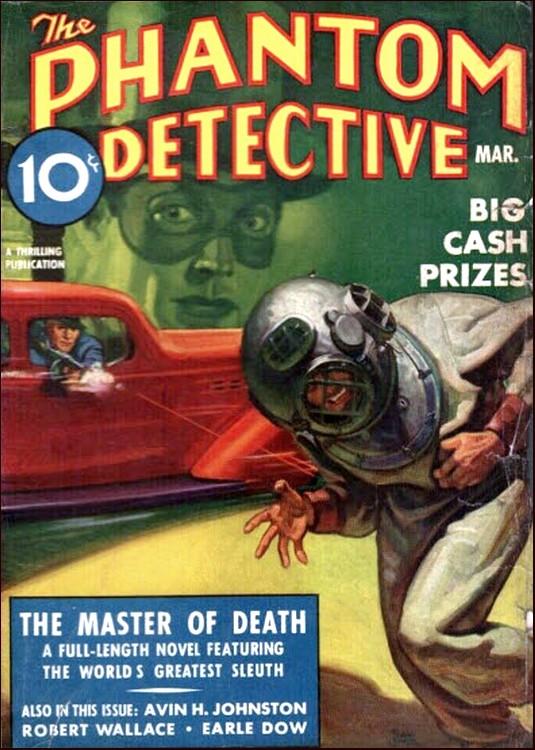
The Phantom Detective, March 1938, with "The Master of Death"
When the ruthless Secret Six demonstrate their contempt for law, The Phantom is called upon to stem the tide of blood which threatens to engulf a fashionable resort city!
JOHN TREVIS was not aware of it, but death had stalked him all the way from Water City. The two men followed Trevis aboard the Camden Express, and sat two seats behind him. Hideously pockmarked was the face of the fat man next to the window. Swarthy, the skin terribly ridged and pitted, it was a mask of evil. And the cruel glitter of a cheta-cat was in the eyes that constantly watched Trevis.
The fat man's companion, a curly-haired, smooth-cheeked youth whose obvious effeminacy had got him several jeering comments from a couple of semi-drunken marines across the aisle, held a violin case between his legs.
Trevis glanced over his shoulder when one of the marines called out boisterously:
"How about playin' a little tune for us, sweetheart?"
A smile replaced for a moment the fixed grimness of Trevis' mouth. The youth kept his long-lashed eyes discreetly ahead. But those marines would have become swiftly sober, and Trevis wouldn't have smiled, if they knew the contents of that violin case. An old, old gag, it was still good: a gleaming tommy gun rested in the case.
And the next murderous burst from it was scheduled for John Trevis!
Tough as those marines were, and trained in the art of killing, they were still amateurs compared with the smooth-cheeked youngster with the soft, white, brightly manicured little hands. Cute little Benny the Duchess, as the underworld knew him, could have taught them a trick or two—
CAMDEN. John Trevis took a taxi.
The pockfaced man and Benny stepped into another. Here Benny fished a little paper packet out of his pocket. He spilled the fine white powder it contained into the hollow at the inner base of his thumb, and sucked it up into his nostrils. The pupils of his eyes began to blacken and dilate. He fondled the violin case and said:
"Why not now?"
"Don't be a fool!" the fat man snapped.
Murder likes darkness and loneliness. It was still daylight, and they were driving through busy streets. The pockfaced man was in no hurry—
John Trevis' cab dropped him off at the Camden Airport. If Trevis noticed that the pair on the train were now also fellow passengers with him on the transport plane which took off for Newark, he gave no sign of it. As the Delaware River and the huge, sprawling Philadelphia just across glided past below the plane, the cruel eyes in that pocked mask of evil kept watching Trevis' broad back. And Benny continued fondling his violin case.
Newark Airport. The evening shadows were lengthening. A nasty little grey drizzle was falling. Only a matter of minutes before the night threw out her mantle. The pockfaced man nodded. The grey drizzle would help a lot.
Another taxi here for John Trevis. But a long, black, closely curtained touring car awaited Benny and the pockfaced man. They got in.
"Tail that cab, but don't get too close to it," the fat man commanded the driver. "I'll tell you when to overtake it. He's going all the way out to Westchester, so there's lots of time."
The black touring car, powerful, silent, kept a discreet distance behind the cab all the way into New York City. Here it closed in a bit, but the driver dropped back again when they finally came out on the Westchester Pike. Benny began to get eager and restless.
"When?" he asked hoarsely.
The other's pitted face did not change expression as he said: "Now, Benny!" He added, raising his voice, to the driver: "Catch up with that cab, Mike. Don't pass it too fast, though. I don't want Benny to have to do this over again."
"The Duchess," the driver grinned back over his shoulder, "never has to spray 'em twice."
And Benny, opening the violin case, giggled like a girl just paid a compliment.
The black touring car obeyed the increased pressure on the accelerator pedal. Swiftly it began eating up the distance between its hood and the rear red light of the cab. Benny reached over and unbuttoned one of the curtains on the right.
"Ready, Duchess?" the driver shouted over his shoulder. "I can pass him now."
"Ready," Benny lisped happily.
He lifted the tommy gun. The tip of his tongue now showed between his full, red lips. But the touring car, instead of making the spurt, slowed down abruptly. The driver cursed.
"There's a highway patrol car behind us," he reported. "Just noticed it in the mirror. Better duck that chopper, Duchess."
The pockfaced man glanced through the rear mirror, and also cursed under his breath. The red headlights of a highway patrol car were about a hundred yards behind them. Not gaining any, so evidently the touring car was not under suspicion.
"Just keep trailing the cab," the fat man ordered the driver. "Maybe we'll shake the police car soon. Though, damn it, we're pretty close to Havens' estate now."
"Havens?" Benny echoed. "Where did I hear that name before?"
"Frank Havens, publisher of the Clarion, and the one man in the whole world who knows the identity of the Phantom Detective. Trevis has a date with him."
"With the Phantom?" Benny hissed, now swaying like some vicious little snake about to strike. "You mean I'm liable to get a chance to blast the Phantom?"
"No. Trevis is going to see Havens, but—"
The driver interrupted tersely: "Hell, the cab is swingin' in at the Havens' estate now. What'll I do?"
The taxi had just cut in between two white pillars marking the entrance to Havens' driveway.
The fat man glanced again at the police car behind them. He said savagely: "Follow it. Don't trigger that tommy until I tell you, Benny! Damn that police car!"
The driveway to Frank Havens' country home was long, lined with magnificent poplars, and it wound snake-like up to the house. When the touring car followed between the white posts, the cab was already out of sight beyond the first turn.
"Good!" the fat man panted. "Turn off the lights, Mike. I don't think the cops will notice it. Brake her right this side of the turn."
The touring car, with lights turned off, was just a long slinky shadow as it coasted noiselessly up to the turn. Here the driver jammed on the brakes. Glancing back, the pockfaced leader saw the red headlights of the police car flash by.
"Good!" he repeated. "Come on out, Benny. Trevis will be delayed a little paying off the driver. Maybe we'll still have time to get him. You swing the car around for a quick getaway, Mike. Back up for us the moment you hear the tommy go off."
Moving his huge body with a curious cat-like grace, the leader piled out, his yellow coat billowing behind him. Benny followed with the machine gun. They rounded the turn. Only thirty feet or so from here to the next turn. They swung around it a few seconds later to face a straight stretch of driveway leading to the porch of the mansion.
JOHN TREVIS hadn't waited to pay off the cab driver. He ran up the steps, crossed the porch and now had each of his hands gripped by the two men who greeted him on the threshold of the open door. A moment later, even as Benny jerked the submachine gun, the door swung shut behind the trio.
The pockfaced man jerked Benny into the blackness next to a tree trunk.
"Listen!" he said tersely. "Trevis didn't dismiss the cab, so he'll be out again soon. Now, did you notice the stocky, grey-haired man on the left?"
"Yes."
"That's Frank Havens. He will certainly come to the door again when Trevis leaves. Get both of them! I want Havens rubbed out, too, understand? The Phantom may be off somewhere, out of touch; may not hear of Havens' death for some time—and no one else could possibly contact him, not knowing his identity. That's what I'm gambling on, and bullets are cheap! To have the Phantom on your trail means having the jitters twenty-four hours of the day!"
"Okay, I'll get them," Benny promised with casual assurance. "Who was the other mug who greeted Trevis, the big husky guy?"
"Don't know, and it isn't important. But don't fail to get those two men, Benny! I'll be waiting in the car."
Benny stepped a little further around the tree trunk, and placed the tommy gun over a low limb. Its murderous snout pointed directly at the front door.
"They're as good as dead now," said Benny, and added in a voice that was almost a moan: "Cripes, if it was the Phantom that I was waitin' for now! Wouldn't I blast the hell outa him!"
The fat man ran back to the now reversed touring car. The snout of the machine gun tilted upward a bit, edged right a couple inches, centered again. And again Benny showed the tip of his tongue between his full red lips. Death, instantaneous and certain, lurked in the darkness there, awaiting the command of Benny's manicured trigger finger!
THE two men whose executions had already been ordered looked alike in many respects. Both were gray-haired, in their fifties, with flat-stomached bodies and ruddy complexions which testified to clean habits and an active life. Frank Havens was shorter, stockier; John Trevis had broad shoulders and a powerfully-built, rangy body.
They shook hands again inside the living room, obvious pleasure at seeing each other in their eyes. Then Trevis said, turning to the third man in the room:
"To find you here, too, Van, is a treat I hadn't expected. How are you, lad?"
Dick Van Loan returned the warm pressure of Trevis' fingers.
"Tip-top, John," he replied. "And it's swell to see you, too. I was out for a drive and stopped in a few minutes ago to say hello to Frank. And so how's the man who showed me the proper way to throw a football, and took me to my first circus and my first big-league game, and who was, actually, my first real buddy?"
Trevis smiled, said:
"We did have a lot of fun, didn't we?" Then the smile left the older man's lips. His mouth and eyes became grim again. "But if you don't mind, Van, I want to explain the purpose of my visit here without further delay. Time is pressing, and I am about to open the lid of something that will set all hell popping loose. I suppose, Frank, you're curious to know why I phoned and made an appointment to see you here, but wouldn't tell you what it was all about on the telephone?"
"Yes," Havens confessed, "I am curious."
Trevis took out a cigar, lighted it, puffed on it jerkily.
"Frank," he said, "I'm the managing editor of the newspapers you own in Water City. The editorial policy on all your newspapers is to print the truth, regardless of any possible consequences. I haven't adhered to that policy. The editorial page of the Water City Herald has for years been discreetly silent about—the octopus!"
"The octopus?" Havens repeated, staring.
"Yes. As you know, Water City, 'The World's Playground,' as it's called, is a commercial venture to induce people to spend money, conceived and functioning on a stupendous scale. More millions are spent there yearly than at any other place of similar size in the world."
"Yes," Havens agreed, "that's true."
"Okay, Frank. Now I'm back to my octopus. It's an octopus with a thousand tentacles, poised invisible over Water City. Those tentacles reach out to claim a tribute in gold on every dollar spent in Water City. Every meal bought, every amusement ticket, every receipted hotel bill—everywhere where money clinks and changes hands, there is a tentacle to claim its tribute. And so the octopus waxes fatter and fatter, on a take of millions yearly that would stagger your imagination."
TREVIS was pale now, his voice coldly furious as he went on:
"I've no time to go into details now on how this unparalleled shake-down racket functions. They work within the law, under the cover of numerous protective associations, and controlled labor unions, but the club held over the heads of Water City's business men is always—terrorism! You either came across or things happened! When I say things, I mean anything from a stench bomb to machine-gun bullets."
"Who," asked Havens, "is at the head of this shakedown racket?"
Trevis made an angry gesture with his cigar.
"That's just it, Frank, no one knows who's behind it. It is openly known, however, that a sinister little group of men who call themselves the Secret Six direct it. Their power and effectiveness lay in their anonymousness. You can't strike back at an unknown and invisible enemy. And because it is common suspicion that in every day life the members of the Secret Six are well-known and respected Water City citizens, one just doesn't dare to open his mouth or make a retaliatory move. You can never tell whether the man whose co-operation you are seeking might not be a member of the Secret Six."
"An ugly set-up," said Havens. "What do you propose to do about it?"
Trevis took a quick step forward.
"I've already written a front-page editorial," he said tersely. "It is a plea to the citizens of Water City to get together and, once and for all time, defy the Secret Six. To form a Vigilante Committee. To place in office during the next election—which is only two weeks away—a mayor whose integrity and honor is unquestionable. Claridge, our present mayor, is totally ineffectual. Harris, our chief of police, is honest, I think, but lacks sufficient fighting initiative and intelligence. I've another man in mind. In other words, Frank, I'm declaring war against the Secret Six, and I shall openly ask for the co-operation of the citizens of Water City. What's more, I'm pretty sure I'll get it!"
There was silence for a few seconds. Van forgot the cigarette smoldering between his fingers. Some of Trevis' grim tenseness had transmuted itself to Van's handsome bronzed face, and boredom no longer shadowed his eyes. It was a man's job Trevis was undertaking.
"Why don't you," Van said, trying to keep his voice casual, "ask Frank to contact the Phantom for you? It seems that you're going to buck a mighty vicious outfit; the Phantom's help might come in handy."
Trevis said eagerly, "If the Phantom would work with me! Could you get in touch with him, Frank?"
Havens coughed. Not even Trevis, an old, old friend of both Van and the publisher, knew that the man who'd made that suggestion, the easy-going, casual Richard Curtis Van Loan, a society playboy, was really the glamorous, mysterious Phantom Detective!
"I'LL try, John," Havens said. "I'm pretty sure I can get him. Has your editorial been printed?"
"No. And that's the principal reason why I'm here now, Frank. Joe O'Keefe, my star reporter, and I have written it jointly. O'Keefe has the copy now and he's waiting for phone call from me before shooting it down to the presses. Once that editorial is printed there's bound to be trouble, Frank. They may blow up a press, damage the plant, and so on. You own the Water City Herald, Frank. I want your okay before—"
"You've got it, John," Havens interrupted quietly. "Go on, make that call!"
Ten seconds later, Trevis was crouching over the telephone. In the tense silence, his voice was low and grim as he said:
"O'Keefe?—John Trevis speaking—Send down that editorial—Yes, right away." He hung up, straightened slowly. "Well, Frank, war's declared!"
Havens placed an arm on Trevis' shoulder.
"You're an old, old friend, John," he said simply. "I shouldn't like to see you hurt. Be careful, eh?"
Trevis grinned, and patted a slight bulge at his left shoulder under the coat.
"I'm armed, anyway, and—well, it's a risk you can't avoid. I don't think they'll dare to kill me. And yet," he added thoughtfully, "my death would nip what I'm trying to start. Would scare everyone into becoming docile sheep again."
"Who," asked Van, "knows so far of your proposed campaign?"
"O'Keefe, who's not only a swell reporter but also one of the finest men I've ever known. And, yes, one other person—Paul Kendall, owner of the Apollo Cabaret and a big shot in the amusement game. I've known Kendall many years, too. He's being shaken down for plenty by the Secret Six. I needed someone who'd break the ice and openly promise to endorse my campaign, and I thought Kendall had more courage than the others. So I had a conference with him this afternoon, and will see him again when I get back to Water City. He's willing to play ball with me, and promised to supply some evidence that will be a bombshell when I explode it in the Herald."
"When're you returning to Water City, John?" Havens asked. "I could put you up for the night, if you like."
Trevis shook his head.
"No, thanks, Frank. I'm going back immediately. Told the cab driver to wait outside. You say you'll contact the Phantom, eh?"
Havens coughed again, and Van stifled a grin as the publisher replied:
"Yes, I'll do that, John. Listen, I was thinking of driving to New York myself this evening and—"
"And I," Van cut in, "have my roadster here. Why don't you dismiss the cab, John? The three of us can drive down in my car."
Trevis agreed promptly. Havens asked his butler to bring his hat and topcoat. Then the three of them walked to the outside door—the door covered, guarded by the murderous snout of the tommy gun—
BENNY the Duchess did not mind the vigil with the submachine gun. The drug in his system now soothed his nerves, lifted him, made time meaningless. It was pleasant enough to wait with the tommy gun. To know that, sooner or later, that door would open and human targets would be in the sights of the gun. Then he would press the trigger, and men would scream, blood would spurt, red and bright.
Men screaming with pain, and blood spurting—it was something that did very pleasant things to Benny the Duchess. A thrill enjoyment that Benny himself did not understand, but a psychiatrist would. And the devilish effect of cocaine always enhanced, made more vivid, that thrill in Benny. He decided to take another-sniff of snow.
ALLOWING the tommy gun to balance on the limb, Benny's little hands fluttered to his pockets. He brought forth another little white packet, and sighed with pleasurable anticipation as he unfolded the paper. He would strut with the gods after this second sniff!
The front door opened, releasing a rectangle of light into the night. Trevis walked out first. Van Loan followed with Havens. They were in a compact little group, a simple target for massacre!
Then Van Loan's keen eyes, looking down the driveway toward his parked car, suddenly spied something that checked him in his tracks. Something white had just fluttered to the ground in the shadow of a tree trunk on the left. The Phantom didn't know it then to be the paper which held Benny's cocaine, but instinctive caution warned him that it was something that could have no normal explanation.
The drizzle had stopped a few minutes ago, and the moon had swung out between ragged clouds. Near where that tiny white object had just fluttered to the ground, moonlight reflected the blue glint of steel!
Split-instant action was characteristic of the Phantom.
"Down!" he shouted.
He clipped the astonished Trevis on the side of the jaw. As the editor staggered to one side, Van Loan whirled cat-like, threw his body in a tackle, smashing Havens just above the knees. Havens, lurching back from the impact of the Phantom's tackle, crashed the guard railing of the veranda, and both of them were still in the air, hurling toward the flower bed in front of the porch, when the spine-tingling, vicious hammering of a machine gun tore apart the silence of the night!
A human cry—the shrill scream of a man mortally wounded—joined for an instant the hellish chattering of the tommy. Trevis, stumbling sideways in a curious crippled hobble. Trevis, a crimson devil's stitch across his chest. He turned, threw up his hands and fell backward through the break in the guard railing.
An involuntary gasp was forced out of Van's lungs as the editor's body crashed on top of him. And equally involuntary was the savage curse escaping his lips as he felt on his neck and face the life blood from John Trevis' bullet-riddled body. He squirmed from beneath the weight crushing him and, still cursing incoherently, groped beneath Trevis' blood-soaked jacket. It took but a second to ascertain that the editor was dead.
Trevis had said he was armed, had patted the bulge at his left shoulder. A second later Van's fingers closed on the butt of the gun there. He jerked out the heavy .45 automatic.
"Creep to the left!" he said to Havens. "Flat on your belly! Quick, damn it!"
THE flowers were thick in this bed and quite high. The machine gunner, who'd ceased firing now, couldn't see them. But he could see the smashed railing immediately above, could reason their position from it.
Havens wriggled snake-like to the left. Van squirmed around and crept in the opposite direction. And both didn't leave a moment too soon. Again there came the staccato hell of the tommy gun. Earth churned and spurted where they had been a second ago. But if those bullets had found human flesh, it was only that of Trevis' corpse.
The flower bed wasn't very long. Van soon reached the right edge of it. Slowly, cautiously, he reared up on his knees. For the second time there was a pause in machine-gun fire, emphasizing, heightening the ensuing silence. In that silence, from a tree trunk across the driveway, Van now heard high-pitched, girlish laughter. Benny the Duchess was enjoying himself.
Then Van heard the roar of an automobile motor coming to life around a turn in the driveway. The third savage burst from the tommy drowned out that sound. The killer was beginning to spray the entire length of the flower bed, making sure that nothing alive survived there!
Van saw the vicious little stabs of flame of the tommy, saw the blur of the killer's body. And a feeling akin to Benny's—the savage lust to kill—pounded through Van as once, twice, three times he jerked the trigger of the .45.
The blur of the killer's body changed shape. Somewhere on the third story of Havens' home there was a shattering of glass. For a dying man's finger automatically now held down the trigger of the tommy. Benny the Duchess would never giggle over a bullet-riddled victim again.
He staggered full into the driveway, into the glare of the taxicab's headlights. And Benny the Duchess knew now what it felt like to have two hot slugs in the stomach. Knew the agony of pain and the terror of near death. He pivoted, screamed, and dropped flat on his face.
In that moment, the back of a long black touring car slithered around the driveway turn. The man who had his head and shoulders thrust far out through one of the rear curtains also now received the glare of the cab's headlights. Van had a glimpse of a pockmarked face, evil and repellant; of a long-barreled revolver swinging in his direction—and he jerked up the .45.
FLAME belched from the bore of the revolver, but only a click responded to Van's pressure on the trigger. The .45 had jammed! Again the pockfaced man fired. This time the slug passed so closely to Van's cheek that he felt the air it had displaced.
Cursing, he threw away the useless weapon. And realizing that he was an easy target anyway, he abandoned caution, leaped to his feet, charged madly across the headlights' glare to where the dead machine-gunner lay near his weapon. Once he got his hands on that tommy—
Bullets pursued him like angry hornets. One touched his sleeve. Another, cutting across his chest, smashed the fountain pen in his vest pocket. Then he was over Benny's body, stooping eagerly for the machine gun. He heard a voice yell:
"Get going, Mike!"
And even as he was straightening with the tommy gun, there was a parting shot from the pockfaced man's gun, the roar of a motor, the slithering of tires on a hair-pin turn.
Then the touring car quickly disappeared around the driveway turn before Van could level the submachine gun.
The tommy cradled in his arms, Van raced toward the turn, pounded around it just in time to see the rear red light of the touring car disappear around the next turn. He cursed, whirled, ran back. His own roadster was parked near the cab. Maybe he could still overtake those murderous rats!
Then he suddenly remembered Frank Havens, remembered the third mopping-up burst of the machine gun.
"Frank!" he yelled. And repeated hoarsely when there was no answer from the flower bed: "Frank!"
The terror-paralyzed driver inside the cab babbled:
"He must've got him, too! There's his body—over there!"
Fear such as Van had never known before chilled his heart, weakened his legs. Because, following the direction of the cab driver's pointing hand, he now saw a body at the head of the flower bed. Frank Havens' body, motionless in the bullet-churned earth!
VAN thought he knew how a condemned man must feel approaching the electric chair, as he steeled himself to walk toward Havens' body. Would he find it a bulletin ridden, gory corpse? Frank Havens, who'd taken care of him since he was a child, who had been the second father to the lonely, orphaned little boy—
Beads of sweat on his face, sweat drenching his body, Van Loan stooped over Havens. The cab driver now came running over with a flashlight.
Havens lay on his back. The flashlight beam showed the publisher's face covered with gore. But Van saw instantly that it looked much worse than it actually was. The cut above Havens' left eye, though bleeding profusely, was only a bullet crease!
More blood on the publisher's chest stifled the flood of wild hope that surged up within Van. Fearfully, he touched Havens' wrist, felt the pulse there. It beat—faintly but regularly. Frank Havens was alive!
But it was not until Van had examined the chest wound that he permitted himself to sag back on the ground, and wipe the sweat on his face, and murmur weakly:
"Thank God!"
The wound on Havens' chest was only a scratch. Van sat there a few seconds, limp with relief. He was jerked erect by a terrified voice from the porch.
"Mr. Van Loan, for God's sake, what happened?"
It was Jennings, Havens' butler, chalk-faced and trembling now. His voice snapped Van out of his momentary inactivity. He leaped to his feet, jerked the flashlight out of the cabbie's hand, ran to where Trevis' body lay. One glance was sufficient; that first machine-gun burst, catching Trevis across the chest, had almost cut him in two. To try to ascertain whether there was a spark of life left in that bloody hulk would have been mockery!
"Bring them both inside," Van yelled to Jennings and the cab driver.
Then he pounded up the steps, and, a few seconds later, crouched over the telephone. His first call was to Havens' physician, who lived nearby. His second was to the Headquarters of the Westchester Police. He asked for Inspector Friar, a personal friend of Havens, and whom Van also knew slightly.
"Murder!" Van snapped, when the Inspector, getting on the wire, asked what was the trouble. "Mr. Havens' friend, a Water City editor, was machine gunned from the grounds of Havens' estate when the three of us were leaving the house. Mr. Havens himself was wounded. I managed to escape with a whole skin. The machine gunner is dead, but the rest of the killers got away."
"In a car?" asked Friar, curtly efficient.
"Yes. Black touring. A new car. Looked like this year's Packard, the expensive model. License plates deliberately obscured by dirt; I couldn't get the number. One of the men wore a yellow coat and had a terribly pockmarked face. Don't know how many others were with him. They escaped less than two minutes ago. Couldn't have gone far yet."
"I'll throw out a radio dragnet immediately," said Friar. "And I'll be over there myself within fifteen minutes."
Hanging up, Van saw that Havens had already been brought into the living room. The publisher showed signs of coming to. Van strode out on the porch—and jerked to a stop when he saw two bodies where only Trevis' had been a moment ago!
"What happened now?" he yelled to the cab driver, who stood between the bodies.
"That butler saw what the stiff looked like and keeled over!" the hackie explained. "I feel kinda sick myself."
AND so was Van sick when he helped the driver carry Trevis' bloody corpse in. Sick at heart. Trevis had been a reporter on Havens' Clarion during Van's childhood. They had met, and had taken a liking to each other. Became, in spite of the difference in their ages, real and sincere buddies. There was nothing that Trevis would not have done for Van, and vice versa.
This deep friendship had lasted all through Van's adolescence, throughout the subsequent years, though Van hadn't seen Trevis much of late. The loss that Van felt now, the seething fury that this cold blooded murder aroused within him, could not have been more intense had Trevis been Van's own father.
The machine gunner himself had paid, but he was only a minor cog of the sinister organization which employed him. The others, the brains directing this assassination—the leaders—were even more guilty of John Trevis' murder. And Van swore to himself right there and then to get them!
He would get them or it would be the last case that the Phantom undertook!
Other gaping, terrified servants were now in the living room. Gregory, Frank Havens' chauffeur; the old Swedish couple who served as cook and housekeeper. Van took another anxious look at Havens. His wounds were bleeding very slightly now, and the doctor had promised to be over in three minutes. Best to leave him alone.
He went out again, ran down the porch steps and, a few seconds later, stooped over the dead machine gunner. Even in death, Benny looked like a crushed little snake, pretty but venomous. He had had the chance he wanted to blast the Phantom, and paid the penalty that so many others like him had paid when they had tried the same thing!
With swift, experienced fingers, Van searched the body. The paradox that was—Benny the Duchess manifested itself in the articles that Van began placing on the ground next to the body.
A woman's compact case, containing powder and rouge; and in the same pocket a murderous six-inch spring knife! Benny's shirt was the sheerest silk, but the automatic in the shoulder holster over that shirt was of a heavy caliber; big, blue, deadly looking.
His wallet held several hundred dollars in cash, a faded photograph of a grey-haired woman who must have been his mother.
An ornate silver cigarette case revealed to Van the little gunman's underworld name: "Benny the Duchess" was engraved on it. Van smiled thinly. The one other article that the search yielded was a long brass key. The tab attacked to it read: The Imperial Hotel, Water City, Rm. 1919.
THE Imperial Hotel, Van knew, was one of the most luxurious in Water City. Credible that this little gunman actually lived there? And why, if he did, hadn't he left the key at the desk? Van shrugged, transferring the key to his own pocket. It was evidence that should be turned over to the police, but Van meant to investigate it himself, first.
He glanced up as a car swung around the turn of the driveway. A white-haired man, carrying a black satchel, jumped out. It was Dr. Barrett, Havens' private physician. The doctor waved to Van, glanced at Benny's body, shook his head, and clipped:
"Where's Frank?"
"Inside, Doc."
Havens was already conscious, his eyes open, sitting up on one elbow. He was staring, his eyes wide with horror, at Trevis' body on the floor nearby. Then he saw Van. Both wanted to say something; both suddenly realized the inadequacy of words. In silence, Dr. Barrett bandaged the publisher's wounds.
Van asked casually, "You feel all right now, Frank?"
"Yes," Havens replied, as casually.
"I'd like to talk to you, alone, in your study. Can you make it?"
The doctor began to protest. Havens silenced him with a gesture. "It's all right, Doc," he said. "I won't be long."
"Give me a hand, Van," he said quietly.
Slowly, Havens' arm on Van's shoulder, they crossed to a small adjoining study. Van lowered Havens into a chair, then went back and closed the door.
"Frank," he said grimly, "a dear friend of both of us has been murdered. You and I know why. I'm going to carry on what he proposed to do in Water City. I'm going to smash the murderous outfit responsible for his death, or die in the attempt. And I mean this as I have never meant anything in all my life. Frank, I want you to make me the new managing editor of the Water City Herald."
Havens was silent a while.
"Why not just go there incognito, in one of your hundreds of disguises?" he suggested. "As the new managing editor of the Herald, continuing with Trevis' campaign, you'll be a marked man."
"I said," Van gritted, "that I wanted to carry on John Trevis' work. Of course they'll probably try to murder me, but I'll risk that. I will stand behind the fighting editorial John Trevis has written. That's what I want to do, Frank."
Havens said quietly: "Very well, Van. What name will you go under?"
"Hugh Gregg is as good as any."
Havens stood up, staggered to a desk. He sat behind it and wrote something on his private stationery. The piece of paper handed to him, Van read:
"This will introduce Hugh Gregg, who is to replace John Trevis as managing editor of the Water City Herald. Any editorial policy he chooses to adopt has my sanction and approval.—Frank Havens."
Van folded the sheet of paper, thrust it in his pocket. In that moment, someone knocked on the door.
"Come in," said Havens.
Burly, heavy-jowled Inspector Friar of the Westchester Police entered. He wasted no time asking for details, nor did Van waste any giving them to him; but he veered considerably from the truth. Richard Curtis Van Loan, a society playboy, couldn't do without arousing natural incredulity and suspicion what the Phantom had done!
"Mr. Havens," he said, "will explain to you why Mr. Trevis had been murdered. Of what had actually happened, I've only a hazy recollection. The three of us stepped out through the front door, and a machine gun went off. Mr. Havens and I dived for the safety of the flower bed outside. Mr. Trevis had been hit, and he fell on top of me.
"He'd told us earlier that he was armed. After we dropped I grabbed his gun and began firing. It seems that I had the good luck of hitting the machine gunner. Then the car I mentioned to you over the telephone appeared. The pockfaced man fired a couple shots at me, missed, and the car made its getaway."
"For blind firing," Friar said dryly, "you've had excellent luck. The gunman out there has two bullets through his stomach and one through his neck."
Now Van, marvelous actor that he was, faked a reaction of extreme nervousness. His hands trembled, his voice quavered as he said:
"It's been a horrible experience, Inspector. I wonder if I could go home now. There's really nothing else that I could tell you."
Friar shrugged. "Certainly you may leave, if you wish, Mr. Van Loan. I'll get in touch with you, should I need you."
"Thanks, Inspector."
Havens' grip, as Van extended his hand, was hard, and it lingered. And there was hidden significance in his parting comment:
"Be careful, Van."
"Sure, Frank."
The Phantom walked out. He paused in one of the bathrooms only long enough to wash off John Trevis' blood still staining his face and neck. Then he was at the wheel of his big yellow roadster, no longer the nervous society playboy Inspector Friar had seen.
His white teeth exposed in a half-snarl, the savage glint in his eyes identified the personality of him whom the world knew as the Phantom! If humanly possible, John Trevis' murder would be avenged! The Secret Six, whoever they were, had a grim fight on their hands!
IT was nine-thirty when Van's yellow roadster began weaving through the traffic of New York City. He parked it in a midtown garage, then walked the length of that block, turned the corner and crossed to a parking lot. It was a dingy, small one, capable of holding only a couple dozen cars. And the car which a grouchy attendant had swung into the out-going lane upon the receipt of a ticket from Van, looked equally unprepossessing.
A black, heavy coupe, it was four years old in model and design. The crumpled fenders had been badly straightened out. A film of dust lay over it, and the enamel beneath showed only too obviously that it had been neither washed nor polished in many months. It was, in short, the sort of a car at which no one would give a second glance.
But this same black coupe was as deceptive as a panther's velvety paw when the claws are indrawn. The glass in that coupe was not merely shatter-proof; it was bulletproof. So was every inch of its body. And the motor below that dirty hood could maintain a speed of well over a hundred miles an hour. Could maintain it easily because of an especially weighted rear.
The Bureau of Motor Vehicles would have found it difficult to trace the Mr. Robert White under whose name the coupe was registered because there was no such person. Because it was the Phantom's own car!
Van gave the attendant a tip, slid behind the wheel and drove the coupe out into the street. The motor was noisy, laborious—until Van touched a button beneath the steering shaft. As if by magic, the sound of the motor dropped to a smooth, barely audible purr. It would take a skillful driver now to hold that coupe down to the average speed of street traffic!
And it was after Van had gone through the Holland Tunnel, now just outside of Elizabeth, that other amazing features built into that coupe manifested themselves. Van pulled into an abandoned and dark side road. He parked, then pushed another button. The entire right half of the seat silently swung forward and down. At the same time, a tiny overhead light flashed up in the roof of the now exposed secret compartment.
A SUBMACHINE gun of a more modern, deadly design than the one Benny had used gleamed shiny and sinister on a bracket at one wall of the compartment. Three automatics hung neatly below it. Under them, on a little shelf, were extra clips of cartridges. And experienced eyes would have identified below that shelf a half dozen tear-gas bombs.
At the opposite wall, perhaps a dozen suits of clothes hung from an ingenious many-limbed hanger. It was here that Van first turned. He brought down a suit of rough grey tweed. To change clothes within the narrow confines of the coupe took skillful acrobatics, but Van had done it before and knew precisely how to go about it.
Dressed in grey tweeds now, he transferred from his evening clothes only the letter Havens had given him, and what he had taken from Benny. Everything else, his cigarette case and lighter, his wallet, other intimate things belonging to Dick Van Loan, he dropped with the clothes into still another secret compartment accessible from the floor of the one he now used.
Now he reached for a flat black box, opened it. It was a compact make-up kit. Swiftly, he began disguising his face. A greaseless substance from a tiny brass container, rubbed into his skin instantly darkened his face, eradicating his healthy bronzed complexion. Tiny balls of wax distended slightly his nostrils.
Two rubber objects, which would have defied identification unless someone could have seen what Van did with them now, fitted beneath his cheeks along the jawbone. They immediately gave him a massive, pugnacious under jaw. A skillfully applied shading pencil furthered that illusion.
The entire process had taken less than a minute, yet no one would dream now of associating Dick Van Loan with the tough-looking, massive-jawed, swarthy man whose face was reflected in the mirror forming the back of the make-up kit. Such was Van's uncanny genius at disguise.
One of the automatics on the wall found a lodging place in a special pocket in Van's vest. Then he brought forth from a tiny compartment something that glittered in the light. It was an emblem forming in platinum and diamonds a tiny mask. The Phantom's badge, and it was thus known throughout the world. Van slipped it inside a secret pocket in his waistband.
The Phantom was ready to take the trail!
Another touch on the button, and the seat swung back to its normal position. Van backed out on the main road, swung south, began depressing the gas pedal. Men driving new cars at better than sixty miles an hour saw the amazing spectacle of that old coupe pass them like a bullet.
The speedometer ribbon kept rolling out—75—81—87! A startled speed cop saw the coupe flash by, gave pursuit. Van heard the siren. He grinned, slowed down, stopped at the command to the trooper's gauntleted hand.
THE trooper got only as far as: "What racetrack do you think you—"
Then his lower jaw sagged. He stared at the tiny, mask-shaped emblem extended through the window. "The Phantom!" he gasped.
"I'm in a hurry, officer," Van said quietly. "Driving to Water City."
And it was tribute to the Phantom's reputation that the State trooper asked no questions. He merely said:
"Follow me, sir."
The coupe roared on down the highway, but a figure in grey, bowed low over the handlebars, preceded it now, the police siren ever moaning its warning. At sixty miles an hour, they catapulted into Trenton, shot down the narrow, crooked streets, traffic opening ahead of them.
The trooper's jurisdiction ended at the bridge which marked the Jersey-Pennsylvania boundary there. "Good luck!" he waved.
Two Pennsylvania troopers were at the opposite end of the bridge. Van pulled over to them, showed the Phantom's badge, again made that simple statement that he was in a hurry. And again was that prompt obedience, homage to the world's greatest sleuth!
"Follow us, sir!"
Two motorcycles ahead of the coupe now. Two sirens clearing the way for the Phantom. Miles flashed by. In incredibly short time, they roared onto the beautiful Roosevelt Boulevard, the fifteen-mile approach to Philadelphia.
The end of the boulevard, Philadelphia's Broad Street, bisecting that metropolis and the longest straight street in the world. Then the approach to the magnificent Camden-Philadelphia Bridge. Van glanced at his dashboard clock. He'd made a ninety-odd mile run in seventy-five minutes.
The troopers left him here. Van roared across the mighty man-made link over the Broad Delaware River, From here it was a sixty-mile run to Water City.
In precisely forty minutes, Van flashed across the city limits of "the World's Playground." He parked the coupe, lighted a cigarette, sat there a while longer, grim-eyed, hard-mouthed. He was on the battleground now. What should be his first move?
HE leaned out of the window and asked a passerby:
"Where's the Water City Herald, brother?"
"Go down this street four blocks, then turn left," the man directed. "You'll see its sign then."
Two minutes later, Van Loan entered the neat, modern four-story building which housed the Herald. The receptionist-switchboard operator was red-eyed, looked as if she'd been crying. The news of John Trevis' murder must have already reached the Herald's office.
"I want to see Mr. O'Keefe," Van said.
"Who's calling, please?"
"Hugh Gregg."
The operator announced him. Van appraised shrewdly the young man who came out a few seconds later. Joe O'Keefe looked as Irish as his name—red-headed, pug-nosed, blue-eyed. He had the rangy, broad-shouldered body of an athlete. That he was under a terrific strain was only too apparent from the wildness in his eyes, the twitching of his facial muscles, the way his big fists kept clenching and unclenching.
"What is it?" he asked in a voice akin to a snarl.
For reply, Van handed him Havens' letter. O'Keefe read it, and his attitude changed instantly. Van checked him as he was about to speak.
"Let's go somewhere where we can be alone."
O'Keefe pointed to an office door marked: "John Trevis, Managing Editor."
"No one will disturb us there," he said bitterly.
They entered the office. Van dropped into Trevis' worn swivel chair.
O'Keefe sat down on the edge of the desk.
"So you've heard the news, eh?" Van asked quietly.
O'Keefe nodded.
"Telephoned from New York a half-hour ago."
Van drummed his fingers on the desk top.
"Trevis," he said, "told me that only you in the office here knew of his proposed campaign against the Secret Six; that the two of you have written that editorial. Someone tipped off the Secret Six about it. The Secret Six knew he was taking that trip to Mr. Havens' home. How, O'Keefe?"
There was a brief pause. All color left O'Keefe's face. His lips drew back over now bared teeth. He forced through them:
"What're you implying, sir?"
"Draw your own conclusion," Van retorted coldly.
Like that of a pouncing animal, swift and without warning, O'Keefe's body jerked across the desk. His big hands lunged for Van's throat.
THOSE hands, hook fingered, quivering with a murder lust, never reached Van. He caught both wrists. Powerful as O'Keefe was, he found himself shackled and helpless in the steel grip of those fingers on his wrists.
"Don't be a fool, O'Keefe!" Van advised softly.
A few seconds longer of this deadlock, then the reporter's arms relaxed. His shoulders slumped, and bitterness replaced the maniacal glare in his eyes.
"Sorry, Mr. Gregg," he said quietly. "I—I lost control of myself. You see, sir, I loved John Trevis. We all loved him here. And when you implied that I might have sicced that murderous crew on him—" He shrugged.
Van released O'Keefe's wrists.
"I believe you're innocent," he said. "It leaves then only one other person who might have been the informer. Do you know if Trevis told Paul Kendall of his intention to go see Havens?"
"No, I don't."
"Do you know what evidence Kendall had promised to supply Trevis?"
Again O'Keefe shook his head. "Trevis popped in here only for a couple minutes after his talk with Kendall. He did not tell me anything about what transpired during that interview."
"What sort of a person is Kendall?"
"I don't know much about him," O'Keefe declared. "He's been in business here many years. Has an interest in one of the great amusement piers, and owns the Apollo Cabaret. A decent sort of chap, so far as I know. Enjoys an excellent reputation in Water City."
Van lighted a cigarette, puffed on it a while.
"What effect," he asked quietly, "had John Trevis' murder on the employees of the Herald? Are they, in your opinion, willing to stick even if the campaign against the Secret Six is carried on?"
O'Keefe's reply was prompt and grimly sincere:
"Yes. Down to our youngest copy boy. I told you that we all loved John Trevis. We'll stick."
"Okay," Van said, rising. "Who was the second in charge here under John Trevis?"
"I was, Mr. Gregg."
"Then you take over the normal business of the Herald. Write another editorial, explaining why John Trevis had been murdered. Tell the citizens of Water City that the Herald will not be intimidated, and that it will go on fighting! Sign my name to the editorial."
O'Keefe extended his hand. Van gripped it.
"I'm glad we're carrying on, sir," the reporter said simply. "What is your next move?"
"An interview with Paul Kendall. Do you know his home address?"
"Yes. He has a suite at the Imperial Hotel."
"You'll hear from me," Van said, and strode out.
He was walking the Boardwalk a few minutes later. A half hour short of midnight yet, and a week-end night, the broad promenade swarmed with pleasure-bent thousands; some were being pushed in boardwalk chairs by sad-eyed Negroes. They were strolling in couples, quartets. Rich men, poor men; factory girls on week-end holidays with boyfriends; a millionaire with his bejeweled wife.
All there for the common purpose—to revel at the man-made shrine to the goddess of pleasure which Water City really was. The World's playground, inviting all, offering a myriad of inducements to fit anyone's taste and pocketbook! A world-famous seashore resort, symbolizing gayety and froth and glitter!
The great hotels Van passed on the left reared twenty or thirty stories of granite skyward. Some of the most luxurious hotels in the world—each would have done credit to a metropolis—they were only one of a dozen others at this seashore resort.
On the right was the ocean. Lights dotted the heaving, restless blue-grey surface which merged with the stars on the far horizon. Creamy surf outlined the beach. At regular intervals, great lighted amusement piers jutted out. Quarter-mile long, some of them were, built to serve the goddess of entertainment, and on the scale unequaled anywhere else in the world.
BUT there was a grim twist to Van's mouth as, with sardonic eyes, he observed all this. These gay thousands were only visitors to Water City. They wouldn't read the Herald. They saw only the beautiful surface glitter. The octopus never picks unsuspecting victims!
The magnificent Imperial Hotel flanked the boardwalk. The entrance to it, however, was from an approach street. Entering, Van went directly to the desk and asked for the number of Kendall's suite.
"Nineteen-Nineteen," the clerk replied.
"Thanks," said Van. "I'll ring it from one of the house phones here."
A few seconds later, he squeezed into one of the modernistic phone booths. He hoped, as he gave the number of Kendall's suite, that no one was there now. If John Trevis had unwittingly confided to a member of the Secret Six, or someone in league with that organization, Van wanted to search that suite before interviewing its owner.
Evidence, specific and indisputable, was what the Herald needed!
He heard the telephone ring in Kendall's suite. Heard, after a little while, the operator's bored:
"Sorry, sir, but nineteen-nineteen does not answer."
Van hung up, stepped out of the booth. As he walked unhurriedly to the elevators, he had the sudden feeling that he was forgetting something, overlooking something—
PAUL KENDALL had been in his suite when the telephone rang. For hours, like a caged beast, he paced up and down his living room. A rather distinguished-looking, white-haired man with finely-chiseled features, he gave the impression now of someone shaken by tragedy.
The well-kept hands which had kept tilting the brandy decanter during the past hours trembled noticeably. Ordinarily, Paul Kendall would have been drunk by now had he consumed a third of the brandy he'd put away, yet it had no effect on him this evening. He could not drown with alcohol the ugly, ever recurring thought that he had unleashed murder on John Trevis' trail.
John Trevis, with whom he'd played golf so often, and laughed and chatted and swapped stories. John Trevis, for whom Kendall had had a genuine liking and wholesome respect.
"I couldn't help it," he tried to argue with himself for the thousandth time. "Trevis' campaign had to be checked! He had to be eliminated! And yet, damn it, why did he have to come to me? Why did he have to force me to become Judas and an accessory to murder?"
He shuddered and reached for the brandy flagon again. A voice behind him said:
"Better make it a stiff one, Paul. It's the last drink you'll ever take!"
Kendall whirled. His was a terrace suite with French doors opening onto the landscaped balcony. Two men stood just inside these French doors. On the left, a horribly pockmarked fat man wearing a yellow coat; his companion had an ape's squat body and long dangling arms. And there was the ape in his low, receding forehead, in his broad nose, in his wicked little red eyes.
The pockfaced man held a revolver in his right hand. The cylindrical Maxim silencer had been screwed on at the end of the long blue barrel.
They stood there a few seconds, silent, motionless. Finally Kendall burst out, staring at the ape-like man:
"What's the meaning of this, Matteo? Who is that man?"
Matteo grinned and said nothing. The pockfaced man murmured: "Since you're hell-ward bound anyway, Paul, why bother with introductions?"
"You," Kendall said hoarsely, incredulously, "are going to kill me?"
"Yes, Paul."
"But why?" Kendall demanded desperately. "I don't know you. I have never seen you before. Why should you want—"
"Here goes, Paul," the fat man interrupted calmly. "An ounce of lead, with your name written on it!"
KENDALL jerked forward. It wasn't fear of death that now widened his eyes, gaped his mouth.
"Your voice!" he said in a kind of panting, incredulous whisper. "Why—why, Mother of God, you are—yes, you must be—"
"Good-by, Paul," said the pockfaced man.
It was then that the phone rang in the suite. Had the receiver been lifted then, Van, in the booth nineteen stories below, might have heard the short, hoarse scream that burst from Paul Kendall's lips. Not much of a scream, because the fat man was very careful about where he had pumped the bullet into the cabaret owner's body. Paul Kendall passed on to eternity an instant later, dead before his body struck the floor.
"A useful invention, the silencer," the fat man murmured. "Benny might have done a more artistic job, but this will do. Search him for that little black book of his, Matteo."
Matteo wiped his nose with the back of his hand.
"Look, Boss," he said hesitantly. "I'm kinda worried about the house dick in the linen closet out in the corridor there. He seen where I came in. Waved to me when I went by. 'Course, I've got a swell alibi an' all that, but I'd still feel kinda better if he—well, you know what I mean!"
The fat man touched his pitted, hideous face.
"Yes," he admitted, "that house dick might be dangerous. I heard you were pretty good with the knife, Matteo. If there is no one else in the corridor when you sort of strike up a conversation with that dick—" His voice trailed away, and Matteo said simply:
"Now?"
"Why not?" the fat man shrugged. "Do it quickly, and come right back. We may have trouble finding that little black book of Kendall's."
Matteo nodded, felt for something beneath his coat, then walked toward the long hallway leading to the outside door—
And it was his footsteps that Dick Van Loan thought he heard when he rapped on the door of Suite 1919.
Van's left hand was already in his pocket, about to withdraw a small, flexible strip of steel with which he could easily pick any average lock. He had knocked on the door simply to make sure that no one had entered the suite in the minute or two that had elapsed since the telephone call. The footsteps had sounded the moment he knocked, and because the sound hadn't repeated itself, Van still wasn't sure whether he hadn't imagined it.
And as he stood there, now, tense, listening, he had the abrupt, spine-tingling feeling of being watched! Years of flirting with death had developed a certain sixth sense in Van; he knew, without a shadow of doubt, that eyes behind him watched every move he made.
It took steady nerves to turn slowly, without the faintest trace of tenseness or alarm. The corridor was deserted. But there was a door obliquely across it. A door without either a number or ventilation slats in it; obviously a linen closet or where the porter kept his equipment. And that door had just closed with soft, sinister and suggestive stealth!
It hadn't closed all the way. Still a crack of an inch or so between the jamb and the door edge. And Van would have staked his life that eyes were peering at him through that crack. Someone was hiding in that closet.
At no time had Van actually stared at that closet. To all appearances, he was merely someone who'd knocked on Kendall's door, received no answer, and now stood there casually debating what his next move should be. And there was the same casualness, an air of unsuspecting indifference, in the way Van now strolled down the corridor.
His thoughts weren't casual, however. Did the Secret Six already know that John Trevis' successor had arrived? Was that his would-be assassin lurking in the closet there?
Van passed the closet door. Then he whirled cat-like. His right hand snaked out the automatic. His left jerked open the door. The blunt snout of the automatic was inches from the man crouching inside the closet and Van said cheerfully:
"Hello."
The other, a burly, red-faced man, appraised Van with hostile eyes. He made no reply.
"I like games," said Van. "Hiding in a linen closet might be lots of fun. Mind letting me in on it?"
Still the man said nothing. And then something hard jammed into the small of Van's back.
"Stopping a .38 slug might be lots of fun, too," a voice behind him said. "You want it? Or maybe you'd rather drop that gat?"
Van allowed the automatic to thud to the carpeted floor. He knew only too well the death that the trigger finger behind him controlled. He was trapped!
THE pressure eased at Van's back.
"Get against the wall there," the clipped, curt voice commanded. "Keep your hands shoulder high."
Van obeyed, turning and backing to the wall. Two men had been standing behind him, both with drawn guns. One now picked up Van's automatic.
"Good thing you came around just then, Sergeant," the man in the closet said. "He knocked on the door there, got no answer—and first thing I knew, he had the drop on me."
Van appraised coolly those grim-faced, grim-eyed men. Detectives, obviously, since one had been addressed as Sergeant. And then Van thought he understood. Paul Kendall, learning of Trevis' murder, fearing for his own life, had asked for police protection.
The sergeant, on the left, said: "Frisk him for another weapon, Joe."
The man with him slapped Van's pocket. He stepped back, shaking his head.
"Listen," said Van, "I can explain—"
"You'll explain," the other cut in curtly, "to the chief downstairs. I'm going to hold this gun in my pocket, see? One funny move outa you, and I'll plug you. Got that?"
Van controlled his rising temper. He merely shrugged.
"Better stay up here a while longer, O'Brien," the sergeant ordered the man in the closet. "Maybe this is the guy we want, but I'm not takin' any chances—Come on, big boy!"
Flanked by the two detectives, Van walked down the corridor. The presence of the Chief of Police himself in the hotel puzzled him. If police guarded Kendall's suite, then Kendall must have been inside when the telephone rang. Why hadn't he answered it? It seemed to Van that there was something peculiar about the whole set-up? And what was it that he still seemed to be forgetting, overlooking?
An elevator took them down to the lobby. A few seconds later, they passed through a door marked: "Manager." Several men whom Van easily spotted as detectives lounged in the outer office. The glass-panelled door to the inner office was closed, but Van's lips tightened at the sudden bellow which now came sharply distinct through the open transom:
"Stop assuring me that this is probably the handiwork of a practical joker, Chief Harris. If a murder is committed in my hotel tonight, I'll attribute it to the lack of vigilance on the part of your men. And I've enough influence in this town to take your official scalp!"
The bellow ended on a hoarse note that was a mixture of baffled rage and fear. Another voice now snarled back:
"What in hell can I do that I have not already done, Mr. Arlen? You have over a thousand guests here. We don't know who is scheduled to be murdered. I've every police officer I can spare guarding the hotel now, and—"
The voice broke off when the sergeant with Van rapped on the door. The first voice yelled to come in, and Van Loan, half stunned by the amazing conversation he'd just overheard, his heart pounding with tense excitement, entered a room that was blue with cigar and cigarette smoke.
"I think," the sergeant announced tersely, "this is your man, Chief."
Silence alone, for the next few seconds, lived in that office. Van instantly recognized, from a previous stay at the Imperial Hotel, the fat man behind the desk. But the sedate, pompous hotel owner who'd personally shown Richard Curtis Van Loan to his suite a couple years ago was almost a stranger to the man who sat behind the desk.
GONE now was Arlen's pomp and dignity. His heavy-jowled face glistened with perspiration. The fat hand which held an equally fat cigar trembled visibly. And his little eyes, almost concealed by pouches of fat, were bright with fear.
Van also recognized Harrington, the manager, a tall, blonde, intelligent looking chap who stood near the left door. Chief Harris was a gaunt, leathery-faced man, whose nose had once been broken and had never healed properly. He sat on the edge of Arlen's desk, and it was he who spoke first, his cold grey eyes on Van:
"Let's have it, Sergeant!"
"Well, Chief, O'Brien seen him knock on the door of 1919. The guy got no answer. He walked down, then cut in and pulled a gun on O'Brien, who was in a linen closet up there. Don't know what he was up to, but I kinda spoiled the party when I came around the corridor corner with Hennessy. Here's the gun he had."
The detective placed Van's .45 on the desk top. Harris never lowered his eyes from Van's face.
"Well?" he prompted grimly.
"I'm afraid you'll be disappointed, Chief," Van said. "You've heard of John Trevis' murder by now, haven't you?"
"I did," Harris admitted. "What has that got to do with you?"
"I am Hugh Gregg, sent down to replace Trevis as managing editor of the Herald. Trevis had had some unfinished business with Paul Kendall, guest of this hotel. I went up to see Kendall. No one answered my knocking on the door of his suite, but I did happen to notice that someone was hiding in that linen closet. Have you seen Trevis' last editorial?"
"I have," Harris replied, his voice peculiarly surly.
"Then," said Van, "you ought to have a pretty good idea why he was murdered. I succeed John Trevis. I, as the new managing editor, am carrying on his campaign against the Secret Six. Need I explain to you why I thought it was a good idea to have a gun in my hand when investigating why someone should be watching me from inside a linen closet?"
AGAIN there were seconds of silence. Arlen now looked more terrified than ever. Harris' dark face remained grimly hostile.
"You can identify yourself?" he snapped.
Van showed him Havens' letter. Harris read it, then handed it to the sergeant.
"Check this," he said. "Right away. Use the phone in the other office."
The detective went out. Harris picked up Van's .45, looked at it, grimaced, lowered it on the desk again.
"Got a permit for this?" he asked coldly.
"No. But Mr. Havens can take care of that in New York."
"This," said Harris, "isn't New York. It's Water City. If you want to carry a gun here, you can make the regular application at Police Headquarters."
Van stared at him.
"I don't understand your attitude, Chief Harris," he said evenly. "I should think that you, as head of the police department here, would be only too anxious to cooperate with what the Herald is undertaking."
Harris crashed his fist on the desk. "You're not bluffing me, Gregg!" he roared. "This campaign of Trevis is only a cheap political stunt to poison the people against the current administration. To expose the supposed inefficiency of the police department. Why in hell did Trevis wait until two weeks before the municipal elections to cut loose with that editorial? He never did mean—even as you don't—to continue attacking the Secret Six after the elections!"
"Any civic administration," Van snapped back, "tolerating a condition that the Secret Six have maintained in Water City isn't fit to hold office!"
Harris jerked forward.
"Maybe you're right!" he gritted. "But another administration would be just as helpless before the Secret Six as this one has been. Trevis knew that. You know that. It was just that the Herald has been promised things by the opposition party."
The sergeant returned now.
"Just spoke to Havens, Chief," he reported. "Says a Hugh Gregg was sent down to replace Trevis."
Harris nodded curtly.
"Listen, Gregg!" he said. "The Secret Six have been running the works here for several years. To leave them alone a couple weeks longer won't make matters any worse. Lay off that campaign until after the elections, and I promise you my fullest cooperation then. It will prove to me that the Herald is sincere, anyway."
"You can prove your sincerity—and your honesty," Van said coldly, "by doing your duty as head of the police department now. You know that something evil exists in Water City; it is your duty to help the Herald to crush it—unless you're yellow, Chief Harris, or are in league with the Secret Six!"
Harris jumped off the desk. For a moment, Van thought he was going to strike him. He stood his ground, relaxed, smiling that thin, dangerous smile of his.
"I'll let that slide," Harris said slowly, his face twitching with fury, "because, you poor fool, I know damn well you'll be on one of the slabs in the morgue within the next twenty-four hours!"
"Maybe," Van drawled, "and maybe not. But you seem to fear there might be a candidate for the morgue in this hotel tonight. You see, I happened to have overheard through the transom what you and Arlen were yelling at each other just before I came in here. What's it all about?"
THERE was silence again for a little while. Van saw Arlen flash a helpless look at Harris. He saw Harrington, the manager, shift his feet awkwardly and become absorbed in something on the opposite wall. Chief Harris was staring now down his crooked nose.
"We're trying," Harris said, "to catch a thief who's been systematically robbing the guests of this hotel."
"The word I overheard," Van said gently, "was murder!"
"Sure," Harris growled. "We're afraid that the thief, if surprised by one of the guests, might pull a killing."
Van shook his head.
"Pretty glib," he said, "but hardly convincing."
Harris said curtly: "I'm sure your time is very valuable, Mr. Gregg. We won't detain you any longer."
It was a back-slap sort of command to get the hell out of there. Van obeyed it, that thin smile still on his lips. He did not bother asking for his automatic; there were others in the old coupe parked near the Herald's office.
But he knew now, definitely, that he could not expect any cooperation from the police department of Water City. He was alone on alien and deadly dangerous territory, and he'd have to fight his battle without a single ally—without a single man whom he could trust!
He walked out, crossed the outer office, emerged into the gay hum of the crowded lobby. It seemed so incongruous to see these well dressed men and women, laughing, chatting, relaxed and at ease. For Van could still hear Arlen's terrified bellow to the effect that a murder threat overhung this great hotel. Could still hear Harris' snarling answer that a thousand guests could not be individually watched, and that there was no foretelling which one of them the killer would pick as his victim.
What did it mean? Certainly, it made no sense; yet just as certain was the grim fact that those two men hadn't been joking. Ugly hell was about to pop loose here, but Van knew neither its source nor intention. Cursing softly under his breath, he walked toward the cigar counter.
He never reached it, however. The vague, annoying feeling that he'd been overlooking something suddenly exploded to its solution like the white naked glare of a signal, flare in his brain.
"The key!" he thought suddenly. "The Imperial Hotel key that machine gunner had in his pocket! Damn it, it was to Room 1919! That's Paul Kendall's suite. How in hell could it have slipped my mind!"
Astonished people gaped after him as he raced the width of the lobby toward the elevators. If that little killer had the key to Kendall's suite, then, unquestionably, some hell must have been scheduled there!
He rode up to the nineteenth floor again, got out, strode swiftly down the carpeted corridor. Rounding a turn in it, he saw the linen closet. Its door was closed now. And then Van saw something else. Something which, as he hastened his stride toward it, brought a sudden chill to his heart.
The carpet of that corridor was a bright green. But a patch of another color stained it just outside the closet door, now a patch of crimson, widening even as he stared at it, that had not been there a few minutes before. Blood was oozing from beneath that door!
WITH characteristic presence of mind, Van took a handkerchief out of his pocket and placed it around the closet door knob before his hand touched it. He was grimly certain what he would find inside, and he wasn't surprised when he jerked the door open.
The burly detective's body, supported by the door, toppled forward. It brushed Van's hip as it crashed to the floor of the corridor. The crimson stain in the carpet was widening swifter now.
Van stooped over the murdered man, rolled him over on his back. An inch-wide slit below the handkerchief pocket in the jacket, more clearly visible in the shirt underneath, showed where a knife had been driven through his heart. The blood still flowed freely; the body was still warm. The murderer's knife had done its ugly work within the past few minutes.
A couple in evening clothes came out of one of the suites. The woman, laughing one second, screamed the next, and fainted in the third. The murdered detective's face, twisted with agony, saliva drooling down one corner of his mouth, wasn't a pleasant spectacle; and, because of the enforced upright position of the body, there was an almost solid mass of gore from the chest to the knees.
The woman's companion, white-faced, looking as if he were ready to faint himself, was kneeling now, rubbing her hands and repeating idiotically:
"What happened? What happened?"
But Van Loan was staring past them. Staring at the door to Paul Kendall's suite. Some deviltry must have taken place in there. The detective must have been murdered so that he couldn't report the killer's entrance into the suite—or his escape!
Four running strides carried Van across the corridor to room 1919. Cautiously, he inserted the key he'd taken from Benny the Duchess. It fit. No bolts needed to be thrown back to open that lock; turning the key to the left silently withdrew the catch at the knob. Nor was there any sound as he pushed the door inward.
A long corridor lay ahead of him, dark, heavily carpeted. At its far end, and on the right, was the oblong of light marking the entrance to Kendall's living room. Voices came from there.
FOR a moment, Van was acutely aware of the fact that he was unarmed. If the murderer who'd knifed that detective was in Kendall's living room, then he had one or more companions with him, judging from the voices. A deadly wasps' nest to disturb with only bare fists as his defense!
For a moment he thought of it, then shrugged it off grimly. If desperate risks had worried Dick Van Loan, the Phantom would never have been born. He softly closed the door behind him, lest a shout from the hallway should alarm the killers. Then, his footsteps completely deadened by the thick carpet, he glided toward the living room door.
There had been a lull in the voices for a few seconds. Now, as Van was only a few feet from the door, someone shouted triumphantly: "Found it, Boss! Here's that little black book. It was in his desk, after all!"
Van continued edging forward. A second later, he was at the doorway, peering into the room.
A white-haired man lay at the foot of a low-slung, modernistic chair. His arms and legs were twisted grotesquely, and even from where Van stood, he could see the vacant, death-glazed eyes. Beyond the chair, near a wildly disarranged walnut desk, crouched the killer. His back was to Van. His left hand, aloft, exhibited a slim black notebook; his right held the murder weapon—a regular U.S. Army bayonet.
Two questions instantly flashed through Van. First, why was the killer so curiously stiff, rigid, frozen in that spot? Second, where was his companion? Surely, he hadn't been speaking to the corpse on the floor!
The next second answered both these questions. The man was looking into the mirror at the opposite wall, which reflected Van in the doorway. And a voice from just beyond the open French doors leading out into the terrace betrayed where the other man was. A sibilant whisper, it commanded:
"Kill him, Matteo! Kill him quickly!"
A bright moonlight night, Van saw clearly the man on the terrace. Saw his evil, horribly pockmarked face, the gross fat body. The man crouching out there with a misshaped, silencer-equipped revolver was the man who'd fired at Van from the getaway car on Frank Haven's driveway!
This man repeated now, louder, more sharply:
"Kill him, Matteo!"
WHIRLING, the man with the bayonet stared, murder glittering in his wicked red eyes. One frozen, spine-tingling second, two, three—and then both moved! Moved in the precise same split-instant—each doing what the other hadn't expected!
The ape-like Matteo obviously wouldn't have parted with his weapon if he hadn't expected Van to turn and dart back into the corridor.
And had Van done that, he'd have received that crimson bayonet in his back. For, with a wrist-snap quicker than the eye could follow, Matteo threw the bayonet. Threw it with the accuracy of a bullet, and with almost equal velocity.
Straight and true that murderous blade whizzed through the air, piercing the place in the doorway that Van's body had blocked. But Van had leaped into the room a heart-beat before the throw. The bayonet had only flicked his left sleeve, cutting the cloth but not the skin. Van heard it thud into the plaster of the corridor. Then another, softer thud as it dropped to the floor.
He swung back, intending to scoop up the bayonet only a few feet behind him. It would help cut down the odds a bit when the man on the terrace joined Matteo. Then he saw that death would follow on the heels of that move. Matteo, his ugly face bestial with fury, was now tugging at his hip pocket.
Already Van could see the blue steel of the automatic the other was withdrawing. Another second to swing it around, a third to summon swift death by a trigger jerk. It was now or never!
He leaped toward Matteo. Leaped, his spine crawling, full into the face of that big .45 now swinging around the ape man's hip. Perhaps it was the split second Matteo needed to shove down the safety catch that had saved Van's life. For it gave him a chance to make that convulsive side-twist as Matteo jerked the trigger.
The .45 roared, belching smoke, flame, hot lead. Even in that moment, Van was aware of a kind of incredulous amazement that he had not been hit. Matteo fired again, but a slap of Van's hand against his forearm deflected the shot.
Then Van's hand caught the thick, hairy wrist clutching the gun. A steel-fingered grip, but strength alone wasn't in it. Van's fingers, though never relaxing the merciless pressure, were moving like the constricting coils of a python. They sought certain nerve centers Van knew to be in the wrist. The wily Japanese many centuries ago who'd discovered the devilish tricks of jiu-jutsu was an ally of the Phantom now.
Matteo, panting like an animal, tried a vicious knee jab to the groin. Van Loan foiled it with his thigh. Then the fingers on Matteo's wrist found the spot they sought. The veins on the back of the Phantom's hand suddenly bulged out, hard and corded, as he increased the pressure.
Dropping the notebook it had held, Matteo's left fist slashed out. Van evaded the first blow by jerking his head. But he couldn't dodge the others that followed. He took them, one blow after another, with grim complacency, his head pressed into Matteo's shoulder. In his desperate anxiety for a knockout punch, Matteo had either forgotten or did not know the much greater weakening effectiveness of hammering at the body. He kept driving short, ineffectual, clumsy uppercuts at Van's head.
These blows did not worry Van; the fact that there was another man on the terrace did. So quickly had the action, so far, taken place, that not more than thirty seconds could have elapsed since the sibilant command to kill! The pockfaced man outside evidently was awaiting to see the outcome of this deadlock, or his revolver had been jammed by the silencer action.
Van swung Matteo around so that the other's burly body was between himself and the terrace. A matter of seconds now before Matteo had to drop that automatic! Then —then those murderous rats would have a scrap on their hands!
It happened a moment later. Matteo screamed hoarsely as he felt his fingers, without any volition of his own, begin to unclench. More, still more, as Van continued the pressure on the nerve centers of the killer's wrist.
MATTEO, frantic, all animal now, reverted to what he looked like. His left fist suddenly became a claw-hooked, talon-like fingers which ripped at Van's face, trying to get to his eyes. His mouth drooled saliva as he sought to bury his teeth in Van's neck.
Van pushed him away by driving the heel of his hand up against that brutal, massive under-jaw. Then he crossed his right hand and snatched the automatic; it had been hanging only by the trigger guard from Matteo's paralyzed forefinger.
"Now, you rat!" he panted.
And, swiftly abandoning the ingenious defense science of old Japan for the more permanently effective skill of a shoulder driven fist, he smashed a hard left to Matteo's chin. The killer threw up his arms, staggered back as if propelled by some invisible force; back to the open French doors, out on the terrace. Still back, until the low parapet was behind him.
He wasn't out on his feet. He must have known, in that awful instant when the back of his thighs touched the parapet, the death that was behind him. Must have known that he was still off balance, still driven by the impact of that blow, unable to check himself—with a drop of nineteen stories at his back!
The ape-like murderer must have known this, because that shrill, strangely woman-like scream had burst from his lips before he'd actually gone over the parapet. There was horrible finality in the way it thinned out; and Van Loan, though he knew he couldn't possibly hear it, unconsciously crouched and strained his ears for the thud of Matteo's brutish hulk smashing itself on the Boardwalk nineteen stories below.
He heard a sound, faint but terribly suggestive, drift up from the boardwalk: the distance-softened bedlam of screaming women and shouting men in the midst of whom Matteo had crashed to his death on the crowded, planked promenade.
But the sinister sound Van expected was not audible. Matteo's companion was out on the terrace somewhere. Why didn't he open fire?
Slowly, the .45 tight in his fingers, Van proceeded toward the terrace. His left toe kicked something. Dropping his eyes for a moment, he saw it was the little black notebook Matteo had held.
He stooped swiftly, picked it up, continued advancing toward the darkness of the terrace. Plenty of time later to investigate the significance of that little notebook. Right now, his fingers twitched for the throat of the pockfaced killer; the man who, undoubtedly, was the leader of that murderous crew.
The advantage, definitely, was with the killer on the terrace. Van was crossing a lighted room, making an easy target of himself; the other was in darkness. Every instant of that wary advance, Van expected to see the flash of a gun blazing away. And yet—nothing happened!
He was three feet from the French doors. He was across the threshold. He was crouching with a tense trigger finger on the terrace itself, his eyes darting to the shrubberies behind which a man hid, searching, searching. There was no one on the terrace!
Van cursed under his breath. He saw now that the terrace was not an individual indentation in the facade of the hotel, space-flanked on three sides. Tiny evergreens, planted very close together, formed hedges above the sidewalls. And there was another terrace on either side of Kendall's.
Immediately upon the heels of this discovery, Van noticed that one of the evergreens at the right wall was crushed and out of alignment with the others. He glared at it. The killer had crossed at that point to the adjoining terrace? Or had he deliberately disturbed the evergreens there to confuse his trail? Had he actually gone over to the terrace on the opposite side? It was simple enough to cross those low hedges without touching the evergreens!
Gambling on the disturbance in the right hedge being the correct trail, Van crossed to it with two tigerish strides. He looked over. This adjoining terrace suite was dark; whereas, as he noticed by glancing over his shoulder, light showed in the French doors of the suite on the left.
It seemed logical that the man should choose to escape through a vacant suite. Escape? Could he, if there was a crowd formed now in the outside corridor near the murdered detective? It might have frightened him into lingering in the suite. If so—
VAN'S mouth was grim as he vaulted the hedge. He tried the knob of the French doors. It yielded, but the little notebook dropped out of his hand as one of the doors swung inward. Dropped inside the room. He stooped, groped for it in the darkness, found it. And he was straightening with it when, without any warning, brilliant lights flashed on overhead.
A voice, very cold, very steady, said: "And what the devil do you want?"
The man—tall, thin, dressed in funereal black—stood just inside the hallway door into the living room. His hand was still on the light switch. There was something vaguely familiar to Van about his bony, elongated face, the deep cleft in the chin; the rimless glasses over blue eyes as emotionless as those of a fish; the thin sharp nose and thin-lipped mouth.
The general effect of inhuman coldness about that face struck a cord somewhere in Van's memory. He'd seen it before.
"You live here?" he asked curtly.
"Mind telling me," the man countered in his cold, emotionless voice, "what right you have to barge in here with a gun and ask me questions?"
"There's been a murder in the adjoining suite," Van clipped. "One of the killers was trapped on the terrace. He could only have escaped to this suite, or to the corresponding one on the left. And so I'll ask you again—do you live here?"
There was a brief pause. Those blue eyes behind the glasses were absolutely inscrutable.
"I," the man said finally, "am Walter Claridge, Mayor of Water City. This is my suite." He bent forward a bit from the hip, and Van could see a vein pulsing in his throat as he added: "Are you telling me that Paul Kendall has been murdered?"
"Yes," said Van.
And now he remembered where he'd seen Claridge's face. It had looked at him from the campaign posters now plastering Water City. Claridge was running for re-election as Mayor of Water City.
Van was about to question him further when a third person joined them. Just as the hallway's thick carpet had enabled Van to surprise Matteo and his pockfaced companion, so did the one in this suite deaden the footsteps of the girl who now appeared behind Claridge.
She flamed in a scarlet evening gown which seemed moulded on her lithe body. Beautiful, yes; but hers was exotic, dangerous, velvet-clawish sort of beauty. Van looked at her live-tinted face with the slightly prominent cheekbones, at her red sensual mouth; at her enormous, slightly slanted black eyes which had a language all of their own.
And his instantaneous impression was that he faced a woman who could take most men's lives and break them as you might snap a twig. Like a gorgeous flower he'd seen in the tropics once, beautiful and deadly poisonous!
Her voice was only very slightly accented as she drawled coolly:
"A burglar, Mr. Claridge?"
"A bearer," said Claridge, and more striking than ever now was the emotionlessness of his voice, "of rather shocking news. It seems that our good friend Paul Kendall has been murdered."
He might have been telling her the weather forecast. But Van's keen eyes saw his left hand, limp at his thigh, suddenly become rigid and talon-fingered for a second. Yes, emotions seethed beneath that mask; Van would have given a great deal then to learn precisely what they were. The Mayor of Water City peculiarly intrigued him.
The girl said, still looking at Van: "He reminds me of those old fighting missionaries, Mr. Claridge. A bible in one hand and a weapon in the other!"
It seemed to Van that she had deliberately directed Claridge's attention to the little black notebook. That Claridge now noticed it for the first time, and that it had a peculiar effect on him, was manifested by the sudden stiffening of his body. No change of expression either on his face or in his eyes, but that involuntary muscular contraction was, to Van, as betraying as a cry might have been.
VAN scowled. These subtle bypaths would have their place in the investigation later; right now he was still trying to catch Matteo's boss. And wasting precious seconds! So he said sharply:
"You've just come in, Mr. Claridge?"
"Oh, no; I've been here several hours."
"And you haven't heard the shots in the next suite?" Van asked incredulously.
"I've converted one of the rooms here into my private home office," Claridge explained. "Had it completely sound-proofed, since the least noise disturbs me when I try to concentrate. I was in there, dictating to Miss La Rue here, who is my secretary. Then I thought I'd come out for some air on the terrace, and heard you opening the French doors just before I switched on the lights."
Van said to himself: "If this gal is his secretary, then she's also my grandmother." Aloud, he said: "So someone might have sneaked through and gone out without your knowledge, eh?"
"No," Claridge denied unexpectedly. "I've installed a simple burglar alarm on my outside door. It cannot be opened without a red light flashing on my desk."
"Then," Van clipped, "you'd better call the police who ought to be in the corridor outside by now. It is quite possible that the killer is hiding here somewhere. I'm going to investigate the other neighboring suite."
Claridge said: "Who the devil are you, anyway?"
But Van was already running back to the terrace. Without pausing in his stride, he vaulted the hedge to Kendall's terrace, kept running and vaulted the one separating the next terrace.
The French doors were wide open here, but he saw no one in the lighted room. He crossed it, ran into the hallway—and almost bowled over the man who abruptly emerged from one of the side rooms.
The man grunted, fell back against the wall. His belligerent curse died in his throat when he suddenly saw the gun in Van's fist. A tall, gaunt, sloppily dressed man, he looked like a scarecrow now, both arms flung out against the wall.
"What," he stammered, "what's going on here?"
"How long," Van snapped, "have you been here."
"Why—why, about ten minutes or so." His eyes blinked behind horn-rimmed glasses awry on his nose. "Has—has anything happened?"
"Are you, too, going to tell me," Van said curtly, "that you didn't hear the shots next door?"
"Shots?" the man echoed, bewilderment on his bony, hollow-cheeked face. "No, I did not. I was taking a shower. Coming out of the bathroom when—when you ran into me."
LOOKING over the man's shoulder, through the doorway at his right, Van saw the brightly-lighted, black-and-white-tiled bathroom. His keen eyes, trained to observe details that most men would have missed, noticed that the shower curtain was stiff, starched. Definite lines of how it had been folded when returned from the laundry were still in it. Water hadn't touched it! Narrow-eyed, he said:
"So you don't use the curtain when you take a shower, eh?"
There was a pause before the other answered. A pause while the man's eyes were down on the little notebook in Van's left hand. Staring, staring at it. Did it hold some hidden significance for him, too? He looked up and stammered:
"Well, I—say, what the devil are you driving at, anyway?"
"That you are lying about having just taken a shower," said Van. "I don't know why, yet; but this suite is one of the two through which a murderer might have escaped. If you know about it, and are shielding him—"
"You fool!" the man cut in, now abruptly vicious. "I am Jeffery Murdock, of the Murdock Hotels, Inc. I own the Shelby Arms in Water City here. I—"
Van turned abruptly and walked to the outside door. If the pockfaced man was hiding somewhere in this suite, a police search should ferret him out quickly enough. Not wishing to add to the commotion he could hear in the corridor by the spectacle of a man abruptly stepping out with a drawn gun, he slipped the automatic in his pocket. And pocketed also the little black notebook. Then he opened the door.
A shapeless mound covered with a white sheet marked the place where the murdered house dick lay. Perhaps fifty men and women now jammed that section of the corridor. Gaping, horrified guests of the hotel; hotel employees; grim-faced detectives.
In the space which had been cleared immediately around the body, the Phantom saw Arlen and Harrington. He saw Chief Harris questioning a chalk-faced woman who hung onto the arm of an escort in evening clothes. He recognized her as the woman who'd fainted upon seeing the murdered detective.
She suddenly noticed Van in the doorway there, and jerked violently back against her escort. Her eyes became wide and dilated with terror. Her mouth opened, but no sound came from it for a moment. And then, pointing at Van, she screamed hysterically:
"There he is! That's the man! That's the murderer!"
Bodies pivoting and freezing. Staring eyes. A deathly hush, which the woman's hysterical scream again cut knife-like:
"That's the murderer!"
HECTIC minutes passed. At first grimly amused, then annoyed, and now helplessly furious, Van found a vicious web of circumstantial evidence swiftly built around him. And it had ceased being absurd! Amazingly and incredibly, he saw himself enmeshed in a murder charge, accused of killing the house dick, Matteo and Paul Kendall!
Harris had whisked him down to the manager's lobby office. He heard Van's explanation with grim skepticism that he made no effort to conceal. Then the woman repeated the hysterical accusation she'd screamed upstairs, but now with several elaborations.
"He was stooping over the body, with a huge bloody knife in his hand, and there was that awful look of a murderer in his eyes."
"What," Van asked caustically, "is the awful look of a murderer?"
"Quiet, Gregg!" Harris shouted. "Go on, Mrs. Bentley."
The woman went on, volubly and energetically, but actually adding nothing else. Van changed his first impression that she was deliberately trying to frame him. The woman, terribly shocked, still on the verge of hysteria, actually believed that she'd seen him hold a bloody knife over the murdered detective's body. Excited witnesses are notorious for stunts like supplying details born only in their imaginations.
Her escort, who was her husband, wavered when questioned about the knife. A mousy, timid person, he just wasn't sure when his wife was as definite about it as all that. He was positive, however, that Van had taken out of his own pocket the key which admitted him to Kendall's suite.
IT was the truth, of course; and it was then Van realized the grim spot that he was in. For Chief Harris' immediate and natural question was:
"Where did you get that key, Gregg?"
Van couldn't explain that he'd taken it from Benny the Duchess' pocket for it would be as much as exposing the identity of the Phantom. The Westchester police had got to Havens ten minutes after the murder; and the only person who could have searched the dead gunman in the interim was Dick Van Loan.
For precisely the same reason, Van couldn't identify himself as the Phantom now. This would be a dangerous and direct lead to Richard Curtis Van Loan, already in print as having been on the scene of the shooting.
"I found it in the lobby when I walked in," Van lied grimly.
Harris grinned unpleasantly. Harrington, the manager, said:
"That key was stolen from the desk yesterday afternoon, Chief Harris."
"I'll ask you again, Gregg," Harris said evenly —"where did you get that key? Who gave it to you? Why did you bump Kendall?"
Van shrugged.
"I told you what happened. That pockfaced devil in a yellow coat is easily spotted. He must still be in one of those two suites, if no one saw him come out into the corridor. Why don't you—"
"Oh, nuts!" Harris cut in contemptuously. "You don't think you can get away with that fairy tale, do you? You noticed O'Brien in the linen closet the first time you were about to enter Kendall's suite. So you faked knocking and getting no answer, then you pulled a gun on O'Brien. Were going to let him have it right then and there, but those other two men of mine broke it up.
"I took your gun away from you, but that didn't stop you. You had that bayonet hidden on you somewhere. You went up again, and stabbed O'Brien. And had the tough break to have that couple catch you red-handed."
"Why," asked Van, "haven't I murdered them, too? If I were the killer, would I have allowed such witnesses to live?"
"That," said Harris, "is about the one card your defense attorney will have to play. Maybe you were crazy enough to bank on it. Or maybe you meant to kill Kendall quickly, run out again, finish that couple, and then make your getaway! But something happened that wasn't on your program; Nick Matteo was in the suite with Kendall."
"And I guess," said Van, "you can also explain Matteo's presence there, eh?"
"Certainly," Harris snapped. "Matteo was the bouncer at Kendall's Apollo Cabaret. Probably came there with some message for him." This was something Van hadn't known.
"All right," Harris went on, "you knifed Matteo. Kendall grabbed a gun somewhere. You took it away from him and shot him."
"Kendall? You mean Kendall was shot and not stabbed?" Van Loan said quickly.
"Stop that innocent act, Gregg. You know damn well that Kendall had been shot. Desperate because you knew the Bentley couple would link you to the murder of the house dick, you thought you'd better try to frame Matteo. You ditched somewhere the gun which killed Kendall. You took Matteo's gun. You fired a couple shots. You dumped him over the parapet. And then, your phony story all figured out, you pretended to be looking for some mythical companion of Matteo's."
"I must admit," Van murmured, "that you've a pretty swell imagination, Chief Harris."
"It's good enough," Harris countered grimly, "to see you strapped down in the electric chair, Gregg. After the boys work on you at Headquarters a while, you'll tell us where you ditched the murder gun. And why you bumped Kendall. Water City may be a hick town, compared to New York, but we know a few tricks too."
Yes, thought Van, he was in a pretty ugly spot! And there didn't seem a damn thing that he could do about it. The campaign the Herald had started was hated by every current office-holder in Water City. Van knew he could expect no leniency, no compromise. They'd hold him behind bars—and enjoy it!
Mayor Claridge, in his cold metallic voice, told the details of his run-in with Van. So did Jeffery Murdock. But Van noticed that neither of them mentioned the little black notebook they'd seen in his hand—and in which both had seemed so interested. The little book was still in Van's pocket, and he had no intention turning it over to Harris.
Then, his stomach sinking, he realized that he'd be carefully searched when they took him to Headquarters. Not only would they find the notebook—and probably destroy it as evidence, if Harris played along with that murderous outfit—but they would also find the Phantom's badge! A careful search would certainly locate it in that secret little pocket!
"I've got to escape!" Van told himself desperately. "I've got to!" He looked up as fat Arlen said hoarsely:
"But how do we know he's the devil who exploded that bombshell of a threat on us? How do we know whether Kendall's murder is the killing threatened in that note yesterday? Couldn't it have been another murder, committed for entirely different reasons, and pulled off by pure coincidence tonight?"
Harris made an explosive gesture with his hands.
"Of course we don't know," he snarled. "But the guy said he'll pull off a killing between midnight and two o'clock. If no one else is bumped in this hotel—"
"If!" Arlen screamed. " If! And meanwhile—"
A telephone, ringing on his desk at that moment, cut him off. Arlen answered it.
"Yes!" Van heard him choke out. "Yes, damn you, go on!"
There was silence a while, disturbed only by the soft pounding of Arlen's fist on the desk top. He hung up, swung around.
"God!" he said in a kind of panting whisper. "He couldn't have timed it any better than had he been in the room here. That, gentlemen, was—he! He was kind enough to inform me not to be confused by the murder which had already taken place here. It was only coincidental, and that he still intends to go through with the killing he'd sworn to pull tonight!"
Arlen's face was purple now, and he seemed to find it difficult to breathe.
"He gave instructions as to how we're to receive his message at two o'clock," Arlen went on. "He wants an amplifying unit placed on the telephone in the room where I will hold the meeting. That way he will be able to address us all. Oh, damn him, damn him, damn him!"
Harris leaped to the telephone, jerked up the headpiece.
"Operator!" he roared. "Contact Police Headquarters and have the call which just came here traced immediately—What?—From one of the house phones in the lobby?—Okay!"
He almost broke the instrument as he banged down the headpiece.
"You might have figured that out yourself, Mastermind," Van said sarcastically. "How in hell else would he already know about the murder committed here if he were not in the hotel?"
Harris glared at him. Arlen moaned:
"There're only a few hundred people down in the lobby now, that's all! Try to sift them for the killer!" He began banging his fists on the desk again. "Well, what'll we do? Do we just sit like so many ninnies and wait until he kills somebody? Isn't there anything we could do?"
"Take it easy, Arlen!" Mayor Claridge's cold voice advised. "The regrettable fact must be faced; right now there's nothing that we can do except to wait."
ARLEN, who'd got up out of the swivel chair, now slumped back. "Yeah, I guess you're—" His voice broke off abruptly, and he jackknifed upward again. "Fools that we are!" he panted. "Of course there's something that we can do. Frank Havens sent Gregg to Water City. Gregg is charged with triple murder, which will boomerang an unpleasant stench to Havens. Maybe Gregg is innocent, as he claims; but to have his innocence proven is something that Havens would want almost as desperately as Gregg himself."
"Gregg is guilty, all right, all right," Harris growled. "But what are you driving at?"
"The fact," Arlen yelled, "that Frank Havens is the only person who can contact the Phantom! The Phantom, gentlemen! The man who is more than a match for the greatest criminal genius; has proven himself so, time and again. He's the man I want at the Imperial Hotel tonight! I've more faith in him than in the entire—"
He broke off, looked around wildly until he saw his manager.
"Harrington!" he ordered shrilly. "Get the Clarion in New York City, and try to contact Havens. Tell 'em, if there's any delay, that it's a matter of life and death. Move, man—move!" He took out a handkerchief and mopped the perspiration on his face. "Gentlemen, I feel better already. Once the Phantom is on this case—"
It was, Van decided, quite a grim joke.
He heard Harrington's quiet voice tell the switchboard operator to put through the call to the Clarion, heard him ask for Frank Havens a little later. Evidently Frank, who hated to miss a single night from his beloved newspaper, had gone to the Clarion's offices in spite of his injuries, because Harrington now said:
"One moment, please, Mr. Havens."
And then Arlen snatched the headpiece.
"Hello, Mr. Havens? This is Henry Arlen, of the Imperial Hotel, Water City. I want to ask you one question, before I go any further; and, please believe me, this is a matter of life and death: Is the Phantom anywhere near Water City now? And, if so, are you able to contact him immediately?"
He jerked forward.
"What? —The Phantom is in Water City now? Splendid! Listen, Mr. Havens! You've a personal reason for co-operating with me in directing the Phantom to my hotel immediately. Gregg, the new managing editor you've sent to replace Trevis, is charged with a triple murder—What?—Yes, I said Gregg—Yes, the evidence is fairly conclusive. I hope he's innocent, that the Phantom can clear him, but the situation here transcends any ordinary crime. It's the most hellish, the most—"
ARLEN choked, unable to go on for a moment, sweat dripping down his moon-like face.
"Mr. Havens," he continued, "an extortion scheme which, I believe, has never been paralleled in the history of crime is about to be unlashed in Water City. I can't go into details now. Briefly, ten of our largest hotels, including my own, are menaced by a scheme which is fiendish in ingenuity. We are faced with either making a cash payment of a million dollars or suffering the murders of twenty innocent men and women!
"If we pay, there is no indication that the killer will be satisfied and would not repeat his demands; if we refuse to pay, then, to save those innocent lives, we must empty our hotels! It means loss of jobs for thousands of employees. It means financial ruin not only for us, since our season has just begun, but it also means the ruin of hundreds of other business men directly dependent on the hotel trade. It means—" He broke off, listened a moment. Then he said:
"But I've told you enough to convince you of the desperate gravity of the situation. Right now, Mr. Havens, the life of some one of my guests has already been forfeited. We're merely awaiting the—the news! You must contact the Phantom immediately, sir. Please explain to him that we, the owners of those ten hotels, are holding a meeting at two o'clock this morning upon the criminal's instructions. He promised to contact us then. It is vitally important that the Phantom should be present at this meeting. Simply instruct him to come to the Imperial Hotel and ask for me—
"You'll try?—Thanks awfully, Mr. Havens—What?—No, of course there could be no bail for Gregg; he's charged with first-degree murder. Mr. Harrington, my manager, will give you all the details. And thank you again, Mr. Havens."
Harrington took over the telephone, and Arlen said, mopping his face again:
"Gentlemen, we're in luck! That Phantom is in Water City now. Havens will try to contact him. Things look somewhat brighter now, damn it!"
Yes, Van repeated to himself, a grim and monstrous joke! There was Arlen, screaming for the Phantom, relieved now that he expected his arrival. And he Van Loan, who was the Phantom, would be languishing in the Water City jail, charged with triple murder!
Poor Frank Havens had no alternative but to stall, and go crazy with worry. For Havens knew that, had Van wanted to reveal himself as the Phantom, he would have done it himself by now. And the maddening fact still remained that only Richard Van Loan, aside from the terrified cab driver, had had the opportunity to search Benny the Duchess and get that key before the Westchester police had arrived.
And the pockfaced killer had seen Richard Van Loan. He might have easily recognized who he was; Richard Curtis Van Loan had made the rotogravure society sections of the newspapers often enough. The killer knew, undoubtedly, that Benny the Duchess had had that key. Would have reasoned the police had got there in a matter of minutes; that they would search Benny the Duchess.
How was it, then, that the police hadn't the key?
If Hugh Gregg, in whose possession the key was, was also the Phantom, then—then the Phantom must be Dick Van Loan. The pockfaced killer would deduce that, and this information would flash like gunpowder throughout the underworld. Inspector Friar, of the Westchester Police, who'd already been faintly suspicious of Van's marksmanship, would guess that.
Even if Van exposed himself as the Phantom, he'd still have to explain where he got that key. And lies were dangerous, when the Phantom's identity was at stake. The Phantom's chief weapon, his anonymity, so carefully nursed for years, would be destroyed!
And if he allowed himself to be taken to Headquarters by Harris' men, the subsequent careful search would ferret out the Phantom's badge! And the cat would be out of the bag, anyway.
"I must escape!" Van repeated desperately. "Hugh Gregg must disappear, and close forever that trail! I must escape!"
LOOKING around, casually, Van masked his desperation. Harris and three detectives were between himself and the communicating door. A half dozen other detectives lounged in the outer office. Any effort to escape in that direction was hopeless.
Two windows were on his left. Ground floor windows, both closed, facing, apparently, an alley. The nearest window was about six feet from Van. Two running strides, and he could dive through the glass. A dangerous stunt, but Van had done it before, and knew precisely how to shield his face with his elbow.
Of course, police bullets would fly thick and fast seconds later. If none of them got him in the back before he could scurry away up the alley.
Harrington's quiet voice was still relating to Havens the details of the triple murder, and Van's alleged implication therein. Chief Harris' voice now said:
"Put the bracelets on Gregg, O'Hara, and take him to Headquarters. You'd better go along too, Sergeant. You can start third-degreeing him, but don't muss him too much. Keep at it until I join you."
Van tensed. Once handcuffed, he'd be helpless. Now or never he must make the break now—
And he was about to leap out of the chair, when he suddenly noticed that something had just moved outside the window. A shadow out there, a blur of some sort. He doubted the evidence of his own eyes until the window began lifting. Slowly, stealthily; now an inch space between the sill and the lower edge; now three, six. The detective approaching Van with shiny handcuffs now also noticed it. He yelled:
"Hey, there's somebody out there!"
The window jerked up all the way. The rectangle now framed a man's head and shoulders. A black silk handkerchief masked the face. A slouch hat was pulled down low over his eyes.
"YOU'RE damn right there's somebody out here. And here's my calling card, gents!"
Gloved hands came up above the window sill level. They held a submachine gun. Its murderous muzzle gently swayed to and fro, menacing the room.
"There's too many dicks in this town anyway," the man drawled. "So I'll be kinda happy to feed a bellyful of lead to the first copper that's dumb enough to reach for a gat. You, Gregg! Come on!"
And as Van stared, dumfounded by this sudden twist of events, Harris yelled hoarsely:
"Don't, Sergeant! Don't, you fool!"
The hatchet-faced sergeant who'd first brought Van here evidently had more courage than brains. He jerked his right hand to his shoulder holster. Maybe his fingers touched the weapon there, but he certainly had not the time to yank it out. The room rocked to the vibrant, hammering hell of the tommy gun in the window.
Van saw the sergeant's body jerk as if it had been roped by a galloping horseman. The machine-gun burst had literally lifted him off his feet and slammed him, a gory thing of horror, into the wall a half-dozen feet away. Throat-rasping stench of gunsmoke instantly permeated the room.
Silence for a few seconds after that short, savage burst. Chief Harris began cursing, softly but with terrible intensity. And then the machine gunner shouted:
"Come on, damn it, Gregg! Move!"
On the right somewhere, there was a roar of a racing automobile engine. Tight-lipped, Van went to the window. Abduction or rescue, he had no other alternative. And he had a hunch that any further hesitation would invite death from that murderous tommy snout.
The masked man edged right when Van came up to the window. Straddling the sill, Van was tempted to pounce on the killer, even if it cost him his liberty. And then he saw that liberty alone would not be the penalty for that move. Three other men, all masked, all carrying guns, were in the alley a few feet from the window.
He crossed his other leg, swung off into the alley. One of the trio hissed:
"This way, Gregg! Quick!"
And the machine gunner's voice, behind him now, warned grimly:
"First man who sticks his head outa this window, gets it blown apart. Try it, if you think I'm kiddin', mugs!"
There was a savage tug at Van's sleeve, a push from behind, and Van found himself running with the trio to the black gorge of that alley. The shadowy blur of the man ahead of him suddenly disappeared, as if the earth had suddenly opened to swallow him. Then Van understood, when a violent push sent him stumbling down a short flight of steps.
He lurched into the first man. Heard a muffled curse. Then there was a faint metallic sound of a heavy bolt drawn back. His eyes a bit accustomed to the darkness now, he saw a heavy door swinging inward. The first man darted through. One of the men behind him shoved Van across the threshold. Van felt other bodies brush by him. Then someone shut the door, bolted it.
The darkness here was intense, absolute. Van could only feel the men around him, hear their breathing. No one said anything. Outside, police whistles shrilled. Pounding footsteps neared the basement steps, passed on.
"I guess we're okay now, Frenchy," someone said in the darkness.
Another voice, amazingly cool, self-possessed, drawled:
"Yes, I suppose so. Maybe we ought to wait another minute or two, McNair."
"Okay."
BLACKNESS and silence for another spine-tingling interval. Then the cool, slightly accented voice said: "You're sure no light will show through your rear window, Sing Woo?"
"No light will show," a Chinese sing-song replied.
"Then switch it on."
A murky, reddish light went on then. They were in a laundry! Baskets of dirty clothes. Ironing boards. Tubs, steam rising from one of them. A couple of fly-specked Chinese calendars. And the Chinaman himself, a moon-faced, pudgy little man, stood beaming near the door.
One after another, the men removed their masks. Van appraised them. Two of them he dismissed immediately as typical underworld thugs. But the other two were different. The man on the left—the machine gunner—was a beam-shouldered, red-headed giant. His face was coarse, brutal, yet there was strength in it. A certain air of authority. And his eyes were intelligent.
The other man had Van's lithe, rangy body. No one could possibly, judging from appearances alone, associate him with the underworld. His clothes were well-cut, conservative, immaculate. His darkly handsome face, finely-chiseled, sophisticated, might have belonged to an acquaintance in Van's swankiest club. He had a tiny black mustache and very white teeth which he now flashed in a pleasant grin as he returned Van's appraisal.
"Mind if I conduct our little business with Mr. Gregg, McNair?" he asked the red-headed giant. "Or would you rather handle it?"
"Go on, Frenchy," the other replied indifferently.
"A charming little nickname I've acquired, somehow," the dark man told Van. "My name, actually, is Henri Duval. I suppose you're—er—grateful, Mr. Gregg?"
"Grateful?"
"Because we rescued you from the clutches of the law. They electrocute people for murder in this state, you know."
"My gratitude," said Van, "is somewhat overwhelmed by curiosity. How did you happen to learn that I was charged with murder?"
Duval shrugged, and showed his white teeth again.
"I've very special sources of information, Mr. Gregg."
"Obviously," Van agreed dryly. "But my curiosity is still struggling with something else. Why did you go to the trouble of rescuing me? Very nice of you, and all that, but why?"
"Oh," Duval drawled, "maybe it was because I like to go around helping people in trouble. A kind of Robin Hood, perhaps." He added carelessly: "Paul Kendall had a certain little black notebook, Mr. Gregg. You have it now. Mind handing it over, please?"
"So," Van said slowly, "that's it, eh?"
"That's it, Mr. Gregg."
"I'm afraid," said Van, "your rescue party has arrived a couple minutes too late. It so happened that Chief Harris, an unpleasant but thorough soul, had me searched. He has that notebook now."
"That," Duval said pleasantly, "is a lie."
STILL grinning, he slashed out with his right fist. Van might have dodged the blow. But he took it deliberately on the side of the jaw. He threw up his hands, staggered back, tripped over a stool and went crashing on the edge of a basket of dirty clothes. It upset, as Van knew it would, turned over on top of him, clothes flying.
Behind and slightly to the left of the basket stood a fire bucket filled with water. Because Van had planned the move even as he was falling, its execution took only an instant. His left hand deftly snaked the little notebook out of his pocket. As he rolled over, his shoulder slightly tipped the fire bucket. A flick of his wrist, and the notebook slid under it. Then he rolled over again, and, supporting himself on his elbows now, said calmly, blood trickling down the corner of his mouth:
"You pack a mean wallop, brother!"
The next second would determine whether any one of them had noticed what he had done.
"I," Duval murmured, "am one of these quick-tempered men, Mr. Gregg. And I have an especial aversion to liars. But perhaps you weren't lying, Mr. Gregg? Perhaps you've simply forgotten that you have that notebook? So suppose you get up, and hand it over. Then we'll be friends all over again, eh?"
Van got up off the floor. He grinned crookedly.
"Sorry to disappoint you, but I told you what became of it."
Duval again drew back his clenched fist, but the blow did not follow. He said:
"Want to search him, McNair?"
The red-headed giant said: "Brother, you're askin' for somethin' that you ain't gonna like."
He handed the tommy gun to one of the other men. Then, without any unnecessary roughness, swiftly, efficiently, he went through everyone of Van's pockets.
"It ain't on him, Frenchy," he said, stepping back. "Look, Gregg! I don't talk much, see? But when I do say somethin', I mean it. You ditched that notebook somewhere. Now, you don't look like a fool. You know that the toughest guy in the world will break down and talk if he's worked on long enough. You can save yourself a lot of hell, Gregg, by tellin' us now where that notebook is."
Van glanced at Duval, holding a revolver in his left hand. At the man with the tommy gun. At the third man with the automatic, the giant and the Chinaman. Absolutely hopeless odds to try to put up a scrap against.
And yet, because of the very reason that they had unmasked, he knew that, in their minds, his murder was already a foregone conclusion. A detective had been machine gunned; they would certainly never let him go and take the chance of police grabbing him and forcing from him their descriptions.
He had a lease on life only so long as they believed they would lose all chance of recovering the notebook if they killed him. And while there's life, there's hope!
"I guess," he said quite calmly, "you may as well start working on me. Because I'm sticking to my story!"
McNAIR showed no outer manifestation of anger, disappointment. Duval merely grinned, and shrugged with his shoulders as well as hands. McNair tapped a broad forefinger against Van's chest and said with casual indifference: "Okay, have it your way. But I sure as hell don't envy you."
The bland, beaming little Chinaman shuffled over and told McNair: "This humble laundryman at one time army officer in China. Unworthy position, but plenty experience make prisoners talk. You like me make him talk? I pull off fingernails. I rub in salt. I think he talk with very much expediency. You like me try?"
Without changing the expression of his face, McNair's enormous hand swung out lazily. The slap catapulted the Chinaman halfway across the laundry. He lurched into one of the tubs, sat down. He was still beaming—with murder in his slanted eyes.
"Why?" asked Duval.
"I'm goin' to raise hell with Gregg," the giant replied, "because I want that notebook. That yellow devil there would torture Gregg because he'd enjoy it. That's the difference. Come on, we may as well take him aboard."
"I hate your guts, McNair," Duval said softly, "but I respect you. Yes, let's go!"
And Van, hearing this conversation, watching the two men, realized one thing: ruthless, cold-blooded killers though they were, they were also men! There was none of the underworld rat in either NcNair or Duval—
"Listen, Gregg!" Duval now told Van. "You follow McNair. I'll be behind you. I'm holding a gun, as you see. You may get bright ideas. Try them, if you like; it's your privilege. But I warn you—you won't make it!"
"No," Van agreed quietly, "I don't think I would."
And he meant it. Never, even in his violent career, had he felt the coldness of death so close to him. This wasn't the death faced in the heat of a gun battle when one hasn't much time to think. It was death, certain and inevitable, pacing his tracks, now. Because of the very caliber of men who captured him, he knew he hadn't one chance in the million to turn tables on them. Duval and McNair knew all the tricks—
McNair moved to the left wall. Several shelves had been built onto it there, holding neatly wrapped laundry packages. The giant grabbed the side wall of the shelves, tugged on it. That entire section swung outward. Now Van saw the shelves had a false back of their own, cleverly painted to match the wall. They concealed a narrow door.
The giant opened that door, squeezed through. The other two men followed. Duval said:
"Your turn, Gregg."
At the same time, the beam of a flashlight shot over Van's shoulder. He entered a short, brick-walled passageway, damp, just narrow enough to permit the passage of a man's body. McNair, ahead, was already at its far end. No door terminated the passageway there. Van saw what looked simply to be a rectangular cut in the facing wall, its lower edge about a yard above the floor.
The flashlight beam revealed green, weathered wood just beyond the cut. It was a trapdoor of some sort, because McNair now pushed it inward and crept through, his big body wriggling like a snake. The other two men followed. Then Van crept through the trapdoor.
To his amazement, he found himself now in what was undoubtedly a truck body, completely enclosed. McNair did something at the cab's rear window. Its frame, back cushion and all, swung downward.
"Stay here, Gregg," Duval's calm voice ordered. "You don't follow—yet!"
McNair crossed to the front seat. Van heard a window being lowered, heard McNair call someone softly. Then the giant glanced back.
"Come on!" he said. "The car's ready for us."
One by one, they crossed to the front seat, got out. And now Van saw that he was in a garage. Perhaps a score of cars were parked here. The old truck they'd just come out of stood flush up against the wall. Nothing could have so innocently masked the entrance from the garage into that passageway.
"Pretty damned tricky, eh?" Duval grinned.
"Pretty damned tricky," Van Loan agreed grimly.
ONE of the men slid behind the wheel of a blue sedan. McNair motioned Van enter the front seat, then he squeezed his big body alongside of him. Duval and the other man got in the rear seat. The submachine gun rested between the giant's legs.
"Just pray," he growled, "that we ain't stopped by cops. Having Gregg along is like jugglin' a case of dynamite."
"You better join the general prayer, Gregg," Duval drawled from the back seat. "Because you'll be the first one to get it—right through the base of your skull."
The sedan swung out of the garage and turned left down the first street running parallel with the boardwalk. Van lighted a cigarette, dragged the blue smoke deep into his lungs. With a gun behind him ready to blow his head apart, and being driven to torture and almost certain death, the situation wasn't precisely conducive to clear-headed thinking. But it was the Phantom's first opportunity, swept along as he was in the whirlwind events following his arrival at the Imperial Hotel.
Van had a keen, logical mind, but the mad maelstrom of murder and intrigue into which he'd been sucked in, left him floundering and bewildered. Something was happening in Water City now that seemed quite apart from the feud John Trevis had started with the Secret Six.
Ten hotels threatened—a million-dollar cash payment demanded—twenty innocent men and women menaced with murder! Who was behind this deviltry? Did it have anything to do with John Trevis' campaign; with Paul Kendall's murder?
The sinister devil who made the original murder threat—who was the subject of the conversation Van had overheard through the transom between Arlen and Chief Harris—had telephoned later for the specific purpose of notifying Arlen that he did not kill Kendall. That he still meant to go through with his threat—to murder some guest of the Imperial Hotel.
Why had he taken the trouble to do that? To further incriminate Van, already charged with that murder? Was it the pockfaced man who'd made that call?
The mysterious little black notebook came in here further to complicate the bewildering pattern.
The pockfaced killer wanted that notebook; had probably murdered Kendall in order to get it. He knew that Van had it. And two other men also knew! Two men and a woman knew, Walter Claridge, Mayor of Water City; his dangerously beautiful secretary, and Jeffery Murdock, the bespectacled, hollow-cheeked hotel owner.
Neither of those two men had made any mention of the notebook to Harris, although both had so obviously been interested in the black notebook. If only three men knew about it, then it was the pockfaced man, Claridge or Murdock who'd arranged that abduction. And why had Duval been so certain that Van was lying about the notebook being taken from him by Chief Harris? It eliminated the pockfaced man, who hadn't been present in that office; Claridge and Murdock knew, of course.
And yet neither Claridge nor Murdock had murdered Kendall! Van shook his head. He couldn't fit to any sane pattern these opposing, clashing facts.
McNair spoke up unexpectedly: "How much did Trevis pay you to get Kendall's notebook, Gregg? I'm just kinda curious."
Van turned his head and stared at the red-headed giant.
"Trevis paid me? What makes you say that?"
McNair shrugged.
"I don't give a damn, really," he said, "but why keep stallin'? Trevis found out about the notebook and sent you to get it, didn't he? Kendall and Matteo caught you, and you bumped both of 'em. I may as well tell you that even if wise-guy Trevis did get the notebook, it wouldn't do him a hell of a lot of good. Because I personally am goin' to rub him out before the night's over."
"Now wait a minute," Van said slowly. "Are you referring to John Trevis, former managing editor of the Herald ?"
"Sure. And what do you mean—former managing editor?"
Van shook his head.
"There's a screw loose somewhere, brother. John Trevis was machine gunned up in Westchester several hours ago. Killed. I came to Water City to replace him on the Herald."
The giant's hand shot around and clamped vise-like on Van's shoulder.
"You're lyin', Gregg! There's only one reason why Trevis should have been bumped—that editorial he wrote. And any come-back to it, in the form of slugs, has to be bossed by me. So—"
"Has it occurred to you, my slow-witted friend," Duval's voice drawled from the rear of the car, "that Trevis might have had other enemies aside from the Secret Six? Perhaps someone else had reason to bump him. Besides, that editorial wasn't out several hours ago."
The significance of those two speeches had, on Van, the stunning effect of a hard fist blow between the eyes. He had accepted for a definite fact that John Trevis' murder was a retaliatory move of the Secret Six. This conclusion now collapsed like a house of cards slapped down by a careless hand! Unless—
"What the hell was Trevis doin' up in Westchester?" McNair asked, his voice low, hard, suspicious.
Van, anxious to get further information, was only too willing to answer McNair's questions.
"He went to see Frank Havens, who owns the Water City Herald."
"Why?"
"To get his permission to launch the campaign against the Secret Six. They got him as he was leaving Havens' home."
"The cops have any idea who bumped him?" McNair asked tersely.
"Well, they know who one of them was. The machine gunner was killed by someone at the scene of the shooting after he mowed down Trevis. The police identified him as a little gunman called Benny the Duchess."
MCNAIR'S both hands were now clamped on Van's shoulders. His face inches away, he forced through clenched teeth:
"You're lyin', Gregg!"
"To gain what?" Van countered coolly. "Hell, it'll all be in the morning newspapers anyway."
McNair twisted in the seat.
"How could we check on this, Frenchy?"
"Easily enough," Duval replied. "A friend of mine in New York is a police reporter. I'll telephone him when we're through with Gregg. Too damn dangerous to stop now, while Gregg is with us."
"Benny," McNair said slowly, "asked me for a couple days off to visit his mother in Baltimore. That was late this afternoon. I thought there was somethin' phony about him suddenly wantin' to see his old lady. If Gregg told the truth, then Benny wound up in Westchester, givin' John Trevis the works. So what the hell does it mean, Frenchy?"
"It's got me stopped, McNair."
"Benny," McNair went on in a low, even undertone, "was in my mob. Took orders from me. You're the front man for the Secret Six, Frenchy. Any orders from the Secret Six go through you. I'm the guy who handles the mob, who takes care of all the strong-arm stuff. Both of us don't know a damn thing about Benny goin' up to Westchester to rub out Trevis. Which means that Benny was takin' orders from somebody else. Who, Frenchy?"
He paused, swung back to the Phantom. His slitted eyes appraised Van Loan a moment, then he cracked him hard across the mouth with the back of his hand. Van's head jerked back. His lips bruised, he tasted the salt of his blood.
"You're lyin', Gregg!" McNair snarled. And then added as an afterthought: "Yet how in hell could you know about Benny the Duchess—Gregg, did you bump Kendall and Matteo?"
"I killed Matteo—in self-defense," Van Loan said quietly. "And now let me ask you a question. Do you know anyone who's fat, very swarthy, with a terribly pockfaced face?"
McNair shook his head. "No. Why?"
"He was with Benny the Duchess when John Trevis was murdered. He was with Matteo in Kendall's suite when I sneaked in there. He shot Kendall—and Matteo was taking orders from him!"
"Matteo," the giant said savagely, "is also supposed to be in my mob. Gregg, I don't believe a word you say."
"Nor I," Duval said calmly from the rear seat. "He'll change his tune, McNair, when proper pressure is exerted on him. An imagination like Gregg's is beginning to interest me."
"It's doin' more than that to me," McNair growled. "It's givin' me the willies. I ain't afraid o' nothin' on God's earth, once I know what the hell I'm fightin'. But if I—" He broke off, cursing, then snarled to the driver: "There's the pier, you sap! Stop here. Take the bus back to the garage."
And Duval said, "Your life is hanging on a hair from now on, Gregg. One even suggestively suspicious move snaps it, understand?"
"Perfectly."
"Okay, follow McNair!"
GETTING out, Van Loan saw that they were at a lonely outskirt of Water City. The boardwalk—the longest boardwalk in the world, linking three towns—was still on the left. But the planked promenade was absolutely deserted at this stretch.
McNair veered to the left. He went under the boardwalk, the planks overhead just topping him. Van Loan followed, ever conscious of Duval and another man just behind him. There was only the soft swishing of shoes disturbing the sand, and the ceaseless rhythmic pounding of the surf on the beach a short distance away.
They came out into the soft beauty of the moon-bathed beach. Now the Phantom noticed, ahead and a bit to the right, a dilapidated old pier jutting out into the ocean. Duval signaled thrice with his flashlight. Immediately there was an answering signal from the end of the pier, also with a flashlight.
They crossed the beach and walked onto the pier. While traversing it halfway, Van Loan considered desperately his chances if he dove off now. No, Duval would probably get him. Or they could flank him along the beach. Or overtake and pick him up in the slinky-lined launch the outlines of which he could see at the end of the pier. Hopeless!
The motor started before they reached the launch. There was only one man in the cockpit, crouching at the wheel now. No one said anything as they got in. Duval, last man aboard, merely cast off the line holding the launch to the pier. A louder roar of the motor, and they were off.
It was a glorious, star-studded night. Creamy foam curled at the sharp bow. The phosphorus wake behind them left an unearthly beautiful path across the ocean. Under any other circumstances, Van Loan would have been thrilled by their bullet-like progress. But he knew that torture and death awaited him at the end of this journey.
Yet the stunning unexpectedness of the information he'd just learned occupied Van's mind more than apprehension of the fate which lay ahead of him. The Secret Six were not behind Trevis' murder. And there was obviously treachery among the Secret Six henchmen, whom McNair headed. Some new, sinister power must be cutting in on the Secret Six's racket!
What was the significance of that little black notebook? The Secret Six, though apparently innocent of Kendall's murder, wanted that book badly enough to send these killers on the dangerous task of snatching a prisoner from under the very noses of the police.
And why was McNair himself convinced earlier that John Trevis had wanted that notebook, had sent him, Van Loan, to get it? Was that notebook the evidence Kendall had promised Trevis? Yet if the evidence was against the Secret Six, why did someone else murder Kendall? The pockfaced man—whose identity McNair did not know—who was he?
These questions and a dozen others pounded at the Phantom as the launch roared on to its unknown destination. The lights of the boardwalk were toy-like now, far, far behind. The ocean swells became longer, the sinuous heave of open sea in fair weather.
McNair said, addressing the man at the wheel:
"We ought to spot the Dolphin's lights by now, Scotty."
For answer the helmsman pointed starboard across the bow. Now Van Loan saw a light that was not part of the celestial majesty. In a couple minutes it was brighter, easily visible now as the light of a vessel riding at anchor.
VAN did not see the hull until they were within a couple of hundred yards of it, because it was all black, from tip of the bow to the wide stern. Even every inch of the superstructure was black.
It was a broad-beamed motor cruiser, about forty feet in length. An open deck on the stern, with the usual arrangement of cushioned bench seats. Perhaps a dozen men were grouped at the rail, watching the launch swing toward the cruiser. Their cigarette stubs glowed in the darkness.
The helmsman cut skillfully behind the stern. McNair threw a line aboard. It was caught, made fast. A few seconds later, they all swung aboard the other vessel.
A squat, broad-shouldered man stepped out of the group and planted himself before McNair.
"Say, Mac," he told the redheaded giant, "you're runnin' this mob, an' I ain't questionin' your authority; But me and the boys are kinda wonderin' why you took us for that little sleigh ride."
"What the hell are you talkin' about?" McNair growled.
"Well, you said you gave Benny the Duchess a couple days off to visit his old lady in Baltimore. We heard on the radio a little while ago that Benny got himself knocked off up in Westchester after he rubbed out Trevis. We just can't understand why you hadda kid us about Benny—"
McNair's broad face became so coldly murderous that the squat man recoiled involuntarily.
"Jees, Mac, I didn't mean to get you sore—"
"Benny," McNair said evenly, "went to Westchester on my orders. If I didn't feel like lettin' you mugs in on it, that's my business, see?"
"Sure, Mac. Sure—"
"Anybody in the cabin now?"
"Yeah, some of the boys is playin' pinochle."
Light poured out when McNair opened the cabin door.
"Scram out on deck, all o' you!" he commanded.
A half-dozen men filed up the short companionway steps. Van saw that they were tough looking mugs, typical underworld thugs. Some tried to speak to McNair; he cut them short with a curt gesture.
"Let's take Gregg down there, Frenchy," McNair told Duval. "You come along too, Lefty."
The last man addressed—a hard-faced bruiser—was the third man who'd participated in Van's abduction. The fourth had been the sedan's driver, now returning the car to the garage.
They descended into the cabin. McNair closed the door and stood with his back to it.
"Well, Frenchy," he said in a savage undertone, "so it's true. Which means that I can't trust my men any more. Somebody —somebody is cuttin' into my mob." He took a quick step forward, and his voice was almost a whisper as he went on: "Look, Frenchy! It ain't you by any chance, is it? You didn't get the bright idea that you might—"
Duval laughed.
"Don't be a fool, McNair! Playing God-almighty to a couple dozen thugs and gorillas isn't one of my ambitions. You know that."
"When is the next meeting of the Secret Six?"
"At four o'clock this morning. A special emergency meeting."
"Emergency meeting, eh? So they, too, smell there's a rotten egg somewhere. That hotel business—who's the wise guy tryin' to muscle in? Damn it! I want to attend that meeting, Frenchy. I wanna know just where the hell I stand!"
Duval ground out his cigarette. "So do I. But we'd better have that notebook with us when we show up there. So I suggest we begin—er—working on Mr. Gregg there. Tying him in a chair ought to make a pretty good start. Get that rope, Lefty!"
"And by the way, Lefty," McNair said, "you know, of course, that you didn't hear a damn word of what was said here and in the car."
"I was deaf tonight, Mac," the gunman replied tonelessly.
Van, though his frozen, set face did not show it had in his mind for the past minute gone through the frantic scrambling of an animal caught in a trap. He knew he was through once they tied him in a chair. Torture first, then death! Now was his last, his very last opportunity to try to escape—
He had one card to play: the launch tied onto the stern of the cruiser! The motor was hot; it should start instantly. And it was undoubtedly much faster than the cruiser. To try to batter his way to it through the companionway was hopeless; a score of men lounged on the stern deck.
BUT he saw that the cabin extended almost up to the very bow of the cruiser. The tiny bow deck was accessible through square, double windows, both open now. If he could go through those windows, dive overboard, swim under the cruiser and emerge near the launch, he might have a chance.
A one in a thousand chance, true; but still a chance!
He tensed as he heard Duval's lazy drawl:
"Sit down there, Gregg!"
The Frenchman was pointing to a chair. Lefty approached with the rope. McNair said:
"You can still stop bein' a damn fool, and save yourself a lot of hell, Gregg."
"Well," Van began hesitantly, "I—"
Like a pouncing jungle cat, he leaped right to where Lefty stood with the rope. His right shoulder, low, caught the gunman in the stomach. His right arm hooked about Lefty's thigh; his free hand had caught the gunman's wrist. An upward jerk and Lefty yelled something unintelligible as he felt himself hoisted in the air, now supported on Van's shoulder.
A second later, Lefty became a human flywheel, as Van began spinning dervish-like. Faster, faster! Van caught flash of Duval boring in now, and he let go of Lefty. The gunman's body, given momentum by the spin, became a formidable human projectile. Duval tried to sidestep. Too late! Lefty's body hit him chest high. Both went sprawling in a mad tangle of arms and legs.
Van whirled. Only McNair stood now between him and the bow windows. The red-headed giant didn't even look excited. In a crouch, poised and motionless, he had the deadly suggestion of any arrow resting in an already drawn back bow. The smile on his brutal mouth was one of slow, self-confident contempt.
Van Loan had no time to plan an effective attack against the giant blocking his way. No time for boxing, for wearing down that brutal hulk. He'd have to take him—fast—or he was through! So he charged McNair. They'd just have to stand toe to toe and swap them. Only a knockout blow within the next ten seconds would give Van his already desperate chance to reach the launch.
Two running strides, and they closed in. An enormous left fist slashed out. A jerk of Van's head and it went harmlessly past his ear. He came back with a savage right to McNair's heart. And a left, and another right. Before McNair had a chance to strike another blow.
The giant's body doubled before the terrific body punches. Van saw that brutal jaw, outjutting. Saw the point just below and slightly behind McNair's left ear where that uppercut must connect. And he put every ounce of his weight in a savage upward slash that had started from his hip.
It would have shattered McNair's jaw had it connected. But the redheaded giant now justified Van's first impression that he was no ordinary thug. Experienced boxer that Van Loan was, he did not telegraph that uppercut. One could no more have followed its course than one could a bullet.
YET McNair must have known it was coming. Must have known he had no time either to block it or to smother it in a clinch. He simply let his knees buckle from under him in a move that was quicker than the eye could follow!
Expecting the resistance of that jaw to his knuckles, all his weight behind the blow, his body following through, Van Loan could not regain his balance when he'd missed altogether. He half-turned. His right thigh struck McNair's shoulder. He tried desperately to check the headlong dive over McNair, but it was too late.
And he was still in the air, falling backward, wildly flaying his arms, when another body shot over McNair's. Duval's rangy body, in a pouncing tackle as sure, as cleanly executed as some tricky contortion of a champion diver.
Duval knew even in mid-air precisely what he wanted to do. Van saw clearly the Frenchman's right knee jerk upward, and knew that that triangle of bone was intended for the pit of his stomach. Knew that Duval's arms, stiff ahead of him, both fists close together, would drive into his face. In professional football, when the boys chose to get rough, this was one sweet and certain method of taking an opponent out for the balance of the game—and maybe for the season.
He tried a convulsive twist and managed to receive Duval's knee in the hip rather than the stomach. Managed to take the bunched fists on the side of his head and not the jaw, which would have knocked him out. But he knew that his brief, desperate break for liberty was burning itself out.
The Frenchman's elbow jabbed expertly into Van's solar plexus. Van saw a flash of that grinning, sardonic face next to his own. At least, he thought grimly, Duval wouldn't look so handsome when he smashed a fist into it! And his biceps was hardening for that blow, which would probably be his last, when McNair's voice, quite cool, indifferent, said:
"Gregg, if I kick you now, I'll break your nose, smash all your front teeth and fracture your lower jaw. Better freeze!"
Van looked up. McNair stood over him.
"Okay, I'm through," the Phantom said quietly.
DUVAL stood up and carefully brushed his clothes. McNair said:
"Nice try, Gregg."
"Let's see if I can guess what you tried to do, Gregg," Duval murmured, still slapping dust off his trousers. "Those bow windows—overboard—the launch. Was that it?"
"Yes," said Van.
"I don't think," Duval said gravely, thoughtfully, "no, I don't think you would've made it, Gregg. But it was worth trying, anyway. I'd have tried it myself. Now look, Gregg! Do I have to blackjack you, and tie you in the chair while you're unconscious?"
"Why," Van countered coolly, "do you think I'm so stubborn about telling you where that notebook is?"
Duval flashed his white teeth in his charming smile.
"Of course we understand each other," he replied. "You're convinced that, once we have the notebook, you'll be killed."
"That's it," Van nodded. "Am I wrong?"
"On the contrary," said Duval, "you're quite correct. And so you reason that, since you're going to die anyway, you may as well keep your mouth shut."
"Precisely," said Van. "Or, at least, I'll try to hold out as long as I can. Something might happen, you know."
"Something will," Duval grinned, "but you won't benefit by it. I'll surprise you, though, by telling you that you'll give me the information I want anyway, two minutes after you're tied in that chair. And yet I will threaten you with neither torture nor death! Would you like to bet your life on that, Gregg? I mean it, literally!"
"YOU said neither torture nor a death threat?" Van echoed staring at him.
"That's right. And you'll tell me where that notebook is, just the same."
"You're crazy," said Van, intrigued in spite of himself. "If I do that, then I'll lose the bet—which is my life."
"Exactly. You will lose your life, and you'll be glad to lose it."
"I think," McNair growled, "you have gone nuts, Frenchy."
Duval's eyes sparkled like those of a child with a new toy.
"Watch! Sit down there, Gregg. I'll take that rope, Lefty."
Van Loan hesitated a moment. Then, realizing that further resistance was futile, he shrugged and sat down on one of the chairs. Swiftly, expertly, Duval lashed the Phantom's wrists behind the chair, then ran a rope from under the seat and secured Van's legs to those of the chair.
"I'll be right back," he said, and ran up the steps to the stern deck.
Van Loan tried the knots. He grimaced. Duval had done a good job. He was absolutely and utterly helpless now. No one said anything until Duval's return, a couple minutes later. With the flourish of a showman, the Frenchman held aloft a heavy barbed fishing hook.
"I thought," he grinned, "one of the men would have one of these to while away the time."
"What in hell are you going to do with it?" McNair asked curiously.
"Well, first I'm going to straighten it—so!"
His long, supple fingers twisted the hook. It became now a tiny barbed harpoon. Duval approached Van with it.
"I said I would not torture you, Gregg and I meant it. I'll ask you for the last time where that notebook is. If you tell me, you'll get a swift, clean bullet, and that'll be that! But should you refuse, here's what I'm going to do:
"Two light jabs with this at your eyes, and you'll be permanently blinded. Two others at your ear drums, and you'll never hear again. It will take me only a few seconds to sever the tendons which now enable you to use your fingers. And I know where I can give your larynx a single blow with my blackjack—and you will never speak again.
"Understand, Gregg, you'll still be perfectly healthy. Your mind will function as well as it always did, and you'll probably live on to a ripe old age. But you will live in awful and helpless darkness. You won't be able to see, hear or talk. No one could possibly communicate with you, nor could you with anyone. You'll be as helpless as a newly born baby, and you will remain so, a thing to be pitied, until the day you die! Now what do you want to do, Gregg? I give you two minutes to make up your mind!"
He laughed softly, and, for a few seconds, that soft laughter was the only sound audible in the cabin. McNair said, shaking his head:
"I ain't exactly been goin' with church people all my life. I rubbed shoulders with all kinds o' devils, and in damn near every corner of the world. But you sure cop the big prize, Frenchy!"
"Thanks, McNair," Duval said modestly—"You've a minute and a half, Gregg!"
Sweat bathed the Phantom's face and neck. Sweat drenched his body. Death itself he had never feared. He had sufficient intelligence to realize that one could flirt with death only so long; take just so many chances and sooner or later, it is bound to catch up with you. And Van Loan had always been quite resigned to what he considered the inevitable.
But the living death Duval proposed was the ultimate in horror! A life, as Duval had said, in awful darkness, absolutely cut off from any communication and association with the world. It wouldn't take many weeks, Van was quite certain, before he'd go stark, raving mad.
"You've a minute left, Gregg," Duval said.
McNair took a step closer to the Phantom.
"Gregg, you've plenty of guts," the giant said. "That's why I kinda took a likin' to you. I hope to God you don't think he won't go through with what he promised he'll do. I'm tellin' you that he will!"
"I'll consider that," Duval drawled, "another compliment, McNair—Well, Gregg?"
"You win," Van said calmly.
Duval nodded without any outward show of triumph.
"Smart," he said. "I'd have taken the same choice, were I in your shoes. Well, where is it?"
"You knocked me down in the laundry," Van said. "I took the opportunity, while on the floor, to snake the notebook out of my pocket. It is now under a fire bucket there."
"Yes!" McNair shouted unexpectedly. "Yes, I remember now. There was somethin' phony about the way you fell, the way that bucket tilted for an instant. I just didn't put two and two together then. He's tellin' the truth, Frenchy!"
Duval said slowly:
"You've brains and courage, Gregg. Too bad we're not on the same side of the fence. I think you and I could have gone places working together. Oh, well!" He drew his gun. "It's a swift, clean way of going out, anyway. So long, Gregg!"
VAN saw the hammer begin to draw back before the slow pressure on the trigger. The bullet would plow through his heart. A second of life left! He waited, a thin, cold smile on his lips—
Knuckles rapped on the door. Every nerve, every fiber of the Phantom's body was attuned to the sound of the shot, to the anticipation of the burning impact of hot lead plowing into his body. He saw the hammer go down as slowly as it had risen, and the reaction left him weak, limp.
"What is it?" McNair bellowed.
The door opened. The squat gunman who'd addressed McNair upon their arrival aboard stood in the doorway.
"Your girl is here, Mac," he leered.
McNair said softly: "Never say that again, mug. Never, get it?"
The gunman's face blanched. "Yes, Mac," he choked out.
He stepped aside. There was a click of high heels running down the companionway steps. Dressed in tweeds now, a red hat pulled down pertly over one eye, still emanating that exotic, dangerous allure, was the girl Van had seen in Claridge's suite—the girl Claridge had introduced as his secretary!
She approached McNair.
"And how is my big red-headed bear? Still love me, darling?"
McNair's nostrils began dilating, and Van could see a vein pulsing in his throat. He tried to put his arms around her. Laughing, she ducked out of the embrace.
"Not now, Mac." Then her enormous, slightly slanted black eyes glanced at Van bound in the chair, at Duval. "I've interrupted something, Henri?"
"Only an execution," Duval grinned, "which can wait."
Mockery twisted her red mouth.
"We seem fated to meet under peculiar circumstances, Mr. Gregg," she said.
"Yes," Van agreed calmly.
The knots on his wrists—were they loosening? How easily he could have snatched the revolver now drooping in Duval's right hand. But those knots, though the rope cut deeply into his flesh, resisted the strain.
"WHAT brings you here now, Nina?" McNair asked.
"Oh, yes!" she said quickly. "I've brought two suitcases with me. They're being transferred aboard now. Please see to it that it's done safely, Mac. The Secret Six attach great importance to the contents of those suitcases."
McNair nodded and ran up the steps. The girl looked at Duval, and her eyes became soft, sensual. Her lips parted. She said, very softly, in French, which Van spoke perfectly:
"The stupid ox so irritates me, Henri. I long for your arms, your lips—"
"He is not stupid, ma cherie," Duval interrupted coldly. "You will please be careful. If he should suspect, he would certainly break every bone in that so lovely body of yours."
She pouted. "You fear him?"
"I fear," said Duval, "only one person on the face of this earth. And that is you, ma cherie. Because, undoubtedly and unquestionably, you will be my ruination."
She laughed, softly, mockingly. "What would you do, Henri, if you caught me—unfaithful to you?"
Duval put away the revolver and drew a cigarette from a gold case.
"Nothing so crude," he drawled, "as breaking your bones, my adorable one! I would simply make you hideous! I would shave all your hair, and rub in a certain chemical that would forever destroy the roots. I would take acid, and spray it—"
"Stop!" she panted.
And it was Duval's turn now to laugh softly and mockingly.
"You think of the most charming things," she said, smiling now. "Anyway—listen! The fool who brought me here blundered, couldn't find this vessel. So it is dangerously close now." She glanced at her watch. "Nine minutes, to be exact. We'd better synchronize our watches. Mine says 1:21."
"So does mine," said Duval. "It's timed for one-thirty, eh?"
"Yes."
"Why can't I go back with you now?" she pleaded.
"McNair might suspect something. And you know that you must wait until practically the last minute. Leave in the launch then. And meet me at Sing Woo's place at 3:30. We'll go to the meeting together—I think McNair is returning now."
The significance of this suddenly terse bit of dialogue was something that Van Loan did not understand. What was supposed to happen at 1:30? What had she meant by "it is dangerously close now"?
He heard McNair's voice. The door opened. A member of the mob descended with a large, yellow-leather suitcase. McNair followed with another.
Both deposited their suitcases near Van's chair.
"What's in them, Nina?" the giant asked curiously. "They're heavier than hell."
The girl shook her head.
"I've no idea. My instructions were simply to bring them aboard here."
"And mine," Duval said, "were to go ashore a few minutes after they arrived. A telephone call will inform us just what the Secret Six want done with them."
"It sounds batty to me," McNair said suspiciously. "Why couldn't they have told her what to do with them when they gave her the suitcases? Why should you have to make a special trip ashore?"
"Perhaps," Duval drawled, "perhaps this charming sweetheart of yours isn't quite trusted, McNair."
THE giant did not look offended. On the contrary, he smiled grimly and said:
"I can understand that, all right, all right."
"And, anyway," Duval added, "I've got to find out where the meeting is going to be held. I'll come back to pick you up."
"Well, I must be going back now," the girl said. "Going to see me off, Mac?"
"Sure, honey."
She waved mockingly to Van Loan and ran up the stairs, followed by McNair and the man who'd helped with one of the suitcases. The Phantom's heart was now pounding as if adrenalin had just been shot into it. He thought he understood the set-up now.
If he were right—if he were right—then he'd still have a desperate chance to cheat death!
HE glanced at the Frenchman, who, an ironic smile on his lips, was looking up, the companionway steps.
"I've been thinking, Duval," he said quietly.
The Frenchman turned.
"Yes?" he drawled. "About what?"
"Well, I thought maybe I could pull something on you and McNair. I thought I'd offer to swap my life in return for telling you two who is cutting into McNair's mob, who killed Kendall and directed the murder of John Trevis; who, in short, has been making all the moves that have alarmed McNair so much. But then I reasoned that it wouldn't work. Because—mind if I continue in French?"
Duval's eyes narrowed.
"There's something on your mind, Gregg. Go on!"
"I reasoned it wouldn't work," Van went on, speaking in French now, "because you already know who the pockfaced man is. You know who is double-crossing McNair and the Secret Six. And because you do, you would realize that I could not possibly have that information. Is it not so?"
Duval stood frozen now, the cigarette near but not quite touching his lips, smoke curling from it in a lazy cloud.
"Go on, Gregg," he repeated tonelessly.
Van Loan heard the heavy tread of McNair descending the steps. Still using swift French, he said:
"I'm watching your hands, Duval. The moment they try to reach for your gun, I shout: 'Time bombs —suitcases'! You couldn't possibly kill me before I say these three words—If McNair understands French, we're both lost, Duval."
And even in that moment, Van couldn't help admiring the steadiness of Duval's nerves. No change of expression either in his face or eyes. He merely raised his cigarette, took a deep drag at it, and said:
"He doesn't. Keep talking, Gregg."
"McNair is already suspicious. Even though you killed me a second later, he will certainly investigate the suitcases. And then what do you think will happen to you, Duval? Remember, I am watching your hands."
"I will die most 'unpleasantly,' " Duval replied simply.
McNair, who'd been staring at both of them, now burst out: "What the hell are you two jabberin' about?"
"Benny the Duchess," Van Loan said calmly, "changed masters for three grand. I flattered Duval by offering him twenty-five. I don't really blame him for turning it down; I don't see how he could have helped me now without getting his skin perforated."
The giant stepped closer to Van. His arms were extended, fingers hooked talon-like.
"You!" he whispered. " You're the man—"
Those fingers poised an inch from Van's throat.
"No," said Van. "My position is pretty much like yours, in relation to the Secret Six. Would you like to know who the big shot on my end of the game is? Would you like to lay your hands on him?"
Always, out of the corner of his eyes, Van watched Duval's hands. And the Frenchman knew that he was watched—
"What're you tradin', Gregg?" McNair asked quietly.
"My life for that information. I'll just take your word as sole guarantee that the bargain will be kept. You can always kill me, McNair."
"How do I know that you ain't lying, just stallin' for time, for a break of some kind?"
"You, Duval and I will get in the launch. You keep a gun on me. We need not even land anywhere. Within a half mile of this vessel, I'll show you proof that I'm being on the level with you. If I do that, will you promise to land me ashore and let me take my chances on dodging the cops?"
"Within a half-mile of here?" McNair repeated, staring at him. "Why, hell, we're three miles out at sea."
Van grinned to himself at the obvious puzzlement now in Duval's eyes.
"I said within a half-mile of here. If I'm lying, you kill me, McNair; if I tell the truth—well, you know what I want. Is it a bet?"
McNair turned on his heels and approached Duval.
"Gimme your rod, Frenchy," he said curtly.
Duval blinked, for once his iron control of himself wavering.
"Why? What's the idea?"
"There are twenty-one of my men aboard here, Frenchy. I said—gimme your rod!"
DUVAL shrugged. He reached to his shoulder holster, drew out his revolver, handed it to the giant.
"Now here's the idea," McNair said. "Maybe—maybe you didn't turn down the twenty-five grand he offered you. Maybe this is just a bright little stunt to get me away from this ship, from my men, so that you could put a slug in me. I'm breathin' today because I don't like to take chances, if I can help it.
"We'll go out in that launch—sure; you, me an' Gregg. But I'll be holdin' a gat on Gregg, an' kinda keepin' an eye on you, too. And if you do feel like showin' your teeth, Frenchy—Well, you just won't have any—Cut him loose, Lefty!"
The other man present in the cabin all the time drew a knife. He approached Van with it. As the rope was being cut, Van grinned openly at Duval. The situation had worked out even better than he had hoped. A gun would still be pointing at him, but one gun instead of a possible score. And he'd be free. A fighting chance was all he wanted—
Freed from the chair, he stood up and stretched lazily, luxuriously. Duval glanced at his watch. He shot a significant look at Van. One-thirty—the time scheduled for the bombs to go off—was perilously close.
McNair tossed Duval's revolver to Lefty, and drew his own big blue automatic.
"Let's go!" he said curtly.
There were no comments when the three of them reached the deck. The men simply stared, silent, curious. Duval transferred to the launch first. Van, close behind him, whispered:
"Find some excuse to get back for a moment. Throw those suitcases overboard!"
Duval nodded imperceptibly that he had heard. When the launch rocked beneath McNair's bulk, he said:
"Damn it, I've left my cigarette case in the cabin. It's worth five hundred dollars, and those gorillas of yours, McNair, aren't precisely paragons of honesty. I'll be right back—"
And again Van found himself admiring the Frenchman's incredibly steady nerves. Duval hadn't even been looking at McNair, hadn't even waited for any comment from the giant. That lazy, indifferent drawl, and he was swinging back onto the cruiser, vaulting the rail with the effortless ease of a trained athlete.
McNair opened his mouth, but checked what he wanted to say. He stood with his legs far apart, automatic near his hip, his eyes narrowed, suspicious as he watched Duval's back disappear down the companionway steps.
"He couldn't be dumb enough," he muttered more to himself than to Van, "to think I wouldn't have him frisked when he came out. Couldn't be dumb enough to pull that gag only to get another rod—"
He shrugged his enormous shoulders. Van considered his chances of jumping the giant now. He gave it up. Even if he overpowered McNair, he'd still need time to start the launch. And a score of men, each undoubtedly armed, were watching them from the stern.
No, he'd have to wait until they pulled away from the cruiser. A red light winked about a half-mile to the left. It was a light buoy Van Loan had remembered passing. It was his intention to lie about a mythical message having been left at the buoy and to put up his last desperate stand there when the lie would be discovered.
TWO to one—one man armed—both men devils who knew all the tricks of dirty fighting. The odds were desperate, but as he had thought earlier, it did give him a fighting chance.
So he stood next to McNair, cool, unworried, at ease, gulping deep lungfuls of the stimulating ocean air. No sense planning his action yet; he'd know what to do when the proper time came.
He suddenly realized that he'd been listening for the past few seconds, without knowing what he expected to hear. Then he understood. Duval could throw the suitcases overboard through the little bow windows. As the cabin was empty now, no one would catch him at it.
Van was listening for the tell-tale splash which should have no significance to anyone unaware of Duval's reason for returning to the cabin. Killers though McNair's men were, Van couldn't stand by and thus indirectly sanction their mass murder. Yet as seconds went on, Van heard no splash. It was possible, perhaps, that Duval had lowered the suitcases very gently into the water. But what was detaining him? The same thought now came to McNair, for he said:
"Hell, he had time now to get a dozen cigarette cases—Hey, Lefty! Look in the cabin and see what the hell Frenchy is doin'?"
The henchman crossed the deck, peered down the companionway stairs. He turned and said incredulously:
"That's funny, Mac. Frenchy ain't down there!"
"What?" McNair yelled. "Where in hell could he be?"
And Van found himself shouting:
"The suitcases! Are they down there?"
"Sure," Lefty replied. "They're right where—"
McNair interrupted curtly:
"Why did you ask that, Gregg?"
But Van was now staring at the giant's right wrist. The wrist-watch there had a radium dial. He saw the small hand on the number one; the larger one on six. One-thirty —exactly!
Without a moment's hesitation, Van threw himself sideways out of the launch. And that move seemed to be the signal for all hell itself to come geysering up out of the ocean floor.
One moment there was the outward peace of those two vessels gently rising and swaying on the bosom of the sea; the caress of water lapping softly; the silvery sheen of moonlight.
The next moment, even as Van was hurtling over the side of the launch, even as McNair gaped after him, open-mouthed, his automatic mute only because he couldn't conceive what Van's motive might have been since there were three miles of ocean between him and the shore—hell spewed up!
The explosion, incredible, awesome, a tremendous, brain-numbing sound, might have been the break-up of the world! Just before Van's body struck the water, he caught a glimpse of that crimson geysering as the cruiser with its score of souls aboard literally mushroomed upward!
A ROAR, the upward mushrooming so terribly suggestive of death and disintegration, the stench of explosives! All that in the split second that Van's body had taken to reach the water. Then he was below the surface, instinctively swimming down and away from the launch. His brain was still numb and stupid from that roaring holocaust of death.
His instinct of self-preservation warned him that debris would continue to fall for a number of seconds, that he had a three-mile swim shoreward and didn't dare to take the risk of being stunned by some descending fragment. So he swam under water as long as his lungs held out, then he jackknifed to the surface.
It seemed incredible that there was a silvery moon sheen across the water again, That the ocean floor heaved on, in its ageless, impersonal fashion. That it was peaceful and majestically quiet. On land, such an explosion would have left a scar, a smoking pit, visible ruin. But the ocean had absorbed and forever obliterated all evidence of it.
It was simply that the broad-beamed black cruiser was no longer there!
Practically nothing at all to remind one of its presence here a minute ago. Bits of splintering wood here and there. A black oil patch. That was all. That and an awful lonely silence.
By some miracle, however—one of the inexplicable freaks of explosions—the launch hadn't suffered the fate of the cruiser. The very point of its graceful bow had been blown off, but otherwise it seemed completely undamaged, was rolling gently on the ocean swell.
McNair's huge body no longer stood in the cockpit. He must have been blown overboard. Van Loan looked around for a bobbing head, for some one possible survivor of the explosion. None! Just the restless expanse of ocean, the launch, the pool of oil. A shudder that was not caused by the cold water quivered his body.
He struck out for the launch. Reached it. Placing both hands on the edge of the cockpit, he jerked himself upward so that his stomach lay over the edge. And then he froze that way, staring, staring.
McNair lay in the bottom of the boat. Or, rather, it was a bloody travesty of what had been McNair. A three-inch, horribly jagged stump was all that remained of his right arm. His face was a mask of gore. His clothes were bloody rags. Something protruded from the giant's stomach; Van shuddered again when he saw that it was a strip of iron driven completely through McNair's body.
The giant's eyes were open, staring at Van. But it wasn't the vacant stare of death, as Van first thought. A spark of life still lurked in his eyes. Then Van saw the bloody lips move. A terrible whisper, slow but perfectly distinct:
"Hello, Gregg. I always had the jitters about croakin' alone somewhere. Come on in!"
The launch lurched suddenly. Van jerked his eyes to the left, saw an arm hook itself in the jagged hole at the point of the bow. Saw a water-dripping head follow up over the far edge. Duval's white teeth, a knife clamped between them. Duval's mocking eyes.
With one sinuous motion, the Frenchman rolled his body onto the flat, streamlined bow of the launch. He was on his feet, poised and balanced, a moment later—even as Van swung himself into the cockpit.
Duval removed the knife from between his teeth. He made a lazy gesture with it, and drawled:
"Mind if I join the party, too, McNair?"
Something like a grin twisted the giant's bloody lips.
"Sure," the giant said in that same terrible whisper. "I was just thinkin' about you, Frenchy. Why did you do it, anyway? You made plenty o' dough with the Secret Six."
"Nina," Duval replied, bowing slightly. "She promised to like me more, if—" He shrugged. "We Frenchmen are notorious for succumbing to that sort of inducement."
"You Frenchmen?" McNair repeated. "Hell, I'm Scotch-Irish, and I'd give up plenty to string along with Nina. The guy before me was a German. He jumped out of a hotel window. Because o' Nina. The Swede before that was knifed by a South American—who hung himself later—because o' Nina. Hell, she has a sort of international appeal."
"She is, to put it mildly, a very unusual woman, McNair," Duval agreed calmly. "And there is no doubt but that I will follow the procession, sooner or later. But may I assure you of one thing: there will be no one succeeding me in Nina LaMar's favor. Because I shall certainly see to it that she accompanies me hell-ward!"
Again a grin twisted McNair's bloody lips.
"Be smart, Frenchy!" he whispered. "After you croak Gregg here, go ashore an' use that knife on Nina's throat. Be smart, I tell you—She kissed me, looked right in my eyes and laughed—and she knew I'd be blown to hell in a few minutes! Kill her, Frenchy, before it's too late!"
Duval shook his head.
"It is too late now. I let her get too deeply under my skin." He looked at Van. "Well, Gregg, what do you think your chances are now?"
"I'm an optimist, Duval," Van Loan replied calmly.
McNair said, "You ain't got one chance in a million with Frenchy, Gregg, when he's comin' at you with a shiv. But I'm rootin' for you, anyway. Say, my right arm is gone. Cripes, I didn't know that!"
Slowly, with a sinuous motion that is almost a dance step, Duval began gliding aft along the streamlined mahogany top which covered the motor and fuel tanks. The knife was close to his right hip, palm beneath the handle, held in a position for an outthrust from the body rather than a downward drive.
THE Phantom awaited him, half-crouching, in the center of the cockpit. Their expressions were strange for two men who were about to do their damnedest to kill each other. Van Loan was calm-faced, steady-eyed. Duval showed white teeth in a charming grin; neither threat nor hatred in his eyes. He was simply closing in on something the outcome of which was already a foregone conclusion in his mind.
A sea gull screeched overhead. There was McNair's tortured, labored breathing. The soft slap of water. And the sibilant sound of Duval's shoes gliding along the mahogany, approaching closer and closer to Van.
Duval reached the forward edge of the cockpit. He stepped down lightly, paused. Perhaps four feet separated them now.
"I've said it before, Gregg," he murmured, "and I'm repeating it now. You're a brave man. Too bad I've got to kill you. Well, here goes, Gregg—six inches of steel. And you can't dodge it!"
It was the lateral drive of a trained fencer, except that the knife now substituted for the rapier. Duval's right leg stepped out swiftly, his knee bent, his body jerked forward from the hip. A lightning-like thrust that no human being could have sidestepped or backed away from—even if Van Loan had the room to do that.
And he knew he couldn't do it. He merely pivoted, deliberately took the sharp point on his hip bone. It glanced off, as he knew it would. A pain akin to a hot poker touch traced the furrow the knife tore in his flesh.
Duval's wrist and forearm, following through, went past Van's hip. A cat-like side-twist, and the Phantom's hand caught the knife wrist.
"I'm still," he panted, "an optimist, Duval."
He blocked easily the drive of Duval's free fist, came back with a hard left to the Frenchman's body. Drove another, and a third, grimly savage now. Duval sagged back. Slowly, inexorably, Van began twisting the wrist.
Yet neither Van nor Duval had motivated the next twist in the action.
Van was still turning Duval's wrist, the knife pointing inward then, when there was an abrupt grinding sound. The launch jerked forward. So unexpected and violent was the motion, that Van staggered back, still clutching Duval's wrist, but no longer exerting any pressure on it.
And the same momentum sent Duval lurching forward. A gasping sound burst from him. Van saw his eyes widen, his head jerk back.
"A surprise, Gregg!" Duval said, his voice curiously strained. "Look down, eh?"
Van did. The knife blade was no longer visible. It was buried to the hilt in Duval's stomach!
The Frenchman said, grinning crookedly:
"Sit me down, Gregg. Gently, please. And don't pull the knife out. It'll hurt more then."
And he sagged forward, then. Van Loan, stupefied by this unexpected turn, held on to the hilt of the knife which Duval's hand had released. It slid out as the Frenchman fell. Blood began to gush. Duval rolled over and struggled up to a sitting position, his back against the side of the cockpit. He grinned at the red-headed giant.
"Clever, McNair. Perfect timing."
"It worked, anyway," McNair whispered back. "I was kinda hopin' maybe I could take you with me. Just for company's sake, you know. Just for—"
His voice trailed away. Slowly, slowly his body began to arch. Then it dropped back and lay still.
And only now Van understood what McNair had done. He'd jammed his foot on the self-starter of the launch's motor. As it was in gear, the propeller churned, driving it forward. McNair had reasoned that the jerk would throw Duval off balance against the in-turned knife—which was precisely what had happened.
Duval had both hands clamped over his stomach now, squeezing, squeezing, as if he could thus alleviate the terrible pain. Sweat stood out in heavy beads on his face. Yet his voice was still composed, steady as he said: "You win—after all, Gregg. Though, come to think of it, your name isn't Gregg."
"Why do you say that?"
"Too much courage. Too much cleverness. Too much fighting skill. No ordinary man could have it. I'm going to make a guess; remember that I'm dying. You're the Phantom, aren't you?"
"Yes," said Yan, quietly.
Duval was quiet a few seconds. "Well," he murmured, "it's no disgrace to be defeated by you. But you've still to get him! He is the most treacherous, dangerous, fiendishly clever of us all. You've still a battle on your hands, Phantom. How would you like a short-cut?"
"The most"—Those words echoed significantly in Van's brain. Then the killer was one of the Secret Six!
"Go on," Van prompted quietly.
DUVAL closed his eyes. He was suffering. Van saw that from the terrible agony in his eyes when he opened them again. But his voice was still quite composed as he replied:
"I mean—how would you like to know who he is? Who the pockfaced man is? What is his aim and object? How you could trap him? Would you like to have the answers to these questions?"
"I would," said Van.
"You've a reputation, Phantom. It is said that you never break a promise. Promise to do something as soon as you get ashore, and I will tell you everything you want to know."
Van stooped over the dying man.
"What would you like me to do?"
A savage glitter crept into Duval's eyes.
"I want you to put a couple slugs into Nina LaMar. I want you to send her after me before the hour's over. If anyone deserves execution, she does, so your conscience needn't bother you. Will you do it? I just want your promise."
Van straightened. "No," he said quietly. "I can't do that."
Duval tried to shrug. His shoulders remained hunched. "You're a fool—after all. Phantom!" he whispered. "Well, I guess—I'm going—places—now—"
His head slumped on his chest. His hands slid away from his stomach and came to rest on his thighs. Death had claimed her last victim of the rich harvest she had reaped during the past few minutes.
And Van Loan, looking down grimly at the two bodies in the cockpit, thought of the irony of it: he alone of all the men here—he for whom Death had almost continuously been reaching her bony claws during the past hour—he alone had cheated her!
EYES narrowed, his mouth hard and set, Van Loan now looked shoreward. The climax of this bloody deviltry was yet to come. Somewhere in Water City was the pockfaced killer, probably already gloating over the destruction of McNair and his mob, and the crushing blow that this was to the Secret Six.
Somewhere ashore, too, was Nina LaMar, beautiful and treacherous—who could kiss a man, and laugh, and know all the time he'd be blown hell-ward with a score of other souls in a matter of minutes.
Beneath the fire bucket in Sing Woo's laundry was Kendall's mysterious little black notebook. Van had a hunch he now knew its significance. He thought he guessed Mayor Claridge's and Jeffery Murdock's interest and concern in it.
The Imperial Hotel was still to be the setting for two sinister scenes. The killer had threatened to pull another killing, lying when he'd said that he had had nothing to do with Kendall's murder. To this move Van also thought that he now had the explanation.
And, last, there was the meeting of the threatened hotel men, when the killer had promised to communicate with them. It was scheduled for two o'clock. Glancing at the waterproofed, radium-treated dial of his wrist-watch, Van saw that it was twenty-five minutes of two.
Twenty-five minutes—he might make it! Terrified men calling in the Phantom; this was not a new experience for Van. It had happened a dozen times in the past. But always those meetings had started him on a case; the one scheduled at the Imperial Hotel was unique in the sense that there was much that the Phantom already knew about the hotel men's case. He was grimly certain that the climax, the final showdown with the pockfaced fiend, was not far off.
"Duval," he said softly, looking down at the Frenchman's body, "we've had some strange bets, you and I. Here's one from me—I'll bet you that you'll still give me the information I want. Yes, even though you're dead! Because, mon ami, you're supposed to meet Nina LaMar, in Sing Woo's laundry at three o'clock. And Nina LaMar knows all the answers. Maybe for once your beautiful Nina, who's tricked and cheated men all her life, will be on the receiving end. The meeting first; then I'll keep your date with Nina, Duval!"
He began laughing a bit crazily, and abruptly checked himself. It was the reaction from the terrific tension of the past hour, and considerable loss of blood, he knew. For he could still feel the throbbing of the knife wound in his hip, the sticky warmth of blood on his thigh.
Loosening his clothing, Van Loan hurriedly examined the wound. It was a shallow, clean gash. He jerked out his water-soaked handkerchief. Made a pad of it. Simply lowering his belt an inch, held the pad firmly over the wound. It would check the bleeding, and salt water was an excellent antiseptic.
His next move was to dump McNair's body overboard. The launch was much too far out for the corpse to be washed up on the beach; and Van's plan would be sheer suicide if the pockfaced leader or Nina LaMar found out what had really happened.
Now he edged over to the controls. A flip of the ignition lever, a touch on the starter—and the launch's motor came to roaring life. Van swung it shoreward.
Minutes passed. The Boardwalk's preen of lights became larger, brighter. Soon he was able to see the creamy surf outlining the beach. Cutting the engine, he glided toward the dilapidated old pier from which the launch had originally left. It was deserted as was also the lonely stretch of Boardwalk beyond it.
A SECTION of frayed rope trailed from the bow of the launch. Van used it to tie onto a post. Then he lifted Duval's body, stepped with it on the pier, traversed the short length of it, and jumped on the beach.
Anyone observing him now would have been convinced he watched a murderer about to conceal his crime. For, running swiftly, Van Loan crossed the beach until he was below the timbers of the Boardwalk. Here he lowered the corpse.
Picking out a spot near one of the huge supporting posts, he dug out a shallow pit in the sand. He lowered the body into it, shoved back the sand on top of it, smoothed it over. Straightening, filthy now with the sand caking his wet clothes, he took a last look around to memorize the spot. Then he crossed further under the Boardwalk and emerged furtively on one of the approach streets.
Hugh Gregg was a wanted man in Water City, subject to instant arrest if some copper should spot him. And though it was simple enough for Van to change his disguise, he had to get to his make-up kit first. And that kit was in the coupe parked near the Herald's offices.
He grinned crookedly. To be wanted by the police, sneaking along in fear of a uniform, was an unique experience even in the Phantom's spectacular career. Hugging the shadows of the darkened store fronts, he went as far as the corner. And it was then that he saw the parked car on the intersecting street.
It was a battered old sedan. Van viewed speculatively, approached it. Evidently the owner of the sedan believed that no one in his right senses would want to steal it, for the ignition key was in the lock.
"Thanks," Van said softly, and, wrenching open the door, slid behind the wheel.
He grinned again now. Stealing an automobile was something else that the Phantom had never been forced to do before. The old car started with a racket akin to that of a boiler factory going full blast. Van winced. If its owner was within three blocks of here, he should surely know about the theft now. He threw in the clutch and whispered fervently:
"Lady luck, stick with me. Just a little while longer—"
It did! Ten minutes later, Van saw his coupe. He kept going to the corner, swung around it, parked the sedan. The streets were still deserted at this late hour. He ran back to the coupe and breathed a sigh of relief when he slammed the door shut behind him. Another minute—
He started the coupe, swung it into a narrow black alley. Parked here. A touch of the button, and the section of the front seat lowered. The overhead light went on. Van pounced on his make-up kit. Any sort of disguise, so long as that of Hugh Gregg had disappeared, would do now. He pulled out the rubber objects distending his lower jaw, removed the balls of wax in his nostrils, wiped off with feverish haste the substance which had darkened his complexion.
Dick Van Loan's face was now reflected in the mirror of the kit. But only for a few seconds. His fingers were flying back and forth, from his face to the make-up kit. Something else rubbed into the skin of his face and neck, gave him the brick-red complexion of a construction worker employed many weeks in the blazing sun.
No one could have doubted the genuineness of the clipped, military mustache which appeared as if by magic on his upper lip. A powder from a tiny atomizer greyed the hair of his temples. Something placed just below the lower lip extended it, made his mouth look fuller, transformed the entire expression of his face. It would also change his voice. The final touch was a pair of steel-rimmed glasses. Ordinary glass in them, of course, but who could guess that?
Next—a change of clothes. A blue serge suit this time. He readjusted the wound pad under the belt, as it had been originally. The glittering little Phantom's badge found a new lodging place in the blue suit. One of the spare automatics slid into a vest pocket especially designed for that purpose. Then up went the seat section, and again Van exhaled with relief.
HE could now function as the Phantom!
Glancing at the dashboard clock, he saw that it was still five minutes short of two o'clock. He could just about make it. He started the coupe, catapulted it the half-dozen blocks to the intersecting street on which the Imperial Hotel fronted.
Thirty seconds later, he entered the swank lobby. The very first person he saw was Harrington. The tall blond hotel manager stood with his back to the desk, watching the entrance door. His attitude betrayed only too obviously that he was awaiting someone's arrival.
Van walked straight up to the desk and, deliberately ignoring Harrington, asked the clerk:
"Any message for a friend of Mr. Frank Havens?"
Harrington whirled, grabbed his arm.
"You? Are you the—"
For reply, Van unclenched his left hand.
The Phantom's little diamond mask glittered on his palm.
"Follow me, sir," Harrington said tersely. And added as an afterthought: "I'm manager of this hotel. If you'd like the clerk to identify me—"
"Lead on, please," the Phantom interrupted. "There isn't much time."
"True," Harrington agreed, and almost ran to the elevators. Van was startled when he snapped to the operator: "Nineteenth."
The same floor where the bloody deviltry surrounding Kendall's murder had taken place! And Van Loan had grim reminder of it when, thirty seconds later, they walked by the linen closet in which the house dick had been stabbed. The attempt to clean up the pool of blood in the carpet had only partially been successful; the ugly discoloration still remained.
Harrington walked past Kendall's suite. He opened the door of the one adjoining it—the suite in which Van Loan had run into Jeffery Murdock earlier in the evening. So the meeting was to be held here! But why choose a place so close to the scene of the first killing?
Van Loan shrugged slightly, followed Harrington inside. Traversing the hallway, he heard Chief Harris' rasping voice:
"Mr. Arlen, will you stop nagging at me? Maybe he did kill someone by now; how in hell should I know? You want to start a panic by awakening a thousand guests at two o'clock in the morning just to see if some of them is dead. Kendall's murder has got people here jittery enough as it is!"
Now Van entered the living room, and it instantly reminded him of people gathered in some cellar awaiting an aerial bombardment. A dozen men were here now, chewing cold cigars, sucking cigarette smoke, pacing the room or squirming on chairs; tense, nervous. Fear swirled here like something tangible. Arlen, about to reply to Harris, remained open-mouthed when he saw Van with Harrington.
"Is this," he panted, "is this—"
"The Phantom, Mr. Arlen," Harrington introduced quietly. Silence, and an abrupt cessation of motion. Every man there froze, staring with a kind of awed curiosity. Then Arlen waddled over and eagerly began pumping Van's hand.
"I cannot tell you how relieved we are that you've come, sir. We're to hear from that devil in less than two minutes now, so I've just time for a sort of general introduction. I am Arlen, owner of this hotel. Nine of these gentlemen are owners of nine other leading Water City hotels.
"The gentleman in the chair on your left is our Mayor, Walter Claridge. This is Chief Harris, head of our police force. And this gentleman is Emil Kruger, who owns the Water City Bank. All of us hotel men have very close financial ties with Mr. Kruger's bank. This was why I suggested his attendance here."
Van Loan went through the farce of nodding, as if meeting them for the first time, to Claridge and Harris. Kruger was a burly, heavy-jowled, bald-headed man, with agate-hard blue eyes and a rather ruthless mouth. His curt nod in return to Van's was insultingly condescending.
Chief Harris pointed to an intricate-looking microphone arrangement hooked onto a telephone at Van's right.
"Amplifier," he explained. "That's how he plans to address all of us. I've a man on another phone in the bedroom right now, and a dozen radio cars at strategic points throughout Water City. The moment that call is put through, a tracer at Headquarters—"
"Stop being childish, please, Harris," Kruger interrupted curtly. "Don't you think he'd have sense enough to anticipate that? But your having a man on the other phone reminds me of something," He raised his voice to a bellow: "Hey, you in the bedroom there! Ask the switchboard operator to ring Wesley Apartments again and see if that damn nephew of mine has returned yet. I want him here. The name is Henri Duval."
Van almost dropped the cigarette he'd just lighted. Henri Duval, front man for the Secret Six, traitor to the Secret Six, an ally of the pockfaced killer—was the banker's nephew! There seemed no end to the amazing revelations this devilish case kept spewing up!
GAUNT, sloppily dressed Jeffery Murdock asked from across the room:
"Why in hell do you want him here?" he snapped.
"You sometimes fight fire with fire, don't you?" Kruger countered, lighting his cigar. "My dear nephew is also an ingenious devil. I think I'd fear him as an enemy more than our so greatly publicized super-sleuth here." He jerked his head toward the Phantom.
Arlen began, "Now look here, Emil—"
And then a metallic voice came from the amplifier-equipped telephone:
"I want suite nineteen-seventeen, please." Van Loan heard, on the open wire, the switchboard operator's reply: "One moment, please." But the metallic voice repeated, after a brief pause: "I want suite nineteen-seventeen, please."
"You've got it," the operator said. "Go ahead, please."
And for the third time, after another pause: "I want suite nineteen-seventeen, please."
Arlen gasped: "What insanity is this?"
The operator's voice, strained, nervous now: "I tell you you're connected, sir."
STILL another pause. Then: "Good morning, gentlemen. This must, of necessity, be a monologue. To save you some superfluous moves, Chief Harris, let me inform you that you are listening to a phonographic transcription of my voice. A simple little device has lifted the receiver in an empty suite on the floor below. Suite eighteen-ten, to be precise. The same gadget started the record spinning. You may send down some of your bright lads to perform the heroic task of capturing—a phonograph. I assure you beforehand that you will not find any fingerprints on it."
"Clever devil," Van Loan found himself thinking.
The metallic voice went on:
"I am assuming that the owners of the ten hotels I have listed in my original note are listening to this. You know my demands, gentlemen. I want a hundred-thousand-dollar contribution from each of you. Failure to concede will result in your being forced to close your hotels.
"And here is how I will do that. Twenty minutes ago, I murdered a guest in this hotel. I'll tell you who he was at the conclusion of this talk. I have been able to kill that person even though I'd warned you, had given you every opportunity to take all precautions."
Someone was now cursing in the room, softly, monotonously. The inhuman, metallic voice continued:
"The murder I have just mentioned, coupled with the fortunate coincidence of another having been committed in the Imperial Hotel earlier, will make national headlines. Now, gentlemen, supposing I publicly announced, through some safe medium, that on a certain day in the near future I intended to murder still another guest in some one of the ten hotels you own?
"I would specify neither the name of the victim nor that of the hotel. Every guest in these ten hotels could truthfully consider himself or herself as a possible murder candidate. I assure you, gentlemen, that rats vacating a sinking ship would not be as spontaneous and determined as the exodus of occupants of your hotels.
"These people would promptly go to other summer resorts. Ten leading hotels of Water City empty means the ruin of other sympathetic businesses. And if I make my murder threat permanent—if your hotels remain empty—Water City will go bankrupt. Even the most stupid of you must realize the simple, uncontestable truth of this.
"Realizing that it may be difficult for each of you to raise a hundred thousand dollars overnight, I shall take it in daily ten-thousand-dollar installments. Mr. Kruger, of the Water City Bank, will, I am sure, honor ten-thousand-dollar notes from each of you. I am sure that he has a hundred thousand dollars in cash in his vaults right now. And I am sure, further, that he will cooperate with you readily enough, since his own financial graph is directly dependent upon the prosperity of Water City.
"I want that initial sum of one hundred thousand dollars to be ready for me at the Water City Bank by noon tomorrow. I want it in ten and twenty dollar bills, I want it in a suitcase, awaiting further instructions from me for its delivery. Then start hustling, gentlemen, and see to it that a similar suitcase is ready for me each noon of the following nine days.
"Any failure to comply with any detail of my demands—any attempts at a doublecross—will result in the public announcement I have threatened. There shall be no further warning, no further attempts at negotiation.
"This is all—until Mr. Kruger hears from me at noon tomorrow. Now the man I have killed is occupying Room 803; I do not know his name. Good-by, gentlemen. I wish you pleasant dreams!"
A SCRATCHING sound. Silence. A gruff voice from the amplifier: "Yeah, Chief, it's a phonograph, all right, all right."
More seconds of stunned silence, every man there a figure of stone. Then Arlen's voice shattered it. Arlen, who'd leaped out of the chair, who screamed now, his face bestial with sweating terror:
"Occupant of 803? Why, that's Chris Allison. You hear that, Murdock? You, Claridge? You, Kruger? A thousand guests here, but it's Paul Kendall who's murdered first. And then Chris Allison. It isn't a coincidence! It couldn't be! And who killed Tre—"
An angry elephant isn't slow of motion. Nor was burly Emil Kruger now. He leaped in, and it was his ham-like fist square in Arlen's mouth that checked what the hotel owner was about to scream. Arlen fell over the chair in which he'd been sitting, and began whimpering animal-like as blood gushed from his bruised lips.
And now Van reached Kruger, covering the distance in two running leaps. He grabbed the banker's elbow, pivoted the gross body with one savage jerk. Kruger swung out. With almost contemptuous ease, Van Loan evaded the wild haymaker. He came back with a hard right to the heart, and Kruger doubled up, both hands clapped to his chest.
Once, twice, the Phantom's fists smashed into Kruger's fat jowls. The banker went reeling backward into the wall. He slid along it, crashed over a bridge lamp and went sprawling across the wreckage.
Out of the corner of his eyes, he saw Claridge dropping to a half-crouch then. The lithe, continuous motion of a whirling cat could best describe the way Van closed in with him a heartbeat later. The wooden-faced Mayor had only partially succeeded in drawing a revolver out of a shoulder holster when Van's steel fingers caught his wrist.
A jerk, a savage downward twist on the wrist, and Claridge went down to his knees as a devilish jiu-jutsu trick yanked his arm to a painful angle against the leverage of his back. The revolver thudded to the rug. This was the first sound to disturb the appalled silence which now reigned in the room. The second was the crack of the Phantom's palm against Claridge's face.
The Mayor lurched left into Chief Harris' legs, and Van, picking up the revolver, said softly:
"I don't believe in rough stuff, but you rats have it coming to you. John Trevis, murdered because he dared to oppose the Secret Six, was a fine gentleman."
MORE of that incredulous frozen silence. The scene looked like an arrested motion picture tableau, the very immobility of every man here intensely dramatic. Harris found his voice first.
"What in hell are you talking about?" he shouted.
"Maybe," Van replied grimly, "Mr. Arlen's answer to my questions might enlighten you. Arlen, why did the fact that it was Chris Allison who was murdered bring that reaction from you? Why did you point out—specifically to Murdock, Claridge and Kruger—that, out of a thousand guests here, it couldn't be sheer coincidence that Kendall and Allison should have been picked as victims?"
Arlen sat up and dabbed at his bruised, bloody lips. Terror was still in his little eyes, but a kind of craftiness there too.
"It was only that both of them were such intimate friends of ours."
Van smiled, with his lips only. "Sure, they were. Intimate as hell. And why did you, Kruger, strike Arlen? You weren't motivated, perhaps, by the fear that he, having lost his head, might have added something more—revealing?"
The burly banker lurched to his feet. His face and eyes looked coldly murderous.
"My clever inquisitor," he drawled, "I don't know what the hell you're trying to imply, but it was just that my nerves were at a snapping point. When Arlen screamed in my ear, I socked him before I knew what I was doing."
Van Loan looked at the gaping hotel men.
"Do you gentlemen find that explanation convincing? But let's see what your Mayor has to say. Let's see what his explanation is for carrying a revolver—and for trying to draw it just then. How about it, Your Honor?"
Claridge was standing now, his face and eyes, as ever, completely expressionless. Livid red fingermarks on his left cheek were the only memento of his encounter with Van. In a perfectly steady, cold voice, he said:
"I carry a gun because my life has been threatened. And you're being ridiculous when you say that I tried to draw it. If I did—which I don't remember—it was a nervous reaction over which I had no control."
Van Loan took a step closer to him.
"You meant," he said evenly, "to kill Arlen if terror drove him to speak any more. You would have claimed the same alibi you just told me: an accident, a discharged gun. Risky and dangerous, true; but still safer than being exposed as a member of the Secret Six!"
One of the hotel men—a white-haired, fine-looking old gentleman—said incredulously:
"Sir, are you inferring that our Mayor is a member of the Secret Six?"
"It isn't an inference," Van Loan corrected grimly; "I'm telling you so. For years, gentlemen, you've been victimized by the Secret Six. You might have fought back if you had known their identities. But you simply had numerous illustrations that they were important men, high in city politics, high in the commercial and financial life of Water City. Because you did not know who they were, you've been forced to tolerate an ugly situation."
He paused, and the deathly stillness of a mausoleum ruled the room. When he continued, his voice rang like that of a judge dramatically pronouncing a sentence:
"Such a situation need no longer exist in Water City, gentlemen. For I shall expose to you now the identities of the members of the Secret Six. Check them off, gentlemen; check off the parasitical vermin who have feasted on you so long. Paul Kendall—now dead. Chris Allison—also dead. The other four are in this room: Mayor Claridge, Arlen, Murdock, Kruger."
"The man's insane!" Jeffery Murdock shouted, his bony face twitching.
The white-haired man who'd spoken earlier asked quietly:
"You've proof, of course, that what you claim is the truth?"
"Read the tomorrow's Herald," Van replied. "The complete detailed expose of the Secret Six will be in it. I've been weeks collecting the evidence which I shall explode in the Herald's pages. Although I am curious how many members of the Secret Six will be alive by daybreak!"
"What do you mean?"
"I mean," Van said curtly, "that I happen to know that one of these four men—Claridge, Murdock, Arlen or Kruger—is trying to destroy the others. Is trying to divert to his pockets, alone, the golden intake of the Secret Six. Not daring a wholesale massacre, fearing the moves that the others might take should they suspect a traitor among them, he has conceived this clever hotel extortion scheme." And, turning to Arlen, he added significantly: "Has it not occurred to you that one of your own members had the most logical possible motive for killing Trevis?"
"I agree with you, Murdock," Claridge's cold voice interrupted: "the man is utterly insane."
VAN smiled grimly. "You'll sing another tune in the morning—if you're alive then, Claridge—to conclude, gentlemen—aside from the money involved, this extortion scheme has already permitted the traitor among the Secret Six to kill off two members without conclusive proof for the others that they are being attacked. Who that traitor is—a man already guilty of triple murder—I shall also know by morning."
"In the meanwhile, though," another hotel owner asked nervously, "what are we to do? Should we prepare the money?"
"Do absolutely nothing!" Van Loan snapped. "I promise you that, by morning, I will either kill the man who's threatened you, or launch him on the one-way trek to the electric chair!"
Without another word, he turned on his heels and walked out. Chris Allison was a new name in the case—another member of the Secret Six who resided at the Imperial Hotel. Van Loan had no time to investigate the details of his murder, but he wasn't particularly interested. The killer was much too clever to have left any bungling clues behind him.
What the Phantom had wanted to do, he'd already achieved. The four remaining members of the Secret Six—one of whom was the killer—had their backs to the wall now. Frightened, desperate, since they could not be certain that the Phantom had really been bluffing about the evidence he supposedly had, they would turn on one another now.
He would have that evidence when, as Henri Duval, he'd be taken by Nina LaMar to the emergency meeting they planned to hold in a couple hours. And, the killer among them, forced to a final desperate move since further subterfuge on his part was impossible, would certainly ask the assistance of his secret ally, Henri Duval. Thus he would expose his identity to the Phantom, who would be Henri Duval by then.
Yes, the showdown now was only a matter of hours, and Van Loan was grimly convinced, as he strode down the hotel corridor, that it would climax in bloody hell even worse than everything that's happened so far. Men of their caliber would die hard—damned hard—
HALF an hour later at a lonely point near the boardwalk, far out of the city limits of the "World's Playground," the Phantom's battered coupe stopped on the moon-bathed, desolate beach. Surf pounding, rearing, and then retreating with a gasping sigh gave forth the only sound. Inside that coupe, the Phantom began performing what a horrified outsider would have called a ritual of black magic.
A corpse now shared with Van the front seat of the coupe. Duval's corpse, filthy with sand in which it had temporarily been buried. Rigor mortis had not made much progress yet; Van maneuvered the corpse as if it were a straw dummy, drawing the knees up to the chest, twisting it so that Duval's shoulders were now against the steering wheel and the head on one of the broad spokes.
Now Van edged over, literally sitting on Duval's feet, and tried to lower the seat section. It just about cleared him. He reached inside the compartment and first brought out a flashlight with a clamp adjustment on it. Fastening the clamp to another wheel spoke, he twisted the swivel so that the flashlight threw a beam full into Duval's face.
Working with the calm, unemotional efficiency of an undertaker preparing a body for burial, Van removed with cold cream the grime on the corpse's face. Then followed the gruesome task of carefully combing the dead man's hair, of removing sand from inside the eyes, the nostrils.
What Van was really doing was preparing a model. And it was with the eyes of an artist that he now studied Duval's face. Studied every detail of it. It was just that instead of employing canvas or marble, he was going to use his own face as base on which to reproduce Duval's.
A much trickier art—and there was another, grimmer, distinction. Failure of an artist or sculptor to make a satisfactory reproduction could only result in possible loss of either fee or prestige; if Van should make a mistake in the most insignificant detail, it would cost him his life!
He tilted down the windshield mirror so that it was on the level with his face and within the flashlight beam. Then he got down to work. First he removed completely the disguise he wore. A shading pencil on the eyebrows, Duval's being blacker and thicker than Van's. Duval's nostrils were somewhat longer, otherwise the shapes of their noses were pretty much alike. An ingenious, little strip of paraffin took care of that.
Duval's tiny black mustache—a few seconds later, one absolutely similar to it was on Van's upper lip. Duval's under jaw, somewhat slighter than Van's, yet wider at the chin. A flesh-colored plastic substance applied with a tiny scalpel widened and reshaped Van's chin. The shading pencil again, used with consummate skill, gave the illusion of his jaw being slighter than it actually was.
Thus he worked on, taking care of one detail after another, patient, thorough, until a miracle took place and the two men inside that coupe were absolutely alike in appearance. The only difference was that one lived and the other was dead!
Duval wore a heavy gold ring on his left hand; Van transferred it to his own. Then he threw open the car door and, for the second time that night, carried Duval's body under the boardwalk where he buried it in the sand.
There was still one other vitally important detail. Returning to the coupe, Van reached into the compartment and picked up a small black box. It had a speaking tube in the center, and earphones extended from either side. Closing his eyes, Van tried to recall something Duval had said, and the exact manner in which he'd said it.
Stooping, he said into the speaking tube: "—And how would you like to bet your life on that, Gregg? I mean it, literally."
Then he put on the earphones, touched a button and heard repeated from the miniature, spring-operated dictaphone the little box really was, what he'd just said. He shook his head. No, Duval's voice was slower; the "r's" slurred somewhat; the "s's" prolonged. He tried it once more. Better, but not quite perfect yet.
SO he kept trying, again and again, patient, unhurried, until he was convinced he imitated perfectly Duval's voice.
And he did! A marvelous character actor and a superb make-up artist had been lost to the world when Richard Curtis Van Loan, bored and driven half-mad by the inanity of a Park Avenue playboy's existence, decided to devote his life to combating crime and criminals.
Replacing the miniature dictaphone the Phantom now brought forth what was really his most cherished possession. It was a combination camera and sound recorder built on an almost unbelievably minute scale. The half-mad German genius who had worked twenty years to perfect it, designed it especially to be used in espionage work.
The leather-cased little box was a half-inch thick, three inches wide and six inches long. Thin straps extending from the sides enabled one to fasten it onto his chest beneath the vest. Two tiny knob-like protuberances in the face of the box could fit through a buttonhole in the vest, and would actually look like black buttons.
Yet by giving a slight turn to the one on top, he could automatically take up to one hundred photographs. Of course, they'd be the size of a thumbnail, yet they could be enlarged. And by turning the knob on the bottom, Van Loan could have a thirty-minute recording of any sound within twenty feet of him. The voice reproduction, when a special amplifier would be placed to the sound film, was the most perfect thing he'd ever heard. He considered it well worth the ten thousand dollars it had cost him.
Stripping his coat and vest, he strapped onto his chest the remarkable little invention. Then he put on his vest again, thrust the two knobs through the buttonholes, tore off the regular buttons and put on his coat.
"The last lap now!" he murmured grimly as he touched the button which controlled the seat section. "Well—here we go!"
He started the coupe, made a slithering U-turn in the road and roared back toward Water City. His dashboard clock showed ten minutes of three when he passed the Imperial Hotel. Parking at the next corner, he carefully examined his automatic before he got out. From now on, he would rub shoulders with Death, again. The slightest error, one false move—and he was through!
Traversing swiftly the street parallel to the one on which the Imperial Hotel fronted, the Phantom saw the garage from which there was a secret passageway into the laundry. A man sat drowsing at a desk in the lighted front office; the rest of the garage was in darkness.
Without bothering to knock, Van Loan opened the office door and strolled in. The man swung around in the swivel chair, and the instinctive darting of his right hand to his chest, to the shoulder holster beneath his jacket, defined his niche in society. A gunman!
His beefy, brutal face relaxed when he saw Van.
"Oh, hello, Frenchy. I guess I kinda fell asleep."
"I guess you did," Van grinned. "Don't be so quick with that rod of yours. I'm calling on the Chinese gentleman. Okay, mon ami?"
AS he spoke, he shrewdly appraised the other. It was the first test of his disguise. But there was no suspicion on the man's face or in his eyes.
"Sure, Frenchy. Go right through. There ain't nobody in the garage now. Better take this flash."
Van Loan took the flashlight the other offered, waved and strolled on through another door into the garage.
He saw the old truck against the left wall. Was there some special trick of making the seat and upper part of the cab go down?
He climbed into the front seat, slammed the door shut behind him and played the flash along the back cushion. The little strip of leather nailed over it, just below the square cab window—was this what one manipulated to lower the back cushion?
He tugged on it. With startling ease, the swiveled section lowered noiselessly. Van crept through. Then the trapdoor in the left wall of the truck and three seconds later he was dropping lightly onto the mildewed stones of the passageway. In another three seconds he was at the far end of it, pressing against the little green door there.
Something held it back. Probably the reversible fake shelves just beyond it. He rapped his knuckles on the weathered planking of the door. No answer. He tried it again, louder this time, winding up by banging with the side of his fist. Certainly the plump little Chinaman should be there now.
Quite without any warning, silent on well-oiled hinges, the little door swung outward. No one in front of it. No voice to greet him. Darkness and silence inside the laundry—suddenly sinister because he couldn't understand it. If Sing Woo had opened the door, where was he?
As if he'd voiced the question aloud, the answer now came from the darkness. The Chinaman's singsong voice, on the left somewhere: "Keep flashlight straight ahead, please. Take three steps forward, please. Fail do same, and I will shoot most accurately, please."
Van grinned. The bland little devil apparently took no chances. Relaxed, confident of his disguise, Van Loan did as he was ordered.
"Take it easy, my heathen friend," he said, now inside. "This is Duval."
Sing Woo, still invisible in the pitch-blackness of the laundry, said:
"Humble station this poor laundryman must excuse vulgar suspicion. Duval's voice—yes. But Duval knows how he must knock. You will knock the correct way, please. Knock on the counter at right, please—now! For humble laundryman, I shoot with much excellence. Knock!"
A cold clammy hand seemed to grip Van's heart. The unexpected—there was a pre-arranged way of knocking which Henri Duval knew, and the Phantom, of course, didn't! And on that comparatively tiny detail hinged the difference between success and failure, between life and death!
He might drop the flashlight and close in with the Chinaman in the darkness. But the subsequent and inevitable exchange of shots would certainly bring the other gunman from the garage office. And Nina LaMar was due here any minute now. Once she suspected deception, suspected he wasn't Duval, the entire structure of his scheme would collapse!
All this, with its inflexible finality, flashed through the Phantom's mind in a second or two. And with characteristic split-instant decision, he decided on a desperate counter-move. He jerked up the side of his vest, dug his finger into the pad over the knife wound. A sharp stab of pain, and he felt hot blood on his hip, oozing from the edge of the pad. Blood which, he knew, would be staining his shirt now.
"You'll shoot?" He laughed, and then added savagely: "You yellow devil, I'm already shot, with much excellence! Get the doctor!"
JUST the proper amount of restrained agony in his voice, on his face when he deliberately tilted the flashlight to it. His left hand was now clamped over his stomach. With mincing little steps, head down, weaving, he moved to where the Chinaman lurked in the darkness.
Van's reasoning was simple. The flashlight had shown Duval's face to Sing Woo. It revealed now the bloody stain on Van's shirt. It was plausible enough that a man badly wounded—as Van certainly looked now—might have ignored the prearranged way of knocking. A swell stall, anyway.
"I said," Van snarled, " get the doctor! Damn it, where are you, anyway?"
He swung the flashlight beam. It picked up Sing Woo crouched against the wall, a long-barreled Luger in his right hand. It was impossible to guess what thoughts went on beyond that bland, moon-like face, those slanted black eyes.
"Vulgar suspicion will not rest," he said. "Forgive, please. Enlighten this stupid laundryman why you did not use telephone in office, why you did not send Mike for doctor. Very strange."
Van paused, closed his eyes as if gripped in a spasm of terrible pain. Perhaps six feet separated them now.
"Damn you!" he moaned, opening his eyes. "Get me some water! Quick!"
He began lurching forward in a kind of jerky hobble, as if about to collapse. Three feet from the menacing Luger now. Two. He raised the hand with the flashlight, acting magnificently the final gesture of a man trying to save himself from falling headlong.
A coiled snake could not have struck quicker, and with less warning.
It was perfect body control muscles trained to obey instantly. The heavy flashlight slashed downward and to the right. And the full strength of Van's powerful biceps and shoulder went into the savage blow. For he knew to the depth of his soul that he'd never be permitted another.
There was a thud and a horrible crunching sound. Tinkle of smashed glass.
Blackness came as the flashlight went out of commission. A softer thud of a body crumpling to the floor. Then, silence!
And Van Loan, crouching in the black silence, panting now, knew he need no longer fear Sing Woo. Knew, even before investigating, that the Chinaman was dead. It seemed to him then that the entire brief, savage little incident symbolized this devilish case. A match of wits—and swift death as only compromise!
NEVER forgetting that the LaMar girl was due shortly, the Phantom groped along the wall until he found the light switch. The murky red bulb lent added horror to Sing Woo's appearance as he sprawled there on his back near one of the tubs. His skull had been crushed just above his left ear.
Revulsion gorged Van Loan as he approached the body, picked it up and carried it to the curtained cubicle where Sing Woo slept. He rolled the body under the bed, pulled the dirty blanket over the edge so that the corpse could not be seen without actually peering under the bed. The next step was to mop up with dirty clothes the pool of blood where the Chinaman had fallen, and the trail of blood to the bed.
"Well, that's that!" he muttered, grimacing as he put away the bloody rags. "Now if he hasn't moved that fire bucket—"
Swiftly, he crossed the laundry, tilted the bucket, thrust his hand under it—and grinned triumphantly as he felt the little black notebook. He carried it closer to the light bulb, opened it eagerly.
On the first two pages, he saw a sub-title in very minute, delicate handwriting: "Night clubs." There followed a list of Water City's night clubs, each given a half-page, with dates and columns of figures beneath every name. It was instantly self-explanatory: the amounts each night club paid the Secret Six, the dates on which the money had been paid, when the next payment was due, and so on.
Scanning the pages, he came to the sub-title "Boardwalk Concessionaires." Dates and figures again. But he hadn't time to pass this division of the shakedown racket the Secret Six controlled. For, behind him, from the passageway, now came the clicking of high heels. Nina LaMar!
Hurriedly, he thrust the notebook into his pocket. As he'd suspected, this little book held all the records the Secret Six had dared to keep. Paul Kendall must have handled the bookkeeping end of it. No wonder Claridge and Murdock had been so startled when they noticed the notebook in Van's possession! And little wonder that, to get it back, they'd been desperate enough to order a snatch from the very noses of the police!
He swung around as the girl darted across the threshold of the little green door. She entered with the tense breathlessness of someone who'd just been pursued, and reminded Van of a hunted thing as she paused jerkily in the circle of his flashlight.
"Henri!" she said in French, "Henri, my darling, I'm frightened!"
"Of what?" Van replied in English, not daring to test the perfection of his French accent.
She bit her lower lip. Even then, Van couldn't help being effected by her flaming beauty. Yes, she'd have no trouble making putty of most men. Then he thought of McNair and, quietly, he turned the two little knobs in the vest buttonholes. She was being photographed now, and, everything she said, recorded on the spring operated sound film.
"There have been no slip-ups?" she said tersely, taking a step closer to him. "Nothing went wrong? McNair and his mob—Gregg—all dead?"
"Certainly," said Van. "What's worrying you?"
She made a savage gesture with both hands.
"I don't know, Henri. It is nothing that I can put my finger on. But—but I feel danger! I feel death peering over my shoulder! Kiss me, Henri."
And Van Loan was glad then, as Nina LaMar extended her arms to him, that he was able to think of McNair. He said curtly:
"Come, pull yourself together, ma cherie. This is one night that you don't dare to let your nerves run away with you. When are we due at the meeting?"
She lost some of her beauty when she now glared at him, suddenly furious. Then she shrugged.
"Yes, I suppose I'm just being silly. But we must leave right away. My car is in the garage. Come on!"
Without waiting for an answer, she turned and disappeared in the black mouth of the passageway. Fierce triumph now pounded through Van. She hadn't even missed Sing Woo, as he feared she would. And if she drove her own car, then Van wouldn't have to risk exposing his ignorance of where the meeting was being held. Duval probably knew—the one other possible hitch that had worried Van.
Stumbling after her in the darkness, he turned off the automatic camera and sound action. Even the little she'd already said was enough to indict her. Thirty seconds later, he descended behind her from the truck. A powerful yellow roadster, its headlights flooding the garage, was now parked near the truck. She slid behind the wheel. When the Phantom got in beside her, she repeated in a kind of panting sob:
"I can't help it, Henri. I'm scared!"
He said nothing. She sat silent and motionless at the wheel a few seconds longer, and Van saw a shudder quiver her body.
"Oh, I'm just being a fool!" she exploded.
She started the motor, threw in the clutch and the big roadster careened out of the garage. Van Loan studied her stealthily. Her face was set, frozen, and she drove much too fast. Strange thing, intuition, he thought grimly; she sensed—and accurately enough—disaster ahead of her.
But even had Van exposed his hand then, Nina LaMar still could not have guessed what lay in store for her. She stopped the roadster before a modest, four-story apartment house.
"He wants something I've got up in my place," she told Van. "I'll be right down."
SHE got out. Van watched her cross halfway to the entrance of the apartment house. Then she paused, turned, stood there as if trying to decide whether she should return to the roadster.
And Nina LaMar was doing precisely that. The strange, inexplicable terror hounding her for the past hour reached its peak now. Reached the point when it threatened to master her. She wanted to scream and run. Something kept warning her—warning her—
"My God," she whispered, "am I going mad?"
She forced herself to walk to the entrance. Her fingers trembled as she fumbled for the keys in her purse. And leaden weights seemed attached to her feet when, opening the door, she began mounting the stairs. Standing finally before her apartment door, she again had the terrible impulse to turn and scream and run!
She opened the door, entered. The very first thing she saw—which brought a chill to her heart—was a cigarette stump smoldering on an ash tray in the living room. So someone had been here recently! Had been? She whirled and stifled a scream with the back of her hand as the front door suddenly closed behind her. It had been swung shut by the man lurking in the kitchenette just inside the hallway.
He stood with his back to the door now, a fat, swarthy, horribly pockmarked man wearing a yellow trench coat.
"I knew it," she moaned. "I knew it!"
"You knew what, Nina?"
"Why have you come to me—this way?" Her voice was a whisper now. "Why?"
The fat man reached over and took the purse from under her arm-pit.
"You've a pearl-handled toy in it that you've used plenty, baby," he explained blandly. "I think I'll borrow it."
HE drew a .22 automatic from the purse, slipped it into his pocket. "Let's go into the living room, Nina."
She turned and went ahead with the stiff-backed glide of a sleepwalker. The couch—she dropped on it because she felt that her legs wouldn't support her much longer. The pockfaced man towered over her.
"You know I love you, don't you, Nina?"
"Why have you come to me—this way?" she repeated.
"I'm going to kill you, Nina," the pockfaced man said.
"Why?"
"I've always succeeded, Nina, in everything I've ever tried. But I will lose this time because when I kill you, Nina, something will also die inside me. There is one triumph, however, that I will not deny myself. I am going to lick the Phantom. Once I do that, perhaps I'd even be willing to follow you."
"But for God's sake," she said, her hands clasped and extended to him, "what have I to do with the Phantom? Why must you kill me?"
"Nina, you're a treacherous snake. You've double-crossed McNair for Duval. You've double-crossed Duval for me. You've sold me out—to the Phantom!"
"No!" she choked out. "It isn't true!"
"The Phantom exposed tonight information that he could only have got from two sources—Duval or you. Duval wouldn't dare to doublecross me.
So it must have been you, Nina. What you might tell him is the only possible evidence he could have!"
"No!"
"As much as I love you, Nina, my hatred for the Phantom is stronger. And my back is to the wall. Good-by, Nina!"
"No!" she screamed, jumping up off the couch. " No!"
He shot her through the heart with the silencer-equipped revolver which had snuffed out Paul Kendall's life. The terrific impact of the bullet literally hurled her back on the couch. The pockfaced man stood over her a while, smoke still curling from the barrel of the revolver. Twice he reached down his left hand to her face, but never quite touched it. Then he dropped the revolver and sat down on the edge of the couch, and covered his face with his hands. His body rocked back and forth.
The hands at his face clenched suddenly, slid down.
"But I will—I will lick the Phantom," he said softly. "I will watch him die!"
He got up, recovered the revolver, thrust it in his pocket. A last long look at the dead girl. Then he tiptoed out, softly closing the door behind him—
Van Loan had been lighting a cigarette when the pockfaced killer emerged from the apartment house, stooping to shelter the match flame from the wind. He did not see the man cross the sidewalk and circle in back of the roadster. The first he knew about him was when the driver's door swung open. He glanced up.
The match burned on until the flame licked Van's Angers. He dropped it. His spine tingled and his shirt collar suddenly felt tight and choking. The pockfaced killer now shared the front seat with him, and the long barrel of his revolver was six inches from the Phantom's chest.
Van said to himself, his face and eyes inscrutable:
"She's found out somehow, and sent him to get me! So this is curtains! Or shall I try a grab at his gun?"
And he tensed for the move that he knew beforehand to be absolutely suicidal, when the pockfaced man said in a sibilant whisper:
"Put up your hands, Duval!"
Van's face did not show it, but he felt the indescribable relief of a condemned man receiving a reprieve even while being led to the gallows. He'd been addressed by the Frenchman's name. So the impersonation had not been discovered! He raised his hands shoulder high and drawled:
"Have you, by any chance, suddenly gone insane?"
The killer edged forward his free hand, slipped it beneath Van's jacket and jerked out the automatic in the shoulder holster there.
"This is only to prevent you from making hasty moves," he said, still speaking in that whisper. "You're in love with Nina LaMar, aren't you?"
"Does it matter, particularly?" Van countered.
"It might—to you. You see, I've just killed her!"
SILENCE, as one tense second succeeded another. Van Loan lowered his hands without asking permission, lighted a cigarette, dragged the blue smoke deep into his lungs.
"Why?" he said finally.
"She betrayed us to the Phantom."
Van stared at the other. "What makes you think that?" he said.
"I don't think you'd be insane enough to doublecross me, Duval. I'm holding murder evidence against you. Even if you killed me, it would still reach the D.A.'s office—and you'd still burn in the electric chair. Yet you loved Nina LaMar, and she has a trick of making men—"
A break in that sibilant whisper. A slow appraisal of those glittering eyes.
Van knew that his life hung on a hair. If the killer was panicky enough, desperate enough, at the stage where he trusted no one and hated everyone, death would reach for the Phantom from the steady barrel of that revolver!
Grinning into the hideous pockmarked face, he said:
"There are other women, and I value my life. If I'd wanted to doublecross you, you know damn well who'd now have—this!"
And, reaching into his pocket, he brought forth Kendall's little black notebook. The killer took it with his left hand. More seconds of silence, of the mute threat of that revolver. Then:
"Maybe I can trust you, Duval. God knows, I need you. But I'm taking no chances on your gumming up the showdown move I'll make tonight. You'll be there so that I can keep an eye on you, but you won't know until the last moment precisely what I propose to do. I'll return you this gun after it's all over. In the meantime—"
He touched the horn button five times. Almost immediately, Van heard a motor race somewhere. The black sedan he instantly recognized as the one which had been on Frank Havens' grounds, skidded around the corner ahead. It stopped abreast of the roadster.
"Mike!" the pockfaced man called, still in that stage whisper. "Come here!"
The gunman whom Van had met in the garage office got out.
"Yes, Boss?"
"You're playing wet nurse to Frenchy until I give you further instructions. He'll drive, following us; you stick with him. He's not supposed to make any moves, get it? Any moves! If he should—if he does anything that looks suspicious to you—" He snapped his fingers.
The gunman transferred his automatic from the shoulder holster to his coat pocket, and held his hand there.
"I get it," he replied tonelessly. "By the way, I picked up Cappy. He's in the bus now."
A pale-faced youth with a curiously bulging forehead stuck his head through the sedan window.
"Everything is set," he said. "Just came from there. The moment that engine gets really hot—maybe two minutes after the take-off—"
"That'll be enough!" the pockfaced man checked him. "When I go in, Mike, give me five minutes before you follow with Frenchy."
He got out of the roadster. Van Loan edged over to the driver's side, making room for the gunman who stared at him curiously but made no comments as he climbed in. Then the sedan door slammed shut behind the pockfaced leader. The big car backed up to the corner, cut in, then swung up the street. Van Loan followed.
His eyes were bleak as he watched the sedan's rear red light. Unarmed, distrusted, covered by a gunman who'd unhesitantly kill him at the first suspicious move—it was not what Van had planned. His chances of checkmating the killer's final showdown move—a move which certainly would entail the murder of the other three members of the Secret Six—seemed desperately thin now.
And, brooding over it, another maddening question came up. Who was the pockfaced killer? That the pockface was simply a very clever disguise no longer was a suspicion in Van's mind; it was an absolute conviction. Who wore that disguise? Arlen and Kruger were the fat men of the four. Did it mean he could safely eliminate Murdock and Claridge? Unless—unless, damn it—
"Hey, watch where you're goin', Frenchy," the gunman growled.
In the tense excitement which suddenly possessed him, Van Loan had come within a fraction of an inch of sideswiping a parked car. He thought he had the answer now! Oh, if he only got a break, at least a fighting chance!
In a few minutes, cutting directly across town, the Phantom saw the sedan ahead swerve into a rutted dirt road. He followed. There was a salt water marsh here on either side, lonely, desolate. Further ahead, moonlight reflected on water. It was a finger-like inlet jutting in from the ocean. A house, some of its windows lighted, stood at the water edge. Their destination?
The gunman with him leaned forward and turned off the headlights.
"Park here," he ordered.
Van jammed on the brakes. Two hundred yards ahead, the sedan's headlights made a sweeping arc as the big car turned off the road to the house. It stopped. The blur of one figure crossed from it to the porch. So Cappy had remained in the car. What had he meant by that curious report to the pockfaced leader?
"How long do we sit here?" Van asked Mike.
"Five minutes. You heard what the boss said. And I wanna give you a good tip, Frenchy. I know you're trickier than hell. So I ain't lettin' my eyes off a you. And I gotta damn nervous trigger finger, see?"
"Okay, mug!"
They spoke no more after that as minutes dragged on.
"Let's go!" Mike said finally in his toneless voice.
Van's underjaw bulged out grimly, and he now had the cool, impersonal poise of a veteran prizefighter after the gong had opened the first round. The showdown!
He switched on the headlights, drove up the road, swung in behind the sedan. It was then, getting out, that he saw the plane. A black cabin monoplane with pontoon attachments, it lay like some monstrous sleeping bird on the smooth surface of the inlet. A man in flying clothes, smoking a cigarette, stood at the end of a small dock to which the plane was moored.
And again Van recalled what Cappy had said. "The moment that engine gets really hot—maybe two minutes after the take-off—" What had he meant by that? Somehow, Van was certain as he walked swiftly to the porch, that that plane featured in the killer's final move.
Mike close behind him, Van mounted the few steps, crossed the creaking planks of the porch. The front door yielded when he tried the knob. He entered a vestibule, and looked longingly for a moment at the telephone he saw on a little stand here. If he could only get a half-dozen words through to Harris!
Voices came from beyond a door on the left. Again Van did not bother knocking. He turned the two little knobs serving as fake buttons on his vest. Every thirty seconds, a photograph would automatically be taken, and a sound record would be made of everything said here. Then he opened the door, strolled in coolly, and waved without batting an eyelash to the weird-looking figures inside.
"Greetings, gentlemen!"
The four men here looked now like the members of the sinister, terrifying organization they represented. Long, black, sack-like garments concealed their bodies. Pointed black hoods, with slits for eyes alone, covered their faces. Each had a huge number painted in white across the black sacking at the chest. Numbers from one to six. The number "2" and "5," the Phantom noticed, were missing.
A BURLY man on the left, number one on his chest, growled:
"About time you got here, Duval."
Emil Kruger's voice! The man next to him said:
"Where's Nina? Wasn't she supposed to come with you?"
"Oh, she'll be with you a little later," Van lied grimly.
Was this deliberate faking by the killer, who knew perfectly well he'd murdered the girl? Well, the next few minutes should expose that. Murdock's voice cut in curtly:
"Aren't we wasting time, gentlemen?"
And Arlen's high-pitched voice completed the identification of the hooded quartet to Van, when the fat hotel man chattered:
"Yes, for God's sake, let's get it over with!"
"Boy! You're just falling apart, aren't you?" Kruger said contemptuously. "Well, gentlemen, let's review for a moment what we're decided on. Because we suspect treachery among us, it is our plan to fly out to McNair's cruiser, now riding at anchor three miles off shore.
"The four of us will be together, will be able to watch each other. The killer among us, no matter how desperate he might be, could do nothing aboard, with McNair and twenty of his men around. We'll stay there until noon tomorrow.
"If the devil behind that extortion scheme is not heard from, then we'll know he's one of us, and we'll take other steps accordingly. But if he is heard from while the four of us are watching each other out there, then we'll know that the Phantom was lying. Now, is that clearly understood?"
THREE hooded heads nodded. Van's lips curled. Of course, one member of the quartet knew that McNair, his entire mob and the cruiser were destroyed. Van understood the devilish plan now; he was only curious to see how the killer would stage it.
On the pretense of wanting to get rid of his cigarette, the Phantom walked a few feet to where an ash tray stood. He was aware of the gunman's eyes following him. But he was equally aware of the fact that the light switch was now directly behind him. It might be an important factor when the hell broke loose!
"Remember," Kruger went on, "that McNair and his mob do not know our identities. That's why we're wearing these damn outfits. Be careful not to show your faces."
"How," asked Arlen, "will we explain the absence of two of our members?"
"Need we explain anything to them, you fool?" Murdock cut in. "Let me make a telephone call first, gentlemen. Don't worry about this being a trick of some sort; you'll be able to hear every word I say. I just want to give some instructions to my housekeeper."
Without awaiting for agreement from the others, he strolled out. Van Loan tensed. The showdown—now? He expected one of the other three to follow Murdock into the vestibule, but no one did. Kruger said slowly:
"Instructions to his housekeeper—at four in the morning!"
"Peculiar, yes," Claridge agreed. All of them were facing the vestibule, suspicious, awaiting to hear the number that Murdock, now out of sight, would, ask for. And then Van heard Murdock's voice, loud, alarmed: "Hey, who's over there?"
A moment later, his hooded black figure backed into the room. Van Loan saw him jerk up the sacking, saw the blue steel of a gun. But it never actually came out of his pocket. The fat, swarthy, pockfaced man in a yellow trench coat suddenly blocked the doorway. He depressed the trigger for a fraction of a second.
A savage hammering sound, staccato and spine-tingling. Tiny tongues of flame darting from the muzzle of the gun. A human scream, and a body whirling, retreating with the jerky awkwardness of a puppet operated by inexperienced hands.
The hooded figure crumpled, and bright against the black of the sacking was the bloody stitch from the left shoulder diagonally clear down to the right hip!
FOR seconds, the echo of that machine-gun burst was the only sound that lived in the room.
"So you," the pockfaced man said in his sibilant whisper, "are the Secret Six. I am surely delighted to meet you."
"Who the devil are you?"
The pockfaced man bowed slightly. "Only someone who intends to cash in on something that you gentlemen have held a monopoly over for too long. I am the author of the hotel extortion scheme. Now you'll concede to me, won't you, gentlemen, that I could easily—er—eliminate the rest of you simply by opening up with this tommy gun."
"And what," Claridge's cold voice inquired calmly, "is holding you back?"
"Only the fact that I'll be killing geese capable of laying golden eggs. It was unfortunate that Mr. Murdock was foolish enough to reach for a weapon. I expected a hundred-thousand-dollar contribution from him. For the same reason, it would be very silly of me to kill Mr. Arlen.
"You, Mr. Kruger, I need to supply financial aid to the other hotel men. You, Mayor Claridge, because I can expose you as a member of the Secret Six, will be useful in the sense that you will see to it that the police aren't—er—over zealous. No, you three gentlemen are much more valuable to me alive."
"How in God's name," Kruger burst out, "do you know so much about us? Even the very identifying numbers—"
"That," whispered the pockfaced man, "is beside the point. You gentlemen have a plane awaiting you. At my right, there is an open window. Supposing you use it. It will enable us to part company without such awkward complications as being followed, perhaps, and so on. I've a half dozen men hiding near this house. Please don't try any tricks, gentlemen! There's the window!"
He made a lazily threatening gesture with the tommy gun.
"You win—for the time being," Kruger said curtly.
He was the first to move toward the window. The first to start a procession which, Van Loan knew, would wind up in a terrible death. And yet he was helpless to do anything about it. A warning shout, and the tommy gun would cut him down.
He glanced left to where the gunman stood. Mike was watching Kruger, ignoring Van Loan for the moment. And the light switch was just behind Van. If he turned a little bit, reached back—
He half-turned, slapped down the switch. Three things happened almost simultaneously. The room was plunged into darkness. Van threw himself flat on his face. And the submachine gun voiced again its hellish hammering, crumpling plaster in the part of the wall that Van's body had blocked a split instant before.
Even in the midst of bedlam, the Phantom knew precisely what his next move should be. The pockfaced devil's first victim, mowed down when he tried to draw a gun, fell near a chair which should be only a few feet to the right. Van wanted that gun with the desperation of a man dying of thirst craving water.
He wriggled right, and soon his groping hands touched warm wet cloth. A blood-soaked garment—the bullet-riddled body he sought. Frantically, he brushed his hands along it. A hard bulge—this must be it!
"Ah!" he forced through his teeth as he felt his fingers close on the butt of a heavy-calibered automatic.
He pushed down the safety catch, reared to his knees. The tiny little red eye of a lighted cigarette on the left—Mike, the gunman, had been the only person smoking. He still held the cigarette between his lips. With the unhurried deliberation of someone on a target range, Van sent two shots toward that little red glow.
It snuffed out. He heard a body crash to the floor. And that was the last sound audible in the room. A silence, stunning in its abruptness, replaced the bedlam. No more pounding feet, the hammering of the tommy gun, the feel of bodies moving violently in the darkness.
Was he alone in the room now?
THE throaty roar of an airplane motor poured in through the window. So Kruger, Claridge and Arlen had got to the plane, after all! Van leaped to his feet. His eyes now accustomed to the darkness, he saw that he was alone in the room.
He darted out into the vestibule, half-expecting to run into a bellyful of machine-gun lead. No one here. No one on the porch, when he reached it a moment later. But a bulky figure in a yellow trench coat was at the sedan now, about to wrench open the door.
Perhaps the killer heard Van's tread on the creaky boards of the porch. Anyway, he suddenly whirled with the murderous tommy gun. But just as his victim here hadn't a chance to use his gun, the pockfaced man never squeezed the trigger of the tommy.
The Phantom's bullet caught him behind his left ear. He dropped the tommy, lurched into the sedan. Slid along it, a huge yellow patch against the black enamel. He struck the running board, rolled off and lay still.
And at that moment, the big black plane took off. Van watched it skim the surface of the inlet. There was nothing he could do to stop it now. And perhaps the three remaining members of the Secret Six in it deserved the fate in store for them.
With a macabre sort of fascination, the Phantom watched the plane leave the surface of the water. It climbed, higher, higher, its motor roaring proudly, defiantly. The pilot banked, circled, then bee-lined west toward the ocean. Then the thing for which Van waited happened!
FOR the second time this night, he saw the geysering green, yellow and blue of an explosion. He watched the flaming meteor it became as it plunged toward the heaving bosom of the ocean.
The Secret Six was no more!
The Phantom brushed his hand wearily over his eyes. Yes, the mad holocaust of death was over! He walked to where the killer lay, nudged the body with his toe as one might that of a mad dog. Then he returned to the vestibule and telephoned Police Headquarters.
He wouldn't need his miniature camera's photographic evidence now—he had nailed the killer red-handed. But the pictures and recorded statements would serve well as a front-page scoop for the Water City Herald—the sort of scoop John Trevis would have wanted. A scoop marking the end of the diabolical crime sextet.
Chief Harris, arriving in the first police car less than ten minutes later, heard with open-mouthed amazement, the Phantom's story. Then, with flashlights, they entered the room in which the meeting had been held.
"You get the devilish ingenuity of it, don't you?" Van summed up. "He wanted to get rid of the other three. But I'd made a direct accusation that one of those four men wanted to murder the others. So he had to be careful. I've explained at the hotel precisely what the killer's motives were."
"Now wait a minute!" Harris exploded. "Three left in the plane. Murdock was machine gunned." He pointed to the hooded figure twisted on the floor there. "This doesn't make any sense to me."
"It will," Van said grimly, when I show you something."
He approached the body and jerked the hood off the head. The death-glazed eyes of the youth called Cappy stared at him. Cappy made up as Murdock.
"Get it now. Chief? Supposing Murdock had simply machine-gunned the other three. Straight and undeniable murder. Just the very fact that he remained alive would point to his guilt—after what I had said. But who could prove now that a deliberately planted bomb had wrecked that plane? The wreckage will sink in the ocean, and you've no evidence of foul play. Some unimportant little gunman's body would be the only evidence left here. Murdock had undoubtedly meant to return later and remove that black robe."
"Why do you suppose he blasted his own gunman?" Harris asked curiously.
"Because this gunman is the one who planted the bomb in the plane. Bad witness to be left alive. Murdock had to have some excuse for not flying out there with the others. So he faked his own murder. Had this poor devil, dressed as he is now, ready to impersonate him when he went out on the excuse of making a telephone call.
"The others couldn't possibly have guessed that this kid wasn't Murdock. He had instructed Cappy to fake grabbing at his gun. Lied to him that he'd only knock him down, or something like that. And now let me show you what I really think is a stroke of genius."
Van led Harris outside to the body near the sedan. He stooped over it, and his fingers tugged and twisted at that terribly pockmarked face. Then an involuntary exclamation escaped the police chief as the killer's head suddenly seemed to come off under the pressure of the Phantom's fingers. But it was only a mask, covering the entire face—and Jeffery Murdock's gaunt features were beneath it!
"Psychologically," Van said, "this is the cleverest thing I've ever heard of. No matter how well a mask may be built, it still wouldn't quite look real. There would be a certain artificiality about it that one couldn't help noticing. But you wouldn't expect a face to look natural that's been cursed by the ravages of smallpox. And that's the whole damn trick of it."
"But the body," Harris protested incredulously, "the gross, fat body? Murdock was gaunt, thin—"
"Have you a penknife?" Van interrupted quietly.
Harris stared at him. He shrugged helplessly, fished in his pocket, brought forth a penknife. Van took it, opened it. Stooping over the body, he slashed twice. Instantly there was a hiss of escaping air.
"There's your answer, Chief," he said, straightening. "Also devilishly ingenious, yet quite simple. You remember how sloppily dressed Murdock was. This is a rubberized suit, with special air pockets padding out the shoulders, stomach, thighs. Clowns in circuses have been using them for years. Beneath that trench coat, his bulk looked perfectly natural. And here is how he could inflate the suit at a moment's notice. I found this in the vestibule."
He showed Harris an aluminum tube, an inch in diameter and perhaps a foot long. A tapering nozzle extended from it.
"Compressed air container, easily portable, holding enough air to inflate that suit a half-dozen times."
"Then Hugh Gregg really told the truth when—"
"Forget Hugh Gregg," Van Loan interrupted softly.
"You!" Harris gasped. " You were—"
"Forget Gregg, I said."
Harris glanced east where the rosy fingers of dawn were dabbling tentatively at the sky.
"This will be one of the cleanest, freshest mornings Water City has had in a long time," he predicted significantly.
And the Phantom, looking down at the killer's body, agreed quietly.
Once again the Phantom had triumphed; and though every muscle of his body ached and pained, Richard Van Loan would not have swapped places then with anyone upon the face of this earth. The struggle had been worth it!
Roy Glashan's Library
Non sibi sed omnibus
Go to Home Page
This work is out of copyright in countries with a copyright
period of 70 years or less, after the year of the author's death.
If it is under copyright in your country of residence,
do not download or redistribute this file.
Original content added by RGL (e.g., introductions, notes,
RGL covers) is proprietary and protected by copyright.