RGL e-Book Cover
Based on an image created with Microsoft Bing software
Roy Glashan's Library
Non sibi sed omnibus
Go to Home Page
This work is out of copyright in countries with a copyright
period of 70 years or less, after the year of the author's death.
If it is under copyright in your country of residence,
do not download or redistribute this file.
Original content added by RGL (e.g., introductions, notes,
RGL covers) is proprietary and protected by copyright.
RGL e-Book Cover
Based on an image created with Microsoft Bing software

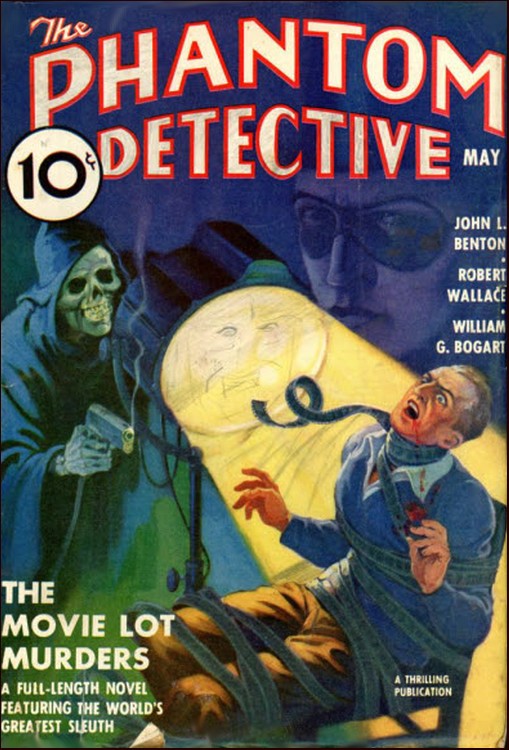
The Phantom Detective, May 1938, with "The Movie Lot Murders"
In the wake of a sensational snatch case, the spotlight of crime is turned on a grisly death spectacle! Murder and tragedy stalk the desert as the Phantom undertakes one of the most baffling cases in his career.
A DESERT night! A star-studded sky, incredible and thrilling in its brilliance; a big yellow moon painting silver the uneven broken floor of the desert, softening the harshness, obliterating the scars of crisscrossing ravines and gulches. A majestic peace reigned here, ageless and permanent.
Impossible to associate strife and murderous intrigue with the hushed majesty of the desert night. But just as the cloud had passed the face of the moon, then so had the first cold breath of death touched the three men asleep on the powdery white sand. Death—murder—born and smoldering now in the brain of the fourth man.
Emil Kroft, the squat, bulging-eyed, bespectacled German engineer, lifted himself up on his elbows. Long and carefully he appraised the sleeping trio, his face twitching.
There was "Apache" Joe, the ancient Indian guide, lying on his stomach, asleep over the rifle which never left his withered, clawlike hands. Freckled Joe Gorman, the cameraman, sprawled on his back, his mouth open, snoring with a curious whistling sound. Claude Finch, location scout and technical adviser, hatchet-faced, gaunt-bodied, lay like a bowled-over scarecrow near Gorman. The cameraman's square black film box pillowed Finch's head.
There was an empty quart Scotch bottle at Gorman's feet. Another, half buried in the sand, was near the Indian guide. Kroft, appraising the trio with glittering, feverish eyes, was again passionately grateful for Gorman's suggestion to hold a quiet little celebration before returning to the main location spot, six miles east.
And the murder-crazed German also thanked now the insomnia with which he had been cursed for years. The white powder which enabled him to sleep—he had slipped a bit of it into the Scotch the others drank. And so they lay there now, not merely in drunken stupor as they would believe upon awakening, but effectively drugged.
Four hours ago, flush-faced and wild-eyed—even the impassive Indian excited, probably for the first time in his life—they had thought they were celebrating a discovery that would make world-wide headlines. As a matter of grim fact, they were celebrating their own doom!
"I shall have all of it," Kroft whispered. "All of it! Lieber Gott, the fools would have told when—"
He choked, unable to breathe for a moment, swept in a frenzy of pulsing avarice, as a glittering vista of the future extended to him. To him—Emil Kroft, who never in his life had earned more than three thousand a year, and who would soon be able to glut himself on all the luxuries and pleasure the world had to offer.
He stood up, mechanically brushed the sand off his clothes, and sneaked left to the burro near which lay his equipment. Gorman stirred, mumbled something, and Kroft froze in his tracks. His hand darted to the revolver on his hip. But the cameraman went on snoring.
Sweat flooded Kroft's squat body as he stooped, over his pack. His hands shaking, he removed to the sand a stick of dynamite, a dry cell battery, a coil of wire. He stuffed these articles into a small canvas bag, added a pair of pliers to them and several other things he thought he might need in his murderous scheme.
HE lifted the bag, and his squat shadow glided in front of him as he sneaked away from the sleeping trio. He hadn't far to go. Fifty feet took him to the crest of a steep rise. It was as if some gigantic ax had cleft it—a gully no wider than six feet, and perhaps thirty feet deep.
It had retained some of the day's hellish heat Kroft knew when he carefully descended into it. Great overhanging rocks and boulders menaced from either side. Sand and loose shale made up the walls. Even now, every few seconds, Kroft could hear the swishing, slithering sound as some loose pebble would roll down, carrying a tiny dust puff of sand with it.
A dangerous stretch to traverse, since there was always the threat of an avalanche. But it offered a short cut of several miles, and fairly rapid transportation. To avoid it meant picking one's way through hellishly rough country.
They had come through this gully yesterday afternoon. Kroft knew that the Indian guide would, naturally, take them through it again on the way back. Or, rather, try to take them through it. For what the German, controlling his nervousness, was doing now would seal the doom of the other three. This gully was to be their tomb.
With experienced eyes, Kroft studied the walls. Then he saw the spot he sought—a deep, scarlike indentation. A great rock overhung above it, and many other boulders above that one. He paused here, and for the next couple minutes worked with swift, trained efficiency.
When he stepped back, a devilish murder trap was set and ready in that gully. The thin white wire stretching across it was almost the precise color of the sand. Only a half inch or so above it, cunningly concealed in place by small rocks carefully tilted over it but not quite touching it, it was practically impossible to detect. The slightest contact with that wire would set off the planted dynamite bomb. Result—swift and terrible death!
Terror hounded Kroft as he stole back to the camp site. If one of the others had awakened, had trailed him maybe to see what he'd been doing—That damned Indian, whose black eyes told so little and seemed to know so much—
But the three men still lay in the precise same positions in which Kroft had left them. He lay down, and in the dead silence listened to the pounding of his own heart. The three hours until sunrise were an eternity to Emil Kroft.
Apache Joe awakened first. Like an animal, he simply opened his eyes, awake, yet his body was still absolutely motionless. The first indication that Kroft had of the awakening was suddenly seeing those black eyes watching him. He recoiled involuntarily, startled, terrified, though he had no definite reason for being so.
And then the Indian gave him reason for terror.
"You take-um walk at night, huh?"
Kroft's tongue stuck to the roof of his mouth. His throat muscles began to hurt.
"What d'you mean?" he said very hoarsely. "How do you know that?"
"Tracks," said the Indian, pointing with a withered hand. "Yours. Go that way, come back soon."
"I guess I got too drunk," Kroft said. "Wandered about a bit. Don't remember doing it, though." He tried to laugh.
"A man drunk no make-um tracks like that," the Indian said. "A man drunk go—" He made a wobbly motion with his hand.
Joe Gorman, awakening now, interrupted this dialogue.
"My God," he moaned, "what a head!" He looked around with bloodshot eyes and spied the Indian. "Hand me your canteen, will you, Joe?" he said thickly.
And Kroft said to himself, desperately, as the Indian got up and walked to Gorman with the canteen: "Let him suspect. What of it? When he learns the truth, it'll be two-three seconds before he's dead. Nothing to worry about. I'll still make it."
Minutes dragged by. The gorgeous pastels of a desert sunrise painted the horizon in the east. Gorman awakened Claude Finch who also promptly grabbed hold of his head and demanded water.
"Hell," said Finch, "I must have passed out."
"We all did, it seems," growled Gorman. "Scotch and the desert air don't seem to mix. Thorpe will have a fit. He expected us back hours ago."
Finch grinned.
"He won't kick, after he hears what we have to tell him. Can you imagine the publicity it'd give the picture?" Then the grin left his lips. In a hard, level voice, he added: "We will tell, won't we?"
There was a brief pause.
"I've always played square," Gorman said curtly. "I'm not changing spots now."
"Okay," said Finch. "I suggest we get moving right away."
"Good idea," Kroft said, aware of the Indian's eyes on him.
Packs were thrown over the backs of patient little burros. Was it possible, Kroft wondered, that they could not hear the pounding of his heart. With the Indian in the lead, they began trudging up the incline. Kroft had maneuvered it so that he was last in line. Finch was ahead of him, and Gorman immediately behind the Indian.
HALFWAY up the incline. Three-quarters. The crest in another few seconds, with Apache Joe and Gorman already out of sight, descending into the gully. Then Finch, leading his burro, entered between the two walls.
Kroft paused on the crest.
"A pebble in my damn boot," he called out, his voice hoarse and strained. "Go on, I'll catch up with you."
The Indian glanced over his shoulder, but said nothing. Finch and Gorman, both with vicious hangovers, also made no comment. Kroft could see his own tracks clearly, and he knew that the Indian's eyes were following them. Soon—soon they would pause at the thin little wire. The damn Indian would notice tracks going to the left wall. If he wondered about them, investigated without touching the wire—
Now! Apache Joe was abreast of the cleft which concealed the dynamite bomb. Lieber Gott, he had stopped! He was looking around, obviously puzzled, suspicious. Gorman had walked up to him. Kroft heard his voice.
"What's the matter, Joe? You—"
A dull booming sound drowned out the rest of his words. Gorman's foot had touched the wire!
The explosion itself wasn't much. The left wall heaved, slowly, lazily, like an enormous mounting ocean wave before it broke. There was an awful split instant when everything seemed loosely poised in the air, held by some unknown attraction.
Kroft heard Finch scream something, saw him try a hopeless dash back to the crest. Gorman stood motionless, stunned, and paralyzed. Apache Joe whirled with the rifle, and fired from the hip. Even less warning of death had Emil Kroft than those for whom he had prepared the murder trap. Apache Joe's bullet plowed through his heart. He was dead before his squat body struck the sand!
Then—the slithering, mounting roar of the avalanche! The suspended wave of tons of rock, shale and sand came down with obliterating, appalling viciousness. The human figures below it, suddenly toylike, were swamped, grounded under, disappearing out of sight. And still the tons of rock and sand came pouring down. A fine cloud of alkaloid dust hung like a smoke screen over the scene.
The roaring, crashing sound died out. Slowly the dust settled. Desert stillness again. Emil Kroft lay motionless near the quivering burro. After awhile, the patient little beast, unwatered that morning, wandered off.
The sun rose higher in the east. It was abruptly day. And, just as abruptly, three specks appeared in the blue of the sky. Two minutes later, the first vulture alighted on the sand near Emil Kroft's body. Another, and a third, joined it in a few seconds. They sat there awhile, then the first vulture waddled over.
Kroft's glasses had come off his nose when he had fallen. The first vulture, with a kind of gruesome daintiness, began picking at his eyes. A bright little green lizard slithered out from beneath a rock and watched gravely. The two other vultures patiently awaited their turn.
CHRISTOPHER THORPE had the reputation of being the most violent tempered director in Hollywood. Temperamental stars soft-pedaled their capriciousness when working under him. Too many of them owed their stardom to his genius.
All feared his temper, which might easily manifest itself with a hard right to jaw—and damn the consequences. All knew that his heart was in proportion to his burly, six-footed body. Thorpe was honest, fair and sincere—qualities that the make-believe world of Hollywood recognized and admired.
Pacing up and down now—in front of a huge, stream-lined trailer, the steady stream of profanity which flowed from his lips brought delighted grins from his audience. An audience as fantastic in its clashing contrast as the general scene around it.
A gaunt, sun-blackened Apache, whose restless wild eyes betrayed his heritage, stood leaning on a rifle next to Viola Stewart, whose ash-blond loveliness was the ultra in sophistication. A bow-legged, unshaven Irish property man handed a match to Paul Drake, the screen lover whose handsome face was probably better known around the world than that of the President of the United States.
A slanty-eyed Mongol with brutally primitive features stood next to the pale, bespectacled, rather effeminate Michael Palmer, one of the world's greatest playwrights. The amazing melting pot that the motion picture industry fostered in its many-veined needs was symbolized here.
And equally amazing was the background. Thorpe's trailer faced a relic of an era long-forgotten; a crooked street with a narrow wooden sidewalk; wooden buildings with clumsy false fronts; hitching-rails.
A town had once mushroomed and boomed here in the desert, stimulated by the discovery of gold and silver in the vicinity. It had had a hectic, violent life—and had died when, one after the other, the mines had played out.
A legend stubbornly persisted that a gold mine of fabulous wealth still existed in the vicinity. But, though many had looked for it, exploring the numerous abandoned mines nearby, no one had found any trace of the precious metal. And the desert had claimed for permanent bleaching the bones of many who had tried.
Now it was a ghost town, abandoned, forgotten, invaded for many years only by slithering, silent creatures of the desert. The timbers had become more warped by the merciless sun; the fine alkali dust had shrouded it more thickly. A forgotten derelict of a town, until the magic of Hollywood had reached out toward it.
It was to be used as the authentic background for Mammoth Films' new great production, and life such as the town even in its boom days had never known, now pulsed in it.
Carpenters' hammers banged in the ancient buildings, reinforcing the rotten foundations, the caved-in floors. Huge stream-lined trailers, bright with chromium, mocked the old hitching-posts. A dozen automobiles were sprinkled here and there. A veritable tent city, for those who did not merit the luxury of a trailer, had sprung up on the outskirts of the town.
THE final touch in the clash between the new and the old was the great silver-winged monoplane reflecting the early morning sun beyond the canvas of the tents. And still further beyond, smoke plumed thinly from the open fires of the score of Apaches, hired for the production, who were cooking their meager morning meal.
"I gave the fools specific orders," Thorpe stormed with red-faced violence. "All they had to do was to find and film the interiors of three—four of those abandoned mines so that I might pick out the one best suitable for our ambush scene. How long should that have taken them? And they've been gone thirty-six hours now—thirty-six hours!"
"Perhaps," said Paul Drake in his carefully cultivated British accent, "they're lost. This beastly rough country—"
"Lost!" Thorpe half-screamed. "Why, the Indian with them knows every foot of this country. How could they get lost?"
Drake shrugged. "Then I'll give you another theory. I wouldn't trust these Apaches any further than I could heave that trailer. Maybe the old devil murdered them for their—"
"Maybe," a flat, slurring voice interrupted, "you one damn fool, huh? My grandfather is with them. My grandfather is great chief, wise man, honest man—and you small yellow dog."
The Apache near Viola Stewart had stepped back a pace. The Indian's thin, long nostrils quivered, and there was murder, swift and merciless, in his black eyes. Paul Drake, who had shown himself a two-fisted, steel-nerved hero in countless screen brawls, turned grey. Fearfully watching the rifle in the Apache's hands, he mumbled something incoherently.
The Apache grunted, turned and stalked away.
"Paul, darling," Viola Stewart drawled, "how could someone as handsome as you be such a scatterbrained idiot?"
Contempt was on her lovely face. Sullen misery was in the eyes of Drake—who was madly in love with her.
"I," Thorpe added savagely, "have several other descriptive adjectives to add. Why, you stupid—"
His voice broke off, even as the Apache, now some thirty feet away, froze in his tracks. A weary little burro had just topped a rise of land on the right.
It began descending toward the trailer.
"Looks like Kroft's," Thorpe muttered. "His equipment, anyway. But where in hell is the Dutchman? And the others?"
He walked swiftly up to the motionless Indian.
"What do you think, Black Eagle?"
The Apache's black eyes rolled toward him.
"We back-track," he said laconically. "Trouble."
He raised his fingers to his lips. A moment later a whistle, incredibly piercing and shrill, rose above the hammering of the carpenters. Thorpe, glancing toward the slope on which the Apaches had their fires, saw immediate motion. Gaunt figures, each brandishing a rifle, came running toward them.
He himself began shouting curt orders. Men converged from different directions, milled about him. One car swung over to the trailer, then another and a third.
Black Eagle examined the burro. He said nothing. And still without comment, his eyes now on the tiny hoof prints, he began ascending the slope. The other Indians followed. Then the first of the cars, Thorpe himself driving it, lurched up in low gear after them.
Luck stayed with the white men. Though it was hellishly rough country, the automobiles were able to lurch on until they reached the very exit of the gully which had entombed three men several hours ago. Thorpe piled out and ran up to join Black Eagle.
"No understand," the Apache said curtly, pointing into the gully. "Tracks, see? Men, burros. Made yesterday. But no come back tracks. This burro it come back another way." He pointed to the single tracks which went upward, flanking the canyon. "Why burro come back hard way, huh?"
Thorpe shook his head. The gully twisted snakelike so they could not see, from where they stood, the debris of the avalanche a half mile ahead. Black Eagle turned to the other Indians and gave guttural orders.
HIS party split up, a half dozen Indians entering the gully to follow the in-going tracks; the others trailed Black Eagle in the back-tracking of the single burro.
It was tough going, especially for the white men. Their feet whipped up choking alkali dust. There were great boulders to circle, almost perpendicular slopes to climb where, on the treacherous sand, one slid back a foot for every two he climbed. The sun, though quite low in the sky now, still poured down its merciless heat.
"Ah!" Thorpe heard a sibilant hiss from Black Eagle.
The Indian's hand indicated three vultures rising awkwardly, lazily, from beyond another great boulder. A minute later, circling that boulder, standing on the crest now from which the gully dropped, they found Emil Kroft's body.
It was only vaguely identifiable now, a thing of nauseating horror. "Shot," said Black Eagle. "See?" Yes, there was no mistaking the bullet hole in the German's chest.
"Shot—by whom?" Thorpe asked hoarsely. "Why? Where are the others?"
A shout made him swing in the direction of the gully. He saw the huge pile of rock and sand choking it fifty yards away, saw the obviously fresh scars in the left wall from which it had come down. And with horrible clarity he saw a man's boot protruding from the near edge of the pile.
Claude Finch, in his desperate dash for life, had almost—almost—escaped the grinding death of the avalanche!
Two of the Indians who had gone up the gully appeared, having climbed the pile from the opposite side. Black Eagle shouted something to them. He received a guttural answer and faced Thorpe.
"My grandfather," he said, "two white men—buried under."
"How do you know that?"
"Tracks go down, see? Moccasin tracks, white man's boots. No same tracks keeps on other side."
IT was childishly simple. If the tracks did not continue beyond the pile of rock and sand, then three crushed bodies were beneath it. Sweat that was not due entirely to the heat of the sun oozed from Thorpe's pores.
"This avalanche, Black Eagle. Accident, you think?"
"Maybe. But I think my grandfather too smart. I think he know before he go in if rocks they come down. And who shoot him?" He jerked a thumb toward Kroft's body. "The bullet come from down there."
"Perhaps the reverberation of the shot started it," Thorpe said. "And yet, why should any of those three want to kill a harmless little guy like Kroft? Hell, it makes no sense!"
"We dig," Black Eagle said. "We find bodies. We find guns. We find what man shoot gun. Good thing burro came when she did. Ten minutes more—no tracks."
Thorpe understood what he meant. A wind was rising now, driving the powdery sand ahead of it. It was as if a knee-high wave of smoke was rolling across the floor of the desert. Soon all tracks would be obliterated.
He shouted something over his shoulder and ran down into the gully. Only two of the six Indians on the crest followed him. The others stood still. Black Eagle paused, shouted again, and waved peremptorily. The quartet of Indians near Thorpe remained motionless. One of them, a squat, heavy-limbed man with a pockmarked face, made a reply. Although Thorpe knew no Apache, he sensed the sneer in the man's voice.
"Telling him to go to hell in Apache," a Federal man from the reservation interpreted aloud. "Says digging is squaw's work, unbecoming a warrior. Those two hate each other's guts. This Running Deer, he's a damn bad Injun. And when an Apache is bad—brother, he's bad!"
Christopher Thorpe paid no attention to this. His fists suddenly clenched, he was staring at one of the men in the crowd, a burly, unshaven, red-headed man with all the earmarks of an ex-pug.
IF Running Deer, the squat Apache, meant to start some hell with Black Eagle halfway down the gully, he was temporarily interrupted. The Indian stood between Thorpe and the red-headed man, and Thorpe's progress could only be described as that of a tornado.
Berserk with fury, he plowed into the group there, the very impact of his hurtling body sending the Indian and another man sprawling to the sand. Another running stride, and Thorpe grabbed the red-headed man by the shirt.
"Damn it to hell!" he roared. "What are you doing here, O'Brien? You know what your job is. You know what you're being paid for. You damn fool, suppose this is deliberately planned to get you away from the kid!"
Choking with fury, he slashed out with his other hand. O'Brien lurched back, throwing up his arms. Only the huge boulder behind him checked him from falling. Blood trickling down the corner of his mouth, he half sprawled against the boulder a moment, then slid to the left and dropped beastlike to his hands and knees.
"It ain't my turn now to stick with the kid," he snarled, vicious hatred in his little eyes. "The three of us take a four-hour shift each. I'm off now, an' there's somebody else watchin' the kid. Why in hell don't you ask —instead of usin' them mitts of yours?"
"Sorry," Thorpe said gruffly. "But you know I've plenty of reason for being jittery about that kid. All right, let's dig those bodies out. You, Palmer—and you, Drake—it won't hurt those lily-white hands of yours! Some of the men may still be alive. Down to work, everybody!"
And he led the rest by being the first to begin clawing feverishly at the tons of rock and shale entombing the bodies. It was nasty, dirty work; and it took hours before the last body was found.
"Alive?" Thorpe muttered bitterly. "They must have died five seconds after that stuff came down on top of them."
He was staring at the three corpses when Frank Haley, the assistant director, touched his arm. Haley was as big as Thorpe, but he had the lithe, broad-shouldered body of a trained athlete. His bronzed, finely chiseled face was ever a phlegmatic mask; it was so even now, composed, emotionless.
"No sense staying on here any longer, Chris," he suggested quietly. "They're probably having a merry riot back at the location camp."
"You go on back and take over," Thorpe replied curtly. "I'm going to stay here and try to find out why this avalanche happened. Why Kroft was shot. And who shot him!"
Haley shrugged slightly. He got into one of the cars. The investigation party began to dribble away. But Thorpe stayed on, characteristically indifferent to effort, to time. He stayed on until night threw her mantle over the desert and until only Black Eagle remained with him. He stayed there, roving the scene like a restless animal, searching, searching. Even the three corpses had been lugged away by now.
And then, upturning a flat boulder, he found grim evidence of the avalanche's cause: a strip of wire and the brown paper casing of a dynamite stick. A dynamite bomb had set off that avalanche! Black Eagle made the second discovery soon afterward. He had picked up a rifle and said gutturally, fingering the bolt:
"My grandfather—he shoot white man whose burro come alone back to camp."
"How do you know that?" Thorpe demanded.
"Apache always reload rifle right away. Bullet come from gully. Nobody else fire gun. No strange, tracks. My grandfather's rifle show one bullet gone, see?"
"I see," Thorpe growled. "But just what do I see?"
He stood there, half crouched, clenched fists slapping his thighs. A deliberate murder of the three men by Kroft! And the old Apache shooting Kroft a split instant before the avalanche! Why? What was behind it? What could Kroft possible gain by the murders of those three men?
And then Thorpe's face suddenly became drawn and haggard. He experienced fear—sheer terror—for probably the first time in his life.
"My God!" he forced through his teeth. "Can it be possible that this is just a ruse to draw the camp away while they—"
He turned and raced madly away from the gully.
HOW Chris Thorpe managed in the tricky moonlight to reach the remaining parked car without breaking his neck was almost a miracle. A dozen times he started miniature avalanches by sliding down treacherous slopes on which even cautious descent was dangerous. He jumped a six-foot ravine, with loose shale on the other side, risking almost certain death on rocks thirty feet below. He tore his clothes and scraped his skin, and was a sweating, dust-caked scarecrow when he finally climbed into one of the cars.
And how he was able to drive that car, accelerator pedal jammed down to the floorboard, doing forty and fifty and sixty over country strewn with boulders, innocent of any grading or even any suspicion of a road, with the car bucking and lurching like a wild bronc, missing time and again by a hair's breadth a suicidal crack-up until its very repetition became monotonous—how he was able to do that could only be attributed to the kindness of whatever gods look out for madmen.
He made it, nevertheless. Reaching the location site, he roared past his own trailer, scattering with apparent murderous indifference several people walking the street. He reached the northern edge of the ghost town and, brakes screaming, pulled abreast another trailer. It was even more sumptuous, more obviously expensive than his own; a luxurious, stream-lined thing as large as a freight car.
He piled out, ran up the tricky steps, burst through the door. A tiny cubicle of a room was here—and it was empty. Empty, when Thorpe knew that a detective was supposed to be on guard here, protecting Patsy Scott, the most famous child star in the history of entertainment.
Thorpe's face greyed. Breathing heavily through his nose, he was afraid to open the communicating door into the next room. He forced himself to do so finally and looked into the room. Something like a moan escaped Thorpe's lips. The bright, gay little room had a child's bed along one side of it. Moonlight streaming through the window showed that bed—empty!
Empty! When Patsy Scott's bedtime was almost two hours ago!
Thorpe still dared to hope as he crossed this compartment and opened the next communicating door. A fat, heavily made-up woman sat snoring in a chair.
"Mrs. Scott!" Thorpe called very sharply.
The woman awakened with a start, jerked up her head.
"Oh, hello, Mr. Thorpe," she simpered. "So nice of you to drop in. I—I'd eaten a bit too much, and dozed off."
"Where," Thorpe asked in a terrible undertone, "is Patsy?"
Mrs. Scott gaped at him stupidly.
"Why, I put her to bed two hours ago. Undressed her and—" She jumped out of the chair and added in a shriek: "Isn't she in her bed now?"
Thorpe brushed his hand over his eyes.
"It's happened," he whispered.
THE woman grabbed his arm. "What?" she panted. "What's happened?"
"Stop yelling!" Thorpe said savagely. "Where's your husband?"
"Why—isn't he here?"
Thorpe ran out of the trailer. He heard the woman scream as she followed him into the next room and saw the empty bed. He cursed under his breath, and cursed again, louder, when his eyes saw certain evidence in the deep sand outside the trailer.
Thorpe did not have the tracking lore of the Indians. But that was not necessary. Those tracks were sharply distinct, and unquestionably made within the past ten minutes, since the ever-strengthening wind had not yet obliterated them. They were tracks of a man's shoes, and tracks of a child's small feet.
They led to the back of the trailer. The ground sloped there, and although the tracks swiftly became more faint, Thorpe soon did not need them. For he saw the black blotch of a body sprawled next to a boulder.
He was stooping over it a few seconds more—over the body of a skinny little man with a pointed grey Van Dyke beard. The child's tracks could no longer be seen. And again Thorpe did not need the tracking lore of the Indian to interpret what had happened at this rock.
Someone had stepped out from behind the rock here. He had slugged the skinny little man whom Thorpe knew to be Patsy's father. Then he had scooped up the child and carried her away!
Thorpe did not even pause to find out whether or not Scott was alive. His eyes and face were those of a madman, he darted back to the trailer.
"Get back inside!" he snarled at the woman.
She obeyed, scared out of her wits by his appearance. So was a passing property man frightened when Thorpe yelled to him:
"Fetch Frank Haley here! Right away!"
He stood there, his face twitching, until he saw his assistant come on the run. Then he grabbed Haley's arm, his fingers sinking into his assistant's flesh, and whispered to him fiercely:
"Frank, it's happened."
Haley's eyes widened.
"Chris! You don't mean—"
"Yes, damn it! Patsy—snatched!"
"My God!" said Haley.
"Listen!" Thorpe's voice was almost too thick to be intelligible. "I want you, quietly, to find out the details. But—and get this straight, Frank—I want no searching parties. No man-hunts, understand? I won't run the risk of them being cornered and murdering the child. If any moves are going to be made on this case, it's going to be made by the best man-hunter that can be found in captivity. I'm flying to Hollywood immediately, and will see Becker the minute I get there. I've an idea he'll have somebody ready to come back with me."
"Who?" Haley said.
But Thorpe did not answer as he darted to the car in which he had come here, piled in, and sent it careening up the street. He almost sideswiped another small trailer when he roared up to it. It held the wireless unit which was the location camp's sole means of communication with the outside world. The kid operator stared at him when he burst in.
He gaped further when he read the message Thorpe hastily scribbled on a pad. It read:
For God's sake try to get hold of the Phantom right away. Remember you mentioned you had heard he was in Los Angeles. See Harris at once. Am flying to Hollywood immediately. What we feared has happened.
Christopher Thorpe.
"Send this to Becker," Thorpe panted. "Immediately. And keep your mouth shut about it."
He ran out. His next pause was a tent. A long-legged young man with a merry, pug-nosed Irish face lay sprawled out on a cot, reading a magazine.
"You ready to fly, Keefe?" Thorpe snapped.
"Sure," the other man grinned. "Where are we goin', and when?"
"Hollywood," said Thorpe. "Right now."
In ten minutes, the huge silver monoplane roared defiance to the desert stillness. It lumbered forward, lifted, raced its shadow on the sand. Christopher Thorpe sat just behind the pilot. His face was supported on his fists, and he rocked gently.
Christopher Thorpe was—scared!
THE office was the size of a small ballroom, and one could almost build a skating rink on the polished top of that enormous desk. One could live at least a year in comparative luxury if he had the price of the Persian, rug on the floor here. And the cost of any one of the dozen oil paintings on the walls could certainly purchase a nice shiny limousine.
Which—was only fitting and proper, for this office represented the inner sanctum of Mr. Andrew Becker, owner of Mammoth Pictures. And Mr. Andrew Becker, in his cherubic, innocent-eyed self, was the absolute dictator of an organization worth approximately twenty million dollars.
BUT to the rangy-bodied, quiet-eyed young man facing the desk, Becker looked anything but the motion picture czar he was. Becker's face had lost its cherubic blandness. His button eyes were frightened, and nervousness quavered his voice.
"Aside from knowing that Mr. Frank Havens is your contact, Phantom," he said, "I've no idea, of course, what your relationship with him is. Frank and I are old business associates, and good friends. So he was kind enough to inform me, when I played golf with him on his visit to Hollywood here, that you were out on the West Coast. And it was damn decent of him to send you here tonight when I asked him to contact you."
Andrew Becker also had no idea that the young man who had played in that same golf foursome—Richard Curtis Van Loan, the Park Avenue society playboy who had come out on a pleasure trip to the Coast with Havens—was the same man who now faced him across the desk. But Van, thanks to his genius at disguise, was now a handsome, olive-skinned Italian or Spaniard, not bearing the faintest resemblance to the well-known and much rotogravured Richard Curtis Van Loan.
There was no way that Becker could possibly have connected that young Van Loan who had played golf with him with the Phantom who now faced him—the Phantom, whose exploits in the criminal world had become legendary throughout the length and breadth of the nation. The grim Nemesis of crime whom the underworld feared as a field mouse might fear a swooping hawk. For so did the Phantom strike—silently, swiftly, surely.
Only one man could ever have connected Richard Curtis Van Loan with the avenger who had become a force for justice, a man unpredictable, but known and respected by the police of a dozen countries. That man was Frank Havens, owner of a string of newspapers from coast to coast, the man who had first suggested to the bored playboy that he might find interest in trying to solve a crime that had stumped both police and newspapermen; the only man through whom the Phantom could now be contacted.
And only Havens knew how the solving of that first crime had led up to the present time when the Phantom was the most feared Nemesis of crime on earth. For Van had not only gained a knowledge of criminology that was equalled by but few experts, but he had become a master of makeup, of the actor's art of mimicry, of ventriloquism, hypnotism and all the scientific aids of the laboratory. Added to that he had mastered a dozen languages and dialects in perfecting himself in his chosen art. And, fearless of death, he was relentless in his sworn war on crime and criminals.
It was with Frank Havens that Van Loan had come to sunny California on a well-earned holiday, and now as he sat quietly listening to Becker there was a hint of a wry smile on his lips. It was occurring to him that it was, after all, as he might have expected, turning into a busman's holiday.
"Would you tell me why," Van asked Becker curiously, "you wanted to know my whereabouts from Mr. Havens four days ago, and waited until tonight to send for me?"
"Because," Becker replied, softly pounding the desk, "I wanted the comfort of knowing where you were in case the threatening event I feared might happen in spite of all the precautions I have taken. And it has happened, damn it!"
Van's curiosity sharpened. A keen judge of character, he knew that Becker was not a man easily frightened. And that he was scared almost out of his wits now was only too apparent. He was about to question Becker when another man burst into the office. And Van had further cause now for curiosity which verged on amazement.
For he recognized the burly man who had just made that whirlwind entrance; who had paused jerkily and was staring at him. It was Christopher Thorpe, the famous director.
Christopher Thorpe's clothes were torn and filthy, his face was twitching, and in his eyes was a life-and-death sort of tenseness.
"Is this he?" Thorpe panted to Becker.
"The Phantom, Chris." Becker nodded.
THORPE exhaled with relief and wiped the sweat from his face. "You've told him yet, Andy?"
"I was just about to tell him when you came in," Becker said. He faced Van and added slowly: "Phantom, you've undoubtedly seen Patsy Scott on the screen?"
Van shrugged. "A rather superfluous question, isn't it?" he said dryly. "Of course I have. Why do you ask that?"
"Because," said Becker, his voice a whisper, "Patsy Scott has been kidnapped!"
Van jerked forward. He couldn't help the involuntary:
"What?"
"Yes. About five hours ago. From her trailer on our desert location out in Nevada. I discovered around eight that she was gone, and telegraphed at once, but Keefe had a little difficulty with his engine before we started, and we were held up. Took us about three hours to get here.
A blanket of silence, tense and spine-tingling, dropped over the office. Van felt his fists begin to clench. His eyes narrowed, his jaw hardened. For he knew that he had just heard announcement of a crime that would shock the country—and the world—as probably none other ever had.
Little Patsy Scott, at eight, the greatest box office attraction in Hollywood had been kidnapped. Patsy Scott, who had the sunlight in her bobbing copper curls, in her eyes, in her smile. A diminutive genius whose dramatic ability stupefied critics and sent them frantically searching for new superlatives.
Patsy Scott, beloved by millions, men, women and children; the most lovable little devil ever flashed on the silver screen to bewitch audiences throughout the civilized world.
"I will pay anything," Becker said softly. "She must not be harmed. There must be no blunders that might endanger her life. That's why I've sent for you, Phantom—a man who has proven his courage and intelligence. I plead with you to go out there. I want you to direct the investigation so that no blunders are made. I want you to handle all the negotiations with the kidnappers. Anything you believe should be done you are at liberty to proceed with. I shall abide absolutely by your decisions."
"Thanks," Van said grimly. And added to Thorpe with characteristic directness: "I'll want the details when we're on our way out there. How soon can we leave?"
There was approval in Thorpe's eyes, himself a man of action.
"A plane is awaiting us now, on a private landing field right on the lot here."
"Come on!" Van clipped.
Five minutes later, the big monoplane took off again. Van, sitting across the aisle from Thorpe, prompted quietly:
"Okay, let's have it. I believe Mr. Becker implied that he has feared for some time that the child might be kidnapped. Why?"
Thorpe ground out his cigarette, leaned forward.
"Four days ago," he said, "we received an anonymous phone call. It went something like this: 'Better watch that kid Patsy Scott real good, because some guys I know are thinking of snatching her. I ain't the kind of guy who squeals to the cops, but I like that kid too much to see her maybe get hurt. So I'm tipping you off.' "
"Which," Van said grimly, "must have given you a bit of the jitters."
"It did. We put a half dozen extra guards on the grounds of her home. We induced the butler and the chauffeur to resign and, without the knowledge of her parents, replaced them with trained detectives. Her governess had, all along, been an ex-policewoman. Detectives unobtrusively trailed the limousine in which she went to and from the studios. In other words, we took every precaution humanly possible—and we failed just the same."
"Referring to the kidnapping tonight?"
"No, not yet. But here's what did happen. Patsy takes a certain doll to bed with her. Wouldn't go to sleep otherwise. This doll was stolen from her one night some time while she was asleep. Stolen, mind you, right out of the kid's bedroom, with the detectives on guard both in the house and out on the grounds. It's unbelievable, yet it was done."
"But why," Van asked incredulously, "should anyone take such tremendous risk just to steal a doll?"
"To prove to us that our precautions were inadequate," Thorpe gritted. "The doll was mailed to the studios here. With it there was a short printed note. I'll quote it to you, since I know it by heart: 'So you've been tipped off about the snatch, huh? And you think you can stop it by having a lot of dicks floating around? Well, here's something that'll convince you how wrong you are. If we could swipe this doll right out of the kid's bed, snatching her ought to be just as easy. We give you twenty-four hours to pay us two hundred grand, or we will snatch the kid. Maybe you'll never get her back. Put an ad in the personal column of any L.A. paper, and we'll give you instructions how to hand over the dough.' "
"AN inside job, obviously," Van commented. "You called in the police?"
"Of course. Every member of the household was questioned. No soap. And the detectives were damn thorough, believe me, as delicate as they had to be about the situation."
"Delicate?" Van echoed. "Why?"
"Well, we didn't dare let her parents know about it. You see, Patsy's contract expires in about two weeks. We were afraid that if her mother—she's the one who wears the trousers in the Scott family—should find out about the kidnapping threats, she would not renew the contract but would take the kid and run off to England, from where the family originally came. She has threatened on a number of occasions to do that.
"Anyway, Mammoth Pictures are putting on a million-dollar production that has already got a hell of a lot of advance publicity. Patsy is the star of it, of course, and it has a supporting cast including such stars as Paul Drake and Viola Stewart. Fully half of the picture is laid against the background of an abandoned Western ghost town, and its theme revolves about a gold legend which actually exists at the place where we intended to shoot our scenes—a bona fide ghost town out on the Nevada desert. We had Patsy Scott brought out there."
"Rather inviting trouble, in the face of those kidnapping threats, wasn't it?" Van said. "A desert location, and so on."
"Upon the contrary, we thought it would be much safer than Hollywood. Because, look! The one road going past the ghost town is guarded for ten miles on either side by Nevada State Police. No one can get through to the ghost town without special authorization from the studios in Hollywood. And a short-wave radio at the location could get carloads of police there within ten minutes.
"Every man sent on the location was hand-picked and absolutely trustworthy. Patsy herself was in a trailer which is really a fort in itself—bulletproof glass, steel body, and so on. We employed crack operatives from a nationally known detective agency to guard her day and night. There are absolutely no strangers there whatsoever, and none could possibly come there. How, we reasoned, could she conceivably be snatched under those circumstances. Yet it proved to be cockeyed reasoning."
He cursed, softly, but with terrible intensity.
"Okay," Van prompted again, "now tell me just what happened on location."
Briefly Thorpe related what they had discovered after back-trailing the one burro which had returned to the main location camp. He told Van of the dynamite trap evidence and the reasoning which proved that Kroft must have been shot by the Apache a few seconds before the Indian himself had been killed by the avalanche. He told, too, of his own sudden hunch that Kroft might have been in with the kidnappers, and had staged the avalanche just to draw the men in camp away on a rescue party so that the kidnappers might work unhindered.
"How," he concluded, "no detective was on duty then, when one definitely was supposed to have been, is something that hasn't been investigated yet. I don't even know yet whether the father is alive, or how was it that he and the child had gone out of the trailer apparently of their own volition. We'll look into it the moment we land at the camp."
Van nodded. The big monoplane roared on through the night, and Van, his chin propped on his fists, brooded over what Thorpe had told him.
"It seems phony to me," he said shortly, "that this avalanche was deliberately staged just to draw most of the members of the camp away so that the child might be kidnapped. I'm more inclined to believe that Kroft had some personal motive to want the murders of the other three."
"Kroft?" Thorpe echoed. "A mild, meek little German engineer? What conceivably could he gain from the murders of the other three?"
"Where was this original location party sent?"
"To investigate some of the numerous abandoned mines near there. We needed an abandoned mine for one of our scenes."
"And what is that gold legend you mentioned earlier?"
Thorpe made an impatient gesture.
"I see what you are implying. Yes, the legend is that a fabulously rich gold mine is supposed to exist near there somewhere. But thousands of men over a period of many years have combed every foot of the country there. Experienced prospectors. Surely they would have found it if it really existed."
"Just the same," Van insisted stubbornly, "that avalanche business, as tied up with the kidnapping, sounds phony to me."
AND the grim Nemesis of crime the world knew as the Phantom would have found substance to his assertion had he been near a tent on the location the plane was now rapidly approaching. The men who met here did not light the oil lamp they might have made use of. Deliberately, they remained in darkness. Deliberately, their voices were low, guarded.
"There's something phony about that snatch," one was saying. "Though we're probably the only ones on the lot, now that Thorpe's gone, who know it's happened, it should have nothing to do with us. We know what we are in on. It's safe, easy money. Lots of it, and there is no possible kidnapping rap that might come with it. That's as far as I intend to go, and I want the rest of you men to get it straight, once and for all time."
"Why," another voice questioned, "are you saying this?"
There was a pause.
"All right, damn it, I'll tell you why. I've an idea that you are in on that snatch, and are trying to drag me into it. I don't know what in hell is your motive. We've run smack into a fortune that's plenty big enough to take care of all of us. The ransom money would be a sweet piece of change, sure; but I'm damned if I'll have anything to do with it."
"Nor I," the first man who had spoken put in savagely, "and that's final. And if you are in on that snatch, if you are the devil who engineered it—God help you! Because Thorpe is in Hollywood right now, hunting for a private investigator. And you ought to know Becker's money can buy the best in the world. Why, it wouldn't surprise me if he couldn't get the whole Federal Bureau of Investigation if he wanted to. Whoever Thorpe brings back, anybody in on that snatch is slated to lose." And that man's words would have been more emphatic, he would have been trembling with fear could he have had the remotest idea that the "private investigator" Thorpe had gone for was—the Phantom!
THE man who had been accused laughed softly.
"You crazy fools, why should I kidnap Patsy?"
"You tell us!"
"I'll tell you to stop being ridiculous. And now let's break up. It'd be bad business if someone spotted us in a huddle here. Let's go!" One after the other they drifted out of the tents, each going in a different direction. The man accused of participation in the kidnapping paused in the shadows and laughed softly.
"Fools!" he whispered. "Cowardly fools, who would be content with comparative chicken feed when—"
He slunk away and within a minute was in sight of the trailer which housed the wireless unit. Squatting on his haunches he waited patiently, every once in a while consulting his wrist watch. When thirty minutes had gone by, he stood up and stealthily approached the trailer.
The portable radio unit in the trailer especially constructed for it consisted of a powerful modern short wave receiving and sending set. Johnny Patterson, the operator, a rosy-cheeked, blond youngster, sat at the desk in front of the panel board. He was sweating over a cross-word puzzle.
"Six-letter word for 'shouted'," he mumbled. "What the hell could it be?"
"Blared," a pleasant voice said behind him.
Patterson swung around.
"Oh, hello," he said. "Blared, eh? Yeah, that's it. Thanks! Anything I can do for you?"
"Yes," said his visitor. "When is Thorpe's plane due here?"
"Oh, in ten minutes or so. Keefe contacted me from the studios before he left Hollywood, and he's always on time."
"Before Keefe lands he'll contact you again, won't he?"
"Sure. To set up the ground flares."
"Well, here's what you do," the visitor said pleasantly. "When Keefe contacts you, you'll tell him to land three miles due north from here. Tell him he'll see the ground flares there. Tell him the State police are there now, and want to see Thorpe immediately."
Patterson stared. "But that's not true."
"I know it," his visitor nodded. "Yet you'll do it anyway."
Patterson began getting up belligerently.
"Oh, yeah? What makes you think I will?"
"Because I believe this will persuade you!"
And Patterson, the blood receding from his face, found himself staring into the muzzle of an automatic.
"Have you gone crazy?" he gasped.
The other kicked the door shut behind him.
"Yes, Patterson," he said softly, "I'm pretty sure you'll follow my instructions."
The operator dropped back on his chair.
"You can't get away with this—"
"Shut up!"
And reading the expression in the visitor's eyes, Patterson's lips became grey.
"Yes, sir," he said automatically.
A few minutes dragged by. There was a buzzing sound in the radio.
"That must be Keefe," the visitor said. "If you want to live, Patterson—"
With trembling hands, Patterson adjusted earphones over his head. He manipulated the instruments, then leaned forward to the mouthpiece.
"Hello? Hello? Yes, Keefe, this is Patterson—No, don't land here. Orders from State Police, who want to see Mr. Thorpe immediately. Land three miles due north of here. Ground flares will be set up for you there. Repeat—Yeah, that's right—Okay."
He threw off the switch, turned. The earphones were jerked off his head as he bolted upright out of the chair.
"What're you going to do with that pillow?" he half screamed. "You said if I wanted to live—and I obeyed—your instructions—"
Babbling with terror he backed away.
The killer, a pillow in one hand now and the automatic in the other, was slowly advancing toward him. The wall of the trailer stopped the retreating operator. Then the killer crossed the remaining distance between them in one leap. He jammed the pillow into Patterson's chest, pinning him to the wall. And as Patterson, half-mad with terror, lunged forward desperately, the hand with the automatic sank, half buried, into the pillow.
Once, twice, three times the man squeezed the trigger of the gun. The shots were muffled. There was an abrupt stench of cordite, of burnt cloth and feathers. Patterson's legs crumpled under him. He fell in a heap at the foot of his desk as an ever-widening pool of blood began forming on the floor.
With unhurried, callous deliberation the killer made sure that Patterson was dead. He glanced at the two holes in the wall where the heavy slugs had gone through after—penetrating the operator's body; the third bullet had remained in the body. That side of the trailer faced fifty miles of desert. No danger of those bullets striking elsewhere and causing an alarm.
He waited until smoke ceased curling from the snout of the automatic, then he replaced it in his pocket. Opening the door a bit, he looked out cautiously. A second later he sneaked out and was again swallowed by the shadows.
"SAY, Mr. Thorpe," Keefe, the pilot drawled, removing his headphones and turning in his seat, "you surely haven't bumped anybody, have you? I mean, there's no blood staining your hands or some black crime weighing your conscience?"
Thorpe glared at him.
"Listen, mug, I'm not in the mood for foolin' around."
"I've gathered that much," the pilot said dryly. "Anyway, the state cops are on location now. Or, rather, three miles north of it. They gave Patterson orders to instruct me to land there. Something's happened there, and they're kinda anxious to have a pow-wow with you."
"Three miles north of the location," Thorpe repeated tersely. He shook his head, glanced at Van. "What in hell could happen there? It's open desert, and after midnight now."
KEEFE shrugged. "Well, we'll find out in five minutes. Going to pass the location soon. The police are supposed to have ground flares for me where we're to come down." He returned to his controls. Thorpe kept shaking his head, but he made no further comment. Van saw that the director's hands were clenched tightly on his thighs.
An oblong observation glass in the floor of the cabin claimed Van's attention. Dropping on his knees over it, he saw, far below, the greyish-white ocean of the desert. There were veinlike streaks in it marking the gullies and canyons; patch-like discolorations of huge cliffs.
Quite abruptly, he saw a minute cluster of lights. That must be the location camp at the ghost town. As soon as he passed them the pilot cut the throttle and began a gradual glide earthward.
"God, what desolate country!" Van said to himself.
And yet it was not all empty barrenness below the plane; it was not all given over to the silent rustling creatures of the desert. But from the altitude the plane still held, Van could not possibly see the man walking swiftly in the same direction that the plane was going.
It was Paul Drake, the famous screen idol. And there on that lonely desert waste, already a mile from the location, he was playing a role that would have stunned his audiences. He would pause and leap in the air. He would shout gibberish out loud, and strike heroic attitudes, and walk on, laughing wildly, madly.
There was a heavy automatic in his hand. It would make a sinister shadow across the sand as he would wave his hand. Once he paused at a rock to take his bearings, squinting his eyes until he saw, still far ahead, an enormous cliff that lifted itself like a snag tooth above the floor of the desert.
"I've got a gun," he said. "I know how to use it. And I've the courage of a lion, the cunning of a fox, the wisdom of the proverbial snake. How can I fail? How can I?"
His dark face, wild and twitching, was not handsome now. His teeth were drawn back in a kind of permanent snarl over his lips. His usually sleeked-down hair was wildly disheveled. Sweat, caked with dust, made huge patches on his white shirt. The millions of women who adored Paul Drake, who dreamed about him and kept his photographs on their bureaus, would not have longed to be in his arms had they seen him now. They would have run from him with horror.
"So they dare to hint that Paul Drake is slipping," he went on savagely. "Even Viola thinks so. Well, I'll show them. I'll show them all that Paul Drake is a great artist. And Viola will come creeping into my arms—creeping—into my arms—"
Like a run-down spring his bravado, his savage self-assurance, seemed suddenly to have oozed out of him. Terror, swift and abject, replaced the wildness in his eyes. Frantically he dropped the automatic and began groping in his pockets. He found a white paper packet. Opening it with trembling fingers, he spilled its contents—something that looked like powdered sugar—on the inner base of his thumb.
He inhaled the fine powder deep into his nostrils, rolling his hand so that it entered both. Almost immediately his shoulders squared. The terror left his eyes—eyes in which the pupils were dilated to twice their normal size. He was able to laugh again.
"I am the great Paul Drake—and the fools shall know it soon enough!" Picking up the automatic, he swaggered on toward the distant cliff—
NO, Van could not have seen the drugged madman far below.
The plane continued its downward glide. Then pinpoints of light dotted the desert floor and Van felt the heave as Keefe banked slightly. The pinpoints brightened swiftly, undertook characteristics of their own; a triangle of ground flares, dazzling, one blue, the other two red.
The pilot banked again and made a complete circle so as to head into the wind. The blue flare of the triangle was his approach point, the red flares marking the side boundaries of safety and channeling his landing run.
Thorpe joined Van at the observation glass. "I don't see anyone there," he said suspiciously. "Do you?"
Van shook his head. Human hands had stationed the flares there, yet no one seemed near them. State police, the pilot had been told. Where were they?
"I don't like it," Thorpe gritted. "There's something wrong."
Pure intuition, for Christopher Thorpe could not have noticed the three Apaches lying on their bellies just outside the circle of light cast by the flares. They were lying there with outthrust rifles, their prone motionlessness like that of coiled snakes about to strike. They were at three different points, since they had no way of telling precisely where the plane would come to a stop.
With something akin to fear in their black eyes, the Apaches watched the descending metal bird that white man's magic had been able to build. How it operated, what made it go up in the air and then descend safely, was out of their range of understanding. But they were only too familiar with something else the white man had invented—the rifles in their hands. And the savage blood in their veins was also only too familiar with—murder!
They waited with the patience peculiar to their race; waited with forefingers curled on the triggers, for the plane to land and for the human targets to step out into the sights of those murderous rifles!
The huge monoplane made a perfect three-point landing.
"Say, it's awful quiet, ain't it?" Keefe muttered. "Where's the reception party?"
"Precisely," Thorpe said evenly, "what I'm wondering about."
And Van unconsciously found himself touching the automatic in his shoulder holster.
"Wait!" he snapped, as Keefe began wrenching open the door. "I don't like this, myself. Can you contact the State Police barracks with your radio?"
Keefe shrugged.
"I can try. But look! Patterson is my buddy, and I know he's as straight as they make 'em. He wouldn't give us a bum steer."
"Of course," Van said slowly, "this might be the only place in the vicinity where a plane might safely land. Perhaps the police are investigating something near by, out of sight from here. And yet, wouldn't they leave someone here?"
"Hell," Thorpe snarled. "I've had enough of this damn suspense! If it's a trap, I'm going to spring it right now."
He wrenched open the door and leaped out on the sand. And both Van and Keefe crouched instinctively, awaiting—something. Seconds dragged, but there was only the incredible desert stillness, peaceful, disarming. Absolutely nothing happened.
Keefe straightened, relaxed.
"I feel like a sap," he said. There is nothing to be afraid of out there. And the cops will probably be trottin' over soon."
A moment later, he joined Thorpe outside the plane. Van hung back, tense, narrow-eyed. With every succeeding second he liked the set-up less and less. Finally he shrugged angrily and followed Keefe out of the plane.
"God," Keefe murmured, "you wouldn't believe it could be so damn quiet. It's like being in some kind of tomb. Will somebody yell, please—just for the hell of it!"
And it was in that moment that a single rifle shot cracked out, shattering the silence, the sound lingering in a kind of receding nervous vibration. Van saw Thorpe's body jerk before the impact of the bullet. The director pivoted on one foot, as if executing some clumsy dance step, threw up his arms and fell on his face.
Van was in motion before he realized what he was doing. His instinct of self-preservation warned him that he was a childishly simple target in the glare of the flares; that, half-blinded by the light, he couldn't possibly seek out the hidden rifleman. He knew that the least hesitation meant other shots and certain death!
And so he was running in a kind of twisting, zigzag fashion which would have been ludicrous had it not been for the grim reason behind it.
He was running wildly, desperately, anxious only to get out of the naked arena of light thrown off by the flares.
The shots came—a mad, spine-tingling staccato of rapid rifle fire. Several men were obviously working the bolts and triggers. Like angry hornets those bullets pursued Van in his desperate dash for life. He felt a tug at his sleeve, a burning sensation at the lobe of his left ear, and the warmth of blood flowing down his neck. The air seemed alive with the whine and hum of flying lead.
The lips of a narrow gully, with blackness between them, yawned a dozen feet ahead. Without having the faintest idea whether the drop was three feet or thirty, aware only of certain death he was cheating by a miracle and could not hope to evade much longer, he dived headlong into it.
There followed a confused madness of choking dust, of rolling over and over and over, crashing into obstacles, being carried over them by the momentum of his descent; the pain of scraped skin, of bruised flesh.
IT seemed to have lasted an eternity; a choking, violent hell. It ended with stunning abruptness. Van found himself on his back, lying perfectly still. The fine alkali dust churned up by his descent swirled like smoke above him, smarting his eyes, choking his lungs.
Then the dust thinned and Van was able to see the star-studded sky far above him. He lay at the bottom of a gulch which was V-shaped, the two walls, though twenty feet apart at the top, almost meeting each other to form a blunt wedge at the bottom. The slant of the walls had saved Van's life. Had they been perpendicular, he would certainly have been crushed to death, for the drop was easily fifty feet, with toothlike rocks at the bottom.
He lay there a little while longer, almost afraid to move, afraid to find out how many broken bones he might have suffered. His body ached from neck to ankles. Cautiously he flexed his muscles, raising first one leg then the other, moving his arms. There was no sharp agony of a fracture.
He reared up to a sitting position, winced at the protest of bruised muscles, and got to his feet. With a kind of incredulous amazement, he realized that minor bruises and scraped skin was the only penalty that his desperate move had exacted from him.
He stiffened as from somewhere above, distant yet still sharply distinct in the desert stillness, he heard a guttural voice.
"Man with leather hat! You make one move and you die plenty quick!" Man with leather hat! That must refer to Keefe, who wore a flyer's helmet. And then he heard Keefe's reply, coldly contemptuous.
"You murderous skunk! Well, there's one move that I am goin' to make, and you can shoot and be damned! I'm goin' to make sure that none of this liquor in my pocket flask will go down your damn throat!" Then came the tinkling of glass as the flask crashed against a rock.
Van's eyes narrowed, his mouth hardened. Grimly he reached beneath his jacket. His hand froze there, and a kind of hissing sound escaped his lips. The shoulder holster was empty! At some point during that breakneck slide down the sloping wall of the gully he had lost his automatic. God only knew where it might be now!
And then he heard Keefe's voice again, sharp, terse.
"Gregory!" It was the name Van had decided to use on this case, and had thus been introduced to the pilot. "If you're alive and can hear me, better start hightailing it. A mopping-up party is going after you now. Scram, brother—fast!"
Van cursed softly. Christopher Thorpe murdered. Keefe captured. He himself now being hunted by whoever had fired those murderous rifles. A lonely desert waste, miles from any human habitation, totally strange to him. And he was unarmed!
"All in all," he whispered grimly, "a very swell beginning!"
VAN whirled as he heard a faint rustling sound behind him. No, it was only some desert night creature, that was dodging from one rock to another. The feeling of a trapped animal began to possess Van Loan. There were no rocks where he might hide, but the bright moonlight fought a losing battle with the shadows at the very bottom of the gulch where he now stood. Hugging one of the walls, it wasn't likely that he could be seen from above.
To try to climb either wall, however was suicidal. A half dozen feet above the floor of the gully, the moonlight held full sway. Against the white background in a climb, of necessity painfully slow, he would be as conspicuous as a bug creeping on white paper.
And yet he did not dare linger there, either. For it was a safe assumption that the killers hunting him would split up, would descend at two points on either side from where they had seen him dive in. By converging, they were bound to run into him. Death in either case.
What to do? He shrugged grimly. Since the days when man first went out with a war-club to bash out his neighbor's brains, surprise attack had been nine-tenths of victory. Hell, he might as well do some stalking himself! Surprise one of them, maybe—strike first—assure himself a weapon, at least.
Cautiously hugging the right wall which seemed more perpendicular than the other and threw off a deeper shadow, he sneaked forward. The abrupt and unmistakable warning whir of a rattlesnake, suddenly aroused, chilled his heart. He couldn't see the snake, and went on anyway, sweat oozing from him as he anticipated the burning contact of poisoned fangs sinking into his flesh.
The snake, wherever it was in the darkness, did not strike, however. But another danger threatened Van. The floor of the gully took an abrupt rise. Quite a sharp slope, it was impossible to climb it without making noise. Pebbles that Van's feet dislodged would roll down. Once he had started a kind of miniature avalanche, it would be clearly audible to anyone within a hundred yards.
Desperation, the trapped animal feeling when all hope seemed gone, again began tightening his nerves. The surprise counter attack on which he had banked began to look like an impossibility. The killers were bound to hear him, to see him from some distance, and they had the reach of their rifles!
And then suddenly he saw a spot which seemed made to order for him. It was at the very break of the hump-like rise in the floor of the gully, where the ground dipped again. Two huge boulders stood there, offering perfect concealment and at the same time visual command of both approaches to the top of the hump.
Quickly Van crossed to the twin boulders, squeezed into the space between them. He breathed easier. Maybe he had a fighting chance, now. If one of those devils passed close enough for Van to grab him before other rifles came into play, he might make it. God, to feel the butt of a gun in his hand! To be able to command death at a distance, as the others were able.
A minute dragged by. Another. Van, ever watching both approaches to the crest from the shadows of the twin boulders, tensed suddenly. On the left there—was that motion of some sort? A moving shadow? Yes! And then he saw the man. It was a long-haired Apache!
And even in that moment Van could not help marveling at the absolute silence of the other's approach. It was uncanny, for the Indian had the same problem which had confronted Van a couple of minutes ago. Yet his feet did not send pebbles clattering down the slope. The Apache might have been a ghost, something which had no physical substance, literally just a moving shadow!
CLOSER, closer, that half-naked body neared the twin boulder. He came on in a crouch, with the ready rifle, gliding along. A stalking Apache on the blood trail—than which there is no beast more cunning, more cruel, more deadly dangerous. Closer and closer. Van could clearly see the high-cheekboned face, the great aquiline nose, the cruel, thin-lipped mouth, and the sweat sheen on that powerful torso.
Less than a dozen feet now separated them, and still the Indian came on. He was almost on the very crest of the hump. Van, his body tensing, preparing to leap at the Indian when he passed the boulders, suddenly felt as if a great clammy hand had clutched his heart.
For the Apache had stopped dead, and Van instantly realized why. Moonlight touched the crest of the hump. The Indian had come up the slope opposite the one down which Van had come to reach this point. And the Apache had seen Van's tracks!
It would be only a matter of seconds now before the Indian traced those tracks to the boulders. Discovery then—and swift death from the barrel of that rifle!
Van stooped. His groping hand found a pebble. He straightened and tossed it across the gulch. The Indian whirled as the pebble struck the opposite wall. And then Van leaped for him from between the two boulders.
It was a long tackle, actually; a dive through the air, with body stiffly horizontal, arms outstretched. For Van knew he had to close in with the other before that rifle could go into action. Then, and then only, would he have a chance.
Instinct warned the Indian. He swung back as Van's body was still in mid-air. The rifle jerked up, and lanced a streak of orange into the night. Echoing and reechoing, the sharp crack of the report poured a torrent of sound down the gully. The bullet had passed so close to Van's cheek that he felt the air it displaced.
Then his outstretched arms encircled the Apache's thighs. The most exacting football coach could have found no fault with that hard, clean tackle. The Indian went down as if the bullet he had just fired had pierced his own heart. The rifle, knocked out of his hands, clattered down the slope. The two of them, with Van's arms viselike on the Indian's thighs, rolled down after it.
Then they were rolling over and over and over in a breakneck descent through a cloud of choking dust similar to the one Van had gone through ten minutes ago. A huge boulder abruptly checked the descent, Van's body cushioning the impact. He felt a sickening pain in his back; his lungs gasped for air.
Involuntarily he loosened his grip on the Indian. The lithe, muscular body twisted out of his arms. Van saw the Apache's hand jerk to his hip and an instant later ten inches of bright steel was reflected in the moonlight. Fierce triumph was already in the Apache's eyes as his hand lifted higher for the death thrust.
Both moved in precisely the same instant. The Indian drove downward with the knife and Van, his back against the boulder, lashed out with both feet. His left foot missed the Indian, but his right caught him full in the chest. The Apache staggered back, tripped over something, and crashed to the ground.
And then Van was on his feet, leaping in swiftly, savagely. He thought of Christopher Thorpe as he kicked the Indian full in the mouth, smashing his teeth, pulping his lips. He thought of Thorpe again as he brought his heel down on the hand which held the knife.
"Now, you murderous devil!" he panted.
And then a voice said behind him:
"Just the same, White Man, you lose!"
Van turned slowly. Another Apache stood a dozen feet away, a squat, heavy-limbed man with a pockmarked face. His rifle was hip high, only casually pointing at Van. There was nothing particularly menacing about his attitude, yet Van knew that nothing on God's earth could save him now. Death, swift and certain, beckoned to him from the Apache's eyes!
He waited, quietly, for the rifle to speak.
Only the cruelty of his breed kept the Apache from firing. Van knew that.
TIME began to drag. Seconds lengthened into minutes. The Apache merely stood there, rifle still casually trained on Van, saying nothing. And Van continued waiting, his face as utterly impassive, as emotionless, as that of the Indian.
"You brave man," the Apache said finally. "I no shoot you through the stomach. No! I shoot you through the heart, when I come back tomorrow. Tonight you sleep with red ants. You hear maybe about red ants, White Man? Red ants—always hungry. Eat anything."
Baiting him on! Inviting him to make a hopeless break for life. It was not the Apache way to kill a man decently.
The other Indian scrambled to his feet. Through bloody lips, he told his companion something in his own language.
"Red Cloud," the Apache with the rifle murmured, "he has soft heart like squaw. He say no feed you to red ants. He say no shoot you. He say he forgive. He tie your hands now. Maybe you move, maybe I shoot. Understand?"
Van controlled the impulse to get it over with by launching himself at the Apache. They planned some horror for him. It would be the more intelligent thing for Van to do perhaps, to deliberately force a bullet from that rifle! And yet, while there was life there was hope! So he submitted quietly as the Apache called Red Cloud approached with a buckskin thong, ordered in pantomime for Van to bring his hands to the small of his back, and lashed his wrists together.
"Red Cloud," the Indian with the rifle said, "he no speak English. I, Running Deer, go to jail three years. Learn speak very good English in white man's jail. Learn plenty other things." He walked up indifferently, without any show of passion, scraped his fingernails across Van's throat. It left four parallel scratches from which blood oozed instantly. "Learn hate white man—plenty much. Walk!"
He pointed up the slope. Red Cloud was already halfway up, recovering the rifle he had dropped. Van walked, his face still relaxed, impassive. But his heart was heavy, and bleakness shadowed his eyes. This was the first time in his career when he had been checked before he'd had a chance to get started.
Torture and death faced him, yet it wasn't about this that he was brooding. Little Patsy Scott was in his mind. Decoying the plane, killing Thorpe, and yet sparing the pilot —meant one sinister summing up to Van. The getaway move of the kidnappers.
A renegade whose skin was white must be directing these Apaches. They would not know how to set up the flares, would not know how to manipulate the false radio instructions. They couldn't possibly hope to put over the subsequent ransom negotiations. And surely a plane couldn't fit in with any of their schemes.
No, a white man's subtlety was only too apparent in the way this deviltry was unfolding. Was Patsy Scott held here? He was sick at heart when his common sense told him the answer. They would not have decoyed the plane, risking the alarm which would certainly be flashed in a couple of hours, unless they held the child here and were ready to take her to some secret hiding place.
He trudged, in single file, between the two Apaches. A dry stream-bed took them out of the gully. Circling back, Van saw the plane. The flares had gone out. In the moonlight, against the desolate setting, the monoplane looked like some monstrous prehistoric bird.
A motionless patch of black was on the sand near it. Van's mouth hardened when he saw it. Christopher Thorpe's body! He did not see Keefe.
Red Cloud led past the plane. A hundred yards away, an enormous cliff stood like some grim grey watch-tower. They circled it. Here were other great boulders. Two were close together, forming a kind of passageway. Traversing it behind the Indian, Van found himself entering a natural bowl, completely surrounded by walls of rock. Toward the left flames from a fire writhed skyward. It showed Keefe, sitting on a rock, his wrists lashed behind him.
And it showed a little figure, wearing a green sweater, miserably hunched on another rock near Keefe. Copper curls, a piquant little face, chalk-white now—Patsy Scott!
QUITE apparently the Irish pilot was telling Patsy a story. Van caught a snatch of it.
"So we boys thought we'd play a trick on him. We put glue on the seat. When he tried to get up—boy, oh, boy!" He laughed with convincing heartiness.
Van saw Patsy try to smile; a brave little smile which tugged at his heart. Then both Patsy and Keefe saw Van arrive with the two Apaches.
"Hello, Gregory," Keefe said quietly. "So the dirty rats nabbed you, eh?"
"Maybe," Running Deer told him, "pretty soon I cut your tongue out, huh?"
"You're not scarin' me, Hiawatha," the Irishman retorted very coolly. "Cripes, but I'd love to have your ugly map in front of my prop for about three seconds!"
Running Deer tilted his rifle against a rock, and with three swift strides reached Keefe.
"White Boss," he said slowly, "he say no hurt you. He say he need you. All right, I no hurt you. Maybe I squeeze your neck, just a little bit—"
With a vicious backslap, he sent Keefe sprawling off the rock, then pounced on the helpless man and pinned him down with one knee to the chest. He fastened his hands on Keefe's throat.
"Squeeze—just a little bit—"
Another voice, with the definite guttural accent of an Indian said contemptuously in English:
"Hyena she very brave when horse half dead, when man creep on hands and knees, with swole-up tongue and crazy head. Hyena she come and bite then. Black Eagle now see Running Deer like hyena. Ugh!"
Jerking his head, Van saw two other Apaches on the opposite side of the fire. One sat with a rifle across his lap. The other—the one who had just spoken—was obviously also a prisoner. He was lying on his side, his ankles as well as his wrists lashed with leather thongs.
Running Deer ignored the prisoner Apache's words. He was slowly strangling Keefe. Van gritted his teeth. The leather thongs bit deeply into his flesh as he strained against them. He heard a choking gurgle escape the Irishman's lips. But the next move, startlingly enough, came from little Patsy Scott.
Two feverish spots of color in her white face, she jumped off the rock and ran over to the Apache. She began hammering her little fists on his naked, muscular back.
"You let him go, you big bully!" she screamed. "You—"
She stepped back, stooped swiftly and picked up a fist-size rock. The Apache glanced up as she was about to bring it down on top of his skull. He jerked his right hand away from Keefe's throat, caught her wrist and twisted it viciously. And the child's scream of agony snapped something in Van's brain.
A red glare before his eyes, he was a homicidal madman when he darted to where Running Deer still kneeled over Keefe. He kicked the Apache behind the ear. The Indian toppled over, out cold.
"Swell going, Gregory!" Keefe said hoarsely. "But it was your last move, I guess."
Two other Apaches were closing in on Van. He dropped one with a kick to the stomach. The other dodged the second kick, and smashed a rifle barrel across Van's temple. The last thing Van remembered was little Patsy screaming, screaming. Then the black vortex of unconsciousness sucked him in.
PAIN—intense agony which seemed to scrape raw every nerve of his body—was the link that jerked the Phantom back to consciousness. He opened his eyes, to see the desert sky overhead. He was lying flat on his back, arms outstretched, and his hands seemed to be dipped in pools of agony, conducting it to his body. Instinctively he tried to jerk his hands away but some unknown force held them anchored there.
Half blinded, with a terrible headache pounding at him, he twisted his head. As if turning the adjusting lens on binoculars, objects, indistinguishable at first, came into focus. He saw his outstretched right arm, saw the stake to which his wrist was lashed. He saw his hand, palm on the ground and a moccasined foot that was pinning it down. And he saw, an instant later, the source of the agony he suffered.
Little splinters of wood had been driven beneath his fingernails. They were burning now, close to the nails, searing the flesh, the delicately sensitive nerves. It seemed incredible that those little burning slivers alone could send frightful agony flowing through his entire body.
The moccasined foot pinning down his left hand was Running Deer's. The other Apache standing over him was Red Cloud, whose lips were puffed up to thrice their normal size.
"Strong medicine to make man come back quick, huh?" Running Deer drawled. "Better than what white man has in small bottle."
Most of the burning slivers were practically consumed by now. The pain began to lessen, to become almost bearable. And then Van saw something which drove even the pain from his mind. It was some devilish contraption that, at first, he couldn't understand.
His vest and shirt had been unbuttoned and over the bare skin of his stomach a knife hung suspended. Its sharp point just barely touched Van's skin. A heavy rock had been lashed above the knife hilt. It was really the rock that the leather thong held up, thrown over a cross bar supported on two forked sticks driven into the ground at his hips.
THE opposite end of the thong was lashed to Van's ankles. And a rifle between his legs, with his thighs and calves securely fastened to it with other thongs, made it impossible for him to flex his knees.
Van was staring at the lashed rifle when Running Deer stooped over it with another knife. The Apache slashed the thongs securing the rifle.
"Keep your legs stiff, Gregory!" Van heard Keefe's voice yell.
Van did not understand the significance of that warning, until a moment later when the weight of the rock over the knife hilt jerked his ankles inward. It loosened the tension of the thong and the rock drove the knife into Van's stomach.
It was no more than a prick, penetrating perhaps an eighth of an inch, for instantly, acting by pure instinct, Van stiffened his legs again. And now he understood. So long as he kept his legs stiffly ahead of him, the rock-weighted knife would merely remain poised over his stomach. The moment he flexed his knees, the knife would enter his body.
And then Running Deer supplied the final details of that fiendish torture contrivance.
"After while, White Man," he said, "we take off your shoes. We make small fire next your feet. Feet burn, you pull 'em away from fire. Knife hurt, you push feet back in fire. Fire, knife—fire, knife—very smart trick, huh?"
He kicked at Van's face, missed, and staggered away. Red Cloud, following, also walked with a pronounced stagger. It puzzled Van, until he saw where they were going. A third Apache near the fire was tilting a bottle of whiskey to his lips. He handed the bottle to Running Deer. It passed around from Apache to Apache.
"That's the second bottle they're on," Keefe's voice said with quiet significance.
By twisting his head as far as he could to the left, Van saw the Irishman, sitting propped against the rock. His wrists were still lashed behind him. Blood flowed from a cut over his left eye, and Van could see bluish fingermarks on his throat. But his eyes were cool and the grin he gave Van was blithely cheerful.
"Howdy, partner?" he murmured.
"Oh, swell," said Van. "I'm sort of getting into the spirit of things now—How's Patsy?"
"She's okay." He looked left around the rock. "Aren't you, shrimp?"
The child star, hitherto out of Van's vision around the corner of the rock, stepped into view. She looked at Van, turned her head away quickly, forced herself to look again. She even managed a tremulous smile.
"Isn't she a plucky little cuss?" Keefe said admiringly. "We've a date to get married ten years from now. She promised to learn how to cook."
"I can't help it," Patsy whispered, sitting down and hugging her little body against Keefe's legs. "I'm so—scared!"
KEEFE'S eyes met Van's. There seemed nothing to say. After awhile, the Irishman murmured: "Look, Gregory! I haven't much in the upper story. I can handle a plane. Aside from that, I'm a pretty dumb mug. You look like you've brains as well as nerve. So I want to ask you something."
"Go on," Van said.
Keefe glanced down at Patsy. He bit his lower lip, turned his head to Van again.
"There's no doubt now what the set-up here is. Those devils expect someone to show up soon—someone they call White Boss. He's the bright lad responsible for all this. Now he's goin' to ask me to take Patsy somewhere in the plane. Suppose I tell him to go to hell? All right, I know what'll happen to me—and I don't give a damn. But what about Patsy? If they can't make their getaway move as they planned. Know what I mean?"
Van showed his white teeth as, unconsciously, he strained at the thongs securing his wrists to the stakes. He knew only too well what the Irishman intimated. Unable to make use of the plane, in all likelihood they would murder the little girl and call the whole business off!
"Better stick with your bride-to-be as long as you can, Keefe," he said grimly. "We'll be meeting again soon. Then you can tell me all about it."
Keefe nodded. He understood the significance of Van's implication. Once his task of piloting the plane was over with, they would certainly murder him. That was a certainty as absolute as the fact that there were stars overhead. But it did not undermine the Irishman's courage.
"That all depends," he says, grinning crookedly, "which way you'll be shoving off—up or down. We Keefes have all got a standin' date in hell. Why, my old man used to tell me—"
A blood-curdling screech drowned out the rest of the words. One of the squatting, whiskey-guzzling Indians leaped to his feet. It was Red Cloud. Brandishing a rifle in one hand and a knife in the other, he began dancing around the fire. If the convulsively jerky movements of his body could be called dancing.
He would stab with the knife at an imaginary enemy, go through the motions of firing his rifle. The other two Apaches joined him and it became a scene that might have been transported straight from the bowels of hell. Half naked bodies leaped, writhed, twisted, as red flames of the fire reflected their savage faces. And on those faces only one expression became swiftly predominant: cruelty and blood lust.
The whiskey they had poured down their throats had inflamed their blood, stripped from them whatever human characteristics they may have had. They were beasts of prey in human form!
"White Man!" a voice called from Van's right.
He jerked his head in its direction, and saw the captive Apache staked out six feet away. Van had forgotten him. The Apache also had a rock-weighted knife suspended over his stomach.
"If White Man smart," the Indian said softly, "he pull up knees quick. He let knife go in deep. Better so. Save much pain. Because they come soon, and they drunk, and so they kill a long, long time. Pull up knees quick, White Man."
"Why," said Van, "don't you do that?"
"I am Black Eagle," the Indian replied with quiet dignity. "Chief of tribe now. Must die like chief. But White Man, he no lose nothing."
"While there's life, there's hope, Black Eagle," said Van. "I'll wait."
"So, if you like. But I tell you, White Man, for you, for me, no hope!"
And Van, watching the leaping, twisting, whiskey-crazed savages dancing around the fire agreed with the captive Apache's quietly worded statement. There seemed no hope! Torture, prolonged death—and nothing on God's earth could stave it off now. It was just a matter of waiting until the devils at the fire were ready to start the torture.
MINUTES dragged on. Van Loan watched the cold, impersonal stars overhead. He did not want to look at the child.
"Cripes, what I wouldn't give for a cigarette right now," Keefe said.
"Or I for a drink of water," Van added.
"I can get you a drink," little Patsy put in unexpectedly. "They said I may drink from that canteen there."
She stood up. Craning his head, Van saw her approach a canteen on the ground a dozen feet away. A battered tin cup lay near it. She unscrewed the cap of the canteen, filled the cup and walked back with it. Dropping on her knees with the cup, she was bringing it to Van's mouth when—crack! A rifle shot echoed and the tin cup went flying out of Patsy's hand.
Running Deer, a smoking rifle hip high in his hands, paused long enough to grin diabolically, then continued his savage dance around the fire with the others. Drunk though they were, their black eyes missed nothing.
Patsy, still on her knees, trembling, looked as if she were about to faint. Like a frightened puppy she darted back to Keefe and cringed there, pressing her little body against the pilot's leg.
"Easy, honey," Keefe told her gently. "Stop shaking, darling."
But something else was now claiming the Phantom's attention. A faint clattering sound had made him notice it first, and now his heart pained with mad hammering that was prompted by hope he did not dare to put too much faith in yet. The cup, a shapeless piece of tin after having been pierced by the bullet, had struck the granite wall six feet behind Van.
A sharp incline led from there to where Van lay. The ragged piece of tin had bounced off the wall, falling about halfway between it and the stake to which his wrist was lashed. And it continued to slide slowly on the smooth rock toward the stake.
The sensation of a marooned man dying of hunger and thirst suddenly seeing a distant ship, without knowing whether he himself was noticed, could best describe how Van felt as he watched that piece of tin. Those sharply ragged edges could easily sever the thong lashing his wrists. But would the piece of tin reach the stake, or reach the eager, waiting fingers there?
It did! It touched his burned fingertips that extended beyond the stake. Those fingers scooped it up with terrible miserly greed. And instantly the sharp edges of the bullet-torn tin were filing the leather thongs on the opposite side of the stake to the one where Van's wrist was touching.
"Good luck, White Man," Van heard the captive Apache whisper softly.
KEEFE, still trying to stave hysteria away from Patsy Scott, did not know what Van was doing, nor could the fiends at the fire possibly see or guess it. Van kept scraping the tin against the stake where the thongs crossed. What matter if his hand was slippery with blood? The thongs were loosening!
"Better hurry if you can, White Man," came the captive Apache's soft whisper again. "I hear somebody coming!"
Though Van strained his ears, he heard nothing except the patter of the moccasins of the dancing Indians, and the crackle of the fire. They were not yelling any more, only circling the fire with animallike leaps, their knives and rifles continuing the slaughter of imaginary enemies.
And then, just as startled animals would, their bodies suddenly froze, absolutely motionless, each facing the passageway which led into the bowl. They, too, had heard the approach that the captive Apache had warned Van about.
"I don't hear anythin'," Keefe murmured, "but I guess it's our White Boss about to show up. It'd be interestin' to find out who he is, anyway, triple damn his heart, body and soul! If I ever run into him in hell, I'll make a hell within hell for him, the lousy rat! A hell within hell—Say, that ain't so bad from a mug like me, is it, Gregory?"
VAN did not hear him. He was aware of nothing but the immediate grim task ahead of him—to cut those damn thongs, to free his right hand. He had already rehearsed in his mind his subsequent moves, and knew precisely what he would do. So he filed away at the stake with frantic desperation, ignoring the pain of the opposite side of the tin tearing at his flesh, deepening the wounds already there.
One of the coils wrapped around the stake must have parted, for Van felt the pressure loosen. And then before he actually knew it, his hand, slippery with blood, slid free. Now he could hear footsteps in the passageway which led into the bowl, and an instant later he heard the captive Apache's whisper.
"One man—much afraid. Come very slow. Black Eagle not understand. What White Man will do now?"
Van showed him. His free right hand shot around to the rock-weighted knife. He swung it over his left hip and jerked up his knees. The knife lowered, just missing his hip. It took but another instant to swing it further left to the stake where his left hand was lashed, to roll over on his left hip. It had a razor edge, that Apache knife. One slash, and Van's left hand was free.
None of the Apaches, except the one captive, had noticed this yet. The three of them had their backs to Van, facing the passageway on the opposite side of the bowl.
A man stepped out of its mouth, a tall, bare-headed, olive-skinned man, with jet-black, wavy hair. And there was an automatic in his right hand.
"Paul Drake!" Keefe shouted. " You are the rat—"
Van saw the rest with the kaleidoscopic blur of someone in a swimming pool, diving off the high board. Things happened too swiftly to interpret them; he saw them merely as so many split instant impressions on his brain.
Paul Drake, whose face he instantly recognized, having seen it many times on the screen, entering the bowl. He heard Keefe's shout and saw the terror twisting Drake's face. The actor half turned, as if he meant to dodge back into the passageway. Then he swung to the Apaches again, jerking up his automatic.
A rifle cracked before Drake had a chance to fire. Drake spun around, going down to his hands and knees. He reared up again, for the second time raising the automatic. At the bark of another rifle Drake jerked backward before the impact of the bullet.
Then Van was in action. Automatically he put into execution the move he had already planned out. Just beyond the captive Apache, a rifle stood tilted against a rock. It was probably Black Eagle's, since every one of the other Apaches had their own rifles.
Van's ankles were still lashed together and he still had the drag of the rock-weighted knife behind him. In a kind of clumsy dive he crashed over the supporting bar and two forked sticks which held the knife poised over Black Eagle. He heard the grunt of the helpless Indian as his own weight knocked the breath out of Black Eagle's body.
He scrambled over the Apache, dragging the rock after him. Finally, with a kind of sobbing sigh, he had his hands on the rifle. Fierce, gloating triumph coursed through him when he realized that it was a modern .30-30 repeater with which he was familiar.
Only now did the other Indians realize what was happening behind them.
RED CLOUD, warned again by that instinctive animal-like sixth sense, glanced over his shoulder. He whirled with his rifle, but he was up against a marksman his equal, at least, if not his superior. Van's finger jerked the trigger, and the Apache's rifle, its butt splintered, was torn out of his hands.
"Aieeee!" Black Eagle screamed, the fierce, shrill scream of a triumphant jaguar.
Running Deer spun about with his rifle. Crack! Crack! No one could have fired quicker with an automatic, and Van hadn't even raised the rifle butt to his shoulder. He fired from the hip, as the Indians had. The first bullet caught Running Deer in the shoulder, and slammed him about. The second broke his leg bone. He and his rifle were six feet apart when the Indian crashed to the ground.
"Aieeee!" Black Eagle kept crying. "Alive, White Man! They must live, to die later—very slow!"
The third Apache had a chance to fire, but his bullet ruffled Van's hair without touching the scalp. He died a split instant later, crumpling with a bullet through his heart.
Running Deer, crawling toward his rifle, dragging his broken leg behind him, stopped when Van sent a bullet whining past his nose. Red Cloud stood like a figure of stone," staring stupidly at Van.
Then Keefe leaped off his rock, unconsciously sending Patsy Scott sprawling as he did so. He darted to Van.
"Gregory, you're a marvel!" he cried loudly with terrible eagerness. "You're the original seven-day wonder. For God's sake, cut me loose, will you?"
His nostrils dilating, his white teeth showing through curled back teeth, Van said evenly:
"Take it easy, Keefe. No hurry now. The show is over!"
"No, it ain't," the Irishman cried. "There's one other thing I must do first. Cut me loose, will you?" Rifle resting across the crook of his right arm, Van reached for the knife which had been suspended over Black Eagle. Clumsily, for the heavy stone was hard to handle with one hand, he severed the thongs lashing Keefe's wrist.
"Thanks!" the Irishman panted. He stood up, flexed his arms, then ran toward Red Cloud, the one man of the trio unhurt.
"You're holdin' a knife, you red-skinned devil," Keefe panted. "So it kinda evens things up."
And before the stupefied Indian knew what was happening, before he had a chance to use the knife still in his left hand, Keefe slugged him with a hard right to the jaw. The Apache threw up his arms and staggered back to where Running Deer was still on his hands and knees. He tripped over him and crashed to the ground.
"Now," the Irishman said calmly, brushing his hands, "I feel a little better. Say, I ain't dreamin' all this, am I? It is all over, ain't it? Where's my bride?"
He ran back to the rock, picked up the petrified Patsy Scott and executed a wild jig with her in his arms.
"He crazy as hell," Black Eagle told Van, "but he brave man, too. I watch him. He Black Eagle's friend now. You Black Eagle's friend, too. You great chief, White Man. I give you Indian name—Strong Heart. Always, Black Eagle and his tribe will honor that name."
"Thanks," Van said gravely.
The reaction of unexpected freedom and life when death had seemed so certain, had passed swiftly.
He was again his steady-nerved shrewd-minded self. Already he was reconstructing what must have happened here, fitting the pattern together; already puzzling over the discrepancies that his keen brain noticed. He freed Black Eagle. The Apache sat, rubbing his thong-bruised wrists.
"This my rifle," he said. "Good rifle. Black Eagle make you present of it, Strong Heart."
Van realized this was the finest compliment, and the most valuable gift from his own point of view that the Apache could have given him. And looking at the Indian's proud aquiline face, he was sincerely flattered.
"Thanks, Black Eagle," he said soberly. "I shall value it, and the friendship extended with it." The puzzle in his mind prompted him to add: "The white man who came here, Black Eagle. You said he came slowly and was afraid. How did you know that?"
"I hear how he put down his feet. A warrior on enemy's trail walk soft and swift, like the hungry mountain lion in search for food. A friend he walk another way, his feet heavy because his heart warm for his friends. A man afraid he walk slow; he stop and think; he all time want turn back. He is jackal, not sure maybe mountain lion finish, maybe mountain lion come back to eat more. This white man he come so."
Van nodded. It fitted in with the terror he had caught on Drake's face, with the actor's first instinctive reaction to dodge back into the passageway. But why had he come with a drawn gun? Why had the Apaches instantly shot him? If Paul Drake was the man who had hired them, they would have no object in killing him.
And yet, on the other hand, it was incredible to suppose that Paul Drake had merely been taking a walk from the main location camp; had stumbled on the scene by sheer accident. This was three miles from the ghost town and was trackless wilderness. No, Paul Drake must have known what he would find here.
Which again brought up those baffling, paradoxical questions. If Drake had been in league with the Apaches, what accounted for his terror? And why had the Indians shot him?
WALKING swiftly to where Drake lay sprawled on his back Van Loan stooped over him. There was a bullet hole near Drake's hip, just above the groin. Blood was spewing slowly from it; internal hemorrhage, mostly. The other wound was a bullet crease in the man's skull, bleeding profusely but not at all serious.
And the actor was, unquestionably, still alive for Van could see the rise and fall of his chest. His pulse, when Van tested it, was faint but steady.
"How is he?" Keefe's voice questioned.
Van straightened. "He might pull through, if we get him to a doctor quickly enough. There's one on the location at the ghost-town, isn't there?"
"Sure."
Turning, Van approached Running Deer, who had dragged himself to a rock and now sat propped up against it, his broken leg extended stiffly ahead of him.
"This man the White Boss you expected here?" Van questioned the Apache. "If so, why did you shoot him?"
The Indian merely looked at him with murderous hatred in his black eyes. He said nothing. A hand touched Van's arm. Black Eagle, holding a rifle, stood there, a faint smile on his thin lips.
"I make him talk, Strong Heart." And before Van could make a move to stop him, he smashed the iron-shod butt of the rifle down on Running Deer's broken leg. Without a sound, the wounded Apache keeled over in dead faint. Van, realizing the horrible pain the Indian must have suffered from the blow, felt slightly ill.
"Pretty soon he come to again," Black Eagle went on calmly. "Hurt too much. I hit him again—same place. Do this two-three times, he talk, Strong Heart."
"No," Van said sharply. "You will not do that, Black Eagle. We'll have him arrested. He'll talk in jail."
"Never," Black Eagle denied. "He die before he talk in white man jail. Why Strong Heart not like him hurt? He bad Indian. He planned kill Strong Heart—very slow. No understand why you not like him hurt."
"And I'm afraid I couldn't make you understand," Van said. "White men have strange customs that the Apaches could never understand." He watched Running Deer's body begin to twitch. As Black Eagle had intimated, the frightful pain from which the wounded man had fainted would not allow him long the merciful oblivion of unconsciousness.
Running Deer opened his eyes, slowly propped himself up against the rock again. Sweat beaded his dark face, his eyes were fever bright with agony, but not a sound escaped his lips—when a white man would have been screaming with pain now.
"You'll answer my questions now maybe?" Van tried again.
THE wounded Apache glanced instinctively at the rifle in Black Eagle's hands, looked down at his broken leg. Then his thin lips tightened. He shook his head.
"Well," Van murmured grimly. "That's that! Does Red Cloud understand English, Black Eagle?"
"Yes, he understand."
Van approached the other Apache. The same murderous hatred flamed also in Red Cloud's eyes. Even as Van voiced his questions, he knew it was futile. The Indian, his arms folded across his chest, stood like a figure of stone, defiantly silent. No, these Apache devils would not talk! Not, probably, from any loyalty to the white man who employed them; but it was their tradition, when captured, never to weaken before an enemy.
And Van, giving; up, was about to turn away from the Indian when a startling thing happened. Red Cloud suddenly changed his statuesque attitude. He jackknifed forward, his hands clapped to his stomach. Distinctly Van saw surprise, succeeded swiftly by pain and terror, flicker through the Indian's eyes.
HIS body began to jerk, slowly at first, then more and more violently. And then he was on the ground, in horrible convulsions, digging at the sand with hooked fingers. Maybe ten seconds of it, then he rolled over on his back, arched his body, tore at his own flesh with his fingernails.
With stupefied amazement, Van watched the Apache's pain-bulging eyes, the saliva drooling down the corner of his mouth. A choking gurgle came from Red Cloud's throat, horribly prolonged. When it stopped, the arched body relaxed and eyes glazed with death stared up at Van!
Keefe's voice, shrill with incredulity, shouted:
"God, look at Running Deer!" Van whirled. The wounded Indian was also writhing convulsively, showing the same symptoms which had affected Red Cloud. In a few seconds, they led to the choking gurgle, and death!
Keefe's voice broke the stunned silence that followed.
"Maybe I'm nuts," the Irishman said incredulously. "Did you see what I did, Gregory? What in God's name killed them?"
Van ran over to the fire. His eyes darted about him until he saw the bottle of whiskey the Apaches had been passing between them. He picked it up. There was still a little bit left in the bottom of the bottle. Van glanced at the label. It was ten-year-old, bonded whiskey. He spilled a little of it on his palm, smelled it.
"This is the answer," he said grimly. "This whiskey doesn't smell right to me. Some foreign odor in it."
Keefe lowered Patsy, walked to Van.
"Let me try it." He spilled a bit on his palm, smelled it, made a wry face.
"You're damn right there's some strange odor in this rye. Smells like camphor was added to it. What the hell does it mean, Gregory?"
"Poison," said Van. "A simple laboratory test will tell us just what poison has been used, but it could be any one of a half dozen I know of which won't effect one for an hour or two, and then kill with the speed of cyanide. It isn't so difficult to guess now why Paul Drake looked so scared when he saw the Apaches."
"You mean, he expected to find them dead? Planned it so that they should do the dirty work for him, and would croak when they polished off that booze?"
"Exactly. Misjudged his timing of the poison's action, and got here a few minutes too soon."
"But why," Keefe persisted, "did they shoot him the moment that he showed up? Hell, they didn't know then that they were poisoned!"
Van rubbed thoughtfully the stubble of beard on his chin.
"Maybe they drank themselves into a homicidal state when, like mad dogs, the identity of whom they attacked no longer mattered to them. They may have forgotten that Paul Drake was the man who employed them."
"White man's firewater always poison to Indian," Black Eagle said quietly. "Better so that all Indians die quick, like Running Deer and Red Cloud, when they drink it. Indian not—" He broke off, swung with his rifle toward the passageway leading into the bowl, and froze that way. "Somebody come here, Strong Heart," he whispered. "Come fast, like angry bear nicked by bullet. One man. White man."
And again the desert-trained hearing of the Apache was too much for Van. Though he strained his ears, he heard nothing for fully five seconds. Only then did he make out a faint sound which he still couldn't identify as footsteps for at least another five seconds.
Another man—a white man, for Van had faith in Black Eagle's ability to tell—coming here! Could it be Drake's accomplice? Or someone who had sent Drake ahead of him, expecting him to be shot by the liquor-crazed Indians and expecting that the Indians would be dead now?
HE waited with a ready rifle for the next mad development in the bloody deviltry which had swept him along since the landing of the plane.
Closer, closer sounded those running footsteps. There was nothing cautious nor wary in the new arrival's approach. Black Eagle's simile of a wounded bear's furious charge described it perfectly. And then the man burst into the bowl—a big, burly man whose face was splattered with gore; a man brandishing an automatic with the wild abandon of a madman; a man whose identity first forced a gasp from Van, and then a ringing shout. "Thorpe!"
It was the burly director whom Van had given up for dead. His bloodshot eyes recognized Van, shifted to Keefe, then saw little Patsy Scott standing near the pilot. He dropped his automatic and without a word extended his arms to the child. She darted over to him. When Thorpe scooped her up, she said, tears running down her face:
"And how did you comb your hair this morning, Uncle Chris?"
She couldn't take off his hat to complete their joke, for Thorpe had lost it. So she kissed a spot on his bald head that wasn't covered with blood and, burying her head on his shoulder, began sobbing quietly.
"So they meant to use the plane for their getaway, eh?" Thorpe said thickly, looking at Van.
"Right. Paul Drake's in on it."
"Drake?" Thorpe shouted. "Are you crazy, man?"
"Look to your left, Professor," Keefe drawled, pointing to Drake's body. "Somewhat messy evidence, but ain't none of us lookin' any too handsome, I guess."
Thorpe recoiled a step when he saw Drake's body.
"Well I'll be damned," he muttered. "Just what in hell happened here?"
"Not now," Van said curtly. "I'm just as curious to know how you happen to be alive as you are about what took place here. I'd like to question Patsy about just how she was kidnapped. I'd like to find out why Black Eagle was captive here. But all this can wait until we're on our way back to the location. My principal interest is to get Drake to a physician."
"So he's alive, eh?"
"Yes, but badly wounded. Prompt medical attention may revive him sufficiently to talk. And this is of paramount importance. Because Drake wasn't alone on this kidnapping scheme. He must have accomplices—back in the ghost town and wherever they planned to take Patsy. Our case isn't over until we trap the rest of them. In fact," he concluded grimly, "I've a hunch we may be up against some pretty astounding discoveries before we're through."
BUSILY stripping off his coat, Van motioned to Keefe to do likewise. Then he picked up two rifles. By thrusting the rifle barrels through the sleeves of the two coats, then buttoning the coats, Van quickly made a crude but serviceable stretcher. With Keefe's help, he rolled the unconscious Drake upon it. Then he picked up the actor's automatic, examined it briefly, and thrust it into his own shoulder holster.
"What about the dead Injuns?" Keefe asked. "Should we take their bodies along?"
"The vultures," Black Eagle put in softly, "eat dead jackal, eat dead snake. They will also eat Running Deer and Red Cloud."
"We haven't time to return for their bodies," Van clipped. "Come on, grab one end of this! Will you lead the way to the plane, Black Eagle?"
The Apache, with his peculiar gliding, silent walk, moved on ahead to the passageway. Thorpe, carrying Patsy, strode abreast of Van, who carried the front end of the rude stretcher. Drake's scalp wound no longer bled, but his face, one half of it a solid sheet of gore, looked ghastly in the moonlight.
"It seems rather incredible to me," Van told Thorpe. "Drake is an important star. Must earn several thousand dollars a week. Why should he jeopardize his career, his very life, by entering into a kidnapping scheme? Could he really need money as much as all that?"
"I don't think it was money that interested Drake," Thorpe replied thoughtfully. "I'll let you in on a carefully guarded Hollywood secret. Drake has been slipping during the past year. The last two pictures in which he starred weren't so hot. One of them the critics have panned badly. He's a drug addict—something else that his dear public doesn't know anything about—and he's been hitting the cocaine a bit too much lately. It's definitely undermined his acting ability. Becker and I have already discussed the advisability of not renewing his contract when it expires in four months."
"I still don't see," the Phantom objected, "what this has to do with him entering this kidnapping business—if money wasn't his object."
"You'll understand," said Thorpe, "when I'll explain this to you: Paul Drake, to get back on top again, must have at least one smashing hit. He didn't want his part in this production, because little Pasty here has a cute and constant trick of stealing the show. Drake has the male lead, yes; but when the picture is over, the audience will remember Patsy, and I don't care how splendid his acting may be. Patsy would be the picture, with every other member of the cast merely offsetting her."
"I get it now," Van said slowly. "Under his contract, Drake has to play in this production, eh?"
"Or else be thrown out on his ear."
"Did he know about the kidnapping threats? Did he know that Patsy's mother had announced she would take the child back to England, and not renew her contract, in the event that there should be danger of her being kidnapped?"
"I don't believe he knew about the kidnapping threats," Thorpe snapped. "No one except those of us guarding Patsy knew that. But he did know her mother was jittery about kidnappers, and wanted to go back to England." His mouth tightened as he looked at Van. "So it's beginning to shape up, eh?"
"It is," Van agreed quietly. "Would you say that this was probably Drake's last opportunity, before his contract expired, to make a smash hit?"
"Right. If Patsy were withdrawn, if another child actor were substituted for the great dramatic star that Patsy is, the entire script would have to be rewritten, giving Drake and the Stewart girl much more spotlight. As a matter of fact, Michael Palmer's original script had in it only a minor role for a little girl. It has been especially rebuilt to star Patsy. By the way, did you shoot Drake?"
"No."
Briefly Van told Thorpe just what had happened.
"Drake is a drug addict, as I told you," Thorpe repeated slowly. "Of course he obtains his cocaine illegally. Probably from some crooked physician or druggist. From the same source, he could undoubtedly get any poison he wished. He knew weeks ago that Apaches would be used in this production. In fact, we had the whole gang of them in Hollywood for a week. He might have made arrangements with Running Deer then."
"But it still puzzles me how they managed to get Patsy out of the trailer," said Van. "Without raising a general alarm?"
"Tell us, honey," Thorpe said to the child star.
She told them then how she awakened, to find her father standing over her, told of his suggestion to take a walk with him on the desert.
"The incredible fool!" Thorpe exploded. "You mean you were already in bed, and he made you get dressed—"
"Oh, I wanted to take a walk with Daddy," she declared. "We were going to climb through the window, but when we found that the detective was not in the next room—"
"So it's true, eh?" Thorpe interrupted savagely. "One of the detectives was not on duty as he should have been in the room adjoining your bedroom?"
"There was no one there, Uncle Chris. That's why we sneaked right out through the door, and then we ran down a little hill so that nobody could see us. Daddy stopped to catch his breath near a big rock down there. Then an Indian stepped out from behind a rock and he hit Daddy on the head with a rifle and—and a lot of blood came from Daddy's head—and I don't remember anything else until I woke up near a fire with those Indians—" She began to tremble, her voice having dropped to a barely audible whisper.
"All right, honey," Thorpe said with gruff gentleness. "Don't talk about it any more. But we just had to find out, you see?"
They had come out of the long, tunnel-like passageway and were circling the huge cliff beyond which the plane had landed.
"To clear up the final mystery, Thorpe," Van said, "how did you happen to show up at the bowl back there? I'd given you up for dead."
Thorpe reached in his pocket and brought forth something that Van couldn't identify until the director handed it to him. Then he saw that it was a long, narrow notebook, with steel plates, hinged at one end, serving as covers. There was a hole clear through one plate and the sandwiched paper, but only a scarlike scratch was on the inside of the other plate.
"Get it now?" Thorpe asked. "I always keep this notebook in my lower left vest pocket. The metal covers saved my life, I guess. Deflected the bullet so that it only nicked the skin along my ribs. But the terrific impact of it was enough to bowl me over, and I banged my head against a sharp rock there. That was what knocked me cold."
"But how did you know where we were?"
"I heard rifle shots almost immediately after I came to. I guess that was when Drake got his, and you knocked over those Apaches."
"Which," Keefe put in, "was the most beautiful thing I've ever seen."
"Anyway," Thorpe went on, "the shots gave me the general direction of where you were. And there were tracks on the sand that a child might have followed—How were you captured, Black Eagle?"
"I stay back at gully where my grandfather die when everybody else go back," the Apache explained. "I still try study tracks. Want to see where men come from—maybe can tell why my grandfather killed. I try—when one, two, three rifles point. Running Deer take me prisoner. Running Deer always hate me. Wants to be chief of tribe. Bring me here, say have some fun with me and white men, too. I no know why."
"Well," said Van, "this about sums up the exchange of information. Now we've the sweet job of finding out just precisely who was in on all the deviltry, and bringing them to book—Try contacting the location on your radio again as soon as we get inside the cabin, Keefe. See if we can find out what's been going on there—if anything."
EVEN as he said it, another idea was beginning to take form in the Phantom's keen mind. A clever kidnapping had been planned, yes; a kidnapping that would have rocked the world. He meant to get the men responsible for that; all of them. But—just prior to that kidnapping four men had been killed. Four!
A red herring was nothing new in the Phantom's experience, and of course it was natural that something should have been done to draw the attention of the camp while the crime was being committed. Still, why had it been thought necessary to kill men wholesale? Could it be possible that there was something more in this whole thing than as yet had come to light?
And he was suddenly remembering, too—It looked as if Black Eagle had been taken prisoner and taken away from the scene of the deaths in the desert because it might be feared he would learn something that somebody did not want to have known.
If there had been any other reason for the killing of those four men than wanting to draw the camp to their death scene, Van Loan meant to find it out. A vague hunch was prodding him that he would discover that the killing of the men in the desert was tied up with little Patsy's kidnapping in a way that as yet had not appeared, but he meant to ferret it out.
And his only starting point was the one he had taken—to find the other kidnappers who were in with Paul Drake. Never in a thousand years could the actor ever have conceived and carried out such a bold crime as kidnapping Patsy Scott without accomplices.
"Okay," Keefe said, in answer to Van's suggestion about the radio.
They skirted the right wing of the monoplane. Thorpe climbed in first with Patsy. He turned and helped to slide Drake's crude stretcher inside. The actor still showed no signs of regaining consciousness.
KEEFE went on to the controls, dropped on his seat, adjusted earphones over his head. No one spoke in the couple of minutes that Keefe fooled with his radio.
"Nothin' doin'," he said finally, turning to Van in the seat beside him. "Which means—what?"
"Murder," Van replied grimly. "Is there another radio operator on the location?"
"Sure. Patterson had the night shift; another guy is on during the day. So you think Patterson has been bumped?"
"I'm afraid so. And neither his murder nor the kidnapping has been discovered yet, or they'd certainly have the day man on duty there now. Think you can land safely without the ground flares?"
"Hell, yes! This moonlight is bright enough. But the wind's beginning to change. Looks like we might have a bad dust storm before long—Okay. Slam the door shut, will you, Gregory?"
Thirty seconds later the rich, throaty roar of the motor again defied the desert stillness. The big plane lumbered forward awkwardly, gained momentum, lifted.
Van sat hunched forward, his chin propped on his fists, his eyes narrowed, thoughtful. Glancing at his wrist watch, miraculously unbroken, had given him a start. Only thirty minutes had elapsed since the false directions to land three miles north of the main location camp. Yet how much swift hell had been packed into those thirty minutes! And what a vicious pattern of murderous intrigue was already beginning to reveal that there was some evil genius behind this deviltry.
"No," he told himself grimly, "this case isn't cracked yet—by one hell of a long shot. Drake, I'm willing to bet, not only didn't plan this kidnapping himself, but is the tool or victim of someone else."
More than ever he had the feeling, as the plane, having gained altitude, began the downward glide toward the ghost town, that something else was connected with Patsy's kidnapping, and that when he discovered what it was he would know of the motive behind the deviltry with which he had already clashed.
He examined the cuts on his hands, the burns at the fingertips. None were serious, but they hurt. The swelling on his head from the knockout blow with the rifle barrel still throbbed and ached. His rangy body lodged pain in a score of places.
It must be dotted with bruises from neck to ankles.
But Van did not mind any of that when he glanced at little Patsy Scott curled on Christopher Thorpe's lap. Safe, unhurt, she would be in her own bed within ten minutes. In this, at least, the Phantom had scored his initial victory!
And Van welcomed the grim battle of wits he was sure was ahead of him, as well as the guns he was equally certain were scheduled to play their part before this kidnapping case was fully solved.
SLIDING low over the false-fronted buildings of the ghost town where a dozen powerful suspended gasoline lamps lighted the crooked street the big monoplane's undercarriage bumped and lurched on the flat stretch near the miniature tent city. It lumbered to a stop.
"Does a good pilot need ground flares?" Keefe boasted. "No, gentlemen—no!"
He wrenched open the cabin door and jumped out.
"Okay, come on," Van told Thorpe. "We must move fast. A doctor for Drake, first. You've a kind of dispensary here?"
"Yes. In one of the buildings we don't intend to use for the production. I'll have him taken there immediately."
"Under," Van warned grimly, "most zealous and trustworthy guard. Someone here, I'm pretty sure, would not want Drake to talk. Get the idea?"
"Sure," Thorpe said tightly. "There are a couple of tough property men here whom I know I can trust."
"Fine. Let's have Drake taken care of, then we'll rush over to see how Patsy's dad is. He's probably in the dispensary now."
Outside, a cold voice clipped: "Why haven't you radioed for ground flares, Keefe? And what in hell happened to your face?"
"Mr. Haley," Keefe drawled back, "just keep your shirt on. There are lots of surprises comin' up. A whole damn barrelful of 'em, in fact."
"You've been drinking!" Haley growled.
"The hell he has!" Thorpe snapped, jumping out with Patsy in his arms.
A group of perhaps a dozen men and women who must have been sleeping lightly after the day's excitement of finding the bodies of the men in the desert avalanche, were already gathered there, in various states of deshabille, drawn by the return of the plane. Others were converging from all sides. The buzz of conversation was choked off by a kind of silent curse when they saw Patsy held by the director, when they saw his blood-smeared face.
And mouths began to sag when the half-naked Apache and Van followed out of the plane.
The bronze-faced young assistant director who had been speaking with Keefe said slowly, incredulously:
"You've brought her back? I—It is Patsy, isn't it?"
"It is!" Thorpe declared ominously. "Damn it to hell, where are those detectives who were supposed to be guarding her? I'll personally break the jaw of the criminally negligent, thick-skulled lout who dared to leave his post, allowing this kid to be—"
Van placed his hand on the director's shoulder.
"Never mind that now!" he said curtly. "I've outlined the moves I want to make. Get Drake to a physician!"
"Sorry, Gregory!" Thorpe muttered, controlling himself. "Where is Scott now?" he snapped to his assistant.
"I had him taken to the dispensary," Haley said.
"He's alive?"
"Yes."
"Good!" Thorpe raised his voice. "Listen, everybody! This is Mr. Gregory, who's been especially sent down as special investigator by Mr. Becker himself. From now on, he's Number One man around here. Becker means to know everything that's been going on. Until further instructions, all production work will stop, and everyone here will take orders from him! Mr. Gregory, this is Frank Haley, my assistant."
HE indicated the bronze-faced man who had first appeared at the plane.
"How do you do?" Haley nodded. Van appraised him shrewdly, A steady-nerved, unemotional devil. His face was composed and relaxed when everyone else was gaping. But—was there a strange, white tension around Haley's mouth? Did shadowy fear lurk in his eyes? Emotions seethed beneath that bronzed, cool mask—Van was sure of it. Emotions which transcended mere surprise or shock.
"You, O'Malley!" Thorpe bellowed. "And you, Landis! Run over to the dispensary—and I mean run—and get a stretcher from Doc Saunders. Tell him to be ready to work on Paul Drake, who is badly wounded."
"But where is Mr. Drake, sir?" a red-faced bruiser in the crowd asked stupidly. "In his trailer?"
"He's inside the plane!" Thorpe roared. "Get moving, mug! Stephanson, Crosley, Morton and you, Josephs—stick with O'Malley and Landis. Sure, go with them to the dispensary when they carry Drake there. If any of you have a gun, take it along. No one but Doc Saunders is to get near Drake. No one, understand—without special permission from me? Slip up on this, and I'll can the whole damn lot of you. Later, I'll appoint a regular guard."
"Guard?" Frank Haley echoed. "Why do you say that?"
"Because Drake will be under arrest for Patsy Scott's kidnapping as soon as the proper authorities are called in," Thorpe replied grimly. The gaping mouths dropped lower. By now the crowd had swollen to well over a score of men and women. They were all stunned to stupefaction.
A slim, ash-blond girl in a silken negligee pushed through the rim of the crowd to confront Thorpe. Van instantly recognized the patrician blond loveliness of Viola Stewart, a Hollywood star who periodically made the covers of various gaudy fan magazines. Van had seen her in her last picture, and had thought her a splendid actress.
The face and the lithe body of the girl just a few feet behind Viola, also approaching Thorpe, was equally familiar to him. Two months ago he had thrilled to the magnificent dramatic performance in a Broadway play of Carlotta Mendez, a vivid Mexican beauty. He had thought then that Hollywood would grab her, and apparently it had.
"Chris," Viola Stewart asked sharply, "is this, some monstrous joke? Paul Drake—badly wounded—wanted for Patsy's kidnapping—inside the plane now. Why, I saw him only a couple hours ago, and you left in the plane this morning!"
"It's true, Viola," Thorpe said quietly.
"Ridiculous," Carlotta Mendez said in her inimitable, husky, faintly accented voice. Her face was pale, accentuating her red mouth, the jet black of her hair. Van thought that she was probably the most beautiful woman he had ever seen. "But," she added, "if Paul is wounded, I must, of course, be with him!"
There was a desperate defiance in her voice, in her attitude as she stood there, her head thrown back, challenging, it seemed to Van, the entire crowd as well as Thorpe.
Soft, mocking laughter came from someone in the crowd, sharply noticeable in the tense silence. Van traced it to a tall, thin, stoop-shouldered man. His unusually pale face, cadaver-like in its utter absence of pigment, his thick-lensed glasses and the high-domed forehead of an intellectual, his pure white hair when he was obviously still a young man—the composite whole of the man's rather remarkable face struck a chord in Van's memory.
It had been in a culturally-inclined society matron's self-styled salon where Van had seen that man when the matron had exhibited her star guest of the evening, Michael Palmer, the famous playwright. The white-haired man laughing softly was Palmer.
"Really, Carlotta," Palmer murmured, "this is awfully amusing."
"Maybe you'll find this is amusing, too," a voice thick with passion snarled.
And a hard fist blow sent Palmer crashing to the ground. His glasses came off his nose. He rolled over and began groping for them, cursing softly, savagely.
The man who had struck him had the loose-lipped, broad-nosed face of a moron, and the thick-shouldered, heavy-limbed body of a brute. Van recognized him as the famous Lion Marshall, a comedian who sent audiences into hysterics wherever the silver screen was shown.
BUT Marshall wouldn't have incited laughter now, had his public seen him. His face bestial with fury, his body in a half crouch, arms dangling loosely like those of a gorilla, fingers hooked talonlike, he weaved toward Carlotta Mendez.
Palmer, still groping for his glasses, said savagely:
"Will someone help me find them? You fools know I'm blind as a bat without my glasses."
A man in the crowd picked them up, handed them to Palmer. He put them on as Van leaped toward him. "Never mind that, you fool!" Van said sharply, grabbing the playwright's arm.
For Palmer, rearing up to his knees, had just drawn a gun. Instantly, the people between him and Marshall scattered like scurrying mice. The playwright's face was twitching; yellow teeth showed through his parted lips.
And then, abruptly, he continued his soft, devilish laughter as Van moved back to Thorpe's side.
"Yes, Mr. Gregory," he said, "you're quite right. His miserable life isn't worth a long prison stretch for me, or a possible hanging."
He put the gun away, stood up and nonchalantly thrust his hands in his pockets. Marshall still stood swaying before Carlotta Mendez. If he knew that a bullet had just threatened him, he was utterly indifferent to it.
"Must you flaunt it?" he growled at the girl in a kind of panting whisper. "Damn you, must you shame me before the entire company? After all, I am supposed to be your husband! Must you admit publicly your infatuation for that skunk Drake? How long do you think I can stand this—and retain my sanity?"
"Say," Thorpe shouted truculently, "you—"
Van's grip on his arm checked the director. Emotions, unbridled and unguarded, were exposing a story now that Van wanted to know. He wanted to see to what climax this scene would reach. But he couldn't possibly have anticipated what did happen—with stunning abruptness and brain-numbing swiftness.
Lion Marshall's gorillalike left arm swung out. With the flat of his open hand he cracked the Mexican girl hard across the face. She staggered back, lurched into Frank Haley. His arms saved her from falling.
Then another man abruptly took a leading role in the scene. He was a tall, British-looking chap whom Van had noticed earlier, leaning on a Malacca walking stick. At that time, the man had seemed to Van to have a pleasant, rather juvenile face.
Now, leaping in with the upraised cane, he reminded Van of the drunken Apaches dancing around the fire in the bowl. The same savage cruelty was in his slitted eyes; the same mad, primitive lust to kill was in the twist of his mouth, the dilation of his nostrils.
Once, twice, he smashed the cane down on Marshall's skull. The second blow splintered the walking stick. Marshall's brutish hulk crumpled. But he was still conscious and as he rolled over, trying to get up, the other pounced on top of him. His hands jerked to Marshall's throat, fastened there.
"I'm—going to—kill you!" he panted. "Any man who strikes Carlotta—who dares to hurt her—"
Marshall, already half strangled, too weakened by the cane blows to fight back, jerked his hand to the side pocket of his jacket. A woman screamed as that hand emerged, holding a small, blunt-nosed automatic.
LION MARSHALL, however, never had a chance to fire. Two tigerish strides brought Van beside the two men on the ground. He kicked the gun out of Marshall's fingers. Then, half stooping, he hooked an arm around the strangler's throat.
It was like tightening the choke chain to subdue a vicious dog as Van constricted the steel muscles of his forearm and biceps. Tighter, still tighter. And the situation was abruptly reversed. It was the would-be strangler who was gasping for breath, mouth open, eyes bulging from their sockets.
"I think we've had enough of this," Van said quietly. "Get up!"
The man let go of Marshall's throat. Van released him as he began straightening. Marshall, rubbing his bruised throat, said without anger: "So you're crazy about her, too, eh?"
"Yes," the other admitted sullenly. "Well, you've my pity, Garrison," the comedian said. "Because she'll break your heart, as she broke mine." And suddenly he snapped with swift fury, getting up on one elbow: "No, she won't, either, because she won't have the opportunity. Carlotta, you devil, I won't repeat this warning. But if I can't have you, no one else will, understand? I'll put six bullets into that shapely body of yours, and I don't give a damn if I hang for it!"
The Mexican star looked down at him contemptuously.
"And I'll tell you something else," she said, a kind of deadly monotony in her voice. "If you shot Paul Drake, as you threatened to do yesterday, and if he dies, I'm going to kill you, Lion Marshall!"
"You little tramp!" Viola Stewart flared. "How dare you take that attitude to Paul Drake! What are you to him, anyway? I am the woman he loves!"
Van's arm checked Thorpe again as he was about to break this up, when the two women looked as if they were about to throw themselves at each other's throats. Muddy undercurrents were being exposed now; personal, intimate things which painted the basic set-up to Van; things which might never have come out otherwise if these people, motivated solely by raw emotion, were not forgetting themselves.
For in these undercurrents, the Phantom felt certain, was born the deviltry already unlashed on the desert here. So he stood quietly, hand on Thorpe's arm, his keen brain checking off and filing away for future reference every innuendo, everything either directly stated or implied. As necessary as it was to find out about Patsy's father, another minute or two would not make much difference.
Frank Haley, the lithe-bodied, handsome assistant director, stepped between the two women.
"Viola, darling," he said, "why do you humiliate yourself by scrapping with her? Or by admitting any connection between yourself and a rotter like Paul Drake? You know he's a no-good, conceited, filthy-minded hophead."
THE blond actress jerked away from him.
"How can you talk that way," she retorted fiercely, "when I told you yesterday that I loved Paul Drake? Did you think I was kidding? I love him because I understand him. And he's worth a dozen hypocritical, sly opportunists like you! Why, when I think of the way you spoke about Chris Thorpe, the man who made you as well as me, about how he's retarding my career by casting me with Patsy Scott, and what you, as my husband-director could do for me—why, you sicken me, Frank Haley! And yet you criticize Paul Drake!"
For the third time Van, narrow-eyed and fascinated, checked an explosion from Thorpe. Grey began to creep beneath Haley's bronze.
"Viola," he said helplessly, "you—"
"Oh," she swept on, "you don't really want me, and I know it. Even as Michael Palmer didn't want me when he married me. He wanted the prestige, the publicity, the ability to sell the studios his plays and to share my three-thousand-a-week income."
"To join this intensely interesting dialogue," Palmer's mocking voice put in, "I can only accuse you of understatement, my dear Viola. I detested you then, although I professed to love you. Now that I'm divorced from you, I still hate you. Nothing would make me happier—and I admit this frankly—than to see you in the gutter; to see that smug conceit rubbed out of you." Turning to Thorpe, he added with a flourish of his hand:
"Really, Chris, you ought to have the cameras set up. A perfectly marvelous scene is being wasted. Don't you agree with me, Mr. Gregory?"
"No," Van said quietly, "I don't. It hasn't been—wasted."
Thorpe looked at him curiously. Then the two men sent for the stretcher returned with it, the crowd parting to let them pass. Thorpe pointed to the open door of the cabin.
"Gently, mugs!" he growled. "You won't be handling stage scenery, you know. Is Doc Saunders ready?"
"Yes, Mr. Thorpe."
Thirty seconds later they brought Drake out of the plane. Viola Stewart put her fist to her mouth when she saw the gory horror that was the actor. Carlotta Mendez moved to touch him, and Lion Marshall's long, apelike arm savagely dragged her back. The two stretcher carriers with their burden, followed by the men Thorpe had appointed to guard Drake, moved through a lane which opened in the gaping crowd.
"Everyone will please remain here until Mr. Thorpe and I return," Van announced with quiet authority. "I want the entire company here. Have someone sent for those who might be missing, Mr. Haley."
"Most of 'em are here," said Thorpe.
"Okay," said Van. "Take me to Patsy's trailer."
Thorpe, still holding the child in his arms, circled left around the plane. Van swung in alongside him. Keefe and Black Eagle, trailing along, concluded their little party.
"You've just had a little taste of Hollywood, Gregory," Thorpe said sourly. "A phase of it that isn't so nice. A lot of emotionally unstable neurotics, fighting for this man or that woman, half the time not really knowing what the hell they want, but all the time absolutely selfish and unscrupulous. Yes, that's Hollywood for you, Gregory. The best attitude to take is to ignore it altogether. That's what I do."
Van shook his head.
"No, I don't think I'll ignore it," he said in a low voice. "I've an idea that what we've just heard and seen is, in a way, the key to what's happened here. We've just got to find the right door to open."
"What do you mean?"
"Hasn't it occurred to you that this entire kidnapping scheme, instead of being pulled for the enormous ransom that was demanded, might instead have had as its sole object the elimination of you and Drake? A fiendishly clever trick to achieve a double murder?"
"I don't follow you, Gregory," Thorpe said slowly.
"Listen! Suppose someone had induced the Apaches to kidnap Patsy and have her taken to that bowl—after all that preliminary letter-writing and ransom demands as a set-up merely. The Indians have poisoned whiskey which eventually would kill them, so they could never expose who'd hired them. Radio operator killed—as I'm convinced he must be—so that he couldn't tell who forced him to send that false message.
"Drake is directed to the bowl on some clever pretext. The Indians know he's not the man who hired them, and so they promptly murder him. You are killed when you step out of the plane. The Indians die of poison. Eventually, a searching party locates Keefe and Patsy. Keefe tells what he saw. And what is the general conclusion?"
THORPE thought it over a while before he answered.
"Well, I've already told you a damnably convincing motive Drake had to pull that kidnapping. I'm still certain that he did it, and that he simply got there too soon and the Apaches, drunk, not yet affected by the poison as he expected them to be, shot him without pausing to think that he was the man who'd hired them. I thought we had it all figured out, and were chiefly interested now in who Drake's accomplices might have been. Why are you trying to build up another theory—of the kidnapping scheme being a deliberate move to murder Drake and myself. Hell, couldn't we have been murdered right on the location here, without all those elaborate moves?"
"True," Van admitted curtly. "And that's what gives me this damnable feeling that there is something else in the wind that we know nothing about yet. Something aside from Patsy's kidnapping, but perhaps in a way tied up with it. Something aside from the purely emotional reasons that Marshall, Garrison, Haley or even Palmer have for hating Paul Drake.
"Those reasons, as I get it are: Marshall hates Drake because Carlotta Mendez threw him over for the handsome leading man. Garrison, because he cannot get Carlotta so long as Drake is alive and she loves him. Haley, because Viola Stewart loves Drake, and he wants her for himself. Palmer, who admitted he hates Viola Stewart, and how better can a woman be hurt than by killing the man she loves? Do any of the people I mentioned also have any particular reason to hate you?"
"Yes," Thorpe replied promptly. "Every damn one of them hates my guts. Garrison, for instance, who's a rather well known stage actor, wanted Drake's part, had been, promised it, in fact, by the studios before I put my foot down. Didn't think he was quite suited for it, and gave him a much less important part instead."
"But," Van said significantly, "if Drake should die, who would get that part?"
"Hell, what are you trying to do, Gregory?" Thorpe asked sharply. "Garrison would get his part then, yes; but the guy wouldn't go so far as to stage a kidnapping and double murder just for the sake of getting the damn part!"
"Not the part alone," Van pointed out. "Remember that Drake stands between Carlotta and Garrison. To satisfy, with one stroke, ambition, love and vengeance—it's a powerful incentive, Thorpe. Go on. Why do the others hate you?"
"I never cared for Marshall's type of humor in the films I directed, and have told Becker that time and again. We've compromised on this being the last production of which I will be the director that Marshall will be in. Since I direct all the really big pictures Mammoth Studios put on—Well, you can understand why Marshall doesn't quite love me."
"Palmer?" Van prompted.
"I forced him, through Becker and the contract under which his play had been bought, to rewrite it for Patsy. It meant tearing the whole thing apart and Palmer screamed that it ruined the play. He had no choice, though, but to obey—and he's hated me ever since."
"Did he know Patsy's mother would remove her to England in the event of the first inkling of a kidnapping threat?"
"Yes."
"And, with Patsy gone, the play would be filmed as he'd written it originally?"
"Yes—Damn it, Gregory," Thorpe cried, "clever as you are, you're deliberately building up suspects, stabbing at the thin air? Of course if one looked at it that way—"
"I'm a detective, Thorpe," Van countered sharply. "I've a puzzle to solve, a mystery to crack. It's my business to pursue every possible avenue which might lead to the guilty man; to take for granted no one's innocence—and no one's guilt—until I know the truth."
Thorpe looked embarrassed, and his tone changed.
"Okay, Gregory, I'm sorry. Anyway, we're down to our fourth man—Haley. He, I suppose, would gain most had I been murdered. For he would, as Viola pointed out, step into my shoes and direct this million-dollar production. Haley is ambitious and unscrupulous. His trying to poison Viola Stewart's mind against me doesn't surprise me one damn bit. He's that kind of louse! Why, I—"
A WILD, piercing scream checked him as a fat, untidy woman in flamboyant pajamas ran shrieking down the steps of the huge trailer they were approaching.
She looked around wildly, frantically, and froze when she saw Thorpe, Van and Patsy. The little girl, sobbing again, squirmed out of Thorpe's arms. She ran to that untidy hulk who, after all, was her mother!
RUNNING to meet Patsy the woman swept the little girl up against her ample bosom. Both were sobbing hysterically, clinging to each other.
"My own little darling!" Patsy's mother gasped between sobs. "Where did you find her, Mr. Thorpe? And—your face, Mr. Thorpe?" She shrieked again, for the first time noticing the gore splattered on Thorpe's features.
The Phantom heard the Apache's guttural voice behind him, telling Keefe:
"Fat white squaw has strong lungs, huh?"
"Well, she doesn't exactly chirp," was Keefe's comment.
A skinny little man with a Van Dyke beard walked out of the trailer. His head was bandaged.
"Scott!" Thorpe yelled, the moment he saw him. "Thought you were in the dispensary."
"Doc Saunders discharged me a few minutes ago," Scott replied nervously. "I'm quite all right now."
"Suppose," said Van, "you take us to the rock where the Indian attacked you and tell us precisely what happened? I suggest that you go inside with the child, Mrs. Scott." The woman obeyed the ring of authority in Van's voice. With Patsy in her arms she waddled back to the steps, climbed them and disappeared inside the trailer. Scott led the way to the rock where Thorpe had found him lying unconscious.
"Really," he said, pausing there, "there isn't much that I can tell you. I—"
"You ought to have your pants kicked from here to Hollywood and back!" Thorpe burst out savagely, no longer able to restrain himself. "How could you have been such a fool! Awakening the child, leading her out on the desert hours after her bedtime! Hell, man, you've seen all the precautions we have taken to safeguard her! And then you—"
"But I didn't think there was anything to be afraid of out here," Scott quavered. "The kidnap warning and threat came when we were in Hollywood. I didn't think they would try it out here."
"Wait a minute!" Van cut in sharply. "How do you happen to know about the kidnap warning and threat? Thorpe, didn't you tell me that business had been carefully kept from the knowledge of Patsy's parents?"
"I did," Thorpe's voice was grim, menacing. "Yes, Scott, how do you happen to know about it?"
Scott suddenly looked like a trapped animal.
"Why," he stammered, "some-somebody told me about it?"
"Who?"
"I—I don't remember."
The Phantom reached down and swiftly grabbed Scott by the back of his collar, jerked him to his feet. He shook him as a terrier might shake a rat.
"I know you're wounded," he said coldly. "I know you are half sick and weak, and that manhandling a puny creature like you is a pretty nasty thing to do. But I cannot conceive of a lower, more despicable crime than a father deliberately jeopardizing the life of his own child. It justifies me taking you apart right now. You arranged Patsy's kidnapping for your own profit, didn't you? Didn't you?" Van's hands shifted swiftly to Scott's bony shoulders. His fingers tightened mercilessly.
"Didn't you?" he snarled again.
Perhaps Scott made no answer because his vocal chords were paralyzed with terror. The whites showed in the eyes rolling wildly behind the thick-lensed glasses. Saliva drooled down the corners of his mouth.
"Maybe Strong Heart want me try old Apache trick?" Black Eagle suggested. "He only lose one eye, and he sure as hell talk damn quick."
"I never jeopardized Patsy's life!" Scott shrieked with startling abruptness. "I love her! I would die before I'd permit anyone to hurt her! It was all faked, just so we could return to England and lead a civilized life, for a change. Just a kidnapping scare, that's all it was supposed to be. Just like the telephone call I made, and the package I sent with the doll. But you wouldn't tell my wife about my threats and I, of course, wasn't supposed to know about it."
VAN released him, and Scott went on feverishly, lowering his voice: "I'll take the penalty for what I've done. In my mind, I can find justification for it. I wanted so desperately to take Pasty away! But don't tell me her life was endangered. I know better. You found her within sight of camp, didn't you? Almost within a shouting distance, as we planned it. When she was released—the kidnapper was to be supposedly frightened by something—she had merely to walk the short distance—no more than a few hundred yards—back to the location. Which is exactly what she must have done. So how was her life in danger?"
Van and Thorpe exchanged glances, and both shook their heads.
"So little Patsy just trotted right back on her cute little legs, and that was that!" Keefe drawled.
"Listen!" said Van. "Your daughter was taken to a wild spot four miles from here. She watched the Apache there and myself being subjected to torture. She saw Keefe half strangled, and was struck by one of the Apaches when she went to Keefe's defense. She had a drinking cup shot out of her hand by a rifle bullet. She saw men killed and wounded. Patsy was rescued, not released. And now what have you got to say to that?"
And it seemed to Van then that Roger Scott suddenly began to grow. His hunched shoulders squared. His body stiffened. The terror left his eyes, and they became cloudy, bloodshot, murderous.
"Thorpe," he whispered, "is this the truth?"
"It is," the director snapped.
"All my life," Scott went on in that same terrible whisper, "I've been victimized and exploited, some way or another. I have taken it, because I am a meek person and violence frightens me. But this is one doublecross for which that devil who pulled it will pay dearly. Most dearly, gentlemen. His honeyed words, his false assurance, his apparently fool-proof scheming in my interest, to get me back to England with my family—lies! I trusted him—went to him in Hollywood to plan for me all I did there—because I thought he was so much cleverer than I am. And he cheated me—made it real! Cheated me into gambling Patsy's life so that he might profit by it."
"Are you referring to Paul Drake?" Van asked quickly.
"No. But if Drake was in on it, he will pay too." Without question, meek little Roger Scott was a homicidal madman now, unrecognizable, a panting beast with but one flaming thought in his brain: to kill! "He shall pay for it! God, he shall pay for it—now!"
Before Van could grab him, Scott whirled suddenly and darted up the slope.
"If we don't catch him, there'll be more murder committed!" Thorpe said hoarsely.
"I catch him," Black Eagle promised coolly.
Dropping his rifle, the savage in him welcoming the thrill of the hunt, regardless what the quarry might be, Black Eagle raced after the fleeing man. And the Phantom suddenly found himself shouting: "Scott! Scott! Look what's ahead of you!"
And then he himself was pounding up the slope, soon passing the Indian despite his start.
"Scott, for God's sake look where you're going!" Thorpe yelled, finally understanding what had alarmed Van.
Running obliquely left from the slope was a deep, narrow ravine. Van had noticed its depth, the drop of at least fifty feet, when he had first descended the slope on his way to the trailer. And the crazed man, blinded with rage, was running straight for it, conscious only that he was running in the right direction but unaware of what was ahead of him.
Van was perhaps ten feet behind Scott, overtaking him swiftly, when Patsy's father heard Van's footsteps. He glanced over his shoulder. Mistaking Van's object, he snarled something and put on an extra spurt, drawing on that mysterious source of strength which the madman finds somewhere. And the nearest lip of the ravine was only a few feet away.
Desperately Van threw himself in a long tackle, grimly aware of the fact that chances were about even that the momentum might sweep him over the edge. His outstretched hands brushed one of Scott's ankles. And then a scream burst from Scott's throat.
He had realized—too late—the death he was plunging to on the rocks fifty feet below.
The scream thinned out swiftly, and then Van was fighting for his own life. His chest had struck a foot from the edge of the ravine. The momentum of the dive sent him slithering forward another foot, so that his head and both arms extended into space. Even then he might have checked himself, but the loose shale and sand on the edge needed far less stimulation than his one hundred and eighty pounds to form a moving dry wave.
Slowly, inexorably, Van felt himself being carried over the edge. It was futile to grope at the loose shale and sand. He might as well have been clutching at air. His chest suspended over the drop, he saw the rocks far below, and the black shape which must be Scott's crushed body. His blood congealed as he already visioned himself hurtling toward it, as he anticipated the impact of crashing on those rocks.
THEN he felt something grip his left ankle. Sweat of relief oozed out of his pore as the slithering forward motion of his body was jerkily checked. Then he was being dragged back, slowly at first, then faster as another pair of hands grabbed his right ankle.
"A hell of a polite thing to do!" he heard Keefe's voice panting. "You might have paused, at least, to wave good-by or somethin'."
Van rolled over, to see Keefe's grinning, freckled face above him. "Thanks," he said weakly.
"Hell, don't thank me! The mighty red man over there pulled the trick. Grabbed your foot just in the nick of time. I just had nothin' to do when I came up, so I thought I'd give him a hand."
Black Eagle, his broad naked chest heaving, almost achieved a grin.
"Yes, he crazy as hell," he said, jerking a thumb at Keefe. "Talk, talk all the time, like old squaw. Make head hurt."
"Nuts to you, O Chieftain," Keefe said, and grinned back.
Extending a hand, he helped Van to his feet.
"Well," Van told Thorpe soberly, when the latter came up, "that's that. Poor little devil!"
They approached as close to the edge as they dared, and watched the black patch of Roger Scott's body that Van had already seen on the rocks, far below.
"Little rabbit try to be bad wolf—never work," the Apache said. "Fat squaw shriek long time now. You want climb down there, Strong Heart?"
"We may as well." Van nodded. "There's one chance in a million that he might still be alive."
"Alive, at least long enough to mention one man's name," Thorpe put in grimly. "The man he was running to get when—"
He clenched his fists and shook them with savage impotence.
"Lead the way, Black Eagle," Van ordered quietly.
Following the ravine a hundred yards, they found a place where descent was possible. And five minutes later, they stood silently over Roger Scott's body. The little Englishman's lips were sealed forever. His back, neck and probably half the bones of his body were broken, some protruding horribly through the skin.
"Whoever is responsible for this is running up a debt," Van said softly. "A debt which he will repay with his neck in the noose, if it's the last thing I do."
ON Van's instructions, they gave the Scott trailer a wide berth when they brought the body out of the ravine.
"Patsy should never see her father as he looks now," he explained simply. "Nor his wife. Have the body removed to the nearest undertaker, the first chance you get, Thorpe. When the undertaker is through working on it, then tell them where it is."
"Of course," Thorpe agreed instantly.
They left Scott's crushed body in one of the abandoned buildings.
"Now where's your wireless room?" Van clipped.
And two minutes later they again stood in a silent, grim group—now over young Patterson's body. The lips of Thorpe were set, his eyes icily promising vengeance.
"Yes," Van said slowly, "he's running up a debt."
Keefe, every freckle sharp and distinct on his white face, half sobbed:
"Gee, he was such a good, clean kid!"
Black Eagle looked at this sudden exhibition of emotion with amazed contempt.
He had seen Keefe grinning when Running Deer's hands were reaching for his throat.
"He boasted yesterday afternoon that the barber here asked him if he wanted a shave," Thorpe said slowly, stupidly. "Was thrilled as hell about it."
Van stifled the emotion the coldblooded murder of this innocent youngster had also aroused in him. Emotion had no business in his kind of work. A man had to be like a scientist in a laboratory: cold, analytic, level-headed.
His keen eyes, trained to observe details without any waste of time, noticed the scorched, bullet-pierced pillow, the two bullet holes in the wall of the trailer. That was how Patterson had been shot. The gun had been jammed into the pillow and against the young radio operator's chest, to muffle the shots. He had been shot twice.
No, Patterson had been shot three times, Van corrected his own thoughts when he rolled the body over on its back. There were three bullet holes, close to each other. A heavy-calibered gun had been used, judging from the two gaping holes in the back where the slugs had crashed through. A .45, probably. The third bullet had probably been fired from a defective cartridge. Mere human bones would not stop a .45 slug fired pointblank at close range.
"You two had better go outside for a minute or so," Van told Keefe and Thorpe. "I want to probe out the bullet in his body."
Neither man needed any urging.
Van motioned to Black Eagle for his knife. Probing for the bullet was not as messy a job as Van had thought it would be. And the slug had been fired from a defective cartridge, for it hadn't even broken a rib over which it had lodged. Van wiped off the blood, and examined the pellet of lead. He knew enough about ballistics to spot it instantly as a .45 bullet.
He straightened, took a final look at Patterson, shook his head grimly and walked out.
"Who," he asked Thorpe, "so far as you know, owns a forty-five automatic here?" The gun Palmer had pulled on Marshall was of a smaller caliber, a .32 probably. Marshall's had been even smaller than that.
"Haley," Thorpe replied promptly. "And Paul Drake. We were amusing ourselves recently by shooting at vultures. Everyone who owned a gun—and almost everyone brought one to the desert here because of the rattlers—was out blazing away. That's how I happen to remember that Drake and Haley had forty-fives. I'm sort of interested in firearms."
"Drake didn't fire his automatic, though," Van said coolly. "Think now, Thorpe. Are you sure you saw him fire it?"
Thorpe stared at him curiously.
"No, I've just remembered that he didn't. He was about to, when someone told him there was an extra rifle around. So he used the rifle instead. But how in hell do you know that?"
VAN reached to his shoulder holster and drew out the automatic cradled there.
"Drake's gun," he explained. "I picked it up when he dropped it, after having been shot by the Indians. It has a full clip, and it hasn't been fired for quite some time. If it had been discharged three times an hour ago, and then reloaded, the stench of cordite would certainly linger in the barrel. Unless the gun were carefully cleaned. And you can see for yourself that this automatic hasn't been cleaned in weeks or months."
Thorpe took the gun, examined it carefully, smelled the barrel.
"You're right," he agreed tersely. "So Drake did not shoot Patterson. As a matter of fact, Scott admitted that Drake was not the man who had tricked him to assist in that kidnapping."
"I have even more specific evidence that Drake could not have shot Patterson," Van declared.
"Evidence?" Thorpe echoed.
"Yes. Listen! It is three miles from here to the cliff where the plane landed. Three miles of some pretty damn rough country. Tough going, in many places, with crossing ravines to climb into and out of, and so on. How long would you say it would take a man to traverse it on foot?"
"Oh, at least an hour."
"At least!" Van agreed. He turned to Keefe. "Do you remember the exact time when you contacted Patterson?"
"You mean the second time—for the flares?"
"Right."
"It was ten after three a.m. exactly. I contacted him just before we left the studio lot just before midnight and told him I'll land at three-fifteen. It's sort of a game with me to come in exactly on schedule, even when it isn't necessary. I get a kick out of it, and keeping up with your schedule while on flight helps to pass the time away. Those hours at the controls get to be pretty long, even if this was only a three hour trip."
"Okay. Then you passed the location at three-fifteen and landed a couple minutes later. Say, three-seventeen. It was a quarter to four when we got through with our scrap at the bowl and were heading back here. Now you are absolutely sure it was Patterson's voice you heard when you contacted the location?"
"Positive," Keefe replied promptly. "He has—had—a funny squeak in his voice that you couldn't mistake once you heard it."
"Just what are you getting at, Gregory?" Thorpe demanded impatiently.
"The fact that the radio operator had already been murdered at ten minutes after three for undoubtedly he was killed immediately after he was forced to radio that false message. This, coupled with the fact that Paul Drake showed up at the bowl thirty minutes later—when we agreed that the three-mile stretch couldn't be crossed in less than an hour—proves that Drake did not kill Patterson. Drake must have been halfway to the cliff when Patterson was killed. Do you get it now?"
"I may be slow-witted," Thorpe growled, "but I'm not so dumb I can't get that. Of course I do. All right, if Drake didn't bump poor Johnny Patterson, if Drake was sent ahead to be murdered himself—who did do it? Haley, as sure as hell! Haley, who has damn good motive to want Drake and me out of the way."
"Or," Van said dryly, "Lion Marshall, who has equally good motive. Or Garrison. Or Michael Palmer."
"And why," Black Eagle put in unexpectedly, "three men die under rocks and sand? And why my grandfather shoot other man before he die? Why strong powder stick set ahead of time to make wall come down when men pass?"
Van scowled. This was the initial mystery which he had temporarily shelved in his mind but had never forgotten.
"Maybe," he replied, "the bad white man thought Running Deer would be afraid to help him if your grandfather, the chief of his tribe, was still alive."
Black Eagle shook his head. "Running Deer was bad Apache all the time. He not afraid of my grandfather. Even bad Apache afraid of nothing. We brave people."
And Van, recalling the scene of the rifle butt and the broken leg, was forced to agree with him. Whatever his faults, Running Deer had had plenty of guts.
"Let's see if Drake is able to talk yet," he suggested shortly. "It might save us a lot of guessing."
THE outside room of the shack which had been transformed into a kind of field hospital was blue with smoke, and crowded with the half dozen burly property men Thorpe had appointed to guard Drake.
That they had taken Thorpe's warning seriously was manifest in the weird array of weapons. Some had lead pipes or clubs; a shotgun lay across one man's lap and a blackjack dangled from the wrist of another. Red-faced, thick-shouldered O'Malley pointed at a spot on the floor.
"See that, Mr. Thorpe?" he asked proudly. "That's a cockroach that tried to get in here. I guess we're on the job, all right, all right."
Thorpe only glared around the room. He moved onto the communicating door leading into the next room.
Entering behind the director, the Phantom saw Drake lying on a cot along the left wall. The waxen tint of his face, the rigidity of his body, forewarned him of the physician's announcement.
"Sorry, Mr. Thorpe," the doctor said. "I did everything I could. He died about three minutes ago."
Thorpe cursed under his breath. "Did he regain consciousness at all?" he asked tersely. "Say anything to you?"
"Only delirious snatches which made no sense. Something about 'hero' and 'drugged' and Viola. Those three words I remember distinctly. He repeated Viola Stewart's name quite a number of times."
"Naturally, having been crazy about her." Thorpe glanced at Van, who had quietly closed the communicating door. "Well, Gregory, our trump card is gone, damn it!"
"Not quite gone," Van said quietly. "Paul Drake is not dead!" The plump little physician stared at Van.
"Really, sir," he said, "at least grant me sufficient medical knowledge to be able to establish a death. I assure you that Mr. Drake is—"
Van checked him with an impatient gesture.
"Drake is dead only so far as the three of us are concerned. Everyone else on the location here will be misled—by you, Doctor—into the belief that Paul Drake is alive, that he has passed the crisis, is sleeping soundly under a hypodermic, and that he will be well enough to be questioned in the morning. I don't care how you elaborate it, since I don't know your capacity for glib lying, but that's the general idea."
The doctor glanced helplessly at Thorpe, then looked back at Van.
"Surely," he stammered, "you are joking. Why should I do that?"
"THAT'S what I'd like to know," Thorpe put in curiously. "What's your plan, Gregory?"
"When we made such elaborate preparations for having Drake guarded," Van clipped, "it was not because we were afraid he might escape before he could be turned over to the authorities, but because we were afraid that someone might try to silence Drake's lips. We are certain now that Drake was not the killer, that someone else on location here is the evil genius behind all that deviltry. And that the identity of that man was known to Drake. All right, the very thing which we were trying to safeguard before, we will now deliberately invite."
He took a step closer to Thorpe, poked a forefinger into the director's chest and continued tersely: "The killer knows that his identity could be exposed by Drake. Put yourself in his place, Thorpe. The Apaches do not kill Drake, as you planned. You learn that Drake will be able to talk in the morning. You know that he will certainly expose you, since Drake, as soon as he was shot, must have known that he was framed. What would you do, Thorpe—between now and morning."
A savage glitter crept into Thorpe's eyes.
"Sure!" he said eagerly. "Of course! I would try to get Drake."
"Right. Even though you might suspect a trap. Even though it meant taking a desperate chance. You have to do it to save your own neck. I intend to make it as easy for the killer as I possibly can—until I'm ready to snap the trap."
"Doc," Thorpe said abruptly to the physician, "we've been friends many years, haven't we?"
"Yes, Chris, we have," the little doctor replied quietly. "And you needn't go on any further. Just give me my instructions. I will carry them out."
"Thanks." Thorpe shot Van a glance. "How do you propose to go about it, Gregory?"
"We'll return now to the plane, before which the entire company is supposed to be assembled now," Van said swiftly. "There's still that matter of the missing detective to investigate—the man who was supposed to have been guarding Patsy Scott, and who wasn't—and I've a few pertinent questions to ask our suspects. Give me about fifteen minutes, then the doctor can come over and make his cheerful announcement about Drake."
"What about the mob in the other room?" Thorpe asked. "Should I have them stick around, for appearances sake?"
"No, you'd better dismiss all of them. We've got to have one man whom we can absolutely trust, and that's Keefe. He has plenty of nerve, and I'd trust my life with him. We can have him, instead of the doctor come over to tell us about Drake. All right, come on!"
Keefe was talking guardedly when Van and Thorpe returned to the other room. Black Eagle stood leaning on his rifle, proudly aloof and indifferent to the stares of the property men.
"Scram, mugs!" Thorpe dismissed them all curtly. "Don't need you any more. The reek of you is enough to kill any patient."
The men, grinning, aware that Thorpe's bark meant nothing, filed out. Then Van outlined his plan to Keefe, and the pilot's eyes began to glitter as Thorpe's had.
"For the chance to lay my hands maybe on the rat who bumped my pal—gee, thanks, Gregory."
"You haven't got a gun, eh?"
"No."
Van was about to leave Drake's automatic with the pilot when the doctor offered to supply him with one. Van jerked his head to Thorpe.
"Let's go! I've a hunch that some merry little hell is going to be popping soon. We've been on the receiving end too damn long."
With which Thorpe agreed profanely.
PAINTING the scene luridly, though dawn was not now far off, a hissing red ground flare threw a crimson tint on the bright metal of the plane and on the white sand. Men and women surrounded the big airship, some sitting, others standing. As Van walked up with Thorpe, and the trailing shadow of Black Eagle, they gave him the impression of a strange cult gathered on the desert to conduct some fantastic ritual.
Then he noticed that the people there were in distinct groups. The caste system of Hollywood prevailed even here. Property men and technicians were in one group and another group was obviously composed of extras and actors having minor roles. The aristocrats of the company were snootily aloof to one side; Marshall, Garrison, Palmer, Viola Stewart and Carlotta Mendez, Haley and several other men and women whom Van did not know.
In this group tension was sharply manifest. The others were simply avidly interested spectators.
"Who set up this flare?" Van asked quietly.
A fat man stepped out from among the technicians.
"Why, I did, sir. I thought we might better have some light."
"You in charge of this particular equipment?"
"Yes, sir."
"Did you notice any flares missing?"
The man scratched his head. "Yeah, I was just goin' to tell Mr. Thorpe about it. Believe it or not, somebody swiped three flares—a blue one, and two red ones."
"I believe it," Van said dryly. "Any idea who the thief might have been?"
"No. I keep 'em in my truck, which I don't bother lockin' up out here. Because who in hell would want to steal landing flares out in the desert here?"
Van waved him back. "All right, that'll be all—Will the private detectives hired to guard Patsy Scott step out, please?"
Two men detached themselves from the crowd, took a few steps closer to Van.
"Where's the third?" Van asked sharply. "Didn't you tell me there were three men, Thorpe?"
Before the director had a chance to answer, a rough voice shouted: "All right, Big Shot, I'm comin'. Just keep your shirt on!"
A burly, thick-necked man came swaggering toward Van. His slightly crooked and flattened nose, battered cauliflower ears and sloping brute shoulders labeled him as an ex-pug. His reddish little eyes were truculent, and there was a sneer in his voice as he added:
"O'Brien's the name, Sherlock. I'm sorry to have kept your Honor waitin'. What do you want?"
VAN appraised him coolly. The thug was half drunk, and playing up to the audience.
"Do you want another bust in the jaw, mug?" Thorpe said evenly. "One more crack out of you until you're asked to speak and—"
"Yeah, and what?" O'Brien sneered. "You'll sock me again, eh? Well, this time I'm ready for you, see? From now on, I ain't takin' no lip from nobody. An' you know why? Because if dough makes a guy a big shot, I'm just about the biggest shot you mugs have ever seen. I could buy this damn company, if I felt like it. I could spend in a night what you high-falutin' stars over there make in a week, an' do it three hun'ed an' sixty-five nights a year. I—"
Frank Haley approached him swiftly, grabbed his arm.
"You're drunk, O'Brien," he said coldly. "Better go back to your tent and sober up before you get yourself into trouble."
"No, I ain't drunk. For the first time in my life, I can be a big shot, and not worry about some lousy fifty-dollar-a-week job. What trouble could I get into that I couldn't buy myself right out of it again?"
"I said go back to your tent, you drunken fool!" Haley said savagely.
"No, let him stay here," Van drawled. "I want to talk to him. In fact, I very much want to talk to him."
Unhurriedly he walked up to the drunken bruiser until only a few feet separated them. For Frank Haley's almost desperate anxiety to get O'Brien away from here abruptly lent substance to what the Phantom might otherwise have believed to be drunken gibberish.
He felt, as his heart began to pound with excitement, that something new was breaking here. His hunch was again prompting him—that this time he had had a momentary, though still unidentifiable and vague contact with perhaps the motivating force for everything that had so far happened.
"Tell me more about your fortune, O'Brien?" he asked and looked quickly at Haley.
But the assistant director, as if afraid to say anything further and anxious to cover up, was quietly walking back to his group.
"Well, O'Brien?" Van urged, quietly. "Go on, tell us all about it!"
BUT craftiness had suddenly replaced the private detective's truculence. He seemed abruptly to have sobered up.
"Oh, hell!" he said, even his voice changed. "You didn't take me seriously, did you? I was only kiddin'."
"Yeah?" Van murmured noncommittally. "When are you supposed to be on duty at Patsy Scott's trailer."
"Between eight and twelve."
"Why weren't you there tonight?"
"If you think I had anythin' to do with that snatch, you're nuts!" O'Brien flared.
"I asked you a question. Why weren't you there tonight?"
O'Brien's massive under jaw bulged out belligerently.
"I didn't feel like goin' on duty, see. I gotta right to quit if I don't like the damn job any more, ain't I?"
"You might have served notice of your decision," Van said coldly, "so that another man could have replaced you."
"Yeah, I guess I might have. Anyway, I didn't—an' what're you goin' to do about it?"
"This, first," Van murmured, and smashed a hard right to that pugnacious, outthrust jaw.
O'Brien went down like a lone bowling pin crashed over by an expert shot. He missed falling directly on top of the hissing flare only by inches. Rolling over, he said viciously:
"Start pullin' a gat, if you've got one, Sherlock. Or tell Thorpe to have his gorillas gang up on me. 'Cause you're sure as hell goin' to the hospital when I'm through with you."
Van waited quietly, a thin, crooked smile on his lips. He had deliberately slugged O'Brien, not because he had lost his temper over the other's surly, insulting attitude, but because he had recognized O'Brien's type. The man was a bully who knew only the superiority of physical force; a coward at heart who might whine out everything he knew if sufficiently manhandled.
And that O'Brien did have information of vital importance was now a certainty in the Phantom's mind. This might be the only way to get it out of him.
Unhurriedly O'Brien got up to his feet. He came weaving in, slowly, confidently, his bulletlike head down between humped shoulders, his huge fist poised and ready. And Van still held his arms limply at his sides.
He held them that way until the last moment, when O'Brien slashed out with his left. A slight jerk of the head—and the private detective's fist went harmlessly past Van's ear. And then Van was in action, with the savage, swamping fury of a pouncing jungle cat.
Once, twice, he buried short uppercuts into O'Brien's brutish body. And as the thug's guard instinctively went down, Van's knuckles three times cut O'Brien'r ugly face. They cut literally, deliberately, the twisting knuckles pulping O'Brien's lips, closing his left eye, and sending a trickle of blood from a cut into the right eye.
Van had long ago mastered the old trick of slightly turning the fist the moment after the blow was struck, so that the skin was cut instead of merely bruised, and blood flowed. He did not want to knock O'Brien out, as he might easily have done. He wanted to punish him, hurt him, hammer the resistance and spirit out of him—and then question him again!
O'Brien tried to fall into a clinch. Van avoided it with a lithe sidestep. O'Brien tried it again, this time supplementing it with a vicious knee jab to the groin. And again Van easily danced out of the way. The burly private detective had served an apprenticeship in the ring, yes; but he was up against an opponent who might have made ring history, had Van so chosen.
Every trick of dirty fighting that O'Brien had picked up was familiar to Van. Within three minutes, O'Brien was floundering helplessly, blind, with both eyes closed and his face a mask of gore. It was like an old bull caribou being attacked by a timber wolf with the caribou constantly and clumsily charging at an enemy as elusive as the wind, yet an enemy whose white fangs were ever slashing, punishing, weakening.
Finally Van, who had not been struck once, was himself sickened by it. He lowered his fists.
"Had enough, mug," he said coldly, "or must I mess up your ugly map some more?"
O'Brien dropped his arms.
"Damn you!" he half sobbed. "Who are you, anyway?"
"I'll ask the questions," Van clipped. "What was that fortune you were bragging about?"
"I was drunk," O'Brien mumbled.
"You're lying! There was some reason why you bragged that way." O'Brien made no further comment, swaying slowly, head down, both arms limp at his sides. And Van just couldn't bear to punish that gory face any further.
"Why," he questioned again, "did you suddenly quit your job—during the shift on which Patsy Scott was kidnapped?"
"Honest," O'Brien whined, "honest, Mr. Gregory, I don't know nothin' about that snatch. I just didn't think the kid was in any danger, an' I got fed up hangin' around that damn trailer doin' nothin', an' so I just walked out."
"Where were you during the time you should have been guarding the trailer?"
"I—I was playin' rummy with Mr. Haley in his trailer."
"What?" Christopher Thorpe shouted. "You mean Frank Haley, my assistant here?"
"Yes."
"Frank!" Thorpe roared. "Come over here!"
VAN had no objection to Thorpe taking over for a while. He sometimes found it more profitable to be a quiet observer. He watched Haley's approach, leisurely, unafraid, his bronzed face calm and relaxed. But could it be the calm of resigned desperation?
Did he just pull his hat down lower so that the expression in his eyes could not be seen?
"All right," Haley said quietly. "Get it off your chest."
"You're damn right I will," Thorpe stormed. "The private dick supposed to guard Patsy sneaks off duty, and the kid is snatched. And that very same dick, during the time of the snatch, is getting chummy and playing cards with you."
"I didn't know that O'Brien was supposed to be on duty then," Haley said, his voice still calm. "I assumed one of the other men was guarding the child."
"I happen to know," Thorpe went on, "that you're a damn snob and opportunist, Frank. You'd never associate with anyone whom you couldn't use, though it might be at some later date. Why did you suddenly become the buddy of that dumb palooka over there?"
"I'll ignore the insult, Chris," Haley declared. "In reply to your question—my brother was in the ring some years ago. He disappeared, and for a long time now I've been anxious to locate him. Casually questioning O'Brien, I discovered that the two of them had been matched in the same bout in Toledo, and had become friendly after the fight. So I invited him into my trailer for a drink, and then I questioned him about my brother."
"O'Brien," Van said sharply, "what was Haley's brother's first name?"
THE private detective jerked up his head.
"Why," he stammered, "it was—it was Mike. Yeah, that's it, Mike!"
"What did he look like?"
"Well, let's see now! He—he was a skinny little guy, with a kind of long nose—"
"A skinny little guy," Van interrupted curtly, "matched in the ring with a big gorilla like you, eh? What did you do in that ring with him? Shoot marbles?"
A roar of laughter went up from the property men.
"Hell," O'Brien said desperately, "I was thinkin' of his manager. Mike was a big fellow. Looked just like his brother there."
"Don't you see that the poor mug is punch drunk now?" Haley said evenly, looking at Van.
"Yeah, he must be," Van snapped back. "You own a gun, Haley?" The other waited a moment before he answered.
"Yes."
"A forty-five?"
"That's right."
"Where is it now? On you?"
"Why do you want to know that?"
"Where's that forty-five now, Haley?" Van repeated sharply.
The assistant director stared at him awhile.
And his voice was as sharp as Van's when he replied:
"No, it's in my trailer. In a drawer of my desk there."
Van fingered in his pocket the .45 slug he had probed out of Patterson's body.
"Let's go take a look if it's still there," he said. "Personally, I've an idea it isn't."
"Why," Haley asked slowly, "do you say that?"
Glancing at Thorpe, Van said: "I'll be right back—Well, Haley, let's take a little hike over to your trailer."
Haley shrugged. Without another word, he turned and moved through the crowd which silently parted to let him pass.
Black Eagle touched Van's arm as he was about to follow.
"I be your shadow, Strong Heart—all right?" the Apache said in a low voice. "Much danger here for you. I can tell. Hate and death very close. You great fighter, brave man, but better maybe I watch your back, Strong Heart."
"All right, Black Eagle," the Phantom said quietly. "Thanks. Because I feel the same thing you do. There is death in the air, close to us."
He followed Haley, and the Apache with the ready rifle in the crook of his arm, glided after him like the shadow he had volunteered to be.
FRANK HALEY straightened from the low, modernistic desk against the wall of his luxuriously appointed trailer. Slowly, he turned to Van.
"Tell me," he said tersely, "why are you so interested in that forty-five of mine?"
"Where is it?" Van asked, ignoring the question.
"I'll try it again, another way," Haley insisted doggedly. "Has anyone been shot with a forty-five automatic? Has such a gun perhaps been found near someone murdered, and you are trying to find out whose it is?"
"Why do you ask that? Don't you know, Haley?"
Haley reached for a cigarette in a humidor on the desk. He lighted it and said quietly, exhaling smoke through his nostrils:
"All I know, Gregory, is that someone stole that gun out of my desk some time after about nine-thirty this evening. I saw it then. I've a feeling that I'm going to be drawn into a sweet little frame." Van accepted the cigarette the other offered, stooped toward Haley's lighter. The assistant director's hand, holding the lighter, was steady.
"Thanks," Van said. "And now why don't you come clean—if you're innocent and feel that you're liable to be framed for murder. Because I will tell you that a forty-five did fire the slugs which snuffed out someone's life. I haven't the gun, but I have the bullet from it." He paused significantly.
"All through?" Haley said.
"Not quite. I suspect you, Haley. I know that there is something between you and that private detective. You could tell me things. But will you?"
"No," Haley said calmly.
"You're fooling with the rope. Ever seen a hanging?"
A sweat sheen glistened on Haley's face.
"Yes," he said.
"I'm only a private investigator," Van said, "but I'm supposed to be pretty good in my line. I know that it is possible to frame an innocent man, if it is done cleverly enough. And your average policeman hasn't much imagination, nor has your average jury. Before it might be too late, tell me whom you suspect, Haley. And why you suspect him. And what was the fortune that O'Brien bragged about, giving you the jitters. If you are innocent, Haley, you'll talk now."
"No," said Haley. "I believe I know who's trying to frame me and why. Now that I'm sure Viola Stewart doesn't give a hoot in hell about me, I can afford to take plenty of chances. So I'm keeping my mouth shut, Gregory."
Van's lips twisted grimly.
"I think you're putting on a swell little act," he clipped. "I'll see you stretch a rope yet. All right, let's tramp back."
And two minutes later, back at the plane, Van replied to the inquiring look from Thorpe with a sarcastic:
"Mr. Haley claims it's been stolen from him. He claims, further, that he's being framed."
"By whom? Why?"
"Ask him!" Van said savagely. "Apparently Mr. Haley doesn't like making explanations."
And then Van had further cause for savage fury. A commotion behind him caused him to spin about. Four husky Nevada state troopers were approaching the plane. They came up in pairs, the first holding firmly to Keefe, the second escorting the plump little doctor, who was forced to trot to keep up with them.
"A mess, Gregory," Keefe said as he spied Van.
One of the troopers who wore a sergeant's stripes on his sleeve, released Keefe and walked over to Thorpe.
"Hello, Mr. Thorpe," he said. "What the devil is going on here? Hollywood has been trying to get in touch with you, and your radio operator wouldn't answer. So we were asked to find out what's the matter. We came shooting up. The shack that you've transformed into a kind of hospital is the last house in the street, and the road goes right off there. So, to find out where your wireless set-up is, we naturally stopped in there first, seeing lights."
VAN felt like socking somebody. Of all the damnable luck! Thorpe's beefy face was coldly murderous.
"That crazy nut over there," the sergeant went on, indicating Keefe, "damn near plugged us when we tried to get in. We finally had to break down the door. The doctor tried to shush us down, saying that there was a badly wounded man in the next room. And when we insisted on taking a look-see, we found that the man in the other room was one of your stars, Paul Drake. Not badly wounded, as the doc tried to tell us, but dead!"
"Dead!" Carlotta Mendez shrieked. Lion Marshall began laughing with wild, mad triumph. Viola Stewart, without uttering a sound, crumpled in a dead faint. Frank Haley stooped over her and alternately rubbed and kissed her hands. Michael Palmer's soft, devilish laughter joined Marshall's.
"Maybe you'll stand a chance with her now, after all, Frank," he said. "Or you with Carlotta, Garrison. Many potentialities are being released now. But, really, Chris"—he shot a glance at Thorpe—"don't you think it's time you told us what in hell happened?"
"Yes," Haley rejoined with swift savagery, "we've got a right to know, damn it, if questions are going to be fired at us. What happened?"
"And may I," the sergeant added sarcastically, "submit a third plea for some explanation?"
Van was aware of a tense hush, of eyes staring at the director, of heads craned forward so as not to miss a single word, of mob curiosity raised to fever pitch.
"One moment, Thorpe," Van said quietly, as the director was about to speak. "Step over to the plane with me, will you?"
Thorpe nodded and followed Van to the fuselage of the plane.
"Listen!" Van whispered. "Don't ask me why I want you to do this, because I haven't the answer myself, but when you tell them just what happened, omit mentioning anything about the two Indians dying of poison. Just say that I freed myself, and killed the three of them in the ensuing gun-fight."
"Okay," Thorpe whispered.
Van reached in the plane's cabin for his coat, the one he had used with Keefe's as a temporary stretcher for Drake, and put it on. He turned and waved to the sergeant who, as well as everyone else, was watching the conference at the plane. The trooper walked over. When he reached him, Van extended his right hand, palm open.
There on the crisscrossing cuts from the tin cup, open and bleeding again from the scrap with O'Brien, a tiny glittering object reflected the moonlight. It was composed of diamonds and platinum, a small emblem shaped as a mask. The big, brawny sergeant flushed with excitement when he saw it.
"The Phantom!" he gasped.
"Yes," Van said tersely. "To you. But to the rest of the company I'm Hugh Gregory, a special investigator sent down from Hollywood by Becker. Now you may release Keefe and the doctor. Both have merely been acting on my orders. Thorpe will explain to you everything that's happened so far. I had a move worked out that would probably have trapped the killer, but you and your men have unwittingly broken it up."
"I'm damn sorry—"
"Oh, it wasn't your fault. I'll try to work out something else, and will see you later."
"But where are you going?" Thorpe wanted to know.
Van grinned crookedly.
"Like the Three Wise Men, I'm going out on the desert to meditate. They won't be"—he added that harshly—"pleasant thoughts." Without another word, he strode away, circling one of the wings of the monoplane. Black Eagle, his faithful if sinister shadow, slunk after him. He heard sounds of a scuffle and the sergeant's voice.
"It's okay, boys. Let him go, if he wants to."
A FEW seconds later Keefe came running around the wing.
"If you don't mind a heathen naked devil of an Apache going along with you," he said, grinning, "it's a cinch you couldn't object to a good Irishman."
"Like old squaw," Black Eagle grunted. "Talk, talk, talk! Bah!" Van saw that the pilot's eyes were begging like those of a tied-up puppy and he half smiled.
"Okay, come on," he said.
Then, his brooding thoughts returning, his face hardened, his mouth tightened. The expression in his eyes checked another wisecrack from Keefe. They walked on in silence, away from the camp, into the still moon-bathed majesty of the desert, over which day would soon break.
Van tried to put his disappointment away from him. With the trap he had planned for the killer unwittingly sprung by the troopers there seemed no other move left. Sure, he knew that one of those four men with motives was guilty. But which one? And how to pin it on the guilty man, once he knew?
Haley, with O'Brien as his henchman? Should he look for his answer there? Was Haley the killer, the devil who had engineered that entire scheme? The entire scheme—Damn it, what was it? Van still wasn't at all sure what basically motivated all this murderous intrigue that revolved around a kidnapping that little Patsy's father had believed was to be a fake kidnapping, but instead had been the real thing.
Haley, though, had somehow seemed convincing in his assertion that the gun had been stolen, that he was being framed. Why, then, was he keeping his mouth shut? What was he concealing? Whom was he protecting? And O'Brien's boast about his fortune—
The Phantom's head began to reel. The set-up was at one and the same time almost elementary in its simplicity and yet devilishly involved.
"Hell!" he growled, and plopped himself down on a flat rock.
Black Eagle squatted on his ankles, and supported himself on the rifle. Keefe hunkered down and waited silently. There was a faint rustling sound as the wind strengthened. The dust began puffing up, as if whipped up by the feet of some invisible army marching across the desert.
"Black Eagle may speak, Strong Heart?" the Apache asked respectfully.
Van jerked up his head. "Sure, go ahead."
"Men Strong Heart ask questions—all tell lies, huh? Man you fight with hands closed he hide things in his heart and tell lies. Man whose gun you search he don't tell what Strong Heart want to know. Just ask questions. Not good enough, Strong Heart."
"What do you suggest?" Van asked.
"My tribe there." The Apache pointed across the desert. "Twenty warriors here. I send message—five hundred more come. Thousand more come. We take away men you want make talk. Take far away, where only Apache know how to find. Then, Strong Heart—fire and hot iron, knife and whip—tongue tell truth then."
"Thanks," Van said gravely. "But that won't work out, Black Eagle. White man's law, not so. Must be like fox."
"Hell!" Keefe said. "He's even got you talking that screwy way of his—Hey, what's the matter?"
For Van had jerked forward, staring at Keefe. He was staring through Keefe, actually, his eyes slitted, fists clenched.
"It might," he said softly, "it might work."
IN his trailer, Frank Haley sat alone, listening to the shrieking of the wind. The dust storm Keefe had predicted had reached the peak of its savage fury. The windows of Haley's trailer might have been the portholes of a below-deck cabin; the dust-laden air swirling outside them had almost fluid-like thickness.
With a bottle of brandy before him, Haley cursed the sergeant who had ordered everyone to return to his trailer or tent and stay there. Haley was in no condition to be alone, listening to the shriek of the wind. Though no coward, fear nevertheless ate at him like slow acid, and this fear laughed at the glass after glass of brandy with which he tried to drive it away.
Outside, a figure was approaching the trailer. It was Van Loan, dressed in a loose raincoat he had borrowed from Thorpe. A hat-brim was pulled low over his eyes; a black silk polo shirt, the sleeves tied at the back of his neck, concealed the rest of his face.
Visibility in the swirling dust was perhaps twenty feet, and it seemed incredible that overhead a big yellow moon was just fading out of the sky. But the sky never clouded over in the desert. The dust smarted Van's eyes; enough penetrated the protection over his nose and mouth to half strangle him, and he could feel the maddening grit of it between his teeth.
He exhaled his breath in relief when he finally reached the trailer. Mounting the steps, he knocked on the door. Haley swung around in the chair at the first sound of those knuckles. Then he stood up and eagerly crossed to the door. Whoever his visitor was, he was welcome, the way Haley felt then. Anything was better than just sitting there alone, listening to the wind, thinking thoughts which raised the short hair on the back of his neck.
A hanging—Yes, he had seen one. He would never forget the way they adjusted the black hood over the head, and the trapdoor dropped, and how the body writhed, twisted, swayed at the end of a rope—Damn that investigator of Becker's for having planted that picture in his brain; a gruesome picture which remained etched there, more vivid and personal with each passing second!
With a swiftly savage gesture, Haley unlocked the door, swung it inward. The fact that the face of the man who stood there was hidden did not startle Haley. One had to have something over his nose and mouth to filter the dust.
"All right, come on in," he said testily. "Don't stand there like some damn statue."
He stepped aside and Van, hands in the pockets of the raincoat, brushed past him. Haley closed, relocked the door and turned.
"I was hoping somebody would drop in," he said. "Feel jittery as hell. Drink?"
"No," said Van, his voice muffled and disguised as if forced through the silk of the polo shirt. "And I'm not staying long, either."
HALEY glanced down at the pockets hiding Van's hands; particularly at the right-hand pocket and its sinister bulge which could not be a fist alone.
"Say, what is this?" he asked sharply. "Who are you?"
"It doesn't matter, since you're hell-ward bound," Van said. "But I'll give you the good old three guesses, if you like."
He saw Haley's eyes, narrowed, trying to pierce the disguise, but Van knew that couldn't be done.
"To help you a bit," Van went on, "I'll theorize awhile. On the interesting subject of a frame-up. A man can be framed, providing he knows nothing about it, or suspects nothing. But once he does, he can make counter moves. Which I don't care to risk you doing, old man, at this stage of the game."
Haley drew in his breath sharply, and his nostrils began to dilate.
"Oh, so it's you!" he panted. "I had an idea you might be coming around. Why, damn you, are you doing this to me? Isn't there enough to go around? Why are you trying to frame me?"
"Since there's no particular rush about me handing you the one-way ticket," said Van, "I'll agree to exchange confidences. Satisfy my curiosity about how you happened to discover that you were being framed—by me—and I'll answer your last question."
"Want to find out just how much I suspect, eh?" Haley snarled. "You asked me to call that private dick over to my trailer here, supposedly to discuss what we were going to do about the fortune. And during that time Patsy Scott was kidnapped.
"You were the only man near my desk this evening, and I recall having seen you—fool with the drawer in which I kept my gun. That gun is gone now, Patterson was killed with a forty-five, and that smart dick Gregory has one of the slugs which killed him. If my gun should be found somewhere, with the murder bullet proved to have been fired from it—"
He laughed bitterly.
"I happened to have seen O'Brien about to go out into the desert, in the direction of where the kid and the plane were. He was checked only because of the sudden return of the plane. I'm no fool. I know damn well that O'Brien is your henchman, in on that kidnapping with you in spite of all he says about being afraid to take a chance. He thinks he's kidding me, too, when he pretends to be my buddy, pretends that he knows nothing about that snatch. Hell, neither of you is fooling me! Now go on, why don't you shoot?"
"By all means, continue," Van drawled. "All this is very interesting."
Haley made a contemptuous gesture.
"You're not going to shoot, and I know it!" he went on savagely. "Because you know that I have to keep my mouth shut. You've got the automatic which could frame me for Patterson's murder, and I'm in this damn business up to my neck. But don't be under the impression that—"
He paused suddenly, and Van, almost quivering with suspense, shrieked in his mind:
"Name him, damn you! Call out his name!"
Haley was staring at Van Loan's masked face, crouched forward, and hands extended in front of him.
"You're not—" he whispered. "You couldn't be—"
Then Haley straightened, laughed shortly, and crossed to the humidor on his desk. He lighted a cigarette, turned and said with a flourish: "Very clever, Mr. Gregory. Devilishly clever, and I give you full credit. Only I happened to have noticed something in time. You are Gregory, aren't you? It doesn't matter, really. I know you are not the man you've almost succeeded in fooling me into believing you were."
There was a long pause. Van's clenched fists, in the pockets of the raincoat relaxed slowly. It was maddening. Here he had been on the very verge of hearing the name of the man who was at the bottom of the whole mess of deviltry—for the second time, in fact, for Patsy's father had been ready to spit out that name, would have, if death had not intervened—and something had suddenly made Haley know that the muffled-faced man before him was not the man whom he had first taken him to be.
What had done that? What was there about Van that had so suddenly shown Haley, not who Van was—which Haley had instantly guessed—but that he was not the man Van wanted the assistant director to believe him to be. What had happened? What had Haley seen? What possible distinguishing mark could that still unidentifiable killer—still unidentified by Van, at least—have which was missing on Van? For the simple reason that he did not know who that kidnap-killer was.
Swiftly as light the parade of the suspected men shot through his mind. One by one they were eliminated. Size, general bearing, voice inflection; none of them would do. The men in question, Van himself, were all too much of a pattern in those respects for a rain-coated figure with the face hidden to have given Haley that sudden shock of realization. Besides, Van had carefully muffled his own voice to a husky whisper that could have come from any man on the lot.
WHAT then—The suspects totted themselves off, and stood aside, one by one, in Van's mind.
And abruptly, in a lightninglike flash, he had it! As plainly as though Haley had spoken the man's name, the Phantom knew who was at the bottom of all the hellishness that had him going around in circles. What was more, he knew what had made Haley so swiftly sure that he was not facing that same man.
The Phantom drew one long breath it that plain discovery, and smiled grimly beneath the shelter of the black polo shirt; a smile that Haley could not see.
"All right, Haley," he confessed, "I am Gregory. But if you are not sure even now, without my admitting it, how in hell did you know I was not the man I tried to impersonate?"
"I never explain riddles, my dear Mr. Gregory," Haley laughed. "I only tell them. Surely the brilliant special investigator sent down all the way from Hollywood ought to have no trouble figuring this out!"
Another pause as Haley coolly puffed on his cigarette. Van stood there, stiff, rigid, a figure of stone, realizing that if he had not had that flash of revelation that he might even now be uncertain whether or not Haley had said all he had just to establish his supposed innocence.
"Well, Haley," he drawled, "there is a homely saying to the effect that there is more than one way of skinning a cat. And what's that other one? If at first you don't succeed, try, try again?"
As he spoke he removed his hands from his pockets and unobtrusively edged toward Haley.
"Oh, of course one should never be discouraged, Mr. Gregory," Haley sneered. "But I don't think you'll try any more impersonations for awhile."
"On the contrary," Van said very softly, "I will try another—right now." And he drove a fist to the point of Haley's jaw.
There was the crack of bone meeting bone. Haley's head jerked to one side. Without a sound, he crumpled to the floor of the trailer. Van stood over him a moment, breathing heavily. Then he swiftly got down to work.
A tough cord operated the pulley-type window curtains. Van removed a section of it and lashed the unconscious man's wrists behind his back. Another section of cord took care of Haley's ankles. Then Van rolled him over on his back.
A goose-neck working lamp stood on the desk. Van shifted it to the floor, adjusting the lamp so that light shone full on Haley's face. Then, squatting on his ankles, he spent a full minute studying the unconscious man's face.
He studied it as an artist might study his model before attempting to reproduce it on canvas or in clay, familiarizing himself with every detail of Haley's features: the precise shape of the nose, of the mouth and lower jaw; the spacing between the eyes; the forehead.
Then he nodded to himself and reached for his compact little makeup kit which, whenever on a case, he always carried in an inside pocket of his jacket. He opened it and his hands began darting back and forth from the kit to his face.
Something which might be labeled magic took place inside that trailer. Subtly Van's face began to change, feature after feature, as deft, experienced fingers manipulated the contents of little tubes and jars, worked with the shading pencil and with minute objects of whalebone which he slid into his mouth and adjusted below the teeth, along the bone of the lower jaw to give his own jaw the exact counterpart of Haley's.
ANOTHER minute or two and he was done. And now there was the miracle of two men, absolutely undistinguishable from each other, sharing that trailer. They were merely dressed differently, and one was unconscious. But one could never have told, judging from appearance alone, which of the two was the real Frank Haley. Such was Van's genius at disguise.
He removed his raincoat and put on Haley's dressing gown that was lying over a chair. A strip torn from a towel served as a gag for the unconscious man. Then Van rolled Haley's body under a couch which ran along one wall of the trailer. He adjusted the slip cover on the couch so that the body beneath it could not be seen, straightened and crossed swiftly to the typewriter on the desk.
He inserted a sheet into the machine. With a crooked, ironic smile on his lips, he typed:
Come see me immediately. I can't stand this suspense any longer, because I am convinced that both of us are being framed. It's time we found out just what the hell is what. The Apache bringing you this cannot read, and I have bribed him to keep his mouth shut. I am waiting for you. Frank Haley.
He removed the sheet from the roller and folded it. And with that crooked smile still on his lips, he walked to the light switch.
Three times the lights in the trailer flashed on and off. Black Eagle, wearing a strip of cloth over his nose and mouth to keep out the choking dust, crouched behind a rock a short distance from the trailer. He saw the pre-arranged signal and knew the instructions the white man he had named Strong Heart had given him.
The Apache stood up and, with his peculiar catlike walk, crossed to the door of the trailer. He rapped on it softly. It opened a few inches and a hand emerged. Black Eagle took the note it held and after listening to the hurriedly whispered instructions, glided off into the darkness.
In a tent several hundred yards away, O'Brien sat on the edge of a cot, wearing pajamas, and nursing his wounds and his hatred. He could see through his left eye but his right was still completely closed, and his face felt as if it were in a plaster cast.
He held a piece of raw steak over his right eye, and thought he would give fifty thousand dollars then for the privilege of stamping with hobnailed shoes on the face of Gregory, that devil of a special investigator sent down by Becker.
"What's more," he said aloud, "I could afford it, too. Who is that mug, anyway? Hell, the way he can handle his mitts—"
He jerked around as the half naked Apache glided into his tent. "What the hell do you want?" For answer, Black Eagle handed him the note.
O'Brien read it.
"The damn fool!" he said savagely. "I knew he'd crack!" Then he snapped to the Indian: "Tell him I'll be there as soon as I can get into some clothes."
There was grim amusement in Black Eagle's eyes as he watched the private detective. One must be like a fox, Strong Heart had said. Strong Heart was a great chief and, though Black Eagle hadn't the faintest notion what Van was up to, the Apache had implicit faith in him. He turned and stalked away to give O'Brien's message to the Phantom.
But O'Brien must have been particular in his dressing, for it was quite a few minutes later—long enough for him to attend to a little more business than hurried dressing—before his knuckles rapped on the door of Haley's trailer. Van opened it to admit O'Brien.
DARTING into the trailer the private detective jerked out a question.
"What's up?" he demanded.
"That's just it," Van snapped back. "What is up? There's a lot of muddy water swirling around my feet, and yours, too, and it's beginning to give me the jitters. Here, have a drink!"
There was a change even in Van's voice and mannerisms which would have fooled Haley's friends. A great actor had been lost to the world when Van Loan had undertaken the career of combating crime as the Phantom.
O'Brien accepted the shot of brandy Van extended to him. He tossed it down.
"What d'you mean muddy water?" he growled.
"I mean," Van replied curtly, "muddy water in which poisonous things live. I want to kick them to the surface. I'm not afraid of anything, once I know what it is. But I'll be damned if I'm going to sit by doing nothing while a murder frame, as well as a kidnapping rap, is being built around me."
Van knew that he was traveling on thin ice now. His sole object was to get the burly private detective to talk; expose, unwittingly, the information Van knew he had. And he wanted to know more about the murderous intrigue he was certain O'Brien had aided a certain other person to concoct.
"I still don't know," O'Brien said, "what the hell you're talkin' about. What makes you think you're bein' framed?"
VAN took a quick step closer to him. His face twitched as he simulated savage fury.
"You were with me when Patsy was snatched, weren't you? He asked me to call you over. Deliberately had me take you off your post. He had me in charge of the camp then and particularly responsible for Patsy's safety, be the man with the detective who should have been guarding the child."
"But, hell," said O'Brien, "you didn't know she'd be snatched then."
"That's just it!" Van shouted. "I didn't know! But he knew. And he—I'm just as sure of it as that I'm alive now—swiped my automatic: A forty-five—and Patterson was bumped with a forty-five. Gregory has a bullet from that gun. I'm already under suspicion, just as you are. If my gun should match the murder bullet, I'll hang! And you'll swing with me, because Gregory equally suspects you. And if you think that Gregory is a fool, you're crazy! We're being framed, I tell you!"
O'Brien glared at him with his one good eye. And then he was yelling.
"Don't you think I been thinkin' about it myself! Who pulled that snatch? Who bumped Patterson, an' all that damn business? Drake? All right, but there was somebody else in on it with him. An' why in bloody hell should Drake wanna snatch that kid? That other stuff is worth a fortune. Drake was entitled to one-fourth of it, so he didn't need any dough. Why should he snatch the kid then?"
Van resisted the temptation to grab O'Brien by the throat, to force out of him what he meant by his reference to something worth a fortune. With fingers on his throat he wanted to check the private detective's bluffing. For Van knew only too well that O'Brien was putting on an act.
"I figger," O'Brien went on, "that maybe Drake was framed somehow, that it was planned for him to be bumped so there would be only a three-way split. An' maybe, like you say, the wise guy who thought everything up is thinkin' to frame you an' me on the snatch so that we don't dare to ask for our shares, don't dare to open our yaps."
Savagely he banged his fist on the desk.
"If anybody's entitled to a bigger share than the rest, it's me! Didn't I find the film box when we was diggin' up the bodies? An' the note inside that the cameraman wrote, givin' directions to the place, an' all that, tellin' just how much o' the stuff is there. I found that box and the note! I had enough brains to keep my mouth shut an' just let you three guys in on it, because you saw me find it, and I didn't think I could swing it myself, anyway. I shoulda claimed half, but I said even split. And then this rat goes an' frames us—"
"Tell you what we'll do," the Phantom said tersely. "You go bring him here. Any excuse ought to do. Then we'll grab him, and beat the living hell out of him until we get the truth. Because I'm sure now that you and I are being framed!"
"No!" O'Brien lurched off his chair. His one good eye glittered balefully. "We'll go over to his place. He's too damn smart to come hikin' over here. We'll get to work on him there. An', brother, when it comes to beatin' a guy up to make him talk, I'm the baby that knows how to do it!"
Van's jaws hardened. He had guessed this invitation would be coming. Everything O'Brien had said had led up to it. Plainly now Haley was the next who was slated to go. And as Haley, from now on he would walk in the constant shadow of death. But this had never stopped the Phantom! Victory or death was ever the alternative of the crucial point of every showdown he had ever faced.
And to the depths of his soul Van knew that he faced it now. Victory or swift, merciless death!
"Come on," he said quietly.
He opened the trailer door, allowed O'Brien to brush by him, then followed the burly private detective into the choking, swirling hell of the dust storm. It was letting up a bit now, was not quite as murky as the first hint of dawn touching the horizon tried to push through it. But the bitter dust still took toll on lungs and eyes.
O'Brien veered left from the trailer. Elbow over his nose and mouth in a futile effort to keep out the dust, he walked swiftly toward the tents up on the little crest ahead. Van followed, grotesque in Haley's dressing gown against that wild setting. A strange dressing gown it was, in a way, for a small automatic rested in one of its pockets and a heavy .45 was within easy reach in a shoulder holster beneath it.
IN the wide sleeve of the dressing gown, kept in place by the position of Van's arm, was a weapon the Phantom seldom used—a long-bladed, murderous-looking Apache knife he had borrowed from Black Eagle. It was a deadly effective weapon in close quarters and Van, who knew that he was now being led to slaughter supposedly like an unsuspecting beast approaching a butcher's knife, meant to sell his life dearly should it have to pay the sacrifice for this move.
Somewhere behind him, Van knew moreover, friendly eyes watched his back. Behind him were friends whose footsteps were muffled by, the carpet of dust, whose bodies were adequately concealed in that murky, dust-laden atmosphere: Black Eagle, Thorpe, Keefe and one of the State troopers.
Yet the Phantom could find little solace in the fact that friends trailed him. His orders to them had been stern and specific. They were not to interfere, under any circumstance. They were merely to be spectators, witnesses, to the scene Van intended to stage. And the Phantom's orders were not to be disobeyed. Reaching the tents O'Brien, with Van close behind him, traversed the separating alley and paused before a tent which was larger and apparently more expensive than the others. Parting the closely drawn flaps, he looked in.
"Now?" Van asked himself.
And he stood by quietly, his face showing no indication of the fact that at any moment he expected a knife or a bullet.
O'Brien turned away from the entrance into the tent.
"He ain't there," he said savagely.
"No. Well, where do you suppose he is?"
"I know where he is," O'Brien snarled. "I seen him foolin' around his car a little while ago. If his car ain't around now, then the double-crossin' rat has gone to the mine."
Without awaiting for any comment from Van, O'Brien proceeded swiftly up the aisle between the tents. Van continued following him, and it was sharply clear to him now what those two murderous devils planned. More than that was clear, too, for O'Brien had given away more than he guessed with that last word, for with that one word "mine," the first time any word other than "stuff" had escaped O'Brien's lips, a whole panorama of revelation opened up and spread before the Phantom's mind. Events that had happened, some that had been confusing, some that had appeared at first view to be incidental, or coincidental, now dropped in their niches to form a composite whole for Van.
Swift deduction led him to swifter conclusions, remembering all that had been told him, all that he had heard and observed on the movie lot, as well as his knowledge now of who was at the bottom of the whole affair. He not only knew that now, but he knew why!
There remained now but to get the two chief conspirators in his grasp, to get them dead to rights, which he would do—unless swift death came to him first. A chance, however, that must always be taken when the Phantom was on the criminal trail, and none the less now.
So, thus mentally prepared, he wasn't surprised at the next development. O'Brien left the tents, crossed a flat stretch, and approached a line of parked cars.
"See?" He pointed to an empty space between two cars. "He's taken his car. An' where in hell would he go if not to the mine? The lousy rat is gonna move the stuff, cache it, an' we'll be left out in the cold. Sure, he's double-crossin' us! An' in more ways than one."
"What do you think we ought to do?" asked Van, merely inviting the answer he already knew.
"Hell," O'Brien replied curtly, "we'll get out there ourselves. I studied the map he had, enough to be able to find my way out there with my eyes shut. We'll catch him at it. An' what better place could you ask for to take a guy apart than an abandoned mine, six miles from here? You can damn well be sure there won't be any interruptions."
"Yes, what better place for murder!" Van told himself. But aloud he said, with faked eagerness, "Sure, let's get over there."
"Come on!" O'Brien snapped. "I got my bus over there."
His brutish figure edged along the row of cars, pausing before a small coupe. He opened the door, got in, and had the motor started by the time Van joined him on the front seat.
"Let's hope none of those damn State troopers spot us," O'Brien muttered as he swung the car out of line.
Crouched forward in the seat, Van watched the yellow fog of the dust-laden air float before the headlights. O'Brien was driving directly across the floor of the desert, a tricky thing to do in broad daylight, and murderous with visibility limited to perhaps twenty feet.
Springs groaned in protest as the little coupe heaved and lurched along. The private detective never dared to let it out of first gear. And Van, watching him out of the corner of his eye, knew that O'Brien could not possibly notice the car that must be trailing them. Hunched tensely over the wheel, O'Brien was far too busy looking out for treacherous rocks and boulders, a head-on collision with any one of which would have arrested the trip right there and then. And the grind of the low gear prevented him from overhearing the motor of the trailing car.
Thus it went on, one nerve-racking minute after another, the little coupe invading deeper and deeper the desolation of the desert. Neither of them spoke. O'Brien was too busy driving, and Van too occupied with his thoughts.
"Well," O'Brien panted finally as the coupe jerked to a stop, "here we are, Haley! And that we made it without breaking our necks is a kind of miracle, come to think of it."
Sweat glistened on O'Brien's face. The Phantom could see a nervous twitch in the man's one good eye, could see his thick throat muscles working. O'Brien was as jittery as hell, Van thought. Apparently the private detective, whatever his faults, wasn't any too intimate with murder.
And as they sat there, looking at each other, Van was aware of two things. First, of the desert stillness, sharply intrusive after having heard the roar of the motor throughout the trip. Second, that, as he faced O'Brien, his back was to the open window of the coupe.
What was to stop a knife from being buried in his back? Or a bullet from blowing the back of his head off? Was that why O'Brien sat there now without getting out?
No man would ever have questioned the Phantom's courage, that had so often been tested and proven in his sensational career, yet Van still was only human, and as he sat there he felt his nerves tightening, tightening. He felt an almost overpowering impulse to look over his shoulder.
The sweat of relief flooded Van's body when O'Brien suddenly pulled open his door.
"Come on, Haley!"
So he wasn't to be murdered right here and now. Or was he? Van gambled his life, and the success of his scheme, on the human characteristic to let the man one hates know that he is about to die. And inside that mine, Van was as certain as he was that the desert sky was above him, was a man with hate in his soul—hate for Haley.
As he followed O'Brien out of the coupe he saw a dilapidated old shack on the left. Beyond it, a timber-supported opening led into what looked like a mine tunnel. It must be one of the numerous abandoned mines dotting this district.
O'Brien led the way to the tunnel. As Van followed him, he thought he heard a pebble roll behind him. Was that made by a desert creature, or by the men he had instructed to trail him? O'Brien either hadn't heard it, or paid no attention to it. And Van, risking a glance over his shoulder, thought he noticed the blur of a man's body skirting O'Brien's coupe.
Even then he found himself thinking that Black Eagle's moccasined feet could not have made that sound. The Apaches moved like gliding shadows. That shadow must be Thorpe, Keefe or the trooper.
O'Brien paused at the mouth of the tunnel and Van stiffened when he saw the private detective jerk out an automatic. In his other hand, O'Brien held a flashlight he had picked up before leaving the coupe.
"That's if he tries to blast us maybe," O'Brien whispered. "You go on ahead o' me. I'll light the way, an' cover you with this gat. The moment he tries to pull somethin', you drop an' I'll let him have it. All right, go ahead!"
To go on ahead, to place his back to a man holding a gun and whom he suspected of planning to murder him; that took steady nerves. But the Phantom did not hesitate.
"Sure," he said and, passing O'Brien, entered the tunnel.
O'Brien's flash went on, dispersing the blackness, and again the sweat of relief flooded Van's body. If O'Brien were to be his executioner, he might so easily have let him have it when Van passed the snout of that automatic. No, he had a lease on life a little while longer yet!
Dust carpeted the floor of the tunnel. O'Brien's flash exposed fresh tracks in it. The tracks went one way only—into the bowels of the abandoned mine. Yes, he was here!
Unhurriedly Van traversed a long section of the tunnel, the trailing O'Brien lighting the way for him with the flash. He came to an abrupt right angle turn. Swinging around it, he paused and waited until O'Brien caught up. Then with the yellow beam of the flash again dispersing the darkness, Van saw that this section of the tunnel was short, with still another right angle turn at its termination. He walked up to it, rounded the turn—and came to an abrupt stop.
Leaning nonchalantly against the wall, a man faced Van. There was a cloth over his face, not as a dis g uise, Van felt certain, but merely to keep the dust out of his nose and mouth. He waved to Van.
"Hello, Haley, old man!" he drawled.
And O'Brien, behind Van, said: "One funny move outa you, Haley, an' I'll blow your damn head off!"
EVEN as the rough command was given the Phantom deliberately faked surprised shock, incredulity. Glancing over his shoulder at O'Brien, he said stupidly:
"Were you talking to me?"
"Yes, you dumb mug, I was!" O'Brien snarled.
"Then," Van stammered, as if he still couldn't understand it, "then you two—deliberately arranged to have me come here—"
"Now," the masked man murmured, "you're beginning to get it, Haley. It's really quite simple. You will be—er—eliminated!"
Van did not know if the men who had trailed himself and O'Brien had entered the tunnel or were within earshot yet. He had to play for time, and he used a bit of psychology in a desperate effort to gain it. Instead of pleading for his life, or trying to start a conversation which might postpone a bit the planned execution, he said savagely:
"So, you murderous rats! I might have known you two were in on that snatch and you got to wipe me out because I know too much, eh? All right, go ahead, let me have it! At least you won't have the satisfaction of playing with me. Or hearing me whine." He whirled to O'Brien. "Go on, you rat! Pull that trigger! Pull it, damn you!"
And the masked man said precisely what Van expected him to say.
"I'm giving orders around here, Haley. When I'm good and ready to hand you a one-way ticket, then you'll get it."
"What can you gain from torturing me?" Van cried wildly. "I know you'll order me murdered—and I know why you want me out of the way. Why don't you get it over with, you cowardly skunk?"
The insult again brought the reply Van expected.
"Maybe," the masked man retorted coldly, "I enjoy watching you squirm. Go on, scream some more!" Behind him, around the angle of the tunnel, Van heard another faint scratching sound. He alone heard it, because his ears had been strained for it, because he expected it. A rat might have made it, sure; but Van knew better.
The men who had trailed him were there now!
He swung back to O'Brien. "Well," he said evenly, "there's one way I can force that slug from you. I'm going after you, mug, and when—"
He paused suddenly and stared at the automatic in O'Brien's fist. Again, his face was stupidly incredulous.
"My God!" he whispered.
Then he threw back his head and began laughing wildly, madly. Magnificent actor that the Phantom was he laughed until tears came from his eyes.
"The guy's gone nuts!" O'Brien said hoarsely. "Maybe I should plug him, huh?"
"I've gone nuts?" Van shouted, controlling his mad laughter. "You fool, do you know what you're holding?"
It was O'Brien's turn now to stare stupidly.
"All U.S. Army forty-fives are alike, aren't they?" Van went on. "You can't tell 'em apart. But when you own a gun long enough, it gets banged up a bit. Scratches, other markings."
"What the hell are you drivin' at?" O'Brien demanded.
Van took a step closer to him. "Just this, you poor fool! My gun killed Patterson, and that skunk there was the guy who swiped it from me and used it to bump the kid radio operator. You know that. But you don't know that somehow he swapped it for your gun. You've got my gun now! The murder gun, get it, you dumb mug? Planted on you. So that he could frame you any time he felt like it!"
"That's a lie, O'Brien!" the masked man declared contemptuously.
Grey had begun to creep into O'Brien's beefy face.
"Maybe," he said, as he shot a glare at the masked man. "But you try to reach for a gat and so help me I'll plug you! First, I wanna know if Haley can prove this is his gat. An' if he can, I'm goin' to put six slugs in your belly!"
"You jittery idiot," the masked man cried, alarm now in his voice, "you're being taken for a ride. I'll show you the murder gun when we get back to the location. Haley's automatic, which I used to bump Patterson, is in a box buried near the first right front stake of my tent. He's pulling a gag on you."
VAN'S heart was pounding madly against his ribs.
"I still say maybe," O'Brien snarled. "You ain't above framin' me. So don't try pullin' a gat if you wanna live. Haley, you might be tryin' a gag on me. I'll grant you that all Army forty-fives look alike. He might have swapped guns with me, and me knowin' nothin' about it. Can you prove that this is your gun?"
"Sure," said Van. "I see where the polish is worn on the left side of the barrel. That's what first tipped me off that you are holding my gun. But I can't see the bottom of the butt, can I? Look at it, you dumb mug, and you'll find a tiny six-pointed star branded into it. Don't know how it got there, but I happened to have noticed it one day. Go on, take a look, if you think I'm lying!"
O'Brien brought the flashlight closer to his right hand. He turned up the butt of the automatic. And in that moment, when the flashlight beam no longer bathed Van, when the snout of the .45 had lowered, Van leaped at the burly private detective. He crashed a fist to the latter's bulldog underjaw, followed it with a hard left to the stomach. He sidestepped, when he instinctively felt that the masked man had a chance to draw his weapon.
Of what happened in the next mad twenty seconds, Van had no clear idea. Palmer's gun roared, the shots reechoing and rendered more thunderous by the walls of the tunnel, the shots slamming at Van's sides. The first two blows Van smashed at O'Brien had made the thug drop both the flashlight and the automatic.
Darkness—and in it the mad bedlam of shots, orange streaks lancing at the blackness. Fists pounded at Van, and he retaliated blindly. Somewhere a man screamed with pain, and Van heard the shrill, fierce war cry from Black Eagle's throat.
Then several flashlights stabbed at the darkness. Van, his broad chest heaving, saw O'Brien at his feet. Blood trickled from the corner of the private detective's mouth, but he seemed to be only knocked out.
Van saw Keefe's freckled, excited face and a trooper's grey uniform. He saw Thorpe hoisting the masked man to his feet by his throat.
"Don't strangle him, Thorpe," Van said grimly. "A man like Palmer ought to be preserved for hanging."
"Palmer?" Thorpe echoed. "How do you know he's Palmer?"
"Tell you later," Van clipped. "I'll borrow that flash, Keefe."
The Irishman handed him the searchlight, and Van played it along this final section of the tunnel. He drew in his breath sharply when he saw a wide cleft in the rock terminating it. He ran toward it, then, a few seconds later, called sharply: "Thorpe! Come back here a moment, will you?"
WHEN the director approached him, Van again sent a beam of light through the cleft.
"This," he said, "is the foundation for the gold legend still prevailing in this part of Nevada."
The flashlight revealed a continuation of the tunnel for a dozen feet beyond the cleft. In the tomblike room a number of leather sacks were pyramided. Several of them had been slashed open, and yellow metal dully reflected the flashlight beam.
"Gold!" Thorpe said tersely.
"Yes. But you can ignore the gold in those sacks. There's only about fifty thousand dollars worth of it in them. But do you know anything about geology?"
"Not a hell of a lot," Thorpe confessed.
"I don't know any too much either," said Van, "but I know a gold vein when I see one. Look on your left there, and at the other discoloration in the rock about two feet lower. They are two almost incredibly rich gold veins. And God knows how far in they might run. The gold already taken out from them is a mere drop in the bucket. This is the principal reason why Palmer engineered Patsy's snatch!"
Thorpe stared at him.
"I don't get it."
"No? Listen! This mine, so far as I can see, is worth, to make a guess, several million dollars. Probably much more. But that's hard rock there. You need expensive equipment here. Equipment which, considering the transportation here, would set you back a couple of hundred grand. To say nothing about buying this mine from whoever still holds the legitimate title to it. And someone must, you know! It was to get money to buy the mine and to start operating it that was the motive for Palmer's attempt to snatch Patsy. He knew damn well Becker would pay anything that Patsy's kidnappers might ask for."
"But how in hell did Palmer know about it?" Thorpe demanded incredulously, "and how is it that such a mine as this was never stumbled over before?"
"One question at a time, Thorpe," the Phantom said. "About this mine first. You yourself told me the gold legend, remember? And I recalled then that I had heard it before—how a crazy old prospector died of thirst on the desert, trying to make his way to town. Rich nuggets of gold—pure virgin gold—found on him. Where had he got it? He must have found it somewhere, and there must be more where it came from. And yet all the gold mines were supposed to be exhausted. Thousands came here to find the source of this gold. They failed, and you can see why right in front of you."
"Yes," Thorpe agreed. "He found these veins, worked them a bit, then artificially sealed off a section of the tunnel. He planned to return when he got the proper equipment. And died of thirst on the desert instead."
"Right. An earthquake or some other trick of the elements made a cleft in this false termination of the tunnel. The men you sent out to film the interiors of several of these old mines stumbled onto this. They knew, of course, that they had no right to this gold. The mine, though unworked, still must be owned by someone. The prospector who died of thirst must have heirs entitled to anything that might once have belonged to him. So the cameraman filmed all that had been discovered, wrote out the details and drew a map, knowing that there would be a thousand questions asked about it when they got back.
"One man in that party, however—Emil Kroft—wanted the gold for himself. So he planned to murder the others by setting off an avalanche which, later, he could say was an accident. We have Black Eagle to thank for having discovered that his grandfather shot Kroft, and when the Indian and I found that somebody had mined the place where the avalanche occurred, the reason for Kroft's murder was plain. The Indian guide had discovered the treachery, for of course Kroft had laid the dynamite trap.
"But the old Apache guide could not save himself from the avalanche. The reason for the deaths of those four men out on the desert might have remained an unsolved mystery if O'Brien, helping in the search for the bodies, had not found the cameraman's film box and the note telling all about it.
"O'Brien, when he thought I was Haley, spoke of three men having seen him find that box. Those three were Haley, Drake, and Palmer, and he'd had to take them into his confidence. They decided to say nothing about it when they saw what the box contained. And then Palmer's personal scheming began the moment he got back to the location. His first move, of course—and immediately—as we know now, was the kidnapping of little Patsy Scott. For he planned to use the ransom money to buy and use this mine."
"Good Lord!" groaned Thorpe. "Poor little Patsy! A pawn in a hellish scheme like that!"
The Phantom nodded soberly. "Yes," he said softly, "and poor Roger Scott. That trusting soul lost his life. There is no way of saying now, but if Palmer ever talks I think he will bear out what I believe is the truth about that kidnapping. From only the few words Scott let drop before he died so tragically, I think I can say just what happened. Especially in Hollywood, before any of this mine business came up.
"SCOTT, I believe, wanting desperately to go back to England, and knowing he could never think up a good idea that would carry weight with his wife, and knowing that she feared nothing but kidnappers, must have gone to Palmer, knowing him for a famous writer who would have plenty of ideas in his mind. It is more than probable that Palmer never had any slightest idea of ever actually having Patsy kidnapped when he thought up a scheme for Scott for a fake kidnapping, but probably took it all as a good joke.
"When the time came, though, that he himself could use Patsy's ransom money so opportunely, he took advantage of Scott, persuading him to go through with all that had been planned—but making the kidnapping real! With Scott to deliver Patsy into his hands, and willingly be slugged by the Indian provided by Palmer, the matter was easy."
"The devil!" gritted Thorpe. "No punishment is hard enough for a skunk like—"
"But that is not all, Thorpe," the Phantom went on, calmly. "It is plainly evident enough now that Palmer, having got into it as deeply as that, decided he might as well kill a few more birds with one stone. Particularly when he had his Indian killers handy, and meant to eliminate them shortly, anyway—before they could have a chance to speak to a soul. There were men he wanted out of the way, and from all that has happened it must have looked like a good time to him to throw the killing stone.
"He wanted you out, of the way, Thorpe, first because he hated you, and second because Haley, who would be in charge of the company then, would certainly see to it that no one fooled around the mine location. He was so anxious that no one should go near the mine, or know anything about it, that he even went to the extreme of trying to have Black Eagle shoved out of the picture, knowing that the Indian's torture and death would be attributed to the fact that Running Deer hated Black Eagle, and that after the death of Black Eagle's grandfather, chief of the tribe, Running Deer, wanted to be chief himself.
"But the reason for Black Eagle's capture was not a tribal feud. It was the deliberate work of Palmer who feared Black Eagle. Knowing what a tracker the Indian was and that he would never give up until he found out all there was to know about his grandfather's death and what led up to it, Palmer hurriedly sent Running Deer and Red Cloud out to where the avalanche had occurred, to get Black Eagle before he could track back to the mine.
"He did not care what they did with Black Eagle after that and Running Deer and his pals, hating Black Eagle, were only too willing to obey. While Thorpe was on his way to Hollywood, Running Deer and Red Cloud had plenty of time to get back with Black Eagle—Palmer must have insisted on them not killing him on the scene of the avalanche, since questions might be asked—and then participate in the kidnapping. Though I think we will find that the third Indian was left behind in order to slug Roger Scott when Palmer and his henchman, O'Brien, got on with the actual kidnapping."
"It doesn't seem possible that anybody could have done such a thing," Thorpe said, awed. "But you spoke of others whom Palmer wanted—er—eliminated, Gregory?"
"Yes," said Van. "One other, at first—then two others, when a third man threatened his plan. He wanted to get Drake out of the way. For two reasons. To hurt Viola Stewart, whom he hated, and to have one person less on the split. He thought Haley was attended to when he framed him so well with the gun that killed young Patterson, for he knew he had to get a stranglehold on Haley, since the assistant director would balk at participation in Patsy's kidnapping.
"But tonight, when he thought he had reason to believe that Haley was cracking—O'Brien must have seen him and told him on the way from his tent to Haley's trailer—he quickly decided that Haley, too, must be put out of the way. That is the reason for this present situation here in this abandoned mine. He had probably planned on getting rid of Haley later, anyhow, because Haley would be sure to guess too much about the true facts of the kidnapping.
"Palmer might have been able to fool most people into believing, when he had made Keefe take him by plane to some nearby hideout, then had returned so that he himself would not be missed off the lot, and had immediately killed Keefe, that a fight had occurred during the getaway of the unknown kidnapper in which Drake, Keefe and the Indians had been killed. With suspicion pointing to Keefe's having killed Drake when he had discovered him in on the plot, since the gun that murdered Drake would probably have been in Keefe's hands.
"But he could not have fooled Haley. Haley would have known. And so Haley would have been too constant a menace to live. Haley was probably slated to go after Palmer had made some plausible excuse to leave the location—illness, anything—in order to conduct the ransom negotiations, then come back and buy the mine. But tonight's developments hurried Palmer's hand, so far as Haley was concerned."
"But how," Thorpe asked slowly, "could Palmer ever have induced Drake to go up to that bowl where Patsy was held?"
"I am certain now," Van said, "that Drake, like Patsy's father, had no idea that the kidnapping would be real. Do you remember the doctor telling us that the three words Drake repeated most often in his delirium were 'drugged,' 'hero,' and 'Viola'? Those words should have made the story plain.
"Palmer had undoubtedly assured Drake that the Indians would be drugged by a sleeping potion in the whiskey he gave them. He must have appealed to Drake's vanity to appear as a hero before the world, and especially in Viola Stewart's eyes, by supposedly rescuing the child, single-handed, from the clutches of those Apaches. If they had been drugged it would have been no great stunt for him to shoot them and bring the child back. He could always claim that he saw the kidnapping take place and had trailed the Indians."
VAN and Thorpe had come back from the hiding place of the gold, and Van's last remarks about Haley, as well as about Drake, had been heard by the two prisoners held at the point of guns by the State policeman, Keefe and Black Eagle.
"Wait a minute!" a voice half screamed. It was Palmer. "Aren't you—Haley? Or have I gone insane?"
"You're mad all right!" Thorpe said roughly. "A mad dog. But this is not Haley—he's the Phantom!"
"I might have known it!" Palmer moaned. "It must have been Haley who exposed my identify to you, damn him!"
"Haley did," the Phantom said, smiling crookedly, "but he had no idea he had told me anything. He did not; in words. But I went to see him, masked, supposedly as the man who was framing him, and I made him believe that for a while. For a few minutes he thought he was speaking to you, Palmer. And then he suddenly realized he was not. He could not have penetrated my disguise. In fact, he was not sure even then who I was; but he was sure I was not the man I had tried to make him believe I was.
"I figured it out, finally, thinking over the characteristics of all the men who were under suspicion. He could not have known by size, not in that shrouding raincoat with the bundled clothing beneath it. One man under suspicion, Lion Marshall, had exceptionally long arms, but I had kept my hands in my pockets. Nor could Haley have seen even the color of my eyes under the pulled-down hat-brim and with the polo shirt about my face.
"Eyes—Then I had it! And was ashamed that the identity of the devil had not come to me before. There was one man on that lot who had an unusually keen mind, a mind trained by his profession to quick, agile and intricate thinking. He alone could have evolved that whole plot in the short time in which it had been made and executed.
"And that man—Well, you should see how I guessed Haley knew it was not you, Palmer. Few people are as blind without their glasses as you are. I noticed that after Marshall knocked you down. Haley, of course, had suddenly seen that I was not wearing glasses—which I would have done had I had any idea I was trying to impersonate you—and he knew you couldn't have come there, especially in that dust storm, without the help of your glasses."
"Great Chief!" Black Eagle's guttural voice commented.
"I've staged many a scene," said Thorpe, "and I'm supposed to be a pretty good director, but I take off my hat to you, Phantom!"
"Thanks," said Van.
He passed his hand wearily before his eyes.
For the first time since he had come to this place Van felt that there was peace on the desert.
There was also peace, and quiet satisfaction, in the Phantom's heart.
Roy Glashan's Library
Non sibi sed omnibus
Go to Home Page
This work is out of copyright in countries with a copyright
period of 70 years or less, after the year of the author's death.
If it is under copyright in your country of residence,
do not download or redistribute this file.
Original content added by RGL (e.g., introductions, notes,
RGL covers) is proprietary and protected by copyright.