RGL e-Book Cover
Based on an image created with Microsoft Bing software
Roy Glashan's Library
Non sibi sed omnibus
Go to Home Page
This work is out of copyright in countries with a copyright
period of 70 years or less, after the year of the author's death.
If it is under copyright in your country of residence,
do not download or redistribute this file.
Original content added by RGL (e.g., introductions, notes,
RGL covers) is proprietary and protected by copyright.
RGL e-Book Cover
Based on an image created with Microsoft Bing software

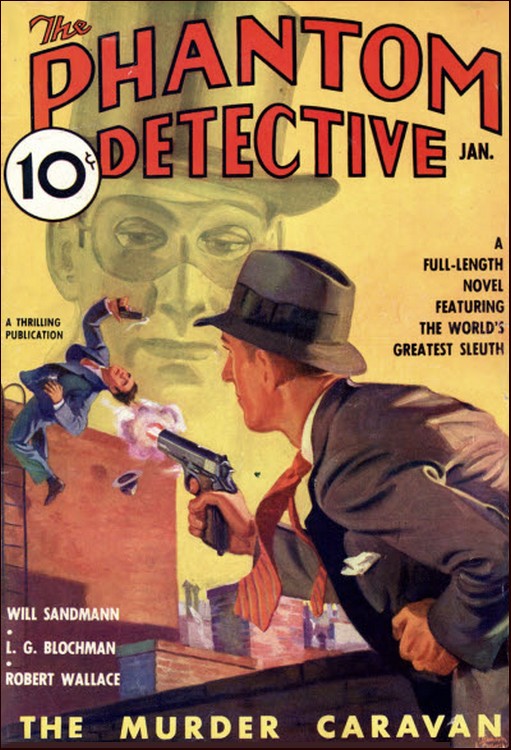
The Phantom Detective,January 1936, with "The Movie Lot Murders"
Crime's most hideous devices—kidnapping and cocaine—are the weapons of a genius of evil in a blood-chilling campaign of terror instigated by greed and the lust for power!
SWIRLING, wind-driven snow cocooned with impotent fury the cheery comfort of Ralph Bankhead's magnificent suburban home. A party was in progress in the huge living room. Tinkling of glasses, laughter; bare backs and jewels: the pleasant hum of social machinery fueled by wealth and good breeding.
It was Madeleine Bankhead's twenty-first birthday—and red-faced portly Ralph Bankhead, standing near the grand piano, had his heart in his eyes as he watched his daughter. The gay sparkle of her! How she radiated youth, beauty, charm! Yes, he thought somewhat smugly, he'd made a good job of the tot whose birth had cost her mother her life. Lovely Madeleine!
Outside, a black sedan joined the string of parked cars. Its lights flashed off, but almost a full minute elapsed before its occupants got out into the swirling snow. Five men. The sixth remained hunched over the steering wheel, wooden-faced, stolid.
"All right," a voice said, "each of you knows just what he's supposed to do. The whole business shouldn't take two minutes. Come on!"
Only the speaker and one other man ran, their bodies crouched against the driven snow, to the front door. The others scurried around an angle of the house to where the brilliantly lighted French windows indicated the living room. Each of that trio carried some object cradled beneath his right arm.
A butler answered the ringing of the front door bell. Opened the door. Then his lower jaw sagged, and his eyes protruded like those of a frightened toad. The man now entering was masked. So was the one behind him. And both carried automatics in their gloved right hands.
"What," gasped the butler, "are—"
He never concluded the sentence. The first man's automatic slashed out. With a moan, the butler sagged to his knees. Blood trickled from a gash above his left eye. He was falling forward when the masked man's snow-wet shoe kicked him under the ear, sending him sprawling into an umbrella stand.
The second man closed the door, placed his back to it. His companion swiftly crossed the vestibule. There was the living room door on the right. Another servant, bearing a cocktail tray, emerged from it when the masked man was about to enter.
The tray crashed to the floor. Grey-faced, his arms lifting automatically, the servant backed into the living room before the deadly menace of that automatic. The masked man followed him across the threshold. Stood there now-silent, motionless, sinister.
Slowly, Bankhead's guests became aware of his identity. They froze into figures of stone.
Ralph Bankhead stepped away from the piano.
"What," he said hoarsely—"what's the meaning of this?"
A splintering crash of glass came from his left. Another, a moment later. The ugly black snouts of Thompson guns had smashed those two windows. Machine-guns which now covered the score of guests.
"No one need be hurt," said the flat, emotionless voice of the masked man within the doorway, "if you behave. You, Miss Bankhead!"
The slim, blond girl wearing a Nile-green evening gown, stared back at him with hypnotic fascination.
"Yes?" she gasped.
"You're coming with us. Since we haven't any time to argue, I'm prepared to knock you out if you're silly enough to resist. Will that be necessary?"
WITH the blind and insane fury of a cornered grizzly, Ralph Bankhead suddenly lurched toward the masked man. Several guests grabbed him as he brushed by them. "For God's sake, Ralph—"
"You were halfway to hell then," the masked man commented coldly. "Coming, Miss Bankhead?"
"Yes!" the girl almost screamed, "Don't hurt him!"
And, her high heels clicking on the floor, she ran to the door. The masked man stepped aside to permit her to pass, and followed swiftly.
"Better grab a coat, if you have one nearby," he advised indifferently.
With trembling hands, she opened a closet door and jerked out a raccoon fur coat. Ten seconds later, they crossed to the snow-blurred, waiting sedan. Snow sprayed beneath the skid-chains of the rear tires as the sedan swung out from the parked line of cars.
Then the three men with machine-guns materialized from the snow swirl. They piled in.
"This snatch was a cinch, anyway," one panted.
"We're not through yet," the masked leader snapped. He raised his voice to the thick-shouldered driver: "Okay, Mike, step on it!" The motor roared throatily as the big car, with its additional passenger, lurched away to breast the fury of the snow storm. The clock on the dashboard showed 11:09.
It was 11:14—just five minutes later—when the first radio police roadster swerved in at Bankhead's home. Then they kept coming, car after car. From Headquarters. From the District Attorney's office. And reporters from every newspaper office in the city.
Efficient, hard-faced men, they prowled the house and the grounds. They cursed softly to themselves. It had been a clean, smooth bit of devilish ingenuity. No clues, no leads. Nowhere even to begin the investigation. The falling snow had filled, in those intervening five minutes, the footprints outside the window. No one had seen the getaway car clearly enough to describe it.
Ralph Bankhead, who had seemed to have aged twenty years in the past few minutes, interviewed the newspaper men:
"Make sure," he pleaded, "that you quote me as willing to meet any ransom demand within reason. My chief concern"—and his voice broke—"is to get my daughter back unharmed. She's—all I have." Hard-boiled little Steve Huston of the Clarion savagely grounded out his cigarette.
"What a lousy racket!" he muttered. "Those rats ought to be strung up by their thumbs."
Still cursing and muttering, like a fight-mad little terrier, Steve went searching for a telephone that wasn't in use at the moment. He abandoned the search when he passed the front door. There was an all-night drug store several blocks away. Quicker to make a phone call from a pay booth there. Besides, he doubted if there was anything further to be learned in Bankhead's home. The kidnappers were sure to wait a day or two before making their contact. No sense hanging around—
Throwing up the collar of his overcoat, he walked out to his small coupé, drove to the drug store, got out again.
"A nervy, smoothly executed snatch job, Mac," he told his city editor. "The cops have nothing to work on yet. Here're the few details."
Tersely, he outlined what had happened, and was about to hang up, when the city editor's voice checked him:
"Hold on a moment, Steve. Lehman is taking something on the other phone, and he seems excited as hell. It's—hell, it's another snatch. Wait!"
There was a brief pause, then the other's voice again:
"So it is, by God! Another snatch, Steve. Jackson picked it up at Headquarters, where the flash came in only a minute ago. Arnold Berber's little boy. You know—the millionaire drug manufacturer. Snatched out of his penthouse on Riverside Drive. A patrolman bumped off. Scoot out there right away. Cripes, two kidnappings less than an hour apart from each other!"
ASIDE from the unexpected climax at its end, the second kidnapping went off with the smooth precision which characterized the first. Upper Riverside Drive was deserted in that snow storm when the same black sedan slithered up to 531. It was exactly midnight.
Only three men got out here. Their sinister, masked figures crossed to the lobby. The uniformed Negro drowsing at the switchboard never awakened to see the gun butt which struck him senseless. Two of the men caught him as he went sprawling off the chair, carried him to the elevator. The bronze arrow indicator above the only car in operation at that time of the night showed that it was descending to the main floor.
An automatic faced the elevator operator when he swung open the door a few seconds later.
"Make one squawk and I'll blow your brains out. Take us up to Berber's penthouse."
The terror-frozen operator could not have made a sound then to save his life. He obeyed automatically. At the penthouse level, two of the men got out. A thin, flat skeleton key admitted them inside.
Berber and his wife were up, both reading in the living room. Yet neither of them heard the stealthy footsteps in the corridor. Footsteps which paused before their little son's nursery. Even the governess, asleep in the adjoining room, heard nothing as one of the men sneaked softly to Tommy Berber's bed and clamped a handkerchief saturated with chloroform to the little boy's mouth and nose.
Thirty seconds later, Tommy Berber's now unconscious little body, the long nightgown trailing after it, was lifted out of the bed. Carried. Out of the penthouse. Into the waiting elevator. Across the deserted lobby—after one of the men had brutally slugged the freckled kid operator.
"You beasts!" said Madeleine Bankhead when they entered the sedan again. "Zero weather—and he's wearing only a night shirt. Oh, you beasts!"
The leader slapped her hard across the mouth.
"You can keep him warm, but don't open your trap again!"
Sobbing softly, she hugged Tommy Berber's thin little body close to her own beneath the fur coat. And it was then, when the driver was throwing in the clutch, that the burly figure of that patrolman loomed up out of the swirling snow. Loomed up three feet from the driver's window.
Perhaps the patrolman had caught a glimpse of Tommy Berber carried to the car. Or maybe he just had a hunch that there was something wrong about that big black sedan. But he paid with his life for daring to investigate it without a ready gun.
The man sitting to the left of Madeleine said tersely:
"I got him, Mike."
His gloved hand jerked the door handle. And when the door swung open, three quick spurts of flame jutted from the snout of his automatic.
THE bulk of the patrolman's body abruptly changed shape. Beastlike now, as he stumbled to his hands and knees. A horrible gurgling sound—a scream muffled by blood gushing from his nose and mouth—reached Madeleine.
And it was then that she made that lightninglike move. Only later would she clarify in her mind the motive for having done so: the desire to leave for the police some clue to the identity of those masked fiends. At the moment, however, she acted intuitively.
Her left hand was near the overcoat pocket of the man who'd just murdered that patrolman. And as the killer was leaning sidewise in the seat, automatic still trained on the patrolman's body, her hand, clutching her own handkerchief, slipped into his pocket.
She felt her fingers close on some small object. No time to identify it now. No time for anything, but that breathless moment while she withdrew it from the pocket. Together with her handkerchief, profiting by the instant while the killer was glancing up and down the snow-blurred street, she tossed it through the open door. The three-inch blanket of snow received it without a sound.
The man swung back so quickly, she thought he'd caught her. But the command he now snapped was to the driver:
"All right, get 'er rolling, Mike. We've still another date to keep before we're through for the night."
It was twelve-twenty-five—just as Steve Huston skidded to a hair-raising stop behind the police car now in front of Berber's apartment house—that Mr. Clyde Parrish airily dismissed the taxi which had brought him and his wife to their Fifth Avenue home.
Burly, thick-necked Parrish had had a cocktail too many at the party he'd just come from; he felt in a mood to conduct an arm-waving discourse right there and then in the damp, swirling snow. His exquisitely beautiful wife, shivering even beneath her mink fur coat, cut in angrily:
"All right, you stupid clown, finish it when you get inside. Come on!"
"Yes," a voice said behind her, "we had better get started."
She gasped, spun about. Recoiled involuntarily from the automatic only inches away from her. And Clyde Parrish, abruptly sober now, stared with red-rimmed, piggish little eyes at another gun jabbing in his side.
"A stick-up, eh?" he growled. "All right, you rats, my wallet is in my left hip pocket."
The arm of the third man behind him, wielding a short brown blackjack, made a lazy slashing motion. Parrish's hat went flying off his head. His knees buckled from under him. The snow blanket cushioned the fall as he went sprawling to the pavement.
"Coming?" one of the men asked his wife, jerking a thumb to the sedan which now glided to the curb. "Or do we have to slug you, too?"
She went to the waiting car, and the speaker, with a mock flourish, opened the door for her.
Crimson stained the snow near Clyde Parrish's head. Monotonously and impersonally, huge, wet snowflakes continued falling on his still body.
Deviltry stalked and strutted, and had a merry time that bleak November night.
STEVE HUSTON, his face blued and pinched with cold, stood over the crimson slush still visible where the patrolman's life blood had gushed out on the snow. Anger fought incredulity in his eyes.
After ten years as crime reporter, he thought he was pretty hardened to anything. But this mad trail he was chasing had him gasping. Three minutes ago, from Berber's penthouse, he had phoned his office. And learned of still another kidnapping just reported to Headquarters.
Clyde Parrish, found unconscious by a passerby in front of his home, had communicated with Police Headquarters as soon as he came to.
The amazing audacity of those devils! Three kidnappings, literally only minutes apart! Everyone executed with the precision of a well oiled piece of machinery. No false moves, no loose ends. Two women and a child snatched from their loved ones, the kidnappers vanishing as completely as the snowflakes Steve could see melting on the warm radiator of his coupé.
With cold-numb fingers, he lighted a cigarette. Dragged the blue smoke deep into his lungs. He was a wise, wise baby, this young crime reporter. Shrewd, clever. And he was almost clairvoyant at times in the accuracy of his sudden hunches. He had two of them now, as he stood there in the falling snow.
First, that some new and vicious racket had spawned into birth during the past two hours. Second, that the police would prove helpless to cope with it. Only one man might sever with quick, sure knife slashes the slimy tentacles of this new octopus of crime. Crush its ugly head.
"The Phantom!" Steve Huston whispered. "Yes, only the Phantom!"
A fever-bright glitter in his eyes, the reporter crossed the sidewalk to his car. He was about to enter, when he noticed that one of the skid chains had come loose on his left rear tire. Stooping over it, he began fumbling with the twisted clasp.
The metal tongue would not wedge back into the groove. Steve looked around automatically for something to bang it with—and his eyes paused on some metallic object, almost concealed altogether by the snow, between the tire and the curb.
Curious, he picked it up. Saw now that it was a long key, with a red tab attached to it. Black letters stamped into the tab proclaimed the key to be the property of the Hotel Barlow. The key to Room 207. The corner of a tiny lace handkerchief was caught in the ring where the tab joined the key.
Only the fact that the handkerchief was so obviously expensive made Steve examine it closer. Then his heart leaped, and his hands began to tremble with excitement. For, delicately embroidered across another corner of the handkerchief were the initials "M.B."
M.B.! Madeleine Bankhead! Her handkerchief?
"Sure!" Steve almost shouted. "That sedan was parked here for the second snatch. She swiped the key from one of those mugs and—" Ignoring the skid chain now, he leaped to the open door of the coupé, slid behind the wheel. Jerked the coupé around in a slithering U-turn. It was ten minutes later, when he veered east into Seventy-ninth Street, the huge Hotel Barlow in sight now, that reason began to replace the wild excitement pounding through him.
SURE, he had a lead that was so hot it burned the pocket where the key now rested. But dared he fool with it? Might he not precipitate something which would result in the prompt murder of the three helpless beings held by the kidnappers? Had he a right to place so much faith upon his own discretion in investigating that lead—discretion so vital when three lives were at stake?
That lead would be investigated—yes! But not by himself. Nor the police. The Phantom would ferret out the significance of that hotel key. And in having made that decision, in having forced himself to drive by the hotel, Steve Huston paid a superb compliment to the man he idolized—the Phantom Detective!
Frank Havens, the middle-aged millionaire publisher of the Clarion, was short, stocky, grey-haired. But his stride as he paced his huge private office was still athletic, springy.
"Those devils!" he rasped to Steve Huston, the one other person in that office, "Capitalizing on the fact that a man loves his child, his wife. Using that love to squeeze money from him. Of course I share your opinion that the Phantom should be called in on this case. But—he's away now."
"Away?" Steve echoed.
"On a Caribbean cruise. The liner he's on, the Mauravia, is docking tomorrow night. It—say, it will pass the Battery, won't it?"
"Of course. They all do."
Havens nodded grimly, walked to the desk, picked up his telephone.
"The red election-return light up in the tower—have it turned on immediately," he ordered. "And keep it on until further notice from me."
Steve Huston grinned crookedly. With slow majesty, the Mauravia steamed past the Battery landing the following night. Passengers who two days ago had sported themselves beneath tropical sunshine now shivered even in heavy overcoats as they lined up at the rail to watch the ever-fascinating Manhattan skyline.
THE blizzard had worn itself out earlier in the day, and the night came on clear and bitterly cold. Huge cakes of grey ice floated in the harbor. An icy wind ruffled the short, choppy waves.
A hilarious party of four couples was up on the boat deck. Well dressed, obviously wealthy people, they did not mind the return to the winter-locked New York. For they could continue having a good time in night clubs and theaters.
One man in that party, however, did not contribute to its general hilarity. His eyes were bleak and brooding as he watched the skyline of Manhattan swinging past.
"Why so glum, Dick?" a strikingly pretty girl demanded laughingly. "You sorry the trip is over?" The tall, handsome Richard Curtis Van Loan glanced in her direction.
"Oh, it isn't that," he replied quietly. "I'm thinking of these kidnappings headlined in the newspaper that we received aboard. I certainly would like to lay my hands on the rats responsible for them."
A short, pudgy man laughed derisively.
"Lord, listen to him! Well, why don't you do something about it, Dick? Try your hand as a detective."
Now others in that party joined the pudgy man's laughter. They knew Dick Van Loan as a likable but rather useless society wastrel, living on the money his father had left him. A man who apparently had no ambitions, no goal or object in life. Who seemed to be content just drifting from day to day, doing absolutely nothing. To think of Richard Curtis Van Loan as a detective was amusing.
But their laughter would have died in their throats had they learned the startling truth: that Dick Van Loan was really the glamorous personality who called himself the Phantom Detective!
The Phantom—whose exploits were becoming legendary throughout the length and breadth of the nation! The grim Nemesis of crime whom the underworld feared as a field rat might fear the swooping hawk. For so did the Phantom strike—silently, swiftly, surely.
Yet in the anonymity of the Phantom—in the fact that only one man, Frank Havens, publisher of the Clarion, was aware of his true identity—lay his chief weapon. So Van merely grinned vacuously in response to their derisive laughter, and glanced at the skyline again.
Then his right hand crushed the folded newspaper it held. He had his first glimpse now of the enormous Clarion Building, rearing its towered head above the skyscrapers there. And that tower, thrusting an arrogant granite finger into the blue-black sky, now had a companion light to the one stationed as safety measure for airships.
It was a red light which flashed on and off, on and off, like the winking eye of some old Cyclops. But there was no humor in the grim message it spelled. The Phantom was called in on a case!
"Of course," said the pretty girl near Van, "we're all going to my place for cocktails first."
"With the exception of myself," Van said gently. "There's some business in town that I must attend to as soon as we dock."
The pudgy man suddenly roared with laughter.
"Why," he gasped, "don't you understand? He intends to go to work on that kidnapping case—don't you, Dick?"
"Certainly," said Van. "Remarkable, really, how you've guessed it." He grinned good-naturedly.
And the pudgy man practically went into hysterics. When the Mauravia docked, at eleven-ten, Van had established the reputation of being quite a humorist.
Van breathed a sigh of relief when he finally managed to get away from that gang. He flagged a taxi. Ten minutes later, he dismissed the cab in front of his garage.
"My car," he told the garage attendant. "And I'm in a hurry, please."
The attendant drove down the ramp a glittering, long-nosed Duesenberg. Van slipped him a bill, and slid his long-legged body behind the steering wheel. Piloting the slinky roadster to a side street deserted at that time of the night, he parked, twisted in the seat.
A push on a cunningly hidden button—and one half of the back rest slid forward silently, revealing the black cavity of a secret compartment. Knowing precisely where each article lay, Van first groped for and found a flat, compact little make-up kit. He turned on the dashboard bulb and, looking into the mirror which formed the inside back of the kit, applied a simple disguise to his face.
Simple, because the deft hands of a master of disguise were at work. His fingertips touched some greaseless stain, rubbed it into his skin. A sallow-faced and apparently much older man now looked back at him in the mirror. A man whose face further changed, until there wasn't the remotest resemblance to Dick Van Loan, merely by a swift shading of the eyebrows, extending his nostrils with two minute balls of wax, greying his temples.
Before he closed the secret compartment, he brought forth an automatic cradled in a shoulder holster and adjusted it over his vest. The Phantom was ready to take the trail.
The big roadster purred along again, pausing for the second time near another garage. Here Van abandoned it, walked up the street a bit, and again flagged a taxi. A telephone call later to that garage, where both Dick Van Loan and his car were known, would take care of the roadster.
"The Clarion Building," Van told the cab driver.
MIDNIGHT. The seldom-used bright overhead light threw a glare over Frank Havens' huge private office. The publisher, behind his desk, sat hunched forward on the edge of his chair. As if preparing himself to bolt out of it.
Steve Huston's thin, diminutive body was lost in the big leather chair to the left of the desk. His eyes were glued on the portable phonograph in front of the publisher, and every once in a while he would pass his tongue over his lips. He smoked cigarettes in an unbroken chain, lighting one from the butt of another.
The three other men in the office could not sit. Each looked like a prisoner awaiting the jury's verdict. Pacing, pacing—
Arnold Berber, a dark-skinned, gaunt-faced man, kept cracking his knuckles, the sound distinctly audible in the dead silence. Ralph Bankhead moved like a man in a trance, arms dangling limply at his sides. His shoulders hunched, he gave the impression that he expected a crushing weight to drop any moment on his back.
Burly Clyde Parrish moved his heavy body with a curious catlike grace. His rubber-soled shoes made no sound. His massive, red face was stone-like in its absolute immobility, but there was a savage glitter in his piggish little eyes.
"I'd feel better," he snarled suddenly, "if I could sock somebody. Anybody. How much longer do we have to wait, Mr. Havens?"
"Until the others show up," Havens replied testily. "I thought I've explained that to you, Parrish. It's in accordance with the instructions in the message from the kidnappers—instructions which we may as well follow to the letter."
"But, damn it," Berber shouted, "what have these others got to do with it? We three are the only ones involved. They're holding Bankhead's daughter, my little son, Parrish's wife. Aside from the fact that the other four men named in that message are in the same business as we three are—"
" That's your explanation," Steve Huston interrupted wearily. "The fact that everyone of you is in the same business. You are the president of the Continental Drug Company. Bankhead controls the Weston Laboratories, one of the largest importers of crude drugs in the world. You, Parrish, are owner of the Star Pharmaceutical Company."
"We're wealthy men," snapped Parrish. "That's all those rats are primarily interested in."
Steve shrugged. "Granted. But don't tell me it's pure coincidence that the three wealthy men they picked on just happen to be in the drug business."
"Nor," Havens added, "could it be a mere coincidence that the four men whose presence they demanded while I play that record enclosed with the message are also in the drug business."
THE publisher's bespectacled secretary now opened the communicating door to the anteroom.
"Mr. Clark and Mr. Stephano are here," he announced.
Jeffery Clark, the first man who stepped through the communicating door, looked like a clergyman—pinkish, round face, steel-rimmed glasses through which mild blue eyes peered anxiously, thin, blond hair smoothed back from his high forehead.
The man behind him, on the other hand, reminded one of a jovial Falstaff. Emil Stephano was short, swarthy, pot-bellied. His beady little black eyes were almost hidden behind pouches of fat. A huge diamond ring glittered on the little finger of his left hand, and an even larger diamond was in the stick pin on his tie. His clothes were almost ludicrously flashy, and in atrocious taste.
"Good evening, gentlemen," he said pompously. "This was certainly a mysterious summons of yours, Mr. Havens. May I ask—"
"Not now," Havens interrupted. "I'll explain in a few minutes. Yes, Jamison?" he added, glancing to the secretary who again thrust his head through the communicating door. He spoke in a nervous tone.
"A Mr. Gary, sir. Claims he's from the broadcasting station you were in touch with—"
"This afternoon," a new voice completed.
A sallow-faced, middle-aged man, cigarette drooping from the corner of his mouth, strolled into the inner office.
"If I'm disturbing some important conference," he said indifferently, "just give me the walk-out ticket. But you said you might need the co-operation of our broadcasting company to make an appeal to the kidnappers. So I was sent down here to talk to you about it."
As he spoke, his left hand tugged at the lobe of his ear. And Frank Havens, who had been staring at him blankly—for the publisher had not contacted any broadcasting station—suddenly straightened in his chair, and a glad, eager look displaced some of the tension in his eyes. That tugging of his ear had betrayed to Havens the man's real identity. The Phantom!
The Phantom was here—at the time when Havens most wanted him. When the sinister intelligence behind those kidnappings was about to lay his cards on the table!
"I'm glad you came, Mr. Gary," he said quickly. "Yes, we might still wish to make a broadcast to the kidnappers. Let me introduce these gentlemen to you."
Van had already recognized Bankhead, Parrish and Berber from their photographs in the newspapers. But Clark and Stephano were new names and faces in the case. Van could not perceive what relationship they had with it. He asked no questions then, however, simply acknowledging with a nod each introduction.
But the portable phonograph on Havens' desk, the dramatic spine-tingling tenseness in the office, did not escape his attention. There was some grim significance about this mysterious midnight meeting.
He dropped into a chair near Steve, and the reporter, who guessed now who Van really was, said softly:
"Rich man, poor man, beggar man, thief—He comes and he goes, and who he is nobody knows."
Van grinned, and glanced to the door as the secretary announced the arrival of two more men: Hugh Keller and Stanley Peterson. Keller was a slim, wiry man, immaculately dressed, with a finely chiseled, intelligent face. His hair and his tiny, pointed mustache were blue-black, in striking contrast to the unusual pallor of his skin.
Peterson was small, stoop-shouldered, and his face had the broad, misshapen ugliness of a gargoyle. An ugliness contradicted by his eyes—soft, brown, limpidly expressive eyes.
Before either of the men had a chance to speak, Havens' voice cut in.
"Gentlemen, I'll gloss over all social preliminaries. Since you're all in the same business, I assume you know each other. But you'll understand my anxiety to get things started without further delay when I tell you that I've received a message from the kidnappers. The three men involved, whose loved ones had been snatched from them, have already been waiting over a half hour to hear what the kidnappers might demand from them. I'm sure you realize how they must feel by now."
"Of course," Hugh Keller said quietly. "I understand their state of mind, and sympathize with it. But why need you have delayed reading that message?"
"Precisely," echoed the clergyman-like Clark.
HAVENS picked up the typewritten sheet of yellow paper on the desk to the left of the portable phonograph.
"I'll save time," he said grimly, "by reading this to you now. It'll answer your questions—and will explain why I telephoned each of you. This letter, by the way, came in a package left downstairs about an hour ago. A package addressed to me, and containing a—phonograph record."
"Left by whom?" Van asked casually.
"I've no idea. One of the elevator operators noticed it propped neatly against one of the ferns in the lobby of this building. I questioned the man, and he swore the package hadn't been there when he had gone up in the elevator a minute or two earlier. That's how I was able to determine the time of its arrival."
"Couldn't you," Berber pleaded, "discuss the thing later? This suspense will drive me insane."
"Sorry," said Havens.
He put on his reading glasses, stepped around the desk. In the absolute silence, his voice seemed strident as he read:
My Dear Mr. Havens:
In a signed editorial of this morning's Clarion, you've been kind enough to volunteer to act as a negotiator between ourselves and the frantic gentlemen each of whom have suffered a regrettable, but not necessarily irreparable loss of a certain member of his family.
We shall accept your offer.
As leader of—shall we say the opposing forces?—I am faced with the necessity of establishing two facts: first, my motive for kidnapping those three persons; second, proof that you are being contacted by the actual kidnappers.
Hence I have taken the trouble of recording my voice—as well as the voices of the three victims—on the enclosed phonograph record.
You will please arrange a rendezvous and invite Bankhead, Parrish and Berber. You will also summon the following persons to be present at the rendezvous: Mr. Jeffery Clark, president of the United Drug Supplies; Mr. Emil Stephano, owner of the drug firm of Stephano & Sons; Mr. Hugh Keller, of the National Pharmaceutical Co., and Mr. Stanley Peterson, who owns the controlling interest in the Atlantic Drug Syndicate.
When everyone of the above gentlemen are present—and then only—you will please play the enclosed record. I fear unpleasant consequences will develop if these simple instructions aren't abided by.
Havens paused, looked up from the yellow sheet. "That's all. There is no signature."
Van was leaning forward in his chair now, his eyes narrowed, his lips compressed. The very wording of that message was in itself grimly significant. Brief, concise, bluntly to the point. No underworld thug had written it. An intelligent and educated man was the guiding genius behind those evil kidnappings.
Berber's panting voice was hardly intelligible as he choked:
"Go on, play that record!" Havens walked to the communicating door, opened it.
"Come in here with your shorthand notebook," he ordered his secretary. "I want you to take down word for word a phonographically recorded message. This record will have to be turned over to the police for laboratory examination, and we may have occasion later to refer to the transcribed message. I want a copy of it."
When the secretary seated himself with his pencils and notebook near the desk, Havens stooped over the phonograph. A scraping sound as the record began whirling beneath the needle, loud and rasping in that room of silence and taut nerves, then:
Gentlemen, this first message of mine to you will also be my last. What you choose to do about it is entirely up to you. I have successfully executed my initial move. My subsequent moves shall be determined by either your acceptance or refusal of my demands. The lives of the persons you love are in the hollow of my hand; you yourself will decide whether I should close that hand and crush them.
In the brief pause that followed, Van could hear the slow thudding of his heart. That voice! Metallic, utterly void of any human quality. Van could only liken it to the thin, piping sound of a mechanical doll. It made his spine tingle.
This (the voice went on) is a direct message to you, Bankhead. I have deliberately kidnapped three persons. Why, do you think? So that I may, if necessary, make an example of the first. Yes, you will be the first of the three from whom I shall demand certain ransom. Balk at meeting it, or try a doublecross of some sort, and your daughter's murdered and artistically mutilated body will too late convince you of your mistake. Even as it will influence Berber and Parrish to avoid making a similar mistake.
"I'll pay," Bankhead screamed. "Anything. What do you want?"
And it did not seem ludicrous, somehow, for Bankhead to have screamed that at the little portable phonograph. For Van himself seemed to sense the sinister presence of the speaker in that office. The illusion was that some invisible being—invisible, yet felt unmistakably—was right there in the room with them. An illusion now heightened as the voice went on with what seemed a deliberate reply to Bankhead's question:
My ransom demand from you, Bankhead, is somewhat unorthodox, so far as the accepted technique of kidnappers goes. In the stock rooms of the Continental Drug Company, of which you are president, there is a considerable quantity of cocaine. Bankhead, I want one hundred thousand dollars' worth of it! At regular retail value of roughly twenty dollars an ounce—twelve ounces to the pound, apothecaries weight—it means slightly over four hundred pounds of cocaine!
Van was now sitting bolt upright in his chair. Steve Huston was out of his altogether.
If you haven't that much in stock, you know where you can lay your hands on it. I give you until midnight tomorrow to have it ready. I want it packed in one canvas-covered bale. Further instructions will reach you at midnight tomorrow. You, Berber, have a similar amount of cocaine, packed the same way, ready to be turned over to me forty-eight hours from midnight tomorrow. And you, Parrish, are scheduled to pay the same ransom forty-eight hours from that date.
These are not unreasonable demands. Each of you either already has in stock, or is in a position to buy legitimately, as much of the drug as he should need. And each of you is wealthy enough to take a hundred thousand dollar loss without facing financial ruin.
"Damn you!" Van heard Parrish rave, repeating the epithet over and over.
Now I come to you four—Clark, Stephano, Keller and Peterson (that inhuman voice continued). I levy upon each of you the payment of twenty-five thousand dollars' worth of refined opium, payable, in the order that I have called out your names, at forty-eight hour intervals after the date that Parrish is supposed to pay his ransom. The threat I hold over you is—death! And again, I am perfectly willing to make an example of the first man in order to swing the others into line. Remember, Clark! You're the first of your chain.
Clark's round face was no longer pinkish now. It looked like a grey death's mask as he stared at the black speaker tube of the phonograph. There was simply a scraping sound now as the needle passed over several unrecorded grooves. Then a woman's voice abruptly came out of the speaker:
Hello, Dad. This is Madeleine. I'm all right. They took us to—
Her voice was suddenly muffled, and Van could see vividly in his mind the hand clapped over her mouth.
"It was Madeleine!" Bankhead shrieked. "Oh, God!"
Still another voice now. Hesitant, barely audible voice of a frightened child.
Daddy, they told me to ask you to take me home. Please do, Daddy. I'm so cold—
Arnold Berber's twisted face was frightful to look at then.
Again a brief pause. Followed by a woman's voice. Not Madeleine's. Deeper, huskier. Quite calm.
This is Martha, Clyde. Better pay what they ask if you want to see me alive again.
Clyde Parrish's throaty cursing became incoherent.
Well, gentlemen (the metallic voice now rejoined) this concludes our—er—unique broadcast. The devil is panting to grab the control strings; it's on your own heads if you supply revelry in hell! Good night, gentlemen!
The voice trailed away on a horribly evil chuckle. Just scraping of the needle on the record now. Automatically, Havens raised the needle, jerked the stop lever. Silence—blank and absolute—hung like a pall over the office.
A HOARSE, incredulous voice suddenly echoed from the wall to the left of the desk:
"... supply—revelry in hell!"
Stanley Peterson had said those four words. Stanley Peterson, a lighted cigar drooping between his fingers, his body crouched forward, horror and incredulity twisting, distorting his gargoyle-like face.
Twice Van saw him open his mouth to add something, but he seemed incapable of uttering a sound. Then, abruptly, his voice came in a kind of wild shriek:
"I know who spoke into that record! By God, I know—"
If Peterson had finished that sentence, no one heard it. For it was drowned in the swift hell that now broke loose. Crack! A gunshot—and the overhead light mushroomed into a thousand fragments. Darkness. Crash and splinter of showering glass. A wild yell from someone. All this in the space of a couple of heartbeats.
Van leaped out of his chair—just as two more shots came from the darkness. Even in that split instant, he realized what had betrayed to the killer his target. For, a dozen feet from him, he could still see the angry red glow of Peterson's cigar.
The high-pitched scream of a man mortally wounded testified to the murderous accuracy of those two shots. The lighted cigar created a tiny meteor as it fell to the floor. And Peterson was still screaming, screaming—
Tugging at his automatic, Van swung in the direction from which the shots had come. And the fourth red stab of flame into the darkness now; revealed to him the killer's position. To his right. Near the communicating door into the anteroom.
To blast away with his .45 at that telltale flash, as was Van's first impulse, endangered the life of whoever might be standing behind the murderous devil. He controlled the impulse. Gave up the attempt to draw his gun. And hurled himself, arms outstretched, at that blur of a man's body that was vaguely discernible in the light coming from the anteroom.
A reckless, dangerous tackle in the face of a ready gun, nevertheless it would have brought the killer down—if he hadn't sidestepped in precisely that instant. Van felt his hands brush the man's trousers, tried to twist in the air. Too late! He crashed into the wall.
Now he regretted not having drawn his gun. For, rolling over, he had a splendid target as the blur of the killer's body darted through the communicating door, slamming it shut behind him. And Van was on his feet, his hand reaching for the knob, when he heard the key turn in the lock.
Cursing softly, he hurled himself against the door. Once, twice, three times. The lock held, but one of the panels splintered before the impact of his shoulder. No light came through the jagged slit now in the door. The anteroom was in darkness.
Van thrust through his left hand, began fumbling for the key on the other side. The roar of a gun again sent him darting instinctively to one side. But no bullet came crashing through the panels. The killer, now either in the anteroom or the outside corridor, evidently was firing at someone else jeopardizing his getaway.
Turning the key finally, Van leaped into the dark anteroom. An oblong of light jerked his eyes to the right. It was the outside door, ajar a few inches. Lighted corridor beyond. Three strides brought Van to the door. He was about to fling it open, when the gruesome sight at the opposite wall checked him abruptly.
An old man sprawled there, his right arm twisted under him, his legs drawn up curiously. His left eye was a bloody horror, literally forced out by the bullet which went plowing upward into his brain. The blue overalls he wore, the black cap near his head, the mop handle still clutched in his left hand, described his occupation—one of the porters employed in the building.
The killer and he must have come face to face when the former ran out into the corridor. And so that murderous gun had sealed another pair of lips which might have betrayed the killer's identity.
All that flashed through Van's mind in the second or two that he paused before flinging the door open. His left hand was about to push the door now when he saw something else which again checked him. Something to which an average person would not pay any attention, yet it was of instant and vital significance when seen through the keen eyes of the Phantom.
A thick cigar stump lay at an oblique angle against the very outside corner of the door, about an inch of its saliva-caked, frayed mouth-end protruding into the narrow aperture between the door edge and the jamb. He noticed it because his eyes were already drawn to the corridor floor by the porter's sprawling body. Just that—but it sent his heart pounding madly.
He whirled, just as lights flashed on in the anteroom. It was Frank Havens himself who had switched them on. The smaller room was crowded now with the men who had followed Van through the communicating door.
"Too late now, fool that I was!" he muttered savagely.
HE kicked the door open, sending the cigar stump slithering away a few feet. Stepped out into the corridor. And then the bony arms of death reached out for him!
It was one of the closest shaves in the Phantom's career. The man crouching near one of the exit doors in the long, deserted corridor was less than twenty feet from him. The heavy automatic in his right hand had for some seconds now been trained and waiting for Van to step out into the corridor. For, through the crack of the partly open door, he had seen Van's shoes. And so his trigger finger began to compress even before Van actually showed himself.
That frayed cigar stump really saved Van's life. That—and his characteristic quickness of movement. The gunman first saw Van's trousered leg come into view. His lips parted over his teeth, and he began squeezing the trigger in anticipation of the torso he knew would appear a heartbeat later. And it was then that Van stooped swiftly to pick up the cigar stump.
Even had he been aware of the crouching gunman, Van couldn't have timed more perfectly that abrupt, stooping motion. The walls of the corridor re-echoed the crashing roar of the big automatic. But the slug intended for Van's broad chest passed harmlessly over his shoulder.
Without attempting to straighten, Van threw himself forward on his stomach—a lightninglike co-ordination of brain impulse and muscle reaction of which only the Phantom was capable. And the second flesh-searching little missile of death from the automatic also missed its target.
Van was still sliding forward across the corridor, like a surf rider on his board, when he jerked the trigger of his own gun. A quick snap shot. He saw the gunman go lurching into the exit door before the terrific impact of a .45 slug. Saw him suddenly jerk the door open.
With about as little emotion as one would feel when shooting a mad dog, Van centered his gun on the body now staggering through the exit door. A light trigger pressure, he knew, would drive the other's soul to hell where it belonged. Then his forefinger suddenly relaxed its deadly curl, and he leaped to his feet.
Blasting the murderous devil would silence lips which could reveal some mighty valuable information. Van wanted him alive. He raced down the corridor, caught the exit door before it quite closed. Darted out on the landing.
Ugly smears of fresh blood on the cement left a gruesome trail of the gunman's progress. And another savage gun blast from the landing below betrayed his whereabouts. The slug passed so close to Van's left cheek that he actually felt the air it displaced; and he heard, a split instant later, the eerie whine of the bullet ricocheting off the wall.
His body in a crouch, a hard, grim twist to his mouth, Van leaped to the head of the landing. Distinctly now, below one of the red exit lights, he saw the gunman's pinched white face. The man was leaning far over the stair rail, his gun hand raised, waiting to put in another shot.
But that shot was never fired. Van saw the other's eyes close, open, close again. Saw his head begin to loll drunkenly. Saw his body sag suddenly over the rail, the automatic dropping from his nerveless fingers. Dropping to the bottom of the stairwell eight stories below.
Then its own weight began to topple the gunman's body over the bannister. Slowly at first, then faster, faster. Too late had Van made that wild dash down the single flight of stairs. His clutching hands as he threw himself the last few feet only caught the gunman's left shoe. And that shoe remained in his hands as the man's body went hurtling down the stair shaft.
Perhaps he hadn't been quite unconscious—or maybe he'd regained consciousness for a moment during that death plunge—but a thin, inhuman wail sounded in the shaft, like that of a lost soul in torment.
It was choked off when Van saw the man's body glance off one of the landing corners. Then—down—down, down that telescoping shaft! A horrible thudding sound as it struck the basement level. And it sprawled there now, on that patch of grey cement far below, like a bundle of old clothes.
"Lord!" a voice choked above Van.
He glanced up. It was Steve Huston who had spoken, leaning over the bannister of the landing immediately above. Havens was on his left; the swarthy, pot-bellied Stephano on the right. The other men were also now crowding to the bannister. Horror on their faces as they stared down the shaft.
"Peterson?" Van asked tersely. "How is he?"
Steve Huston shook his head.
"Dead!" he replied, and savagely ground out his cigarette on top of the bannister.
For a few seconds longer, Van continued staring at the ring of faces above him. Parrish, Berber, Bankhead. Clark, Stephano, Keller. Everyone there—but Peterson. Peterson, whose murder was grim tribute to the nerve and intelligence of the devil behind this new racket.
Van's lips were compressed grimly as he began descending the stairs. It was less than ten minutes since he had come to Havens' office. In those ten minutes he had seen the birth of a racket hitherto unprecedented in the history of crime. He had seen a murder committed before his very eyes. He had come within an ace of being murdered himself.
And he knew now that the red hell of the past few minutes was only the beginning of a devilish trail. A trail which would task all the skill and ingenuity of—the Phantom!
VIOLENT death is never a pleasant spectacle to behold; it was especially hideous as exemplified in the bloody thing at the bottom of that stairwell. Crushed bones, pulped flesh. Gore. Grim, hideous death.
A dozen pairs of eyes were staring at it now. The men who'd been up in Havens' office. Attendants on night duty in the huge building. Two radio patrolmen—and the curious men who'd followed them when they crossed the lobby. Other reporters from the Clarion's city room.
And with each passing second, more and more men from the various offices open all night crowded into the landing, profiting by the fact that the two patrolmen were busy examining that crushed and battered body.
IN the babbling confusion, while three-fourths of the people there hadn't the faintest idea what had happened and were asking excited questions of each other, Van drew Havens aside.
"I'm going to sneak away, Frank," he whispered tersely. "For reasons which I'll explain to you later. Try to manage to be alone in your office in an hour or so. I'll be back then."
"But the police," Havens remonstrated. "They'll want to know what became of you. Should I tell them who you were?"
"Tell Inspector Farragut—yes! But no one else. Better have him come over to your office and await my return. And I may have use for little Steve Huston."
"Okay, Van."
Unobtrusively, Van began edging to the steps. A hand suddenly caught his arm, fingers digging into his flesh. It was swarthy Stephano who had stopped him, and there was a curious glitter in his beady little black eyes.
"As a mere employee of a broadcasting station," he said in a sibilant whisper, "I certainly admire your proficiency with a .45 automatic, Mr. Gary."
"Is that so?" Van drawled, and those beady little eyes wavered before the steady appraisal of his own.
"I was just curious," Stephano continued, "what broadcasting station had sent you down."
"And I," said Van, "am rather curious why should that particularly concern you."
Stephano shrugged, and the diamond glittered on his little finger as he gestured indifferently.
"Sorry," he said. "Prying into other people's business is a vice of mine. Forget it."
Van nodded briefly, mounted the stairs to the lobby level. His hand on the knob of the exit door, he glanced abruptly over his shoulder. Stephano stood at the bottom of the flight, looking up. There seemed some mocking triumph in his eyes. The moment he saw that Van was looking at him, he turned his head away and moved back to the fringe of the crowd surrounding the gunman's body.
Van's eyes were very thoughtful as he opened the door and stepped into the magnificent lobby of the Clarion Building. What motivated Stephano's behavior? He shook his head, proceeded to cross swiftly the huge lobby, and stopped jerkily as a voice called out:
"Mr. Gary!"
Little Steve Huston was running after him across the lobby, his hat awry on his head, cigarette dangling from the corner of his mouth.
"Hell's bells," the reporter said incredulously, lowering his voice, "you're not leaving now?"
"I'll be back later," said Van. "Wait for me in Havens' office."
"No, there's something I want to tell you," Steve panted. "A lead I've been saving for you two days now. Let me come along for a little while, anyway."
They were near the outside door now, Steve half-trotting to keep up with Van's long-legged stride. Van paused, glanced sharply at the little reporter.
"A lead?" he repeated. "Okay, newshound. But I've a hunch that my company now is as safe as a runaway buggy loaded with high, explosive on a bumpy road. Want to risk it?"
"Don't get me sore," grinned Steve.
Both had been sitting in their hats and overcoats in Havens' office; they threw up their collars as they emerged from the warm lobby. There was a knife edge in the icy blast of wind moaning through the man-made canyons of that financial district. A district boiling with humanity during the day, but deserted now. The snow crackled crisply beneath their shoes.
"I know a saloon nearby that's still open," Steve suggested, his lips already blued from the bitter cold. "We'd better pop in there, eh?"
Van nodded. They crossed the street, turned right at the next corner. A light delivery truck passed them, turning the same corner, its skid chains clanging in the dead silence of the winter-locked night. Van had reached for Steve's arm the moment he'd seen over his shoulder the hood of the truck round the corner; he breathed easier as he now watched it disappear around the corner of the intersecting street ahead.
He felt curiously wary, every nerve, every muscle of his lithe body tense and alert. Some warning instinct—a grim conviction of immediate and deadly danger—kept pounding through him. And it refused to be suppressed. So he walked on the balls of his feet, his head thrust forward, his eyes ever darting about him. Like an Indian on the warpath.
Then he heard those clanging chains again. Behind him. Which meant that the truck had simply gone around the block. Why? So that it might pass them again. Pass them and—
The truck was still fifty feet or so behind them, shooting up fast now, when Van saw the snow-covered short flight of steps leading down to a basement delivery entrance of the building on his right. That truck—going around the block—speeding up to get abreast of them: it suddenly spelled a sinister explanation to Van.
With one lightninglike motion, Van's hands darted to Steve's hips. Closed, fingers gripping the folds of the reporter's overcoat. Swung Steve off his feet. And tossed him as if he were a sack of potatoes into the black cavity of that basement entrance. Then he dived after him, his chest spraying up the snow as it scraped the top step.
He was still flying through space when he heard Steve scream: "You're not the Phantom, damn you! You—"
AND then that scream was drowned out by the spine-tingling, mad hammering of a machine-gun. A short, savage burst, it shot up tiny geysers of snow along the top step. Drummed like wind-driven hail on the basement door. Tiny splinters of wood showered on Van and Steve, both now entangled at the foot of the stairs.
Frantically, Van tugged at his automatic, jerked it out, pushed down the safety catch. And, rearing up to his knees, he directed the gun up the slant of the stairs. By a heartbeat or two, he had escaped that hellish spray of lead. But he could hear the roar of the truck's motor, the clanging of the skid chains—and the peculiar slithering sound of flying snow beneath skid chains which would not grip.
Stuck, were they? Slowly, Van raised himself to a crouching position, his head still a few feet below the sidewalk level. Louder now was the roar of that motor. It seemed closer, too. As if the truck was on the sidewalk.
And it was—as Van realized an instant later. When he saw twin beams of headlights bathe for an instant the side of the building. Then the right front wheel of the truck loomed into view. The door, window lowered, the head and upper torso of the man leaning far out with the machine-gun.
In perfect synchronization was Van's trigger jerk and that of the machine-gunner. But only a half dozen bullets from the tommy screamed their way down the black cavity of the basement. The machine-gun was still hammering away—yes! But the finger of a dying man held down that trigger, driving lead into the running board of the truck.
The machine-gunner was sagging over the edge of the window, and bright blood spurted from the severed artery in his neck where Van's bullet had caught him. Then the tommy gun dropped from his convulsive clutch. It struck the top step; clattered down toward Van.
SOMEONE cursed savagely—and again there was that throaty roar of the motor, the clanging of skid chains. The sagging man in the window disappeared from view as the truck lurched ahead. Van scooped up the tommy gun, ran up the steps—just as the truck made a slithering turn from the pavement back into the street.
Training the nozzle of the tommy at the truck, Van savagely jerked the trigger. A metallic click! The gun had jammed when it struck the steps. By the time he could swap it for his own automatic, the rear red light of the truck vanished around the corner.
For perhaps ten seconds longer, Van crouched there, his eyes as hard as the blue steel of his gun. Twice now he had stood on the brink of death. Twice, he and the murderous devils behind those kidnappings had swapped lead. So far, the Phantom had emerged victorious. So far—
He straightened jerkily, swung toward the basement.
"You all right, Steve?" he called out, suddenly remembering the reporter.
Steve Huston's slight figure came up the steps. His face was bloodless, and his lips were drawn back over his teeth. But his voice was steady enough as he replied:
"Oh, I'm okay. Shaken up a bit, that's all." His toe pointed significantly to the crimson stains on the snow where the machine-gunner's blood had spurted. "It's more than that rat could give thanks for. Is this what you half expected when you warned me against coming along with you?"
"Yeah," Van said grimly. "I had a hunch that the devil who murdered Peterson realized that he hadn't fooled me. I suspected he'd given orders to have me rubbed out."
Steve gaped at him. Then his left hand shot out, gripped Van's shoulder.
"What are you saying, Phantom? The devil who murdered Peterson—had given orders—Why, haven't we seen him crushed at the bottom of that stairwell?"
Van shook his head.
"That gunman did not kill Peterson. He was to be the cover-up man. Was supposed to have dragged the red herring across the trail—to protect his boss. Peterson's killer, Steve, had walked down those steps with yourself and Havens."
"What," Steve gasped—"what leads you to believe that?"
"A two-inch, frayed stump of a cigar," Van said cryptically. "I'll explain when we get back to Havens' office. Right now, I want to—eliminate Mr. Gary. I'm as eager to do so as the killers in that truck were. But I rather prefer doing that with my make-up kit. How far is that saloon from here?"
Steve moistened his lips.
"All right," he said, "I'll wait. The saloon is only a few blocks from here. Come on!"
A five-minute walk took them to the financial district. In spite of the late hour, the saloon was crowded. Bowery derelicts rubbed shoulders with the comparatively well dressed newspaper men who frequented the place. The bald-headed bartender waved to Steve, but no one paid much attention to Van. Especially as two drunken gentlemen of the press were loudly and profanely debating the merits of a certain prizefighter.
Motioning Steve to ease to the bar, Van walked quietly the length of the saloon, and entered the washroom in the rear. He locked the door behind him, stepped to the dirty mirror and brought forth his compact little make-up kit.
And thus began the elimination of Mr. Gary. A chemical swiftly removed the sallowness of his previous disguise. Now Van went to the other extreme. A liquid from a tiny vial which dried almost instantly blanched Van's natural healthy tan. A swift application from another vial bleached his eyebrows, and a skillfully used shading pencil lent his face a deceptive gauntness.
He removed the balls of wax distending his nostrils, and placed two especially constructed strips of cartilage under his cheeks along the lines of his lower jaw. Now, a gaunt-faced, lantern-jawed man, the unhealthy pallor of his skin implying prolonged dissipation stared back at Van in the mirror.
His black overcoat and grey hat had nothing particularly distinguishing about them. Nevertheless, before he walked out, Van took the trouble of turning up the brim of the hat which had previously been pulled down low over his eyes.
Again no one paid any attention to him as he retraced his steps back to the bar. He stepped alongside of Steve, and in a harsh, rasping voice ordered beer. The reporter glanced indifferently over his shoulder—and his eyes widened when Van winked furtively.
"Haven't I," Van drawled, "met you in that basement entrance?"
"God," said Steve, "it's uncanny. To achieve such transformation in a couple of minutes—"
He paused and reached for his glass as the bartender now returned with Van's beer. Both drank in silence for a little while. Then Steve edged closer to Van.
"That lead I mentioned to you before," he said softly. "Listen!" Briefly, he related where and how he had found that hotel key, with Madeleine Bankhead's handkerchief attached to it, and his reasons for not having turned it over to the police.
"I returned it to the hotel the following morning," he concluded. "Was casual as hell about it, of course. Simply mentioned that I picked it up somewhere. I did find out that the guy who occupies that room is a mug by the name of Frank Capardi—a smooth-talking racket boy as deadly as the blazing muzzle of a tommy gun. The rest is up to you."
Van nodded. Yes, there were many things now left up to—the Phantom! And he had no illusions but that this would be a battle where no quarter would be either asked or given.
"We'll linger here thirty minutes or so," he said grimly. "Then—back to Havens' office. And after that—well, maybe we will supply revelry in hell. But not quite in the sense it was meant in that recorded message."
FRANK HAVENS' private office was now illuminated by a desk lamp. Bits of glass still strewn about the floor, the hideous red stain in the green carpet where Peterson had lain, the smashed panels of the door were grim evidence of the swift hell which flamed here. Frank Havens stood, his feet astride, his hands locked behind his back, at the window. Inspector Farragut, a mild-faced, bald-headed man, wearing steel-rimmed glasses, sat in the leather chair Steve Huston had occupied.
Both swung to the smashed communicating door as footsteps sounded in the anteroom. A moment later, Steve and Van entered quickly. Havens stared blankly at Van, then glanced inquiringly at Steve Huston.
"Just another of the Phantom's thousand faces," the reporter explained with a tight-lipped grin. "Gape—and marvel!" He added unnecessarily, glancing at the crimson patch on the rug: "So they've carted Peterson away, eh?"
"And the rat who murdered him," Inspector Farragut put in, his voice coldly furious, "is gracing a slab in the morgue. Which leaves us exactly nowhere. No leads, no clues, no suspects. Absolutely nothing, damn it!"
"Permit me to disagree, Inspector," Van murmured. "We do have everything you mentioned—leads, clues and suspects. I can write six names down for you. One of these will be that of Peterson's murderer—and the evil genius behind that kidnapping scheme. And, I am sorry to say, that man is not gracing a slab in the morgue."
Farragut stood up out of his chair, took a quick step forward.
"Are you trying to tell me, Phantom," he said incredulously, "that the man whose crushed body we found at the bottom of the stairs shaft did not kill Peterson?"
"Precisely."
"But," Havens remonstrated, his voice shrill with excitement, "he was the man whom you chased into the corridor. Who had the gun duel with you out there. And I myself saw him plunge down that shaft."
"Besides," said Farragut, unfolding a handkerchief on top of the desk, "here's the tiny vest-pocket pistol we found in his pocket. It's the gun which killed both Peterson and the porter.
"How," Van asked quietly, "would you reconstruct what had happened, Inspector?"
Farragut shook his head.
"You've something up your sleeve, Phantom. Because I don't see anything complex about that murder setup. That gunman had been told to try to eavesdrop, if he could, on the reactions of the men to that recorded message. He sneaked into the deserted anteroom and listened outside the communicating door there, which had been partly open.
"When he heard Peterson about to name either himself or his leader—the latter far more likely, since he was only a cheap gunman—he shot out the lights and plugged Peterson. Plugged the porter who saw him run out into the corridor. Took a couple shots at you when you followed—and finally wound up at the bottom of the shaft."
"And this," said Van, "is precisely the interpretation the killer wanted the police to take. That he succeeded in fooling you, a damn smart policeman, is a tribute to his intelligence."
"What had happened, then?" Farragut said testily.
"The killer was one of the men in this office. He heard Peterson about to name him. Everyone's attention on Peterson, he drew that little twenty-two, shot out the lights, killed Peterson, and ran into the anteroom, locking the communicating door when I pursued him."
"Then what?"
"He opened a few inches the outside door to the corridor. The porter saw him—and died. One of his henchmen was loitering in the corridor, probably to receive a message from him as soon as the meeting was over. The killer tossed him the murder gun, and told him to plug the first man who ran out into the corridor, then make his getaway. So as to drag a red herring across the trail."
"You mean," asked Havens, "he never left the anteroom?"
"Exactly. He hid there somewhere, and, in the darkness, mixed with the men who followed me through the communicating door. And if you come with me to the outside door, I'll show you what betrayed his move."
TEN seconds later, Van demonstrated where the cigar stump had lain against the outside corner of the door.
"Get it now?" he concluded grimly. "No man could have squeezed his body through a door ajar only four inches or so. And he couldn't have gone through that door without brushing that cigar stump out of the way. A cigar stump dropped by someone who walked by in the corridor after we'd all gathered in Havens' office."
"That's why," Steve put in tersely, "he gave orders to put you on the spot. Must have seen that you noticed that cigar stump, and reasoned what instant interpretation you'd make of it."
"Exactly," Van snapped. He whirled when he saw Farragut almost run to the telephone on the secretary's desk. "What're you going to do, Inspector?" he asked, and the sharpness in his voice checked Farragut's hand as he was about to lift the receiver.
"Why, I'm going to have those men shadowed," the police official replied. "Day and night. They won't be able to make a single move without it being instantly reported to me. Sooner or later, the man we want will betray himself."
"It's precisely," said Van, "what I do not want you to do. I do not underrate the intelligence of that ruthless devil. No matter how skillful your men might be, he's bound to find out that he's being watched. And I fear the consequences."
"What do you mean?"
"That he might promptly murder the three kidnap victims, and wash his hands of the whole matter. Because this thing is big, Inspector. Not merely several kidnappings, planned with a view toward a huge ransom. Only a huge and well organized narcotic ring can dispose of the hundreds of pounds of cocaine he demanded as ransom. I want to smash that ring—and smash it without jeopardizing the three innocent lives held prisoners by those devils."
FARRAGUT nodded, swung away from the telephone, began pacing the office.
"Of course, I see your point," he admitted. "What do you propose to do as your next move?"
Van lighted a cigarette, dragged the blue smoke deep into his lungs.
"Try to solve a mystery that's been haunting me for the past hour," he said quietly. "We've agreed, have we not, that the killer—the leader of those kidnappers, and, I believe, also the head of the narcotic ring I've just mentioned—is really one of the men named in that recorded message?"
Farragut nodded.
"Yes, there's no doubt about that now."
"All right, how did Peterson spot him—which supplied the motive for his murder? Surely Peterson did not know who the killer was before that record was played. Yet the voice was so disguised that one couldn't possibly identify it. What, then, made Peterson suddenly scream: 'I know who spoke into the record'?"
There was silence for a while. "Damned if I know," Farragut confessed reluctantly.
Van slapped his clenched right fist against the open palm of his left hand. Did it again and again as he paced tigerishly the anteroom.
"There must be some explanation," he said fiercely. "I am safe in the assumption, I think, that the three of us have as much intelligence as Peterson. If the killer had somehow revealed himself to him, then—Let's play that record over again!"
And they did. Not once. A half-dozen times. Until Farragut said, tiny globules of sweat on his round face:
"I don't give up easily, but—well, it's got me licked!"
Van shook his head, rubbed the stubble of beard on his chin, threw out his hands in an explosively angry gesture.
"I give up, too—for the time being. You might investigate Peterson. Find out with whom of our suspects he had been especially intimate. For the killer might have used some characteristic trick of phrases which had betrayed him to Peterson. Lord knows, I can't think of any other explanation."
"Okay," Farragut said pessimistically, "I'll do that. Where are you going now?" he added as Van waved to the others and moved to the door.
"To investigate a certain lead which might yield something. I'll contact you gentlemen later."
Two minutes later, Van walked out of the building and flagged a cruising taxi.
"The Hotel Barlow," he told the cabbie.
Only now, as he settled back on the leather cushion, he fully realized how damnably clever that kidnapping scheme was. Drugs for ransom—from people who had huge supplies of it in the companies they controlled.
Cocaine and opium—more valuable to those rats than actual cash. For disposing of it did not carry the risk of passing marked bills. Sniveling drug addicts, their souls craving for the stimulant, would be only too glad to get it. And they'd keep their mouths shut. A drug addict will never betray his source of supply, since his life and sanity depend on it.
Yes, they'll come, those thousands of cokies—and they'll pay fifty, seventy-five dollars an ounce for the drug. Pay it willingly, eagerly. Which meant that the hundred thousand dollars' worth of cocaine Bankhead was to hand over as ransom—at the commercial value of twenty dollars an ounce—would eventually be resold to addicts for three times that amount.
Kidnapping and drug peddling dovetailed—a unison of the two dirtiest rackets known to mankind, engineered by a ruthless, vicious gang of killers, led by an arch-fiend for whose throat Van's fingers were even then itching.
Those were the cards stacked against the lone hand of the Phantom.
And death sat leering at the table to claim the loser!
THE huge Hotel Barlow enjoyed a unique reputation. Middle-aged school teachers who stopped there on the New York vacation trips saw nothing amiss as they sat austerely about the lobby.
Broadway gamblers rented rooms there, and a half-million dollars might exchange hands during the course of the night. Crooked stock promoters, racetrack touts, racketeers and respectable commercial travelers passed each other in the lobby, and rubbed shoulders at the bar, and were blissfully ignorant of the next man's business.
The management and the hotel detectives knew, of course—and were graciously discreet. All in all, it was a strictly live-and-let-live sort of place.
Hence the bored night clerk paid no attention to the fact that the man who asked for a room and bath at two o'clock in the morning had no luggage. He merely said:
"That'll be three-fifty—in advance."
Van threw a bill on the counter, lifted the pen to sign the register.
"By the way," he drawled, "I'd like something on one of the lower floors. I don't like elevators. A room on the second floor, perhaps?"
The clerk glanced at his schedule of vacancies.
"Yes, I've a single room on the second floor. Room two-eleven."
"That's fine," said Van.
He signed "George H. Clifford, Newark, N.J.," on the register, received his key and change and waved away the hovering bellhop who offered to show him to his room.
"No, I want to sneak in a drink at the bar—if it's still open."
"Yes, it is. To your left—one flight down."
There were only a few people at the magnificent, glittering bar downstairs. Van ordered a drink, downed it, then strolled to the telephone booths. The first two booths were house phones; the third was a regular pay station booth.
Entering the latter, Van telephoned the hotel switchboard.
"Room two-o-seven, please," he said, simulating a drunken slur.
If Mr. Frank Capardi was in, he'd simply be annoyed by a drunk who had rung the wrong room. If he wasn't, Van meant to do a bit of prowling through his room. There was a repeated click in the receiver as the operator rang the room, then:
"Sorry, but two-o-seven doesn't answer."
Van hung up, walked out swiftly and took the elevator from the basement level. Getting out at the second floor, he strode right down the carpeted and deserted corridor. Thirty seconds later, he crouched before a door numbered 207. He brought forth a flexible strip of steel from his pocket, inserted it in the lock, twisted it expertly. There was a metallic click as the bolts swung back. Van entered and softly closed the door behind him.
A thin, beam from a pocket flashlight showed him the location of the electric switch. He was about to turn it on, then changed his mind abruptly and walked to the two windows at the opposite wall. Those windows, he saw before he carefully lowered the shades, looked out on what seemed to be a low garage roof.
Then he turned on the lights, and his keen eyes began darting about the room. One thing was instantly obvious—Mr. Frank Capardi was a man of means. That room was really the sitting room of what seemed to be an expensive suite—larger than the average hotel room, and beautifully furnished. The open door on the right revealed part of the bedroom; the one on the left led into a large, black-and-white tile bath.
Methodically and expertly, Van first searched the living room. A long-barreled, vicious-looking German Luger, with a half-dozen clips of cartridges, was his first significant find. It was in a drawer of an end table near the couch. Van let it lie there, and continued the search.
Satisfied finally that there was nothing of further interest in the living room, he entered the bedroom. It was modernistically furnished in chromium and green. Glittering chromium bars for bureau handles, chromium frame for the detached hexagon-shaped mirror over it, huge square chromium knobs over the short posts of the bed.
Quickly, Van went through the bureau drawers. The clothes in the two closets. The night table near the bed. He learned simply that Frank Capardi had an expensive, if not particularly admirable taste in clothes.
For some reason which he couldn't quite identify yet, his eyes kept returning to the posts of the bed. What was it about them that drew his attention? Then he realized suddenly what it was. The posts themselves were square, and also of bright chromium. Three of the knobs over them ran parallel with the lines of the post angles. The fourth, however, topping the left post at the head of the bed, seemed a bit out of line, as if it had either been screwed on too much or not quite enough.
He approached it quickly, tried to turn it. And his heart began pounding with excitement as the knob turned easily before the pressure of his hands. A few seconds later, he removed it altogether, thrust his hand down into the square opening.
YES, there was something there! Something which felt like a deck of cards. He lifted out the small package, moved closer to the reading light he had turned on over the night table, examined it curiously.
Two rubber bands crossed and recrossed about fifty yellow cards. The one on top was a pawn ticket, from an uptown shop. A person by the name of Henry Husing had pawned a portable radio for one dollar and fifty cents. Removing the rubber bands, Van saw that the other cards were also pawn tickets.
He ruffled through them, shook his head puzzledly. At least fifty pawn tickets were in that packet. From as many different pawnshops all through the city. Pawn tickets for small articles as binoculars, book ends, alarm clocks, candle sticks. All made out to different names, and none pawned for more than a dollar and a half. Many were in pawn for only fifty or seventy-five cents.
On the back of every ticket was a lightly penciled number. None of the numbers, Van noticed, was over thirty and under ten. He kept staring at those pawn tickets. Of what significance were they? Why did Frank Capardi have them concealed in the post of his bed? And the insignificant amounts for which those articles were pawned—why should they be in the possession of a man who must be paying at least two hundred dollars a month for his hotel suite?
It was a mystery as baffling and inexplicable—as maddening in the sense that Van couldn't even guess at a possible explanation—as the mystery of Peterson having been able to identify the voice which was recorded on that phonograph record.
Then Van suddenly became aware of a cold draft of air on the back of his neck. He was standing with his back to the communicating door into the living room. The windows in that room, he recalled perfectly, had not been open when he drew the shades. And now—
HE turned slowly, and then stiffened, his nostrils dilating, his fists clenching involuntarily. A man crouched just outside the door. A tall man, wearing a tightly fitting blue overcoat and black derby. There was snow on his clothing. The revolver in his right hand was equipped with a silencer, and it was centered on Van's broad chest.
For perhaps thirty seconds they faced each other, both absolutely motionless. The other's darkly handsome, Latin face, had the immobility of bronze. Only his eyes seemed alive—mocking grey eyes, contradictory to the olive tint of his skin. Self-assurance in them. And cruelty.
"And what," he asked, dropping the words out of the corner of his mouth, "are you doing in my apartment? I knew somebody was prowling here when, parking my car in the alley, I saw light behind those drawn shades."
Van's shoulders cringed, and he simulated terror on his face and in his voice as he whined:
"Gimme a break, guy. It'll be my fourth offense if you turn me over to the cops. I ain't taken nothin' yet. I just—"
"Cut it!" Capardi snapped.
There was a brief pause, and Van could feel the other's eyes searching his face.
"I don't believe you're a dick," he said in a queer, flat monotone. "I know the line those mugs would use if they were in your shoes. No, you are somebody who got wise to the fact that those pawn tickets are worth a hundred and fifty grand. Came here to hijack 'em. And so, palooka, you're getting three slugs in the belly."
"Now, listen!" said Van. "I—"
"Shut up! Follow me!"
Slowly, the silencer-distorted barrel of the revolver trained steadily on Van, Capardi began backing into the living room.
"Come on!" he repeated savagely. "Through that door. That's right. Now move to that open window there. Quick now, damn you!"
Van understood now the other's object. He'd shoot him out on that roof, then roll his body into the alley. Fresh snow was falling; it would cover up the telltale marks on the roof. And Capardi would be in the clear.
This flashed through Van's mind as he edged by the gunman, now crouching to the right of the communicating door. Less than four feet separated them. But Capardi could summon death merely by a slight trigger pressure on that big, silencer-equipped .38.
The leaden weight that seemed to be now in the pit of Van's stomach became heavier and colder. Death! Certain death when he reached the window. Now he still had a slight chance—maybe. Yes, it was now or never.
He paused, glanced at the open window.
"You mean," he said incredulously—"you mean, you gonna let me go?"
A smile twisted Capardi's thin lips.
"Sure," he said. "Sure, I'll let you go."
"Gee—thanks! You're a regular guy. What you want me to do with these pawn tickets?"
"Toss them on that chair there."
Van turned in the direction of the chair. He threw the pawn tickets against its leather back. And on that instant when, he knew, Capardi's eyes would involuntarily follow the flying tickets, Van gambled his life.
EVEN as his left hand, holding the tickets, made that flipping motion, his right shot out in a wild grab for the long barrel of that .38. It was like trying to catch the head of a snake ready to strike.
Van really made two moves, both lightninglike, yet perfectly timed. The first was merely to slap the gun barrel to one side. There was a sound like the ripping of heavy paper as Capardi's forefinger jerked the trigger. Something hot—like the glowing tip of a cigarette—touched the lower lobe of Van's left ear.
Then his fingers caught the blue barrel. Caught it close to the cylinder. Jerked it upward—and flame and smoke again belched from the gun. Plaster crumpled on them from above. Capardi was making panting, inarticulate sounds in his throat, writhing, twisting, fighting like the devil he looked then.
Three times his free fist smashed into Van's face, and Van felt the saltiness of his own blood in his mouth. Grimly, he ignored the blows. Continued twisting upward and to the left the barrel of that gun. Only a matter of seconds now before he wrenched it from Capardi's already weakening fingers. Then the brief, savage struggle would be over.
And it did almost come to abrupt termination a second later—but not the way Van had planned it. The slight relaxation of Capardi's body, a momentary pause of its fierce twisting as he sought to regain possession of the gun, should have warned Van. He did not see the gunman draw that blackjack. Only a swift sucking of Capardi's breath—a kind of pant of fierce triumph—prompted Van to look up suddenly.
Too late! The blackjack was already slashing downward. Impossible to dodge altogether that swift, savage blow. Van tried. Tried to ram his head into Capardi's chest. The blackjack caught him just above his right eye. A glancing blow, it opened the skin there as if a sculptor's chisel had ripped across his forehead. Blood gushed, blinding his right eye.
Will power and nothing else saved Van from sagging to his knees. There was a roaring sound in his ears. He saw Capardi through a kind of red glare—only his hate-twisted face. The background of the room blurred and vague. And Capardi's face suddenly seemed to expand until it filled the room. The savage triumph already glittering in his eyes! And that blackjack—again descending.
Van wasn't really aware of having struck that blow. It was like the drowning man's instinctive and convulsive clutching at something afloat nearby. He smashed his fist into Capardi's face, and every ounce of strength left in his body had gone into that blow. Perhaps because he knew subconsciously that, failing in its object, he wouldn't live to strike another.
Capardi's face receded suddenly, disappeared. Vaguely, as if the sound had come from a great distance, Van heard the crash of an overturned piece of furniture—and the softer thud of a flesh-cushioned human body.
He shook his head, dropped into a crouch, drew his automatic. Desperately, he tried to get his eyes to focus. And they did, slowly, slowly, like binoculars being adjusted to suit one's vision. The first thing he saw was a pair of shoes, toes pointing ceilingward. His eyes traveled up. To the grey trousered legs. The lower part of Capardi's blue overcoat. The yellow muffler at the gunman's throat. And came to rest finally on Capardi's face.
Capardi lay on his back near the artificial, gas-log fireplace. There was a queer greyish tint now in the olive of his skin. And his eyes were open! Staring, staring—apparently at the etching above the fireplace. Why? Why did he lie so quietly there? Why didn't he employ to further murderous use that big silencer-equipped .38 still in his right hand?
Training the automatic on the gunman, Van commanded:
"Get up!"
HIS voice was a hoarse croaking in his ears. He didn't recognize it. And Capardi still didn't move a muscle. Still continued staring, staring at that etching. Unwinking eyes blank, expressionless, glazed. Suddenly Van understood, and he said incredulously:
"But I couldn't have killed him with a fist blow."
Then he saw something else—and he took a shambling step forward. Two andirons, having spearlike, sharp heads, supported the gas-log in the fireplace. There was blood on the one closest to Van. And a thin trail of blood led from it across the rug to Capardi's head, to join the ever-widening pool of blood on which the gunman's head was pillowed.
The overturned footstool between himself and Capardi's body helped Van to reconstruct what had happened. A hard blow to Capardi's jaw. The gunman staggered back. Tripped over the footstool. Fell. And struck with the back of his head the sharp, spearlike point of that andiron.
Bringing forth a tiny pocket mirror, Van approached the body, stooped over it, held the mirror for a few seconds before Capardi's lips. No film of moisture showed on it.
"Yeah—dead!" Van muttered.
He continued crouching there on his hands and knees, staring at the dead gunman, and a bitter, savage feeling of frustration twisted his bruised mouth. It seemed that whenever he cheated death—as he had just done for the third time that night—it retaliated by snatching his adversary. Thus making hollow and empty his victory.
Those ashen lips of Frank Capardi could have told Van many things he wanted to know. For the man had certainly been one of the kidnappers. But death had sealed Capardi's lips. What now?
HE straightened stiffly, half staggered into the bedroom. The wound in his forehead throbbed dully, and his face was a bloody horror as he saw it reflected in the mirror. His right cheek and the side of his neck were crimson and sticky with the blood which still flowed slowly from the cut over his eye.
Partially undressing, Van washed away the blood. He found a first-aid kit in the medicine closet, and stuck a plaster bandage over the cut. Another where the bullet had nicked the lobe of his ear. He felt infinitely better when he returned to the living room.
He wondered for a moment that no one had been alarmed in the adjoining rooms to Capardi's suite, then realized that the two shots fired were from a silencer-equipped gun, and the entire bitter struggle hadn't lasted a minute.
That open window on the left—the icy draft from which had first warned Van of Capardi's presence! Why had the gunman opened it? Van approached it swiftly, looked out on the roof just below the windows. Though it was snowing heavily now, those footprints he could see leading across the roof hadn't been filled in yet.
Shivering because he had discarded his overcoat, Van climbed out on the roof. Followed the footprints to its far left corner. A narrow steel ladder dropped from here to the alley below. Thirty feet or so to the right, Van saw a parked automobile.
So that was how Capardi had entered his suite! That convenient ladder, the roof—an ideal arrangement if Capardi had been up to some deviltry, and did not want the time of his return checked by the hotel people in the lobby downstairs. It permitted him to establish an alibi—to say nothing of having a means of getaway should the police ever trap him in his suite.
Clever enough—and it planted the seed of an idea in Van's mind. An idea which suddenly made him forget the bitter cold, and brought a fever-bright glitter to his eyes. Could he get away with it? If he could —if he could—
He climbed back through the window, approached the sprawling body, stooped over it. A swift search established the fact that the man was really Frank Capardi, from such identifications as automobile license in his wallet; his name engraved inside the case of his pocket watch; the initials "F.C." in the sweat band of his derby.
Then Van glanced at the mysterious pawn tickets on the leather cushion of the chair. Capardi had stated bluntly that they were worth a hundred and fifty thousand dollars. He had had no object in lying at that moment. If they were worth that small fortune to Capardi, they must have similar value to the other members of the gang who doubtless knew the significance of those pawn tickets.
And on that simple fact Van based the skeleton of the bold plan now clarifying swiftly in his mind. His eyes began darting about the room, detailing the evidence of the fight which had taken place here several minutes ago.
A GROOVE in the lower part of the window indicated the path of the first bullet fired from the .38. The window lowered, that groove would be invisible. The second bullet had lodged in the high ceiling. Chipped a bit of plaster out, but one wouldn't ordinarily pay much attention to the dent there.
It left the blood on the andiron and near Capardi's head, the tiny bits of plaster on the rug, the overturned footstool—and the body itself. Getting a towel from the bathroom, Van wiped thoroughly the andiron and the trail of blood across the floor to Capardi's head. He wrapped a clean towel around Capardi's head—the wound at the base of his skull was no longer bleeding—and propped the dead gunman against the corner of the couch.
The rug, wine-colored originally, showed just a barely noticeable stain when Van finally straightened up with the bloody towel. It took him but a few seconds to clean up the bits of plaster and upright the stool. Then he went into the bedroom and carefully replaced the knob over the hollow bed post where he had found the pawn tickets.
That took care of the preliminary cover-up details. Now the grim business of getting Capardi out of that suite. Climbing into his overcoat, Van picked up the pawn tickets, dropped them in his pocket and snapped off the lights.
He knew how a murderer must feel when, ten seconds later, he dragged Capardi's body through the open window. He lowered the window, and the gunman's legs made twin furrows across the roof as Van dragged him to the head of the steel ladder. The snowstorm was blinding now—heavy, wet flakes, swirled into a ghastly white dance by the wind.
SLOWLY, Van descended with his gruesome burden the dozen rungs of that ladder. His hands were numb from the cold when he finally stood crouching in the alley, Capardi's body slung over his right shoulder. He moved to the car he had seen earlier, brushed with his free hand the snow concealing the license plates. 11Y43—and that was the license number typed on Capardi's owner's certificate. His car!
Evidently Capardi meant going somewhere else that night. Hadn't bothered parking the heavy, expensive coupé in a garage—which was a break for Van, He lowered the body to the running board, found Capardi's keys, tried them with awkward, cold-numb fingers in the door lock.
The second key did the trick. Van opened the door, lifted the body onto the seat, climbed over it, and slammed the door shut again. The cold motor refused to start, and Van began getting the jitters as he listened to the dull grinding of the self-starter. Not being able to use this car would send his entire scheme toppling like a house of cards.
Then the motor coughed reluctantly. Again. Still again. And abruptly roared into life. Though zero weather out, there were tiny beads of perspiration on Van's forehead as he finally sent the big coupé slithering into the teeth of the snowstorm.
It was a drive Van wouldn't easily forget. The padded fury of the snowstorm. The ghastly white, restless silence which the whining of the motor only seemed to emphasize. And the corpse at his side, its head lolling constantly, as if nodding in macabre agreement with what Van was doing.
It ended a half hour later when Van swung the coupé into another narrow alley. The loading platform of a warehouse slid by. Then a Chinese laundry, the rear of an abandoned factory, a garage, a smaller warehouse.
Abreast of the battered green rear door of that warehouse, Van jammed on his brakes. He turned off the motor and lights, got out quickly and again lifted Capardi's body over his right shoulder. Five seconds later, he inserted a key into the lock of that green door. It swung inward, and Van entered, slamming the door shut behind him.
He breathed easier when he lowered the body to the floor, and turned on the lights. No one passing that inconspicuous green door could have possibly guessed what lay beyond it. This long, raftered room was the Phantom's secret workshop, and thousands of dollars had gone into its equipment. In those three huge steel cabinets on the right were clothes for practically every disguise conceivable. Had he wished, in a matter of minutes Van could have walked out of that warehouse as an army officer, a Chinese hatchet man, or a Baptist minister, and the clothes he wore for each disguise would have been correct to the most insignificant detail.
The latest lethal weapons invented by man were in the gun racks facing the cabinets. Beyond them, in a partitioned corner, was a fully equipped chemical laboratory. The corner opposite to it contained shelves upon shelves of volumes, many in foreign languages, of what perhaps was the most complete crime library ever assembled by one person.
But the most important part of his workshop was what he called his make-up room—a curtained alcove near the gun racks. It was there that his long legs now carried him. He drew aside the curtains. Directly ahead of him was a huge dressing table, running practically the entire width of the alcove. A bewildering array of bottles, jars, tubes was lined along it, and there were hundreds of others in the open shelves beneath it.
Hanging neatly on the right wall were scores of wigs, ranging in colors from the white of an albino to the swarthy brown of an Indian. Two glass-shelved cases, like those used by dentists, were at the opposite wall. They contained clever little devices of bone and cartilage to fake extending jaws, abnormally high cheekbones, and so forth.
The light which Van now turned on was blue-white, the closest equivalent to sunlight possible. In the case of the mad German, Kohler, Van had almost paid with his life for using a disguise which did not stand up in bright sunlight. It had taught him a valuable lesson.
A swiftly applied chemical solution removed from his face his present disguise. Walking out in the main room again, Van loaded Capardi's body on a low operating table and wheeled it into the alcove until it was directly beneath the glare of the blue-white bulb.
He examined the gunman's face with the dispassionate intentness of a scientist, studying it feature for feature. Then, whistling softly, he got down to work.
A greaseless cream rubbed into his face gave him the precise olive tint of Capardi's skin. The gunman's nose was longer than Van's, wider nostrilled and slightly hooked. A bit of wax and an inserted strip of cartilage took care of that. Capardi's lower jaw seemed thinner—a shading pencil, used with a skill of which only the Phantom was capable, instantly gave the illusion of gauntness to Van's well-proportioned lower jaw.
Thus he continued, altering feature after feature to correspond with Capardi's. Lipstick to bring out a greater fullness to his mouth; a curved bit of bone beneath his lower lip to attain the slightly pendant effect.
LESS than twenty minutes after he had started, the absolute counterpart of Frank Capardi's face looked back at Van from the mirror. It was an amazing feat which smacked of black magic—and in the Middle Ages would have surely earned Van flaming death at the sorcerer's stake. Though death would be no less swift and certain if he were discovered by the murderous devils he would try to trick.
Turning away from the mirror, Van appraised critically Capardi's body. They were about the same height, and any possible discrepancy in weight wasn't noticeable. Quickly he removed the gunman's overcoat, and the flashily cut blue serge suit beneath it.
Cleaning the bloodstains from the collars of both overcoat and jacket with a bit of alcohol, Van changed his own clothes for Capardi's. The jacket was a bit tight at his shoulders; otherwise they fit well enough. Even Capardi's black derby—as Van discovered a moment later. Then he walked to the steel cabinets where he kept his disguise wardrobe.
He returned to the alcove with a small bundle of clothes, and began the gruesome business of dressing the corpse again. Dressing it in clothes deliberately dirty and greasy—the clothes of a Bowery derelict. Turtleneck sweater, shabby black suit which looked as if it had been slept in for weeks, filthy overcoat held together by only one button, and a greasy grey cap.
The next step was to make Capardi's face look in character with the clothing he now wore. A simple task for the magic fingers of the Phantom. A clever dab of a bit of putty—and Capardi's nose looked broken, pointing to the left side of his face. His white teeth undertook the appearance of black decay from some substance Van rubbed across them.
A MINUTE or two longer, and the repellent face of a filthy Bowery bum stared up with death-glazed eyes at Van from that operating table. A face which hadn't the least likeness to Frank Capardi's.
Now just one other important detail. Leaving the alcove, Van strode into his chemical laboratory. He stooped over a small machine which looked like a cross between a dictaphone and a phonograph. There was a soft whirring sound as he pushed a button. Then Van visualized in his mind the scene in the hotel suite when Capardi had surprised him. And he said, talking out of the corner of his mouth as he had seen Capardi do:
"I don't believe you're a dick. I know the line those mugs would use if they were in your shoes now. No, you're somebody who got wise to the fact that those pawn tickets are worth a hundred and fifty grand—" He pushed another button, closed his eyes, listened with hunched in tensity. A brief pause, then the recording of what he had just said, accurate to the finest shade of pitch and tone, came back from the machine.
Van shook his head. Capardi, as he recalled it, slurred his words more, and his voice had a flat, metallic quality. He tried it again and again, listening as the machine reechoed the words. Finally he nodded grimly. He had it now.
There was no other precaution he could take. As it was, he simply tried to strengthen the hair on which he knew his life would hang during the next twelve hours.
Approaching his telephone, he dialed the Clarion's number.
"Connect me with Steve Huston's desk in the city room," he told the night switchboard operator.
A brief pause, then Steve's clipped voice:
"Huston speaking."
"Hello, Steve," Van said tersely. "This is—Mr. Gary. Do you think you can get hold of Inspector Farragut in the next few minutes?"
"Sure. He said he'll be at Headquarters for the balance of the night."
"That's swell. Run out there and pick him up. Then the two of you meet me at—well, let's see! Meet me on the corner of Grand Street and Wesley Avenue. Got that address?"
"Yes. In about a half hour?"
"Right. I'll swing up in a blue Packard coupé."
"Okay—Mr. Gary."
Van's eyes were grim as he slowly replaced the receiver. He glanced about the workshop he loved so much, and he knew chances were about even that he might never see it again. The Phantom was about to embark on one of the most dangerous adventures in his career! But the stakes were worth it. And so there was no hesitancy in his stride as he strode swiftly to where Frank Capardi lay.
SWIRLING snow sought to obliterate with a white shroud Steve Huston's little coupé, parked on the corner Van had designated. The reporter dragged deeply on his cigarette, and blue smoke mixed with vaporized breath when he exhaled. He could feel the bitter cold penetrate to the very marrow of his bones. Inspector Farragut sat hunched forward alongside of him, puffing on a cherry-bowled pipe that was the exact color of his nose.
"What a night!" he growled. "Why do you suppose he asked us to meet him here?"
Steve shook his head.
"To anticipate the Phantom's moves," he said with a tight-lipped grin, "is something that even a wise guy like little Steve won't try to do. It's like trying to figure out where lightning might strike next."
The inspector grunted something unintelligible and hunched deeper into the collar of his overcoat. Several minutes longer passed in silence. The wind made an eerie little wailing sound near the corner of the windshield somewhere, and there was the slap-slap-slap of snowflakes striking the glass.
Then a figure loomed up near Steve's window, and both swung in its direction at the sound of knuckles rapping on the glass. A hook-nosed, olive-tinted Latin face was peering into the interior of the coupé. And Inspector Farragut said tersely, his right hand darting beneath his overcoat:
"Frank Capardi! It's a trap, Steve!"
The inspector's gun was coming into view from beneath his coat, when Steve Huston grabbed his wrist.
"Wait!" he yelled.
The lips of the man outside the coupé widened into a grin. He wrenched open the door, thrust his clenched right fist under the steering wheel, unclenched it slowly. The dashboard light reflected on the tiny glittering object resting on his palm. It was a platinum badge, shaped as a tiny mask, and studded with precious stones. The insignia of the Phantom—and known as such the world over.
"The Phantom!" Farragut whispered. His eyes traveled up to Van's face again. "It's uncanny! I questioned Capardi on a murder charge sixteen hours last month, so I'm pretty damn familiar with his face. And I could identify you under oath as—Frank Capardi."
"Thanks for the compliment, Inspector," said Van, and Farragut jumped as if he had been stabbed with a pin.
"Even the voice," he gasped. "It is uncanny, damn it! All right, what's the idea of the impersonation?"
"Step out, you two," Van said grimly. "Want to show you something."
He led them to Capardi's blue coupé, wrenched open the door, pointed to the body slumped in the seat.
"That's Frank Capardi. I've disguised him as a Bowery bum. And, as such, I want you to see to it, Inspector, that his body is taken to the morgue. Railroad it to Potter's Field as quickly as you can. Can you arrange that?"
Farragut stared at him.
"Of course. But I still don't get it. You killed him?"
"Yes. In self-defense."
Briefly, Van related what had happened in that hotel suite.
"Redeeming those pawn tickets to find out their significance," he went on quickly, "might instantly tip off our hand. I don't want it known that something happened to Capardi. Because I'm pretty sure the other members of the gang will try to contact him—to get those pawn tickets, if for no other reason."
"You mean," said Farragut, "we'll grab the rats as they come to Capardi's hotel suite?"
Van shook his head.
"No," he said curtly. "Why do you suppose I've gone to the trouble of lugging Capardi out of that suite, of meeting you here, of disguising myself as the gunman? No, I'm playing a lone hand on this deal, Inspector. Listen!"
HE brought his face closer to Farragut's, and a glitter of excitement crept into his eyes.
"I—and I am Frank Capardi, mind you—will be hurt in an auto accident. I will be taken to St. Agnes Hospital, as I intend to stage the accident near it somewhere. And I will remain in that hospital until some of my pals come to get me out. I've hopes they'll take me to the lair of the gang. What happens then—well, it's in the laps of the gods, Inspector."
"You can't get away with it!" Steve Huston said, his voice high and shrill. "No, not even you. You don't know the names of the men who might call for you—as Frank Capardi should. There are a thousand intimate little things, which the real Frank Capardi should know that are bound to trip you up. I think your scheme is sheer suicide."
"Granted," Van replied sharply—"if Frank Capardi is supposed to be in full possession of his faculties. But Mr. Capardi will receive a peculiar injury when he smashes up his car. The shock, the blow on the head that he supposedly will suffer, will result in what is known as total amnesia. Frank Capardi will remember nothing, understand?"
There was silence for a few seconds.
"Amnesia!" Steve whispered. "Why, sure! There are thousands of such cases. Convincing enough if—"
"If nothing unforeseen comes up," Van concluded grimly. "That's the chance I'll have to take. See to it that the story breaks in print in the first morning edition of the Clarion. I do think someone will contact me before the night's over; if not, that newspaper yarn certainly ought to do the trick. Now grab hold of Capardi's feet, will you? We'll transfer him to your car." They carried the gunman's disguised body to the smaller car, wedged it in the corner of the seat.
"Nothing new on your end, is there?" Van asked the inspector.
"No. I've checked up on Peterson, as you suggested. Questioned his wife and son when they came to claim the body. Peterson had been intimate with every one of those men. They were all members of the swanky Drug Manufacturers Club. In fact, last fall, Peterson had gone fishing up in Maine, with Clark, Stephano, Keller and Parrish. So it's one possible lead that petered out."
Van shrugged. Time might clear up that baffling mystery of how Peterson had identified that recorded voice.
"All right," he said, "you two had better scram. I don't want someone to notice Frank Capardi in a huddle with an inspector of the Homicide Squad."
"Good luck," said Steve.
Inspector Farragut echoed it, and the little coupé lurched away. Van stood there until its rear red light disappeared, then waded through the deep snow back to Capardi's car. The purring of the motor changed to a full-throated roar as Van threw in the clutch and jammed down the accelerator. At dangerous speed, he careened into Wesley Avenue. St. Agnes Hospital was a half-dozen blocks ahead.
Near Howard Street, only two blocks from the hospital, Van knew, was a branch store of Harmond & Levy, well known jewelers. Thirty seconds later, he sighted vaguely through the snow curtain the huge plate glass window of the jewelry store. A window which should certainly be equipped with an electric burglar alarm—
Without a moment's hesitation, Van wrenched right on the steering wheel. By inches, he missed an elevated pillar as the big coupé left the street and hurled itself up on the sidewalk. Five feet. Five more. Across the sidewalk now, resembling in the swirling snow some prehistoric monster running amuck.
The plate glass window leaped to meet, it seemed, the long slinky nose of the coupé. There was a mad crash of splintering glass, crumpling of metal, a wild heave and lurch of the car. Van gasped, his breath forced out of his lungs as he was jerked into the steering wheel. Steam hissed like an angry snake from the telescoped radiator.
The windshield and side windows of the coupé did not splinter from the terrific impact. Bullet-proof, as Van suspected. He straightened from his sprawling position over the steering wheel, tore off the bandage he had placed over the blackjack cut, winced at the sudden sharp pain. The wound reopened, blood began flowing down the side of his face again.
He sat there, feeling the blood bathe his face like some caressing warm hand, until he heard the faint moan of a police siren. The burglar alarm system on that plate glass window was effective enough; it couldn't have been more than three minutes since he had smashed the window when the police roadster shot up to the wreck.
VAN heard the door being wrenched open, felt the beam of a searchlight on his bloody face.
"This guy looks pretty much a mess," a gruff voice said.
"The truck," Van mumbled, "came out of the side street—forced me up on the curb—damn him—"
He let his head slump to his chest feigning unconsciousness.
"We'd better shoot him up to the hospital," one of the patrolmen said. "Here, give me a hand—"
The other man interrupted abruptly: "Say, you know who this mug is? Just recognized him. Hell, it's Frank Capardi."
"What! Why, so it is! All right, I guess we still have to take him to the hospital. Though I'd sooner play wet nurse to a rattlesnake. Come on, let's drag him over to our bus. Then you'd better stay at this smashed window and wait until I return."
Throughout the brief ride to the hospital, Van still feigned unconsciousness. It was only when he was placed on a table in the emergency accident ward that he groaned and opened his eyes.
"Nice chap," he heard the bored young physician comment.
The doctor, speaking to the patrolman, was pointing at the .45 strapped over Van's vest.
"Hurt badly, is he?" the patrolman asked.
"That skin cut over his eye is the only thing I see wrong with him. Unless we find some broken ribs when we undress him. You feel pain anywhere else?" he asked, glancing at Van.
There was a blank, vacant expression in Van's eyes.
"No, I guess I'm all right now," he mumbled.
The burly patrolman stepped closer to him.
"You got a permit for that gat, Capardi?"
"Eh?" said Van. "What gat? Oh! I don't know."
"What d'you mean," the patrolman said truculently, "you don't know?"
Van swung his legs off the table, sat up, shook his head dazedly. There was already a temporary bandage on the cut over his eye.
"Funny," he whispered. "I keep seeing that truck. Coming toward me. Big as a house. And I keep hearing the smash—when I plowed into that window."
"Quit the stallin'," the patrolman growled. "I asked you if you got a permit for that .45."
"This is queer," Van went on, speaking in the same incredulous, dazed tone of voice. "I feel dopey, sort of. Like somebody just woke me out of sound sleep, when I had a nightmare about the truck and the crack-up, and, though I know I'm awake, I just can't get my thoughts past that truck. I—hell, I can't explain it."
"I think," the young physician said quietly, "I understand. What's your first name, Capardi?" There was a pause. Then the doctor asked again: "What's your first name?" Van opened his mouth, then closed it and stared blankly up at the doctor.
"You wouldn't believe it," he said slowly. "It sounds crazy as hell—but, Doc, I can't think of my own name."
"Where do you live?"
Van's fists clenched slowly. His body hunched forward, and something akin to terror crept into his eyes.
"I don't know," he shouted abruptly, "I don't know!"
THE patrolman's heavy voice shattered the momentary silence.
"Now what kind of a crazy gag would you call this?" he demanded incredulously.
The doctor shook his head.
"It isn't a gag, Officer—and we have a definite name for it. Amnesia. The shock of the accident, and that blow on his head, made him lose his memory. It'll wear off probably, especially if he comes in contact with people who know him and who could prod his memory." He turned to Van. "Let me see the wallet I felt in your hip pocket. We got to find out about you somehow." Van handed it to him, and the physician went quickly through its contents.
"Here's something that answers what you wanted to know before," he told the patrolman. "A gun permit. Properly dated, too."
The patrolman swore softly. "That's one of the reasons why I feel like giving my kid a whaling whenever he says he'd like to be a cop when he grows up."
The doctor grinned, turned to the gaping nurse nearby.
"Telephone the Hotel Barlow," he ordered. "That's where he lives. Explain the situation to the management. Perhaps they know some of his friends, and would send them to the hospital here." Glancing at Van again, he added: "Holding you here as a mental case under observation is about all we can do, Mr. Capardi. Physically, there's nothing the matter with you."
Van took the wallet from him. Extracting two fifty-dollar bills, he handed one to the doctor, and the other to the patrolman.
"Just let me lie down somewhere where I could be alone and quiet for a couple hours," he pleaded, "I think I'll be all right then. And I'll pay for that smashed window," he added to the patrolman, "just as soon as—as I can catch up on myself."
"I think it's a good idea," the physician agreed promptly. "There's a little private room off this ward. I'll give you a sedative—"
"No," said Van. "I just want to lie down for a couple hours."
The last thing he heard, when the nurse led him into the private room, was the patrolman's comment:
"Handing a copper fifty bucks when there really ain't no need for it—well, the guy's memory has gone screwy on him!"
The nurse, in whose mind was still vivid the sight of the big .45 strapped over Van's vest, obeyed willingly enough Van's thumb-jerk to the door.
"At least," she said, turning in the doorway, "let me wash away the blood on your face."
"Beat it!" Van growled.
The door slammed shut behind the frightened girl. Van walked to the bed, threw his weary body on it. The first stage of his plan had come through without any awkward complications. He'd fooled that doctor—though he was skeptical whether he might have got away with it had he been examined by an experienced psychiatrist.
Nothing else to do now except wait. He felt sure that the other members of the gang would contact him within the next few hours. For Capardi obviously was supposed to have gone somewhere else that night; otherwise he certainly wouldn't have left his car in the alley. Because of the zero weather. And because it would look very suspicious parked there for the balance of the night.
Capardi failing to show up wherever he was supposed to have gone, chances were a thousand to one that somebody would either telephone or come down personally to the hotel. Get the hospital message there. Come over. And then—
"Then," Van muttered grimly, "I'd better do some mighty swell acting."
Minutes dragged by, while Van permitted himself the luxury of the first bit of relaxation that he had had in the past four hours. His eyes, heavy with fatigue and drowsiness, closed. He didn't mean to go to sleep, and he hadn't actually. The loss of blood he'd suffered must have been responsible for the sort of coma, neither sleep nor wakefulness, during which he had that dream.
A MACABRE sort of dream. Van dreamt that he was overlooking from somewhere the entire island of Manhattan. Then the shadow of a huge hand crossed his vision. A hand which groped among the buildings below. A hand which shot up now, and clutched in those talonlike fingers was a tiny human form, struggling, squirming, screaming with terror.
Then, somehow, Van had found himself engaged in terrific struggle with the owner of that hand. A shadowy someone, whose face he could never see clearly. It was a struggle which seemed to have been going on for eternities.
He remembered finally striking a smashing blow. The man staggered into the doorway of a room which, Van knew, had no other exit. Feeling that the other was trapped, exultant with victory, Van followed through the doorway. Lights seemed to have gone on at precisely that moment.
Six men faced him in straight-backed chairs. All were stiff and rigid, and looking as if they were in a hypnotic trance. Portly Bankhead. Gaunt-faced Berber. Burly, thick-necked Parrish. Clergyman-like, pink-cheeked Clark. Swarthy, flashy Stephano. Keller with his pale face and tiny black mustache.
Van knew with absolute certainty that his struggle had been with one of those men. And even as he thought that, the inhuman voice he'd heard on the phonograph record, the speaker himself invisible, said:
"Sure, that's right. But which one? He's trapped here—yes; but five others are with him. Can you pick him out? Can you? Can you?"
The last two words, repeated over and over, became a mocking chant. And still that sextet sat there, mute, motionless. One guilty, five innocent. Which one?
And then for some reason Van heard himself quoting from The Merchant of Venice : "A pound of flesh—no more, no less. And not a drop of blood." While the mocking chant continued: "Can you pick him out? Can you? Can you? Can you?"
THEN something seemed to be tugging at his sleeve. His body in a cold sweat, his fists clenched, his mouth a straight, grim line, Van sat up jerkily on the bed. And gave the blond little nurse, who had been touching his arm, the shock of her life. She recoiled, brought her hands to her throat, began backing to the door.
"I was only trying to awake you," she managed finally. "Several of your friends have come to the hospital."
And she bolted out of the room. Van swung his legs off the bed. Now! The success of his entire plan depended upon how convincing a performance he would give now. Every nerve of his body was still raw and quivering from the devilish dream he'd just had—a dream which he recalled vividly.
Would that mocking chant be answered by the appearance of his visitors? If one of those six suspects had walked into the room now—unaware, of course, that there was any known tie-up between Capardi and the kidnappers—
He tensed at the sound of footsteps approaching the door. Voices. The only one he recognized among them was that of the young physician. Then the door which the nurse had left ajar swung inward. The doctor entered first. The man behind him looked Prussian with his short-clipped, blond hair, his straight carriage, his triangular scarred face in which were set the coldest blue eyes Van had ever seen.
The man following him was thick-shouldered, burly. And his bulk supplied ridiculous contrast to the wizened, hunchbacked body of a chimpanzee-like creature who brought up the rear. It was he who spoke first, his bright little monkey eyes appraising Van from beneath overhanging, bushy eyebrows.
"Hello, Frank, old kid," he said in a peculiarly high, squeaky voice.
Van said nothing for a few seconds, his eyes passing from man to man. Then he asked quietly:
"You guys are supposed to be friends of mine?"
Another brief pause. The burly man murmured, stroking gently his heavy lower jaw:
"Why, ain't we, Frankie?"
Three strides carried Van across the room. He paused before the doctor, and a terrified gasp escaped the young man's lips as the muzzle of Van's .45 jabbed viciously into his stomach.
"You're a doctor," Van said savagely. "So you oughta know what'll happen to your insides if I jerked the trigger now."
All color left the doctor's face, until the freckles on it stood out stark and clear.
"But why—for God's sake?" he asked hoarsely. "Why do you threaten me?"
"Better shut that door, Hugo," the burly man told the hunchback. He drew a gun with his left hand. "We're with you, Frankie. If you wanna bump off Mr. Sawbones—okay. But what's the idea?"
"I was in a smash-up, see?" Van replied, speaking quickly, wildly. "I remember plowing my head through a plate glass window. Then I passed out, and came to with that mug leaning over me. The guy's done something to me—and if he don't undo it in the next two minutes, I'm emptying this gat in his belly."
"What d'you mean—he's done somethin' to you?"
"Must've given me a needle of some kind," Van grated, glaring at the terrified physician. "A needle which made me feel dopey. I don't remember who you guys are, who I am, where I live. I don't know where I was this afternoon, or what I had for dinner. I couldn't tell if I'm wearing garters on my socks unless I looked. I don't remember a damn thing.
"Why," his voice rose to a sudden shriek, "I must be bugs. And it's this guy's fault. He made me that way. And I'm gonna send six slugs in his—"
"Wait, for heaven's sake!" the doctor screamed—and no man on earth could have faked the terror in his voice. "I've done nothing to you. And you're not crazy. You're just suffering from amnesia—a temporary loss of memory. Why, come up to the psychopathic ward with me and I'll show a score of cases—"
"Yeah, take it easy, Frank," the blond man said, his voice, slightly accented, as cold as his eyes. "I've seen plenty of amnesia cases during the war. You'll be all right in a little while. Better put that gun away and come with us."
Van hesitated, looked at the speaker, glanced back at the doctor's chalk-like face, and wearily brushed the back of his hand over his eyes.
"Okay, Doc," he said slowly. "I still got my own ideas about what happened to me." His smile now was the sly, crafty smile of a madman. "I know how you doctors are always making experiments. You tried something on me. Well, if it don't wear off forty-eight hours from now, I'm coming back, see? And I'll blast you to hell!"
"Come on, Frankie," the burly man said gently. "Grab your hat on the bed there."
TEN seconds later, they walked out, leaving the still terrified physician in the room. Van hated himself for having frightened the young man as he did, but it had made a damnably convincing demonstration.
And he had proof of it when the burly man said, just before they entered the big back sedan awaiting them in front of the hospital: "You'll be all right, Frankie. Don't worry about it. You finished that bottle of rum, Baron?"
"No, there's some left," the blond man replied, moving over to make room for Van. "Here!"
He handed Van a bottle, then leaned forward to the driver. And Van almost choked on the drink he was taking when he heard him say: "To the hangout, Mike—and step on it. We're plenty late as it is. The boss will raise hell."
It wasn't the fiery rum that now seemed to pump electric excitement into Van's blood. The cards were dealt precisely as he wanted them. He was being taken to the lair of the kidnappers. Taken to meet—the Boss! That mocking chant would still be answered before the night was over—
NO one spoke in the first few minutes as the big car swayed and lurched through the night. Tricky driving in that deep snow, and Van appreciated the skill of the thick-shouldered man at the wheel. A typical getaway driver. Skidding corners with locked rear wheels, maintaining a hair-raising speed while the visibility was limited to perhaps twenty feet in the blinding snow.
Sandwiched between the burly man and the man called the Baron, Van could feel the hunchback's monkey eyes on his face. Felt that this grotesque travesty of a man wanted to say something. Finally a clawlike hand touched Van's knee.
"Those pawn tickets," the squeaky voice said in the semi-darkness, "what'd you do with 'em, Frankie? Try to remember that."
Van, who'd held himself slumped forward, his head supported on his hands, straightened jerkily.
"Pawn tickets?" he said vaguely. "What pawn tickets?"
The burly man said: "That's lovely. What pawn tickets, the guy says!"
"Now listen, Frankie!" the hunchback's voice was a whine now. "Please try to remember, or there'll be hell to pay. I gave 'em to you, 'cause I thought the cops had me spotted. You said you had a swell hiding place in your hotel suite. Now where did you put 'em?"
"Don't you understand," Van said savagely, "that I can't remember anything? Or you think I'm just trying to be funny? Why don't you go up to my suite and look around—if those pawn tickets are so important to you?"
And the burly man murmured again: " If they're important, the guy says."
The hunchback's clawlike hand tightened on Van's knee.
"We already searched your joint, Frankie—the Baron, me and Slasher. Searched it when you didn't come back to where you was supposed to meet us. We figgered maybe something happened to you. So we just about turned your dump upside down. The pawn tickets wasn't there."
"Has it occurred to you fools," the Baron's cold voice interrupted, "that the pawn tickets might be in his pocket now. Any reason why he couldn't have had that smash-up after he picked up the tickets?"
"Hell," said the Slasher, turning his massive, brutal face toward Van, "that is right, ain't it? Look through your pockets, Frankie."
"I wish you mugs would let me alone for a while," Van snapped. "Why worry about pawn tickets now? The hockshops are closed at this time of the night."
"Look through your pockets, Frankie," the Slasher repeated, and there was a steely edge now to his voice. "I don't scare easy, but I get the jitters when I think what the Boss might do when he hears that we're back without them tickets. It ain't been so long since the last guy croaked in the Devil's Bathtub."
The sedan had passed a street light just then, and Van caught glimpse of the hideous terror which suddenly twisted the hunchback's face.
"You think so, Slasher?" he half screamed. "Think he might throw us—"
He didn't seem able to finish the sentence. Van made a pretense of searching his pockets. What was the Devil's Bathtub, which so terrified the hunchback? Some torture contraption, evidently, to punish the gang members who fell down on the job. It'd be ironic enough if he were murdered—as the result of punishment meted out supposedly to Frank Capardi.
"I ain't got nothing that looks like pawn tickets," he growled.
The Slasher began whistling 'Annie Laurie.' The Baron took another drag from the rum bottle. And the little hunchback made snarling little sounds in his throat.
"Maybe," the Slasher said ponderously, "he hid them in his car somewhere. You remember where you had your smash-up, Frankie?"
"Yeah. At Grand and Wesley Avenue."
There was a thump as the Baron tossed the now empty bottle to the floor of the sedan.
"Grand and Wesley?" he repeated sharply. "What the hell were you doing in that neighborhood? Your hotel is uptown. And you left us on upper Fifth Avenue. You told us you'd drive over to the hotel, then come right back to Fifth Avenue."
A bad break! The unforeseen that he had mentioned to Steve Huston. Van swung to the blond man. His left hand shot out, grabbed the lapels of the Baron's overcoat, his right, clenched, paused inches from the other's triangular face.
"Listen, mug!" he gritted. "My head feels now like there's a steel foundry blasting inside. And you asking questions don't help me none, see? Because it only puts me further back, if you know what I mean. So you keep your trap shut. And that goes for the rest of you. I'll wrap my gat around the thick skull of the next guy who asks me any questions!"
The Baron's eyes were cold, unwinking, inhuman in their utter lack of expression.
"Okay, Frankie," he drawled.
"Maybe," the Slasher hazarded again, "he had to drive back to the pier for some damn reason or other."
"Pier Twenty-one," the hunchback's squeaky voice objected, "is miles above Grand and Wesley. You know that!"
VAN would have given plenty then to know what the hunchback was referring to. He dared not ask any further questions, however. The seed of suspicion was already planted in the trio's minds. Would it take root and grow? It wouldn't take much more to snap the thread or which his life was hanging.
Again there was silence for a number of minutes in the black interior of the sedan. Van saw the web of bridge girders, delicate and fairylike with the snow lines to accentuate them, through the left window. The Queensboro Bridge—and they were roaring across it now.
"No, Frankie," the Slasher spoke up abruptly, "I think you got too much brains to try to pull somethin'. Not now, especially, when all of us stand to make a barrel o' dough. And when there's the Devil's Bathtub waitin' for you if we catch you. To say nothin' about this."
Van saw his left hand clutch the fingers of his right, the latter stiff and rigid in the black glove. Artificial hand—and Van had proof of it a second later, when the entire hand slid away from the wrist. The bridge lights, penetrating the windows of the sedan, reflected on a short steel hook over which the artificial hand had fitted. A devilish hook, attached with straps to the stump of the Slasher's forearm. There was a tiny sharpened barb—like that of a fish hook—near the needlelike point.
"You're a pal of mine, Frankie," the Slasher sighed. "I'd sure hate to interduce you to hook-nosed Mamie here. I'm just tellin' you, kid. A hundred and fifty grand ain't worth it."
Van glared at him.
"I'd get sore—if I knew what you were talking about. I—" He groaned, brought his fingertips to his temples. "Cripes, my head! There's a tommy gun hammering away inside my skull."
Out of the corner of his eye, Van saw the Slasher replace the artificial hand over the hook. He felt more at ease now. They had accepted him as Capardi—which was the most important thing. The only suspicion in their minds was that Capardi was trying to hijack for himself those pawn tickets worth a hundred and fifty thousand dollars.
He could instantly eliminate that suspicion, if his life were dependent on it, by directing them to the hiding place of the pawn tickets—in the seat of Capardi's smashed car. It had been a clever bit of foresight on Van's part.
Now he could always "remember" that a police car seemed to have been trailing him when he had left the hotel. That was why he had gone out of his way to where the smash-up had occurred. And it would logically explain why he had hidden the tickets. No, there was still nothing to worry about.
Without giving indication of it, Van followed closely the progress of the sedan. It roared through the Long Island communities of Woodside and Corona, following the course of the Elevated overhead. Then it swung left until it reached a broad, concrete highway. The wind shrieked louder here, and faster was the ghastly swirl of the driven snow.
For perhaps twenty minutes, the sedan seemed to tunnel through some white, yielding substance, headlights blurred and thrown back. Then Van lurched into the Baron as the driver again wrenched sharply left on the wheel. Side country road now, with the car swaying and slithering like a light buggy behind a runaway horse.
Another turn, shortly afterward. Right, this time. The evenly spaced trees on either side, gaunt and barren, with limbs like hands in supplication, indicated that this was a private driveway of some sort.
"Brake the moment those lights flash on," Van heard the Baron yell to the driver. "Last time we almost had a tommy gun say hello to us."
Thirty seconds later, Van saw what lights the other had referred to. From both sides of the road, powerful searchlights suddenly threw glaring, inquisitive fingers on the sedan.
"Hold it!" a voice bawled.
The car shuddered and skidded to the right. A bowed, running figure darted out, sharply etched in the instant that it crossed the beam of light. It was a capped, heavily muffled man, brandishing a machine-gun. Another, also holding a tommy gun, appeared from the opposite side of the road.
The Baron wrenched open the door so that the searchlight on the right bathed his triangular face.
"Okay, guy. It's me and the boys."
The machine-gunners lowered their ugly weapons, and the sedan lurched forward again. As it rounded another turn, Van saw ahead the looming outlines of what seemed to be an old wooden house. Yellow rectangles of light framed two of its windows. At least a half dozen automobiles were parked near the rickety, weatherbeaten porch.
"Yeah, the Boss is here," the Slasher commented. "There's that snooty grey job he gen'rally uses—with different tags on it every time."
He stabbed a stubby forefinger in the direction of the heavy grey limousine near which the sedan had swung in.
"Come on," the Baron said tonelessly.
They got out and crossed to the porch. A man holding a sawed-off shotgun opened the door before the Baron, in the lead, had a chance to reach for the knob. And Van, his jaw muscles standing out in hard little balls, followed the blond man across the threshold.
The lair of the kidnappers—at last! Exultation pounded a mad, wild melody in Van's blood.
A SCORE of men crowded that long, low-ceilinged, raftered room. Cigar and cigarette smoke hung like a grey pall over it. The inadequate illumination of the two wall-bracketed oil lamps seemed to emphasize the viciousness of those criminal faces.
They were all standing about, since the room was barren of furniture. Then Van sucked in his breath sharply, and the hands inside his overcoat pockets clenched slowly. There were two pieces of furniture in the room that he hadn't noticed at first. A kitchen table and a chair, in the far left corner of the room. And seated behind that table was a figure which might have been the product of a drug fiend's morbid imagination.
In vain Van told himself, after the shock of first seeing it, that it was only the disguise which made it look so incredibly evil. A hood of shiny black patent leather concealed the man's head. There were slits cut in it for eyes, but only air perforations for the nose and mouth.
From the lower part of the hood extended a cape made of the same shiny leather. The hands thrust through slits in the cape wore black leather gloves. The nightmarish effect reminded Van Loan of a hooded cobra's head mounted on the body of some giant bat. Theatrical and ridiculous under other circumstances perhaps, but horribly symbolic of all that is evil in that setting.
THEN the inhuman, metallic voice Van had heard from the phonograph record came through the perforations in the mask.
"About time you men got down here. What happened to you, Capardi?"
Van was about to answer, when the hunchback brushed by him. Like an eager, cringing dog, he sidled to the table, leaned over it, began whispering something. The hooded head nodded several times while the hunchback was still speaking, turned in Van's direction once, moved to the hunchback again.
"The hospital physician verified that?" Van heard him ask.
Again the quick, sibilant whisper from the hunchback. Then Van saw one of those black-gloved hands slap the hunchback hard across the mouth.
"That's absurd, you fool!" the masked man said. "Capardi is the one man in the whole damn gang of you whom I can fully trust. How do I know you didn't steal those pawn tickets yourself? We'll discuss that later, however. Stand aside there."
Again giving the impression of a dog—a whipped cur now—the hunchback sidled away. And Van thanked the enormously important fact that Frank Capardi seemed to have enjoyed that masked devil's full confidence. It simplified things.
And it made up for the disappointment that the killer's identity was still hidden from him. Though in his mind the faces and figures of the six suspects, were vivid, it was impossible to penetrate that disguise. As impossible as any attempt to identify that metallic, inhuman voice. Well, it was just a matter of time now—
The masked man was now consulting a small notebook, turning the pages awkwardly with his gloved fingers. He looked up finally.
"All right, men, I've detained you here long enough. To business. I'll hear the reports first. Philadelphia!"
A fat man stepped up to the table.
"Cocaine is what we need—badly," he said. Opium and heroin is holdin' up pretty well. But we've less than fifty ounces of snow left."
"How many ounces of cocaine are you prepared to buy?"
"Five hundred."
"Okay!" He made a notation in the book, looked up again. "Boston!"
Another man stepped up.
"We're droppin' our opium business. The Chinks would rather get it through their own tongs. But we need cocaine. Less than a week's supply left for our regular trade."
"How much do you want?"
"Five hundred."
Again the notation in the book. "Atlanta!"
"Cocaine—hundred ounces."
"Chicago!"
"A thousand ounces of cocaine. Fifty pounds of opium."
"A thousand?" the masked man repeated. "You must've got rid of the competition that's been bothering you."
The rat-faced man at the table now grinned, showing broken black teeth.
"Yeah—sort of. The cops were three days fishing the guys outa Lake Michigan."
Van's fingernails dug into the flesh of his palms. He felt he could have turned a machine-gun on the whole gang of them, and exterminate them with precisely the same emotion he might feel when crushing a scorpion beneath his heel.
DEATH was the legal penalty for murder. But to Van's mind everyone of these rats was guilty of a more heinous crime than murder. For they killed, with the drugs they peddled, the human soul. What penalty did that deserve?
He stood there, grim-eyed, while city after city, covering geographically the length and breadth of the United States, was called out by that metallic voice. St. Louis, Denver, Ft. Worth, New Orleans, Salt Lake City, Los Angeles, Seattle, Cleveland, Miami—
He had arrived there just in time to witness a meeting of a national narcotic ring, and the huge scale on which it operated was staggering. The requisitions of drugs asked by those men ran up into hundreds of thousands of dollars.
Yes, far and wide reached the slimy tentacles of that vicious octopus. An octopus that got fat and bloated on trapped souls. Van thanked his Maker that he at least had a fighting chance to obliterate it.
"Well, this completes the reports," the masked man said some ten minutes later. "Now I'll sum up the new arrangement so that there shall be no misunderstanding. You realize that you are no longer simply distributors of mine, as you have been for the past two years. From now on you take care of your own trade. I am merely the wholesaler, so to speak, who supplies you with the drugs at a certain stipulated price; what you do with it is entirely your own business. Is that clear?"
He paused a moment, then went on when no one said anything: "Now the price we've agreed on is thirty-five dollars an ounce for cocaine, payable immediately upon the receipt of the drug."
"A high enough price," someone grumbled, "since you'll get three hundred pounds of the stuff for nothin' from them kidnappings."
"For nothing? This State will also supply for nothing the juice in the electric chair should my men and I be caught. What's running a chance like that worth in dollars and cents, you fool?"
THE rat-faced leader of the Chicago drug mob stepped forward suddenly.
"How you get the stuff," he brawled, "ain't none o' my business. And I'm willin' to pay the price you ask. But I ain't anxious to get the rap for kidnappin's that I had nothin' to do with. Are the kid and the two dames in this house? If so, I'm gettin' the hell out—and quick!"
A number of other men, to whom the possibility of being involved in the kidnappings by being trapped in the same house with the victims must have also just occurred, echoed the Chicago man's question. The masked man silenced them with a curt wave of his hand.
"Fools," he said, "do you suppose I'd take a chance of having a score of men, in a half-dozen automobiles, drive up here—if the child and the two women were held in this house? No, they're many miles from here. And they're pretty safe where they're kept, too."
Van saw the Slasher grin broadly and nod his ugly head in agreement. This was his second disappointment. For it stifled the hope that, before morning, he might have rescued the kidnap victims. Where were they kept? What brought that ugly, sly grin to Slasher's thick lips?
The Chicago man was speaking again.
"All right, it's a load off my mind. Now you promised to give us part of the stuff tonight. We're dead outa cocaine. By tomorrow night, a hundred cokies in Chi will start screamin' for the stuff. I gotta have at least a couple hundred ounces to ship out right away. How about it?"
"I had it for you," the masked man replied, "but a freakish accident happened to one of my men a little while ago. I'll question him now."
The hooded head turned in Van's direction.
"Capardi, Hugo told me about your smash-up. I'm not going to doubt your amnesia claim. You know damn well that, at the first hint of a double-cross from you, the District Attorney's office gets evidence which will fry you for a certain murder that's still being investigated. So I'm safe enough to assume that you're telling the truth. Now try to concentrate. You've got to remember what you did with those pawn tickets!"
The last doubt that he might be caught in the impersonation vanished from Van's mind. That masked devil's own words showed that he didn't suspect him. It'd be a cinch to stall him off for a few hours.
He spread out his hands in a helpless gesture.
"I feel things are beginning to come back to me," he said tersely, "but they're all jumbled up somehow. Don't make any sense yet. Give me a little time—at least until this damn headache of mine lets up a bit—and I'm sure I'll remember."
The black-gloved fingers drummed on the table-top.
"A shot might snap you out of it," the masked man said. "You got your hypo with you? The needle!" he repeated as Van stared at him. "Never mind! Fix him up a shot, Hugo," he snapped to the hunchback. "You know the amount he takes."
The hunchback brought forth what looked like a black thermometer case out of his pocket. It contained a hypodermic needle. He dipped the lower metal part into a tiny vial, pulled back the plunger.
"I ought to," he squeaked back to the masked man. "Jabbed enough of these in his arm."
And in that instant Van knew how a wild thing must feel when the steel jaws of a trap suddenly snap on its leg. The unforeseen again—and this time there was no circumvention of it. Frank Capardi was a drug addict. Used the hypodermic needle. Which meant that there ought to be marks of it on his forearm—the scores of discolored pin pricks of the habitual needle user. The absence of those marks—
"I've been sniffing the stuff lately," Van said coolly, taking the one desperate bluff chance he had left. "The needle raises hell with me." Would the masked man realize that, in character with his total amnesia claim, Van wasn't supposed to remember in what form he was taking the drug?
The sinister figure behind the table jerked forward suddenly. His right fist banged the table-top.
"There's something wrong here," he said slowly. "Capardi, only last night I saw you take the needle. Only last night you told me sniffing cocaine made you sick in the few times you tried it. Could it—God, is it possible—"
He rose out of the chair, and those black-gloved hands gripped the sides of the table. A brief pause, then:
"Capardi, I want to see your right forearm. Draw up your sleeve."
In the tense silence that followed the command, a score of pairs of eyes staring at him, a dozen hands already instinctively reaching for their weapons, Van could hear the slow thudding of his heart.
Trapped! And this time he saw no escaping the bony hands of death reaching for him!
YET there was no hint of fear, of alarm on his face. No indication that his brain was racing, seeking an out of some sort. A plan which would offer at least a chance.
"My right forearm?" he repeated, his voice vaguely puzzled. "Sure!"
With terrible clarity, he realized that the exit door was at least ten feet behind him. Slasher and several other men were between himself and that door. Which made hopeless a dash in that direction. They'd be on him like a pack of wolves before he took three steps.
The one other door was clear across the room. He couldn't possibly make it. Nor could he hope to get the drop on the score of men in that room. Men who were on either side of him, behind him, in front of him. Men already on their guard. Men who'd draw their weapons at the first suspicious move he made.
No, that trap didn't seem to offer even a fighting chance!
This flashed through Van's mind as he slowly began sliding upward his overcoat sleeve. Playing for time. For the few seconds longer during which something might occur to him. One thing he could always do: draw his gun and blast hell-ward that evil figure in black—though he himself would be riddled with bullets an instant later. It'd be a service to humanity which, perhaps, would justify the sacrifice of his own life.
Then he suddenly became aware of the fact that he was standing directly in front of one of the windows. The window! A backward leap—Wild hope replaced the grim resignation of a second ago. A chance now. Slim, desperate—but still a chance.
VAN told the truth when he now muttered, looking at the masked man.
"Sleeve too tight. Must take off my coat."
Those glittering eyes peering through the slits of the mask seemed to have read Van's mind. For they flicked instantly to the Baron, "Cover him," the metallic voice commanded.
And in that instant Van's hand darted for his big automatic. A lightning-like draw which was merely a flick of the wrist, it rivaled in blurred speed the gun-fanning of a Western outlaw. Yet it was neither at the Baron nor the masked man that Van drove his first shot.
Out of the corner of his eye, he had noticed the guard with the sawed-off shotgun near the door. The murderous weapon was already trained in Van's direction, and it was his greatest immediate menace. For no man could miss his target with a shotgun at the distance of a dozen feet.
At the stab of flame from Van's gun, the guard went stumbling forward, his shotgun clattering to the floor. Van spun left to the table again. A fat man, who leaped with a drawn gun between himself and the masked leader, saved the latter's life—at the cost of his own. Van's bullet caught him just above the bridge of his nose, and the top of the fat man's head was bloody horror as he slumped to the floor.
No time now for another shot. Van spun to the window. Brought up his left forearm to protect his face. And threw himself forward across the low sill. The point of his elbow smashed the glass. His shoulders widened the jagged hole as he dived through.
Even above the splintering of glass, the wild bedlam behind him, he heard that metallic voice yell:
"Alive! I want him alive!"
Then he felt himself strike something soft and yielding. Something into which he went burrowing, head first, up to his hips. Desperately, realizing that seconds now meant the difference between life and death, he sought to extricate himself. He knew it now to be a snow bank; that window on the weather side of the house, snow had piled up three feet deep there.
He was still floundering in the snow when footsteps pounded on the porch. A half-dozen men, led by Slasher and the Baron, their figures blurred by the snow curtain, came charging around the corner of the house. Savagely, determined now to sell his life as dearly as he could, Van jerked up his automatic.
Slasher, his burly body in the sights of Van's automatic, had one foot straddling in hell when that second body plunged through the now smashed window. The hunchback's twisted, misshapen body. Like a jungle cat pouncing on its prey from a tree limb, bony hands outstretched, fingers hooked talonlike, the hunchback struck Van's stooping back.
It was the slippery snow and not the impact of the hunchback's weight which sent Van sprawling to his hands and knees. Clawing, strangling fingers were at his throat. He felt the other's hot breath on his face, heard the snarling, animal-like sounds emanating from him.
With a violent jerk of his body, Van threw off the clawing weight on his back. The hunchback desperately made a grab for Van's gun hand, missed and screamed when he saw the snout of the .45 jerk in his direction.
But Van never had a chance to fire. Slasher's heavy boot kicked the gun out of his hand. Then he launched his great bulk in a clumsy, smothering tackle. It would have been child's play for Van's lithe, trained body to have evaded that tackle—if it weren't for the hampering, waist-deep snowbank in which he was still floundering.
THE crushing weight of Slasher's burly body drove Van into the mass of piled-up snow; he was literally buried in it, suffocating, helpless. Apparently the lower part of his body was above the surface of the snow, for someone was kicking, savagely and methodically, at his shins and thighs.
Abruptly, he felt Slasher's weight removed from his back. His lungs bursting, Van shot up to his knees. And then a fist rammed full into his mouth. Another to the side of his head. A third opening the cut over his eye. Those half-dozen men were in a tight little circle around him, pounding at him with fists and heavy boots.
Somehow, Van managed to get to his feet. Blind, reeling, only vaguely aware of what he was doing, he tried to fight back. But it was the hopeless, losing battle of a bull caribou, wounded, overtaken by a pack of timber wolves.
It ended when the Baron's cold voice said:
"Enough, men! The Boss wants him alive!"
Rough hands grabbed Van. Searched him for any other weapons. Then dragged him toward the porch. Twice during the brief trip Van thought he was going to lose consciousness, nauseating blackness sweeping over him. He fought it as if it were something tangible—and vanquished it with sheer will power.
Again he was in that long, raftered room. Again he was seeing that sinister figure in black. Again that inhuman, metallic voice addressed him:
"I still want to see your right forearm!"
Slasher stepped up to Van. Slasher, who had removed his artificial hand, and was gently caressing the shiny steel hook it concealed. That hook flicked out now, and Van's right sleeve was slit up to the elbow as neatly as if it had been done by a razor.
"Bring him closer to me," the masked leader commanded.
Slasher pushed Van toward the table, and the masked man glanced briefly at Van's muscular forearm.
"I thought so," he said. "You're not Frank Capardi!"
"Maybe I'm batty, Boss," Slasher said incredulously, "but I knew Frankie for years. This guy looks like him, talks like him. And you say he—"
"Isn't Frank Capardi," the metallic voice cut in. "Capardi has needle marks from wrist to elbow on his right forearm. Gentlemen, you are highly privileged this evening," he added to the other men. "For we've truly a distinguished guest. May I introduce—the Phantom!"
THE silence of a mausoleum followed the mock introduction. The Phantom! Like dry leaves rustled by the wind, the name most hated and dreaded in the underworld passed around the room. Those suddenly blanched faces, the instinctive darting of hands to gun butts—even though Van stood there bloody, battered, helpless—was tribute to the Phantom's grim reputation.
"How," someone asked hoarsely—"how do you know he's the Phantom?"
"There isn't another person on the face of this earth capable of the impersonation you're seeing now." The glittering eyes peering through the slits of the mask interlocked with Van's. "Will you deny—not that it particularly matters—that you're the Phantom?"
Van shrugged.
"Failing to see any reason why I should," he replied coolly, "I won't deny it!"
"Where is Capardi now?"
Van did not answer.
"All right," the masked man said, "it doesn't matter. Somehow, you must have spotted Capardi as one of my men. The fact that it was necessary for you to impersonate him proves that you weren't able to get much information from him. My guess is that you killed him—perhaps in self-defense. My second guess is that you know the whereabouts of those pawn tickets. Am I correct in that assumption?"
Again Van made no reply. The masked man folded his gloved hands, leaned forward across the table.
"You're a dangerous enemy, Phantom," he continued. "Now that I have you in my power, I must, of course, order your execution. You must die. That's obvious, isn't it?"
"Quite," said Van.
"Very well! Now death can be swift and painless—as a bullet through the heart, for instance. Or death can come after a prolonged and hideous torture. The choice of how you prefer to die I shall leave up to you. Tell me where those pawn tickets are, and I promise you a swift bullet. Refuse—and I shall be compelled to subject you to what I consider the most terrible torturing death ever conceived by the human brain. What do you choose to do, Phantom?"
There was another brief pause. Van knew that the masked devil meant precisely what he said. Swift, immediate death or prolonged torture—and the choice was left with him. Van guessed now the significance of those pawn tickets. But it wasn't like the Phantom to throw the white towel into the ring. While there was life, there was hope—
He grinned crookedly. "Stubbornness is a characteristic vice of mine. Those pawn tickets will remain where they are now." The masked man shook his hooded head.
"Well, you've had your choice. Introduce him to the Devil's Bathtub, men. You, Slasher, stay with him until he's ready to talk. I give him about four hours, at the very most. The rest of you come right back. I've other work for you. Take him away!"
The Baron grabbed Van's left arm; the hunchback's clawlike, horny fingers clutched his right. Slasher led the small procession. Two men with drawn guns brought up the rear. They walked out of the house and trudged through the knee-deep snow to a low brick building fifty yards away.
The hinges of a low, thick door grated harshly as Slasher pushed it inward. A gun barrel prodded into the small of Van's back, and the hands of the men clinging to his arms tightened.
"Hold him there," came Slasher's rasping voice, "until I find the lamp."
THE burly killer's body disappeared in the blackness of the building's interior. A match scraped, and its tiny, flickering light showed Slasher a few seconds later near the wall on the left. He lighted an oil lamp there, replaced the dirty glass shade over the smoking wick.
Van saw that the brick building had at one time been a modern dairy. Stalls for cattle, feed racks, troughs. Rusty milk cans. He had time for just a brief glance at the place when a violent shove from behind sent him staggering to the right, to where there seemed to be a pit of some sort.
He managed to regain his balance at the very edge of it, tried to step back—and received a vicious kick to the base of his spine. A kick which hurtled him into the black cavity of the pit. Down he plunged, having no idea how deep it was, twisting in the air instinctively so that he might take the fall on his right shoulder.
The impact against the stone bottom of the pit knocked the breath out of his body. He rolled completely over, as an experienced tumbler might. Above him, Slasher's, voice snarled:
"Hell, Baron, breakin' his neck ain't what the Boss wants."
A finger of light stabbed into the blackness of the pit, the Baron's triangular face above the flash.
"He's okay, Slasher. Where's the acid?"
"In the third stall from the back. You get it, Hugo."
Now the Slasher's ugly face peered downward from above, bestial in that semi-darkness.
"How's the air down there, Phantom?"
Van stood up unhurriedly. He'd suffered no broken bones in the fall. A fall that, he saw now, was about ten feet. The pit was about three feet wide and perhaps eight feet long. Both ends oval in shape, it did look like some huge sunken bathtub. And it was easy enough to guess for what purpose it had been used at one time—a place where to keep milk cans cool while awaiting shipment.
What fiendish use it was employed for now, Van had no idea. But he hadn't forgotten the hunchback's terror at the mention of the Devil's Bathtub. And for what purpose had the little monster been sent to fetch the acid? So that they could spray it on him from above?
The floor of the pit, Van now noticed, was slanted slightly. Though the walls were of cement, the floor itself seemed to be made of what looked like highly glazed clay of some sort. A border of the same substance, difficult to identify in the semi-darkness, ran for six inches or so along the bottom of the walls.
"Tryin' to figger it out, eh, Phantom?" Slasher's voice gloated from above. "Well, you'll know quick enough now. Hurry up with the acid, you monkey-faced little devil!"
"Coming," the hunchback's panting voice replied.
Ten seconds later, Van saw him appear at one of the curved ends of the pit, stooping beneath the weight of a five-gallon glass container similar to the ones used on water coolers. Slasher's big hands relieved him of it, and lowered it carefully to the floor. Then he tilted it over on one side, so that the neck protruded sharply over the edge of the pit.
Van saw his fingers fumble for a second with the glass stopper, easing it out slowly. The characteristic, throat-rasping odor of nitric acid reached Van's nostrils, and he leaped back as a thin trickle of the deadly fluid began pouring into the pit.
The hunchback's high-pitched laughter and the clapping of his hands was like that of a delighted child amused by a new toy.
"The Devil's Bathtub!" said Slasher, and his rumbling laughter now joined the hunchback's.
PERHAPS three seconds passed. The gloating laughter above. The slap-slap-slap of the trickling acid. Its acrid fumes. Now Van understood the purpose of the foreign, porcelain-like substance lining the floor and the lower edge of the pit's walls. Acid would eat through ordinary cement.
A small pool of acid was already forming at the bottom edge of the slightly inclined floor. Van could visualize it widening, widening. Creeping slowly up the incline. Forcing him to the other edge—and still pursuing relentlessly. Until—and it was only a matter of time—he'd stand ankle deep in acid.
Ankle deep in acid! Cold, clammy fingers of horror reached to Van's heart. The acid would eat through his shoes. Attack the flesh, the bones, the sinews. Sear and burn and destroy. Until his feet wouldn't be able to support the weight of his body. Until he would fall into that devilish fluid, a screaming madman.
And wherever his clothes, his flesh, came in contact with it, new sources of agony would be born. Acid burns, which cauterize the wounds even as they are made, eating deeper and deeper. Merciful God, how long would he be dying in this black pit?
The Devil's Bathtub—what an appropriate name!
"I guess you get the idea now, Phantom," Slasher's rasping voice came from above. He laughed again, and added to the others: "You guys had better get back, like the Boss said. I'll take care of this mug."
Van heard the receding footsteps of the other men, the slamming of the door. Slasher placed a milking stool near the edge of the pit, squatted on it, began cleaning the fingernails of his hand with his murderous steel hook.
"'Course," he drawled, "it ain't much of a jump for you to catch the edge with your hands an' hang on. Guess you'll do that when you see the acid creepin' up to your feet. Then what do you think I'll do?"
No elaboration of Slasher's threat was necessary. He made it clear with a flick of his hook. The reek of the acid already began to tear at Van's lungs. He could just barely see the near edge of that yellowish, fuming pool, ever fed by the acid trickling from above. Already it had gained several inches since he had looked at it last. Creeping, creeping—
Despair began to tug at Van's heart. What could he do? Expose the whereabouts of the pawn tickets—and take a chance that the masked man would stick to his promise of a clean, swift bullet? There seemed to be no other way of cheating this horribly prolonged death.
He glanced at the upper edge of the pit. Yes, he could leap up and catch it easily enough. Then what? Try to grab hold of Slasher's foot, maybe? Drag the killer down into the pit with him? And even as the plan suggested itself to him, Van dismissed it as hopeless. A blow of Slasher's big fist, and he'd go hurling back into the pit.
Even if he managed to secure a good hold, Slasher could always rip his throat out with that hook of his. It was something to try only when the pain became unbearable. When death would be a welcome relief.
Evilly, the bright steel in Slasher's hook reflected the yellow light of the oil lamp. Van stared at it, fascinated. Then his eyes narrowed. His heart began to pound.
Was he crazy, or did he actually see a way out? A chance to trick the burly killer. A desperate, one-in-a-thousand sort of chance, which might —might work! Van dared not elaborate on it. He edged closer to the wall, and stealthily removed his belt.
He knew perfectly well that looping the belt over Slasher's hook in an attempt to yank him down into the pit would not work. The razor-sharp barb near the point of the hook would sever even that heavy belt as if it were a strip of gauze. But the square, brass buckle on the belt—if he could somehow slip it over the hook—
Gritting his teeth, Van controlled the excitement pounding through him. His life depended on one swift, sure move. A move which required steady nerves. And he was coldly, grimly steady when he suddenly leaped upward to catch the edge of the pit.
HIS fingers—belt buckle hooked over right thumb—gripped the cold, damp stone convulsively. Then Slasher recoiled involuntarily when Van's head appeared over the edge. With sadistic deliberation, he waited until Van was able to throw his left forearm over the top, thus supporting the weight of his body. There was a contemptuous grin on the burly killer's lips.
"So what?" he sneered. "So I'll carve my initials on your mug!" The murderous hook swung out. Slowly, lazily. Because Slasher was so sure of himself, so certain that Van hadn't a chance. Because he felt secure in the knowledge that Van's attempt to grab the hook with his bare hand would result only in terribly mutilated fingers.
With the speed and accuracy of a striking snake, Van's right hand flashed upward and to the left. The hand holding the belt buckle. He wasn't at all certain, when he now threw himself backward into the pit, whether he had really slipped the buckle over the hook.
His right hand was now holding the belt just below the buckle. Would there be a jerk on it, signifying that he had succeeded in his trick? Even in that heartbeat of time, when he was hurtling backward through space his stomach was sick with doubt.
Then it came—the jerk which for a split instant arrested Van's progress. A split instant when he was literally hanging on the belt. Slasher had shot up out of the stool. Crouched now at the very edge of the pit, his right arm extended toward Van, alarm that bordered on terror on his beefy face.
A deadlock for a moment. A grotesque tug of war. Then Van's feet shot up to the wall of the pit. His left hand reinforced the right in its grip on the belt. And as his muscular legs jackknifed, driving his own body away from the wall, Slasher's great bulk teetered over the edge.
VAN twisted in the air to escape the body coming down on top of him. He struck the floor of the pit a split instant before Slasher did. The big killer's heavy thighs brushed his head. Rolling over, Van came up to his hands and knees with the lithe quickness of a cat.
He was ready to lunge himself at Slasher's thick throat, ready for another bitter fight, when he saw that the killer lay motionless, his brutish body twisted grotesquely. Unconscious? And it was then that Van smelled a foreign odor in the acrid acid fumes—burned flesh.
Slasher's left hand, he saw a moment later, was submerged in the pool of acid now stretching a third of the way across the pit. Without thinking, revulsion gorging him, Van rolled Slasher over on his back. Then he sucked in his breath sharply and recoiled involuntarily from the gruesome sight six inches below his eyes.
The needlelike point of that steel hook was imbedded deeply in Slasher's right temple. Blood and brains oozed slowly down his forehead. The burly killer's own murderous hook, ironically enough, had killed him when his head struck it at the conclusion of the fall.
Van shook his head grimly. It was grisly business forcing the hook out of Slasher's skull so that he might slip off the now bloody buckle. He secured the belt around his waist again, thrust Slasher's automatic in it.
He felt like a man who'd been interred alive coming out of the grave when he caught the upper edge of the pit again and climbed out. Fingers curled tightly on the butt of the automatic, he ran to the door. The bitter cold of the night, the swirling, wind-driven snow felt welcome on his bloody, battered face. Hatless, the slit sleeve of his overcoat flapping wildly, he stumbled to the snow-covered bulk of one of the cars he saw on his right.
Van was behind the wheel of that heavy sedan, about to jam his foot down on the self-starter, when reason began to replace the first wild impulse to flee. What would he accomplish by running away now? He'd save his life, of course. But he would also thus automatically scrap all the headway that he had made so far on this devilish case.
Less than fifty yards from him was that masked fiend—kidnapper, murderer, drug procurer. His hellish crew was with him. And the rats of that vicious national narcotic ring. Should he give them an opportunity to escape—by running away himself?
"No, damn it!" Van muttered savagely.
His keen brain raced, searching for some plan. A lone-handed battle against such overwhelming odds was hopeless. Yet there was no telling how long it might take him to obtain police reinforcements. And the gang would certainly abandon the hangout the moment it was discovered that he had escaped from the pit.
The grey limousine which Slasher had indicated as the one used by the masked man was a dozen feet to Van's right. He stared at it a while. If he could follow that car without being detected—And even as the idea had suggested itself, he shook his head. The snow blizzard limited visibility to perhaps twenty feet. He was bound either to lose the limousine, or be caught trailing it.
Then his eyes paused on some debris piled up beneath a low shed of what seemed to be an outhouse of some sort. The car in which he sat was parked abreast of it. On top of the pile he saw a short, sturdy shovel handle. Only a rusty metal point remained of the shovel itself. Looking at it, and thinking of the limousine, an idea suddenly spawned into birth in Van's mind.
He got out swiftly, picked up the shovel handle, rummaged about until he found several yards of heavy wire. Approaching the limousine, he stooped over the rear bumper, and skillfully lashed the shovel handle at right angles to it. The metal point, extending downward from the bumper, was at least four inches beneath the surface of the deep snow.
It would create a furrow between the tire tracks the moment the sedan started moving.
There was a grim smile on Van's lips when he trudged back to the other car. He raised its hood, fumbled for the distributor. Lifting the cap, he slid out the tiny rotary wheel inside the distributor. No one could start that car now.
Sneaking back to the hangout took courage. Van's life was again hanging on a hair when he skirted cautiously the porch. But the blizzard was literally blinding now; huge heavy snowflakes which seemed to fall in a solid mass. Van's footprints were filled up almost as quickly as he made them.
At the rear of the house now, Van edged along the wall until he stumbled over the smaller back porch. He mounted the three snow-buried steps, tried cautiously the knob of the rear door. The door gave at the pressure of his hand. Open. A hum of voices reached him when he entered softly.
HE closed the door behind him, brought forth a tiny pencil flash, risked a beam of light. The thick carpet of dust on the floor of that room was reassuring. Sneaking across the room, Van placed his ear to the communicating door leading into the next room.
"That's about all, men," he now made out the metallic voice of the masked leader. "Be there on time, as I don't intend to wait for anyone. I'll have enough cocaine to supply all of you. Now you two, step over here."
Stooping, Van looked through the keyhole. Just the corner of the desk was in his line of vision. But he could see clearly enough the two furtive-looking men standing in front of it.
"I want you to crack a wall safe at the home of Hugh Keller, 302 Riverside Drive," the masked man's voice commanded. "Make sure you get the name and address straight. It's a private home. The wall safe is behind a picture over the mantelpiece in the living room. If anybody gets in your way, bump 'em. I guess I don't have to tell you your business."
"No, chief," one of the men said, "you don't. Anythin' special you want from that safe?"
"Yes. A sealed grey envelope. The initials 'C.P.' are printed on it with red pencil. You can't mistake it. Keep for yourself anything of value that you might find in the safe, but I want that envelope. Have it with you in your hotel where Slasher or the Baron will pick it up. You'd better relieve Slasher at the pit for a few minutes, Hugo. I've got some work for him."
Van straightened jerkily. The escape would now be discovered. What did Keller have in that grey envelope that the masked man wanted? It promised a lead that was worth the risk he'd taken in sneaking back to where he was now. One little lead might be all he needed.
A minute later, the hunchback's voice shrilled:
"He's gone! Slasher is dead at the bottom of the pit. The Phantom has escaped!"
WILD bedlam greeted the announcement. Then the masked man's voice rose above it:
"Let's get away from here—quickly. Stop chattering and get going, fools! Before he has a chance to spread an alarm and have the police hem us in here."
Again that grim smile twisted Van's lips. He glided through the back door, peered around the corner of the house. Men were stumbling through the knee-deep snow to their respective cars. Self-starters ground, motors roared.
"This bus won't start," someone yelled from the car which Van had disabled. "Guess she froze."
The blurred figure of the masked leader, resembling a huge bat with his flying black cape, paused a moment near the speaker.
"Well, don't sit there worrying about it, you fool!" Van heard his voice. "This car is stolen, isn't it?"
"Sure."
"All right, get into one of the other cars. Quick now!"
He himself, followed by the Baron and the hunchback, ran to the grey limousine. One after the other, the cars roared away down the driveway. Van waited until the last disappeared, then plodded to the abandoned sedan.
It took him but a few seconds to replace the rotary wheel in the distributor. Then he sent the heavy sedan roaring in pursuit. There was no need to watch for tire marks until he reached the end of the winding driveway. Here he had reason to thank his ingenious little trick with the shovel handle.
For the cars had separated at the foot of the driveway, some swinging left, others right. He would not have been able to tell which way the grey limousine had gone—if it were not for the telltale deep furrow bisecting the twin lanes left by the rear tires of one of the cars.
That car had swung right, and it was right that Van now wrenched his wheel. At the first intersection the cars again separated, and again that sharply distinct furrow enabled Van to follow the progress of the grey limousine. It had gone straight ahead, passing that crossroad, the next one, and turning right into the main highway.
Its tire tracks and the betraying furrow between them were becoming fainter now. The limousine was gaining too much of a lead. Must be traveling at a terrific rate of speed. Van jammed down his own accelerator to the floorboard. His powerful hands held firmly the swaying wheel, his eyes peered ahead grimly.
The approach to the Queensboro Bridge. The bridge itself, white, deserted of traffic. The limousine was still out of sight ahead somewhere, its tire tracks ever betrayed and identified by the furrow between them.
Manhattan now. Traffic, in spite of the late hour and the nasty night. Taxis. Trucks en route for early morning deliveries. But Van still had no difficulty trailing the limousine. It had swung into upper Fifth Avenue. And it was less than five minutes later that Van sighted it abruptly. Sighted it parked when he was only fifty feet or so behind it. He jammed on his brakes, swung to the curb. Had they spotted him? Van didn't think so as he watched three blurred figures swiftly cross the sidewalk from the limousine to the stoop of what looked like a private home. The entrance door swallowed them.
A moment later, the limousine slithered away again.
Van glanced at the house before which he was parked. The number over the doorway was 713. Which meant that the house adjacent to it, the one which the occupants of the limousine had entered, was 715. Van's hands suddenly tightened on the steering wheel. 715 Fifth Avenue was Clyde Parrish's address!
Drawing Slasher's automatic, Van got out of the sedan. His body hunched, he ran to the driveway separating the two houses, traversed it. Ten seconds later he was crouching before the rear kitchen door of Parrish's home.
The key was on the inside. Van turned it with a pair of tiny pincers, entered noiselessly. Dark room. Silence. A silence eerily disturbed a moment later by the moan of a man in pain. It came from the front of the house somewhere, and was repeated as Van glided in its direction.
A soft, orange wall light illuminated the small hallway outside the kitchen. The door leading from it into the other rooms of the big house was ajar a few inches. Van sneaked toward it, reached out for the knob—when stealthy footsteps suddenly arrested his hand. Footsteps approaching the other side of the door.
Even had Van wanted to retreat, there wasn't time for it. The door swung toward him. Burly Clyde Parrish, a revolver in his right hand, stood framed in the doorway. His massive face twisted with insane fury when he saw Van.
"You!" he snarled.
A scarlet tongue of flame lanced from the barrel of his heavy .38 as he fired pointblank at Van. Or, rather, fired where Van had stood a split-second ago. For a tigerish sidestep, taken when he saw Parrish's forefinger whiten on the trigger, carried Van out of the path of that leaden missile of death. He wanted Parrish alive.
LEAPING in, he smashed the snout of his automatic across Parrish's gun wrist. Brought it down just as the other was about to fire again. The sights of the .45 ripped an ugly gash across Parrish's wrist. He could no more help dropping the revolver beneath that blow than he could help breathing.
But he was game, that burly drug merchant. Without a moment's hesitation, he hurled himself at Van. Again only the desire to capture the other alive checked Van's trigger finger.
His free left crashed to the point of Parrish's massive jaw. A terrific uppercut, it would have floored another man. But Parrish merely shook his shaggy head and lunged to the right. Only when that huge reddish hand caught his gun wrist, yanking it downward to an upraised knee, did Van realize Parrish's object.
An old wrestler's trick, if Van hadn't recognized it his wrist would have been snapped like a rotten stick across that upraised knee. He foiled it by lunging against Parrish, driving him leftward into another door.
Van could only reconstruct later what had happened then. He remembered the two of them swaying, interlocked, before that door. Remembered the terrible strength of Parrish's arms as they crushed him in a bearlike hug. His panting snarl:
"I'll break your damned back!"
Then Van rammed his fist to Parrish's solar plexus. A short, scientifically placed blow, it forced a choking gasp from Parrish's lips. His arms still around Van, he fell against the door. A door which suddenly crashed open before their combined weight.
LOOKING over Parrish's shoulder, Van had a glimpse of a flight of wooden steps leading into the basement. Then, rolling over and over, still interlocked, they went crashing down those steps. Parrish's body cushioned the fall for Van when, in a mad tangle, they struck the cement floor of the cellar.
Parrish now lay limply below Van. Unconscious, apparently. Struggling up to his feet, Van was about to stoop over the drug merchant when a powerful beam of light suddenly settled on him from above. A voice which he instantly recognized as the hunchback's screamed:
"The Phantom! Down here, Baron! Blast him!"
Van snapped a shot along that beam of blinding light, then leaped to one side. And not a moment too soon. The walls of the cellar seemed to tremble from the savage hammering of a machine-gun. Crumpling plaster, splintering wood and glass, showered to the cement floor.
And it was then that Van made a discovery which sent clammy fingers exploring his vitals. Made it when he trained the .45 up the steps and jerked the trigger. No shot followed. Just a metallic click! There had been only one bullet left in the clip of Slasher's automatic.
Darting to the protection of an oil furnace, Van feverishly went through his pockets. When searching Capardi's clothes in the hotel suite, he recalled having felt an extra clip of .45 cartridges. Which pocket had it been in? Overcoat? No! Jacket?
His fingers finally closed eagerly on the cartridge clip, when, in the semi-darkness, he saw the blur of Parrish's body change shape. He was getting up. Not unconscious, as Van had thought. Merely stunned. Baron's cold voice clipped:
"Come on up the steps."
Speaking to Parrish, was he? Yes! Because he added an instant later: "I know you're in back of that furnace, Phantom. Stick your nose out, and I'll blast you to hell!"
Only now Van realized that the cellar window was behind and above the furnace. Enough light filtered through it for the Baron to see fairly accurately the furnace and everything around it, and yet himself remain invisible at the top of the stairs somewhere.
Parrish, cursing savagely, was mounting the steps, when Van finally slipped the fresh clip into the automatic. Van could see that peering around the side of the furnace. But the instant he raised the automatic, another hellish spray of lead came from the machine-gun.
Now the hissing of a punctured steam pipe added to the bedlam. Helpless, Van crouched behind the furnace, while lead tattooed against it as if it were some devilish drum. This was again only a short burst. To cover Parrish climbing the steps, Van guessed.
The moment that the Baron let up on the tommy trigger, the faint moan of a police siren reached Van through the smashed window. The others heard it too, for the hunchback's voice shrilled:
"The cops!"
Damning caution now, Van leaped from behind the furnace. Fired two blind shots toward the top of the steps. There were no answering shots, but he suddenly heard running footsteps pound across the ceiling above him. They were escaping!
He raced to the steps. Took them three at the time—only to find that the door leading out was now locked. He controlled the first impulse to shoot away the lock, and hurled his muscular body against the door. Again. Still again.
He half expected to meet a bellyful of lead when the door finally crashed open and he catapulted into the small hallway. But it was deserted. From a distance somewhere, as he darted through the door where Parrish had confronted him, he heard another burst of machine-gun fire.
A grim scene met his eyes when he ran out on the stoop some five seconds later. He was just in time to see the green radio police roadster crash into a lamp post. And less than twenty yards away, the big grey limousine was swinging away from the curb.
The last thing Van remembered was the hunchback's monkeylike face thrust through the open rear window. Then a spurt of flame came from the interior of the car, and an invisible mailed fist suddenly smashed him on the side of the head.
Darkness engulfed him as he stumbled and then slowly rolled down the five stone steps to the sidewalk.
CIGAR smoke oddly enough was the hook which yanked Van back to consciousness. It was from a black stogie clamped between Inspector Farragut's teeth, and its burnt rope odor as he puffed on it furiously, standing near the couch on which Van lay, was the first thing the Phantom was aware of as he came to.
He groaned, opened his eyes, closed them again as devilish little hammers began a mad tattoo inside his skull. Then he felt himself lifted to a sitting position, heard a voice say:
"Drink this."
The edge of a glass touched his lips, and Van gulped down automatically the bitter medicine offered him by the ambulance physician. He felt better instantly. As he raised his hand to the bandage around his forehead, the doctor said reassuringly:
"You'll be quite all right in a few minutes. A bullet creased you. Merely a scalp wound."
Now Van realized that he lay on a couch in Parrish's huge living room. In addition to the white-coated doctor, Inspector Farragut, Steve Huston and several plainclothes men were in the room. All staring at him.
Van swung his long legs off the couch, cut short with a curt gesture—the doctor's advice to lie still a few minutes longer.
"I'm okay now," he lied, for a hellish headache was still pounding through him, and glanced at Farragut. "Parrish and the men with him got away, Inspector?"
Farragut stepped forward with the panting eagerness of a suddenly unleashed bloodhound or a hot scent.
"You saw Parrish?" he almost shouted. "With the gang that machine-gunned that radio patrol car?" He controlled himself, lowered his voice. "Listen! I came tearing down here with Huston when one of the patrolmen identified you as Frank Capardi, and telephoned Headquarters to that effect. We knew, of course, who the man resembling Frank Capardi really was. Anyway, I've some evidence that's plenty hot. But I want to hear your story first."
Briefly, without any dramatization or superfluous words, Van sketched what had happened to him. Farragut's eyes began to glitter at the conclusion of the terse recital.
"So that's why this happened to be lying at the foot of the basement steps," he yelled. "It must have dropped out of Parrish's pocket!" He handed Van a thin, brown leather loose-leaf book. Some of Farragut's excitement transmitted itself to Van as he opened the leather cover. Typed neatly on the first page was:
"Without Much Rhyme or Reason"—by Clyde Parrish.
Rifling briefly through the other pages, Van saw that it was a typed collection of short poems.
"Turn to page eleven," Farragut said grimly. "And I hope you have not a weak stomach."
Van obeyed, and the title of the poem at which he now stared made him jerk upright on the couch. It was called Revelry in Hell. Above it was typed the date and place where it had been written: "Maine, September 11th, 1935."
That poem was the most spine-chilling exhibition of inhibited sadism that Van had ever seen. It dealt with hands groping through hot entrails; of bones broken one by one while the victim's screams was music in the torturer's ears; of blood and gore—a mad, horrible chain of almost incoherent lines. And each of the six stanzas ended with:
Yes, the devil is panting to grab the control strings.
Come, gentlemen, let us supply mad revelry in hell.
The voice recorded on that phonograph record instantly flashed to Van's mind. He leaped to his feet, swung to Farragut.
"You told me Peterson, Parrish, Clark, Stephano and Keller had gone fishing up in Maine last fall. Can you find out precisely when they took that trip?"
"I already have," Farragut replied grimly. "The first two weeks of September. That poem had been written on September eleventh of last year. Written during that trip. And it's a cinch that anyone writing an ugly thing like that would have sense enough at least not to show it to anyone. A fact as logical to assume as the fact that anyone, once reading it, could never forget it."
VAN waved impatiently. There was no necessity for Farragut to continue that line of reasoning. For it was obvious enough what had happened. Peterson, without the author's knowledge, had read that poem. Horrified, he would certainly say nothing about it. The killer, in that flamboyant recorded message of his, was pleased to use those two lines. And Peterson, of course, instantly recalled the poem.
"What's more," Farragut continued, "we've even already established Parrish's motive. Follow me." He led to a door on the left, flung it open dramatically. A body sprawled there in a pool of its own blood. The body of a bald-headed little man, wearing a canary-colored dressing gown. Van recalled the moans he had heard when he first entered the house.
"Who is he?" he asked tersely.
"Parrish's secretary. He'd been shot three times, but was still alive when I got here. Was able to talk a bit."
"Parrish shot him?"
"He didn't see the killer. Had been shot from the back, while working at that desk there. He told me that Parrish's wife was going to divorce him. Was leaving, as a matter of fact, for Reno next week. He knew that."
"So what?" said Van. "Is that motivation for murder?"
"It is—when I tell you that Parrish, although president of that huge pharmaceutical corporation, held his job only on the strength of the fact that he was married to the woman. Because she, the secretary told me, owns the controlling block of stock in the corporation, having inherited it from her father who had started that concern. Stock registered in her name, understand?"
"You mean, once she divorced him, Parrish would lose his job?"
"Precisely. And he has very little money of his own. If she should be murdered, however, Parrish would inherit her private estate. You see how the cards are beginning to read now?"
Van nodded curtly, began pacing the huge living room. Murder within the framework of that triple kidnapping. The woman supposedly murdered by the kidnappers when something went wrong with the ransom delivery. An elaborate scheme to get drugs for his narcotic ring—and eliminate the woman who stood between himself and a fortune. Was this the explanation of the motivating forces behind that entire devilish web?
Wearily, Van passed his hand over his eyes. This headache pounding at him—if it would only let up for a few seconds, so that he could think clearly. He had the uncomfortable feeling that he was overlooking something. Something of vital importance. What?
"How long was I unconscious?" he demanded of Farragut.
"About a half hour."
"I told you the little trick I used which had enabled me to follow, that grey limousine. I wonder if we could still—"
"No," Farragut cut in, anticipating what Van was going to say. "We found that shovel handle and a pair of plates in a side street near here. They spotted it when they changed plates. I suppose the only thing we can do now is to flash a general alarm for Clyde Parrish."
Van nodded vaguely, only half listening to what the other was saying. He still felt that he'd forgotten something. If it weren't for this headache—
"I've got it!" he said suddenly, snapping his fingers. "Keller!"
AND he was almost dragging the gaping inspector to the front door, Steve Huston trotting behind them, when he explained the last orders he had overheard the masked killer give. Orders to those two men to blow Keller's safe, and secure a grey envelope with the initials "C.P." printed on it with red pencil.
"Since he told those two mugs to bump anybody who got in their way," he concluded grimly as they ran down the stoop, "you'd better have your driver step on it!"
Ten seconds later, the big police car, its siren wailing an eerie warning, shot bulletlike down Fifth Avenue.
"We'll get there in five minutes," Farragut said, lifting his voice above the roar of the motor. "What the hell do you suppose is in that envelope he wants so badly?"
Van shrugged. "I've no idea. I have, however, solved one baffling mystery that's been driving me crazy. Those pawn tickets! Figured out their significance. By the way, is Capardi's coupé in police custody now?"
"Of course. We had the wreck towed away. But I wish," he added impatiently, "you'd stick to one thing at a time. You were talking about the pawn tickets."
Van smiled briefly.
"That aside has a direct bearing on the subject. For I've hidden the pawn tickets in the seat of the car. Anyway, the explanation of how they happen to be worth a hundred and fifty thousand dollars is quite simple. It's the most damnably ingenious method of distribution that I have yet to run across."
"Distribution?" Farragut echoed.
"Of course. Of cocaine. Remember me telling you about penciled numbers scrawled on the back of every ticket? Numbers from ten to thirty. It should have tipped me off to the significance of those tickets. For those numbers indicate the ounces of cocaine concealed in those pawned articles."
BOTH Steve and Farragut now stared at him blankly.
"Oh, don't you see it?" Van continued. "Possession of the drug is the biggest risk that your dope distributor runs. And a hundred and fifty thousand dollars' worth of cocaine is an impressive quantity. Bulky, and damn dangerous to have around. So they made the pawnbrokers throughout the city store conveniently the stuff for them.
"A pawnbroker who is asked a fifty-cent loan on a portable radio, for instance, isn't going to bother examining the interior of the set. It's so obviously worth more than the loan asked. He'll take it and put it away—without having the faintest idea that perhaps fifty ounces of cocaine are hidden inside the set. Nor would another pawnbroker go looking for a false bottom in an empty suitcase—to cite another illustration—that someone else would pawn."
"Cripes, what a set-up!" Steve Huston said shrilly. "Anybody who'd come to the distributor to buy the damn stuff, pays for it and merely gets a pawn ticket in return. A pawn ticket for an article in which are hidden the number of ounces he wants. Then he just pays the pawnbroker a few cents to redeem the article—"
"Are you explaining it to us, teacher?" Farragut interrupted impatiently. "We all know you're a bright lad." Glancing through the window, he added to Van: "We're almost there now. Keller's private home is in the middle of the next block."
The house before which the police car came to a slithering stop was much less pretentious than Parrish's.
"There's a light behind those drawn shades, I think," Van said significantly. "And it's four in the morning now. I've an idea we're just in time, Inspector. Got an extra gun in the car here?"
Farragut handed him one, and Van leaped out of the car, the inspector and Steve close behind him. He was running up the steps, when he noticed that the front door was ajar. Gone already, were they?
He kicked the door open, crossed the small vestibule, and paused jerkily at the entrance into the living room. Three men were in that room. Two stood against the wall, their hands shoulder-high, looking like the trapped rats they were. The third, in pajamas and brandishing a big revolver, sat in the upholstered chair facing them.
Van recognized the marble-white face, contrasting so strikingly with the blue-black hair, of the man sitting in the chair. It was Hugh Keller. And the pair at the wall were the men sent by the masked leader to break into Keller's safe.
THE three of them jerked their eyes to the door at Van's abrupt appearance. Keller said tersely, half-rising from the chair:
"I just telephoned the police. Maybe thirty seconds ago. So you couldn't be—"
He broke off at a choking gasp from one of his prisoners. The man had obviously spoken his thoughts aloud, probably unaware that he did so.
"The—the Phantom!" he said hoarsely.
Van was startled—until he realized that he was still in the disguise of Frank Capardi, exposed as the Phantom in the gang's hideout. Before he had a chance to say anything, Farragut's chunky body brushed by him. The inspector gripped the man's shoulder, slammed him into the wall.
"So you know he's the Phantom, eh?" he said savagely. "How? Will you talk now—or will you wait until the boys at Headquarters get to work on you?"
The man cringed against the wall, his eyes rolling, his face blanched and twisted with terror.
"You got me cold," he panted. "All right, I'll talk. I know he's the Phantom 'cause I seen him caught 'bout an hour ago. He—"
"Let's not waste time, Inspector," Van interrupted quietly. He glanced at the cringing crook. "Where were those kidnapped people taken to? Better come across, brother—or you won't have to wait to be taken apart at Headquarters. I'll do it right here. Well?"
"I don't know. I ain't had nothin' to do with them kidnappin's. I can prove it," he screamed when Van took a quick step toward him. "My buddy an' I got outa Sing Sing only this mornin'. You can check up on that easy enough."
"How did you get mixed up with that gang, then?"
"Slasher bumped into us when we hit town this afternoon. Safecrackin' is our line, an' Slasher said he had a job cased for us. A couple mugs picked us up at about midnight, drove us to that house. A guy wearin' a black—"
"That'll be enough," Van cut in curtly. "I overheard his orders to you." He turned to Keller. "You've a grey envelope in your safe, with the initials 'C.P.' printed on it. Will you let me see it, please?"
Was there fear now in Keller's black eyes?
"What's in that envelope," he replied, "is personal. I don't see what right—"
"Bring it out of the safe," Van snapped.
The steely edge in his voice jerked Keller out of the chair. He glared at Van a moment, then shrugged and walked to the mantelpiece. Swinging aside the picture overhanging it, he fumbled with the combination of a small safe now exposed in the wall. Thirty seconds later, without further comment, he handed Van the envelope.
Van ripped it open. It contained a single sheet of paper. Farragut looked over his shoulder; he read:
I, the undersigned, do hereby acknowledge the receipt on October 17th, 1936, from Hugh Keller of the Eastern Drug Supplies, four hundred pounds of cocaine. It is a loan which I promise to return to the aforementioned Hugh Keller sixty days from the above date.
This receipt, for reasons which I am prepared to explain to proper authorities if and when it should be necessary, is substitute for the regular blank provided by the Federal Government. I have assured Hugh Keller that I will take care of the necessary notification to the U.S. Department of Commerce, Narcotic Division, in Washington.
Clyde Parrish.
"Now just precisely what," Van said sharply, looking up, "does this mean?"
"Chiefly," Keller snapped back, "that I'm in a jam with the Government. That is, if you make this public. And I see no earthly reason why you should."
"WHY have you made that peculiar loan to Parrish?"
"Oh, he said his company was putting out a new anaesthetic. Putting it out in huge quantities on a very special order from a foreign government. There was a shortage of cocaine on the commercial market last month, and prices were soaring. Forced to buy it then, he stood to lose quite a bit of money."
"So he came to you to lend it to him?"
"Exactly. He paid me ten thousand dollars for the—favor. When prices drop next month, as they invariably do before the first of the year, he'll be able to buy all the cocaine he wants at a reasonable price. Then he could return to me what he had borrowed. As he actually would use up the drug in the anaesthetic, he could account for it to the Government inspectors."
"Why, then, did you say that you were in a jam with Washington if this receipt were made public?"
"Because under the Federal narcotic law every ounce of cocaine—and other drugs listed as narcotics—commercially bought and used, must be accounted for in Washington. If I transferred four hundred pounds of it from my stockroom to Parrish's, notification of this must immediately be sent to the Department of Commerce."
"All right, why haven't you done that?"
Keller smiled bitterly. "For a very simple reason. The importers and wholesalers, from whom Parrish would have otherwise been forced to buy the drug, immediately would have found out about it. In which case I wouldn't have been very popular with them, to put it mildly. The least they could do to me is to clamp down on my credit. This receipt at least saves me from actual indictment by the Federal people, as Parrish voluntarily shoulders most of the responsibility, but I'll have 'em on my neck anyway."
"Did Parrish see you put the receipt in your wall safe?"
"Yes. He made it out right in this room. I put it in that envelope, sealed it, printed his initials on it and—" Keller paused suddenly and stared at Van. "Say, you're not hinting that Parrish had deliberately sent these two crooks here to steal the receipt?"
"If it had been stolen," Van countered, "could you have produced other proof that Parrish owes you that quantity of cocaine?"
"Well, only by the fact, perhaps, that he wouldn't be able to account for the source of the drug he'd used in that anaesthetic order."
"Anaesthetic, my eye!" Farragut sneered. "That coke is parked in those pawnshops. Sure, that's what he did with it! Was going to turn it over to that narcotic ring of his. Hell, Phantom, there's no doubt now, is there, that Parrish is the devil behind those kidnappings? You yourself heard the masked leader of the gang give orders to have that receipt swiped. Only Parrish could have benefited by that."
It was simple, irrefutable reasoning. Clyde Parrish must be the killer!
"But that's absurd!" Keller objected sharply. "Parrish, big as he is, tough as he acts, is really one of the gentlest men I've ever known. The only time that I saw him lose his temper was when Jeffrey Clark tortured a cat at the clubhouse. Parrish just about wiped up the place with him."
"Tortured a cat, eh?" Van repeated slowly, thinking of the sadism exhibited in that poem. "Does Clark know about that receipt?"
"Yes. I told him about the loan—we're pretty good friends—and showed him the receipt to find out to what extent it really covered me. He swore, of course, that Parrish would doublecross me somehow, but that's because they hate each other. He—"
The abrupt arrival of two radio patrolmen interrupted him.
"Too late, boys," Farragut told them. "Take care of those mugs. Charged with attempted robbery." Out of the corner of his eyes, Van saw Steve Huston reach for a telephone.
"What're you going to do, Steve?" he asked sharply. "None of this is for publication yet."
"Oh, I just want to tell Havens that you're okay," Steve explained. "He made me promise to phone him as soon as I had some news about you. Guess I should've done it from Parrish's place."
Van nodded, began his characteristic tigerish pacing of the room. Keller's last few words were damnably significant. Could Parrish have been framed by Clark? Clergyman-like Clark—possible that he was the killer?
"On your fishing trip in Maine last fall," he asked Keller, "did you notice any of the men with you scribble poetry?"
"Poetry?" Keller repeated blankly. He grinned. "No, they seemed to have devoted most of their time to the appreciation of New England applejack. I really had little to do with 'em, being one of these fanatical fishermen. At it all the time."
Van was about to say something, when a new strident note in Steve Huston's voice jerked him in the direction of the telephone. Steve was now crouching low over the mouthpiece.
"Stephano, eh?" he was saying. "But we already know who the killer is. It's Parrish. He—"
VAN unceremoniously snatched the telephone from the reporter. "Hello, Frank," he snapped, in the voice of Dick Van Loan which Havens would instantly recognize. "What's that about Stephano?"
"He phoned me at least a half dozen times during the past two hours," Havens replied tersely. "Claims he knows the killer's identity. But he would reveal it neither to me nor to the police. Insists that I should send the Phantom to his home. It might be a trap."
"What's his address?"
"Twenty-two Washington Square, South."
"Okay, Frank. Thanks."
Riffling through a telephone directory, Van quickly found Stephano's number. He dialed it. At the very first ring, a voice answered: "Hello!"
"Mr. Stephano?" Van clipped.
"Right. Who's this?"
"The man you've been trying to get Frank Havens to send over to your home. What's up?"
"If you're the Phantom," Stephano said, the slurring of his words indicating that he'd been drinking, "I'm going to steal some of your thunder. I've advanced a step since I last phoned Havens. Then I just knew who Peterson's murderer was. Now I have him looking into the muzzle of my automatic, ready to blow his brains out at the first move he makes!"
"Who is it?" Van demanded.
"Mr. Jeffrey Clark!" was the triumphant reply.
ONCE again the big police car pursued the twin beams of its headlights, now roaring downtown to Washington Square.
"Maybe," Steve Huston hazarded, "Stephano is crazy drunk. Just got a brain storm that he caught the killer."
"If so," Farragut growled, "he'll sober up with a nice black eye."
Van said nothing, peering grimly at the snowflakes swirling like a cloud of albino locusts in the path of the headlights. He did not believe Stephano's message was the senseless boasting of a brain befuddled with alcohol.
What he thought of now, as he sat crouching forward tensely on the seat, was the fate of the three kidnap victims. Rescuing them out of the clutches of the gang was his immediate vital problem. More important than the apprehension of the masked killer, or definite establishment of his identity.
In fact, trapping the killer now, arresting him, would only result in the prompt and instant murder of the three victims. Three innocent lives in jeopardy.
That grim knowledge tied Van's hands, restricted his moves. It was a case unique in the Phantom's career—for he actually dreaded catching the fiend responsible for that deviltry before first effecting the rescue of the kidnap victims.
The police car shot across the double-tracked Fourteenth Street. It'd be at Stephano's Washington Square home in but a few minutes now. If Stephano had really somehow learned of the masked man's identity, and held him prisoner there, how should he, Van, handle that situation? It would be a hollow victory if two women and a child paid with their lives for the killer's capture and eventual electrocution.
Sheridan Square. The police car swung left. Crossed Sixth Avenue.
"Here we are!" Farragut said grimly.
He got out first, but Van beat him to the steps of Stephano's home. He was about to press the bell when the muffled report of a shot came from inside the house. Another followed a moment later.
Van didn't bother now ringing the bell. He jerked a ring of skeleton keys out of his pocket. The second one he tried in the lock did the trick. The door swung inward. Tugging at the butt of his gun, Van leaped inside the dark vestibule.
The third crack of a gun and a cursing scream now guided him. It came from the right somewhere. And it was then that he saw light showing from below a closed door there. He leaped toward it, jerked it open.
A grimly savage tableau met his eyes. Those two men rolling on the floor of the small study were fighting for their lives. Each was trying to gain possession of the gun. The gun held by Stephano, but useless to him, as his wrist was pinned to the floor by Clark's knee.
Clark's face wasn't mild and pinkish now. It was a savage mask, his eyes blazing, his lips drawn back over his teeth in a fixed, animal-like snarl. His left fist was pounding at Stephano's face while he tried with his other hand to twist the revolver from Stephano's fingers. The smaller man's free hand was vainly trying to secure a hold on Clark's throat.
Neither of them was aware of Van's presence until he snapped:
"All right, cut it out!"
Both froze for an instant, resembling a motion picture still of abruptly arrested action. Then Stephano spoke through bloody lips.
"You're just in time. Couldn't have—held out—much longer."
"I'm afraid to release his gun-wrist," Clark panted. "The drunken madman might still shoot."
Van took two quick steps forward, relieved Stephano of the automatic, stepped back.
"Get up!" he commanded curtly. "Both of you!"
"Sure," said Stephano, dabbing the back of his hand against his bruised lips. "But you'd better keep your gun on him. He's as quick as a snake—and as treacherous."
"Why, you fool," Clark snarled, "I had to do something. The way you were fingering that gun, I knew it'd go off sooner or later. I wanted at least a fighting chance for my life."
STEPHANO'S beady little eyes glittered like those of an angry rattler. And his voice was also a snakelike hiss as he drawled:
"You mean, damn you, you became desperate when you realized that the Phantom was due here soon."
"Enough of that!" Van said coldly. "Just answer questions now. You said you suspect Clark of being Peterson's murderer, Stephano. Why?"
"For the same reason that Peterson spotted him, though I didn't think of it until much later. In that recorded message we heard in Havens' office the guy used the expressions 'revelry in hell' and something about the devil grabbing the control strings. Peterson remembered right away where he had seen those two phrases used before. I did too—but not until I got home. I read them in a poem Clark had written on a fishing trip up in Maine last Fall."
"Clark?" Farragut's voice cut in. "You say Clark wrote it?"
"Yes!"
"But that's a lie!" Clark said wildly. "I didn't write that damned poem!"
"Go on, Stephano," Van prompted. "How do you know he'd written it?"
"Parrish, Peterson and Keller were with us on that fishing trip," Stephano continued quickly. "We had one big tent. I walked in to get something—and there was Clark, sitting before a portable typewriter Parrish had brought up with him. He didn't hear me come in, and I read the poem over his shoulder. Didn't mean to, but couldn't help it after I saw the first few lines. It was the ugliest thing you could possibly imagine. Why, it turned my stomach—"
"Never mind describing it," Van interrupted. "What happened then?"
"Oh, Clark denied that he wrote it. Just about then Peterson walked into the tent. He read the thing, too. Clark kept denying that he'd written it, but we knew, of course, that he was lying."
"I was telling the truth, you idiot!" Clark said fiercely. He turned to Van. "I came in to write a letter. The poem was in the typewriter, but I hadn't written it. Somebody else did—maybe Stephano himself—and forgot to take it out of the machine. That's what I kept telling those two fools, but they wouldn't believe me. Peterson, though, found out later who was the author of that poem."
"How?"
"Well, the three of us left it in the typewriter when we walked out of the tent. That night, Peterson apologized to me. Said he saw somebody sneak into the tent and get the poem—the man who'd actually written it. I asked Peterson who that man was, but he wouldn't tell me. Said it was best to forget it, and I agreed with him."
"He's lying his fool head off," Stephano sneered.
"Can you," Van asked quietly, looking at Clark, "alibi where you've been during the past three hours?"
Clark admitted profanely that he couldn't. Lived alone in a walk-up apartment not far from the Square.
"I was in bed," he continued angrily, "when Stephano phoned me about a half hour ago. He told me he'd thought up a way of tricking the man to whom we're supposed to pay the opium ransom—under the threat of death. Said the others were gathering at his home—would I come over, too? I did, and he stuck a gun in my ribs the moment I entered."
"And that," said Stephano, "was my way of tricking the killer—by shoving the gun in your ribs! I've held out from sicking the cops on you right away, planning, to wait until the Phantom got here, because I didn't want to risk the lives of those two women and the kid. Then I got to thinking that I'm liable to be bumped off for the same reason that Peterson was—and I sort of figured I'd better get to you first." Clark shrugged.
"Well," he said, his voice cold, controlled now, "I won't even try to defend myself any further. Am I under arrest? If not, I'd like to bid you gentlemen—good night."
FARRAGUT was about to speak, when Van checked him.
"I suppose," he said, "your word is as good as Stephano's. And as there's absolutely no other evidence against you, I don't see how you could be placed under arrest."
"You mean," Stephano cried, "you're going to let him go? I tell you—"
"Oh, shut up!" Van said wearily. He turned and walked out. Through the vestibule. Out into the street. Crossing, he brushed the snow from a park bench, sat down, propped his chin up on his fist. And it was so that Farragut and Steve found him a minute later.
"Clark scrammed—and Stephano is still screaming that we're making the mistake of our lives," Farragut said gruffly. "What the hell do you make of it, Phantom?"
Van remained in his hunched position a while longer, looked up. The white bandage was awry on his head, and an angry, fighting glitter frosted his eyes.
"Clark," he said, showing white teeth as he spoke slowly, "might be the killer, trying to frame Parrish. Or maybe there was no frame, and Parrish is the man we want. It's very possible that Stephano had put on an act to avert suspicion from himself, or that Keller was lying. So what've you got?"
"A mess," said Farragut.
"Right. It'll be a worse mess if we force the killer's hand, step too closely on his heel. I mean the murder of the three victims in his power. Well, I know of one sure, certain lead—and I'm going to ride it for all it's worth."
"What lead?" Farragut asked curiously.
"I overheard the masked leader tell those rats of the narcotic ring to meet somewhere in the near future where he'll have enough cocaine to supply all of them."
"Meet where?"
"I've no idea. But his obvious source of the drug he'd promised them is Bankhead's ransom payment of four hundred pounds of it at midnight tomorrow—today, rather. I'm going to trace that ransom delivery, Inspector. Because, I've a damn good hunch that the masked leader, the members of the ring and the kidnap victims will be wherever those four hundred pounds of cocaine wind up. Saving those two women and the child is my first concern."
"Yes, but how do you propose to trace that ransom delivery?" Farragut said. "Bankhead, fearing for his daughter's safety, will not cooperate with you—and I'll bet my badge on that."
"Which," said Van, getting up, "tips me off to my very first move—to convince Bankhead that he must trust me. There's no other out, Inspector. Drop me off at the nearest phone booth. I want to tip off Mr. Bankhead that he'll be receiving a visit from me—within the next hour."
And it was in the phone booth of an all-night drug store ten minutes later that Van heard something which had the effect of a blow between the eyes.
"But I tell you," the frightened voice of a man who identified himself as Bankhead's butler insisted, "he really isn't here. He left about an hour ago, after I had brought him up that message."
"What message?" Van asked savagely.
"I was awakened by the ringing of the front door bell. When I opened the door, a masked man handed me an envelope. Told me to give it to Mr. Bankhead immediately. I did. He dressed, got his car out of the garage, and drove off somewhere. That's the truth, sir." Van, who'd got that information because he said he was from Police Headquarters, felt like smashing his fist through the wall of the booth. "He said nothing to you, eh?"
"Only something to the effect that the number he'd been celebrating certainly turned out to be jinx. I'm trying to answer your question literally, sir."
"Okay," Van muttered, and hung up.
His face seemed carved of granite as he walked out of the drug store and crossed to the police car. An hour too late! The masked leader hadn't waited until the time he'd stipulated to contact Bankhead. Had already made his contact, eight hours before he was expected to, thus sidestepping possible intervention by police. How clever!
And now the plan of action Van had banked on so much crumpled like a house of cards slapped by a careless hand. Like a cancerous growth in his vitals, the poison of defeat gnawed and ate at the Phantom.
FOR a long time, the police car stayed where it was. Farragut had returned to his pipe. Van and Steve dragged on their cigarettes. The driver sat hunched over the wheel with patient, placid indifference that Van found himself envying from the bottom of his heart.
He glared fiercely at Steve when the reporter said, chiefly to break the awkward silence:
"He told the butler nothing, eh?"
"Oh, yes!" he replied sarcastically. "Bankhead did leave behind such valuable information as the opinion that the number he'd been celebrating turned out to be jinx. Which is—"
Van's voice broke off suddenly. His eyes narrowed, and he began slapping his left thigh softly.
What had prompted Bankhead to make that remark? He'd probably only voiced aloud his thought at the moment, but there must be some reason why that thought had occurred to him then. The number he'd been celebrating—that must be a reference to his daughter's twenty-first birthday. Twenty-first—twenty-one—
Van was sitting bolt upright now, both Farragut and Steve staring at him. What answering chord in his memory had that number awakened? Then he remembered suddenly, and wild excitement began pounding at him.
The time in the car when the Baron's suspicions had been aroused upon Van telling him where he'd had that fake smash-up. Slasher's guess that perhaps he, Van, had run down to the pier. The hunchback's instant objection that Pier 21 was miles above Grand and Wesley Streets.
The swift chain of events that followed drove that bit of dialogue from Van's mind. Pier 21! Was seeing that word and number on the message from the kidnappers the reason for Bankhead's remark?
"Driver!" Van snapped so sharply that the patrolman's hat came off as he jerked away from the wheel. "Pier Twenty-one, Hudson River—and step on it!"
"What the hell!" Farragut gasped as the big car lurched away.
VAN explained briefly, and his feverish excitement transmitted itself to the inspector and Steve.
"Your pessimism generally gives me a pain," said Steve, "but I can't help thinking that Bankhead had plenty of time to get to the pier by now—if that message had directed him to it."
Van nodded briefly. There was little else said during the next fifteen minutes. The police car had crossed the intersecting avenues; was now swaying down the deserted forlorn looking strip of waterfront.
"Pier Twenty-one ought to be around here somewhere," Farragut muttered. "You can't see a thing in that damn swirling snow. Ah, there it is!"
The driver had also noticed the dirty white numerals above an old warehouse. 21! He swung the sedan abreast of it, jammed on the brakes.
Getting out, Van saw that the black, icicle-bordered rectangle of water between the warehouse side wall and the actual dock was barren of any vessel.
He drew his automatic, motioned Farragut to follow him to the huge double doors of the warehouse. The rusty padlock on the doors parted before the pressure of Van's fingers. Wasn't even locked. And Van saw why when he opened one of the doors sufficiently to permit the passage of his body, and directed an investigating beam from his pencil flash inside the warehouse.
That decrepit old building hadn't been used for any commercial purpose for a long time. Holes in the rotting floor. A stench of decay. The grey, gaunt body of an enormous rat crossed the beam of searchlight, its claws leaving tiny prints in the thick carpet of dust.
The dust, nowhere disturbed by human footprints, was certain proof that no one had entered the warehouse in many months. Van walked out, circled to the dock again. Snow covered it with a white blanket as smooth as the top of a billiard ball. Of course, any tracks made here a half-hour ago would by now be totally obliterated anyway.
Empty, rotting warehouse. Empty dock. A wild-goose chase? Apparently Farragut was beginning to think so, for he said:
"How do you know they had referred to a pier on the Hudson waterfront? Maybe they meant East River or Harlem."
"In that case," Van retorted sharply, "Slasher couldn't have supposed that I might have gone to the pier. Too far out of the way."
Yet even to himself his words did not seem convincing. Deserted warehouse, empty dock. What could the kidnappers have been doing here? Across the street, yellow light of an all-night lunchroom showed through the snow film. Van strode toward it, the others trailing him.
The warmth of the little lunchroom was pleasant relief from the bitter temperature outside. Two men were inside, one leaning on his elbows behind the counter, the other holding a steaming cup of coffee in gnarled, enormous hands. Both looked up curiously to appraise the new arrivals.
"I'd like some information, brother," Van said pleasantly, addressing the bald-headed stocky man behind the counter. "The warehouse across the street isn't used any more?—right?"
"Yeah—that's right."
"What about the pier itself? Any ships ever dock there?"
"Only that old scarecrow, the Mary Hastings," the other said. "Muller—he's her skipper-owner—moors his tub there."
The man drinking coffee contributed unexpectedly: "Sure, an' I just figgered out why. A sewer empties there. The smell of it must make that rat feel right at home."
The bald-headed man grinned. "Old Tom here an' Chris Muller don't hit it off so good. You interested in that property, mister?"
"Maybe," Van said. "When was the Mary Hastings in last?"
"Oh, a couple days ago. She weighed anchor for Montevideo."
"And," the other man cut in with undisguised malice, "dropped the hook again just six miles out at sea, off Point Barlow Light."
Van appraised him swiftly. A neatly dressed old man, whose body still suggested tremendous physical strength. Weatherbeaten brown face, mild blue eyes. Honest eyes. He could be trusted.
"What sort of craft is it," he asked—"a freighter?"
"Yes."
"And you say it's riding at anchor Only a few miles from here?"
"Right. Muller's engineer, I heard, got drunk once too often an' bashed his skull in. So Muller is tryin' to save the cost of berthin' again by anchorin' out there until he can get a new engineer—if somebody is fool enough to ship on that rusty pile o' junk."
"Where did you pick up that information?" Farragut asked suspiciously, edging closer to the old man.
"I'm master of an ocean-goin' tug, mister," the old man replied with some dignity. "'Course I hear all the waterfront gossip."
VAN knew that Farragut was already suspecting what he himself did. Knew it by the vein which was now pulsing visibly in the inspector's throat. By the way his shoulders were beginning to hunch. A freighter anchored a half-dozen miles out at sea. What safer, what more perfect hideout where to hold those kidnap victims? A set-up!
Yet his keen mind already detected one flaw in that set-up. Bankhead's delivery of ransom to that pier was a clue which even a stupid policeman wouldn't find difficult to link up with the anchored freighter. Unless, of course, they intended to murder Bankhead after taking the ransom from him.
Even so, even if they intended to take the cocaine to the ship, why take the risk of doing so from that pier? If the freighter was already out at sea, they could go out to it from any point on the Manhattan waterfront. It didn't click, somehow.
"You mean," the bald-headed proprietor was asking the old man, "Muller's own brother would charge him extra if he helped to berth the Mary Hastings again?"
The tug skipper, shrugged his huge shoulders.
"Why not? Both of 'em are rats. Though Chris Muller owns the pier, he makes his brother pay for moorin' his tug there."
Van clutched the old man's arm, swung him around. "Tug?" he repeated sharply. "A tug also uses that pier?"
"Sure. Otto Muller's tug, the Crusader. Is that somethin' to get excited about?"
"Listen!" said Van, his jaw muscles taut. "Did you happen to notice whether that tug was moored at the pier at—well, an hour ago?"
"Yes, it was. Workin' up steam. My own tug is at the next pier, and I seen it walkin' over here." Van's fingers tightened on the old man's arm.
"Let's walk over to your tug," he said quietly. "There something I'd like you to do for me."
There was hostility in the old man's eyes. And suspicion.
"Yeah?" he drawled. "And who the hell are you, mister?"
In a whisper that only the other could hear, Van said: "They call me—the Phantom."
The old man's eyes widened. Slowly, he lifted himself out of the counter seat.
"Come on!" he said tersely. Outside, he extended a huge, toil-calloused hand. "I thought the biggest thrill of my life was shakin' Roald Amundsen's hand shortly after he discovered the South Pole. This gives an old man a more unforgettable memory."
Their hands gripped.
"Tom Fenton is my name. Now what can I do for you?"
"I want you to take me to that anchored freighter," Van replied bluntly.
Fenton grinned.
"Hell, that's simple enough."
"Oh, yeah?" Van said grimly. "Well, I'll complicate it a bit by warning you that chances are excellent that we might stop a machine-gun burst. You've read about the recent triple kidnapping, haven't you?"
It was the old man's hand now which caught Van's arm.
"They're aboard the Mary Hastings?" he asked incredulously.
Farragut's voice cut in before Van had a chance to answer: "What's the matter with the police boats? The Coast Guard? I've just to make a phone call, and that freighter—"
"Oh, use your head, Inspector!" Van interrupted curtly. "We've no positive evidence of that freighter's guilt. What do your smuggling ships generally do when revenue cutters close in on them? They dump the illegal cargo overboard—and that's that! I know damned well that the moment a police boat or a Coast Guard vessel approached that freighter the weighted and murdered bodies of the three kidnap victims will be gently directed to the bottom of the Atlantic Ocean. So will the cocaine ransom. What'll become of your case then?"
"You're right, of course," Farragut muttered. "Well, what do you propose to do?"
"I'm getting aboard that freighter—somehow," Van said slowly. "There's a chance that I may be able to rescue those two women and the child without alarming the murderous vermin holding them. A slim chance—granted, Inspector. But it's something that I must—and will—try first. If I fail—well, then you can get your police boats and Coast Guard."
"But, damn it," Farragut objected, "a tug couldn't approach that freighter without being noticed."
"I'll settle this point, if it's a-worryin' you," Fenton said cheerfully. "Though a law-abidin' citizen, I kind of didn't believe in Prohibition. So I bought me Sally, to run some liquid freight from the Rum Row. Sally is black from bow to stern. Her motor don't advertise her speed. I can run 'er to hell an' back, and the devil—he'll go right on snorin', folks."
"Come on," Van snapped. He added grimly: "I'm pretty sure Sally's nose will cross hell's border, but I'm not promising a return trip!"
LIKE some foraging killer of the sea, the streamlined launch slunk across the seas. Van was half-sprawling fore of the cockpit, automatic tight in the fingers of his right hand. Icy spray occasionally caressed him with its clammy fingers.
Though it was bitter cold, neither he nor the men in the cockpit behind him were aware of it. They looked—and felt—like men in frontline trenches awaiting the zero hour. Awaiting the officers' whistles which would send them scrambling over the top.
For Tom Fenton had just reported coolly: "Gettin' close now, folks. Less 'n' a half mile away."
How the old man knew where he was directing the launch was a mystery to Van. It was still snowing heavily, though the ocean was comparatively calm. No lights of any sort. No sound except the rhythmic purring of the motor—faint, because Fenton had cut the throttle down until the launch did little more than drift along.
They were running without lights. A fast oil tanker once crossed so close to their bow that the launch almost capsized from the propeller wash left by the larger vessel. Van was trying to place the location of a fog horn's mournful bellow, when he thought he suddenly detected another sound.
His ears strained for its repetition. Then he heard it again. Closer now—and unmistakable. Above the purring of the launch's motor, above the slap and swish of the waves, he now distinctly was hearing the characteristic creak of oarlocks.
He swung around to Fenton, and the man nodded grimly.
"Yeah, I hear it too," he whispered to Van. "Do we say hello?" The metallic click as Van pushed down the safety on the automatic answered his question.
"Remember," Van said softly; "no shooting, unless absolutely necessary. We're too close to the freighter."
Fenton's big hands suddenly spun the wheel sharply to the left. The creaking of the oarlocks instantly became still louder. Van could even hear now the panting, labored breathing of the man who must be rowing. Then the outlines of the boat came into view—a dozen feet to the left. The moving back of the man on the row bench. The blur of another figure sitting in the stern.
So skillfully had Fenton edged in with the launch, that the man rowing was not aware of it until the thin beam of Van's pencil flash linked the two boats.
"Freeze, brother!" Van commanded, his voice low, menacing.
And then he almost dropped the flashlight. His eyes blinking from the light, Ralph Bankhead's frightened face stood out cameo-like in the circular spot of the flash!
Van saw his lips begin to move, but no sound came from them. A woman's voice suddenly came from the stern of the rowboat, composed, yet betraying an undercurrent of hysteria:
"I knew it was too good to be true, Dad. Those beasts simply played a joke on us."
Swinging left the flashlight, Van saw Madeleine Bankhead's pale, yet still lovely face. The small body which she held close to her own with a fiercely protective air was that of Berber's little boy.
"No, Miss Bankhead, we're friends," Van said gently. He glanced at Bankhead. "They released your daughter when you paid the ransom?"
EVEN as he said it, he realized how stupid the question was. Would Bankhead and his daughter be permitted to escape alive from the freighter—when their very first move would be to direct the police to it? And why was Berber's son with them?
"Released us?" Bankhead panted. "No, somebody helped us escape." Haltingly, prompted by Van's quick, impatient questioning, Bankhead explained. A communication had reached him, shortly after the meeting in Havens' office, to get the cocaine ransom demand ready immediately. Have it packed in suitcases, instead of the bale originally asked, and keep them in his car until he was contacted again.
Then the message handed to the butler, directing Bankhead to drive down to the pier. Several men met him there, took him aboard a tug awaiting at the pier, brought him to the freighter. When, handing over the ransom, he asked to be released with his daughter, the masked leader merely laughed, and had him locked in the same cabin where Madeleine and the little boy had been kept prisoners.
"Then," Bankhead continued, "an astonishing thing happened. One of the sailors furtively unlocked the cabin door. Told me he was sorry he got himself mixed up with these kidnappers—and asked if I would use my influence to clear him with the police should he help us escape. I told him I would, and he sneaked us out to this boat, which had already been lowered overside."
"Why didn't he come along with you?"
"He said he didn't dare to leave yet. Would escape later. Since little Tommy Berber was with Madeleine, we took him along, of course. Neither Madeleine nor the sailor knew where Mrs. Parrish was kept, and we didn't dare to search for her."
"Tell him," Madeleine said abruptly, "what we saw when we passed that cabin."
"Oh, yes!" A savage note crept into Bankhead's voice. "I know who that masked devil is. Parrish. Because we saw him sprawled out on the bunk, sleeping or resting, when we passed a door that was ajar a bit. He'd removed that black hood, and Parrish's face was beneath it."
"What," Van snapped, "did that sailor look like?"
"An ugly devil. Triangular face, closely cropped blond hair. A scar on his chin."
The Baron's description! The Baron—who was no more a seaman than Bankhead himself. The Bankheads were deliberately permitted to escape—so that there might be living witnesses to testify to Parrish's guilt.
Van was beginning to see now the whole devilish set-up—the spine-chilling crimson pattern of intrigue and treachery. He had Bankhead describe the location of the cabin where he'd seen Parrish, then asked tersely:
"That tug is still near the freighter?"
"Yes."
"Well, we haven't a second to waste now. Steve! You can handle this launch, can't you? You told me once you'd owned a motorboat."
"Oh, I can handle it," the reporter replied, "but what's the idea?" Van ignored the question, swung to the old man.
"How far is it to the nearest Coast Guard station?"
"There's one at Point Barlow. That's three miles due east."
"Okay, Steve," Van addressed the reporter again. "You're scooting there in the launch with Bankhead, the girl and the kid. Tell the C.O. at the Coast Guard station to raid that freighter just as soon as he possibly can."
"But why," Steve objected truculently, "can't Fenton run the launch over there? You trying to look out for my neck?"
"No, you sap! Fenton can operate the tug near the freighter now; you can't. That's why I need him with me. We're getting out there in the rowboat."
There was something in Van's voice which silenced further objections from anyone. Less than two minutes later, Van, Farragut and Fenton were in the rowboat, and Steve, with Bankhead, his daughter and the little boy, disappeared as the launch glided away swiftly.
Rowed by Fenton's experienced hands, the oarlocks of the boat made little noise. Thus several minutes dragged. Then Van heard Fenton's panting whisper:
"'Less I'm dead wrong in my blind reckonin'—an' I never was yet—we oughta sight her lights now."
And the old man hadn't finished speaking when Van, crouching tensely in the prow of the boat, saw red, white and green lights wink dead ahead. The riding lights of the Mary Hastings!
A whispered caution, and Fenton slowed his rowing strokes. Just a short heave on the oars, then he'd simply let the boat coast slowly. A ghostlike approach, absolutely noiseless. The hundred yards between Van and the freighter were cut down to seventy-five, fifty, twenty-five. He could see clearly now the rusty plates, caked with the salt of the seven seas.
And when the rowboat slowly crossed beneath the looming bulk of the high stern, Van saw the tug. He'd heard it earlier—the throbbing of its engines, the grind and scrape as it rubbed against the frayed, manila rope cushions padding its contact to the plates of the freighter.
There was no one on the deck of the larger vessel, but the red glow of a cigar betrayed the man leaning against the superstructure of the tug. The first enemy to dispose of! Van's lips twisted grimly.
CLOSER, closer, the rowboat crept to the tug. Van, balancing himself on the triangular little seat built in the very prow, tensed for a leap. The corner of the superstructure now concealed him from the man with the cigar.
Ten seconds—ten more. A gap of less than six feet now between the two vessels. Van took a deep breath—and jumped! The slight thudding noise he made when landing aboard the tug was something he couldn't help. Nor could the other man help the shuffling sound of his footsteps as he ran around to investigate it.
Van was ready for him. Ready with a savage slash of his gun butt. It crashed against the side of the other's head, and he went sprawling to his hands and knees. Then his supporting arms collapsed. He lay motionless on the deck of the tug.
Van yanked out the revolver he saw sticking out of the man's pea-jacket. Gun in either hand now, a grim, menacing figure, he glided to the companion way door. No one in the galley. In the two cabins. In the larger dining-room saloon. Edging to the steel engine-room floor, Van suddenly heard loud tuneless whistling. Footsteps. And the door began swinging open. Like a gliding shadow, Van moved swiftly to one side of it.
The black-bearded, burly man who stepped out never saw, never knew what had hit him. Again a gun butt to the side of the head, and throwing up his hands, the bearded man fell backward through the door.
VAN verified that there was no one else in the engine room, then sneaked back on deck again—to see Farragut's chunky figure cross aboard from the rowboat. The old man followed a moment later.
"They've got steam up for immediate getaway," Fenton whispered. "Can tell that without goin' to the engine room."
"I think I know why, too," Van said grimly. "I'm boarding the freighter. You stick down here, Inspector, to cover me if I might have to come down that ladder in one hell of a hurry. You, Fenton, stay in the control room, and be ready to swing the tug away the moment I yell and cast off."
Both men nodded, and Van was about to move to the Jacob's ladder hanging overside the freighter when a voice suddenly came from above: "Hey, Otto! Otto!"
Van jerked up his head. A man's blurred figure was leaning over the rail of the freighter. Van had swift choice now of either shooting him or try to get away with impersonating Otto—whoever he was. He gambled on the latter.
"Yeah?" he muttered, knowing that, in the shadow of the superstructure where he stood, he was just barely visible to the man above.
"The deadline is four-thirty," a quick, terse whisper reached him. "We're sliding down this ladder at four twenty-eight. Be ready to cast off right away. Your watch is synchronized with mine, so there can't be any slip-ups. Three minutes from now, get it?"
"Okay," said Van, his hand over his mouth to muffle his voice.
The blur of the body above disappeared from the rail. Van stared upward a few seconds longer. What was going to happen—in three minutes?
He shrugged, handed the revolver to Fenton, thrust his own automatic in his overcoat pocket. Then, monkeylike, hand over hand, he swiftly swung up the ladder.
The snow-covered deck of the freighter was deserted. There were the freshly made footprints in the snow of the man who'd just spoken—leading to a companionway door on the right. Hunched forward, automatic again gripped tightly in his right hand, Van sneaked to that door.
A short flight of stairs here. Van glanced around quickly. It was the starboard corridor, aft of the smokestack. And so Bankhead had described the passageway into which opened the cabin where he'd seen Parrish. Second cabin, facing the stern—
With the stealthy silence of a stalking jungle cat, Van descended those steps. The door of that second cabin was closed now. There was grim significance in the fact that the key was on the outside of the door. Someone held prisoner in that cabin?
Van tried the knob. Yes, the door was locked. Locked from the outside, yet the key left in the keyhole. He turned the key, opened the door. Clyde Parrish lay sprawled out on the bunk, his eyes closed, his right arm dangling limply. Either dead or unconscious. And sitting near his head, her hands in his hair, her eyes swollen with tears, was Clyde Parrish's beautiful wife!
SEEING Van, she stood up jerkily. He raised a finger to his lips.
"What's the matter with him?" he whispered.
"Drugged," she replied.
He glanced out into the passageway again. Deserted—though he could hear the murmur of voices from the freighter's saloon near its aft end. For just a moment longer he paused, then approached the bunk.
It was tricky business slinging Parrish's huge bulk over his shoulder, half-running with it down the passageway to the steps, mounting those steps. On deck and near the ladder again, Van panted to the woman:
"Climb down first. Go ahead!" She obeyed—a terrifying stunt for a woman on that swaying rope ladder. Van was about to follow with Parrish, when he saw a coil of heavy rope a few feet to the right of him. It took but a few seconds to loop one end of it beneath Parrish's armpits. Quickly, Van lowered him to the tug.
Then he swung away from the rail, retraced his steps to the passageway. Before he left this hell-ship, Van wanted to know what was happening in the saloon. Silently, edging along the wall, Van traversed the twenty feet of that passageway. Even before he reached the saloon, he heard the metallic voice of the masked leader:
"Well, men, you all have receipts for the money you've given me. Present them to the Baron when he begins weighing out the stuff, and you'll get the amounts you paid for. I've got to get ashore now to arrange Berber's ransom delivery."
Van didn't dare now to peer into the saloon—as was his first intention. The masked devil would be emerging from it any moment now. Swiftly, taking a chance now on being overheard, Van raced back the length of the passageway. Leaped up the short flight of steps. Paused in a grim crouch, automatic shoulder-high in his right hand.
Footsteps now echoed in the passageway. Approaching closer, closer. Now!
Van leaped in, automatic slashing downward, as a man's figure crossed in front of him. A man stooping before the weight of the large suitcases he lugged in either hand.
The suitcases thudded to the deck as the blunt snout of the automatic crashed above and slightly behind the man's left ear. He crumpled as if he'd just received a bullet through the heart. And Van found himself staring at someone who hadn't yet entered as suspect into the case. A burly, thick-necked man in the uniform of a merchant marine skipper.
He swung back to the companionway—and, at that moment, came within a hair's-breadth of being disemboweled. Like a huge bat with his flying black cape was the macabre figure now launching itself at Van. The ten-inch blade of the knife in one of those black-gloved hands was already driving upward from his hip.
One of the buttons of his overcoat had really saved Van's life. For it deflected the point of the knife until it merely ripped the flesh above his right hip bone.
The now crimson blade flashed back. Up. In again. But the masked killer no longer had the advantage of a surprise attack. With almost contemptuous ease, Van's lithe body evaded the second knife thrust. Then his fist crashed out, and the masked man thudded to the rail.
He bounced away from the rail like a prizefighter slammed against the ropes. Van could have shot him now, but the other must have realized that Van did not dare to squeeze the trigger. For it would instantly bring the rest of the murderous crew pouring up the companionway like angry hornets.
HE charged with the knife again and even in that moment Van had time to marvel that he made no effort to cry out, to summon the men below. Then he understood suddenly and something akin to panic now driving him, he leaped in to meet the charging killer.
Again he evaded the knife thrust with a convulsive twist of his body. Again his free fist crashed out. A terrific uppercut, it literally lifted the masked man off his feet. Back, back, he staggered, as if pushed by some invisible spear in his chest. The low rail checked him for an instant. Then, black-gloved hands extended upward as if casting an evil malediction, he went hurtling over the rail.
Van, listening for a splash as he followed swiftly to the rail now, heard a thud instead. Then he realized that the tug was just below that point. He leaned over. There was the killer's body, spread-eagled and motionless on the deck below.
"Never mind him now," Van shouted wildly. "Start casting off the hawsers. I'll join you in ten seconds—We're ready to beat it!"
The old man's voice, cool, unruffled, replied from the control room: "She'll be moving when you hit the deck."
Van raced back to the two suitcases near the unconscious skipper, grabbed and heaved them overboard.
He didn't bother using the ladder in making his descent, but swung himself over the rail, hung a moment on his hands and dropped, landing catlike on all fours. Farragut was now casting off the last hawser, and Van could hear the propeller begin to churn. Slowly at first, then faster and faster, the tug swung away from the freighter.
Less than fifty yards of sea separated the two vessels when it happened! A brain-numbing, paralyzing roar! A solid sheet of flame suddenly seemed to have lifted the old freighter out of the water. Lifted it and then flung it apart. Flying bits of metal, acrid black smoke—an incredible, inferno-like scene.
It lasted perhaps five seconds, then empty, indifferent ocean rolled and heaved over the spot where the Mary Hastings had been anchored. Some black oil there, bits of flotsam—that was all. The freighter with its cargo of human rats had gone to the bottom of the sea.
"Swift justice," Van muttered.
"I still don't get it—quite," Farragut said. "What was his purpose in blowing up the freighter?"
A grim, mirthless smile twisted Van's lips.
"I can best answer that, Inspector, by summing up the situation if I hadn't been able to foil the killer's getaway on this tug. Parrish and his wife would have been dead. The Bankheads would have sworn that Parrish was the masked killer. Any member of the gang who knew that Parrish had really been framed, as—well as anyone who knew the killer's real identity, died in that explosion. Hell, your case would have stopped, Inspector—right there! Precisely as Mr. Hugh Keller had planned!"
"Hugh Keller?" Farragut echoed. He glanced at the still body of the masked man. "How do you know?"
"Parrish had been framed—there's no doubt about it now. Stephano and Clark wouldn't have drawn attention to themselves—the former by the scene he'd put on, the latter by accepting his invitation to come over to his home—if either one of them were guilty. Besides, the killer was due at just about that time to meet Bankhead making that ransom delivery. It leaves only Keller."
AND Farragut had proof of it when he tore off the black hood. Hugh Keller's white face received the beam from Van's flashlight. His eyes were open—even as Frank Capardi's eyes had been open. Glazed and blank with death. Something which looked like a tiny aluminum tube was still clenched between his teeth. It explained the metallic voice disguise.
"His back struck that iron bit when he crashed to the deck," Farragut said soberly. "Broken back. Don't they kill snakes that way?"
Van nodded, removed his thumb from the flashlight button.
"A clever, ruthless devil," he said. "Knowing that I was certain that one of the men present at that meeting at Havens' office was the masked killer, he realized he had to frame one of the suspects—or be trapped, sooner or later. The moves he'd taken to frame Parrish were little short of genius."
"Then Keller had written that poem up in Maine?"
"Yes—as Peterson had found out. Both Stephano and Clark were telling the truth, really. It was simple enough for Keller to retype his poems, and attribute their authorship to Parrish by writing his name beneath the title. However, that wasn't sufficient evidence to convince us that Parrish was the killer."
"But Parrish's attack on you in his home—"
"Was something Keller could not have deliberately planned on. Here's what actually must have happened. Keller sent some of his henchmen to Parrish's home. He was to be kidnapped and brought aboard the freighter. But first they forced him to write out that fake receipt for the cocaine. Frank Capardi had been one of those henchmen. He left Parrish's home to get the pawn-tickets—that's why the Baron had referred to upper Fifth Avenue when he became suspicious why I had my fake smash-up as far downtown as Wesley and Grand Streets.
"Parrish, who has plenty of courage, must have turned tables on the men left to guard him until Keller would pick him up on the way to the freighter. So Parrish was really trying to escape—when he ran into me. And so far as he knew, I was Frank Capardi, one of the men who captured him and murdered his secretary. Of course he attacked me."
"But the lead to the receipt in Keller's safe—surely Keller didn't know you'd overheard him give the orders to the two safe-crackers?"
"Certainly he didn't. Those two rats, on the other hand, didn't know the masked man's identity. They knew only Slasher, who'd contacted them. Keller deliberately meant to catch them—as he did—when they broke into his home. He knew they'd squeal about the receipt when the police put the pressure on them.
"Now you get the rest of the setup, of course. The moment I'd noticed, however, that Berber's little boy was permitted to escape with the Bankheads, I knew that Keller hadn't intended to continue with further ransom demands. Even as I was dead certain that something would happen to that ship before the Coast Guard or the police had a chance to raid it. Because too many of those rats knew that Parrish had really been kidnapped.
"When I learned, overhearing his last few words in the saloon, that the men of the narcotic ring had already paid him for the cocaine—and at thirty-five dollars an ounce it runs up to a fortune of close to one hundred and seventy thousand dollars—I knew he was all set to blow up the ship. Especially since the men, with the exception of the Baron, didn't know that the Bankheads had been permitted to make that pseudo-escape."
"How do you know they didn't?"
"Keller told them he was going ashore to arrange a ransom delivery from Berber—an obvious lie in the face of the fact that Tommy Berber had gone with the Bankheads. I can tell you without opening those suitcases that they hold the ransom cocaine. The Baron had undoubtedly been left in that saloon with a couple of suitcases of powdered sugar, or some other substance that looks like cocaine."
"Then," Farragut summed up, "he wanted the hundred and seventy grand from the narcotic ring. He wanted the cocaine to replace the holes in his own stock for what he had already handed over to the ring in the past, plus the hundred pounds of the drug he planned to account for by claiming he'd loaned it to Parrish. Parrish—who would have been the masked leader killed with his henchmen in the mysterious explosion which sank the Mary Hastings."
"Precisely," said Van.
Walking to the rail, Van leaned his elbows on it and stared moodily at the white circle of light now swinging around to settle on the tug.
It was the searchlight of a Coast Guard cutter. Running parallel with it, like the sleek back of a partly submerged whale, was Fenton's black launch with Steve Huston at the wheel.
A great weariness began to spread its slow poison through Van's body. The knife cut over his hip, still uncared for and bleeding, throbbed dully. So did the two gashes in his forehead. He ignored the wounds, and there was triumph in his eyes.
Once against the Phantom had scored a victory, crushing the vicious hydra head of crime which had menaced society. There would be no roll of drums, no flourish of trumpets, no back-slapping and praises to pay tribute to that victory. And Van wanted none of these things.
He did wonder what excuse Dick Van Loan would give to account for his injuries at his Club tomorrow night. Then he grinned suddenly. Why, he would tell the fat man he'd received them while cracking that triple-kidnapping case. He might as well maintain his reputation as a—humorist!
Roy Glashan's Library
Non sibi sed omnibus
Go to Home Page
This work is out of copyright in countries with a copyright
period of 70 years or less, after the year of the author's death.
If it is under copyright in your country of residence,
do not download or redistribute this file.
Original content added by RGL (e.g., introductions, notes,
RGL covers) is proprietary and protected by copyright.