RGL e-Book Cover
Based on an image created with Microsoft Bing software
Roy Glashan's Library
Non sibi sed omnibus
Go to Home Page
This work is out of copyright in countries with a copyright
period of 70 years or less, after the year of the author's death.
If it is under copyright in your country of residence,
do not download or redistribute this file.
Original content added by RGL (e.g., introductions, notes,
RGL covers) is proprietary and protected by copyright.
RGL e-Book Cover
Based on an image created with Microsoft Bing software

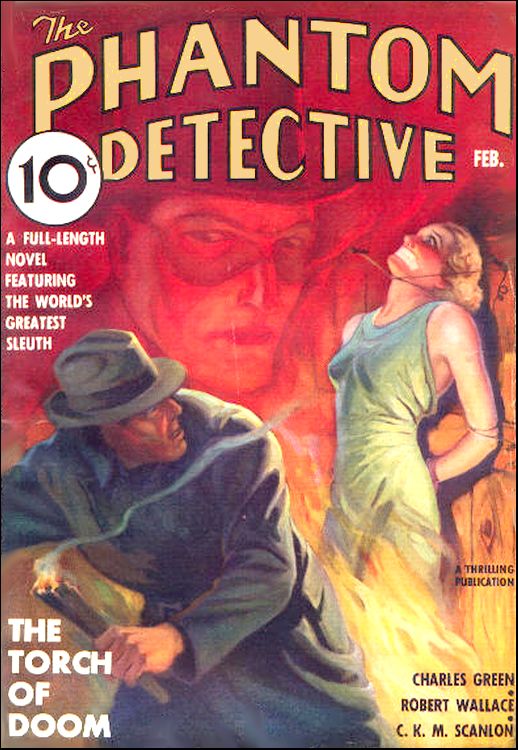
The Phantom Detective, February 1937, with "The Torch of Doom"
Murder, theft and arson are the weapons of a monarch of crime who wages a desperate campaign of terror against America's automotive industry! Featuring the world's greatest sleuth in action!
THE hidden corpse in the sub-basement of Grand Central Palace sprawled hideously, its presence unsuspected.
Blood matted the hair where the top of the skull had been beaten in. Blood had trickled over the grease-smudged, terror-stamped face, and dried in grim rivulets of red.
The body was crammed on its stomach on top of the powerful motor beneath the golden hood of a long, streamlined racing car. The corpse had been there several hours. And the ruthless murderer, a stalking specter of death, strode the echoing corridors above.
Up on the main floor the throngs of visitors to the spring New York Auto Show failed to sense the menacing pall of death drifting foglike through the noisy, spacious exhibition building.
The motor public saw only the flashily colored cars. They heard only the enthusiastic chatter of their own voices, the rhythmic swing music of the two alternating orchestras, and the announcer cutting in with:
"Ladies and gentlemen, through the courtesy of Western Oil we will have with us in a very few minutes that daring driver of racing cars, twice winner of the Indianapolis Speedway Classic and the favorite to win that five-hundred-mile grind for the third time next week—Mr. Al Harran!"
But up in the sixteenth floor suite occupied by Western Oil, the whisper of fear was a discordant undertone draining gaiety from the party going on there.
In the reception room of the suite, beefy Nick Gold, president of Western Oil, snapped irritably:
"Where the devil is Al Harran? The main floor just phoned up for him!"
Gleason, the athletic-looking man standing beside Gold, lifted alert blond eyebrows. "I'll go look for him."
The blond publicity director of the American Petroleum Association strode off quickly through a new group of guests breezily entering the already crowded suite. The worried frown stayed on Nicholas Gold's face. Al Harran, who placed a premium on speed and promptness, had never been late for anything before.
Across the large room Big Tim Tangway, Harran's jovial boss, nodded nervously and came over. As president of Flight Motors, builder and owner of Harran's famous Bullet Six racer, Tangway, too, had reason to worry.
It was grimly possible that the speed driver's unprecedented delay might have a connection with the mysterious series of telephone threats that had been received.
Untraceable, those messages had been phoned by an obviously disguised voice—always the same voice speaking from widely scattered pay booths in the metropolitan district. Several city newspapers, the executive offices of the American Petroleum Association, and the Wall Street offices of Western Oil, had received those calls.
Each brief warning had been identically worded:
Western Oil will be wrecked, as an example to the gasoline and automobile industries.
And each cryptic message was cut to a ten-second conclusion with the chilling verbal signature:
This is the Torch speaking!
During the three weeks those startling calls had been coming in, nothing had happened. The newspapers had agreed to keep the warning from the public. Police and industrial detectives had got nowhere.
THE very lack of any action added grimly growing suspense to the challenging menace. The slightest irregularity in habits or routine of persons connected with the two industries reacted like a magnet now, attracting the accusing finger of suspicion.
"No word from Harran yet?" Tangway asked nervously.
Gold shook his head. "Paul Gleason just went to hunt for him. Lord! Do you think this has anything to do with the Torch threats?"
Tangway made a wry, dubious face. "Harran's not a Western Oil man. And Flight Motors hasn't been directly threatened—yet. I don't believe it would happen so back-handedly."
Both men stiffened as they recognized the stolid, flat-faced man coming toward them from the corridor doorway. "Hi-card" Guffy, the big New York gambler, had his usual two darkly alert bodyguards with him. Behind them trailed a city detective in a loose-fitting tuxedo.
The meeting was too direct to be evaded. Gold nodded an okay to the hovering plainclothes man.
"Swell show you got here, gents," Guffy declared in a fast flow of coldly emotionless words. "I'm enjoin' it. Just dropped up to let you know I've bet two hundred grand on Al Harran and the Bullet Six to cop the Indianapolis merry-go-round next week." His fishy eyes shifted and stayed on Gold's face.
"You'll probably win," the beefy Western Oil president stated with open annoyance. "Personally, I'm not interested in your damned bets."
"You'd better be interested." The humorless twist of Guffy's hard lips was a wise sneer. "It's your gas that'll kick that speed-can around the track. Well, glad we had this nice little chat."
THE gambler turned abruptly, strode out of the room, flanked by his two dark-featured guards. The tailing detective jerked up his jaw, followed them into the corridor.
"You see how it is?" Gold exclaimed angrily. "Anybody can get in here! The diabolical devil who makes those Torch phone threats could be in this show building right now, and we'd never know it until too late! I tell you, Tangway, this thing is getting my nerves."
"Mine, too!" Tangway agreed moodily. "But what can we do?"
Gold's nervous glance shifted to a startlingly beautiful young woman wearing a low-cut black evening gown. She was entering the crowded reception room. She was escorted by a dapper gentleman in a tuxedo. Both were foreigners. Gold elbowed Tangway significantly.
"There's that Carloff girl again, with the same man. I haven't been able to get a report on them yet."
The burly motor car manufacturer eyed them keenly. The girl and her dapper companion had appeared suddenly in the social life of the Eastern automobile world two weeks before. Their shrewd, persistent campaign of questions concerning the motor industry had brought them under suspicion.
"Go talk to her, Tangway," Gold urged. "While I do some phoning about Al Harran."
Tangway nodded, frowning. "That ought to be a pleasure. I can't see how anything can happen here with all the police protection we've got." He strode aggressively toward the Carloff woman.
Gold went to the rear of the room, tried for five minutes to locate Harran at his hotel. He was about to phone the Western Oil booth downstairs when a startled murmur broke in the room.
He swung round, saw a figure staggering in the corridor doorway. Harran!
Nicholas Gold's eyes blazed. He started across the floor in quick, choppy strides. The famous race driver wasn't a drinker, yet he looked drunk now—drunk enough to be wearing his racing togs, blue overalls, helmet, goggles over his eyes. He was fumbling with a big bandanna handkerchief in his left hand, coughing into it.
"Al, you fool!" Gold cried. "What's the matter with you? You're disgracing us!"
The bandanna stayed at Harran's face. His free hand shoved hard against Gold's thick chest, the fingers jabbing at the breast pocket of the beefy executive's tuxedo. In the swift push, nobody saw the folded note leave the swaying driver's fingers.
"Yeah?" Harran sneered. "Disgracin' you, am I? Damn you!"
"Al—please—" Gold's eyes rolled frantically in search of help, but Tangway was no longer in the room. "I'm your friend, Al. Let me help you out of here before—"
"You're a rat!" The baleful eyes glared evilly behind the distorting lenses of the racing goggles.
Quick panic quavered in Gold's voice as the driver gave him another hard shove. "Somebody—help me get Al outside!"
A powerfully built man lunged through the stupefied spectators as Harran's cursing shout shrilled:
"Rats! You're all rats! All of you!"
The bandanna still blurred the racer's face. A heavy .45 Colt appeared in his right hand, jerked from beneath the blue coveralls.
"Harran!" the big man shoving out from the crowd shouted. "Drop that gun!"
Suddenly the swaying figure in the blue coveralls crouched. Drunkenness dropped from him like an actor's cloak. A killer's gleam of triumph leaped into those deadly eyes behind the goggles. A piercing, nerve-shattering laugh broke from the snarling lips masked by the red bandanna.
"My God!" Gold screamed. "He's gone crazy—crazy! He's not—"
The heavy Colt roared twice, and completely drowned out his frenzied cry.
Nicholas Gold slammed backward as the slugs smashed into his white shirtfront. A wild, despairing expression became fixed on his face. His knees buckled.
As Gold's beefy body hit the floor, two more blasts from the gun killed the echoes of the first deafening reports. The powerfully built man who had lunged out of the frozen crowd took the bullets in his head. The back of his skull spilled blood and brains. He plunged to the floor, face down.
In the center of the room a blond woman in a green evening gown screamed and fainted. The Colt blasted again, and the young man standing beside her, moving to catch her slim slumping body, stopped the fifth slug with his right shoulder.
The woman and the man whipped to the carpet together in a senseless tangled heap of green and black, flecked with dripping red.
The goggled, crouching killer swung back through the doorway into the corridor. He crashed a sixth shot at a uniformed building guard who lunged at him from an adjacent office. The guard staggered, gripping his stomach with both hands, and pitched forward on his face, writhing.
The next instant an elevator operator lay sprawled on the corridor floor, felled by a merciless blow of the heavy Colt's barrel. The elevator door slammed. The car shot downward.
Back in the Western Oil suite the acrid odor of cordite was sharp and biting as pandemonium broke loose.
THE tall, tanned, sharp-featured gentleman in the expensively tailored dinner jacket slid out from behind the wheel of the polished new Duesenberg roadster in the show booth.
"Very nice," he told the automobile representative. "I've one a couple of years older than this model, but I might be induced to trade."
The salesman beamed. "Certainly, sir. Could I call with a demonstrator?"
"Toward the end of next week, perhaps." The tall man handed over a card. "I'm not certain when I'll be back from the Indianapolis race."
The salesman's eyebrows arched as he read the engraved name:
RICHARD CURTIS VAN LOAN
"Thank you, Mr. Van Loan!" he exclaimed with suddenly awed respect. "I'll certainly be waiting to give you that demonstration."
The gentleman nodded, started strolling again about the big main floor of the crowded exhibit.
He was looking for a woman he'd never met, a Miss Naomi Carloff who had been pointed out to him by his friend Frank Havens, owner of the crime-crusading newspaper, the Clarion. Unofficially, the tall gentleman knew about those menacing phone calls to Western Oil, and was starting on a Torch investigation of his own.
The Duesenberg representative, his eyes clinging to Van Loan's broad, straight back, murmured excitedly to another salesman:
"Boy! What a break! Richard Curtis Van Loan—"
"The Park Avenue clubman?" the second salesman said enviously.
"One of the wealthiest and most popular sportsmen in America! Am I going to take that Bermuda trip I've been promising himself, on the commission I'll make off the Duesey roadster he'll buy? Yowsah!"
In his eager enthusiasm for the Van Loan sale, the Duesenberg representative failed to notice the warning flash of lights over the building exits.
But Richard Curtis Van Loan's sharp grey eyes had already caught the danger signal. He glanced about quickly, saw no commotion on the main floor, but noticed the quick movements of building guards hurrying to cover the doors. From the puzzled looks on their faces they didn't yet know what had happened nor where.
He strode quickly to the elevators as one of the arrow indicators whirled around past the circle of floor numbers without a downward stop. The car halted at the main floor. A white-faced, wide-eyed operator leaned out, gasping:
"Murder! Get a doctor! And more police—"
"What floor?" Van Loan demanded tersely and stepped into the car.
"Sixteenth! Western Oil suite!" A uniformed police lieutenant and two detectives shoved into the elevator, ignoring the tall man in the dinner jacket.
"Keep the crowd locked in," the lieutenant shouted to somebody out on the floor, and snapped at the operator, "Up! Sixteen! Step on it!"
As the car lurched upward, one of the detectives demanded hoarsely, "What the hell happened up there, Lieutenant?"
"A shooting," the officer grated. "Somebody phoned down from Western Oil. But there was so much damned racket up there on the phone that I couldn't make out what—"
"It's Al Harran, the big-shot race driver!" the elevator operator exclaimed. "He went crazy with a gun. I was comin' up empty and I could hear th' shots even in th' shaft. I stopped at sixteen and somebody shouted it to me an' ordered me down for a doctor an' more cops." He nodded at Van Loan. "This guy's a doctor."
The tall gentleman neither denied nor affirmed the operator's excited assumption. There'd be plenty of doctors.
He could give medical first-aid himself, if necessary. The important thing was to get up there without being stopped.
THE lieutenant glanced at him. "Well, neither Al Harran nor anybody else will get out of this building until we let 'em out."
The car bounced to a stop and Van Loan stepped out behind the policeman. The corridor was a shambles.
A matronly woman and two men were working over an unconscious elevator operator stretched on the floor. Further along, a man with the professional bearing of a doctor was kneeling beside a building guard, pressing a towel to a gunshot wound in the agonized man's abdomen and shouting for more water.
Van Loan's eyes narrowed as he followed the hurrying lieutenant into the Western Oil suite.
In the center of the room a slim woman in a green evening gown was being revived from a faint. A young man in shirt sleeves was having his right shoulder bandaged with a first-aid office kit.
On the floor near the corridor door, sprawled gruesomely in dark smears of blood, a big man lay face down, the top of his head blown off. Nearer the door Nicholas Gold was stretched on his back, with two grim circles of red staining his white shirtfront.
Van Loan didn't recognize the bigger corpse lying on its face. But he did know Nick Gold, and his thin lips tightened as he stared at the beefy executive.
THE police lieutenant, glaring morosely around the room, sniffing the lingering odor of cordite, called out sternly, "Nobody leaves this floor until they're told to go!"
He grimaced at the body, face down on the carpet, passed the man up as being too dead. Turning to Van Loan, he pointed at Nick Gold.
"Take a look at that one, Doc, for luck."
Kneeling beside the body, Van Loan fought back a sudden burning impulse to step in, declare himself, and take over the investigation openly. He frowned off the urge, concentrated his attention on Gold.
The Western Oil president was dead, shot through the left lung and the heart. Nothing could be done for him. But there were other things that could be done!
Van Loan's dexterous fingers were hidden as he explored the murdered executive's clothing. He didn't expect to discover much of importance, and certainly nothing without an expert search.
But in the most accessible place of all—the breast pocket of Gold's tuxedo—his fingers touched and palmed out a small folded slip of paper. He managed a swift glance at the cryptic pencil-printed words:
This is the beginning. Half a million dollars cash will save you from
The Torch.
Dick Van Loan's nerves jumped. He held in his palm the first definite motive for those mysterious Torch telephone threats!
Instinct urged him to put that extortion note back, to let the police find it in Gold's pocket. Experience warned him to hold it. This looked like big-time crime. And he was no novice at it.
His slitted, slatey eyes flicked to the red-smeared holes in Nicholas Gold's breast. There would be more notes, more violent and sudden deaths—
He slipped the note into his own coat pocket and stood up, taking a deep breath, feeling strangely relieved, vitally alert. He was into this now, crime-deep. The police would see that grim extortion note in due time.
An elevator door slammed open out in the corridor. He turned, recognized Captain Wander, the Homicide Squad officer, coming flatfootedly into the room in front of a dozen more detectives.
Van Loan moved away swiftly, his back turned to the Homicide men. He was facing a row of office windows.
And suddenly a sharp tension gripped him. For, out across the roofs of Manhattan, red lights were blinking atop the Clarion Press Building—a coded call in crimson!
Watching narrowly, he decoded that winking red Phantom message, and a sardonic smile played for a moment across his thin lips. Frank Havens, owner of the Clarion, was calling him, directing him to the Grand Central Palace killings!
There was irony in that. For the first time since Van Loan had inaugurated this secret signal of crime, he was already at the murder scene. And with a clue in his possession that even the police had not muddled.
Yet the advantage of his presence here presented a new pattern of risks. Ordinarily, when that Clarion call came, he had the whole of Manhattan and his three major hideouts in which to fade and from which to emerge again as the Phantom.
But now he was definitely known to be here, as Dick Van Loan. Captain Wander would shortly recognize him, if that eagle-eyed Homicide officer hadn't spotted him already. And there was his card downstairs in the hands of a Duesenberg salesman.
On a spectacular double murder of such importance as the Nicholas Gold killing, every least item would be checked. And the police would let nobody leave the building now.
Nevertheless, before the possible trail of that extortion note grew cold, Richard Curtis Van Loan, wealthy Park Avenue gentleman, had to disappear, and quickly—to make way for that mysterious figure of a thousand faces who stalked the treacherous byways of crime in the guise of the Phantom.
AS Dick Van Loan glanced warily over his shoulder to locate the position of Captain Wander, his sliding glance caught a profile view of Naomi Carloff, the girl Frank Havens had pointed out to him.
Havens hadn't been able to tell him much—only that Gold was trying to have her investigated, along with Felix Goerner, a dapper foreigner who usually accompanied her. The investigation, Havens had emphasized, was entirely prompted by the Torch phone threats, and had thus far failed.
She was speaking to Goerner now and there was fear on her very lovely face.
Before Van Loan could spot the Homicide captain, the Carloff girl had moved away and was slipping through a side door of the large reception room into a smaller adjoining office.
Van sidled over to the police lieutenant who had come up with him in the elevator, nodded to the officer and said crisply:
"Nothing can be done for either of the victims, Lieutenant. I'd like to wash my hands."
"There should be a washroom round here somewhere," the lieutenant told him and turned to one of his detectives brusquely.
Felix Goerner had moved over near the door through which the girl had disappeared, but another detective had singled him out and was shooting questions at him.
Van Loan stepped quickly toward the same door, which was closed. As he approached, the beady eyes of the smartly dressed foreigner flickered at him with something unreadable but warning in their amber depths.
Van strode past, and the dapper man made a belated movement to stop him. But the detective caught the fellow's arm, irritable, holding him, asking more questions.
Reaching the door, Van opened it swiftly, stepped quietly through into the small office beyond. He shut the door noiselessly behind him, and stopped abruptly, his grey eyes narrowing.
Naomi Carloff was almost fully hidden by a tall steel filing cabinet at the left of the door. Her back was turned and only one arm and a portion of her bare shoulder was visible. But her voice, excited and frightened, was clear enough, although low-pitched. She was speaking tensely into a telephone.
And her slightly accented words were sufficiently damning:
"Yes—Pedro! They shot him, I tell you! And I'm afraid! I don't want to go through with it—"
Van took a step nearer as she paused to listen to the speaker at the other end of the line. Then she went on:
"I don't want to, but I will, for Felix and you. After one o'clock tonight—at the Buckley garage. But I'm still afraid—"
Her voice broke off in a little gasp of dismay, and Van caught a fleeting flash of his own lean face in the small purse-mirror she had been holding to warn her of anyone's presence.
THE tiny mirror disappeared and the phone tinkled back on its cradle as she turned.
"I beg your pardon," Van said quietly, but without smiling. The girl was startlingly beautiful, with luminous eyes that seemed jet black; and her jeweled fingers moved in nervous foreign gestures.
"I seem to have—intruded, mademoiselle?"
"Oh, monsieur!" Her black eyes were wary, but her red lips smiled engagingly. "Not an intrusion, no. But you gave me a start, monsieur. I—thought you were perhaps the police." She ended the softness of her words in a little rippling laugh of disparagement.
"And why the police?" Van asked calmly.
She shrugged her bare shoulders. "They might not like it that I did not ask their permission to use the telephone—under the circumstances." She tossed her head with a quick gesture of challenging defiance. "I was only calling my garage, as you may have overheard, monsieur."
Van Loan didn't press his advantage. She was lying, but she couldn't be sure that he knew it.
"It's quite all right," he assured her, masking his shrewd appraisal of her behind a polite smile. "I'm not a police official. I was about to use the phone myself." He stepped over to the desk, began dialing a number, his broad back concealing the figures from her. "My call is no secret, mademoiselle."
"Oh, but I wouldn't think of listening, monsieur!" she exclaimed and moved to the door, opening it. "Thank you for being so kind."
Then she was gone. But she did not quite close the door behind her. And Frank Havens, owner of the Clarion, was answering the unlisted private number Van had dialed.
Havens' voice, anxious and worried, took on a relieved note when Van identified himself with a clipped:
"Hello, Frank. Cut off those tower lights!"
"Excellent, Dick!" Havens exclaimed eagerly. "Where are you now?"
"I'm at the auto show," Van said hurriedly. "Your new automobile reporter, a chap named Joe Riley, has lost his press card and can't leave without it. Send him over a fresh ticket—and a pocket Colt. Sixteenth floor. Western Oil suite."
"Riley?" the publisher demanded. "I haven't any reporter named Joe Riley."
"You have now!" Van declared with flat conviction. "Get it, Frank! Joe Riley, your new automobile reporter. He wants a Clarion press ticket and a pocket Colt right away. He'll be waiting here, in the Western Oil offices!"
Frank Havens made a clicking sound over the line with his tongue as he caught on to Van's gag. "Aah—right!" he said. "Joe Riley! I'll be there myself with both items in less than ten minutes."
Van slid the phone back on its cradle, smiling thinly as he turned and faced the small room.
Through the slit opening the woman in black had left in the doorway, he could see the city detectives had not yet finished their preliminary routine of writing down names and addresses.
The small office had, besides the entrance into the next room, a corridor door and a partly opened narrower door leading into a washroom. Van crossed to the washroom quickly, heard voices approaching.
Over his shoulder he got a fleeting glimpse of Captain Wander and Goerner—the man who had tried to stop him from entering this office—coming toward the not quite closed doorway opening into the main room beyond.
Van reached out swiftly, opened the corridor door, whipped it shut again, slamming it hard. The next instant he had slid into the washroom, snapped on the inside lock.
Outside, he could hear Captain Wander's biting voice saying, "Hell, I was sure I saw Dick Van Loan come in here!" And Goerner's surprisingly deep and resonant voice with an accent: "The gentleman must have left when that door slammed. Perhaps he's out in the corridor."
The two voices trailed off.
VAN LOAN turned on the washroom light, removed his dinner jacket, and his fingers dug at a peculiarly constructed belt he wore next his skin. It was wide, thin, with a number of zipper pockets, from one of which he produced a small packet that unfolded in a neat, compact make-up kit.
He surveyed himself a moment in the washroom mirror. Then his long, dexterous fingers went to work on his face.
With a bit more time and opportunity than he had now, Dick Van Loan's various character changes were perfect examples of the art of physical human camouflage. Characterizations, to him, included altered posture and carriage, different mannerisms, change of voice and upon occasion even ventriloquism.
The roles of the Phantom demanded many varied disguises. For, in conceiving and building the character of that mysterious scourge of crime, Van had set the steadfast rule that never, under any circumstances, should his real identity be revealed.
If such a disaster ever happened, then the Phantom as an active menace to crooks and murderers would completely lose his power.
For the Phantom's success lay in the freedom of movement that was possible only so long as the real man behind the quickly changing masks remained unknown. It was the swift switch in disguises, the deadening shock of the Phantom's startling surprise appearances, that made the character so grimly invincible.
Frank Havens was the only living person who knew that Richard Curtis Van Loan and the Phantom were one. And Van protected the elderly publisher at all times from being tricked or forced into revealing the Phantom's identity—protected him as he was doing now in assuming the disguise of the non-existent Clarion automobile reporter, Joe Riley.
It was suspected, and in closer detective circles known, that during the heat of a major crime hunt the Phantom sometimes contacted the Clarion publisher, the city or state police, and sometimes the Federal Bureau of Investigation. But in every such instance, all trace of him was lost in another swift change of disguised personality.
The entire present make-up job took him scarcely five minutes. In his own opinion it was an imperfect makeshift. But when his expert fingers had finished the final facial touch, the features of Richard Curtis Van Loan had completely disappeared.
The face that looked back at him in the mirror was the reflection of a dissipated man of thirty-five with sunken cheeks, accentuated cheekbones, pouchy eye sockets, and lax lips above an uncertain jaw.
He replaced the make-up kit in his skin-belt, put on his dinner jacket, hitching it ill-fittingly over shoulders that seemed to have shrunk and sagged.
With a final twist to his black tie, he listened a moment at the door as he unlocked it noiselessly and switched out the light.
A moment later the Phantom—now, Joe Riley, Clarion automobile reporter—slouched carelessly across the small office and ambled out into the corridor, his drooping lids above the pouchy eye sockets veiling the sharp alertness of his grey, roving glance.
Most of the guests and exhibition officials had been herded into one of the other office suites on the floor. And several white-coated morgue attendants were waiting in the corridor.
An assistant medical examiner, Captain Wander, several detectives, and two police photographers had taken over the murder room. With them were three witnesses, one of whom Van recognized as Big Tim Tangway, when a uniformed cop stopped him at the door to the main office.
"Where do you think you're goin'?" the cop demanded.
"Nowhere until my boss gets up here." Van's voice no longer was that of the Park Avenue clubman. He spoke with an indolent drawl. "I'm a reporter on the Clarion."
"If you're a reporter, stick your press card in your hat or somewhere we can see it," the cop ordered. "How'd you sneak up here?"
"Been here all the time," Van told him. "Lost my press pass and was looking for it. My boss, Mr. Frank Havens himself, is bringing me over another ticket. I just phoned him."
"You phoned—from here?" The policeman shifted uncertainly on big feet and his officious attitude changed. "Havens, eh? The bigshot publisher? You better wait right here until he comes, fella! And say, don't crack about phonin' out of here or some of us cops'll get in a jam."
"It's okay with me," Van stated and leaned against the door frame where he could watch what was going on in the murder room. "Have they caught Al Harran yet?"
"Hell, no!" the cop answered. "They'd have him right up here in this office, making him talk in front of them two corpses, if they'd got him. But he won't get far. Probably hiding in the building."
The switch of an elevator made Van turn. A car door opened and Mr. Frank Havens, accompanied by a police officer, stepped out.
THE Phantom strode over to the stocky, grey-haired, square-faced publisher swiftly and declared himself before Havens could speak.
"Hello, chief!" Van said brusquely. "I'm Joe Riley, the legman who lost his ticket. The police have been good about it, though. But it's a break for me you were coming up here anyway."
Frank Havens didn't hesitate, but his blue eyes, narrowing on the Phantom's dissipated features, held a quick gleam of relief and surprise. It was always a marvel to the publisher whenever he first encountered Van in one of these roles, for he seldom had the opportunity of knowing in advance what sort of disguise to expect.
He said, as casually as he could, " 'Evening, Riley. I brought you another press card. Don't lose it again."
Van took the red Clarion ticket the publisher handed him. It had Joe Riley inked across its face in Havens' bold, frank handwriting. Havens would slip him the pocket Colt at the first opportunity, with a Clarion police pistol permit to go with it.
"Thanks, chief," Van said. "Captain Wander is in charge of the investigation. Do we go in?" He gestured toward the murder room.
Havens nodded, strode in past the cop at the door. The Clarion publisher had as much political influence and power as any man in the city. And the chain of newspapers he owned from coast to coast made him a nationally important personage.
Van entered the room with him. The fact that Havens did not hesitate was a silent tribute to the publisher's confidence in the Phantom's disguise. Captain Wander glanced at them as they entered, and motioned them to join him.
"Didn't expect to see you here in person, Mr. Havens," he exclaimed respectfully, but with a sharp glance at the red Clarion press card sticking out of Van's breast pocket. "One of your reporters, eh?"
"Joe Riley, covering the auto show for me," Havens said definitely, with a confirming nod toward Van. His blue eyes surveyed the two bodies on the floor. "A ghastly mess, Captain!"
"Plenty," Wander growled. "Not much use for an automobile-show reporter now, Mr. Havens. If you say so, though, I'll have to let your man stick around, I guess."
"I know you don't like reporters on a police investigation, Wander," Frank Havens said crisply. "But I am going to ask you to let Riley stay here. I think," he added with another glance at Van, "you'll find him of some help, Captain. He's familiar with police reporting and has some contacts that might prove helpful—in case Al Harran can't be found. I understand Harran hasn't been caught yet."
"Harran's having drunkard's luck, but we'll get him," Wander grumbled. "Okay, Mr. Havens. Your reporter, Riley, is in." He eyed the Phantom appraisingly. "Know a lot of people in the automobile industry, eh?"
"Some of them," Van stated, drawling the words. "I'd like to look over the show list of exhibitors, Captain."
"Sure, sure. The building superintendent'll fix you up." Wander looked across at the corridor door sharply as two detectives entered. "Yeah?" he called. "Now what?" One of the plainclothes men was carrying a small brown cloth zipper bag. The other detective pointed at it and said triumphantly:
"Now plenty, Cap! Take a look at that!"
The city sleuth carrying the cheap bag slid open the zipper, displaying its contents. Captain Wander stared into the case, swearing under his breath. His big hand dipped into the bag, drew out a wadded suit of blue coveralls.
He shook loose the folds of the garment, held it full length, dropped it on the floor, and reached into the zipper case again. In all, his hand went into the bag five times, emptying it.
When he was through, on the floor alongside the blue coveralls lay a race driver's helmet, a forty-five caliber Colt, shatter-proof driving goggles and a large, red bandanna handkerchief.
HAVENS, Van and the police stared down at the grim assortment, and Wander's voice rasped at the two detectives: "Where the hell did you find this stuff?"
"Crammed behind a corridor fire hose on the eleventh floor," the man who had brought in the bag answered. "That's where Harran left the elevator after the shooting."
"Is this the outfit he wore?" Wander snapped at the three witnesses who were gazing down at the assortment on the floor.
Big Bill Tangway lifted his thick shoulders and let them fall again. "As I told you, Captain, I wasn't in here during the shooting, but the stuff seems to fit the descriptions I've heard these other two men give you." He looked questioningly at the well dressed gentlemen standing beside him.
"I'd say it was the costume Harran wore," one of them stated, and the other man nodded, adding: "There's no reason to presume otherwise."
"You're right, there," Wander agreed. "Positive identification."
"Positive, for the things on the floor," Van corrected unhurriedly. "But that doesn't prove that Harran wore them."
"What the devil are you talking about, Riley?" Wander glowered at him, picked up the heavy Colt, using a handkerchief to hold it. He sniffed at the barrel, passed the gun to one of his detectives with a curt, "Rush that down to our lab for prints and a ballistic test," and eyed Van again. "I don't expect to find fingerprints on that rod, but if the riflings of that Colt don't match up the slugs the M.E.'s assistant here dug out of Nicholas Gold, I'll eat 'em!"
"That still won't prove that Al Harran was the murderer," Van insisted lazily. "Suppose you reconstruct the crime, Cap, for the benefit of Mr. Havens."
TWO more men came into the room. One of them was tall, lean, with a waxed mustache more blond than his tanned, thin face. The other man was the chunky city detective Van had seen questioning the dapper, smartly dressed foreigner before he'd put on the Phantom disguise.
"This bird claims he's a private dick," the chunky plainclothes man said to Wander. "He insisted he had to see you."
"I'm Jacks, chief of the American Petroleum Association's industrial detectives," the tall blond man said curtly.
His pale, restless eyes, roving over the two dead bodies on the floor, slid up and stopped on Big Tim Tangway's rugged face. "Oh, hello, Mr. Tangway! I just heard about this—" he indicated the floor again with a jerk of his head. "Mr. Gleason phoned me."
"Glad you're here, Jacks," Tangway said friendly. "Captain Wander, Jacks and his men have been doing some sleuthing on some phone threats that Western Oil has been receiving."
Wander nodded. "I've got a memorandum on that down at Headquarters. Glad to help you if I can, Jacks. But this doesn't look like what you're after." He glanced wryly at Van, made a smile for Frank Havens. "Al Harran, Mr. Tangway's race driver, busted in here drunk, all togged up in that junk spread out on the floor, and went completely haywire with the gun."
"Mr. Gleason told me on the phone," Jacks said shortly, "that the police were looking for Harran." He looked sharply at the dead man whose skull had been partially blown open. "That's Blockman, general manager of Flight Motors, isn't it? Hell's bells!"
"It's Blockman, all right," Tangway growled deep in his throat. "The poor devil! He got it, trying to stop Harran from killing Gold, according to all the witnesses who were here in this room."
Captain Wander said: "Harran winged one of the guests in the shoulder—not seriously, fortunately—and shot a building patrolman in the stomach. Then he knocked out an elevator operator with his gun barrel and escaped to the eleventh floor in the car."
"Why the eleventh floor?" Jacks asked with curious bluntness.
"For speed, I figured it," the Homicide captain explained. "To beat the signal-light alarms he must have known would be used to stop him. One of the show officials who happened to be on this floor got the red lights turned on about half a minute after Harran had scrammed. And we found Harran's murder outfit—this stuff spread on the floor here—hidden in a cheap zipper bag down on the eleventh!"
The Phantom said dryly, "You're making the killer out a very smart and sober drunk, Wander, if he thought and acted that fast."
Captain Wander swore softly to himself, then exploded at Van: "Riley, this is no time for wisecracks! Every witness who was in this room and who knew Al Harran—every one of 'em, mind you—has told us it was Harran! And when we catch him—"
JACKS cut in curtly: "Did you find anything on the body of Gold, or Blockman either, that could be taken as a threat—any letters or something of that sort?"
Van's grey glance flicked to Jacks' thin, sharp features. The industrial investigator looked and spoke as though he knew what he was about. The Phantom pegged the fellow as being probably the shrewdest of the group of detectives in the room.
But there were too many present to spring the extortion note he'd taken from Gold's tuxedo pocket. Wander was already so set in his opinions concerning the killings that to show him the note now, especially in front of the others, would only drive the Homicide captain into pinning the pencil-printed threat on to Harran.
Al Harran, Van realized, might be the man who called himself the Torch. But so might anyone else, particularly those connected with the gasoline or automobile industries.
"Didn't find a thing, Jacks," Wander stated flatly. "I know what you're looking for. But if we had found a threat note, that would only tie up Harran with a motive, would it not? It'll all come out soon as we nail him."
"It seems to me, Captain," Frank Havens said impatiently, "that the whole case hinges on catching the race driver. What's being done about that?"
"Hell, everything!" Wander exclaimed. "He couldn't have got out of the building any normal way before the alarm lights went on and the exits were blocked. Every floor is being searched. And there's a radio pick-up out for him, in case he managed to squeeze through a keyhole or something. It's maybe only a matter of minutes before we'll have him. He's well known and will be easy to spot."
The police lieutenant who had first come up with Van in the elevator entered and handed Wander a long list of names and addresses.
"There's everybody we've been able to round up so far, Captain," the lieutenant said. "They're all in the suite at the end of the corridor, waiting to be questioned some more or let out. What'll it be?"
Wander's eyes skimmed down the list. "I'll go in and look 'em over, Lieutenant. Mr. Tangway, you'd better come along with the other two witnesses. Probably you can help me get a line on some of the people." He grinned sourly at Havens. "It's routine. Want to join us?"
The publisher glanced at Van, who shook his head lazily.
"I guess not, Captain," Havens answered.
Jacks said, "I'll tag along with you, Tangway. Okay, Captain?"
Wander nodded, strode out of the room, followed by the men going with him. The lieutenant stayed, taking charge of the Western Oil suite, and the police photographers went to work again.
Van frowned slightly as the lieutenant eyed the red Clarion press card in the breast pocket of his dinner jacket.
In the excitement, the lieutenant seemed to have forgotten about the elusive "doctor" with whom he had ridden up on the elevator. And Captain Wander had not mentioned hunting for Richard Curtis Van Loan.
It was the unfortunate ability of the police to skip such seemingly unimportant details in their criminal investigations that made their methods sometimes unreliable and dangerous. The relative ease with which he himself had evaded them, he realized, could have been repeated by someone else—by the Torch, for example.
He remarked to Frank Havens, "I'll be going downstairs in a moment, Chief, if you'll wait," and strolled over to the city detective whom he had seen questioning Goerner.
"Felix Goerner," Van said. "What you've got on him?"
The dick stopped to consult his scribbled notebook. "Commodore Hotel. Retired gem dealer. He's got a visitor's visa and a passport from France. Been in this country two months."
"Thanks," Van said and returned to Havens. "Okay, Chief. Let's go down and look at the exhibitor's list. The show manager's got it." As they passed out into the corridor, the lieutenant was calling the morgue men into the room. The cop at the door let them get into a down elevator, and a detective was riding the car.
When they got out at the ground floor, the crowd of auto show visitors were still milling about. Most of them didn't know that they had been locked in or that tragedy had struck on the sixteenth floor. Those who had been stopped at the main doors were standing about in the lobby, waiting impatiently to be let out, demanding to know what had happened.
AS the Phantom and Havens crossed to the show manager's booth near the entrance, a thickset man whom Van recognized as one of the deputy police commissioners appeared, spoke to the detectives in the lobby, and the front doors swung open again.
Eyeing the quick flow of outgoing visitors, Van commented wryly:
"They might as well not have locked those doors in the first place."
Havens glanced at him sharply. "What makes you question everyone's certainty that it was Al Harran who did the shooting?"
The Phantom thrust his hand in his pocket, felt the extortion note in his fingers.
"Wherever there's a number of witnesses to any fast, violent action, their descriptions of what happened and what the attacker looked like always vary. And here, all of a sudden, everybody who saw the killings agree that it was Al Harran."
"Doesn't that make it even more certain?" Havens asked.
"Too certain to be real," the Phantom replied gravely. "Even without any other pointers, that alone would make me suspect that somebody put on an act, disguised as Harran—and overdid it. There wasn't enough chance given for normal errors on the part of the witnesses. The stunt was made too positive."
Havens' eyes clouded. "That's psychology, but it isn't proof—"
"Did you get a whiff of the whiskey odor on those blue coveralls?" Van demanded. "They'd been saturated with liquor. Gold, from what I overheard the witnesses say, called Al Harran's name and told him he was drunk. Harran was expected at that time. In the embarrassment and excitement of his entrance, it was easy to fool Gold. The rest of them took Gold's word for the identity. But the man wasn't drunk. He was too exact in what he did afterward."
The Phantom drew Havens into a vacant angle between the elevator bank and the show manager's booth. He removed his hand from the pocket of his dinner jacket, and his fingers held out the extortion note.
"And here's the proof, Frank! Al Harran has been racing all month out in California. He just came to town this morning, according to the newspapers. I see no reason whatever to show he wrote this!"
Frank Havens, taking the small slip of paper, stared at the cryptic message grimly, and a gasping exclamation broke from his lips.
"Good God! Where'd you get hold of this, Dick?"
Van folded the publisher's hand over the note. "Put it out of sight in your pocket, Frank. I'm leaving it with you. I found it on Gold's body before the police discovered it. You're the only person I've shown it to."
Havens' blue eyes hardened. "The police commissioner will have to see this!"
"You can handle that yourself," the Phantom said quietly. "Tell the commissioner your automobile reporter found it near Gold's body. That will help convince him of the right lead on this."
The publisher asked sharply: "What's the lead? I don't see it."
Van's grey eyes became moody. "The lead is that Gold didn't have that extortion note until it was put in his pocket by the killer. I found it tucked in the breast pocket of his tuxedo. If he'd got it before, he wouldn't have been carrying it at all, probably, and certainly not in that particular, exposed pocket."
Frank Havens' square jaw thrust forward as he shoved the note into his coat. "By God! Gold wasn't given a chance, then! The devil simply walked in and shot him!"
Van nodded. "It makes a spectacular enough example of what anyone else may expect who doesn't pay off to the Torch. If that's the purpose behind this shooting, it's only the beginning, Frank."
They went into the show manager's booth where the deputy police commissioner who'd ordered the doors open had taken over a telephone and was muttering explosive orders into the instrument. Havens did the introducing, and the manager produced the exhibitor's list willingly.
"Hell of a thing, up on sixteenth," the manager complained. "The publicity will ruin the show for us."
"It's more apt to increase the attendance," Havens corrected. "Morbid curiosity, you know. I think the important newspapers will go light on the crime, though. I can guarantee that the Clarion will. You close up for the night pretty soon, don't you?"
"Right away," the manager stated and glanced at the deputy commissioner. "That guy Harran must have got out of the building somehow, but the police want to go through it again."
The Phantom glanced up from the list he was studying, asked:
"Where's Harran's Bullet Six? The racer he brought on from the West Coast. It's listed here with the Flight Motor exhibits, but I didn't notice it on the display floor."
The show manager looked at the list over Van's shoulder. "I remember." He produced a pencil, wrote "Basement Storage" after the Bullet Six item on the list. "That car was brought in late this afternoon with an order for a rush spray-paint job before it went on the display floor, so we parked it downstairs. I don't know if Flight Motors sent over any painters or not."
"I'd like to look at that car," Van said thoughtfully.
"It's okay by me," the manager agreed. "You'll find it in the "D" section of the lower basement. That is two flights down."
The Phantom nodded to Havens and they left the booth. As they circled down the stairway to the first basement level, Havens asked: "What do you expect to find, Van?"
VAN LOAN stopped, held out his hand. "I don't expect to find anything I can name, Frank. Maybe I'm acting on a hunch. But it seems to me that Al Harran would have come down here this afternoon to see that his racer was all right, or to supervise a paint job on it. If he did, he might have left a trace of himself. This is as good a time as any to slip me that Colt you brought, I guess."
"Yes, certainly." Havens took the automatic from his hip pocket, passed it to Van along with an extra clip and a Clarion police pistol permit made out to Joe Riley.
They went on down to the second basement level where the Clarion press card and a word from Havens got them past a watchman at the iron stairway door.
The sub-basement was poorly lighted, but Van made out a painted white "D" on a steel beam across the expanse of concrete flooring. He led the way around a bunch of hand trucks, past a high pile of wooden packing cases and crates. In a far corner of the cellar, beneath a drop light that had been turned off, was the bulky, long mound of a car covered by a grey tarpaulin.
The Phantom produced a pencil flashlight, crossed to the bulgy covering, lifted up a length of the tarpaulin.
"This is it, Frank," he said. "Don't try to come in close. It's fresh paint." He ducked under the cover.
The tarpaulin was propped off the fenderless body of the racer by a temporary wooden framework, and the stinging smell of paint, bright gold in the glow of Van's light, made his eyes water. The name Bullet Six glowed in large black letters along the hood.
Van crouched and circled the car, stopped on the opposite side and stared closely at a slight smudge-scrape along the hood's front down low near the radiator. The metal cover was fastened, but the catch at this corner had not held.
He put his light nearer the smudge, but could see nothing that resembled fingerprints. A thorough workman would not have left that smudge there, when a single squirt of a spray-gun would have covered it.
The electric beam of the torch, lighting a vent slit in the hood, reflected off cloth and leather instead of the black metal of the motor.
The Phantom's eyes narrowed sharply. He propped the light against the frame holding up the tarpaulin, took out a handkerchief, unfastened the catches and raised the racer's freshly painted hood.
For a long moment he stood there staring at the body of the man crammed in there, belly down on top of the engine. The dead face was twisted upward and sideward where the head had been pushed down over the back end of the motor above the flywheel.
The top of the fellow's head had been bashed in with some heavy, blunt instrument, probably a wrench or hammer. But the motor-smudged features were recognizable.
The dead man was Al Harran!
STILL staring at the dead, grisly face with the grim rivulets of dried blood streaking it, the Phantom reached out, touched the body, pinching the cold flesh with sensitive, experienced fingers.
His grey eyes became smoky, almost sullen as he reached across the corpse and went through Al Harran's pockets.
But there was no Torch note this time.
He took nothing from the body, stepped back out from under the tarpaulin, faced Frank Havens. The publisher started to speak, but stopped when he observed the bleakness in Van's glance.
"I was right," the Phantom said with a touch of bitterness. "Al Harran didn't do that shooting upstairs, Frank. Harran is in there under the hood of Tangway's Bullet Six, and he's been dead at least three hours."
Frank Havens' lips compressed, his blue eyes squinted. He put out his hand, took the electric torch from Van, and his stocky body ducked beneath the race car's covering. Van could see a vague glow through the tarpaulin as Havens moved about with the light.
A moment later the publisher emerged again, handed back the pencil flashlight. His solid features were grey and tense.
"I'll get the commissioner down here on this myself," he said flatly. "You'll want to talk with him, won't you?"
The Phantom shook his head. "I'd rather talk to Tangway, and to that man Jacks, right now." They moved toward the stairway, and he added: "And that's passing up an opportunity to watch Captain Wander try to squirm out of the hole his over-confidence in the obvious got him into."
At the iron stairway door, Van said to the building watchman: "How long have you been on duty here?"
"Since eight o'clock this evening," the man answered. "There's no watchman down here until I come on. A city detective was askin' me that same question."
"They'll be asking you more, in a couple of minutes," Van told him, and preceded Havens on up the stairs, saying over his shoulder to the publisher:
"Harran was murdered long before that watchman got here, Chief. Whoever impersonated him up on the sixteenth floor knew Harran was to be at the Western Oil suite about nine-thirty tonight, and knew also that he wouldn't get up there to expose the impersonation."
"A hundred people or more might legitimately have known that Harran would come up to the Western Oil show offices about that time," Havens said worriedly. "I'm afraid that's not much help, except that it probably ties in Harran's murder as a prelude to Gold's."
"As a prelude to some future Torch murders, too, I'm afraid, if we don't stop this crime sequence," the Phantom warned grimly.
At the main floor stairway landing, Van paused, said to Havens: "If I don't see you again before you leave, I'll phone you in the morning. I'm going to ask you to tell the police what we've discovered, but to stall about one minute so I can get up to sixteenth before they phone up the information. There's a chance that I might get a new lead from somebody's reaction when Harran's murder is announced."
"Lord, I hope you do!" Havens exclaimed fervently.
Van stepped out onto the main floor ahead of the publisher, hurried into an elevator, flashing his Clarion press card again. The police and building officials on the exhibition floor were already closing up the show for the night, urging people out.
DETECTIVES were still riding the elevators. There was one in Van's car, but no other passengers.
"Captain Wander still holding the people upstairs?" Van asked.
"He's let some of 'em go," the detective stated indifferently. "Not much sleuthing to this case now, I guess, except to pick up that screwball race driver."
The Phantom's thin smile passed unnoticed. He got off at the sixteenth floor, nodded briefly to the same cop who was still parked in front of the Western Oil suite. The two bodies had been removed, but there were white chalk marks on the floor where Gold and Blockman had fallen.
"Everybody's in those offices at the end of the corridor," the policeman told him. "Them that's still here."
Van went along the corridor, turned into the open doorway at the end, and stepped unostentatiously into the suite Wander had appropriated.
There were about twenty people remaining in the office in which he stood, and the doors to the side rooms were closed. Captain Wander and several detectives were grouped near a window, talking with Big Tim Tangway and the tall, thin fellow Jacks.
Seated at the other end of the room, the Phantom saw the girl in black, Naomi Carloff. She was listening earnestly to something that was being said to her by Felix Goerner.
STANDING near them, apparently trying to listen without seeming to, was a tall, athletic-looking blond chap. Van didn't know him, but the elderly, rangy gentleman who strode over and interrupted the listening act was recognizable from his frequently rotogravured picture as Lyman Sack, president of the Continental Gas and Oil Corporation.
The Homicide captain looked across at Van sharply, called out belligerently, "Back again, eh, Riley?" and started to make some disparaging comment to Tangway, but strode over to a desk phone instead as the instrument buzzed insistently.
Van watched him scoop up the instrument, saw his heavy jaw drop and his face redden as he listened.
The Phantom's grey, veiled eyes slid around the room, darting at each person except the detectives. The unintelligible but angry crackling that came out the phone, audible all over the office, attracted everyone's attention.
Wander made a strangled sound in his throat, swallowed, and swore under his breath as he hung up. He glared about the room, and barked suddenly:
"I'll have to ask you people to be patient and stay here a while longer. That was the deputy commissioner on the phone. Something's gone screwy on this case. He asked me to tell everybody up here that Al Harran has been found murdered down in the basement of this building!"
The office became ominously silent, except for the slight rustle of movement as the stunned listeners strained forward. The girl in the black evening gown, and Felix Goerner with her, half rose from their chairs.
Lyman Sack, and the tall, handsome man standing beside him, and the industrial detective Jacks, each fixed their eyes on Tim Tangway.
The burly president of Flight Motors blinked as though he'd been hit between the eyes. One of his big hands struggled up and rubbed his forehead, and when the hand dropped down again his florid face was a knotted, fighting frown.
The expression on the faces of the others in the room, during the flash glance the Phantom was able to catch of them before Wander's gruff voice broke the silence, was a mingling of shock and fright.
Then the Homicide captain was admitting, with more human grace than Van had given him credit for:
"I don't know why the deputy commissioner wants me to scare you with this new mystery murder. But I'll have to say, since I've already taken a stand in this case, that it certainly upsets my apple-cart. The Homicide Squad investigation will have to start over again, but maybe now some of you people can give us more information that will help."
There was a murmur of nervous comment. Still looking over the office, Van couldn't be certain that forcing Wander to spring the fresh murder discovery this way had done any good. He'd been able to spot the six people who'd shown the most interest in the grim announcement, but their tenser reactions might have been due to entirely legitimate and honest emotional interests in Al Harran.
At least, however, his opinion of Captain Wander had risen. The Homicide head was a man who could take it and come up with a grin.
Van ambled over and joined the group about Wander. The blond young athletic chap with Lyman Sack had stepped into the cluster of men, and the Phantom heard him mentioned as Paul Gleason, public relations council for the American Petroleum Association.
Big Tim Tangway seemed to have recovered from the first jolt of his race driver's death. Gleason and Jacks had his attention, and Gleason was saying in a questioning but quiet voice:
"One of Captain Wander's men says that Hi-card Guffy, the gambler, was up here this evening making a pass at Mr. Tangway and Nick Gold about betting two hundred grand on the Bullet Six at Indianapolis next week."
The beefy builder of Al Harran's Bullet Six nodded moodily.
Wander's voice broke in with, "I know about Guffy, Mr. Gleason." He started for the corridor door, saying to one of his detectives, "I've got to go down and see that basement kill. Keep these people—"
A scuffling commotion outside stopped him. The next moment two city plainclothes men were strong-arming a tough-looking, thickset man into the office. They shoved him against the wall of the room, and one of the detectives announced thickly to Wander:
"We caught this guy floating around down on the eleventh floor, chief, where Gold's murderer disappeared and parked the trick clothes. He dodged into the Continental Gas and Oil suite—"
Lyman Sack strode into the scene with a flare of anger. "Those are my offices!" He glared at the prisoner. "Who is this man?"
Big Tim Tangway shoved forward, leaned close to the fellow. "Yeah! By Lord!" He straightened, his eyes blazing. "I know this bird, Cap! He's Rip Sosne, an ex-race driver. Got run out of the business for being crooked. He disappeared from the tracks about five years ago."
One of the detectives who had brought him in said grimly, "We unloaded a rod and a blackjack off the rat. He could be Gold's killer!"
"Do you admit you're Sosne?" Wander snapped at him.
The fellow stared sullenly about him. "Yeah, I'm Sosne. So what?"
"So you get a free one-way ride down to the Tombs!" Wander growled. "Unless you want to talk here."
"I'll take th' ride first," Sosne declared.
WATCHING the man closely, Van saw that confidence had seeped back into him somehow.
"Take him along," the Homicide captain ordered his men. "Don't stop to book him at this precinct. I'll tend to that. Get him into the Tombs where we can work over that tongue-tied trap of his!" He faced the people in the room. "All right, I won't hold any of you here any longer tonight. We've got your names and addresses, in case we need you again."
Rip Sosne made no further protest as he was ushered out into the corridor, handcuffed to one of the detectives. His attitude seemed even more confident than before.
Following the detectives and the prisoner to the elevators, the Phantom tried to keep his eyes on the six people in particular whom he had singled out from the others in the office. He noticed that, now police surveillance over them had ended, they all seemed to know each other and appeared to be on friendly terms.
Rip Sosne, four detectives and Captain Wander rode down in the first car. Van edged into the next down car that followed a moment later. Crowded in with him were Naomi Carloff, Felix Goerner, Tangway, Gleason, Jacks, Lyman Sack and five other people whose names he hadn't yet had a chance to learn.
He slouched next to Jacks' tall, thin figure, said confidentially:
"I'd like to have a talk with you as soon as possible."
Jacks eyed him curiously, nodded. "You knew about Harran before you came back upstairs, eh?"
"I found him," Van admitted. "How'd you figure I knew?"
"You were the only person in the office who didn't show surprise of some sort when Wander gave out the news," Jacks stated flatly. "You were too damned busy looking us over."
"Nice going, Jacks," Van said quietly. "How about our talk?"
"I'm around at the Commodore Hotel," Jacks offered. "I'll be there the rest of the night, I hope, if Wander doesn't go screwy again.
A third car had carried down the rest of those who'd been held up on the sixteenth floor, and several more detectives. When they all unloaded on the main floor, Sosne was being taken into the show manager's booth where Frank Havens still waited, sitting with the deputy commissioner of police.
Havens' keen blue eyes shifted questioningly from Sosne's tough looking features to Van as the Phantom ambled into the booth behind the prisoner and the officers guarding him.
"Some detectives caught this fellow prowling the eleventh floor," Van told Havens as Wander reported the arrest to the stocky commissioner. "If there's a connection," he added, leaning closer to the publisher and speaking quietly, "the fellow was probably hunting for that zipper bag that contained the driver's costume, wanting to get it out of the building."
He glanced over his shoulder, saw that the rest of the people who had come down in the elevator with him were leaving through the main entrance.
The deputy commissioner was saying to Wander:
"You're not so hot, eh, Captain? It took Mr. Havens and his Clarion reporter to find Harran. Well, okay, send your prisoner down to the Tombs. I put the lieutenant in charge temporarily in the basement, but you'd better go down there yourself and see what happened."
Wander frowned a moment at Van, but his eyes held puzzlement rather than anger. Van returned his gaze frankly, told him: "Curiosity plus luck, Captain."
Wander turned on the four detectives with Sosne, snapped: "Get going, you men! And have that tough guy softened up by the time I get back to the Tombs."
For an instant fear showed again in Sosne's shifting gaze. Then the detectives were shoving him out of the booth and across the lobby to the front exit.
Van touched Havens on the shoulder, said hurriedly, "I'm going to catch Jacks if I can," and swung out of the booth.
He crossed the lobby in long, loping strides, nodded to a door guard who let him out onto Lexington Avenue. A half block south there was a small automobile parking space that cut between the tall, stone buildings, and at the first doorway beyond was the nearest street-level entrance to the Graybar Building, Grand Central Terminal, the Commodore Hotel and the maze of subterranean corridors, passageways, tunnels and tracks that extended almost halfway across Manhattan at Forty-second Street.
The late May evening was soft, fresh and inviting, and the street was fairly crowded with people out for the air. Van strode south toward the terminal entrance, and as he came abreast the narrow parking lot, the police car carrying Sosne and the four detectives pulled out of the vague darkness of the shadowy lot between the buildings.
Through the window of the police sedan, Sosne's hard features stared at him sullenly. The Phantom stepped back to let the car pass.
And suddenly, from the other side of the police sedan, the rumble and screech of night traffic was punctuated by the chilling, staccato hammering of a sub-machine-gun!
The glass windows of the car shattered as slugs poured through. One of the detectives toppled off his seat.
Then a scream of abject terror shrilled above the din of death, and the sullenness on Rip Sosne's harsh features changed to a vacuous, ghastly stare as a swift line of small holes blotched redly across his frightfully sagging face.
VAN'S view of the grisly interior of the police sedan was cut off as he threw himself flat on the sidewalk, his right hand clawing out the Colt from his hip pocket.
He squinted narrowly beneath the car, his gun leveled along the cement. But he couldn't shoot, was unable to be certain which set of the many feet he saw belonged to the killer with the tommy-gun. Women's feet were in his line of vision, too.
The police car lurched on past across the sidewalk into the street, its siren wailing, and banged to a stop against the side of a Lexington Avenue bus. The rear window of the sedan smashed outward, and two revolver barrels appeared, unable to be fired because of the frightened, staring crowd.
Van lunged to his feet. In the crowd ahead of him the only moving figure was a man in a dark suit.
IT was impossible to judge the fellow's build accurately, for he was hunched over, running, carrying a tan leather case that was no wider but longer than an ordinary overnight bag.
The Phantom darted after him as the man ducked into the first entrance to the Grand Central labyrinth of lobbies and corridors. Police whistles were blasting back on Lexington when Van swung through the doorway.
Two hundred feet ahead, the man with the tan satchel was turning toward a subway stairhead. He saw Van over his shoulder, saw the Colt in the Phantom's hand.
There were still too many people in the way for Van to shoot. As he ran forward, the fellow half swung around, jerked up the leather bag, holding it upside down with one hand under the inverted handle.
Without warning, the end of the case pointing at Van began streaking out jets of stabbing flames, and the hammering of the tommy-gun racketed through the corridor.
The Phantom dove to one side, heard the crash of window glass as the slugs shattered an indoor storefront down and across the corridor. The fellow had a sub-machine-gun rigged up inside that leather bag! A woman screamed and fainted. A chorus of shouts and cries mingled with the echoes of the shots as people stumbled for shelter behind pillars and in doorways.
The next moment the machine-gun had been choked off and the man was racing down the subway stairs.
Van sprang after him, lost sight of the killer for several seconds as more people got in the way, and a turn in the stairs blocked off the view ahead. He plunged on down, shoving aside those in his path, turned the corner and caught sight of the man again leaping the subway turnstile.
There was no train in the station at the moment. The man, still lugging the satchel with the tommy-gun, dropped off the platform onto the tracks below.
The Phantom had a clear straightaway view for an instant. He jerked up the Colt, snapped a shot at the man's head as the fellow ducked out of sight. The bullet pinged off a steel pillar.
He fired again, and for a second thought he'd hit the man, for the disappearing head stayed down.
Still running, Van jumped the turnstile, dashed across the platform, his narrowed eyes sliding along the tracks. A local and an express, both on his side, were thundering now toward the station, the roar of their approach drowning out all other sounds.
But the murderer with the tommy-gun was nowhere in sight.
With a hard, calculating glance at the speeding head of the on-rushing subway local, gauging his chances, the Phantom leaped to the tracks, spun and ducked under the steel and concrete platform as the string of cars screeched past.
The rush of air about the train plucked at his coat, and electric sparks from the deadly third rail flashed as the trucks smashed past him. He moved swiftly away from the slowing cars, his eyes searching for movement somewhere ahead of him beneath the station platform.
He had to crouch almost on hands and knees under the metal beams. But this was the only place into which the killer with that gun could have so suddenly disappeared.
And then he saw him again!
The man, bent almost double, was scurrying, ratlike, through a square opening in a concrete wall.
In the artificial, dim glow of light beyond, Van had a clear shot. He whipped up the Colt, stopped in his tracks to aim.
And at the same instant the fellow turned, stared back.
The Phantom's gun blasted. He saw the leather bag jerk, then twist as the hidden nozzle of the submachine-gun was aimed at him. He dropped to the stone floor, rolled aside.
Tommy slugs crashed past him, hammering into steel platform uprights, ricocheting against other pillars, cracking into the car trucks of the subway local that was beginning to pull forward again. The pounding clatter of the gun and the grinding rumble of the train vibrated deafeningly.
Van fired again when the tommy-gun stopped. The leather bag seemed to kick in the man's grasp. He held it a second, then dropped it, leaving it upright as a barrier while he plunged further through the opening in the black wall.
The Phantom knocked the gun-case over with another shot, but the killer was out of sight now.
Grimly, Van moved forward, hunched over, his body bumping into iron uprights. He reached the hole, grabbed up the leather case, ducked on through into another tunnel where electrified tracks made a twisting maze of gloomy, deceiving distance.
He stared right and left, caught a vague glimpse of a figure scurrying up a steel ladder into complete darkness fully fifty yards away. In the dim light he couldn't make out whether the man was a subway track-walker or the murderer he was chasing.
Still lugging the bag, he ran toward the ladder. Light showed at the top of the ladder an instant, then blacked out again as a trap door in the ceiling banged shut.
Sweating, panting, Van climbed the rungs, pocketing his Colt to get the trap open. He pulled himself up through it, closed it, and stood in a tool-crowded storage room. Only one door led out, and he opened it, stepped hurriedly over the sill—and stood staring defeatedly at the moving crowds of late, home-bound commuters in the enormous main waiting room of Grand Central Station!
THERE was no chance of finding the killer in that swarm of people. He hadn't even had a look at the man's face.
Grimly, the Phantom stared down at the leather bag in his hand. He'd got that deadly token, at any rate. For a moment he gazed at it, then stepped back into the storage room, closing the door.
He slapped the bag down onto a packing box, worked open the leather cover, and stared at the tommy-gun. It was set up in a steel frame inside the case, its death-spitting muzzle fastened into a metal, funnellike bullet opening that, viewed from outside the case, gave the appearance of an accidental puncture in the leather end of the bag. The trigger was rigged to work through the slot where the brass cover lock under the handle should have been. The case was wide enough for free turning of the drum and airing of the mechanism. And the ejected shells were caught at the bottom of the case in a padding of asbestos. But one of his own Colt slugs had disabled the weapon. The ingenuity and simplicity of the set-up showed mechanical dexterity and brainwork. Van bent closer over the gun, his fingers exploring the bag itself.
Originally, he surmised, the case had been an ordinary traveling bag. There were still several toilet pockets in it that had not been ripped out. He explored their seemingly emptiness, fingered out several discarded spring-washers, a small brass screw, a folded and very smudgy envelope with nothing inside it.
He unfolded the greasy envelope, looking for an address that might be written across its face. There was none at all, and there was no canceled postage stamp. But printed on the upper left-hand corner of the envelope was a return address:
BUCKLEY RACERS
409 Court Street
Long Island City, New York
Van read the name and address again, and his grey eyes narrowed as he recalled the girl in the black gown, Naomi Carloff, repeating the words—"Buckley's Garage"—over the phone in the small side office of Western Oil.
He refolded the envelope, thrust it into an inside pocket of his dusty dinner jacket. Closing the tommy-gun's case, he brushed subway dirt from his clothes.
Buckley Racers—Buckley's Garage.
The Phantom's eyes were bleak and hard as he caught up the tan leather traveling bag, moved to the storeroom door with it.
He opened the door quickly, stepped out into the Grand Central Station waiting room again—and stopped short!
Facing him, smoking a cigarette with an air of calculating patience, stood the fellow Jacks, the industrial detective.
The lean, thin, tall man eyed him shrewdly, and said as though he'd rehearsed the words and enjoyed them:
"I thought I saw you go into that storage room. Do you still want to have that talk with me?"
Van let air out of his lungs slowly. "You get around, don't you, Jacks!" He nodded toward the Lexington Avenue end of the big domed room. "Okay. We'll talk on the way down to the Tombs!"
JACKS fell into step beside him, glanced sharply at the leather bag in Van's hand, and said:
"That was fast going against Sosne. I heard the shots, but didn't get back through the crowd in time to do any good. Sosne's too damned dead now to do any talking. What's in that bag?"
"The tommy-gun that the killer used. He dropped the case when I crippled the gun in it with a bullet," Van said, and added warily, "Ever hear of Buckley's Racers?"
"Hell, yes!" Sharpened interest gleamed in Jacks' shrewd gaze. "That's old Bill Buckley himself! He's been building racing cars for years—something like the famous Miller Specials, but not so well known. Buckley's been cursing the big automobile corporations, in and out of law courts, almost as long as I can remember. Claims they steal every new motor and car invention and improvement he brings out on his own racers."
Van asked, as they approached the exit to Lexington Avenue:
"Is Buckley registered in the auto show?"
"Buckley wouldn't have any part of a show that included the bigger motor companies he's perpetually fighting," Jacks told him. "But he builds good racers, and is running one of his cars—the Mystery Rocket—in the Indianapolis speedway classic. What's Buckley got to do with all this, Riley?"
Van didn't tell him then, for they came out into the clatter and excitement of Lexington Avenue.
The police sedan was being hoisted by an emergency Traffic Department truck. Down the street an ambulance was clanging its way south through the crosstown traffic of Forty-second Street.
Van flashed his red Clarion press card on one of the policemen, asked him: "Where'd they take the men who were in that sedan?"
"Bellevue Hospital," the cop answered impatiently.
The Phantom hailed a taxi, motioned Jacks inside the cab with him, and snapped, "Bellevue Hospital!" to the driver.
"Look here, Riley!" Jacks exclaimed. "You wanted to talk to me. About what, exactly?"
Van stared through the cab window thoughtfully before answering. He couldn't trust Jacks yet. The industrial detective was unquestionably smart and keenly alert. But that sudden and unexpected appearance in front of the Grand Central Station storage room door needed some explanation.
"I wanted to find out," Van said, "what your men had been able to dig up about those telephone threats to Western Oil."
Jacks said flatly, "You've been damned heady about what's happened so far—finding Al Harran, for one thing. But why should I tell you anything? You're just a Clarion reporter—or aren't you?"
The Phantom smiled inwardly. "Reporters make good sleuths, when they're interested. Let me ask you this: Why were you waiting for me a few minutes ago in Grand Central Station?"
A low-pitched, humorless laugh preceded Jacks' reply. "Ripley or not, Riley, I was reporting the Sosne kill to the night man in my office, and I saw you through the phone booth. That simple enough?"
It was almost too simple, Van decided. But Jacks would find out about the Buckley angle anyhow, if he didn't already know. The Phantom took the smudgy folded envelope from his pocket, handed it over.
"I dug this out of the gun case, Jacks."
The greenish eyes of the industrial dick narrowed, and a sharp whistling sound came from his tightening lips as he stared at the name and address printed on the envelope.
He exclaimed aloud. "That's Bill Buckley's address, all right."
VAN shrugged. "The envelope might have been in that case a long while and be merely a bum lead, a drop-in."
Jacks tapped the Phantom on the knee with a bony forefinger, emphasizing his words. "There's another twist to this, Riley! There's a hot car syndicate operating here in the East on a big scale. Buckley might be sore enough to have joined them."
"Now you're telling me what I wanted to talk about, Jacks," Van told him practically. "How far has your investigation gone?"
"Not far enough to make any important arrests yet," Jacks admitted with a frown. "But the hot car racket isn't all. There's a hell of a big syndicate distributing raw gas and stolen oil in damned near every state east of the Mississippi!"
He stopped speaking a moment. Van saw he was trying to make up his mind how much to tell, how much to hold back. Then Jacks said grimly:
"I've gone this far, so I might as well tell you the rest, Riley. I've been forced to the conclusion that both the hot car and the gas and oil rings are being operated as one big organization. I think one man is behind the whole damned business!"
The Phantom's jaw jutted. "The Torch—is that it?"
Jacks nodded decisively. "Right as hell, Riley! I think the man who calls himself the Torch is the brain behind the whole crooked, murderous show! And I mean murderous, fellow! My investigation has turned up dead men before these killings tonight, small-fry truckmen, gasoline station operators who wouldn't go for the syndicate's cheap raw gas."
VAN said slowly. "Up in the Western Oil suite, shortly after the murders there, I happened to overhear Miss Carloff talking to somebody named Pedro, over the phone. She mentioned Buckley's garage—" He held back the fact that she'd mentioned one o'clock tonight, also, for in the back of his steely brain a definite plan was forming; a plan that only the Phantom, alone and without interference, could carry through.
"The Carloff woman is tied up somehow with Felix Goerner," Jacks said. "They're both new in this picture. And they spend money all over the town. Paul Gleason, who's the publicity head of the American Petroleum Association and in a way is one of my bosses—he's trying to get a line on both of them through the dame."
The taxi pulled up and stopped at the curb and the driver called, "Bellevue," as he reached back and opened the door.
Jacks paid off the hackman, followed Van into the reception lobby of the big hospital. There was no registration for Sosne on the book.
The Phantom frowned, said to Jacks, "In the morgue, I guess," and led the way around to the Twenty-ninth Street building.
He said to an attendant, "A gun-wound case just came in? We're here to identify the body."
"Down in the basement," the attendant directed. "The first icebox on the left of the main corridor. Some guys and cops are down there already. We ain't got any name on it yet."
Chill air caught them as they descended the stairs. They rounded the cold, grim corridor corner, turned in through an open doorway, saw four men and another attendant who wore an overcoat. At the sound of their footsteps on the frigid concrete floor, the men turned from their grim scrutiny of the body in the wicker morgue basket.
Van was not particularly surprised to see Frank Havens among the group. The Clarion publisher had the reputation of determinedly staying with a case, once it got his attention.
With him was the stocky deputy commissioner, and Captain Wander, and one of the Bellevue morgue doctors.
The Phantom stepped up to the basket, stared down at the greyish, bullet-torn and blood-streaked face of Rip Sosne.
"Anybody identified this body yet?" he demanded.
The deputy commissioner eyed him curiously. "That's scarcely necessary, is it? We know he's—"
The Phantom cut him off with a quick, sharp glance. "That's not the body you think it is," he said flatly. "If you don't mind, I'd like to have the doctor and the attendant step outside for a few minutes. It's important!"
"Better do as Riley says," Havens advised quickly.
The deputy commissioner jerked his head. The doctor and the attendant went out, shutting the door. The rest of the men put questioning eyes on Van.
The Phantom said without preliminary:
"That was an act, gentlemen. Of course this stiff in the basket is Rip Sosne. But he's got to live through this shooting!"
"Have you gone crazy?" the deputy commissioner rasped at him.
"Let him talk," Havens snapped.
Van's narrowed grey eyes darted at each of them in turn. When he spoke his voice was tense, determined:
"Sosne was murdered tonight to stop him from breaking down under police questioning. He knew enough to be dangerous. I want Sosne's death to go unreported, so I can masquerade as Sosne myself!"
Captain Wander growled: "Hell, man, you wouldn't live three hours!"
"That's my own risk," Van declared flatly. "What I've proposed is the quickest attack against this series of crimes—"
The Homicide captain cut him off with: "How do you figure a crime series out of this? There's been several killings, but—"
The Phantom looked at Frank Havens. "Have you shown them that note, chief?"
"The deputy commissioner knows about it," the publisher stated.
"Let them all see it now," Van directed.
Havens produced the extortion note Van had taken from the body of Nicholas Gold. He handed it to the deputy commissioner who looked at it again, passing it to Captain Wander and Jacks.
The silence in the icy morgue room tightened as the significance of that grim Torch demand hit them. Wander's heavy lips moved, but in unspoken profanity. Jacks, when he'd finished reading the pencil-printed threat, looked up and kept his eyes on Van.
"Who found this?" Wander demanded.
Havens glanced across at Van, saw the vague flicker of his grey eyes, caught the almost imperceptible nod of his head. The time had come.
THE publisher said in a low, grave tone:
"That extortion note was taken off the body of Nicholas Gold under the eyes of the police a few minutes after he was murdered. The man who lifted that note undetected and turned it over to me is here with us now, in disguise. You've each heard of him—"
Frank Havens paused a moment for emphasis. Then his voice cracked: "The Phantom, gentlemen! Alias Joe Riley!"
The deputy commissioner opened his mouth, snapped it shut again. Captain Wander's head lowered as he scrutinized Van from beneath shaggy eyebrows. A hard, sharp, short laugh broke from Jacks' caustic lips, but the derision was aimed at himself.
The Phantom gave them no time to comment. He said evenly:
"Now I've declared myself, let's get on with this. I didn't turn the Torch's note over to your men, Commissioner, because it would only have added more confusion to a situation which is already complicated enough."
The deputy commissioner growled: "If the extortion demand isn't given publicity and appears not to have been found, the killer who wrote it will sure as all hell have to go through his routine again with somebody else."
"Not in the same way," the Phantom argued. "This is the Torch's first definite demand for a pay-off. If Gold had received the extortion note in advance of the murder, he'd have told the police or Jacks."
"He would," the thin industrial detective put in grimly. "But he didn't."
Van went on: "From the position of the note when I discovered it in Gold's breast pocket, it had just been thrust in there, probably when Gold was tussling with the killer. I don't believe Gold knew that note had been planted on him."
"You mean to say," Wander demanded, "that the murderer just walked in, planted the note, and killed Gold without giving him a chance to pay the half million bucks the note calls for?"
The Phantom nodded. "For two reasons: First, to make the next extortion victim realize that the Torch is a ruthless killer. Second, to impress on the next victim the swiftness of Gold's death, and the necessity for speed in paying off whatever demand is made."
"Damned good criminal showmanship!" Jacks commented dourly.
"Yes," the Phantom agreed. "If the note had been given publicity! But now the Torch is going to have to know what happened to it! That's why I want to pose as Rip Sosne, gentlemen. Sosne is known to have been questioned by the police."
"Your idea," the deputy commissioner said thoughtfully, "is that the Torch won't kill Sosne until he finds out what Sosne can tell him about the note. If you want to impersonate Sosne under that set-up, I'll back you."
He nodded, eyed the men determinedly, and declared:
"I'll leave here now. In half an hour, you hand out a police report to the newspapers, announcing that Rip Sosne, superficially wounded, escaped from a segregated cell in the Bellevue prison ward where he had been questioned by the police."
The Phantom's narrowed grey eyes smiled briefly at Frank Havens' worried, squarish face. He stepped back to the door of the morgue icebox, and warned:
"If Sosne's ghost happens to walk in on you, don't start shooting!" Then the solid morgue door shut the Phantom from view.
TWENTY minutes later Van was slouching his way across the narrow foyer of a medium-priced apartment building in the Fifties.
He rode up to the top floor in a self-operating elevator, thumbed the bell of the rear apartment. There was no name in the card rack on the door. It was one of his three secret sanctuaries.
Heavy footsteps tromped across the floor inside. The door opened. A beefy, red-headed giant of a man in rolled-up shirt-sleeves eyed him challengingly.
"Hiyah, Champ!" Van grinned. Jerry Lannigan always gave him an expansive feeling of good-humored freedom whenever he saw the burly Irishman after a stretch of Park Avenue.
The big man slapped the door shut, bolted the lock, followed Van into the simply furnished but comfortable living room.
The beefy fellow snorted, eyeing the Phantom's dissipated features. "Skipper, you should ought to do a face-lifting job on yourself. You look like hell!"
"That's what I'm here for, Jerry," Van told him crisply. "And you—wrastle yourself into some clothes so you'll pass as an automobile mechanic. You're going to feel at home on this murder hunt, big boy!"
"Aaahhh! Murder again, is it?" Lannigan's pale blue eyes glinted. "And who are you going to masquerade as, Skipper? Barney Oldfield or Al Harran?"
"Listen, Champ," Van said moodily, "Harran was murdered tonight. Harran and two other men. It's their killer we're after, a man who calls himself the Torch."
He told Lannigan in clipped words what had happened, whom he was going to impersonate and why.
Lannigan's alertness bristled as Van gave him the facts. The beefy Irishman made up in brawn, courage and trustworthiness any deficiency in brainwork, although he wasn't dumb.
Van had run across him by sheer chance during another criminal case, and had thrown the big man into the river to keep him from being blown up with a bridge in Harlem.
Since that time, Lannigan had worked for him with a slavelike faith, and Van had discovered that Jerry's ambition was to meet again a certain Major Van Loan who had commanded Lannigan's air squadron in France.
It was an odd trick of fate that the man whom Lannigan most admired, the man for whom he was now working, could not reveal his real identity. The Champ had several times tried to interview Richard Curtis Van Loan in his Park Avenue penthouse apartment, but had never been admitted.
As matters stood between them now, Lannigan knew only that the man who employed him was the Phantom—a figure of unexpected appearances and startling disguises, a person of cold logic and surprising displays of emotion, a secret investigator who never showed his real face.
"Race cars!" Jerry exclaimed when Van had finished talking. "Okay, Skipper! This is right down my alley. Hell, I drove the Pike's Peak race one time, and—"
Van grinned, shut him off with a wave of a hand. "Some time when we're not so much in a hurry, Champ!" Lannigan, concerning his own personal history, was given to an Irishman's fancy for tall-story telling.
The Phantom stepped into a corridor, unlocked a door to which he alone had the sole key, and entered a small make-up room. There was a full-sized table, mirrors, washbasin and shower bath, and a closet of assorted clothes.
HE locked himself in and went to work.
The dissipated features of Joe Riley, Clarion automobile reporter, smoothed out, became bunchy. When he was finished at the make-up table, Sosne's evil features leered back at him from the mirror. There was a bandage around his head and another across his chest. Beneath the bandages were what appeared to be sewed-up bullet wounds.
From the closet he selected a worn, baggy suit similar to the one Rip Sosne had worn, a blue denim shirt, and worn shoes.
The shirt, open at the throat, showed the chest bandage beneath. A battered felt hat topped off the make-up, except for the hospital odor of disinfectant which he sprayed on himself.
He reloaded the Colt automatic, stuck it in his belt beneath his blue shirt, and put in his hip pocket a stubby .38 caliber revolver and a handful of extra bullets.
Beneath all this, the thin, wide skin belt was still around his waist. He strode into the living room, holding a roll of currency in one hand.
Jerry Lannigan, already dressed, looked bigger and tougher than ever in work clothes. He'd smeared dirt over his face and arms, and was examining a revolver when the Phantom entered.
"So help me," the Champ growled. "A mean-lookin' customer, that guy Sosne must have been, from the looks of you!"
"I'll find out how tough he was." Van handed Jerry the money. "Here, Champ. I don't think Sosne would stop on his way out of Bellevue to hoist any beer parlors. The cops would be holding his money. You'd better be the banker tonight."
Pocketing the bills, Jerry grunted, "Don't you feel lost without dough on you, Skipper?"
The Sosne grin Van put on his face was a sour snarl of exposed and stained teeth, but his eyes twinkled. In one of the zipper pockets of the skin belt he wore were five hundred dollars in bills of various denominations. But neither Havens nor Lannigan knew he wore such a belt.
"I'll get by, I hope," he answered. "Now get this, Champ! You're supposed to be a tough East Side grease-monkey who knows me as a car thief. I've asked you to drive me, because the cops are looking for me. You may not have to alibi yourself to anybody, but that'll be your story. And that's all you know."
"I got it straight, Skipper," Lannigan declared.
Van said grimly, "I saw your old Packard coupe parked down in front. You're about due for a new car anyhow, so we'll use that." His voice sharpened. "Drive it around to the alley and pick me up at the rear exit. Let's go!"
It was exactly an hour after Van had left the Bellevue morgue that he climbed into the Packard and slumped down low in the seat beside Jerry.
The clock that was part of the rear-vision mirror showed twenty minutes after midnight.
"Drive past Grand Central Palace," the Phantom directed. "Then if I don't stop you, go on over the Queensboro Bridge to Long Island City. I'll tell you where to drive, after that."
Traffic was beginning to thin out as they crossed Broadway at Forty-second, riding east. And Grand Central Palace was dark and deserted when they rolled past it.
"Nothing new there," Van said and hunched down farther in the seat, shadowing his face with the battered felt hat.
They wheeled right at Fifty-seventh Street, rolled over the bridge to Long Island City on the upper level, and Van pointed to the south.
"The spot we want is down toward the Thirty-Forth Street ferry," he said. And a dozen short, jolty blocks further on: "There's Court Street. Turn down toward the river."
IT was a dead-end street, with a dark wharf closing it.
The Phantom sat up alertly, his narrowed grey eyes studying the row of dark warehouses and squat, lightless two-story factory buildings with vacant, scrap-covered lots gaping between. Both sides of the street presented the same bleak desolation, and some of the buildings showed stark, jagged holes where window panes had been broken and left unrepaired.
"Drive on down to the wharf, turn the car around, and roll back this way like you were afraid of a police trap," Van ordered tersely. "I'll spot the number. Pull up when I tell you."
"Okay, Skipper." Lannigan's rough voice was a tense and strained growl.
The Phantom took the stubby gun from his hip pocket, held it in his lap. "There's the shop—four-o-nine." His eyes traced the sooty white letters above the garage doors of a two-story drab brick building:
409—BUCKLEY RACERS—411
There was not a light visible from the front, and as the Packard slid past toward the wharf Van could see no lights at the side of the building. He glanced at the mirror clock. The hands showed twelve-fifty.
Lannigan circled at the wharf end, started back slowly.
"It's too deserted to park on the street," Van muttered. "Drive by and stop around the corner on the other street. I'll get out here."
"What do I do then—just sit?" Lannigan grumbled.
"Twiddle your thumbs, Champ." Van slid out of the moving oar. "I'll pick you up later."
He darted across the weed-grown cinder sidewalk, flattened for a half minute against the side of the building in shadow until Lannigan's car had turned the corner and the grumble of its motor ceased.
There was no sound now except the distant rumble of traffic from the city across the East River, and the occasional forlorn hoot of a boat's horn out on the water.
The Phantom crept along the building, his crouched figure almost invisible as he neared the rear. There were no windows along the last half of the side wall.
He edged around the corner, and the odor of oil-saturated dirt assailed his nostrils. The yard back of the building was cluttered with partly dismantled cars—grotesque shapeless objects huddling in the darkness—and empty oil drums lined along one edge of the yard like a haphazard barricade.
A double door in the center of the rear wall was closed, and there was a smaller door cut through the right hand half of this entrance. It was closed also, evidently locked. Two iron-barred windows on each side of the double doors were dark.
The Phantom listened a moment as his eyes roved about the yard. He slid up to the smaller door, tried it carefully. The narrow panel refused to budge, but in the slant angle of his position he detected a light along the edge of the further window on his left. There was no sound.
Van hesitated, then raised the butt of his gun and beat an irregular tattoo on the narrow door panel.
A DOOR slammed inside the building. Scraping footsteps followed. Then a voice:
"Who is it?"
"Open up!" Van growled through the panel. "Message for Buckley." There was a muttered oath, the sound of a bolt being slid back. The door opened a crack. An electric flash glowed in Van's face.
"It's you, Sosne! By God! Get the hell out—"
The Phantom beat the sudden movement of the man with a hard forward thrust that knocked the door wide open. He lunged over the foot-high door sill, menacing the stocky figure with his stubby gun.
"Yeah, it's me!" Van slashed the door shut behind him.
A new voice cut across the darkness. "What in hell's going on here, Packy?"
"It's Rip Sosne, the dirty rat!" the stocky man growled.
Van covered both of them with the revolver. In the glow of light from the doorway in the left corner of the building, the second fellow's tall, rangy body loomed powerful and belligerent, advancing.
"I told you to keep the hell out of here, Sosne!" the stocky man exploded. "You and Gregg Fowbin both!"
"Lookit th' gun he's got, Buckley," the stocky fellow grumbled sourly. "What you want here, Sosne?"
The Phantom said in a harsh voice, "The cops are after me, you dumb lugs! I gotta hide here awhile." Herding the two men through the corner doorway, he tried the name of the other man they'd mentioned, and demanded: "Where th' hell's Gregg?"
He stood now in a walled machine shop. It was lighted by a single wire-caged bulb suspended from a drop cord. A streamlined racing car stood with its four wheels jacked up in the center of the concrete floor. On the hood of the cream-colored racer was printed the name: Mystery Rocket.
"Gregg Fowbin?" The venom that leaped into Buckley's dark eyes and passionately thickening voice was devilish. "How the hell should I know where Fowbin is? Damn him! Damn you, too, Sosne!" Buckley's arm waved at the racing car on the floor, and he started to advance upon Van. The Phantom stopped him with a prodding movement of the stubby revolver, kept a wary eye on the fellow Packy.
"I'll wait here for Gregg," Van declared, goading Buckley with the hated name of the unknown Fowbin. "How do you like that?"
"You'll—wait—here?" Buckley's voice became a wild, frantic bellow. "With the police hunting for you? You swine! You dirty thief! You—you murderer!"
"I'm a murderer, am I?" the Phantom snarled. "Shut your trap or I'll prove how damned right you figured me!"
"I'll say what I—"
A foreign voice—Felix Goerner's—cracked from the machine shop doorway:
"You won't have to say anything, Buckley. We'll tend to this thug!" The Phantom had a split second in which he might have thrown himself aside behind the Mystery Rocket. Out of the corner of his eye he saw the gun in Goerner's hand waver as the foreigner's glance darted round the shop in search of any other armed adversary.
But Van didn't move. He'd come here to get information. A gun fight would drive these men off, perhaps kill the two leads he was following. And Lannigan was still outside, the Irishman should get impatient and come snooping to investigate what was going on pretty soon.
"Drop that gun, Sosne!" Goerner ordered.
The Phantom let the stubby revolver slide from his fingers and clatter to the concrete floor.
FELIX GOERNER stepped into the machine shop. A long-barreled Luger in his fist centered on Van. Behind him entered a slim, dark man with black, shifting eyes. Back of both of them the Phantom saw Naomi Carloff hesitate, then follow them in.
In contrast with Van's drab, wrinkled Sosne outfit and the greasy work clothes worn by Buckley and Packy, Goerner and the Carloff woman appeared weirdly out of place in their dinner clothes. Over her black evening gown the girl had thrown a dark red cape. She stood back near the door, her black eyes unreadable.
"Raise your hands," Goerner ordered Van, and said to the slim, dark man who'd come in behind him, "Tie him with wire, Pedro!"
From the doorway, Naomi Carloff said in a soft, sibilant voice, "Felix, he is the gunman whom the police captured in the auto show. He escaped, it was reported. Be careful."
"Don't worry, Naomi," Goerner promised grimly.
The Phantom stood perfectly still but his eyes noted every movement of the five people. Buckley was staring with a peculiar gleam in his eyes at Goerner and the woman. Van was sure he detected uncertainty in the race car builder's gaze. Packy's glance shifted back and forth nervously from Goerner and the Carloff girl to Buckley, waiting for a sign from the builder.
"High-brow pals of yours, eh, Buckley?" Van sneered.
Pedro came up behind with a coil of wire, jerked down his arms, began fastening his wrists behind him. Van doubled his fists into hard knots, swelling the muscles; when he loosened them after he was tied, there'd be play in the wire bindings.
Buckley exclaimed curiously: "From the looks of it, Sosne, they're better than you and Fowbin!"
"That's what you think, stupid," Van growled. "They'll take you like Tangway and all the rest of them big-shot automobile guys have been doin'."
Goerner's gun jammed into Van's stomach as the dapper foreigner faced him. "Shut up!" the man snapped, and demanded of Buckley, "What's he doing here?"
The Phantom grinned evilly. It seemed certain that Buckley didn't know Goerner or the girl or Pedro, nor why they'd walked in.
"Ask 'em what they're doin' here, Buckley," Van said suggestively. "Or are you gettin' used to people walkin' in on you with rods in their hands?"
The Luger rammed harder against his stomach. "Answer my question, Mr. Buckley!" Goerner ordered tersely.
"I'll answer it," Van said quickly. "I'm hidin' out here from th' cops. Turn me over to 'em—if you can explain that cannon in your mitt!"
"I've got a police permit for the gun," Goerner declared, but the pressure of the Luger eased off against the Phantom's belly. "Buckley, I came out here to see you in private. The door wasn't locked, so when we heard some disturbance in here I took the privilege of entering as I did, believing I was helping you."
Pedro had finished wiring Van's wrists and was poking about the Mystery Rocket. He started to lift the hood.
"Get away from that car!" Buckley took four quick, long strides, caught the thin, dark fellow by the shoulder, sent him spinning across the shop. He glowered at Goerner. "You want to see me in private, huh? So this squirt with you can snoop!"
"Monsieur, no!" Naomi Carloff came further into the light, her dark, luminous eyes on Buckley. "You misunderstand us. Monsieur Goerner and I would like to speak to you confidentially concerning certain patents of a chemist, a Monsieur Norton. We understand that you are friendly with him, yes?"
THE Phantom's nerves became suddenly taut. Here was something new, a different angle entirely!
And Buckley's reaction to the woman's statement was as unexpected and surprising as the girl's presumable frankness. For Buckley shut up like a steel trap; even the knotted muscles of his face seemed to freeze.
"Never heard of anybody like you mention!" he declared.
"You're Mr. William Buckley, aren't you?" Goerner demanded sharply. "You built this Mystery Rocket here?"
"I'm not denying that," Buckley said curtly. "It's none of your business! You'd better get out of here right now!"
"Oh, but Monsieur—" The woman started toward Buckley.
Goerner waved her back with his free hand, said to Buckley:
"You can't get rid of us that easily. Actually, our business isn't with you, but with Phillip Norton, the chemist. We know he's been working with you. It will be much simpler if you tell us now where we can find Norton."
"I don't know what you're talking about," Buckley growled defiantly. "Get out of here!"
Felix Goerner stepped between the door and Buckley, and the Luger in his hand waved significantly toward the speed car builder.
"Let's understand each other, Buckley!" The dapper foreigner's dark eyes smoldered. "Our proposition with Norton is strictly business—big business. We've gone to the trouble of tracing certain patents to Norton, and we've traced Norton to you. By the same method we can finally locate Norton himself—with a bit of pressure. I'm asking you to give us a short-cut."
Van made a harsh chuckling sound. "He's askin' you, Buckley? Hell, he's tellin' you! You goin' t' take it?"
Buckley's glaring eyes stayed on Goerner. "Get out!" he grated.
Goerner's lips thinned in a dangerous, confident smile. "What about him?" He nodded toward Van. "Do you want the police to find you harboring an escaped murderer?"
A chilling voice growled suddenly from the doorway: "Drop that rod, mister! I'll take care of him, and you, too!"
Van's narrowed gaze shifted to the door, but he kept his face expressionless.
Felix Goerner jerked round, let the Luger fall from his hand. Naomi Carloff put her hand to her red lips, stared with wide eyes that slowly narrowed. The small fellow named Pedro raised his hands. And Packy made a sour grin without moving his body.
Buckley's glowering eyes merely shifted from Felix Goerner to the doorway.
The man who came into the machine shop had a gun in each hand. He was medium-sized, sandy-haired, husky to the point of appearing overweight. His dark grey suit coat was unbuttoned and the tan belt holding up his grey trousers cut into the hard bulge of his stomach.
"Quite a gathering," he sneered in the same chilling, grating voice. His bright brown eyes darted in recognition at the Phantom. "So you beat the cops, eh, Sosne!"
"What are you doing here, Fowbin?" Buckley growled.
"Looking for Rip Sosne, the bold, bad jail breaker," the husky man answered with a sarcastic grimace at Van. "Heard he beat the Bellevue prison ward. I figured he'd show up here."
Van said in an offended voice, "I come to th' right spot, didn't I?"
"We'll argue that out later." Fowbin glanced contemptuously at the Phantom's wired wrists, kicked Goerner's gun under the jacked-up racing car, turned beady eyes on the dapper foreigner and then demanded:
"What's so tough about you, punk?"
Buckley said sourly, "He thinks I know a chemist named Phillip Norton. I told him I don't."
Gregg Fowbin shoulder-holstered one of his guns, stepped behind Goerner and frisked him expertly. He opened the foreigner's wallet, paid no attention to a thickness of bills it contained, but glanced at the passport and gun permit. Jamming the wallet back into Goerner's pocket, he spun the man around, gave him a jolting shove toward the door.
"Scram, while your shoes are on your feet," he ordered harshly. "They take 'em off in the morgue." Going to the door, he called outside: "Hey, Dopey! Catch two guys and a dame coming out."
"Okay, boss!" a nasal voice answered from the dark garage.
Fowbin prodded Goerner with the gun, asked him: "Is that your Packard coupe parked around the corner?"
"We came here in a speed boat," Goerner replied angrily. "It's tied up at the dock at the end of this street. This whole thing is preposterous!"
Fowbin ignored him, but kept the gun poised. "Put 'em on their boat, Dopey!" he shouted outside again. "They won't come back."
Van said, "They could tell th' cops where they saw me!"
FOWBIN stood away from the door motioned Naomi Carloff, Goerner and Pedro out. A flashlight spotted their three figures as they left. Fowbin kicked the door shut, turned on Van.
"The cops didn't make you any brighter, Sosne! Anybody jamming in here to find Phil Norton, like those three dopes just did, ain't going to holler copper!"
The Phantom nodded, faking dumbness. But his mind was keyed to lightning awareness.
What Goerner and the woman had said, he felt certain, was probably very close to the truth. But what was more important was the evidence in Fowbin's last sneering remark that he, and Buckley also, knew all about Phillip Norton.
Gregg Fowbin spun the revolver in his fist, pocketed it, and pulled out a big roll of bills. He counted off five thousand dollars in five hundred and hundred-dollar denominations, handed them to Buckley, and put the rest of the money back again.
"That'll get you up to Indianapolis, Buckley," he stated. "Now don't pull any more of your screwy sour acts!"
Buckley growled: "I said I was through with you fellows." But his voice lacked conviction now, and he was staring at the money.
"That's a laugh!" Fowbin declared. "Until this deal goes over, you're through with us like you're through breathing."
The race car builder shrugged his wide shoulders, put the money in his pocket. "I guess I'd better stick with you." His eyes shifted to Van. "But I don't want Sosne staying here, Fowbin!"
The Phantom snapped shortly, "Take this damned wire off my wrists, Gregg!"
"Yeah?" Fowbin turned on him. "You're doing swell the way you are, punk! I got some questions to ask you. Some questions the Big-Shot wants the right answers to!" He glanced at Buckley sharply, ordered: "Buckley, you and your race driver scram."
"Well—" Buckley jerked his head at Packy. "Come on, Miles. I finished making the change in that gas mixture, Fowbin. The car's all set." He and Packy went out the door.
Fowbin went over to the Mystery Rocket, lifted the cream-colored hood, pulled the drop light closer to the motor. Van edged nearer. He was trying to work his hands free, but the binding wire was still too tight when he unclenched his fists; getting loose would take time. And Fowbin's eyes kept darting up at him distrustfully.
Van's gaze concentrated with sudden intentness upon the odd motor under the hood of Buckley's racer.
He didn't need a second look to realize that it wasn't an engine of conventional design. There were only four cylinders, but each had quadruple ignition. And there were two carburetors coupled together in series.
The Phantom's eyes gleamed narrowly. The motor was a bulky freak. It looked like a throw-back to the early days when cylinders were made separately instead of en bloc.
From the outward appearance of the engine, he realized, the explosive pressure it was built to withstand must be terrific. The entire motor was ribbed with projecting truss flanges. And the deceiving length of the hood in front of the short, blocky motor covered an oversized cooling system with a large high-speed double fan.
Gregg Fowbin lowered the hood.
"Some motor!" the husky gunman exclaimed boastfully.
"Yeah?" Van sneered. "It'll take more than that car to beat Tangway's job."
"Hah—nuts!" Fowbin snorted. "Not with Al Harran out of the way!" He glowered at Van. "All right, punk! What'd th' cops do?"
"Plenty!" the Phantom growled. "I'm tryin' t' forget it."
Fowbin was getting to the questions now—questions that Van wanted asked.
GREGG FOWBIN stepped forward from the side of the racing car, gave the Phantom a quick shove that sent Van staggering back across the machine shop. With his other hand Fowbin produced one of his guns again, fingered it menacingly.
"The plenty they did ain't nothin' to what I'll do if you start stalling," the heavy gunman warned grimly. "You were told to snatch a zipper bag off the eleventh floor of Grand Central Palace tonight, and you muffed it. The cops got the bag. And they got you! What'd they do then?"
"Gosh, Gregg!" the Phantom cried. "It was a killing! They was goin' t' frame a murder rap on me!"
"A killing never bothered you before," Fowbin grated. "Come on, spill what happened! What did them coppers tell you?"
Van snarled back at him: "They said they had me red-handed for killing two guys on the sixteenth floor. An' when they found Al Harran murdered down in the basement, they said they'd pin that on me, too. I wasn't gettin' no help from you or from nobody else, so I lammed."
"Bright boy, eh," Fowbin said. He said it again, with slow, bitter sourness, and exploded suddenly: "Damn you, Sosne! When the cops told you they knew why you'd killed those guys, what'd you give them for a story?"
The Phantom forced dumbness into his eyes, stupidity into his face.
"What d' you mean, the cops told me they knew why I'd done them killings? Hell, they slapped me all over the ward cell, tryin' to make me tell them why I'd knocked off three guys!"
"They didn't tell you they knew?" Fowbin advanced upon him, eyes gleaming balefully. "The cops didn't show you they knew—"
Suddenly Fowbin's grating voice stopped. He stared incredulously at Van, his gaze smoky with disbelief that fought with fear.
"Take these wires off my wrists," the Phantom said sullenly.
Fowbin came round behind him, examined the bonds, but didn't unfasten the wire.
"You're dumb, Sosne," he growled. "Dumb or worse." His voice hardened. "You're no damned good, punk. No good."
"What the hell you mutterin' about?" Van demanded.
Fowbin shook his head. "You're no good, Sosne. No good to me any more. Got any idea who shot up the police sedan you were riding in?"
The Phantom grimaced. "The cops asked me that. Told me it was somebody tryin' to rod me out so's I wouldn't squeal. They said I was bein' double-crossed. I told 'em they was nuts. Told 'em to go to hell, Fowbin. I ain't no squealer."
Fowbin's eyes were slits with smoldering fire behind the drawn lids.
"That may save you, Sosne," he said grimly. "I'll find out."
HE went to the door, called outside: "Dopey! Come in here!"
The man with the nasal voice came into the shop, dangling a gun in one hand, holding a long-barreled flashlight in the other. "I had Beefer get rid of them two guys and th' dame, boss. Put 'em on their boat."
Fowbin said, "Okay. Watch this mug here until I get back." He went outside, slamming the door behind him.
Van eyed the nasal-voiced guard, judged from the fellow's curious, suspicious stare that they weren't supposed to have met before. The man came over, tested the wired wrists behind the Phantom's back, and warned him:
"Stay away from them tool benches, punk! I ain't takin' no chances on you gettin' loose."
"What's th' idea?" Van demanded. "I'm one of th' mob, ain't I?"
The guard shrugged, refused to talk. Silence settled upon the shop. Van shifted his feet irritably.
Fowbin hadn't mentioned any extortion note. Nor had he named the Torch. But he'd implied that a definite motive for the Grand Central Palace murders should have been discovered by the police.
The obvious inference had to be that Fowbin was worried because that threat note planted on Nicholas Gold had not been found. Its disappearance had thrown mystery over the entire crime pattern. And mystery meant fear—fear that should drive the Torch out into the open.
In the gnawing silence, Van began to think about his own dangerous predicament.
There wasn't much chance now that Jerry Lannigan would be able to slip into this guarded garage, with Fowbin's men on the job. The Champ might already have been caught trying to get in. Van knew the shortness of Lannigan's Irish patience, his brazen fearlessness once he'd made up his mind to get some place.
And Lannigan wouldn't upset things by going for police help, no matter how many mobsters might be lurking in the darkness outside the garage. It was an iron-bound rule, to protect the Phantom role, that what jams Van got into he'd have to get out of without police aid.
Fowbin was gone about twenty minutes. He came in alone, a grim expression on his face.
"Outside, Dopey!" he snapped at the guard. And when the nasal-voiced gunman had left: "Sosne, you're washed up!"
The Phantom's eyes flickered. Gregg Fowbin's statement was flat, deadly, and his eyes had turned cruel, remorseless.
"So what?" Van demanded tersely.
"So I take you out and knock you off"—Fowbin snapped his fingers—"like that, see?" He pulled out a gun, cocked it, came over and examined Van's wire wrist-bindings, but without giving Van a chance to use his feet in a kick. "I might get a laugh out of watchin' you go, at that!"
The Phantom's muscles tightened. There was no doubting Fowbin's intention to carry through this ruthless death sentence.
"Gosh, Gregg!" Van made his voice whimper. "What—what's happened?"
"I ain't sure, except I got orders to erase you punk," Fowbin growled. "Something's gone screwy. Let's get goin'!" He prodded Van with the gun, shoved him toward the door. "I got things to do, besides this. Somebody's trying to horn in an' take over the racket, the way it looks now!"
Van didn't resist. Gregg Fowbin's nervousness was showing itself in the husky mob leader's twitching features, in his jerky overflow of words.
"Th' racket?" Van repeated as they went outside.
"Not the racket you were in on," Fowbin growled, and added harshly, "This is something you won't ever have to worry about, punk!"
THE Phantom put desperation and panic into his voice:
"Gawd—Fowbin! Who—who's tellin' you t' do this to me?"
"Going mushy, eh?" Fowbin sneered. "It won't help you none! I don't know any more'n you do who the order came from. I ask for instructions in code on the short-wave set in the gas truck, same as usual, and the order comes back."
He poked Van with the gun again. "Go round to your left. We'll do this down at the dock."
"Damn you, Fowbin!" The Phantom made his disguised voice whine. "You'll fry fer this!"
"Like hell!" Fowbin was keeping the revolver against Van's back. "You'll be floatin' in the East River, punk. The fish will eat you. And I'll be long gone. We're moving out of here tonight."
"Gawd, Fowbin! Gimme a break—"
Van half turned as a shout of warning came from behind in the cluttered yard back of the garage. A powerful flashlight shifted back there through the darkness, and was joined by another focusing upon four men advancing with drawn revolvers. In the torch beam, Van got a clear, swift picture of one of the men—Hi-card Guffy!
Fowbin cursed, grabbed the Phantom, swung him toward the dock, making him run.
A shot blasted and both torch beams winked out back in the yard. The next instant somebody started a truck motor, drowned out all the other sounds.
"Damn them!" Fowbin grated behind him. "Keep going. I'll tend—to you—first!"
Van increased his pace, making Fowbin concentrate on keeping up with him. Fowbin wouldn't shoot, he hoped, until they were very close to the water. Bloodstains on the dock would be dangerous.
The stubby pier loomed a few yards ahead. Behind them the truck motor kept up its racket. Then the Phantom's feet were on the wharf, and Fowbin had a grip on him where the wire bound his wrists, was yanking him to a halt.
"This'll do!" the gunman growled. "Damn them guys back there! Stand nearer the edge, Sosne! I ain't got time to take you down under the dock."
But the Phantom was still going forward. Suddenly he made a tighter V of his pinioned arms, clamping Fowbin's hand in the wedge above his wrists. He whirled toward the dock end, twisting his body, jerking Fowbin with him.
The husky gangster's gun roared in a single blasting shot that seared Van's side. But the powerful tug of the Phantom's body killed Fowbin's aim.
The next instant both men were in the air, hurtling downward into the river. And as they hit the water, Van let Fowbin break free.
VAN stayed under as long as he could, swimming with his legs only, helping the swift current sweep him out away from the wharf. With both his hands wired, drowning would be easy if Fowbin found him in the blackness.
When he kicked himself to the surface he was forty yards offshore, being whirled in a swirling eddy. The current of a hard ebb tide was carrying him rapidly down stream toward mid-channel.
Gregg Fowbin was not in sight. If the gunman could swim, he was probably already scrambling ashore. The choppy water, the whirling motion of the eddy, and the blackness, made guess work of visibility.
Above the slap of the river, Van could still hear the rumble of that truck motor ashore. Then even that stopped. Across the river, a long way downstream a small tugboat whistled.
Van rolled over on his back, trying to kick his way closer to the blurred Long Island shore. The water was treacherously cold. At this late hour—about two o'clock in the morning, he estimated—East River boat traffic was practically stopped. The one lone tug that had hooted was barging toward the bay, too far away for help.
The Phantom spotted a curve in the shore line where a coal dock jutted, and headed for it. Waves slapped over his face. His clothes and shoes weighted him down, slowed him. His hat was gone. The swirling current had ripped off the false bandage on his head.
It took him a half hour to reach shore, and when he did the coal dock he'd aimed at was half a mile past him upstream. He found a ladder on a sand barge tied to a wharf, and hitched himself up it backwards.
Five minutes later, Van was wearing a break through the wire bindings of his wrists, bending the strands back and forth over a spike sticking out of the barge wall.
He freed his hands, removed enough of the make-up on his face so that the Rip Sosne features were unrecognizable. Taking a ten-dollar bill from his waterproof skin belt, he climbed off the barge, hurried along the dock to the street beyond.
It took him a precious ten minutes to find a taxi, another ten minutes to be driven back up the river. He paid off the cab driver a block from Court Street, and went toward the Buckley garage.
Jerry Lannigan's old Packard coupe was still parked around the corner, but there was no sign of the Champ. A worried frown settled on Van's face as he approached the garage from the rear.
THERE was no need for stealth now. The shadowy, cluttered yard and the garage were deserted.
He went inside, found the machine shop door locked. It took him several minutes to pick it, using the thin, flat steel instruments from one of the cases in his belt. As he stepped into the shop, found the light and turned it on, he swore under his breath.
Buckley's Mystery Rocket was gone!
The Phantom made a swift circuit of the place. Some of the tools that he'd noticed before had disappeared also.
He snapped out the light, locked the door behind him as he left.
There was nothing he could do here now. He went down to the dock, looked around and under it, came back without finding a trace of Gregg Fowbin.
His eyes were moody, dejected as he got into Lannigan's Packard, started the car, and drove across Queensboro Bridge to Manhattan and the Champ's apartment.
That, too, was deserted. He removed his wet clothes, eyed himself in a mirror sourly. There was no use sending out a police alarm for Fowbin now. A cop hunt would get nowhere.
He planted himself in bed, closed his eyes, with his mind centered on eight o'clock in the morning.
But it was six-thirty and dawn was scarcely turned to full daylight when movement in the apartment brought him springing to his feet. He blinked, stared at Jerry Lannigan humorlessly.
The Champ was weaving wearily into the living room. His clothes were oily, dirty. His face was greasy. The knees of his trousers were wet, sagging, and slopped with what looked like discarded motor grease. His blue eyes were angry, bloodshot.
"Lord, Champ!" Van said. "You look like you'd got yourself shanghaied into a sewer!"
Lannigan's gaze focused across the room at him, and a relieved gleam shown in his eyes. He came over, slouching, trying to grin.
"Gee, Skipper! It's you, no fooling? I was afraid you got hurt or something."
"Not quite that bad," Van said, his expression becoming serious. "Where the hell did you fade to?"
The Champ went to a sideboard, took a drink of liquor, lighted a cigarette, trying to get his wits together again. He sprawled in a chair, and said with more energy: "I guess I wasn't much help, Skipper. But I got you a new lead!"
"That's something, Champ. I lost all mine. What did you turn up?"
"Right after I parked the Packard," Lannigan explained, "another car and a couple of trucks—one the size of a moving van—came along. So I ducked out and hid. There were so many guys around, from those trucks, I couldn't get near the garage."
"Recognize any of the men?" the Phantom demanded.
"No. But I'd remember a couple of 'em if I saw 'em again," Jerry declared. "I was circling the place, and down at that dock I found a speed launch that had come in. It had three cockpits and a sedan top over the front pit. The two rear cockpits were protected with canvas covering. I was explorin' this boat when I see four people approachin'. One of 'em is a dame."
"The Naomi Carloff woman," Van said alertly. "I saw her."
"Yeah," Jerry said glumly. "And I found out a bit about 'em, before I finally got away. When they came up, quick-like, I didn't have any spot to hide. So I sneaked into the middle cockpit. I got under the canvas cover okay, but somebody buttoned it down over me. They thought it had probably come loose by itself."
Van couldn't help chuckling at the picture.
"It wasn't no joke!" Lannigan declared warmly. "Three of 'em, including the dame, got into the front cockpit They started the motor right away quick and scrammed. An' me with 'em!"
The Phantom's eyes narrowed. "Could you hear them talking?"
Jerry lifted his big shoulders. "The motor was right behind me, makin' a hell of a lot of racket, so I got only snatches of what they was sayin'. Nobody had cleaned out that cockpit since th' boat was bought, I bet!"
"Skip the cockpit," Van told him. "What'd you learn?"
"That the dame wanted them to bring Joe Riley around so she could get chummy with you!" Lannigan, said triumphantly.
"Why?"
"She claimed you was a very smart reporter and would be able to help them out," the Champ explained. "She seemed plenty confident she could talk you into being on their side."
"What sort of help was I supposed to give them?"
"That part wasn't very clear, Skipper. On account of the damned motor. Somethin' about Buckley, the race car builder, comin' to terms with them before he got hurt."
"Did you hear them mention the name Phillip Norton?"
"Yeah. A couple of times. But one of the two guys keeps sayin' he can get this Norton the hard way, and wants to make Buckley agree. It sounded like they weren't so upset about anybody, though, except Buckley and two other guys."
"Who?" Van demanded sharply.
"Well, they were mentioned together several times. Paul Gleason, and a private dick named Jacks. The dame thinks this Gleason is a live number. She's been tryin' to get next to him, but he won't go for her. One of her boy friends in the boat blames it onto the interference of Jacks."
THE Phantom's eyes gleamed. "Anything else?"
"Sure! Pedro is one of the guys in the speedboat. The dame tells Pedro to get busy. The hell of it is, Skipper, I couldn't make out what Pedro is supposed to get busy about because she talks to him like he already knew. There's a man named Lyman Sack tied in with this Pedro business, too, because Pedro asked a lot of questions about Sack."
"Lyman Sack, eh?" Van began pacing the floor. "He's president of Continental Gasoline and Oil. As big a man in the gas industry as Nicholas Gold. When was this Pedro to go into his act?"
"He's in it already, I guess," Lannigan stated. "He told the dame and the other foreigner he'd tend to things soon as they got ashore. Said it wouldn't take long. They're all planning to meet Monday or Tuesday in Indianapolis."
The Phantom said tartly: "They'll have company! The birds I tangled with, unless I'm completely foggy-brained, are on their way to Indianapolis already by car and truck. Well, Champ, what happened then?"
"I figured I'd tail this Pedro." Lannigan made a wry face. "But it was a bum figure. They didn't touch shore until they'd gone all the way down around the Battery and up the Hudson beyond the George Washington Bridge. When they docked, there was somebody with a car to meet 'em. And before I could rip my way out of that damned cockpit cover and get ashore, they'd gone. I tried to catch them, but couldn't. And when I went back to the dock, to get the marine license of the boat, it was gone, too." He finished the drink in his hand, and added ruefully: "Try gettin' stuck some time up above the bridge on the Jersey side at five o'clock in the morning!"
"Did you hear any mention of the name Gregg Fowbin?" Van asked.
"Fowbin—Fowbin—" The Champ scraped his jaw with his fist. "Yeah! Pedro wanted to knock off a guy named Fowbin, but the dame told him to forget it."
"Was there any short-wave radio equipment in that boat?"
"Sure," Lannigan answered. "I was gonna tell you. A short wave set was under the canvas in the rear cockpit, but I didn't get more than a squint at it."
Van asked grimly, "Could you tell if they used it or not?"
The Champ shook his head. "Not with that motor pounding. I was lucky to hear what I did, and that was only because they got mad every once in a while and shouted at each other. But, hell, Skipper, there wasn't any aerial."
"The top was up over the front cockpit, you told me," Van said crisply. "There could have been a concealed overhead aerial in that."
He strode abruptly to the telephone, dialed Frank Havens' home. The frown deepened on his face when a butler told him that Mr. Havens had been called to the Clarion office only a few minutes earlier. The publisher never went to his office at this hour of the morning.
Van clicked off the connection, dialed Havens' private office wire. There was no answer.
He waited nervously, pacing the floor again, telling Lannigan what had happened inside the Buckley garage. He tried Havens' line four times in the next ten minutes before he got an answer. Then Havens himself answered, and there was no mistaking the worry in the publisher's voice.
"Thank God!" Havens exclaimed when Van identified himself. "I just got here this minute. That man Jacks phoned me at my house. Got me out of bed, in fact. Can you get right over here?"
"Not for half an hour," Van answered, thinking of the necessity for a renewed disguise. "What's happened?"
"The worst!" Havens exploded. "The Torch notes again! Three of them! Big Tim Tangway got one. Lyman Sack got another. Paul Gleason got the third. And Lyman Sack has disappeared!"
The Phantom's jaw jutted as he listened carefully.
"And listen!" Havens' voice beat over the wire. "Each of those Torch notes was wrapped around a fired revolver bullet. Jacks is having them tested now by the police ballistic laboratory. He thinks they came from the same gun that killed Nick Gold and Blockman—the gun that was found in the zipper bag in Grand Central Palace! Jacks is here now, waiting for the lab report."
"Where's Lyman Sack live?" Van asked grimly.
"Across the Hudson up above George Washington Bridge," Havens answered. "Jacks got a phone call from the Sack home about midnight when the note and bullet were found. He went right over and got the note and token then. It was the first of the three."
The Phantom's voice was terse. "Joe Riley will be over as soon as he can make it," he said and hung up. He swung round to Lannigan. "Get dressed, Champ!" he snapped. "Make yourself look like a news cameraman. You can get your beauty sleep while we're traveling."
MEMORABLE indeed was that meeting in Frank Havens' Clarion tower office—for three reasons: it consolidated the attack on the Torch; it proved indisputably that the crimes formed a premeditated unfinished pattern; and it evoked from the Phantom a display of temper that even the publisher, who'd known him since childhood, had never suspected in the smooth, mild-mannered Richard Curtis Van Loan.
Van, disguised again as Joe Riley, Clarion automobile reporter, anticipated the first two of these results before he reached Havens' tower suite.
Before they reached the Clarion Building, he said to Lannigan:
"Stall in the lobby, Champ. There'll be a call for you in a few minutes. I'll have Mr. Havens fix you up with the equipment of a press cameraman, although what shooting you may do will probably be with that young cannon you cart in your holster."
Jerry, cleaned up, shaved, wore a freshly pressed grey suit which failed to hide his bulging muscles. He'd stuck to his inevitable green necktie.
It was a few minutes after eight o'clock in the morning when Van entered the publisher's private office off the balcony of the executive's skyscraper suite.
The tall, thin industrial detective, Jacks, was already there, as Havens had told him. But Van was surprised to find Captain Wander and the deputy commissioner present also.
He greeted the men, told Havens on the side what he wanted done for Jerry. As the publisher excused himself and phoned down the order, the Phantom faced the three men squarely, said:
"This is a bit different from the city morgue in Bellevue where we came to an agreement last night. I've got some pretty tangled information for you, but let's hear about these new Torch notes first."
HAVENS came over from the phone, nodded an okay to Van. Jacks said crisply: "Captain Wander and the deputy commissioner just got here ahead of you. Mr. Havens called them. So I'm saved the trouble of repeating a damned disheartening story." He spread out three notes on the table. "There they are, gentlemen!"
Van, the deputy commissioner and Wander stared closely at the folded and crumpled pieces of paper. The printing was the same pencil work as the Nicholas Gold extortion note which Havens now laid beside the others.
The wording, too, was almost identical in two of the grim demands. A half million dollars was the price of life for Big Tim Tangway and for Lyman Sack. Each was ordered to pay the money, wrapped in a waterproof package, within thirty minutes of the phone call that would follow. The signature was: The Torch.
But the threat note that Paul Gleason had received was different:
Call off your private investigators and the police. You're easier to kill than Gold. This is a friendly tip from
The Torch.
"Friendly, all right," Jacks said sourly. "And those private investigators mean me!"
"What's Gleason say to that?" the deputy commissioner demanded.
"He says, Commissioner, it's up to you," Jacks stated. "You and Tangway and Lyman Sack. That's for publication. Personally, he told me to ask you to stick with the investigation. And he told me that if I wanted to quit, it would be okay, but he'd hire somebody to take my place right away. So I'm still working on this."
Frank Havens asked worriedly, "What do you think," he asked Van.
Van said flatly, "There isn't ever but one way to think in a case like this! Keep on hounding them until they're caught!" He eyed Jacks. "You say that there was a fired bullet in each of these three notes?"
"There was, and the police ballistic experts should phone in a report on 'em any minute now."
"How were those notes delivered?" Captain Wander demanded.
"By mail," Jacks answered. "In ordinary heavy envelopes. I sent the envelopes along to the police lab with the bullets. They were each stamped Special Delivery. Gleason got his at his hotel, the Yorktown, over on Gramercy Park. Tangway's was addressed to him in care of the Manufacturers Club where he's stopping. And Lyman Sack didn't get his at all, but his family did, over in New Jersey. The three envelopes were delivered last night between nine and eleven o'clock."
"What happened to Sack?" the Deputy asked sharply.
Jacks lifted his thin shoulders, let them drop again. "When he didn't come home or phone last night they opened the special delivery addressed to him. I had one of my investigators staying there. He phoned me, about two o'clock this morning. That's why the police weren't informed. I figured I'd better get you gentlemen together and tell you in private."
Wander asked with a show of resentment: "What the hell was one of your dicks doing at Sack's home?"
"I've had men in the homes of all the important executives who are members of the American Petroleum Association," Jacks said tartly, "ever since the Association put me on those Torch telephone threats. The executives voted for that kind of protection."
"Damned poor protection they're getting, I'd say," Wander commented.
IGNORING the caustic remark, Jacks said:
"Both Tangway and Gleason phoned me about their threats as soon as they got them—they didn't get back to their quarters until between two and three this morning. Their calls came in around three o'clock."
"You already knew about the Sack threat then," Van pointed out.
"Give me time," Jacks snapped. "Certainly, I know, and I had some men working on it, checking up on Sack himself. He was last seen at the Biltmore Bar—he's a widower. He was alone, and had one drink. Then he walked out, and we're still hunting for him."
The phone jangled. Havens answered it, handed it to Wander.
The deputy commissioner said to Jacks, "I think you handled this dangerous situation okay up till now." His voice hardened. "Without consulting the three threatened men, I'm turning the whole police department loose on this! Wander, give me that phone when you're through!"
Captain Wander called over to them: "This is the ballistics man on the line. Those bullets came out of the gun that killed Gold!"
Van put a hand on the deputy's arm. "Suppose, before you cut in with all the cops in New York, you hear what I've got to say."
The deputy nodded to Wander, who hung up and came over. "What was the pay-off, Phantom, on that Sosne angle you tried last night?" the Deputy asked Van.
"Plenty!" Van said grimly. He told them the story in crisp, graphic words. When he told them about Lannigan's boat ride, however, he avoided using Jerry's name.
As he talked, the faces of the four men changed from alert curiosity to tense, bewildered concentration.
There was grim silence for a long moment as Van concluded, with the flat statement:
"I believe the trails, all of them, peter out here entirely!"
"You mean," Havens demanded after a pause, "that the Torch will get away?"
"I mean," the Phantom said defiantly, "that he's got away already!"
"You're screwy!" Wander growled, "We'll pick up this Fowbin—"
"Where'll you pick him up?" Van snapped. "It might take you a year to find him. After last night, he'll not show himself. Besides what charge could you hold him on?"
"We've got exactly twenty-one items of material evidence," Wander declared warmly. "The stuff found in that zipper bag. The extortion notes. The envelopes they were mailed in. And eight bullets fired from the murder gun. We've even got the gun!"
THE Phantom leaned over, tapped the table with his knuckles, emphasizing his words. "Granted, Wander! But not one of those material clues will be traced to Fowbin or anybody else. When the police laboratory brings out the serial numbers on that Colt, with acid tests, you'll find that the gun was stolen or has changed hands so many times you won't be able to tie it on to any one. Whoever is operating behind the signature of the Torch is too clever to be tripped by anything like those twenty-one exhibits!"
Jacks backed him up.
"The chances are, Captain, that the obviously disguised handwriting of those extortion notes and envelopes won't be any help, either. Printing is harder to pin on a suspect than script writing. And we can't take time now to collect, for comparison, normal samples of the hand printing of every person who might be the author of those four notes."
"That's the size of it," Van agreed. "Remember, this criminal is active, not passive! We're up against a murderer here who hasn't yet got what he's after. He's already killed four men that we know of, including Rip Sosne. He'll keep on killing until he gets what he wants or we stop him!"
The Phantom stabbed a finger at the Homicide captain, and then went on:
"I'll routine through your rogues gallery pictures, but I don't expect you've got Fowbin's face there. That would be asking for too much luck. And I'll try to see Buckley, but I don't want him stopped from going to Indianapolis. We've got nothing on him yet, and he might lead us somewhere."
Van turned to the deputy commissioner. "Have the harbor cops look for the speedboat that was used last night. Wander, you check up on Hi-card Guffy."
The phone buzzed again. Havens took the call, and said into the instrument: "Send him up!" He turned to the others. "That was Mr. Gleason."
The Phantom glanced at his watch. It was already nearly ten. He said to Jacks, "I suppose you put a bodyguard with both Gleason and Tangway, after the threats."
"Tried to, but neither of them would go for it," Jacks answered.
A moment later Paul Gleason entered. The Petroleum Association man was trying to control his excitement.
"Pardon my intrusion, gentlemen!" he apologized. "Glad I caught you here, Jacks. Is it all right to talk?"
Jacks nodded, introduced him to the deputy commissioner and Frank Havens. Gleason's eyes flashed recognition to Wander and Joe Riley, and he explained hurriedly:
"Jacks left word at his office he'd be here. So when I got the news, I came straight here."
"What news?" the commissioner demanded brusquely.
"I phoned Mr. Sack's home, to find out if he'd shown up yet. He hadn't, but they'd got a telephone message from the Torch!"
The eyes of every man in the room glinted. A sudden tension seemed to electrify the atmosphere of the office.
"What time did that call go through?" Van asked.
"Eight-thirty this morning." Gleason's voice was strained, his lips tight across his teeth. "The demand was that a half million dollars be drawn from the Newark National Bank—where Lyman Sack was a director—at nine o'clock when the bank opened. Sack's daughter was told to carry the cash in a briefcase and ride in a subway to Thirty-fourth Street and Sixth Avenue, Manhattan."
Gleason took a quick breath, then spoke rapidly again:
"She was told to leave the bank at nine-fifteen, alone, with the money. If everything looked all right, somebody would take the brief case from her at one of the subway stops and turn her father free by noon. The girl's aunt, Sack's sister, who phoned the bank to have the money ready, told me she'd sent the detective out there along to trail the daughter."
"My man, eh?" Jacks said. Gleason nodded, eyed the others grimly.
The commissioner growled:
"Come on, come on! What the hell happened?"
"That's all I know!" Gleason cried. "The bank phoned Sack's home when the girl had left with the money. That's the last anybody's heard."
With a rasping sound in his throat, the commissioner moved for the nearest desk phone. It buzzed as he grabbed it. He listened, snapped:
"Yes—" His jaw began to jut, while words crackled unintelligibly from the instrument pressed tight against his ear. "I'll be there right away, with Captain Wander!" he grated.
Pronging the receiver, he glared balefully, and exploded:
"The Torch got it—a half million! He killed your detective, Jacks! And slugged the girl unconscious! Got away with it at the last tube stop in Jersey City! Come on, Wander!"
THE other men in the room were stunned by the news.
The Phantom's voice cut into their consciousness:
"You'll find a dead detective, Commissioner. And a girl who won't be able to remember enough to help you! Did they tell you how long ago this happened?"
"Approximately a half an hour ago," the deputy growled. "It took time to identify Jacks' detective and the girl; and time to notify the New York police and phone me here."
Van's eyes flashed. "And the bank let a girl walk out with that much money—half a million dollars!"
The Phantom's voice rose, filled the entire office with its accusing, furious challenge. "The bank! His family! What have they to lose? They lose money—money they won't even miss! They think they're saving one life, the life of Lyman Sack. He'll probably be found dead. And for one life, what do they risk?" He paused, then his voice thundered on:
"They jeopardize the girl! They get a detective killed! They add another human sacrifice to the death toll of the Torch! And they do worse than that! They make it possible for blackmail, extortion and kidnapping to continue! They themselves make possible these crimes—the deadliest crimes on the calendar—because they make those crimes profitable!"
The Phantom stopped speaking. His jaw clamped shut, and a dull flush suffused his features, even through the dissipated make-up of the Joe Riley disguise. He strode to the door. With his hand on the knob, he turned and faced the men in the room.
"I'm sorry I lost my temper," he told them quietly. "The bank should certainly have notified the authorities. And so should Mr. Sack's family."
His eyes rested a moment apologetically on Frank Havens. Then he strode out of the publisher's office.
And at that very moment, by car and truck, by train and plane, the deadly Torch crime pattern was weaving its treacherous tentacles of greed and violent death across the Allegheny Mountains toward a spectacular focal point—the Speedway at Indianapolis.
LOAFING against the inside rail of the famous Indianapolis race track, the two men attracted little attention. The mechanics, news men, timers and hangers-on intent upon the preliminary speed tests being run over the two and a half mile oval course.
One of the men at the rail was tall, muscular. His grey eyes wore a squint, as though the habit of fast driving had fixed his lids against some constant rush of wind. He was dressed in dark whipcord trousers, tan leather zipper jacket. A battered felt hat with a red press card stuck in its band, shadowed his wide, tanned forehead.
The other man, big, beefy, had a brazen gleam of challenge in his blue eyes. He wore dark-brown corduroy trousers, a zipper jacket similar to his companion's, a green tie and a checkered cap that he kept pushing back over his fiery red head.
The Phantom, using the alias of Bert Standish and the disguise of a skeptical race driver, turned automobile reporter, wore the press card of the Examiner, a paper owned by the Frank Havens' extensive newspaper chain.
The Champ, who had been lugging a heavy camera and plate case for two days as though they were a couple of match boxes, was registered at an inexpensive hotel with Van under the name of Jerry Lang. His photographer's card was an Examiner ticket also.
It had seemed advisable, with the shift of scene, to discard the Joe Riley role, yet keep the freedom of movement afforded a member of the press.
Thus far, since their arrival at Indianapolis by car, they'd had all the freedom and movement they'd needed—too much movement, the Champ had complained with a sour grimace at his big feet—but no luck in connection with the trail of the Torch.
And back in New York, as Van had prophesied, the various leads had petered out one at a time.
There'd been no trace of the man who'd lifted the money-loaded briefcase from Sack's daughter and shot the detective shadowing her. And Fowbin's face hadn't been in the New York police files.
Phillip Norton's quarters had been ferreted out up in the Bronx, and a fair description of him obtained from his landlord. But the middle-aged and evidently timid chemist himself had completely disappeared. And his experiments remained a mystery.
The phone threats had stopped. The extortion notes had not been traced, and no new notes had appeared.
Buckley and his driver, Packy Miles, had faded from the picture completely, but had left word with a mechanic at the Buckley garage that they'd gone to Indianapolis and had shipped their racer, the Mystery Rocket, by truck. But up till now neither the car nor the men had checked in at the track.
And the Naomi Carloff-Felix-Goerner-Pedro combination had not arrived. Van and Jerry had trudged in and out of every hotel in the city, searching for a sign of them, without success.
As the Phantom leaned against the rail, his keen eyes on the blue racer, the Champ nudged him again.
"I gotta get into this race somehow, Skipper," Jerry declared, for the hundredth time. "I'm goin' nuts, watchin' them cars squirt around this track. Did I ever tell you about th' time I drove all four tires off a Miller Special on th' last two laps at Los Angeles an' still come in first on th' rims? Was that a race!"
Van eyed him wryly. "That was not the race you won riding across the finish line on the ball bearings, was it, Champ?"
Lannigan's steady blue gaze looked hurt. "Don't believe me, huh?"
"I could use some proof," Van told him with a sly grin.
Lannigan shrugged, dug an old, worn leather wallet from his hip pocket. From one of its folds he extracted some faded, much-thumbed newspaper clippings. He flattened them out, handed them triumphantly to Van with the comment:
"I always carry some of my credentials along, for guys what don't recognize th' truth when it's told to 'em."
The Phantom's sly grin turned to a broad smile as he read the worn clippings and looked at the three press photographs of Jerry in helmet and goggles behind the wheels of three different race cars. There was no denying evidence here. Lannigan had been a professional speed driver, and had hung up several track records in the West.
"You win, Champ!" Van laughed as he handed back the clippings. "I wish you were in this race myself, now."
LANNIGAN pocketed the clippings proudly, but exclaimed a moment later:
"Hey, ain't that Tangway's Bullet Six over there? The gold speed wagon bein' shoved onto the track at the fifth pit?"
Van's squinting gaze focused upon the streamlined car a quarter mile along the track. He raised the binoculars that hung across his shoulder, and his thin lips compressed.
"That's Tangway's job!" he snapped. "Maybe we get a break, finally. There's Tangway himself—and Pedro! Come on!"
Jerry grabbed up the camera and plate case, strode along with him. "Pedro, eh? What're you going to do with the little rat?"
"That," the Phantom said tersely, "depends upon the set-up we walk into. Just keep shut and pretend you know how to take pictures."
As they approached, the Phantom's nerves tightened. It was Pedro, and a very brazen little devil he appeared to be, too, for he was climbing into the driver's seat of Tangway's racer when Van came up.
"How about a couple of pictures, Mr. Tangway?" Van asked with a friendly grin. "Is he your new driver?" He nodded at Pedro.
Tangway glanced at the Examiner card in the Phantom's hat-band.
"A Havens newsman, eh? I'm considering this man as a driver." Tangway nodded toward Pedro. "But I've come to no decision yet. I'd rather you'd hold off with the pictures until I get a pilot."
"Okay, Mr. Tangway." Van caught a sly look on Pedro's face. "This chap here whom you're considering—mind giving me his name and record?"
"His name's Pedro Lorenzo," the president of Flight Motors said readily enough. "Says he's raced in Spain and France. He was recommended by a friend of mine, a Miss Naomi Carloff. I'm giving him a crack at the Bullet this afternoon."
THE Phantom bent over, jotting down the names in a notebook, hiding the quick gleam in his eyes.
"Thanks, Mr. Tangway. I'll be watching. I suppose you're stopping at the Warden Hotel?"
"That's right," Tangway admitted. "There's a bunch of us from New York and Detroit putting up there. Understand your boss, Havens, will join us, too."
Van lifted his eyebrows, feigning surprise, and Tangway turned to give some orders to a couple of mechanics who came up to the car. The small foreigner, Pedro, stayed behind the wheel.
When Van Loan and Lannigan were out of earshot, the Irishman said:
"Why don't you step right in Skipper, and make the pinch?"
"And scare everybody else into a fadeout?" Van shook his head, "Besides, I can't put the pressure on him just because he took a boat ride around Manhattan one night."
The Bullet Six motor broke suddenly into explosive life. The gold-colored racer began rolling down the track. Pedro, alone in the car, was adjusting helmet and goggles as he let the engine warm.
"Boy, does Tangway trust that little squirt!" Jerry growled. "Twenty-five thousand dollars' worth of racing car, and he lets that runt wheel it all by himself!"
"There's more than that at stake," Van said grimly.
The car picked up speed, and the Phantom put the binoculars to his eyes again. The Bullet Six was beginning to roll now. It came out of the first turn into the back stretch, but Pedro Lorenzo was still holding it down, and was feeling it out.
As it took the second curve and came thundering past, the whine of the supercharger shrilled into action and Van saw the driver wave at Tangway.
The car circled the track three times more, then Pedro tromped down on the throttle. The racer seemed to leap ahead.
Beside him, Van could feel Jerry tense against the rail. The big Irishman had driven plenty of races himself, knew what was going on behind the wheel of that roaring speed wagon.
The Bullet skidded into the far turn, swayed onto the back stretch. Jerry had his own binoculars to his eyes now, was muttering to himself. Van saw the speeding car bang expertly into the second curve at breakneck pace. It appeared to tip, righted itself, then fell out of the turn into the front stretch with scarcely any loss of speed.
Pedro didn't wave when he smashed past Tangway this time. He was by, into and through the far curve again and howling down the back straightaway almost before Van could twist around and catch the focus.
A dry gasp broke from the Champ's lips, a gasp of appreciation. The Bullet rocked on the second turn once more, whizzed past in front of them, then began slowing.
The Champ turned to Van. "That's driving!"
"I thought you didn't like that fellow," Van said dryly.
"I give credit where it's due," Lannigan declared warmly. "Killer or not, he just wheeled a couple of the neatest, fastest turns I've seen in one hell of a long while, Skipper."
The Bullet rolled around the track once more, still slowing. Van and Jerry walked back over to the group about Tangway, were standing there when Pedro brought the racer to a stop beside them. The small man's face, when he raised the goggles, was expressionless, flat.
Tangway was smiling, confident, and exclaimed, "Nice rolling! I'm satisfied with you, Pedro. You drive a big race for me!"
Pedro removed his helmet, got out of the car. He said, without humor, "No, Señor. I thank you. You have a fine car. But the race—it is not for me!"
Tangway stared at him, unbelieving, then exploded: "Nonsense! Why—I clocked you myself, and you tied the track record!"
Pedro Lorenzo shrugged, started to walk away. Van grabbed him.
"This is news, fellow!" the Phantom exclaimed. "A race driver turns down the chance to drive a Tangway car in the Indianapolis Classic? You'll have to give the press a reason."
Pedro stared into Van's eyes, and there was a vague, dangerous flicker in his flat, fearless gaze. "I am not able to handle the car in the turns," he said evenly. "I am afraid, Señor!"
"Afraid—you?" Jerry cried.
Van shook his head quickly, shut Lannigan off, and let go Pedro. The small man walked away without glancing back.
Tangway still stood staring, with anger seeping into his narrowing eyes. The Phantom stepped close to him, said in a low tone:
"Let him go, Mr. Tangway. I've got a driver for you!"
Tangway's stare shifted to Van's face. "Yeah?"
"An old-timer," the Phantom said quickly. "Mr. Havens will vouch for him, too!" He turned to Jerry. "Show Mr. Tangway those clippings about your race driving. Here's your chance!"
Tangway growled, "What the hell is this?" but began reading the news clippings Lannigan showed him. When he'd finished with them he eyed Jerry with sharp appraisal, began shooting questions at him.
Jerry answered the barrage with bold fearlessness. Van felt a new surge of admiration for the burly Irishman. He saw, too, that Tangway was genuinely interested, that Lannigan was convincing him.
The builder of the Bullet Six said abruptly: "All right, fellow! I favor the older drivers myself. I'll give you a try-out right now. If you can handle the car, and if Frank Havens vouches for you, you can drive the big race. Let's see what you can do behind that wheel!"
The Champ didn't speak, but his blue eyes held a promise. A mechanic handed him goggles and a helmet. The motor pulsed into action.
AS the Bullet rolled down the track, Tangway growled to Van: "I hate a driver who turns yellow! Your man there looks good to me."
"He's better than he looks," the Phantom guaranteed.
Over near the stands he saw Pedro stop and look back, then stand there gazing as the Bullet's motor thundered. Pedro Lorenzo was still staring at the gold racer as, three minutes later, Lannigan rocked it out of the far turn faster even than the foreigner had pushed it.
Tangway and the others were staring, too, gripped by Lannigan's mad, exulting speed.
But the Phantom was no longer, watching the dizzy streak that was Tangway's challenge to modern motordom. For Van had eased himself out of the group and was fading from sight behind the judges' stand.
It wasn't the Champ or the Bullet that needed his help now.
BUT it was a tired and disheartened Examiner reporter who aroused Lannigan with his entrance into their hotel room that night shortly after midnight.
Van went over and sat on the bed, his grey eyes staring Fate in the face. He lighted a cigarette, smiled wanly at Jerry. The grin of welcome that had appeared on the Champ's freckled features faded.
"I heard you're driving Tangway's Bullet in the race," Van said finally. "Congratulations!" He was silent for a moment, then added. "That's about the only thing I did find out, for all my smart sleuthing."
"Where the hell'd you disappear too?" Jerry asked. "I didn't dare ask anybody, or go hunting for you. I figured—"
"Yeah," Van nodded wearily, "I figured, too. But it didn't pan out. Hell! I've been tailing Pedro Lorenzo for twelve hours without turning up a damned thing! I think he's looking for them, too."
"You mean he don't know where Goerner and that Carloff dame are?"
"That's what I mean, Champ. We covered the town. No sign of 'em!"
Lannigan said suddenly, "Gee, I almost forgot. There's a wire came for you." He fished the yellow envelope from beneath the heavy gun under his pillow. "Delivered here about ten o'clock this evening."
The Phantom glanced caustically at Jerry, opened the telegram. It was from Frank Havens, in code. He decoded it, and slowly read it aloud:
LYMAN SACK'S BODY FOUND IN FLUSHING BAY. HIS WATCH CONTAINED PICTURE NAOMI CARLOFF. SACK ESTIMATED DROWNED FOUR DAYS AGO. ARRIVING BY PLANE NOON TOMORROW WITH JACKS.
—FRANK HAVENS.
Van's eyes were bleak when he looked up from the message. Jerry whistled softly, watched the Phantom touch a match to the grim message. When the last blackened curl of the telegram had drifted to the floor, Van crunched the remains to dust and said in a dead, flat voice:
"I put Pedro to bed for the night. He won't leave town. You've got to qualify with the Bullet on speed tests tomorrow, so you'd better get some sleep. Let's turn in."
Van was asleep five minutes later, but at seven in the morning he was up again, fresh, with no sign of the dejection that had marked him the previous night. He made sure that Pedro was still on tap, and hired a local private detective to trail the foreigner.
Nothing happened in the morning, and Van's inner tension increased. He met Havens and Jacks shortly after noon, when the transport flew in, held a conference with them in a suite Havens had reserved at the Warden Hotel where Big Tim Tangway was staying.
Neither Havens nor the tall, thin industrial detective had anything new to offer. Their guess, based upon the New York City medical examiner's report, was that Lyman Sack had been killed the night he disappeared—before the Torch had phoned his home.
Van had just finished telling them about Pedro, Tangway and Jerry, when the house phone in the suite buzzed.
"It's Tangway," Havens said over his shoulder when he answered. "He wants to come right up. Gleason is with him."
"Tell 'em both to come up," Van directed.
Several minutes later Tangway and Gleason entered, shook hands cordially but hastily with the publisher and Jacks. Van stood in the background, scarcely glanced up as Havens introduced him under the name of Bert Standish, Examiner reporter.
Gleason asked sharply, "Does he know about the—" He grimaced, made a "T" sign in the air with his forefinger.
"You can talk in front of him," Havens guaranteed. "If anything new has developed, Standish may be of help. He's a crack investigator."
"Well—" Tangway hesitated. "We don't want too many people in on this. Somebody might try cutting a slice for himself with a phony demand. The fact is"—he took a deep breath—"I got a touch from the Torch, about ten minutes ago. Gleason was having a drink with me when a bellhop brought it up." He handed an envelope to Jacks.
The Phantom and Havens read the note over the industrial detective's thin shoulder. The envelope had been sealed and bore only Tangway's name pencil-printed on it. The note itself, printed in the same style as the previous extortion threats, read:
This is the end, if you do as I direct. Put five hundred thousand dollars in bills not larger than five hundred dollars denomination, in a brown leather briefcase. Deposit the briefcase in the cockpit of the Winning car immediately at the conclusion of the Indianapolis Speedway race tomorrow. Remember you have only one life.
—The Torch.
Van read the note twice. Jacks asked:
"I suppose there's no check-up on who gave this to the bellhop?"
Tangway shook his head. "The lad said one of the room clerks found it on the registry desk in the main lobby. Nobody saw it put there." He glanced questioningly at the others. "What the hell do I do now?"
Havens said, with a quick look at Van, "I'd certainly have the money ready, and the briefcase, too, Mr. Tangway. In case of emergency."
The Phantom frowned. "If you have the money available, it's too easy to pay off at the last minute! And if you pay, you encourage this type of crime, and make it look more profitable for the next crook—" He broke off. This was what he'd blown up about in front of Havens, Gleason and Jacks before, back in New York.
Gleason said: "A half million, to save Tangway's life."
"In case you don't know it, Mr. Tangway," Jacks warned, "Lyman Sack was found floating in Flushing Bay. It looks like he'd been murdered before his family got the touch put on them."
"The hell you say!" Tangway exclaimed grimly.
"It's a tough spot you're in, Tangway!" Gleason's eyes shifted to the others, and he spread out his hands, palms up. "What can we tell him? It's his money."
"I think you'd better hide out somewhere, Mr. Tangway," Van advised.
"Maybe they run away, in Chicago," Tangway declared, "but not where I come from. I'm up here to see the race, and by hell, I'll see it! This guy who calls himself the Torch isn't going to try any rough stuff on me until after the checkered flag goes down on the winner. He don't ask to get paid off until then!"
"So you're going to have the money ready?" Van asked moodily.
"If the Torch is as smart as everybody who knows about him seems to think he is," Tangway said flatly, "he'll probably be able to find out whether I do or don't have the cash on hand." He nodded to Havens and Jacks. "I thought you had better know about this, anyway I'll see you out at the track later this afternoon."
Gleason left with him, and Van said:
"If we tell the local police about this, they'll start cluttering up the landscape and probably make Tangway mad enough to pay that money."
"I'd say let it ride until we see what's happening out at the track," Jacks agreed. "If Buckley's going to race his car tomorrow, he'll have to put it through the time trials today."
HAVENS excused himself. "I'll be at the track later," he told them. At the desk in the lobby, Jacks checked up on the Torch note Tangway had received. It had been as the bellhop had stated, the room clerk on duty assured them. There was no way of knowing who'd laid it on the desk, for the lobby was crowded with race enthusiasts.
Van phoned the private detective agency who had a man trailing Pedro. The dick had called a half hour earlier to report he'd shadowed the odd foreigner out to the track.
"That probably means he hasn't yet contacted Goerner and the Carloff woman," the Phantom told Jacks. And as they drove out, he asked, "Did anything in particular strike you about that last Torch note?"
"The set-up for the pay-off," Jacks said immediately. "The money to be planted in the winning car. That guy certainly figures he can pick 'em in advance. He ought to play the horses."
"I mean something aside from the physical set-up," Van stated.
The lean industrial detective shook his head, eyed Van curiously.
"That first sentence in the note," the Phantom pointed out. " 'This is the end, if you do as I direct.'" A faraway look crept into his grey eyes. "He's taken a half million already from Sack. If he gets away with this second five hundred grand from Tangway, he'll have collected a cool million. His note says he'll be through then. Have your investigations in bootleg gas and hot cars turned up anything that a man in the automobile or gas industries could profitably buy for a million dollars?"
"With that much dough," Jacks stated, "a guy wouldn't have to invest in anything crooked. A million bucks, cash on the line, would make him boss of any number of businesses."
"I understand all that," Van said impatiently. "But nothing has turned up that is crooked and worth a million?"
"Not a thing," Jacks guaranteed. "With all the investigation pressure being put on bootleg gas and hot cars lately, no smart lad would give ten grand for the whole control."
Their car rolled into the race track grounds. Van parked and they walked past the empty stands down to the rail and the timing booth. Jerry Lannigan spotted them, came over. He was grinning, but there was a sterner glint in his blue eyes.
"I placed first in the time trials, so far," he exclaimed, then glanced uncertainly at Jacks. When Van nodded, the Champ said grimly, "Buckley and his driver are here with their Mystery Rocket. They timed early this morning, and took the car away again."
The Phantom's eyes narrowed. He introduced Jacks to Jerry, asked: "What clocking did Buckley's wagon get?"
"Hundred and thirty-eight miles an hour, same as I did with the Bullet. We were both holding back, though."
Out on the track Van saw Pedro Lorenzo sitting behind the wheel of a yellow racer, a foreign make. The small man drove the car off the track through a gate where an official waved and handed him an okayed qualifying ticket.
And as the Phantom turned his head, Hi-card Guffy strolled past with his two dark-featured bodyguards.
The factors, Van realized grimly, for a complete crime set-up were being assembled. It was like Death on parade.
JERRY and Van moved over to the Warden Hotel that evening, at the invitation of Frank Havens. The move centered the investigators all in one place, for Jacks was stopping at the Warden also. It gave them a more direct contact with the New York police, through Havens. And it provided the Champ with a bed big enough to hold him.
But the idea had come from Van Loan in the first place. He'd had no luck in a second attempt to locate Felix Goerner and the Carloff woman. The private detective he'd hired to shadow Pedro Lorenzo had produced no information concerning them. Evidently Pedro still had not heard from his foreign associates.
With all this lack of definite information, Van had decided to stay as close to Big Tim Tangway as possible. The Flight Motors head had admittedly arranged to have the five hundred thousand dollars of the extortion demand ready in cash in a brown leather briefcase. And he had authorized Paul Gleason to handle it for him, in case something happened.
Nothing new had come from the New York police end of the edgy situation. But here in Indianapolis the Phantom's inquiry had produced one unexpected and seemingly meaningless development.
The canary-yellow foreign racer in which he'd seen Pedro that afternoon at the track, and which had qualified for the race, was entered as being owned by its driver, Pedro Lorenzo himself!
Van, Jacks, Havens and Lannigan were sitting in Havens' suite in the Warden Hotel at eleven o'clock that night, when Gleason rapped and came in. The tall, blond American Petroleum Association publicity man looked around the room, asked: "Where's Tangway? I thought he'd be up here with you?"
"He's gone to bed," Havens stated. "I left him a half hour ago. We've got a private detective on guard outside his suite, but Tangway does not know that."
Gleason nodded approval, and said:
"I won't wake him up, then. I'd only make him sore, because what I'm going to tell him is that he'll have to get somebody else to handle that half million for him, if that becomes necessary. I don't believe in paying off extortions."
He paused, wet his lips, and added:
"Besides, I'm not sitting so good myself in this jittery business. I can't afford to overlook the fact that I got one of those damned Torch notes myself!"
"It's about time you remembered that," Jacks told him wryly.
Havens suggested a poker game, but Van shook his head, excused himself and Lannigan. "Got to see that Tangway's new race driver gets some sleep for that five-hour grind tomorrow," he told them.
It was three hours later, shortly after two o'clock in the morning, when the Phantom awakened with a start, the echo or perhaps only the dream of a shot still reverberating like a distant snap of thunder in his ears. Across the room from him the Champ still slumbered, snoring. Van stepped barefooted to the open window, leaned out and shifted his glance over the grounds and the parking lot at the rear of the hotel.
Nothing moved, and the fire-escape was clear.
Yet the echo of that sharp noise persisted in his head. He remained at the window. And then, two stories below and along near the middle of the building, the Phantom's narrowing eyes detected three blurred figures emerging from the window of Tim Tangway's suite!
There was no mistaking that particular window; Van had made careful note of its position, had disliked the idea of a fire-escape exit from the motor manufacturer's rooms. And there was no doubting now that the three figures were out on the iron framework, that two of them were carrying the third.
With the swiftness of an animal, the Phantom crossed the bedroom, was back at the window again with a powerful flashlight and a revolver. And in the speed of his movements, he had managed to awaken Lannigan.
"Champ!" he ordered tersely over his shoulder, "phone the hotel switchboard operator that there's a kidnapping act on the south wall fire-escape! Tangway's suite!"
His revolver leveled on the men scrambling down the fire-escape steps. Behind him, Jerry's rough voice was barking the information over the house phone. The Phantom's electric flash shot a dazzling beam that centered on the descending group of three.
"Stop!" he shouted down at them. "Stop or I'll shoot!"
But he couldn't shoot. It would be impossible to cut loose with that heavy Colt of his without taking a big chance of hitting the man who was being carried bodily to the ground.
One of the men turned his head, stared up an instant. Both of them wore a full-face mask and gloves.
Van fired over their heads, three quick shots that blasted a warning through the still night. His light caught the face of the man being carried; it was Tangway!
An answering shot smashed up at him as the trio hit the ground. The slug chipped the stone window sill. A second bullet shattered the window glass above Van's head, drove him back into a crouch inside the bedroom.
An instant later the two masked men and their human burden had disappeared around a corner of the hotel. An automobile motor rumbled, followed by the clash of gears, the shrill whine of tires.
A POLICE siren wailed in the distance—too far away.
The Phantom darted across the room again, slid into trousers and slippers. With Lannigan following, he ran into the hall, up two flights of stairs around the first elevator shafts.
Frightened, curious faces showed in several opening doorways as Van reached Tangway's suite. He tried the locked door, glanced back along the corridor as an elevator door clanged open and the night desk clerk, the elevator operator and a bellhop ran toward him.
"It's locked!" Van snapped. "Open it up, quick!"
The startled clerk produced a pass key. Van pushed him aside, shoved in first, followed by Jerry's bulky figure. The lights were off. He snapped them on, stared about the living room, went on into the bedroom at the left.
"Call a doctor!" he ordered tersely, then stooped and shook his head as he stared into the dead face of the private detective whom Havens had hired to guard Tangway's door. "Never mind the doctor. Make it the coroner!" The guard's head had been bashed in.
The Phantom stood up, stared moodily, sullenly about the bedroom. There were visible signs of a brief tussle. Tangway was a big man, and had fought. Something out of that swift scuffle had made the sharp noise, like a gun shot, that had awakened him.
And then he saw what it was—a smashed window pane, away from the fire-escape. The glass had been knocked out and had fallen onto a patch of lawn down at the base of the building.
He saw something else, too, in the same swift glance: half of a raggedly torn business card—the kind commercial salesmen carry in their vest pockets. Van picked it up quickly, glanced at it.
The card had been torn diagonally, so only part of the cheaply printed firm name it bore was legible. It read:
etroleum Refinery
olis
ana
The Phantom pocketed the printed fragment, his mind almost automatically filling in the missing letters, to make it read:
Petroleum Refinery
Indianapolis
Indiana
A uniformed patrolman came through the living room into the bedroom and stared with awed, startled eyes at the corpse on the floor. Jacks, and then Havens, appeared in the corridor doorway.
Van said to the cop, "Better keep people out until the Homicide Squad takes charge. There's a snatch been pulled off here, too. Your headquarters have that report by now, but not the dead one."
"I'll ring 'em." The patrolman grabbed up the desk phone.
Van motioned Jacks and Havens inside, told Lannigan to keep the others out. The first carload of detectives came in while Havens and Jacks were still looking grimly around.
A half hour later, with what he'd seen through his own bedroom window drummed into the Homicide lieutenant's head, and with the dead private detective identified and his presence there explained, the Phantom sent Lannigan back to bed and joined Jacks and Havens in the latter's suite.
There'd been no arrest reported on the kidnapper's getaway car, and apparently nobody had caught the license number or the car's make. It was supposed to be a black sedan, and there were thousands of them from out of town parked all over the city while their owners waited for the Speedway to open in the morning.
"The Torch," Jacks said sourly, "couldn't have picked a safer night to pull this. I'm presuming there's no doubt this was done by the extortionist we're hunting."
"We won't have to wait longer than morning, to be sure of that," the Phantom prophesied. "There'll be word of some sort. A letter from Tangway himself, I imagine, addressed to Gleason, asking him to handle that briefcase full of cash."
"Gleason had better be notified," Havens suggested.
JACKS said caustically, "If Gleason can sleep through all the racket these local cops are making in this hotel, he's stone deaf! I'll go find out how deaf he is, though. Should I bring him here?"
"That won't be necessary," Frank Havens said. "Just so he'll let us know the minute he gets a message from Tangway, if he does get one."
Van said abruptly, "Talking all night about this isn't going to help any. I'm going to make another pass at some shut-eye." He left them, went to his own room where Lannigan was snoring again.
But Van didn't make that pass at shut-eye yet.
First, he dusted the torn card he'd found on Tangway's bedroom floor, using the fingerprint outfit he'd brought along in his suitcase. He got several smudges, and one distinct print, a large thumb.
He went back to Tangway's suite, talked his way past the cop at the door, and snitched a small whiskey tumbler he'd noticed before. He took the tumbler back to his room, dusted several of Tangway's prints that were on the glass, and compared them with the print on the card.
THE prints matched. Tangway had, evidently, torn that card himself. The matching prints partially explained to him the vague hunch he had followed in not showing the torn card to anybody. But it still didn't make complete sense. And when Van permitted hunches to guide him—and he did, very frequently—he traced them down as quickly as possible. The peculiar feeling he had about this card was that he didn't want to part with it.
He looked through the list of Petroleum Refineries in the local classified phone book, found a number of them, nine in all.
He went to sleep then, but was up and on the street with Jerry by eight o'clock, and drove him to the already crowding Speedway.
"Go through with the race, Champ," he told Lannigan gravely. "Just as though Big Tim was there cheering you on."
"I'll do my best," the big Irishman promised, "if you'll be there watching me, Skipper."
"You'll see me in the Bullet's pit, don't worry," Van told him.
It was ten-thirty when he got back to the hotel, but he'd already canvassed the nine petroleum refineries, had samples of all their business cards. He'd shown nobody the torn card he'd found with Tim Tangway's print on it. But not one of the nine cards he'd collected matched the torn one in texture, size or type of printing.
When he reached the Warden Hotel, however, he found that Gleason had received the expected message from Tangway. It had come by local special delivery mail. And Jacks had already proved it to be genuine by testing the script against samples of Tangway's bold scrawl.
The wording of the brief letter was almost pitiful:
Dear Gleason:
They got me last night, as you must know by this time. It's the Torch. Well, hell, I'm still alive. Pay over that half million in the briefcase for me as per instructions in the last Torch note. And for God's sake, don't try any tricks!
—Tim Tangway.
The effect of that message was chilling. Van felt his own nerves become jerky as he read it. What depths of fear and despair Tangway must have felt when he wrote! And the tortured hours of waiting now—
The Phantom covered his emotion with words, and demanded:
"You going to go through with it for him, Gleason?"
"By Jove, I am!" Gleason declared grimly.
Van nodded. "You won't be going out to the speedway until later, then." He glanced swiftly at his wrist-watch. "They're lining 'em up out there now. I'll see you at the finish."
FROM his position in the Flight Motors pit with the mechanics, Bert Standish, auto reporter for the Examiner, had a far more dramatic view of the famous Speedway Classic than Richard Curtis Van Loan could ever have.
Jerry Lannigan had pulled into the pit only once during the five-hundred-mile grind, thus far, for a new tire. That brief stop, however had given Van an even closer and more comprehensive picture of the race.
The Champ, grease-smeared, oil-spattered, his pale blue eyes gleaming as he wiped his goggles, answered their swift questions with a strained grin and dragged on a cigarette.
"What a race! What a race! Keep your eyes on that lunatic driving Number Nine. He's gonna kill somebody, sure as hell!"
"Nine?" One of the mechanics shouted. "That's that yellow foreigner, driven by a guy named Pedro Lorenzo."
"Yeah," Jerry growled. "He scrapes the paint off any car he gets near. He almost put Buckley's Number Three through the fence twice!"
"You aren't giving 'em much room yourself, Champ," Van told him. "You're running second, only two laps behind Buckley's Mystery Rocket!"
Lannigan snorted. "Buckley's driver, Packy Miles, is pushing the fastest crate on this track. He must have T.N.T. in his tank. He must have been doin' damned near two hundred miles an hour the times he's passed me. I had t' look back to see if I had an anchor out or something!"
The Mystery Rocket roared past the pit in a hot blast of swirling suction, followed by five other racers in speed-mad succession. The thundering rrrumph, rrrumph, rrrumph of their passing was like the first shattering shock of two railroad trains shooting past each other.
An instant later Lannigan's Number Two, the Flight Motors' Bullet Six, was shoved out onto the track again, and Jerry, with a quick wave of his big hand, was roaring around the two-and-one-half mile circuit, three complete laps behind the Rocket.
"Four hundred fifty miles!" one of the mechanics exclaimed as the Bullet, battling through the close snarl of racers, howled past the pit again. "Fifty miles to go! Only twenty-five laps! It'll be close! Look at that wild Irishman take that turn!"
The Phantom sprang up on top of an oil barrel, focused the binoculars to his narrowed eyes as Jerry broke through the sweeping huddle of cars on the curve and streaked down the back stretch after the Rocket.
Ahead of them on the track, but trailing by five laps in the mileage count, the yellow racer driven by Pedro was swaying into the far turn on the tail of two more speeding cars. A swift moment later all three of them came roaring down the front stretch, with the Buckley Rocket and Tangway's Bullet eating up the gap, making a five-car jam as they tore past the grandstands.
The Phantom felt a choking sensation clutch his throat at the spectacular scene. The crowd's swelling shout from the stands became a thunder of suspense. The five cars careened into the turn.
And then it happened!
Deliberately, yet with the cool, dexterous swiftness of death itself, Pedro Lorenzo jerked his wheel to the left as the cream-colored Buckley Rocket tried to plunge past on the inside of the curve. Packy Miles, crowded to the rail, wedged in by the livid yellow racer, braked suddenly in a desperate attempt to force Lorenzo ahead.
Through his binoculars, as clear cut and vivid as though he himself were in Lannigan's following car, Van saw the whole action, and his breath seemed to stick in his lungs.
Buckley's cream-colored speed wagon skidded against the brakes as Packy jammed them. The rear end kicked around, brushed Lorenzo's left back wheel with its streamlined tail.
Two things happened simultaneously then. Buckley's car slid through the inside fence and stopped with Packy Miles' figure slumped over the steering wheel. The yellow racer driven by Pedro slammed to the right, knocked into another car. The two of them bounced end over end, in a snagged tangle of ripping metal.
A SECOND later both of the crates smashed through the outside rail, disappeared over the embankment.
Jerry Lannigan's Bullet skidded sharply, swayed an instant as the Champ fought it around the deadly snarl. Then Jerry broke past, roaring into the back stretch.
The last of the group of five racers had squirmed through, too. And spread around the oval track, the other racers were an endless chain of continuing, driving speed.
But the Phantom was already running toward that cream-colored car with the slumped, motionless figure at the wheel. He reached the racer at the same moment that Bill Buckley and three mechanics got there.
"Packy—he's dead!" one of the mechanics shouted.
Van bent over the still figure of the driver an instant. A splinter of wood from the fence rail was sticking out of Miles' right eye. The point had pierced the brain.
As they lifted Packy's body out of the cockpit, one of the other mechanics, squinting at the car, exclaimed, "By hell! There's nothing gone on this crate except a couple of bent spokes. Tommy! Scram and get another rear wheel from the pit!"
Buckley looked up from Packy Miles' body where it lay now on the ground. The Mystery Rocket's builder growled:
"Dead! I've got no other driver." Van's grey eyes glowed with sudden resolution. He touched Buckley on the shoulder, and said with quick conviction: "I'll finish the race for you Buckley."
Bill Buckley stared at him. "You will—Who are you, mister?"
"The name's Standish," Van snapped hurriedly. "My buddy's driving the Flight Motor job in there. He beat me out of the job. I'm only looking to get square with the big punk! Lemme beat hell out of him in this crate. It can do it!"
"Grudge, eh?" Buckley asked, but there was grudging approval in his voice. "Want to beat that Flight Motors job real bad?"
"That's it!" the Phantom exclaimed. "Don't worry about the prize money. Pay me a hundred bucks, if I win. Nothing, if I don't!"
The mechanic ran up with the replacement wheel. Buckley studied a second, his brows drawn. The mechanics were already putting the new wheel on, without orders.
"Okay, Standish!" Buckley said. "I'll give you this chance." He motioned Van to the car, pointed at a small pet-cock handle on the dash. "When the speedometer needle hits sixty, turn that gadget to the right," he directed. "The supercharger goes on automatically at fifty."
Van nodded, put on helmet and goggles one of the mechanics handed him, and got into the car. The wheel jack thunked to the ground as the Rocket was pushed off it, back onto the track.
A moment later Van was rolling down the track at the outside rail, stepping up the speed, feeling out the car. The machine seemed loggy at first. He tromped down on the foot throttle as Lannigan's golden Bullet pounded past.
The Rocket rolled sluggishly, picked up pep as the speed needle pushed by the fifty mark and the supercharger whined into action. The needle swayed on over to sixty. The Champ's car was a quarter mile ahead, going into the turn.
Van reached out, twisted the petcock handle full to the right.
For another second nothing changed. Then, with the kick of a mule, the Mystery Rocket lunged forward, the power of the plunge plastering Van hard against the back of his bucket seat.
And before the next two seconds had ticked off, the tail of Jerry Lannigan's racer stopped receding, began to enlarge in the Phantom's strained, narrowed vision.
Van watched the gap close up, and a grim, twisted expression that was almost a smile of triumph turned the corners of his thin, compressed lips. Felix Goerner and Naomi Carloff had been after something here—
He forgot Goerner and the Carloff woman then, as he raced up behind the golden Bullet and edged left for a pass. The thrill of the roaring motor, the sing of the supercharger the vibration of dizzying speed gripped him.
His foot gunned the Rocket for a swift, sharp try at getting by Lannigan's speeding racer. And again that hard, unexpected leap of the car crushed him back in his seat.
In a blurred vision of whirling speed, he saw the Bullet's golden body slide past behind him, caught a glimpse of Jerry's oil-smeared, goggled face turned for a snap look at him. Then the hot scorch of stabbing flames from the exhaust stacks, blown by a side-draft, warned him that he was already wheeling into the turn.
But his foot stayed down on the throttle! He cramped the wheel slightly, waited for the bounce of the front tires, and rocked the car out of the curve into the front stretch.
Ahead, the other racers were strung in a close group. He swept down upon the bunched machines, weaved through them, bounced into the far turn, his tires shrilling for the mercy they'd never get unless they threw themselves from their wheels.
VAN had a straightaway on the back stretch to himself when he rocked out of the turn. He gunned the bobbing crate's motor harder, glimpsed the speedometer needle quivering over further toward the stop-pin.
The Rocket took the next curve in a stubby skid that jolted it, but lost practically no speed on the way out. The Phantom took time to glance at the gasoline gauge. It showed two-thirds of a tankful left.
Van's eyes flickered. He picked his way past a staggering chain of roaring cars, concentrated on passing Lannigan again, and caught the Champ on the back stretch. He went by him faster than before, waved a hand swiftly, and glanced at the gas gauge again.
Two-thirds full!
It couldn't be, after four hundred and eighty miles of grueling, driving speed! Buckley and his mechanics must have cheated, got the tank refilled somehow against the rules of the race. Each car was allowed only thirty-eight gallons for the entire five hundred miles, and some of them were already slowing now, conserving their drained supply.
The gauge might be broken, too. But that would be one of the first things Buckley would have checked, after the car went through the fence. And Buckley hadn't mentioned gas, hadn't even bothered to look.
Van saw two cars roll out of the race into their pits, as he thundered past the stands. When he roared around again, their tanks were being examined. Driven bone dry, he decided, for those two cars did not come back out on the track.
He passed Lannigan three times more, five times in all, in the next eight laps. Van thought he'd caught up with the Champ in mileage now, gotten back the lead lost during the accident. But he couldn't be sure. He grinned dourly, challengingly, as the tail of the golden Bullet appeared in front of him once more.
THE Phantom's foot weighted the accelerator almost to the floor board, caught a fleeting glimpse of the King Blue last-lap flag as he swirled past the judges' stand. Ahead of him, Jerry went into the turn.
Van jockeyed the curve, thundered up alongside Lannigan on the back stretch. They went around the final turn together, side by side.
Then Van stomped the throttle all the way down.
His head jerked with a snap. The Mystery Rocket seemed suddenly to leap forward off the ground. The nose of the Bullet Six was snatched away behind him. He was past the judges' stand so fast that he barely saw the whip of the checkered finish flag at all.
He was into the far turn, skidding dangerously before he eased off the throttle, braked the car into the back stretch, slowing.
Across the speedway field he could see the crowds packed in the stands leaping to their feet. The almost unbroken line of spectators circling the inside of the track were waving handkerchiefs and hats wildly.
The Phantom clung to the outside rail as he rolled down the front stretch to the judges' stand. He stopped, caught in the applauding roar of the crowds, as Lannigan's Bullet came up behind.
Officials ran over to him, and the cry went up from thousands of throats, louder even than the barking roar of the cars still finishing their five-hundred-mile grind on the track:.
"Winner! Winner! Winner!"
The Phantom stood up, started to climb out of the cockpit. The police were trying to hold back the surging throngs of applauding enthusiasts. Cameramen were running toward him, and two men carrying radio mikes on extension cables were struggling to get through.
But as Van stepped down from the Mystery Rocket, his suddenly narrowed eyed focused upon but one man in that entire sea of faces—the tall, broad-shouldered, blond figure of Paul Gleason striding determinedly, grimly toward him.
In Gleason's hand was a brown leather briefcase!
Van nodded, and Gleason came on, stopped beside him. Without a word, the American Petroleum Association man reached out, dropped the leather case into the Rocket's cockpit.
For a second both men stared at each other, their eyes sharp yet bleak, while the shouts and clamor beat around them.
And in that swift instant, a human figure leaped into the racer, knocked Van aside with a spanner wrench.
The Rocket's motor thundered. The car leaped ahead, roared down the racetrack, swerving through an open gate and out of sight between a massed line of parked automobiles.
But in the stunned movement of turning dizzily and falling, the Phantom managed to get a look at the face of that driver.
It was the Rocket's builder, Buckley!
CLUTCHING his head, Van slipped to the ground, fighting off engulfing unconsciousness. He staggered to his knees, felt strong arms lifting him, heard Lannigan's voice: "Skipper! Who th' hell done it?"
Gleason, too, was helping him up, but the Phantom struggled out of the hands of both men. He turned, saw Jerry's racer, lunged for it. But Lannigan beat him, helped him into the cockpit, and hunched behind the wheel himself.
"Follow that car!" Van snapped. His head was clearing now. "The Mystery Rocket! Buckley slammed me and took it!"
Lannigan's answer was a hoarse bellow for gangway. The Bullet plowed forward, broke free of the shouting, startled crowd of newsmen and track officials.
"Through that open gate down the track on the right!" Van clipped.
The car shot forward, skidded into the gateway. They slashed past lines of parked automobiles, slowed a moment to get through a street gate. Far down the road on their right a swirl of color and vacuumed dust gave them their lead.
Jerry tromped the accelerator to the floorboard, shouted in Van's ear, "We're damned near out of gas! Maybe Buckley is, too!"
The Phantom didn't answer, but his eyes hardened as he hung on to the seat, while Lannigan tooled the racer past trucks and cars on the street. Buckley wasn't anywhere near out of gas, Van was sure. And the Rocket was certainly faster than Tangway's speed wagon.
But this kind of race didn't depend entirely upon speed. It was driving ability that would win on a concrete roadway like this one—if that gas tank didn't go dry.
The Rocket was a mile ahead at the start. But the gap was closing now as the Champ hugged the wheel.
"I'll catch him!" he shouted. "He's afraid of his own car!"
The Rocket swayed left at a fork, disappeared for a moment, its cream-colored, streaking body cut off from view by trees. But it was in sight again, and closer still, when Lannigan skidded into the turn, slapping the wheels onto the straight road in front of them without letting up on the throttle a fraction.
The Phantom pulled a revolver from his shoulder holster, cocked it, his grey eyes glinting as the distance between the two racers narrowed down to less than a half mile.
But he didn't have to start shooting.
For suddenly the Rocket slowed, rocked off the highway into a winding, tree-lined side road.
"Can't be very far now," Van shouted grimly above the screech of the tires, as Jerry wheeled sharply and bounced the Bullet over the rougher, unpaved road. "Slow down, you idiot!"
Lannigan had to slow down to keep the car in the ruts. The Rocket was out of sight again around a bend. When it came in sight once more, Buckley had stopped off the road in front of a dilapidated weather-washed barn, was trying to shove open the barn doors.
The Phantom leaped out, ran toward him, whipping up the gun.
"Damn you!" Buckley rasped over his shoulder. He spun around, raised his hands. "You won't get it. You won't—" He shut up, stared at Van with startled recognition. "Standish! I thought you were—"
Van called to Lannigan: "There is a briefcase in his car. Bring it here." He stepped closer to Buckley. "You thought what?"
The race car builder shook his head violently, and his jaw clamped.
"You'll talk," Van promised. "Here, or in—"
HE broke off, stepped back away from Buckley as a dull thumping sound came from somewhere within the barn. The noise persisted. In the shifting glance of Buckley, the Phantom read startled surprise.
"Who's inside?" he snapped.
"Nobody," Buckley declared. "Nobody's supposed to be there! This is my hideout—for my car!"
Lannigan ran over with the briefcase, set it down, and at a nod from Van put his shoulder to the wide double doors. They creaked, slid open, showing a dilapidated interior, mildewed with dampness, with worn cow-stalls and corners gloomy with cobwebs.
"Is this where you've been parking your racer?" Van snapped.
"No!" Buckley's tone was defiant. "I was saving this, for an emergency—" He stared up, bewildered, as the thumping sounds kept up, becoming louder, more violent.
The Phantom's eyes, surveying the barn's deserted and forsaken interior, noted that there were no tire marks inside. He spotted a rickety ladder of slats nailed to the wall, and a dark, square opening cut into the ceiling above it. The cobwebs were everywhere, but they had been broken on the ladder rungs and across the hole above.
"Watch Buckley," Van said to Lannigan, and started pulling himself up the ladder toward the bumping sounds.
He pushed bunches of rotting hay aside as he climbed through the square opening. His pencil flash threw a thin shaft of light over the eerie, black loft as he stood up. Mounds of old hay made lumpy shadows against the gleam of his torch.
The thudding kept up, and he spotted it with the beam—a body covered with hay, with only the head, face down, visible.
The Phantom stepped across to the man, knelt down warily, shoving off the matted, musty smelling hay that covered the figure. The man's feet and arms were spread-eagled, wired to nails driven in the floor. It was the head that was making the thumping noise.
As Van put his light closer, and the head turned, he gave a startled exclamation and his narrow eyes widened.
"Tangway!" he muttered.
The Flight Motors chief twisted his head around more, so that his wild eyes stared at Van's features. Tape covered his mouth, and had covered his eyes, but his persistent beating against the boards had scraped the adhesive off the upper half of his face.
Van holstered the gun in his hand propped the pocket flash in the hay. In its light he worked the tape off Tangway's lips, started unfastening the wires on the prisoner's wrists.
"I've got Bill Buckley downstairs," the Phantom told him. "Chased him here in your racer—"
A gun shot blasted down below, followed by a piercing scream of agony and terror. Four more shots roared in quick succession.
Van's muscles tensed as he caught up his gun, left Tangway still partly tied. He leaped a mound of hay, started down the ladder.
A sixth shot splintered one of the ladder rungs at the Phantom's descending legs, made him stumble. He dropped off, whirling as he struck the dirt floor of a stall.
Lannigan was reeling about the barn, banging into walls, partly blinded. Blood seeped through the lingers clasped to his forehead. Buckley lay sprawled on the floor, face down, with a gaping bullet hole at the base of his skull.
Through the open barn doorway, Van caught a glimpse of a tall, swift-moving figure wearing a black mask. The man was already running down the road, and the briefcase was in his hand.
The Phantom leaped toward the door, snapped a shot at the fleeing figure. The man didn't stop. A clump of brush hid him.
Van fired again, running toward the road in pursuit. He caught a glimpse of the back end of a sedan, heard the motor break into a rumble. More brush hid the license number, and trees obscured his view as the car lunged into motion.
The Phantom sent a shot crashing through the trees after it as the sedan pounded out of sight down the road.
He swung round, ran back to the barn. Lannigan might be dying.
Jerry was sitting down on the floor, wiping blood from his face with a handkerchief, swearing grimly to himself.
"Champ!" Van bent over him. "How badly are you hit?"
"Creased, I guess is all," Lannigan grunted and glanced up with a wry grin. "These head wounds bleed like hell."
Tangway came down the ladder from the loft, moving stiffly. His face was white, his forehead a map of bumps and scratches. He stared at the scene, his eyes still wild and frightened. Van saw he couldn't leave them alone here yet.
"What happened?" Tangway handed Van back his pencil flashlight.
"I'm trying to find out." The Phantom's eyes were brooding. "Buckley's dead." He turned back to Jerry. "If you can talk, Champ, let's have it. The killer got away with the briefcase. He's gone, in a sedan he'd parked down the road. He even had it turned round in the right direction, headed back to the highway."
LANNIGAN groped to his feet, stood shaking the fog out of his head.
"I'm okay now, Skipper," he said. "A guy with a mask sneaked in on us and killed Buckley without giving either of us a chance! Buckley's fall snarled my gun, and he plugged me so I couldn't see. I fell down. He must have thought I was dead."
"There were more shots than that," Van said.
"Yeah, Skipper," Lannigan admitted. "That was me and him both. I tried to shoot him from where I was layin', when he grabbed the briefcase and ran for the door. He shot back, but kept running. Where he wanted to get to was more important, I guess, than makin' sure I was dead and waiting to rub out you and Tangway."
Van asked sharply, "You sure he knew somebody was up in the loft?"
"Sure, Skipper. I could hear you say Tangway's name, hear you say you had Buckley down here. That was a second before he started shooting, so he must have been coming in the door and heard what I heard."
A sudden gleam of comprehension came to life in Van's eyes. He ran out to the Mystery Rocket racer, looked into the gas tank, called Tangway over to see the half tank of fuel that still remained.
"Jerry," he called. "Take everything out of Buckley's pockets." Tangway's alertness returned as Van opened the Rocket's hood. The motor manufacturer peered at the odd looking engine, then leaned over it closely while Van stood back, watching Tangway's exploring hands.
"By God!" Tangway cried as his fingers traced the lines of the peculiar double-carburetor system. "Buckley, the old blow-hard, had something on the ball this time!" He bent down, looked beneath the car, then hurried back to the rear and lifted the gasoline tank's streamline cowling. "Yeah! Here it is!"
Van looked at the second and much smaller tank that seemed to be, but was not, a part of the larger one. Tangway forced open the screw-cap cover, smelled of the contents.
"Take a whiff of that!" he exclaimed. "I don't know what it is but it's the stuff that gives this car its kick. That smaller carburetor up front connects directly to this small tank. The vapor that's the result, is sucked into the regular gasoline carburetor, and the combination of regular gas vapor and this new mixture is what goes into those over-blocked, reinforced cylinders."
He scratched his jaw, glanced sharply at Van. "Say—who won the race today. Lord—"
"This car right here!" the Phantom told him.
Tangway whistled softly. "Poor Buckley! He'd been a millionaire a thousand times over, with this, if he'd lived!"
Lannigan hurried over from the barn with a fistful of cards, papers, letters, and the rest of the things he'd taken from Buckley's pockets. Van spread them out, went through them rapidly, frowning.
Over his shoulder he said to Tangway, "Now, damn it, we're up against a blank wall again. There's not a thing here that offers a lead." He stood up, holding a slip with the name of Hi-card Guffy scrawled on it along with a New York City phone number.
Pocketing the slip, he said, "Put the stuff back on Buckley, Champ. Just one better-aimed shot, if I'd had the luck, would have stopped that devil a few minutes ago. It's hell!"
He looked moodily at Tangway, "Isn't there one damned little item, snatch of conversation, anything, Tangway, that you heard or saw or smelled, that might help us or give us a clue?"
"You mean," the motor manufacturer said thoughtfully, "something that came out of those thugs who kidnapped me last night?"
The Phantom nodded. "Something, anything, Tangway, that'll point to a hideout. The Torch went there, obviously, when he did what he had to do here and escaped just now."
TANGWAY said hesitantly, "I suppose it's only an Indianapolis telephone exchange, but I heard one of them mention the word Lakeside, in connection with some petroleum refinery."
Van's body jerked as though an electric current had shot through him. A hard, grim light leaped into his grey eyes. He reached into one of his pockets, took out the diagonally torn business card he'd found on Tangway's bedroom floor the night before.
At sight of it, Tim Tangway gave a start. "So you found that! I'll be damned! One of those kidnap thugs dropped it while he was tussling with me in my bedroom last night. I didn't get a chance to look at it before I tore it in half." He dug in his coat pocket, grinned ruefully. "I had a hazy idea the torn pieces might be used for ransom identification, hoping the police would find that half you've got. Here's the other piece, which I kept for myself."
Van took the torn half Tangway handed him, matched them together on the palm of his hand. The complete printing read:
Lakeside Petroleum Refinery
Persepolis
Indiana
"Your hazy idea," the Phantom declared grimly, "may turn out a bit more practical than you thought—if we're fast enough now! Persepolis is about ten miles north of Indianapolis."
He shouted to Lannigan, and climbed into Buckley's racer.
"Drive your own car into the city, Tangway," he snapped. "And tell Jacks and Mr. Havens where Jerry and I are headed."
The Mystery Rocket's motor drowned out Tangway's reply.
AS they hit the highway beyond the winding side road, Lannigan, still holding a handkerchief to his forehead, said, "We'll get stopped, with this hot racer."
The Phantom shook his head behind the wheel, shot the car expertly around a sand truck. "I don't think so. Not until it's known that Buckley is dead. And we'll be at that Lakeside Refinery before then. Buckley had a license to scram off with his own car after the race, didn't he?"
"But with all that dough in the briefcase?" Lannigan protested.
"He didn't know it was there," Van said above the drum of the motor's exhaust. "Buckley wasn't in on Tangway's snatch. Remember, Buckley was given five thousand bucks to come up here to Indianapolis, and he took the money under threat, at a time when Goerner and the Carloff woman were trying to get information from him."
Jerry was puzzled. "I don't see—"
"Buckley isn't the kind of man," Van declared, "who can be threatened into kidnapping. Besides, he and Phil Norton, the chemist, had nothing to gain. Their racing car was perfected. All they had to do to become millionaires was to demonstrate the Mystery Rocket at the Indianapolis race and win."
Jerry's eyes flashed. "You figure, then, that the Torch, operating through Fowbin, was spending dough to get an interest in Buckley's car?"
The Phantom nodded. "Crooked money, Champ! Fowbin's mob are car thieves. Probably in the bootleg gasoline and hot oil racket, too. I don't know how much Buckley and Norton were demanding. My guess is that a million bucks is the figure—the pay-off on the kidnapping of Sack and Tangway."
"If it's that," Lannigan demanded, "why doesn't the Torch just step in and grab the car and the whole damned works. He's tough enough!"
"He can't get around patent rights, Champ. And Norton would not have put all of his chemical formula in his patents. He'd hold out some part of it, carry it around in his head, so nobody could steal the entire formula and manufacture it in a foreign country where United States Patent Rights wouldn't be respected. The Torch could, though, buy a legitimate interest in the invention with a million dollars."
"If that's the set-up," Jerry exclaimed grimly, "this Lakeside Petroleum Refinery we're headed for is one of the bootleg gas plants. I'd better reload our rods!"
The Phantom tromped down harder on the accelerator, drove in stony silence. A road sign read: "Entering Persepolis." He slowed, stopped when he spotted a large gasoline storage tank down a side street. The town didn't have more than a thousand population, and most of them evidently hadn't come home yet from the Speedway.
"Come on, Champ," Van ordered. "That should be the refinery."
"Okay, Skipper," Jerry muttered. "But I don't get our angle yet. Do we sneak in, or walk in blasting?"
VAN told him cryptically: "I won't know until we see the reception we get. If it's one of the bootleg stations, they'll pose as legitimate anyhow until they find out what we want."
The street was lined with trees. A tall wire mesh fence shut off the property around the tank and the several buildings within the enclosure. There was a second tank behind the first one.
Van strode directly to the entrance gate. A burly, sullen guard eyed them from behind the wire barrier. The gate was locked. Above it a sign read:
LAKESIDE PETROLEUM CO.
"We're closed for the day," the guard told them. "Come around during business hours if you want something here."
"I've got business here right now!" Van's gun leaped into his hand, its muzzle aimed at the fellow's stomach. There was only one way to get in, and that was by being tough, arousing suspicion. "Open up here!"
The guard's hand moved toward a bell button in the small booth behind him. The Phantom pretended not to notice, let the signal go through. But his eyes slid to the windows of the nearest building inside the fence.
Behind a window in the building a vague shadow moved, peering out. A moment later a phone in the gate booth tinkled. The guard drew out the instrument, his sullen eyes never leaving Van's gun.
"Yeah?" he rasped into the phone. Unintelligible words crackled from the receiver. He hung up, said surlily: "You guys can come in."
Van holstered his gun, strode through the gate to the entrance to the nearest building. Lannigan was beside him. The gateman stayed at his post.
"Looks like we're sure as hell walkin' into something," the Champ muttered.
The Phantom's lips scarcely moved, but he warned swiftly: "We are! Watch yourself and don't let them slug you."
The front door of the building opened abruptly. A cold voice called: "Come in!"
Van entered first, his glance taking in every corner of the room in a hurried, keen look. Lannigan, heavy-footed, followed and stepped back against a wall between two windows with drawn shades. The room was an ordinary office. But the man behind the desk had the stamp of a thug rather than of an oil company clerk.
"You guys wanted to see what?" he demanded.
Another ugly-featured fellow closed the door. The lock clicked as a bolt slid into place.
"I want to see whoever is in charge here," the Phantom stated.
"Know what you want, eh?" the fellow scoffed.
Van sensed hidden eyes watching him. The man behind the desk was obviously stalling, waiting for an order or a signal.
"I'll talk to the man in charge," Van repeated tersely.
At the end of the office a door swung open. But the authoritative, harshly familiar voice that shouted, came from somewhere back of the dark man who stood in the opening eyeing them.
The voice bellowed:
"Show those two guys down here!" The Phantom's nerves tensed, but his face retained its cool mask of insolence. The surly fellow at the desk leered, jerked his head and snarled at Van:
"Okay. Go, go on down."
Van nodded curtly to Jerry, crossed the office, and strode past the dark fellow at the doorway. He'd anticipated having his holstered gun taken from him, for the gateman outside must have phoned in about it by this time. But the dark man at the door made no pass at either Lannigan or himself.
"Follow me!" he directed. He led them along a corridor, then down a steep flight of stairs that brought them into a low-ceilinged cellar room in which a full-length mirror in one wall reflected light from a single bulb in the board roof.
The place had the furnishings but not the atmosphere of a private office, and was occupied by three men. But it was the husky man settling himself behind the heavy oak desk who held Van's sharp stare.
The husky fellow and his harshly familiar voice went together: it was Gregg Fowbin!
Once again the door behind them was locked and barred.
"Well!" Fowbin snapped, his eyes tightening on Van's face. "You seeing a ghost or something? I'm the guy in charge here. I heard what you said you wanted, up in the front office."
The Phantom glanced at Lannigan, motioned him away from the mirror, closer to the desk. He said in a flat, clipped voice:
"I came here to get Phil Norton!" Fowbin's beady eyes turned icy. "Frisk that gun off him!" he grated at the other men. "Shake down the big dope, too."
The Phantom made no attempt to stop them.
"So you want Norton, eh? Know who he is?" Fowbin demanded. "He's the chemist who worked with Bill Buckley on the Mystery Rocket."
The Phantom shrugged, and put a wry grin on his face. "Mind if I smoke, now you've got my rod?"
"Why th' hell should I mind if you smoke?" There was finality, cold confidence in Fowbin's tone. "You wouldn't be a cop, would you?"
Van's hand went into his trousers pocket slowly, came out with a cigarette and a pack of matches. Palmed in his fingers was a single .38 caliber shell.
He lit the fag, stood toying with the match packet.
Fowbin's hands spread out over the desk.
The other men behind Van sidled casually nearer the wall away from the mirror.
"I didn't come here to answer questions," the Phantom said curtly. "How about my seeing Norton?"
"The last two people who wanted to see Norton," Fowbin said with a malicious, evil grin, "bumped into some tough luck." His eyes traveled round the room, centered on Van again. "Okay, wise guy!" he rasped suddenly. "You can see Norton—in hell!"
HIS hand snapped up, slammed down hard on the desk top. For the space of three ticked seconds, deadly silence swelled in the cellar room like an impending explosion. Slowly, noiselessly, the full-length mirror swung open—a transparent pane of glass when viewed from its rear.
A man had been standing there, looking through it into the room. A tall, powerfully built man in a long, tan raincoat. His face was completely masked in black. His baleful eyes gleamed through eye-slits in the black silk covering his face, deadly and implacable. In each hand he held a .45 Colt automatic.
He stepped into the room, a specter of death. His two guns covered the Phantom and Lannigan, never wavering.
For a flash second, Van saw past him into a cavern-like opening back of the mirror. Saw Felix Goerner and Naomi Carloff wired to the wall by their throats, only their toes touching the ground. Their lips were white blotches of adhesive tape.
And a dangling, limp figure hung by the neck between them!
"All right!" the masked man barked. "Touch off the fire, Fowbin! I'll tend to these two! The rest of you get out—"
THE Phantom's fingers snapped. The bullet palmed in his hand flicked upward, shattered the single light bulb.
As the cellar room went black, Van dropped, dove forward, his fingers groping at the trouser leg of the masked leader.
"Stay here!" he shouted to Lannigan.
Above him the two Colts crashed into flame and thunder. The cellar door banged open, slammed shut a moment later in the echoing darkness.
Footsteps charged up the stairway outside.
A chilling laugh followed. Then Fowbin's rasping voice:
"They're still in there!"
And the icy laugh turning into words:
"Let them burn with the other three!"
A heavy bolt clicked on the far side of the cellar door. Two more sets of footsteps clattered up the stairway.
As the Phantom crouched in the blackness, the pungent odor of gasoline began seeping into the room. And with it came the sharper sting of burning oil, the feel of terrific heat!
THE flashlight stabbed the blackness, picked out the hulking figure of the Champ on hands and knees in the mirror doorway.
"Get that other door open!" the Phantom ordered grimly. "They're pouring gasoline down the stairs!"
"The murdering devils are firing the whole refinery, I'd say!" Lannigan growled. "What about them—" He jerked his head toward the three figures in the cavern beyond the mirror.
"I'll get them loose," Van snapped. "You work on that door."
He darted past Jerry, into the cavelike room back of the mirror. Working feverishly at the wires holding the Carloff girl's soft throat he swore under his breath. Her dark eyes were rolling wildly.
"I'll want a statement from you, in writing, if we get out of this alive," he told her.
She nodded as he freed her and removed the tape from her lips. Her hand fluttered to her throat where the wire had made a raw, red groove. "Anything, Monsieur—" she murmured. "The fiend—"
"Know who he is?" the Phantom demanded as he began working at Goerner's throat wire.
"No," she told him. "Always he wears the mask—and the long tan coat. He and his men made Monsieur Goerner and myself prisoners when we were leaving New York to come here to Indianapolis. They brought us here by car."
"What about him?" Van indicated the third victim wired to the wall by his throat.
"He—" The girl looked away. "It is Phillip Norton, the chemist for whom we were searching. He was a prisoner here when we arrived. He—died a little while ago—" She broke off, sobbing hysterically.
Van got Goerner loose, eased the tape off his lips. As he worked at the wires that had strangled Phillip Norton to death, Goerner gasped: " Monsieur, I, too, will give you a written statement, if you can get us out of here alive! But I cannot tell you who is behind these murders. The man in the black mask and long coat is the Torch. I heard him call himself that!"
The Phantom said sourly, "Norton, here, is dead, poor devil. And his chemical invention was a success. Buckley's car won."
Goerner leaned weakly against the wall, looked searchingly at the girl. And Naomi Carloff asked in a frightened whisper:
"Pedro—what happened to him, Monsieur?"
"Pedro was killed in the race," Van said quickly. "He deliberately tried to crash Buckley's car!" He told her what had happened.
For a moment she stood, as though stunned. Then she took a deep breath, faced the beam of his torch, and said in a soft, throaty voice:
"Poor, poor Pedro! Monsieur, do not blame him. He loved me."
Goerner cut in with, "Pedro was one of the best race drivers in all Europe! He came over here with us, to help us find out about the Norton invention we'd heard about. You see, Monsieur, Miss Carloff and I are agents for a group of European oil interests. We were sent over here to try to buy the Norton patents, or an interest in the new gas he'd been experimenting with."
The girl exclaimed tearfully: "Pedro found Norton for us through Mr. Buckley, who was working with the chemist. But Mr. Buckley wouldn't let us meet Norton. There was somebody else giving them money."
"The Torch!" Van said sourly. "But what about Pedro in the race?"
"He came along only to help me," the girl declared warmly. "He had his own race car shipped over here, too. I can see what happened now. When we didn't meet him here in Indianapolis, he was afraid we had been kidnapped, perhaps. He knew enough about what I was after, not to want anyone else to get an interest in the patents."
"I think I see, now." Van said solemnly. "He tried to crash Buckley's car so that the chemical invention would not be proved a success until you had another chance to get an interest in it. But why did he drive Tangway's car on the trials, and then quit?"
"I got him that opportunity," the girl answered. "So he could tell me how fast the Buckley car would have to go in order to win. I planned to give that information to Buckley and Norton, as an inducement to them to let me buy a share in their venture. Monsieur, it is horrible that Pedro should have to die."
THE Phantom nodded, moodily. Out in the cellar room Lannigan was making a lot of noise at the stairway door. The odor of gasoline was getting stronger. Van said:
"One thing more, Miss Carloff. Mr. Sack has been murdered, after paying a half million ransom demand. Your picture was found in his watch!"
The girl put her hand to her throat again. "Mr. Sack and I were friends, Monsieur," she declared. "He—" She stopped, looked helplessly at Goerner.
The foreigner spoke for her hurriedly. "Sack fell in love with Naomi," he said frankly. "She gave him her picture, a small snapshot. When Pedro wanted a boat, to take us to Buckley's garage the night of Gold's murder, she borrowed Sack's speed launch. Pedro, when he found out who owned the boat, was furious with jealousy, of course, and caused us some trouble."
"We compromised with him," Naomi explained. "Pedro was given permission to go to Mr. Sack and get back my picture. And I promised never to see Mr. Sack any more."
The Phantom nodded. That cleared them, and made sense out of the wild boat ride Lannigan had taken. But it didn't help track down and stop the Torch.
Something crashed out in the cellar room, and Jerry shouted:
"Got it open, Skipper! Hurry up!"
Van picked up Norton's body, draped it over his shoulder. The electric flash wasn't needed now, for the light of leaping flames flickered beyond the door that Lannigan had pried open. The stairway was burning, but had not been completely destroyed yet. A lot of the gasoline that had been dumped down had soaked into the earth.
BUT up above was a raging inferno.
"Carry the girl," Van said to the Champ.
Lannigan shot an embarrassed look at him, reached over suddenly and picked Norton's corpse off his shoulder, started up the flaming steps.
The Phantom grinned briefly, motioned Goerner to follow the beefy Irishman. As the foreigner started up the stairs, Naomi Carloff swayed dizzily.
Van caught her in his arms, eyed the licking flames. The next moment he was carrying her up through the fire, feeling the steps tremble under his feet.
At the stairhead he heard Jerry's shout, saw him for an instant through the billowing smoke. Lannigan was poised in a doorway.
"I kicked this one open!" the Champ bellowed. "Quick! It's our out!"
Van stumbled ahead. He reached the door, plunged through it, with the girl still in his arms. Fresh air swept over him as he ran out across solid ground.
Clear of the flaming building, the Phantom set the girl down. Fire sirens were screaming beyond in the streets. Lannigan shouted again and through a truck gate being swung open for a way through the high mesh fence, Van spotted Havens, Gleason and Tangway, with Jacks behind them.
Hurriedly, Van took Naomi Carloff toward them. Goerner was already there, talking excitedly, gesticulating. Havens' deep-set eyes lighted as the Phantom approached.
Havens started to congratulate him, but Van shut him off with a clipped:
"Glad you brought everybody along, Tangway. Where were they?"
"At the Warden," Tangway said. "Waiting—"
"All of them?" Van demanded with a peculiar gleam in his eyes. "Havens—Gleason—Jacks—"
Gleason looked over, said casually, "Don't mix me up in that Torch gang. I was driving out here, hunting for Buckley's racer on a tip that was phoned to me. I saw the fire—guess I got here ahead of you, Tangway."
Van said with sudden sharp intensity: "I guess you did, Gleason!"
The blond, broad-shouldered publicity expert stared at Van coolly. "What the hell do you mean by that?" he demanded.
"We'll all find out in a minute," the Phantom said flatly. He turned to the others, but kept Gleason in his range of vision. "I think the Torch has burned himself out into the open, finally!" he said bluntly.
As they stared at him, he gave them a clipped, swift picture of what had happened since he and Jerry had left Tangway. His hand snaked into his pocket, came out with a torn match folder. He handed it to Frank Havens, and said grimly:
"Remember, the man wore a mask and a long tan raincoat when I dived at him. I tore a piece off that match folder, and managed to tuck it into his trousers cuff."
He glared about at the men grouped around him. His voice hardened.
"That man was admittedly the Torch. Both Naomi Carloff and Felix Goerner will swear to it, and that will be enough in any court! I'm going to ask Mr. Havens to examine the cuffs of each man present here. The Torch has that piece of match cover on him right now! It will fit the small cardboard cover I've just handed to Havens—"
For a split second nobody moved. Then Gleason whirled, started to run!
Van darted after him, shouting to Jerry. A group of firemen lugging a hose got in his way. He skirted them, saw Gleason swing suddenly and jerk the nozzle of the hose away from the front fireman as a powerful swish of water burst from the brass snout.
A revolver was in Gleason's hand, driving the other firemen back away from the hose. He turned it on them as the full blast of the stream shot out. They staggered away.
The hose swung again, hit Lannigan as the beefy Irishman plowed at Gleason. The Champ fought it with his hands, turning sideward, struggling to keep his feet. He slipped, was knocked to the ground.
Gleason was backing away rapidly, already nearing the line of curling smoke that would blot him out from view. He turned the hose once more, aimed it at Van.
The Phantom crouched, then dived to the ground. The stream shot over him as he tugged at the second revolver that lay under his clothes against his stomach. The stubby gun came out. He aimed it, but not at Gleason.
Five hard shots smashed from the revolver in swift succession. The hose line jerked as the slugs ripped into it. Water spouted up from the holes. The line bulged, twisting, writhing snakelike. And suddenly it burst wide open, the force of the water tearing the line apart where the bullets had opened it.
GLEASON flung the brass nozzle from him, ducked closer to the thick smoke wall that reached out for him. He flung his arm over his face, disappeared from sight in the billowing swirl.
Van was already on his feet, racing forward. He felt the heat hit him like a solid wall as he ran into the smoke. Somewhere ahead, invisible in the fire, a series of gasoline explosions drowned the shouts of the fire fighters.
The blast of the ignited gas cleared the smoke for a moment, gave him a view of Gleason. The blond murderer was standing still, staring ahead, searching for an opening in the flames, ripping off his clothes.
Van leaped for him. The Torch swung round, jerked up his gun again, fired pointblank!
But the Phantom's stubby revolver jolted a split-second sooner. The slug hammered into Gleason's right fist, knocked the gun from his grasp, destroyed the aim.
A second later Van had him by both arms, was dragging him back out of the roaring fire to safety. He forced him toward Havens and the others, held him upright.
"Look in his cuff now!" the Phantom shouted.
Havens bent down, took from Gleason's cuff the torn piece of match folder. The two parts fitted perfectly.
"It's a frame-up!" Gleason screamed. "He put that in my cuff while we were hidden in the smoke!"
Frank Havens shook his head grimly. "It won't go, Gleason! You ran, and lost."
"He was trying to rip off his clothes, so he could burn the evidence," Van stated flatly. "He might have escaped, if he'd squirmed through and got out on the other side of the fire." He turned to Gleason. "You're burned out, Torch. Come on, let's go to jail!"
AN hour later, as the Phantom concluded his preliminary charge before an Indianapolis magistrate and Gleason was formally locked up, the blond Public Relations counsel for the American Petroleum Association looked like an old man.
It was in Frank Havens' suite at the Warden Hotel, some time after that, when Naomi Carloff and Felix Goerner finished writing out their sworn statements. The Phantom checked through the two documents, lifted his grey eyes to the girl, and said quietly:
"I misjudged Pedro. If he were still alive, I'd want to apologize." Van had explained some of the features of the crime series to the men in the room. And they knew about the girl and Goerner now.
Jacks kept making sour faces to himself. Van slapped him on the back, and said to cheer him up: "Quit kicking yourself, Jacks; you've got your bootleg gasoline and hot oil ring cleaned up now, with Gleason in jail. No crooked ring can operate without its leader. And it was you who really hounded him out; remember that. It was your investigations that showed Gleason he couldn't keep on making money in the crooked gas and oil rackets he was operating."
"Yeah," Jacks said moodily. "I hounded out Gleason, the head of the thieving oil and gasoline combination. I fixed it so he couldn't make a dime at it. So what was the result? I chased him into inventing the Torch role, didn't I? I drove him into murder, intimidation, blackmail and kidnapping!"
The Phantom shook his head. "Not so bad as all that, Jacks. He'd have gone from bad to worse without your help. Greed would have done it. As soon as he found out about Buckley and Norton, he'd have gone completely murder wild, no matter what racket he'd been getting by in. Because Buckley and Norton wouldn't let him in for less than a million dollars, he went out to get it."
Jacks eyed Van sharply, and said:
"Now you've told us most everything, how about giving me a lesson in real sleuthing? Gimme a break, and tell me how you got onto Gleason. You knew he was the Torch before you stuck that piece of match cover in his cuff."
"I didn't know it was Gleason for certain, even then," Van corrected. "I had to use that trick to force him into making the final error that would trip him flat. But he had made some serious errors before then.
"He'd overdone the Grand Central Palace murders, to begin with. No criminal would have executed those first crimes in that manner unless he was himself a man working in the industry in some executive capacity. He wouldn't, otherwise, have been able to conceive and take advantage of all the elaborate angles he used.
"Also, the Torch had to know, personally, the characters of the men he was holding up. Tangway was willing to pay, being a free and easy type. Sack would never have paid, but the Torch knew his family would. Of course, that's only corroborative reasoning and deduction.
"Gregg Fowbin gave me another angle, when I posed as Rip Sosne. The Norton chemical invention motive came up then, which furthered the conclusion that the Torch was a man very close to the big shots in the gas and motor industry.
"But it wasn't until the trail led to Indianapolis that I began to single out and narrow down the possible individual suspects. You won't have any trouble getting a complete confession out of Gleason, because he's the type who has to be in the front row, even in court.
"Ask him, though, if it ever occurred to him that always he was the bird who was Johnny-on-the-spot when it came to a decision about the ransom payoffs. He practically engineered the Tangway money. And he's the only one of the entire crowd who kept plugging the idea that the money should be paid. He hasn't had a chance to spend the dough yet, so you'll get it back—probably all of it. A million dollars is hard to lose.
"Also, there was some similarity between Gleason's conversational phrases and the phrases in the ransom notes. Of course, you can't get a conviction on that.
"But in reconstructing the series of crimes, all the little details pointed to somebody like Gleason—a man with an intimate knowledge of the most likely candidates for a kidnapping payoff; a man with an intimate knowledge of crime and crime investigation. Gleason had access to all your reports all the way through. And, finally, a man who realized the value of publicity in crime.
"Well, Jacks, that character fit Gleason. And Gleason wasn't accounted for when the crimes were taking place. But I'll admit that down there in that cavern under the refinery, I didn't know for sure if it was Gleason—or you! So you see, I had to force it."
Van stopped talking and glanced at his watch. "I'm taking a plane for New York," he said mildly. "I'd better pack."
Before anybody tried to stop him, he'd strolled out of the door. Nobody would follow him, he knew. Havens would see to that. And Lannigan would pack for him, and drive the car back to Manhattan.
The Phantom was free again. And until the grim specter of greed and murder arose once more, he could rest. A short rest, he suspected moodily. For those red signal lights atop the Clarion tower had a habit of arousing him again before the routine life of Richard Curtis Van Loan became too monotonous.
But right now he was tired. He was glad it was over. Glad he was flying back home. He didn't want to see an automobile again for a good long while.
But Fate was laughing at him, chuckling with mild irony. For, patiently awaiting the return of Richard Curtis Van Loan, the Duesenberg salesman from the New York auto show was fingering Dick Van Loan's engraved card and gazing expectantly up Park Avenue with a determined gleam in his eyes.
Roy Glashan's Library
Non sibi sed omnibus
Go to Home Page
This work is out of copyright in countries with a copyright
period of 70 years or less, after the year of the author's death.
If it is under copyright in your country of residence,
do not download or redistribute this file.
Original content added by RGL (e.g., introductions, notes,
RGL covers) is proprietary and protected by copyright.