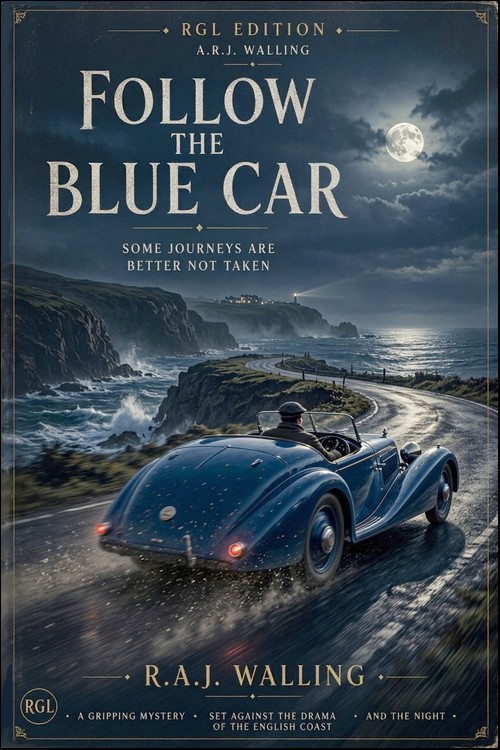
RGL e-Book Cover
Based on an image created with Microsoft Bing software
Roy Glashan's Library
Non sibi sed omnibus
Go to Home Page
This work is out of copyright in countries with a copyright
period of 70 years or less, after the year of the author's death.
If it is under copyright in your country of residence,
do not download or redistribute this file.
Original content added by RGL (e.g., introductions, notes,
RGL covers) is proprietary and protected by copyright.
RGL e-Book Cover
Based on an image created with Microsoft Bing software

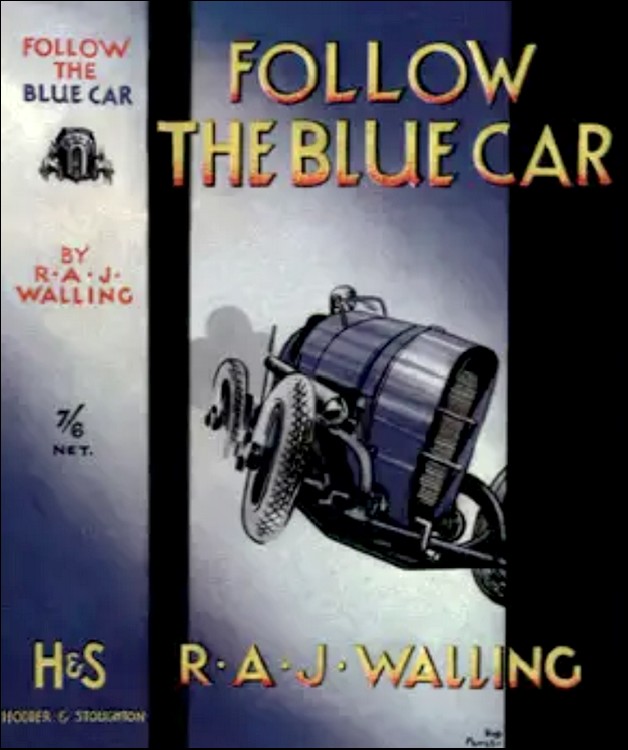
"Follow the Blue Car," Hodder — Stoughton, London, 1933
"Follow the Blue Car,"Hodder — Stoughton, London, 1933
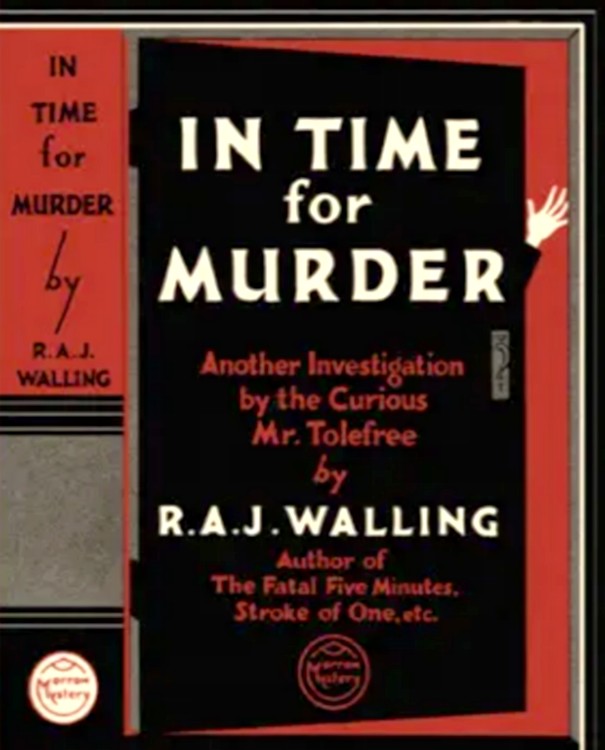
"In Time for Murder," William Morrow & Company, New York, 1933
Two members of a firm building a new harbour on the South Coast hear that a gang of crooks is to rob their representatives when they take a large sum of money to pay their workmen. Private detective Philip Tolefree receives an anonymous letter warning him of the holf-up and of a mysterious blue car. He and a friend follow the car, which leads them eventually to a house in which they find a young man dead! After many thrilling incidents and conflicting clues Tolefree brings the murderer to justice.
"WELL!" said Mr. Trinnery. "I'm——"
The melancholy-faced man who sat opposite him frowned.
"Pardon, Winsey," said Mr. Trinnery. "You startled it out of me. Not that it matters: you think I'll be damned anyhow, eh?"
The melancholy-faced man did not pronounce himself on the question of Mr. Trinnery's predestination. He frowned a little deeper.
"Quite sure, Winsey? You haven't imagined this?"
"Dead sure, Mr. Trinnery. I don't—ah—imagine things."
Mr. Trinnery gave him a long look, from the thin lock of black hair scraped across his scalp to the second button of his dingy waistcoat, which was as far as Mr. Trinnery could inspect him across the table.
"No," said Mr. Trinnery, "I suppose imagination ain't really your long suit, Winsey. And yet—well, it's queer. Half a tick. Let me think."
He lay back in his swivel chair and folded his hands across his ample stomach. His blue eyes stared out of a ruddy, clean-shaven face to the window, where he read the legend

which curiously Russian-looking inscription had quite a different appearance for Mr. Trinnery's clients if they glanced up at it from the pavement of Lincoln's Inn Fields below.
Mr. Trinnery, the general manager of the large contracting firm whose style this was, chiefly employed in the business of digging docks and building railways, had heard a piece of startling intelligence from his morose but faithful henchman, Winsey. His half-tick stretched to a whole one, and then to a good many more. His eyes travelled between the inscription on the window and Mr. Winsey's lugubrious countenance.
"Ah!" said he, at last, "let's have it again, Winsey. You've been taking down the cash from the bank every Thursday since the job started. Sure you never saw these thugs till a fortnight ago?"
"Dead sure."
"What made you notice anything then?"
"When we turned off into the three-mile stretch between Sutton Pynes and the Paybury road—right through the woods—you know the place I mean?—there's a garage on the cross-roads——"
"You mean Monson's Wood?"
"No—several miles farther, beyond Sutton Pynes."
Mr. Trinnery nodded.
"A black saloon car stood about a hundred yards from the corner. As I passed, it started up, followed, came alongside, went ahead, dropped back again. Just that."
"Nothing in that," said Mr. Trinnery.
"Not once. But when it happened again last Thursday, exactly the same way——"
"Exactly?"
"Yes, and each time when the big car had dropped back, a fast racing car, painted blue, followed us all the way to the sea."
"Blue car? By gosh! I wonder..."
Mr. Trinnery opened a drawer, extracted a book, ran his fingers up and down its columns.
"I see Anderson has four thousand men on the sheets this week. Biggest pay-day of the year on Friday, Winsey."
"That's what made me think, sir."
"Think what?"
"That if any evil-disposed persons had got to know of it——"
"Solemn old Winsey!" Mr. Trinnery screwed the fat wrinkles round his eyes. "They might be looking for a gold mine in Sutton Pynes Wood tomorrow afternoon; eh? Well, get on with the washing. I'll do a bit of cerebration on my own account."
Winsey got on with the washing. For the rest of the afternoon he superintended the manoeuvres of a small army of clerks with documents and books and long rows of figures; and if money had truly been the root of all evil, Winsey could not have looked upon them more gloomily.
He was called to Mr. Trinnery's room before the office closed to hear the issue of his employer's cerebration.
"You're a constitutional pessimist, ain't you, Winsey? You always see the dismal side of things."
Winsey's expression denoted a long experience of Mr. Trinnery's jovial criticism; he looked like Patience on a monument sighing at Grief.
"You're capable of attributing sinful intentions to a new-born babe. But I'll admit you never have any illusions, Winsey, and I reckon that car wasn't imaginary. Suppose we called in the police——"
Winsey perked up.
"I'm not going to," said Mr. Trinnery.
Winsey relapsed into his accustomed gloom.
"Suppose we did—could you tell them the registration number of the car?"
"I could. It was a London registration, X W 0492. But that don't mean anything. It'll be another number to-morrow."
"Ah! Was it changed, then, from one week to the other?"
"No—same each time. That's why I noticed it. But there wasn't any need to change till they meant business. If I were in the habit of betting, Mr. Trinnery, I'd bet you I shan't see that number again."
Mr. Trinnery put his elbows on the table, and looked intently into Winsey's eyes.
"By gosh, Old Mortality!" said he, "you are dead sure and no mistake. If you're right, it's the very deuce. Got any suspicions, eh?"
"Suspicions!" said Winsey, with a snort.
"I mean, you know—if it's a plot, your hypothetical persons of evil minds know a few things. Not only how Navigators Limited carry the stuff down to Paybury Harbour, but also that the boodle will be twice as big as usual to-morrow."
"Looks so," said Winsey.
"But how, Winsey? How? I dare say the crooked have divers ways of getting information. But how the devil could they discover a fortnight ago that our job would need all these extra men in this special week? Tell me that, Winsey."
"How can I tell you, Mr. Trinnery?"
"Somebody's spilt it, my friend."
Winsey looked as if a scorpion had stung him.
"I suppose you're not suggesting that I——"
"Don't be an ass, Winsey! But somebody——"
"Don't know about that, Mr. Trinnery. Dock work—everyone knows there's some dock work can only be done at the lowest springs. Whoever it is, they've taken enough interest in us to find out that Anderson would have to rush in a lot of men this week to do that revetting before the neaps covered the site again."
Mr. Trinnery considered this.
"All I can say, Winsey, is that the knowledge of harbour engineering's a damn' sight wider spread in the world of crooks than I should have thought! No, my friend. You can take it from me, that, if you ain't dreaming, there's a lot more in this than meets the eye. Anyway, they're going to get the surprise of their little lives to-morrow."
Whereupon Mr. Trinnery rubbed his hands and displayed the products of his cerebration.
If Winsey's friends in Sutton Pynes Wood were just crooks, he said, he would deprive them of their expected booty. If they were something more than just crooks, and if they included any of his own acquaintances—then... Mr. Trinnery looked fierce. It was up to Winsey to help the good work on.
"You're going down the road to-morrow, Winsey," said he, "as usual—same car, same black bag, same time, same route."
"The devil I am!" exclaimed Winsey, startled out of his puritanical formality. "I assure you I won't, Mr. Trinnery—unless I'm accompanied by two large policemen armed to the teeth."
Mr. Trinnery laughed.
"Don't interrupt," he said. "Am I running Navigators Limited, or you? I say you'll go in the car accompanied only by Fitch the driver. To all appearances, my gallant hero, you will be George Winsey in charge of ten thousand pounds of the good money of Navigators Limited, on his innocent way to Paybury Harbour, an easy and unsuspecting victim for any crook who happens along. In reality, Winsey, you'll be in charge of nothing more valuable than a few odd newspapers. Meanwhile, young Bostick will be going down to Paybury by rail with the cash and a policeman. How does it strike you?"
"Unpleasantly," said Winsey. "Don't like it."
"What!—a gallant sportsman like you? I'd have thought you'd jump to it, Winsey!"
Winsey eyed his superior under a lowering brow.
"Why don't you call in the police, Mr. Trinnery, and let 'em lay an ambush? If the money's going another way, what's the point of sending me? I can't do anything about it."
Trinnery clasped his hands over his stomach again. He regarded Winsey for a space.
"Count out the police, Winsey," he said. "There are reasons. I've thought it all out. Don't want any publicity."
"Then why the—ah—that is, Mr. Trinnery, why in the name of goodness——"
Winsey paused with his mouth pursed.
"Why don't I let it go? Tell you why, Winsey: I want to know. I want to know about that blue car. If you're held up, nothing nasty can happen to you. You just haven't got the stuff, that's all. You've just got a bunch of Builders' Journals and Engineerings that you're taking down to Anderson. See?"
"I see nothing."
"You've got eyes in your head, Winsey. You can see who's in a blue car. Crooks are shy birds. They don't like strangers. Suppose, as I think, that Winsey and his Thursday ways are well known to the persons who've spilled it? Who's any use to me but Winsey?"
Mr. Winsey departed looking like an undertaker.
At eleven o'clock on Thursday morning, Winsey entered Mr. Trinnery's office carrying a large, black bag. He placed it on the glass-topped table. Mr. Trinnery was standing a little way back from the window, looking over the blind into the square.
He turned.
"Ah, well, Winsey! So far so good. Weighs a bit, I guess?"
"Just twenty pounds, the bank clerk said."
"Phew! We'll want a few papers to make up twenty pounds, eh? See about it. Don't forget to hand over the key to Bostick before lunch-time, but keep it till then. Now, rout out the other bag, and we'll make up the weights. You've got another like this?"
"Twin brother to it," said Winsey.
"Nearer the better. They won't suspect. Think of their faces when they cut it open, Winsey. Damn it all, I wish I could go with you! It's a lark, Winsey, that's what 'tis."
Mr. Trinnery seemed to be enjoying himself like a schoolboy. His merriment did not infect Mr. Winsey, who continued to wear a funereal countenance.
"Cheer up, Old Mortality," said Mr. Trinnery. "They're waiting for you."
"Eh?" exclaimed Winsey, startled.
Mr. Trinnery nodded towards the window.
"Been looking at a fellow hanging about by the railings while you were at the bank. I guess he was interested in you. Made sure you got back with the bag. Then hopped it."
Winsey stepped to the window and gazed out.
"I don't like it," said he.
Mr. Trinnery burst into a loud laugh.
"Whoever'd think you'd been born and bred in London, Winsey?"
"If this is a joke, Mr. Trinnery——"
Winsey turned on him fiercely, but wilted before his manifest enjoyment, and left the room, presently to return with a black leather bag and a heap of journals. The bag was, as he had said, twin brother to the one he had brought from the bank. Mr. Trinnery applied himself with zestful chuckles to the packing of the newspapers in small bundles and placed them in the bag. Both he and Winsey weighed it in their hands against its companion, and the process of filling went on till the weights were about equal.
"There!" said Mr. Trinnery, "I can hardly tell one from the other myself. Think you've got the instructions right, Winsey?"
"We're to leave here at one-thirty, carry on just as before, drive through Paybury Wood at an ordinary pace, and if we're stopped we must not resist and not talk. That's the idiotic scheme."
"You can back out if you like, you know, Winsey," Mr. Trinnery remarked. "You can go with the cash and the policeman, and I'll send Bostick with the car. I didn't want anyone else in this; but—you can back out if you wish, Winsey."
"Being a free-born Englishman and not a slave, I know I can. But you know I shan't, don't you? You've put me in a position where I'm bound to go on. Don't talk any more about it."
Mr. Trinnery peered at him for a moment.
"Very well," said he. "I'm sending Bostick off by the one-thirty. He'll leave here before you go. Now, Winsey, for the last time—nobody in the office is on to this?"
"Not a soul."
"Then get your lunch early, have Fitch here with the car at one-thirty sharp, and we'll get you away. I just want to know who's in the blue car. That's all."
PHILIP TOLEFREE dragged me into the affair of the blue car quite casually, with no fell intention. He did not run a car himself: wanting to do sixty or seventy miles by road, he borrowed my motor and took me as chauffeur. It was just as casual as that.
Tolefree did minor investigations for City firms, chiefly into the peccadilloes of their employees, camouflaging this, his working concern, under the outer trappings of a little insurance agency in Watling Street, and spending his leisure in mugging up German philosophy. Only once had he become involved in an enquiry into major crime, when he prised his way through the mystery of the death of old Burnet at Midwood. He certainly had no thought of a first-class sensation when he rang me up at my office in Moorgate Street on Wednesday afternoon, the 27th of last July. In fact, he imagined something very different...
But I shall no doubt show that as I go on.
"Shipping very absorbing, Farrar?" he asked.
"You didn't spend three-halfpence on a call to ask me a fool question like that, did you, Tolefree?" said I. "Shipping!—why there ain't any. If you know anyone wants to buy a thousand ships at fivepence apiece—"
"Ah, well, I thought as much. What about coming round this evening for a jaw? Want you to help me solve a puzzle."
"I detest crosswords."
"So do I. This is hidden meanings."
"If there's anything more inane than crosswords it's acrostics."
"All the same——"
"Very well. I'll be there about nine."
It was as casual as that.
When I climbed the three flights of stairs to Tolefree's apartment, he was on the landing to greet me and apologise for the absence of an elevator. He always did.
No reason in the world save his own queer tastes demanded that he should live on the third floor of a grimy building in the City. He might as lief have had a suburban house or a West End flat. But he declared that he liked the quiet of the City at night—and, to say it, had to raise his voice above the rumble of trains and the shrieking of locomotives going in and out of Cannon Street station.
Not that Tolefree's rooms lacked charm. They expressed him. All the contradictions of his character were there—his isolation and secrecy in their situation; his friendliness in their solid, if Spartan comfort; his peculiar mentality in the extraordinary library that monopolised the walls of his living-place. As I sat in his one arm-chair the smoke of my pipe curled like incense among the memorials of the Abstruse Great and obscured a row of august names beginning with Berkeley and ending with Einstein. I would look round at the backs of these tomes and say:
"My aunt, Tolefree!—'twould do you a world of good to read a French novel now and then."
And Tolefree would smile:
"I try one on and off; but they're deuced dull, Farrar—at any rate to my jaded palate. Constant debauchery among these sensations"—and he would wave his arm towards the shelves—"spoils me for high-brow reading."
All the same, he never tried to inoculate a friend with his metaphysical bug. In fact, he had a mighty relish for small talk, and he knew nearly everyone in the City.
But this evening he was neither for gossip nor for business. It was warm—a sultry, moonless night. He perched on the sill of the open window, looking out over the roof of the station to the green and red signal lights on the bridge and the glow in the sky over Southwark across the river.
"Tired of mysteries, Farrar?"
"I prefer the obvious to the mysterious," said I. "But what's the notion?"
"I'm puzzled, that's all. Thought I might test out solutions on you. No cause for alarm. Don't want to put you through an experience like the last. No friend of yours can be mixed up in this, so your feelings won't be harrowed."
Tolefree's dark face crinkled into a smile.
"Just trying it on the dog?" I suggested.
"Something like that. But let's call it a cooperation of intellects, on the strength of the wellknown fallacy that two heads are better than one."
He fished in his pocket, pulled out an envelope, and handed it over.
"Take a look at that."
I glanced at the typewritten address: "Philip Tolefree, Esq., 115A Watling Street, E.C.2." From the envelope I drew a quarto sheet of plain typing paper, and read these half-dozen typed lines:
"If you happen to be on the Paybury Road to-morrow afternoon, the 28th, between four and five, I expect you will encounter something of considerable interest to yourself in the neighbourhood of Sutton Pynes Wood, between four and half-past. Look out for an unmistakably blue car—and keep your eye on it."
I looked up, surprised that Tolefree made anything of an anonymous chit like that. But he was gazing at me intently. I flicked the paper.
"No address—no signature," said I. "Practical joke, Tolefree? Or does somebody really want you out of London to-morrow?"
"That's how it strikes you?"
"Anonymous, typewritten, no postmark—hand delivered, I presume?"
"In my letter-box after lunch."
"Hoax—don't see what else you can make of it."
"No? Well—it intrigues me. On a fine afternoon, that's nice country—down by Sutton Pynes. If you've nothing better to do with your car...?"
"Joy-ride with you, Tolefree? I'd like nothing better," said I. "But how the deuce it can intrigue you—a manifest fake——"
"Not so manifest. You'll see. I guess I know who wrote it."
"Then you're toying with me! Why not have spilt the beans at once?"
"Only one bean to my name, Farrar. I said I guess. Fact is, I know the typewriter that was used to write it, and I know who uses that typewriter."
I held the paper under the table-lamp for a closer look.
"How you can identify——" I began.
"Tiny thing, but infallible to my mind. One letter occurs there only once: the letter 'x.' The right-hand top of the cross is missing. Makes it look like a Greek I."
"Nothing very unusual about that, eh?"
"Perhaps not. But calculate the odds that two women using identical typewriters—one of the cheap portables—will have the precisely same defect in their machines and will write separate letters on those machines, at an interval of several months, to the same man. I should say the odds are at least a million to one against."
"A woman!" I exclaimed. "Tolefree—if your guess is right, you aren't asking me to play gooseberry at an assignation, are you?"
Tolefree smiled.
"Hardly. You know the full tale of my amours: they don't exist. Nothing so alluring. What intrigues me is this: that the lady who wrote the first letter was concerned in a little enquiry I did last January, and therefore knows something of me. Remember that affair at Trinnery's?"
"Cashier—just about to get away with it? Yes, I recall that."
"A Miss Mary Bellairs was employed at Trinnery's at the time. She gave me a hand. Competent young woman—and quick. That was the cause of the first letter. After Trinnery's had closed down one Saturday she thought of a point, and wrote to me straight off from her lodgings——"
"On a typewriter?"
"She's a typist—or was. I guess she'd had a pretty thin time earning a living before she fell in with Trinnery. She's a type, too, not often seen in a typist's chair. She interested me——"
"Ah! Well—carry on, old Platonist."
"As a type—of the fish out of water. Get her from what I recall of her, Farrar. I haven't seen her or had news of her since——"
Filling his pipe from an ample pouch, Tolefree sketched Miss Mary Bellairs. An attractive young woman, he said—not conventionally beautiful, striking, rather: one of those dark, broad-browed women with hair almost black—she wore it cropped but contrived somehow to conceal the ends; delicate eyebrows, dark eyes deep-set, a straight nose, thin lips, a good chin; a pleasantly grave expression which gave her a look of earnestness and candour; slim, but not scraggy; about five feet four; active, healthy...
"Help, help!" I exclaimed. "You ought to be a passport artist, Tolefree. Say she's a paragon and call it a day."
"Ah—but physiognomy, bearing, habit of body—my dear Farrar, how important!"
However, he had finished describing Miss Bellairs.
"You said attractive? Well, I admit it. And then?"
"And then intelligent, well educated. I should guess Girton. Also good birth. Family come down in the world—new poor. Keen, efficient, but not much in love with the City. Have you got her?"
"Near enough, Tolefree."
"Well, then, I'll call it a day."
He lit his pipe.
"Now, why does Miss Bellairs write to me anonymously?"
"Haven't an inkling—unless it is that sleuthing is infectious, and she thinks she's caught another cashier robbing the till——"
"And taking it away to a God-forsaken wood down in the depths of Sussex, and letting her know everything beforehand, even to the colour of the piratical car! It would be a jolly adventure to catch him just as he was burying the stuff. Unfortunately for that theory, Miss Bellairs is no longer in London."
"But you said you had no news of her since January."
"Until to-day. Naturally, having persuaded myself that this billet-doux was from Miss Bellairs, I pried around a bit this afternoon. She left Trinnery's at Lady Day for another job. My informant doesn't know what job, but it was somewhere in the country. I've been wondering whether it's anywhere in the neighbourhood of Sutton Pynes Wood. And that's why I rang you up."
These passages were the essentials of the half-whimsical talk that started us on our quixotic pursuit of an unmistakably blue car. I had good reason to know Tolefree's uncanny flair for what he called "hidden meanings," but as I went back from Cannon Street to Manchester Square I confess that his typewritten coincidence and the structure he had built on it looked particularly flimsy; my theory of a practical joke seemed much more likely. However, Tolefree evidently had Miss Mary Bellairs much on his mind, and a July afternoon in the country riding through leafy lanes was a good substitute for an afternoon in the City waiting for business that wouldn't turn up...
So I pulled up my car outside Tolefree's office in Watling Street at two o'clock the next day.
He had been working on a map—had the route to Sutton Pynes Wood taped off in detail. It was a short cut, apparently between the main road to the coast at Shoreham and the Paybury road. We were to make Dorking by three o'clock, and then get off the high road, leave Horsham to the east, and find our way into the maze of West Sussex lanes and woods that criss-crossed the country behind the South Downs.
We carried out the programme without a hitch, almost to the end. It was pleasant tooling along the roads in the sunshine after we had left concrete and traffic behind, and curled through the park-like country where even hamlets were sparse and the trees now and then thickened into little forests. Tolefree had lightly thrown off my chaff about his paragon among women; I had dropped the subject; we were talking scenery when, after passing through the village of Fernhurst, we entered upon a stretch of narrow road which persistently curved in a kind of crescent round a gentle hill, cutting through thick woods. The place was marked on the map as Monson's Wood.
The time now approached four o'clock: we expected to reach the rendezvous given by Tolefree's anonymous correspondent, some miles ahead, at the hour almost exactly. As it happened, we never got there....
Tolefree saw it first, being on the near side and having more of the road ahead in view.
"Whoa, Farrar! Blue car!" he exclaimed.
Immediately I caught a glimpse of bright colour in front—jammed on the brakes. An unmistakably blue car stood by the roadside, its bonnet towards us, and apparently no one on board.
"Reverse her! Get back out of sight!" said Tolefree urgently.
There was no need. On the slope it was enough to release the brakes: we slid back till the blue car became invisible—perhaps thirty yards. Then I said:
"Why? Weren't you to keep an eye on it?"
"Yes, but an unseen eye's better than a plain stare. Hang on. I'm going to reconnoitre."
He got out, strode over the low hedge, and disappeared into the wood. I sat with the wheel in my hand, looking alternately at the hedge where Tolefree was hidden and at the tall bank of rhododendrons on the other side of the road; reflecting on the absurdity of the scene, wondering what Moorgate Street would think if it knew. Of course there was no reason in nature why I should not sit in my own car in a Sussex lane if I liked, or why Tolefree should not take a stroll in the woods: I found myself inventing such explanations of our eccentricity to present to imaginary enquirers. For, even if Tolefree's theories about his anonymous letter did not crack up into laughter, and there really was something interesting to him to be observed in connection with a blue cap, Tolefree appeared to be acting on the supposition that there could be only one notably blue car in West Sussex that afternoon. Which was absurd.
The imaginary enquirers did not materialise, but as if in preparation for them, and to preserve an appearance of nonchalance, I took out a cigarette, lit it, and leaned back in my seat.
Tolefree might have been gone two minutes, not more, when I heard the car start—the whirr of an electric motor, and then the great burbling noise of a big engine, rising to a roar, a rapid run through two gears—and immediately a streak of blue flashed past. I could see little of the driver, deep in a sort of cockpit. As I turned in my seat to look, he went up another gear, the noise decreased.... he was gone.
Tolefree came running down the road, gesticulating, crying: "Turn her round, Farrar! Quick!"
In that narrow space it took three locks to get round. Tolefree waited impatiently. Then he jumped in.
"Get after him, Farrar!" he cried.
I let in the clutch.
"All right, Tolefree," said I. "But I suppose you know we might as well get after an aeroplane? That fellow's got ninety horse-power. I dare say he can do a hundred miles an hour."
"No doubt—on Brooklands," said Tolefree. "But he can't do a hundred anywhere around here. You've often boasted you can touch sixty. Now, Mercury—put the boast to proof! What is it they say in America? I know: 'Step on the gas.' Step on it, Farrar!"
He betrayed an unusual excitement—for him. But it seemed only half in earnest. As for me, I was not going to risk our valuable necks at sixty miles an hour in Sussex lanes, but I opened the throttle to the limit of safety. It was true, as Tolefree said, that we could travel pretty nearly as fast as his quarry dared go on roads of this sort.
"Well?" I asked. "Who is he?"
"Never saw his face."
"Then—why in the name of sanity are we going hell for leather after him?"
"I'll tell you. But don't slack off! Keep on stepping..."
It was not much to tell. Tolefree had gone in a few yards among the trees and stolen along until he came, as he judged, about level with the car. Then he heard rustling in the undergrowth, and crept towards a tangle of bramble bushes near the roadside. He had to force his way, and must have made some noise, for a man leapt up among the brambles, seemed to listen for a moment, and then dashed out to the road. A moment later Tolefree heard the starting of the car. He took a hurried look around the bramble brake where the man had appeared, saw the evidences of his trampling there, and nothing else—except one thing which was exceedingly curious.
"Here 'tis," said he. "But for heaven's sake don't look, Farrar. Keep your eye on the road. It's a decent little bundle of new pound notes—fifty at a guess. So we shan't have our trouble for nothing. Now perhaps you can see why in the name of sanity—hell for leather—and so on?"
It certainly was curious.
"A person having just an innocent stroll in a wood doesn't get off like a scared rabbit when he sees another person doing the same thing and leave largesse like this behind him."
Which was certainly true.
"The anonymous letter-writer was a good prophet when she promised something interesting, eh? To a poor man like me, fifty pounds is more interesting than most novels. But having proved her accurate in this important respect, I think we're rather bound to play up and keep our eye on the blue car, don't you?"
"Doing my best," I answered. "But he's got the heels of us."
"Carry on. If we can't catch him, we can trace him. You didn't see his number-plate?"
"No. He was gone in a flash."
"I did," said Tolefree. "But no matter—we shan't want to use it. If we strike no luck in the chase, Farrar, are you game to come back here before nightfall?"
"Why on earth?"
"If you'd dropped fifty pounds in a wood do you think you'd take a sporting chance that nobody had found it, and go and look for it when the coast was clear?"
I took a glance at him. The ordinarily sedate and unexcitable Tolefree was grinning like a schoolboy.
THE chase of the blue car, which brought us to such surprising results, lasted exactly nine hours. The story of nine hours' motoring would be naught but a tedious category of place-names and of twists and turnings in an inexplicable route. I will inflict no such dullness on anyone who chances to read this narrative.
There were only two points of interest in a journey which would have appropriately ended at Bedlam. The first was our overtaking of the car and the next, which came hours later, our realisation of what the man who drove it was after.
We overtook it, in fact, about a quarter of an hour after the chase began. As we ran down a stiffish hill, Tolefree thought he heard a car ahead. I slipped into neutral and listened. The booming of a powerful engine ascending the opposite slope was loud. On a straight piece two miles farther on we caught sight of him half a mile ahead of us. His brilliant blue paint made him as unmistakable as Miss Bellairs had suggested—if indeed Miss Bellairs it was who had started us on this merry-go-round.
Merry-go-round is the appropriate figure. We progressed in swirls and bounds, leaping forward at high speed when he was out of sight to catch a view of him again before he could turn off into some byroad. We found surprisingly little difficulty in doing this: it soon became evident that if he had at first divined or feared pursuit, his suspicions had melted away. He took no advantage of his engine-power. He ambled along at moderate speed, and we even had the queer illusion that he actually waited till we were in sight before taking a turn, in order that we might not miss him!
The curiosity of his behaviour, however, was not his pace but the way he took. Having run for close upon an hour in a generally northerly direction, he crossed the Brighton road to the south of Redhill, and at once became involved in a maze of by-ways. His steady gait seemed to betoken a purpose; but his route belied any purpose whatever. It was aimless—unless he were twisting and doubling in order to put a pursuer off the track. But in that case he would have used his speed. And, in fact, here was the pursuer close behind him, and he taking no more notice than if we had been driving on the other side of the earth.
"Either the fellow's insane, or else he's merely out for a joy-ride to kill time," I declared, "and your precious anonymous correspondent was a practical joker after all."
"You forget what I've got in my pocket, my dear fellow. It don't come like that to me. Let's trail the skirts of happy chance. I'm enjoying it—and so far we're fifty pounds up on the deal anyhow."
At seven o'clock, he had by devious ways reached and passed East Grinstead, making for Ashdown Forest. Then he turned south and west, and from the start had covered more than half a circle. Round a corner beyond Crowborough, we almost ran into him. He put on a little speed. The rumble of his engine became a roar.
I met Tolefree's glance.
"If he does that again," said I, "there's only one thing to think."
"Looks so," said Tolefree. "It's very sad. I've been thinking it for the last hour."
It dawned upon us both that the man in the blue car was leading us a dance, was fully aware of our presence at his heels, and had for his own purpose hung back at every turn so that we might see which way he went. Soon we should be back in the region of Monson's Wood again after a randan of perhaps nearly a hundred miles.
I fell back on the practical joke theory, even proposed that we should abandon an excursion in which we were making ourselves ridiculous.
Tolefree would have none of it. He took the packet of notes from his pocket and waved it in my face. He meant, he said, to discover that fellow's ultimate destination. We went on.
Instead of making the complete circuit to Monson's Wood, the blue car ran farther south, and, turning short of Lewes, rose to the South Downs. I mention this detail, because on the heights he slowed down to a crawl, and manifestly wished to see whether we would overtake him. Here, in open country we could see him at considerable distances, and I stopped at a petrol station near Stanmer to fill up my tank. Apparently having assured himself that we did not intend to pass him, he resumed his steady pace and set his face westward. At sunset, just before nine, we were well into Hampshire, still running over by-roads...
Waiting for darkness!
That was the now obvious explanation. The chances were a hundred to one that when night came on he would give us the slip. And undoubtedly he would have done so if he had not reckoned without the long twilight, the fact that the moon, in her third quarter, was giving appreciable light, and that his policy of sticking to the comparatively narrow and curly secondary roads put us almost on a par in the matter of speed.
It was half-past eleven, and we were somewhere beyond Winchester when he did his volte-face and the real struggle began. He worked up the speed, but could nowhere travel faster than ourselves. For a spell he switched off his lights, but the noise of the engine was almost as good a guide.
I began to share Tolefree's excitement.
"If he gets away, make for Monson's Wood," said Tolefree.
But he did not get away for quite a long time, and when he did, it was far from the wood. We were on his tail at Petersfield. The two cars raised the echoes in sleeping Midhurst half an hour after midnight.
Two miles south-east of Midhurst we lost him—suddenly, inexplicably. One moment his light was a few hundred yards ahead of us, and his engine loudly burbling. The next moment, no light and no sound.
I slowed down and brought the car to a stand after it had swung round a sharp bend—where a white railing on the off-side fenced the road from a slow-moving little stream—and crossed the bridge beyond.
Unless he commanded some incredible magic, he could not have gone beyond this. The road rose sharply on the farther side of the bridge: he could never have climbed that hill in silence.
"Hang on, Farrar," Tolefree said. "Switch off the lights. I'm going to reconnoitre again."
"I'll come with you——"
"No; stay where you are. We may want the car in a hurry."
"Tolefree!" said I, "be careful."
He was gone.
The absence of the lights bothered my eyes for a few moments, but a pale moonlight soon brought surrounding things into view. We were in a dead silent and lonely country, not a house in view—woods on the left, on rising ground, a thick growth of willows on the right in the neighbourhood of the stream. I took in this dim landscape, peered along the road forward and back for Tolefree. He had disappeared. In the windless night there was not a sound except the swish of unseen water under the bridge. I thought I saw a flash of light among the trees on the left. It might be fancy. Or summer lightning.
Tolefree was absent ten minutes. Then, before I realised him, he was looking into the car.
"Come quietly," he said in a whisper. "I've spotted him."
A perfectly sane shipbroker who hoped to continue in that honourable career should, I suppose, have given a little more consideration to a proposal, made to him between midnight and one in the morning in a lonely and silent valley under the South Downs, that he should face up to a man with clearly urgent reasons for evading human society, who was probably a thief and might be a dangerous bandit. I confess that no such prudence afflicted me when Tolefree came out of the darkness like that to summon me. He infected me with his own excitement. The only important thing in life at that moment was the discovery of the blue car and a sight of its driver.
The next instant I was with him on the road.
"Where?" I whispered.
The gibbous moon hung behind the woods, which rose high on the left of the road, but a little diffused light showed their contour and gleamed on the white palings round the curve we had descended. Tolefree twicked my sleeve and began to walk back over our tracks. But not far. Before we came to the little bridge, he muttered: "In here!" and turned right, apparently into the woods.
A white gate, now swung open and held back, gave access to a narrow road which appeared to follow the course of the stream. It stood obliquely to the bridge and had been concealed from us as we passed in the car.
I trod stealthily in Tolefree's footsteps. We wound into the obscurity under the trees in rare conspiratorial style. The little road—a drive of sorts, for the high bank opposite the river was thickly grown with rhododendrons—veered steadily to the right. A hundred yards... two hundred....
Tolefree put a hand back and brought me up. I looked over his shoulder.
The road ahead widened, left the stream, and took an upward course among the trees. At the turn, moonlight shone palely through and made a dappled pattern on a bright blue surface.
There stood the car.
We eyed it, holding our breath. The dappled light was uncertain. I could not see whether or not anyone sat in the deep cockpit. Then a slight shifting of the shadows, some infinitesimal movement among the branches through which the light came, showed it up clearly for a mere instant.
The car was empty.
Tolefree pressed me back. "Come out of hearing," he said. We turned and stole to the gate.
What did I make of it? I had been thinking hard and all I could make of it was a commonplace. A thief, a stolen and abandoned car—one read of such things in the newspapers every day. Tolefree listened while I expounded this theory. He said it was possible, but almost certainly not true. He argued it out as we stood in the angle by the white gate. Some person, whether Miss Bellairs or another, knew of the journey the blue car was to make: no such person was likely to be in the confidence of a common motor bandit. Again, the fellow had unquestionably been conscious of our curiosity about him. He could have got away from us any time he pleased by turning into a main road and opening the throttle. A motor bandit would certainly have done that. He had definitely and unmistakably lured us along, and in the end had disappeared from us in this remote, queer place, at this uncanny hour.
"I work out two possible reasons," said Tolefree. "There may be a hundred better ones; but this is what I can see. Either he's uncertain about our intentions—or, which is the same thing, may have mistaken us for other people whom he had cause to fear—in which case he's probably lying up for us somewhere around here, and may at this moment be within hearing——"
"Good lord!" said I, startled.
"Or, when he got to this point, he stopped because he couldn't go on."
"How d'you mean?" I asked, puzzled.
"Cars don't go on for ever unless you feed 'em, do they?"
"You mean—he ran out of juice?"
"Isn't that possible?"
"Why, of course! An engine like that's a pig for petrol, and however big a tank he has—Tolefree, you've hit on it, for a million! He hoped to get away from us, make Monson's Wood, recover his lost bundle——"
"It may be. There's another idea, Farrar—but let's assume it, and go and have a look at his car."
"Wait while I take my ignition key. If he's around here, he might be tempted——"
"I think not," said Tolefree, "but go ahead. A stitch in time——"
The second walk up the bank of the stream was no stealthy affair. Tolefree now strode along regardless of noise, and when we reached the blue car, took a torch from his pocket and threw the light all over it. Little winged things fluttered into its beams. Otherwise, our proceedings attracted no attention.
A big sports car of a famous make, the speed merchant's joy. It was absurd. The eight cylinders inside its bonnet would have taken it away from us like a streak of greased lightning at any moment of the ride, if he had opened the throttle. I leaned over the side, switched on the battery, and looked at the petrol gauge.
"Right you are, Tolefree," said I. "Look here—dry as the Anti-Saloon League."
"Yes, I see. But the question is—why did he run out of petrol?"
"I've often asked myself that when I've done it," said I. "One does, you know——"
"Yes—but why here?"
"I don't get you, Tolefree."
"I don't express myself clearly. I mean not why did he run out of petrol here, but why was he here when he ran out of petrol?"
"I suppose because his petrol ran out when he was here. Aren't we rather like two low comedians cross-talking?"
"Not at all." Tolefree was rummaging in the side pockets of the car, turning out dusters and oil rags, and the debris that collects in such places. "Not a bit of it, Farrar. By a process of exhaustion we arrive at a conclusion."
He stuffed the rags back. There was nothing of any significance in the car.
"I take it this young man was an expert motorist," said Tolefree. "Admitted? Well, he knew all the time how much petrol he had and where it would take him. Therefore he must have intended to come here. I think he made a slight and perfectly excusable miscalculation. He thought the petrol he had would get him to his destination, but it proved not quite enough. Therefore his destination is hereabouts. I judge from the position of the car that, if he had not miscalculated, he would have driven it up this hill, while we, not being able to see that white gate, should have gone along the main road and missed him. Conclusion: We'd better climb the hill ourselves and see what's on the other side of it. A house if I'm not a Dutchman—and the house for which he was aiming."
It seemed a possibility. But....
"But then, Tolefree? When we have discovered that there is a house——"
"A step at a time. Solvitur ambulando, my dear fellow. Aren't you interested?"
I was, but a trifle apprehensive, either that we might play an undignified part in the evolution of a gross practical joke, or that we might be barging into a crooks' nest from which wise citizens should keep away.
However, I said nothing of this; I walked with Tolefree up the hill. It rose stiffly for four or five hundred yards, and the woods thinned out at the top. We came to a point where an iron fence on each side of the drive took the place of the rhododendrons, and we began to descend between open meadows. Over against us to the south was another hill, in shadow: no sign of a house. Somewhere in the far distance a single bell note sounded from a church tower. It was one o'clock.
"A stumer, Tolefree?" said I. "One of those private roads—six miles to nowhere?"
"Perhaps—but we'll go on a bit. D'you mind?"
We were plodding down the slope, silently, when we both saw it together—that gleam of light which seemed to shoot from the body of the opposite hill. We stopped dead. It took shape, the oblong of a lighted window. Had it just come to life, or had we merely cleared some obstruction that hid it?
The question was answered immediately. While we stood gaping at the first, another oblong lit up and then another.
"Now, I wonder why we start our illuminations at one a.m.," said Tolefree. "This wants looking into. Come along, Farrar."
Distance deceives at night. We had guessed those windows at half a mile away. But within three minutes we found the drive ascending again, passed through another white gate, standing open, and mounted to a broad, gravelled platform. We stood before a house whose size or shape we could not see; but one of the lighted windows was in the wall in front of us and threw a faint illumination on the ground.
I jumped at a sound—a good round oath in a man's voice, instantly followed by a squeal from a woman. The noises were close at hand. We groped forward together, touched a pillar, found ourselves under a porte-cochère. The voices came from within the house, but were surprisingly clear. Inching to the wall, feeling a way along it, Tolefree reached a doorway, with me immediately behind him. The door was open.
"It's a lie, Jane!"
"Peter!"
"Get away out of it—pronto!"
"Peter—I won't! What are you going to do?"
"Peter—I saw!"
"You saw? My God! Saw nothing! There was nothing to see."
"Peter—I'm afraid!"
"Don't be a fool. Don't whine. Get back to bed—quick!"
"I'm afraid. Oh, Peter—what does it mean? Where is he? They'll all be down. There was a light in Mr. Trinnery's room——"
"Damn Trinnery!"
Tolefree started back as if the oath shocked him. Then I gasped as, with a sudden motion, he pushed the door wide open and switched on his torch. Tolefree's astonishing gesture revealed an even more astonishing spectacle.
In a large hall with a shining parquet floor stood a girl in dressing-gown and bedroom slippers, panting with excitement, and three feet away from her a slight, fair-haired youth of diminutive inches, in his pyjamas, who shielded his eyes when the beam flashed on him, and cried:
"Who the hell are you?"
As soon as the light had passed him, I heard a scurry of feet and Tolefree was defending himself against a furious onslaught from a right and a left. Tolefree is a rather heavy man. He brushed the attack away, and the youth took a seat on the parquet.
"Burglars!" cried the girl—rushed in and snatched at Tolefree's torch.
"Steady, young lady!" said he, handing her off.
"Easy all, Jane!" the youth warned her, scrambling to his feet. "There's two of 'em."
The whole scene had passed in a few seconds. The girl now stood back, leaning on the edge of a great oak table, the boy in the middle of the hall.
"What's wrong here?"
A quiet voice broke in on the momentary silence.
Tolefree's light searched a staircase at the back of the hall on the left. It showed against the panelling the figure of a man about to descend. He put on a light at the head of the stairs. A tall man in a dressing-gown. The girl cried out:
"Oh, Mr. Leybrook!—be careful. Burglars!"
"Nonsense, sir!" Tolefree's voice was sharp. "There are no burglars here. We've called——"
"What's up, Leybrook?"
A second man appeared on the stairs behind him, and then a third. They hurried down in a string. All had evidently just turned out of bed.
The second man, a tall, soldierly fellow with a frosted tooth-brush moustache, took charge. He frowned upon us. His glance passed to the tousled youth in pyjamas and the dark-haired, black-eyed girl.
"Peter! Jane! What does this mean?"
"Jane heard a noise, sir, and came down——"
The tall man looked coldly at him as he hesitated.
"Jane can answer for herself. What were you doing down here?"
"I, sir? Well—I heard a noise. Then—these fellows——"
"Ah! And you, sir?"
His cold glance passed to Tolefree.
"Apparently," said Tolefree, "a misunderstanding. We have arrived at the wrong address. We were expecting to find ourselves at Fursdon Manor, but we seem to have missed it and hit another place at an awkward moment. I apologise."
Tolefree's smiling politeness and the readiness of his prevarication astonished me; but there was something still more astonishing yet.
Ever since the light was switched on and the little procession came down the stairs, Tolefree's gaze had been fixed on the third man in it—a stout man of middle age and florid complexion. On a less excited occasion he would have made a figure of fun, for the thin hair on the top of his head was ruffled into two draggling wisps and his dressing-gown bulged in front of him to fall within six inches of the floor far in advance of his feet. His very blue eyes shone out of a rubicund face. If Tolefree's stare at him was persistent, the stout man stared at Tolefree even more rigidly. I thought I saw a sign of secret intelligence between them while the tall man was speaking.
"Fursdon Manor?" he was saying. "Leybrook, do you know anything of this? Fursdon Manor's two miles off, sir. And what were you wanting at Fursdon Manor at one o'clock in the morning?"
"Excuse me," said Tolefree, "but isn't that rather—well, we haven't been acquainted long enough for confidences, have we?"
Tolefree's smile as he said this was an artistic study. All their eyes were shining on him as he looked genially round the group, from the quiet man whom they called Leybrook at one side of the hall, to the girl leaning against the table on the other. He had been absent-mindedly flitting his torchlight round over them. When it came to the girl, he seemed to be afflicted with a severe rictus, his smile vanished, he switched off the torch, and turned to me.
"Shut the door!" said he. "There's a draught."
I scarce believed my ears. But mechanically I swung the door. It closed with a clang.
"What the devil d'you mean, sir?" cried the tall man. "Shutting my door? If this is—— If you try any violence, let me warn you——"
"My dear sir," said Tolefree, you are completely at sea. You need fear no violence from us. But we seem to have arrived at an opportune moment for a little talk about violence. Look there!"
He pointed his torch at the girl, touched the button. Its ray shone on her feet, encased in soft white slippers.
"Farrar," said he, "guard the door!"
Five pairs of eyes regarded the white slippers on the parquet, and there was a gasping sound from their owners. The girl herself looked down and shrieked. A vivid scarlet stain was dyeing them, shining moist in the light of the torch. She stood in a pool of scarlet.
"Steady, young lady!" said Tolefree, as she tottered, and he advanced, holding out his hand to her. "Come away from there."
She shrunk back against him, looking over her shoulder to the floor.
The tall man and the stout man crept towards the table, stooping to peer beneath it.
"Stop!" shouted Tolefree. Then: "Excuse me, sir. Don't you think——"
I expected another outburst, but Tolefree held the tall man with his eyes. He drew back. What magnetism in Tolefree enabled him to take command in this house, where he had not set foot till five minutes ago, I could not guess; but he had for the moment subdued them all. The tall man stood waiting for his next move; the fat man gazed at him with eyes almost bolting out of his head; the quiet man remained near the foot of the stairs, from which he had never moved.
Tolefree, without shifting his position, bent down and threw the light under the great table. We all stooped to look.
Sprawled on the floor between the table and the wall was a man, lying quite still. He had been hidden from the view of persons standing in the hall.
The tall man seemed suddenly to shake off the hypnotism of Tolefree's eyes. Avoiding the damp stain on the parquet, he stepped round the table and looked down.
"Leybrook! Trinnery!" he called. "Come here! It's Harley. He's been shot."
"Harley?"
"Shot? Good God!"
The three of them were now looking upon the man on the floor. Tolefree's torchlight, flitting as he moved, played over their faces.
"Shut off that damn' thing, sir!" cried the tall man.
"Sorry," said Tolefree, switching out the torch and putting it in his pocket.
"Is he dead?" Leybrook asked.
The tall man dropped to his knees. We could not see what he did, but we heard him say:
"Not a beat... Perfectly dead... Warm.... He must have been killed a few minutes ago."
A moan. Tolefree and I turned. The girl had left his side and was grasping the arm of the youth in pyjamas.
SO stunning was the revelation made by Tolefree's torch that no one appeared to know what to do. For the nonce, what had been the great thing, the monstrous intrusion on a privacy committed by Tolefree and myself, was forgotten. We were all bound together in a common horror. After the tall man's quiet, grave answer to Leybrook, not a word was said for several seconds. The sound that seemed still to echo about the hall was the shrill exclamation of the fat man addressed as Trinnery:
"Shot? Good God!"
Trinnery's grotesque figure fascinated me—that rotund, rubicund personage, with the tassel of his dressing-gown dangling absurdly in front of him, and his stivered hair and his bolting eyes which never left Tolefree.
The girl was near collapse; she hung convulsively to the fair boy's arm. The tall man, who had turned to her when she made that moaning sound, frowned at the pair of them for a second or two and then walked across and seized each of them by the hand.
"Jane!" said he, "and Peter—what do you know of this? You seem to have been the first down!"
"I swear to God I know no more than you, sir," the boy declared. "I heard a noise and came down—fumbled about in the dark—and then Jane——"
"Look out!" cried Leybrook. "She's going——"
The girl's grasp relaxed; she tottered with eyes closed. The tall man seized her, took her in his arms.
"Where's Miss Bellairs?" he said. "Anyone seen Miss Bellairs?"
Tolefree's jerk against me was a warning—not quick enough to suppress the start I gave; but no one noticed it. Leybrook pointed to the head of the stairs. A man who had shuffled trousers on over his pyjamas stood there looking as though he saw a congregation of ghosts.
"Ah, Parsons," said the tall man, "have you seen Miss Bellairs?"
"No, sir."
"Go and call her. Say Miss Jane is ill. I'm taking her to her room. Peter—come up."
Whereupon he strode up the staircase with the girl inert in his arms. We stood watching in silence. The startled servant disappeared. The tall man and his burden followed. The boy went last. We watched them vanish at what appeared to be the entrance of a corridor. A door closed behind them. Tolefree cast a glance at Trinnery, immobilised in the middle of the hall, and seemed about to address him. Instead he walked round the end of the table and took a long look at what lay behind it. Then he turned to Leybrook:
"Where's the telephone?"
"In there——" Leybrook pointed to a door on the left of the hall, near the bottom of the stairs. Tolefree moved. "Who—what—are you going to do?"
Tolefree did not answer. He stared in the eyes of Leybrook, who presently stood back, shrugging his shoulders. Tolefree strode to the door he had indicated, and opened it. The three of us, standing motionless, followed his movements. The light from the hall shone dimly into the cavern of a little room, fitted as an office—or so it looked—with a roll-top desk and a small table bearing a telephone and an electric lamp under a green glass shade. Tolefree fumbled with the lamp, uttered what sounded like an imprecation under his breath.
"I can't find the switch," he called testily. Leybrook went in.
"It's there—a push-switch, under your hand."
"Farrar," Tolefree called again, "come and see if you can find the telephone directory."
Almost as I passed in, Tolefree kicked the door closed. We were in darkness.
"Mr. Leybrook," he whispered, "give me your hand. Don't touch that switch. Feel the bulb."
A moment passed. I heard a little hissing exclamation.
"Farrar," Tolefree said under his breath, "your hand, too. Feel here."
I groped towards the table, my hand was caught and applied to the smooth surface of an electric light bulb. It was warm—more than warm; it was hot.
"Ah!" said Tolefree aloud, "here it is."
He switched on the light, and opened the door. Trinnery still stood, with his tassel hanging down, in the middle of the hall. Tolefree removed the telephone receiver and listened. We waited some immeasurable moments. Then his voice broke the stillness with the words:
"Police, please."
With the instrument at his ear, Tolefree said:
"Mr. Leybrook—will you speak to them, or shall I?"
"Don't you think we'd better wait for——"
"Impossible now," said Tolefree. "Here they are."
"Then——" Leybrook motioned to him.
"What's the name of this place?"
"Pitway House—Major Cramb," said Leybrook.
"Hello! That the police? I'm speaking from Pitway House, Major Cramb's. There's something here needs your attention at once. A man is dead.... No.... Mr. Harley.... Shot... No. Bring a doctor with you. How long?... Thank you.... What?... Yes, we'll see to that.... All right... And, by the way, the drive's obstructed about two hundred yards from the gate. You'll have to walk from there... No, you can't pass it.... All right."
Tolefree put down the receiver. Leybrook eyed him curiously, was going to speak, thought better of it, shrugged his shoulders again. Tolefree took a look round the little room. It was a veritable office—stacks of files, a safe in a corner, a shelf of account books over a door at the end opposite the hall. Tolefree stooped as though he saw something significant on the floor, picked up a scrap of something—I could not see what—threw it down again. He extinguished the light. We turned to see the tall man frowning at us from the doorway.
Tolefree went out and we followed.
"Major Cramb, I understand?" he said.
"At your service, sir." The frown deepened.
"I've taken the liberty of telephoning to the police—to save time."
"A cool impertinence, sir," declared Major Cramb. "What the devil do you mean by it? And who the devil are you? Leybrook, what on earth——"
"Pardon me," said Tolefree. "I asked Mr. Leybrook whether he would communicate with the police. He wished to wait for you; but as I had already put the call through he preferred me to go on with it. I give you the impertinence, but I'll remind you that there's a man lying dead on the floor over there, and every minute is important. That's what the devil I mean by it. Who the devil I am I will inform the police when they arrive. At present, I and my friend are casual passers-by who arrived by accident at an unhappy moment."
Major Cramb's face had reddened to almost apoplectic anger during this harangue.
"Damn you, sir!" he exclaimed.
"Cramb——!"
It was Mr. Trinnery who spoke, in a throaty voice—the first word he had said since that outcry: "Shot? Good God!" The Major turned on him with a furious glare.
"Well, Trinnery?"
"Wouldn't it be just as well to wait for the police before——"
"Damn it all, man—aren't we waiting? You, sir!"—he swung round to Tolefree—"no doubt you'll explain to the police how you came to be here when this unfortunate man was killed, and what you know about it. You, with your bluff——"
"Cramb!" cried Trinnery again.
"If you please!" Tolefree pleaded quietly, "I quite understand how Major Cramb feels. I shall make all the proper apologies to him at the proper time. Meanwhile, wouldn't silence be the best wisdom? We don't know how Mr. Harley—I think that's the name?—was killed, or even whether he killed himself. For my part I don't know who Mr. Harley was, or why he was here. I'm not curious. All I'm concerned about now is to fulfil a promise I gave the police on the telephone—that nothing should be disturbed until they come. And I notice that you're dangerously near that stain on the floor, Farrar."
I started back towards the door, looking with horror at the dark trickle which had crept out into the room. They all looked at it. Combined with Tolefree's quiet gravity, it reduced the temperature considerably.
"I'll go and learn how Jane's getting on," said Major Cramb, turning his back on Tolefree. "Leybrook, see that nothing is touched—and that nobody leaves."
This with a flick of the eye towards Tolefree. Upon which, Roland for Tolefree's Oliver, he stalked up the stairs, the figure of offended dignity. The remaining four of us followed Tolefree's prescription of wisdom; no one spoke. We might have been mutes round a bier.
It was a long half-hour. But I suppose the inspector (it was an inspector at Midhurst who had answered Tolefree's call) could not turn his superintendent out of bed, get a car, drive to the white gate, and walk up to the house from there in less time. A purgatorial half-hour.
No one spoke. The fat man did move. Edging away from the neighbourhood of that creeping stain, he dropped himself down on a chesterfield that stood in the corner under the staircase. Leybrook leaned against the wall. Tolefree and I stood a yard from the door of the little room.
I heard a clock ticking; no other sound.
A swarm of speculations spun in my head. About the man who lay concealed by the great oak table. Harley? Who was Harley? The man in the blue car? If so he must have been shot while we were spying into his car, or walking up the drive beside the rhododendrons. Miss Bellairs—it had been a startling thing to hear her name like that. But Tolefree was probably right about the authorship of his anonymous letter. What had that fellow been doing in Monson's Wood? If Miss Bellairs suspected him of some illicit deed or purpose (and it was only that which would "interest" Tolefree in her sense of the word), why had he led us back to Miss Bellairs? Why had he led us at all? And that boy and girl whose quarrel we had disturbed in a pitch-black place with a dead man lying there—what did that portend? And ourselves? How far would Tolefree go in the explanation of our presence which would be demanded as soon as the police arrived?
It was fantastic—that clock, ticking in some hidden corner, now began to chime: a quarter past. We had not been in the house a quarter of an hour. And we were up to the neck in a tragedy which might have a sequel stretching how far into the future it was impossible to foresee. Here we were, in a strange place of whose existence we had not known fifteen minutes before, with two utter strangers, and the four of us looking askance at each other in a deadly stillness.
I realised the purport of those looks when I caught a glimpse of Leybrook's lazy eyes with the lashes raised, intently regarding Tolefree one moment, and switching round, without a turn of the head, to observe Trinnery in his corner; and when I saw Trinnery's goggling gaze fixed on Tolefree as though he saw a ghost; and Tolefree with the faraway look which betokened his keenest observation... It was horrible. We were weighing each other up in the presence of that dead man on the floor.
The clock had chimed the half-hour, and ticked on. My watch showed twenty minutes to two when the tall man, Major Cramb, appeared at the top of the staircase.
"Ah, Cramb—how's Jane?"
It was Leybrook's question that broke the spell of silence.
"She's come round." He descended and went to Leybrook, disregarding us. "A simple faint. Miss Bellairs is with her. She's all right now."
"Good! A bit too much for her—that horror of the slippers. Temporary shock. I shouldn't worry, Cramb. Peter——"
"I told him to go and dress. No doubt the police will want to ask him some questions."
Tolefree stirred, looked as if he would speak, but said nothing. We sank into silence again.
The clock had chimed for the third time when I heard footsteps on the gravel. Cramb heard them too. He went to the door and threw it open. Three men in uniform stood there.
"Hello, Fiddick! Come yourself? That's good of you. How d'e do? And Murdoch? By God, I'm glad you're here."
Two of the men were in the hall. Cramb was shaking hands with the first. The third, a constable, remained at the door.
The officer greeted as Fiddick had a superintendent's stars on his shoulder-strap. He was a tall, spare, elderly man, with a white moustache, a keen grey eye, and a look of alert intelligence. His companion, the inspector, was a younger man, stoutly built, about forty, obviously smart: his sweeping glance took in the whole scene. Their presence made itself felt instantly. Cramb lost his barrack-square manner, Leybrook seemed to come fully awake, Trinnery stirred out of the coma that had afflicted him.
"Sorry there's trouble here, Major," Fiddick was saying. "Staggered me to hear—Harley, your secretary? Why—an hour ago... but first, who was it telephoned to Murdoch?"
"I did," said Tolefree.
The superintendent looked him up and down, as if inviting him to announce himself. Tolefree waited.
"Murdoch tells me he said no one was to leave the house and nothing was to be touched. Has that been seen to?"
"Nothing has been touched," said Tolefree. "We've been waiting for you. Everything here is as it was discovered in the first place."
"Here? You mean in this hall?"
For answer Tolefree pointed to the stain on the floor and raised his finger as though tracing it to its source. The officer was affected as Trinnery had been.
"Good God!" he exclaimed, as his eyes followed Tolefree's pointing finger and he stooped to look under the table. "Murdoch, get your man inside and shut the door." He looked around at us one after the other. "You gentlemen kindly remain where you are. Come, Murdoch."
Their inspection of the body was brief enough. We could see their heads moving as they knelt behind the table.
"Quite dead, Major," said Fiddick, rising. "The police surgeon is coming on, but there's nothing to be done for the poor fellow. What happened, Major? Did he shoot himself?"
"Eh? Shoot himself? Why should he? You know as much as I do, Fiddick. It was all over when I heard a disturbance and came down from my room."
"Ah! A disturbance?"
He turned from Cramb to Leybrook, and then to the rest of us. No one answered his unspoken question. His eyes narrowed.
"I see... Murdoch will have notes to make and other things to do. Is there some place where we can talk meanwhile?"
"Come into the drawing-room, Fiddick?" said Cramb. He led the way to a door on the right at the back of the hall. We filed after him past the table and followed him through. A pleasant room, which gleamed into bright colours as Cramb put on the lights, shining from sconces on the walls. An open piano with a litter of sheet music on top of it. Long French windows, with curtains undrawn. This room faced south: I caught sight of the gibbous moon above a bank of trees. Leybrook brought up the tail of the procession and closed the door. We sat about, the superintendent at a little table which he used as elbow-rest.
He looked us over again, wrinkling his eyes and pulling at the white moustache. We must have seemed a strange assembly to him—the three men in their night-clothes and dressing-gowns, Tolefree and I fully dressed, carrying our hats. The lookover was prolonged. At last he said:
"When did this happen, Major?"
"Can't say, Fiddick. Probably about one o'clock."
"Your telephone message was timed at twelve minutes after one. Quick work. By the way, you've been careful to see that no one has left the house?"
"Very careful. Strict orders."
"Well, if you don't know what happened, does anyone?"
His look went round to us all, one by one. We shook heads in turn. Some of his geniality evaporated. He pulled harder at the moustache.
"A man killed at one o'clock, discovered a few minutes later, five people on the spot—and no one knows anything about it. Is that right?"
It was a question in the air. No one took it to himself. The superintendent jumped up and went to the door.
"Murdoch," he called, "leave that and come here."
Murdoch, wrapping something in his handkerchief as he came, joined his chief, who pointed to the seat by the little table.
The inspector appeared to know what was wanted. He sat down, took a note-book from his pocket, and spread it open. Fiddick faced us, standing with his back to the piano.
"I'll have the names of all you gentlemen, if you please. Major Cramb I know. Mr. Leybrook I know. You, sir?" He looked at the fat man.
"Joseph Trinnery."
"Address?"
"Hundred and eighty, Lincoln's Inn Fields," said the throaty voice.
"Trinnery's the managing director of my firm, Fiddick. Down to spend the week-end with me," said Cramb.
"Yes—and Mr. Leybrook spending the week-end too—a house-party? I understand. And you, sir?
He nodded to me.
"I can answer for this gentleman," said Tolefree.
"Can you?" exclaimed the superintendent. "Is he dumb?"
"James Farrar," said I, "of Zembla House, Moorgate Street, shipbroker."
"Thank you, Mr. Farrar. Member of the house-party too?"
"No—a casual visitor by accident. My friend will no doubt explain."
He turned to Tolefree.
"You, sir?"
"Philip Tolefree, Watling Street, Insurance Agent. Here's my card."
I saw the inspector drop his pencil and stare at Tolefree. As the superintendent took the card and glanced at it, Murdoch caught his attention, gave him a nod.
"Oh?" said Fiddick. He put the card in his pocket. He paid no more attention to Tolefree. So simply did the inquisition go off.
"Other people in the house, Major? Please name them as a matter of form."
"My step-daughter, Jane, you know," said Cramb. "Her companion, Miss Bellairs. Young Peter Hurst. That's all, except the servants."
"And they——?"
"Parsons, the butler, the chauffeur—he lives in a cottage—three maid-servants——"
Cramb ceased speaking suddenly and listened. Outside a thundering sound grew to a roaring rattle, like the noise of a thousand machine-guns, seemed to shake the house, then passed quickly away.
"That's a late one," said Cramb.
"Night plane from Paris a bit off its bearings, I expect," said Leybrook.
"You were saying three maid-servants, Major. Any others?"
"That's all."
"Well?"
The apparent reluctance of anyone to say anything obviously puzzled the superintendent. It puzzled me. That neither Leybrook, who first broke in upon that scene in the hall, nor Cramb himself, who clearly suspected Tolefree and me of being two murderous thugs, nor the fat man, Trinnery, should immediately pour out his story on the police was incomprehensible. Fiddick's "Well?" hung in the air, however. With a motion of impatience, he turned to Cramb.
"Perhaps you'll tell us about that disturbance, Major? But first—when did you see Harley alive last?"
"This morning—I mean yesterday morning. We did our usual business. After that I didn't see him at all, but I heard him. He went off in that car of his before lunch. Hadn't returned when we went to bed."
"Did you expect him earlier?"
"Expect? Not an actual expectation. Nothing particular about it. But he was unusually late. We didn't go up till—what was it, Trinnery?"
"Twelve just gone," said Trinnery.
"Was it? Well—anyhow, I went up last. I called Parsons, and told him not to bolt the door, so that Harley could get in with his Yale key."
"Was he on business of yours, Major?"
"No. Just joy-riding, I suppose. Don't know. But there's a thing I must tell you. Jane saw him in the garage just before he left, cleaning up a revolver."
"Whew!" exclaimed Fiddick. "That's strange. Say where he was going?"
"Not a word. She asked whom he was going to assassinate, or something like that, and he said the world was full of people who deserved it—some such thing."
"A gun! Well—I'd like to hear more about that. I just knew Harley. He didn't seem to me the sort of fellow—— Anything queer about him? Tell me. How long with you?"
"About a year. Straight-run young fellow. His father's something in Whitehall—don't quite know what. Well educated. A dog at figures. Invaluable to me."
"Any special animosities of his own, or anybody dislike him? Any woman in his life? Anything wrong? Anything that would account for it if he killed himself? Or any reason why somebody else should want to kill him?"
"Not to my knowledge," said Cramb. "At least——"
He hesitated and looked to Leybrook.
"I think Fiddick should know that, Cramb," said he.
"Well—Leybrook thinks Harley had rather fallen in love with Jane. I hadn't noticed it myself. But here's the fact—though there's nothing in it, Fiddick. Jane and young Peter Hurst want to be engaged. She's too young. However, I like the young jackanapes, and I'd have no objection in a year or two. But he's a regular bantam cock. Got the idea Harley was making up to Jane. Two or three days ago he went for him. Very insulting. They had a thorough good row. I called Peter on the carpet for his impertinence. But that!—nothing in that, Fiddick."
"Of course not, Major. Young people—well, we know."
The superintendent stood toying with his moustache.
"And now—about that disturbance, Major——"
"Leybrook was first down. Will you ask him?"
The superintendent shifted his look to Leybrook.
"It had just struck one—that is, if I'm to tell you, Fiddick?"
"You might go back a bit. Did you see Harley leave this afternoon?"
"No, I came over about three for tennis. Miss Bellairs and I and Jane and Peter played till nearly tea-time. Then the young people went off to jump Cramb's brook for a bet——"
The superintendent smiled as if he knew something of the young people.
"And I sat on the terrace with Cramb. He told me about Harley going off with a revolver. I said the newspapers were full of motor bandits, and that was probably why a sober-sided secretary like Harley had taken a gun with him."
"Mr. Harley did a lot of motoring in that car of his," said Fiddick.
"Couldn't miss it, could you? Made a noise like the Day of Judgment. Well, Cramb was worried about Jane's story of the revolver, but I told him there seemed to be nothing to worry about. He said Harley'd been so invaluable to him that he'd hate him to get into any mess through playing about with a gun. And then I think that was all till Miss Bellairs gave us tea. Mr. Trinnery turned up just before dinner."
Fiddick looked across to Trinnery, but the fat man volunteered nothing.
"Then," said Leybrook, "we talked a bit after dinner about Peter Hurst's aeroplane stunts and about the foursome we were going to have with Harley to-morrow. Then Jane turned on a gramophone in the hall and danced with Peter, and I with Miss Bellairs. Cramb and Mr. Trinnery sat on the chesterfield and looked on. At eleven o'clock Jane and Peter toyed with some jazz on the piano here for a few minutes and then went out on the terrace. The rest of us had an hour of bridge. Then we all went upstairs at twelve o'clock. The last thing was that Cramb told the butler to leave the door unbolted for Harley."
"Now, Mr. Leybrook," said Fiddick, "you've accounted for all the time till midnight. All the persons too? No one came in that you haven't mentioned? You were all together all the time?"
"No one came in, certainly. And we were all here in the hall except when Jane and Peter went out. I think Parsons once called Cramb away for a moment——"
"Yes," said Cramb, "but nothing could have happened in that time. I wasn't away more than two minutes, to speak to one of Stephens's farmhands who'd come with a message. They were still dancing when I got back, and anyhow, Trinnery was sitting on the chesterfield all the time."
Trinnery nodded.
"So, Mr. Leybrook, nothing out of the ordinary till everyone's in bed?" said Fiddick.
"Nothing that I know of. Nothing till one o'clock. I wasn't asleep. I'd been reading, turned out the light at a quarter to one, and was trying to get off. Almost immediately after the clock struck—Farshott church clock—you can hear it quite well from here—I heard a noise—a sharp noise——"
"Shot?" Fiddick interjected.
"Couldn't say. Sharp bang or crack. I sat up in bed and listened. Nothing more. It might have been anything—a door, or something dropped. I waited a minute, may have been two or three. All quiet. Then I heard footsteps outside my door—passing. I wondered. Got out of bed. Switched on the light. Put on my dressing-gown, opened the door, listened. I heard voices in the hall. Then some scuffing. Thought there must be something wrong, and came along to the staircase. Looked down and saw an extraordinary thing. A torchlight was playing about the hall. Peter Hurst, in his pyjamas, had taken a fall on the floor and was getting up. Jane in her dressing-gown was snatching at the man who held the torch. Peter cried out to warn her that there were two of 'em, but I could see neither. Jane went back against the table. I found a light switch at the top of the stairs and put it on. Then I saw that this gentleman held the torch and his friend stood behind him."
Leybrook paused; I think he expected the question to pass to Tolefree. But the apparition in the story of two unknown persons with an electric torch strangely failed to touch Fiddick's sense of curiosity.
"Yes—and then, Mr. Leybrook?" he said.
"Well, then Cramb came down, and Mr. Trinnery, and there were questions—as to why these two gentlemen were at Pitway House at one in the morning, and so forth—and that went on till Mr.——?"
"Tolefree?"
"Yes—Mr. Tolefree—noticed that Jane stood in a puddle of blood, and flashed his torch under the table—and then we saw Harley."
"Ah—that was the first anyone saw of him?"
"So far as I know. Then Jane fainted, and Cramb carried her upstairs, and Mr.—ah—Tolefree telephoned to the police station. After that, we stayed here till you came, Fiddick. I think the only thing that happened was that Cramb came down and said Jane was better."
Thus Leybrook glossed over the wrangle between Cramb and Tolefree. The superintendent said to Cramb:
"That's a full account?"
"Nothing more, I think."
"But you, Major—you were disturbed too?"
"Yes. I was dozing. I thought I heard a bump—guessed 'twas Harley closing the door, and turned over. Shortly after, someone began moving about—I suppose Leybrook—and I got out to see what was the matter, and then I heard the shemozzle in the hall."
"And you, Mr. Trinnery?"
"I? Oh, I was asleep. I'm a light sleeper. Something woke me up. I didn't know what. I heard tramping and voices, thought it might be fire—and got out to see. When I came to the head of the stairs, Leybrook and Cramb were going down, and these two were in the hall with the youngsters. The rest——"
"Was as Mr. Leybrook has told it. I see."
Fiddick delayed for a perceptible moment or two before speaking to Tolefree. They held each other's eyes.
"And you, Mr. Tolefree?" It came at last.
"Where do I begin?" he asked.
"Begin—well, begin at the point where you think your evidence becomes material."
"Fiddick——!" It was the Major in an outraged tone. "These fellows——"
"A moment, Major, if you please. Better let me do the job my own way... Now, Mr. Tolefree."
"I'll begin, then," said Tolefree, "where Farrar and I arrived at the door of Pitway House, not knowing where we were. Farrar, I should say, had been kind enough to drive me in his car to do the business I had in hand. No doubt you passed his car on the way up—or saw it? Well, we arrived here. We should not have dreamed of disturbing the house if it hadn't been quite clear that something was wrong."
"How—wrong?"
"As we approached, there was no house to be seen. What made us aware of a house at all was that windows began to light up. That seemed to give us the chance of making an enquiry as to our whereabouts. No doubt it was when Mr. Leybrook and Major Cramb and Mr. Trinnery were disturbed one after the other. But the lower part of the house was quite dark, and we were surprised to hear voices raised when we passed under the porch. The little light there was outside showed us that the door stood open, but the hall from which the voices came was quite dark. We could see nothing."
"Voices? Whose?"
"A man's voice, and a woman's. Something was said about switching on the light. No light went on. I had an impulse to—well, to illuminate the scene. I flashed my torch into the hall, and saw a young man and a young woman there—dressed just as Mr. Leybrook has described them. I suppose it was natural, though it astonished me at the moment, that the young people took us for burglars. I rather fancy Major Cramb had the same idea." Tolefree stole a smile at the Major, sitting very erect with his nose in the air. Anyhow, the boy came for me like—like a regular bantam cock, and when I pushed him aside, the girl followed up the attack. Then it happened exactly according to Mr. Leybrook's statement."
"The time?" Fiddick asked.
"We were coming down the slope opposite the house when that church clock struck one."
"Walking?"
"Yes—we couldn't bring along the car because of another car broken down and deserted not far inside the gate."
"Harley's car. The constable saw him—and heard him—pass through Midhurst about half-past twelve; saw another car just after—yours, I presume. Now, Mr. Tolefree—you know nothing of this affair of Harley, and nothing of Pitway House?"
"Never heard of either in my life," said Tolefree.
"Thank you. Major Cramb, will you be good enough to send for young Mr. Hurst? Either he or Miss Upfield must have been the first person on the spot—and not more than a minute or two after Harley died. Have they told you anything?"
"No, Fiddick—or I should have said so at once. Jane wasn't fit to be questioned. I told Peter to go and get some clothes on."
He stepped to the fireplace and pressed a bell-button. The butler, Parsons, entered, now fully clothed.
"Go and fetch Mr. Hurst, Parsons," said Cramb.
"Very good, sir."
Fiddick and his inspector went to the end of the room, talking in murmurs while we waited. Parsons took a long time about his mission. He came back to say:
"Mr. Hurst appears to be out, sir."
"What!"
"Out?"
"How? Where?"
A chorus of monosyllables from Cramb, Fiddick and Murdoch.
"Cramb!" said the superintendent, "I said no one was to leave the house."
"Absurd! He can't have gone out, Fiddick."
The superintendent strode up to Parsons.
"Look here, my man—what does this mean? Do you know anything of this?"
"I, sir? No. Ames says——"
"Ames? Who's Ames?"
"The chauffeur, sir. Says he was woke by Mr. Peter starting up his plane in the meadow, and——"
"Plane! He had a plane here? Murdoch—the telephone, right away."
"Cramb!" he said with a fierce frown. "This won't do! I hold you responsible. It's damned serious."
FIDDICK'S fury was intense. Cramb, seemingly a peppery person by decree of Providence, rose to ineffable heights of rage when a mere policeman turned on him with this savagery. Tolefree and I became passive spectators of a scene of sulphurous anger.
Though Fiddick was naturally aggrieved that a witness so vital as young Hurst had been allowed to leave the house—and how much greater would his wrath have been if he had overheard the conversation we had surprised in the dark hall!—in the circumstances I thought him unreasonable with Cramb. The Major could certainly not have foreseen this evasion, nor, short of tying up the youth to his own bedpost, could he have prevented it.
What happened was that, having carried the girl upstairs, he sent Peter Hurst to dress. Jane having recovered her senses, he left her to the care of Miss Bellairs, who had been awakened (the whole house was by this time alive), and went to Hurst's room to try to extract a coherent story from him. But all the boy could say was that a noise disturbed him and he came down to see what caused it, and that Jane had arrived in the hall immediately afterwards.
I divined some suspicion in Cramb's mind about this encounter; but he said nothing of it.
He had then left Hurst to return to the hall when he had finished dressing.
"Why did you insist on his dressing? No one else was dressed," Fiddick objected.
"I dislike young people running about my house in their night-gear," said Cramb coldly.
After that no one saw anything of Hurst. The chauffeur, whose cottage stood close to the meadow where Hurst parked his plane, was awakened by the noise of the engine. He had no doubt about it: he knew the sound of Mr. Peter's engine too well.
"Yet," exclaimed Fiddick, "when the noise all but deafened us as we sat in this room, no one thought of Peter Hurst!"
"At two in the morning! Who would have dreamed——" Cramb began.
"But you dreamed of a strayed night mail from Paris—or Mr. Leybrook did."
It was almost as though he accused them both of complicity. He glared at Leybrook.
"I? My dear Fiddick, I didn't even know that young Hurst had a plane here."
In this atmosphere of hostility and suspicion the enquiry went on. In Hurst's room it was found that he had left all his belongings behind. He knew the house well. He had got out unseen through a conservatory behind the dining-room.
"Lost his head," said Cramb. "Obviously. I know 'em—young fellows. You don't mean to suggest——"
His question tailed away before Fiddick's lowering look.
"All I suggest is that the essential witness has made himself scarce under suspicious circumstances."
He mouthed out the hackneyed words with pardonable malice, but the tone stirred up Cramb's bile.
"Suspicious circumstances be damned, Fiddick! You know the Hurst family well enough—lost his head, I tell you! Got on his nerves. The young fool's a bundle of nerves."
I rather liked the way the irascible old fellow stuck up for the boy. But he cut no ice with Fiddick.
"You have your opinion, Major, and I have mine. I suppose Miss Upfield's not gone as well?"
I thought Cramb would have a fit or commit an assault. He clenched his fists.
"Cramb!" said Leybrook quietly.
The Major suppressed his emotion with a mighty effort.
"Sorry I've mistaken you for a gentleman till now, Fiddick," said he. "Do you want to see Jane?"
"I apologise, Major Cramb. But damning tries me rather high. Don't do it. Yes—if Miss Upfield feels fit now to tell us what she knows, I want to see her."
When the girl came into the room I felt a rush of sympathy for her. If what Tolefree and I had heard as we stood outside the open door meant what it seemed to mean, she was due for a bad quarter of an hour. In the bright light of the drawing-room I saw her as it were for the first time. Now dressed, she looked larger, more vivid—an utterly different personality from the girl surprised by Tolefree's torch in the stress of that episode in the hall. Moreover, the dark young beauty was perfectly composed: I might have spared myself a waste of sentimental sympathy.
She came forward holding out her hand to the superintendent with a "How d'e do, Mr. Fiddick? You want me?"
Absolutely at ease. She took no more notice of Tolefree and me than if we had been two chairs. Sitting down close to Fiddick she gave all her attention to him. And when he began questioning, her answers showed either that she did not know we had overheard her talk with Peter Hurst, or that if she did she meant to defy us.
Question and answer took an astonishing turn. Who was first down in the hall, Fiddick wanted to know—she or Peter Hurst? Neither, she told him; they both went down together.
"What!——"
Cramb and Leybrook exploded.
"No interruptions, if you please," Fiddick commanded sharply. "You mean, Miss Upfield, that you and Mr. Hurst heard something at the same time and met each other coming down to discover what it was?"
"Something like that, but not quite," she said. "When we heard the noise, Peter and I were talking together at the end of the corridor upstairs."
"Major Cramb—no interruptions, I insist!" Fiddick was emphatic. Cramb, who had started up from his chair, sat down again.
"Do I understand that at one in the morning, you and Mr. Hurst, in your night-clothes, were having a conversation in the corridor before anything unusual occurred—or rather anything more unusual? Is that what you mean?"
Fiddick was an elderly man and no doubt a little old-fashioned.
"Exactly. Didn't I say that?"
Fiddick looked at her with the wonderment he might have bestowed upon some hitherto unheard-of curiosity of the sea-shore.
"Very well. What time did the conversation begin?"
"Didn't time it, Mr. Fiddick, but I should say about half-past twelve—when everyone was safely tucked up. Peter came and knocked at my door, and said he meant to have it out then as he'd be off before I was down in the morning. So, as I couldn't let him into my room, I came out and we walked along to the window at the end of the corridor. It was light there—the moon."
"Have what out?" asked Fiddick.
"Oh—I didn't say, we'd been having a row just before. While the others were playing bridge, we'd gone out on the terrace and there was some crosstalk. Peter was peeved—quite rude, in fact. I ticked him off and came in. Then everybody went up. And I suppose he couldn't sleep or something—anyhow, you see?"
"I hear," said Fiddick. "You wouldn't care to say what the row was—I mean what was the subject of the difference?"
"I wouldn't. Quite a private matter—between us two."
There was a certain finality in her tone. Fiddick took a long look at Leybrook and a longer one at her; but he did not pursue the point.
"You realise, Miss Upfield, that the terrible thing which happened to-night must have taken place while you and Mr. Hurst alone were in a position to know what was happening?"
"When? Yes, certainly. But we hadn't the foggiest notion what."
"Mr. Harley was killed in the hall out there just after one o'clock. According to your own account you were then talking to Mr. Hurst in the corridor just above. Perhaps you'll say exactly what you did hear or see?"
"Didn't see a thing. We heard the door opened—or heard the key pushed into it—and guessed that Mr. Harley had come in. We were going to get back to our rooms before he came upstairs when we heard a shot and jumped out of our skins. We rushed along to the stairs and down to the hall——"
"In the dark?"
"Yes—I forgot the switch at the top of the stairs and I suppose Peter didn't know of it. I was going for the switch in the hall when a torchlight came on, and Peter yelled out 'burglars!' and went for the man who held the torch. He knocked Peter down, and I tried to get the torch away from him. The next thing everybody was down there, and Major Cramb challenged the two men. I expect they've told you what came after that——"
The amazing little liar! I looked to Tolefree. He made no sign. She had produced a yarn which, if we had overheard nothing, would have been quite convincing, for from the moment when we appeared on the scene her account was as accurate as a photograph. Fiddick, for all his elderly disapproval of midnight conversations in pyjamas and moonlit corridors, was clearly impressed. He took the story as the basis of a cross-examination. She stood up to it without flinching; she even gave it a new conviction. He went over the ground from the opening of the door by Harley. Did he seem to be alone—that was, no voices were heard from the hall? No—not a sound, except the closing of the door, Harley's footsteps on the parquet, and then the shot——
"How long after he had closed the door?"
"Not long. We listened, whispered about getting back to our rooms, tiptoed along the corridor. We were near the head of the stairs when the shot came."
"What did you think?" asked Fiddick.
"I didn't think—I just ran. Does one think when that sort of thing happens? I was too startled."
Fiddick considered this.
"I wondered whether any theory occurred to you on the spur of the moment, Miss Upfield. There's one thing you've not mentioned—that before Mr. Harley went away in his car at lunchtime yesterday you saw him cleaning a revolver and had some talk with him about it."
"So I did. Who told you? But it never occurred to me. And when I got down and immediately saw two strange men in the hall—well——"
"Anyhow, that idea didn't strike you? I see. And you're quite sure you and Mr. Hurst came down together? He wasn't even a little before you?"
"As a matter of fact, I think I was in front—but all that part of the house was in darkness, and it was such a rush——"
The door opened and the inspector put his head in.
"Surgeon's arrived, sir. Shall we carry on?"
"Carry on, Murdoch. You've telephoned?"
"Yes—a general alarm."
I looked at the girl as Murdoch withdrew. If she understood the significance of this she gave no token of it. Fiddick was at her again.
"I shouldn't have troubled you at all to-night, Miss Upfield," said he, "if I could have put all these questions to Mr. Hurst. No doubt you've heard—that is, do you know where Mr. Hurst is?"
"Croydon by this time, I expect."
"Ah—why Croydon?"
"Well, he's due there for duty before six. Probably he didn't think it worth while to go to bed, and——"
"Yes—and——?"
"I should imagine he was a bit fed up, and went off in a huff."
"Why? With you?"
"Oh, with life generally. Major Cramb had a few words with him, and I suppose he thought he'd had enough brimstone for supper and just got along out of it."
Fiddick looked upon her with stiff disapproval.
"Doubtless you remember, Miss Upfield, that Mr. Harley's lying dead a few yards away from us. Do you think Mr. Hurst could have forgotten it when he decided to leave?"
That was the nearest Fiddick got to breaking her. Her glance went down to her feet and she shuddered. But instantly she had pulled herself together.
"Naturally, I don't forget. As for Peter—he's not likely to forget either. Not that he'll go into mourning for Mr. Harley. They didn't like each other."
Which was perhaps the boldest stroke she had made—spiking Fiddick's guns completely. He stood pulling his moustache for some moments. Then he said:
"Thank you, Miss Upfield. I hope to call Mr. Hurst back from Croydon in the morning, so that he can confirm what you say. That's all—for the present."
The girl rose.
"Good night, Mr. Fiddick," said she, and marched out of the room without another word.
I watched Cramb, curious about his reaction to the daring fiction his step-daughter had invented—and apparently had succeeded in putting over on Fiddick. He gazed after her for a moment or so, then slowly brought his eyes back to the superintendent. Fiddick roused himself.
"Major Cramb," said he, "I wish to see the servants, and look over the upper part of the house."
Cramb looked as if he were about to snort, but on a second thought got up and led the way out. Leybrook followed. Trinnery hesitated, then shrugged his shoulders and stayed. The door closed on them. Tolefree and I were left with Trinnery. He had been the most silent and the least explicable of the company. A stranger to me personally, I knew (chiefly through Tolefree's connection with that enquiry into his cashier's fraud) that he was at the head of a big contracting concern. But I had never heard of Cramb in this connection. On sight, I placed Trinnery less easily than Leybrook, obviously a neighbour and a friend of the Major, and one of his own sort. Trinnery gave me a sense of mystery—not only in his relation to the rest of the group, but in his own personality also. He made a farcical figure in the dressing-gown with the elaborate tassel; yet somehow he gave an impression of strength and hidden possibility. His first action when the others had gone was startling enough, at any rate to me. No sooner had the door shut than he rose and took a seat near us.
"Well, Tolefree," said he, "the most unexpected things happen, don't they? Who would ever have thought of finding Philip Tolefree at Pitway House to-night?"
"Yes, Mr. Trinnery," said Tolefree, with his smile, "but—omnes sum fortuna copulati, you know."
"And a damned ill chance in this case, Tolefree! But I wonder... somehow, I never think of you as a man who's much ruled by chance. And there's a pretty strong coincidence, you'll admit, about your arrival on the spot at the psychological moment."
"You think so?" Tolefree raised his eyebrows. "No, Mr. Trinnery—I missed the psychological moment. Just missed it. I was probably about, let me see—about four or five minutes too late to save a man's life. Farrar—if we hadn't been scared and cautious down there by the white gate, we might just have done it, eh?"
"Looks so," I answered.
"It's not like you to be late, Tolefree," said Trinnery. "So, I'm wondering——"
"Yes, Mr. Trinnery?"
"Oh, lots of things. For instance, whether you had a premonition that Harley might be killed."
"Certainly not!" Tolefree exclaimed. "Never heard of Harley. Didn't know of his existence. Wasn't aware of any such place as Pitway House, or of any such people as Major Cramb, or Mr. Leybrook, or Mr. Hurst, or Miss Upfield. Of all the outfit the only one known to me was Mr. Trinnery. And when I saw Mr. Trinnery in this galley, I got a real kick, I assure you."
"That so? But it's natural enough for me to be here, Tolefree. Cramb's my chairman. Fact, his interest in the business was left to him by his father—only he's never done anything in it except to draw fees and blow in at directors' meetings. The real surprise was to see you when I came down the stairs. But I suppose there was some reason why you didn't want to acknowledge me——"
"Precautionary, my dear sir—purely precautionary. But you played up well. I'm grateful."
"Don't mention it. But why precautions, and precautions against what?"
Tolefree did not reply to that question. Instead, he asked another.
"Did you know Harley?"
"Never saw him—at least, never saw him alive," said Trinnery. "Heard of him, of course. Cramb's factotum."
"Ah, well—no doubt we'll have opportunities of sorting out our knowledge, our ignorances and our conclusions, Mr. Trinnery, when we get clear of Fiddick and Co. A type, Fiddick—don't you think?"
"It's pretty thin, Tolefree. But if you won't speak, you won't. Fiddick? He seems a most capable policeman, certainly. Just as likely to drain the well of truth as any other bucket with a hole in it. Tolefree—I'm desperately afraid of you! Who put you on to it? And what's the game?"
"Poker, Mr. Trinnery. But I can't tell you who put me on to it. I've only got a guess myself. As you say, it's a strong coincidence. Makes you think, a coincidence like that. I've been wondering, too."
"What?"
"Whether you could draw a little more liquid out of the well of truth than Fiddick's likely to get."
Trinnery was swinging the tassel between his fat legs.
"We shall see, Tolefree," said he slowly. "At present it's not my call. By the way, I heard Fiddick talking about your car—or your friend's. If you're going back to London to-night—but it's morning now, ain't it?—could you possibly give me a lift?"
Tolefree passed the word to me. I said I should be delighted to have Mr. Trinnery as a passenger.
"So you're not wanting to stay for a long confidential conversation with Fiddick?" Tolefree asked with an ironical air.
"Not at present, I think, Tolefree. After I've called a bluff, perhaps. Just now, my urgency's to be in the City before ten o'clock."
"Ten o'clock? Yes, I see. Most important hour in the City."
A dialogue so oblique was, of course, full of conundrums for me; all I could make of it was that a sardonically humorous understanding existed between them, that at present they played a game, and that two more perfect poker faces could hardly be found in the world. Trinnery, having settled the question of his journey to London, declared that he would go at once and fix it with the superintendent, get on his clothes, and be ready for a start at any moment. Tolefree and I went into the hall with him on his way upstairs.
The hall was quiet. The constable on guard at the door stood immovable. Murdoch and a grey-headed man were looking down on the floor between the table and the wall. They turned.
"Ah, here's Mr. Tolefree—I told you, doctor," said Murdoch.
The grey-headed man made acknowledgment of Tolefree's presence.
The man lying on the floor was not so unpleasant a sight as I had feared. Someone had covered over his face with a handkerchief. His sandy hair was all I could see of his head. He was a big, well-built fellow, looking very long as he lay stretched out with the toes of his brogue shoes pointing to the ceiling. Tolefree and the doctor spoke in whispers. Then the doctor bent, picked up one of the brown, limp hands, and turned it over. There was a jagged cut along the palm.
"Curious," he said.
"Very," said Tolefree.
"Was he shot at close quarters?"
"Hard to say. Not very close. Skin's not singed."
Tolefree looked at the pool of now blackening red, which had spread under the table and stained the girl's slippers scarlet.
"Hardly a head wound, that?"
"No—neck; jugular vein."
"A shot in the dark," said Murdoch.
I shuddered... a stealthy attack in that cave of blackness into which we had peered, and the sudden visitation of unseen death....
Murdoch had spread out on the table a little collection of things taken from the dead man's pockets—with one exception a pathetic museum of trifles: a pipe with the marks of strong teeth on the stem, a pouch, a matchbox, a few coins of silver and copper, a thin wallet of notes, a handkerchief, a penknife, a pocket-book. The exception was a small revolver. Tolefree did not touch it, but bent down and examined it closely. I knew little of firearms. This one seemed to be of old-fashioned shape—at any rate very different from the pictures I had seen of modern automatic pistols.
Murdoch opened the pocket-book and took from it a small snapshot photograph which he handed to Tolefree. It was a picture of Jane Upfield, standing smiling at the camera.
"Yes, I see," said Tolefree. "Most interesting. Been over the place, Mr. Murdoch?"
"Yes. There's nothing much. All concentrated in that one spot." He pointed to the space behind the table. "A shot in the dark. But why was he there?"
It was, indeed, a strange thing that the body lay, and therefore Harley stood when the shot was fired, behind the table. For this spot in the great hall was on the way to nowhere; the tracks to the various doors all passed across the great space in the middle.
Tolefree took his torch and ran the beam along the wall and the table, felt the surface with his hand, and flashed the light for an instant upon the figure on the floor.
"Driven behind the table," said he. "Just dropping for shelter when he was hit."
Murdoch stared at him.
"How d'you get that, Mr. Tolefree?"
"Look——"
He put the light on the table just above the body. Four heads leant over. There was an almost imperceptible indentation in the table's rim: its unstained oak betrayed no difference in the colour. But touching the place Tolefree indicated, one after the other, we felt the edge sharp and fresh.
"The bullet just touched."
"Maybe," said Murdoch doubtfully; "but wouldn't a shot in the dark have been aimed higher?"
Tolefree had started to walk away.
"We can't be dead sure it was a shot in the dark, can we?" he said, as he reached the door of the little office and regarded the table from there.
Our attention was diverted from him by a sound of footsteps on the gravel outside. The constable opened the door to admit the butler and a young man in an overall (it was Ames, the chauffeur, we learnt) carrying a door, evidently taken from some outhouse. As a little procession passed out into the open, Parsons leading with a light, and the doctor bringing up the rear, with what had been Harley between them, the party from the upper stories came down, Fiddick walking behind with Trinnery, now dressed and carrying a suit-case.
In the absence of Harley, and the presence of these preparations for breaking up, the intensity of the feeling that had prevailed for more than an hour thinned out. Our voices were louder. Arrangements were discussed in a normal tone. A man had been killed, and what the sequel of his killing would be we could not guess. But when he was no longer there other things became important—our return to London, Trinnery's urgency, Fiddick's arrangements for telephoning in the morning, seeing the coroner...
When at last five of us walked out into the dawn, the only person we had not seen was Miss Bellairs, and Tolefree had never mentioned her. Fiddick and Murdoch walked in front; Tolefree and I behind, with Trinnery between us, and we carried his suit-case by turns.
During that walk over the hill and down to the white gate, we were silent by common consent. A sharp "Who's that?" startled us. It was a constable guarding the blue car. Fiddick and Murdoch stopped to go over it but found nothing except that the tank was empty.
"The poor fellow just miscalculated," said Fiddick. "I wonder whether, if he'd had enough petrol to get home, he'd have missed that shot?"
But it was an idle speculation. If he had, then Tolefree and I would not have been mixed up in the Pitway House case, and this narrative would not have been written.
At Fiddick's request, before going on to London, we drove into ancient Midhurst, sleeping in the grey light, and stopped at the police station so that he might get our statements written out and signed. It was this that led to an explanation of the complacency with which Fiddick had accepted Tolefree's unconvincing account of our presence at Pitway House. But it also led to a fresh and critical turn in our adventure.
It seemed that both the inspector and his chief had been familiar with Tolefree's name and reputation through accounts given to them by Inspector Catterick and other officers of the case of Wellington Burnet. They perceived that no one in Cramb's household had any knowledge of him, had kept their own in the background. Providentially he might be able to give them some pointers. In that hope, Fiddick, as soon as we were crowded into his office, with his permission to smoke, dismissed all thought of signed statements, and said:
"Now, Mr. Tolefree—going to tell us all about it? Up there you began your story when you arrived at the door of Pitway House. If you were to begin a good way further back, perhaps——"
Tolefree, carefully loading his pipe, stopped with finger poised over the bowl.
"If I did, Mr. Fiddick," said he, "it might be a disappointing yarn, full of irrelevancies. And it might also be very misleading to you. You've got a fresh scent; why not follow it up? What I might say would almost certainly lead you off on another trail."
This was a dark saying even to me, who had been with Tolefree from the start. The superintendent pondered it.
"You mean," said he, "that there are two scents——"
"Not less—perhaps three or four," said Tolefree. "You see, my hints, for what they're worth, have nothing to do with anything you discovered at Pitway House to-night. And they may have nothing to do with the death of Harley. However, I must, at least, put myself straight with you. There's one confession to make: I told Major Cramb a tarradiddle—though that was before we knew Harley had been killed."
"Tarradiddle?" Fiddick exclaimed.
"He wanted to know why we were there; he was in a rage, thought we were burglars or bandits. I had to tell him something, and didn't want to tell him the truth——"
"Why not?"
"Oh—for reasons. He wasn't the only person present."
"I see. Well——?"
"So I told him a whopper on the spur of the moment—that we were looking for Fursdon Manor and had missed our way."
Fiddick's eyes opened wide.
"Fursdon Manor? If you didn't know of Pitway House, how the devil did you know of Fursdon Manor?"
"I didn't. Happened to see a private signpost at the end of a lane, and the name stuck in my silly memory. You realise that we were in an awkward fix, and just feeling about for a way to get out of it? It was Harley's death that altered all that."
"I dare say," said Fiddick. "But the truth was——"
"I'm going to tell you—with the assurance that you won't make any use of it unless it proves to have some relation to the death of Harley. Also that Mr. Trinnery here——"
"I'll go out if you like," said Trinnery.
"Not a bit of it. I want you to stay."
Fateful words...
"I'm here," Tolefree went on, "on account of an anonymous letter——"
"Oh, that stuff!" Fiddick snorted.
"——which was so queerly phrased that I showed it to my friend Farrar. And he said exactly what you do. But perhaps I've got a sixth sense or something—I persuaded him to bring me in his car to keep the appointment made in the letter. Here 'tis, Mr. Fiddick."
Tolefree took the typewritten envelope from his wallet and passed it over. The old fellow handled it as one might any other unpleasantness. But when he had read the first two lines, he cried out:
"Good lord!—blue car——"
"What's that?"
Trinnery was on his feet. Tolefree shot him a glance.
"Blue car, Mr. Trinnery," said he. "A blue car is mentioned, and you remember that Harley drove a blue car."
Trinnery, with a long look at Tolefree, slowly sank back into his chair.
"May as well read it out," said Fiddick. He recited the words which I, by this time, had by heart. "Well," he added, "what happened?"
"That we found a blue car, which was Harley's, but not at Sutton Pynes Wood. It was at Monson's Wood, some miles away."
"Then in that case," Fiddick observed, "the blue car of the letter can't have been Harley's."
"Possibly not. But whether it was or wasn't, in encountering Harley's car I did encounter something of considerable interest to myself. Harley was out of the car at the time and in the wood. I startled him there, and he bolted——"
"Bolted!——"
"Ran away like a tailpiped dog. Got into his car and scared off."
"Why the deuce should he be startled or run? Harley—very decent chap, Mr. Tolefree. Don't try to make me think he was up to anything wrong."
"I don't, Mr. Fiddick. I just tell you what happened. In the place where he'd been doing—well, whatever he was doing—I found something he'd dropped in his hurry to get away, and it was this."
Tolefree handed over the packet of notes. Fiddick received them with an astonished stare, flicked the edges, and said:
"New notes—fresh out of the bank? Well, I'm damned!"
I heard a kind of hiccupping noise, and turned to see Trinnery, sitting next to me, apparently about to have a fit. His face had gone purple, and he was tearing at his tight collar.
"Hold on, Tolefree!" said I, and grabbed him, trying to unfasten the collar. He fought me off. All of them were on their feet. Murdoch poured water from a carafe and brought it. Trinnery took the glass and drank. His colour became normal.
"Better," said he. "Thanks. Something came over me. The heat, fatigue—I'm not used to these hours."
Fiddick slid open a window. We settled down again. But Tolefree hastened over the story of our chase, and soon made an end.
"So that, you see, Mr. Fiddick, is why I said there was another scent, which might confuse you. They may lead together. I can't see how, but they may. You know all I know now. You won't want any interference with your own job. Mine is to discover the author of that letter."
Fiddick's face was a study in bewilderment.
"Why, particularly?"
"Because, though fifty pounds is a very interesting sum, I'm quite convinced that it wasn't what the writer meant. You won't want us at the inquest?"
"Not to begin with. But——"
"I'll help you any way I can, Mr. Fiddick; but I hate publicity. It's the very devil for me. My job depends entirely on secrecy."
The superintendent pulled at his long-suffering moustache for a space.
"All right," said he. "I'm going for young Hurst. He's the quickest way to the truth—perhaps the only way."
"Perhaps," said Tolefree.
>HE drove Trinnery to London. Tolefree sat beside me, Trinnery in the back seat. The fatigue of much driving and lack of sleep made me morose. Tolefree, I imagined, deliberately refrained from going in with Trinnery. There was something in their attitude towards each other more than a little strained—as if each nursed some secret thought that never got expression except in innuendo. Anyhow, Tolefree, on my left, gave an excellent representation of a graven image all the way home.
We passed over Westminster Bridge at seven o'clock on a beautiful summer morning, the sun gilding the towers of the palace, and the street traffic beginning to flow, rumbling tramcars, scarlet buses—everyone looking fresh and cheerful, boys whistling, newsmen setting out their stalls, people turning out of the underground railway and comparing their watches with Big Ben...
All that affair down among the woods of Sussex—the flashing torchlight, the red-stained slippers, the roaring aeroplane, the snapping of Fiddick's voice, the still form carried out on a door, the apoplectic face of Trinnery in the police station—seemed like a nightmare remembered, distant, unreal.
But Tolefree was turning round and speaking.
"Where shall we drop you, Mr. Trinnery? Three hours to ten yet, and much too early for the bank."
"Bank?" echoed a throaty voice. "Who in hell said anything about the bank?"
"Sorry," said Tolefree genially; "ten o'clock, you mentioned."
"Out of your way to drop me in Lincoln's Inn Fields, Mr. Farrar?" Trinnery asked, ignoring Tolefree.
"No—almost on my way," I told him. "I'm taking Tolefree to Cannon Street."
I pulled up outside a building in Lincoln's Inn Fields, where gold letters on the first-floor windows indicated the offices of Navigators Limited. Trinnery got out. He thanked me.
"Tolefree," he said, through the window of the car, "I must see you to-day—early as possible."
"It would be wise, Mr. Trinnery. Name your own time."
"Eleven o'clock?"
"Make it eleven. Here?"
"If you'll come."
"And Farrar? He's in this."
"If he'll come."
Trinnery was walking up the steps to the door when I moved on.
"Park the old car in the station yard and come and have a bath, and then breakfast with me," said Tolefree, as we went down Cannon Street. It was too alluring a prospect to be missed. His daily help was about the place when we went in.
"Lor' now, Mr. Tolefree!" she exclaimed. "And I was just going to knock at your bedroom door!"
"All right, Mrs. Stoker. Farrar and I've been on the loose all night—regular rag, you know——"
"Oh, sir! You are a one for your joke, ain't you?"
"Well, anyhow, Mrs. Stoker, put two places for breakfast, will you? Well help ourselves."
"Very good, sir."
"The estimable Parsons couldn't beat that!" said Tolefree as she waddled away.
The estimable Parsons... leading a procession with a door in the middle of it... standing on the stairs with trousers over his pyjamas, looking as if he had seen a spectre... I shivered.
Tolefree said nothing of the night's experience till we had finished breakfast, and were in his den with our pipes going. Then he remarked:
"Mustn't take this to heart, Farrar. It wasn't nice; but, after all, we're only spectators—interested spectators, curious to solve the secret of the play."
"And a devilishly gory piece," said I. "Wish I hadn't seen it. That girl——"
"Remarkable young woman," he mused. "Stood up to it like a young Amazon."
"More than the boy did," I observed.
"The boy—remarkable boy, too," said Tolefree. "We shall hear more of that boy. Wonderful thing, an aeroplane. They talk about the way the motor-car facilitates crime—at least the newspapers do—but when our criminals learn to handle aeroplanes—flying squads—my dear Farrar, think of it!"
"Yet he didn't look like a criminal, Tolefree."
"Not a stigma of crime about him. But what is crime? Is it character, or is it circumstance?"
"I suppose it may be either——"
"Exactly. But this crime? And that's just the point, Farrar. When we know whether 'twas a crime of character or a crime of circumstance, we'll have our thumbs on the criminal."
I well knew the processes Tolefree employed in worming his way to the bottom of a problem. Someone, remarking on his success in discovering the murderer of Wellington Burnet, said his knowledge of the reactions of the human physiognomy to internal sensations amounted almost to second sight. A rather heavy way of saying he was a good judge of a face. But Tolefree had no conceit about this: he always said the essence of the thing was the element of surprise. Forewarned of the presence of a policeman or a detective, any delinquent would be on guard over his face and his actions; taken unawares face and conduct infallibly displayed his inner emotions. I certainly know that he read me as easily as the alphabet. So when he talked of character and circumstance, I chipped in:
"Queer party down there last night."
"Not very, d'you think? Mixed grill, to be sure—but that's a modern fashion. Cramb interests me. I always thought Trinnery was the head of that show."
"What is it? A big show?"
"Oh, rather! Dock work on a large scale. Expensive stuff, that. They're building a new breakwater at Paybury Harbour now. I've seen accounts of it in the papers. Trinnery's a clever chap, though he don't look it... What's that?"
"Paybury—the anonymous letter——"
"Of course—and that's where Mr. Trinnery arrives in the picture. Cramb, Trinnery, Harley, Paybury, blue car—all washing about together in my head. We shall have a profitable hour with Trinnery, you watch: he's scared stiff as a fresh herring."
I noted an omission from the procession of names.
"You haven't mentioned Leybrook," said I.
"No, nor Miss Bellairs, nor young Hurst. No doubt they'll all play their parts within the next day or two. But I wish I knew more about Harley: it would simplify things. If, for instance, we could be quite sure he was a crook. How does it strike you?"
"Blue car, letter, furtive way of him down in that wood——"
"Yes—there's certainly the letter. And if Miss Bellairs wrote it, Harley was a crook. She's been in the same house with him, and she's not the kind of woman to make an error about a man's character. Yet somehow I can't see Harley as a crook."
"But—Monson's Wood—bundle of bank-notes," I put in.
"That's where I boggle," said Tolefree. "If he was up to mischief, why didn't he get away with it? He could have given us the slip a dozen times. Instead he led us on. We could have stopped him and challenged him as many times. How did he know we weren't the police? However, let's assume he was a wrong 'un—suppose we disturbed him in some roguery——"
"You mean—robbery?"
"There's that bundle of bank-notes as you say. Suppose it, anyway. Crook generally eats crook. Harley could have been killed by some associate he was double-crossing."
"That's a new one on me," I said. "I can't quite see the associate——"
"At Pitway House? Perhaps not. I only said that he could, not that he was. But on this theory you have to count in the whole world. Suppose Harley is crook number one. X is crook number two. X knows that Harley, having done his nefarious job whatever it is, will ultimately arrive at Pitway House. Lies in wait for him."
"But," I objected, "your X is not only unknown: he's non-existent. There was nobody. We arrived immediately. We saw nobody."
"Not so immediately, you know, Farrar. If all those people aren't lying, the shot that killed Harley was fired before we saw those windows light up. We didn't get there till three or perhaps four minutes after that. And when we did the door was open. You remember that someone—who was it?—it was the girl—said she heard Harley close the door."
"That girl—she's an expert liar, you know, Tolefree."
"When she's bent on it—yes, by gosh! But here's a casual detail there was no need to invent. She wouldn't have invented it. I think we can assume that Harley closed the door behind him. He would, naturally. But it was opened again, and in plenty of time for someone to get away—clear away. He'd hear us, dodge us, and be off."
"Curious this didn't occur to anyone last night—if it's feasible," said I.
"You see why? We're the cause of it. By arriving at what Fiddick called the psychological moment and being taken for a couple of burglars, we distracted everyone's attention from the possibility that the killer had got away. There's this to be remembered, too, Farrar: however it happened and whoever killed Harley, there was a rough house first."
"Rough house?" I exclaimed. "How d'you make that out?"
"You saw his hand, scored and torn? Violence there. May have been in a struggle for the gun—or for anything else either of them had. I rather think Mr. Trinnery may be able to enlighten us on that."
"Trinnery—but, Tolefree, you don't imagine a fat, puffy man like Trinnery—and, besides, we saw Trinnery ourselves coming down from his bedroom in that absurd dressing-gown——"
"Steady! I don't suggest anything; but didn't it strike you that Trinnery was by turns all hot and bothered, and like a man in an unpleasant dream? And that little attack of his when I said my piece about Monson's Wood? Depend on it, Trinnery knows a lot he don't mean to tell Fiddick but he'll have to tell me. In a few hours we'll know. So let's go on from the crook theory, and take Fiddick's theory—and Murdoch's."
"What's that? Have they a theory?"
"Clearly. Jealousy—the boy. Fiddick didn't believe a word of the girl's story. He wanted to make her say what we know to be the truth—that Peter Hurst was down in the hall first and she found him there. Everything conspires to show Fiddick a clear road. The row between Harley and Hurst that Cramb owned up to, the vagueness of the yarn about what happened in the hall, Hurst's getaway. He'll search Croydon in vain—and the rest of the earth also, if I'm not mistaken. There's one thing that shakes him, but he'll disregard it and go on. And there are two things I could tell him which would confirm his faith. The first, that hot lamp——"
"Ah—you didn't mention that to him. I wondered. Why?"
"A reason of my own, Farrar. I may think of it one day, and tell him, if that reason proves false."
"But you took particular care to tell Leybrook. Won't he——"
"No, I think Leybrook will be quite certain to hold his tongue about it. I only wanted him to know that I knew."
I looked askance at Tolefree.
"My dear man," he smiled, "I told you as well, didn't I? A hot lamp soon gets cold, and then your evidence is gone. But there's another bit of evidence Murdoch's sure to find. On the floor of that office——"
"I remembered that Tolefree had stooped to look at something, pick it up, and drop it.
"What was that?"
"A pearl button, about three-quarters of an inch in diameter. It came away from whatever garment it had fastened with a shred of blue silk at the back. Therefore it was torn away. You didn't notice there was a pyjama button missing—the top one—from young Hurst's coat, and that he wore blue silk?"
I had an impression of a human whirlwind in blue pyjamas, but as to buttons—in the excitement of that five minutes in the hall I had taken in no such details.
"Great Scot!" I cried. "They'll convert that button into a nail for Hurst's coffin!"
"Maybe. There was a scrimmage, and Hurst was in it. But we'll reserve judgment. There's a thing Fiddick is keeping to himself—an important thing that rather mucks up his Hurst theory. You didn't observe that Murdoch carefully concealed in his pocket the gun he'd found?"
"Gun——!"
And then I remembered seeing Murdoch drop into his pocket something wrapped in a handkerchief.
"Yes—I said gun. I suppose they think no one else has any eyes."
"You saw the gun! Where?"
"On the floor under Harley's arm when I went to take a look at him before I telephoned for the police. Butt just showing—one of the dull metal horrors—an automatic."
"But, Tolefree!—I never saw it when you flashed the light under the table."
"Nor did I. It wasn't in view then."
"But, Tolefree!—Harley's revolver was on the table afterwards, and it wasn't an automatic."
"I know. You see? Looks like suicide—or is meant to."
"Good God!" I exclaimed.
"Suicide was a possibility," said Tolefree, but the odds were a million to one against. He set out his reasons:
First, his conviction that the bullet had hit the edge of the table—therefore Harley could not have fired it. (On the point I raised that two shots might have been fired, he said he had closely examined the wall, and the bullet which hit the table had certainly not reached it.)
Next, a man committing suicide did not shoot himself the way Harley was shot. Next, a man who had a gun of his own did not borrow somebody else's to shoot himself with. Last, no one had ever suggested that Harley had a suicidal mind—far from it, he seemed to be a vigorous and active man who, if crossed in love, would be more likely to shoot his rival than himself.
Then, I said, if Tolefree's thesis was sound, and if the mark on the table-edge was made by a bullet, and if that was the bullet which killed Harley—then we were up against the atrocious supposition that after Harley died someone planted the weapon to fake a suicide.
"And that's exactly it," said Tolefree. "Hundred pounds to an orange pip it was planted. Same odds that when the inquest is held, the discovery of the gun will be brought out and the guileless public will conclude that Harley killed himself for hopeless love or something. Buckets of sentiment, portraits of the young Anaxarete—and her Iphis, if they can get him! You know the sort of dope. Meanwhile, Fiddick and Murdoch dig round for something a bit more feasible."
I had to go home to Manchester Square to get a change before putting in an appearance at my office. Tolefree said the talk had clarified his own mind. We'd taped it all off. Either Harley was murdered by a crook, or by a jealous lover, or he had committed suicide. He dismissed suicide as a gross improbability. There remained the two scents, which might come together or mightn't—the trail of Peter Hurst and the trail of Joseph Trinnery.
I reminded him that so far as the trail of Peter Hurst was concerned he wasn't being particularly helpful. He'd said nothing about his discoveries in the little office, and he had concealed the vital squabble we heard between the boy and girl in the darkness.
"That's right, Farrar," he said. "But I like that girl; don't you? So—well, I'm hot on the Trinnery trail. Eleven o'clock at Trinnery's—call in at Watling Street on the way, will you?"
But when at half-past eleven we came out of Trinnery's office, the trail was so obscure that it had been almost wiped out. We found quite another Trinnery from the nervous apoplectic of the early morning, and instead of telling Tolefree all those things which he had not told Fiddick, he came across with nothing at all.
Trinnery was a fascinating study. At a glance his physical appearance gave no promise even of common intelligence. He seemed a podgy, stodgy man, with that large, soft stomach of his, that red face, and those thin wisps of hair across his cranium. But when you saw his extremely blue eyes, and the depths of reflection in them, and heard him speak (as we did that morning) with as much confidence in himself as Alexander or Napoleon, you forgot the derogatory corporation and the coarse features, and acquired respect for his intellect. To nonplus Tolefree as he did was in itself an intellectual triumph. I judged by his eyes that in less strenuous circumstances Trinnery would reveal a sense of humour—and, indeed, Tolefree told me afterwards that it was just his whimsical humour that had first attracted him to Trinnery during the enquiry which made him acquainted with Miss Bellairs.
This morning, however, Trinnery was anything but whimsical. He was alert, self-confident, summary—and not in a very good temper.
We were shown to him in a large, pleasant room with a view over the square. He looked anything but a man who had been up all night, witnessed a tragedy in real life, had a fright (for there was no doubt about it, Trinnery was frightened), and almost gone off in an apoplexy. Sitting behind a large desk talking to a scraggy and lugubrious-looking person whom he addressed as Winsey, he nodded to us.
"Winsey—chairs for Mr. Tolefree and Mr. Farrar. You know Mr. Tolefree."
"How d'e do, Mr. Tolefree?" said the lugubrious one. His funeral accents made it plain that he cared nothing for Tolefree's health. His face took on a deeper cast of gloom as he regarded us. Tolefree smiled pleasantly; Winsey melted away.
Trinnery sat back in his round chair and crossed his hands over his stomach.
"Well," said he, "I'm afraid I've troubled you two fellows for nothing."
"Trouble, Mr. Trinnery?" Tolefree murmured something about pleasure.
"You and I know each other too well, Tolefree, to waste our time over bouquets. Last night I was afraid of something. It was a mistake—a mere coincidence. It's all over. I've nothing to tell you. Nothing to ask you. Count me out."
"Out of what, Mr. Trinnery?"
"Out of the affair at Cramb's house, of course."
"I see," said Tolefree, measuring him with a contemplative eye. "Something has happened that you didn't expect?"
"To the contrary—something hasn't happened that I did expect, or rather I feared. But I'm not going to discuss it with you, Tolefree. Not a word. I know you too well. You'd scrape the skin off an ivory image to see what was underneath. Don't know what you're going to do about your anonymous letter, or if you're going to do anything. And don't care. Count me out."
"You're no longer interested in blue motor-cars?"
"Not a cent. Hate the things. Always go by train if there is one."
"Or in fifty pound packets of bank-notes?"
"Ah—there you have me, Tolefree. Damned if you haven't! Auro loquente—you know. But not in one packet more than another."
"Well, Mr. Trinnery—that's that. And it's good news. I had an idea it wouldn't be so good. But you asked me a question. I mean to chase up that anonymous letter. That won't annoy you?"
"What in hell——! I mean, why should that annoy me?"
"Thanks. Glad to know I shan't be putting spokes in your wheels. We'll say no more about it. Nevertheless, if you aren't interested in what happened at Pitway House, you are in Major Cramb. Can you tell me anything about him and his household?"
"About him? Yes. His household? No. Never was there till yesterday."
"That's queer," said Tolefree.
"Why is it queer? See nothing queer in it."
"It struck me as queer—in the circumstances. Long-standing invitation? Or on the spur of the moment?"
Trinnery raised a hand and checked it as it was about to fall hard on the table.
"Now, look here, Tolefree—don't try to come any third degree over me! The visit was fixed up a fortnight ago, but why the devil I tell you, I don't know. Didn't I say, count me out? What d'you want to know about Cramb? His grandfather started this business in the early days of railways. His father inherited it and worked it. Cramb inherited it—or some of it—and didn't work it. Ornamental person. Was a lieutenant in some Territorial regiment when the war came. Took a smack from a bullet and spent the rest of the time at headquarters. Came out as a Major—very much so. Married a widow with a daughter. Buried her. He's been trying to run Pitway House and a step-daughter without any help, and making a ghastly muddle of it till he got this fellow Harley to be his secretary—kind of major-domo—and lately got a young woman to take the little gipsy off his hands. Since then he's been able to attend to the real business of life—which is 'osses and golf."
"Admirable portrait," said Tolefree, "of a favourite child of fortune."
"Eh? Well, you say so."
"And the duenna, Mr. Trinnery—Miss Bellairs, wasn't it? She didn't appear last night. Surely my intuition deceives me? It can't possibly be the Miss Bellairs who was so helpful to me in running down that little affair of your indelicate cashier?"
"It possibly can be. In fact it is."
Trinnery wrinkled his fat forehead over his bright blue eyes.
"Dear me!" said Tolefree. "Well, then, I needn't bother you about Miss Bellairs. But as to Leybrook?"
"Don't know the fellow from Adam. Neighbour of Cramb's. Lives at that place you hit on—something Manor. That was a rank outer of yours, Tolefree."
"It was. But as a famous statesman once observed, one must say something, mustn't one? Leybrook, unknown quantity, then. As to young Peter?"
"Young Peter nothing. I'm told he's an aviator employed by one of the firms at Croydon. Harley nothing. The servants nothing. Didn't see a dog or a cat. And that about exhausts the household, don't it?" Trinnery rose from his chair. "Au revoir, Tolefree. 'Morning, Mr. Farrar."
He held out his fat hand.
"Au revoir, Mr. Trinnery," said Tolefree. "Glad the whole thing's been cleared up so perfectly."
And in thirty seconds we were out on the pavement in Lincoln's Inn Fields.
NEVERTHELESS, Tolefree stuck to what he called the Trinnery trail...
I never learned how he made up for the white night at Pitway House, but for me that Friday was a lost day. I paid a formal duty call at my office, went home to Manchester Square, another bath and fresh clothes, and found oblivion to tragedies and trails and all else in the world
The next day, Saturday, Tolefree and I were prowling around Monson's Wood again. It happened this way. Tolefree, while I lounged and slept, had acted upon certain vague ideas that came to him in Trinnery's office. Between seven, when we landed him in Lincoln's Inn Fields, and eleven when we kept the appointment with him, Tolefree argued, something vital had happened to Trinnery—transformed him from a rabbit into a lion. Now, a man of Trinnery's type—shrewd, hard-bitten man of the world—doesn't become a rabbit except under extreme compulsion, and in Trinnery's case that compulsion occurred at Pitway House and it had some connection with the fate of Harley. The fate of Harley was mixed up with some question of money. Fifty pounds of the money reposed in Tolefree's pocket. There were two separate reactions of Trinnery to the fate of Harley. He wasn't interested in Harley personally, having no acquaintance with him; but he was interested in Harley's motor-car, for the mention of a blue car in the anonymous letter when Fiddick read it out gave him a galvanic shock, and he would have let the cat out of the bag but for Tolefree's silent warning. Tolefree gave the warning because he wished to discover for himself what Trinnery knew of the blue car. Then, a few minutes later, Trinnery proved to be even more excited by a bundle of green bank-notes than by a blue motorcar, for the production of Tolefree's packet had made him throw a fit. Therefore, it was money that turned Trinnery into a rabbit, and, moreover, money that had something to do with the death of Harley. Tolefree declared that only money can cure the wrongs that money does. I didn't agree with him; but he said I needn't, and that some day or other he would discuss the exceptions with me. At all events, he felt sure that it was money which had converted the seven o'clock rabbit into the eleven o'clock lion; and as he greatly wished to have a rabbit rather than a lion to deal with for a day or two, he devoted himself to combing the City for hints.
The comb yielded nothing. But before the day was out the vital hint came of itself. The news spread about that a number of shares in Navigators Limited had suddenly come on the market. It was most unusual. The shares were supposed to be held in a narrow ring which kept a tight hold on them. The company recorded a regular ten per cent. You couldn't ordinarily buy a share. Along with the offer of shares, rumours of development. Up they went. A regular little boom. They were doled out; rose and rose. Then profit-taking began, and they dropped and dropped. And before the House closed the episode was over.
A momentary sensation, that was all. But by devious ways known to him Tolefree had discovered by three o'clock that the shares actually dealt in were Trinnery's.
Trinnery had needed a considerable sum in cash that morning, and he had been obliged to raise it in this way. Trinnery's decision was evidently, according to Tolefree, what had turned him from a rabbit into a lion—and a short-tempered lion at that.
So, to Somerset House... The register of shareholders in the company disclosed that the whole of its large capital was held by Joseph Trinnery, except a few registered in the names of Cramb and sundry clerks, or some such persons—Winsey was one of them. On the showing of this register, Trinnery was a wealthy man. A man so wealthy as Trinnery, said Tolefree, usually walks about with half a crown and a bunch of keys to tinkle in his pocket. He never needs so much cash as the rest of us poor mortals.
One thing at least, Tolefree thinks, is certain: that all Trinnery's capital is in the concern, and that he's not going to borrow from the bank when he can get up an artificial boomlet that will yield him what he wants by way of profit.
But why this sudden necessity for a large sum in cash? Blackmail?... Tolefree wonders. Whatever it means, he traces it back to Pitway House, and beyond Pitway House to the blue car and Harley's eccentric behaviour in Monson's Wood. So Tolefree, lying low himself, sets a watch on Trinnery's steps. Trinnery has not left his office between half-past eleven and three o'clock except once—to pay a visit to a branch bank in Kingsway. He has spent ten minutes in a private room at the bank just before it closes at three o'clock. He has returned to his office. Just after three he has come out and Winsey has accompanied him to the steps. His last words to Winsey are: "Shan't show up here in the morning. Bring Fitch and the car and meet me on Westminster Bridge at two. How long will it take?" And Winsey has said: "An hour and a half, perhaps two." Then a taxi is whistled up, and Trinnery rides off. The destination he gives to the driver is "Charing Cross Station." At Charing Cross, Trinnery books for Croydon and goes down in an electric train, with Tolefree's man in the next compartment. From the station he takes a taxi to the aerodrome.
There, Tolefree's man, doubting whether his commission runs to chartering a plane to chase Trinnery to whatever part of the world he may be visiting, rings up Tolefree, who tells him if Trinnery goes away by air to stay on terra firma himself and return to London as soon as may be.
But Trinnery does not go away by air. He walks about looking at planes and pilots. He consults officials. He is taken from one office to another, and in the end a gentleman strolls towards the exit with him, talking, occasionally lifting his hands and shaking his head, as who should say: "My dear sir, this is a sad world and there's never any knowing what will happen in it."
I don't suppose this interpretation was placed on it by Tolefree's humble watcher; but this was what Tolefree made of it. Trinnery had gone to Croydon not intending to fly away to other lands with several thousand pounds in his pocket, but merely to get what news he could of Peter Hurst. Which naturally glued Tolefree's nose tighter than ever to the Trinnery trail, and was the cause of our journey on Saturday morning to Monson's Wood.
Fiddick had notified us both by post that he would not want us as witnesses at the opening of the inquest. The coroner would at present take only evidence of identification and the surgeon's report, and then adjourn. Fiddick would advise us if and when we were required. This freed us to carry out the plan Tolefree had conceived.
Perhaps in a cool mood, unaffected by the excitement which Tolefree, for all his casualness, contrived to import into the adventure, I should have turned down the proposal to do what seemed so impossible a thing—to witness Trinnery's arrival in Monson's Wood. There was a chance, of course, that Trinnery's appointment with Winsey related to some other place: at moments I almost wished it might prove to be so. If by any chance we were seen, we might merely appear ridiculous or we might land ourselves in real trouble. But Tolefree was confident and dead set on his plan, and overbore my hesitations. We took a picnic lunch, good camouflage in case stray persons should be curious about our doings. We left the car in Fernhurst village at one o'clock, and walked, carrying our sandwich cases, to that long curve of the road through the wood where we had got our first glimpse of the blue car.
There were two good hours before Trinnery was likely to turn up. We employed them in laying out two plans—or rather in preparing two ambushes.
It was like a game. Tolefree seemed as eager about it as a boy scout, and for much the same reasons. He had a good eye for locality and found, without faltering, the point in the road where the blue car had drawn up; we inspected the scene of our exploit at greater leisure than was possible two days ago. It was a cross-road giving, according to the map, a direct route to the little col through the Downs that must be passed to reach Paybury Harbour; but it carried a scanty traffic and was remote from habitations. We were thereabouts for more than two hours and saw only one horse-wagon pass with a load of rough lumber, and one tradesman's van, until....
But I will take incidents in order. Tolefree's first concern was to cross the hedge and inspect the little thicket where he had made his discovery. This was the first time I had seen it. A yard or two in from the low hedge grew a tangled screen of blackberry brambles, thick, reaching a height of five or six feet, but broken here and there. One of the openings faced the spot where we crossed, and it was behind this in a cluster of hazel bushes, Tolefree said, that he had alarmed the driver of the blue car. The trees near the road were mostly birch, with long, straight, silvered trunks. Before one of them Tolefree pulled up and pointed.
A freshly made knife-mark appeared on a level with our eyes: a wedge of the bark had been neatly cut out. The naked wood gleamed white.
Someone else had made sure of marking this spot.
And then Tolefree suddenly grasped my arm, put a finger on his lips, and turned his head towards the brambles in an attitude of listening. Motioning me to be seated and pointing to the sandwich box, he crouched to the ground, opened his own, took a sandwich from the napkin, and bit it. I followed suit. Munching as he went, Tolefree stole towards the gap in the brambles, still crouching, and inched a way through it. Hardly had he vanished among the greenery before he was back again. This time he sat by me, and extracted a flask from his hip pocket. We must have presented to anyone who could have seen us the perfect picture of two innocent hikers taking lunch by the wayside.
But, immediately, I heard voices, and footsteps crunching the leaves and twigs. Tolefree looked over his shoulder, the flask in one hand and half a sandwich poised in the other. Two men came through the gap, talking in disputatious tones, ceased when they saw us, and passed with a stare.
"Warm day," said Tolefree pleasantly.
One of them threw back a "Yuss!" as he stepped over the hedge into the road. They were two youngish men, nondescript of dress, except that they both wore pullovers, soft collars, and gawblimey caps—Cockneys, beyond question. There was a difference between them. One was tall and hulky, with a devil-may-care good-humourish look; the other a weedy fellow, undersized, with dark hair worn too long, and a sickly face. They turned to the left along the road, away from the Fernhurst direction, and were soon hidden. Tolefree listened to the thudding footsteps—rubber-soled boots—repressed with a look the question I was on the point of asking, and continued to listen. In two minutes we heard a car start up.
"Thought so," said Tolefree, "not good hikers, that sort... Well—you heard 'em?..."
I did. Three or four angry sentences had come quite clear before they spotted us:
"Yer a —— fool, Spike!" (I omit the high-toned epithets that seasoned this passage.)
"—— fool yourself, Bill! I seen the marks where the car stopped. I cut a slit in the tree."
"Wrong tree, Spike."
"Gaw!—look at the perishin' place, all mussed up. Can't yer see wot's 'appened?... Some guy wuz wise to it... "
And it was then they saw us...
"Yes, Tolefree, I heard them."
"Other people besides Mr. Trinnery interested in the blue car and bundles of bank-notes. Seems like being a profitable afternoon. Time for a look at their tracks, I think—if they've left any. I should guess two hundred yards on. Let's explore. Smart youths. Wouldn't stop on the spot, but left the car just far enough away to get it quick when wanted."
We walked along the crescent of the road, dappled with sunlight and the shadows of leaves. There were tyre marks, but vague. The thugs had left no other traces. We had long passed the two hundred yards, perhaps twice as far, when we came to the oil spot. It was more than a spot—a pool—of drying oil. The car that had leaked it must have stood there a considerable time. That was nothing uncommon; we should not have delayed over it but for the litter of twigs and drying green leaves all around. While we speculated about a possible meaning for this, Tolefree, poking about, picked up a piece of metal. He passed it to me.
"What's this?"
I handled the thing and smelt it.
"Looks like a bit of a smashed carburettor," said I.
It was part of a bronze cup. The fracture which had split it off was quite fresh.
"How would that happen?" he asked. "In a smash?"
"Very unlikely. Seems as if somebody took a dislike to the carburettor. I'm not surprised. It's an old one."
Tolefree poked around again among the leaves and under the hedge. He found nothing more.
"You motorists!" he said, putting the bit of scrap in his pocket. "There's a whole technique of names and things—all Chinese to me. What's a carburettor do?"
The function of the carburettor lasted us during the walk back to the nicked tree. It might well have seemed to a detached observer that a scrap of broken metal found on this roadside could have no remotest connection with the affair at Pitway House; but such was the influence of the thickening plot that I was prepared now to credit the most incredible things.
And at a quarter to four, after I had counted three cars past at long intervals, when the fourth car slid by and I saw the melancholy countenance of Winsey beside the driver, the incredible became credible. For the car, having passed the nicked tree without hesitation and gone round the bend, then came to a stop. It seemed positive mimicry...
We had been able to select our two lairs at leisure. Tolefree posted me on the side of the road opposite the tree, where concealment was quite easy, for a large bank of rhododendrons grew close to the hedge. He stood off, informed me that I was absolutely invisible, and himself vanished into the wood behind the tell-tale tree. Our vigil had lasted almost exactly a quarter of an hour when the car went by.
Upon its sudden stoppage, my first thought was to rush out and cross the road to Tolefree. Fortunately, before I had stirred I heard gears screaming in reverse. In a few seconds the car came backing along the road, the man Winsey with his head out of the window.
"Stop here, Fitch!" he cried, and the car came to rest on my side of the road, and perhaps ten yards from me.
Winsey got out. Trinnery immediately appeared from the back of the car and joined him in the road. The chauffeur stayed in his seat.
"Sure, Winsey?" said Trinnery.
"Yes, Mr. Trinnery. This is the place."
They crossed the road. Winsey led the way over the hedge and through the gap. They vanished. But within three minutes they were back again, and stood by the hedge talking in tones so low that I could distinguish nothing. I saw Winsey pointing down the road and up, and referring to Fitch, who leaned out of the car and made motions with his hands. Trinnery frowned and nodded. They walked to the car, and as they opened the doors the chauffeur started up his engine. Trinnery, with his foot on the running board, shouted above the roar.
"Garage at where did you say?"
"Cross-roads ahead," replied Fitch.
"How far?"
"Three miles, about."
"Right away then, Fitch."
And they were gone.
Tolefree was even less fortunate than I. He had heard nothing. He saw the pair pass the gap in the screen of brambles, and stand looking at the hazel thicket behind it. Trinnery said: "Yes, I see," and they returned to the road.
"Most lame and impotent conclusion," said Tolefree.
"Wasn't quite the end," I said. "Couldn't hear anything till Trinnery shouted to the chauffeur over the noise of the engine—asked him where the garage was, and how far. He said it was at the cross-roads three miles on."
"Cross-roads? Garage? Three miles?" Tolefree repeated speculatively. "What would they want at a garage?"
"Might want petrol, you know."
"To be sure. Well—shall we walk along and see how much petrol they buy?"
I pointed out that, if we did, we should walk three miles to the cross-roads, plus three miles back, and two miles from Monson's Wood to Fernhurst for our car; total eight; whereas by walking the two miles first and taking the car...
"Little allocution worthy of Solon himself," laughed Tolefree, starting backwards at once; "I shall never get the real hang of the motor-car."
The garage at the cross-roads proved to be a roadside shack with a petrol-pump, apparently established by some rural speculator on a basis of faith alone, since the road crossed was even smaller and less important than the one through Monson's Wood. We had been prepared to drive past if, by some chance, Trinnery's car were there, and Tolefree had primed me with questions to ask if it were not. But we found the place deserted. I hooted till a man appeared from the shack, walked like an automaton to the pump, and unshipped the hose-pipe.
"Yes," said I, as he came up to the window, "put in two gallons. But it wasn't petrol I wanted so much as information."
"Aw, yes, sir?" He looked as informative as he knew how.
"We expected to overtake some people in a Buckley Twenty. This being a cross-roads——"
"Just too late, sir. Gone about twenty minutes."
"Oh!" Tolefree chimed in; "only twenty minutes? They were a lot more than that ahead of us at Fernhurst."
"I dessay. They would be. Stopped a while to have a look at the car. Queer business, that——"
"Queer?" said Tolefree. "Never heard the like of it. Got the car here now?"
"Aye—but the job's beyond me, sir. Wants to go back to the works."
"What was it? Carburettor gone wrong?" Tolefree asked in the tone of a master of technique.
"Carburettor? I should say so! You just come and see."
I couldn't then and don't now guess exactly what that garage man made of us—whether he thought us friends of Trinnery, or whether he had an idea we were the police. He was so full of the queerness of it, and so anxious to make a sensation.
It was, in fact, queer enough. He took us into the dim bowels of his shack, and pointed to a saloon car.
"Now, sir," he said, arms akimbo and head back, "would you say, as a motorist, that there car had been in an almighty smash?"
"Well—off-hand," I answered, "I should say it hadn't been scratched."
"Smash! I don't think. I said just what you've said to the stout gentleman this afternoon, and he didn't quite know how to take it with that couple of liars looking on. But, mark me!—that was dirty work."
He lifted the bonnet of the car; pointed behind the engine. There, hanging on a broken petrol pipe was the carburettor of which I had a piece in my pocket.
"Smash!" he drawled, with ineffable irony.
"Good lord!" I exclaimed. "Somebody must have hit it with a two-pound hammer!"
"Or a three-pound spanner! And they two damn' liars stood here a' Thursday afternoon and talked about what they called the accident. I'd—but, of course, it's no affair of mine."
"That'll cost poor old Joseph a penny, I s'pose?" said Tolefree to me. And to the man: "Where did the accident happen? Or where did they say it happened?"
"Near about three miles back on the road to Fernhurst, somewhere in Monson's Wood."
"And what did Joseph make of it to-day?"
"Mr. Joseph? That's the stout gentleman? I reckon he was a bit puzzled, but they two damn' fellas—they got away with it." He shut down the bonnet. "Two gallons, you said, sir?"
"SHOOTING TRAGEDY IN WEST SUSSEX:
INQUEST ADJOURNED..."
We had stopped the car in Dorking to buy an evening paper. I read, over Tolefree's shoulder, the report adorned by these headlines:
"An inquest was held this morning at Pitway House, the residence of Major Cramb, on the body of Frank Harley, 28, Major Cramb's private secretary, who was found shot dead in the hall of Pitway House in the small hours of Friday.
"The body was identified by the father of the dead man, Mr. Onesimus Harley, of 15, Greeson Avenue, Streatham, a Civil Servant. Mr. Harley said his son was a graduate of London University and by profession an actuarial accountant. He had been secretary and accountant managing the private estate of Major Cramb since the summer of 1931. He seemed perfectly happy and contented at Pitway House.
"Superintendent Fiddick said he would call evidence of the discovery of the body and of its injuries, and ask the coroner to adjourn the inquest while further enquiries were made.
"Inspector Murdoch, of Midhurst, stated that he was summoned by telephone about a quarter past one on Friday morning to Pitway House, and informed that Mr. Harley, whom he knew, had been found shot. When he reached the house Major Cramb and some of his guests were in the hall in their night attire, and gave him an account of the noise that had awakened them. Harley's body lay on the floor of the hall, fully dressed. He was quite dead, apparently from a bullet wound. On the floor beside him, or rather under his right arm as he lay, was the automatic revolver produced.
"The only other evidence called was that of the police surgeon, who described the injury, a wound by a bullet which had severed the jugular vein and lodged in the head. In a post-mortem examination the bullet was extracted. It was such a bullet as might have been fired from the revolver produced. Harley had been dead less than an hour.
"The Coroner: Had the revolver, in fact, been fired?
"Witness: I understand so.
"The Coroner: Never mind. I will ask the police officer.
"Inspector Murdoch, recalled, said the weapon had a full magazine with the exception of one shell which had been fired. It was an assumption that Harley was killed by a shot from this revolver. Further examinations and experiments would be made.
"The Coroner: The medical evidence shows that he died about one o'clock in the morning. He was then fully dressed. The other persons, you say, were apparently disturbed in their sleep?
"Witness: Yes. Harley's car was in the drive and it had been seen passing through Midhurst just before one.
"The Coroner: Then he must have entered the house only a few minutes before his death.
"Superintendent Fiddick said it would be convenient if the coroner would take the adjournment at this point. At the next hearing the evidence would be completely presented.
"The Coroner: It looks like a case of suicide. But I will adjourn until next Saturday, and sit then with a jury if it seems necessary."
Tolefree folded up the paper and crammed it into his pocket.
"Clever old Fiddick—dodged the first snag," said he. "What a nuisance the coroner's inquest must be to the police! But Fiddick's got away with it this time. Nothing very sensational for the public—and a whole week to do his own song and dance. Home, James!"
No doubt in the world Tolefree had long since resolved in his own mind what happened at Pitway House. He said as much later on. But even such acuteness as his could not yet hack through the jungle of obscurities where some link must lie between Pitway House and Monson's Wood.
The theory of murder by a jealous and furious youth, maddened by suspicions about his girl and Harley, would have been good enough in simpler circumstances. What we had heard through that open door supported it; the escape of the youth immediately the police arrived confirmed it. But the circumstances were not simple. They were highly complicated, for:
The tragedy in the small hours could not be dissociated from Harley's journey.
The journey could not be dissociated from Trinnery.
Harley's purpose in making it could not be dissociated from money; nor could Trinnery's behaviour at the police station be dissociated from the same money, nor his attitude in Lincoln's Inn Fields, nor his strange proceedings this afternoon.
But we had no evidence to connect the tousle-headed Peter with any of these things, except the one fact that Trinnery had been enquiring about him at Croydon.
"Farrar," said Tolefree, when we had worried all this out, "the secret's not at Pitway House. It's on that road. I agree with our friend the garage man—dirty work at the cross-roads!" he added with a grin. "If we could only make that pair of liars tell the truth——"
He was an unresting incarnation of energy, Tolefree, when any obstacle challenged his intuitions. That evening, while I dined at home, and settled down to the distraction of a book, he continued to follow the Trinnery trail with very curious results. But I was to learn nothing of them for a time because of a new and quite unexpected diversion.
Slippers, arm-chair, pipe, a long glass, a reading-lamp at my elbow, a narrative of seafaring... I was far enough away from Sussex Woods, out in the far Pacific, staring at the phenomenon of Lot's Wife Island to see which my narrator had gone 600 miles out of his course. Gigantic, unapproachable cliffs shooting from the floor of the ocean into the sky, a sea of indigo, a line of white breakers, a flight of Seabirds, an immense silence...
"Damn that telephone!"
I laid the book open at Lot's Wife Island, and went to the side-table where the telephone stood. I heard:
"Are you there? Hello! Hold the line."
Possibly Tolefree... But when the connection was made it was a woman's voice that asked:
"Is that Mr. Farrar?"
"Yes—Farrar speaking."
"You don't know me. My name is Bellairs—and I'm speaking from Pitway House on behalf of Major Cramb."
The devil she was! Major Cramb had displayed no anxiety to improve my acquaintance the last time I saw him.
"Yes," said I. "What about?"
"I've been ringing up Mr. Tolefree, and can get no answer. I'm told you were with him on Thursday night. Found your telephone number. Wondered whether perhaps he might be there—or you might know where to get at him."
"No—Tolefree's not here. If he's not at his rooms—— Is it urgent?"
"Yes, rather urgent——"
The telephone went dead for a moment or two. Then:
"Would you be good enough to speak to Major Cramb?"
"Certainly."
Some clicking...
"Is that Mr. Farrar? Good. Look here, you know, I want to apologise and all that. Quite misunderstood the other night. Natural, perhaps—under the circumstances, eh? Well, I've heard since your friend is—well, I needn't say on the phone. I've heard what he is. I want him."
"Sorry, Major Cramb. I should think you'd catch him at home a bit later."
"Can't wait—can't wait! Get hold of him, will you? Get him down here right away, I want him—like the devil!"
"Perhaps you could tell me——"
"What for? Not on the phone—certainly not. Well—anyhow, no names. A certain person—no, damn it!—not on the phone. You understand? I want him to find her!"
"Just a moment," I said, needing a space to decide whether to believe my ears...."If I get your meaning, wouldn't it be a matter for our friends from Midhurst—you know—who were with us the other night?"
"No, I'll be damned if it is. Can't you see? Impossible! Now, be a good chap. Get him! Ring me up. Let me know."
"Very well. I'll try. I can ring any time, I suppose?"
"Thanks. Yes—any time. You'll get to it sharp?"
"All right."
I put down the telephone. No more Lot's Wife that night!
There was but one possible interpretation of the Major's spasms and elisions: if he urgently wanted Tolefree to "find" a feminine person (it could not be Miss Bellairs) that person must be Jane Upfield. If Jane Upfield had followed the example of Peter Hurst and vanished into the blue, and the Major was afraid to inform the police....
The telephone bell in Tolefree's rooms rang into emptiness half a dozen times before midnight when finally I got him and poured the news upon him in a breathless sentence. It excited him not at all.
"Gone, has she? Fancy that! Not very surprised, are you, Farrar? When you remember what passed before I put the light on her? Job for Fiddick. If the Major don't want Fiddick, well—he'd better wait. I've more important affairs on hand. Can't possibly go down to-morrow. Going somewhere else. Also, I don't want to. Why not go down yourself and talk to Mary Bellairs? She's worth talking to. Find out all about it. I'll see you Monday."
IN this way it came about that on Sunday morning, as the bells were ringing for church, I drove through sedate and medieval Midhurst in a procession of motorists out from London for a summer day, and turned off into the by-road that led to Pitway House.
Tolefree's suggestion had seemed just a bad joke at first. However much Cramb, in his change of heart, might want an expert enquiry agent, he could certainly have no use for a ship-broker whose only reason for being in evidence at all was that he possessed a motor-car and could drive it. But Tolefree was insistent. He displayed a certain exaltation quite unusual in him while we argued about it on the telephone—said "things were going to happen"; he'd have a surprise for me shortly; declared that I must get in touch with Mary Bellairs; urged me to "make no bones about it," but go; wagered that if I rang her up and told her what he proposed, she would welcome me with open arms; finally turned his suggestion into an appeal, saying that he really wished to have someone at Pitway House in his absence, and that Cramb's message was a godsend.
Which all left me puzzled, but interested. When in fact I did ring Pitway House and ask if Miss Bellairs were still up, she came at once to the telephone. To my extreme surprise, Tolefree was right. She did welcome his idea—went eagerly to consult Major Cramb about it, returned to invite me to arrive as early as I could make it on Sunday morning...
I was not destined to arrive at Cramb's alone. Some distance from the point where the road sloped down to that curve of the little stream, with the white railings protecting it, a man stood at the entrance to a lane and signalled to me. I slowed down beside a private signpost: "To Fursdon Manor"—the thing that Tolefree had seen and I had not as we flashed past in our chase on Thursday night.
The man was Leybrook. He came to the car.
"Miss Bellairs told me you were going up to Cramb's," said he. "Thought you wouldn't mind giving me a lift."
"Good morning. Jump in," said I, pushing open the door.
The Leybrook of Thursday night, in his nondescript dressing-gown, had seemed a nondescript, rather neuter personage. He had told his tale to the police simply and accurately so far as my observation could test it. He was a casual guest of Cramb's, alarmed by a shot in the night, and happened to be the first to get down after the boy and girl, but had far less insight into the circumstances than Tolefree and myself.
True, Tolefree had chosen to make him, as well as me, a witness of the evidence that during the murder, if murder there was, or immediately before or after, someone had been in the little office; and when I questioned Tolefree about this he replied mysteriously that Leybrook would be certain to hold his tongue. But apart from any intention that might lie behind Tolefree's conduct and his remark, Leybrook had been a rather vague and detached figure at Pitway House.
Now that he sat with me in the car, a tallish, slight man of about thirty, looking rather donnish for all his country clothes and his sunburn, he gave me a more definite impression. Whether it was a good or a bad impression I could not quite resolve—only that he was more significant than I had thought. The very fact that he had intercepted me on the road to Pitway House—for the pretence that he wanted a lift over the half-mile or so from that corner was quite transparent—suggested wariness in dealing with Mr. Leybrook. Still, nothing in his manner of speech on the way provoked suspicion. He did not mention Jane Upfield, nor did he show any curiosity about my visit. On that he said only:
"I was speculating whether Mr. Tolefree would be with you."
For the rest, he talked mostly about Harley—what an excellent fellow he was, his brilliant professional talents, his athletic courage, his passion for speed, his golf: how his sudden snuffing-out was one of those inexplicable tragedies which—and so on, while I nodded my sympathy with his palinode.
There was no blue car inside the gate now, and at Pitway House no symptom of the tragedy. The drive appeared much shorter than when we had walked along it in the darkness; but my first glimpse by daylight showed the house to be quite as secluded and solitary as it had seemed when those lighted windows leaped out of the blackness one after the other. It sat in a fold of the wooded hills, with the forest coming down almost upon it at the back and a stretch of open land in front between it and the crest of the hill we had climbed. Not a very old house—a Palladian place, probably built within the hundred years. As we reached the bottom of the dip, Leybrook pointed to a broad, level meadow stretching away to the right.
"That's where young Peter parked his plane," said he. "Daring young devil—risked his neck, taking it up with only moonlight to show him out."
It was true enough, for an aeroplane could obviously only find one exit from that valley—straight down the meadow to the west where the hills fell away on either side. But I found myself wondering why Leybrook had alluded to it.
The approach of my car had been observed from the house, for Parsons stood under the porte-cochére waiting for us. A very different Parsons from the dishevelled and startled apparition I had first seen at the top of the staircase—a neat Parsons in black and white, with a composure as smooth as his sleek, black hair. He saluted Leybrook, turned to me and said:
"Major Cramb is expecting you, sir. Will you come this way?"
"See you again, Mr. Farrar, I dare say," said Leybrook.
I followed the butler—to that same little office where Tolefree had guided my fingers to a hot electric lamp. The hall, lit by windows on either side of the porch, was cool and richly coloured with its oaken walls and its shining parquet. There were no smears upon the floor, no pool under the oaken table, no horror hidden behind it.
"Mr. Farrar, sir," Parsons threw open the door of the office.
"'Mornin'," said Major Cramb, rising from behind the central table. "Very sportin' of you to come. Sorry Mr. Tolefree couldn't get here. What's to do? You used to this sort of thing?"
His brusque, spasmodic speech hardly cloaked his agitation. He, too, was changed in appearance from the sputtering, harried, angry figure disturbed from its bed two mornings ago. Tall (he towered over me), with greying hair and a greyer toothbrush moustache, a brick-red complexion, grey eyes, a straight nose, and an air of command, he looked more of a soldier and a man than Trinnery's sketch of him suggested. But this morning the soldier was dominated by the anxious father.
I told him I had no special competence in "this sort of thing," but that Tolefree thought I might get a light on it, and that anyhow I could pick up the facts and digest them for him.
"Well," he said, "the only fact that matters a damn is that Jane's vanished—poof!—gone, like that. Peter—well! But Jane—good God!"
He got out the story in that style—it reminded me of a nervous machine-gunner. And a strange story it was.
The day before, when the inquest was over—although "that fool Fiddick" called for the evidence of neither himself nor any of the people in the house, he insisted that they should all be there—Cramb thought it would do Jane good to get out of the filthy air of mystery that the policemen created. He made up a tale of visiting a tenant of his to discuss repairs at the farthest border of the estate—on the southern side of the hill; said he would like to walk so as to clear out the cobwebs, and took Jane with him.
They left the house at half-past five for a walk of two miles each way, and expected to get back in good time for dinner. The first part of the programme went off "accordin' to Cocker." They reached the gateway of the farm road. Jane said she would not bother to walk up to Stephens's (Stephens was the name of the tenant) and listen to a boring conversation about roofs and barn-doors; she would sit on the gate, smoke a cigarette, and wait for him.
Cramb left her, walked the five hundred yards through two fields to Wood Barton (that was the name of the farm), found that his tenant was away in Midhurst, as he fully expected, and returned to Jane—or rather to the place where he had left her.
Jane was not there.
He made nothing of this—supposed she had started to stroll back, tired of waiting. She was a somewhat impatient young thing, little Jane.
How long was he away? I asked. He had a very precise idea about that, though naturally he did not make note of the times. It would take him seven minutes to walk to the farm and seven minutes back, which made fourteen; perhaps one minute discovering that Stephens was away, which totted up to fifteen. He had not looked at his watch, but he could say with certainty that in a quarter of an hour from the time he left her, he was back at the gate.
He called out "Jane—oh!" and whistled, in case she had strolled on or into the woods, got no answer, concluded that she was on her way home and that he would overtake her, but reached the house to find that she had not arrived. Even then, he was not disturbed: she might have taken it into her head to return through the woods: there was a meandering path over the hill which would bring her down at the foot of the long meadow.
But the long and the short of it was that Jane did not return at all. Dinner-time came, and she was not there. Miss Bellairs became anxious. Cramb gave up his dinner, got out his car, drove to Wood Barton, scoured the few roads and tracks in the neighbourhood, extended his search, failed to find a single trace of her, except the stub of a cigarette which she had thrown away at the gate. It then occurred to him that she might have had the whim of calling at Leybrook's place. The boundaries of Pitway and Fursdon Manor ran together beyond Wood Barton Farm. He went there: Leybrook had seen nothing of her. He came home at half-past nine, and Miss Bellairs, thinking something might be seriously wrong, suggested the summons to Tolefree.
"Little Jane!" Cramb exclaimed, after he had staggered through this narrative. "Good God what about it, Mr. Farrar? What's to do?"
Two points stuck out plainly. The first was for Cramb to settle; the second I decided to settle for myself if I could, or to save it for Tolefree:
Why had not Cramb called in the police immediately he feared something was wrong? The surest and quickest way to discover what had happened to the girl was to set the police machine at work.
And why had Leybrook, who, it now appeared, knew of Jane's disappearance, said nothing of it to me?
I put the first question to Cramb.
"Police?" he cried. "Damn it all!—as you were, I'm sorry—but police? With that scallawag Peter gone off, and old Fiddick scratching everywhere for him? If she's got——"
He came to an abrupt stop. But he might have finished the sentence: if Jane had an arrangement with the boy, and Cramb put the police to search for her, and they found her traces, and those traces led them to him, well, then....
I sat eyeing him while his emotions chased one another across his countenance.
Well, then—plainly, Cramb was not willing to do anything to help the police to find young Peter Hurst; but he agonised to discover for himself what had become of little Jane.
If, however, Peter was the reason of her disappearance, I reflected, Cramb was not at all likely to make the discovery. He did not know what was always present in my mind when I thought of Jane Upfield. He had not heard that cry of hers: "Peter—I saw!" If her disappearance was voluntary, it meant that she was afraid to stand examination upon what she saw. And the conviction had been growing in my mind while Cramb spoke that Jane, having weighed up her situation while watching the course of the inquest, had resolved to make herself scarce before the curiosity of Inspector Murdoch had time to develop. Probably Cramb's own anxiety to take her thoughts off the subject by means of a smart walk—just the sort of prescription that would occur to a Cramb!—had given her just the chance she wanted to get a few hours' start. But even with that advantage, she could not have contrived so complete a get-away without help. Cramb had ranged the country for many miles around, and found no trace of a girl on foot; had enquired at every place where she might have obtained a car, without result.
Money? I asked. Yes—she had money. He himself had given her money in the morning to pay bills in Midhurst. But she had not gone to Midhurst, and Miss Bellairs could find no money in her room: so that she had money with her—at least twenty pounds—and could have hired a car if she wished; but no car had been hired at any place within walking distance of Pitway House—he had made sure of that.
Therefore, someone had helped her to disappear—and that immediately. She had vanished from the gateway of Wood Barton Farm too suddenly and perfectly for any other theory to hold water. And that was why I wondered deeply about Leybrook, who had never so much as mentioned her name to me.
So when Cramb once more, with that harried look in his eyes, said to me: "What's to do?" I answered:
"First thing, Major, I'm going over that ground. To study it by myself," I added hastily as he rose with the air of welcoming any proposal whatever for movement.
He stared at this.
"Want to go alone?"
"Absolutely alone."
He would have said "Tcha!"—I could almost see the expletive forming—but he shrugged his square shoulders instead, and replied: "Very well. You carry on along the drive, round the hill—two miles. You'll see Leybrook's fence on the left—iron hurdles—and a gate on the right with 'Wood Barton' painted on it. That's the place. But——"
"But what the devil's the good of my going there?" I smiled. "Simply an idea: if I'm there alone, as Miss Jane was, I can better imagine what Miss Jane may possibly have done."
"Imagination!" The depth of scorn he put into that word! Not but I felt just as scornful of it myself: it was simply the first pretext that occurred to me. And, as it happened, I utterly wasted all this feeble ingenuity; for, as we walked through the hall, I saw Leybrook standing on the gravelled terrace smoking a cigarette.
"Hello, Leybrook," said Cramb. "Mr. Farrar's going up to Wood Barton—to have a look-see by himself."
"Ah, yes?" Leybrook in his milder fashion was just as scornful as Cramb had been. "Taking your car?"
"No," I hurried to answer, "walking. I want to get the atmosphere of yesterday."
I fully expected Cramb to echo "Atmosphere!" in the same tone as he had said "Imagination!" But he merely washed his hands of me.
"Two miles," said he, "and the name's on the gate."
Then he went back into the house. I nodded to Leybrook and walked away. Half an hour brought me through the woods and over the hill to a south-facing stretch of farm land, to the place where an iron fence narrowed in towards the drive, and on the right hand a white gate stood, inscribed "Wood Barton," and a farm track cut through a field beyond it. Needless to say that I squandered no time on imagining what Jane Upfield would have done, or in absorbing the very commonplace atmosphere of an entrance to a farm. I walked on.
In another hundred yards I came upon a wicket-gate in the iron fence and stopped short. On the footpath to which this gate gave access, his back to me, walking away from me, and presently disappearing behind a clump of trees, was a man—a broad-looking fellow in plus-fours. Nothing out of the common in seeing a man walking on a footpath. But this footpath was in Leybrook's ground, and at the moment everything about Leybrook interested me profoundly. Moreover, the gate was apparently a friendly accommodation between the owners of the two estates, the footpath probably led to Leybrook's house, and it was within a stone's-throw of the spot where Jane Upfield had last been seen. As no person had overtaken me on the drive, the man must have entered it from the other direction. I still walked on.
Cramb had said Wood Barton was on the fringe of his property, and in fact I came, within three minutes, to the end of the drive. A lodge stood inside big iron gates—obviously the formal entrance to Pitway House. Here I found three unexpected things:
The gates were locked.
The lodge was uninhabited.
An empty car stood in the road beyond. The small gate at the side giving a way for foot-passengers stood open. I passed through and had a look at the car.
Two or three days on this business with Tolefree had completely dulled my sense of gentlemanly propriety. I took a look up and down the empty road. Then I went through that car deliberately. It was a small saloon in excellent order, but it contained nothing more than the customary appurtenances of a motor-car, except a copy of that morning's Observer. From the character of his Sunday reading I came to a conclusion as to the owner's type, and was about to move away when a pencilled word on the margin of the paper caught my attention, a mere newsagent's scribble—the name of the person to whom the Observer was to be delivered.
The name was Hurst!
It gave me a little jerk. I should have followed that footpath from the wicket-gate around the clump of trees, anyhow. But now that I perceived that a gentleman named Hurst had driven his car up to the gates of Pitway House and, finding them locked, had left it in order to walk wherever that footpath had taken him, I became doubly intent on exploring it for myself. A man with any other name than Hurst would have been an annoying irrelevance, for I had treasured the idea of an unobserved visit to Mr. Leybrook's manor house. But Hurst!...
All my decent inhibitions went west that morning. If anyone had told me a week before that I should spend a Sabbath hour in slinking about behind trees and peeping and eavesdropping, there would have been assault and battery. But that was precisely what I did....
The footpath, as I have said, wound past a clump of trees. They crowned a slight elevation in the park, and possibly covered an acre of ground. As I passed round them, through a clearing I saw the dark outline of a sort of belvedere tower, cloaked with ivy, and hardly distinguishable from the surrounding greenery. From the mound the footpath took a straight course to a thick laurel hedge over the top of which showed chimneys and gables. Leybrook's house, of course. Cramb had said it was two miles from his.
A well-kept laurel hedge is a lovely sight; but I welcomed this one not at all for its beauty and solely because of the excellent cover it afforded to a Peeping Tom. And it was between the thick black stalks and shining leaves of the laurel that I obtained my first close view of the man who had walked along the footpath. I recognised his wide plus-fours and his square shoulders; but to my surprise—I don't know why, but I was surprised—he had a thick mass of white hair and was a man not less than sixty. He had taken off his cap and fanned his face with it while he talked to a very manifest servant—a younger edition of Cramb's man, Parsons. They stood on the gravel walk that ran in front of a long, low, two-storied house of warm brown stone, with a steep-pitched roof of thatch from which projected the dormers and the twisted chimneys I had seen at a distance.
They were too far off at first for me to hear their talk. Then the white-haired man moved towards me to get out of the sun, and the servant followed him a respectful pace behind.
"....thinks no one could possibly guess?"
They were the first words I heard—the end of a question addressed by the white-haired man to the servant.
"Mr. Percy has no doubt about it, sir. There's only him and me that knows."
The white-haired man came to a stop not ten yards away from me. He was a handsome old man, very ruddy, clean-shaven, square-jawed. He thrust his hands deep in his pockets and looked into the servant's eyes.
"Damn' dangerous, Wills!" said he. "What about old Hannah and the maids? Won't they worm it out?"
"Don't think so, sir. Never go near the old place. And it's good cover, anyway. I'm not leading them there, and they wouldn't follow Mr. Percy——"
"Don't like it, Wills.... What time will Mr. Leybrook get back?"
"Lunch at half-past one, sir."
"I'll wait—do nothing till he comes."
"The study's a cool room, sir. I can get you...."
They were walking away again. The servant stood aside for the white-haired man, who passed into the house.
The eliptical talk threw me into a state of excitement. I filled the elipses experimentally to fit the vague theory which had floated into my mind while Cramb was speaking—that Jane Upfield had gone into the ewigkeit to avoid being questioned about what she saw in the hall that night; that she could not have contrived such a disappearance without help; that the nearest help was Leybrook's; and that Leybrook's conduct and attitude lent probability to the supposition that he had knowledge of things concealed from Cramb. Now I learned that "no one could possibly guess" something that was known only to Leybrook (I presumed "Mr. Percy" to be Leybrook) and his servant; that the something was, in the opinion of Mr. Hurst (I presumed the white-haired man to be Mr. Hurst and a relative of Peter, probably his father), dangerous; that the something was to be discovered in an old place to which the women servants never went, but only Leybrook; that the old place was "good cover..."
Suddenly I started back along the footpath. It had become as plain as a pikestaff.
A gunshot would almost have carried from the gate where Jane Upfield smoked her cigarette on Saturday afternoon to the spot where I had hidden behind the laurel hedge, and on the way it would have passed over the clump of trees and the belvedere that stood in their midst.
I took care to walk beyond the little wood, to be out of sight of anyone in the region of Leybrook's house, before I turned on my tracks and began the career of slinking and prying to which the Tolefree demoralisation had brought me. Then I plunged in, making a furtive way towards the tower, peering from behind one trunk before advancing to another. Dead silence but for the rustling of leaves by my own footsteps: I should have cut the figure of a lunatic if there had been a spectator of my doings. But there were no other spectators than the few rooks sitting high in the elms.
The belvedere stood about fifty yards from the edge of the clump. I came upon it unawares. A square tower, perhaps forty or fifty feet high, built probably when the trees were young, and then justifying its name by giving a view from the upper windows or the roof over the surrounding landscape. But now the trees over-topped it, concealed it completely except from the clearing I had passed—which apparently indicated the path originally designed as an approach. The ivy blurred its outlines, hung in masses round its mock battlements; the windows were boarded up: the place stood derelict. A door faced the clearing, its woodwork bleached, weather-stained, warped. The whole structure looked as though no one had entered it for years.
Yet, as I peered from behind my last tree, I feared to go nearer. Somewhere behind those walls, eyes might be watching, and I wished no eye to see me there. Without a closer view, however, I could not discover what I wanted to know. Scouting round among the trees to look at the tower from all sides, I found my opportunity. The wall on the opposite side of the clearing was blank. Without further hesitation I crossed the three or four yards of coarse couch-grass and nettles, and came to a halt under the blind wall. I calculated that by keeping close to it I could work round to the door without being seen through any aperture—and it was about the door that my curiosity centred. Within a minute I had seen what I half expected. The rank growth of grass and weed, now at its most luxuriant, completely surrounded the building. It had been disturbed (except by my own passage) nowhere but on the line of the clearing. There it was beaten down in a narrow swathe. I looked carefully at the laid grass. It was as long as the standing grass around, therefore had been laid within the last few days. I examined the door, a sturdy oaken door for all its dilapidated look. A large keyhole was the only opening in it. I pushed lightly; it was locked. I stooped to look through the keyhole: blackness.
There was nothing to be done, even in a place so solitary as this, at high noon on a summer day. Any attempt to get at the secret of this queer building must be made under cover of the dark, and I hoped Tolefree would be at hand before then. For the present the essential thing was to leave everyone in ignorance of the fact that my attention had been attracted to the belvedere. I went back to the blind side, stole away through the wood, and came out on the footpath plump into Leybrook.
He was just a sardonic smile. I ought to have felt like a fool, caught like this prowling about his property. But I had no such feeling. In some way Leybrook's presence and that smile gave me a lift in my own good opinion.
"Ah—it's Mr. Farrar!" he exclaimed. "Found anything, Mr. Farrar?"
His voice had the same supercilious tone in which he greeted Cramb's announcement that I intended to explore Wood Barton.
"Nothing," I answered, "except a theory."
"Ah? Did you find it hereabouts?"
"Here? Why, no—I saw a man coming along this way, thought it might be the farmer—what's he called? Stephens?—and meant to ask him a few questions. But I've missed him."
"Don't think it could have been Stephens. Someone coming to see me, I imagine. But it's lucky we met. I was looking for you, Mr. Farrar. Mr. Tolefree's been telephoning. Wants you. I promised Cramb to send you back. Come in and have a drink before you start?"
"No, thanks——" I began. And then my mind went back to the white-haired man. "Well—perhaps, since you're so good. Warm day for walking——"
But I took a cool drink in Leybrook's cool study, with his enigmatical face smiling at me over his own glass, and we were alone. No white-haired man appeared.
"I should judge from what Cramb said that Tolefree was rather eager to speak to you," Leybrook remarked. "I'll send you down in my car. Save you half an hour."
It did. I was at Pitway House in less than ten minutes. Parsons awaited me, opened the door of the car, and as I got out, said:
"Will you be good enough to see Miss Bellairs at once, sir? I'll take you to her if you will come this way."
He strode before me across the hall and up the memorable staircase, through a corridor to a door at its end, knocked and put his head into the room, saying:
"Mr. Farrar has arrived, miss."
And here was Tolefree's paragon among women—dark, rich complexion, black hair, dark, deep eyes, determined chin, and all the rest of it. She had been sitting under the window at a table strewn with papers. A little typewriter was on a stand at her side. She had turned when Parsons spoke, and rose, holding out her hand to me as he withdrew.
"Major Cramb asked me to apologise to you, Mr. Farrar," said she. "He's had a message calling him to London—urgently, and he's gone off in the car with Ames."
"By Jove!" I exclaimed. "Anything about——?"
"Jane? No such luck, I'm afraid. Something to do with business—He said he might have to go to Paybury Harbour before he came home."
Paybury Harbour—Trinnery! The Trinnery trail had been out of my mind since last night. And now for Tolefree.
"Mr. Leybrook said Tolefree was telephoning for me," said I.
She pushed the papers together on her table.
"Yes. The Major asked me to attend to it for you. Will you come down? He promised that you should ring Mr. Tolefree at his rooms immediately you got back."
She certainly was all that Tolefree had depicted—in looks, aplomb, voice, manner. She was more. I never saw such self-possession, unless in the person of Leybrook.
It was Miss Bellairs who got through to Tolefree. He might have been an indifferent stranger to her, with her cool-voiced enquiry:
"That Mr. Tolefree? Hold the line. Here's Mr. Farrar."
I took the receiver.
"Hello, Tolefree!"
"That you, Farrar? I'm leaving Victoria at three-fifteen," said Tolefree's voice. "Meet me at Petersfield station at four. No train to Midhurst this afternoon. Got that? Right. Now—not a word about this to anyone down there. Wreckage of a plane in the sea off Littlehampton. Scent strong and going good."
"All right, Tolefree."
I managed to get that out without betraying my excitement to Miss Bellairs, who stood by.
"You know," I added, "that Major Cramb's not here—been called to London?"
"Oh? He didn't say—but never mind; makes no difference. It's you I want to see. No news of the girl?"
"None—at least, I'll tell you this afternoon."
"Good. Not a word, mind, about Littlehampton. On your life, Farrar, not a word!"
"All right, Tolefree. Au revoir."
I rang off.
"Tolefree's coming down this afternoon," I said to Miss Bellairs.
Apparently she did not reciprocate Tolefree's ardent interest in her.
"Oh?" she said. "Shall we go in to lunch? I'm afraid 'twill have to be a party of two..."
A TÊTE-À-TÊTE luncheon with Mary Bellairs could not be other than a charming affair. A pity my inquisitiveness must spoil some of its charm.
But here was I, with two new lights on the problem of Pitway House and the chance of first cut at a person who was, so to speak, the mediate cause of my presence at Cramb's table. Upstairs was the little typewriter on which, if Tolefree guessed right, she had tapped that anonymous message, drawing our attention to a blue car on the Paybury road. I simply had to be inquisitive, however brutally I shattered the pleasant illusion of a polite luncheon-party....
Mary Bellairs, however, was a rank disappointment. I probed and probed into a cushion of indifference.
Harley—I tried her first with him. Harley, the central figure in the affair, was a sealed book to me and she could break the seal. She could bring that young man alive, whom now I knew only as a far-seen figure in a motor-car and as a dreadful corpse. She could read some reason into the events of Thursday night and Friday morning. But she would do neither. She professed ignorance, almost indifference—said she had slept soundly when she went to bed at midnight, and had heard nothing till Cramb summoned her to attend to the girl; remarked (with a certain amused archness) that so far as she could make out I knew a great deal more about Thursday night than she did. And it gradually became plain that Miss Bellairs was playing with me, intended to tell me nothing. What went on behind that level forehead I would have defied even Tolefree to guess. When I spoke of the disappearance of Jane Upfield, she became perfectly banal: said it was naturally very distressing to Cramb—but with modern young girls you never knew where you were, did you, or some commonplace of that sort, which she could hardly have supposed would take me in.
Upon that I gave up all thought of having confidential talk with Miss Bellairs, and entered into the lightness of her mood. We play-acted through an excellent meal. Once more I did try to get her reaction to Harley. If she had been at the trouble we supposed in order to put Tolefree on the track of Harley, nothing was more natural than to assume some strong feeling based on the foreknowledge she must have had of Harley's plans for the crucial afternoon. The result was no more encouraging than her casual tone about Jane Upfield. All she could tell me of Harley was that he had a great reputation as an accountant, was a genial if somewhat unconventional companion, but a rather censorious person—inclined to be a bit ruthless about human weakness.
I pricked up my ears—asked for examples of his ruthlessness. She said it was a general impression she had of him, and the only particular instance she could remember was his persecution of a farm-hand of Stephens's whom he accused of stealing from his car. In that instance, Major Cramb had to step in and be merciful. As I said to Tolefree later on, it seemed to me a pretty feeble example of a man's ruthlessness that he tried to take it out of a thief, but I let it pass. Miss Bellairs admitted that Harley's death was a terribly tragic thing, anyway, and a great loss to Cramb. And that was all.
Well, if she chose to pose as a rather unconcerned employee, busy about her own job, who regarded all these events as irrelevant interruptions of the normal course of life, and therefore a great nuisance, it was not for me to try to alter her professed point of view, and I did not feel competent to tear down the camouflage. She smoked a cigarette with me on the terrace after lunch. I left Pitway House with very ample time to meet Tolefree at Petersfield.
No sooner was he out of the train than I began to pour my story on him—of the cache in Leybrook's grounds and of my curious experience with Miss Bellairs. He listened attentively, with a wrinkle in his forehead, and proposed that we should find a place to take tea and "consider the situation" before going to Pitway House. It was like old Tolefree. Over the tea-cups in a little garden restaurant, just outside Petersfield, he carefully and considerately corrected my perspective. Just like old Tolefree: he always suffered fools gladly. But I did feel an ass before he had been talking two minutes, and, for all his considerateness, it was not a nice feeling. If he had said:
"Look here, Farrar—you've not begun to get the hang of this affair. In starting out after Jane Upfield you're beginning at the wrong end, and doing more harm than good. And anyway, if you had a suspicion like that about Leybrook, what the devil was the good of barging in there in broad daylight like the world's worst mutt and exhibiting yourself to anybody who cared to look? If Leybrook was concealing someone, and he knew you were going near the hiding-place, wouldn't his first thought have been to discover just how much you suspected or could find out? And now, having seen you prowling round his precious cache, the first thing he'll do will be to shift its contents somewhere else. You've just yelled a warning at him!..."
If Tolefree had spoken like that it would have produced no more unpleasant sensation in my mind than what he actually did say—namely, that he guessed Leybrook was pretty nippy about the cerebellum, and would put two and two together, so that it was unlikely we'd get much change out of that extremely romantic, ivy-clad tower. And the way he grinned at my enthusiastic description of the ideal hiding-place was at once annoying and disarming.
"However, Farrar," he said, "I'm not much concerned about Jane Upfield at present. Other fish to fry. She'll be important later on; but the trail I'm following will lead to her in due course. Now, I'll tell you."
"The plane——" I began.
"Oh, that? Put it aside for the time, along with the girl. It's Fleet Street news—I got it this morning from the tape at the club. No one realises yet what it means. I wouldn't have realised myself if I hadn't had the curiosity yesterday, when I learned of Trinnery's visit to Croydon, to find out the identification marks of that young pocket-Hercules. When the marks found on the wreckage came up on the tape 'G. B. ZYX' I recognised them. No news of the pilot. I didn't expect there would be."
"Why, precisely, Tolefree? I mean, why should you expect or not expect?"
"Expect—well, perhaps that's a strong word. Say I had a hunch. But there's reason to it. Figure it out this way: either young Peter Hurst murdered Harley or he didn't."
"There's the possibility that Harley committed suicide, Tolefree."
"Well—suppose he did. Then young Peter didn't murder him. If he didn't, he knows who did. He's a youngster it's not easy to scare, but he was scared stiff. We were a godsend to him: we released his feelings. You remember how he came for me like a little gamecock? You haven't forgotten what the girl said to him, and what he answered? She said she had seen—whatever she did see. We know why she was able to see it—because the light had been switched on in that little room. Anyone else who was there at the time must have seen also."
"But no one else was there——"
"I'm not so sure. I want to know a little more about Mr. Leybrook. You can't miss it—the patness of Leybrook's arrival! The silence of Leybrook during the excitement! The remarkably concise and logical story he told! I shall certainly devote a good deal of attention to Leybrook and his relations with Cramb's household, and his possible connection with the adventures of Mr. Hurst and Miss Upfield. And what you've told me of his visitor this morning, and the remarkable coincidence that he was on his way to Cramb's house by the longest route when you came along, and the unnatural garrulity of Mary Bellairs in telling him of your arrival, and—oh, quite a lot of things about Mr. Leybrook, I assure you. I should judge that Mary Bellairs will be an invaluable source of information about him."
"And I should judge her to be about as loquacious as a clam," said I.
"Your acquaintance with her is quite short, you know, Farrar—just between the hors-d'oeuvres and the coffee. Now I—but never mind. The point is that Leybrook knows why young Hurst took flight, and why the girl went off in her turn. I don't believe he crashed. Why should a young devil who could get his machine out of that paddock crash it in broad moonlight on a calm night? If he did, it was suicide, and I don't believe in suicide."
"But," I said, in wonderment, "you've just said the plane crashed."
"Yes—the plane, certainly."
"I give it up, Tolefree."
"Best way. I'll tell you more about it when I've had a go at Leybrook. But don't omit to notice that the parachute was invented in 1783."
"Parachute!—ah!——" I gaped at Tolefree. "You must be pretty sure about Peter Hurst if you think he would risk a parachute descent in the dark——"
"I am pretty sure. Not many risks that young man wouldn't take. But we won't waste energy speculating about what I mean to squeeze out of Mr. Leybrook if I have to stick him in his own cider-press. There's better work to do for the moment, Farrar—so will you listen while I say my piece?"
Before Tolefree had said his piece through, my eyes were literally goggling.
"The Trinnery trail—that's the true line," he began...
Harley's death wasn't a love story at all. It was a crook story. No doubt Harley was a susceptible young man who had fallen for Jane Upfield; no doubt, Peter had quarrelled with him about Jane Upfield; but Jane Upfield had nothing to do with the journey of the blue car, and it was because of what happened on that journey that Harley had died. Up to the time when Harley returned from it, Peter and Jane were mere irrelevances. So let us get them out of our minds, and follow the Trinnery trail.
First we are invited by someone who knows what Harley is going to do on Thursday afternoon to spy on him. That's the plain English of it. We spy. We see him in extraordinary circumstances doing an extraordinary thing. We startle him and he flies, so alarmed at having been observed that he does the most amazing thing of all: he leaves behind him a bundle of new bank-notes worth fifty pounds. Let us disregard the sequel, and consider what might have happened had we not disturbed Harley.
Two other sets of people knew what Harley was doing in that wood. The first was a choice pair of persons whom it would not be altogether outrageous to describe as crooks. One of the pair had visited the place apparently not long after our departure and cut a slit in a tree to mark it. We could speculate about the consequences of the meeting between him and Harley which might have taken place but for our untimely interference; but we could not tell at present whether it would have been a meeting by appointment or not.
The second set of people who knew what Harley was doing in the wood was the Trinnery party—Mr. Trinnery and his mournful clerk, and Mr. Trinnery's chauffeur. Some connection existed between these two parties, and one of the links was a broken-down car which had been parked at the cross-roads garage.
Tolefree set himself first to discover the nature of the connection. One fact stuck out, he said. Winsey's visit to that spot in Monson's Wood when we saw him was not his first, nor was it the first time the chauffeur, Fitch, had been there.
There was slight hope of expressing any information from dried-up old Winsey. But Fitch looked more juicy. Tolefree went after Fitch. He found his address in Camden Town with the aid of the caretaker of Trinnery's office, and ran him down at a Saturday-night party in a "snug" near-by.
A smile lurked at the back of Tolefree's eyes all the time he was relating the manner of his interview with Fitch.
"Good fellow, Fitch—loyal fellow—and a merry soul into the bargain," he said. "Refused to tell me anything whatever, even under the most mellowing influences. Appealed to me whether it wasn't up to a decent man to keep his employer's secrets, and agreed with me that anyone who tried to worm his employer's secrets out of a man was the worst kind of skunk. So, having established perfectly sound relations..."
Tolefree's way with Fitch was a bluff of trial and error, and he obtained most of his information out of Fitch's denials. But what information!
Navigators Limited were doing a big harbour work at Paybury, and it had been the custom for Winsey to take down the cash for wages every Thursday afternoon. Fitch had noticed that Winsey was fidgety for one or two journeys past. On Thursday last he had the cash in a black bag as usual. At various points along the road Winsey made enquiries about a blue car which seemed to be following them after they left Dorking.
"Blue car! Cash bag—cash for wages on a big job?" I exclaimed. "What's fifty pounds got to do with that?"
"Listen," said Tolefree. "I got it out of Fitch with much difficulty. I bluffed him—absolutely; pretended I knew all about it and gave him a vivid description of the place. Put up absurdities to him, and finally got the whole tale. I guess he took me for one of the big noises of Scotland Yard! Anyhow, listen to it."
I listened with my ears flapping, as the saying goes, to Tolefree's version of Fitch's tale.
He was approaching the long stretch where the road crescented through Monson's Wood when Fitch cried out: "Hell!" He stepped on the brake and the car pulled almost to a standstill. Winsey had been thrown forward with his black cash bag still clutched in his hands, and as he recovered himself, he exclaimed:
"My God!"
The twin causes of this profane duet were, first, that a big car had slipped out of a side road at the northern edge of the wood and Fitch had just escaped running slap into it; next, that as Winsey pulled himself back and heaved the black bag on to his knees again, it had burst open, and a bundle of notes had fallen out of it on to the floor. The big car had drawn clear ahead, and was already out of sight round the curve. The blue car behind was not in view, and would not come into view for a minute or two unless its driver decided to overtake.
They were travelling on a gentle, continuous bend, with a thick growth of trees on each side of the road, so that there was a view of not more than 200 yards ahead and behind. Winsey stuffed the notes back into the bag and clasped it. Then he cried:
"Pull up, Fitch!"
The car came to a stand.
Winsey leaped out into the hedge on the near side, tore through it, pushed the bag into a thicket, took one look back from the hedge, dashed into the car again.
"Get on!" he said.
Fitch automatically revved his engine and let in his clutch. The car moved forward. It had been an affair of thirty seconds.
"What's the game, Winsey?" asked Fitch.
"Shut it! Get on, you fool!" replied Winsey.
"All right—but I'm not in any hanky-panky, I warn you, Winsey. Gosh! here he is again," said Fitch.
Winsey turned and knelt on the seat to look through the rear window. The bonnet of the blue car just showed round the bend and vanished from view again as Fitch gathered speed. In the next minute things happened like flashes of lightning.
Fitch continued his plaintive protests. (He was particularly careful to impress this on Tolefree.)
"I'm under your orders, Winsey," he said, "but I'm on the straight—you take me? I don't stand for any crook business."
Winsey growled again: "Shut it! You make me tired. Keep your eyes skinned. You're going to be held up. And stop instantly if you're challenged."
Fitch's suspicions were doubled, and he was protesting against what he thought was Winsey's sneaking game when he had to brake suddenly, and the car screeched to a standstill two feet from the branch of a tree spraddled across the road. At the same instant a man appeared at each window. A gun was pointed at Fitch's head, another at Winsey's as he scrambled up from the floor.
"Put 'em up!"
Winsey raised his hands above his head. Fitch followed suit. The doors at the back of the car were opened. Hands searched the seat, the floor. A torch flashed.
Somebody yelled: "Where's the stuff?" over a pistol barrel to Winsey.
"What stuff?" said Winsey. "You've made a mistake. We've got no stuff."
"Nothing here," came a voice from the back.
"He's crossed us! Pronto!—truss 'em up."
In a few seconds Winsey was himself tipped on his face into the back of the car, his hands tied behind his back, his feet fastened together, a gag fixed in his mouth. In just as quick time Fitch in like case had joined him, half sprawled over him.
Fitch had the motorist's mind. As he lay with Winsey snorting and shuffling beneath him, he was conscious of every sound and movement about his car. He swore to himself when he heard the bonnet flung open and a noise of crashing metal. He said he knew the devils had bashed in the head of his carburettor. He sniffed for the scent of petrol. When it came to him the bonnet had been closed again.
There was a swish of leaves. They were dragging the branch back out of the road... Silence... The purr of an engine.... a clutch let in.... a whine.... the big car moved on.... Silence again.
It was damn' clever, Fitch said. Ambush!—the black car ahead, the blue car behind, the choice of place, the lightning speed, the method. He could imagine it—casual cars passing that way, people seeing one drawn up at the side of the road, supposing its occupants had just gone for a stroll in the woods. And here were he and Winsey, huddled up on the floor, invisible, unable to shout or to move... A car did occasionally pass without paying them the least attention.
And old Winsey? What about old Winsey and his queer conduct? Knowing all about a hold-up before it happened? Hiding a pot of money in a bramble bush?
And as for him, Fitch, what was he to do? Those fellows—he thought there were three of them—he had hardly seen their faces: too busy looking down the ugly muzzle of a gun for the few seconds of the attack. He could not recall the face behind it. Even if the crooks should ever be caught, he, Fitch, could not identify one of them.
And this was Fitch's story.
"Good heavens—Winsey?" I cried. "I'd never have thought—— Did you get the time it happened?"
"Near enough," said Tolefree. "About ten minutes or a quarter of an hour before we got there. We did the wrong thing, Farrar."
"How—wrong thing?"
"The letter about the blue car misled us. We ought to have driven on a bit. Then we'd have discovered what happened to the carburettor. It took Fitch twenty minutes to wriggle out of his lashings and liberate his tongue and his pent-up store of strong language. Then he set Winsey free, and they surveyed the damage. Car couldn't be moved, of course. They walked back to the place where Winsey had hopped over the hedge, and found that the bag had been taken. They walked on, bound for the garage at the cross-roads to get the car towed in."
"Saying nothing to anyone? Asking for no help on the road?"
"None whatever. Curious, eh? But Winsey insisted that they should keep their own counsel."
"Winsey! well—— And didn't telephone from the garage, either?"
"Ah—he didn't. But he couldn't. You saw that shack? It's not on the telephone. But whether Winsey would have telephoned if he could—that's the question."
"My dear Tolefree—when we saw Winsey the next day at Lincoln's Inn Fields, he and Trinnery were apparently on the best possible terms. If Winsey'd been playing up any games with a bag of money——"
"Quite so, Farrar. The obvious conclusion is that Trinnery knew all about it. But it's out of the realm of speculation. Trinnery did know. Trinnery knew when he had that incipient fit at the police station. He knew before that—when he asked for a lift to London so that he might be at the bank as soon as it opened. You observed that something had happened to Trinnery before we saw him again on Friday morning. Trinnery had been raising money—a large sum. Presumably as we've heard nothing to the contrary, the wages reached Paybury Harbour in time to be paid on Friday. As the black bag certainly did not reach Paybury Harbour, we can deduce the fact that Trinnery provided the money himself."
"But the black bag——"
"Ah, yes! The black bag—if only we could trace the black bag, Farrar! I suppose we can assume that Harley snaffled it—was examining it when I disturbed him, accidentally dropped a bundle of notes, took it into the car with him. Does it seem likely that he disposed of it anywhere on the way while we chased him?"
"Most improbable. We never really gave him a chance."
"And it wasn't in the car when we found it in the drive. He almost certainly carried it to Pitway House. Then—you see? The girl's cry, the hot lamp, the button torn out—if only we could trace the black bag, Farrar!"
"Yes, but—Tolefree!" I ejaculated, "it puzzles me worse than before. Trinnery—if he counted for anything in it—I don't see why he acted as he did. He'd literally have been robbing himself——"
"Ah! you perceive that? People have been known to rob themselves, Farrar."
"Well, it don't appeal to me as an element in a murder case. And the boy and Leybrook—I don't fancy them in this galley."
"If we could only trace the black bag...." Tolefree repeated.
"Rank robbery like that, Tolefree—it's a crook job, don't you think? You haven't forgotten the two thugs in Monson's Wood?"
"Forgotten? You'll see! Here's the end of my piece, Farrar. Saturday night certain members of the City detective force—you know we've an excellent detective force in the City, don't you?—though people hear very little of it—well, these fellows got curious as to the recent movements and present whereabouts of one, Spike, to whom their attention had been drawn. It seems that our young friend who made the nick in the tree has the misfortune to be well known to the City police. A slight word-picture and his nickname were quite sufficient to identify him. They find that Spike has gone to earth quite suddenly. His burrow will probably be revealed to me this evening. In the meantime you will learn with regret that Spike and one of his colleagues have been seen more than once lately in the neighbourhood of Lincoln's Inn Fields."
"Gosh!" I cried. "How can Trinnery hope to keep it dark? I suppose he does want to keep it dark?"
"Seemed so, didn't it? Spent a large sum to cover it up, and nearly hoofed us out of the office when I showed curiosity about it. But so far as I can learn he hasn't called in the police. And that means that he's letting ten thousand pounds go west."
"Ten thousand!"
"Well, I figure it out at about that, judging by the number of men it was meant to pay."
"Whew!"
"So you see it's becoming a most fascinating problem, linking up the conduct and motives of Trinnery with the proceedings of Spike and Harley and Winsey, and the subterfuges of Thursday night at Pitway House, and the disappearance of young Peter and Jane, and the reticences of Leybrook, and deducing from the result the hand that fired at Harley and planted the gun to fake a suicide."
It undoubtedly was a fascinating problem. But at that moment what stuck in my throat was Trinnery's behaviour. How could such a mishap as the non-arrival of ten thousand pounds at the works of Paybury Harbour be concealed?
"Tolefree," said I, "I don't believe Trinnery has been able to keep it dark. Wouldn't a thing like that make the people at Paybury Harbour devilish suspicious—and wouldn't they think it their duty to let the chairman of the company know? Cramb was called away all of a sudden this morning, and Miss Bellairs told me he might have to go to Paybury Harbour."
"Ah—that's an idea, Farrar. Well, no doubt if there's any suspicion down there, Cramb will have it out with Trinnery. But that's all my news, and now I want a long talk with my friend Mary Bellairs. Shall we be moving?"
THE first person we saw at Pitway House was not Miss Bellairs, but Leybrook.
This enigmatic neighbour of Cramb's seemed to haunt our every movement. It made me a little impatient; his slow smile when his eyes met mine had an element of irony in it. Tolefree, however, welcomed the contact effusively; stepped up to Leybrook standing on the terrace as we alighted, held out his hand, declared his gladness—though there was never any knowing what motive Tolefree might have for being glad about anything, and I did not think Leybrook was likely to take anyone's professions at their face value. These two gave me the impression of fencers shaking hands before an onset.
Leybrook went into the house between us, telling Tolefree how eager Miss Bellairs was to renew her old acquaintance with him. Not half so eager as he was, Tolefree replied. Leybrook had evidently learned how and why they first met?
"Yes—she says you're such a wizard for piercing secrets that she's half afraid of you herself," he laughed.
"Oh," said Tolefree, "I'm quite sure the secrets of Miss Bellairs have no professional interest for me. Though," he added, I wouldn't be staggered to discover a friendly interest in one of 'em."
This dark saying was illuminated before we had been half an hour in the house, for it became apparent that the magnet drawing Leybrook to Cramb's place was neither his neighbourliness for Cramb, nor his hostility to us (albeit clearly he intended to see that we were never left to our own devices at Pitway House), nor his interest in Peter Hurst and Jane Upfield, nor his concern about the death of Harley. It was Miss Bellairs.
These two were heels over head in love. Nothing mattered to Leybrook but the good pleasure of the girl; nothing to her but the approval of Leybrook. She was polite, even friendly, to Tolefree. But this was going to make an inevitable difference to his job.
Officially Tolefree's job was to discover for Major Cramb what had become of his stepdaughter: that provided the only ostensible reason for his presence at Pitway House. How a tacit admission came about on all sides that the disappearance of Jane Upfield was not the primary matter between us, and that Tolefree's business was to elucidate the death of Harley, I can hardly say. But so it happened. And a most uncomfortable conviction grew in the same tacit way that both Miss Bellairs and Leybrook had formed a league of defence against Tolefree. They were very aware of him, signalling their mutual understanding, determined to give nothing away, yet anxious to conciliate him, affecting to consult his opinion, trying to probe his mind.
On his part, Tolefree, having given five minutes' perfunctory lip-service to Cramb by pretending to explore and consider the facts about Jane Upfield, turned with gusto to the strange triangular duel that was being fought over the body of Harley. Now, the death of Harley was a police matter. Tolefree so declared and said it was "not his pigeon." Leybrook agreed, but pointed out that the accident by which Tolefree had become the first discoverer of the tragedy must naturally make him curious about it... By the time Parsons came to say supper was served, and we went into the dining-room, the talk had become a general discussion of theories of the crime, and under the surface a subtle contest between Leybrook and Tolefree each to ascertain what the other knew and thought.
That supper was the strangest feast in my experience. Miss Bellairs did the honours of Cramb's table in his absence with perfect coolness and grace. As we were all in our informal rig she had made some sort of compromise with a gown of a russet hue which finely set off her calm beauty. Parsons hovered about in the background, directing the operations of the two maids who served the table, and while the servants were in the room no word was said of the subject that absorbed us. Tolefree, however, was perfectly at ease. Sitting next to Miss Bellairs and opposite Leybrook, he got him involved in an argument about the Thing in Itself, a philosophical abstraction which penetrated about as far into my thick cranium as a moonbeam can pierce a brick wall. Guttural names and incomprehensible polysyllables darkened the air. Kant, Fichte, Schuppe, Wundt were bandied about; immanence, essential co-ordination, voluntaristic phenomenalism hurtled across the table, while Miss Bellairs toyed with the stem of a wine-glass and I sat gaping from one to the other.
Into this unreality, on a sudden, Tolefree flung a very real bombshell. A maid had served him with a soufflé and crossed to supply Leybrook, whose attention was momentarily switched off from metaphysics to whipped cream. Tolefree turned to Miss Bellairs.
"May I speak to Parsons a moment? Parsons——"
"Yes, sir?"
The butler came to the side of Tolefree's chair. Looking straight at Leybrook, who held a spoonful of soufflé poised over his plate, Tolefree said:
"Parsons—when Mr. Harley came in the other evening, he was carrying a black leather bag. It contains something important. Have you seen it anywhere?"
The intensity of Tolefree's gaze at Leybrook had caused me to look at him also. The spoon remained poised while Tolefree spoke; his eyes were as if fascinated by Tolefree, wide, open, unwinking—his lips just parted.
Parsons hesitated a perceptible moment, while no one spoke. Then he said:
"Yes, sir—there is a black bag which I'd not seen before; but it's empty."
"Ah? Where was it, Parsons? Mayn't be the same, you know."
"It was behind the chesterfield in the corner of the hall, sir."
"Did you handle it yourself?"
"Yes, sir—the maids found it yesterday when they were cleaning up, and brought it to me."
"Empty, you say?"
"Quite, sir."
"And did you tell the police?"
"No, sir—they have not been here since it was found."
"Tell anyone else?"
Again that perceptible hesitation.
"I—well—no, sir. I attached no importance to it. Never thought of poor Mr. Harley in that connection. Did I ought to have spoken——"
"Oh, I'm not suggesting that, Parsons. As you say, you couldn't connect it with Mr. Harley. Now, will you get it?"
A shell-burst, followed by two moments of painful silence. Fichte and Wundt went back with Kant and Schuppe into the shades. The ghost of Harley took the stage. Leybrook dragged his eyes away from Tolefree, emptied the spoon on to his plate and tapped it: that was the first sound we heard; immediately after, Parsons closed the door behind him, and the maid moved round to offer the soufflé to me.
"Hope I didn't take too great a liberty, Miss Bellairs?" said Tolefree, smiling at her.
"Not at all," she answered.
But nothing more was said till Parsons came into the room again carrying a black leather bag. He handed it to Tolefree, who lifted the two brass catches, opened it, and looked in.
"Exactly as it was found, Parsons? Yes? It contains nothing. Leave it, will you?"
Tolefree dropped it beside his chair.
"Well, as we were saying, Mr. Leybrook...."
Leybrook picked up the metaphysical ball with obvious effort, but made no allusion to the scene that had passed. Tolefree's manoeuvre, almost insolent in conception, was quite insolent in its success. The idea of making his enquiry for a black bag in the middle of a meal, putting the question to a servant in such a way that it left no chance of interference, was as cunning as the issue was lucky. For it Leybrook or Miss Bellairs had sought to interfere, their action would have told him as plainly as any words that the bag had been brought into the house by Harley, and that they knew of it. I silently agreed with Miss Bellairs that Tolefree was a wizard for piercing secrets.
Whatever they knew or did not know about the murder of Harley, I half sympathised with those two as I watched their reaction to Tolefree's game—the fearful glances that passed between them while Parsons brought round the coffee-tray and Tolefree meandered on about co-ordination and phenomenalism.
Parsons completed his duties at the table by presenting with gravity and ceremony a box of cigarettes and a silver spirit lighter, and betook his black-coated, white-shirted person out of the room.
Then Tolefree ceased to babble of German philosophers....
He picked up the black bag, looked it over, handed it across the table to Leybrook.
"Ever see that before, Mr. Leybrook?" said he.
"No—never," was the short answer.
"A pity!" Tolefree exclaimed. "When you can trace the story of that bag, you will infallibly light on the man who murdered Harley."
He looked from Leybrook to Miss Bellairs, and gave her his most engaging smile, but put no question to her. The contrast between Tolefree's bonhomie, and the excruciating torture he inflicted on these two unhappy people was grotesque. Excruciating is not too heavy a word; they were visibly suffering almost more than they could bear.
"A pity," Tolefree repeated. "But never mind it now. Let's come to the problem Major Cramb has asked me to solve: Where is Miss Upfield?"
It seemed as if he fired this question in their teeth rather than put it rhetorically to himself, for he paused and fixed his gaze on the face opposite him. Leybrook made no sign. Tolefree went on:
"I was too busy this morning to accept Major Cramb's invitation at once. Farrar kindly undertook to discover what could be seen on the spot. He's told me. It's exactly nothing."
"So he told me," said Leybrook.
"There must have been a reason for Miss Upfield's disappearance. Either she was spirited away against her will, or she has vanished voluntarily. You know the young woman well, Miss Bellairs. Which do you say?"
"I? Neither. The whole thing's a complete puzzle to me."
"And you, Mr. Leybrook?"
"To me also. It's the last, thing I should have expected to happen—the very last thing."
Tolefree seemed to find a particular interest in this remark. He looked quickly from the man to the girl and back.
"That so? As I see this young lady, she's a pretty modern specimen of careless courage, who wouldn't stick at a thing she wanted to do. True she fainted the other night, but that was a nervous shock received under—-well, under trying circumstances. The way she tackled me for a supposed burglar, and the way she faced up to Mr. Fiddick afterwards, convinced me that we had a remarkable young girl to deal with. Nice girl, Miss Bellairs?"
Mary Bellairs held a cigarette between finger and thumb, dropped the ash into a tray, and watched the little spiral of smoke going up from its end.
"Nice? Well, Mr. Tolefree, what's a nice girl in your classification?"
"I think a nice girl would be a girl of whom you quite approved," said he.
"If that's not an artificial bouquet, then Jane's thoroughly nice. I entirely approve of her. I think she's good stuff all through."
"And you'd even approve if she'd gone off in these very remarkable circumstances of her own free will and of set purpose?"
"I think that follows."
"Well—that clears the air anyhow. So we needn't worry on the score of Miss Upfield. She's a plucky girl who, seeing her boy go off the deep-end for whatever reason, has gone off the deep-end too. Fiddick's likely to charge Peter Hurst with the murder of Harley—if he can get him. Do you believe he murdered Harley, Miss Bellairs?"
"Certainly not!"
"And you, Mr. Leybrook?"
"Ridiculous! And you Mr. Tolefree?"
"Ah—I've nothing but one piece of circumstantial evidence to guide me: the excessively foolish conduct of Peter Hurst on Friday morning, when he vamosed from Pitway House and didn't go to Croydon. That was asking for it. However, it may happen not to matter after all."
"How's that?
"Peter Hurst's plane was wrecked in the Channel off Littlehampton on Friday morning."
"Oh! Oh!"
A cry of pain from Miss Bellairs. But I was looking at Leybrook; he said nothing, and did not turn a hair.
"So," said Tolefree, "unless someone else was flying the plane, or unless it was flying itself, we shall have to assume that Miss Upfield's eccentric courage has been displayed to no purpose."
"I suppose so," Leybrook remarked calmly, while the girl regarded him with an expression of horror.
"Let us therefore dismiss this part of the subject from our minds," said Tolefree...
I could not but admire the process by which he had got behind their guard—satisfied himself that they both knew all about Jane Upfield, and that Leybrook was in the secret of Peter's flight. Whether the theory he had formed of the wreck of the aeroplane was sound or false, Leybrook evidently knew that Peter Hurst had not gone down with it...
Having dismissed the subject of Jane and Peter, Tolefree came back to the black bag. He took the thing up again.
"Here is the secret of the murder of Mr. Harley," said he; "or rather, here it was."
"Was?" Leybrook raised his eyebrows.
"Yes. There's nothing in the bag now."
"What was in it?"
"Money. Lots of money," said Tolefree. "Most prolific of all the parents of crime."
If Miss Bellairs was not astonished she acted perfectly.
"Money? Mr. Harley?" she exclaimed. "How did Mr. Harley come by lots of money?"
She had leaned over the table staring at Tolefree and the bag. Leybrook made no exclamation, but he, too, stared at the bag, and from it to Tolefree's face, but with a shrinking back instead of her eager movement.
"How?" Tolefree was saying. "I can tell you how. But I wish I could tell you why. Did Harley strike either of you as dishonest—to put it bluntly, a thief?"
"Mr. Harley a thief? Absurd!" exclaimed Miss Bellairs. Again Leybrook stayed silent.
"Well, that money didn't belong to Harley. He obtained it in a most suspicious way. He can never now either answer the charge of being a thief or account for his weird conduct if he was not a thief. But is there someone who can tell us where that money is now, and why the empty bag was hidden behind the chesterfield in the hall? If so, that will settle what Harley was doing and why he was doing it, and why he died."
Tolefree paused. He removed his gaze from Leybrook to me.
"I'm going to tell Miss Bellairs and Mr. Leybrook the tale of our adventures, Farrar—unless you——"
There was meaning in that glance.
"If you like, Tolefree——"
"Well, I've been talking a lot. Carry on."
In some fashion then obscure Tolefree had come to a determination how to deal with the passive resistance of Miss Bellairs and Leybrook. That was plain to me—but not the startling test to which he meant to expose them. He sat back in his chair, eyes half closed, looking through his lashes at Leybrook while I gave a brief account of what we had seen in Monson's Wood, of our chase of the blue car, and how we discovered it stranded in the drive of Pitway House.
The tale began, of course, with the anonymous letter to Tolefree. I had my eyes on Miss Bellairs when I mentioned it; again, if she had any knowledge of that letter, she was a consummate actress. They heard me through in silence, following every movement of my lips. The girl's face expressed by turns wonderment, incredulity, distressed conviction. When I reached the point of our arrival at the door of the house, Tolefree chipped in.
"I wonder if we could find a hint on the spot?" said he. "It often happens so." He pushed back his chair. "You permit, Miss Bellairs? Shall we go into the hall and see if we can picture what may have taken place?"
"If you wish," she responded.
Leybrook answered: "Reconstruction?" and put all his superciliousness complex into the word.
We all got up from the table. Tolefree, taking the black bag, led the way into the hall. At this hour on a July evening a twilight from the two north windows was diffused in every corner. As Tolefree pointed out, to re-create the scene we must imagine night without. But within? No one seemed to have thought of asking whether Parsons, when he went upstairs, left a light in the hall to illuminate the return of Harley.
"Yes—I thought of it," said Leybrook, "simply because it seemed so extraordinary to me that you should be playing a torch down here. As a matter of fact, Parsons switched all off; the switch of the floodlight up there is just inside the door, ready to anyone's hand coming in."
He pointed to an opal basin hanging from the ceiling.
"Then," said Tolefree, "we must imagine darkness within as well as night without—until Harley has entered. Let me try to do what Harley may have done."
He stepped to the doorway, black bag in hand, caught back the Yale lock, went outside, closed the big door. The three of us watched it in a sort of fascination. We heard a slight noise of rattling on metal, the handle of the big latch moved slowly, the door suddenly swung open. Tolefree stepped in softly and swiftly, placed the black bag on the floor, pushed home the door, and, one hand on the Yale lock and one on the big iron handle, eased the door so that when it closed there was but a muffled concussion. He turned, fumbled for the bag, found it, assumed an attitude of listening.
His look then went to the little office. He started as in surprise, stole across the parquet on tiptoe, listened at the door. Then he opened it—though whether he intended to represent Harley as opening it or some person from the inside was not clear. He stood there for a full minute, making the motions of talking, stepped back with the black bag stretched out in his right hand, pulling it to and fro; suddenly dropped it and shook his hand as though it hurt; looked within the room again, put up his arm and backed quickly across the hall behind the table, where he flung himself down upon the floor.
The next moment he had joined us where we stood.
"That's what I imagine Harley did," said he.
"You simulated a man groping in the dark after you had closed the door," said Leybrook. "Why wouldn't Harley have switched om the light?"
"There may be several reasons, but the master-reason is that he did not desire to be seen carrying that bag."
"But," Miss Bellairs observed, "the office—you mean to suggest he saw a light there. How can you possibly know that?"
"Mr. Leybrook knows——" Tolefree began.
She cried out: "Percy!—you——"
"I put Mr. Leybrook wise to that, Miss Bellairs. When we went in there to telephone to the police, the lamp was still hot. It had been burning not many minutes before."
"Then!——" She stepped back and sat down on the chesterfield.
"Rush to no conclusions, Miss Bellairs. Don't think of persons; think of proceedings. Or if you want to think of persons, think of two criminals who had known for several hours that Harley was probably in possession of that money and could easily have lain in wait for him."
Leybrook turned on him excitedly.
"Do you know this for fact, or are you supposing it?"
"Fact. Why? It suggests something to you?"
"I don't know. Don't let me interrupt."
Leybrook was supercilious no longer.
"Very well. Crooks or no crooks, somebody was in that room. Farrar—take the bag and impersonate Harley, will you? Do just what I did, only stay on the floor when you're down. I'll go inside and impersonate the murderer. But I warn you—look here!"
Tolefree fetched the bag and turned over the handle on its swivels. Underneath, the seam in the leather had given away in several stitches, and a strand of stiff wire protruded.
"Don't pull too hard on that," said Tolefree. "You might cut your hand. In fact, as I noticed when Parsons gave it to me, someone has cut his hand already. See?"
The end of wire was certainly reddened. Tolefree pointed to some spots on the bag itself.
"Quite a dangerous thing," he remarked, handing the bag to me.
Miss Bellairs shuddered—and somehow that touch gave a realism to the scene that it might otherwise have lacked. I carried it out to the point where I listened at the door, which Tolefree then flung open himself from the inside. He had switched on the table-lamp, which glowed in my face. We went through the dumb show of talking, he snatched at the bag, and we pulled till I dropped it and backed away. As I went, Tolefree stood in the doorway; he had his arm outstretched when I reached the table, and a shot rang out just as I dropped to the floor.
I heard Miss Bellairs shriek, but on the instant, Tolefree had dashed back into the office. I could see him from where I lay. He seized the bag, opened it, stuffed his pockets with imaginary contents, looked around, strode to the chesterfield, dropped the bag behind it, and finally went to the hall door and opened it.
"That," said he, "is what I think happened."
I scrambled to my feet just as Parsons and two maids arrived breathless in the hall.
"It's all right, Parsons," said Tolefree, "just a harmless detonator. Leave us, will you?" And when the servants had gone: "I beg your pardon if it was too realistic, Miss Bellairs. I wanted Mr. Leybrook to agree with me that it's what did happen."
Leybrook had kept his head, but was disturbed.
"I don't know—I can't see—how do you get the shot from there?"
"The lamp you admit. That gives you your man. The shot? Well, Farrar, you go behind the table, stoop so that your head's just above it in the act of diving down for shelter. Mr. Leybrook—take the gun. Stand in the doorway and aim at him. Then I'll show you."
Leybrook looked at Tolefree's little pistol with distaste. But he took it. Presently he was pointing it at me as I crouched.
"Hold that attitude," said Tolefree, and went to the table. He put a finger on the edge of it close to my head. "That'll do. Now, Mr. Leybrook, look at this——"
Leybrook came across. Tolefree pointed out the dent on the edge of the table.
"The bullet hit there and was deflected upwards. It accounts for the ghastly sort of wound that killed Harley. But we're sickening Miss Bellairs. Won't you go into the drawing-room? We'll join you directly."
"Yes—go, Mary," Leybrook urged her. She went away.
"You enacted the part of the murderer as you see it," Leybrook said. "So you believe in the theory of the crook or crooks?"
"Why? Are you interested in the theory of the crooks?"
"Ye-es—rather."
"Some special reason?"
"Hardly a reason—a kind of intuition. If you think the murderer, as soon as he'd secured the money and got rid of the bag, left the house——"
"Well, that's going a step beyond my knowledge," said Tolefree. "But as the door was open when we came upon the two children here in the dark, I had to get it open somehow, hadn't I? Harley couldn't open it because he was dead. Therefore——" He raised his hands. "But I can't go further than that at present. No doubt in time——"
"Very interesting, Mr. Tolefree. But you seem to have overlooked one important thing."
"Yes?"
"You depicted the murderer with a gun presumably not Harley's. That was your intention?"
"Certainly."
"But Harley was killed with his own gun."
"That's exactly what he wasn't, Mr. Leybrook. I examined Harley's gun very closely. It was an antiquated pin-fire revolver, cleaned, oiled—had not been fired since it was cleaned. The gun found on the floor was a modern automatic."
"But the police—the evidence at the inquest——"
"My dear Mr. Leybrook," said Tolefree, "the police have their own ways of getting at the truth of things. At present they wish the man who fired that gun to believe that they think it was Harley's own."
"My God!" said Leybrook.
WE got away from Pitway House at ten o'clock, leaving two people in a state of desperate anxiety to conceal their nervousness, to put it no higher than that. And why and of what were they fearful?
It leapt to the eye that Leybrook counted for something in the disappearance of Jane Upfield; but what other cause there was for either of them to feel apprehension was obscure enough. Yet Tolefree's reconstruction after the incident of the black bag, and his revelation about the guns, had startled and alarmed them.
However, having now, as it seemed, got all he wanted at Pitway House, Tolefree coolly assumed that neither Miss Bellairs nor Leybrook wished him to do anything more in the matter of Cramb's commission to search for the girl. He even affected a sort of washing of his hands; though he was naturally curious about the crime on which we had stumbled, it was really no business of his: the enquiry lay in the hands of a very capable police. There was nothing for us to do but drive home.
"We'll wait on events," he said. "I shall get in touch with Major Cramb to-morrow and tell him we've had no luck with the hunt for Miss Upfield. Hope I didn't harrow your nerves, Miss Bellairs?"
And then, in three minutes, we were driving away in the late twilight.
But not home—at any rate for many hours. Tolefree had quite other ideas than a passive waiting on events. A set purpose in his treatment of these two soon appeared. He had deliberately prepared the scene in the hall—down to the last detail, even to the provision of a blank cartridge for the little pistol he carried, the sudden demand for Winsey's bag, the production of the theory of the two crooks. Now, he meant to test Leybrook more closely still.
"Are you game, Farrar?" he asked. We were then driving through Midhurst. "I want a look at Leybrook's belvedere, or whatever it is. We can drive round a few miles, I suppose, and get on that road where you saw the empty lodge? We'd still be home soon after midnight."
We were not. But Tolefree could not foresee that.
"All right," I said. "Of course I'm game. But—what's your edge on Leybrook? Where's all this tending? How's it going to affect your friend, Miss Bellairs? And why didn't you ask her about your letter?"
"Edge on Leybrook? I distrust him, that's all. Too good an actor for his type. Feudal manor-holder up to date, a bit high-browish, inclined to come the superior person, noblesse oblige, and all that—but lying thirteen to the dozen with the blandest air in the world. I distrust Mr. Leybrook, and I've got to distrust Mary Bellairs too, dammit!—for she's hand in glove with him. Easy to see why the wind sits in that quarter..."
He stopped without touching what I thought the crucial point.
"But—the letter?" I persisted.
"Ah, the letter! Well, I like Mary Bellairs, and I didn't want to make her tell needless lies, as she'd certainly have done. She'd deny the letter. Better they shouldn't know I suspect who wrote it. You see, Farrar, something happened after it was sent which made Mary Bellairs regret she'd sent it. Otherwise there's no sense in her attitude towards me."
"The something——?" I questioned.
"Plainly the thing Jane Upfield saw. What's the odds that Leybrook saw it too? He may have been at the top of that staircase long before we got there. If so, then Ananias and Sapphira must take a back row after to-night's performance. Did you notice how joyfully Leybrook sprang at the theory that Harley was murdered by crooks?"
"Yes—but that's not strange. It's a good working theory," I observed.
"No doubt; but also Leybrook had never thought of it. I thought of it for him. It's a working theory, true. So is suicide, as long as the police conceal the curious fact about the two guns. There's a whole lot of working theories. There's Peter Hurst, for one. Or there's anybody who was at the house when Harley died—Trinnery, Cramb's servants, Cramb—even Leybrook himself! Any of them could have done it."
"A pretty tangle, Tolefree!"
"Very. And the queer doings of our friend Trinnery tangle it up all the more. I bank on the Trinnery trail. Still, there's nothing but method for a job like this. Strand by strand, Farrar. For the present, the Leybrook strand. Here we are, with Leybrook at the mercy of any trap we can lay for him. If he falls in, things will happen, I guess. We'll discover not perhaps that he murdered Harley himself, but certainly that he's got some most useful information which he won't now spill. So—on to the feudal manor."
At half-past ten I pulled up in the exact spot where Mr. Hurst's car had stood in the morning. It was then as dark as ever it gets on a summer night in our latitude.
We left the car off the road in the sweep alongside the iron gates, lights switched off, ignition locked; we passed through the small gate by the door of the deserted lodge, set off along the drive; we reached the wicket-gate, and entered the footpath leading to Leybrook's house.
The country was sunk in the profound stillness of a windless night. I headed a silent Indian file of two towards the little clump of trees, now a mere silhouette in a darker shade against the dark sky.
As we turned the corner where Hurst had disappeared that morning, a glimmer showed ahead in the direction of the laurel hedge.
"The house?"
"Yes."
We talked in whispers. Dimly I saw the opening into the clearing, and halted.
"Here!" said I.
Nothing was to be seen that way but the deepening shadows of the wood.
"Go on to the tower," said Tolefree.
We entered the clearing, slowly made our way to the crest of the mound, found ourselves wading in long, dew-laden grass, perceived the lightening of the sky, and the shape of the belvedere rising into it.
I paused with a hand on Tolefree's arm. We listened intently: not a sound in the wood but our own breathing.
Then, suddenly, from a distance came a whine, growing louder. A car... The whirr of the gear wheels seemed to come quite close in the stillness before it ceased and we heard a door slammed.
"Leybrook!" said Tolefree. "Just got home. Now, Farrar—that door—to listen."
I groped my way to the wall. Tolefree followed.... The unbelievable thing! The door swung open as I touched it. I exclaimed.
"Sh-sh! What is it?"
"You were right, Tolefree. I made a horrible mess of it this morning. No need for silence now: she's gone."
"Still, don't make a noise," said Tolefree. "I rather expected as much. And it was a jolly good guess of yours, anyhow, that this was the place they talked about."
He was as considerate as ever.
"What do we do now?" I asked.
"Take a look-see right away, and then prospect a little down by the house. Leybrook's half-way into the trap already. But I must confess I don't understand the open door. We seem doomed to meet with open doors that no one can explain, don't we?"
I imagined without seeing it the grin on Tolefree's face. We felt our way inside. Tolefree swung the door to behind us.
"Safe to have a light now," said he, and the beam of his torch sprang out, blindingly bright. Immediately a piercing screech overhead made my skin creep.
"What the deuce!——" I cried out.
A tremendous racket followed while every nerve in my body jerked.
"Owls," said Tolefree calmly.
Invisible wings flapped away; the noise ceased.
"Owls—and that shows that the other bird's flown a while since."
This time I could see Tolefree's grin by the light a whitewashed wall reflected from his torch. It lit up a windowless chamber, used as a store for junk—broken implements, a pile of hurdles, some bundles of poles. On our left a stone stairway ascended. Tolefree, after a quick look round, led the way up. A door at the top gave on to a timber-floored loft, empty. The stair continued.
Tolefree at the head of it pushed open a second door.
"Ah!" he exclaimed.
We stood on the threshold of another loft exactly similar to the one below, except that it contained three pieces of furniture. Tolefree's torch played about a camp bed and flitted from it to a deal table and a kitchen chair standing beside it. A window space in each of three walls was boarded up. In the fourth, facing us, through a low doorway we caught sight of a steep wooden stair which appeared to be built into the thickness of the wall and probably led to the roof.
The bed was one of those concertina-like contraptions with as many legs as a centipede and a canvas support for the sleeper's body. Upon it were tumbled in disorder sheets, a blanket and a pillow. On the table stood the remains of a meal—a glass, a wine bottle, plates, a silver entrée dish, sundry tools. One of the plates had been used as an ash-tray. It contained the stubs of two cigarettes.
"We won't show a light to the windows," said Tolefree, looking around at the boarded apertures in the wall. "Hardly likely they'll come for the silver to-night; but you never know."
And he kept the beam down as he walked to the table and lifted the cover of the dish.
"Hurried departure soon after breakfast," said he. The dish bore unmistakable evidence of bacon and egg. "I'm afraid Leybrook didn't trust you not to pay a second visit to his summerhouse, Farrar."
At first it seemed that Miss Jane Upfield had left no other token of her tenancy than the remnants of her breakfast and the ends of her cigarettes. But Tolefree threw back the tumbled bedding which half trailed on the floor, and turned over the pillow. Underneath it lay a crumpled scrap of a handkerchief. He picked it up, sniffed at it and passed it to me.
"Scent's lively," he said with a chuckle.
I held the perfumed rag in my hand and was staring at the monogram in the corner when Tolefree grabbed at my arm and switched off his light.
There were voices below, muffled when I heard them, suddenly growing loud and gruff. The door had been pushed open. The sounds came up to us hollow, magnified by the empty building.
You never knew!—as Tolefree had remarked. What we were to do when they came up to collect the silver I had not the least idea. Tolefree's hand on my arm enjoined stillness and silence. Had they come to collect the silver? Or had we in some way betrayed our presence, and had they come for us? And if Leybrook and his servant found us there, what was to be our excuse for the trespass? Cramb's commission to search for Jane Upfield, of course; but unfortunately Tolefree had announced to Leybrook his abandonment of that quest.
We stood in the darkness and listened. The voices became louder as the door was opened, but they were too far away for us to distinguish words. If they came nearer it would mean that their owners were ascending and our discovery was assured.
They did not leave us many seconds in doubt. We heard the clack of shoes on the stone steps. Tolefree's hand, still on my arm, pulled me forward. He flashed his light for a single instant, and made for the low door in the opposite wall...
Crouched in extreme discomfort on a narrow stair, with my head against the sloping trap that led to the roof of Leybrook's belvedere, and Tolefree crouched below me, I had the surprise of my life.
The footsteps and the voices steadily grew louder. A streak of light passed across the opening below us.
"Light the candle, Wills."
That was Leybrook. A yellow glow filled the arch of the doorway; the bright light vanished.
"So this was the place?"
I had trouble to suppress the impulse to exclaim.
"As you see, Mr. Trinnery," said Leybrook.
Trinnery!...
"And a very nice, snug little place, too, if those damn' nosy parkers hadn't smelt it out."
Trinnery's fattish, husky voice.
"Pack these things up, Wills—everything. Dump the table and the chair down below. Take the bed and the other stuff back to the house."
"Very good, sir."
Sounds of movement, scraping of table-legs on the floor, bumping of wood against wall, retreating footsteps on the stairs.
"Damn those two fellows!" said Trinnery.
"What I can't understand"—Leybrook spoke in his formal way—"is how the man Farrar hit on it. He does not seem to me to be especially endowed with brains or imagination."
I could almost feel Tolefree's grin.
"Farrar? He's a quiet one. But Tolefree's the very devil, Mr. Leybrook. You could have knocked me down with a feather when I saw him in Cramb's hall on Thursday night. It's an infernal mess."
"It is. Miss Bellairs says Tolefree is bound to worm his way to the truth."
"Miss Bellairs is right. He will."
"And if he does, Mr. Trinnery, how will that affect you?"
"I might ask you the same question, I think, Mr. Leybrook, with just as much chance of a reliable answer. I don't know how it would affect me. You were on the spot before I got there."
"So it seemed—but I don't know who was on the spot before I got there."
"No—I suppose not. And if the only persons who do know either can't say or won't say... A clever get-away, Mr. Leybrook. Everyone's puzzled. But don't make the mistake of imagining it's going to puzzle Tolefree for long."
"I won't imagine anything, Mr. Trinnery. And as for me, Tolefree's at liberty to discover everything he's likely to discover."
"And you won't put me on to the other hiding-place?"
"I don't think I'm justified in going any further, since you won't put me on to the reason why you want to know. I've proved to you by bringing you here that what I said was the truth."
"You must have a strong motive for doing this," said Trinnery.
"I have. But it's a purely impersonal motive, Mr. Trinnery. And by the way, you must have a strong motive for curiosity——"
"I have—a damn' strong motive, and a purely honest and straightforward one, Mr. Leybrook, though I can't go so far as to say it's impersonal."
They were silent. I could imagine Trinnery's blue eyes staring and Leybrook's eyelids drooping as they faced each other. Then Leybrook said:
"Here's Wills."
Footsteps on the stone stairs; on the wood floor.
"Roll up the bedding, Wills... Will you take that bundle, Mr. Trinnery? Close the bed and give it to me, Wills.... Take the table stuff yourself. I'll go ahead and show a light. Blow out the candle and bring it along. Leave nothing behind. You have the key, Wills? Now, Mr. Trinnery...."
A confusion of footsteps; receding voices.
"Good lord! We're done, Farrar," Tolefree muttered.
We were. In two minutes the door below clashed home. A key turned in the lock.
When we stood in the loft a moment later, Tolefree's torchlight must have shown him a woebegone and angry countenance.
"Don't look so murderous, Farrar," he laughed. "Leybrook's turned the tables on us without knowing it. But I guess it's been a useful evening. What do you think of the Trinnery trail now?"
The Trinnery trail was not much clearer to me than before. But Tolefree seemed to get a lively satisfaction out of the incident. I think he'd have whistled with joy but for his anxiety that we should not disclose ourselves. To avoid the remotest risk of this he insisted on waiting a long ten minutes before we tried to get away.
It would need no great strength nor any special ingenuity to break out of so ramshackle a place. But we were naturally anxious not to take needless chances of breaking our necks in the process. We therefore set about examining our prison methodically.
The door, our first hope, failed us utterly. Without tools it was foolish to dream of forcing that obstacle to liberty. A stout oaken door with a huge lock sunk in it: a burglar's jemmy would hardly have shifted that. There was nothing for it but a first-floor window. Tolefree, measuring the height with his eye, thought it meant a fifteen-foot drop, but supposed the ivy was probably ancient enough to give us hand-hold. I was wondering about the tensile strength of the ivy plant when Tolefree said: "Gee!" and laughed. His torchlight, flitting round the junk-store, had picked out the end of a ladder projecting from behind the lumber of poles and hurdles.
"The gods are good," said he.
We got it out, not without noise enough to alarm an owl outside whose hoot was answered by two distant ones. We were stirring up the night-birds if we did nothing else.... A twenty-foot ladder, and rather heavy; but between us we hoisted it to the top of the stairs and rested it diagonally across the empty loft.
Choosing the window on the left of the stairway and therefore away from the direction of Leybrook's house, we attacked the boarding that sealed it. It was, in fact, merely wedged into the aperture and came away easily enough. Everything, indeed, went easily—for the time: the pushing of the foot of the ladder through the hole, the lowering of it, though that was an arm-stretching manoeuvre. At last its foot touched ground, and its head just reached the sill of the window. This operation had been done in the dark. Tolefree would not chance showing a light when the window was unshuttered.
I went first, clambering through the opening, liking the feel of the outer air, searching about with my feet for the top rungs, then slowly and quietly climbing down. The wood was a black silence save for the occasional cries of the owls, who continued to disapprove of our proceedings. I reached the bottom of the ladder, felt my feet in the long grass, and then...
A hand on my arm and at the same instant another over my mouth, and a voice in my ear:
"Not a sound, if you please!"
I shook with the shock and was half stifled with the rough hand on my mouth.
I heard Tolefree's murmur from above: "All clear? I'm coming," his steps on the ladder, the gasp he gave when he arrived. There was dead silence for a quaking moment or two, broken only by the hooting of an owl.
"All right!" said a voice close to me. "Got 'em."
Then from two points in the ring of trees around the tower bright lights sprang out. They came towards us, and presently illuminated the huge bulks of one policeman holding me, and of another handling Tolefree.
The lights converged on us and stopped.
"Well, I'm damned!"
"Good evening, Mr. Murdoch," said Tolefree.
THIS farcical ending of the adventure born in the mere chance that the door of Leybrook's belvedere was open when we arrived tickled Inspector Murdoch to what I thought excessive merriment. Tolefree, however, took it quite good-humouredly.
"Been up there looking for anonymous letter-writers, Mr. Tolefree?"
Murdoch accompanied his merry sarcasm with an order to the puzzled constables to take their heavy hands off us.
"Well, Mr. Murdoch, that's according," said Tolefree. "I guess I was looking for what you thought you might find—and that we're all a bit late for the boat."
"Oh? Fancy that, now!"
"Unless, of course, you came for us?"
"And that's all according, too," said Murdoch.
Then perhaps I'd better say at once that I had no notion of butting in on your ground. Major Cramb called me in to make an enquiry for him. That's why I'm down to-day. There seemed to be a strong smell of fish just around here. Obviously. You've noticed it yourself. So—you see?"
"Exactly," said Murdoch.
"How long have you been haunting these owl-ridden woods?"
"Ah—so you twigged that, Mr Tolefree?"
"Rather leapt to the ear, didn't it?"
"I thought it quite realistic. But no matter. How long? Oh, about five minutes or so. Just time to catch you."
"And you've seen no one about but us two?"
"Seen anyone yourself?" Murdoch countered.
"No—and yes. I shall explain that paradox, of course. But first—do you want to explore? I think you'd better. Fortunately we've provided the ladder; otherwise you'd have had to break down a particularly good door."
"Most thoughtful of you," said Murdoch. "I'll be glad to hear about that paradox, and how you got in without hurting the door, and a few other things. Your car is in the road out there, of course? Wait for me, won't you?"
Murdoch climbed the ladder, torch in hand, disappeared through the window. We heard him tramping about...
When he returned, he ordered his men to take down the ladder and lay it on the ground by the wall. Then he turned to Tolefree.
"You said we were all late for the boat. But was there any boat?"
"There was," said Tolefree; "but it sailed earlier in the day. I find this grass a little damp. Should we move off, d'you think? You aren't proposing to make another call now, are you?"
"No—at least not till you've explained that paradox, Mr. Tolefree."
We found our way to the empty lodge gates and my car. A police car was parked behind it. Murdoch suggested that we should go back to Midhurst with him. Tolefree objected that we were on the way home, and it was late enough.
"Come into Farrar's car for a few minutes. I'll tell you all about it," he said.
I switched on the light in the roof. Tolefree and the inspector sat in the back of the car and I on the driver's seat. We saw the forms of the constables moving about outside while Tolefree put Murdoch in possession of all we knew about that belvedere, and how we came to know it.
"No business of mine to be running down anyone in connection with the murder of Harley," Tolefree had said. "So I shouldn't volunteer this story, Mr. Murdoch, unless I knew you were already halfway there. You wouldn't have been here to meet us if you'd not discovered something suspicious going on at Leybrook's place. Therefore you must have concluded that Leybrook didn't deliver all the goods on Thursday night——"
Murdoch nodded.
"And therefore I'm not giving Leybrook away in what I say, because you'd get it anyhow. That understood?"
"All right, Mr. Tolefree. Carry on."
"I'm going to tell him the whole lot, Farrar—your adventure and everything. Any objection?"
"None," said I.
"Then, I may astonish you or I may not, Mr. Murdoch. The reason of our visit to-day is that Jane Upfield has disappeared, and Cramb has asked me to find out what became of her. The reason why Cramb did not immediately call in the police—well, I suppose you can guess that?"
"I'm a father myself," said Murdoch. "But——"
"Yes, I know all the buts," Tolefree interrupted him. "The chief one, however, is that no one can prevent Jane Upfield from going where she likes and doing what she pleases, so long as she turns up in time to give her evidence at the inquest. That's so?"
"Well——"
"I'd proposed to give her two days, and if she wasn't found by that time to advise Cramb that he must call in the police."
"Yes——"
Murdoch veiled his successive astonishments fairly well, but was manifestly uneasy as Tolefree unfolded the events of that day. He had been making enquiries about Peter Hurst, and had learned earlier in the evening of the elder Hurst's visit to Leybrook. That was what had brought him to Fursdon Manor. He arrived in time to see Leybrook and two other men, whom he could not identify in the dark, coming away from the little wood, and his party reached the belvedere just in time to hear us bumping about with the ladder and dismounting the obstruction in the window.
Tolefree's story rudely shook the inspector out of a fond prepossession. The process began with the revelation of Jane's evanishment and its circumstances. It developed quickly when Tolefree explained the paradox that we had seen and not seen three persons in the belvedere. The fact that one of them was Trinnery gave him an electric shock, and he listened with staring eyes to the account of the talk between Trinnery and Leybrook. But at the end Murdoch almost jumped out of his clothes.
"I can guess what you had in mind, Mr. Murdoch," said Tolefree; "but you haven't yet heard, have you, that young Hurst's plane crashed in the sea off Littlehampton on Friday morning?"
"Good God!" cried Murdoch.
He turned incredulous. He cross-examined Tolefree on his information. He could not bring himself to believe it. And so it came out that Murdoch had imagined the temporary inhabitant of Leybrook's belvedere to be Peter Hurst himself! He had, in fact, expected to arrest Harley's murderer when he stood waiting for us to come down that ladder.
After all, it was not so preposterous an idea, in view of all the facts. The vagueness of the story told by Leybrook, the unconvincing tale of Jane Upfield, and the flight of Peter Hurst, linked up these three with some deliberate concealment, and the visit of Peter's father to Leybrook in the morning bound them tightly together.
Tolefree said it was a reasonable conclusion, one he would certainly have made himself.
"If it's the girl and not the boy," said Murdoch, "and Leybrook concealed her, and if he's removed her to some other hide-hole, then—what about her evidence? She don't mean to give any evidence! And Trinnery in the conspiracy too! Looks," said he lugubriously, "as if I'll have to pull in the lot!"
"Anyway, they've all got to talk," said Tolefree. "And you can make 'em talk now, you know, Murdoch. You can get right inside Leybrook's hide whenever you think you'd like to. He hasn't the least idea that we were anywhere in the offing just now."
"Yes—but Leybrook! I tell you, Mr. Tolefree, I'd as soon have suspected the Bishop of Winchester as Leybrook. Always liked him—and he's one of my own magistrates. There's something more in this than—— but what damn' platitude am I talking!"
"Platitude," said Tolefree sententiously, "is a high-brow name for the plain statement of elementary truth, and if there's anything more useful than that to a policeman——"
A bright thought suddenly struck Murdoch.
"By gosh!" he burst out, "none of these people know yet about young Hurst!"
"Ah!" said Tolefree.
"Best thing that could have happened to him, though I ought not to say so. But if he's dead, why should they play about any longer? That'll make a difference!"
"It'll make all the difference in the world, Mr. Murdoch, if——"
"What's the 'if'?" said Murdoch, as Tolefree paused.
"If young Hurst is your man."
"I'm as certain young Hurst is the man as I am that to-morrow will be Monday."
"Fancy that, now!" Tolefree allowed himself this facetious echo of Murdoch's own words. "I'd like to be as certain of anything in this wobbly old world. You never know when some new factor will come in to upset your calculations. However, all clear between us now, Mr. Murdoch? Can I go off looking for anonymous letter-writers once more?"
That remark of Tolefree's about unsuspected factors coming in seemed literally prophetic. We had seen the police car drive off for Midhurst; I had covered a mile in the direction of the London road when Tolefree stopped me.
"Let's go back for a few minutes, Farrar. I want to see Stephens's farm—what's it called? Wood Barton?"
"Whatever for, Tolefree?"
"A hunch. You didn't see the place, did you?"
"No—but it's clear that Jane Upfield never went there."
"Quite clear, d'you think? Anyhow, humour me. I want to see it."
"We shan't see much this time of night."
But I turned the car.
"I wouldn't worry about it to-night except for that hunch. And to-morrow I shall be too busy. Like to clear the ground as I go."
I made no further objection. For the third time that day I paced Cramb's deserted drive. The way from the white gate to the farm was a cart road across two fields. The building itself stood in a hollow invisible till the second field had been passed. In fact, it was never visible to us. We came upon the farm place suddenly, saw the shadowy form of buildings, and started several dogs barking furiously.
I felt grateful for the regulation of the Ministry of Agriculture which required dogs to be fastened up at night. The row developed as we stumbled across a cobbled yard until it was loud enough to wake the dead. It effectively woke the house. We were scarcely conscious of having reached it when a window was thrown open and a voice cried out:
"Who's there?"
"Is that Mr. Stephens?" shouted Tolefree above the racket.
"Aye. Who are you, and what d'ye want disturbin' peaceable folk this time o' night?"
An uproar like this had not, I supposed, been part of Tolefree's plan. But having raised the storm he rode it. Throwing his torchlight on himself and me, he contrived in spite of the din to make the farmer understand that his visit was important—said something about a special message from Major Cramb.
"Wait, I'll come down," we heard Stephens say, and after a five minutes' interval of barking and howling, a door opened in front of us, and a man, hurriedly dressed, with a top-coat huddled round him, appeared there with a candle. He shouted to the dogs, and their noise ceased.
"Better come inside, whoever you are."
It was in a farm parlour smelling of paraffin, seated on hard horsehair chairs facing on the other side of a guttering candle a bearded man none too complacent about being awakened from sleep near midnight, that we dug up the unexpected factor in the problem of Pitway House.
Tolefree improvised well. He told the farmer he had been employed by Major Cramb to trace Jane Upfield. Jane's disappearance was so strange and so complete that he had been driven to come to the place from which she vanished to pick up any hints he could. The enquiry was urgent. And so forth.
And then the surprising truth came out—that Stephens had heard nothing about the disappearance of Jane Upfield. First he thought we were pitching him a tale with some evil intent; his face was a mask of suspicion. Then, when he had persuaded himself of our good faith, he muttered that there was altogether too much mystery about this danged affair, and asked what we wanted to know.
"The thing I can't understand, Mr. Stephens," said Tolefree, "is that Miss Upfield, in a quarter of an hour or twenty minutes, should have been able to melt away like that and be seen by no one. So far as we can discover, there's been neither sign nor sound of her since Major Cramb left her down there at your gate. But there must have been people about the farm, weren't there?"
Stephens betrayed nothing to encourage the theory I imagined was in Tolefree's mind. If he knew anything of Jane Upfield he was the most plausible of liars. He scratched his head.
"Saturday afternoon? No, mister—I reckon there'd be nobody about the farm then except my wife here in the house place."
"What about your men?"
"My hind was in Midhurst wi' me. And Bill Bennetts——"
He checked at the name of Bill Bennetts, and scratched his head again.
"Bill Bennetts?" Tolefree prompted him hopefully.
"Bill Bennetts? No—he weren't here Friday evening. I give him the sack Friday morning. Told him to clear out of it quick."
"Ah? And what was Bill Bennetts, and why did you sack him, Mr. Stephens?"
Bill Bennetts was the unexpected factor. We disentangled him from a rambling story. The farmer had bought a tractor in time for the spring ploughing, and, having no man who could drive a tractor, he took up with "this 'ere Cockney chap," who, though Stephens never liked him much, was pretty good at tractors and a handy man with farm machinery. But he wasn't a proper countryman, and he never fell in with country ways. And there was the affair with Mr. Harley—he'd have sacked him for that, only Major Cramb thought there was some doubt about it and he agreed to give him another chance.
Tolefree, if he felt any excitement, repressed it.
"What was that affair, Mr. Stephens?" he asked indifferently.
An affair at the Major's garage, where Mr. Harley kept his car, Stephens said. Harley found the man prowling around there twice, missed something or other—he thought it was a battery or some such contraption; anyhow, it was valuable—and Harley accused Bennetts of stealing it. Major Cramb went into the case, and found that there wasn't enough evidence to prosecute on, warned Bennetts to keep away from the garage; and there you were. Mr. Harley was pretty angry about it, because he had to get a new battery, or whatever it was.
"And why did you sack him in the end? More batteries?"
No—not for dishonesty. So far as he knew, Bill Bennetts had never robbed him of anything. But he was an unsatisfactory sort of chap. And when he took French leave three weeks running—well, that put an end to the farmer's patience.
"French leave—when?"
Three following Thursdays—went off without a word, and when he came back told some yarn about going to see an invalid sister.
"I wouldn't have minded if he'd asked for leave. But I told him first time that it mustn't happen again. It happened the third time, last Thursday, and on Friday I just paid him what I owed and showed him the door. He packed up and went off about midday, so he can't have seen Miss Jane in the afternoon."
"Quite so," said Tolefree. "There was a fellow—it's curious—what's Bennetts like to look at, Mr. Stephens?"
"A little pale-faced chap, about thirty. Dark, lanky hair, and a cheeky way with him."
"A Cockney, you say?"
"Couldn't mistake his manner of speech. I believe he'd been a lorry driver in London. He was pretty smart with machinery. Mr. Leybrook would send over for him when anything went wrong with his car that the chauffeur couldn't put right."
That was the gist of the interview with Stephens for which Tolefree had pulled him out of bed. We got away with apologies for stirring him up so late. It was half-past one when I dropped Tolefree in Cannon Street and went home to bed, with a head full of excited speculation.
The long day had brought many surprises, but two stood out beyond all the rest—Murdoch's cocksureness about Peter Hurst and the sudden apparition of the Cockney motor driver who had formed a habit of taking French leave on Thursdays. As to the first, Murdoch, in Tolefree's judgment, had something up his sleeve or he would not have expressed that dead certainty about his trailing of Peter Hurst.
As to the second, it brought us right back on the Trinnery trail; it was possible, indeed, that we had already made the acquaintance of Bill Bennetts ourselves on Saturday afternoon in Monson's Wood.
Could the two trails be brought together? That was the question Tolefree had raised with Fiddick, and it was still unsettled.
I left him with the understanding that he meant to be away from London during the greater part of Monday, but would get in touch with me by telephone some time in the afternoon. I spent the day in Moorgate Street.
The newspapers reported the discovery of the wreckage of an aeroplane off Littlehampton and traced its ownership to Peter Hurst, whose father, being interviewed by telephone on Sunday night, said he understood that his son, who had been flying his private plane during a vacation, was due back at Croydon on duty on Friday night or Saturday morning, and the mishap might have taken place during a crossing of the Channel. He entertained hope that his son might have been picked up by a passing vessel—perhaps a French or Belgian fishing boat.
A few years ago the newspapers would have "featured" such an accident; nowadays, air casualties were so many that a thing of this sort passed without much notice. If the newspapers had known the point and time of departure of Peter Hurst's plane on its last flight!... But the Pitway House affair also received scant attention; most of the papers dismissed it as "Supposed Suicide of a Secretary."
No message came from Tolefree till I was on the point of leaving the City. At ten minutes to five he rang through.
"Hello, Farrar! Glad I caught you. Could you get to Victoria Station by six?"
"Yes, of course," I said. "Why? Want me anywhere? Where are you?"
"No—don't want you. I'm at Paybury Harbour. I'm catching a train in half an hour—gets me into London Bridge at eight-thirty. I shall go straight home. But, listen. Miss Bellairs and her friend have left—you know where. Their train makes Victoria at five minutes after six. Now, get this, Farrar: take a taxi right away now. Call at my office and pick up the boy, Allen. He's a smart kid. Get to Victoria and see that train in. Don't show yourselves. Follow them wherever they go: Allen knows the ropes. If they're still on the move by nine o'clock, leave the job to Allen and come on to Cannon Street to see me."
"All right, Tolefree. I can do all that. But—you can't enlighten me a bit, I suppose?"
"Not on the phone. But I've had some day, Farrar! We're very warm indeed. Au'voir. Nine o'clock."
I rang off and was called again before I had taken down my hat.
"Mr. Trinnery wants to speak to you, sir," the clerk said.
Trinnery!...
"Hello!—that you, Farrar? I've been trying to get Tolefree. Know where he is?"
"No—except that he's not in London. Went away this morning."
"I know. I understand he's been at Paybury Harbour."
On the Trinnery trail....
"Oh?" said I. "Well, I can't say anything of his movements. You could try his rooms later on. And he's sure to be in London to-morrow morning, anyhow. I suppose I can't do anything?"
"You? No! But if you hear from him you might get him to ring me up."
"All right, Mr. Trinnery. Good-bye."
Five o'clock. Plenty of time. I collected Tolefree's little clerk-of-all-work, Allen. We got through the squash to Victoria by a quarter to six, disposed ourselves near the barrier and awaited the train in the convenient shelter of a bookstall.
Whatever the mission or intention of Leybrook and Miss Bellairs, they made no effort to conceal it. They came off the platform together, following a porter who carried two suit-cases. I pointed them out to Allen, and told him to watch them closely while I kept in the background.
"Never fear, sir! They can't get away from me," said he with cheery juvenile bombast. But he was as good as his word. Whereas I had to confess that in the confusion of the station yard I might easily have missed them, he was quickly back at the side of our taxi.
"Fourth cab ahead," said he to the driver, and gave him the number.
In the result, our man inched his way in amid the objurgations of his opposite numbers, and when we had turned into Victoria Street, Leybrook and Miss Bellairs were in the cab immediately ahead of us. We sat on its tail on a long eastward trek. I thought of various possible destinations. A West End hotel? But we passed through Trafalgar Square into the Strand and left the West End hotels behind. Waterloo Station? But we passed Wellington Street and the entrance to Waterloo Bridge, and ran down Fleet Street. Liverpool Street Station and the Harwich boat train? But we passed St. Paul's and Queen Street and went down Cannon Street...
Cannon Street! Another farcical denouement. Opposite the station yard the cabby pulled in to the kerb and stuck his head out of the window to ask a question of a policeman, who pointed to the narrow street leading down towards the river. The cabby wormed his way across the double tide of traffic and entered it.
Undoubtedly Leybrook and Miss Bellairs were going to call on Tolefree...
Allen slipped out of the taxi, telling the man to wait. In five minutes he returned.
"Looking for the guv'nor, sir," he said. "Going into the station hotel to wait. If you don't want to hang about, shall I keep an eye on 'em?"
I certainly did not want to sit in a cab for close on two hours, and if they were camping out at Cannon Street for the deliberate purpose of meeting Tolefree, there was no need for the vigil. I dismissed the cab, left Allen on guard and told him to ring me up at the City Club if anything happened. Nothing happened. I met Tolefree myself at London Bridge.
"Ah, well," said he when I had reported, "that simplifies things. We'll have an explanation with these two interesting people at once."
Allen met us on Tolefree's staircase. The two visitors had been prospecting at intervals of half an hour.
"They're on hot plates!" said Tolefree. "But I'm not surprised. Murdoch's been getting busy. I rang him up this afternoon. He was just about to send a car dashing off to overtake them, but I promised we'd keep an eye on them. He didn't want to call in Scotland Yard on what might be a fool's errand. I'll bet it's Miss Bellairs's idea to come to me."
How busy Murdoch had been getting I realised when Leybrook began to discharge his wrath later on in Tolefree's study. They came in not long after our arrival. Tolefree himself admitted them. I heard him at the door:
"Why—Miss Bellairs! What a charming surprise! And Mr. Leybrook? Well! Come in. Here's Farrar."
MISS BELLAIRS entered first and came across the room to me with her hand out. A neat young woman in her tailored costume, self-possessed as ever.
"You and Mr. Tolefree are the real Siamese Twins," she said. "How d'e do?"
Leybrook's tall figure came behind her on his guard; he just nodded.
Tolefree pushed out chairs for them, fussed about the girl, produced a cigarette-box.
"What a delightful room!" she exclaimed. "Like a bit out of a novel. So learned-looking. Yes—I will have a cigarette."
Tolefree gave her a light.
"Have you read all these books, Mr. Tolefree?" she asked with mock awe.
"No—they're just a pretence. I sit and look at the bindings of an evening and think I'll start reading 'em some day when I've nothing better to do," said Tolefree.
This was the rather artificial note into which Leybrook crashed with a resounding discord.
"Mr. Tolefree," said he, "you'll excuse me for getting down to brass tacks. I'm here against my own will, at the request of Miss Bellairs."
"That's wise of you," said Tolefree, with his best smile. "Ce que femme veut, you know. I have a high opinion of the judgment of Miss Bellairs—if she'll allow me. I should usually defer to it myself."
"Perhaps I should not have said against my will, but against my inclination."
"Sorry," said Tolefree. "Couldn't help it, could I? If you were to have a cigarette and take it a little less tragically——?"
Leybrook swallowed hard.
"I see," said he, "that you've never had the experience of being virtually accused of murdering a man."
"Hardly so bad as that. Of many crimes, but not murder," Tolefree replied cheerfully. "Anyhow, what's an accusation when one has a clear conscience?"
But Leybrook was in real bad humour.
"Look here, Mr. Tolefree—do you believe I'm the sort of man who would commit a murder?"
"You certainly don't strike me as being that sort of man. Neither does Farrar. Nor do I think I'm a typical homicide myself," said Tolefree. "But I can conceive circumstances in which I might have an irresistible impulse to kill somebody. I think I might in some circumstances have a greater respect for a man who killed than for a man who lied either by word or action. But why discuss these generalities? You spoke of brass tacks... Who, then, has been accusing you?"
"Not in so many words. But by inference. Murdoch, the police inspector——"
"Dear me!" said Tolefree. "I thought Mr. Murdoch had quite other ideas about this unhappy business."
"Then why does he badger and insinuate and cross-question me?"
"I don't know. Police work is very difficult, Mr. Leybrook. You sift and sift and go through a ton of material to find a grain of fact. Perhaps if you indicated what Murdoch's insinuations seem to be?..."
"First that I'm a liar."
"All men are liars," Tolefree remarked. "What particular feat of mendacity had Murdoch in mind?"
"He suggests that the evidence I gave to Fiddick on Thursday night or Friday morning was untrue."
"Untrue—or incomplete?"
"Same thing."
"Not quite. There's the truth, and there's the whole truth, you remember. I must admit it struck me on that occasion that you might have said more than you did. No!—don't be angry. An impression. I may be wrong. Hear me out, Mr. Leybrook. If you did see, hear, or get to know something which, for whatever reason, you have not disclosed to Murdoch, and if Murdoch has discovered something which convinces him that you did—well, as I've said, police work is very difficult."
In a quandary, Leybrook clenched his teeth.
"I'll ask you a plain question," he said, in a low, strained voice. "Do you think I killed Harley?"
Tolefree gave him a long look before answering, and then spoke deliberately, as if he weighed each short sentence.
"I've no evidence yet to show me who killed Harley. Evidence is a ticklish business; you're a magistrate, and you know. As to my thoughts, what do they matter? Thinking in the sense you suggest, Mr. Leybrook, is just jumping at conclusions—of all the gymnastics of the human brain the most dangerous. But I could mention one or two things that seem to need explanation. I don't insinuate. I'm not Murdoch. Harley's murder, if murder it was, is not my affair. I'm just an onlooker, and I'm certainly not going to ask you any questions. I'll put what appear to me to be facts, if you like, and you can comment on them or not, just as you please. Agreed?"
Leybrook looked to Miss Bellairs, just then pressing the stub of her cigarette into an ash-tray. She nodded to him.
"Very well," said he.
"First, then, it seems to me quite certain that you were standing on the stairs before I flashed on my torch..."
Tolefree paused.
"In that case, you heard a conversation between those two children..." He pulled up again.
"If so, Murdoch rightly thinks the evidence you gave to Fiddick was incomplete, and therefore in his sense untrue."
"Good lord!" Leybrook groaned. "You heard?"
"We heard something. You may have heard more—I don't know. But if you heard only what we did——"
Tolefree shrugged his shoulders.
"But Murdoch!" Leybrook exclaimed. "How could Murdoch know?"
"I can only guess. Murdoch had evidence in his possession from the first which drove him to a certain conclusion. I know some of his evidence, and I know his conclusion—that there's a conspiracy to conceal the truth, and that you're in it. You'll see how if I continue to put what I think to be the facts. Shall I go on?"
Leybrook assented.
"Well, I think that when young Hurst went off in his plane, and you suggested that the noise was made by a belated mail liner or something, even if you weren't actually aware that Hurst had a machine at Pitway House, the idea must have occurred to you...
"I feel pretty certain you afterwards made up your mind, for whatever reason, not to disclose what you knew to Fiddick and Murdoch. That, in order to prevent the facts from leaking out, you concealed a person in a building in your grounds. That yesterday you became alarmed lest the hiding-place had been, or should be, discovered, and removed the person to another one. That on Sunday night you went to the building with your servant, and took away as you thought all evidence of its occupation...
"Now, Mr. Leybrook, if Murdoch got hold of these facts, supposing them to be facts, is it surprising that he should pester you with insinuations or what not?"
"You say—if Murdoch knew——"
"I'll go further. Murdoch does know. He was puzzled for a moment about the identity of the person you were concealing. I was, myself, for a moment also. But he knows more than that, Mr. Leybrook. He knows who accompanied you and your servant when you went to the building on Sunday night to destroy the evidence."
Leybrook's face darkened.
"How did Murdoch get to know all this?" he demanded.
"From me."
Leybrook rose from his chair and took a step towards Tolefree.
"And you!" he exclaimed, "you said a moment ago it was no affair of yours! Mr. Tolefree—you're playing with us."
Tolefree made a gesture of protest.
"Indeed, you're wrong. I was never more serious," said Tolefree. "Do sit down and consider. I said the murder of Harley was not my affair, and it isn't. It's a police affair, and no doubt Murdoch will get to the bottom of it. He strikes me as a highly capable man——"
"Murdoch! I'm not afraid of Murdoch. But I am afraid of you."
"Why?" said Tolefree sharply. "What have you to fear? If you fear anything, why come here to-night? I'll tell you, Mr. Leybrook, I was delighted you did come—immensely relieved. When I heard that you and Miss Bellairs had left Pitway House this afternoon, I thought you were going to do something silly."
"You heard! How the devil could you hear? Is this a bluff?"
"Percy!" exclaimed Miss Bellairs.
Leybrook dropped into his chair again.
"You're a little overwrought, perhaps," said Tolefree. "I don't bluff—at any rate where Miss Bellairs is involved. I did hear. But let's get back to the point. You're angry because I told Murdoch who it was visited you last night, and went with you and your servant to that building in your grounds. Why shouldn't I tell Murdoch that? If I'm not concerned with the murder of Harley, I am concerned with Mr. Trinnery—very much so."
I glanced at Miss Bellairs. She looked grave, but to my surprise did not appear to share Tolefree's concern about Trinnery.
"Well, said Leybrook, "I'll be hanged if I can understand why you're specially interested in Trinnery—any more than I can get the hang of Trinnery's own game, You don't suppose it was Trinnery who murdered Harley, do you?"
Again—liar or actor?
"Come now, Mr. Leybrook!" said Tolefree. "I've said a dozen times that Harley's not my pigeon. But is it feasible, do you suggest, that Trinnery made a special journey down from London on Sunday evening just for the pleasure of a stroll through your place in the dark? What are you asking me to believe?"
"That I don't know why Trinnery turned up on Sunday evening—or rather that I don't understand the reason he gave."
"Which was——?"
"I'm afraid I'm not telling you that," said Leybrook.
"No need. I know. He was greatly interested in the whereabouts of a person who'd been your guest. Greatly annoyed that Farrar had discovered your guest's quarters. Wanted to make sure that our beastly curiosity wouldn't succeed in tracing your guest. Isn't that so? Of course it is."
Tolefree paused. Leybrook stared at him with a queer expression, half wrath and half apprehension.
"We've had enough of this," said Tolefree, altering his tone. "You're not coming across to me, I see. It might be better if you did. But I'm not worried about it. Play your own hand, but don't underestimate Murdoch. Now—there is something you can do, you or Miss Bellairs, which won't affect your hand at all, but may solve my problem for me. I put it to Miss Bellairs. Why was I dragged into this business if, when I got in, I was to be balked at every point?"
He had turned to Miss Bellairs, who reclined in his long chair.
"Dragged in? Balked?" She sat up. "Were you dragged in? How should I know, Mr. Tolefree?"
Tolefree sighed.
"Ah, well, so that's that! We're old colleagues, so to speak, Miss Bellairs. I thought you might have come to put me wise. But if not——"
He waved a hand.
"I haven't half a notion what you're talking about," said she.
His look passed quickly from one to the other of them.
"You two——" he began, but stopped. "Look here, Miss Bellairs, no doubt what happened to Harley made a difference. But I think it's up to you to tell me why, having done what you did, you've spent three days tacitly repudiating it. I quite understand about Mr. Leybrook. He probably disapproved of what you did. But it was done, and the very fact entitles me to some little confidence."
She seemed genuinely astonished.
"You're talking Sanskrit. What have I done?" she asked.
"Dragged me into the Trinnery affair and left me in the air," said Tolefree.
"Have you gone mad?" she exclaimed. "I know nothing about a Trinnery affair, and until last night I'd not seen you for more than six months."
"My misfortune," said Tolefree. "But it won't do, Miss Bellairs. You ask me to trail Harley——"
"Mr. Tolefree!——"
"You ask me to trail Harley, and I do it. I come to the end of the trail to find him dead, and then there's a conspiracy——"
"Mary!"
Leybrook cried out like a man in pain.
"Percy, I assure you he's raving!"
Leybrook went to her side and faced Tolefree. An instant thought struck him.
"Raving—or bluffing," said he. "Stop this damn' nonsense, Tolefree. Lord knows what you're after! Why—you told Cramb you'd got business at my house and arrived at his by mistake! Of all the infernal cheek——"
"If I'd thought it necessary, I'd have apologised to you, Mr. Leybrook," said Tolefree. "As I told Fiddick afterwards, Fursdon Manor was the first thing that occurred to me because I'd seen the name on a signpost. I didn't think it necessary to apologise because I assumed you were in the confidence of Miss Bellairs. I'm neither raving nor bluffing. I don't suppose Miss Bellairs will deny that she wrote that letter to me about Harley the day before he was killed."
"I wrote to you? Percy, it's an insane lie!"
"Be careful, Miss Bellairs. I have the letter."
"Mind your manners, Tolefree," cried Leybrook passionately. "I have a right to protect Miss Bellairs from insult."
I thought it time to end an absurd scene.
"Aren't you all getting a bit overheated?" said I. "Tolefree certainly received a letter as I told you last evening, and he had good reason for believing it came from Miss Bellairs. If it didn't——"
"Thanks, Farrar," said Tolefree. "I'm quite satisfied now that Miss Bellairs did not write it. She'll pardon the touch of roughness, I know, and if Mr. Leybrook knew me a little better he wouldn't talk of insults. But since she didn't write it, who did? Here's the letter, Miss Bellairs, and the envelope it came in. You'll see in an instant why I fathered it on you."
He took the now familiar envelope from his wallet and passed it to the girl. She extracted the letter and read. A little gasp escaped her. Then she passed it back to Tolefree, shaking her head. He handed it on to Leybrook.
"Of course I did not write that," said Miss Bellairs. "It's incomprehensible. Why did you think I wrote it?"
"You haven't perceived that it was written on your typewriter?"
"What! Let me see it again, Percy... It might be," she added, scanning it. "But there are a million machines like that. How can you possibly identify it?"
She glanced up from the paper to Tolefree's face with a queerly startled look.
"I see you know that not only it might be but it was, Miss Bellairs. The way I detected it? I've got a sensitive visual recording apparatus. You once typed me a note on the same machine. It has one defect..."
She looked at the paper once more.
"Of course!" she said. "The broken x! You're sharp. But, good heaven!—it can't be——"
"It must be," Tolefree persisted. "Come—who used your machine last Wednesday morning, Miss Bellairs?" His dark eyes were eager.
"Amazing! It can't be true! You'll think I'm mad. It was Mr. Harley."
"Harley!"
Tolefree leaped to his feet as if he'd been hit by a hundred thousand volts.
"He came up to my room on Wednesday morning," she said breathlessly. "Begged me to allow him to type a short note—he didn't have a typewriter himself. I offered to type it for him. He said no, he wouldn't trouble me; sat down there and then and did it."
"Harley! But it's absurd..."
Tolefree stood gaping down upon her for a minute at least. Then he whistled long and low.
"But—it might be!... I see it.... That's it... Farrar!" he cried to me, "that's it! That's why—all that dodging and racing about. Didn't know me. Couldn't be sure. Was afraid. God!—what a crime! Leybrook! Miss Bellairs!—if you're concealing anything, never hope to be forgiven! Farrar—I must telephone!"
He dashed out, slamming the door, leaving three people in a hopeless mystification. That, at any rate, was my condition; judging by their faces, theirs also. We did not speak till Tolefree returned.
He sighed with an air of relief as he came into the room. All his excitement had gone. He smiled to Miss Bellairs, asked pardon for his brusqueness, supposed she would hardly go back to Pitway House to-night, offered to ring through.
But it appeared that Cramb was still away, detained, she understood, at Paybury Harbour on the firm's business; and there was no need to telephone to Pitway House. Whereupon Tolefree bethought him that no one had been able to dine, and suggested that we should all share a scratch meal with him. There was in all this a manifest desire to put Miss Bellairs at her ease.
Having discovered a cold joint and called on the full resources of his crockery, Tolefree presided at his own table pleasantly. He even contrived coffee, and over it restarted consideration of the extraordinary problem of Harley, but in a comparatively detached and leisurely fashion. The revelation of the authorship of the letter had settled in his mind the chief difficulty in the case. He was kicking himself because he might have discovered it three days ago by going straight to Miss Bellairs and challenging her about it. The delay might well have ruined any hope of getting at the truth.
"I'm a goof!" he exclaimed, when he had seen Miss Bellairs supplied with a cigarette. "I'll give up my job, Farrar, and take to navvying. Watched the navvies down at Paybury Harbour to-day: ideal life—just shifting stuff——"
"Paybury? Why Paybury?" the girl asked.
"Oh, just because, I told you, didn't I, that I was greatly interested in Mr. Trinnery?"
"So you did. Did you meet Major Cramb?"
"Saw him. But Paybury's by the way. Ought to have seen through that letter, Miss Bellairs. There was just one snag I couldn't, get over: Harley. He didn't seem to fit. If your view of him was right, and everyone else's, what was Harley doing in a hold-up? Yet I thought you had written to put me on to his misdeeds! Awful bad break—it shakes up my complacency. For here was that poor chap, not only honest but brave. He'd got wind of an infernally impudent thieves' plot and made up his mind to put the lid on it."
"But why did he call in you?" Leybrook interjected. "Why not the police?"
It was the question that bothered me, too.
"I can see an overwhelming reason why he didn't want the police butting in then," said Tolefree. "But why me?—that's a twister. How did he know anything of me?"
"I'm afraid," said Miss Bellairs, "I'm the culprit. We were talking some time ago about the tangle of accounts he'd had to put right for Major Cramb, and he said something about the impossibility of seeing through all the rogues who'd been muddling them up. I said there was one man who could see a scoundrel behind any camouflage, and I told him about the incident of Mr. Trinnery's cashier. I must have mentioned your name."
"Say anything about my ostensible business as a big noise in the insurance world?" Tolefree laughed.
"Very likely."
"Ah!—and the directory did the rest. That explains me."
"But not," Leybrook insisted, "why having called you in he ran away from you."
"Chapter of accidents," said Tolefree. "The hold-up took place not in Sutton Pynes Wood where he had asked me to be, but several miles away. Beyond doubt, when Farrar and I started chasing him, he took us first for a couple of bandits. Afterwards he gave us numberless chances of overtaking him and speaking to him, but we never did. He would risk nothing with all that money in his possession, and at the end he gave us the slip—unhappily for him."
"Lots of money, you said——"
"Ten thousand pounds, minus fifty."
"What!"
Leybrook's eyes almost bolted out of his head.
"Ten thousand pounds," Tolefree repeated.
"How the devil would ten thousand pounds be on the road in a motor-car? And how did Harley know of it? And if there was a hold-up which he prevented, how was it he had possession of the money? And how did the bandits know he would take it to Cramb's? And how did they get there at the precise moment?"
Leybrook strung off the obvious questions in a tone of scepticism.
"Incredible, isn't it?" said Tolefree. "Why ten thousand pounds were on the road is a question that goes deep, and I haven't got the answer. But there must be an explanation, because it happened. I think Harley had known for two or three weeks that it would happen. He got possession of the money by taking it from the place where it was hidden. I think two of the bandits at least knew all about Pitway House, and I went to the telephone just now to make sure that they shall not from this moment be lost to view, and at the same time to make sure also that my curiosity about Mr. Joseph Trinnery shall be satisfied. But there's a thing I want to know about Harley, Miss Bellairs."
"Yes? if I can tell you——"
"He was a gentleman, no doubt. Would you say that he'd find it hard to believe in human depravity—I mean, try to find all the excuses there possibly could be for a dishonest man?"
"I think he was one of the straightest men I ever knew," she answered. "Hated dishonesty. He had a hot dispute with Major Cramb about a man whom he twice found stealing things. The Major's rather easy-going——"
"Except when unannounced visitors turn up at Pitway House at one in the morning, eh, Farrar?"
"But he is—too easy-going for Mr. Harley. He wouldn't have the fellow prosecuted or sacked. Mr. Harley thought it was asking for trouble. Still, I think Mr. Harley would have taken excuses into account, if they were good. I mean if there was any real distress or overwhelming temptation. He was extraordinarily sympathetic."
"Ah, well—thanks; that's a picture that fits."
"But, Mr. Tolefree—all you said just now means that you've made up your mind——"
"About what?"
"About who—who did it."
"I made up my mind on that three days ago," said Tolefree. "Harley himself was the problem—a misconception of Harley's part in his own death."
"I'm afraid of you!" she cried. "Won't you put us out of our suspense?"
Tolefree tapped his fingers on the table for a moment or two.
"No, not now," he said. "I daren't. It's too grave. I've been wondering whether I should let you sleep to-night without giving you a shock. But you're bound to know soon. After you left this afternoon, Murdoch caught and detained Peter Hurst."
MY mind was full next day of the turn the affair must take, now that Peter Hurst was in the hands of the police—the distress of Miss Bellairs, the futility of the prank Jane Upfield had played. All the morning I heard nothing. Tolefree was not at the club for lunch. I had gone back to Moorgate Street, and settled down to work. The afternoon passed. It was getting towards five when my clerk brought me a card: "Mr. Joseph Trinnery."
"May I bring Winsey in?" he said, as the clerk held the door open for him.
His gloomy-faced fidus Achates followed him, sat on the edge of his chair, and looked as if they had come to announce the approaching end of the world. The urgent cause of Trinnery's call on a man whom he had never seen till Thursday night soon appeared.
"All the suitable apologies, Farrar," said he. "I can't get hold of Tolefree, and as that chap Murdoch's beginning to worry me, I thought you might be able to give me an angle on this business. Tolefree seems to have got up to the neck in it. What's he after?"
Trinnery's tone chilled me to caution.
"Murdoch! Worrying you?" I exclaimed. "How d'you mean?"
"On the telephone twice this morning—all sorts of fool questions. Can't make it out. Seems to have made up his mind that young Peter Hurst killed Harley. If he did, well—looks as if he's paid the penalty. Did you know his plane was wrecked in the sea off Littlehampton?"
"I heard they'd found a plane supposed to be his."
"Yes—and the inference is obvious, I should think. What I can't understand is Murdoch's curiosity about me. Appears to fancy I know something of young Hurst. Ain't satisfied when I say I don't. Now he's coming up to town to see me——"
"What? When?"
"Now—this afternoon. May be here at this very moment for all I know. What I want to ask Tolefree is whether he's said anything about me to Murdoch."
"Good lord, Mr. Trinnery!" I said. "Why should Tolefree talk to Murdoch about you?"
"Ah—why? Damned if I know... Beg pardon, Winsey——"
I glanced at the object of this diversion. He frowned upon the world with profounder disapproval than before. Trinnery grimaced.
"Winsey's a stickler for propriety, Farrar," said he. "Keeps my unruly tongue in order... Well, I can't give a first guess at Murdoch's idea, nor can Winsey—unless he's poking his nose into something that's no concern of his."
"Ah," I echoed Tolefree, "that's not impossible. It's a way the police have, you know. Sifting——"
"Sifting be—hanged!" exclaimed Trinnery. "Anyhow, know where Tolefree is?"
"Haven't seen him to-day," I answered.
"Last night?"
"Yes, I had half an hour with him last night."
"Ah!—he was at Paybury Harbour yesterday. Why? Did he mention it?"
"Yes, he said he'd been down there. But why?—well, he didn't say why."
"Damn' funny, don't you think?" asked Trinnery, keeping his eyes away from Winsey. "Winsey thinks it's—queer, don't you, Winsey?"
"Most queer," said Winsey, "unless Mr. Tolefree is also poking—I mean putting himself forward in a matter that does not concern him."
This kind of talk seemed quite likely to go on indefinitely. Even if I had possessed the information he wanted, remembering the queer doings of Mr. Trinnery, compared with which Tolefree's were commonplace, I should certainly not have obliged him. He went on pumping, and I went on being dry:
Until Tolefree walked in upon us.
He came unannounced, pushed open the door as usual with a "Hello, Farrar!" Then, seeing my guests: "Oh, I say—sorry, gentlemen. I hadn't the faintest——"
"No matter, Tolefree," said I. "You're quite apropos. Mr. Trinnery tells me he's been trying to get you. Came along to find out whether I knew your movements."
"Really?" Tolefree put hat and stick in a corner, and pulled up a chair opposite Trinnery. "Really? That's curious. I've just come from Mr. Trinnery's office. Very man I want to see. And Mr. Winsey, too. Couldn't be better!"
Tolefree at his most mellifluous.
"Mr. Trinnery's been suffering inquisition at the hands of the Torquemada of Midhurst, said I.
"He can't make head or tail of it."
"Murdoch? Now, just imagine! What can Murdoch want of Mr. Trinnery? Anything about what happened at Pitway House last week, I wonder?"
"Come off it, Tolefree!"
Trinnery's red face went purple, and his angry eyes looked bluer than ever.
"I want to know why this damfool policeman's worrying the patience out of me with his wet questions. You've got the hang of this thing, no doubt. What's it all about?"
"You don't think highly of Inspector Murdoch?" said Tolefree, without changing his tone.
"Don't think anything about him. Why should I? Only saw him that once. Told him all I knew."
"Did you? I wonder," Tolefree replied softly.
"Of course I did. You too? Tolefree!—what the devil does this mean?"
"If you would mention what Murdoch particularly wanted to know——"
"Some rot about young Hurst—at least, I suppose he must have meant that. What he said was that he thought I had information about an essential witness, and he wanted me to disclose it. Now how could I have any information? I never saw the young fool till that night at Cramb's."
Tolefree looked him straight in the face for an instant.
"This is no affair of mine, Mr. Trinnery," said he. "I'm not the police. I told you my only interest in it was to find out who wrote me that letter and why."
"Well—did you?"
"I have a theory. It's possibly right. You could confirm it, or perhaps throw it down, if you'd answer a few questions."
"I'd rather answer yours than that fat-headed policeman's!"
"You're making a mistake. The policeman's anything but a fool. But I suppose one of the questions he might ask is this: Are you anxious for the whole truth to come out, Mr. Trinnery?"
"The question's an insult!" said Trinnery fiercely.
"Not at all. There are things that suggest to me you'd rather the whole truth did not come out. For instance—on Sunday night you paid a visit with Leybrook to a certain building, and supervised the removal of certain evidence which would have been of great value to the police."
Tolefree spoke very deliberately. The measured words punctured Trinnery; he almost collapsed, but made one effort.
"Look here, Tolefree—I don't know how you learned I'd been to Leybrook's house; but I admit I did go. No reason why not, I suppose?"
"Your movements and your motives are your own, Mr. Trinnery."
"All right. But as for having anything to do with the removal of evidence, as you call it—damn' nonsense, Tolefree! Don't know what you're talking about."
"No? But I happen to know what you were talking about. You were talking about the nuisance of having to shift the evidence from one place to another in consequence of the interference of some busybodies. Ah! I see you call that to mind now——"
The puncturing of Trinnery had, indeed, been completed. He gulped, and his hands fell down beside him.
"There's another question of curious interest," said Tolefree, "and Mr. Winsey's concerned in this one. Most fortunate that you brought him along. If you weren't bent upon concealing something, Mr. Trinnery, why did you and Winsey pay a visit to Monson's Wood on Saturday afternoon to explore the spot where Harley had dropped that bundle of notes? And why were you so deeply interested in the damaged car found in a garage near-by?"
Neither Trinnery nor Winsey uttered a word. They stared at Tolefree with a kind of fearful hostility.
"I could go on asking many other questions. For example—you profess that you're not concerned about young Hurst and his doings. You only saw him in that casual way at Pitway House. Yet you're at Croydon Aerodrome next day making enquiries about him. That's so, I believe?"
Trinnery said nothing. Winsey shuffled on the edge of his chair.
"And then, there's this queer thing you could explain if you wished, no doubt. Why did not a very large sum of money reach Paybury Harbour for wages on Thursday afternoon as usual? Why did you provide that sum on Friday out of your own account? And what has become of the original sum which Harley had with him when he reached Pitway House, but disappeared within ten minutes of his arrival?"
This galvanised Trinnery. He jumped up and shook his fist in Tolefree's face.
"That'll be enough, Tolefree!" His throaty voice seemed to be choking him. "Accuse me of being a thief and a murderer!——"
Tolefree shrugged.
"No accusation whatever. I ask the questions Murdoch will probably ask. You wanted to know what it was all about. Well—there you are! That's it."
"If I might——"
Winsey's mournful tones broke in upon the dispute. Both looked at him, Trinnery standing with his fist clenched and his face blazing, Tolefree seated between them.
"If I might make a slight suggestion, Mr. Trinnery——"
Winsey's sententiousness cooled the air.
"Well?" Trinnery snapped.
"It is that Mr. Tolefree has a very wrong angle on you, but knows so much that he might as well know the—ah—the lot, so to speak."
"What's it got to do with him?" demanded Trinnery.
"Mr. Tolefree thinks, though he does not say so, that you either had some responsibility for Mr. Harley's death or know something about it which you won't reveal."
"Well? And I tell him I haven't and I don't, and he's making a fuss about a purely private matter. What d'you want to spill, Winsey?"
"I think Mr. Tolefree imagines that Harley was killed because of what happened in that wood. He may have been. I don't know. But I'm quite sure Mr. Tolefree misreads what happened there."
"That's what you want to spill!" Trinnery exclaimed. "And drag all that stuff out in evidence? No! Damned if I do!"
Winsey winced visibly.
"What if I know everything that happened in Monson's Wood?" said Tolefree softly.
"You know? Don't be silly, Tolefree!"
"I won't be any sillier than God made me, Mr. Trinnery. Here's an account of what happened. Check it. On Thursday afternoon, you sent Winsey off in a car, as usual, with the wages for the works at Paybury Harbour, Fitch driving him. He had a much larger sum than usual, as your engineer had taken advantage of the spring tides to treble his staff of labourers for some under-water excavation. The sum was approximately ten thousand pounds. In Monson's Wood, Winsey suddenly stopped the car, hid the money in a black leather bag in a thicket near the road and drove away. Some time later he arrived at a garage three miles farther on, said there had been a breakdown, got his car towed to the garage. There'd been no breakdown. The carburettor of the engine had been deliberately smashed."
Tolefree paused to take a look at Winsey, still twisting his hat between his knees.
"Harley had wind of a plot to spirit this money away——"
"Or was in the plot himself," growled Trinnery.
"A very natural conclusion," said Tolefree. "I came to that conclusion myself. I abandoned it when I learned that it was Harley who had sent me the letter drawing my attention to what was going to happen on the Paybury road."
"Oh—my God!"
Trinnery sagged in his chair, hung in it like a bulging sack, staring with terrified eyes at Tolefree.
"You see? Now, do you wonder I think answers to my questions are necessary? Mr. Trinnery—it's useless to conceal anything. Winsey perceives that. An experienced man of business, warned that a hold-up is possible, sends a great sum of money, almost unguarded, along the very road where the threat lies, when there were half a dozen ways of securing safe conveyance. What's the inference to outsiders? That he meant it to be held up."
Trinnery dashed to his feet again.
"It's a damn' lie! Be careful what you say, Tolefree."
"Sit down, Mr. Trinnery. I'm quite careful. I said that would be the inference of outsiders. But it's not my inference. If I knew why really you did send that money in that way——"
"Mr. Trinnery did not send it—I took it," said Winsey.
"That's a dark saying, Winsey, isn't it?"
"The fact is the origin of all the trouble." Winsey's formality never failed. "May I say how, Mr. Trinnery?"
"Yes. Go on. Get it out now."
"Very well, sir. As a business man, naturally, Mr. Trinnery would never have dreamed of risking a large sum of money like that. But I had told him I suspected some mischief on the road, and he was anxious to discover its source."
"Ah!" said Tolefree. "Then Mr. Trinnery had suspicions, too?"
"I never said so," Trinnery snapped.
"Perhaps not. But never mind. Yes, Winsey?"
"Mr. Trinnery therefore arranged to send the money down to Paybury Harbour by train under guard. I was to take an exactly similar bag on the car, containing no money, allow myself to be held up if challenged, and give up the bag, but at the same time to observe closely the car or cars and the persons involved in the nefarious transaction."
Tolefree smiled, unobserved by Winsey twiddling his hat continuously and regarding the floor. "I was followed by a blue car, as I expected. At the cross-roads before entering Monson's Wood we nearly had a collision with a big car coming out from the left, which went through the wood ahead of us. The jolt threw the bag down and it burst open. I then discovered that I had the bag with the money, and the bag which contained a corresponding weight of old newspapers had been sent under guard by train to Paybury. How the mistake had been made I can't say. The two bags were never out of Mr. Trinnery's room after they had been filled. Nor was I until the young clerk came to receive the money and went off to the station with a policeman at his side. I must have made the mistake myself when the two bags stood on the table together."
"No, Winsey," Trinnery exclaimed. "I won't let you take the blame. My funeral. I pointed out the bag to you when Bostick came in, and I made the mistake. When we finally weighed 'em up to judge whether they contained about the same quantity of paper, it must have been then that——"
Tolefree interrupted.
"Immaterial, Mr. Trinnery," said he. "We're not concerned with anything but what happened in Monson's Wood. Winsey's explained how the money came to be on the road. But not why he hid it in a bramble bush."
"An impulse," Winsey said. "A car I suspected in front of me, another behind. It was all U P with the money if I got held up with it on board. I took advantage of the curve of the road to dash into the hedge, unseen as I thought by either of them. It was the best thing I could think of——"
"But Harley must have just seen you——"
"It seems so. We went on, and we were held up. The road had been blocked by a great branch of a tree, and immediately we stopped, two guns were thrust in our faces while the car was searched. They found nothing, of course, said they'd been double-crossed, bound and gagged us, smashed the carburettor of the car, and made off. It was quite a long time before we could get clear of our bonds. Then we went back to the place where I'd left the bag. It had been taken. That's what happened in Monson's Wood."
"Thanks, Winsey," said Tolefree. "It accords exactly with my own information, except that I didn't know why you were careering about Sussex with ten thousand in a black bag—and that makes a difference. And, Mr. Trinnery, if you thought Harley was a crook and in the plot, that makes a difference, too."
"And now that you've got the silly story, what difference does that make to anybody?" Trinnery grumbled. "It's cost me a pretty penny without having it rubbed in publicly."
"I dare say it has. But why, Mr. Trinnery?"
"Damn it!—if you're so sharp as you pretend, Tolefree, you know why!"
"I might think I did if I could understand one thing," said Tolefree. "I can't understand why you chased up young Hurst the way you did on Saturday morning, and why you were at Leybrook's place on Sunday night."
"Can't you? If you'd lost ten thousand, I guess you'd want news of anyone who'd been within yards of it! Not that I knew anything of the loss at first. When I went down to Cramb's on Thursday what worried me was not the money but Winsey. I'd had word of the arrival of the money at Paybury Harbour—or what I thought was the money—but not a word of Winsey. And I'd let Winsey loose among a lot of crooks with no better defence than Fitch the chauffeur. You know why I did that, Tolefree?"
"I think I know," said Tolefree.
"Well—then carry your mind on to the thing that happened in the middle of the night at Cramb's. Harley shot! That meant wind up for me..."
I thought of the half-ghastly, half-comic figure of Trinnery in his dressing-gown.
"I was scared stiff. I admit it. But even then I was nursing the illusion that the money lay safe at Paybury. Then you flung that letter and the fifty pounds! For the first time I realised the truth—and then there was Winsey: no knowing what had become of old Winsey! I found him safe in the morning, thank heaven!—I found him—and the same cool, wily old bird as ever. But Harley dead—the money gone! If anyone knew a thing about it—Peter Hurst did, and the girl, and therefore Mary Bellairs, and therefore Leybrook. You must have seen that Leybrook was hiding up something? That explanation of the plane—you see?"
"You didn't miss a lot, Mr. Trinnery. I see one thing quite clearly: you stood up to the strain very well—and if young Hurst——"
He was interrupted by a knock at the door. My clerk entered and announced that a Mr. Murdoch wished to have a few words with Mr. Trinnery.
"Ah!—Nemesis arrives," said Trinnery. A lightning change had come over him during the last few moments: he was once more the nonchalant Trinnery of the interview on Friday morning.
Murdoch pursed his eyebrows when he found us all together. His attitude towards Tolefree and me was friendly enough. With Trinnery he inclined to be brusque, evidently expecting, after his telephone talk, to meet a man on the edge of his nerves. But Trinnery had regained all his native phlegm. When Murdoch began in a rather official fashion to question him about his "movements" on Sunday, he said: "What's the point of your investigation, Inspector? I thought you were enquiring into the death of Harley and the whereabouts of Hurst? I'll remind you that the murder took place on Friday morning. What I did on Sunday is no affair of yours, I think. Anyway, you'll explain why you want the answers before I reply to any questions. You know quite well it's up to me to answer them or not. No fishing, if you please. Come straight across with it."
Murdoch sighed.
"Very well. I have reason to believe you were conspiring with another person on Sunday to conceal an essential witness in the Harley case."
"Conspiring? Witness? What witness? Can you conceal a witness when there's no occasion for his appearance? Was the witness bound over to appear in any proceedings on Sunday? You know, Inspector, you're just talking through your hat! You're not thinking about a witness at all. Why prevaricate?"
I chanced to catch Tolefree's glance while Trinnery was speaking; his excitement equalled Murdoch's astonishment.
"If you're not bound to answer my questions, Mr. Trinnery," said the inspector, "I'm certainly not going to be cross-examined by you. I'm sorry you take this line. I hoped you'd see reason and tell me something about Peter Hurst."
"How the devil should I know anything about Peter Hurst?" Trinnery asked.
"I don't know how the devil you should—it would be interesting to find that out—but I know you do. You say there's no such offence as concealing a witness. But there is an offence known as harbouring a criminal. You make me tired, Mr. Trinnery. Peter Hurst was at Fursdon Manor on Sunday. You went down there to see him. You couldn't see him there because he'd been moved to another place."
"You know a lot, Inspector. Perhaps you could find out a bit more. I don't recognise your right to question me, and I'm not going to answer."
I scarcely heard the angry exchanges that followed this revelation of Murdoch's delusion. I was looking at Tolefree, who had taken that delicately-scented handkerchief from under the pillow, and Tolefree was frowning back at me a warning to silence. Then Trinnery stung the inspector.
"To trail that fool boy as a murderer's just the fool thing the police would do!" he said.
"You might be polite, Mr. Trinnery, if you can't be honest," exclaimed Murdoch. "I've plenty of evidence that the fool boy, as you called him, killed Harley, and Mr. Tolefree's provided me with some of it."
Trinnery turned sharply on Tolefree.
"I should hardly say it was evidence, Mr. Murdoch," Tolefree protested. "Just circumstance that might lead to evidence."
"It does lead to evidence," declared Murdoch. "It all works in with the fact that Hurst was the man first found in the hall that night, and that Harley was shot with Hurst's gun."
"What? Impossible!" Trinnery shouted.
He echoed my own feeling as Murdoch's bombshell burst. We all stared at the inspector, looking his grimmest, and were in this posture when my clerk came in and spoke a word in Tolefree's ear. Tolefree nodded, and tiptoed out of the room after him.
"You're clean mad, Murdoch," said Trinnery. "If you go on with this you'll do a foul wrong to the memory of an innocent lad."
"You persist in the fairy-tale about Hurst's death, Mr. Trinnery. I advise you to wash it, out. Come across with the truth, can't you? It's a serious thing to shield a criminal, or even a person charged with crime."
"I can't help that, Murdoch. I'm not doing it, and all this official stuff of yours leaves me cold——"
The desk telephone took my attention away. I raised the receiver.
"Tolefree speaking," I heard. "Don't answer. Get away. Bring Winsey. Say he's wanted down here. I've had a message I've been waiting for. Leave Trinnery and Murdoch to wring it out together. I'll fix it all."
He clicked off.
"Excuse me, Mr. Murdoch"—I broke in on the dispute with Trinnery. "Winsey, someone wants to speak to you below."
Winsey went out.
"Afraid I have an appointment at six-thirty," said I. "But carry on, you two. One clerk will be staying till I return."
I gave this legend as much verisimilitude as possible. Murdoch was so certain he had Trinnery in a corner that I supposed he missed the point of the sudden clearance of three people from the room. I underestimated Murdoch.
In the downstairs office, Tolefree was telling my clerk to say that Winsey had been summoned away and did not care to interrupt the conversation between the inspector and Mr. Trinnery. He had a taxi drawn up outside, and bundled Winsey and me into it; but before he himself entered he turned suddenly and spoke to a man who lingered on the edge of the pavement close to the driver's elbow. Tolefree took out a card, scribbled on the back of it, and handed it to the man.
"Tell Mr. Murdoch," said he, "that's where we've gone. If he wants us immediately he can get news of us there."
The man muttered something in Tolefree's ear.
"Very well—follow if you like. I don't mind. We can't stop to argue about it." Tolefree leaned in at the driver's window. "Corner of Narrow Street, Ratcliff," said he, "and make it as quick as you like."
The taxi joined the stream of traffic along Moorgate Street, and turned east at the Bank.
"No flies on Murdoch, Mr. Winsey," said he. "But this ain't his pigeon—it's yours. Farrar—we're going to see Spike and Bill, and Winsey's going to tell us whether he's made their acquaintance before."
TO say I had any fervent longing to encounter these two worthies in a Ratcliff slum would be excessive.
Tolefree, however, assured us that the police would be present at the meeting, for his word portraits had enabled them to recognise Spike at once as an old acquaintance, and the mere suggestion that he had been concerned in an attempt to steal a motor-car had given them a warm desire to renew the relation. They had, in fact, spent two diligent days in tracking him down to an inconspicuous lodging in Ditch Lane, hard by Ratcliff Dock, where three plain-clothes men now awaited us to see fair play.
Winsey was wanted to identify; after that the police would do the rest.
"Do the police know anything about the—ah—the bag, Mr. Tolefree?" Winsey asked.
"Seeing how little we know about it ourselves, Mr. Winsey, I didn't mention any bag."
"I think on the whole that was wise, Mr. Tolefree," said the sententious Winsey.
"You see, Mr. Winsey, there may be a little more in this case than even you imagine."
"I should not be surprised, sir. Mr. Trinnery is emphatically of the opinion that imagination is not my strong point—I think he says my strong suit."
"You old fraud!" laughed Tolefree. "But I doubt whether your imagination reaches far enough. As a matter of fact, it's Spike's colleague who interests me, and if he's the man I guess, then we may be in for something big. Really big. But I dare say that wouldn't surprise you either."
"Having lived in London all my life, Mr. Tolefree, it takes a lot to surprise me. The men I've seen go up and down—you'd never believe."
"Tolluntur in altem——"
"Ah, Mr. Trinnery occasionally indulges in the Latin language, but it's Greek to me," said Winsey...
We had passed through Whitechapel, turned down by Shadwell Station, and were threading the warren of little streets between Commercial Road and the river. Well as I knew the docks, this was a vague no-man's-land to me. At a corner in Brook Street, marked Butcher Row, Tolefree stopped the car, and himself got out on the side-walk. He waited till another taxi pulled up behind us and then invited us to alight.
I divined Murdoch's myrmidon, and was all the more astonished when Tolefree opened the door and a man and a woman got out.
Leybrook and Miss Bellairs...
"You've got down in good time. Thanks," said Tolefree. "We'll walk, I think—attract less attention. Driver, follow that car to the corner of Narrow Street and wait there."
Leybrook was looking about him with distaste, glancing from the dingy surroundings to the girl by his side.
"Tolefree!" said I. "Surely this isn't a place for Miss Bellairs?"
"I hope not, Farrar. But I suspect it may be. Anyhow, you must all do an act of faith now. Follow me—not in a crowd."
The scents and sounds of the river came up to us as we walked—Tolefree leading, then Leybrook and Miss Bellairs, Winsey and I whipping in the procession—along a street full of traffic from the waterside. We had approached the river closely when Tolefree made a sign to two men standing at the corner of a narrow alley. One of them turned into it.
"Mr. Leybrook," said Tolefree, "stay here with Miss Bellairs. This officer will remain with you till he gets a signal. Farrar, Winsey—come on."
The alley opened out at the end into a courtyard fronting a ramshackle, two-story cottage. The plain-clothes man hurried across the yard, Tolefree at his heels, and lifted the latch of the door. It was locked or bolted. He banged a fist on it, and waited.
"Give 'em a chance to open," said he. "If they don't take it, we'll go through." He measured the strength of the door with his eye. "One good shove, I should think——"
A window on the upper floor creaked open, and an old man put his head out. "What the 'ell——!" he began.
"Stop talking, Smithen, and come down and open the door."
"Oh, it's you, Mr. Farley? I didn't notice. What's up? Can't we talk 'ere?"
"No, we can't, Smithen. If you don't let me in quick, I'm coming through. Get a move on."
"It's very 'ard, Mr. Farley. I got a sick man——"
"I dare say. I got some medicine for him," said the unsympathetic Farley. "Now—are we coming in or breaking in? No hanky-panky, Smithen. I mean it."
The sullen face was removed; the grumbling voice died away. Farley listened intently with his ear against the lintel. I, a yard away, heard the sound of a door banged. But no footsteps descended the stairs.
"The old dodger!" exclaimed Farley, fishing a powerful jemmy out of his pocket. "Give a heave with your shoulder, Mr. Tolefree, as I say when."
Wood cracked and splintered; in five seconds the door crashed back. We stood at the foot of a flight of stairs, with the closed door of a room on our right. The complaining voice came from above
"Breakin' up the place——"
"You stow that, Smithen, and don't try to be clever with me. You ought to know better. Where's the invalid? In there?"
He burst into the room on the right. Over his shoulder I saw a figure vanishing through a doorway in the far corner. On a bed behind the door a man sat in his shirt and trousers: we had disturbed him in the act of lacing his boots.
Farley gave one glance.
"One of you watch the courtyard," said he. "Mr. Tolefree—look after this fellow——"
He leaped after the retreating figure. Winsey, who was behind me, went out into the yard.
"Kick off those boots, Bill," said Tolefree. "You won't want them for a bit. Take 'em off, quick, now! And don't reach for anything. It's dangerous."
The little fellow we had seen in Monson's Wood scowled at us without a word. Tolefree took a step towards him. He pulled off the boots. Tolefree kicked them across the room. As they clattered against a fender, a procession of three came in by the doorway in the corner—another obvious policeman in mufti, dragging by the collar a dishevelled and cursing man, who was being impelled at the same time by Farley from the rear. They pushed their captive on to a kitchen chair.
"Shut your trap, Spike," said Farley. "I don't like your voice. Game's up. Now, Mason, what you try to say just now?"
"The other one got away, Mr. Farley. Over that wood fence. Couldn't nab both, so I went for Spike here. There's a man trailing him."
"So three of the beauties are in it? What's the other side of the fence?"
"Baiter's Wharf."
"Ah, well, we'll get him when Spike begins to talk. Who was it, Spike?"
"Go to 'ell! You ain't got nothin' on me. I done nothin'," Spike growled.
"That's why you bolted, I s'pose? Mr. Tolefree, who is it identifies?"
"Winsey," Tolefree called, "come in here."
Winsey's long face appeared in the doorway.
"Seen these two before, Winsey?"
"Yes, Mr. Tolefree. That"—he pointed to Spike—"is the person who threatened me with a revolver; and this"—he nodded towards the man on the bed—"is the person who attacked Fitch."
Winsey spoke with his native primness.
"There were others," said Tolefree.
"One other if not two, but I—ah—I had no opportunity of seeing their faces."
Tolefree looked enquiringly to Farley.
"Is that enough? Thursday last, the twenty-eighth, on road between Fernhurst and Paybury, attempted highway robbery with violence—doing wilful damage to a motor-car—won't that do for a start?"
"Sounds pretty good. We'll just get 'em to the station, Mr. Tolefree. Now, Spike, you're coming along to see the super. And you—what's your name?"
The bootless man sitting on the bed made no answer.
"Got a tongue in your head?" Farley demanded impatiently.
"As he's so modest," said Tolefree, "perhaps I can help him out. Winsey, would you mind stepping back and asking Mr. Leybrook and Miss Bellairs to come along? Thanks. Mr. Farley—meet William Bennetts, lately employed at Wood Barton Farm in Sussex. I'm not quite sure whether he'll get five years for highway robbery or be hanged for complicity in a murder."
The bootless man had started up, white-faced, in a fright. He collapsed, with the assistance of a push from Farley, just as Winsey brought Leybrook, Miss Bellairs and the officer with them crowding into the room.
"Miss Bellairs," said Tolefree, drawing her forward, "have you seen this man before? Who is he?"
"Good gracious! It's Farmer Stephens's man, Bennetts," she answered. "Why—Mr. Tolefree!—Jane!——"
Horror in her tone and look.
"Exactly! You begin to see, Miss Bellairs? May I put a question to this fellow, Mr. Farley? If he's got a spark of decency in him... Bennetts!—where's Miss Upfield?"
"Dunno."
"It'll go pretty hard with you if any harm comes to her, my man."
"Dunno. I ain't sayin' nothin'. You got no right to ask me questions."
Winsey created a diversion.
"Mr. Tolefree," he said, "I perceive that Mr. Smithen has just come downstairs very quietly, and is now walking through the alley."
"The old rat!" cried Farley. "But we'll get him if we want him. Now, Mr. Tolefree, I'm going to put these crooks where they belong. I'll take one of your taxis. You can follow in a minute or two. Stepney Police Station."
We stood outside. The policemen passed out with their prisoners. Five of us stood looking through the doorway.
"Mr. Tolefree!—Jane?—it can't be!"
We turned at Miss Bellairs's cry.
"I'm afraid it is so," said Tolefree. "I'd been wondering whether——"
"Oh, look!"
She pointed to the window-sill, rushed across and picked up from the corner a little brown hat, like an inverted bowl.
"Jane!" she cried.
"Miss Upfield's? Good lord? Here? Then——"
Tolefree paled, looked perplexed, anxious. He took the hat from her, twirled it in his fingers. His glance passed round the room and fixed itself on the door through which Farley had brought his prisoner.
"I wonder——"
He strode to the door, flung it open, and went out.
"Stay, Miss Bellairs. Farrar, come with me," he called.
I followed him through a dingy scullery place into a cobbled yard. We faced a wooden fence of ancient feather-boards, seven feet high. The yard was empty.
"Give me a leg-up, Farrar."
I supported him while he looked over the fence.
"Not feasible, I think," said he. "Have a look yourself."
He heaved me up. I saw on the other side a small derelict wharf, stretching on black piles over the river, where tugs and barges were passing. The place was deserted, strewn with junk.
"A man might get over in the time, but he couldn't take a woman with him," said Tolefree, when I stood beside him in the yard again. "Quick, Farrar—upstairs!"
We ran through the room where Leybrook and Miss Bellairs stood, and Tolefree went up the narrow stairs three at a time. There were two doors at the top. One was open, revealing a dirty bedroom unoccupied; the other locked. Tolefree banged upon it and listened. No answer.
"Kick it open!" said he.
In ten seconds we had crashed through a flimsy panel, Tolefree had put his hand through and turned the key, and we were inside.
"Miss Bellairs!" he cried.
They were already behind us on the stairs. Tolefree was kneeling beside a bed, the fellow of the one in the room below, and on it Miss Upfield, dressed, with a dingy quilt over her feet, her eyes opening and closing languidly, a vacant look on her face.
"Jane!"
Miss Bellairs leant over her, took her hand. Tolefree rose.
"A doctor!" said he. "But let's get her out of this. Leybrook, will you go on and bring the taxi to the corner? Farrar, lend a hand."
We found no doctor at home in that hard-worked region, and eventually Leybrook, Tolefree and I stood in the lobby of the Stepney Hospital, waiting for a report on Miss Upfield's condition.
There, Tolefree had said, as the attendants carried her down the corridor, was the final clue to the murder of Harley. I had suffered a continuous rush of new emotions since the moment when Tolefree challenged that little weed to tell him where Miss Upfield was; but the outstanding one was astonishment. Jane had been concealed in Leybrook's belvedere; Leybrook had moved her to a place of greater security; and now we found her a prisoner in a Ratcliff slum. And here was Tolefree asking Leybrook an extraordinary question.
"You hadn't guessed Bill Bennetts, and all that Bill Bennetts involves?"
"No," said Leybrook; "it leaves me gaping. We'd both thought of her as getting away to avoid having to speak about Thursday night."
"But," I protested, "you yourself had her hidden!"
He turned sharply on me.
"You thought that? Tolefree—surely you never thought that?"
"For a moment only."
"But, Tolefree!" I exclaimed, "you've evidence in your pocket now—what you found under the pillow——"
Tolefree took his wallet, pulled out the little wisp of cambric, and sniffed at it.
"The perfume still lingers," said he. "Peter Hurst is an uncommonly sentimental young fellow for these days, Farrar. Where'd you put him when Farrar nosed out that hide-hole of yours, Leybrook?"
"Where did Murdoch find him?"
"At his father's house."
"Well—that's where we put him. I thought it was the last place Murdoch would go to look twice for him."
"Everyone," said Tolefree, "has been underestimating Murdoch."
I LOOKED at my watch as Jane Upfield came along the corridor, Miss Bellairs and a nurse supporting her...
It was half-past seven, a bright July evening which gilded even the squalor of Stepney. Incredibly only half-past seven: it seemed many hours already since we had left Murdoch administering the third degree to Trinnery in my office...
A tottering Jane, very pale and feeble, with a thin voice that said quaveringly:
"Hello, Mr. Leybrook! Quite a little party, what?"
She looked askance at me and Tolefree—as though she spied birds of ill omen.
A doctor came behind and turned enquiringly from one to the other of us. Tolefree took the lead.
"Glad to see Miss Upfield's no worse, sir," said he.
"She'll soon be all right. A day or two. Shock. She's not very communicative for a person of her age." He gave her a whimsical look. "Shock on top of a most amazing course of treatment. What happened? What's it all about? She's full of bromide—just saturated! Either of you a medico? But, of course not."
"It's all rather complicated, doctor," said Tolefree. "Whatever she's swallowed, it's against her will, you understand?"
The doctor whistled.
"Then you're—the police?"
"Not exactly, but sort of acting for them in re Miss Upfield. The point is—what's the best thing to do with her?"
"Take her home. Put her to bed. Call her doctor."
"Home's some fifty miles——"
"Get a car. It's a lovely evening. A drive will do her good."
That was why I presently sped in a taxi to Manchester Square, and back again in my car, and took them on board: Tolefree sitting beside me, Leybrook and the two women in the back. London left behind, we threw open the roof and had the last of the sun. In my mirror I could see the girl sitting silent between the other two, taking big breaths of the summer air, getting back a little colour. Tolefree spoke hardly a word.
I pulled up under the porte-cochère of Pitway House in the blue dusk at ten o'clock. There Miss Bellairs took charge. Parsons, told by telephone that we were coming, stood waiting in the doorway, ever the estimable Parsons, stepping to open the door, and saying "Good evening, Miss Jane," as though Jane had just returned from a picnic; giving orders to the maids hovering in the hall.
"Supper ready, Parsons? We've had no dinner. Ann, take Miss Jane to her room; I will be there presently. Any message from Major Cramb, Parsons?"
"No, miss. I told you when you rang that he phoned this morning to say he might return to-night, but could not be sure. He said he might have news of Miss Jane——"
"Ah, well—we've forestalled him, Parsons."
Jane was already going up the staircase when we filed in after Miss Bellairs. A malaise was among us as, after washing off our travel stains, Leybrook, Tolefree and I waited for her in that bright drawing-room where Fiddick and Murdoch had opened their enquiry into Harley's death. Tolefree stood looking through the window at the darkening outline of the woods. Leybrook sat quietly in the chair he had occupied that night. I fidgeted with an illustrated paper on a little table.
"That girl," said Tolefree, turning suddenly, "had a devil of a time. But it's nothing to what's coming to her."
"Yes," said Leybrook, "but the torture will be sharp and short. And—well, Tolefree, you've brought it on her, you know——"
"I? How d'you mean?"
"Well, I don't suppose Murdoch would ever have taken young Hurst without your help."
"How could I avoid it? Could I keep any evidence I had to myself? Of course not. The police had to know everything and I gave them everything. What use they made of it was their business. I told Murdoch the lot—about the hot lamp in that damned little room, the button torn off Hurst's jacket——"
"What!"
"Didn't you know about that? I found it on the floor, with a bit of the silk hanging to it. I gave him those two blackguards that Farrar and I found skulking about the wood. I gave him Trinnery's version of the story. I gave him my suspicions about Jane. The rest was up to him."
"Poor Jane!" said Leybrook.
"But, Tolefree," I began, "Peter Hurst can't——"
I stopped as Miss Bellairs came into the room.
"Jane's much better," said she. "Actually wants to come down to supper. I won't let her. But you men must be famished."
She pressed a bell-button. Parsons opened the door. We went to the dining-room.
It was a silent meal. No one seemed to wish to talk of the day's adventure. My question about Peter Hurst still hung in the air. It was to be brought to earth presently. Tolefree began the process.
"Wicked luck for Miss Upfield," he said at last. "Has she steeled herself to it, Miss Bellairs?"
"I think so."
"Murdoch will have no mercy. He'll want to know everything—what she knew, what she saw. She never told you?"
"Not a word."
"Did Harley ever give you a hint of any suspicions he had?"
"No—but he'd been queer—morose and ill-tempered—for some weeks."
"You see?" said Tolefree. "Harley has his nose in the affairs of the firm, smells a rat, no doubt suspects that tripe-hound who's been messing about the garage; keeps an eye on his wanderings—you know Winsey says the blue car was on the road two Thursdays running—knows that the haul will probably be made last Thursday; doesn't want to call in the police for obvious reasons; gets me there. So far, so good. If the programme had been carried out according to the book of words, he'd have been on the spot when the attempt was made, and so should I. But two things prevented that. First, Winsey was wise to the attempt. Next, the thieves altered their plan and lay for him in a different place. Because of that, poor Harley's dead. Because of that, he recovered the money; he's died thinking Winsey a crook. Because he recovered the money, and because he wasn't sure of us—you know, we'd come upon him just as he might have expected the bandits to do—because of that he dodged us all those hours and came back here—to be immediately confronted by the principal in the swindle, and to be killed because he had that bag! That's what Jane will have to explain to Murdoch directly—and Peter Hurst——"
Tolefree had raised his voice a little as he worked out the story. Then Miss Bellairs looked up.
"Sh—sh!" she said. "Jane—why on earth have you——"
Jane Upfield stood in the room with her back to the door.
"Good God!" cried Tolefree, pushing back his chair and going to her. "Miss Upfield, how long have you been here?"
Miss Bellairs had reached her, took her by the hand, led her to a chair.
"I heard all you said. Beastly, I call it. You're all wrong. Give me a drink, Mary. You're all wrong. Peter never——"
She wavered in her chair.
"Steady!" said Tolefree. "You're not fit. All friends here. Don't distress yourself."
"Peter never did——"
So my question came to earth.
"You've misunderstood," Tolefree said quietly, standing beside her. "I don't believe that Peter did, Miss Upfield."
"Then——!" Jane's puzzled cry expressed the relief which shot into the faces of the other two. "Then—you know who did?"
"I know," he answered. "I can't tell you—now. The trouble is—that story you told the police last Friday morning, about what you saw. Murdoch will want to ask questions. You'll have to tell him."
"I didn't see—anything particular."
Tolefree shook his head slowly.
"It's no good. Farrar and I heard your talk with Peter—you remember the door was open. You said to him: 'Peter, I saw!' You've got to make up your mind to tell the truth, Miss Upfield, however painful. Just why you were in the hall, and what you did see before the light in the little room went out."
The wide-open eyes became terrified.
"That tale of meeting Peter in the corridor to talk about a quarrel—it wasn't true?" said Tolefree.
"It was, in a way.... But I don't think I can tell you. Peter—— I can't! I won't say a word."
Miss Bellairs laid a soothing hand on her shoulder.
"But, my dear Jane," said she, "if you don't, Peter will have to."
"What!"
It was almost a shriek. The girl came alive with a sudden leap from her chair.
"Peter? What are you saying, Mary? Peter's——"
"Peter's all right," said Leybrook.
She looked wildly at him, turned to Miss Bellairs and gripped her arm.
"Mary!—this is true? They told me Peter was drowned. Don't delude me——"
"The devils!" cried Tolefree; "they told you that? Not a word of truth in it, Miss Jane. Peter's all right, as Mr. Leybrook says. Only—he's in a funny position. He'll want your help."
"Funny position? What does that mean?"
Jane's dark eyes searched Tolefree's face.
"You mustn't be alarmed. There's no real danger. But Peter has been arrested——"
"Oh!" It was a wailing little exclamation.
"I assure you there's no danger. It's already past. But it makes a difference, doesn't it? You'll have to tell the exact truth now."
Jane sat down, flung her arms on the table and bent her face between them for a moment. But only for a moment. She shook the hair back from her eyes.
"All right," she said. "I'll tell you."
In three minutes we had heard from Jane Upfield in her direct, forthright way, what it was she saw in the hall that Friday morning...
It wasn't true that Peter had come to her room: she went to his. Her bedroom was immediately above the hall. She heard Harley come in, wondered that his famous car had made no noise in ascending the hill to the house, concluded that he had not come in the car, speculated why. And while she speculated she heard voices and a sort of scuffling noise—thought it couldn't be Harley after all. It might be burglars.
She got out of bed, opened her door. The noise went on. She slipped along to Peter's door. He opened to her knock and came out. She whispered her news. Peter said: "Good God! I wonder——" and then stopped to listen.
It was still going on—"skittering about and growling," she expressed it. Peter said: "Half a sec—I'll get my gun," and went back into his room for it.
At the top of the stairs he told her to wait where she was, opened the staircase door and went down. The hall wasn't lit, but a streak of light shone out from the office. Peter showed up in it for an instant, then he rushed into the room. Almost immediately after someone dashed out into the hall, there was a shot, and the light went out. She heard quick footsteps, called out "Peter!" got no answer, and ran down the stairs.
"Jane!" Miss Bellairs exclaimed.
"I did, Mary. I thought Peter... well, I'd seen Mr. Harley go off with a revolver at lunchtime. I was afraid. And then, grubbing about in the dark, I fell over Peter. He was on hands and knees over by the hall table. He swore and I yelled out. Then I got afraid of something else, and we were having an argument about it when you shot on your light, and I took you for a burglar."
She pointed to Tolefree.
"But after you got down, you heard nobody except Mr. Hurst in the hall?"
"No. But of course I knew someone else was there—and then you——"
"I see. But you must have guessed we weren't the people who'd scuffled about and disturbed you?"
"I didn't—not till long after."
"When?"
"You see I hadn't realised anything till you pointed at my slippers." She shivered. "And then Peter, going off like that. I had to make up some story on the spur of the moment."
Tolefree nodded. "But," he said, "on Saturday——"
"How—Saturday?"
"You guessed nothing then?"
"How could I guess anything? It was horrible. I was scared out of my wits when Major Cramb told me Inspector Murdoch had found the gun that killed Mr. Harley and it was Peter's. Then, a minute or two after Major Cramb had gone over the fields, those two terrible men sprang on me——"
"One of them was Bennetts?"
"I thought so, but I saw hardly anything. They flung some sort of cloth over my head; I smelt chloroform. They dragged me some distance. Then I went off, I suppose, and the next thing—I woke up in the room where you found me."
"See anyone else there?"
"No, the only person who ever came into the room was an ugly old man, who brought food and tea and told me about Peter. I was asleep or dazed all the time."
"Ah," said Tolefree, "they'll pay up in due course. But I think you've done enough talking, Miss Jane——"
The opening of the door interrupted him. Parsons entered, apologetic, whispered a word in the ear of Miss Bellairs.
"Mr. Tolefree," said she, "you're wanted on the telephone. Inspector Murdoch."
"Good!" Tolefree exclaimed. "Excuse me, then——"
Tolefree was away four or five minutes. Not a word passed between us. Jane Upfield sat staring at the door till he came back. He looked grave—a little puzzled.
"If you took Miss Upfield to your room now, Miss Bellairs? She mustn't overdo it——"
An extraordinary thing for Tolefree to dismiss the girl from her own dining-room!
"Don't treat me like a child!" she exclaimed. "What have you heard? Peter——"
"Nothing at all about Mr. Hurst," replied Tolefree gently. "Miss Bellairs—tell her she can rely on me. Please go."
He accompanied them out of the room, and returned to us looking at his watch and wiping his forehead.
"Leybrook, Farrar—something unpleasant's going to happen. I want your help. Murdoch's missed his man. Telephones from London that the man's on his way here——"
"Here!"
Leybrook and I exclaimed together.
"Murdoch says so. He astonishes me. Here I present him with a simple arrest and he won't make it."
"Won't?" I cried.
"Won't?" Leybrook echoed.
"Simply declines to lay hands on the man. Says I'm right off the rails. I guess we've got about twenty minutes to fix up a plan and prove whether I'm right or wrong. First I'm going to ring Fiddick and find out whether he's a bit quicker in the uptake than Murdoch. You've begun to see daylight, Leybrook?"
"A glimpse," said Leybrook.
"Hang on here, you two, while I get Fiddick."
Leybrook and I faced each other across the table. If he saw daylight, it quite eluded me. When Tolefree returned, it was as though he had heard me thinking aloud. He stood at the end of the table, knitting his forehead, looking down on us.
"Farrar," he said, "you haven't guessed what was in my mind when I gave Murdoch his tip this evening. Leybrook, you have, I think. I may be wrong. If so, you'll agree that I shall do well to have kept it to myself. If not—well?"
Leybrook raised his eyebrows. Tolefree seemed to want some sort of answer to an unspoken question. He insisted.
"Well—how will it affect you?"
"Indifferently," said Leybrook; "I shall not be surprised."
"Very good. Then here's my plan...."
Because of the fog in which he had left his theory, I heard Tolefree's plan with mounting distaste as I gradually realised that he meant to reproduce as nearly as possible the conditions of that ghastly Thursday night. If he was not mistaken, he said, the murderer of Harley would not be aware of our presence in the house. He would not risk alarming Miss Bellairs and the servants. He would come stealthily, do the thing he was coming to do, and expect to get away again unseen. It was now half-past eleven. Fiddick and his men would be on hand in ten minutes or so. Our man could not arrive till midnight. In the meantime Tolefree laid out his dispositions.
He first cleared us out of the dining-room, switched off the lights, locked the door and took the key. He locked every room giving on the hall and the entrances to it, including the door at the top of the staircase, but excepting that of the little office, and removed all the keys. He passed into the office itself and examined the door at the back which led to a passage running towards the kitchen quarters. He told me to shift my car from the gravel drive and put it out of sight. As I came round from the yard, Fiddick's car roared up to the house, and I found him in the hall shaking hands with the other two.
"A risky business, Tolefree," he was saying. "If you aren't quite sure——"
"You'd have no compunctions, Mr. Fiddick, if you'd seen Miss Upfield as we saw her this afternoon."
"Murdoch says——"
"But Murdoch didn't see Miss Upfield, sir. A very few minutes will settle it one way or the other. May I suggest it's important that the place should seem to be asleep? Your car—could you get it driven round to the yard with Farrar's, out of the way? And hide your two men where they can watch the door? If there's nothing in it after all, you needn't appear and we'll look after ourselves. I've got a line of retreat for you."
"Ah, well——" Fiddick acquiesced. "Here's what you want." He handed to Tolefree a Yale key.
"I'm borrowing Harley's key," he said, answering our questioning looks, "against the chance that the door be shut in my face."
At midnight, all the lights in Pitway House were out. Fiddick stood in darkness in the passage behind the office, his "line of retreat." Two constables were concealed with Tolefree, Leybrook and myself among the shrubs across the drive...
A dark night, very still. Sounds carried a long distance. We heard twelve strike in Farshott church tower, an occasional hum of motor gears rising, falling, melting away, an owl's lament...
"Now, steady!" said Tolefree; "not a sound."
The whine of an engine had grown from remoteness to nearness, and suddenly stopped. The car seemed to have come up the drive as far as the gate nearest the house.
Moments passed.... A gentle thud, thud, grew into my perception. Footsteps... A shadow crossed the gravel platform, vanished under the porch.... A tiny click of metal.... Then silence.
If Tolefree was right the man who killed Harley had come back to the scene of his killing.
Tolefree's plan left the two constables in their concealment and took us stealing across to the porch. This time the door of Pitway House was closed against us, but the Yale key came into use, without even a click. We slipped silently into the hall; Tolefree made the door fast behind us; the other two moved on; obeying instructions Stayed, fumbled till I felt the switch of the hall light, kept my hand upon it. My exceedingly unpleasant sensations, a thrumming in the ears and a feeling of nausea, were perhaps partly claustrophobia and partly physical excitement. The intense darkness and the knowledge that somewhere within a few yards was the man who had not hesitated to shoot Harley made nerves tingle. He was trapped. He could not get away, either into the house or out of it. And he might well be a desperate man.
I knew what the others were doing—following up Tolefree's speculation that the interloper would make immediately for the little office. Leybrook had crept across to the staircase, gone up half-way, and was now there with his face turned towards me. Tolefree had taken a place by the office door.
No doubt the waiting time before the white light flitted so startlingly across my face was only a few seconds—Tolefree said afterwards that he had only just had time to cross the hall; but it seemed an age. The light came from the office, a mere instantaneous streak through the opening where the door stood ajar a few inches.
He was there, and using a torch.
The light swung away. In the aperture it flickered vaguely and was still. Then, to my amazement, the electric lamp came on. The aperture was illuminated by a steady glow. I could see neither Tolefree nor Leybrook—nothing but that long slit of light.
The ping of metal on metal... The sound of slight movements within the room... an eternity which lasted perhaps a minute. The lamp went out suddenly. A torchlight gleamed again for an instant. There was the faint noise of a closing door.
In a fever of excitement I waited for Tolefree's signal. It came—one tap of his heel on the parquet. I pushed down the switch. The hall was flooded with light from the big opal basin. Then I saw:
Leybrook, standing with his hand on the baluster, half-way up the stairs.
Tolefree behind the door with a revolver upraised.
Three paces away from him, in a light overcoat and a soft felt hat, carrying a large attaché-case—Major Cramb!
"What the devil——!" cried Major Cramb.
"Good lord, it's Major Cramb!" said Tolefree, dropping his revolver arm. "By Jove, sir—I nearly shot you."
"What the devil——!" Major Cramb repeated. His glance went round the hall. He saw Leybrook on the stairs. "You, Leybrook! Well—I suppose there's some explanation?"
I saw Tolefree's theory crash with a certain feeling of relief. I was unaccustomed to shooting.
But it was a humiliating anti-climax.
"The explanation's up to me, Major," said Tolefree. "I had reason to think the man who shot Mr. Harley would come here to-night, and we'd laid a trap for him. He couldn't possibly have got away. Your friend Mr. Fiddick's in the passage behind your office. Mr. Leybrook is guarding the stairs, and Farrar the front door. I had a gun ready, as you see. Every way out of the hall is locked, and there are two policemen outside. Pretty complete, wasn't it? Mr. Fiddick"—Tolefree pushed open the office door and raised his voice—"you can come out."
Cramb stared with a frown at Fiddick coming through the little room.
"Good evening, Major Cramb," said Fiddick. "Just arrived?"
"Yes, Fiddick—and I should jolly well like to know what all this means. You're the head of the police. Are you responsible for this—pantomime?"
"No doubt, Major."
"Then I'd be obliged if you'd kindly put an end to the damn' nonsense, clear these fellows out, and let me go to bed. I've had a long day." He turned to the figure stuck on the stairs. "Leybrook!—what the hell are you doin' up there?"
Leybrook seemed paralysed.
"You, sir!" Cramb addressed Tolefree. "Are you gettin' out?"
"I think," said Tolefree sweetly, "your natural irritation has caused you to forget what I said, Major. We're expecting a visit from the man who killed Harley—and obviously—well, we're bound to see it through, aren't we, Mr. Fiddick?"
"Certainly," responded Fiddick.
"While we're waiting, Major," Tolefree resumed, "I've good news for you. We've discovered Miss Jane and brought her home. She's upstairs now, with Miss Bellairs."
"Ah?" said Cramb grudgingly. Even the safety of little Jane did not appear to mollify his wrath over the start we had given him.
"Yes. She's had a most distressing experience. Kidnapped. Kept for more than two days in a deplorable place in Ratcliff. You don't know Ratcliff?"
"How the devil should I know Ratcliff?"
"Of course not. But I mean, if you did, you'd appreciate what a rotten time that girl has had. And then, when we get her out of the hands of the most deleterious people in London, the first thing she hears is that Peter Hurst has been arrested for the murder of Harley——"
"Hurst arrested? Fiddick—are you insane? Aren't you here to catch someone else? Or is it all a fatuous joke? Will somebody say two penn'orth of sense?"
Again his eyes found us all in turn.
"There are some strange things about the adventure of your step-daughter, Major, which may have a bearing on the Harley affair," said Fiddick. "I think you'd better hear what Mr. Tolefree has to say. You engaged him to find her. As for Hurst, you can make your mind easy. He's not arrested, but we naturally detained him for enquiries as soon as we could lay hands on him. He'll be released if the night goes as we expect."
"Ah—not arrested? All right. That's better. I'm going up to my room for a moment. Won't keep you long, Fiddick."
He turned to the stairs.
"I think, Mr. Fiddick," said Tolefree, "our plans had better not be disturbed."
"Quite so. Major Cramb, I'm afraid we shall all have to stay here."
"What in hell are you talking about, Fiddick? Is this my house or yours?" Cramb cried.
"Be patient, Major," Tolefree urged him. "It's most important that there should be no ingress to the house, even for a moment. You agree, Mr. Fiddick?"
"Yes," said Fiddick, I agree."
"Damn' nonsense!"
"For a very little while, Major." Tolefree smoothed him down. "You'll wish to know about Miss Jane. As Mr. Fiddick says, her nasty adventure has a distinct connection with Harley's death. I don't know whether you're acquainted with the motive for the murder of Harley? He was murdered by a man who wanted a large sum of money temporarily in Harley's possession. One of the several persons who knew about that money was a man named Bennetts, who'd been employed by a tenant of yours, Stephens."
"Bennetts!" exclaimed Cramb. "The fellow Harley wanted me to prosecute?"
"That's the fellow. He'd taken French leave on Thursday when Harley went off on the mysterious expedition that puzzled you so much. Perhaps that lets a little light in on the reason why Harley took a gun? Anyhow, Bennetts knew somehow that a large sum of money belonging to your firm would be on the road on Thursday afternoon. Harley knew it, too."
"What are you saying—that Harley was a thief?"
"I thought he might be at first. Now I know he wasn't, but a good fellow who lost his life trying to prevent a crime. However, keep your mind on Bennetts. He was one of two men who kidnapped Miss Jane immediately after you'd left her on Saturday afternoon; they maltreated her, and kept her a prisoner till we found her, You'll be glad to know that both he and his—er—his coadjutor are now in the cells at Stepney Police Station. Even if Mr, Fiddick doesn't get his prisoner to-night, it won't be long. Bennetts and his pal will squeal with a little pressure."
"Then it's not Bennetts himself?"
"No, Major. He's half rat, half rabbit—hasn't guts enough to do murder."
"Never liked the fellow," said Cramb. "Ought to have given Harley his way."
"It would have been wise," said Tolefree. "But—spilt milk.... By the way, I'm wondering how Harley got wind of that money, and the fact that somebody would try to steal it. I suppose you never said anything to him?"
"I? Certainly not. Trinnery's business. Harley had nothing to do with the firm's affairs. He just looked after my private concerns."
"So I understood," said Tolefree. "Somehow or other, though, Harley did know about it. Harley did prevent a big robbery—snatched the stuff away under the thieves' noses, so to speak, and brought it back here, where he was killed for it."
"Followed back?"
"That's what we hope to discover directly. I'll give you the facts as they seem to me, and my theory about them if you like. It'll help to while away the time. Then, when the crisis comes, you can judge."
Tolefree looked at his wrist-watch.
"About ten minutes, Mr. Fiddick?"
Fiddick looked at his. "About that," said he.
"Be ready to open the door at the signal, Farrar."
Cramb looked around at us with an expression of resignation.
"Think I'll sit down while you talk," said he, and walked to the chesterfield, put down his case, threw off his hat and coat, and reclined in the corner, with Leybrook looking down on him, mute and still, guarding the door at the stair-head.
"You see," said Tolefree, "the whole thing turns on that money—or Harley's knowledge of it, and the man who wanted it. They were both together here that night. To find Harley's murderer, we have to find a man who had plotted the hold-up of Trinnery's car. He must have known every detail of the firm's methods. He must have been aware that on Thursday the haul would be a particularly big one. He must have suspected that Harley might butt in. But unless he was one of the men actually present when the hold-up was spoilt, I don't think he could have known, until he got here, that Harley had butted in successfully."
"Then," said Cramb, I don't see how you identify him."
"No? Well, Major, it's a deduction from a number of little circumstances. First, he had been waiting for Harley, where do you think? In that little office of yours!"
"How——"
"How do I get that? The place was in darkness when we reached here a few minutes after Harley was killed. But the lamp had only just been made out. It was hot. When Harley came in, he carried the money in the black cash bag where Trinnery had packed it. That may have given away to the man who waited, the fact that Harley had brought it off. But I rather think Harley immediately challenged the man himself. There was a good deal of scuffling and talking which was heard by Miss Jane and Peter Hurst. They naturally thought of burglars. Young Hurst got his gun and ran down. There was then a light in the office. He went in, and what exactly happened then, only he and the murderer know. But roughly it was this: that Harley and the murderer were struggling for the bag, that Hurst tried to separate them, and the little chap got the worst of it. The murderer caught him by the throat—by the way, he tore out the top button of his jacket, which I afterwards found on the floor—and snatched the gun away from him. Harley, seeing the gun, let go the bag and ran. He was killed just as he dropped behind the table. Then the murderer switched off the light. The first thing he did was to empty the bag, the next to come into the hall. There was a reason why he couldn't escape by the front door. There was another reason why he couldn't escape up the stairs. He dropped the empty bag behind the chesterfield where you're sitting, Major, and got away by the door at the back of the office."
"Seems to me," said Cramb, "a damn' fine lot of surmise in this."
"There is, I admit," said Tolefree. "We shall know presently." He looked at his watch again. "I said first that if we could find the black bag, we should find the murderer. That was wrong, for when Parsons discovered the bag it was empty. What we want now is to find the contents of the bag. I've got a notion we shall."
Tolefree strolled across to the chesterfield.
"Put that damn' gun away!" said Cramb.
Tolefree looked down, as if surprised to find the revolver still in his hand. He lifted it.
"Sorry," said he. "That was for the benefit of the man we expected—in case he should turn nasty."
With his left hand he picked up the attaché-case from the chesterfield and backed away towards the table. I gasped.
"I expect you are armed, Major Cramb. But please don't move. I have you covered. Mr. Fiddick, will you come and open this case? Then we can see what Major Cramb took out of his safe just now. Farrar, mind the door. Leybrook, don't move."
Fiddick walked over, took the case from Tolefree, opened it, and turned out on the table a close-packed pile of neat bundles—green and brownish bank-notes—each the fellow of the one Tolefree had found in the thicket. Tolefree turned to glance at them, said to me:
"Farrar, call in those men!"
I heard a hoarse shout from Leybrook: "Look out!" and on the instant an explosion. Cramb lay back in the corner of the chesterfield with a sooty patch on his temple. Footsteps rattled, there was banging on the door at the end of the hall. Parsons's voice was heard behind it, crying:
"What's the matter? For God's sake open!"
I had mechanically unlatched and flung back the door when Tolefree called to me. A car stood outside. From it rushed Murdoch and at his heels Peter Hurst and Mr. Trinnery.
Lincoln's Inn Fields,
1st November.
Dear Tolefree,
From your letter posted in Denver I judge that you and Farrar have had a rare holiday on the other side.
This will catch you up, I suppose, at the Golden Gate. San Francisco ought to take the nasty taste of Pitway House right out of your mouth if the Rockies have not already done so. But you're a persistent devil—or, to use Winsey's formula: "Mr. Tolefree is an extremely pertinacious gentleman"—and, as you ask for news and want answers to some questions, I'll try to give you both.
First, as to the news, I've had to spend some hard-earned money on a wedding present for Mary Bellairs, who to-morrow becomes mistress of Fursdon Manor. They called in a fortnight ago. Now that he's quit of all his suspicions about me, Leybrook seems almost human. I think they'll be a straight and well-matched pair. Mary Bellairs is still afraid of you, but hopes you'll visit them at Fursdon, and says that if you prefer a bed in the belvedere she'll see that you're provided with a key.
Peter and Jane have been persuaded to postpone their flight to the Garden of Eden till next year. Spike and Bill got it in the neck from the judge at the Central Criminal Court: the magistrates committed them to the C.C.C. as there was no assize in Lewes for three months. They'll not be able to hold up Winsey again for at least five years.
The firm got back most of the money. Cramb had spilt about £500.
I think that's all the news, except that, what with Winsey and this damnable weather, I am in a homicidal frame of mind, and should probably commit a murder—if I could be quite sure you had determined to settle in America and join Pinkerton's.
Now for your questions. You say Farrar's curious to know whether you or I first realised that Cramb was a crook. As you had not seen Cramb or even heard of him till 1 a.m. on the 29th July, it's my honour. I knew my Cramb long ago.
As to this particular matter, I suspected his crookery at 11 a.m. on the 27th, so that I'm thirty-six hours up on you. It was when Winsey told me about the blue car. I then thought wrongly that Harley was hand in glove with him.
A shocking specimen, Cramb. One of that common type, the playboy, born with a silver spoon in his mouth, eating the spoon, grabbing anybody else's he could lay hands on, never doing a decent day's work in his life, footling away time and substance, reckless gambler, hopeless incompetent, property mortgaged up to the hilt.
His father left him half this concern. I had to buy his interest by degrees to keep him above water. Latterly he'd been living entirely on the fees he didn't earn and what he could borrow from me. Finished up in the middle of the summer with one huge gamble at Epsom and another on the Stock Exchange. I told him he'd have to go broke. Went down that very Thursday night to talk things over with him—see if there was any way of pulling him straight. My God!—think of it!
Harley carried to his grave the secret of his discovery of Cramb's character and his plot. But it's quite easy to see, from the state of Cramb's private affairs, that his secretary must have known at least two months before that they were past praying for.
A point that was obscure at the trial has come out since you went away. Fiddick told me about it. Murdoch was so hipped by his failure to see through the Hurst entanglement that, after it was all over, he got permission to sift over Cramb's papers, and found out the origin of the relations between Cramb and Bill Bennetts. Cramb had squeezed out of Bennetts, by the threat of prosecution for his picking and stealing, a sort of confession with a regular crook's biography at the end of it. Murdoch says he must have used this ghastly document as a lever to pull Bennetts into his scheme for robbing the firm (which, of course, meant me!) of £10,000. I don't doubt Harley got to know something was in the wind between this ill-assorted pair, and tracked it down. I don't doubt, either, that Harley's plan, when he suddenly found himself in possession of the money, was to get it back to the firm. I think he'd probably have done that without challenging Cramb about it if Cramb hadn't been lying in wait for him. Leybrook thinks so too: says Harley was a sound sportsman, and having taken a salary from Cramb would certainly have done anything not to let him down. But Cramb was lying in wait for him, and it had to come to a fatal issue between those two.
When I talked about this with Fiddick, he raised the question how Cramb could possibly have known before Harley came back that he had the money. That's simple: Bennetts. I got it out of the immaculate butler, Parsons. Cramb was called away by Parsons while we sat watching the young people dance. It was to speak to Bennetts, who pretended to have a message from Stephens, the farmer. Can't be any question: he'd come to report that the plot had blown up.
Well, that's almost enough about my late lamented chairman. But there's just one point that still puzzles me. It's quite clear Cramb planted that gun of young Hurst's. But how? Have you worked that out?
I'm addressing this to San Francisco as you say you'll be there till the middle of November. Give my love to Nob Hill and buy me a few joss-sticks in Grant Avenue. Greetings to Farrar.
Yours sincerely,
Jos. Trinnery.
Hotel St. Francis,
San Francisco, Cal.
5th November.
Dear Trinnery,
Farrar and I had your letter to-day when we reached this incredible city after a long round in the South West. When we stood at a little rond pont near El Tovar and looked down 5,000 feet into the Grand Canyon, we thought what a pity it was Bill Bennetts could not be there so that we might push him over to join Cramb wherever he's gone. Five years only? What could his lordship have been dreaming about? The dirty little skunk ought to have a year for every hour Jane Upfield was in his beastly custody.
Farrar and you both have the advantage of me in being familiar with this country. Farrar rambled about the bottom end of Broadway and shook hands with people in shipping offices, and rushed into elevators and shot up a thousand feet into the air as though he'd been doing it all his life. You talk of San Francisco in the most matey style, while it awes me with its amazingness, its half-insolent and half-mystic beauty.
As you say, this Baghdad of the Western World ought to take the filthy taste of Cramb out of one's mouth; but it's a lingering annoyance, as hard to flee as the smell of a civet-cat. I could almost forgive Cramb more easily for killing Harley than for his treachery to young Hurst and his treatment of Jane—I was going to say his paternal treatment, only fate spared her the indignity of blood relationship with him. And I suppose—indeed, I'm sure—his taking-off did not worry her much, for I gather that she had never liked him: you noticed, of course, that she invariably referred to him quite formally as "Major Cramb"?
I quite expected you to say that you beat me on the post in the race to fasten suspicion on Cramb. But there's this in my favour: I hadn't been in his presence five minutes before I was convinced. You know, I had the luck to see him immediately after he'd done the frightful thing, and before he knew who I was.
As soon as I realised that a man had been killed, that wretched instinct of mine to look for guilt in a man's face sent me round and round all you folks in that hall. Peter Hurst?—the little cock-robin!—certainly not. The girl?—never knew a thing about it, except that she saw her boy go into the office with a gun and Harley rush out to be shot on the instant. Leybrook puzzled, suspicious, possibly knowing or guessing something; I wasn't quite sure of my Leybrook. Trinnery? obviously petrified with horror. But Cramb?—with a deadly secret behind his eyes, nerves in rags, dashing about for a way out, finding it. That was the devilish thing, the unpardonable thing—the way he piled up his defence.
The first point, you remember, came out in Hurst's evidence at the inquest—that Cramb persuaded him to vamose so that his girl should be saved from disgrace. If Hurst had taken his advice and gone abroad, instead of thinking better of it and deciding to stay near-by to lend a hand to the girl if she wanted it, there'd have been a pretty problem of suicide or murder, with the odds on Hurst's guilt. But that wasn't the worst of it. The most hellish thing he did was to plant that gun. You want to know how I work it out. It doesn't need working out. He did it deliberately. Even if he didn't know that Hurst's initials were on the gun, he must have guessed it could be traced to him. And the gallant gentleman planted it there right under our noses!
Here's the answer to your question. When I shot my light under the table, no gun was there. I'm quite certain of it. You remember he and you and Leybrook went over together to look at Harley. Cramb knelt down by him. He did it then, for when I went to look after Cramb had taken the girl away, the gun was there.
Think of the swine—but that's an insult to a harmless and useful animal, Trinnery!—think of that fiendish coward immediately he has shot Harley: rushing to the door, remembering that he's in his dressing-gown, rushing back to that office, securing the money in the safe, dropping the bag in the hall where young Hurst gropes about in the dark, then getting away for the first few minutes before the house is awake. He can't venture up the staircase, he steals round by the servants' quarters through the office, undresses, remembers the gun, which he's probably put in his pocket, wonders what to do with it, hopes to get rid of it downstairs. Then think of him finding us there, taken off his guard, scheming while he scolds me-then doing the trick!
If I'd been sure about Leybrook at that moment, I'd have denounced Cramb on the spot. Perhaps I ought to have taken the risk. If I had, it would at least have spared little Jane the horror of that den in Ratcliff, and Peter Hurst the infernal experience of being held up between the choice of a charge of murder against him or the martyrdom of his girl by the accusation of her father.
However, I can boast that from the Sunday when I learned that he'd flitted from Pitway House, Cramb never made a movement that I didn't know. I had him tailed every minute. It was necessary, because, Trinnery, he knew from the first that I knew. The dodge of getting me down to Pitway House on Sunday to look for Jane confirmed my opinion about that. But whether he pretended to have urgent business at Paybury Harbour, or whether he vanished into a London slum, or got over fences, or took taxis to lordly West End hotels, he was being taken care of all the time. Murdoch is a capital chap, and he had good reason for his obsession about Peter Hurst. The discovery of Hurst's gun was too much for him. He would not believe my eyes when I told him that the gun was not there when we first saw Harley's body; said I must have been mistaken. Also he suffers from the inferiority complex in the presence of bigwigs, or he'd have taken Cramb at the hotel where I sent him, and Cramb would have been hanged instead of passing out of his own accord. Kismet. Let him pass.
I had no chance before we left of making proper amends to Leybrook for my temporary doubts of him. The thick-and-thin way those two stuck to the defence of the young 'uns was a fine lesson in loyalty. I ought to have twigged the simplicity of his motive during that talk with you, when he said that what he'd done was for no personal ends, and you rapped out that your intentions were just as honourable—or something like that. They ran pretty tough risks, those two! Leybrook was quick enough to see through the dirty plot when he knew the facts.
I like your character sketch of Cramb—the egomaniac playboy whose pampered egoism leads him from passive to active dishonesty and then to violent crime. It's a type, as you say. Fortunately, few have to face the dilemma of exposure or murder, or there would be more Crambs. Enough.
Farrar and I are going across the Bay to Berkeley to-morrow. There's a man at the University of California who's written something notable on Voluntaristic Phenomenalism. Tell Leybrook that after his honeymoon's over I'll resume that discussion with him, fortified with new learning. The weather here is heavenly, but nobody takes any notice of it because it always is.
This afternoon in a shop in Grant Avenue, a Chinaman said to Farrar, after a deal in joss-sticks: "Will your excellency take this insignificant parcel, or shall I send it to your honourable hotel?" For a moment I thought it was Winsey speaking.
Yours sincerely,
Philip Tolefree.
Roy Glashan's Library
Non sibi sed omnibus
Go to Home Page
This work is out of copyright in countries with a copyright
period of 70 years or less, after the year of the author's death.
If it is under copyright in your country of residence,
do not download or redistribute this file.
Original content added by RGL (e.g., introductions, notes,
RGL covers) is proprietary and protected by copyright.