
RGL e-Book Cover©
Roy Glashan's Library
Non sibi sed omnibus
Go to Home Page
This work is out of copyright in countries with a copyright
period of 70 years or less, after the year of the author's death.
If it is under copyright in your country of residence,
do not download or redistribute this file.
Original content added by RGL (e.g., introductions, notes,
RGL covers) is proprietary and protected by copyright.
RGL e-Book Cover©

A Thrilling, Descriptive Tale of the Scourge of Paris, Telling How Sexton Blake, Tinker, and Pedro Were Pitted Against Them.
DONG! Dong! Dong! One by one, up to the number of eleven, the slow and heavy strokes came throbbing across the heart of London, making themselves heard above the faint and ceaseless roar of the traffic. It was eleven o'clock, and the voice of Big Ben was proclaiming the hour near and far; but tonight, whether it was due to some atmospheric influence or to the course of the wind, there seemed to be a mournful cadence, a note of almost human sorrow, in the sound of those brazen chimes.
So, at least, Sexton Blake imagined as he walked homeward through the streets of the mightiest city in all the world, listening to the clanging voice, and as he had that evening performed a sad duty, in arresting a young man who had brought the punishment of the law upon himself and ruin upon his little family, his mood was as melancholy as the voice of the great clock, and he felt that it was echoing his own sombre thoughts. It was as if Big Ben, high up in its stately tower, was grieving for the sin and misery, the squalor and distress, that ever lurked in the teeming wilderness of bricks and mortar that stretched for miles and miles on all sides of palatial Westminster.
Dong! dong! dong! As the last stroke sounded and died away the detective turned into Baker Street, and when he had strolled leisurely on for some distance, sunk in a reverie that absorbed him to the exclusion of all else, he heard a door being shut, and then footsteps approached him. He indifferently raised his eyes, and had a fleeting glimpse of a man who strode by him; a tall man in dark clothing, who wore a top hat with a flat brim, and had a pointed beard and waxed moustaches of a pale, golden hue. The stranger passed on, and a moment later, having been roused from his dreamy mood, Sexton Blake perceived that he was opposite to his own door.
"That was a Frenchman, and his features seemed vaguely familiar to me," he said to himself, as he mounted the step and took his latchkey from his pocket. "I wonder if he has been to my place? He came out of some house close by here."
He hesitated, half inclined to turn back, and then entered the hall and shut the door behind him. At once a slight, rustling noise fell on his ear, and he was conscious of one of those subtle premonitions of danger that had so often put him on his guard. The light from the gas-jet, which was burning very dimly, revealed to him no cause for alarm, showed him no lurking intruder; but as he was about to ascend the staircase he saw a shapeless object crouching by the hatrack, and the next instant, as he stopped, a monkeyish figure sprang erect, and an arm lunged towards him with a swift, flashing glimmer of steel.
"You scoundrel!" exclaimed the startled detective.
He recoiled just in time, narrowly evading the murderous stroke that was aimed at his breast, and as promptly, having beat aside the hand that was lifted to strike again, he flung himself upon his assailant, who dropped the weapon and seized him by the throat. It was a tight, suffocating clutch, and it prevented Sexton Blake from giving an alarm. As he fought for his life, trying to break the grip, he perceived by the faint light that he was struggling with a slim and wiry youth, who was shabbily dressed, and had a red handkerchief knotted around his neck. The hot breath of his adversary was on the detective's cheek, and a sallow, vicious face, distorted with fear and passion, was staring into his own.
For a few seconds the two scuffled to and fro, from one side of the hall to the other, and then, as Pedro barked from the yard at the rear of the house, and a shout was heard at the top of the stairs, the young ruffian wrenched himself free, darted back, and let fly with his foot at Sexton Blake, who grew dizzy with pain as he was kicked under the jaw. As he fell heavily upon a bench that was behind him the door slammed, and he knew that his assailant had escaped; but for a brief interval he was helpless, and before he had recovered Tinker came bounding down the stairs, and bent over him anxiously.
"What is the matter?" he cried. "Are you hurt, guv'nor?"
"I—I don't think so!" gasped the detective, as he rose to his feet and felt his bruised jaw. "I was stunned for a moment. I will be all right directly. Where is that scoundrel?"
The landlady was out, and all was quiet save for the sullen growling of the bloodhound, whose instinct had told him that his master had been in peril. The pain having left him, Sexton Blake hastened to the door, opened it, and glanced a up and down Baker Street, where nobody was in sight.
"Too late!" he muttered, as he turned back into the hall. "The fellow has got clean away, worse luck!"
"Who was he?" asked Tinker. "A burglar?"
"No, I have reason to believe that he was no burglar," the detective replied, in a puzzled tone. "He was concealed in the hall, and as soon as I came in he flew at me like a tiger. Here is the knife with which he tried to stab me, and the handkerchief he wore about his throat. It is a mysterious affair. The ruffian's features were French, and I have no doubt that he was an Apache, as the hooligans of Paris are called, from the dexterous manner in which he kicked me under the jaw. That is a trick commonly practised by the class of young desperadoes I have just mentioned."
"Ah, now you have given me a clue!' exclaimed the lad. "If the fellow was a Frenchman, I'll bet he sneaked into the house after the French gentleman who was here a bit ago."
"A visitor for me?" questioned Sexton Blake. "What was he like?"
"Tall, and middle-aged, with a fair, pointed beard, and waxed moustaches. He wore a top hat, with a—"
"Yes, I saw him. I passed him in the street. What did he want?"
"I don't know. He came at ten o'clock, and waited nearly an hour, for I thought you would return at any minute. He wouldn't say much about himself, but he appeared to be in great distress, and from what little I could learn he had just arrived in London on some matter of private business, and he wanted you to help him. But when he left he said that he would have to do without your assistance."
"Did he tell you his name, my boy?"
"He gave me his card guv'nor. Here it is. He left no address, though."
A slip of pasteboard was handed to the detective, and when he had held it up to the light he read the name that was neatly engraved upon the polished surface; the name of a nobleman, in whose veins flowed the eldest and proudest blood of France.
"Count Jean Philippe de Breville" he murmured, in surprise.
"A big swell, isn't he?" inquired the lad.
"Yes, he is a very distinguished man," answered Sexton Blake. "I remember seeing him at Longchamps several years ago."
"I wonder why he needed your help?"
"I wish I knew. The mystery deepens, my boy. It is obvious, for one thing, that he was shadowed from France by the young Apache, who tracked him here, boldly slipped into the house, listened outside the door of the consulting-room, and hid himself when the visitor departed. He would then have followed him, I imagine, had I not appeared on the scene. The ruffian's purpose was, of course, to hear what the Count de Breville said, not to do him any harm.
He could easily have stabbed him in the dark hall, had he wished to do so."
"You are right," declared Tinker. "It is as plain as daylight. If you had only come home a little sooner you might have—"
"It has just occurred to me." interrupted the detective, "that the struggle occupied but a short time, and therefore the Apache may have overtaken the Count de Breville, and be now shadowing him to the place where he means to stop for the night. I am anxious to offer my assistance to the count, and we shall probably be able to find him by following the scent of that young scoundrel, since he has fortunately left his neckcloth behind him. This is a mysterious case, and it may turn out to be one of great importance. Fetch Pedro, my boy, and we will be off at once."
WHEN Sexton Blake and Tinker left the house, accompanied by the sagacious bloodhound, about a quarter of an hour had elapsed since the escape of the Paris hooligan, if such he was; and on that point the detective felt little doubt. Success was by no means assured, for the spy might not have overtaken the Count de' Breville; or the latter might have hailed a cab before he had gone far. The red handkerchief promptly gave Pedro the scent, however, and when he had followed it down Baker Street to Oxford Street it looked as if the Apache, at least, would be ran to earth, whether or not he was shadowing the count.
"We are on his track," said Sexton Blake, "and I am inclined to think that he is following the Count de Breville."
"I hope he is," replied the lad. "We have had a quiet time of it lately, and I should like some excitement for a change. I shouldn't be surprised, guv'nor, if we were to find ourselves in Paris before long."
The chase had led eastward, and at this hour of the night the patrons of the West End theatres and restaurants were homeward-bound. A tide of hansoms, motor-cars, and electric broughams rolled along the street, and the people who thronged the pavement glanced curiously at the clean-shaved man and the sturdy lad, as they strode at the heels of the great dog, intent on their task.
There had been a slight sprinkle of rain half an hour ago, and this had kept the scent fresh, in spite of the fact that it had been trampled by hundreds of feet. At all events, it offered no difficulty to Pedro, who followed it easily to Oxford Circus, where he crossed the street and trotted steadily along the south side of it until he had nearly reached Tottenham Court Road. Bearing to the right here, he led the way across Soho Square, and thence into Greek Street, which is known as the worst thoroughfare in London, for it is a rookery of foreign criminals, Nihilists, and other evil characters.
"This is a queer neighbourhood for the Count de Breville to come into," muttered Tinker.
"It is not likely," the detective answered, "that he did come here."
When half-way to Shaftesbury Avenue the bloodhound turned to the right again, and a few moments later, after he had gone down Dean Street for a short distance, he squatted on his haunches in front of a door that had a grim and forbidding appearance, as many doors have in the Soho quarter of the great city.
Pedro wanted to go in, but Sexton Blake had no such intention. Followed by the dog, he and the lad stepped to the other side of the street, and from there looked across, having first made sure that nobody was near them. It was a private door to which the scent had led, and next to it, on the ground floor of the same house, was a restaurant typical of the neighbourhood. One or two customers could be seen within, seated at little tables, and in white letters on the grimy windows, which had brown curtains, were the words: "Café de Provence. Frederic Lestocq, Proprietor."
There were two floors above the restaurant, but at none of the windows was there any sign of a light.
"What are we going to do next?" asked Tinker.
"There is nothing to be done here at present," replied the detective, "for it is not the Apache that I want to find. No doubt he lodges in that house, and by now he is probably in bed. As for the Count de Breville, he must have given the young hooligan the slip, and gone to some hotel. We will try the Cecil and the Savoy first, and if he should not be at either of them—"
"Hark!" broke in the lad; and as he spoke a dreadful sound, the most awful cry known to human ears, rang out in muffled tones on the silence of the night:
"Murder! Murder! Murder!"
Pedro's fur bristled, and he raised his head and growled.
"By heavens, it is up there, over the restaurant!" cried Tinker.
"Yes, you are right! exclaimed the detective. "Come, my boy! Be quick, for a life is in peril!"
"Murder! Help! Help!"
Again the agonised voice was heard, fainter than before, as Sexton Blake and the lad sped across the street to the private door, which was fortunately not locked. It gave them access to a dark hall, and when they had dashed up a staircase, with the bloodhound at their heels, they heard a noise of scuffling, and saw ahead of them a crevice of light. It shone from a room at the rear of the house, and a moment later, as the detective flung the door open, there was a glimpse of two figures swaying and struggling in a small apartment. But at once, even before Pedro could get to the spot, one of the combatants jerked away from the other, rang to the window, and leapt through it with a crash of breaking glass and splintering woodwork.
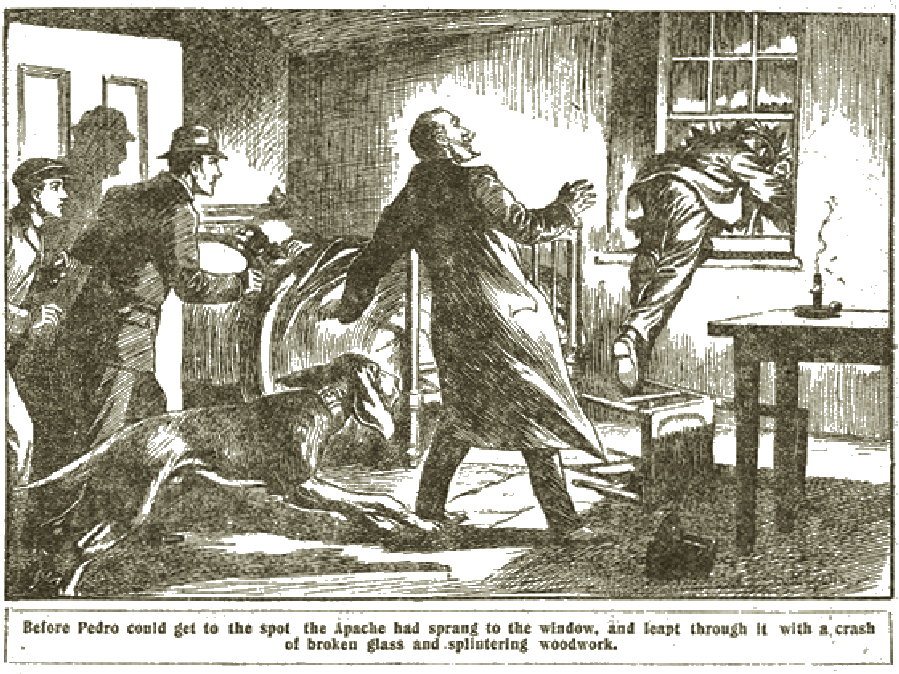
The man who had thus escaped was the Apache, and he had narrowly missed a vicious snap from the bloodhound. He bayed with disappointment as he lifted his big paws to the window-sill. The next instant Sexton Blake was by his side, peering out into the darkness, listening to the patter of retreating footsteps. His impulse was to jump after the fugitive, who had landed in a court below; but on second thoughts he concluded not to risk breaking one of his limbs. As he turned from the window, his glance sweeping the squalid little room that was by a candle, he observed the Count de Breville, and perceived a motionless form lying on a bed.
"Ah, monsieur, if you had only come a little sooner!" cried the count, whose clothing was dishevelled. "I am afraid—"
"Wait but a moment!" interrupted the detective. "You must be off in pursuit of that fellow, Tinker," he added.
"You will get on his scent round at the back of Dean Street, and the chances are that the hound will be able to overtake him and seize him. Here is the handkerchief. Go at once!"
The lad was off like a shot, followed by Pedro, and by then a clamour was ringing in the street; but as yet nobody had ascended the stairs, and it was probable that the alarm had not been heard in the restaurant, which communicated with the rest of the house.
"That boy!" exclaimed the Count de Breville, who was in great agitation. "Where have I seen him before? Ah, I remember now! is it possible, monsieur, that you are Sexton Blake?"
"Yes, you are quite right," answered the detective. "I have sought for you, knowing that you had need of me. But calm yourself, and try to tell me what has happened."
"I—I—how can I be calm?" moaned the count, wringing his hands. "It is a terrible thing! I came here to keep a secret appointment, but that youth followed me and crept into the room, and stabbed poor Foulard just as he had begun to speak to me. The ruffian would have killed me also, but I knocked the weapon from his grasp, and struggled him until you—"
"What, has murder been done?" cried Sexton Blake.
"I fear so," was the reply. "I dare not look, monsieur. Ah, it is too horrible!"
In three strides the detective was across the room, and by the flickering light of the candle he saw, lying on the bed with closed eyes and pallid cheeks, an elderly man with a black beard. The covers were partly off him, and blood was oozing from a wound in his chest, and from a gash on his arm.
"Has the poor fellow been slain?" inquired the Count de Breville, approaching with reluctance. "Is he dead, monsieur?"
"He appears to be," answered Sexton Blake, who had now come to the shrewd conclusion that the man before him had been murdered to prevent some secret from passing his lips. "No, there is still life in him," he added.
He was right. The wounded man had stirred, and a moment later, with a groan of pain, he opened his eyes. He looked up, and when he saw the count bending over him an expression of relief brightened his distorted features.
"I am glad that you are still here!" he gasped, "Are you hurt?"
"No, but that villain has unfortunately escaped," the count told him. "And I fear, my poor fellow, that he has—"
"He has done for me," said the man, speaking with an effort. "I am dying. I feel that my end is near. But first I will try to finish my confession."
"Do so, my poor Jules!' begged the Count de Breville. "You can imagine the suspense that I feel! Tell me, for the love of heaven, where to find my son?"
"Ah, I wish I could do that!" was the husky reply. "It is not in my power. But listen, monsieur le comte, and you will learn that which may be of help to you. I will confess all, hoping for your forgiveness. I had already told you, before I was stabbed, that it was I who helped your wicked cousin, Monsieur Charles de Breville, to kidnap the child years ago. Also, as you will remember, I had informed you of the events that drove me to seek a refuge in London, from fear of my life; and now, since this has happened, I cannot doubt that I am the victim of an assassin who was sent by your cousin to find me. By some means he must have—"
"Yes—yes, I understand that!" broke in the count. "I forgive you, my poor fellow, deeply though you have sinned. But tell me of my son, my little Lucien! What has become of him? Speak speak, before it is too late!"
For a few seconds the dying man was silent, struggling for breath, and writhing in agony.
"Alas, I can tell you but little of the boy!" he continued, almost inaudibly. "He is alive, and I fear he has been brought up in evil ways, for it was thus that Monsieur Charles had planned to be revenged upon you, as he once boasted to me, I could never learn where your son has been living, but I have reason to believe that a certain man of the Montmartre quarter in Paris known as Pere Antoine, can give you some information about him. Seek for him, monsieur le comte, and ask him—ask him to tell you—"
The man could say no more. It was only by a supreme effort that he had kept himself alive whilst he unburdened his guilty soul, and he was now at the last gasp. His eyes, staring with mute entreaty at the Count de Breville, slowly closed. There was a rattling in his throat, a brief convulsion, and then he lay quite still.
"He is dead!" said Sexton Blake.
"Yes, it is over with him," replied the count bitterly. "I should be thankful that he was able to finish his confession, to reveal to me what little he knew; but I had hoped to learn more. And you heard what he said to me of my cousin's purpose? Ah, if that should be true! But I will not believe it!"
"It is evident," said the detective, "that there has been a great sorrow in your life."
"A heartbreaking tragedy, Monsieur Blake," was the answer.
THE cry of murder and the dash into the house, the escape of the assassin and the confession of his victim—all these incidents had transpired in a very brief space of time. Meanwhile, the alarm had spread in the street below, where people were shouting and running to and fro; but at first they could not locate the house from which the dreadful cries had come, and for a few more seconds Sexton Blake and the Count de Breville stood undisturbed, in reverent silence, by the bed on which lay the corpse of the murdered man. Then two persons, a stout Frenchwoman and a little Frenchman with a moustache and imperial, hastened along the upper hall and burst into the room. And at the same moment there was the rapid tramp of feet on the staircase, mingled with a babel of voices speaking in several languages.
"A crime has been committed!" the woman cried in horror, as she approached the bed, and saw what was upon it. "Our lodger, Monsieur David, has been murdered!"
"Ah, what a dreadful thing!" gasped the little Frenchman. "That it should have happened under our roof!"
"And here are the assassins, Frederic!"
"Without doubt, Christine. They must be apprehended!"
A slight smile of derision curled the lips of the Count de Breville, who had controlled his emotion, and was once more the stiff and haughty aristocrat of France.
"My good people, you are wrong!" he said. "We had nothing to do with the death of this man."
The proprietor of the restaurant and his wife—for such they were—did not believe the statement. They retreated in fright to the doorway, where now a little crowd had gathered.
"David was, of course, the assumed name of this poor fellow," the count said, in a low voice to Sexton Blake. "His real name was Foulard, and he was the servant of—but I cannot explain to you now. The police are coming, monsieur, and I trust it will not be necessary to reveal my private affairs to them. I have urgent reasons for secrecy, if that can be observed. You have offered me your valuable services, for which I am grateful, and I am anxious that you alone should know the true facts of this—"
"I understand," interrupted the detective, "and you may be assured I will do what is possible. Leave all to me."
As he spoke, the tall form of Inspector Widgeon of Scotland Yard pushed into the room, followed by a constable. The latter drove the excited spectators into the hall, while the inspector strode forward, and started with surprise at sight of Sexton Blake.
"Hallo, you here!" he exclaimed. "You seem to have a finger in everything! I happened to be in the neighbourhood when the alarm was given. What is it this time, Blake?"
"It is a case of murder," answered the detective.
"Murder?" echoed Widgeon, as he bent over the corpse. "Yes, you are right. What do you know about it?"
"Very little," replied Sexton Blake. "My companion, who is also my client; is the Count de Breville," he added, in a low tone. "He came here tonight to get some secret information from the dead man, and while the two were talking the assassin crept upon them. He stabbed the man on the bed, attacked the count, broke away from him, and leapt through the window just as I arrived on the scene."
"And what was the motive?"
"That remains to be discovered, Widgeon."
"Well, I must get to the bottom of this mystery," declared the inspector curtly. "Who is the dead man?"
"We know nothing of him, sir," put in the little Frenchman. "I am Frederic Lestocq, and this is madame, my wife. We keep the Café de Provence, and let out the rest of the house in apartments. Several days ago this poor fellow came to us, stating that his name was Monsieur David, and asked for a lodging. Since yesterday he has been ill, and now, alas, he is dead!"
"And these ruffians have murdered him!" cried Madame Lestocq. "Take them to prison, sir!"
"Nonsense, my good woman!" said Widgeon. "One of these gentlemen is a friend of mine. Look at that broken window, and you will see how the assassin escaped. Can you give me any clue to the man's identity," he continued, addressing the Count de Breville.
"Unfortunately no," the latter answered. "I never saw the scoundrel until tonight, and I have no idea who he could have been."
"Yet he murdered the man who was about to give you certain information," the inspector said shrewdly. "What was his object? You should be aware of that."
The count was silent. He glanced in perplexity at Sexton Blake, and just then Tinker forced his way into the room, with the bloodhound at his heels.
"I have lost the fellow!" he exclaimed. "I am very sorry, but I could not help it, guv'nor. I picked up his trail around the corner, and Pedro led me to Shaftesbury Avenue, where he lost the scent. The man must have jumped into a 'bus or a cab."
"Then it is not your fault that you have failed," said the detective.
"There is too much mystery about this business," Widgeon muttered aggressively. "A terrible crime has been committed, and it is my duty to find the guilty man. You had better be frank with me, Blake."
"I am more than anxious to help you, my dear fellow," blandly replied Sexton Blake, who had meanwhile been writing in a notebook. "But what more can I tell you? You have the facts, and you can report them at Scotland Yard. The Count de Breville came here to get certain information that does not concern either you or me, and as that information was about to be revealed to him," the detective purposely emphasised the word about, "an unknown person stabbed this Monsieur David, and then fled. I had a good look at the murderer, however, and here is a written description of him. I strongly suspect that he is one of those Paris hooligans known as Apaches, and you will probably be able to effect his arrest if you will have the railway-stations watched, and the Channel boats searched."
"You are keeping something from me, Blake."
"I have told you enough for the present," said the detective. "I may call at the Yard in the morning, however, to give you some further information."
"I shall expect you!" snapped Widgeon, as he put into his pocket the leaf torn from the notebook. "I am not at all satisfied."
Sexton Blake shrugged his shoulders, and turned to Tinker. "We will be off, my boy," he said. "Come, monsieur le comte," he added. "I should like to have a talk with you."
But just then Madame Lestocq stepped forward, gazing earnestly into the face of the Count de Breville.
"I have seen this gentleman before!" she exclaimed, in a puzzled tone. "No, it is rather that he resembles somebody who is known to me, though I cannot think who it is."
"You are right, Christine," declared Monsieur Lestocq.
"The gentleman's face is certainly familiar, yet I do not know why."
"Will you permit me to pass, madame? the count said politely, with a bored look.
The woman stood aside, and Sexton Blake and his companions made their way down the staircase, and out of the house of murder. They pushed through the crowd in Dean Street, and a few moments later they were driving westward in a four-wheeled cab.
"You shall tell me all, monsieur le comte," said the detective, "when we have reached my chambers."
"Ah, if I had only had your assistance seventeen years ago!" was the bitter reply.
EVENTS had moved quickly that night. At eleven o'clock Count Jean de Breville had left the house in Baker Street, having failed to obtain the help that he wanted; and now, several hours later, he was seated in Sexton Blake's consulting-room, ready to begin his story. The detective was lying back in a big chair, with his pipe in his mouth. Pedro was stretched on the floor at his master's feet, and Tinker was curled up in a corner of the couch.
"It is a sad tale," said the count, "and I think it will arouse your pity. You must know, in the first place, that I belong to an old family which has always been proud of its blue blood and long ancestry, and that I reside near St. Cloud, at the Chateau Meudon, which has for many generations been the home of my race. For reasons which I need not explain, monsieur, our ancient title fell into abeyance during the Revolution, and was lost to us; but eighteen years ago, when I had been happily married for some time, and my son Lucien was a year old, I felt that it was my duty to revive the title. It was mine by every right, and yet, to my surprise, the claim was contested by my cousin, Charles de Breville, who, against my advice, brought matter before the courts. The judgment was in my favour, as was inevitable, and my cousin professed to be satisfied.
"I did not imagine that he bore me any malice, though it is true that his branch of the family and mine had been on bad terms for more than a century, and that he had been an unsuccessful suitor for my wife's affections prior to her marriage to me.
"To continue, the lawsuit dragged through the courts for some months, and shortly after it was decided, my little son, who was then two years of age, mysteriously disappeared one summer evening, his nurse having left him alone in the grounds of the chateau for a few minutes. You can imagine my grief, Monsieur Blake, for he was an only child. He was never found, and I did not doubt that he had been kidnapped, though no demand for ransom was made. At all events, I did not believe, as did some persons, that he had wandered to the river and been drowned, for in that case the body would have been recovered. I had no suspicions of Charles de Breville, you will understand. He did all that he could to console me, but there was no comfort for my wife, who very soon died of a broken heart."
The count paused, struggling with emotion.
"I tried to hide my sorrow from the world," he went on, "I could not forget. Year after year rolled by, yet still I cherished the hope that some day my lost child might be restored to me. It was only natural, I may add here, that it did not occur to me to suspect my cousin, since he had nothing to gain. He well knew that the next heir to the title and estates, after myself and my son, was my younger brother Raoul, who chose the sword for his career, and is an officer in the Foreign Legion in Algiers.
"To resume, monsieur, seventeen long years elapsed, and last evening a letter bearing the London postmark was handed to me as I was at dinner at the Chateau Meudon with Charles de Breville, with whom I have been on the most friendly terms. I opened the letter, which stated briefly that if I would come to London, and inquire for Monsieur David at the Café de Provence, I would learn something of my lost child. You can conceive what a joyful shock this was to me. My hand trembled, and I turned pale. I read the letter again, and perceived that the writer was anxious that I should confide in nobody until I had seen him.
"'What is it that has caused you such agitation?' my cousin demanded. 'It is nothing,' I replied, striving to be calm, 'but I find that I am compelled to go to England to-morrow,' I told him no more than that, but I had already said more than was prudent. I set fire to the letter and the envelope, and watched them until they had been consumed to ashes. I finished my dinner, bade good-night to my Cousin Charles, and departed for Paris. I spent the night at the Hotel Ritz, crossed the Channel to-day, and arrived in London this evening, my train being a couple of hours late."
"While in Paris, or during the journey," asked the detective, "did you see the youth who committed murder?"
"No, I saw nothing of him," replied the Count de Breville. "I paid no attention to my fellow-passengers. I was burning with impatience when I beheld the welcome lights of London; and then, thinking it possible that a trap might have been set for me by some designing scoundrel, I concluded that it would be wise to ask your advice. I had often heard of you, and I knew that you would be familiar with all the pitfall's of this great and wicked city. I obtained your address, came here, and waited an hour for you to return. If I had known then what I have since learned from your lips, a life might have been saved. But I never dreamed that I had been shadowed. Resolved to take the risk alone, I walked to the Café de Provence, in Dean Street, inquired for Monsieur David, and was led upstairs to the room in which you found me. And I was staggered, at a loss for words, when I recognised the writer of the mysterious letter as Jules Foulard, the old servant of my Cousin Charles."
Again the count paused. He rose from his chair, and began to pace the floor, making excited gestures.
"I was not prepared for the revelation that awaited me," he exclaimed, though I might have guessed it! Picture my horror, my wrath, when Jules Foulard confessed that he had stolen my son seventeen years ago, at the instigation of Charles de Breville who had always hated me in secret, and chosen this means of revenge! My senses swam, and when I recovered, Jules was speaking to me, pleading with me for forgiveness! I could have seized him by the throat, but he was ill, and I wanted to hear all!"
"'Pardon me,' said the wretched man, 'and I will tell you what I know of your son. I have been loyal to my master all these years, and I should have remained so, had he not quarrelled with me several days ago, and struck me in anger. I lost my temper in turn, and in a moment of passion I threatened to betray him. He was frightened, and begged me to overlook the blow. There was a murderous gleam in his eyes that terrified and warned me, however, and I felt that I would not be safe under his roof. I knew that he would not forget the threat. Moreover, I was resolved that you should learn of your cousin's crime. I had carried the secret long enough. But I dared not confess to you in France; I was afraid of Monsieur Charles, and I was also afraid that you might have me arrested. So I fled to England, and took a lodging under an assumed name, and wrote the letter that has brought you here.'
"Such were the words of the guilty servant," the Count de Breville continued, "and he got no further, Monsieur Blake, for at that point the assassin, who had noiselessly entered the room, stole suddenly upon us, and before I could prevent him, he had stabbed Jules Foulard in the breast, and turned upon me. The rest you know. You saw me struggling with him, and witnessed his escape through the window. Also, you heard what else the wretch Foulard told me, with his dying breath, And now I appeal to you for justice and for help. I want you to find my son, and to punish Charles de Breville. He killed my poor wife, and ruined my life. When I think of his villainy—ah, it maddens me!"
"I can understand your feelings," said the detective. "But calm yourself, and we will discuss this matter quietly. There are several important points to be considered. As for my help, I will give you that most willingly, if I can see my way clear. Tell me this, first of all. Can the assassin be aware that the servant had revealed your cousin's guilt to you?"
"I think not," answered the count. "I am sure that he does not even suspect, for there was a pause as he crept into the room, and just before that Foulard had said fondly: 'I sent for you because I wanted to make a confession.' I remember that now."
"Then we may assume, and, I trust, correctly," said Sexton Blake, "that the murderer is under the impression that he accomplished his purpose, that he believes Jules Foulard to have died with his secret untold. I hoped that such might be the case, and therefore I was careful not to let Inspector Widgeon know anything that might have led to your secret being made public; my object was to further the interests of justice, as I think you understand. The facts relating to the tragedy are fairly obvious," he went on, pulling at his pipe, "from what you have told me. The servant having disappeared, after uttering threats of betrayal, Charles de Breville feared that the man would try to communicate with you in some way. His first instinct was to protect himself by—"
"By keeping a watch on me," broke in the Count de Breville. "He has been almost constantly in my company during the last four or five days."
"And last night his patience was rewarded," said the detective. "The agitation that you showed after reading the letter, and the statement that you foolishly made, satisfied your cousin that the letter was from Jules Foulard, and that the man was in England. Moreover, since you spoke no angry or accusing word to him, he naturally supposed that Foulard had merely written to say that he had something of importance to confide to you. Having learned this much, Charles de Breville at once resolved what to do. He shadowed you to Paris, and then procured the services of that young Apache, whose instructions were to find Foulard's hiding-place by keeping you under observation, and kill the poor fellow before he could confess. And the ruffian did his work well. He accompanied you to London, dogged your footsteps here, and followed you to the Café de Provence, with the result that we know."
"Your theory is certainly right," declared the count. "There can be no doubt of it. One crime has led my cousin to another. Fearing that his villainy would be exposed, he has paid an assassin to kill his servant."
"Don't you think," put in Tinker, that Monsieur de Breville may have gone first to this Pere Antoine, and that he procured the Apache?"
"That is very likely," assented Sexton Blake, "since there is reason to believe that Charles de Breville placed the stolen child in the care of this man who was mentioned by Foulard."
"That should be a strong clue," said the count. "I have no knowledge of any person named Pere Antoine, of course; but he is doubtless one of that community of scoundrels who dwell in the Montmartre quarter of Paris."
"It should be easy to find him," replied the detective.
"But it may not be easy to get him to tell what you want to know," suggested Tinker.
"Perhaps not," said Sexton Blake. "No, I imagine that will be both a difficult and dangerous task."
"I implore you to help me, monsieur!" cried the Count de Breville. "With your skill, your courage, you will surely succeed where the French police might fail! Restore to me my lost son, the heir to my title and estates! I may yet be happy again, after all these years of misery! Expense is no object! I will gladly pay any price you may ask! As for my wicked cousin, there can be no mercy for him! He must suffer for his crimes! When I think of his heartless deed, of the treachery and hatred he,has masked under the guise of friendship—"
"Calm yourself,' interrupted the detective. "Sit down and listen to me. I am going to do what I can for you, but you must leave everything in my hands. Though the Apache will no doubt declare that Jules Foulard was killed before he had time to confess, Charles de Breville may fear that you, at least, suspect the truth, because of your discovery that it was his servant who summoned you to London. Therefore, when you have returned to Paris after the inquest—you must stop for that—it will be necessary for you to remain on intimate terms with your cousin. He must be made to believe that you have no idea of his guilt, for otherwise he might suspect that the lost child was being sought for, and that would mean peril to myself. Meanwhile, I shall be working to find your son. That is the first step, and if I succeed, the next step will be to obtain the proof of Charles de Breville's crimes, and bring him to justice. I am anxious to do so, for this is a case that appeals to me strongly. Your cousin is one of the most infamous scoundrels that I can recall in all my experience."
"He is, monsieur!" exclaimed the count. "It is hard for me to believe that he is responsible for my ruined life. But you have given me hope! You will find my son, and punish the guilty man!"
"I intend to do both, be assured. And now tell me, if you can, how the identity of the lost child could be established. Is there any mark on his body?"
"Fortunately, yes, monsieur. On his left arm, above the elbow, there would be a birthmark. It was a small, red spot, the size and shape of a strawberry."
"That is important," murmured Sexton Blake. "I will make a note of it. Did the child resemble yourself?"
"Yes—so my wife used to tell me," the count answered, with a sigh. "But that was seventeen years ago, when my little Lucien was only two years old. It is sad to think that he has now grown up."
There was a brief pause. Tinker had taken a keen interest in the conversation, and the prospect of a trip to Paris was pleasing to him, though he knew that the search for the count's son might be dangerous.
"What about the assassin of Jules Foulard, guv'nor?" he said. "If he should be caught, your plans may be spoilt."
"That is true, my boy," replied the detective. "It will be better for us if the murderer goes free for the present, and I imagine he will. It is not likely that Widgeon will be able to lay hands on him."
"There is one thing that I have forgotten to speak," the Count de Breville cried suddenly, in a tone of distress. "It inspires me with horror, monsieur, as you will conceive. You remember Foulard's last words? It would appear that my cousin, in his fiendish hatred of me, may have caused the boy to be brought up in evil ways. By heavens, what if my if Lucien should be a criminal?"
"Then he would have to be reformed," said Sexton Blake. "But don't let that worry you," he added. "We will hope that your son will prove to be worthy to bear your name."
"Can I believe that?" the count exclaimed bitterly. "No; there is too much reason to believe otherwise. I dread the future, monsieur. I shrink from the hour when my child will be restored to me!"
The same fear was in the detective's heart, but he said what he could to comfort the unhappy man, who shortly afterwards departed in more cheerful spirits, to procure a bed at a West End hotel.
"I will try to hope for the best," were his parting words; "and I will be guided entirely by you."
On the following day the inquest on the body of Monsieur David was held, but the verdict left the crime shrouded in mystery; for the real name of the murdered man was not disclosed, and the Count de Breville, previously instructed by Sexton Blake, was able to conceal his knowledge without making any false statements to the coroner.
The next morning he returned to Paris, and the same night the detective crossed the Channel with Tinker and Pedro. Meanwhile, he had partly confided the truth to Inspector Widgeon, and explained his reasons for secrecy; but Widgeon, while admitting that those reasons were in the interests of justice, had declared that he had a clue to the identity of the assassin, and that he had communicated with the French police. This had the result of making Sexton Blake feel slightly uneasy; and there was another thing that worried him as well.
Charles de Breville could hardly doubt, it seemed, that his servant Foulard had been recognised by the count. What, then, would he argue from the fact that the dead man's name had not been revealed at the inquest? Would he not come to the conclusion that this meant danger; that his cousin suspected his guilt? If so, he would take prompt steps to secure himself; and, since he had already shown that he was capable of hiring an assassin to commit murder, the search for the lost boy would be attended with grave peril.
The Rival Apaches—At the Café Tabarin—A Surprise for the Defective.
IT was between eight and nine o'clock of a warm night in the spring of the year, and the beautiful city of Paris was looking its best, frothing and sparkling like champagne, when Sexton Blake and Tinker left their humble lodgings in the Rue de Beaune, off the Quay Voltaire, and bent their steps to the north.
You might have known them well in London, but you would never have recognised them now; for, in their big, wide-brimmed hats of black felt, their baggy trousers and velveteen jackets, they were perfect types of the Bohemian students of the Latin Quarter. To add to their disguise, moreover, the lad's features had been altered, and the detective had a false beard and moustache, while both wore wigs that made them look as if their hair was sadly in need of cutting.
Having crossed the Seine, and threaded the courts of the Louvre, they strolled up the Rue Richelieu to the Grand Boulevards, where thousands of little electric lamps glimmered amid the green leaves of the trees, and thence on until they presently found themselves in the Rue Blanche, approaching the heights of Montmartre.
"This is the quarter of the Apaches, isn't it?" said Tinker, as he saw ahead of him the sails of the famous Red Mill.
"Yes; it is one of their haunts," answered Sexton Blake; "and I remember that some of that fraternity used to frequent the Café Tabarin, where I hope to get some information about Pere Antoine."
"How does it come that they are called Apache, guv'nor?"
"Because of their nature, my boy. The name is well suited to them. The Apaches are the most savage and ferocious of the American Indians, and these young hooligans of Paris are much the same. There are no persons quite to be compared with them in any other capital of the world. They are ruffians who hate work, spend much of their time in idleness and absinthe-drinking, and live by crime, holding human life cheaper than dirt. They are clever acrobats, and it is no uncommon thing for them to leap upon the shoulders of their victims, or kick them in the face with their wooden sabots. They are held in dread by everyone, so bloodthirsty and merciless are they. They prowl about with their chiefs, or leaders, seeking opportunities for theft or murder, and rival hands often fight among themselves and kill each other. Moreover, when any of their number are arrested by the police, or betrayed by other persons, they are prompt to take vengeance, which is the cause of many mysterious murders in Paris. There are 50,000 of these pests in this beautiful city, and they ought to be exterminated like rats! The worst of it is, that the police are utterly unable to cope with them."
"I hope we sha'n't get mixed up with them in any way," said the lad.
"I should be very sorry if our work was to take us among them," replied Sexton Blake; and a shadow of uneasiness darkened his face as he remembered that Pere Antoine was an inhabitant of the Montmartre quarter.
It was a curious coincidence that he should have just finished his little homily on the Apaches of Paris: for now, a moment after he and the lad had crossed to the north side of the Boulevard de Clichy, a band of these very hooligans came striding along the pavement, jostling other persons out of the way. Tinker looked at them with keen interest. They numbered about thirty, and ranged in age from seventeen to twenty-five. They were stunted, wiry youths, shabbily dressed; and all had vicious, sickly faces, that bore the stamp of crime and evil passions.
"We had better wait until they have gone by, my boy," said the detective, in a low voice.
They had stopped at the edge of the pavement, almost in the glare of the red light cast by the Moulin Rouge; and a few seconds later—it was so swift that they scarcely realised what had happened at first—a second band of Apaches rushed out from a side street, and threw themselves upon the other one.
An exciting scene followed, and a loud clamour swelled along the boulevard. The drivers of passing cabs whipped up their horses, and pedestrians fled in terror; but before Sexton Blake and the lad could escape, they were surrounded by the howling mob of ruffians, who fought with the utmost ferocity.
"Down with Barbe Rouge!" dried some of them. "Vive la Montmartre!"
"Vive la Belleville!" yelled others. "Death to Barbe Rouge!"
It was evident, from these battle-shouts, that the quarrel was between two rival factions—one belonging to the Montmartre quarter of Paris, and the other from the district of Belleville. And as they dealt kicks and blows, using knives and pistols as well, they swarmed on all sides of the two disguised students, whose lives were in imminent danger, though at first their presence was ignored.
"They will tackle us next," exclaimed Tinker, "if we don't get out of this!"
"We'll have a try for it," said the detective. "Come this way."
But now the struggle had thickened, and one of the hooligans, flung heavily against Tinker, turned upon him with an oath, and whipped out a knife; but before he could strike, the detective's fist landed on his jaw and knocked him down, and at this critical moment a group of real Latin Quarter students, who had been making merry at a café near by, perceived the situation, and gave prompt assistance. They sprang into the scuffling, maddened crowd, and forced their way through it with splendid courage.
"To the rescue!" they cried. "To the rescue of our comrades!"
It was a gallant act, and it probably saved the lives of those whom they supposed to be of their own class. Some carried walking-sticks, and for a brief interval they rallied around Sexton Blake and the lad, helping them to keep their assailants at bay; and then, when the odds were getting too great, and the bullets were flying, a shout arose that the police were coming.
As a rule, the Apaches are willing enough to fight with the guardians of the law, but on this occasion they seemed to think that discretion was the better part of valour, for at once they took to their heels, melting away like magic. The real students gave chase, and the detective and Tinker, without having an opportunity of thanking their brave rescuers, took themselves off, just as a force of gendarmes and sergents-de-ville appeared on the scene.
"I sha'n't forget that in a hurry," panted the lad. "I've seen as much of the Apaches as I want to."
"We had a narrow escape," answered Sexton Blake, who had been grazed by a bullet and slightly pricked by a knife.
"Where do you go now, guv'nor?"
"To the Café Tabarin, my boy. It is not very far from here."
The noises of the boulevard life faded away behind them and when they had gone on to the north for less than a quarter of a mile, through comparatively quiet streets, mounting towards the higher part of Montmartre, they bore to one side, and soon entered the Café Tabarin, where they seated themselves at a vacant table near the middle of the room, and ordered bocks.
It was a typical café of its kind—one that was not often visited by foreigners. At one end of the large room, which was badly lighted and of mean appearance, was a stage, on which a couple of girls were dancing. The audience was mixed, as was to be expected; and here and there one saw evil faces among them, though for the most part they comprised students and shopkeepers, workmen in blue blouses, and artisans with their wives and sweethearts.
"How are you going to get the information that you want?" asked Tinker.
"I have just been putting that question to myself," replied the detective, as he sipped his bock. "I used to come here a great deal, and I was well acquainted with the proprietor; but I observe that the place has changed hands, and the new man is a stranger to me. No doubt some of these people around us know of Pere Antoine, and could tell me where to find him, but it might not be prudent to inquire of any of them."
"Then what will you do, guv'nor?"
"I will think about it, my boy. I must get the information in some way, for it is important that I should have an interview with Pere Antoine as soon as possible."
"He may be dead!"
"I hope not. What may be the case, though; for, from what Jules Foulard said, he had merely heard of the man from Charles de Breville. I don't believe he knew anything of him."
During this brief conversation, the two had been subjected to a keen scrutiny by a young man of perhaps twenty, who was seated close by. He wore a workman's blouse, and his features were honest and attractive. He now rose, hesitated, and then stepped over to the detective's table, and sat down.
"Good-evening, Monsieur Blake!" he said quietly. "I don't think I can be mistaken."
Sexton Blake was more than surprised. He was startled and alarmed by this unexpected recognition, and he at first suspected that it meant danger. He glanced at Tinker, who was no less puzzled.
"I beg your pardon," continued the young workman, whose face now appeared vaguely familiar to the detective. "I should not have accosted you. But surely you are Monsieur Blake?"
"Do I resemble any person known to you by that name?" inquired Sexton Blake.
"You do not, monsieur," was the reply. "Your disguise is indeed perfect. You need have no fear of that."
"Then how did you recognise me?"
"I have served you at the Trocadero Restaurant in London, and you wore there the peculiar ring which you now have on your right hand. As it is not likely that there could be two such rings—"
"Very clever," interrupted the detective, with a sigh of relief. "You have taught me a lesson, and I will not forget it in future. I now remember seeing you at the Trocadero. You were not there long, however."
"For only a short time," said the young man; "but I lived in London for several years. "My name is Claude Lestocq. My stepfather keeps the Café de Provence, in Soho; and it was by my mother's wish that I took his name instead of my own, which is Gautier."
"The Café de Provence!" exclaimed Sexton Blake, regarding this as a queer coincidence, in view of what had happened there.
"Yes, in Dean Street," said Claude Lestocq. "It was the scene of a mysterious murder a few days ago, as I read in the Paris journals. I was born in Paris," he went on, showing an inclination to talk about himself, "but when I was very young—it was after the death of my father—my mother took me to Marseilles; and when I was fifteen years of age she went to live in London, where she married Frederic Lestocq. I could not get on with my stepfather, however, so I came to Paris eighteen months ago. I was a waiter at the Café Tabarin for a year, and then I found employment at the Halles as a day-porter. Lately I have been spending my evenings here for a certain purpose. It is risky, but I do not mind that. I am anxious to find an Apache, monsieur, who must be brought to justice for a crime he has committed."
"That will not be an easy task, I should imagine," said the detective. "Are you familiar with the Montmartre quarter?" he added, as it occurred to him that he might safely confide in this young man, who had impressed him favourably.
"There are few persons who know it better," replied Claude Lestocq, "though I have lived in the neighbourhood for only a year. But I was about to tell you of my purpose, monsieur, if you care to listen. The Apaches of Montmartre, whose leader is the terrible Spider, are in the habit of coming here, and I had the misfortune to offend them. For that reason I left the Café Tabarin to seek other employment; and meanwhile, by living frugally, I had saved enough money to marry my sweetheart, whose mother has a laundry near the Halles. My wedding has been put off, however, for a week ago, as I was walking on the boulevards with my little Fleurette, I was attacked by one of the Spider's gang, who knocked me down, and stunned me, and robbed me of all my money. I might have forgiven that, but the scoundrel also struck my sweetheart, and therefore I am determined to have him arrested. I have not found him yet, but one of these evenings he will appear."
"You are a plucky fellow," said Sexton Blake, "but you had better be careful. The Apaches are a dangerous lot, and a short time ago we were mixed up in a fight between the Montmartre and Belleville gangs."
"Yes, they are always at war," answered the young man. "Their leaders—Barbe Rouge and the Spider—are bitter enemies."
At this point the conversation was interrupted by the shuffling of feet. A number of persons had entered the café, and it was evident, from the sudden hush that ensued, that their presence was distasteful to the rest of the audience.
The detective was about to look round, when Claude Lestocq bent towards him and said in a low voice:
"It is some of the Montmartre gang, and the Spider is with them. He has seated himself to your left, monsieur, with two others. He is the tallest of the three."
The Spider—News of Pere Antoine—The Fight at the Café.
HAVING slowly turned his head, Sexton Blake saw a slim and wiry youth, with sallow and vicious features, who had a handkerchief knotted about his throat. He gazed at him furtively for a few seconds, and then, with a slight start, he suddenly remembered where he had seen that evil face before. He was back in Baker Street, fighting for his life, and again he felt the hot, foul breath of the young ruffian upon his cheek.
He quickly shifted his eyes, and his startled expression was observed by Tinker, who inquired the cause of it.
"I know the Spider," the detective answered, in a whisper that was inaudible to the young market-porter. "He is the assassin of Jules Foulard."
"By Jove, that discovery ought to be worth something!" muttered the lad. "But there is no fear of his recognising you, guv'nor?"
"Not the slightest, my boy!"
A young woman had begun to sing on the stage, and she drew the attention of the audience from the Apaches, who were behaving well.
"This is no place for me," said Claude Lestocq; "for those fellows have a grudge against me, and they may suspect why I am here. But it won't be safe for me to leave at once. I will wait for a time, and perhaps they won't observe me."
"Yes, that will be wise," said Sexton Blake. "I am interested in the leader of the gang," he added, "Can you tell me anything about him?"
"I can tell you what everybody in Montmartre knows," was the reply. "The Spider has been the chief of the gang for three or four years, and before that he was a pupil of Pere Antoine, who used to boast that he could make him—"
"Of Pere Antoine?' broke in the detective.
He was silent for a moment, pleased by the opportunity of getting the information he wanted so badly. It flashed upon him, with a feeling of dread, that the Spider might be the lost son of the Count de Breville; but he promptly dismissed the theory as too improbable for belief, telling himself that this young ruffian, with crime stamped on every line of his brutal face, could not be of good birth.
"What do you knew of Pere Antoine?" asked Claude Lestocq.
"I have heard his name mentioned, that is all," Sexton Blake replied. "Who is he?"
"He is one of the greatest scoundrels in Paris, monsieur," was the answer; "and yet he is so cunning that he has never yet got himself in the clutches of the law, though the police have been watching him for years. I once heard it said of him that he was the French Fagin, though I do not know what that means. He is a one-eyed old villain, looking like a big monkey, who has spent his life in training young boys to steal for him, and then turning them loose to commit worse crimes. Many of his pupils are on the Devil's Island, and some have died by the guillotine. The Spider was one of his pupils, and so was Barbe Rouge, of the Belleville gang. He is very proud of them both."
"Where is he to be found?" inquired the detective.
"He lives alone, not far from here," replied Claude Lestocq. "I lodged in the same house when I was a waiter at the Café Tabarin, and I often saw him. He used to come here, but now he goes to the—"
There was a sharp exclamation from Tinker, and, as the young porter glanced instinctively to one side and sprang to his feet with a look of fright, the Spider strode over to the table, brandishing a knife.
"Come on, comrades!' he cried. "I have found the spy that we have a grudge against! He has been warned more than once to keep away from here, and now we will settle him!"
Before the young man could retreat the knife flashed at him, and he would have been stabbed but for Sexton Blake, who seized the ruffian's descending wrist with one hand, and with the other wrenched the weapon from him. A fierce struggle began between the two, and, while the spectators looked on—they were too terrified to interfere—the Spider's companions made a rush towards the spot. They numbered nearly a dozen, but they were held in check by Tinker and Paul Lestocq, who defended themselves with chairs, raining blow after blow upon the Apaches.
"Settle that fellow, guv'nor!" urged the lad. "We must get out of this!"
But the detective was rolling on the floor, with his assailant's hands at his throat, and Tinker and the young porter had all they could do to look after themselves.
They fought on for a few seconds amid a swelling tumult, until several of their foes drew firearms. A pistol cracked, the ball narrowly missing the lad's head, and then, at this desperate crisis, a fresh band of Apaches suddenly dashed into the Café Tabarin, led by a youth with red hair and a stunted beard of the same colour. It was Barbe Rouge, the chief of the rival gang.
"Belleville—Belleville!' shouted the invaders.
"Montmartre!" yelled the others. "Vive la martre!"
Loudest of all rang the voice of the Spider, as he jerked free of the detective and sprang to his feet, eager to give battle to his enemies. In a trice he had joined his companions, and they threw themselves upon the Belleville ruffians, who met the attack by a furious charge. There was a deafening clamour, blending with the crack of revolvers. Tables went crashing to the floor, and women screamed with fright, as Claude Lestocq led Sexton Blake and the lad through the scuffling, scrambling audience. With great difficulty they reached a side door that gave them access to a court, and, without stopping, they ran on until the shrill tumult had faded in their ears, and they found themselves in a quiet street near the Boulevard de Clichy.
"I thank you both," the young porter said gratefully. "But for you, I should have been killed by those fellows! I was a fool to go to the Café Tabarin. But is there any service I can do for you in return, Monsieur Blake? It is evident that you have not come to Paris for pleasure!"
"I will take you at your word," said the detective. "I am anxious to have a conversation with Pere Antoine, an I shall be glad if you will tell me where he lives."
"I can do that. Do you know the Rue Martial, a mile north of here?"
"Yes, I know where it is."
"Very well. Half-way up the Rue Martial turn to the left into the Passage des Morts, and at the end of it you will find a tall house. Climb the first flight of stairs, and you will see facing you the door that leads to Pere Antoine's apartments."
"Is he likely to be alone?"
"Yes; he seldom has visitors. But will you go there tonight?"
"If you think it is safe I may do so," replied Sexton Blake.
"Oh, it will be safe enough!' said Claude Lestocq. "The old man will not try to rob you, and he has no pupils at present. He had to stop that game, through fear of the police. But it may be that he has moved elsewhere since I lived in Montmartre, and if so you will be pretty sure to find him at the Cave, near the Market Halles. If you wish it, I will accompany you there to-morrow night and point him out to you. It is a dangerous place—a very den of criminals—so you had better disguise yourselves more suitably. As for me, I shall wear a false moustache, for the Montmartre Apaches often visit the Cave."
"It may be necessary for me to accept your offer," said the detective, "and if so I will write to you in the morning. What is your address?"
"Care of Madame Lenoir, Rue Pernod, the Halles," answered the young porter.
"I will remember it. You will probably hear from me to-morrow, whether or not I should wish to visit the Cave."
"I shall be glad to assist you in any way, monsieur. And now I will bid you good-night, for I have an appointment to keep with my little Fleurette."
And with that, touching his cap, Claude Lestocq strode quickly away, and turned the corner into the Boulevard de Clichy.
"It was fortunate that we should have met this young man," said Sexton Blake. "He has already given us some valuable information, and he may be of service to us in the future. I will leave you here," he added, "and you can return to our lodgings in a cab."'
"Are you going to visit Pere Antoine tonight?" exclaimed Tinker.
"Yes, the sooner the better. As it is, I am afraid that Charles de Breville may have put him on his guard."
"I wish you would wait until to-morrow, guv'nor."
"There will be no risk about it," answered the detective. "I won't enter until I have first assured myself that the old man is alone. I would take you with me, my boy, but it is possible that the Count de Breville has something to tell me, and that he will call tonight at the Rue de Beaune. That is why I want you to go back at once. Moreover, Pedro will be lonely."
"All right, I'll go," said Tinker. "But I am not thinking about Pedro, He can't come to any harm, but there's no telling what may happen to you!"
The Man on the Stairs—Pere Antoine's Visitor—A Fresh Peril.
VERY reluctantly the lad went off alone to pick up a cab on the Boulevard, while Sexton Blake turned in the opposite direction and walked northward, thinking of the knowledge he had gleaned at the Café Tabarin, and wondering what bearing it would have upon his quest for the lost boy.
"I am on the right track," he said to himself. "Doubtless Charles de Breville paid Pere Antoine to send the young assassin to London to murder Jules Foulard, and the fact that he thought of this villainous old man in his hour of need, suggests that he put the stolen child in his charge seventeen years ago. It is in the power of Pere Antoine—and perhaps of the Spider as well—to give me the information that I want. But what has become of the Count de Breville's son? How has he been brought up, and who are his associates? I am afraid the count has good reason to dread the time when those questions will be answered."
The hour was not very late, but this part of the quarter of Montmartre, with its narrow streets and ancient buildings, was almost as quiet as a country town. It was fairly well known to the detective, who went steadily on, passing a few night-prowlers and one or two policemen, until he came to the Passage des Morts, which was a dark and forbidding-looking alley, paved with flagstones.
He made his way to the end of it, entered a tall house that faced the Rue Martial, and climbed a rickety staircase to the first floor. Here he paused, for immediately in front of him was a thin crevice of light, and he knew that it shone from under the door leading to Pere Antoine's apartments. But a murmur of voices fell on Sexton Blake's ear, and he felt, to his disappointment, that he would have to put off his visit till another time.
"If the old man is there he has a companion with him," he said to himself. "But he may not be there. He may have given up the rooms, and somebody else may have taken them. At all events, I had better wait until to-morrow night, and go to the Cave with Claude Lestocq."
Instead of withdrawing, however, the detective stepped close up to the door, impelled by curiosity, and put his eye to the keyhole. He could see nothing, nor could he distinguish what was being said by the two speakers, who were apparently in an inner room; but he could hear that one of the voices was harsh and croaking, and that the other betrayed both culture and education—which suggested to him an idea of an alarming nature. He listened for a few moments, and then, as he heard his own name mentioned, he knew that his suspicion must be right.
"I was afraid of this," he thought. "The game is going to be more dangerous than I expected, for the arch-villain himself is playing a hand."
At that instant, as Sexton Blake was about to depart, he heard a slight noise in the hall below, and judged that some lodger had entered the house. His first impulse was to go boldly down, as if he belonged on the premises; but, on second thoughts, he crept into a corner at one side of the door, and braced himself against the wall.
Somebody was now ascending the stairs, slowly and warily. The footsteps came on, and just as they reached the landing, and stopped there, the pressure of the detective's body caused the thin wall at his back to creak.
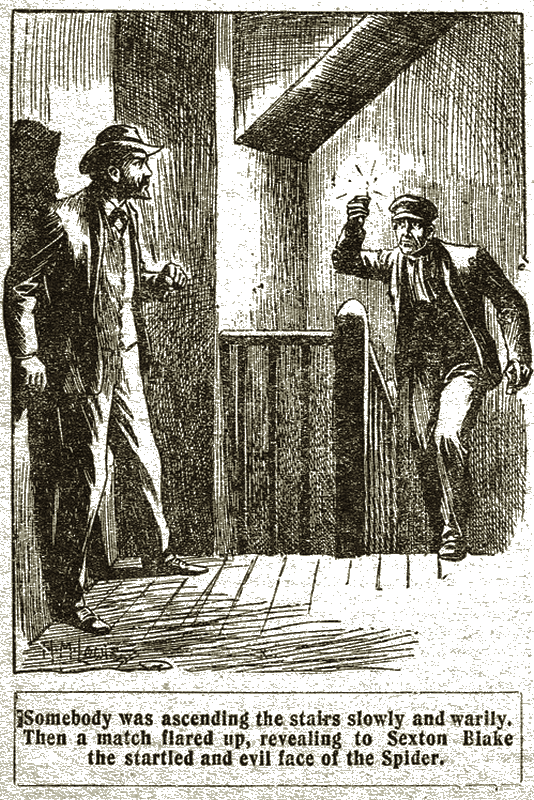
Almost at once a match flared up, and the glow of the little flame revealed to him the startled and evil face of the Spider.
For a couple of seconds the two stared silently at each other, and then, with swift action, Sexton Blake sprang forward and gripped the throat of the ruffian, who dropped the burning match, and trod on it as he closed with his assailant.
Locked together, they swayed at once to the top of the staircase, where they tripped and fell, rolling half of the way down, and sliding to the bottom. The detective was on top, and was not hurt, but the hold on him had relaxed, and he knew that the Spider must have been stunned or disabled by the fall.
He rose to his feet, and as he dashed out of the house, he heard a gasping cry from the young ruffian, and the sound of a door opening overhead. He ran through the paved passage, intent on escape, but when he emerged in the Rue Martial, and saw to one side an empty cart standing at the edge of the pavement, that gave him a shrewd inspiration.
He stretched himself flat on the bed of the cart, in the front of which was a crevice that commanded a view of the mouth of the alley, and there he lay hidden, in spite of the risk of discovery.
The street was deserted, and for a little time all was quiet in the direction of the house where Pere Antoine lodged; but at length footsteps approached, and now the Spider came limping out of the Passage des Morts.
He glanced up and down the Rue Martial, shook his fist, and turned back, without paying any attention to the cart.
The coast was clear, but Sexton Blake was not yet ready to leave his shelter. He waited for a few minutes longer, expecting to see somebody else, and then his patience was rewarded, for a tall man glided suddenly out of the passage.
His features were in the shadow, but it could be seen that he wore a soft hat and a long fawn-coloured overcoat. He glanced in both directions, and walked rapidly away down the Rue Martial.
"And now to follow Pere Antoine's visitor," murmured the detective, as he crawled out of the cart. "I can guess who he is; but I want to make sure of it."
The chase was difficult at first, but it became easy after it had led to a neighbourhood where more people were about. The man in the light overcoat evidently did not suspect that he was being shadowed, for he never once looked back. He made his way rapidly to the Boulevard des Batignolles, later Sexton Blake had stepped into another one that was fortunately near.
"Follow that cab in front," he said to the driver, "and when it stops, go slowly by."
He had made a disturbing discovery, and he knew that Pere Antoine and the mysterious visitor, who had of course learned of his struggle with the Spider, would regard the incident with alarm; but he hoped that they would not suspect his identity, or the motive that brought him to the house, since the light of the match had shown him to be apparently a harmless student.
"It won't make much difference, though," he reflected, "for I have no doubt that the scoundrels are already on their guard."
There was considerable traffic at this hour, but the detective's driver had no difficulty in following the cab in front, which pursued a steady course along the Boulevard de Courcelles, by the Parc Monceaux, to the Avenue de Wagram, and thence south across the Place de l'Étoile, where stands the splendid Arch of Triumph. It was now in a very swell quarter of the city, and soon it stopped before a handsome residence, into which the man in the light overcoat vanished as Sexton Blake drove by.
He marked the house, and when he returned to it a few minutes later, after dismissing his own cab, he accosted a sergent-de-ville who was strolling by.
"I am looking for a gentleman who promised to give me a commission for a picture,' he said. "His name is Monsieur Pelletier, and he lives somewhere in this neighbourhood; but I have forgotten his street and number.'
"I know nothing of him," the policeman answered.
"This looks like his house," said the detective, pointing to the residence he had observed.
"You are wrong!" was the reply. "The gentleman who lives here is Monsieur Charles de Breville."
It was the answer that Sexton Blake had expected, and it confirmed his suspicions. He thanked the sergent-de-ville, and shortly afterwards he picked up a cab, and drove to the Grand Boulevards, where he sat outside a café for a little time, thinking of the unpleasant turn affairs had taken. He then walked across the river to the Rue de Beaune, and just as he reached the house where he had procured lodgings, he perceived a dark form lurking in the shadow on the opposite side of the street.
Somebody was standing there, and this was enough to arouse the suspicions of the detective, who, after a moment of hesitation, walked slowly across; but before he had put foot on the pavement a man sprang suddenly at him, dealt him a violent blow on the chest, and then took to his heels.
Sexton Blake was knocked down, and when he rose he gave chase to his assailant, but soon lost sight of him.
More troubled than ever, he turned back and entered the house, where Tinker and Pedro were waiting for him.
"You look worried," said the lad. "What is the matter?"
"I will tell you presently,' the detective answered. "Has the Count de Breville been here?"
"No, guv'nor; but here is a letter that must be from him."
Sexton Blake opened the envelope, and read the contents aloud:
"'I have obeyed your instructions, and resumed my friendly intimacy with my cousin, who appears to suspect nothing. He has not questioned me as yet about my visit to London; and if he does so, I will be guarded in my answers. Trusting that you will soon find my lost boy, and that he will be worthy to bear my name, I inscribe myself, monsieur.—The unhappy Jean, Comte de Breville.'"
"Well, that sounds all right," said Tinker. "Things are going on smoothly."
"On the contrary, they are going all wrong!" declared the detective, as he sat down and lit his pipe. "The Count de Breville has been deceived by his cousin, who is playing a deep and cunning game."
In a few words he gave an account of his visit to the house in the Passage des Morts, and of his little adventure in the Rue de Beaune.
"I need hardly tell you what all this means," he went on. "It is evident, in the first place, that the reports of the Soho murder in the French papers warned Charles de Breville of his danger. He suspected that his guilty secret was known to the count, and that I have been employed to find the stolen child, and therefore he must have gone to Pere Antoine tonight for the purpose of putting him on his guard. But that is not the worst. Charles de Breville must have got a glimpse of his cousin's letter to me before it was posted, and that accounts for his sending a spy to watch this house."
"You are right, of course!" exclaimed the lad. "This will make our work harder and more dangerous."
"We are in danger of assassination, to speak plainly," replied Sexton Blake.
"What is to be done, guv'nor?"
"I have decided on that, my boy. We must elude the spy, who has probably returned by now, and we must also break off all communication with the Count de Breville for the present. We will leave here at once, secretly, and obtain other lodgings where we shall be safe, And then to go on with our task. If we fail to get the information from Pere Antoine, we will try the Spider. If he knows anything about the count's son—and it is possible that he does—he may be induced to confess if we threaten to have him arrested for the murder of Jules Foulard. But I am more likely to succeed with Pere Antoine, who may be tempted by money to betray Charles de Breville."
It was, fortunately, possible, as the detective knew, to elude the vigilance of the spy. A couple of gold pieces were placed on the table for the landlord; and then, carrying their bags and followed by Pedro, the two lodgers stole noiselessly downstairs and gained access to a garden at the back of the house, from which a gate led them to a narrow street at the back of the Rue de Beaune. They got a cab on the quay, and half an hour later they were quartered at a modest hotel on the north side of the river, in the neighbourhood of the Place de la République. They had outwitted Charles de Breville, but their task was not likely to be any the easier for that.
A Night at the Cave—A Surprise for the Company—Paul Flamard's Mistake.
ON the following morning, having some reason to fear that the next step he had in view would fail, Sexton Blake wrote a few lines to the young market-porter, making an appointment with him for that evening. He then set off for Montmartre, and when he reached the house in the Passage des Morts he learned that his suspicions were correct. Alarmed by what had happened on the previous night, Pere Antoine had vacated his rooms, taking the furniture with him.
"It is just what I expected," the detective said to himself, as he walked away from the house. "However, I shall probably have better luck tonight."
After making some purchases he returned to the hotel— it was kept by a man with whom he was acquainted—and he did not leave it again until nine o'clock in the evening, when he and Tinker set forth disguised as French workmen of the lowest class, wearing coarse blue blouses and greasy caps.
They walked down the Rue de Tarbigo to the Pointe St. Eustache, and here they found Claude Lestocq waiting for them in the vicinity of the Central Markets—known as the Halles. These great structures of iron, which are ten in number, and contain two hundred and fifty stalls each, form one of the most interesting sights of Paris. Though they were not now as busy as they would be later, all was bustle and noise, and carts laden with vegetables, fruit, and flowers were constantly arriving from the country and the railway-stations.
The young man, whose features had been altered, greeted his friends warmly. They would not have known him, nor could he have recognised them, had it not been arranged that they were to meet at a certain spot, and at a fixed time.
"Well, here we are," said Sexton Blake. "I imagined that we should need your assistance—and I was right. "Pere Antoine no longer lives in the Passage des Morts.'"
"The chances are that he will be at the Cave, and if so, I will point him out to you," replied Claude Lestocq. "But I must warn you, monsieur, that it is one of the most dangerous places in Paris to which we are going."
"I am aware of that. I think our disguises will protect us, however."
"Yes; they could not be better, Be guided by me, monsieur, and there will be nothing to fear."
"If your man is there, guv'nor, what are you going to do?? Tinker inquired in a low voice.
"I will wait until he leaves, and then follow him," was the reply. "I must have a talk with him, for that is the only way of getting information about the count's son."
Meanwhile the three had been walking on, and shortly after they had passed the fountain of Jean Goujon they came to the Caveau des Innocents—commonly known as the Cave. The young porter led the way through a dirty bar on the ground-floor, and thence down a dark, well-worn flight of stone steps to an underground cellar, where he and his companions seated themselves at a table that happened to be vacant.
The place was familiar to the detective, but it was new to Tinker, and he gazed with interest at what was undoubtedly the worst den in Paris. A typical company were present consisting mostly of evil-looking workmen, vagrants, thieves, and Apaches who had brought their lady friends with them. They sat on rough benches under the arched walls, on which were inscribed, as a roll of honour, the names of notorious criminals who had perished by the hand of the public executioner. The atmosphere was dense with smoke, both from foul pipes and a paraffin lamp, and on all sides rose a babel of hoarse, gruff voices.
Having ordered a litre of red wine, Claude Lestocq glanced furtively about him, and then nodded to Sexton Blake.
"Pare Antoine is here," he said, "and there is somebody else with him who is known to you. They are on the other side of the room, at the fourth table from the door."
The detective and the lad looked in that direction, a at once they recognised the Spider. He was puffing at a cigarette, and talking earnestly to a man who sat opposite to him—a villainous old man with one eye and repulsive features, a mop of unkempt hair, and a matted beard and moustache that gave him the appearance of a big gorilla.
"So that is Pere Antoine!" murmured Sexton Blake. "His looks do not belie his reputation. He is probably, speaking of me, little dreaming that I am so near to him."
"If they go off together," said Tinker, "it won't be safe for us to follow them."
"They might separate afterwards," replied the detective.
"At all events, I must contrive to have a few words with the old ruffian tonight. Each day that goes by will make my task more difficult."
As it was not likely that Pere Antoine and the Apache would leave until after midnight, Claude Lestocq and his companions settled themselves for a long wait, and tried to appear accustomed to their surroundings as they sipped their wine. More evil characters arrived, and the air grew thicker and fouler as the paraffin lamp smoked incessantly.
Now and then a quarrel arose, but it was promptly checked by the long-haired patron of the place. All of the customers were drinking, and a few were supping off vegetable soup and garlic-flavoured sausages. An hour wore by, and meanwhile, knowing that the young porter was to be trusted, and that he was likely to be of service in the future, Sexton Blake had confided to him, in low tones, his object in coming to Paris.
"I am glad that you have taken me into your confidence," said Claude Lestocq, when all had been made clear to him.
"It is a sad story, that of the Count de Breville, and I feel deeply sorry for him. But why is it that you have taken no steps to have the Spider arrested for the murder of Jules Foulard in London?"
"Because that might spoil my plans," the detective answered. "If I fail to get the information that I want from Pere Antoine, I may obtain it from the Spider by holding a threat over him."
"I understand, monsieur. Yes, that is wise. I am anxious to help you, and if I can be of any further assistance—"
At that moment a gruff, baying sound was heard, and into the Cave, with a leash dangling from its collar, bounded a huge, liver-coloured bloodhound.
"It is Pedro!" exclaimed the lad.
"No, you are wrong," declared Sexton Blake, "But the dog certainly resembles Pedro," he added.
Now a shout was heard above, mingling with the clatter of feet; and the next moment, to the surprise and consternation of the detective, his old friend Paul Flamard dashed down the staircase and into the cellar, closely followed by half a dozen sergents-de-ville.
"Find him, Bedor!" he cried. "Seek for the villain! Where is he, my good Bedor?"
The customers were on their feet, every face showing terror and guilt. For a few seconds the hound hesitated, apparently at fault, and then, with a loud bark, he stupidly leapt upon Sexton Blake, gripped him by the shoulder, and bore him to the floor.
"Ah, villain, I have you!" shouted Paul Flamard, as he rushed forward. "My good dog has betrayed you! I arrest you, assassin! You are the Spider in disguise, and I charge you with the murder of Jules Foulard, at the cafe de Provence, in London!"
"Let nobody interfere!" cried the police, as they also pushed to the spot. "We warn you in the name of the law!"
Sexton Blake had shaken off the clumsy hound, but he had no chance to explain the mistake, for Paul Flamard had seized him by the throat, and at the same time two of the sergents-de-ville had thrown themselves upon him. Nor could Tinker or the young porter make their voices heard, for now there was a deafening tumult, and somebody extinguished the lamp, plunging the room in total darkness.
The panic that followed baffles description. Oaths and yells, mad howls of terror, mingled with the baying of the bloodhound, the tramp of feet, and the crash of falling chairs and tables. The customers were fighting their way up the staircase, and, meanwhile, the luckless detective was struggling desperately with his captors, who, knowing the place well, dragged him up another flight of stairs, and thence out to a street at the rear of the Cave. In the scuffle the prisoner had lost his false beard and moustache: and now, by the light from a lamp post, the truth was revealed to Paul Flamard.
"Ace bleu, what have I done?" he gasped. "I have arrested my friend, Monsieur Blake! How is this?"
"You clumsy idiot!" exclaimed Sexton Blake. "A nice mess you have made of it, I must say! You ought to be kicked!"
"A thousand pardons!" cried the French detective. "But how is it that the mistake could happen? I have word from Inspector Widgeon, of Scotland Yard, that it is the Spider who is wanted for the murder in Soho! I take my hound—I have train him to be like your clever dog, Monsieur Blake—and I go to the lodging of the Spider. He is not there, but I find one of his socks, and I put my Bedor on the scent. He lead the way to the Caveau des Innocents, and then he most stupidly do jump upon you! Ah, but it must be that you have the same scent as the young Apache! Yes, it is surely that!"
"Confound you and your dog!" growled Sexton Blake. "You are a pair of fools! Of course the Spider has escaped, and it serves you right!"
"But I will get him yet!" shouted Paul Flamard. "He may be in the cellar. Come, my good Bedor! We will—"
"The place is empty, Monsieur Flamard!" broke in one of the sergents-de-ville, who had darted down to the Cave as soon as the mistake was discovered, and quickly returned.
"There is only the patron there, and he has lighted the lamp. Everybody else has gone."
"No matter," said the French detective. "We will again get on the scent of the Spider. The noble Bedor will run him to earth!"
"In my opinion," declared Sexton Blake, "that noble hound of yours isn't fit to chase rats! He might do all right for drawing a milk-cart, and I would advise you to go in for something of that sort yourself!"
"Ha, you insult me!" cried Paul Flamard.
"That is impossible!" snapped the British detective, who had thoroughly lost his temper.
And as he spoke he strode off, not knowing what he might be tempted to say next.
A Long Chase—The Spider Takes a Hand—On the Railway Line.
BETWEEN Inspector Widgeon and Paul Flamard, who, of course, could not be blamed for wishing to catch the Soho murderer, the chances of finding the Count de Breville's son had begun to look pretty blue. After what had happened, having heard the words of accusation uttered by the French detective when his dog seized the supposed assassin, it was certain that the Spider had been made aware of his danger, and that Pere Antoine also must have been seriously alarmed, because of his connection with the murder of Jules Foulard.
Sexton Blake could not doubt that the two ruffians would now keep in hiding, avoiding all their usual haunts, and therefore he was both angry and disappointed as he walked away, thinking of the harm that had been done, and wondering what he should do next.
"Yes, they have been thoroughly alarmed," he told himself. "It did not matter so much while they were only afraid of me, but now that they have the police to dread also, they won't show themselves in public again in a hurry. So far I have accomplished almost nothing, and there doesn't appear to be any prospect of better luck for the present."
The detective's immediate purpose was to seek for his two companions, who must have been forced along with the hurrying crowd; but he had emerged in a rookery of streets at the back of the Caveau des Innocents, and, when he had got his bearings, and was about to turn towards the entrance to the Cave, he saw a bent figure shuffling by on the opposite side of the street. His heart gave a quick throb as he recognised, by the light from a tobacconist's window, the sinister features of Pere Antoine. At once he stepped into a doorway, to elude observation, and when he stole out from it a few seconds later, he had decided what to do. He crossed the street, and glided after the old man.
"I must track him to his lodgings, and have a plain talk with him," he reflected. "There may be some risk about it, but if I miss this opportunity I may never get another one. As for Tinker and young Lestocq, they have probably gone to the nearest police-station; thinking that I have been taken there by Paul Flamard. They will be worried when they learn that I was set free, but that can't be helped."
Sexton Blake's task was likely to be more difficult than perilous, for he had no means of altering his dress, and he knew that Pere Antoine and the Spider must have observed him closely at the moment when he was seized by the hound and denounced by the French detective. On the other hand, he had lost the false beard and moustache which he had then been wearing, and therefore he might not be recognised should the men he was following get a glimpse of him.
"Nevertheless, I must be very careful,' he said to himself, "for if the old ruffian sees me, and suspects from any dress that I am the same person who was in the Cave, he will be alarmed, and will try to give me the slip."
It appeared, however, that Pere Antoine believed himself to be secure, and that he had no need to take precautions. He probably felt that he was in no danger as yet; that he was not suspected of complicity in the murder for which the young Apache was wanted by the police. At all events, he did not once look back. He slouched steadily on, with his hands in his pockets, while the disguised detective shadowed him furtively. He crossed the Grand Boulevards, then the Boulevard de la Chapelle, and continued on the same course, doubtless with the intention of going to the fresh lodgings he had obtained after his fight from the Passage des Morts.
The chase moved quickly, and at the end of half an hour it had led into the northernmost quarter of Paris, where the streets were badly lighted, and strips of waste ground appeared between old and squalid buildings. The fortifications were not far ahead, and on the left lay the hilly district of Montmartre. Immediately to the right were the great goods yards of the Northern Railway, and at frequent intervals was heard the rumble of trains and the shrieking of whistles. Pere Antoine went on still farther, bearing to the right and then to the left. He was now in a narrow street that had been partly torn down, no doubt to make room for some railway improvements, and at the end of it he disappeared in a little house that stood by itself, a few yards out on a patch of vacant ground that was littered with heaps of rubbish.
"Ah, now I have him!" murmured Sexton Blake. "I have run the old fox to earth, and he is sure to be alone!"
He waited for a few moments at the edge of the waste ground, crouching in shadow until he saw a light glimmer at the window of the little house; and then, striding rapidly forward, he pushed the door open, and entered, keeping his hand in one of his side-pockets, in which he had a loaded revolver. A candle, burning on a shelf, revealed a poorly-furnished room, and showed Pere Antoine, with his back to the door, in the act of pouring something from a bottle into a glass. At the sound of footsteps he swung round, and when he saw the intruder he turned ghastly pale and dropped bottle and glass. Then, with a snarling oath, he tried to draw a weapon, but before he could do so he was staring into the muzzle of the detective's pistol.
"Who are you?" he gasped. "What do you want? There is nothing here to steal, if you are a thief."
"I am not a thief," Sexton Blake said quietly. "Keep your arms up, or I shall have to shoot you. I will tell you in a few words what I want," he continued, "and if you are not a fool you will come to terms. I know all about you. I have sufficient proofs to convict you of complicity in the murder of Jules Foulard, and to send you to the Devil's Island for the rest of your life. It lies with you to escape that fate. I have the authority to offer you immunity, and a reward of money as well, if you will restore to the Count de Breville the child who was stolen from him seventeen years ago."
Rage and terror flashed to the old man's one eye, and then he uttered a harsh laugh.
"You must be mad, monsieur!" he exclaimed. "It is somebody else you are seeking for! I know nothing of the Count de Breville or his son!"
"It is false!" declared the detective. "You cannot deny your guilt. Will you accept my offer? Will you come with me to the residence of the count, and there make a full confession? If you refuse I shall be compelled to—"
He paused abruptly, hearing just then a creaking noise behind him, and as he wheeled swiftly around he saw the Spider creeping towards him across the room. He levelled his revolver, but at the same instant Pere Antoine leant upon his back and seized him by the throat, and as he pulled the trigger of the weapon it exploded harmlessly in the air. At once the young Apache sprang at him with the fury of a tiger, and he was borne to the floor, with the two scoundrels on top of him.
A wild struggle ensued, but it was as brief as it was desperate, for Sexton Blake had struck his head against the table with no little force, and pain rendered him incapable of offering much resistance to his enraged foes. His revolver was torn from him, and while the old man pinned him down with a suffocating grip, the Spider bound his wrists and ankles, and stuffed a dirty neckerchief into his mouth. In a short space of time the prisoner was helpless, at the mercy of his assailants, who were now bending over him, staring into his face by the light of the candle.
"What a stroke of luck!" said Pere Antoine, with a hideous grin of triumph. "This is surely the British detective against whom we were warned. It means money in our pockets, for by killing him we shall earn 5,000 francs."
"Yes, he is our man!" snarled the Spider. "I should know him well, for I fought with him in that house in London. Moreover, he is the same fellow who was seized by mistake in the Cave tonight. He was then disguised, but when I saw him afterwards in the street, without his false beard, I knew him by his dress. He was shadowing you, as I perceived, and I was quick to suspect what that meant.
So I shadowed him in turn, and you have me to thank for his capture. When we have put him out of the way there will be one danger the less to fear."
"We will soon settle him, and I know how!" croaked the old man. "But first let us have a drink of absinthe, if any is left in the bottle, for my nerves are not as strong as they used to be. Ah, monsieur, you, will pay for your folly!" he added, glaring at the captive. "Dead men tell no tales, and you will speedily be dead, be assured!"
"The sooner the better," muttered the young Apache. "And then for our reward."
Meanwhile, having discovered that he was not very tightly bound, Sexton Blake had been rallying his strength; and now, by one strenuous effort, he snapped the cords that confined his wrists. He had hoped to be able to snatch his pistol from the Spider, but before he had a chance to do so the young ruffian rapped him on the skull with the butt of the weapon, and he remembered nothing more.
"You should have tied him more carefully," Pere Antoine cried angrily, "He might have shot both of us if he had got hold of his revolver."
When the detective recovered consciousness, after an interval that he knew could not have been very long, he was bound more tightly than before, and the Spider and the old man were carrying him out of the house. He was weak and dizzy, his head throbbed with pain, and at first his thoughts were confused. But as he was hauled over the waste ground, with his feet trailing, he remembered all that had happened, and realised that some murderous purpose was intended; and when at length he had been dragged to the top of an embankment, where he saw telegraph poles a the gleam of metal, the truth suddenly flashed upon him.
"By heavens they are going to leave me on the line!" he said to himself.
Such was the fiendish object of the two scoundrels, who, after glancing in all directions, placed their captive across the nearest line of metals, with half of his body on one side of it and half on the other.
"We ought to tie him in some way," said Pere Antoine. "He may roll himself off."
"It is not likely that he can do that," replied the Spider, "for he is still weak from the rap I gave him on the skull. Moreover, a train will soon come along. That signal yonder shows that one is just pulling into the station of the Avenue de St. Ouen."
"Yes, you are right," assented the old man. "We will have to leave the fellow as he is."
With a final look at their prisoner the ruffians departed, and as soon as their footsteps had faded into silence Sexton Blake endeavoured to save himself from the ghastly fate that threatened him. But hope soon fled, for his limbs were cramped and numb, and he had scarcely any strength. He could not loosen his fetters or get the gag from his mouth, nor could he even turn his body over. For a few moments he writhed and twisted, until pain and exhaustion compelled him to abandon the attempt; and then, with a sickening sensation of fear, he heard a rumbling noise in the distance.
A whistle blew, and a fiery light appeared to the left. A train was approaching along the Ceinture Railway that skirts the northern quarters of Paris.
The next few seconds were perhaps the most dreadful, the most agonising, of the detective's life, as he lay there waiting for death, knowing that he must soon be ground to atoms under the iron wheels. He was helpless, unable to move an inch. The train thundered rapidly on, drawing nearer and nearer to him. He could see the dark bulk of the engine and the reflection from the lighted windows of the carriages. The vibration of the metals was coursing through his body like an electric current. By heavens, was there no escape for him? He closed his eyes, feeling as if he was going to swoon from horror, and then, ringing above the grinding sound of the wheels, he heard a loud, deep-throated bay of distress. The next instant Pedro was by his side, and now, just in the nick of time, the noble animal gripped him by the shoulder and dragged him clear of the line.
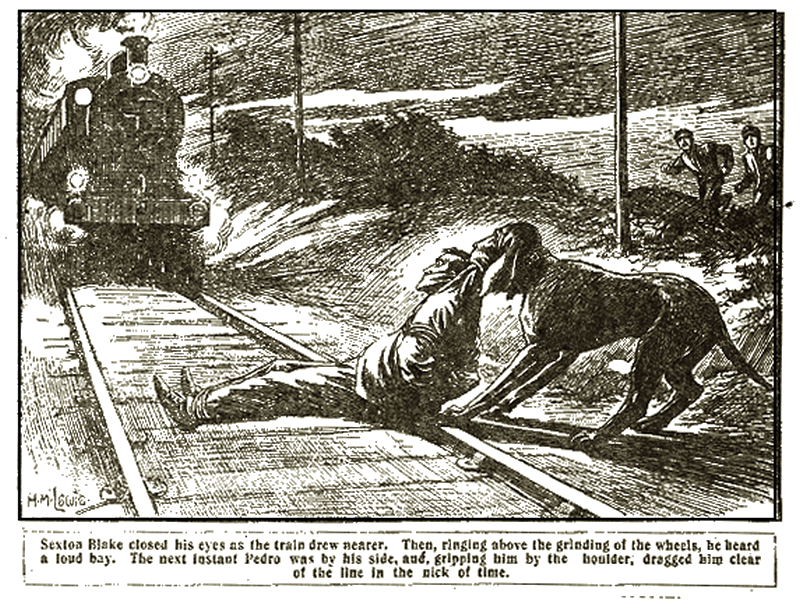
The Signal of Danger—The Chase in the Moat—Sexton Blake is knocked Out.
THE train went roaring and rattling by the spot, shaking the very earth, but Sexton Blake did not hear it. He was practically unconscious for a few moments, and when he recovered from the shock, and looked about him stupidly, he was lying on the side of the embankment, and the bloodhound was licking his face. Tinker and Claude Lestocq were kneeling by him, and the lad was pressing a flask of brandy to his lips.
"Drink this, guv'nor," he said. "It will do you good."
The detective swallowed some of the fiery spirit, and promptly felt better. He sat up, shuddering as he recalled what had happened, as he thought of his narrow escape.
"Just in time!" he muttered. "You saved me just in time! I followed Pere Antoine to that house yonder, not knowing that the Spider was behind me. They attacked me, and dragged me here. I should have been ground to death if Pedro had not—"
His voice broke, and he put his trembling arms round the faithful dog's neck.
"It was indeed a close shave, monsieur," declared the young porter. "The train all but touched you as it went by."
"Don't speak of it," said Tinker. "It is too horrible! How glad I am that we came, guv'nor! While we wore looking for you we met Paul Flamard, and he told us that you had left him. But you were not at the hotel when we got there, and that made me feel uneasy. I had a sort of a premonition that you were in danger. So I put the brandy in my pocket, and took one of your handkerchiefs, and then we hurried back to the neighbourhood of the Cave, where Pedro picked up your scent, and followed it here. When he saw the train coming he seemed to know that there was no time to lose, for he suddenly dashed ahead of us."
"When he gripped me by the shoulder I believed that we should both be killed," Sexton Blake said huskily; "and after that I remembered nothing more. But we are wasting time," he added, as he rose to his feet. "I am anxious to catch those two scoundrels, though I fear it will be useless to look for them. Moreover, they have taken my revolver from me."
"And I have left mine at the hotel," replied Tinker. "We can't do anything without weapons."
"If that little house yonder is the one in which you were trapped," said the young porter, "we saw no light there as we came by."
"Then the ruffians have probably fled, being afraid to remain in the neighbourhood," the detective answered. "But it is not certain. The old man may be at the house, and if so, the three of us should be able to capture him."
"I don't believe that anybody is there," said Claude Lestocq. "I have a plan to propose, monsieur, I wish to continue to help you in your work, and therefore I propose that you should take lodgings with Madame Lenoir, my landlady, and the mother of Fleurette. It will be a safe place for you, and we shall be together, which will be another advantage. I will give up my employments at the markets, and spend my time in searching for Pere Antoine. And I would be able to find him before long, for I know Paris well."
"That is not a bad idea," replied Sexton Blake; "but if we can get our hands on Pere Antoine tonight if may not be necessary to—"
"Hark!" interrupted Tinker. "I wonder what that means?"
During the brief conversation several peculiar whistles had been heard in the direction of Paris, and now one was heard again, nearer than before.
"I know what that means," declared the young porter. "I should have thought of it before. We are in peril, monsieur."
"In peril?" exclaimed the detective.
"Yes, I fear so, and with good reason. That peculiar whistle is a signal which is in use among the Apaches of Montmartre, many of whom live in the squalid quarter just to the south of us. Your two enemies must have seen us go by, and meanwhile, knowing that we must have rescued you, the Spider has been whistling to call some of his comrades together."
"There it goes again!" muttered Tinker.
"Yes, and I can hear footsteps," said Claude Lestocq.
There could be no doubt that the young man was right, for now, as Pedro growled, a number of dusky figures were seen approaching over the waste ground, and a moment later, as Sexton Blake and his companions darted across the railway line, shouts in the rear told that they had been seen. At once they climbed down the opposite embankment, and found themselves in the dry moat of the inner line of the fortifications that girdle the city of Paris. Here they were compelled to turn, for the wall which rose in front of them was so steep that they must have been overtaken by their foes had they wasted time in trying to scale it.
"Which way?" asked the detective.
"To the left," replied Claude Lestocq. "I think that will be best."
"But this is a trap. If we are caught here there will be no help for us. We must get out of it at the first chance."
"We shall find a way presently, monsieur."
It was a lonely place, and it was also dark, which led the fugitives to hope that they might throw their pursuers off the track, but they soon found that to be impossible, for the Apaches had also descended into the moat and turned in the same direction, uttering savage cries as they gave chase.
"If we only had weapons!" panted Tinker.
"Faster, faster!" urged the young porter. "If they come up with us we shall be killed!"
It was impossible to make any better speed, however, great as was the need of it. On the contrary, owing to the injury that Sexton Blake had received, his strength was rapidly failing, and he was soon so exhausted that he begged his companions to leave him and save themselves. Their answer, was to take him by the arms, one on each side, and thus they fairly dragged him along for two or three hundred yards, from bastion to bastion, while the hound followed at their heels, growling and snarling. A bridge with lights on it could now be seen a short distance ahead, but the hooligans, doubtless led by the Spider, were drawing nearer in the rear, yelling with rage.
"You will have to let me go," the detective said faintly.
"We'll never do that, guv'nor!' vowed the lad, "We'll pull you through somehow!"
"It is not far now," exclaimed Claude .Lestocq. — "We shall be able to get up to the boulevards yonder."
It was a perilous situation, and it appeared to he hopeless when the Apaches suddenly began to discharge their pistols.
Their aim was fortunately poor, but bullets whizzed by the fugitives as they pushed on as fast as they could through the dry ditch, and just as they came to the bridge, and saw to one side a sloping path, Sexton Blake gave a start, and stumbled heavily against the young porter.
"Are you hit?" cried Tinker.
"It is nothing!" gasped the detective. "Only a scratch, I think. Don't stop, or we are lost!"
He was in pain, and his head was swimming, but by a hard effort he kept his feet while his companions hauled hire up the steep path to the top of the moat, where they turned to the left. Beneath them was a grassy slope, and beyond it, through a gap between two tall houses, was a glimpse of street-lamps shining on pavements. But would there be safety here? The foremost of the Apaches were swarming ever the crest of the moat, firing wildly at the running figures. A bullet, pierced the young porter's cap, and another grazed Tinker's shoulder. Pedro looked back, the fur of his neck on end, and bayed angry defiance.
"They will get as yet!" exclaimed Tinker.
"We must find a place to hide," declared Claude Lestocq, "or there may be police to help us."
"Be quick!" said the detective. "You will have to put me down, or I shall—"
His voice sank to a whisper, and he was almost like a dead weight, his limbs trailing, as Lestocq and the lad dragged him on.
Closely pursued by the screeching mob of hooligans, who had no intention of giving up as yet, the weary fugitives emerged from between the houses into a wide, lonely boulevard, dimly lit. The prospect was not cheerful, for no police were in sight; but as they gazed around them, observing a few people running in terror, they heard a rumbling noise, and perceived approaching them an omnibus that was making its last trip from the northern suburbs to the city.
"There you are!" panted Tinker. "There is our chance! Only a few more yards, guv'nor!"
"Stop, stop!" shouted the young Frenchman, waving his hand. Pull up!"
The vehicle happened to be empty, and the driver, who was a brave fellow, checked his horses. as soon as he saw he what was wrong.
"All aboard for the Madeline!" he called. Move lively
"Hurry up!" urged the conductor who called. "We can't wait long!"
A moment later Claude Lestocq and the lad hoisted Sexton Blake upon the steps of the 'bus, followed by the hound; and they staggered inside, and dropped breathlessly upon the seats, Tinker cried to the conductor:
"Apaches! They are after us! Save us!"
"I'll cheat the rascals!" declared the man. "Don't you worry! Of course, there are no police about, as usual!"
The driver had already cracked his whip and shouted to the horses, which started with a heaving effort. They broke from a trot into a gallop, and as the vehicle rolled over the bridge that spanned the fortifications, and went rattling and jolting down the Avenue de St. Ouen, the swarm of hooligans ran after it as hard as they could.
For some yards they kept up with it, from a short space in the rear, and it seemed at first that they would overtake it; but presently they found that they were losing ground, and then, in their rage, they let fly with a fusillade of revolver-shots. Crack! crack, crack, crack! And as the bullets penetrated the woodwork and smashed several of the windows, the detective and his companions threw themselves to the floor of the 'bus.
When the firing ceased they rose, and on looking back they saw that the Apaches had given up the chase, and were scurrying into a side street.
"We are all right now," said Tinker, "but I wouldn't want to go through that again."
The driver and the horses had escaped injury, and the conductor had also saved himself by crouching between the doorway and the winding staircase. He stepped into the vehicle, shaking his fist in the direction of the retreating foe.
"They are regular pests, that's what they are!" he exclaimed angrily. "They ought to be killed like mad dogs. I see too much of them on this route, and only last week they shot one of my passengers in the foot. You have had a narrow escape, messieurs. They wanted to rob you of course. And now for your fares, please!" he added, in a business-like tone. "All the way to the Madeleine for thirty centimes."
"I will pay," said Sexton Blake, who was huddled on a corner, with half-shut eyes.
He thrust a shaking hand towards his pocket, and then, with a low groan, he lurched forward and slid from the seat to the floor.
In Hospital—Fresh Lodgings—Startling News.
WITH a whimper of distress Pedro stood over his master, who lay with closed eyes and pallid features; and then Tinker and the young porter knelt by him, they saw, to their surprise and consternation, that his left sleeve was soaked with blood. Having gently drawn the coat-half off, and ripped up the sleeve with a knife, they discovered that a bullet had penetrated the fleshy part of the arm above the elbow.
"Surely he is not dead!" cried Claude Lestocq.
"No, his heart is beating," replied the lad. "How he must have suffered, and how bravely he fought against pain and weakness! He told us that it was only a scratch, which was just like him."
"He has swooned from loss of blood,'" said the conductor, "and he should have proper care without delay. I advise you to have him treated at the Hospital of St Joseph. I will take you there, for it is not far out of my way."
"That will be the best thing to do," declared the young porter.
"Yes, you are right," assented Tinker, who was greatly distressed.
He took his handkerchief from his pocket, and knotted it tightly around the wound and above it, so as to check the flow of blood. Meanwhile the conductor had gone on top to speak to the driver and when he descended a few minutes later the detective was still unconscious, a few drops of brandy having failed to rouse him.
No more passengers were picked up, and in less than a quarter of an hour the omnibus turned aside into a quiet street, and stopped before the entrance of the Hospital of St. Joseph.
"Here we are!" said the conductor. "They will soon have your friend on his feet again.'
He helped to carry the wounded man into the sombre building, where, after Tinker had given a brief explanation to the house-surgeon, Sexton Blake was put on a stretcher and taken upstairs by a couple of porters. The conductor departed, and when Claude Lestocq and the lad had been kept waiting for some time in the office, the surgeon came to them, looking rather grave.
"The patient won't be able to go home with you tonight," he said. "He must be detained, for fear of complications. He has recovered his senses, but the wound has brought on fever, and there is also an injury to his head. The chances are, however, that he will be much better to-morrow."
"Can't I see him now?" asked Tinker.
"No; it is impossible," was the reply. "But you may be allowed to see him in the morning."
"Very well," said the lad. "Will you tell him, please, that he need not worry about us. Come, Pedro," he added, "we will have to go. There is no help for it."
But the bloodhound, who had been exceedingly restive, had no intention of going. One might have supposed that he had understood every word of the conversation, for he now bolted from the room and up the staircase. A moment later a low bay of distress was heard, mingled with excited voices.
"I will fetch him back!" exclaimed the surgeon. "Wait here."
He was absent for several minutes, and when he returned Pedro was not with him.
"It is impossible to remove the dog," he said. "He is by the patient's bed, and he growls when anyone tries to touch him."
"What is to be done?" inquired Tinker. "He would come with me, I think."
"You had better leave him for the present," the surgeon answered. "The patient's recovery may be the more rapid if he has the animal with him, for he appears to be greatly attached to him. It is against the rules, but I will overlook that."
This decision pleased the lad, since it had occurred to him that the Spider might learn whet had become of the detective, and attempt to kill him.
"I shall feel easier," he thought, "if Pedro is here to protect the guv'nor."
He felt much depressed, however, as he left the hospital with Claude Lestocq, who was also worried on account of the man in whose work he had taken such an interest.
They proceeded in a cab to the hotel near the Place de la Republique—the time was only a little past midnight— and when Tinker had paid the bill, he drove with his companion, and with his own and Sexton Blake's bag, to a modest house in the Rue Pernod, near the Market Halls, where he was introduced by Claude Lestocq to Madam Lenoir and her daughter Fleurette. He speedily came to terms with them, and was put in possession of two small, furnished rooms on the second floor, which was a step that he knew the detective would approve of.
"They are comfortable, if they are not luxurious," said the young porter, when the two were alone, "and I don't suppose you will mind the smell of damp clothes from the laundry. And what do you think of my little Fleurette?" he added.
"She is beautiful and charming," replied Tinker,
"Ah, I am glad you think so," said Claude Lestocq, his eyes sparkling with honest affection. "I love her dearly, and I am going to marry her some day."
"My guv'nor will help you, after all you have done for him."
"That is but little, monsieur," was the reply. "I am not too proud to accept pay, but it must not be for nothing. I will work at the Halles for one more day, and then I will devote my time to searching for Pere Antoine, if Monsieur Blake still wishes him to be found. As for the Count de Breville, how deeply I pity him! To think that his son has been lost to him for seventeen years! It is very sad."
The young man withdrew, and after tossing restlessly for an hour, Tinker fell asleep, and knew nothing more until he awoke at nine o'clock, when, having eaten the breakfast of coffee and rolls provided by Madame Lenoir, and learned that Claude had gone to the Halles, he set off to the Hospital of St. Joseph, wondering what news would be waiting for him there. It was not bad news, but it was less favourable than he had hoped it might be.
"It is not advisable that you should see your friend to-dey," said the surgeon. "He is doing well, and the wound shows signs of healing; but he had rather a bad night, and the fever is not yet broken. He is now asleep, and a long rest, without anything to excite him, will be better than medicine. The dog watches by him constantly, and is no trouble to us, so he had better remain. If you will come again to-morrow, at this hour, the patient will probably be able to leave with you."
"Is it likely that he will get any worse?" the lad inquired.
"It is most unlikely," was the reply; "but if he does I will let you know at once."
There was no more to be said. Tinker gave his address to the surgeon, and reluctantly left the hospital, feeling lonely and anxious.
"As things are now,' he told himself, "it don't look as if the Count de Breville's son would be found very soon."
ANOTHER night had passed, and the second day of Sexton Blake's sojourn in the Hospital of St. Joseph had begun.
It was between nine and ten o'clock in the morning, and he was sitting up in bed, with a couple of pillows behind him.
By his side, with a look of devotion in his eyes, was the faithful Pedro, still keeping guard over the master that he loved. Though his affection for the lad was almost as great, he had not wavered in his choice when he had to decide between the two.
There were other beds and other patients in the long ward where nurses in neat grey uniforms moved quietly to and fro, speaking in whispers. Vases of flowers and a few pictures on the walls helped to relieve the air of gloom. Now and then was heard a groan of pain, and through the windows floated the noise of traffic from a boulevard that was not far off.
The detective was much better, and he was taking an interest in his surroundings, studying a phase of Paris life—the darker side of it—that was not familiar to him. His wound was healing, and the fever was gone; but he was still weak, and the surgeon had informed him that he must remain until the following day. That had depressed him at first, for he was impatient to go on with his difficult and dangerous quest; but he was now in more cheerful spirits, and looking forward to the arrival of Tinker, having been told that the lad might be expected in the course of the morning.
"He will soon come, Pedro," he said, as he stroked the dog's head. "Your young master will soon be with us."
The hound wagged his tail, and at the same time he uttered a low whimper, as if something troubled him. He had been restless, indeed, since the previous evening, and Sexton Blake had supposed his own illness to be the cause of it. Half an hour wore by, and then, accompanied by the surgeon, Claude Lestocq entered the ward and approached the bed.
"Good morning, monsieur!" he said cheerfully. "I am glad to find that you have taken a turn for the better again. When I learned that you were worse—"
"I am getting on all right," broke in the detective. In fact, I have been making steady progress. But how is it that you are alone? Where is Tinker?"
"Where is he?" the young porter exclaimed, in surprise. "That is a strange question to ask! I expected to find Monsieur Tinker here, of course. Where else would he be?"
"But I have seen nothing of him. He has not been here."
"How can that be possible, monsieur? He was summoned to the hospital last evening by an urgent message—"
"No message was sent from here," interrupted the surgeon. "I can assure you of that."
A ghastly fear gripped Sexton Blake's heart. A wild look came into his eyes, and he turned almost as white as the pillows behind him.
"Tell me!" he gasped. "Tell me all!"
A nurse stepped hastily to the bedside, and the surgeon frowned.
"This won't do," he said; "the patient must not be excited."
"I—I am not excited!" the detective answered, clutching at his throat. "I am quite calm. You must let this young fellow speak. I will hear him!"
The surgeon hesitated, and then nodded to Claude Lestocq, who, himself greatly agitated, sat down on the edge of the bed.
"There is not much to tell you, monsieur," he said. "I worked at the Halles during yesterday, as usual, and in the evening, instead of going to my lodgings—you must know that Monsieur Tinker also procured lodgings there the night before last—I went to a wineshop in the Villette quarter, where I had an idea I might find Pere Antoine. But he was not there, so I returned home long after midnight and went to bed, and when I rose this morning I heard from Madame Lenoir of what had happened. It seems that just after dark last evening a hospital porter came to the house to say that you had suddenly taken a turn for the worse, and Monsieur Tinker at once departed with him, as was natural. As soon as I learned of this I came here to inquire."
"By heavens, it was a trick!" cried Sexton Blake. "I can understand it. Pere Antoine or the Spider must have learned in some way—probably from the driver or conductor of the omnibus—that I had been taken here. One of the scoundrels set a watch on the hospital, saw and recognised Tinker when he called here yesterday morning, and followed him to the Rue Pernod. The rest was easy. A uniform was procured, and one of the Spider's band of Apaches was paid to impersonate a hospital porter, and deceive the boy by a lying message."
"No doubt, you are right, monsieur!" exclaimed Claude Lestocq. "Ah, this is terrible! But what does it mean?"
"Yes, what does it mean? I don't know, I cannot guess!Why have they enticed Tinker into their power? If they had intended to kill him they could hardly have taken the trouble to—"
"Monsieur, this is very bad for you," broke in the surgeon. "It will make you worse. I cannot allow you to excite yourself."
"But you do not understand!" the detective cried hoarsely. "I am no longer ill! I am quite strong! Fetch me my clothes! I must leave at once, to search for my poor boy! I cannot lie here while his life is in peril! Those scoundrels may—"
As he spoke he tried to rise, but the surgeon and the nurse promptly seized him, protesting earnestly, and a brief struggle ensued. And now Pedro showed intelligence that was almost human, apparently realising that his master ought to be prevented from leaving the hospital. He whined with distress, and growled several times, but made no attempt to interfere.
Having fought for a few moments, begging to be released, Sexton Blake was forced back on the pillows, utterly exhausted; and as he lay there, panting for breath, with the hound licking his face, the young porter bent over him.
"Cheer up, monsieur," he said. 'I will help you. I well know the hiding-places of the Apaches of Montmartre, and I will find and rescue Monsieur Tinker. I will save him from the clutches of the Spider."
"How can you hope to do that?" gasped the detective.
"With courage I will succeed," was the reply. "Trust to me, Monsieur Blake."
"You had better go," whispered the surgeon, touching the young man on the arm.
"Yes, it will be for the best," said Claude Lestocq; and, with a glance of sympathy at the patient, he left the ward.
Tinker's Discovery—The Den of Apaches—The Spider's Threat.
THE reader can imagine what a shock it was to Tinker when, as he was sitting in his room on the evening previous to the young porter's visit to the Hospital of St. Joseph, Madame Lenoir knocked at the door, and came in to tell him that Sexton Blake had suddenly grown worse, and that a messenger had called to take him to the hospital. At once the lad put on his hat, and hastened downstairs, to find a cab waiting for him in the Rue Pernod. It was not an ordinary cab, nor was the driver a regular cabman; but the man inside wore a plain uniform, such as is seen on hospital porters, and therefore it never occurred to Tinker to suspect any treachery. He stepped into the vehicle, and as the horse set off at a trot he turned to his companion, who was a clean-shaved youth, with rather unpleasant features.
"Is the patient very bad?" he inquired.
"I cannot tell you that, monsieur," was the reply. "I only know that he is worse, and that the surgeon sent me to fetch you."
"But he was doing well this morning."
"Ah, that may be, monsieur."
No more was said. Fairly familiar though he was with Paris, the lad did not at first perceive what course the cab was taking, nor did he observe that the messenger was watching him narrowly. His thoughts were gloomy and distracting, and for a time he sat in silence, knowing that Sexton Blake must be dangerously ill, and fearing that he might die. But at length, lifting his eyes, he saw that he was passing the Lycée Charlemagne, which he knew to be in the very opposite direction from the Hospital of St. Joseph. Then the truth flashed upon him. Then quickly, with a sensation of horror, he realised that he was in danger, that he had been deceived. At once he suspected that Pere Antoine or the Spider was at the bottom of the trick, and his immediate impulse was to jump out of the vehicle, fast though it was going; but before he could make the leap a blunt weapon rapped him on the head, and at the same time the supposed porter seized him by the throat, and pressed against his mouth nostrils a cloth that was saturated with some pungent, odourless drug.
Partly stunned as he was by the blow, Tinker could offer no resistance whatever to his wiry young assailant. With every breath he inhaled the fumes of the drug, and very soon his limbs relaxed, and he sank buck unconscious on the seat, a helpless victim of treachery.
Nobody had observed the brief struggle, for the hood of the vehicle was raised, and it was a dark neighbourhood. It had probably been chosen, indeed, as a suitable spot for the ruffian's purpose. The cab rattled on through a few quiet streets, and thence to the opposite side of the Boulevard Bourdon, which skirts the strip of water known as the Basin of the Arsenal, a sort of dock that joins the river at one end and the Canal of St. Martin at the other.
Here the lad was quickly lowered down from the quay to a boat that was waiting, and a moment later the driver of the vehicle, which had been in such a position as to hide what was being done, turned his horse around and drove rapidly away. It was a daring deed, the removal of the prisoner from the cab at the edge of a lighted boulevard; but in Paris almost all things are possible. In no other city of the world does crime flourish with such impunity.
"Did he give you any trouble, Jacques?" asked one of the five villainous-looking youths who had been waiting with the boat.
"Not much," replied he who had impersonated the porter. "He came like a lamb until he discovered that he was going in the wrong direction, and then I was ready for him."
Tinker's arms having been bound, and a dirty handkerchief stuffed into his mouth, a tarpaulin was thrown over him. The graft was now moving down the Basin, and when it had glided under the Pont Morland into the Seine, where the lights of Paris made a beautiful picture—in both directions, the two Apaches who were at the oars pulled up and across the river, towards the Isle of St. Louis, until the boat touched the high granite wall of the Quai Bernard, some distance below the Pont Sully. It slid on for a few yards in deep shadow, and then, while one of the occupants gripped an iron ring and held the craft fast, another bore his weight against the wall. A grating noise was heard, and one of the apparently solid blocks of granite, which was really but a thin slab, moved aside with the pressure, and disclosed an opening about three feet square.
The tarpaulin was now lifted from Tinker, who had meanwhile recovered consciousness, and with it a clear remembrance of what had happened. The blow had not been a hard one, and the drug had left scarcely any unpleasant effects. He had a glimpse of his companions and of the wall that towered above him, of the lights of Paris, that flashed along the quays up and down the Seine; but he had no chance to identify the locality, for almost at once be was seized by two of the Apaches, and thrust into the opening in the wall, where, after he had been pushed forward for a few yards, he was able to stand erect.
"Good-bye. Jacques!" said one of the four youths who remained in the boat. "Give our regards to the Spider, and tell him that we wish him luck. This is all right for a hiding-place, but he will soon get tired of it."
"It won't be his fault if he is here much longer," was the reply. "He has had enough of it already."
The boat moved of with a faint splashing of oars, and when the opening had been closed with the slab of stone, the two Apaches grasped Tinker by the arms. He was first led for some distance along a level, and then he began to ascend as flight of steps that felt as if they had been cut out of hard earth. Though he was curious to know where he was going, and was also badly frightened, it cheered him somewhat to think that the message had been a lie, and that Sexton Blake was probably doing well at the hospital.
"Dear old guv'nor!" he said to himself. "I am glad he is all right! No doubt he will be out to-morrow, and then he will begin to search for me. But I can't imagine why the Spider and Pere Antoine have had this done, if they are at the bottom of it. Would they have had me brought here to be killed, when I might have been knocked on the head and thrown into the river? I can hardly believe it."
He did not have much time for conjecture. When he had reached the top of the steps—his captors seemed to know the way well in the dark—he was guided along another level passage, and then, turning sharply to the left, he saw close in front of him an arched doorway that was outlined dimly by a reflected light beyond it. One of the youths now gave a low whistle, which was immediately answered, and a moment later, when Tinker had been pushed through the doorway, he saw to the right of it a scene that was calculated to arouse his worst apprehensions.
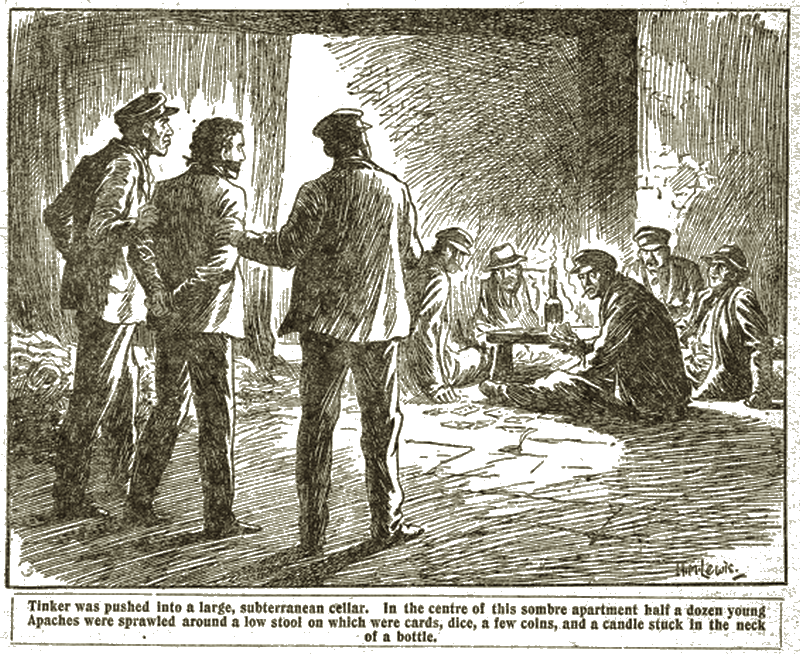
At a brief glance his eye took in most of the details. He had entered a large chamber, evidently a subterranean one, that was much like a cellar. The ceiling was of hard earth, but the walls were partly of masonry, and the floor was paved with slabs of stone that had been worn smooth. In the farthest corner was a curtain of sacking, from behind which shone a light, and in the middle of the sombre apartment half a dozen young Apaches, who had the most brutal and repulsive faces that can possibly be imagined, were sprawled on heaps of straw around a low stool on which were cards and dice, a few coins, and a candle stuck in the neck of a bottle. At two sides of the room, ranged along the walls, were straw pallets, on which were spread some greasy blankets; and on a third side, behind the group at the stool, was a disorderly pile of vegetables and fruits, loaves of bread, tinned meats, drinking-cups, and bottles of wine and absinthe.
The two new arrivals greeted their comrades, and when the latter had spoken a few words, and had stared curiously at Tinker, they shoved him roughly down on one of the straw pallets, with his back against the wall. The lad had meanwhile observed his surroundings, and he knew that he must be somewhere underground, though he had no idea in what part of Paris it was. As a matter of fact, to enlighten the reader, these passages and steps led for a considerable distance beneath the Quai St. Bernard, and the chambers—there were two of them—were close under the great bonded warehouses known as the Halle aux Vins, where hundreds of thousands of casks of wine are stored in buildings separated by little streets that bear the names of the different vintages, the whole immense area being enclosed by a wall.
As for the subterranean excavations, their origin was shrouded in mystery. They had probably been made before the Revolution, and in later days they had been discovered by a band of thieves, the last survivor of whom, after his comrades had all died, or been sent to penal servitude in New Caledonia, had revealed the secret entrance to the Montmartre gang of Apaches. It was not a place that they cared to live in, naturally, but they had found it very useful on more than one occasion, when some of their number were compelled to vanish from their regular haunts, and hide for a time from the police.
Tinker easily guessed that such was the object to which the place was put, though he could not imagine why he had been brought here. He puzzled over the question for a few moments, with increasing anxiety; and then, as the curtain was lifted, the Spider stepped out of the adjoining apartment, followed by Pere Antoine. They squatted down on the straw, immediately in front of the prisoner, and regarded him with ferocious scowls, nodding to each other.
"You have done well," the Spider said, to the youth Jacques. "This is the fellow I wanted. Are you sure that you covered your tracks?" he added.
"You may be sure of that," was the reply. "There is no fear of discovery."
The one-eyed old ruffian took the gag from Tinker's mouth; and viciously pinched his arm.
"Ah, you whelp!" he croaked, leering horribly. "You young fox, who have helped the British detective! I wish I could do what I liked with you. I would slit your throat, and cut off your limbs one by one, and feed them the fishes. It is not well to make an enemy of Pere Antoine, as you may yet learn to your—"
"Come, don't frighten him!" the Spider broke in sullenly.
"You know what he is here for, and it is as much to your advantage as mine that we should take good care of him. It will be the worse for us if we have to kill him, eh?"
"Yes, that is true!" muttered the old man. "Are you afraid to die, mon garcon?" he inquired of the captive.
"No, I am not afraid," Tinker answered boldly. "You won't dare to harm me, for if you do Monsieur Blake will see to it that you are sent to the guillotine."
"Bah, there is no guillotine in these days!" sneered Pere Antoine.
The Spider lighted a cigarette, and puffed a cloud of foul smoke in the lad's face.
"I am going to have a sensible talk with you," he said, trying to look pleasant. "Tell me, are you the son of this British detective?"
"No; I am not," Tinker replied.
"But he cares as much for you as if you were his son?"
"Yes; that is true."
"And he would do anything to save your life?"
"That depends on what it was."
"Well, the situation is like this," said the Spider. "As you know, Monsieur Blake has been making things warm for us, and Monsieur Paul Flamard is also playing the same game, so that Pere Antoine and myself, with a few trusty comrades have been forced to hide here from the police, which is not pleasant. You must understand, then, that it is for our own benefit that we have got you into our power. We might kill you, and Monsieur Blake, and the French detective as well, but we should still have to keep in hiding. Therefore, since we wish to return to Montmartre, and to able to go about as we please, we intend to demand of Monsieur Blake that he should do certain things which will permit us to leave our hiding-place. If he consents, and keeps his word, you will be set free. If he refuses, you will be at once put to death, and he will shortly meet with the same fate. It is not likely, however, that he will refuse."
"You will find that he will," declared Tinker. "I am sure that nothing will induce him to drop the work which he is—"
He paused, realising that he had spoken imprudently, and for a moment, he feared that he would be murdered then and there. The two scoundrels glared at him, their features distorted with passion, and Pere Antoine whipped out a knife.
"I told you so!" he snarled. "The boy is right. We may as well finish him, and be done with it!"
"No; not yet," said the Spider. "Put that weapon down, and listen to me. How should the boy know what his friend will do? We will give Monsieur Blake a chance, and I believe that he will be glad enough to come to terms with us when he understands what refusal will mean."
"I won't wait more than two days," vowed the old man, with an oath, as he reluctantly put the knife into his pocket.
"We shall have an answer in two days," replied the Spider; "but it is necessary to find somebody to act for us. Ah, I have it! Who could be better than Puvis Lavalette? He is a clever fellow, and he can write a better letter than I can. I will send Jacques off in the morning to arrange matters with him."
"And if the plan fails?"
"Then you shall have the pleasure of sticking your knife into the boy, and we will lose no time in—"
The Spider did not finish the sentence. He withdrew behind the curtain, followed by Pere Antoine; and Tinker was left to his dismal reflections, and to the company of the eight young Apaches, who glanced at him for a moment, and then began to play cards and drink,absinthe. The light from the guttering candle shone on their evil faces, and the vilest of Parisian argot (slang) fell from their lips.
"I could not be in a worse scrape," the lad said to himself, as he watched the repulsive scene. "Though I am sure that the guv'nor would not give up his task, even for my sake, he may pretend to agree to the demands of these ruffians, on the chance of being able to find and rescue me. But it is not likely that he can do that, for they will be too sharp for him. No; I am afraid there is no hope. I must prepare for the worst, unless I can find a means of escape, and I don't see how that will be possible."
Days of Searching—The Chance That Was Lost—A Visit to the Morgue.
IT was on a Friday evening that Tinker fell into the trap, and on the following morning, it will be remembered, Claude Lestocq brought the startling news to the detective, who was for a time almost prostrated by it. But it was not in his nature to yield to despair, or to admit that there was any difficulty which could baffle him.
However, before he had recovered from a exhaustion brought on by his struggle to escape, an opiate was administered to him in a glass of milk without his knowledge. He at once fell asleep, and when he awoke—late on that Saturday afternoon—he made such an earnest appeal to the surgeon that the latter consented to let him go.
"You are very foolish, monsieur," he said; "but, I perceive that to detain you any longer will do you more harm than good."
So Sexton Blake's clothes were given to him; and when he left the Hospital of St. Joseph, still weak and with his wounded arm in bandages, he drank some brandy at a café, and then drove in a cab to the house in the Rue Pernod, where there was no cheering news for him. The young porter had come back from the hospital, and had then disguised himself and departed again, leaving word that he might not return for a day or two.
"Claude bade me tell you, monsieur said Mademoiselle Fleurette, "that you were to trust in him and hope for the best."
Was there any ground for hope, apart from Claude Lestocq's promise? On consideration, it appeared that there was. Though it did not occur to the detective what might be the object of the mysterious abduction—he was so agitated that his brain was not equal to deductive work—he felt that the circumstances warranted him in believing that Tinker's life might not be in immediate danger.
His first impulse, therefore, was to try to discover the place to which the lad had been taken. "Having disguised himself, he went to the Prefecture of Police, made a statement there, and got a list of various cafés and dives frequented by the Apaches of Montmartre. In the course of the evening he visited a number of them without result; and late on Saturday night, when he returned to the Rue Pernod, he found that the young porter had not been back.
The next morning Claude Lestocq was still missing; and when Sexton Blake had forced himself to eat some breakfast he set off again, leaving Pedro in the care of his landlady. He had slept for a few hours, and was much stronger, though his anxiety had increased. We need not follow him on his wanderings, or describe more than briefly what happened to him.
Having gone a second time to the Prefecture of Police— no news awaited him there—he spent all Sunday, disguised as a vagrant, among the slums of Paris, seeking for Pere Antoine and the Spider. And that night, while sitting among criminals in a vile den in the Belleville quarter, a deathly faintness suddenly came over him, and he reeled to the floor.
A drug had been put into the wine he was drinking; and when he recovered from the effects of it—after sunrise, on Monday morning—he was lying in a squalid alley, with his pockets turned inside out. He knew that he was fortunate to have escaped with his life; and there was the more reason for congratulation when he found, in the lining of one of his pockets, a gold coin that the thieves had overlooked.
Instead of now returning to the Rue Pernod, on the chance that Claude Lestocq might be waiting there for him with some information, the detective concluded to go on with his quest, feeling that every hour was precious. His amazing vitality enabled him to do this. He ate some breakfast at a café, washing it down with some brandy-and-water, and until late in the afternoon he went from place to place, without getting on the track of those for whom he was seeking. He then made his way back to the Rue Pernod; nearly distracted with grief, and found the landlady and daughter in tears.
"What is the matter?" he demanded, drinking heavily down on a chair.
"Poor Claude!" cried Madame Lenoir, wringing her hands. "What can have become of him?"
"He has not returned, monsieur!" sobbed little Fleurette. "We fear the worst!"
"Ha has surely been killed by the Apaches!"
"Alas, we shall never see him again!"
"But this is foolish!" said the detective. "There is no occasion for such distress. Did not the young man tell you that he might be absent for several days?"
"Yes; that is true," assented Madame Lenoir, wiping her eyes with her apron. "It is a long time, however. He could not have meant to be away from Saturday till Monday. Ah! but I am forgetting that there is a letter for you, monsieur.'
"A letter?" exclaimed Sexton Blake.
"Yes; here it is. It came yesterday morning, shortly after you had gone."
An envelope, marked private, was handed to the detective. He tore it open, drew out a dirty sheet of paper, and read the following:
"To monsieur Blake, from one who means business. You must know, monsieur, that your boy is my prisoner, and that it rests with you to save his life. You will understand, without many words, what it is we require of you, speaking for Pere Antoine and myself. You must compel Monsieur Flamard to give you his solemn oath that he will in future make no attempt to arrest either of us—surely it is in your power to do this—and you must also swear that you will abandon the case on which you have been working, and return to London, leaving us in peace.
"If you agree to our demands, the boy will at once be set free; but if you refuse, he will be put to death! Should you be willing to deal with us, and to arrange the particulars of the matter, be at the Café Blanche, in the Montmartre Quarter, at nine o'clock tonight, and a friend of mine will meet you there. Be sure that you come alone, and that you do not consult the police in the meantime, for your movements will be watched. If you do not come, the boy will be dead before morning, and you will find his body in the river! And it will not be long until you follow him to another world. This is from the Spider, who is not to be trifled with."
Sexton Blake crushed the letter in a trembling hand, and swayed against the table, ghastly pale. The threatening words seemed to have burnt into his brain, as if branded with a hot iron. What he might have done under the circumstances, what weakness he might have been tempted to yield to, for the lad's sake—that could make no difference now.
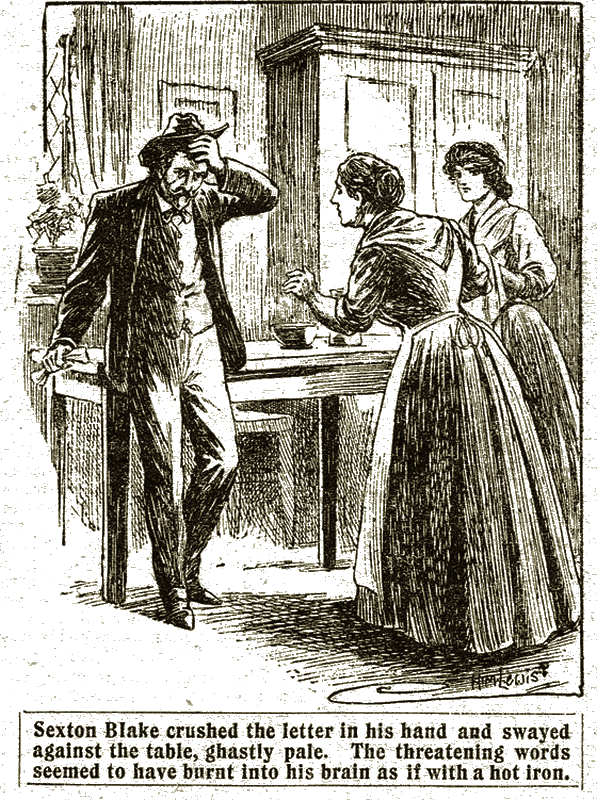
"The letter had been written yesterday—early on Sunday morning—and this was Monday evening. The appointment was for last night, nearly twenty-four hours ago. The Spider's emissary must have waited and gone, believing that the terms had been contemptuously rejected; and it was almost certain that the Apache chief, in his rage, had kept his word and put Tinker to death. Yes; he would have done that. No reprieve, no further offer, could have been expected. Sickening visions filled the detective's mind. His thoughts were maddening.
"If I had only come before!" he groaned. "If I had only returned yesterday! But now it is too late—too late! Ah, the pity of it!"
"Monsieur is ill!" cried Madame Lenoir.
"I will fetch him a glass of water," said Fleurette, who was still sobbing for her lover. "Wait but a moment, monsieur."
"No, no; I want nothing, mademoiselle!" gasped Sexton Blake. "I—I have had bad news. I must be off at once."
"Where would monsieur go?" asked the landlady.
"To the Morgue. Yes; I must go there."
"To the Morgue?" shrieked Madame Lenoir, as she threw her arms around her daughter. "Alas, he would seek for the body of poor Claude!"
"He is dead!" screamed little Fleurette. "I knew it!"
The detective had dashed out of the house, leaving the letter lying on the floor. He paused on the pavement, pressing his hands to his throbbing temples, and looking about him stupidly. An empty cab came by, and he found himself seated in it, vaguely remembering that he had told the driver where to take him.
"It is a dream!" he muttered. "I shall wake up presently."
But he know that it was not a dream, and in his anguish he dug his nails into his palms. The day was over, and the purple dusk of evening was shrouding the streets with mystic beauty. Paris—queen of cities, and goddess of pleasure—was radiantly lovely with her flashing lights; speaking with the voices of the happy, merry crowds that thronged the pavements; laughing and bubbling and frothing; yet Sexton Blake was blind to her charms, deaf to her caressing sounds. He sat staring straight before him, seeing visions that he could not banish. He tried to hope, but the thought of one hideous thing—the spectre of what he expected to find—drove hope from his heart.
"I have nothing left to live for," he said to himself— "nothing but vengeance! The Count de Breville is happier than I."
The horse trotted swiftly on, and street after street whirled by. How beautiful Paris was, and how mocking to one in distress! The cab rattled across the Pont au Change to the Isle of the Cite, bore to the left along the Quai aux Fleurs, and stopped in front of a low building.
"The Morgue, monsieur," said the driver, turning round.
Sexton Blake shuddered at the words. He slowly got out of the vehicle and paid the man; and very slowly, with timid, hesitating steps, he entered the building, not doubting what he should find there. He stopped, feeling unable to go any farther; and then, overcoming his reluctance by a hard effort, he advanced to a large glass partition, thankful that he was alone.
A mist swam before his eyes, and when it had passed he caught his breath. In full view behind the glass, stretched on sloping slabs of white marble, were a number of human bodies that had been frozen in a refrigerator before being laid out here to be identified by the public!
It was a sad sight, on which nobody could have gazed unmoved, Here were the unfortunate waifs of Paris, victims of self-destruction, or perhaps of murder—between seven and eight hundred of them pass through the Morgue each year—who had been found floating in the river. They had been made as life-like as possible, so that they might be recognised by relatives or friends, and their clothing had been carefully arranged, The detective looked at the first figure. It was that of an old woman of the working-class, with toil-worn hands neatly folded, and side by side with her was a youth with bruised features and a gash on his cheek. Next was a middle-aged man in a blue blouse, whose attitude suggested sleep. Then came a young girl in tawdry finery, a negro with thick lips and short, woolly hair, and an old man with a white moustache and imperial, on whose dignified face, with its calm repose, there seemed to be a reflection of the pride he had once felt in the red ribbon of the Legion of Honour that was pinned on his breast.
And next—but there were no more. Sexton Blake's eyes, moving farther, perceived only the empty surface of the marble. He had seen all the bodies, and he knew now that Tinker was not there. A wave of gratitude surged to his heart, to be succeeded by a chill of depression. No, he still dared not hope.
"They have not found him yet; it is too soon," he told himself. "I must come again!"
He turned gladly from the gruesome spectacle, and his heavy, leaden feet, carried him through the portals of death into the fresh, cooling breeze that blew from the Seine. He paused, uncertain which way to turn, and watched a cab that was rattling swiftly towards him. It stopped with a jerk, the door was flung open, and a familiar figure sprang to the pavement. It was Claude Lestocq, and his face was flushed with excitement as he clapped the detective on the shoulder with one hand, and in the other waved a letter.
"Ah, so here you are!" he cried. "I thought I should overtake you. Your visit has been fruitless, of course. I have read the letter, and I know all! And I tell you, monsieur, that I have found him!"
"What letter?" exclaimed Sexton Blake. And whom have you found? Surely it is not—"
"Yes, yes, monsieur, it is the boy!" broke in the young porter. "That is, I am certain that I know where he is concealed!"
Everything seemed to the detective to be swimming around him. For a few seconds the words rang confusedly in his ears, and then he clutched Claude Lestocq by the arm and drew him over against the wall of the Morgue.
"Tell me," he gasped—"tell me all! Is there really hope?"
"Why should there not be?" said the young man. "But wait until you have heard my story, and judge for yourself. I will make it brief, monsieur, since you are in suspense. Let it be sufficient for me to tell you that for three days and three nights—ever since Friday—I have been living in disguise among the Apaches of Montmartre, eating with them, sleeping with them, drinking with them, and pretending to be one of themselves. It was weary work, as well as dangerous, and I was afraid at first that I should fail. Though there was one youth named Baltazar who had taken a sort of a fancy to me, he was very close-mouthed, and I tried in vain to get information from him. But this afternoon, after he had drunk more absinthe than was good for him, his tongue became loosened, and he made statements that caused my heart to leap for joy. I shipped away on some pretext, hastened to the Rue Pernod, found Madame Lenoir and Fleurette weeping for my supposed death, read the letter that you had dropped on the floor, learned that you had gone to the Morgue, and came after you as fast as I could!"
"But what is this information that you have gained?"
"It amounts to this, monsieur, to explain to you in a few words. Being in fear of yourself, and also of Monsieur Paul Flamard, the Spider and Pere Antoine, and a number of the Spider's most trusty friends, have been hiding for some days in a safe retreat that has been known to them for years. It is a sort of a cave, deep under the Quai St. Bernard, and the entrance is by water, from the river. There is a slab of stone in the wall of the quay which moves when it is pressed hard—there is a mark by which one can tell it—and then there are passages and steps that lead to a couple of chambers. And Monsieur Tinker is there, it cannot be doubted!"
"He must have been taken there," the detective said hoarsely; "but is he still there? Is he still alive? You have read the Spider's letter, and you know what he threatened to do if I failed to keep the appointment, of which I had no knowledge until a few minutes ago. Can we believe, then, that the boy is alive?"
"I have reason to believe that he is, and I will tell you why," replied Claude Lestocq. "It appears, from what I further learned from the youth Baltazar, that the Spider and Pere Antoine have some work on hand which has no connection with yourself or Monsieur Tinker. Yesterday morning an Apache brought a message to the old man, and shortly afterwards he and the Spider left their hiding-place, in disguise. They spent last night in the Montmartre quarter, and they were seen there at a late hour this afternoon. It is supposed that they intend to help some criminal of their acquaintance to commit a big robbery, and therefore I imagine that they have not as yet done any harm to the boy, since they may have left their retreat before they knew that you had failed to keep the appointment at the Café Blanche. Moreover, it is not likely that they will go back until to-morrow."
"Did Baltazar have any knowledge of Tinker?"
"I think not, monsieur, or he would have spoken of him. Those who were concerned in the boy's abduction must have kept it a secret from the rest of the gang."
What was to be inferred from these statements? Had the Spider carried out his threat? Had Tinker been put to death, or was he still alive? If he had been murdered yesterday morning his body would probably have been thrown into the Seine, and it should have found its way to the Morgue by now. This occurred to Sexton Blake, and ne felt that there was at least a ray of hope.
"It is possible that the boy is alive," he said, "and if so he must be rescued at once, before Pere Antoine and the Spider return. Every second is precious."
"Ah, that is true!" declared Claude Lestocq "I will at once guide the police to the hiding-place. Such was my intention."
"My brave fellow, how can I thank you? You shall be rewarded as you deserve! You shall marry Fleurette, and I will give you a start in life."
"That is kind of you, yet it is not for the sake of a reward that I wish to save Monsieur Tinker from death. But it will not be an easy task, and therefore I will tell you what I had better do. I will go first through the hole in the wall, and creep up to the chamber where the boy is, so that I may have a chance to protect him if the Apaches should try to kill him before you arrive with the police. If I am discovered, I will pretend that I am one of them, and that I have come with a message."
"That is a good plan," said the detective. "Is there only the one exit from the place?" he added.
"Yes, so far as I know," replied the young porter.
"Well, let us be quick. But wait! Yonder stands an empty cab. Hasten to the Rue Pernod and come back as fast as you can, bringing Pedro with you, and also two loaded revolvers that you will find in my room. Join me at the Prefecture of Police."
"Very good, monsieur, I go at once."
And a moment later Claude Lestocq was speeding away in the cab, while Sexton Blake was walking rapidly towards the police headquarters, which were on the Isle de la Cite, and within a short distance of the Morgue.
"What will the end be?" he said to himself, in his harrowing suspense. "What will the next hour bring forth? Has Tinker been foully murdered, or shall I find him alive? I pray Heaven that I may be in time to save him!"
Bursting into the Prefecture of Police, panting and excited, he found Paul Flamard there, and told his thrilling story in a few words. And not long afterwards, when the rescue-party were ready to start, the young porter arrived in a cab with the bloodhound, who seemed to understand, as he sprang joyously upon his master, that he was going to seek for the missing lad.
A Premature Alarm—How Claude Saved the Prisoner—A Startling Theory.
IT was quite true, as Claude Lestocq had suggested, that certain events of a mysterious nature had so far saved Tinker from his threatened fate, though he had been a prisoner for three days and three nights, with no opportunity of escape. He had been brought to the subterranean chambers on Friday evening, and on the following Sunday morning, after the arrival of an Apache messenger, the Spider and Pere Antoine had disguised themselves carefully, and left the hiding-place The lad supposed that their departure had something to do with the negotiations with Sexton Blake, but he was wrong. The Spider was not then aware of the fact that the detective had not kept the appointment at the Café Blanche, but he evidently learned that during his absence, for when he returned on Monday evening, without Pere Antoine, he spoke a few low words to his comrades, and then strode over to the captive.
"Your friend Monsieur Blake cares nothing for your life," he said, scowling ferociously, "for he has refused to have any dealings with us, I swore to kill you if that plan failed, and I shall have to keep my word."
He had drawn a knife, and for a few seconds, as the young ruffian felt the edge of the steel, Tinker was speechless with terror, believing that his last moment had come. But the Spider hesitated—not from any merciful motive— and at length he put the weapon back in his pocket.
"No, I won't do it now," he muttered, with an oath.
"You shall live a little longer, for if I were to kill you at once your body would have to be dropped into the river—my comrades would not want it to lie here—and it is too early in the evening for that. Moreover, it is possible that the British detective did not get my letter, and that he may yet come to terms, But that is a matter for the future, I have a job on hand for tonight that will fill my pockets with gold, and thus, if your friend is not willing to buy your life, Pere Antoine and I will be able to live in luxury in some other part of the country, far from Paris. Yes, we will hide for a time, but first we will kill you and Monsieur Blake, and Paul Flamard as well. You can be sure of that!"
It was only a few moments ago that the Spider had spoken these words, and he had then retired behind the curtain to the inner apartment, no doubt to prepare for his undertaking. And now, while the detective and his companions were embarking in a boat off one of the quays of the Isle de la Cite, and the eight Apaches in the outer chamber were as usual playing cards and drinking absinthe, Tinker was lying on a damp pallet of straw, bound hand and foot.
Three days and three nights of captivity and suspense! The time had seemed like an eternity to him, and he was in the lowest of spirits. He had been reprieved, it is true, but there was no comfort in what the Spider had told him.
"The guv'nor is doing his best to find me, of course," he said to himself, "but there is not a chance in a thousand that he will succeed. As for his coming to terms with these scoundrels, I am sure that he won't consent to do that, for it would mean that he would have to give up looking for the Count de Breville's son. No, there Is no use in hoping. I shall be killed in the end, that is almost certain."
A few minutes were on, while the gamblers drank their vile liquor, and shuffled the greasy cards, and filled the outer chamber with foul tobacco smoke and fouler language. They were intent on the game, and as the lad's face was turned towards them, neither he nor they observed a dusky figure that had appeared in the open doorway. It hesitated for a few seconds, and then, creeping on hands and knees, it moved forward inch by inch, keeping close to the wall, until it was in the dark shadow immediately behind Tinker, who did not even hear the straw rustle.
Several more minutes elapsed, and then came a startling interruption to the game. From somewhere in the subterranean passage, beyond the flight of steps that descended towards the river, floated a dull sound as if somebody had fallen, followed by the muffled report of a revolver, and a loud, deep-throated bay that caused the lad's heart to throb wildly, telling him that Sexton Blake and the bloodhound must be near by. And the next instant, as the curtain was torn aside, the Spider appeared from the inner apartment; his face as white as those of his comrades, who had at once leapt to their feet.
"The police?" he cried. "We are betrayed! The British detective must be coming!"
"Then we must be off!" exclaimed one of the others. "We have time to escape by the upper end!"
"Not until I have killed this fellow!" vowed the Spider.
"They sha'n't take him alive, I swear!"
"Help, help!" shouted Tinker. "Help, guv'nor! Be quick!"
Voices responded from a distance, and again was heard the dog's angry bay, almost drowned by a clamour of yells and curses. Some of the frightened ruffians had turned to flee, but the Spider drew a knife and sprang at the lad, who had given himself up for lost when, to his surprise and joy, Claude Lestocq sprang suddenly in front of him, and levelled a pistol at the would-be assassin.
"Stand back, you scoundrel!" he cried. "If you dare to touch him I will shoot you!"
"It is that sneak Lestocq, from the Halles!" raved the youth Jacques, recognising the young porter in spite of his altered features. "We must pay him for this!"
The Spider drew back, snarling with rage, and pulled a revolver from his pocket. Meanwhile a couple of his comrades had whipped out pistols, and one of them fired at Claude Lestocq, who was still holding the Spider at bay. The ball grazed his head, and the next instant, as he was about to discharge his weapon, one of the Apaches knocked the stool over, with the result that the candle was extinguished and the room plunged in darkness, fortunately for Tinker and his rescuer. A knife hissed by them, and they saw the flash of two revolver-shots.
"We are coming, Lestocq!" a familiar voice shouted. "Do your best!"
"Run for it!" cried the Spider. "We'll have our revenge at another time! Follow me comrades; you know the way!"
The danger was over, thanks to the brave young porter. For a few seconds there was a clamour of threats and curses, yells of terror, mingled with the scuffling sounds of retreat; and then, as rapid footsteps were heard and a glimmer of light appeared, Pedro bounded into the outer chamber, closely followed by the detective, Paul Flamard, and seven sergents-de-ville, two or three of whom carried lanterns. Already Claude Lestocq had cut the fetters of the prisoner, who staggered to his feet, and, with tears of joy, threw himself into the arms of Sexton Blake.
"Guv'nor—guv'nor," he exclaimed, "you've done it! I am all right, but I should have been killed if it hadn't been for Claude!"
"Thank heaven, my boy!" cried the detective, his voice trembling with emotion. "I was afraid we would be too late! I sha'n't forget this, my dear fellow!" he added to the young porter.
"But where are the ruffians?" shouted Paul Flamard. "I see them not! If we have lost them it will be your fault, Maillard! Stupid fool that you are, why did you give an alarm by falling over yourself and exploding your pistol?"
"They can't be far off!" declared Claude Lestocq. "We have them in a trap!"
But such was not the case. Meanwhile Pedro, after licking his young master's face, had darted to the inner chamber, whence now came a noise of deep growling and of appeals for help. All hastened through the doorway—the curtain had been torn down in the scuffle—and the glare of the lanterns showed them two things. The youth Jacques was lying on the floor, with the bloodhound snarling at his throat, and behind him was a narrow, arched opening, from which mounted a flight of steps.
"Ah, monsieur, there must be another exit!" said the young porter.
"And we have lost the Spider!" wailed Paul Flamard. "What infernal luck!"
"Come; we may get him yet!" cried Sexton Blake.
Two of the sergents-de-ville took charge of the prisoner, who was in terror of the dog, while the British detective seized a lantern and sprang up the staircase, with Flamard and the rest of the police at his heels.
There was a trapdoor at the top, and it was fastened on the other side, but by bearing his shoulder against it Sexton Blake forced it open, and when he and his companions emerged they found themselves in a corner of the Halle aux Vins, surrounded by tiers of wine-casks, some of which had probably been standing on the secret door for years, thus preventing its discovery. They had now been hurled aside, and when the little party had scrambled through the gap, they perceived a window that had been burst open.
"The villains are gone!" raved Paul Flamard. "They have escaped!'
"They haven't much of a start, for I just heard them," replied the British detective. "If we are quick we may overtake them!"
He was the first to climb through the window, followed by the others; and at once, as they gained the little street known as the Rue de Bordeaux, a couple of pistol-shots and a cry for help drew them to the left, where, within a short distance, they came upon a watchman, who was wildly firing a revolver.
"Thieves have been stealing the wine!" he bawled, as he saw the uniforms of the sergents-de-ville. "There they go, messieurs, ahead of us! Ah, the rascals!"
"After them!" yelled Paul Flamard.
"After them!" echoed Tinker.
Away they all went, Sexton Blake and the watchman leading, while after them trailed Claude Lestocq and the lad, the bloodhound, and Flamard, and the police. They dashed fleetly on between the warehouses stocked wit wines, and as they approached the end of the little street they had a glimpse of a dusky form vaulting over the wall; but when they had opened the big gates that were close to one side, and had rushed out to the Quai St. Bernard, they saw nobody on the dark thoroughfare. They could hear retreating footsteps in the direction of the Pont Sully, but that was all.
"Luck is against me!' Paul Flamard cried bitterly. "A second time I have lost the assassin of Jules Foulard!"
"I am afraid it will be useless to pursue the scoundrels any farther," said one of the sergents-de-ville.
"Quite useless," replied Sexton Blake; "for by now they are lost in the maze of streets to the south of the river. But we have one prisoner,' he added, "and he may be induced to give us some information that will help us to capture the rest of the gang."
"I will neither eat nor sleep,' vowed the French detective, "until I have my hands on the Spider!"
"Then I hope, monsieur, that you will not die of fatigue or starvation," said Tinker.
At all events, there was nothing more to be done at present, except to question the prisoner. The Apaches had made good their escape, and the pursuers returned sadly to the warehouse, and descended through the trapdoor with the watchman, who was greatly surprised to learn of the subterranean chambers and passages. Meanwhile the two policemen had bound the arms of the youth Jacques, who was at first sullen and defiant.
"You are only wasting your breath!" he snarled. "You will get nothing out of me! I am an Apache, and I will not betray my friends; no, not if you send me to the guillotine!"
"There are worse things than the guillotine," said Sexton Blake. "There is the Devil's Isle, for instance. Do you want to go there?"
"I am not afraid, monsieur," was the reply. "What do I care for the Devil's Isle?"
"If he would only speak!" put in Tinker. "He could tell us where the Spider has gone tonight!"
"Ah, wouldn't you like to know!" muttered the prisoner.
"Come, don't be a fool!" said Paul Flamard. "Why should you not save yourself, when a few words will do it? If you don't give us the information that we want, we will leave you here by yourself until morning. How will that suit you?"
The young Apache shivered, and his eyes gleamed with terror. He was a coward at heart, like all of his class, and the prospect of spending the night alone in the subterranean chamber had aroused his superstitious fears.
"If I tell you," he said, in a husky voice, "will you let me off altogether?"
"Yes, if you do not deceive us," replied Flamard. "If your information proves to be correct—that must be seen to first—you shall be set free."
"You swear it, monsieur?"
"I give you my word of honour."
"Very well, then," said Jacques. "You have got the better of me, and I will trust to your promise. My comrades have scattered, and it will not be easy to find them, for they will lie low. As for the Spider, you may be able to catch him if you are clever, for he has a job on tonight. I can't tell you just where he has gone to, but I know that he means to rob a big house somewhere near St. Cloud. He was put up to it by Pere Antoine, who got the tip from somebody else."
"You are sure you don't know whose house it is that is to be robbed?" inquired Paul Flamard.
"I do not, on my oath," was the reply.
Sexton Blake had suddenly knitted his brows, and there was an anxious, worried expression on his face. Having remembered the dying words of Jules Foulard in London, and recalled the fact that a messenger had summoned Pere Antoine and the Spider from their hiding-place, the statements made by the young Apache had struck him with a peculiar significance.
A sinister and startling suspicion flashed upon him. He was almost certain that a fiendish plot had been devised, by a person who was capable of any wickedness, and that it was about to be carried out. He told himself that by some means it must be frustrated, though the task was a puzzling one, and beset with difficulties.
"Do you know who put Pere Antoine up to the crime?" he asked of the prisoner.
"Not I, monsieur," declared Jacques; who was in a more amiable frame of mind since he had been promised his freedom. "The Spider is a good sort, but it is not often that one can get any information out of him. He has a chance of making a rich haul, and that is all I know, I give you my word."
"Do you think we can believe this fellow?" the French detective inquired doubtfully.
"I do," Sexton Blake answered. "I am satisfied that he has told the truth; and what is more, I have an idea that I know whose house it is that the Spider means to rob tonight, though I may be wrong."
"I don't see how you can have guessed that," said Paul Flamard.
"A theory has occurred to me, that is the explanation," Sexton Blake replied. "You may learn more about it later. By the by, what is the quickest and shortest route to St. Cloud?"
"There are three or four. You can go by steamboat, or by the tramcars that start from the quay of the Louvre, or by electric train from the Gare des Invalides of the Versailles line!"
"Would not that be the quickest?"
"Assuredly it would, Monsieur Blake."
"Then we will take it! Come, Flamard, let us get out of this! There is no time to lose, for the Spider also may conclude to travel to St. Cloud by the Versailles line!"
Claude's Peril—The House at Meudon—A Warning for the Count.
LEAVING the two subterranean chambers to darkness and solitude, Sexton Blake and his companions, lighted by the lanterns of the sergents-de-ville, went through the passages and down the steps to the hole in the wall, where, having closed the opening, they embarked in the boat that had brought the rescue party.
Bridge after bridge swung overhead, and Paris glittered right and left like fairyland as the craft was pulled downstream to one of the sloping landing-places near the Quai St. Michel. Here it made a brief stop, and when the British detective had got out, followed by Tinker and Pedro, Paul Flamard, and Claude Lestocq, the sergents-de-ville put off again, and drove the boat across the river, towards the Isle de la Cite, with the intention of lodging their prisoner at the Prefecture of Police.
"I have not deceived you, monsieur," were the young Apache's parting words. "I have told you the truth, and I shall expect you to keep your promise."
"I am a man of honour," answered Paul Flamard, as he turned away. "Do you think there are enough of us for your purpose, Monsieur Blake?" he added. "It is not too late to call the boat back if you want to take a couple of my men with you."
"That will not be necessary," said the British detective. "Surely four of us, not counting the dog, will be sufficient to deal with the Spider!"
"But if he should have accomplices?"
"He may have one, Flamard, but certainly not more."
The young porter had been lagging behind, with a worried expression; and now, the top of the quay having been reached, he held out his hand to Sexton Blake.
"I will leave you here," he said; "it is not likely that you will require my help."
"No, I won't need you," replied Sexton Blake. "But why should you not come with us?"
"For the best of reasons. I am not a coward, but I do not wish to die just yet. During the fight a bit ago, before the candle was extinguished, I was unfortunately recognised by that fellow Jacques, and he denounced me by name to his comrades, who did their best to kill me before you arrived. Jacques is a prisoner, it is true, but the others will surely try to take their revenge. Therefore I am now going back to the Rue Pernod, to bid farewell to Fleurette, and then I will seek for a hiding-place elsewhere in the city. I must lie low for a time."
"You are right. There can be no doubt that your life is in grave peril. Moreover, it may not be safe for you to return to Madame Lenoir's house."
"There will be no danger if I go at once, Monsieur Blake, for the Apaches who escaped must be still on this side of the river; and I wish to get some clothing, as well as to bid farewell to little Fleurette."
"But I must see you again," said Sexton Blake. "I am in your debt, my dear fellow, and I must have an opportunity of squaring accounts with you."
"I don't want to be rewarded, monsieur," replied Claude Lestocq. "As I may be of further service to you, however, I will write to you to-morrow, in care of Madame Lenoir, to tell you where I can be found."
"Very well. I will go there for a letter. Good-bye for the present!"
"Good-bye, monsieur, and good luck to your enterprise!"
With that the brave young porter strode away, and a few seconds later the British detective and his companions were driving along the quay in two cabs, which in less than half an hour put them down at the entrance to the Gare des Invalides, on the south side of the Pont Alexandre.
They were soon seated in the train, and as it started Sexton Blake glanced at the tickets, which he had not purchased until he had questioned the king-clerk.
"We are not going to St. Cloud, after all," he said, "for I find that our proper station is Meudon-val-Fleury, close to Sèvres. I also made inquiries about the Spider, put could not learn that anybody of his description had travelled by the train that left half an hour ago."
"He might have gone by if, all the same," declared Tinker.
"If he has, my plans may be spoilt," answered Sexton Blake; "but it is more likely that he travelled by steamboat, and if that is the case, we shall arrive in time."
"But where are we going?" inquired Paul Flamard.
"What house do you imagine is to be robbed?"
"I will tell you when we got there," replied the British detective, as he began to fill his pipe. "Have patience a little longer."
The journey by the Versailles line, which is a beautiful one by day, did not take very long. Between ten and eleven o'clock the electric train arrived at Meudon-val-Fleury, which is only five miles from Paris, and when Sexton Blake had questioned the stationmaster he led his companions for some distance in the direction of the river by a lonely road that was skirted on both sides by deep woods, and at length paused before a gate that was set in a high stone wall.
"Here we are!" he said.
"Ah, I recognise the place!" muttered Paul Flamard.
"This is the entrance to the Chateau Meudon, the residence of Count Jean de Breville."
"Of Count de Breville?" exclaimed Tinker, who was not a little surprised.
"Yes, the count lives here," said Sexton Blake, in a low voice. "And now to ascertain if my theory is correct. Stop where you are, and make no noise," he added, "while I see if the gate can be opened from the inside. I don't want to waste any time by going around."
With the help of the lad he climbed to the top of the wall, and swung over. Several minutes elapsed, and then the gate having been noiselessly opened, Paul Flamard and Tinker glided through, followed by the bloodhound.
"This way!" Sexton Blake whispered. "Keep to the cover of the shrubbery."
SHORTLY after eight o'clock that evening, to go back a little in the thread of our narrative, Count Jean de Breville and his cousin were sitting in the dining-room of the Chateau Meudon. They had finished dinner, and were lingering over their coffee and cigarettes.
The count was depressed, but Charles de Breville, who had been spending the day with him, was in the highest spirits. They presently rose with one accord, and strolled over to a large window that looked towards Paris.
Beyond the terrace and the sloping woods, far across the sparkling Seine, the lights of the beautiful city flashed like a myriad of gems in the purple dusk of the evening, from the Eiffel Tower and the golden dome of the Invalides on one side to the great cathedral of Montmartre on the other.
"It is a fine estate, this ancestral home of our family," said Charles de Breville. "What a pity that it will in time pass to your brother, who has no children, though, of course, he may marry yet! If only you had a son to inherit it! But I forgot that you have never recovered from your loss. Pray forgive me, Jean!"
"I do not care to be reminded of my loss, it is true," replied the Count de Breville, "I feel, however, that there may be happiness in store for me in the future. I have never believed my child to be dead, nor do I believe it now."
"You think that he may yet be found?"
"I have some reason to think so, yes."
"Well, I hope your dream may come true," said Charles. de Breville, his lip curling in a sneer; "and I also hope, my dear cousin, that if the boy should ever be found he will prove to be worthy to bear our name."
"I thank you for your good wishes, Charles!" answered the count, who could scarcely keep his hands off the throat of the man he knew to be responsible for his ruined life.
"Come, let us take a walk in the grounds,'" he added, turning from the window.
But at that moment a servant approached, gave a letter to his master, and withdrew. The envelope was a dirty one, bearing the Montmartre postmark, and when the Count de Breville had opened it he found inside, illiterately written on coarse paper, the following communication, which he read aloud:
"To monsieur le comte. I have discovered that an attempt is to be made to rob you tonight by a thief who knows that you have in your library safe a large sum of money, recently paid to you for the sale of a block of houses in Versailles. The thief will come about eleven o'clock, meaning to force an entrance by the conservatory, and if, you wish to catch him in the act, I would suggest that you set a trap for him in the library. He will come alone, so you are not likely to have any trouble with him, I who write to you, monsieur le comte, am a poor devil to whom you once gave a louis on the boulevards. I have not forgotten that, and I take this way of showing my gratitude."
The Count de Breville put the letter into his packet, and glanced at his watch.
"What do you think of that?" he said.
"In my opinion the writer is to be believed," replied Charles de Breville, with an ill-concealed gleam of triumph in his eyes.
"There is no doubt of it," said the count. "I have often given money to vagrants on the boulevards. It is true, moreover, that I have in my safe a sum of 90,000 francs, which I meant to deposit in the bank to-morrow."
"Shall we set a trap for the thief, as the writer suggests?"
"Yes, that will be the best plan, since there is plenty of time. Come along, Charles, and we will go to the police-station."
An Important Capture—A Shock for the Count—Pere Antoine Speaks.
THE Chateau Meudon was surrounded by extensive grounds, thickly wooded, and it was a few minutes past eleven o'clock when Sexton Blake and his companions drew near to the fine old mansion, approaching it from one side.
They paused within a few yards of the conservatory, seeing no sign of a light anywhere; and when they had been standing here in the shadow for a brief interval, uncertain what to do next, Pedro suddenly bristled his neck and uttered a low growl. Sexton Blake at once sprang into a clump of shrubbery close to the left, and when he emerged immediately afterwards he was dragging with him a man whom he had seized by the throat with both hands.
"Help me with this fellow!" he whispered. "Be quick, and make no noise!"
There was a short struggle with the prisoner, whose throat was not released until he had been securely gagged and bound, and then by the glimmer from the stars he was recognised as Pere Antoine, His one eye snapped with rage, and he strained convulsively at his fetters.
"By Jove, we have got the old rascal!" muttered Tinker.
"And I'll bet the Spider is inside!"
"Then why would this fellow have been hiding here?" said Paul Flamard. "Shall we question him?"
"No, I think I know what it means," replied Sexton Blake. "It is a villainous game—something more than burglary—and I am anxious to frustrate it. I have no doubt that the Spider is inside, and if possible we must capture him quietly, and get him away from the house without raising an alarm. The Count de Breville must not see him. But if that plan fails I had better be prepared to make the best of a very ugly situation," he added, as a shrewd idea occurred to him, "Wait here, my boy, and guard the prisoner. If you hear me whistle twice, it will be a signal that you are to bring Pere Antoine in. Cut the cords of his ankles, so that he can walk, and clap a revolver to his head if he—"
"Hark!" interrupted Tinker; and as he spoke the crack of a pistol was heard, followed by several loud shouts.
"They have discovered the burglar!" Paul Flamard exclaimed.
"Yes, we are too late!" Sexton Blake said bitterly.
With Pedro and the French detective at his heels, he darted forward to the conservatory, where he found a door open, and when he had dashed through that and into a marrow passage, with a clamour ringing in his ears, a door in front of him was suddenly opened, and he came in violent contact with the escaping thief, who struck him on the chest, and then tried to rush by him.
But the detective tripped his assailant, falling on top of him, and for a few moments the two fought desperately on the floor of the passage, while the hound endeavoured to help his master, baying and snarling, and Paul Flamard and four other men made futile efforts to do the same.
The light had revealed the features of the Spider, but not until Pedro had nipped him in the leg did he relax his hold on Sexton Blake, who then hauled him to his feet, and dragged him by the collar into the library of the chateau, where he found himself in the presence of the Count de Breville, the latter's cousin, and two local gendarmes. The Spider dared not move, for the hound was sniffing at his ankles. He trembled like a leaf, and his eyes rolled in terror.
"How does it happen that you are here, Monsieur Blake?" the count demanded, in surprise.
At the mention of that name Charles de Breville gave a violent start. He glanced at the British detective, and for an instant he turned white to the lips.
"I have been on the track of this scoundrel," said Sexton Blake, addressing the count, "and I had reason to believe that he meant to come here to commit a crime."
"You are right, monsieur," replied the Count de Breville.
"The fellow meant to rob me; but I was warned of his intention by an anonymous letter, and I set a trap for him. He was about to open my safe, and when we sprang towards him he fired a pistol at us, and dashed from the room."
Sexton Blake read the letter, which was handed to him, and then, as he perceived that the count's cousin appeared to be frightened, he began to hope that he might yet be able to frustrate the fiendish plot that he was certain had been devised.
"We may as well remove the prisoner," he said, turning to the gendarmes. "As there are other charges against him, Monsieur Flamard and I will take him directly to Paris, to the Prefecture of Police, if you have no objections."
"The gendarmes were willing, but the Spider was not. Roused to desperation by the thought of his fate, he now made a dash for freedom, and at the same instant he was seized by Charles de Breville, who was determined not to be cheated of the revenge he had planned.
There was a short, sharp struggle, in the course of which the young Apache's coat was torn off, as if by accident.
Then he fell to the floor, with his assailant on top of him, and when he was raised to his feet—the detective had meanwhile not had time to interfere, though he suspected the ruse—his shirt sleeve had been ripped from top to bottom, and on his left arm above the elbow was seen a red mark the size and shape of a strawberry.
There it was in plain view, and the one person who was not surprised was Sexton Blake, for he had suspected this since early in the evening.
The mischief was done beyond recall. The Count de Breville had observed the mark at once, and when he had stared at it for a moment, deathly white, he recoiled as if he had been dealt a blow.
"Look—look at it!" he gasped. "My lost boy had such a birthmark on the same spot. By heavens, can it he possible that No, no, I will not believe it! Tell me, Monsieur Blake, that I am mistaken!"
"My poor Jean, I fear there is no mistake!" declared Charles de Breville, with a defiant glance at the detective. "This is a most unfortunate discovery, and I would gladly have prevented it if that had been possible. No, it cannot he doubted that this unhappy lad is your son. I learned several years ago that he was alive, and that he was one of the worst of the Apaches of Paris, but I spared you that knowledge because I thought it best that you should not—"
"My son a criminal!" cried the count. "And he came here to rob me! Merciful Heaven, can it be?"
"I am afraid it is true. Bear up, Jean, under this terrible blow!"
But it is your doing! It is your revenge, Charles! You cannot deceive me!"
"My poor Jean, you must be mad to talk like this!"
"I am not mad, you scoundrel! I have known for days of your villainy, and I accuse you of—"
The Count de Breville's voice broke, and he sank into a chair, covering his face with his hands, too overcome to denounce his wicked cousin. Sexton Blake now put his fingers to his lips and gave two shrill whistles, and several minutes later, while the Spider was staring about him in astonishment, Tinker entered the room, leading Pere Antoine. Charles de Breville glanced at the latter, and guilty fear flashed to his eyes. It was evident that he knew what was coming, but fright held him rooted to the spot.
There was hushed silence as Sexton Blake took the gag from the old man's mouth.
"Are you aware that you have been betrayed?" he said to him.
"Betrayed?" muttered Pere Antoine. "Ah, I begin to understand! Do you tell me that Monsieur de Breville has set a trap for the Spider?"
"Yes, he has done just that," the detective answered. "Listen to me. I know what all this means. Monsieur Charles de Breville, who has been your companion in crime, sent for you several days ago, and told you that there was money in this house, and persuaded you to send the Spider to steal it. It did not occur to him that you might come with the young Apache, to share the plunder after the crime was committed, else he would not have carried out his plans. As it was he wrote an anonymous letter to the count, warning him of the intended robbery, and suggesting that he should have gendarmes concealed in the library. The result is that you have fallen into the trap as well as the Spider, who, it has just been discovered, is the lost son of the Count de Breville. Now, what are you going to do? Will you let the man who betrayed you escape, or will you denounce him? You are fast in the toils—there is more than one crime that I can prove against you—and you know whom to blame for your capture. Will you let Monsieur de Breville escape punishment, while you go to the Devil's Isle for the rest of your life? Speak while you have the chance!"
"I am not afraid of any lies that he may tell," muttered Charles de Breville, with forced calmness.
"Lies?" cried the old ruffian, his voice thick with fury. "Ah, you scoundrel! Yes, you deceived me! I can see that, fool that I was. I will have no mercy on you! If I go to the Devil's Isle, monsieur, you shall keep me company there. Are you not as guilty as I am? Did you not steal your brother's child seventeen years ago, and put him in my charge, and bid me bring him up to a life of crime? You hated the count, and this is your revenge! You wanted to break his heart, and bring dishonour upon him, by having his son arrested for crime in his own house, and revealing his identity. And who came to me to hire an assassin to seal the lips of your servant, Jules Foulard, who had fled to London? That also was you, monsieur. But there is one thing that you do not know. I have kept the secret from fear of you, and now it is in my power to—"
"You lying old villain!? shouted Charles de Breville, who could contain himself no longer. "This is a plot! Not one word of what you have said is true."
And, with sudden fury, he sprang forward and drove his clenched fist in the face of Pere Antoine, who fell backward to the floor and struck his head against the wall with such force as to render him unconscious.
"Seize that man!' exclaimed Sexton Blake. "He is guilty!"
"Yes, seize him!" cried the count.
Charles de Breville would now have attempted to escape, but as he turned towards the window the two gendarmes threw themselves upon him, and after a desperate struggle he was overpowered, and a pair of irons were snapped on his wrists. Then he was flung into a chair, where he sat glaring like a wild beast. The Count de Breville, who appeared to have aged years in the past few minutes, could hardly speak for emotion—He averted his eyes from his son, and from his cousin as well.
"This—this is a terrible shock to me!" he said hoarsely. "I am just beginning to realise what it means. As for this wretched man, I was, of course, aware of his guilt before, as Monsieur Blake knows. I cannot spare him—his sin is too great. Justice must be done, though he is my near relative."
"Justice will be done," declared Sexton Blake. The Spider is guilty of murder, and Charles de Breville and Pere Antoine of conspiracy to murder. And other charges will be preferred against all of them."
"It is a big haul," muttered Paul Flamard, with an envious glance at the British detective, "and I have learned some surprising things tonight. Unfortunately, I cannot congratulate the Count de Breville on the recovery of his lost son."
"Is there no way in which the boy can be spared?" inquired the count, in a low voice.
"None whatever," was the reply. "He must be extradited to England, where he will be tried for the murder of Jules Foulard."
With a groan the Count de Breville buried his face in his hands, and hot tears trickled through his fingers. Sexton Blake was looking closely at the red mark on the Spider's arm, and, from his expression, it seemed to have caused him some astonishment. He stepped aside, and as he glanced at Pere Antoine, who still lay where he had fallen, he wondered what significance was to be attached to the threatening words that the old man had spoken just before he was knocked down. And as he wondered a shrewd and startling theory flashed to his mind.
"Is there anything more to be done here?" said Paul Flamard.
"No, I think not," Sexton Blake answered. "We will remove the prisoners to the local police-station, and as soon as Pere Antoine has recovered consciousness I shall want to have a talk with him in private. I am deeply sorry for you," he added to the count, touching him on the shoulder.
"I can understand your feelings, and I wish that you could have been spared."
"If only my son had been dead!" said the Count de Breville, lifting a haggard face stamped with misery, "It would have been better so!"
"But you must remember that there is a silver lining to every cloud," the detective whispered to him. "It is possible—I can make no promises—that at another time I will have something to tell you that will go far to lessen your sorrow."
"How can that be?"
"I do not know as yet. You must have patience."
"Is it true, monsieur," asked the Spider, "that I am the son of monsieur de comte?"
"Whether or not you are the son of this unhappy gentleman," Sexton Blake replied coldly, "you can be sure that there will be no mercy for you."
"He is my lost boy, my little Lucien," the count said bitterly. "How can I doubt it, after what I have heard and seen?"
WHILE Tinker remained with the Count de Breville, who was in such a state of mind that it was not advisable to leave him alone, the three prisoners had been taken to the Meudon police-station by Paul Flamard, the British detective, and the gendarmes. On the way Pere Antoine had partly come to his senses, and when he later recovered full consciousness he had a brief and private conversation with Sexton Blake, who then hurried away from the station, accompanied by Pedro.
Having walked to Sèvres, he picked up a cab there, and was driven rapidly back to Paris, arriving at the house in the Rue Pernod between one and two o'clock in the morning.
He let himself in with his key, and was greeted by Madame Lenoir, who had not yet gone to bed, late though the hour was. She had a cloak and bonnet on, and was sipping a glass of wine.
"Ah, monsieur, you are too late!" she said.
"Too late?" asked the detective. "What do you mean? Where is your daughter? And what of Claude Lestocq? Has be not been here?"
"Yes, he has been here and gone. He and my little Fleurette."
"But I must find the young man. It is most important that I should see him."
"You will not see him tonight, monsieur," declared the landlady, "for he is now on the way to England."
"To England?" Sexton Blake cried, in surprise. "How is that?"
"It happened in this way, monsieur. Claude was in danger, as you doubtless knew, and he had been here but a few minutes when a note was slipped under the door. It was addressed to him, and it stated that within twenty-four hours he would be stabbed to the heart for betraying the Apaches to the police. He was greatly alarmed, as you may imagine. 'My poor Claude! There will be no safe hiding for you in Paris,' I told him, 'That is true,' he replied. 'There is only one thing to be done, I will go at once, this night, to my mother in London, at the Café de Provence.' 'And I will go with you,' vowed my little Fleurette. 'I will not desert you when you are in peril.' I tried to reason with my daughter, but it was useless to—"
"And they have both gone?"
"Yes, monsieur," replied Madame Lenoir. "They had just time to catch the train that connects with the boat at Calais, and to-morrow morning they will be in England. I saw them off from the Gare du Nord, and I was so distressed by the parting that I have been sitting here, with my cloak and bonnet on, ever since I returned. But I shall not long be separated from my child, though Madame Lestocq will be as a mother to her. I will sell my business here, and open a laundry in London, and then Claude and Fleurette will be married. That is, if I prosper. And I was to tell you, monsieur, from this young man who thinks so much of you, that when you go back to England—"
"Never mind about that now," interrupted Sexton Blake.
"You are a worthy woman, and I wish you and your daughter every happiness. As I may not see you again for some time, I beg that you will accept this from me as a gift."
He pressed a banknote for a large amount into the hand of Madame Lenoir, and a moment later had left the house, with Pedro at his heels. He hastened at once to one of the telegraph-offices that are open all night, and from there he sent, by special service, the following message to the Count de Breville:
"COME AT ONCE, WITH THE BOY, TO THE GRAND HOTEL, WHERE YOU WILL FIND ME. WE CROSS TO ENGLAND IN THE MORNING, ON BUSINESS THAT CONCERNS YOURSELF."
The Café de Provence Again—The Last Act—The Count's Generosity.
NEARLY twenty-four hours had elapsed since the attempted burglary at the Chateau Moudon. It was between nine and ten o'clock in the evening, and while a few customers lingered over their coffee and cigarettes in the Café de Provence, in Soho, idly, watched by a waiter, a little party of four sat at supper in a cheerful room at the back of the long apartment.
"To your good health, my boy!" said Frederic Lestocq, as he raised his glass, filled with ruby wine. "We are glad to have you with us again, and I trust that we shall not have any more quarrels in future."
"Yes, to your good health, Claude!" said Madame Lestocq. "I drink to both of you, and I hope it will not be long until we hear the wedding bells ring for you and Fleurette."
"Thank you," exclaimed the young porter, his face beaming—"thank you, mother and father! As for the wedding-bells, it will be a happy day when they ring for us. Is it not so, my little Fleurette?"
The girl blushed and nodded as she slipped her hand under her lover's arm, and a moment later, when the toast had been drunk, the waiter rapped at the door, opened it, and announced visitors. Into the room stepped Sexton Blake and Pedro, followed by Tinker and the Count de Breville. The group at the table rose to their feet, the landlord and his wife, confused by the presence of such distinguished company, and Claude Lestocq, springing forward, warmly shook the detective's hand.
"Ah, what a surprise!" be cried. "I have been thinking of you, Monsieur Blake, and wondering anxiously what happened after Fleurette and I left Paris last night. I searched the newspapers to-day, but—"
"There is nothing in the London papers as yet," broke in Sexton Blake. "I may tell you, however, that the Spider was caught last night at the Chateau Meudon, and that Charles de Breville and Pere Antoine have also been arrested and lodged in prison."
Madame Lestocq, whom the detective was watching as he spoke, had suddenly turned pale, and dropped her wine-glass. She sat down, trying to hide her confusion.
"This is indeed good news, monsieur," said the young porter. "And is it possible, since you have returned to London, that you have also succeeded in finding the son of monsieur le comte?"
"Yes, I think I have found him," the detective answered. "I have every reason to believe so."
"Unfortunately there can be no doubt of it," the Count de Breville said gloomily. " But how much longer are you going to keep me in suspense, Monsieur Blake?' he added. "You told me this morning that I should learn some good news, and I am still waiting to hear it, Why have we made this long journey from Paris? Why have you brought me here? It is a mystery that I cannot fathom."
"I am now about to satisfy your curiosity," replied Sexton Blake, "if this young man will kindly take off his coat and roll up his left sleeve."
Puzzled by the request, Claude Lestocq hesitated for a moment, and then slowly removed his coat. Madame Lestocq reached a trembling hand towards him, but before she could prevent the act he had rolled up his left shirt-sleeve, and on his arm, above the elbow.
"How—how is this?" exclaimed the Count de Breville, staring incredulously. "Can there be two such marks? What does it mean, monsieur? Tell me quickly!"
"Can you not guess?" said the detective. "It means that your lost child stands before you!"
"Can it be possible? the count asked hoarsely. "Is this indeed my son?"
"And is this my father?" gasped Claude Lestocq.
"I can assure you," said Sexton Blake, "that there is no room for doubt."
It took a few seconds for the truth to dawn upon them, and then, with one impulse, father and son fell into each other's arms. Fervently they embraced, at first. speechless with joy and emotion. Frederic Lestocq and his wife exchanged glances, and little Fleurette looked as if she had not a friend left in the world.
"I have lost him," she said to herself, with quivering lips. "I have lost my Claude. He will never marry me now, nor could I expect it!"
"But there is much that I do not understand," said the Count de Breville, as he held his son at arms' length, and regarded him affectionately. "Why was I deceived last night? How came that mark on the Spider's arm? How can you be sure that this is my lost son?"
"That can easily be made clear," answered the detective; "but it would be better if the first part of the explanation were to come from Madame Lestocq, who can tell you that this boy is not her own son. As for herself, she is the daughter of Pere Antoine, though she is a good and worthy woman."
Pale with terror, Madame Lestocq hid her face in her hands, and began to weep.
"Come, don't cry!" bade Sexton Blake. "There is no need to be frightened. What you did was for the best, and you deserve great credit for it. Dry your tears, my good woman."
Claude sprang to her side, and put his arm around her.
"She has been a good mother to me," he declared, nobody shall say a word against her!"
"I will tell all," said the landlady, looking up with a more cheerful countenance. "I have nothing to conceal that I am ashamed of, nothing that my husband does not already know. It is true, as this gentleman has stated, that I acted for the best. Yes, I am the daughter of Pere Antoine, who used to take children in his charge, and train them to be criminals. And there was one little boy brought to him, seventeen years ago, who aroused my pity. I knew nothing of him, nor could I learn who his parents were; but my heart went out to him because he resembled my own child, who had died recently, a few months after his father. So I fled from Paris with this little boy, to save him from a life of crime. and I gave him the name of Claude, and brought him up to believe that he was the son of my first husband, Emile Gautier. I went first to Marseilles, and then I came to London, where, after a time, I married my second husband."
"It was a noble act, madame!" exclaimed the count. "I am deeply in your debt. I have no words to express my gratitude, and I shall see that you are properly rewarded."
"It seems incredible," declared the young porter. "I hardly yet realise it."
"But how did you learn this, Monsieur Blake?" inquired the Count de Breville, as he again clasped his son in his arms.
"I will tell you in a few words," replied the detective, "I believed at first that the young Apache was your son, but I soon had reason to think otherwise. When I closely examined the mark on his arm I saw that it was not a birthmark, and then, as I recalled what Pere Antoine had said just before he was struck by Charles de Breville, a suspicion of the truth flashed upon me. I had an interview with the old man at the police-station, and he made a full confession. After your son was stolen from him he was in such fear of your cousin, with whose evil purpose he was familiar, that he safeguarded himself by imitating your son's birthmark, with India ink, on the arm of another child who had fallen into his clutches, and afterwards grew up to be the leader of the Apaches of Montmartre. Moreover, he told me that he had been certain from the first that his daughter had carried off your boy, and that it had recently come to his knowledge that she was living in London, that she had married again, and that she and her husband kept the Café de Provence in Soho. These statements cleared everything up, and convinced me, with the help of what I already knew, that Claude Lestocq was your lost child. I hastened from Meudon to the house of Madame Lenoir, learned that the young man had gone to England, and telegraphed to you to join me at the Grand Hotel; our journey across the Channel has resulted as I expected it would."
"You have made me the happiest man on earth!" exclaimed the Count de Breville.
"And will you also make me happy, father?" said Claude, in a timid voice, as he took the reluctant girl by the hand, and led her forward. "Here is Fleurette, my promised bride. She loves me, and I love her. She cannot boast of noble blood;but she is as good and pure as she is beautiful. She was true to me in the days of my poverty, father, and I cannot give her up now. No, not for title and riches."
For an instant the proud Count de Breville hesitated, and then, drawing the little Fleurette to him, he kissed her on the lips.
ONE beautiful afternoon in the late summer, a few days after the Spider had been executed in a London gaol for the murder of Jules Foulard, a little group of three persons, who had been spending several weeks at a seaside resort on the coast of Brittany, stepped from an express train into the bustle of one of the great railway-stations of Paris. One was an elderly and distinguished-looking Frenchman, another was a handsome young man, and the third was a lovely young girl who was dressed in the height of fashion.
They walked slowly towards the exit, followed by an obsequious footman in livery, who had met them on their arrival, and suddenly they paused, glancing at one another, each wondering if the others had seen. And what was there to see? Close to one side, almost near enough to be touched, stood two men in convict garb. surrounded by four warders. Irons were on their wrists, and on their clean-shaven faces was stamped such hopeless misery and despair as no words ran adequately describe. The two convicts were Charles de Breville and Pere Antoine, and they were waiting, shackled together, for the train that would bear them on the first stage of their long journey to the Devil's Isle, where they were to expiate their crimes under the burning sun of the tropics, thousands of miles from the land of France.
"Look, monsieur!" muttered Pere Antoine; and he nudged his fellow-prisoner, who raised his eyes and met the pitying glance of the man he had so deeply wronged.
"Curse them!" snarled Charles de Breville, biting his lip.
The returned travel paused involuntarily for an instant, and then, walking quickly and silently on, they passed out of the station and entered a splendid carriage that was waiting for them. But as they drove off into the bright sunshine, through the crowded streets of the beautiful city on their way to the Chateau Meudon, they could not banish from their minds what they had seen. They were thinking of the bitter despair of the two convicts, and contrasting it with their own happiness.
"Let us forget, my boy," the Count de Breville said, at length.
"Ah, my dear father, I can forget all but your great kindness and generosity," replied the young man who had once been Claude Lestocq. "Ever shall I remember that! Wealth, luxury, and title—what should I have cared for all these, had you not given to me my little Fleurette?"
And his voice faltered as he bent over to kiss his blushing wife.
Roy Glashan's Library
Non sibi sed omnibus
Go to Home Page
This work is out of copyright in countries with a copyright
period of 70 years or less, after the year of the author's death.
If it is under copyright in your country of residence,
do not download or redistribute this file.
Original content added by RGL (e.g., introductions, notes,
RGL covers) is proprietary and protected by copyright.