RGL e-Book Cover©
Roy Glashan's Library
Non sibi sed omnibus
Go to Home Page
This work is out of copyright in countries with a copyright
period of 70 years or less, after the year of the author's death.
If it is under copyright in your country of residence,
do not download or redistribute this file.
Original content added by RGL (e.g., introductions, notes,
RGL covers) is proprietary and protected by copyright.
RGL e-Book Cover©

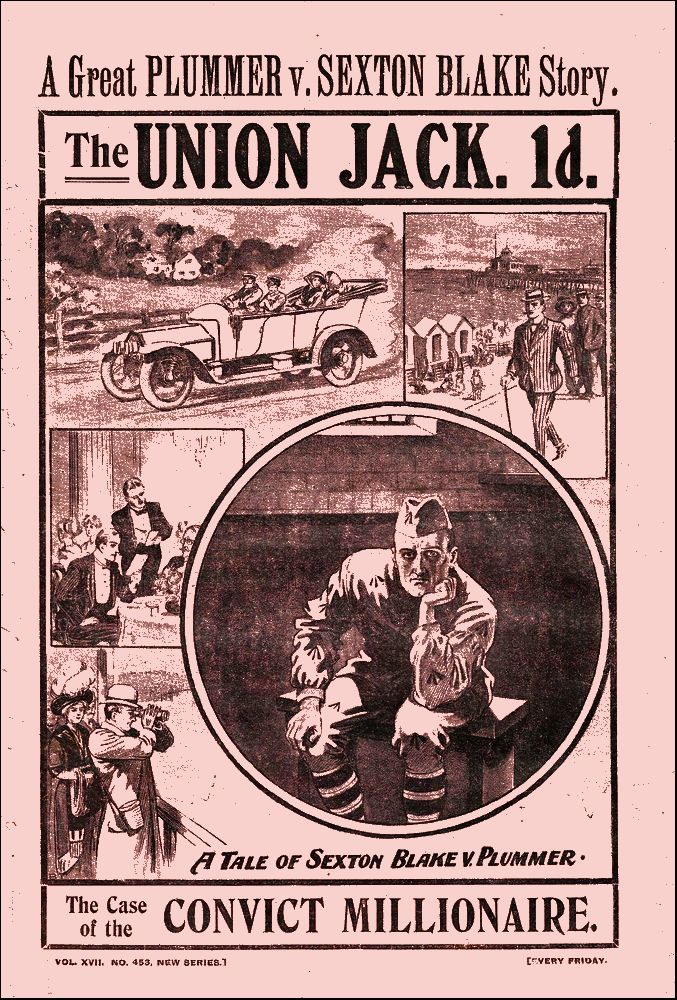

Once again the great character—Plummer—breaks out from Bleakmoor and takes up the fierce fight for revenge on Sexton Blake. How he succeeds is dramatically told in the story.
The Nameless Convict—The Lost Millionaire.
THE fog curled up the street in thick waves, one moment blotting out houses and people, and the next thinning into a veil that permitted a peep of them if no more.
It was noon; but, for all that, the street-lamps and the lights in the windows of the shops were burning in a vain attempt to conquer the demon of blackness that had fallen over the city of Leeds. It was noon; but the usually busy streets were almost deserted, and there was little traffic save the occasional horse and cart that nosed along cautiously, or the crawling motor-car that hooted its impatience every second.
The windows of the Universal Hotel should have been a blaze of brilliance, for there were lights behind each one of them, but little of the glow escaped into the streets; and even in the hotel itself the fog had taken possession, so that the guests all had something of an uncanny appearance. They were creatures of fog and fancy, instead of the hard-headed business men of Leeds.
A large number of the men staying at the hotel were assembled in the smoke-room, looking gloomy at the business hours that they were being forced to leave idle, and the conversation was desultory in the extreme. It was the hour for doing business, and they felt like fish out of water. The fog was fighting against the profits that they should have been making.
And in a room on the first floor, the window of which over-looked the street, a man stood alone. He was a tall man, and powerful about the shoulders, though just now they drooped in a manner that was plainly unnatural to them. In age he was about forty, but his face had the lines of more than two score years graven upon it, and his dark hair was very white at the temples. As for his face, it was clean-cut and rather thin, with a something about the prominent jaw that suggested determination in the highest degree.
This was Mr. John Fell, and rumour had it that it would not be for long that he would be at large. It was no more than twelve months back that he had started a stock and share exchange in Leeds; but each week of each month had been marked by some financial disaster, though not to Mr. John Fell. He had come to the north unknown; but whether he left it of his own free will, or in charge of detectives, he would be notorious enough then.
Who Mr. John Fell was there was no man in Leeds could have said, but what he was most were certain by now, though the law of slander kept their accusing voices to a whisper, and the law of libel was a great check upon their fountain pens.
A fire burned in the grate, though the day was far from being a cold one, but a close glance at it would have shown the reason for it. In short, Mr. John Fell had been destroying papers, and a heap of ashes lay black among the grey of the cinders.
The man never moved away from the window, and now and again, when the fog thinned, it was possible for him to make out a broad figure that stood on the opposite pavement. All the morning it had been there, almost as motionless as a statue, and Mr. John Fell knew only too well the significance of it. It had been at sight of the man that he had ordered a fire to be lit in the grate, and it had been because of the man that certain papers and letters—which did not bear the name of John Fell, but of a man well-known and highly-respected as a merchant in the City of London—had been destroyed.
John Fell's powerful jaw tightened as he looked through a gap in the fog at the man opposite, and he glanced at his watch.
"It's time that he was here," he muttered impatiently. "He must have his last directions before the others—"
There was a timid tap at the door, like the brushing of a frightened bird's wing; and, in answer to Mr. John Fell's "Come in!" a curious little figure entered the room.
It was that of an old—very old—man, and the light tweed suit that he wore, which had the appearance of being ready-made, not only hung loosely on his spare figure, but was as out-of-place as evening-dress could have been upon a scarecrow. In a mental picture one could have imagined him in silk-hat, spats, and the other articles of attire that go to make the outward part of the City man who has always been of the City, and nothing else.
The man's face was thin and shrunken and hairless, save for the wisps of side-whiskers that adorned it, and as white as the hair that crowned it. It was something more than white, too, for it glistened with a moisture that might have been left there by the fog—or fear.
"Then it is going to happen, sir?" the old man said, in a thin, reedy voice.
"Yes!" Mr. John Fell answered harshly. "Stand back from the window; there is a man watching from the opposite pavement, and he must not see you. No one watched you enter here?"
"No, sir," the old man said hurriedly. "I managed to book the bed-room next to this, and I said that I was going to lie down after my journey. On no account was I to be disturbed."
His thin hands twined nervously about each other, and his weak eyes peered up into the younger man's face.
"Is there no way out of it, sir?" he pleaded.
Mr. John Fell's prominent jaw became more prominent than ever, and his shoulders were set squarely.
"None!" he answered, with conviction. "You know why I did it. The old firm of Mathew Skelton & Son—the firm that was my father's pride, and the pride of his father before that had to go on. No one knew of the reverses that we had had, and we dared not have tried to obtain credit to tide us over the trouble. A whisper that we were not financially sound would have been the end of all things. Because of that I have swindled"—the man's head went up, and his eyes glinted—"ay, I am not afraid of the word—swindled and robbed, for the sake of the firm. The money that I have obtained will put matters right again; and inside twelve months, if you follow my instructions, we shall be as prosperous as ever. Then I will see that every farthing that I have obtained is paid back."
"I know, I know, sir!" the old man mumbled. "But when I think—"
"It is not a time for thinking, Josiah Spindle," John Fell interrupted sharply, "but to act; for at any moment I may be arrested, and you must in no way be connected with me. I shall stand my trial as John Fell, of nowhere save my address in Leeds. Take this."
He drew a letter from his pocket and some closely-written sheets of paper, and handed them to Josiah Spindle.
"The letter is to my son," he said, in a voice that broke a little, despite the obstinate prominence of his chin; "it is to tell him that I am called away upon business, possibly for twelve months"—he laughed bitterly—"possibly for more. You will post it in London. The other papers are your instructions, and I trust you to carry them out faithfully until my return. Remember that Jack, my son, must have no suspicion of the truth. He is only a lad, but he has brains; and you must keep him quiet. For the first time, I am almost glad that his mother is dead. That is all, now—"
The fog had rolled back from the street again, and as John Fell glanced mechanically across to the opposite pavement he saw that the burly, watching figure was no longer there.
"Quick!" he ordered, swinging round upon Josiah Spindle. "Back to your room!"
With shuffling haste the old man departed, his eyes dim with more than the shortness of their sight; and John Fell sighed with relief as he heard the door of the next room shut.
Then, for a moment, a questioning expression crossed his strong face, and slowly he drew from his pocket a Colt's revolver. He clicked open the cylinder, and the half-dozen little messengers of death splashed out into the palm of his hand. He looked down at them, with a curious, new kind of interest, and the frown between his brows deepened.
"Shall it be this?" he muttered as his fingers, steady enough, slowly replaced the cartridges in their chambers, "Or shall it"—the cylinder had clicked back into its place now, and one of John Fell's fingers was on the trigger—"or shall it be prison?"
He raised the weapon a little, and his forehead had grown damp.
"By Heaven, no!' he said sharply. "I must remember Jack. He will never know of the stain of crime upon me; or, if he does, I think that he will forgive when old enough to understand."
John Fell, to use the name by which he was known in Leeds, placed the revolver on the table, and dropped heavily into a chair. The fire in the grate had started to burn low, but already it had done its work, and the man made no effort to replenish it. The papers that would have connected him with Mathew Skelton & Son—in fact, told the world that he was none other than John Skelton—were ashes—as much as the happiness that had turned to ashes in his mouth.
Not for long, however, was John Fell left in peace, for the door was opened abruptly, and three burly men hurried in, the leader at once leaping to the table and snatching up the revolver that lay there.
John Fell, looking up, saw the action, and smiled a little grimly.
"I have been expecting you, gentlemen," he said steadily, rising to his feet.
"Good!" the officer in command answered sternly. "I am Inspector Hanlow, and I arrest you, John Fell, on a charge of fraud, and must warn you that anything you say may be taken down in writing and used at your trial in evidence against you."
He drew a pair of handcuffs from his pocket, and the others closed in as if expecting resistance; but the steel clicked on John Fell's wrists without him making a sign, unless it was that his face set more doggedly than ever.
"I am ready, gentlemen," he said calmly. "I trust that you have a cab waiting?"
The detectives moved towards the door, but there the inspector stopped.
"You will take the prisoner to the station," he ordered. "I shall stop to search the room."
For a moment John Fell's eyes rested upon the heap of ashes in the grate, and he smiled.
The court was crowded to its wooden-panelled walls, for the trial of John Fell for fraud was drawing towards its conclusion. What the result would be not a person had any doubt, for the accused man had pleaded guilty to the charge without faltering. In fact, there had been something almost defiant in his air when he had been asked to plead, and that defiance had remained with him throughout every stage of the proceedings.
In a sense the trial was a commonplace enough one, just a case of fraud and deliberate swindling—and there are only too many similar ones in the country's record of crime. Yet there were distinctive features about it that made it out of the ordinary.
The chief of these was that nothing, absolutely nothing of John Fell's antecedents were known. He had decided upon Leeds, carried out his swindles, and was now standing his trial for them. That was all. To all questions with regard to his career he was dumb, and all efforts of the detectives had failed to discover anything, any more than they had been able to recover the considerable sums that the prisoner had obtained. Banknotes for large sums had been traced to abroad, but there always the trail had snapped off blindly.
Portraits of John Fell had appeared in the illustrated papers, but even if their smudgy surfaces bore a resemblance to a certain John Skelton, head of one of the most reputable firms of merchants in the City of London, was it likely that anyone knowing Mathew Skelton & Son, could possibly connect the two? Besides, Josiah Spindle had given it out some time back that his employer had left the country on important business, and might be absent for a considerable period.
Now the final speech of the prosecuting counsel had been made, and John Fell had made no response to it. He simply stood in the dock, his strong face set and determined, scarcely seeming to hear the words that were uttered. Only at certain moments did he show interest in the proceedings, and that was when he glanced round the court each time that he entered it, sighing with relief when he saw that there was no one there from London who would have recognised him.
In a brief speech the judge summed up the case, and the jury waited with an obvious air of impatience that showed that its members had already made up their minds. There was conviction on the face of each one of them.
"There is no more to say, gentlemen," the judge concluded; "you have followed closely the evidence for the prosecution, and if you consider that the charge of deliberate fraud has been proved it will be your duty to return a verdict of guilty. If you do not think that the alleged facts have been proved"—it appeared almost as if the judge suppressed a yawn—"you will acquit the prisoner."
The judge leant back in his chair, instead of rising to leave the court, for he knew that there would be no question of the jury retiring to come to its decision, and he was right. For a few seconds the twelve good men and true whispered together, then the foreman rose to his feet.
"You have well and truly considered," etc., was mumbled over. "Do you find the prisoner guilty or not guilty?"
"Guilty, my lord!" the foreman answered, with a rush, as if the words had been waiting to burst from his tongue, and sat down amid a rustle of applause.
But John Fell's face did not change its set expression, and his eyes met those of the judge without flinching. The latter still leant back in his seat, very cold and very hard in expression, his eyes a little narrowed, and his mouth drawn down at the corners.
"John Fell," he said slowly, "you have heard the verdict of the jury, and there can be no doubt in the mind of any man who has followed the case that it is a just one. Whether your career of crime commenced with these daring frauds we have no means of telling—"
The shade of a smile crossed John Fell's lips, then his face was expressionless again.
"Whether it will continue after you have served your term of imprisonment will rest in your own hands. That you are a man of exceptional business abilities there can be no manner of doubt, and it is to be deplored that one so gifted has not used them in a legitimate manner. Taking into consideration your entire want of contrition, and the fact that not one penny of the money that you have fraudulently obtained has been recovered, I sentence you to three years' penal servitude. It is a sentence that, under the circumstances, tempers mercy with justice, and I trust that when your period of detention is passed you will start upon a new life."
Still John Fell scarcely showed a sign that he heard, and he stood unmoved amid the excitement that bubbled through the court; and it was not until a warder touched him on the shoulder that he turned and followed the man from the dock.
And up in London the evening papers were printing a special edition containing the verdict and sentence in the Leeds Fraud Case.
And Mathew Skelton & Son continued its business as usual, save that Josiah Spindle, now in charge, looked a little thinner and a little more bent.
Sexton Blakes Warning—"I Shall Keep My Word"—The News From Bleakmoor.
THERE was a knock at the door of Sexton Blake's house in Baker Street, and a neatly-folded paper flopped through the letter-box into the hall. That was not all that the postman had brought by a long way; yet it was that which Tinker pounced upon first, staring at it with a frown on his boyish face.
"Another of 'em!" he muttered. "I wonder if it's a joke?"
With the letters and the papers in his hands, Tinker went through into the consulting-room, where Sexton Blake, robed in a long dressing-gown, was scanning a new book on criminology-that had recently been published.
"It is really marvellous the mistakes that some of these supposed experts make, my lad," he remarked, as Tinker entered. "The worthy author of this book makes the bold statement that no child is born a criminal, and that it is chance or environment that makes it one."
The famous detective impatiently turned the leaves of the book as he added:
"And yet I had thought that the treatise of mine dealing with the brain-cells that represent vice and virtue should have disproved that. It is merely which group is the stronger, though I do not say that they cannot be trained—"
"I know, sir," Tinker interrupted hurriedly; "but here's another of those beastly papers!"
He dropped the letters on to the table, but the paper he held out towards his master, as if considering it necessary that he should examine it at once.
"It can wait," Sexton Blake said calmly, and if he showed any interest in the paper, only a slight narrowing of the eyes betrayed him as he turned to the letters and opened the nearest one.
"A cheque for five hundred from Sir Melville Turso," he murmured, as he examined the contents. You might remind me to send the amount to the hospital fund, Tinker; it was an unsavoury scandal, and I do not care about taking money for hushing it up."
"Very good, sir."
From letter to letter the detective went, tossing some into the waste-paper basket, and putting others aside for further reference in the future, until only the neatly-folded paper lay on the table before him. His long, supple fingers went out to it, and as he picked it up his lips were thin and very determined in expression.
"From the same man," he said quietly, looking at the typed name and address; "I would know that dropped capital S anywhere. Give me the other papers, Tinker."
From a shelf the boy produced six papers, different issues of the one that had just arrived for Sexton Blake. In each case a certain paragraph was marked on the front page, under the part that is generally known as "The Agony Column," Right at the top of the column it stood, and in every instance the wording was precisely the same:
"Sexton Blake,—I am still waiting to keep my word. I shall see you soon.—G. M. P."
That was all, but it conveyed much to the famous detective. Each day of the past six one of these papers had reached him, the only variance being that they were posted from different parts of London, and he could not fail to understand the meaning of the apparently simple message. Only a short time back Sexton Blake had been instrumental in sending those two master-criminals, John Marsh and George Marsden Plummer to prison.
John Marsh, ex-financier, and one of the cleverest rogues breathing, had taken his sentence comparatively quietly, and no word had passed his grey lips as he left the dock.
It was George Marsden Plummer, ex-detective-sergeant of Scotland Yard; and with some of the best blood in England, if also the wildest, in his veins, who had turned upon the quiet-faced man who sat at the solicitors' table—turned upon him and told him that when chance served he should die a violent death. Sexton Blake had smiled, perhaps a little grimly, for he did not doubt that the threat was meant.
He knew Plummer's violent temper, and that he would have had murder on his hands long since had it not been for the restraining influence of John Marsh. The latter was quite as big a criminal as his partner, and had as much reason to hate the detective who had thwarted him, but his brain was of the cold, calculating type that thinks seriously before it lets its owner act, and so it thought of a hangman's rope as the price of blood, and left murder out of its calculations.
And now, though Plummer was in Bleakmoor Prison, working among the stone quarries, always with black hatred in his heart for the man who had sent him there, somehow he had managed to send to his enemy the news that he had not forgotten, that he still nursed his vengeance.
"I suppose it is Plummer, sir?" Tinker ventured, as Sexton Blake carefully cut the wrapper from the paper.
"Yes," the detective answered, without emotion. "You must remember that Gustave, chauffeur, criminal, and help in general to Marsh and Plummer, is at large. How he has communicated with the latter I do not know, but it is plain that a way has been found, and that he is acting upon instructions."
Tinker looked puzzled, and none too certain.
"I suppose Gustave isn't doing it on his own, sir," he suggested.
"No," Sexton Blake answered, with conviction. "Plummer is not the type of man to allow anyone to go over his head, and it would be a bad time for Gustave when he came out of prison."
Sexton Blake unfolded the paper, and there again a marked message lay before him. He glanced at it carelessly, expecting to see the same words that had been repeated five times, then he caught his breath in sharply and looked more closely at it.
"What's wrong, sir?" Tinker asked excitedly.
The detective handed the boy the paper, and as he read the message there he gasped in amazement.
"It's impossible, sir," he said. "He can't get away. It's someone playing the goat with you—"
"It is not!" Sexton Blake interrupted quietly. "Ring up Mr. Spearing, and ask if he can come here at once. Tell him to bring a revolver with him."
Tinker moved mechanically towards the 'phone, and Sexton Blake turned once more to the paper and read:
"Sexton Blake. It will be tomorrow.—G. M. P."
It will be tomorrow! The detective's lips were compressed into a thin, straight line. He was a man who did not know the meaning of fear, yet a certain dread possessed him. He knew why Plummer would risk everything to put him out of the way; because he was the one man who had succeeded in checking his criminal career.
At first Plummer, confident in his own ability through the manner in which he had successfully hoodwinked the most prominent officers at Scotland Yard, had regarded the detective's success and his own failure as a fluke. Then it had happened again, and again. After that he had found his plans interfered with, until he knew that he was up against a master brain, an intellect that seemed to be able to see into the future and anticipate his very movement.
After that had come Plummer's and Marsh's first spell at prison, where they had been sent through the genius and nerve of the famous detective. And from that day on, whether at work or in prison, Sexton Blake was always in Plummer's brain. He hated him, and in a sense he feared him. It was only Marsh who had prevented him risking all to get his enemy out of the way.
Sexton Blake sat thinking of these things as he waited for Mr. Spearing to arrive, and his thin face was haggard, though his eyes sparkled. In the advent of Plummer and Marsh into the army of criminals he had found antagonists worthy of his genius, so that it almost came as a loss to him when he stopped their activities by sending them to prison. He was still thinking of them when a thundering knock at the door announced the arrival of Mr. Spearing, at one time a high official at Scotland Yard, but now a private detective and a firm friend of Sexton Blake's. A few seconds later that worthy, looking burlier and more important than ever, swaggered into the room.
"All rot!" he jerked, without waiting to say good-morning. "Seen the message—only a bluff?"
Sexton Blake waved his hand towards a chair, and his shoulders went up in a shrug.
"Why?" he asked simply, "Has it been usual for Plummer and Marsh to bluff?"
Mr. Spearing's hand went up to his bristling hair, and he rubbed at it with the vigour that always made it appear that he had a grudge against it, or was trying to prove that there was no deception about it.
"Safe in prison!" he jerked. "Can do nothing!"
"He is safe in prison at present, my friend," Sexton Blake agreed; "but to-day, unless something is done, he will escape. You forget that he and Marsh have broken free on three previous occasions, despite the great precautions taken to guard them; and what they did then Plummer can do now.'
"Plummer?" Mr. Spearing's brows went up in a sharp query. "Why not Marsh, too?"
Sexton Blake's eyes narrowed, and the smile on his lips was very grim.
"Surely that needs no explanation?" he protested. "It is Plummer who wants to put me out of the way, Marsh having qualms on the subject of murder. It is, therefore, plain that our friend Plummer intends to escape alone, to carry out if possible the vengeance that he has been nursing since he has been in prison."
Mr. Spearing's round, red face wore a worried expression, for when Sexton Blake spoke with such quiet confidence he was generally right.
"What do?" he jerked. "Any use tracking Gustave. Dropped S of the typewriter might help, or inquiries at paper office—"
"It would only be a waste of time," Sexton Blake interrupted. "There is only one thing for us to do—go to Bleakmoor."
"What for?" Mr. Spearing demanded.
Sexton Blake rose to his feet, and his nostrils quivered like those of a sensitive animal.
"We may be in time to spoil Plummer's little plan, my friend," he answered, "At another time I should have looked forward to his being at large; it would have lent a zest to life; but just now it is inconvenient, and if possible I must prevent his escape, so as to leave be free to carry out the work that I have in hand."
"Better wire governor of —," Mr. Spearing suggested; but Sexton Blake shook his head.
"No," he answered; "that is the obvious thing that we should be expected to do, and Plummer is a man who prepares for the obvious."
He turned to Tinker, who had been listening eagerly.
"Fetch the car round at once," he ordered; "we shall go to Bleakmoor by road."
"Take a dickens of a time!" Mr. Spearing objected. "Good train at eleven o'clock."
"Precisely!" Sexton Blake agreed drily. "But there is one thing that you have forgotten—there are sometimes accidents to trains."
"You mean?" Mr. Spearing gasped.
"That it is also likely that George Marsden Plummer will expect me to travel to Bleakmoor by the first available train," Sexton Blake answered, "and he is not a man to stick at trifles."
Mr. Spearing picked up his hard felt hat, which always appeared to be about a size too small for him, and jammed it on to his head.
"Right!" he jerked, "Car safer!"
Sexton Blake's great car sped up towards Bleakmoor. Away to the left the sea shone blue and silver under the sun; between it and the road along which the car rushed roofs of red tile and thatch making another break of colour. A little further on the white road wound round to the right, starting to climb up, towards the spot where the grey building that was Bleakmoor Prison lay.
With the detective at the wheel the car had done the journey from London in something like record time, so that if was still afternoon when the neighbourhood of Bleakmoor was reached, though it was still several miles to the prison on account of the winding nature of the road.
On went the car, Sexton Blake in the front, Mr. Spearing, Tinker, and Pedro in the back, the great bloodhound having been brought in case—
Crack!
Sexton Blake's fingers gripped harder on the driving-wheel, and his head craned forward with the chin very prominent.
Crack, crack!
Two shots—one report treading on the heels of the other.
For a moment Sexton Blake turned his head, and the lines about his eyes and mouth were very hard.
"Plummer has made his dash!" he said, between his teeth. Mr. Spearing did not answer at once, but stood up in the car and stared away across the moors, as if expecting to catch a sight of the escaping man.
"Won't get far—not even fog to hide him!" he jerked.
Sexton Blake opened wide the throttle, and the car improved its pace.
"He has got away!" he said, with conviction.
The Escape—Hidden—Above Suspicion.
NUMBER THREE gang was at work in one of the quarries furthest from Bleakmoor Prison; forty men—if the dejected-looking creatures with the brand of crime upon them could be dignified by that description. Over them five warders, their rifles at the easy, or on their shoulders as they strolled up and down, kept guard—big men, with faces made hard by the work that was their living. Possibly they did not care much about it, for it is impossible for any man to look at convicts without feeling a certain compassion, however much the criminals may have earned their punishment. They are pariahs, animals to be brought out of their stalls to do their work, to be taken back when the allotted task is finished. They are neither of the world nor out of it; they are a race apart.
The forty convicts toiled listlessly, more than one of them limping when he moved about in his rough shoes, and the warders made no attempt to hurry them. Why should they? If the work in the quarry was not finished by this gang, or the one after, or the one after that, there would still be the other generations of criminals to follow. Besides, it was a pleasant day, and even a warder in a convict prison must be expected to be influenced to some extent by his surroundings.
And of the forty men there were five who worked rather apart from their fellows, at the point furthest from where the warders stood, also at a spot where the side of the quarry sloped at a wide angle, so that it was possible for a man to clamber up it without much delay. These five men seemed to work harder than the rest, possibly with the object of not attracting unwelcome attention from the warders; and as they worked they whispered. If the warders noticed it they ignored it, knowing full well that no amount of punishment will stop it. Besides, they might be looking forward to a time when the dehumanising effect of silence upon a prisoner, at present a rule of the great prisons, will be removed.
George Marsden Plummer, ex-detective-sergeant, toiled and sweated with the rest. In the ordinary way he did as little as possible, the aristocratic tendencies in him rebelling at the coarse work; but to-day it was different. He helped to move the blocks of stone with a savage energy that made his companions stare at him; but then they did not know that he was thinking of Sexton Blake, and of the vengeance that he meant to have so soon.
Day by day, night by night, whether in the quarries or in his bare cell, George Marsden Plummer had never allowed this idea of vengeance to leave his brain. Day by day, night by night, the desire for it had increased in him until it had become an obsession. Nothing mattered to him save his vengeance upon the man who had put him behind these grey walls for the fourth time. But this time he would prove himself the master, and gain both vengeance and fortune.
Now, too, that vengeance seemed very near to him, and that was why he laboured so furiously, for otherwise he would not have been able to keep himself under control until the proper time arrived.
Two hundred yards away, working in another gang, was John Marsh, for Colonel Castell, the governor of Bleakmoor, had deemed it wise that the partners in crime should be kept apart. Little did he imagine that this was precisely what Plummer had desired. If he had confided his plan to Marsh, it would never have come off.
Now Gustave—communicated with by the aid of a heavily-bribed warder—had done his part well, and with luck the next hour would see Plummer a free man. In his attempt at escape he would be taking great risk, but it was just that which made him think that it would be successful.
"How soon, cully?" the man next to Plummer whispered.
The latter glanced towards the sea, to a spot where his keen eyes could make out a small boat lying at anchor.
"When that man hoists his sail it's time," he answered. "Don't look that way, you fool, and remember what I told you. Make for the gap that lies to the right from here; the car will be waiting there, with disguises ready—"
"What you doing it for?" the other convict asked suspiciously. "You'll have job enough to get away by yourself without—"
The man could whisper no more, as a warder strolled up at that moment, and stood indifferently eyeing the men as they worked. Only for a minute or two did he stand there, then he strolled away again. Plummer chuckled, for it was the man who had made communication between himself and Gustave possible.
It was afternoon now, and in less than an hour it would be time for the convicts to be marched back to the prison. As the minutes passed, Plummer looked anxiously towards the boat, that lay with its sail down, and his four companions also looked in the same direction. When one of them had asked Plummer why he had planned that they should escape too, he had not had time to answer, which was perhaps just as well, as he certainly would not have told them the truth. He had his reasons for the move, as will shortly be seen.
At last! Plummer saw the flag of the boat go fluttering up towards the mast-head, and his dark eyes lashed in the direction of the nearest warder, who conveniently had his back turned for the moment.
"Now!" Plummer said sharply.
There was the sound of quickly-drawn-in breath, then five men were at the sloping face of the quarry, scrambling up it for dear life. Possibly the nearest warder was not blessed with the best of hearing, more probably he found it convenient to be deaf just then to the scrambling sounds of the heavy shoes, but anyway it was not until the convicts were at the top of the quarry that he turned and saw them. In an instant, just as they began to run, his rifle went to his shoulder, but the bullet that he let fly went very wide of them.
Beyond the quarry the ground was very broken, so that it was quite possible that a man might run for hundreds of yards without being seen.
"To the right!" Plummer shouted, and the other four convicts swung off in that direction.
Crack! Crack! With a gasping cry one of the men pitched forward on to his face, but the others held on. Plummer bore away to the left, but in their excitement his companions did not notice it. He was hidden by the warders who had started in pursuit, and as they could see the three men, it was upon them they concentrated their fire. It was for that reason that Plummer had suggested that they should "escape" with him.
The three men raced away to the right, down to the hollow in which Plummer had told them that they would find a car waiting. They made for it madly, blindly, trying to get away from the grey walls of Bleakmoor Prison.
Then they reached the hollow, and there was no motor-car there!
Panting for breath, the convicts looked sharply at each other, then about them for the man who had inspired the attempt at escape, and they saw that he was not there. There was something that they did see, however, and that was two warders with levelled rifles within a score of yards of them.
"Now then, no tricks," one of the warders growled. "You've made a bust for it, and missed it, so you'd better come back quietly."
The convicts looked at the warders, then they cursed Plummer under their breath. They knew the punishment that was given to men who had tried to escape.
In the meantime Plummer had made to the left, dropped into a kind of gully, and raced along it for dear life. He had guessed that the warders would pay most attention to the three men, and now he knew that he had been right. If only Gustave had carried out his instructions to the letter, and he had not much doubt about that, all would be well.
From the gully Plummer turned into an old quarry, so that he was still hidden from the warders, and he hurried on until he was panting for breath. Every yard of the way he knew, for since his last imprisonment in Bleakmoor he had planned this move in case it should prove necessary, and he was in consequence familiar with every foot of the ground.
Another few yards, a dash on to the road, and within an hour he ought to be free to carry out his vengeance upon Sexton Blake.
The end of the quarry was reached, and still, so far as he could see, he had not been discovered. Cautiously Plummer clambered up the side of the place, until he crouched at the edge of a road. Less than a hundred yards away a market-cart was crawling towards him, loaded high with nets of cabbages. The man who was driving nodded forward in his seat, yet it was curious to notice that as Plummer's grey figure appeared beside the road he slashed his horse with a whip.
At an ambling walk the horse and cart came on, and as it same abreast of him Plummer stood upright, jumped for the wheel, and from there on to the cabbages.
"You'll find it there," the driver said, without turning his head. Where's Mr. Marsh?"
"Nabbed," Plummer answered readily, for he knew that he dared not tell Gustave that he made no attempt to help him.
In the centre of the nets of cabbages there was a hollow, and out of this Plummer drew a net, empty save for the leaves that had been ingeniously woven into the strands. In a few seconds he had clambered into it, the leaves completely covering him, and there he lay, pretty sure now of his escape, while the cart jogged on, the disguised Gustave sitting on one of the shafts.
"Halt!"
In his hiding-place George Marsden Plummer heard the order, and his heart beat furiously. Somehow, just then it was not the idea of going back to the work in the quarries that worried him, but the notion that he would have no chance yet of being avenged upon Sexton Blake. It was that, and that alone, of which he thought.
"What d'you want?" Gustave asked, in a husky voice.
"A convict has escaped," a voice answered sternly; "and, for all we know, he's hidden in your cart."
"You don't think as he's in the 'orse?" Gustave suggested sarcastically.
"Stow your lip," the other man, who was evidently a warder, ordered; and Plummer could hear him climbing up into the cart, so that he lay still and scarcely dared to breathe. The men stepped on him, and he could have cried out with pain, but he bit his lip and kept silent. For what seemed an eternity the warder groped about among the nets of cabbages, but at last he dropped to the ground.
"All right, drive on," he said gruffly.
"Can't give yer a lift?" Gustave asked, with a laugh; but the warder did not answer.
Very slowly the cart jogged along; sometimes Plummer heard voices of men in the roadway, but no one again offered to search the cart. And all the time he could hear the booming of the bell that came from the watch-tower on the top of Bleakmoor, telling to the countryside that a convict was at large.
"All right, guv'nor." It was Gustave who spoke, and as he did so the cart came to a standstill. With a sigh of relief Plummer wriggled himself free from the net, and though his eyes blinked in the strong light he could see that they were in a country lane.
"Over the fence," Gustave added hastily. "You'll find the things there. Bury the old ones and, get to work with the hoe you'll find there. Don't move until I come back."
In a moment Plummer was out of the cart and over the thick hedge, and the cart at once moved on. Beneath the hedge was a bundle, and from it Plummer took a suit of clothes that might have been worn by a farm-labourer and a sandy wig. Five minutes sufficed to change into them, two more saw the ugly convict rig hidden under the soil, then, hoe in hand, Plummer walked out into the field of turnips and commenced to work.
Clang! clang! went the bell of Bleakmoor Prison, and as Plummer heard it he stabbed viciously at the clods of earth with his hoe, as if each of them was the head of Sexton Blake.
Later a couple of warders from the prison came hurrying along the lane, but they bestowed no more than a passing glance upon the man who worked with bent back in the field.
It was just as dusk was setting in that the hoot of a motor-horn caused George Marsden Plummer to look up. He saw the large car that came into sight, and somehow it was familiar to him. Then, with a fierce oath, he clenched his hoe as if to break it under the savage pressure of his fingers, for he had seen that the man at the wheel of the car was his enemy, Sexton Blake. By an effort he turned to his work again, though the little pulses at his temples throbbed with the anger that he was forced to keep under control. Then he laughed, and his mirth was more threatening than his snarl.
"So, you are in the hunt, too!" he muttered. "Well, it will save me looking for you, and when you find me look out for yourself."
Still Searching—Pedro on the Trail—A Near Thing.
COLONEL MATLOCK, late of the Indian Army, and still possessing a temper as hot as the climate that he had been accustomed to for so many years, glared fiercely at Sexton Blake and Mr. Spearing. The latter glared back with interest, but Sexton Blake's thin face was practically expressionless.
"What the blazes d'you mean by suggesting that you can help me?" the governor of the prison snorted. "All my men are out—all that can be spared—and I'll wager that we shall have the scoundrel before the morning."
Sexton Blake's shoulders went up in the merest possible suggestion of a shrug.
"I am not a betting man, colonel," he answered calmly; "but I am open to bet you that you fail."
Colonel Matlock's face went dangerously red, and he pulled at his grey moustache as if his one ambition was to jerk it out by the roots.
"Why?" he demanded.
"My dear colonel, seeing that you have allowed Plummer to escape after he had positively advertised his intention of doing so," the detective answered. "I certainly do not think that you will catch him."
"After what?" the colonel roared.
Sexton Blake drew from his pocket the scraps of paper that he had cut from the agony columns of the newspapers.
"Our friend George Marsden Plummer fancies that he has a grievance against me," he observed; "and he is not the type of man to allow it to rest. Also, being a gentleman of theatrical tendencies he adopted the method you see of trying to intimidate me. How the advertisements were smuggled from the prison here is of course no business of mine; I am not governor of it, and shall not have to answer to the Home Secretary."
Colonel Matlock stared at the famous detective in amazement, as if to make sure that he was not bluffing, but a sight of the keen, pale face must have convinced him that that was not the case.
"You mean to tell me," he almost stuttered, "that you knew that this was going to happen and never warned me?"
Sexton Blake bowed, and picked up the scraps of paper.
"I have been busy, colonel," he answered, "Besides, I know Plummer better than you do, and I doubt if anything short of putting him in irons would have prevented his escape. When you come to think of it, I have some cause for complaint against you."
"What do you mean?" the governor snapped.
"It was through me that Plummer was placed in your hands," the detective answered cooly; and although he threatened my life you have allowed him to escape."
"Hear—hear!" Mr. Spearing jerked, for the blustering manner of the governor of the prison did not appeal to him.
Colonel Matlock swung round upon the worthy ex-official of Scotland Yard, but he suddenly checked his anger. It was only a short time since he had been appointed governor of the prison, and this early failure to keep safe the men under his charge, unless he quickly rectified it, was likely to count against him.
"I am sorry if I spoke hastily, Mr. Blake," he said apologetically, "but you will quite understand that I am worried. Of all the men under my charge this Plummer and his friend Marsh were the most notorious, and now one of them has escaped. I shall be most grateful if you will help me, and if Mr.—er—Spearing will do so, to."
"Humph!? Mr. Spearing grunted non-commitally, but Sexton Blake nodded.
"We know the direction that Plummer took when he made his dash," he said, "and there is a possibility that Pedro will be able to pick up the trail, though I have little hope that the man is anywhere near Bleakmoor now."
Colonel Matlock pulled more sharply than ever at his white moustache. He was a good, honest, brave sort of soldier, who would have led a forlorn hope at the word of command, but he was no reasoner. His only idea of tactics was to get at the enemy with his men—and carve or shoot his way through, but he found that more than a trifle awkward when he did not know where the enemy—in this case George Marsden Plummer—was hiding.
"Impossible, Mr. Blake!" he said sharply. "Every road and every station is being watched. There's not a villager who isn't on the look-out for the reward paid for the capture of an escaped convict. He can't possibly have got far. Once the convicts are locked in for the night I shall be able to spare a few more men, and he won't be at liberty for very long."
Sexton Blake glanced at his watch, and did his best to keep back a yawn.
"Then I take it that you do not need my services, colonel?" he remarked quietly.
"Pardon me, hardly that, Mr. Blake," the old soldier said quickly. "There is no harm in trying every possible means of running this dangerous ruffian down. If you will tell me what to do I am entirely at your service."
"Only one thing," Sexton Blake answered. "Let me have a pair of the escaped man's shoes, and a warder to show me where he was working in the quarry before he and the others made their dash for liberty."
"Certainly," Colonel Matlock agreed. "I will send for the shoes at once, and Adams will show you the spot. It's a good thing that only the one man got away."
"For Plummer!" Mr. Spearing jerked. "Bet got other chaps to bunk as a blind—led hunt in wrong direction."
Sexton Blake nodded, for he quite agreed with this theory of the ex-Scotland Yard official. Colonel Matlock sent for the shoes, at the same time asking for Warder Adams to be sent to him. The shoes were quickly brought, but it was a few minutes before Adams arrived. He was a youngish man, well-set-up, and of fair complexion. He saluted his chief, and glanced from him to the detectives with a certain air of uneasiness. Hidden away amongst his kit were the banknotes that had passed from the hands of Gustave to his—the notes that had made it possible for Plummer to communicate with the outer world, and had caused the warder to look absent-mindedly towards the sea at the psychological moment when the convicts had made the dash that had ended so disastrously for all but one of them.
"You were on duty close to the man who escaped?" Colonel Matlock asked abruptly.
"Yes, sir," the warder answered mechanically, trying to appear at his ease.
"Very well," the governor said. "You will take Mr. Blake and Mr. Spearing as nearly as possible to the spot where you saw the convict Plummer last."
It was only by an effort that Adams kept back a sigh of relief as he saluted his chief, all his confidence restored now that he felt that he was not suspected.
"This way, gentlemen," he said civilly. "I will fetch a lantern if you will wait in the yard."
Sexton Blake and Mr. Spearing waited before the house of the governor, Tinker joining them with Pedro. It seemed as though the great bloodhound knew that he had work to do, for he looked up inguiringly into his master's face. In a short time Adams returned with the lantern, which was quite necessary now that night had set in, and the little party moved towards the gates of the prison, before which a warder, with rifle on shoulder, paced up and down.
The gateway opened straight onto the moors, and as the men moved ahead they could from time to time see the flashing of lanterns, like so many stars coming and going; as warders still searched for the escaped man. They believed, as did Colonel Matlock, that Plummer had not succeeded in getting far away, and they were quite prepared to find him crouching in some old disused quarry.
Warder Adams strode along a little ahead of the others, and he, at least, was pretty convinced that the escaped man would not be found so easily. Anyway, it should not be his fault if it was the case, he decided. Not that he was particularly loyal to the man who had bribed him, but there was something about the demeanour of Plummer that had warned him that he was not a man if would be safe to play fast and loose with.
Over the rough ground the men made their way, stumbling in the ruts left by the carts used for shifting the stone from the quarries, but they had not far to go before they reached the spot from which Plummer had made his sensational escape. Without hesitation Warder Adams led the way down into the quarry, and in the darkness the others could not see the little smile that played about his lips.
"Here we are, gentlemen!" he announced. But if the truth were known he was nearly a hundred yards from the spot where the convict had been working.
Without loss of time Sexton Blake took Pedro's lead from Tinker, at the same time producing one of the shoes from his pocket. He held it to the bloodhound's nose, and the animal sniffed at it knowingly, aware of what the work was that was required of him.
"Find, boy!" Sexton ordered, but almost before the words had left his lips Pedro's muzzle had dropped down to the ground.
"He'll run him down!" Tinker said confidently. But Sexton Blake was not so sure. In the case of an ordinary convict he would have felt confident enough of success, but with George Marsden Plummer to deal with the case was very different. He would know that likely as not the bloodhound would be put on his track, and he would in consequence do everything in his power to break the trail.
Pedro sniffed round with confidence, knowing that his master would not put him on a trail that was not there. From side to side he moved, then round in a circle, but still the whimper did not come that would have shown that he had found the scent.
"Find!" Sexton Blake said again, and for a moment Pedro looked up at the detective with his great, pathetic eyes, as if to show that he was doing his best. Again he nosed round, this time in a wider circle, but still there was no result.
"Wrong place!" Mr. Spearing jerked; and glanced suspiciously at Warder Adams, who found it convenient to look away.
For a third time Sexton Blake tried, but still without result, and the light from the lantern that Adams held showed his face to be very set and hard.
"The ground's too hard, sir," the latter said hurriedly.
Sexton Blake shortened the leash with which he held Pedro, then, motioning the others to keep back, he beckoned Adams to follow him to the right.
"You will show me the right place," he said coldly.
Adams tried to bluster, but the lantern in his hand shook, and the colour flooded up into his face.
"That was the place. sir," he said hastily; "at least, so far as I remember."
Sexton Blake did not speak at once, but his narrowed eyes looked into those of the warder until the latter's dropped.
"Warder Adams," he said quietly, "I have no particular grudge against you, and if you tell me the truth I promise you that I will say nothing to Colonel Matlock. You know where Plummer was standing when he made his break for liberty. Show it to me."
For a moment, but no more, the warder hesitated, for there was something about the detective's quiet manner that was more forceful than all the bullying in the world could have been.
"Perhaps—perhaps I'm wrong, sir," he said hesitatingly. "It might be more this way."
This time he led the detective in the right direction, and Pedro had scarcely dropped his muzzle to the ground before he gave vent to a low bay of triumph.
"Follow!" Sexton Blake ordered.
There was no need to give the great bloodhound any further encouragement, for already he was scrambling up the side of the quarry, evidently on a hot scent. Up to the top he went, and without the slightest hesitation he went to the left.
"As I thought!" his master muttered. The others went to the right; he must have used them as a screen to cover his own escape."
Pedro led on without any hesitation now, the others following. Down into the old gully he went, and along it to where Plummer had climbed up on to the road, and there he stopped, nosing round helplessly, the scent evidently coming to an abrupt end.
"The lantern!" Sexton Blake ordered sharply, "We may find—"
Boom!
It was the sound of the gun that signalled that a convict had escaped, and for a moment the men stood looking at each other.
"Well, we are in for it!" Warder Adams said blankly.
Boom! The gun went again, and close upon it sounding the tolling of the alarm-bell, the death-knell, so far as freedom is concerned, of so many men who have tried to escape from the great prison on the hill.
Sexton Blake, however, paid no heed to the gun. He had taken the lantern from Warder Adams, and he was holding it close to the dusty road. Its light revealed distinctly the mark of broad wheels.
"There is a clue here," he said calmly. "We must follow—"
Then, in a manner that was unusual with him, Sexton Blake hesitated. He could see that the tracks led to the right, the marks of the hoofs showing him that, but suddenly an idea had occurred to him. He remembered why it was that George Marsden Plummer had made his desperate effort to escape, knew that it was that he might have vengeance upon the man who had put him into prison, and he wondered to what the track might lead.
No man knew better than he of what Plummer was capable when his temper was roused, and that he was armed by now he was certain. He himself was quite prepared to take the risk, but had he the right to take Spearing and Tinker into it. The former was a man with a family, with people to miss him; while Tinker was no more than a boy. As for himself, why, yes, he believed that there were those who would miss him, but yet he decided that it was his duty to take the risk alone.
"Go to the left," he said quietly, "and I will go to the right. I think there is no doubt that Plummer made his escape in the cart, and we must take no chances. If he is in the cart I shall be on the track, but he has got quite brain enough to leave that as a false trail."
Mr. William Spearing rubbed at his shock of short hair, and looked doubtful. Sexton Blake's reasoning was plain enough, but for all that he did not like the idea of separating. He knew that George Marsden Plummer was quite capable of keeping his word, and tough proposition that Sexton Blake was to tackle single-handed, there is no guarding a blow that is delivered in the dark.
"Don't like it!" he jerked. "Better stick together—chance it!"
But Sexton Blake shook his head, and his face was very determined.
"No," he answered, "I shall go this way. My electric lantern will give light enough, so you can take the lamp."
"And me, sir?" Tinker queried.
"You will go with Mr. Spearing," Sexton Blake replied. "If we find nothing we will meet in the inn in the village. You understand?"
Tinker's face fell, but there was something in his master's voice that brooked no opposition.
"All right, sir!" he said dejectedly.
Without another word Sexton Blake moved away in the track of the wheels, and no man knew better than he that he was carrying his life in his hands, for the track might very well lead him to death at the hands of George Marsden Plummer. That the latter's threat had been no idle one, he knew, for a very demon of revenge lurked in the criminal's soul. At all times he was a dangerous, passionate man, and the imprisonment that he had suffered was not likely to have made him less vindictive. He had to soil his hands with work, those hands that would have been peculiarly graceful had it not been for the nails bitten to the quick, the clue that had more than once been the downfall of a man who gave vent to his pent-up passion in that way.
Time after time Sexton Blake had thwarted him, stepped between him and the fortunes that his skillful, criminal brain had brought him, and turned him adrift to start all over again, to even risk his freedom in petty robberies that would supply him with food.
And George Marsden Plummer could not forget the noble blood that was in him, could not get out of his mouth the taste of the delicate food and drink for which he had such a craving. And because of that Sexton Blake carried his life in his hands as he followed the trail of the cart. In his madness for revenge the escaped convict was quite capable of sacrificing all else, even his chances of getting clean away, to wipe out the grudge that he bore the detective. Possibly he had made his escape for no other reason, just as it was possible that the warning advertisements had appeared for no other purpose than to put Sexton Blake on his mettle. Sexton Blake had the gift of looking ahead, and summing up the possibilities. But so had George Marsden Plummer, only he could not see quite so far ahead.
It was a night, too, when all the conditions were in favour of the man with vengeance in his heart. All day a moorland mist had threatened, and now it had crept out from its hiding-place to make the task of Sexton Blake the harder. Yet there was a grim smile on the famous detective's lips as, from time to time, he flashed the light of his electric lantern upon the wheel-tracks that showed in the dust of the road.
Sexton Blake moved swiftly, his head bent forward, ever drawing nearer to the spot where George Marsden Plummer crouched in the shelter of the hedge. Until the dusk he had made a pretence of working with his hoe, and even after his hard toil in the quarries the lighter task made him curse under his breath. His deliberate warning to Sexton Blake that he meant to escape had been a bit of sheer bravado, and he was almost sorry that he had done it. If he carried his escape through he felt that he would have done something towards humiliating his enemy, but if he failed—
His hand closed over the knife that was in the pocket of the clothes that the faithful Gustave had supplied him with, and his agate-coloured eyes had murder in them, There would be no more fighting for freedom, but just death for one of them, and with murder already on his soul George Marsden Plummer was not likely to hesitate.
Yet, stronger than his vengeance was the desire to escape. He wanted to make money, the fortune that he had several times been so near achieving, and after that there would be time enough to remove for ever from his path the sleuth-hound who had trailed him down, and shut the gates of Bleakmoor Prison upon him.
What was that? Plummer crouched lower under the hedge, as he could have sworn that he caught the sound of footfalls approaching. In a few hours' time Gustave would have completed the arrangements that were to get him to London, where he knew that he would be able to hide safely, but until then—
The knife came out of Plummer's pocket, and he moved so that one spring would have taken him through a gap of the' hedge into the roadway.
Then he saw the flash of the electric lantern as it picked out the trail of the cartwheels, and although the light was fully a score of yards away he held his breath.
There was the flash again, this time within ten feet of the gap of the hedge, and as it swung upwards before going out it shone upon a face that Plummer had only too much reason to remember—that of Sexton Blake.
Murder, black murder rose in the man's heart, and a red mist that hid the damp fog of the moor rose before his eyes. Here was his enemy—and alone. His fingers gripped on the hilt of the knife, until his knuckles stood out like bare bone through the flesh. Should he take his chance, and for ever remove his great enemy from his path?
Now Sexton Blake was opposite to the gap, and as the light of his lantern flashed on to the road it seemed impossible that Plummer could escape detection.
The dread of Sexton Blake possessed the escaped convict, but his hatred was enough to banish that, and with one spring he was out on the road.
Taken by surprise, though he had been used enough to them in his career, Sexton Blake was too late to strike up the hand that clutched at his throat, and the next moment he was lying on his back, George Plummer kneeling on him, his right hand raised with the knife gripped in the fingers.

"At last!" the convict hissed, and even in the darkness and the fog Sexton Blake knew who the man was who held him down with the strength of a madman. In falling he had struck his head hard against the road, so that he was dazed and weak. But for all that he did not intend to give in without a struggle. With all his might he strove to free himself, but though he clutched at the arm of the hand that held his throat he was powerless to shake it free.
It seemed that at last Plummer was to wreak the vengeance that he had waited for so long, and with one swift stroke of his knife remove his great enemy from his path for ever.
"At last!" Plummer snarled again, and as Sexton Blake struggled to free himself he saw the knife raised higher. Many a time had he faced death, and he had no fear of it, but this was different. He had sworn to free the law-abiding public from this scoundrel before he finished his career, and it was the thought of his failure that flashed into his brain, and seared it as he saw the knife raised.
The end had come, and the greatest detective of modern times was to meet his death at the hands of—
A rush of feet, through the mist loomed a figure in the grotesque costume of the convicts of Bleakmoor, and the knife fell with a clatter to the hard road.
With an oath Plummer almost released his grip of Sexton Blake, but as the latter would have moved, the man in convict kit leapt upon him, and held him down.
It was Marsh, the man who had been Plummer's partner in most of his colossal schemes of crime.
"Stand out of the way," Plummer cried fiercely, snatching the knife up from the road, "or I'll put you out of the way, too!"
"Don't be a fool!" Marsh answered sternly, struggling to hold the detective down. "We've got to bind and gag him, then we'll escape the way you had planned for yourself."
For a moment Plummer hesitated, then the knife was in his pocket, and he had taken the belt from round his waist, and hitched it about the detective's arms. Always Marsh had been the brake upon his passions, and even now he could not stand against it.
"Why not finish him?" he hissed "He's stood in our way long enough, and it's our chance—"
"It's my chance to stop you swinging, though I'm hanged if you deserve it!" Marsh interrupted coldly. "Give me your handkerchief!"
In five minutes, by the aid of the belt, the handkerchief, and strips torn from Marsh's convict garb, Sexton Blake was made secure, and thrust through the gap in the hedge. Even in his half-stunned state he realised that he had had a miraculous escape from death, and that it was Marsh who had saved him. Then the men were gone, and he was struggling to free himself from the bonds that held him.
And down the road George Marsden Plummer and John Marsh faced one another, and it would have been hard to say which face held the most hatred. Plummer was the bigger man and probably the stronger, but for all that he flinched under the steady eyes that met his.
"I have worked with you for the last time," Marsh said sternly. "You deserted me, escaped on your own, and it was only by luck that I got away. But I am going to stick to you, my friend, until we are safe in London or both—you understand that it will be both—recaptured. Then I leave you to fight your own battle, and if you end with blood on your hands it will be no concern of mine, you traitor!"
George Marsden Plummer's jaw was thrust forward in ugly fashion, and his hands twitched.
"How do you know that I'll let you escape with me?" he snarled. "You've robbed me of the vengeance that I have lived for, dreamed of when I was in the cell, or sweating in those cursed quarries. D'you think I'm the type of man—"
"Stop, you madman!" Marsh cried fiercely. "Unless you kill me I tell you that we escape or are captured together!"
For a moment the men faced each other in silence, and Marsh's eyes were steady enough as they looked back into those of the man who had come so near to staining his bands with blood again.
"All right!" Plummer growled at last. "I'll be glad enough to part with you when we reach London—if ever we do!"
The two figures, the one dressed as a yokel, and the other in all that was left of the dress of a convict of Bleakmoor Prison, moved away until the night and the mist swallowed them up.
It was not until past the dawn that Mr. Spearing and Tinker, their faces white and haggard with anxiety, found the man who had been such a good friend to both of them, and quickly released him.
"Hurt, sir? How did it happen?" Tinker asked eagerly.
"I'm all right, my lad," Sexton Blake answered, though he was so stiff that he could scarcely stand. "There is no time to explain now. We must get the car and away to London, for it is there that we must hunt down George Marsden Plummer."
Plummer at Work—A Recognition—A Daring Plan.
IN the East End of London, leading off the Commercial Road, is a side street that bears that sweet-sounding name of May Tree Walk. It is a narrow street, with a road bordered by strips of pavement that are usually littered with half-dressed urchins, overflowing into the gutter—a shock-headed sea of young humanity that yells and screams until it gets old enough to fight, and then drifts into the various channels of life that are known to the inhabitants of May Tree Walk.
Possibly, very many years ago, for the mean houses are old and decrepit, with a paintless suggestion of better days, the street may have been named for a good reason; but if so, it has long since vanished, and there is not so much as a blade of grass, much less a may-tree, to suggest anything growing. The houses are all alike, dirty and curtainless, with sheets of paper or daubs of whitewash to serve as blinds, and here are born, and live, and die, generation after generation of that type of Londoner who is essentially a part of the east, and who very rarely travels westward save on expeditions that, when discovered, do not meet with the approval of the police.
If there is anything in the theory of people being influenced by their surroundings, it could be understood why the inhabitants of May Tree Walk were always dirty—the men particularly grimy, and the women particularly faded. As for the children, why, in a sense, the dirt suited them, and possibly it did something to keep the cold away from the rents in the rags that tried to cover their bodies.
And to this salubrious spot had come George Marsden Plummer, ex-convict and scoundrel in general, and all the aristocratic tendencies in him raised a great loathing for the life that for the present he was compelled to lead, and a great envy for the wealth and luxury of the idle rich whom he longed to be one of. But to this spot he had come for the excellent reason that he had no choice in the matter. John Marsh had been as good as his word, and after they had made their precarious journey to London, by boat and other intricate ways too numerous to mention, he had left his old partner, and Gustave had gone with him.
So George Marsden Plummer was alone with only a few shillings in his possession, for though Marsh had been able to command a certain amount of money—in fact, it had been with his funds that Gustave had contrived the escape—he had flatly refused to give the other more than five pounds, which, to a man of his tastes, was worse than nothing. Therefore, here he was, occupying a garret in May Tree Walk, his only consolation being that he was free of Bleakmoor, and that apparently he had managed to elude Sexton Blake, his arch-enemy.
On this particular afternoon he sat in the bare garret, his seat the edge of the truckle-bed, his eyes glowering into space while he gnawed and gnawed at his nails, though they were already nearly bitten to the quick. His hair no longer showed short, for a neat wig covered it, and his scrubby beard and moustache completed a disguise that it would have been hard even for Sexton Blake to penetrate.
For the first few days after he had reached London, the knowledge that he was again free had buoyed him up even in his wretched position; but as his money had vanished; all the old bitterness had returned to him, and he cursed the world in general, and Sexton Blake in particular. That the latter was looking for him he had no doubt; but, so far as he knew, he had not left one thread that could be followed. Still, that did not give him a living, and he was angrily conscious of the few shillings left in his pocket. Something had got to be done, that was a certainty, but what?
Plummer objected to risking his liberty in the commoner paths of criminality, but he realised that it was that or nothing now. In his wretched clothes, and with practically no money, it was impossible for him to launch out into one of the great schemes that his ready brain was only too capable of planning, so that anything of that kind would have to be abandoned at least until clothes and money had been obtained.
Plummer continued to bite at his fingernails, and if ever there was black hatred in a man's heart, it was in his.
"Curse him!" he muttered. "If it wasn't for him, I'd be rolling in money abroad!"
He rose to his feet, and paced up and down the room, and once more the inclination to rid himself of Sexton Blake, at any cost, possessed him. Then again he remembered his lack of funds, and he had no intention of merely accomplishing his vengeance. He would need money to cover up his tracks and to get away.
With a desperate air, George Marsden Plummer thrust his battered felt hat on to his head, and slouched out of the house, as grimy and dejected-looking a figure as any that could be found in May Tree Walk. instinctively he turned to the left, where there was a low public-house, and he pushed open the swing doors and entered the sanded bar. The place smelt of stale tobacco, and still staler smoke, and, despite the time that he had spent at Bleakmoor, the escaped convict shuddered with disgust.
It is chiefly at night that the male inhabitants of May Tree Walk emerge from their kennels, and there was only one other man in the bar, a cunning-looking fellow, whose right foot, swathed in dirty rags, rested on a chair.
Plummer ordered whisky, and shuddered again as he tasted the liquid that was sold under that denomination; then he picked up a soiled paper that lay on the bar, and listlessly began to scan the news. The ghost of a smile curled his lips as he read the paragraph that referred to the fact that he and Marsh were still at large; but it was the next one that attracted his attention most, though why, he could not have said at the time. It read:
"The relatives of Mr. John Skelton, of the well-known City firm of Mathew Skelton & Son, are greatly concerned as to his safety, and the aid of Scotland-Yard has been called in by Mr. John Skelton junior, the only son, who is only eighteen years of age.
"So far as can be gathered, the disappearance of Mr. Skelton is far out of the ordinary, and is, roughly, as follows. Nearly three years ago Mr. Skelton was, called away on business, though where to, even Mr. Josiah Spindle, who has managed the great commercial house ever since, is unable to say. A little later the son received a letter, posted in London, saying that his father would be absent abroad for probably twelve months. That is more than two years ago, but since then nothing whatever has been heard of him.
"Our representative contrived to obtain an interview with Mr. Josiah Spindle, who informed him that he could make no statement, save that he had no reason to believe that harm had come to the head of the firm, though he could in no way explain the protracted silence on the part of Mr. John Skelton. It was not he who called in the assistance of Scotland Yard, but the son of the missing man."
George Marsden Plummer glanced up from the paper, and, as luck would have it, caught the eyes of the solitary occupant of the bar.
"Any news, mate?" the man asked.
"No," Plummer growled, for chance acquaintances were not much in his line. He had learnt to fear Sexton Blake in every man he did not know well, and somehow that had bred in him a great distrust of all and sundry. "There's only that case of the man who disappeared nearly three years ago.
The other man raised his pewter-pot, and as he raised if to his lips; he looked over the rim of it at Plummer, until the latter glared back at him in no friendly fashion.
"What's the game?" the escaped convict snarled.
The little man chuckled, but checked himself as Plummer half-rose from his feet, a distinctly threatening expression on his face.
"Oh, don't get shirty about it, mate!" the little man said hurriedly, "I ain't a nark!"
He drew his stool nearer to Plummer, limping badly on his right foot as he did so.
"Have a drink?" he suggested.
Plummer hesitated, but not long. He could see that there was something that the man wanted to tell him, and there would be no harm in listening to him. For a moment a cold dread gripped him that he might be an agent of Sexton Blake, but he quickly put that idea from him. The famous detective was not the type to get others to act for him whatever the risks he ran might be.
"Right," he assented shortly.
The men drank in silence, and Plummer waited impatiently for the little man to speak; but the latter said nothing until the potman had departed to the other end of the bar.
"Down" on yer luck?" he observed, in a low tone, "Not been out long?"
The angry colour flooded tip into George Marsden Plummer's face, and his fingers closed hard on the stem of his glass.
"What the blazes do you mean?" he demanded.
"There yet go again," the little man protested. "Lor', I've bin through it meself, an' if yer don't want it spotted, you 'ad better hide those precious 'ands of yours."
Plummer glanced down at his hands, with the long fingers and the closely-bitten nails; all scarred with the rough work in the quarries, then, hastily, he thrust them into his pockets.
"What's it got to do with you, anyway?" he asked slowly.
The little man looked thoughtfully into his pewter-pot before answering:
"Wondered if you was good fer a job. I can't trust none o' me own pals, an' I thought per'aps you'd care ter take a hand."
With an instinctive movement, Plummer drew his chair nearer. He wanted money, wanted it badly, and so long as the means of getting it were not too desperate, he was ready.
"Speak out," he said, in a low tone.
"Well, it's like this 'ere," the little man said in a hoarse whisper. "Your humble servant, Sam Wiffles, that's me, 'as 'ad 'is optics on as good a little crib as a gent of his perfession can find in twelve months; then, jest as all's ready an' 'e wants the oof bad, 'e slips up an' crocks 'isself."
This sort of business was not in Plummer's line as a rule, but he was ready enough for it serve him now, and his eyes lighted up with eagerness.
"Go on," he said quickly.
"Swear as you won't blow on the game if you don't take it up," Sam Wiffles urged.
"All right," Plummer said impatiently.
Sam Wiffles bent forward and tapped Plummer on the knee with a dirty forefinger, in a manner that that worthy would have resented had he not been so down on his luck.
"It's the 'ouse of that Skelton cove what disappeared," he said slowly. "It's up Streatham way, all nice an' comfy in its own grounds, slop passes 'bout once every two hours, an' one winder with a reg'lar baby-burglar catch on it."
Plummer drew his breath in sharply, and his eyes flickered greenly.
"Silver—tons of it," Sam Wiffles whispered. "And it's 'alves fer you if yer pull the job orf. Are you on?"
Plummer hesitated. Was this a catch to rail him red-handed again, or was it—Bah! The fact that he was an escaped convict was good enough ground for arrest, He was getting frightened at his own shadow.
"Tell me everything," he said eagerly.
"You swear to 'alves?" Sam Wiffles answered. "No 'ank, or I'll see as you answers fer it!"
"I swear," Plummer snarled. "Don't waste time."
Then Sam Wiffles bent still further forward from his stool and for close upon half an hour spoke in a low tone, now and again pausing to draw plans, with a pipe-stem, on the top of the bar with an accuracy that would have done credit to an architect.
"Now you've got it, mate," he said at last.
"And the tools?" Plummer whispered.
Sam Wiffles winked, as he motioned to the barman for more beer.
"Lend yer the nobbiest outfit in London, mate," he answered.
George Marsden Plummer paused by the edge of Streatham Common, and looked about him with a nervousness bred of the time that he had spent in the quarries of Bleakmoor. Somehow the dark stretch of land, broken only here and there by bushes, reminded him of those wild stretches about the grim prison. He felt much as he had done when he crouched behind the hedge after his escape.
The night was dark enough for anything; and now that it was twelve o'clock, the only lights to be seen were those of the street-lamps, or of a late electric car that trailed along the bottom of the common, looking very much like a liner at sea.
It was a long time since George Marsden Plummer had had to descend to this lower branch of his profession; and his blood stirred with an excitement, despite his nervousness, that his greater adventures had never bred in him. He felt like a new hand in crime.
Sam Wiffles had described the neighbourhood well; and it was without hesitation that he made his way along the left-hand side of the common; inwardly cursing his luck, and Sexton Blake, that had brought him to this pass. The lot of a common burglar was by no means to his liking; but he realised that it was his only way of obtaining funds with which to launch out into a greater scheme. The idea of merely keeping out of the way and turning honest never occurred to him, for his one ambition in life, apart from the satisfying of his own appetite for luxury and all that wealth would bring, was to humiliate Sexton Blake; to show him that there was at least one brain in the world as subtle and as clever as his own.
The White House, as the residence of the missing John Skelton was called, lay in its own grounds, as Sam Wiffles had said; and it was the work of a moment for Plummer to slip into the drive and dodge into the shelter of the shrubs that bordered it. From there he was able to take a leisurely survey of the house—a square, substantial building—and to his relief he saw that not a light showed there.
"So far so good," he muttered. "Once I've raised this silver I'll give you something to think about, Sexton Blake."
Noiselessly as a cat, and keeping always to the shelter of the bushes, though it was not likely about to see him, Plummer made his way round by the path that Sam Wiffles had described to him. He did not know whether or not a dog was kept; but from the silence that prevailed it seemed that it was not likely.
Plummer counted the windows made his way to the third, the one with the "baby-burglar catch." Here he paused to listen, but save for the faint rustling of the trees there was not a sound to be heard, until a cat screeched somewhere in the darkness, and the man's heart leapt into his mouth by the sudden breaking of the stillness.
From an inside pocket of his coat Plummer produced a narrow steel tool, and the next moment the thin end of it was being insinuated between the sashes of the window. Once he swore softly under his breath, as one of the fingers of his right hand, badly-bruised while working in the quarries, hit against the woodwork. Then there was a faint click, and the window was slid gently upwards.
Plummer was inside the room, |breathing a little fast through nervousness, but for all that, with his blood tingling with excitement, The spirit of adventure had been born and bred in him, and if it had been directed into other channels there can be no doubt that he would have made a fine soldier; for, criminal though he was, he was possessed of a sense of loyalty to his country. that nothing could shake. He was the type of man to lead forlorn hopes.
Very carefully Plummer pulled the curtains. to behind him; then he drew a lantern from his pocket, and flashed the beam of it carefully along the floor. It showed the curved legs of chairs, the pedals of a piano, and the carved lower panels of a cabinet, and he knew that he was in the drawing-room that Sam Wiffles had mentioned. Slowly he raised the light and moved it round; and as he did so his eyes glittered greedily. True, the valuables that the light showed him were nothing compared with the jewels and other precious property that had come in his hands, and been taken out again by Sexton Blake, but they were a lot to him just then.
The carved cabinet was full of silver, heavy stuff from the look of it, and there was more scattered about the room.
With the quickness of an expert George Marsden Plummer commenced to make his haul. In a very few minutes the lock of the cabinet had given way before him, and its contents stowed away into the numerous inner pockets of his coat. Other articles followed, until it seemed to the thief that it was time to desist.
"Hang the bulkiness of the stuff," he muttered in a whisper. "One decent diamond would be worth more."
He moved cautiously across the room, shifting his light about him as he moved, and suddenly he stopped, with its beam upon a large framed photograph that stood on a small table. There were other portraits in the room, and pictures that would have appealed to the taste of George Marsden Plummer had he had the time to examine them, and it was strange that he should pause before this particular photograph. It was a full-length portrait of a man of apparently about his own height, but it was at the face only that Plummer stared.
He had seen it before, of that he was certain, and recently, too. But where? The original of the portrait was not likely to have been in the East End, yet where else could he have seen him? Was it before he was taken away to Bleakmoor Prison?
George Marsden Plummer caught his breath in sharply, started so that he almost let the lantern fall from his hand, then stared at the portrait with his strange-coloured eyes all aglow with excitement.
"Seventy-three," he muttered; "and he was John Fell, sentenced for fraud nearly three years ago—the same time that John Skelton disappeared."
He brushed a shaking hand across his face, then eagerly he snatched the frame up and drew the photograph from it. On the back was written:
"John Skelton. May, 18—"
Plummer stared at the face, as if he could not believe his eyes, but the more he looked at it the more certain he was that it was the face of Convict 73, convicted under the name of John Fell. Slowly some of the details of the trial came back to his brain; he remembered the man's strange silence; the fact that nothing was known about him or his previous career, and again he drew his breath in sharply.
"If it is true," he muttered, "what a chance."
He slipped the photograph into his pocket, and left the house as noiselessly as he had entered it. But now he was no common burglar, but a daring criminal who was ready to carry out one more astounding scheme should it prove to be true that John Fell was none other than the missing John Skelton.
It was too late now for George Marsden Plummer to return to town unless he walked; and, apart from the distaste that he had for so much exertion, his appearance might give rise to suspicion, and that was the last thing that he wanted. There were big things at stake, very big things if it was John Skelton who was still working in the stone quarries of Bleakmoor.
There was nothing for it but to spend the night on the deserted common, and take a "workman's" tram up to town in the morning. There was nothing about his appearance to suggest to anyone that such a role was not genuine, and it would be the safest way of avoiding unwelcome attentions.
It was cold on the common, with a keen wind blowing across it, but George Marsden Plummer thought nothing of it as he squatted down in the shelter of a clump of bushes. There was no time now for him to think of discomfort, and the chance that Fate seemed to have put in his way sent the blood coursing through him so that he did not feel the cold.
He drew the portrait from his pocket, and with care flashed the light of his lantern upon it. Yes, he would swear that it was the face of Convict 73 that looked back at him.
And the firm of Mathew Skelton and Son was reputed to be one of the most wealthy in the City.
Metaphorically Plummer licked his lips as he thought of that, but he frowned as he wondered why it was that John Skelton, if he were the same man as the convict, should have committed fraud in the north, and gone to prison for it. For the time being, however, that mattered little. The one thing to be certain of was that the two men were one and the same, and if that were established Plummer had no doubt but that he would be able to turn it to his own advantage.
So the escaped convict sat all the night through on the common, and even when he rose stiffly at dawn still no sense of the cold touched him. Every minute and every hour of the night had convinced him that the opportunity that he had expected hard to find had come to him.
Well, it was there, and Sexton Blake or no, he would take advantage of it. If it worked well it should be his last big scheme, and after his revenge upon his enemy would come the life of luxury that he craved for.
At six o'clock Plummer boarded a car bound Citywards, and it was only a little after seven that he entered his garret and found Sam Wiffles waiting for him.
"What luck?" the little man asked eagerly, limping forward on his lame foot.
"The best," Plummer answered with a laugh, as one after another he drew the stolen articles from his pockets.
"That all? You call it the best?" Sam Wiffles said disgustedly, as he eyed the swag.
George Marsden Plummer laughed again, and his hand touched the pocket in which the photograph lay.
"You bet I do!" he chuckled.
Young Skelton Asks for Help—The Return.
SEXTON BLAKE sat moodily in his favourite chair, between his teeth a disreputable-looking short clay pipe that had long since gone out. His face was paler than usual, and his clothes and boots were covered with dust though it was not nine o'clock in the morning. Under his eyes there were dark marks that suggested sleepless nights, and the frown between them could mean nothing but failure. It was only when Tinker entered the room that he looked up listlessly.
"Look here, guv'nor, this won't do," Tinker remarked briskly. "You've been messing about all-night again."
Sexton Blake shrugged his shoulders, and on his lips there was not the usual smile that he kept for Tinker.
"Yes, and there will be many more nights unless the luck changes," he answered in a low voice. "Plummer is at large, and until I have tracked him down again I shall not be able to rest."
"And Marsh, sir?"
"Yes, there is Marsh, too," the detective admitted; "but he saved my life, and, as far as I could judge, he and Plummer are not likely to work together again. Every moment I expect something to happen that has the mark of Plummer's genius upon it, but as for Marsh—well, if he does not interfere with me, I shall leave it to the police to deal with him—if they can."
"There's no trace of Plummer, sir?"
"None," Sexton Blake answered bitterly; "and that means that he has something big in hand. It is two weeks now since he escaped from Bleakmoor, yet I have been able to find no trace of him. He threatened to do for me, but probably that was only for the purpose of making me cautious in my movements—"
"As if anything would do that sir," the boy put in.
The famous detective shrugged his shoulders again, prodded the remains of the tobacco down into his pipe, and relit it.
"I shall need all my caution with George Marsden Plummer, my lad," he said slowly: "so long as he and I live we shall be enemies, and the finish of that enmity can only come in the extermination of one of us. It will mean death."
"Then don't you jolly well go out so much without me, sir," Tinker said quickly. "Old Spearing's all right, but—Hallo, there he is!"
There was a knock at the door that could have been produced by no other man but Spearing, and Tinker looked inquiringly at his master.
"I wonder who his friend is," Sexton Blake murmured.
"Friend, sir?" Tinker queried in surprise.
"Precisely," Sexton Blake answered. "There was the skid of motor-wheels stopping just before the knock, and it was made by a heavy private car. As our friend Spearing does not possess a car the deduction is obvious. Show them in."
Tinker departed, to return shortly with Mr. William Spearing, as large and important-looking as ever, and a youth of about eighteen, though he was so well set-up that he might have been two or three years older. He was good-looking, too, though just now his face was white and strained.
"Morning!" Mr. Spearing jerked. "This is Mr. Jack Skelton."
Sexton Blake had looked indifferent; almost bored, until he heard the name, but then the lids went up from his eyes, and he surveyed the youth with interest. Despite his search for George Marsden Plummer, he had still had time to follow the news of the day, and the strange story and disappearance of John Skelton, head of the firm of Mathew Skelton & Son, had not escaped him.
True, it was the finding of Plummer that occupied his time at present, but for all that he was sufficiently interested in the other case to be ready to listen to the details of it.
"Be seated, Mr. Skelton," he said, "and please tell me why you have called. Possibly my friend. Mr. Spearing has told you that I am very much occupied at present."
"Yes, Mr. Blake," young Skelton answered quickly "but I implore you to help me. You probably know that I went to Scotland Yard with regard to my father's strange absence, but they have done nothing. A friend told me of Mr. Spearing, and when I called there this morning he brought me here, as he is unfortunately busy to give his whole time to the case."
The glimmer of a smile crossed Sexton Blake's lips, and the naturally high colour of the ex-Scotland Yard official deepened. There was no better man to be found when it came to dealing with the average type of case, but he realised, though he only admitted it inwardly, that he had his limitations. It was then that he was accustomed to seek the help of his old friend of Baker Street.
"Hope you can help," Mr. Spearing put in hurriedly; "rather interesting facts in case—very!"
"Then tell me everything at once; Mr. Skelton," Sexton Blake said quietly, settling himself back in his chair and half closing his eyes; "though I warn you at once that I cannot promise to help you."
"You know the story of my father's disappearance, sir," the young man commenced at once. "I was only a little more than fifteen when he went away, and I was too young to think much about it. But more than two years makes a big difference, and I have become alarmed for his safety. Time after time I have gone to Mr. Spindle about it, but he has always assured me that everything would be all right, though he could not, or would not, explain why he should think so—"
"Would not?" Sexton Blake echoed, a gleam of interest in his eyes.
"I say would not, sir," Jack Skelton explained, "because I am sure that he is keeping something from me. Everything has been in his hands since my father disappeared, and I have wondered, though I hope that I am wrong, whether—whether—"
"Yes," the famous detective prompted.
"Whether Mr. Spindle had anything to do with the disappearance," Jack Skelton concluded. "To all intents and purposes he is the firm, with power to act in every way; sign the cheques, carry through all transactions, everything."
Sexton Blake bent forward in his chair, and there could be no doubt that he was interested now.
"This Mr. Spindle has been with the firm for years?"
"Since my grandfather's time, sir."
Sexton Blake was silent for a while, the tips of his fingers closing and unclosing on each other.
"Has he said how soon your father is likely to return?" he asked at last.
"Within a short time, sir," Jack Skelton answered; "but why, he does not say, and he denies having heard from him."
Sexton Blake rose to his feet, and all the tired look had gone out of his face. For the moment he was prepared to allow the disappearance of George Marsden Plummer to be shelved, and to try and discover whether there were really any unusual features in the prolonged absence of Mr. John Skelton.
"Where can I see this Mr. Spindle?" he asked quickly.
"I have wired him to be at my house at Streatham this morning," Jack Skelton answered readily. "I thought that it would be better to see him there than at the office. If you could only come in the car—"
"I am coming—now," the famous detective answered quietly. "Can you give me the exact date of your father's disappearance?"
"November 8th, 18—" Jack Skelton replied. "It was on that date that I heard from him."
Sexton Blake turned to Tinker, and the boy was all attention.
"Put the file of the 'Telegraph' from November to January in Mr. Skelton's car, my lad," he ordered. "I shall be ready in five minutes!"
It was less than five minutes later that Jack Skelton, Mr. Spearing, and Sexton Blake were in the large car that had been waiting and on their way to Streatham. The moment that the car started the famous detective balanced the file of newspapers on his knees and set to work to scan page after page. It was not long, however, before he stopped and glanced at Jack Skelton.
"You are sure that Mr. Spindle said that your father would return soon?" he asked.
"Yes," the young man assured him. "He appeared to be quite confident about it, though he would not say why."
Sexton Blake nodded, and settled himself back in his seat, and the line between his eyes showed that he was thinking hard. It was not until the car had buzzed through Streatham and turned up the road at the side of the common that he roused himself.
"You have a theory, sir?" Jack Skelton asked eagerly.
"Theories are bad things sometimes," Sexton Blake answered cautiously. "I will tell you what I think when I have seen Mr. Spindle."
The car passed up the drive and stopped before the door of the White House. Jack Skelton led the way in, and an inquiry from a servant elicited the fact that Mr. Josiah Spindle had not yet arrived.
"Inspector Minten is here, sir," the girl added; 'he's looking at the drawing-room again."
"Inspector Minten?" Sexton Blake queried, turning to Jack Skelton. "I know him, but why is he here?"
"Oh, a matter that is of no real importance, sir, though I thought it as well to tell the police," the young man answered. "The house was burgled two nights ago, and the silver stolen from the drawing-room."
"Then suppose we have a look at the room while we are waiting for Mr. Spindle," Sexton Blake suggested, and Jack Skelton at once led the way to a room at the end of the hall.
It was a well-furnished apartment, showing that the missing Mr. John Skelton had been a man of considerable taste, and had it not have been for the open and empty cabinet there would have been no obvious sign that a burglary had been committed. Over the cabinet leant a tall, well-built man, whose bearded face wore a none too pleased expression as he turned and recognised the famous detective of Baker Street.
"Didn't know that you were in this case, Mr. Blake," he said gruffly.
"I'm not," the detective assured him blandly. "Do you think that you'll get the man?"
"Can't say," the inspector answered shortly. "It's a case just like scores of others that happen in a year, and there isn't so much as a finger-print to help."
Sexton Blake nodded, and looked round the room with dreamy eyes. The burglary was nothing to him, as he had said, but now that he was on the scene of it his natural instincts compelled him to take an interest in it.
Suddenly he stepped swiftly forward to a small table, and picked up the empty photo-frame that stood there, a quick interest in his eyes.
"Was there a portrait in this?" he asked sharply.
"Yes, my father's!" Jack Skelton exclaimed in surprise. "I did not see that it was missing. What can a burglar want with that?"
But apparently Sexton Blake had lost interest in the matter, for he paid no heed to the question.
"May have been taken out by one of the servants to clean glass," Mr. Spearing suggested, "and she forgot to put it back."
Before more could be said the door opened and a servant entered the room.
"Mr. Spindle is in the library, sir," she announced.
"Then we will go to him at once," Sexton Blake said quietly.
Mr. Josiah Spindle, dried up and bent with the accumulation of years of work, looked up sharply as Jack Skelton entered, and his lips twitched as he saw the two men with him, though they were quickly steady again.
"You sent for me, sir?" he remarked in his cracked voice.
"Yes, Mr. Spindle," Jack Skelton answered simply; "you know how anxious I have been about my father. These gentlemen have consented to help me clear the mystery of his disappearance up—they are Mr. Spearing and Mr. Sexton Blake."
The old man's jaw dropped at the mention of the second name, and his fingers fidgeted with the black ribbon that served him as a watchguard.
"There—there is no mystery!" he stammered hurriedly. "Your father wrote you that he would be away some time."
Sexton Blake was looking keenly at the little man, and no shade of his expression escaped him. There was fear there, though it scarcely seemed to be the fear of guilt.
"Mr. Spindle," the detective said quietly, and he did not fail to see the old man's mouth set like a trap, "I am going to take the liberty of asking you a few questions. You will admit that Mr. Jack Skelton has reason to be apprehensive, and if you cannot dispel his fears it is only right that I—"
"I have told him that his father is safe!" Josiah Spindle cried. "He will return soon, within a few days—"
"Then you have heard from him recently?" Sexton Blake interrupted meaningly.
Josiah Spindle glanced into the detective's face, but quickly lowered his eyes as he met the other's searching look.
"I did not say so," he mumbled.
"Said back in a few days!" Mr. Spearing jerked. "How know that?"
Josiah Spindle did not raise his eyes, and though his lips moved, he did not speak at once. He was like a man who weighs his words carefully, and there could be little doubt that that was what he was doing. If he had known how nearly Sexton Blake had guessed his secret, perhaps he would not have hesitated.
"A friend of his called yesterday," he answered slowly. "He had seen him—"
"Where?" Jack Skelton interrupted eagerly, and for the first time, Josiah Spindle looked up, an expression of pleading in his eyes. In the excitement of the moment there was not a man in the room who heard the authoritative knocking at the front door.
"Can't you trust me, Master Jack?" the old man pleaded. "I loved your father, served him—"
Then the door of the room burst open, and the maid-servant, her face white and startled in expression, burst in.
"The master has come home!" she gasped.
A cry broke from Jack Skelton, old Josiah Spindle stared at the open doorway with startled eyes, and even Sexton Blake, cool man though he was, swung round in that direction.
Then the man who called himself John Skelton, came quickly into the room—a tall, well-built man, with hair white at the temples, and haggard lines on his strong, obstinate face.
"Jack!" he cried, as he hurried forward and held out his hand to Jack Skelton. But before the latter could take it, it had dropped back to his side, and he was staring, not from one face to another, but straight into the eyes of Sexton Blake. For a moment they held each other's gaze, Sexton Blake calmly, the other with eyes that seemed to shrink back into their sockets.
"Who are these gentlemen?" he asked slowly, turning to Jack Skelton, who was staring at him with a kind of fascination.
"I grew anxious about you, father," Jack answered quickly. "Mr. Spindle would tell me nothing, and so I asked Mr. Sexton Blake and Mr. Spearing to help me."
Mr. John Skelton bowed coldly to the two detectives.
"I am sure that I am very much obliged to you," he said drily, "but you will see that I have no need of your services. I fancy that I have heard of you, Mr. Blake, though I cannot be sure in these days when every retired policeman turns private inquiry agent."
Mr. William Spearing glared, and his hand rubbed at his bristling hair as if he were endeavouring to drive it in at the roots.
"I am sorry that your time should have been wasted," Mr. Skelton continued. "Mr. Spindle will give you a cheque for your fees."
"Yes, yes, certainly," the old man put in hurriedly.
"There is no necessity," Sexton Blake said coldly. "I am only too glad that you have returned safely from your—er—travels."
Mr. John Skelton's eyes snapped, but his lips twitched into a smile as the detectives moved towards the door. Before it was reached, however, Sexton Blake paused.
"May I have a word with you privately, Mr. Skelton?" he asked.
The man addressed started, and the fingers of one of his gloved hands flickered across his lips.
"It must be short," he answered hesitatingly; "at such a time I wish to be only with my son."
At a sign from him, Josiah Spindle and Jack Skelton left the room, and as the door closed upon them, Sexton Blake looked coolly into the face of the man who had been missing for nearly three years.
"Well?" the latter asked sharply, and his strong jaw showed very prominently.
Sexton Blake knew that he was playing a bold game, and that it might be that he was in error. But at the back of his mind was the memory of George Marsden Plummer, the escaped convict from Bleakmoor, and his mortal enemy, and he looked at this man who called himself John Skelton, saw the curious agate-coloured eyes, and wished that he would remove the gloves that covered his hands.
"I was only going to make a suggestion to you," he said slowly. "Why not invent a better story with regard to your disappearance? People may talk, you know."
"Let them!" the other snarled, and for a moment the detective looked into the face that was John Skelton's—save for the eyes.
"As you like," Sexton Blake responded coolly; "but you might not like it if Mr. John Skelton; of Mathew Skelton & Son were identified with John Fell, convicted of fraud nearly three years ago at Leeds."
John Skelton drew his breath in with a hissing sound, and his face was ugly.
"What the dickens do you mean?" he demanded. "If you wish to insult me, I have heard enough."
Sexton Blake shrugged his shoulders, and the conviction that had been growing upon him was now a certainty, turned into that by the man's tone.
"On the eighth of November, three years ago, John Fell was arrested in Leeds," he answered coldly, "and on the same date, a letter from you was set in London, saying that you would be absent for a considerable period. No, wait. At the time, portraits of this John Fell appeared in the papers"—the detective's shoulders went up in a shrug again—"there is a distinct resemblance. You must also remember that John Fell's time is just up if he earned the usual remission of sentence for good conduct."
Sexton Blake turned towards the door, but the other man was there before him, his face damp with sweat.
"What if you are right?" he said huskily. "I have served my sentence, and every penny has been paid back anonymously. Is not that enough?"
"Quite," the detective agreed. "I merely warned you to be careful. I shall say nothing."
With an expression of relief, the man who called himself John Skelton held out his gloved hand as he moved away from the door, but apparently Sexton Blake did not see it.
"By the way," he said carelessly, as he passed out, "I am sorry that you have been burgled. What an extra-ordinary thing it was that the thief should have taken a portrait of yours, and left the silver frame!"
Without another word, Sexton Blake stepped into the hall, and as the man who called himself John Skelton looked after him, his gloved right hand went up to his lips, as if he would have gnawed at the nails that were hidden by his gloves.
Then the door closed behind Sexton Blake, and a look of the most awful hatred leapt into the man's eyes.
"You fool!" he snarled. "What do I care if you think that John Skelton is John Fell? He'll be safe enough to-night, and then—"
The ugly look vanished from the man's eyes as Jack Skelton' stepped into the hall and eagerly held out his hand.
"Ah, it's glad to be back, Jack!" he said earnestly, "but do not ask me questions now—I am tired."
And so it was that George Marsden Plummer, escaped convict; embarked on the new daring enterprise that he fondly hoped was to bring him a fortune and the luxury that he loved.
The great car glided away from the White House, Streatham, and as it turned into the roadway, Mr. William Spearing grunted in disgust. It had seemed to him likely that there was the chance of a profitable case, but now all that was over. The man who had been missing had returned, possibly mysteriously, but that was nothing to do with anyone save himself.
As for Sexton Blake, he leant back in the car, his face showing worn and drawn again; but with something in his half-closed eyes that did not suggest that he considered the morning wasted. Tinker could see that he was thinking deeply, wrestling with a freshly-found problem, and he wondered what it could be.
"Nuisance!" Mr. Spearing jerked, as the car swerved round on the tram-lines and whizzed along in the direction of town. "Wasted your time and mine."
Sexton Blake's eyelids flickered, and his right hand moved in a gesture of impatience.
"I think not," he answered. "By the way, if you have a little time to spare, I shall be obliged if you will find out for me when John Fell, who was sentenced to three years' penal servitude at Leeds, came out of prison."
Mr. William Spearing started, and his eyebrows went up to the edge of his hair until they appeared to be in danger of disappearing entirely.
"Think John Skelton and John Fell the same man?" he jerked. "Explains strange absence. Strange—very!"
"Yes, my friend," Sexton Blake answered quietly. "You may have noticed that the returned man did not remove his gloves."
"Humph! Didn't want to show bands damaged in the quarries," Mr. Spearing answered.
"Possibly," Sexton Blake murmured; then his lids had drooped again, and he did not raise them until Baker Street was reached. There Mr. Spearing departed to make his inquiries with regard to the release of John Fell from Bleakmoor, while Sexton Blake passed straight through to his consulting-room with Tinker.
With quick, almost nervous, movements, the famous detective removed his coat and waistcoat, and wrapped himself in a loose dressing-gown. Then, with his old pipe between his teeth, and his legs stretched out before him, he sat huddled up in his usual attitude of thought.
As for Tinker, he perched himself up on a chair, and made a pretence of reading the morning papers, though if the truth were known, he did not know one printed line of them. He knew that it was no ordinary problem that was exercising his master's brain, and| he waited as patiently as he could to learn the nature of it.
Mrs. Bardell looked in at one o'clock to inquire whether lunch would be required, but her question received no answer, and Tinker whispered to her to go, though he was feeling hungry enough. If Sexton Blake had even been aware that the woman had entered, he did not show it, and the set lines of his face remained rigid with thought.
The afternoon came, but Sexton Blake did not move, but sat there with the cold pipe between his teeth, until the sharp ringing of the telephone bell at last roused him.
"That is probably Spearing, my lad," he remarked, as calmly as if he had been sitting thinking for five minutes instead of hours. "See what he has discovered."
"Hallo!" Tinker said, with the receiver at his ear. "Yes, it's me. The guv'nor told me to answer the 'phone. What's that? Yes, I've got it. John Fell was liberated from Bleakmoor yesterday, and reached Waterloo Station last night."
The lad was about to hang the receiver up again, but Sexton Blake restrained him with a gesture.
"Ask if it is known whether anyone met him," he said quietly.
Tinker asked the question, then turned and nodded to his master.
"Yes, sir," he replied. "The warders who travelled up by the train say that John Fell was met by a tall gentleman, who took him away in a motor-car. Is that all, sir?"
"Yes."
The receiver was back on its rest now, and Tinker turned eagerly to his master, who once more looked as if he would drop off into a reverie.
"What's the game, sir?" he ventured to ask eagerly.
Sexton Blake frowned a little, then his face cleared, and he smiled upon his young assistant.
"I fancy that the game is Plummer," he answered slowly.
"The gloves that John Skelton wore!" Tinker ejaculated.
"The tall man who met him with a car, although Josiah Spindle, who must have known all about his master's imprisonment, was plainly surprised when the supposed John Skelton turned up at Streatham this morning," Sexton Blake said.
"Then the real Skelton?" Tinker cried. "Plummer must have murdered him."
The famous detective shrugged his shoulders, and shook his head reprovingly.
"We go too fast, my lad," he said. "So far, it is all theory, and even if this man is George Marsden Plummer we need have no fear that John Skelton is dead."
"Why, sir?"
"Because Plummer is not going to risk his neck yet," Sexton Blake answered drily. "You forget that he still has his threat to me to carry out."
Tinker shuddered, and his expression was a very anxious one as he looked into the face of the man who had been such a friend to him.
"I wish you'd never been mixed up with the beast, sir," he said earnestly. "He's dangerous, and he means what he says."
Sexton Blake rose to his feet, knocked the ashes from his pipe, and refilled it.
"So do I," he answered. "And the duel between Plummer and myself will continue until one of us goes under. Now, tell Mrs. Bardell that we will have lunch, and after that—"
"Yes, sir?" Tinker queried, as his master paused.
"After that you will go to Waterloo, and see if you can pick up any information with regard to the car. One fact I especially want to know. Was there a chauffeur, or did the tall man drive?"
"Right, sir!" Tinker answered. "And you?"
"Oh, I have a few investigations to make," Sexton Blake said coolly. "You need have no fear for my safety, my lad. If we are again playing the game with Plummer he will not act yet. It will be the money with him first, then—me!"
A Curious Call—Plummer Gets Nervous—The Prisoner.
GEORGE MARSDEN PLUMMER, now outwardly John Skelton, of Messrs. Mathew Skelton & Son, sat in his private office in the City. It was only the morning of the day after he had turned up at Streatham, to the surprise of his supposed son and Josiah Spindle, and to his own surprise, not to mention a certain amount of alarm, when he had found Sexton Blake and William Spearing. It had been all that he could do to prevent himself turning tail, and bolting. Then he had realised that it was impossible that his enemy could be there because he suspected the truth, and by an effort he had pulled himself together.
The real John Skelton was safely out of the way, as powerless as he had been in Bleakmoor Prison, or in the quarries, where the stern-faced warders had stood ready to shoot him down like a dog if he made a dash for liberty that lay away towards the silver sea or the tolling green of the moors.
And now Plummer sat in the office with a mass of papers before him, and his brows were drawn together harshly as he went quickly through them. It was only natural that in his character of the returned John Skelton he should wish to take up the strings that he had been forced to drop for nearly three years, and to see how the business had progressed in his absence. Josiah Spindle had already assured him that the years had been very prosperous ones, and that the firm's assets and credit were good for close upon a quarter of a million.
Slowly the frown disappeared from between Plummer's eyes, and his harsh lips slipped into a smile. He was a master of figures, and paper after paper that he examined brought nearer to him the gold that was the property of Mathew Skelton & Son. It would only need a little scheming, and then—the Continent and a fortune.
And Sexton Blake? Yes, George Marsden Plummer had no intention of abandoning his revenge, but if would be the money first.
There was a knock at the door, and Plummer looked up sharply, with an instinctive motion dropping his hands beneath the level of his desk. In a few days, if he managed to restrain his old habit of biting them, his fingernails would be the same as those of other men, but until then it would be as well to be careful. Sexton Blake was searching for him, and though Plummer could think of no trace that could put the detective on his track, he was taking no chances.
"Well?" he queried, as a clerk entered.
"A Mr. Penfold to sea you, sir," the latter announced. "He says that you will remember him."
The fingers of George Marsden Plummer's right hand went up towards his mouth, but he quickly dropped them again. Who was this Penfold who claimed to know John Skelton? Should he see him, or say that he was too busy? The man might be of importance, and if so—
"Show him in!" he said, with a quick making-up of his mind.
It was a minute or so later that George Marsden Plummer looked up from the papers he had been examining, and found himself face to face with his visitor.
Mr. Penfold was a man of beneath the middle height, though the stoop of his shoulders might have largely accounted for that, and his dress was shabby and of a half clerical cut. His face was pale and bloodless in appearance, a fringe of weak white hair beneath it, running up on either side to the straggling white locks that looked to be badly in need of trimming. His lips were weak and tremulous, and his eyes, which were very round, looked weakly from behind a pair of spectacles.
George Marsden Plummer's keen eyes looked into the mild ones, from there to the tremulous lips. He was accustomed to search for the wolf beneath the sheep's clothing, but in this case the surface appearance satisfied him.
"You will remember me, sir," the visitor said, in a hesitating tone. "You once very kindly assisted me in a time of great distress."
Mr. Penfold's thin fingers fidgeted with the buttons of his stained waistcoat, and his mild eyes blinked nervously, Plummer frowned at him angrily, wild at being interrupted in his pleasant occupation of discovering how much money he would be able to rob Mathew Skelton & Co. of.
"What do you want?" he asked sharply.
A tinge of hope slipped into Mr. Penfold's eyes, and his fingers gripped on to a button, and stopped there.
"If—if you could manage five pounds, sir," he stammered, "I know that I have no right to ask you, but if you only knew what suffering is you would—"
George Plummer Marsden laughed harshly, and his mind swung back to the heartbreaking days at Bleakmoor, and at the more recent ones that had meant the reek of a slum and the coarse food that is the lot of the ragged edge of mankind.
"You shall have it," he said. "I will give you a note for it."
Plummer's right hand began to move up towards the edge of the desk that hid it, and possibly there was nothing remarkable about the fact that the wide eyes of the visitor watched for it.
The knuckles showed above the edges of the desk, then by chance Plummer's eyes looked into the mild, watching ones of Mr. Penfold.
"Leave your address, and I will post the money to you to-day," he said quickly.
"It would be more convenient now, sir," Mr. Penfold urged.
"Would it?" Plummer snapped, losing control of his temper which was easy enough for him. "Get out!"
Mr. Penfold made a shuffling bolt for the door, but turned with his fingers on the handle of it.
"The—the five pounds, sir?" he stammered.
"Get out!" Plummer cried again, and the door closed sharply upon the man.
With a gesture of annoyance Plummer rang the bell on his desk, and it was Josiah Spindle who answered it.
"Yes, Mr. John?" he queried.
"I will see no one else," Plummer answered. "I have all these papers to go through, and until that has been finished I cannot be disturbed. You understand?"
"Certainly, sir!" Josiah Spindle agreed. "I think that you will be pleased with the result."
"I hope so," Plummer answered affably. "I can assure you that I shall not forget the work that you have accomplished for the firm during my—er—absence."
"It was nothing, Mr. John," the old man said, with a bow. "I have served the old firm all my life, and I would have sacrificed myself for it, as you did, had it been in my power. Thank Heaven we can hold our heads up again—"
"Unless the identity of John Fell is ever suspected," Plummer interrupted.
"Ah, no—no!" the old man cried. "There is no fear of that; and in a short time it will even be forgotten that you were away so long."
George Marsden Plummer shrugged his shoulders, and for the first time ventured to speak of the plan that had been in his mind ever since he had decided upon adopting the role of John Skelton.
"I do not think that I shall remain in the firm long," he said slowly. "Bleakmoor has—"
"Hush, sir!" the old man said warningly, with a nervous glance towards the door. "If the truth were known we should be ruined!"
"I know," Plummer continued quickly. "I have thought of that, too. It seems to me that it will be best if I wind up my affairs here as quickly as possible, and retire."
"But the firm, sir?" Josiah Spindle gasped, in accents of horror.
"That rests with you, old friend," Plummer answered. "I am afraid that I shall not be able to leave much capital in it—"
"The credit would be enough to carry it on, sir," Josiah Spindle put in eagerly; and though I'm old, it would make me young again to uphold the name of the firm that has been my pride since I came into it as a boy."
George Marsden Plummer rose to his feet, and held out his hand to the old man.
"It is no less than you deserve," he said graciously. "This afternoon I will consult you on how soon the affairs of the firm can be wound up and the assets realised."
"But many of the investments are very sound, sir," the old man protested, "and it would pay you—"
"No," Plummer interrupted. "I mean to start a new life, probably out of England, and all the old threads—that, Heaven knows, I have loved well enough—must be cut."
With a beautiful sigh of resignation he picked up his hat and gloves and moved towards the doorway. He did not care about going out, for the excellent reason that he would be bound to run into men who had known John Skelton, but in this case it was necessary. It was a very small purchase that he wished to make, but it would not have done to have asked any of the clerks or boys to make it.
Sexton Blake, garbed in his ordinary clothes, and no longer disguised as the fictitious Mr. Penfold, emerged from his changing-room in Bedford Street, Strand, and hailed a taxi that was passing. It was some nights since he had had much rest, but though the marks under his eyes were dark, his chin was firm and prominent, and there was that in his bearing which would have told anyone who knew him that he was hot on the heels of a mystery, and that he did not intend to rest until each link of it had been welded together to make the fetters for another breaker of the law.
During the short run to Baker Street the famous detective scarcely so much as stirred a muscle, but sat with the lines of his face set and hard. Even when his destination was reached it seemed to be more by instinct than anything else that he paid the driver of the taxi and passed into his house and into his consulting-room.
There were letters and telegrams upon the table, and three cards of men who had evidently called, but Sexton Blake did not so much as glance at them as he flung himself into his favourite chair. The next moment his eyes were almost closed, and he lay back in the curiously rigid attitude that was his when it was necessary for him to push the powers of his strangely-trained brain to the utmost.
And there was need for him to do so now. George Marsden Plummer was at large, and until he was safe back in prison there was nothing in the country that could be counted as safe—from a countess's priceless jewels to the as priceless reputation of a Cabinet Minister.
Possibly, too, the famous detective realised that amongst the things that were not safe was his own life, but if so, that did not trouble him in the least as he began to turn over in his mind the things that had happened and the others that might happen in the future.
Certain facts could be taken at the start, the chief ones being that the John Fell who had been convicted of fraud at Leeds was the John Skelton of London upon whose name never a shadow of suspicion had fallen. Then there was the certainty that George Marsden Plummer had escaped from Bleakmoor before the liberation of Skelton, but how were the two to be connected?
Was the connecting link furnished by the robbery at the White House at Streatham? That Plummer was practically penniless when he escaped to London Sexton Blake was certain, and before now the latter had known him sink to common burglary to obtain the funds with which to live and have time to think out one of the audacious crimes that had startled the world and given Blake many an anxious moment.
If it were Plummer who had committed the burglary at the White House, had it been chance that had led him there, or had he suspected the real identity of the John Fell who had worked beside him in the stone quarries of Bleakmoor? As a fact, that scarcely mattered. The great thing was to prove that it was Plummer who was impersonating John Skelton.
Sexton Blake thought of the photograph that had been taken from its silver frame, thought of the hands that the man who called himself John Skelton had kept covered with his gloves, and of the agate-coloured eyes that surely no other man in the world possessed. Still, that was not enough to risk an arrest on, for one reason in particular.
There was nothing that George Marsden Plummer would like better to do than send Sexton Blake on a wild-goose chase, and it was possible that his quick reasoning brain, if he were in reality the man who had burgled the White House, had shown him a way of doing it. He would have known that it was likely that the curious fact of the stolen photograph would have been mentioned in the newspapers, and that it would at once have put Sexton Blake on the alert.
And that was why the famous detective sat motionless in his chair, weighing every little fact, fancy, and theory, until the door opened and Tinker entered, at which interruption of his thoughts he looked up eagerly.
"Well, my lad?" he asked.
"Not much to report, sir," Tinker answered gloomily. "I went to the station, but all that I could find out fresh was that the tall man who met the released John Fell drove the car away himself."
"That is helpful," Sexton Blake murmured; "but you have been a long time finding it out."
Tinker coloured with chagrin, for he hated being unsuccessful in the service of his master.
"I tried to find out the number of the car, sir," he said, "but it wasn't a bit of good. Seems to me that most people are born blind these days. Anyway, their eyes aren't much good to 'em."
"And after that?" Sexton Blake prompted.
"Well, sir," the boy answered hesitatingly, "I went down to the City and looked up the offices of Mathew Skelton & Son, though I suppose that I oughtn't to have done so without asking you."
"Anything happen?" Sexton Blake asked quickly.
"Only an old buffer called," Tinker answered. "Looked like begging for money—"
Sexton Blake chuckled softly, and his young assistant looked surprised.
"A bit later this Skelton, or whoever he may be, went out," Tinker continued, "and I followed him down to Ludgate Hill. He went into a shop there—a stationer's—and bought a slate and some pencils, though what the dickens he wanted them for don't ask me, sir."
"Slate and pencils Sexton Blake shouted excitedly, springing to his feet. "You've done well, my lad—very well! I think that you have brought me the clue that I want."
"Glad to hear it, sir," Tinker answered; "but I'm blessed if I see how!"
Sexton Blake smiled, and there was an expression of the utmost satisfaction in his eyes.
"What could the supposed John Skelton want with a slate—as he has no young children—except for the purpose of communicating with someone who is either deaf or dumb?" he said. "Even in that case paper would have served, save for one objection."
"What's that, sir?" Tinker asked eagerly.
"That it would have to be destroyed," Sexton Blake explained; "and the only way to accomplish that completely would be to burn it. It is hot weather for a fire, and you must not forget that in Plummer—if he is the man—we have no brainless criminal to contend against. Hence the use of a slate, from which questions or answers could be wiped out in a second for ever."
"Yes, I see that, sir," Tinker said. "But where is the real John Skelton?"
"The slate seems to prove that he is a prisoner," Sexton Blake answered thoughtfully; "and it also proves that he is gagged. That would scarcely be necessary in a place where Plummer could threaten him into not crying out for help; and, as far as that goes, Plummer knows many a den in the East-End where John Skelton could shout himself hoarse without bringing anyone to his assistance. That means that he is somewhere where there is a danger that he might be discovered if so much as a whisper was heard, and I think that those may be brought down to two—the offices of Skelton & Son and the White House at Streatham. If it was Plummer who met John Skelton at Waterloo he would have to have some plausible reason for taking the-newly-released convict away with him, and what more likely than that he represented himself to be a Scotland Yard man who had discovered his real identity, and who suggested going down to the offices to talk the matter over?"
"You've hit it, sir!" Tinker cried. "Skelton must be a prisoner at the offices."
Sexton Blake shrugged his shoulders, and his eyes glittered.
"If we are right in thinking that it is Plummer who had a hand in this, my lad," he answered. "Bear in mind that we do not know for certain that the man is really not John Skelton, alias John Fell, and it would be mightily awkward if we made a mistake."
"Can't see it, sir, unless—"
"You forget the police," the detective interrupted. "It would mean explaining that the highly respectable John Skelton is the ex-convict John Fell, and I have no wish to throw a man back into misery when he appears to have done all in his power to expiate his crime."
"Then what will you do, sir?"
"Visit the offices of Mathew Skelton & Son to-night," Sexton Blake answered coolly.
"But how, sir?" Tinker cried.
Sexton Blake drew out his watch and stifled a yawn.
"I have at least four hours in which to make my plans," he answered; "and I already have two schemes in my mind."
At Work—Dangerous Times—The Clues—Against the Law.
WIGLEY COURT, City, although it is quite close to the Bank of England, the dirty grey pile of the Mansion House, with its light-reflectors outside the stained-glass windows, giving the impression that its inmates are not insensible to the advantage of effects of colour, and to the numerous other buildings, including the pillared Royal Exchange, is still a place apart.
Somehow or other it appears to have been thrust away behind the larger buildings and been forgotten, though, as a matter of fact, the business of Messrs. Mathew Skelton & Son alone was as large as that of half a dozen firms whose brand-new offices flaunted it out in the busier street.
In Wigley Court there was even a little square of apologetically-green turf, with hardy shrubs—that needed to be hardy there—standing guard at the corners of it. At times, dingy sparrows smudged into the general grime of the City, flutter down to the oasis, glad even of that small suggestion of the country.
To be exact, Wigley Court is rather in the nature of a valley, for the old buildings only occupy two sides of it, the ends leading out, through archways, into busy streets. And behind No. 14, which was, and possibly is, occupied by the offices of Messrs. Mathew Skelton & Son there is a small yard, which had probably at one time been a garden. At the back of it is a road that few workers in the City would dream is there, with beyond it a great blank wall, windowless, that the clerks of Messrs. Skelton & Son have the pleasure of staring at all day.
So much for Wigley Court, which it was necessary to describe if the reader is to follow the incidents of this chapter, and to understand how it was possible for George Marsden Plummer, masquerading as John Skelton, to show Sexton Blake—
But all that will be explained in the story, if our readers will kindly follow us to the disused cellar that lay beneath the offices, its only light in the daytime coming from the grating that covered a kind of small area in front of its solitary window.
It was not a nice cellar, even as cellars go, for with age it had grown damp, and tears of moisture trickled down the walls that had once been whitewashed and soaked into the dirt-covered floor until a dank, vault-like smell filled the whole place.
A stump of candle, stuck into a bottle, furnished all the light that there was in the place; but it was quite enough to show up the unpleasantness of it, and the two men who were there, one lying on the floor, bound and gagged, the other standing before him, an ugly expression in his eyes.
The latter was George Marsden Plummer, still the living double of the photograph that had been stolen from the White House, though there was little resemblance between him and the man who lay bound on the floor. The man's face was ghastly white, where it was not streaked with dirt, and in one place it was stained with blood. But though his face was white, his eyes were steady enough as he stared back at the man who stood over him.
"Then you won't tell me where Josiah Spindle keeps the key of the safe?" Plummer snarled. "Remember that the sooner I have carried out my object the sooner you will be free."
The bound man shook his head, and his teeth seemed to clench into the gag that had been thrust between them.
"You fool!" Plummer snapped passionately. "D'you think that'll stop me? It's only that it'll take a little more time. I should have thought that you would have been glad enough of your freedom on any terms after Bleakmoor."
But the bound man showed no sign of weakening.
"There's one thing that I shall do if you prove obstinate," Plummer continued meaningly. "I shall take care that John Fell and the highly respectable John Skelton are known to be one and the same man."
The eyelids of the bound man twitched, but it was only for a second before they were steady again.
"All right!" Plummer said savagely. "For a week you will remain here, while I am completing my scheme. I hope that it will not inconvenience you, and that I shall find it possible to bring you food. If not—"
He shrugged his shoulders, and the laugh that completed his sentence was not pleasant to hear. As a matter of fact, since midday he had known that there were the best of reasons why he should hurry to obtain the fortune that lay so close to his hands, For years his fight against the law, and particularly against Sexton Blake, had caused those keen eyes of his to miss little; and though Tinker did not know it, Plummer had been quite aware that he had followed him.
For a moment it had brought consternation to the soul of the escaped convict; but his quick brain had shown him a way out of the difficulty—a way that would also take a rise out of his enemy if the latter acted as he believed that he would.
With a last angry look at his prisoner, Plummer put out the candle and left the cellar, carefully locking the door behind him. He passed up the stone steps, but paused before he reached the top, and carefully wiped from his boots the dust that had accumulated on the soles. That accomplished, he felt his way in the dark up the higher floors; and turned into a room at the top and back of the house. Even then he did not strike a light; but made his way towards the window that showed dimly.
From his pocket he drew an envelope, then opened the window, and carefully placed on the edge of the sill something that he took from the paper. A gouge and a hammer were the next things in his hands, and by the aid of them he made a deep dent on the woodwork of the lower edge of the window-frame.
"I reckon that'll do it," he chuckled; "and if Sexton Blake isn't in my power by tomorrow morning, it won't be my fault."
Leaving the window open, George Marsden Plummer made his way down the stairs again, and through a passage that took him to the side-entrance of the building, which was very little used. There he crouched, listening for the slightest sound; then, inch by inch, he pushed the door open, and went out. Noiselessly he fastened it behind him, and glanced anxiously up and down the passage into which he had emerged.
Keeping as close to the wall as possible, and treading on the extreme tips of his toes, he emerged into the main street. Behind him practically the only track that was left was that of a large motor-car, and any detective would have told you that it had passed through the passage quite recently, while a small pool of oil close by the entrance to the yard of Messrs. Mathew Skelton & Son, would have suggested that for some reason or other it had stopped there for a little time at least.
Ten minutes later George Marsden Plummer had fetched the car from the garage in which he had left it, and was driving at top speed back to Streatham. He had laid his false trail for his mortal enemy, and if he followed it, as he felt confident that he would, before the morning he would have him in his power, and so be free to carry out the scheme that was to bring him a fortune.
It might be awkward if Sexton Blake did not come alone, but the escaped convict was pretty, sure that he would do so. He knew the famous detective's affection for Tinker, and that of his own free will he would not allow him to run into possible danger.
Of course there was William Spearing, but there again Plummer doubted whether the ex-official of Scotland Yard was likely to be asked to help. Taking risks alone appealed to Sexton Blake, especially when they were risks at the hands of George Marsden Plummer.
Possibly the latter would not have felt so pleased with himself could he have known that one man at least had seen him make his stealthy departure from Wigley Court. He had been a man of medium height, bearded and badly dressed, who had been standing on the pavement with a few boxes of matches in his hand, though it was not likely that he would receive any custom at that time of night.
But then the man was John Marsh, and if George Marsden Plummer's great ambition was to get level with Sexton Blake, it was Marsh's ambition to repay Plummer for the manner in which he had deliberately deserted him at Bleakmoor.
Sexton Blake walked boldly into Wigley Court, he having learnt through many years of experience that open movements, even if they may have something of the unusual in them, very seldom lead to comment. Probably it was not once a week that anyone passed through Wigley Court at ten o'clock at night, and it was a good hour later than that now—quiet as if the place were in the heart of the country instead of a spot in the throbbing City of London.
No one had seen the detective enter the court, for even John Marsh had taken his departure after witnessing George Marsden Plummer come and go. That Sexton Blake was looking for him, too, he had no doubt; but for all that, he had no intention of giving up his scheme for getting level with the once partner who had deserted him.
Without the slightest hesitation Sexton Blake turned up the narrow passage at the side of the house of Mathew Skelton & Son, and so reached the lane at the bottom of it. There he paused and listened, but the next moment he was over the wall and into the yard.
With the caution of a burglar the famous detective eyed the windows at the back of the building, as it was possible that a caretaker was kept, and in that case there might be a light. Not that it was likely, for that would have meant that the man would have had to be in Plummer's. pay, or out of the way when the real John Skelton had been brought there. That he had been taken there Sexton Blake had not a shadow of doubt, the buying of the slate and pencils having brought the touch of fact to his theories.
Sexton Blake examined the windows that were close to the ground, and it was not long before he had made his choice. With an agility and strength that few men could have displayed, he drew himself up on to the narrow stone ledge, and balancing himself there, he set to work on the catch of the window.
This proved to he a very easy task, for even in the way of fastenings No. 14, Wigley Court was old-fashioned, and the detective raised the sash and slipped into the room beyond.
That he was taking his liberty, if not his life, into his hands he knew full well, but that could not hold him back. He was not of the type to underestimate another man's powers, and he acknowledged that George Marsden Plummer displayed in his scheming a brain far in advance of that of any other criminal with whom he had come into contact.
Guarding the light with his coat, so that it was not possible for it to shine back through the window, Sexton Blake made a quick survey of the room in which he found himself.
It appeared to be one used by several clerks, judging from the desks and the old office-coats that hung on pegs on the wall, and one glance was sufficient to convince the detective that he would discover nothing there. He crossed to the door, and to his surprise found that it was not locked, which was surely unusual in such a place.
Just for a moment he hesitated in the darkness, his ears strained for the slightest suspicious sound; but he could hear nothing save the noise of a rat gnawing at the old wainscoting of the room.
"Where should he try first?" Sexton Blake asked himself the question, and was at once able to put certain of the rooms aside. It would be useless to try John Skelton's private room, or, in fact, any of those used by the clerks on the ground floor.
If there were offices on the next floor, they, too, would have been useless to hide John Skelton in; but at the very top of all there were sure to be attics, and possibly some of them were unused.
Sexton Blake decided that, following this theory, he would commence at the top of the building, and with the curious instinct of a man who has trained himself to move in the dark, he felt his way up without so much as a stumble. Past the first and second floors he went, stopping at last on the third landing. Again he flashed his light round cautiously, and at once stepped through the doorway of the room that lay opposite to him.
"Not here," he muttered, "or the door wouldn't be open. Yet everything points to the fact that Skelton was brought here, if indeed this man who calls himself by that name is Plummer."
For all that Sexton Blake went into the room, and as his lamp flashed out once more an ejaculation escaped him. The room was bare of furniture or fittings of any kind, but for all that there were things there to interest the famous detective.
On the mantelpiece stood a slate, its surface all smudged where the writing upon it had been wiped out; and Sexton Blake at once crossed to it and examined it eagerly. There was nothing there, however, not even a single letter intact to tell him anything, though actually he had no need of it. He could guess for what purpose it had been used, and he looked round quickly for other clues that would show him that John Skelton had been a prisoner there.
Had been, for where was he now?
The light of the electric lantern played about the room, and an exclamation broke from Sexton Blake as he picked out some fragments of biscuit that lay on the floor. Then it was that he noticed the draught coming in through the open window, and the next moment he was there.
Very cautiously, for the detective had no desire for even a reflected light to be seen by anyone, Sexton Blake turned the rays of his lantern upon the sill. Then the fingers of his left hand picked up something that less trained eyes would not have seen—a few fine shreds of hemp. The next second he was examining the lower woodwork of the window-frame, and as his fingers touched the hole in it he shrugged his shoulders impatiently.
"I might have known that Plummer would have sense enough not to keep his prisoner here long," he muttered. "He must have taken him away to-night, lowering him down to the yard-by means of a rope. The mark of the hook that held it is plain enough, and he could easily have jerked it free after reaching the ground."
Sexton Blake looked at the strands of hemp again, at the smudged slate that stood on the mantelpiece, and he had not the slightest doubt as to what had happened. The only thing to be ascertained was where John Skelton was now. True, the detective believed that he had evidence enough that the supposed John Skelton was George Marsden Plummer to risk an arrest, but that might not bring the real John Skelton back. Plummer was quite capable in his passion of keeping his mouth shut and allowing the man to die of starvation.
Realising that there was no more to be discovered in the house the detective descended the way he had come, went into the office on the ground floor back, and dropped quietly out into the yard. To close the window was impossible, but Sexton Blake did not think that that would matter. By the morning, if luck held him, he would have released John Skelton and made Plummer his prisoner.
In the yard Sexton Blake did not hesitate, but crossed at once to the gateway that gave on to the lane. The key was not in the lock, and the detective was forced to swarm over the wall.
It was risky now for him to turn-his light on, but there was nothing else to be done if he was to be sure how John Skelton had been spirited away, and the beam flashed on to the ground. As it moved across the breadth of the place it picked out the imprint of the tread of the heavy motor-tyres, and the pool of oil that showed that the car had waited there.
"Humph," Sexton Blake muttered, for the time being ignoring the fact that anyone passing either end of the lane might see his light; "looks like the car that young Skelton fetched me in. I'd know that cut in the rubber anywhere."
Then Sexton Blake's light was out, but not soon enough.
There was the sound of heavy footfalls, the gleam of a lantern in the mouth of the passage, and the detective knew that a policeman had seen the light, and was coming in to investigate it. In a second his brain was working, as he wondered how he was to get out of the difficulty. He thought of turning and bolting in the other direction, but he was not sure that it was possible for him to get clear that way, and he dared take no chances.
The idea of explaining to the constable also occurred to him, but he realised that that would at least mean being taken to the station, where the particularly neat house-breaking outfit that was upon him would certainly mean his detention until he had been able to convince the authorities that everything was all right. Besides, as a matter of fact, he had no desire to give his real reasons for being there, feeling quite convinced that if the authorities interfered George Marsden Plummer would be fully a match for them.
So it was that Sexton Blake waited, his back against the wall, with the firm intention of getting clear away, even if it meant inflicting upon the constable some slight bodily discomfort. Should that be necessary he would make it up to the man, he told himself, though he hoped that a simple enough trick would give him the chance that he required.
"Now then," a voice growled; "come out of that. I've got you, and you'd better give in quietly."
Then, from out of the shadow leapt Sexton Blake, and with the dive of a Rugby footballer he had the constable by the legs and sent him a purler to the ground. The next instant he himself was up, had snatched away the man's whistle, and was sprinting for the opening.

The main street was empty as Sexton Blake reached it, but already the policeman in the passage was yelling out for help, and it would only be a brief space before he came charging out in pursuit. Opposite, and to right-and left, were various passages leading through into other streets, One of them would have to be taken, but which?
Never before had the famous detective's brain worked more rapidly, for it was in fractions of seconds only that he had time to think. A few yards to the right he saw that a street-lamp burned brightly, and with a quick jerk of his fingers he threw the constable's whistle right into the brightest part of it; where it shone so that it could scarcely fail to attract attention.
Now Sexton Blake dashed for the passage opposite, and the darkness swallowed him up as the constable ran into the main road, his uniform very dusty, and the expression of his face suggesting that it would go hard with his aggressor should he catch him.

Sexton Blake halted inside the passage, waiting to see whether the man would take the bait that he had left for him, and it was not long before he knew that he had done so. The whistle that the detective had thrown into the patch of light cast by the street-lamp rang out shrilly.
The policeman was going in the direction in which the whistle had been thrown, evidently convinced that his assailant had gone that way.
And Sexton Blake, lighting a cigar, and throwing open his thin overcoat so as to show the evening-dress beneath, slipped out of the passage and walked coolly in the same direction, looking as unlike a burglar as any man very well could.
He could still hear the call of the whistle, and when he reached the corner of the Bank he found his constable, still very dusty and out of temper, excitedly relating what had happened to a sergeant. They both looked sharply at the detective as he approached, and stopped by them.
"Anything much wrong, officer?" he asked carelessly.
"I heard police whistles going."
"Can't say, sir," the sergeant answered civilly. constable here saw a light in Menton Lane, and was knocked down when he went in to investigate. I am going there now to see that everything's all right, for the man, whoever he was, will have got away by now."
"Good-night! I hope you are lucky," Sexton Blake said, hailing a taxicab that was crawling past.
"Streatham Common!" he ordered the driver.
"It's a bit out of the way, sir," the man answered.
"A sovereign for the journey," Sexton Blake said quietly.
"Right you are, sir. That's good enough. Jump in!"
The detective did jump in, and as the cab moved away on its journey he took a piece of pencil from his pocket, and made a note on his shirt-cuff. "P.-c. 08080."
The White House—A Criminal's Brain—A Prisoner—How Will it End?
GEORGE MARSDEN PLUMMER'S manner was quite jaunty as he entered the dining-room of the White House at Streatham, but for all that there was a flickering restlessness in his eyes, and his lips were very thin-and straight in their lines.
Young Jack Skelton was in the room, and he looked up with a smile as his supposed father had entered.
"I have been waiting for you," he said. "I cannot hardly realise yet that you have come back, and when you are not here I—I almost think that I must have been dreaming."
Plummer threw himself into a chair, and lit one of the very excellent cigars that he had discovered among the possessions of the man who worked for nearly three years beside him at Bleakmoor. Age had matured them, just as it had matured the escaped convict's hatred for Sexton Blake.
"Perhaps it seems like it to me, too," he answered, with a grim curl of his lips, as he peered through the grey cloud of smoke at the comforts that surrounded him. He was a man born for luxury, who was willing to sell his soul for the flesh-pots, and there were many things in this room to appeal to him.
The pictures were good, the furniture was massive, yet comfortable, and even the heavy Turkey carpet on the floor could not have been improved upon. Everything harmonised, and George Marsden Plummer felt that he harmonised with it, too.
"Why not for good?" he muttered, speaking his thoughts aloud, a habit that many men who have spent years of their life in prison contract. "It would be easy enough to—"
"I beg your pardon, father!" Jack Skelton interrupted.
Plummer started badly, but quickly recovered himself, though his teeth bit hard into the butt of his cigar.
"An old habit, my lad," he said quickly. "I must really break myself of it. It is caused through being so much alone, without a soul to speak to, nothing but the bare wall and—"
He laughed bitterly, and though he did not appear to be looking in that direction, he saw the questioning expression on Jack Skelton's face.
"You have not told me where you have been all this time," the latter said; "and even old Spindle could tell me nothing. Do you know, I began to wonder whether everything was right, or whether it was possible that Spindle had done away with you, so that he might run the business for his own benefit."
"Ah, you should not have suspected him!" Plummer answered, with a reproving shake of his head. "There are only too few honest men in the world — and I respect honesty."
He lapsed into silence, and still he knew that the young man's eyes were upon him, and it was all that he could do to keep from fidgeting in his chair. That he would be questioned was natural enough, but he had no intention of answering.
"Dad," Jack Skelton said suddenly, "where have you been all this time?"
"Been?" As George' Marsden Plummer-echoed the question he flicked the ash from his cigar. 'Why; it is no time for all that now, Jack; I have had a hard time, but I believe that it is past. You have thought of me always as a rich man, but you were wrong. It was poverty that put—sent me away."
"But everything is all right now?" Jack urged.
"It will be very soon," Plummer answered; and this time he laughed with real enjoyment. "But don't question me now, my lad. You will know everything soon enough."
There was silence for a time, and it was a curious fact that both Plummer and Jack Skelton glanced more than once at the clock that stood on the mantelpiece, and which showed the hour to be shortly after nine o'clock.
"Will you mind if I go out to-night?" Jack asked suddenly. "The fact is that I arranged to go to the club to-night—of course, that was before I knew that you were coming home—and I have quite forgotten to put it off. I am afraid that it will upset the arrangements of my friends if I fail them."
"Plummer looked round eagerly. He had been wondering how to get this youth out of the way, and here was the opportunity ready to his hand.
"Go, by all means!" he answered. "You need not alter your habits just because your old father has come home. You need not hurry about returning early, as I shall turn in soon, By the way, do you want any money?"
"Well, I could do with some," Jack admitted, with a heightened colour. "It's pretty well the end of the quarter, you know—"
"That's all right," Plummer interrupted with a laugh, drawing from his coat a pocket-book that he had also found among John Skelton's possessions, and taking a twenty-pound note from it. "It's quite a pleasure to give it to you after all this time."
Jack Skelton took the note with thanks, which Plummer stopped with an airy wave of his hand.
"And remember that you need not hurry back, my boy," he said.
Then the door had closed behind Jack, and George Marsden Plummer was alone. In an instant a very different expression had: taken possession| of his face, and his eyes changed to the curious agate colour that was there when the man's passions were roused, and of passions he had many—hatred, greed, covetousness, and a great desire for vengeance.
He crossed to the window and stood there, with his face close to the Venetian blind, one lath of which he turned, waiting to make sure that Jack Skelton left. Probably there was plenty of time for him to make his preparations for the reception of Sexton Blake—that he would come he was morally certain—but for all that he itched to be ready.
The front door of the house banged, and an oath broke from Plummer as he saw Jack turn towards the garage instead of making his way down the drive. On no account did he wish the car taken out, for he knew that Sexton Blake would not fail to see the marks of the wheels crossing the ones that had been made when he brought the car in. That might mean that the detective would decide that he was out, and that must be prevented.
With quick steps Plummer left the house, and hurried, almost at a run, to the garage, just as Jack was about to insert a key in the lock.
"I am sorry, Jack," he said hastily, "but I may want the car to-night. There is the possibility that an old friend of mine will call, and should he do so I may have to drive him back to the station in the car."
"Right you are!" Jack answered cheerily. "I-can get a train easily enough, and I'll take a taxi home if I'm late."
With a good-night he walked off briskly down. the drive, and with a sigh of relief Plummer returned into the house. His cigar was still between his teeth, but his teeth gnawed on it now so that it frayed out, and he flung it away with angry impatience, and lit a fresh one.
"I wonder when these cursed servants go to bed?" he muttered. "I daren't venture out until then."
He threw himself into an armchair, but even the comfort of it after the hard bench in his cell at Bleakmoor could do nothing to still his impatience. More than once he jumped up, believing that he heard stealthy footfalls on the gravel, though cold reasoning told him-that if Sexton Blake came alone it would not be yet.
Ten o'clock arrived, and from the basement came the scraping of bolts and the closing of doors. Next there was the sound of footsteps on the stairs, and the escaped convict, leaning forward in his chair, counted them, with the certainty of a man who, sitting in his cell, can tell the tread of every warder as he passes on his rounds.
"Four!" he muttered. "Thank goodness that's the lot of them gone to bed!"
Five minutes passed, then Plummer rose to his feet and turned out the light. With cautious steps he went out into the hall, and that was in darkness as he opened the front door and passed out. The night swallowed him up until he was no more than a sinister shadow moving towards the garage into which the large stable at the side of the house had been converted. From his pocket he drew a key, which it might have surprised Jack Skelton to know that it had taken his supposed father precisely one hour to make. Then he was in the garage, and, with the door closed, he turned on the light.
Already once that day he had taken stock of the place, and seen that it was admirably suited to his requirements, but he had still to complete his preparations.
The heavy car stood right in the centre of the big coach-house, a trapdoor above it. This was the opening to a loft, and a ladder led up to it.
With an exertion that made him curse under his breath, Plummer moved the car back so that it was well away from the opening; then he paused to think, with a heavy line between his eyes.
"He must expect to find Skelton here," he mused. "It would be awkward if he tried the house first. How's it to be done?"
Suddenly he laughed, and drew a penknife from his pocket. Then he drew up his right sleeve, and, without so much as wincing, made an incision in one of the smaller veins. Instantly the blood began to drip down on to the white stone floor, until there was a small pool of it right beneath the trapdoor.
"Now for the door?" he chuckled.
The door was painted white, and Plummer opened one side of it, and gripped the edge with his blood-stained fingers.
"The bait!" he snarled, with a sudden outbreak of passion. "And, by Heaven, it's a fish worth angling for!" He closed and locked the door, turned out the light in the coach-house, and swarmed up the ladder into the loft above. His right hand went out, searching for something that he had placed there earlier in the day. It was a coil of fine but very strong rope, with a noosed end, the eye of the loop being formed of metal, so that it might slip easily, in the same way as the lassos of the American cow-punchers.
And in the darkness he waited for the sound that would tell him that his enemy was approaching, and there was no room for mercy in his heart. Sexton Blake threatened once more to stand between him and a fortune and liberty, and out of that path he would have to be removed. There would be time enough after that to settle with Tinker.
It was past midnight as Sexton Blake paused by the entrance to the drive of the White House. He knew that it was possible that he was on a wrong scent, and that if was not to here that Plummer had brought John Skelton, but in his heart of hearts he had little doubt about the matter. The escaped convict had had time enough to find a safe hiding-place for his victim, where he himself could attend to him, and he was not likely to have taken anyone else into his confidence while that was the case.
As to the risk, the detective thought nothing of it, and he was ready enough to face the master criminal when he had discovered for certain that Skelton was hidden there. For that another reason had occurred to him.
John Skelton had the brand of Bleakmoor upon him; but apparently he had done all that was possible to make amends, and Sexton Blake was not the type of man to graven the brand deeper upon him in the eyes of those who were ignorant of the truth. Therefore, it might be that he would have to allow Plummer to escape in his assumed character, so as to be able to arrest him either as an escaped convict or on some charge that would not involve John Skelton.
A quick glance up and down the road showed Sexton Blake that it was empty, and he slipped through the gateway and into the drive.
Before him the house rose in absolute darkness from among the trees, and for the fraction of a second he dared to switch on his electric lantern and flash the light upon the gravel. The latter was new, and had been none too well rolled at present, and the marks of the wheels of the car were plain upon it. Naturally there were more than one set, but the detective's practised eyes were able to assure him that, the last had been made by the car returning home, and that none had been made since.
Keeping to the edge of the drive, Sexton Blake moved forward, and it was towards the garage, and not the house, that he went. For one thing, it seemed possible to the detective that John Skelton had been taken to the former place, and, anyway, an examination of the car would probably tell him whether or not the kidnapped man had really been taken away in it.
Before the white door Sexton Blake paused, and now he had no fear of using his lantern, for even if anyone were stirring in the house it would be impossible to see the light playing on the door.
The yellow ring of the lamp fell upon the white-painted woodwork; then, despite all his nerve, an ejaculation of horror broke from Sexton Blake.
Outlined on the paint, and plain in the circle of light, was the imprint in blood of a hand.
Sexton Blake's heart sank like a stone, and he shivered, although the night was warm. Into his brain had leapt the thought that he was too late.
For fully a minute he stared dumbly at the red marks of the fingers, pictured to himself John Skelton somehow managing to break loose when the garage was reached, and the fight that had ended in his death. That the struggle would have gone against him Sexton Blake was only too certain, for he knew the strength of George Marsden Plummer, which would not have been decreased by the work that he had been forced to do at Bleakmoor.
Then, of a sudden, the detective's expression changed. His face set hard, and his keen eyes glinted with the light of battle. A crime had been committed, but he was there to exact punishment and justice for it. It was his hands that were willed to close upon a desperate man, and he did not hesitate.
From his pocket he drew the curious thin flexible steel instrument that had so often stood him in good stead; and after two adjustments the end of it turned the lock of the garage, and one pull would bring the door open and reveal the tragedy that lay behind it.
If Sexton Blake did hesitate then it can scarcely be wondered at, for even a career that has brought a man face to face with death in awful shapes need not harden him to the horror of them.
Slowly Sexton Blake pulled the door towards him until it was far enough open for him to slip in. The light rippled out from his lantern as he steeled himself for whatever he might see; but as he sent the disc dancing round the coach-house it showed him nothing but the car, the tins of oil, and the other things that one would naturally have expected to find there.
Yes, first it found only those things; then it found something else—the little red pool right under the trapdoor of the loft, and the light held steady on it, like a searchlight that has been seeking through the night for a ship and at last found it with its white finger, and laid the end of it upon it.
"With a quickening of his pulses, Sexton Blake moved forward to the tell-tale pool.
"It may not be blood," he muttered; but even as he uttered the words he knew that he lied to himself.
He dropped onto his knees by it, lowering his head as Pedro might have done to take up a trail.
"Blood!" he said hoarsely. "It's murder at—"
His words broke off with a choking cry as suddenly some thing jerked tight round his throat and dragged him to his feet. His electric lantern fell from his hand and went out, and in the darkness he started to fight for breath and life.
The whole thing had been so sudden that for the moment his brain was confused, and he could only claw upwards at the rope that stretched tautly away from him.
From above came a mocking laugh that he knew well—the laugh of George Marsden Plummer when he was triumphant; and, despite the awfulness of his position, Sexton Blake understood all. Plummer had found out that he was suspected, and with the subtle criminal brain that he possessed he had laid the trail that had led his enemy into his hands.
But if the laugh told Sexton Blake the truth, it also roused him to desperation, and his brain cleared as if a sponge had wiped away the agony of suffocation that he was already suffering.
He had got a knife in his pocket, and if he could only get it open he would be able to cut himself free and meet Plummer on equal terms. Perhaps if would be that last fight for which he had waited so long, and which would mean the final Victory of either the master criminal or the greatest criminal tracker of his age.
The rope had been drawn up so hard now that only the detective's toes touched the stone floor, and his strength was fast deserting him. The place was no longer in pitch darkness, but full of red, dancing lights that seemed to stab at his bulging eyes and burn them. With feeble fingers he felt in his pocket for the knife that could free him, but he was not destined to make use of it.
Even in his half strangled state Sexton Blake heard the sound of a man dropping beside him from above, and as his left arm was gripped he swung his right fist out with all the strength that he could muster. He felt it strike flesh and bone, and if he had wanted more proof that he had got home hard a fierce oath from Plummer would have furnished it. Again he struck, but the lights before his eyes were growing more confused, and he could scarcely lift his arm, He felt a cord grip at his wrists, then he knew no more.
How much later it was that he came to his senses Sexton Blake did not know; but when he did do so it was to find the coach-house lighted up, and to see George Marsden Plummer sitting on the long step of the motor-car, a cigar between his teeth, and a very ugly expression in his eyes. The left one was already pretty badly swollen, as was his nose, which showed where the detective's blow had got home.
Sexton Blake made an effort to rise, weak though he was; and then he knew that there were cords round his wrists, and a gag in his mouth.
"So you've come round, have you? Plummer snarled viciously. "I thought of finishing you off and having done with it, but I've changed my mind."
He rose from his seat and crossed to where the detective lay, and spurned him with his foot.
"You won last time, didn't you?' he sneered. "And you thought you'd got me safely stowed away in Bleakmoor for ten years. You forget that there hasn't been a prison built yet that could hold me. They'll have to let me show them how to make one. Ha, ha!"
Plummer laughed recklessly, half mad in his triumph; but the look of hatred was not long absent from his face, and his eyes were as yellow and vindictive as those of a beast of prey.
"Do you know what I'm going to do with you?" he hissed. "I'm going to keep you alive, with just enough food to make you want more and just enough drink to keep you always with a thirst. And I'm going to be the respectable John Skelton, my friend. I'm going to get my hand on his fortune bit by bit, and each day I shall come and tell you how much more I have drawn into my hand. Perhaps there will be other fortunes, too, and you shall know of them—never fear. You who have been the only man with brain enough to baulk me!"
He flicked the hot ash from his cigar, and it fell upon the face of Sexton Blake and made him wince, though it was the brag of the man who held him prisoner that hurt him most. Sexton Blake knew that while he was out of the way there could be little doubt that Plummer would be able to carry out his boast, and his brain reeled at the enormity of the crimes that the man might commit.
In his state of greed he would stop at nothing, care about nothing save the huge sums that he would rake in, and there was no one who would be able to stop him.
Tinker! Yes, there was the boy, and he knew of his master's suspicions with regard to the supposed John Skelton, but as he lay there Sexton Blake prayed that he would not be able to act upon them.
Always since the commencement of his career that had been of such benefit to civilisation the famous detective. had known that on any day, at any moment, he might be called upon to meet a violent end, and never had he flinched before the knowledge or allowed it to interfere with him in the execution of his duty. But Tinker was different, with most of his life before him; and again Sexton Blake blamed himself for having trained the plucky boy to take as great an interest in the detection of crime as he himself did.
Besides, he knew only too well that Tinker would not rest when he failed to return, and, even though he enlisted the help of Spearing, he feared for the worst. George Marsden Plummer's brain was keen enough at any time; but a desire of vengeance brought it to a razor edge.
And Plummer, reseating himself on the step of the car, gripped his cigar with teeth laid bare by the devilish smile of triumph that curled his lips. For years he had lived for this moment, and every second of it was precious to him. It is even likely that for the time being even the thought of the possession of a fortune sank to the back of his brain, and that for the present the sight of the helpless detective obsessed him.
"I warned you," he sneered; "and you see that I have kept my promise! You have made me suffer"—his face darkened as he held out his maimed fingers—"but I tell you that you shall suffer in return. Years ago men were tortured on the rack, and I am going to put you on a rack of my own—impotence. You will be my prisoner, with all that marvellous brain of yours useless, because there happens to be one man in the world who happens to have a brain that is even more marvellous. You will know that I am sucking away from the rich the thing that is their blood—their gold, and still you will lie here and be unable to stop me. Perhaps the thought of it all will turn your hair white, or you will go mad." He laughed fiendishly, "I rather think that I should like you to do that.
"Fancy being able to turn you loose, an idiot, just the husk of a man with only brain enough to make him eat and drink! How would you like that? I am told that there are ways of doing it, subtle poisons that come from the East, and to which there are—mark you this—no antidotes. Once the poison has bitten the brain it is dead."
Sexton Blake looked at the man with unflinching eyes, but his heart was heavy enough. He knew that George Marsden Plummer was quite capable of carrying out even his last threat, and that it was possible the detective knew only too well.
Once, in India, he had seen a man, a rajah of a great state—a man who had been one of the finest rulers of his time, until, out of vengeance, the poison had been given to him. Sexton Blake had seen him in the great halls and courtyards of his palace, still fine of physique, but, as Plummer had said, "just the husk of a man, with only brain enough to make him eat and drink."
"Yes, I think that will be your fate," Plummer continued, and if he had had the poison there, there could have been no doubt that it would have been used. "Scotland Yard will come to you for help, then, won't it? And you'll be just as ready to help them, only that great brain of yours will be like a sponge out of which the water has been sucked, the one difference being that you can fill a sponge again, while you—"
He stopped abruptly, and, with a startled expression on his face, rose to his feet. Sexton Blake heard, too, the sound that had stopped the escaped convict in his wild harangue. The gate of the drive had close noisily, and a man's feet were crunching on the loose gravel.
With a quick movement Plummer turned out the light, and slipped from the coach-house, closing and locking the door behind him.
Sexton Blake, as he lay there helpless, listened with strained ears. He feared, though he could hardly believe it possible; that Tinker had tracked him to Streatham, or come there on chance when he had not returned to Baker Street, but he was soon to have his fears set at rest.
"I expected to find you in bed, dad," he heard the voice of Jack Skelton say. "I suppose that your friend called."
"Yes," Plummer answered.
"And you saw him off safely?"
"Oh, he is quite safe!" Plummer laughed. And though he added something Sexton Blake could not hear it, for the man's voice trailed away as he walked towards the house with Jack Skelton.
Tinker and Spearing on the Trail—Pedro Wins—And the Consequences.
"THANK goodness you've come!" Tinker said, as Mr. William Spearing entered Sexton Blake's consulting-room. The boy's face was pale and drawn from anxiety and want of sleep, and his voice was husky with emotion.
"Blake not back yet?" Mr. Spearing jerked, rubbing at his short hair.
"No," Tinker answered, "It's two days now since he went off in the evening, and since then I've heard nothing from him. I shouldn't be afraid"—his voice broke, despite all his efforts to control it—"if I didn't know that it was Plummer the guv'nor was after. more than once he's sworn to kill him, and now—"
Mr. Spearing laid his hand on the boy's shoulders, but the smile that he forced to his lips had little mirth in it. He knew only too well the type of man that George Marsden Plummer was, and since Tinker had told him of Sexton Blake's belief that the supposed John Skelton was Plummer in disguise he had felt anxious, too, with regard to the safety of the man who had been such a good friend to him.
"Be all right, my lad," he said. "I've been watching this Skelton, or Plummer. No chance to get away—never fear. One of my men keeping an eye on his office now while I came here. Blake probably off on some other trail, likely—very."
But Tinker was not to be deceived by Mr. Spearing's well-meant words, and his eyes were dim as he looked up into the round, good-natured face of the man he had at times been inclined to make fun of. He felt so helpless and alone without his master, and he needed help badly.
"Honestly, what do you think?" he whispered.
Mr. Spearing hesitated, but it was not for long. He knew the pluck that Tinker had in him, and that he possessed more than the nerve of the average man.
"Fear the worst," he answered huskily. "Heard rumours that this Skelton, or whoever he may be, is settling up matters and going abroad. Inclined to risk everything in making arrest."
But Tinker shook his head, and his young face was very grave and old for one of his years.
"It wouldn't do," he said. "If this Skelton really is Plummer, and he's got hold of the guv'nor, you can bet that he's got him safely hidden away. If he's not already killed him—"
"Heaven forbid!" Mr. Spearing cut in earnestly as the boy's voice broke.
"He wouldn't tell us where he is if he was arrested," Tinker continued. "He's a vindictive beast, and he wouldn't so much mind going back to Bleakmoor if the guv'nor was d—"
"Don't say it, lad?" Mr. Spearing jerked. "Got to keep on hoping. Think, lad—think!"
The advice was good enough, but there had not been a minute of Sexton Blake's absence during which the boy had not thought, and as he stood staring out of the window with unseeing eyes a feeling of utter hopelessness took possession of him.
As for Mr. Spearing, he strode up and down the room, but now it was no longer with a swagger, but with bent shoulders, and he, too, looked helpless-as from time to time he halted and rubbed frantically at his hair.
"Got to risk it!" he jerked at last. "Go to Streatham—see if clue can be picked up there. Would a scent last two days?"
"To Pedro, yes!" Tinker cried, guessing at Mr. Spearing's plan. "You mean to see whether the guv'nor has been to the White House again?"
"Yes, and if he came away," Mr. Spearing answered meaningly.
Tinker shuddered, for never before had his master been away for so long a period without telling him that his absence was probable, and he feared for the worst. If Sexton Blake had been fighting against any other man than George Marsden Plummer he would have had no fear, but this ex-detective-sergeant of Scotland Yard, with the brain of a genius warped to criminal tendencies, was very different.
"I'll get Pedro," he said. "I'd better take a boot of the guv'nor's, as the scent won't be very strong."
Tinker hurried from the room, eager to get to work even though he believed that any efforts they might make would be too late. It was something to be up and doing; in fact, anything was better than remaining in Baker Street and picturing the fate that might have befallen Sexton Blake.
Fate? Perhaps fates would be the better term, for George Marsden Plummer was a man of inventive mind, and if he really had meant to put his enemy out of the way there would have been no sudden blow and death about it.
Mr. William Spearing stood in the centre of the room, waiting for the return of Tinker with Pedro, and as he stood there there was no trace of hope on his broad face, nothing but a settled gloom that spoke of tragedy. Once he drew from his pocket a heavy revolver, and looked to make sure that all the chambers of it were loaded, and as he glanced at the brass-capped bullets his lips smiled, but it was with a smile of vengeance and not of mirth.
"Here we are," Tinker announced, trying to speak lightly, as he entered the room with the great bloodhound on a lead. "We'd better take a taxi."
Within a few minutes the ex-official of Scotland Yard, Tinker, and Pedro were speeding on their way to Streatham in one of the very newest of taxicabs, but neither the man nor the boy spoke until fully half the journey had been covered, and the car was making its way up Brixton Hill.
"Suppose we find no clue here?" Tinker asked, in a low voice, as if afraid to utter his thoughts aloud.
"Only one thing to do," Mr. Spearing answered, with conviction. "Impossible to arrest—wait opportunity—attack the supposed Skelton in the dark—soon know whether he's Plummer—must be wearing wig, and there's the plate on his head, where trepanned, anyway!"
"Yes, we could do that," Tinker assented eagerly. "My aunt, wouldn't I like to be the one to knock him down."
Mr. William Spearing looked at one of his own great fists, and though he said nothing the action spoke loudly enough. The taxi swerved round into the road that runs up the side of Streatham Common, and Tinker signalled to the driver to stop.
"Here's your fare," he said, as he alighted and paid him. "If you care to wait you can take us back."
The driver looked at Pedro, who was already sniffing about the ground as if knowing what was required of him, at the burly form of Mr. Spearing and at Tinker.
"All right," he answered.
Without hesitation Tinker led Pedro along the path, Mr. Spearing beside him, but for the present he made no attempt to put the bloodhound on the trail that might be there. It was close upon three days since Sexton Blake had disappeared, which meant that the scent would be faint in any case, but Pedro was more likely to pick it up as it was his master's and very familiar, than if it had been made by a stranger.
It was not until the White House showed no more than a hundred yards ahead that Tinker drew Sexton Blake's boot from his pocket. He looked about him, and saw that there was no one at all near save a nurse in charge of a child whose great ambition in life apparently was to get drowned in a pond.
"Find," Tinker whispered, holding the boot to Pedro's muzzle, and his voice was husky with emotion. "Find—your master."
Perhaps the great bloodhound understood the words, for it is hard to gauge the limit of an animal's intelligence, and Pedro possessed more than the ordinary dog's share. Anyway, he looked up curiously into Tinker's face before he sniffed at the boot, and it seemed to the boy that his sad eyes were full of understanding.
"Find," he whispered again. "Pedro, you must find him."
The bloodhound sniffed at the boot, but it was only for a second, as if the scent of it was so familiar to him that he needed no reminding of it. Then his muzzle dropped to the path, and Tinker and Mr. Spearing waited breathlessly for the result. There had been a time when the latter had sneered at the powers of the bloodhound, but that was long since past, and now he felt that the animal, and no other, could help them in their search for Sexton Blake.
From side to side of the path went Pedro, whimpering a little with annoyance, and it seemed as if either there was no trail, or even his powers were not great enough to take it up after the time that had elapsed.
Suddenly the whimper changed its note, and Tinker held his breath in his anxiety. Many times before had he heard the sound, and he knew that it meant that Pedro had found.
It was right enough. At a slow pace, as if the scent required careful following, Pedro kept along the pathway until he reached the gates of the White House, and stopped before them, whimpering to be let through.
"Got to risk it!" Mr. Spearing jerked, with conviction, and without hesitation pushed open the gate. In a moment Pedro had darted through, fairly dragging Tinker after him, and now the scent that he followed appeared to be hotter, which could be accounted for by the fact that fewer people would have passed up the drive than along the public pavement.
Without so much as a glance at the windows to see whether they were observed, for they could think of nothing but that the bloodhound was following the trail of the missing detective, Mr. Spearing and Tinker hurried along in the wake of Pedro. Straight for the stables he led the way, and stopped by them, his muzzle close to the bottom of the door.
"The guv'nor came here," Tinker said, in a low tone, and his face was deadly white.
"May have gone away again," Mr. Spearing suggested, but his tone was not as hopeful as his words.
"We can soon prove that," Tinker answered, and stooped and patted Pedro's head.
"Find!" he ordered, but the great bloodhound still continued to sniff at the slit at the bottom of the door, and when Tinker led him away and repeated the order it was to the door that he went again.
With a grey face Tinker turned to Mr. Spearing and in the eyes of both was the certainty that they had come too late. Before they could say anything, however, there was a crunching of feet on the gravel, and young Jack Skelton, an angry expression on his face, came striding from the direction of the house. As Tinker and Mr. Spearing turned towards him he recognised them, but even then he bowed coldly.
"May I ask the meaning of this intrusion?" he said. "I employed you to find my father, but he returned, and—"
"Didn't return!" Mr. Spearing snapped sharply. "Reason to believe not your father at all— impostor?"
Jack Skelton started, for there as something in the words of the ex-official of Scotland Yard that carried conviction with them.
"What do you mean?" he cried
"No time to explain," Mr. Spearing answered, "Must have this stable-door open."
"That is impossible," Jack Skelton answered mechanically, still staring at the burly detective. "My father asked me for the key two days ago."
"Why?" Tinker put in, but before Skelton could answer Mr. William Spearing had acted.
Drawing back a few feet, he flung his great bulk full against the woodwork, but though it creaked under the impact, it flung him back with bruised shoulder. For a second time he prepared to throw himself at the door, but another idea occurred to him, and he drew from his pocket the heavy revolver that he carried and thrust his barrel against the lock. Twice he fired, then the door swung out towards him, and he and Tinker dashed through, Jack Skelton following.
There was nothing there save the car and the things that Sexton Blake had seen by the aid of his lantern when he had entered it.
"You must be mistaken," Jack Skelton said sharply and angrily. "How could my father have been impersonated? Think of the risk that any man would have run in doing so, not knowing when he would come home."
But Tinker had flung himself to his knees, a great cry of fear breaking from him.
"Blood!" he sobbed, his fingers touching the brown stain that lay below the trapdoor. "He's dead!"
Even Mr. Spearing's usually red face had gone white as he looked at the tell-tale stain; then he swung round furiously upon Jack Skelton, who was moving towards the door.
"Stop here!" he thundered. "See what's happened before allow anyone to go. May be in it; make sure—"
From above came a curious thudding sound—thud, thud, thud—and the trained ears of Mr. Spearing and Tinker both knew what caused it. It was the heel of a boot being struck on the boards of the loft, and almost before the sound of the first thud had died away Tinker was going up the ladder as nimbly as a monkey.
"Guv! he shouted joyously, as he stumbled over the body of a man who lay helpless on the ground.
To have seen the burly Mr. Spearing go up the ladder would have been an eye-opener to the slim, and before five seconds had-passed he was slashing away at the cords that bound Sexton Blake, while Tinker took the gag from between his master's lips.
With a stiff, cramped action the famous detective rose to is feet, but he did not appear to see the hand that William Spearing held-out to him. His face was haggard, and his keen eyes showed bloodshot.
"There is not a second to be lost," he said in a weak voice, as he staggered towards the ladder. "Already Plummer has got well over a hundred thousand pounds in his hands. He has come here and taunted me with the figures, so I know."
Down the ladder went Sexton Blake, and Mr. Spearing and Tinker followed. In the coach-house he paused, and the light of day that streamed in through the open doorway seemed to bring him back to his senses.
"I haven't thanked you," he said earnestly, holding out his hand to Spearing, while he laid the other on Tinker's shoulder; "but it's shaken me a bit, these two days that I've had in purgatory."
"How happen?" Mr. Spearing jerked, returning his friend's hand-pressure with interest.
Sexton Blake's shoulders were elevated in a shrug, and there was a great bitterness in his eyes.
"Why, George Marsden Plummer was one degree cleverer than I thought him," he answered. "Now we must be going to the City to make the arrest of the supposed John Skelton before Plummer can receive the alarm."
That Sexton Blake was physically almost played out was obvious, and he swayed a little as he led the way down the drive, the others following. But his strong jaw was prominent, and in his steady eyes was the light of battle. For once George Marsden Plummer had worsted him, but it was his trump card. So long as the escaped convict did not know that he had been rescued all would be well. He would be at the offices of Mathew Skelton & Son, satisfying the greed that was so much a part of him; and which on more than one occasion had been his downfall.
"Did you bring the car, my lad?" Sexton Blake asked, over his shoulder.
"No, sir," the detective's young assistant answered. "We took a taxi from Baker Street."
Sexton Blake paused and frowned, then he shook his head doubtfully.
"All may be well," he said slowly; "but if I know anything of Plummer he has been informed by now that you have come here. If you wanted a taxi you should certainly not have taken one in Baker Street or one that had followed you."
Tinker looked crestfallen, but Mr. Spearing grunted sarcastically.
"Shall find cab waiting!" he jerked.
As the party walked down the road, however, it appeared that the surmise of Sexton Blake was only too correct. Certainly there was no sign of a taxi where the one that had brought Mr. Spearing and Tinker to Streatham had been left.
"Plummer knows," the famous detective said drily.
"But my father?" Jack Skelton broke in. "Where is he?"
Sexton Blake turned to the youth, and his haggard face wore a reassuring expression.
"I think I can promise you that he is safe," he answered. "We shall know soon."
As a matter of fact Sexton Blake was practically certain that nothing worse than being a prisoner had befallen John Skelton, alias John Fell. For one thing, Plummer might have found him useful for forcing information from, and, anyway, he was not likely to have committed a murder that. would not have benefited him in the least.
Also, Sexton Blake was pretty sure that the missing man was at Wigley Court, for it was plain now that Plummer had deliberately made the clues to lead his enemy to Streatham, and, apart from the fact that he was anxious to get him into his power, it was also obvious that it was his business to remove him from the spot where John Skelton was imprisoned.
With quick strides, his strength coming back to him with every second that passed, Sexton Blake led the way past the common, and was lucky enough to find a taxi on the cab-rank outside the station. A little later he and Mr. Spearing, Tinker, Jack Skelton, and Pedro were in it and speeding away towards the City, the driver making ground for all he was worth on the strength of the promise that the Baker Street detective had made him.
Little was said during the drive, Sexton Blake only briefly relating how he had been captured, . the narration of it was no pleasant task for him. hen he sat back in his corner, his eyes almost closed, his long fingers clasping and unclasping. For three days he had naturally been unable to shave, and the dark growth showed up the pallor of his face.
And as he sat there his brain was working rapidly. He was almost sure that the taxi driver who had brought Tinker and Mr. Spearing to Streatham had been in the pay of George Marsden Plummer. It was one of those simple precautions that the master criminal would have taken, the human "wireless" that would let him know when the time had arrived for him to escape.
The outskirts of the City were reached, and it was only then that Sexton Blake sat forward, With something in his eyes that suggested trouble for George Marsden Plummer had he not already made his escape.
Past the Bank went the taxi, and no inmate of it noticed the ragged man who stood by the kerb, a few boxes of matches in his hands, and even if they had seen him, it is scarcely likely that they would have recognised John Marsh, the second of the convicts who had escaped from Bleakmoor.
Yet it was Marsh, and day by day, since George Marsden Plummer had assumed the character of John Skelton, he had waited there and watched. Unlike the man who had once been his partner in crime, he had possessed a certain amount of money when he had reached to London—sufficient, anyway, to have allowed him to lie low for a while. But he, too, had an act of vengeance to perform—Plummer had got to be punished for the rank treachery that he had displayed in endeavouring to escape from Bleakmoor Prison without him.
The faithful Gustave had been watching, too, seated in a neat little car stationed a few yards down the road. and though Plummer never suspected it, that car had followed like a shadow of himself every day when he had left the offices of Messrs. Mathew Skelton & Son.
The taxicab stopped before the entrance to Wigley Court, and the faces of the men and the boy who alighted from it were full of excitement. Even then Sexton Blake had a trace of colour in his cheeks that had been made paler than usual through confinement, while Mr. Spearing walked with the old, official swagger that meant trouble for anyone on whom he might lay his hands.
Even Pedro, as he trotted along on the lead held by Tinker, looking about him inquiringly.
Sexton Blake walked straight to No. 14, and into the outer office, where half a dozen clerks were hard at work.
"Mr. John Skelton?" the famous detective asked sharply.
"I think that he is out," one of the clerks answered.
"If he is, I must see Mr. Spindle immediately. My name is Sexton Blake."
All the clerks looked up at the mention of the celebrated name, while the one to whom the detective had spoken hurried into an inner office, to return very shortly with the information that Mr. Josiah Spindle would see the visitors.
Mr. Spearing's face had fallen at the news that the supposed John Skelton had gone out, and a little of the keenness had even gone out of the eyes of Sexton Blake, as he stepped into the office of the old manager of the firm.
A Daring Action—John Marsh Gets Even—The End.
MR. JOSIAH SPINDLE looked up with a touch of impatience as the detectives entered. Since the supposed return of John Skelton he had been working at high pressure, for his employer had lost no time in going into the affairs of the firm, and had insisted upon every detail, every investment, and every figure being explained to him. In short, there had been nothing too trivial to escape his attention, and it seemed to the old manager that the time John Skelton had spent at Bleakmoor had quickened his wits rather than dulled them.
At sight of the anxious face of Jack Skelton, however, the old man rose quickly to his feet.
"I trust that there is nothing wrong, gentlemen?" he asked hastily.
Sexton Blake glanced over his shoulder, to make sure that the door was closed before he answered, and when he did speak it was in an exceptionally rapid manner for him, as if every second saved was of import.
"Mr. John Skelton is out?" he asked.
"Yes, sir," Josiah Spindle answered. "A taxicab called for him a short time back, and he left in it almost at once."
Sexton Blake cast a quick glance at Mr. Spearing, as if to remind him of what he had said about the chauffeur being in the employ of Plummer. It was only for a second, however, that he turned his attention away from Josiah Spindle.
"Did he take anything with him?"
"A portmanteau," the old man answered. "It has been here for some days."
Sexton Blake's face set harshly.
"Have you a key of the safe?" he demanded sharply.
"What has that to do with you?" old Josiah Spindle answered coldly.
"There is no time for questions now," Sexton Blake said sharply, "But perhaps you will understand when I tell you one thing—the man who has been with you as John Skelton is the escaped convict George Marsden Plummer."
"What?" the old man gasped, every vestige of colour going out of his face. "We've—we've been realising securities, almost everything—the safe!"
With a surprising rush the old man dashed through the doorway at the back of his office into the room that had always been the sanctum of the Skeltons. From his pocket he drew a key, and with shaking fingers he fumbled to unfasten the safe, the others watching him breathlessly. At last the door swung open, then, with a cry of horror, Josiah Spindle staggered back.
"Gone!" he gasped. "Gone!"
His hands darted into the safe, snatching out the papers that were there, then he dropped into a chair, and sat with his face buried in his hands.
"Two hundred thousand pounds at least!" he moaned. "And my master—"
With a cry of horror he rose to his feet, and his hands were stretched out pleadingly towards Sexton Blake.
"Is he dead?"
"I think not," the detective answered promptly. "But now we must act at once. I had not thought to call Scotland Yard in, but it must be done. Plummer will make for abroad, there can be no doubt of that; and every port must be watched unless we can get a clue to the route that he has taken."
The lines about Sexton Blake's face were harsh, and Tinker knew what the expression in his eyes meant. He was blaming himself that Plummer had got away, though he had little enough reason to do so.
"Where is the 'phone?" he demanded. "I must call up the Chief Commissioner, and see whether he is at the Yard. If so, I will go to him at once after I have freed the real John Skelton."
"Then you know where he is?" Jack Skelton asked eagerly.
"He is in this building," Sexton Blake answered, with certainty. "Plummer planned to get me away from here, not only to have me in his power, but to prevent me finding the kidnapped man. You had better search the place while I am at work."
Trembling with excitement Josiah Spindle led the way to his room, where the telephone was placed, but before Sexton Blake could pick up the receiver a clerk entered the room.
"There's a taxi-driver here, sir," he said, "and he says that he must see someone in power at once."
"Then show him in," Sexton Blake ordered, before anyone could speak.
A few seconds later a stout man, bearded and red-faced with exposure to the weather, stepped into the room, touching his peaked cap as he came.
"Which is the manager here?" he asked, in a gruff voice.
"I—I am!" Josiah Spindle stammered.
The chauffeur removed his cap, and twirled it nervously in his gloved hands.
"Don't know whether I'm right," he said; "but I thought I ought to come here. I drove a gent from here this morning, just as I've driven many another, and it's only when I got to Waterloo that I thought as something was wrong. The gent what left here was clean-shaven, but the one as got out at Waterloo had a beard."
"Yes?" Sexton Blake urged eagerly, a curious glitter in his eyes. "How did he explain it?"
"Laughed. Said it was for a joke!" the chauffeur answered, "and give me a couple of quid to say nothing. Still, I thought it was my duty to keep my eyes' open, an' I left the taxi and saw him take the boat-train to Southampton."
"Then we've got him!" Mr. Spearing jerked excitedly. "Can 'phone police there description of traveller, or might get there first by a special!"
The chauffeur still stood twirling his cap in his hands, as he looked from face to face.
"I hope that I have done right, gentlemen," he ventured. "It didn't seem straight to me."
"You've saved a fortune!" Josiah Spindle almost sobbed.
"Yes; you have done quite right," Sexton Blake assured him, in a curiously quiet voice. Then, with a sudden jump, he was at the stout chauffeur. But quick though he was the latter was quicker. He sprang sideways, avoiding the arms that were stretched out to grip him, and the next moment he had swung round, and was bolting through the outer office.
"After him; it's Plummer!" Sexton Blake cried. But Mr. Spearing had already guessed the truth, and he needed no urging, charging after the famous detective with an agility marvellous in one of his weight.
Through the outer office they dashed, but before they reached the passage leading to the court wild cries and oaths reached them, and when they did emerge into the open a strange sight—strange, indeed, for the highly respectable Wigley Court—met their eyes.
On the ground was the stout chauffeur, struggling madly with a ragged man, who had him by the throat, matchboxes scattered all round them. Clerks, men of business, stood looking on in blank amazement, for the time being no one having the wit or nerve to interfere.

With a wrench the chauffeur dragged himself free; but as he leapt to his feet Sexton Blake was on him, and this time the detective made no mistake. There was a click of steel, and one of the chauffeur's wrists was handcuffed. He struck out wildly with the other hand, but the fingers that gripped the wrist were those of Sexton Blake, and they were as strong as the handcuff that snapped home round it a second later.
"Bring him into the office!" the detective said quickly. "We must get out of this crowd."
George Marsden Plummer's eyes were ugly as Mr. Spearing gripped him on the other side, and led him none too gently into Josiah Spindle's office. But Sexton Blake did not follow immediately. He turned back to the man who had first thrown Plummer, and touched him on the arm as he would have hurried away.
"Come with me, my friend," he said quietly.
The ragged man hesitated, then, with a shrug of his shoulders he stepped into the office, Sexton Blake following, and they ran right into a man who was just being helped up the steps of the cellar into the passage.
"We've found him!" Jack Skelton cried eagerly. And Sexton Blake was looking into the face of the real John Skelton, which, though it was haggard and grimed with dirt, was still mightily like the disguise that Plummer had assumed.
"Then help him into the office|" Sexton Blake said, with a smile on his lips, and turned to the gaping clerks.
"See that no one enters," he ordered, "and one of you fetch a couple of policemen."
Then Sexton Blake followed the others into Josiah Spindle's office, and closed the door behind him.
The stout chauffeur stood there with Mr. Spearing gripping his arm, and somehow he seemed to have shrunk. Without a moment's hesitation Sexton Blake crossed to him, and with a quick jerk he removed the beard and wig from the man's head and face.
"Quite a good disguise, Plummer," he said coolly. "Suppose we have the gloves off too. Yes, still the same old habit, I see."
George Marsden Plummer looked up, and there was murder in his agate-coloured eyes.
"I was a fool not to murder you when I had the chance," he snarled. "But the next time—"
"We can wait until that comes," Sexton Blake interrupted. "You were clever, Plummer, very clever; but you made one of your usual slips when you came back to put us off your track. You forgot that it must have been obvious to me that the real taxi-driver was in your pay when he picked up Tinker and Mr. Spearing this morning. It is also plain that he came here to warn you. Knowing that you would be liberal in such a matter, for your own sake it was scarcely likely that the man would have come back here to split on you. Simple reasoning, but sound."
Plummer made a sudden move forward, his manacled hands going up, but something in the steady gaze of the famous detective stopped him, and his hands dropped helplessly before him. Over him had come that feeling that he had known before, that this quiet-faced detective was his master, the man with the brain a fraction more trained than his own, his enemy who in the end always won.
Near by stood the real John Skelton, Tinker, Jack Skelton, and the ragged man, but not one of them had spoken when two constables entered the room.
"What's the trouble, gentlemen?" one of the constables asked, looking in surprise at the handcuffs.
"Merely a man I want you to take charge of," Sexton Blake answered quietly. "He is George Marsden Plummer, the escaped convict."
"What!" the constable gasped, but recovered himself. "I suppose there's proof of that, sir?"
"The proof is that I am Sexton Blake," the famous detective answered coolly, and the hands of the constables went up to their helmets." I need scarcely warn you to keep a close hold on your prisoner."
"You need not, sir," the constable answered, with a grim smile, advancing with his comrade. "I suppose you'll follow to the station, sir."
"Yes, when I have settled matters here. By the way, Tinker, you might run to the cab that you will find waiting, and bring the bag that is in it here."
Sullen, but with all the pluck knocked out of him, Plummer allowed the two constables to lead him from the office, each with a grip on him that it would have taken even more than his strength to shake off, apart from which he stood no chance of escape in the City with manacles on his wrists.

"Well, that is settled," Sexton Blake said coolly, as the door closed behind the men and their prisoner, "and I really am not sorry. The past few days have been trying ones."
It was then that the real John Skelton stepped forward and held out his hand, which the detective took readily enough.
"I scarcely know what has happened," he said, in a husky voice. "I want to thank you for all that you have done, and—"
"That will wait," Sexton Blake interrupted, as Tinker entered the room with a portmanteau in his hand. "We will make sure that everything is in order, then you had better go home."
The ragged man edged towards the door, but the detective noticed the action, and stopped him with a gesture of his hand.
Josiah Spindle pounced eagerly on the bag, fairly wrenching it open, and dragging the contents onto the floor—rolls of banknotes, bonds, even bags of gold, lay in a confused heap, and with shaking hands the old man went through them.
"Safe!" he gasped, in accents of relief.
"I am glad to hear it," Sexton Blake said, with a yawn of genuine weariness. "May I have the use of your private office, Mr. Skelton?"
"My office?" John Skelton repeated, in a dazed manner; then he laughed hoarsely, "Why, yes, I had almost forgotten that I owned one!"
Then Sexton Blake motioned to the ragged man, and the latter followed him slowly into the inner office, the detective closing the door behind him.
For a brief space the two men faced each other in silence, something of defiance in the expression of the ragged man, while Sexton Blake's eyes were curiously searching.
"So we meet again, John Marsh," the detective said slowly.
"Ay, I am John Marsh," the ragged man answered doggedly, "and I don't know that I mind so much falling into your hands now that I have repaid that cur for his treachery."
"It is not so long since we met," Sexton Blake continued, "and then it was that Plummer had a knife over my heart—you saved my life."
"I am not a murderer," Marsh muttered.
There was silence again, and still Sexton Blake looked at the escaped convict searchingly.
"You have been a fool, Marsh," he said at last, "quite one of the most unutterable fools that I have ever met. You even saved my life, I who sent you to Bleakmoor."
The escaped convict shrugged his shoulders, but remained silent.
"I have been very busy of late," Sexton Blake said, with apparent irrelevance, "and I am not sure that it has not affected my memory. Perhaps I am not sure that you are Marsh."
The escaped convict looked up quickly, a gleam of hope darting into his eyes.
"I am beginning to think that you are a man who told me that he was going abroad with his wife to start a new and straight life," the detective went on. "Am I right?"
The ragged man passed a shaking hand across his face.
"You will let me do that?" he whispered hoarsely.
Sexton Blake glanced towards the door, and a little smile curled his lips.
"Even I may set a value upon my, life," he answered, "and I do not know that I am employed by the Government to find escaped convicts."
He slipped his hand into his coat, and drew out his pocket-book, but Marsh held up his hand, the fingers scarred with the toil of the quarries.
"No," he said hurriedly, "I have enough, and I think that you may trust me to take the chance that you are giving me."
"Then it is good-bye, for we are not likely to meet again."
With an impulsive gesture, Marsh thrust forward his maimed hand, but he drew it back hastily, and moved towards the door, and was gone.
Sexton Blake stood looking at the open doorway, a thoughtful expression in his keen eyes.
"A life for a life," he muttered. "Well, may his be a new one."
Dinner was over at the White House, and round the table sat John Skelton, still very pale and haggard, his son, Sexton Blake, and Mr. William Spearing. It was the night after John Skelton's release, and the detectives had dined there by his urgent request.
All through the meal John Skelton had exhibited obvious signs of nervousness, and they were even more pronounced now.
"Leave us, Jack," he said suddenly; "there is something that I wish to say to these gentleman."
Rather reluctantly young Skelton left the room, and the door had no sooner closed behind him than John Skelton turned quickly to the detectives, a great trouble in his eyes.
"You know who I am, why I was away so long?" he asked in a low voice.
"You were John Fell," Sexton Blake answered simply.
"Yes, I was John Fell the Leeds swindler," John Skelton answered bitterly, "but you do not know why I did it all, and how I have repaid the wrongs. Will you listen to me, then perhaps you will not think of me so hardly?"
Sexton Blake nodded, and Mr. Spearing followed his example.
In low, earnest tones, John Skelton told everything, of the old family firm that had been on the verge of ruin through bad luck, and of the desperate means that he had taken to save it.
"But I have repaid all with interest," he concluded, looking from face to face, "and I am in your hands either to lead a straight life, or to be branded for ever as an ex-convict from Bleakmoor."
Sexton Blake pulled a decanter towards him, and filled Mr. Spearing's glass and his own. Then he rose to his feet, and there was a smile on his lips.
"Gentlemen," he said quietly, "it is the duty of a detective to punish crime, but it is not his duty to brand for ever a man who has paid for his folly with suffering.
"I drink to the future of John Skelton, and to the memory of John Fell—who is dead."
Mr. Spearing rose readily to his feet, and raised his glass.
"Future of John Skelton!" he jerked. "John Fell—dead!"
John Skelton raised his glass, too, then let it fall with a crash to the table, and he buried his face in his hands.
It was a blazing hot day at Bleakmoor, the moors quivering under the rays of the sun, the sea in the distance a livid picture of blue across which white-sailed ships drifted rather than sailed before the slight breeze that left their canvas flapping against the masts.
And in the quarries the sun seemed to pitch down more mercilessly than ever, so that the drab-garbed men who toiled there glistened with moisture, and muttered hoarsely at their work. The very stones under their feet were hot, and their rough, heavy shoes galled their feet.
"Get on there, Forty-seven!"
The convict addressed looked up, his face savage with heat, and his hands gripped at the pick as if he could have struck the warder down. He even took one step forward, but it was a dragging one, for from his tight ankle hung a chain, and to the end of it was fastened an iron ball.
"Get on there," the warder ordered again, "or I'll have you up before the governor!"
And George Marsden Plummer raised his pick, and struck savagely at the earth about a boulder that was to be loosened, and as he struck, he tried to think that the steel end of the pick was biting not into earth, but into Sexton Blake's heart.
Roy Glashan's Library
Non sibi sed omnibus
Go to Home Page
This work is out of copyright in countries with a copyright
period of 70 years or less, after the year of the author's death.
If it is under copyright in your country of residence,
do not download or redistribute this file.
Original content added by RGL (e.g., introductions, notes,
RGL covers) is proprietary and protected by copyright.