RGL e-Book Cover©
Roy Glashan's Library
Non sibi sed omnibus
Go to Home Page
This work is out of copyright in countries with a copyright
period of 70 years or less, after the year of the author's death.
If it is under copyright in your country of residence,
do not download or redistribute this file.
Original content added by RGL (e.g., introductions, notes,
RGL covers) is proprietary and protected by copyright.
RGL e-Book Cover©

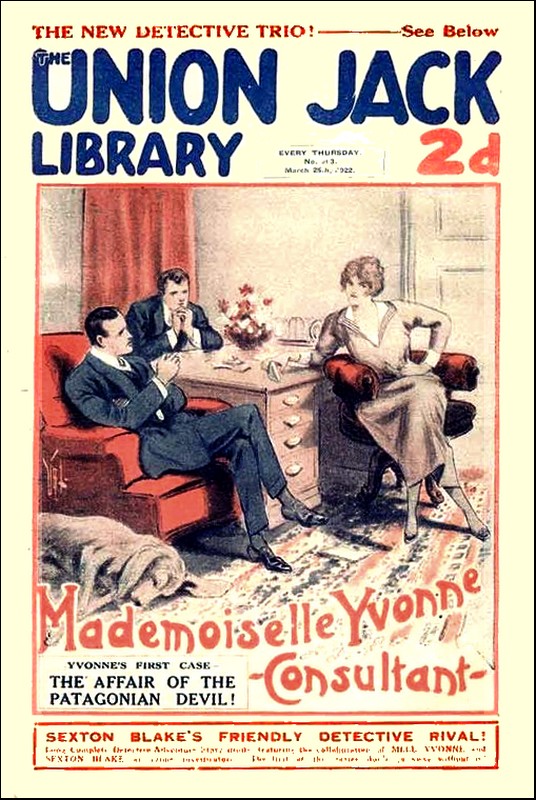
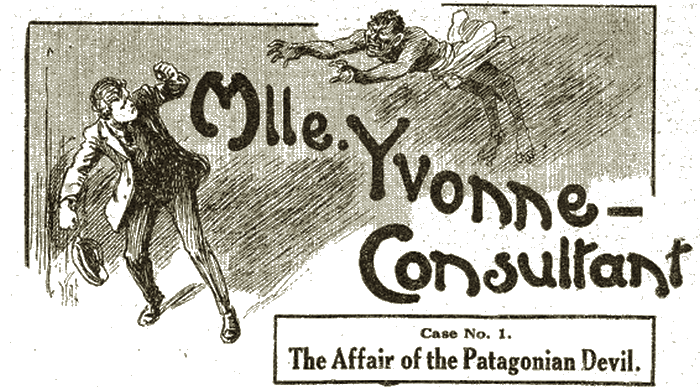
In this specially attractive yarn the creator of Mademoiselle Yvonne has cast her in a new role. She is now a detective on her own account—until she has to call on the more mature experience of Sexton Blake to help her out! This new combination makes a really fascinating feature of the Old Paper. Please tell your friends so!
ON a warm, sunny morning in early April, Mr. Sexton Blake, the eminent London criminologist, with his assistant, Tinker, who led the great bloodhound, Pedro, on a leash, descended the steps of his chambers in Baker Street.
The little party paused on the pavement for a few minutes while Blake and Tinker discussed which way they should go; then, turning, they began leisurely to walk towards Oxford Street. They had gone scarcely a hundred yards when, from the direction of Portman Square, they saw a smart grey two-seater car coming towards them. As it drew into the kerb and a small gauntleted hand was held out, they recognised Mademoiselle Yvonne at the wheel. In her smart fawn motoring coat and little orange-coloured velour hat she and the shining car seemed in complete harmony with the bright spring morning.
"Whither away, O Mighty Solver of Riddles, and thou, O Lesser Light?" she asked, with a smile.
Blake and Tinker returned the smile as they removed their hats and paused by the car, while Pedro put his great forepaws on the seat and thrust his muzzle over the side for the caress which he knew always followed the sound of that voice.
"For once in a way we are idling, Mademoiselle," responded Blake. "We were just debating which way we should go for our stroll."
"Then allow me to indicate the direction for you. Let me recommend you to visit the small but strictly businesslike offices in Oxford Street of Mademoiselle Yvonne—Consultant."
"Have you really carried out your threat, then?" asked Blake.
"I have, indeed, and moreover, I already have a client. I have been frightfully busy for the past two weeks getting things in shape, but now the offices are ready. I kept it as a surprise, for I wanted you and Tinker to be the first to see them. Of course, uncle has been there." Yvonne laughed. "As a matter of fact, I have to drive him away from the place half a dozen times a day. He walks about as though it were his idea, and I really believe he imagines he has the makings in him of a great criminologist. I was just on my way to your house. I really have a client, and while it may sound like a confession of weakness, I want your advice on a technical point."
"It is entirely at your service," smiled Blake. "Shall Tinker and I walk round to your offices now?"
"Will you, please? It's a little way down on the left. You'll recognise it by the name-plate. I shall be there when you arrive."
With a little nod and a wave of her hand, Yvonne turned the car and drove back the way they had come, while Blake and Tinker continued their walk towards Oxford Street.
"I thought she was only joking when she said she was going to open an office as a consultant," said Tinker, with a grin, as they went along.
"I am not really surprised that she has done so, my lad. I rather think the germ of the idea has been in her mind for a long time, and I fancy it was our conversation at dinner that night about three weeks ago that really caused her ideas to crystallise. After all, why shouldn't she? She has plenty of money and a thinking apparatus for which I have the highest respect. Personally, I think it an excellent outlet for her energies."
"Exactly what is her idea, guv'nor?"
"Well, my lad, I believe she intends confining her practice chiefly to her own sex, and only those of it who are unable to pay for professional advice. It is not her idea to make money out of it."
"But," objected Tinker, "you never charge anybody when they are not in a position to pay."
"Quite so, my lad. But, then, consider the number of cases of that nature which we are forced to decline owing to the pressure of business. Besides, Mademoiselle Yvonne has had an experience and education which fit her exceptionally for the class of work she has decided to take up, particularly in dealing with her own sex."
"Yes, that's true, guv'nor," agreed Tinker. "She certainly is fine," he added warmly. And although he made no reply, Blake entirely agreed with the lad's sentiment.
On ascending to the first floor of the address in Oxford Street, which Yvonne had indicated, Blake and Tinker paused to study with interest the two ground-glass doors which faced them. On the one immediately facing them was painted, in neat black letters, "Yvonne Cartier, Consultant," and on the other one to the right, the same announcement, with the small addition of "Private" underneath. Then Blake turned the handle of the first door and stepped inside, followed by Tinker and Pedro.
The room into which they entered had been furnished by Yvonne as an extremely comfortable waiting-room, the general scheme of which was sober dark brown for the walls, with deep armchairs upholstered in dark green leather.
A small desk was immediately on the right as one entered, and at this sat a stocky, freckled, red-headed boy of about fourteen, who, at the moment, was engrossed in the current issue of a well-known detective story journal.
At another desk in the corner, near the door which led to Yvonne's private room, sat a young lady, busily typing. In the centre of the room was a square, heavy table of mission oak, on which lay a number of recent' periodicals, mostly devoted to matters feminine. Although it was warm outside a cheerful little fire burnt in the grate.
Altogether, Blake decided the room was distinctly harmonious and restful, the only incongruous note of colour being the flaming red hair of the office—boy.
As the latter laid down his journal and rose to inquire their business, the door of Yvonne's room opened, and she herself appeared. She had thrown aside her motoring coat, and looked very trim and businesslike in the smartly-tailored grey suit which she wore. She crossed the office with a smile, and welcomed them with her outstretched hands.
Then, turning to the young lady who was typing, she said:
"Miss Bryan, this is Mr. Sexton Blake and his assistant—Tinker. You will probably have considerable correspondence with Mr. Blake. And, of course, this is Pedro, of whom you have undoubtedly heard."
Miss Bryan rose, and smiled her acknowledgments. Then Yvonne turned to the red-haired boy; but instead of speaking she laughed, for he had been gazing in the deepest awe at Blake, and was now goggling at Tinker enviously.
"I see you don't need any introduction, Peter," she said at length, "seeing that you've been reading of his adventures in that paper of yours. Please remember that when either Mr. Blake or his assistant come here I am to be informed at once!"
"Y-yes, ma'am," stuttered Peter. Yvonne smiled again, and led the way to her room. It was furnished simply, but in keeping with the good taste and comfort of the other room. Yvonne's desk was large and flat, and of dark, polished mahogany, while her chair was a low swivel affair, of the same wood. A magnificent Persian rug of dark tones almost covered the floor, and a large easy-chair like those in the other office stood at the other side of the desk. A few fine water-colours were on the walls, and in the small fireplace a cheerful fire was glowing. The only really feminine touch which she had permitted herself was a large damascene brass vase of roses, which stood on the desk.
"Well. how do you like it?" she asked, as she closed the door and waved them to seats.
"Awfully well," answered Blake. "You have struck exactly the right note."
"I am glad you approve," she smiled, as she seated herself at the desk. "And now, will you listen while I tell you about the point that is bothering me? But, first, you must light a cigarette."
Blake nodded his thanks as Yvonne held out the big silver box of cigarettes which had reposed on the desk. Lighting one herself, she proceeded.
In a few brief sentences she explained her difficulty to Blake, who listened attentively. As it was a subject on which he had once written a monograph, he was able to solve her difficulty promptly. When he had done so he rose.
"If anything else comes up, please let me know. I shall always be very glad to do anything I can. And you know that both Tinker and I wish you every success."
They took their departure a few minutes later, and continued their stroll. But as they turned into Hyde Park neither of them guessed that the very next day they were to plunge into an active part of Yvonne's first real case.
MADEMOISELLE YVONNE lay staring up into the darkness, wondering what could have wakened her. She had no impression that a noise had been the cause. Nor had she the feeling that any stealthy prowler had disturbed her. She felt perfectly normal in every way.
She had slept soundly without the slightest suggestion of disturbing dreams. Her room was quiet, and against the open window she could hear the soft "swish" of the curtains as they were fanned back and forth by the faint breeze.
What time it was she had no idea. It was still dark, and there was no sign of the early summer dawn. She put the hour down as between one and two.
Still, she was wide awake. That puzzled her.
Every faculty was acutely functioning, which was unusual in a sudden waking. As far as she could tell, she was lying in exactly the same position as when she had gone to sleep. And yet something—something either audible to her hearing or alarming to her subconsciousness had caused her to wake.
She lay perfectly still, watching and listening. Not a sound broke the stillness of the great house for some time, and then a distant cock-crow came through the summer night. A prosaic, natural thing in the early hours of any summer morning.
When nearly a quarter of an hour had passed, without the slightest thing occurring to rouse her uneasiness, she sat up in bed, and, reaching out her hand, switched on the night-light on the table beside her bed. Instantly the room was filled with light, and, taking care not to disturb her companion, who was still sleeping soundly, Yvonne gazed about the room with a puzzled frown.
The addition of the light left her as unenlightened as before. It was still the large, old-fashioned and gloomy chamber it had been when she and the girl who lay sleeping beside her had retired.
As far as she could see, not a thing had been disturbed, and there was nothing to suggest that anyone had entered the room while they slept. If anyone had, and the person was still in the room, then there were only three places of concealment. One was a big cupboard which had been let into the wall which faced the bed; one was an enormous ancient wardrobe which stood against the wall on the right of the bed; and the third was beneath the big, four-poster bed.
Yvonne herself had locked the door before retiring, and from where she sat the key appeared to be just as she had left it. The door was of heavy oak, built in the days when honest workmanship and sound materials were a matter of pride. It would yield to nothing less than a battering ram. Above it was a narrow transom of more modern type which had been let into the wall at some time to increase the ventilation of the room. It was filled in with three small ground glass panels, and at the moment was slightly ajar. It was the draught blowing from the open window through the aperture that caused the window curtains to sweep gently back and forth.
The transom was controlled by a fairly heavy brass rod which was attached to the door frame, and which could only be operated from within the room. Like the key in the door, the transom appeared to be exactly as Yvonne had left it on retiring.
When Yvonne had taken in these items, she reached out to the chair near the bed where she had thrown a Japanese silk dressing-gown, and, slipping it over her shoulders, stepped softly out of bed. Her slippers were on the floor, close at hand, and when she had thrust her little white feet into them, she reached under her pillow and drew out a small but very effective automatic. Grasping this, she bent suddenly and peered beneath the bed.
There was nothing more.
Then, settling her pink boudoir cap more firmly on her head, she tiptoed across to the great wardrobe. She wanted, if possible, to make her investigations without waking her sleeping companion, but she remembered that the middle door of the wardrobe squeaked slightly. She opened the two end doors first and peered within. There was nothing to be seen but the filmy dresses belonging to her sleeping companion and herself.
Then she risked the main door in the middle. Inch by inch she drew it open until she could see inside.
Every hook bore its burden, and it would not have been a difficult matter for someone to lie concealed behind the billows of frocks. But Yvonne settled this doubt by reaching in her arm and poking the barrel of her automatic into every corner. There was nothing there that should not be there. Now only remained the wall cupboard.
She glanced back towards the bed to find that the girl there had not been disturbed by her movements. She went swiftly across the room to the cupboard, and, turning the handle of the door gently, drew it open. The cupboard was so large that it was almost a small room. Just inside the door was a switch, which Yvonne turned on. Then she stepped inside, and, holding her pistol in front of her, made a slow tour of the place.
It was quite empty of anything human.
Turning out the light, she closed the door and crossed to the rod which controlled the transom. It was secured just as she had left it. She then turned her attention to the door leading into the corridor. She turned the handle, but the door did not yield. It was locked just as she herself had locked it.
Now she made her way back to the bed, and, turning out the little light on the night table, crossed to the open window. Leaning on the sill, she gazed out into the garden beneath.
It was a beautiful starry night. There was no moon, but by the light of the myriad stars Yvonne could easily make out different objects in the garden beneath, and even in the grounds beyond. The sweep of the moor, however Highmoor Grange, where she was staying, was in one of the most desolate parts of Dartmoor—was only a dark blur beyond the confines of the grounds.
To the right she could make out the shadow of the stables, and to the left she could see the high stone wall which separated the garden beneath her from the lawns in front. She stretched her head well out, and looked both upwards and downwards.
There was one floor beneath her—the ground floor—and one above her, but no light showed from any of the windows. It was just a mild night, with a faint breeze blowing over the moor, and with neither sight nor sound of an unusual nature. Even as she leant on the sill a cock crowed again, and she noted that the sound came from the poultry yards at the back of the stables.
Yvonne withdrew her head, and stole back to bed.
"I must be developing nerves," she thought, as she slipped off her dressing-gown and slippers, and crept once more between the sheets. "All the same; it is most unusual for me to wake like that. It must have been because I was subconsciously dwelling on what Eleanor told me before she went to bed."
She reached out for her little luminous watch, and glanced at the time.
"A quarter to two," she murmured. "I wonder if I dare smoke a cigarette? I don't want to wake Eleanor. I'll risk it!"
Turning on the light again, Yvonne opened her gold cigarette-case, which lay on the table, and took out a small Russian cigarette of the kind she affected. She lighted it, and lay back against the big pillow, thinking. She had only arrived at Highmoor Grange that afternoon, and so far there had been little opportunity to get her bearings.
A week before she had had no thought of coming to Dartmoor. Her visit was the result of an interview with Eleanor Hilyard in London, and what she had heard on that occasion had resulted in her coming to Highmoor Grange.
Ostensibly she was a former school friend of Eleanor's. As she was older than the other girl they had achieved the polite fiction that she had been somewhat senior to Eleanor at the private school which the latter had attended. From what Eleanor had told her since her arrival, there had been, at first; considerable opposition on the part of Stephen Curley to her visit.
But this had been anticipated, and before Eleanor Hilyard had left London Yvonne had primed her with several arguments to use in case her guardian tried to raise difficulties.
Yvonne's foresight had been wise, for a letter from Eleanor, a day or two after her return, had made it plain that Stephen Curley had raised strong objections to anyone visiting his ward, giving as his reason that he might have to go to Scotland on business in the near future, and, if he did so, would wish to take Eleanor with him.
But Eleanor, stiffened by a strong letter from Yvonne, had held out, and two days before a telegram had arrived, asking Yvonne to come as soon as possible. Yvonne had met Stephen Curley, Eleanor's guardian, for the first time that day. And now, as she lay back smoking, she was thinking of the big, fair, smiling man, and reviewing the family history which had ended in her coming to Highmoor Grange at the earnest pleading of Eleanor Hilyard.
Briefly, that history was as follows:
Martin Hilyard—Eleanor's father—had left England as a young man, and had gone to Australia. His life there had been somewhat obscure, and after a few yours he had joined a party which was migrating to Chile at the time Australian sheep were introduced into the southern part of that South American Republic.
From the very start Martin Hilyard had been enormously successful; and had made money fast. While in Chile he had married the daughter of an English official living in Valparaiso, and four children had been born—three sons and one daughter—Eleanor.
As the children had grown up they had been sent to England to be educated, although neither Martin Hilyard nor his wife followed them then. Mrs. Hilyard, always rather delicate, had died after a long illness. Then the Great War had broken out, and, with the joining up of all three sons, Martin Hilyard had decided to sell out his interests in Chile and retire to England.
Already a wealthy man, he was made still more so by the enormous price he had realised on his estates due to the war boom in stock prices. Eleanor was at home at the time at school in Brighton, and remained there for a year after her father's return. Unable to rest in cities Martin Hilyard had sought about until he found something that would remind him even a little of the mesas of the southern table-land of Chile.
He had finally come upon Highmoor Grange on a bleak part of Dartmoor, and had bought it.
About this time Stephen Curley, whom the Hilyards had met once or twice in Chile, appeared on the scene. Curley was an explorer, and had been exploring the southern part of Chile and Patagonia when he had first met the Hilyards. Martin Hilyard liked him, and it must be confessed that most people looked upon Stephen Curley as a genial fellow with a tinge of romantic adventure about him.
His books on his various journeys of explorations were models of their kind.
It never occurred to the layman to wonder why Stephen Curley was never accompanied by his lieutenants on more than one expedition. But there were a few men scattered about the globe who could have told why. It was because Stephen Curley was the "lounge-lizard" type of explorer. Others did the work and suffered most of the hardships while he reaped the glory. A tricky little point in all his agreements, too, was an undertaking that no member of the expedition should publish anything dealing with the work of the expedition without Curley's consent.
So, although the truth was known in several quarters, and although the scientific bodies that really counted had been strangely reluctant to bestow any form of fellowship on Curley, the ordinary public thought of him as quite a wonderful man who ranked high among the great explorers. The second-class letters which he could write after his name meant little to them.
Among his admirers was Martin Hilyard, who, in his loneliness, had welcomed the renewal of their friendship. With his three sons at the Front and his daughter at school, the occasional visits of Stephen Curley were doubly welcome.
A big, blonde man, with a bluff manner and almost constant smile, he acted on Martin Hilyard like a tonic. Shortly after the outbreak of war, Curley had been appointed an interpreter, and, as his duties kept him mostly in London, it was not difficult for him to get down to Highmoor Grange on frequent leave.
Then Martin Hilyard's eldest and youngest sons had been killed in the same action. The blow had been a severe one, and Hilyard gradually came to lean more and more on the ready sympathy of Stephen Curley. Eleanor Hilyard came home to stay when the news reached her, and at first did not perceive the intimacy which had grown up between her father and Stephen Curley.
For some reason, which she could not have explained, she mistrusted the man. His smiling lips made her shiver, and eventually—perhaps the loneliness of Highmoor Grange was the cause—she grew almost to hate him, and to look forward with strong distaste to the increasing frequency of his visits.
Then another tragedy had occurred.
Eleanor had gone up to London to meet her brother, who had run across for a few days' leave, and would not have time to come to Devon. The week-end she was there, Stephen Curley had came down. A telegram had recalled her, and the terms of it had been sufficient for Rupert, her brother, to get an extension of leave. They had come down together to be met by Stephen Curley with the news that their father had died of heart failure on Sunday night.
It appeared that he had been sitting at his desk writing when he had collapsed. Stephen Curley had come into the room shortly after, and had found Martin Hilyard lying across the desk unconscious. Curley had carried him to a sofa, and had rung for the housekeeper. The chauffeur had been sent off at once for the doctor, who lived about six miles away, and Curley and the housekeeper had done what they could for Hilyard.
They had carried him to his room, and, following that, Stephen Curley had discovered that Martin Hilyard had been in the act of adding a codicil to his will when he had collapsed. He had already signed it, but it had not been witnessed. Martin Hilyard had regained consciousness shortly before the doctor's arrival and had at once asked for the will.
Stephen Curley had brought it to him, and at his further request, had fetched the housekeeper and the gardener. The two servants had acted as witnesses, and then Martin Hilyard had again collapsed to remain unconscious until he died.
After the dreary funeral, Hilyard's solicitor, from Exeter, had read the will and the codicil which had been added so recently. The original will had divided the property in equal shares among the four children, but the codicil had altered that to a division between Rupert and Eleanor, and, in the event of the death of either of them before marriage, his or her share was to go to the survivor. It was a clause covering the possibility of Rupert's death at the Front.
There were a few legacies to old servants in Chile, and to charity, with a sum of five thousand pounds left to Stephen Curley "for whom he felt a deep affection and gratitude for the sympathy and companionship he had received since the death of his two sons." Then at the very foot of the page was the following paragraph:
"And I appoint the said Stephen Curley as sole guardian of my daughter Eleanor, should my only remaining son, Rupert, be killed. This guardianship to continue until the marriage of my daughter; which I hope will be with the full approval of her guardian. During the period of any such guardianship he will have full power to advise my daughter regarding investments, and the management of the estate, and shall draw from the income of the estate the sum of two thousand pounds annually, together with any expenses he may incur. Should both my surviving children die, then the residue of my estate shall pass to my friend, Stephen Curley.
"(Signed) Martin Hilyard."
The last line of the writing was touched by the scrawl of the signature, and the solicitor had gravely explained that Martin Hilyard must have collapsed immediately after signing. The estate was even larger than expected, the will being proved at a little under two hundred thousand pounds.
No question was raised about the validity of the codicils which had been added. There was no question about mental competence, and after the housekeeper and the gardener had given evidence that they had witnessed the signature at the request of Martin Hilyard, who was quite clear in his mind, the will was probated.
Stephen Curley had shown considerable surprise when he discovered that he had been a beneficiary under the will, and had been so kindly and sympathetic to both Eleanor and Rupert that the former almost forgot her antipathy towards him, while the latter never had felt any. Then Rupert had returned to France, while Eleanor had gone to London to work in a hospital. Stephen Curley also had returned to his duties in Whitehall, and the Grange was left in charge of the housekeeper.
After the Armistice, Rupert was demobilised, and had returned to the Grange with Eleanor. During her nursing period, Eleanor had met someone whom she cared for, and she had confided to Rupert the secret of her engagement. It was to be kept so until after the demobilisation of her fiancé.
Then Stephen Curley, also demobilised, had come down to Highmoor Grange.
Although he had not seen very much of Eleanor in London, he knew much more of her movements there than she dreamed, and already suspected her engagement to the young officer with whom he had seen her on several occasions.
He gave no sign, however, and was as smilingly cheerful as ever. He and Rupert rode a great deal, and it was while they were out one dreary winter evening that Rupert had been thrown and killed.
Curley had brought him back to the house, and had showed a depth of grief which was even greater than he had exhibited at the loss of his old friend, Martin Hilyard. He continually reproached himself—for, as he explained, it was due to a whim of his that they had been so late.
In taking a short cut home, Rupert had tried to take a stone wall on the slope of a stream. His horse had somersaulted, and then had fallen on Rupert, killing him instantly. An inquest was held which confirmed this, and once more the Grange went into mourning. The fact remained, nevertheless, that the estate now passed altogether to Eleanor, and the terms of guardianship automatically came into force.
For the first three months, Stephen Curley's attitude had been quite irreproachable. He had taken hold of all the onerous duties of administering the estate, and his frequent advice to Eleanor had been of the soundest. He insisted at all times that this advice should be approved by the solicitor in Exeter, but that gentleman was unable to find any flaws in it. When a rearrangement of investments became necessary, Stephen Curley drew up a list of trustee bonds which the most conservative banker would have approved of.
In fact, Eleanor's bankers in London wrote her a letter congratulating her on the wisdom of her choice, and adding that they could have suggested nothing better. Steadily her old mistrust of Curley was lulled, until, by the spring, she thought it better to tell him of her engagement. She was anticipated by Curley himself, however, and what he had to say came like a bombshell to Eleanor. He asked her to marry him.
Although Stephen Curley was still under forty, his friendship had been with her father, and Eleanor had unconsciously ranked him with the older generation. She herself was now twenty-three, and, as Curley gently explained, the difference in ages was not at all out of the way.
She had, of course, refused him, and had confessed the fact of her engagement. He had taken it very well, but had warned her that he would not give up hope. Immediately after that he had engaged a woman to act as companion to her.
This woman was a middle-aged, hard-featured person, whom Curley had engaged in London. She was completely under the domination of Curley; and although Eleanor began to find her life growing more and more unhappy, she found it impossible to get away. Her only hope was in an early marriage, but the transfer of her fiancé to a regiment in Mesopotamia, and the indefinite postponement of his demobilisation put that quite out of the question, as, even if she were married to him, she would find it impossible to get permission to go to Mesopotamia.
Then she had worked herself into such a state of nerves that she became filled with an obsession of fear of Stephen Curley and the hard-featured "companion." It had taken her a long time to put her scheme into effect to seek outside advice from someone whom she could trust, but she had at length managed to get up to London.
She had heard of Yvonne from a school friend, and had sought Yvonne's counsel. The result was Yvonne's decision to go down to Highmoor Grange as an old school friend of Eleanor's, and although Stephen Curley had at first opposed it, for the reason already stated, he had at last given in.
That is how it came that Yvonne was at Highmoor Grange under the name of Mary Guest. And it was of the several tragedies which had overtaken so many members of the Hilyard family that she was thinking as she lay back on the pillow smoking.
She had finished her cigarette, and was in the act of placing the end in the ash-tray when a dull sound reached her that caused her to sit up and listen intently. She dropped the cigarette-end noiselessly, and waited. Again the sound came, somewhere out in the corridor. It sounded like nothing so much as the fall of a body.
Yvonne glanced down at Eleanor, but saw that she still slept quietly. For a few moments there was no repetition of the sound, and then, suddenly, it came again from just outside the door. Following the thud came a slow, scraping noise, as though some creature were dragging a useless limb along the floor. Yvonne had once seen a hamstrung steer in Australia, and the remembrance came to her as she listened.
Once more the sound stopped, but only for a few seconds, and when it came again it was accompanied by a sharp, panting sound like the heavy breathing of an animal. Yvonne was not a nervous person. She had faced too much danger in her life, and had been through too many situations tinged with the uncanny to sink into terror.
But the scraping, panting sound outside the door at that time of night made her shiver as if with cold. She picked up her automatic, and kept her gaze fixed on the door, hoping that Eleanor would not wake. Who it was or what it was she couldn't even attempt to guess. But that her door was the object of its interest was certain, for a few seconds later, after an increase in the scuffling sound, she heard a slight rattle and the handle of the door move a little.
She watched the key with fascinated eyes. She was convincing herself that she was quite certain that she had tested it when she had made her tour of the room. But what if she had been careless? What if she had not turned the handle far enough to make quite sure?
If she were wrong, and the Thing outside, whatever it was, opened the door, she made up her mind that she would shoot, and shoot straight, be it man or beast.
The handle rattled again, more loudly, and she heard a grunting and a creaking, then for one brief instant something showed in silhouette against the ground-glass panel of the transom. A light burned in the hall all night, and although, it was some distance up the corridor, it was sufficient to enable Yvonne to distinguish that something which lay for an instant against the glass.
Was it a hand? It seemed to have a grotesque resemblance to one. What else could it be? And who or what was it trying to get into the room? What ever it was, it had evidently tried to climb up to the transom, for as the shadow on the glass disappeared, there was another thud similar to the two she had heard at first.
Again the slow, scraping sound followed as the Thing retreated along the corridor. Yvonne could stand it no longer. She got out of bed, and put on her dressing-gown, Then, holding her automatic firmly in her right hand, she crossed to the door and turned the key.
Jerking the door open quickly, she levelled her pistol and gazed out in the hall.
To right and to left it was utterly empty of any living presence.
The light a little distance along was burning, but Yvonne could see not the slightest vestige of the thing which had been at the door only a few moments before. The great house was wrapped in silence, and its occupants, excepting Yvonne, apparently, in slumber.
She closed the door softly and locked it again, wondering if, after all, her nerves had played her a ghastly trick and had conjured up the horrible incident completely from her imagination. She turned back to the bed, and then paused.
Eleanor was sitting up in bed, gazing with fearful eyes at the automatic which Yvonne was clutching.
"What is it?" she whispered. "What has happened?"
Yvonne smiled.
"Nothing, dear," she said. "I have been wandering about the room, that is all. I heard a sound, and thought I would investigate. I am sorry I woke you. I tried not to make a noise."
While she was speaking Yvonne walked to the bed and laid the pistol on the table. Then she took another cigarette, and, lighting it, slipped into bed.
"Now that you are awake, we may as well have a little chat," she said carelessly. "Will you have a cigarette?"
Eleanor shook her head.
"They are very soothing," murmured Yvonne. Then: "Tell me, Eleanor—during the past few months, when you have been frightened down here, has anything ever happened in the night to disturb you?"
Eleanor shook her head.
"Nothing out of the ordinary. Why do you ask?"
"Curiosity, that is all. If I am going to help you, it is necessary for me to know everything bearing on the matter, and that occurred to me. You are quite sure you have never heard or seen anything unusual?"
"Quite sure."
"Then your fear of Stephen Curley is simply an instinct?"
Eleanor clutched Yvonne's arm.
"It is only instinct, but I know he means harm to me if I refuse to marry him. You don't know what it has been, Yvonne, living day after day, and week after week, in the same house with him and the terrible companion he brought for me. His smile terrifies me. Oh, I know others would say I was mad, and that he is only genial; but in that smile of his I read nothing but cruelty and—and murder. I am sure, Yvonne, that he was the means of my brother Rupert's death. I don't know how, and I know it will never be discovered, but I am sure it was through his agency."
"It certainly is rather odd," agreed Yvonne thoughtfully. "But, of course, anyone who benefits by the death of another is liable to suspicion. At the same time, it is extraordinary how things have worked out for him."
"Your two brothers in France, then your father, and, lastly, your remaining brother. That leaves only you; and that he has his eye on you and the estate is proven by his suggestion of marriage. You are quite sweet and attractive enough, Eleanor, to make him want to marry you without any estate, and it may be an honest love.
"Still, like you, I am rather inclined to mistrust your guardian. And I don't like that clause in your father's will which gives Stephen Curley the residue of the estate in case anything happens to you. But you have nothing to fear, dear. I promise you that you shall not be left alone until we know a great deal more than we do. And if I can't solve the puzzle, then we must get someone else to help us do so. If that should become necessary, I know of one who will not rest until he has worried every shred of truth out of the matter."
"Who is that, Yvonne?" asked Eleanor.
"Sexton Blake," responded Yvonne, with a faint flush. And in that same moment was born Yvonne's private decision to write to the great criminologist early in the morning.
SEXTON BLAKE sat on the sand in the shade of a big, jagged rock, reading letters. At his feet, dozing in the warm mid—morning sun, lay Pedro, who from time to time blinked lazily in the direction of Tinker, who, in company with another young man whom he had met at the tiny Cornish village where he and Blake were staying, was doing hand-springs through the surf which thundered on to the beach.
Business connected with a case in which it had been necessary for Blake to produce some ancient records of Cornish tithes had brought him and Tinker to Wadebridge, an on the completion of the business, Blake had decided that a few days by the sea before returning to the smoke of London would do them no harm.
In Wadebridge he had heard of a small inn some eight miles out on the estuary of the Camel, so they had piled their luggage into the car, and, with Pedro guarding it in the back, had motored out to the tiny village where the inn was situated. There were less than a dozen houses altogether, and a rugged golf-course separated them from the next village, which was even smaller.
Out in the estuary the Doom Bar, made famous by the activities of the old Cornish wreckers, lay like an enormous yellow turtle-back, with here and there the jagged ends of spars still sticking up from the sand to show where some valiant craft had found her grave. Beyond the bar was the main channel of the estuary, and on the opposite shore the busy and picturesque little fishing town of Padstow straggled up the side of the hill.
At Padstow the river twisted from view, but at the mouth of the estuary Blake could see where the outflow debouched against the incoming tide, and farther out stood two small green-clad islands as everlasting sentinels, accessible only to the gulls which wheeled shrieking in the blue above. At the back of him rose a great hill of sand, on which, so rumour had it, an ancient camp of the early Britons had once been erected, and around the edge of the gradual slope he could just see the tip of a fourteenth century spire—relic of the wave of religion which had swept over Cornwall in that century, and which had led to the building of churches from one end of the country to the other.
Both he and Tinker had already tackled the surf before breakfast, but that had been insufficient for the lad, who had responded readily to the hail of his new acquaintance as the latter had passed the inn on his way to the beach. Blake, with the letters which had been forwarded by Mrs. Bardell to Wadebridge and thence to the little village where he was staying, had followed more leisurely.
He had dealt with all of them except one of considerable thickness, which he had reserved for the last. He had recognised the writing on the envelope as that of Mademoiselle Yvonne, though he had been a little surprised to note that the postmark was that of a small village on Dartmoor. Before opening it he lit a fresh cigarette; then, slitting the envelope, he drew out the closely-written sheets which it contained. He spread it out on his knee and began to read:
"Cher ami,—I fancy you will be a little surprised to discover that I am down in Devonshire. In fact, I am surprised myself, for my decision to come was made suddenly. You will see from the heading of the paper that I am at Highmoor Grange. It is situated on a very bleak part of the moor and six miles from the nearest village.
"Now for why I am writing to you.
"I am really down here on business, and certain things that have arisen are the reason for my writing. Let me say to begin with that Highmoor Grange was, until recently, occupied by a man who, for a good many years, owned a large sheep estate—and had other interests—in Chile. He died recently of heart failure, and two of his sons were killed in France. That left one son and a daughter to survive him. The mother died some years ago. Recently, however, the third son was killed by his horse falling on him—or so goes the accepted version.
"By the father's will the death of the last surviving son caused a friend of the father's automatically to become guardian to the girl. The father's name was Martin Hilyard. The guardian's name is Stephen Curley. He is reputed as an explorer, and you may have heard something of him.
"I want you to be good enough to make inquiries for me in London, and find out all that is known of this man. He appears to have considerable bearing on the mystery which surrounds Highmoor Grange, and I mistrust him. But I have absolutely nothing to go on so far, I came down here at the request of Eleanor Hilyard—the daughter—who is living in a state of constant fear—of what she doesn't know.
"It all began with her guardian proposing marriage to her. Her affections had already been given to someone else, but she dared not confess that at the time. She had been hoping that an early marriage would be possible; but her fiancé has been ordered to Mesopotamia, and, as you know, European women are not admitted to Maspot. I am curious to know if Stephen Curley had anything to do with the sudden transfer of her fiancé.
"During the war Curley was engaged as an interpreter for some time, then he was employed in some post in Whitehall. I am not quite sure what it was. His manner and his treatment of his ward are, outwardly, beyond reproach. He poses as a bluff, good-humoured guardian, who is willing to indulge her, and his advice regarding her investments has certainly been of the most conservative and well-balanced nature.
"Outwardly, everything seems all right, but his proposal of marriage to his ward rings badly in the light of the terms of the will. Briefly, they were these:
"On Martin Hilyard's death the estate —it was very large—was divided equally between Eleanor Hilyard and her brother Rupert. Stephen Curley benefited to the extent of five thousand pounds. In the event of anything happening to Rupert Hilyard, Stephen Curley was to become Eleanor's guardian, and was to remain so until her marriage, which, if it occurred, her father hoped would be with the approval of her guardian.
"If the guardianship should become effective Stephen Curley was to manage the estate, and during the term of his management was to draw two thousand pounds annually from the income. And, finally, in case anything should happen to Eleanor Hilyard as well as her brother— if they both died—Stephen Curley was to inherit the whole residue of the estate.
"Shortly after he was demobilised Rupert Hilyard came down to the Grange. After the death of Martin Hilyard it was closed for a time, and Eleanor remained in London, where she took up military nursing. It was there that she met the young man to whom she became engaged. On their return to the Grange, Stephen Curley—who had also been demobilised—came down, and it was while he and Rupert were out riding that the accident occurred which cost Rupert his life.
"Curley's story was that the boy tried to put his horse over a stone wall on the down-grade of a hill, and that the horse somersaulted over the wall, pinning Rupert beneath and killing him instantly. Not long after that he proposed marriage to Eleanor.
"She had always more or less mistrusted him, but he was so kind and sympathetic after the death of her father, and he showed such grief at the death of Rupert, that her feelings of antipathy became far less strong. They were all roused again, however, by his proposal, with the result that she gradually worked herself into an acute nervous state. It was then that she managed to get away to London, and sought my help. She feels convinced that Stephen Curley deliberately planned Rupert's death, and is sure that the same fate will overtake her if she doesn't marry Curley,
"There is, of course, not a shred of evidence to suggest either of these things, but at the same time there is an atmosphere about the place that is sinister, and one or two very queer things have happened even since my arrival yesterday afternoon. Stephen Curley thinks I am an old school friend of Eleanor's, and no one suspects my identity. He opposed my visit strongly at first, but finally yielded.
"He was very charming at dinner last night, and seemed really anxious to make a good impression on Eleanor's friend. We retired early, and at Eleanor's appeal I shared her room.
"The first 'queer' thing happened in the early hours of the morning. I woke up suddenly with the feeling that something outside the normal life of the house had been the cause. I turned on the light and searched the room thoroughly. Everything was just as it should have been. I returned to bed and lighted a cigarette.
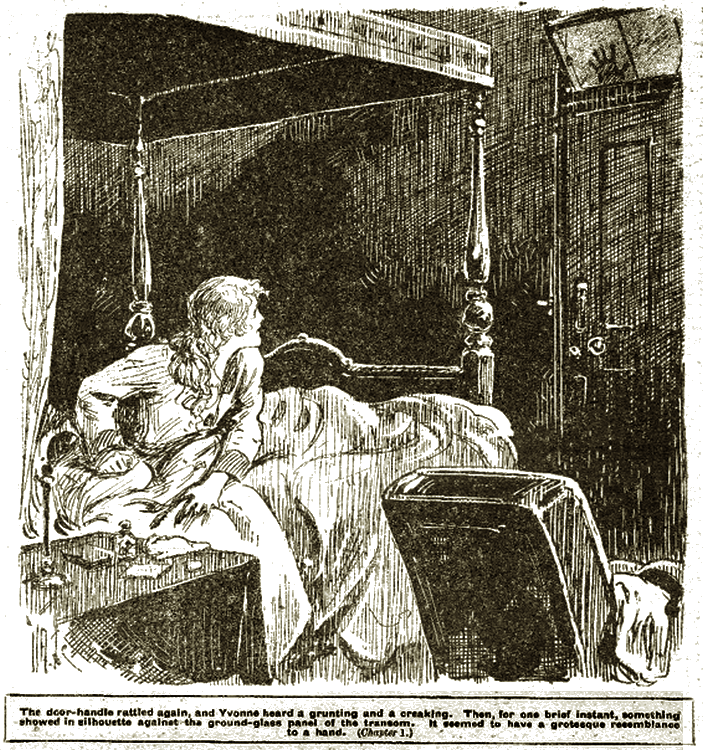
"While I was smoking I heard a sound out in the corridor, like the fall of a heavy body, then a slow, scuffling noise, as though some creature were dragging itself along the floor. Whatever it was it stopped just outside the door of the room, and then the door-handle rattled. Following that, there was a sniffing sound, and a few moments later I saw a shadow against the ground glass of the transom over the door.
"The shadow only remained an instant, then there followed another thud, as though the creature had fallen back to the floor. After that, it appeared to drag itself along the corridor again. At that point I took my revolver and got out of bed. I went to the door, and, throwing it open, looked out into the hall.
"There was no sign of anything out of the ordinary, so I returned to the room and locked the door. I had no chance to make further investigation then, for Eleanor had waked up, and I didn't want to frighten her. That was all that happened in the night.
"But the second thing that might be called 'queer' occurred before breakfast. Eleanor and I had risen early, intending to take a ride before breakfast. On reaching the lower hall we found Stephen Curley already there. He knew we intended riding as we had mentioned the matter overnight. He had already ordered the horses to be brought round, and went out to the steps with us. On arriving there Eleanor saw that her mount was not the one she was accustomed to use, and asked Curley why it had not been saddled. He replied that he had bought a new hack a few days before, and would like her to try it. The animal was certainly a little beauty, and Eleanor made no objection.
"We mounted and started off.
"Now, you know, I had a very thorough experience of horses in Australia, and, in addition to the training my father gave me, I have a natural instinct for the points of a horse. While the horse Eleanor was riding was a beautiful little animal, there was something about its eye I did not like.
"As we left the enclosure of the Grange and struck off across the moor, I watched it carefully, and after we had gone about a mile, I suggested to Eleanor that we change mounts. We had both been riding astride, so there was no difficulty about saddles.
"She was a little surprised, but agreed, and, after making the change, we went on again. I tried the horse with every pace, and could find no fault. I put him at one or two jumps, which he took in perfect fashion. I could see nothing of any description to justify that something in his eye which my instinct had mistrusted. I have never seen a horse yet with that in his eye which did not prove 'yellow' in some way.
"We had covered several miles more, when we came to a small stream, which we decided to ford. Eleanor went first, as she knew the ford. It was not deep—about two feet or so. I followed, and was just in the centre of the stream, when my horse reared without the slightest warning and then fell on its side. I was just in time by the fraction of a second to pull my feet free and leap to one side as it fell.
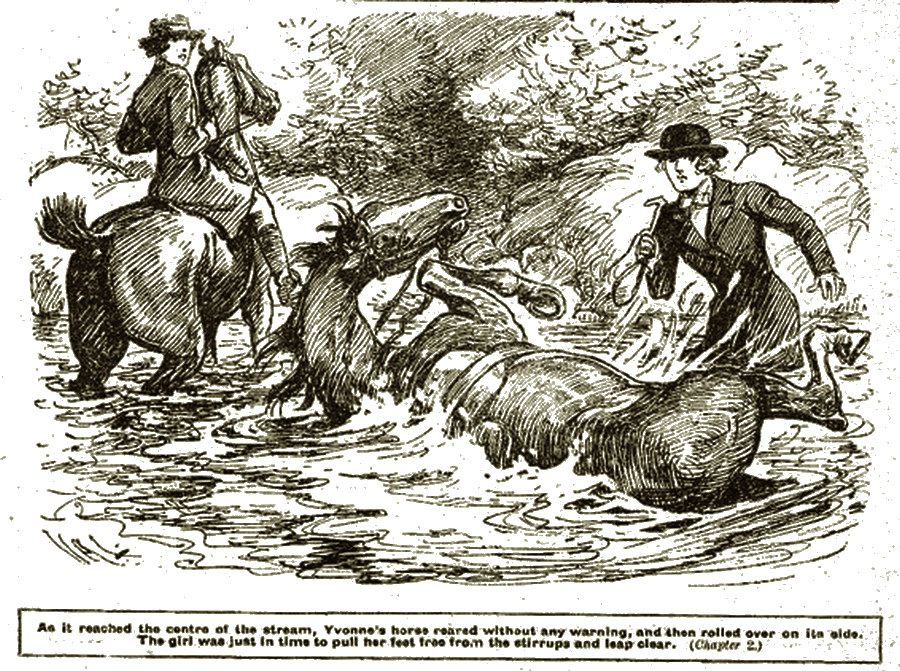
"If I had lost that fraction of a second, I should not have been writing this; for, as it lay in the water, the horse began thrashing out murderously with its feet. I managed to wade round it, and got hold of the bridle-rein. I then took my crop and began to thrash the animal soundly. It finally got to its feet and allowed me to lead it to the bank.
"If Eleanor had been in the saddle she would either have been very badly injured or crushed beneath the horse and drowned, for she does not ride very well. I got into the saddle again and put the horse back into the ford. I was on the watch this time, and as he reached the middle of the ford he did exactly the same thing. I jumped well clear this time, for I was expecting a repetition of the trick.
"I have seen a stock horse in Australia do the same thing, even in a few inches of water, and it is hopeless to try to cure one of the habit. That was the kind of horse Stephen Curley had sent Eleanor out on. And, don't forget, if I had returned to announce that Eleanor had been accidentally killed by the horse falling on her, Stephen Curley would have inherited the Hilyard estate.
"Before we returned to the Grange we changed horses again, and at my request Eleanor said nothing of what had happened. I managed to get up to my room and change my wet clothes without being seen by Stephen Curley; but whether the housemaid will tell him about the condition of my riding-garments, I don't know.
"That, mon cher ami, is the story to date. You will now understand why I want to know all there is to know of Stephen Curley. I am determined to remain here until I have solved the mystery which surrounds this place. I shall not rest until I discover what it was that was prowling about the corridor in the night. I wish that you were down here. There are certain features of this case which I am sure would appeal to you. But I suppose you are too busy to think of such a thing?
"Please give my love to Tinker, and pull Pedro's ears for me! I shall write again soon, and tell you how things are progressing,
"Yours,
"Yvonne."
"P.S.—I have walked to the village of Abmoor to post this. If you write, please address all your letters in care of the postmistress at Abmoor. She is a dear old soul, and I have arranged with her to receive and keep my letters for me,—Y."
Blake folded the letter, and returned it to its envelope. Then he gazed musingly out across the estuary.
"Stephen Curley!" he muttered. "I sha'n't have to make inquiries to tell her about him. Yvonne apparently does not know that Curley resigned from the Explorers' Club shortly after his return from his latest expedition to Patagonia. He claimed to have crossed Chile and Patagonia, and would have got away with it if he hadn't been bowled out on the Andean observations which he submitted.
"It was hushed up, of course, but he was proved to be a charlatan and a fraud—a second Dr. Cook. Then there was his first expedition to Patagonia, from which he was the only European member of the party to return. There were some ugly stories afloat at the time, I remember, about his abandonment of his companions. And now, it appears, he has given up exploring for a more profitable means of livelihood.
"I wonder if the instinct of the Hilyard girl is right? Or has Fate just played into his hands, as it so often does in freakish fashion? And what on earth can it be that Yvonne heard in the night? Is Curley, under the impression that Yvonne is a school-friend of his ward's, trying to frighten her away from the place with a silly bogey?
"He seems to have opposed her visit at first, and then to have consented. He seems to have given his consent handsomely in the end. Was he counting on other means to isolate his ward? And is this night bogey the means? Then, again, there is the incident of the morning ride?
"On top of the fatal accident to the girl's brother, it was a daring move on Curley's part, if it really was a deliberate plan to get rid of her.
"I wonder just what he would have done if Yvonne and Eleanor Hilyard had not changed horses, and Eleanor had been killed? Would he have shown great grief, as Yvonne says he showed at the time Rupert Hilyard was killed? It would not have been so difficult for him to bluff through the affair. He could easily have avoided any discovery that dropping and rolling over when crossing water was a confirmed habit, by shooting the horse immediately after the tragedy. His anger towards the animal would have been sufficient excuse, and would be accepted by almost everyone.
"Still, there is the ugly fact that, in the case of Eleanor Hilyard's death, he would have come into the whole estate. Finding that the chances of setting possession of the estate by marrying his ward were remote, he may have decided on the only alternative; for I take it, although Yvonne doesn't say, that in the event of her marriage the estate would pass into her own control, and, ipso facto, into that of her husband.
"In such a contingency, Stephen Curley would not only lose all chance of benefiting by inheritance, but he would also lose the two thousand pounds per year which he is now drawing from the income of the estate. His wise advice regarding investments doesn't mean much. If he counted on getting the estate into his own hands, it would be only natural that he would choose carefully when reinvesting the funds.
"At the same time, I don't particularly like Yvonne tackling a case of that sort, even though Eleanor Hilyard may be in danger. If Curley's intentions are criminal—then, if he ever discovers who Yvonne really is, she will be in even greater danger than the girl she is trying to protect, for he would then know that he was under suspicion. The whole thing is a most-curious affair, and bears some phases of distinct interest.
The form of the will in particular is strange, and Martin Hilyard must have had a very deep confidence in Stephen Curley to leave him as sole guardian of the girl. I should like the opportunity of examining that will."
Blake's thoughts broke off as Tinker came along the beach at a jog-trot, and dropped on the sand beside him.
"You ought to have come in, guv'nor," he panted, as he rolled Pedro over on his side. "It was ripping!"
"I am glad you have made the most of it, my lad, for I am afraid you won't have much more opportunity at present."
"What do you mean, guv'nor?" asked Tinker, in surprise. "Are we leaving so soon? I thought we were going to have at least another four or five days of it."
"So did I," responded Blake. 'But I have received a letter this morning, Tinker, which has caused me to alter our plans. We still have a few days at our disposal before we return to London, and I have just decided that we shall put them in on Dartmoor."
"But that won't be half as decent as here," protested Tinker.
"Read this letter before you decide," said Blake, as he passed over Yvonne's missive.
While Tinker obeyed, Blake smoked, and gazed out towards the Atlantic, only bringing his eyes back when Tinker laid the letter down.
"This entirely alters things," remarked Tinker. "I had no idea that Mademoiselle Yvonne was in this part of the country. Does it mean that you are going to take a hand in the case she is working on, guv'nor?"
"Not necessarily. She may prefer to work things out in her own way. But we shall go through to this village of which she speaks—Abmoor—and send word to her that we are there. I can tell her a good deal about this man Curley; and then, again, she may wish us to take a hand in it. Anyway, we shall see when we get there.
"She doesn't say what the exact personnel of the household is, but if Curley has criminal intentions, then Yvonne, as well as Miss Hilyard, is in a position of considerable potential danger. The weather is fine, and we shall enjoy motoring through. So we shall pack up tonight and leave early in the morning.
"We can go over the road-map this evening. I fancy we ought to be able to reach Abmoor by four or five o'clock to-morrow afternoon. I think, too, that we will send a telegram to Yvonne, in care of the postmistress at Abmoor, telling her that we are coming."
With that Blake rose, and, slipping on a macintosh over his bathing suit, Tinker joined him. With Pedro padding along beside them, they made their way along the beach to where a narrow lane led up to the inn. On reaching the inn, Tinker went to change, while Blake wrote out a telegram to Yvonne.
Half an hour later Tinker got the car out and motored into Wadebridge to send off the telegram.
They packed that evening, and afterwards blocked out their journey on the road-map. At six o'clock the following morning they started, and at exactly half-past three that same afternoon they drove into the yard of the little inn at Abmoor village.
They had come by Wadebridge, and down the backbone of Cornwall by way of St. Austell thence by way of one of the moor roads to Newton Abbot. From there it was a straight run-through to Abmoor, which they would have reached sooner had it not been for a blow-out at Redruth and a stop for lunch at Newton Abbot.
As they garaged the car in a small shed attached to the inn, and took their way round to the front, they saw, just across the road, a little ivy-clad cottage, on one end of which a board announced that it was the post-office. At that same moment the door opened, and a figure appeared.
It was Yvonne, dressed in a smart grey tweed country suit, and with a soft felt hat crushed down on her head. She carried a heavy walking-stick, and her dusty shoes showed that she had walked some distance. As she reached them she held out her hands—one to each of them—and her violet eyes danced with pleasure.
"What luck!" she exclaimed. "I had no idea you were in Cornwall! I came in early this afternoon to see if there were any letters, and found your telegram waiting for me. I was so glad to get it. It was awfully good of you to come straight on here!"
Blake led the way into the bus.
"You haven't mentioned the postmistress, have you?" in a low tone.
"No. When I saw that you had sent your telegram under the name of 'Blake Baker,' I knew what it meant."
"Yes. I thought it would be just as well to use another name during the few days we shall stay here. By the way, what name are you staying under?"
"Mary Guest."
Blake smiled.
"And very appropriate it is," he said.
"Now, you are going to have tea with us, and afterwards we shall walk back with you. While we are having tea, you can tell me all about things."
When Blake had booked rooms for himself and Tinker, and they had got rid of some of the stains of the road, they rejoined Yvonne where she was waiting for them in the small parlour of the inn, where the proprietress brought them a real Devonshire tea of scones and jam and clotted cream. When she had departed, and Yvonne had poured the tea, Blake said:
"I have studied your letter very carefully, and there are a few points on which I would like a little more information. But firstly tell me if anything 'queer' has happened since you wrote."
"Nothing new; but last night we had a repetition of the night mystery. It happened at about one o'clock. I determined that if it happened again after the first night that I would throw open the door and find out exactly what it was. But last night Eleanor—Miss Hilyard—was awake. It was the first time she had heard the noise, and she was terrified.
"She was in such a state of nerves that she would not listen to my suggestion, so I was compelled to let the thing, whatever it was, get away. In every respect the incident was like the night before. That is all that has happened, except that Stephen Curley went off to Exeter on business this morning. He will return this evening. Can you tell me anything about him?
Blake nodded.
"I can tell you a good deal about him," he said grimly. "That is why I came on here to see you. I did not need to make inquiries in London, I have no wish to interfere with the duty which your new profession entails upon you"— Blake smiled one of his rare, whimsical smiles—"but I think you ought to know that, if as you seem to think, Stephen Curley has criminal intentions regarding the Hilyard estate, and if the incident of the ride was deliberate, then you are playing a very dangerous game. Has it occurred to you that you would be in a position of extreme danger if he discovered your identity?"
Yvonne nodded gravely, the while her eyes rested on Blake's.
"Yes," she said, "I have weighed all that. And, moreover, I feel more and more certain that Stephen Curley will stop at nothing to get possession of the Hilyard estate. He may not have abandoned all hope of securing it by wearing down Eleanor's opposition and persuading her to marry him. That is why I think the night incidents have been produced more for my benefit than for hers. I think he hopes to frighten me away."
"It seems rather strange that Martin Hilyard should make a will such as he appears to have made," went on Blake. "He must have had very great confidence in Stephen Curley. Had they been intimate for long?"
Briefly, Yvonne told him what she herself knew of the relation that had existed between Martin Hilyard and Stephen Curley.
"That, of course, explains part, but not all," remarked Blake, when she had finished. "The sweeping terms of the codicil are in distinct contrast to the main body of the will. I should like very much to make a detailed study of the original. Have you any idea where I could get possession of it?"
"It has been probated, but I fancy you could see the original by applying to the solicitor in Exeter. He is greatly under the influence of Stephen Curley, though."
"I think I can get around that," said Blake, "And now tell me exactly, what is the personnel of the Grange? How many servants are there?"
Beginning with Stephen Curley himself, Yvonne gave Blake a list of all the residents of the house, including herself. As she spoke, Blake had been jotting them down on the back of an envelope which he had taken from his pocket. When she had finished he glanced up.
"I have marked a cross opposite two names here—Mrs. Brunton, the housekeeper, and Mrs. Harrison, the companion who was brought down for Miss Hilyard. Let us take the housekeeper first. What is she like?"
"A little, mouse-coloured, nondescript woman, who flits about like a shadow. When Stephen Curley speaks to her she hangs on every word he says, and obeys him implicitly. She is always gliding about in a nervous manner, as though waiting for him to speak to her. She is rather an irritating little person."
"And the companion?"
"In my opinion, a most undesirable person as a companion to Eleanor. Since I have been at the Grange she has not been much in evidence. Whether that is due to orders from Stephen Curley, or merely the fact of my presence, I do not know, She is a middle-aged woman, with hard, rugged features, and a mouth like a steel trap. She is overbearing enough with Mrs. Brunton and the other servants, but literally cringes when Stephen Curley speaks to her."
"From your descriptions I gather that both the housekeeper and the companion are absolutely under his thumb, possibly from different causes, but still entirely his creatures."
"I should say so—yes."
"As far as I can see, Yvonne, you have tackled a case where any precipitate action would be fatal to your success. There are certain concrete points which want clearing up in order that you may have a straight line of reasoning to work against. The main object is to prove Stephen Curley's intentions to be criminal.
Once you have done that, you will then be able to use weapons which are bound to protect Eleanor Hilyard. But until you can do that you are on shifting ground, for the simple reason that he is her legal guardian, and the law will uphold him within reason, and, to a great extent, beyond what you and I might consider to be reasonable. He knows that as well as we do.
"And if the last surviving member of the Hilyard family should meet with a fatal accident, such as might have occurred when you were riding two mornings ago, who is going to prove that Stephen Curley had anything to do with it? What you have got to do is to be on guard that no such 'accident' has a chance of occurring until you can get him just where you want him. Then you can fight him with the weapons you need."
"Yes, I quite see that. But what do you suggest?"
"Do you want me to tell you?"
"Of course."
"Then if I were in your place, I should make it my first effort to discover what it is that disturbs you in the night. At present it is a mystery. In the meantime, if you are willing, I should like to make a personal examination of that will. The difficulty in my suggestions is that your investigation of the thing which is disturbing you in the night may prove dangerous. It may be, as you have suggested, a silly bogey, but, on the other hand, it may hold danger for you. I would like to suggest that while Tinker and I are here you allow us to take it upon ourselves to run this particular part of the mystery to earth."
"I will accept your help and advice gladly; but how would you do as you suggest?"
"It would be necessary for us to get into the Grange during the night. Are there any dogs to be on guard against?"
"There are two in the kennels, but they are locked up at night."
"Could you manage some way for us to gain access to the place?"
Yvonne thought deeply for a few minutes, then she said:
"I might arrange for you to come in through one of the windows. There is an empty room next to the one occupied by Eleanor and myself. I know—listen! Before I return to the Grange I can get some thin rope, and this evening Eleanor and I can make a rope ladder. When we come upstairs after dinner we can fix that in place from the window of the room next to ours. If you can get over the wall you could easily get in that way."
"That sounds feasible," responded Blake slowly. "Just tell me what the corridor outside your room is like."
"It is a long, narrow hall, that runs neatly the whole length of the main wing of the house. On the right of our room, towards the part of the house occupied by Stephen Curley. There are two empty rooms beyond ours, then there is a slight right-angle in the corridor of about six feet. From that it continues on again. It is at this angle that a lamp is left burning during the night. It is a small wall bulb. On the left of our room the passage continues only a short distance before it turns and leads to a back staircase, which connects with the floor above. That staircase is used mostly by the servants. Where the bend occurs there is a heavy, dark-green velvet curtain. The room by which I have suggested that you enter is the last one before the end."
"From that I take it that this heavy curtain would be just outside that room?"
"Yes."
"And opposite your room?"
"There is only the wall, and, of course, windows. They look out on the side of the house. The wing is rather narrow in that part."
"I follow you perfectly. In the absence of any more definite plan, I think it would be a good idea for us to get some thin rope as you suggest, and for you and Eleanor to make a ladder. Only please be sure it is strong enough to hold us. If Stephen Curley is not returning from Exeter until this evening, you ought not to have much difficulty in smuggling the rope into the house."
"Oh, I will manage that all right. Only promise me that you and Tinker will be careful, I don't want you to run into danger for my sake."
Blake smiled and Tinker laughed out-right.
"I don't think we shall run much risk," he said.
From the inn they went to the village shop, where they succeeded in getting some rope, although, in order to make the length necessary, they had to purchase two different thicknesses. Yvonne decided to use that of the greater diameter for the strings of the ladder, and the thinner for the cross ropes or rungs.
Then they set out along the dusty road, which led towards the Grange six miles away. It was a glorious summer afternoon, and after their long journey in the car both Blake and Tinker were only too glad to stretch their legs. Yvonne, who had already walked the distance once, was still fresh, and they made good time until they came in sight of the Grange.
When they were about four hundred yards away, and for the moment were hidden from view of anyone who might be watching from the house, Yvonne drew up.
"I think you ought to leave me here," she said, "it is not likely that anyone will see us, but it is as well to be sure."
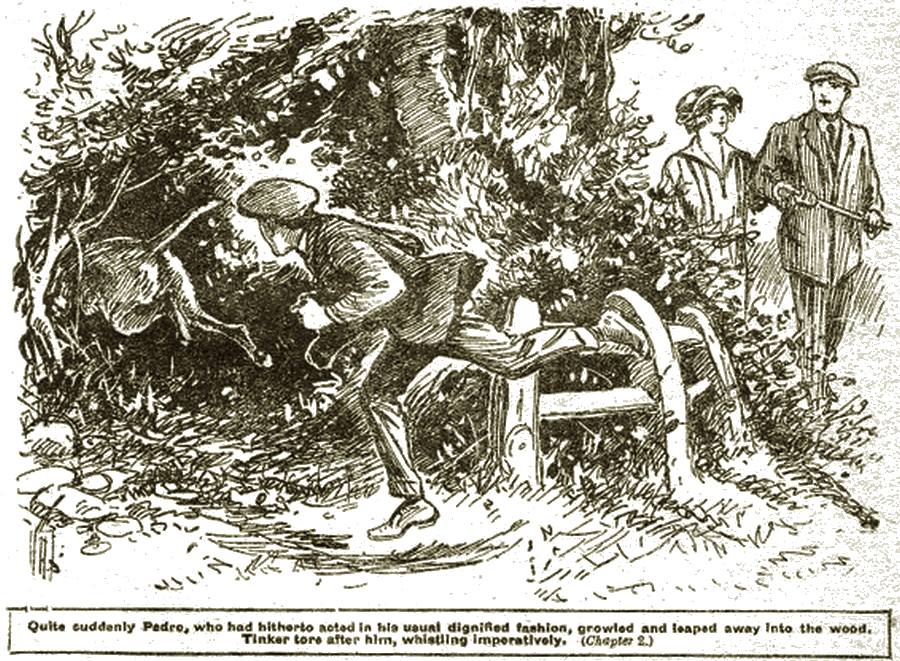
Blake nodded his agreement, and was just about to take leave of her when; without the slightest warning, Pedro, who had accompanied them all the way in most dignified fashion, growled and went off with great leaps towards the wood on the right. He cleared the wall with a single bound and was instantly lost to view.
Tinker tore after him, whistling imperatively, but Pedro paid no attention, so, climbing the wall, Tinker dashed through the wood after the bloodhound, puzzled over his extraordinary behaviour.
Blake, who thought it would all prove to be some trivial whim on Pedro's part, despite the bloodhound's thorough training, urged Yvonne not to wait. When she had gone on towards the Grange Blake lighted a cigarette, and, turning, strolled slowly back towards Abmoor, waiting for Tinker and Pedro to overtake him.
So absorbed was Blake in his thoughts that he suddenly realised with a start that he had reached the outskirts of the village, and that there was no sign of either the lad or the dog. He remembered a small knoll about half a mile back, from which he had been able to see a considerable distance; so, as it was still early, and the sun was still high in the sky, he retraced his footsteps until he came to the knoll.
Climbing to the top, he gazed along the road towards the Grange. He was about three-quarters of a mile from the village, and could see for nearly a distance of two miles along the road in the other direction except for one small patch of wood which hid a bend of the road.
There was no sign of Tinker, and although he waited for fully a quarter of an hour to give the lad a chance to appear, in case he had been hidden by the small wood when Blake reached the top of the knoll, no one came into view.
While he was standing there he heard the sound of a motor behind him, and, turning, he saw a big car bearing towards him from the village. It swept past in a cloud of dust, but before it disappeared from view Blake had caught a glimpse of the man at the wheel. Although the view was only a fleeting one, he felt certain that it was Stephen Curley, whom he had seen on one or two occasions at the Explorers' Club in London.
When the dust-cloud raised by the car had settled Blake waited some time longer for Tinker to appear, but without result. Then, with a shrug of irritation, he turned and continued his way to the village.
"He oughtn't to have gone off like that," he muttered. "I don't want Curley to see him and the dog in the vicinity of the Grange, and it would be just Tinker's luck if he ran into them on his way back. However, he will probably turn up presently."
How little Blake guessed what Tinker was doing at that very moment!
WHEN Tinker first entered the wood he could see no sign of Pedro. He was as puzzled as Blake to know why the bloodhound had gone off so suddenly. He knew it could only be some extraordinary scent which had stirred the big fellow to disregard his call, or else, as had happened more than once in the past, Pedro had suddenly come upon a scent which had at some time been of a strongly hostile character.
Tinker found a narrow path, which he followed at a brisk run. He did not wish to risk calling to Pedro there, as he knew it was Blake's desire that their presence should be unsuspected. But he did give a series of short, sharp whistles which Pedro would understand well enough.
The path was apparently little used, and went in a continually twisting fashion, as if it had been originally made by the aimless wandering of cattle or sheep. He had gone perhaps a hundred yards or so when he caught a fleeting glimpse of the bloodhound. He emitted a sharp, imperative whistle, which this time Pedro obeyed, although it was plain that he was waiting impatiently.
Tinker caught up with him, and, leaning down, admonished him in a low tone. Then the lad raised his head and peered about cautiously, trying to discover what it was that had caused Pedro's extraordinary action.
The dog's nose was pointed towards where the path wandered off to the left. Slipping a leash on Pedro, Tinker moved in that direction until, on making a turn, he saw all at once that the wood opened out into a small clearing, in the centre of which was a small stone cottage, obviously a keeper's hut.
Beyond it the trees thinned out, and he could just see a high wall; which he knew must be the one surrounding the Grange. He was puzzled, however, to understand what interested the bloodhound, for there was no sign of anything or anybody moving about the hut.
Nevertheless, Pedro was straining hard at the leash; and Tinker knew very well that something or someone had either passed the cottage or entered it within a very few minutes.
Suddenly he drew back and dragged the dog down into the concealment of a thicket. The front door of the hut had opened, and a man was standing gazing up and down the path.
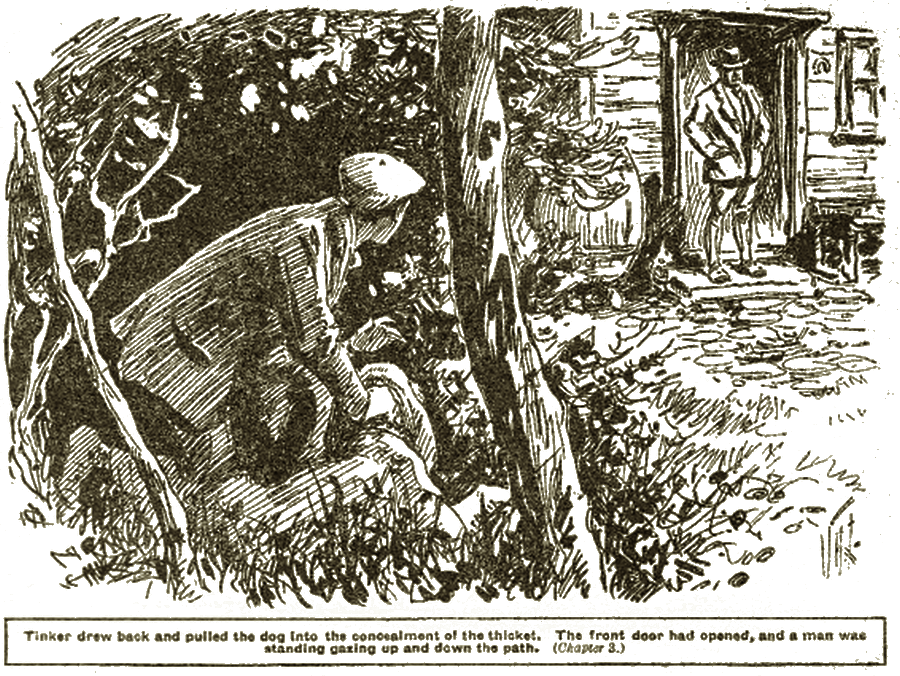
Tinker crouched low and studied him. The man was a big, burly fellow, dressed as a keeper, and yet there was something about him that seemed familiar to Tinker. Somewhere, some time, he had seen that man before, and he was trying to remember where or when it could have been.
The keeper was evidently satisfied with his examination of the path, for, after turning and looking back into the cottage, he closed the door and started towards the Grange. As he moved along he displayed a slight limp, which caused his left shoulder to jerk in an odd manner. As he saw that, remembrance came to Tinker.
"Thruster Joe!" he muttered. "I thought he was still in prison. He must have been released lately. But what the dickens is he doing, down here as a keeper? I wonder if it was he that Pedro was trailing?"
Tinker's recognition of Thruster Joe brought back the details of the affair that had ended in the latter going to penal servitude.
Tinker recalled that he had been convicted along with a woman, who was thought by the police to be his wife, in connection with a series of complaints regarding the severe ill-treatment of several children who had been placed in their care. Tinker recalled, too, that the pair had only escaped the more serious charge of murder because the evidence, while very strong, was not conclusive.
That had been some four or five years ago, he remembered, and the matter had passed out of his mind until he recognised the man in the wood. The case had been entirely a police prosecution, and neither Blake nor Tinker had had any professional interest in it other than a watching one for the purposes of the "Index," where all the evidence and the prisoners' photographs were collected for future reference.
He was puzzled, therefore, at Pedro's apparent interest in Thruster Joe, for, as far as he knew, the bloodhound had never before come into contact with the criminal. As the ex-convict disappeared from view, Tinker looked down at Pedro. The dog had paid scarcely any attention to the man who had emerged from the hut, and Tinker could see that all his attention was still concentrated on the building.
"It wasn't Thruster Joe," he muttered. "Whatever it was is still in the cottage. I think I'll investigate."
He got to his feet. But as Pedro sprang up eagerly. Tinker laid a restraining hand on his collar.
"Nothing doing, old fellow," he whispered. "You've got to stay here until I see what it is."
With that he drew the reluctant dog back farther into the shelter of the thicket, and tied the leash to a small sapling. He then raised an admonishing finger.
"Now, no. nonsense!" he whispered sternly. "You stay here and keep quiet!"
Then Tinker emerged from the thicket, and, after a preliminary survey of his surroundings, went cautiously towards the hut. It was only about thirty yards distant, so it did not take him long to cover the intervening space.
It was a plain little hut, built of rough stone, with a slate roof. The ground floor was apparently divided up into two rooms, while Tinker judged there was probably a small garret over them. He could not see the rear of the hut, but thought there would be another door there. He approached the front, and paused by the door.
He stood and made another survey of the path, then he knocked lightly. He had made up his mind that if there was anyone inside he would ask his way to the road, allowing the occupant of the hut to think that he had lost his way in crossing the moor, There was no answer to his first Knock, so he rapped a second time, louder.
No response came, but, pressing his ear to the door, he thought he could make out sounds within. He gave another glance about him, then turned the handle and looked inside. He saw a small room furnished with a cot, bed, table, a couple of deal chairs, and a washstand. There was a small fireplace, in front of which stood some battered cooking utensils. Some garments hung from a peg in one corner, and a couple of pairs of rough boots stood by the bed.
The room, however, contained no human presence, but, as he stood just inside the door, Tinker again heard sounds. They appeared to come from the rear of the hut. A small door in the wall opposite opened to the back, so, closing the front door, he stepped across the room. On reaching the door he lifted the latch which held it, and drew it open. The next instant he had started back with a sharp sensation of nausea and revulsion at what he saw.
In there was something such as he had never seen before. It was human and yet it was not human. It crouched at one side of the small, half-dark room, snarling and mouthing at him like some ghastly nightmare creation of evil. The room was filled with the mephitic stench of the Thing. In the sudden uprush of disgust Tinker drew back, and would have closed the door, but with a hideous, throaty whine the Thing launched itself full upon him.
Tinker braced himself for the shock, and as the Thing struck he drove a straight right full into the mewling face of the hideous creature. His knuckles struck hard and straight, but came away dripping with blood as the Thing snapped swiftly as a timber-wolf. It was clinging to him now, with both feet braced against his thighs, after the fashion of a lynx. Its arms were about his neck, and the hot stench of the Thing's breath was sickening him as the foul, snapping teeth sought his throat.
Even in the stress of the terrible struggle Tinker realised that it was no beast that had attacked him, but something of ghastly human caricature.
It wore a loin cloth, and the face and upper part of the body, although dark brown in colour, were undoubtedly human. The hair was short and black, and was matted thickly over a low, ape-like forehead. The eyes were black, and gleamed with animal ferocity, The nails were long and sharp, but were not claws, And yet the Thing had the fetid odour of the beast, and fought like one.
Tinker understood only too well what had started Pedro off so suddenly, and he regretted now that he had left the dog in the thicket. Time after time he drove his bleeding fists into the Thing's face; and time after time it tore at him with snapping teeth. Gradually but surely its arms tightened round the lad's neck until the pressure and the stench of its breath made his head reel with nausea.
He gathered himself together for a supreme effort. He allowed his body to relax, and, at the yielding of his muscles, the Thing shifted its hold for a death-grip.
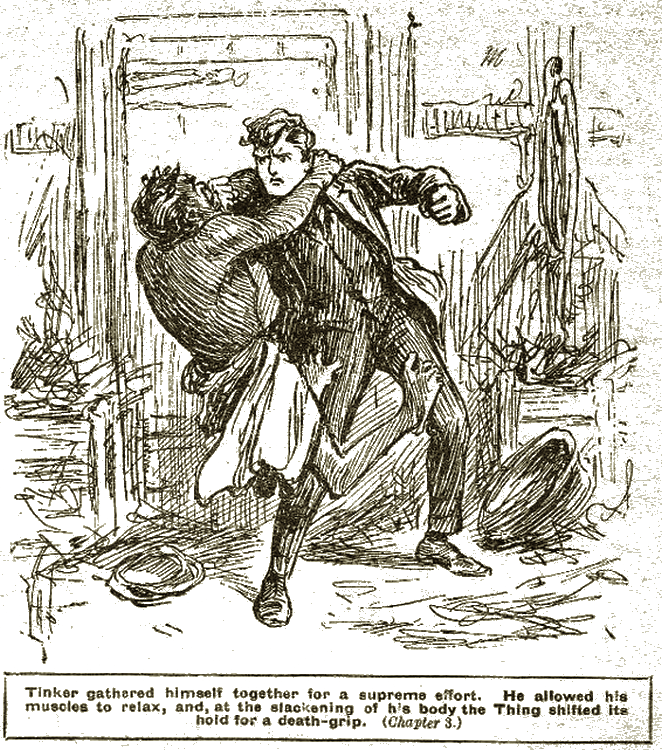
In that brief moment Tinker acted. He stiffened sharply, and, with a terrific drive of his fist to the Thing's body, drove it snarling from him. It crouched for a spring, and as it came Tinker side-stepped swiftly, and drove his right to the jaw. The creature went spinning sideways. Before it could recover Tinker was upon it, and with right-left, right-left, sent it snarling, spitting, and whining into the corner. And at that same instant Tinker heard the slam of the front door of the hut. He drew back, and shot a quick glance towards the little door by which he had entered. It had swung to during the fight, and had latched itself with the bang.
The Thing still crouched whimpering in the corner, and showed no signs of attacking again. It had evidently had enough for the present.
Tinker gazed about him for some place of concealment. He had no doubt that Thruster Joe had returned, and he did not want to be discovered. Apart from the risk of a hand-to-hand struggle with the ex-convict, Tinker had made a discovery in the hut which, he believed, would throw no little light on one point in Yvonne's case.
His discovery, too, might alter their plans for that evening, and he wanted to get back to Blake to report what he had discovered. But he could see nothing that would give cover to a rabbit, let alone himself. All the room contained was a heap of dirty rags in one corner, on which the Thing was crouching. Contrary to his expectation, there was no door leading to the back.
Then Tinker looked up, and saw a small opening just above his head. He knew it must lead to the small garret above. It was about eighteen inches higher than his head; and with a slight jump he was able to grasp the edge with his hands. He could hear sounds in the front room, but, so far, whoever it was, had not approached the Thing's prison. Slowly Tinker pulled himself up until his chin was above the edge of the manhole. He managed to get his elbows up, and, with the purchase this gave him, he was able to crawl through. He had just drawn his heels up when he heard the latch of the door lifted. He rolled over as noiselessly as he could, and lay quiet, trying to stifle his panting breath.
What if it was Thruster Joe? And what if the Thing below should in some way warn him that there was something in the garret above?
Tinker lay and waited. He dared not risk peering down. He heard footsteps cross towards the corner where the Thing crouched. Then came the sound of a hoarse voice.
"What's the matter with you now? Tinker heard. "Still whining because I beat you up, are you? Well, you escape again as you did this afternoon, and you'll get worse, d'you understand? Now, shut up, or I'll kick your ribs in!"
No sound save a low, throaty whimper came in reply, and after a short pause Tinker heard the man walk back towards the door. He risked a surreptitious look, and saw that it was Thruster Joe. For a brief moment Tinker's eyes encountered the malevolent glare of the Thing in the corner. Then the lad shifted into a more comfortable position, and set himself to watch for a chance to escape.
Fully half an hour passed, and still he could hear the sound of Thruster Joe in the front room. The garret in which Tinker lay was almost dark, the only light being the little that filtered up through the manhole by which he had gained it. Through the darkness he could see a tiny chink here and there, which he knew would give him a view of the front room.
But he dared not risk dragging himself across the floor. The boards were so thin that Thruster Joe would have been sure to hear him. He could hear the rasping of a match, then the smell of strong tobacco reached him. Following that a chair scraped. Thruster Joe had evidently filled his pipe and had sat down.
Tinker wondered if that meant he was to be cooped up there for the whole evening. If the worst came to the worst, he knew he would have to drop down out of the garret and make a dash through the front room, trusting to his own fleetness to get him clear and away before Thruster Joe could recover from his surprise.
He figured that at least an hour must have passed, when suddenly he heard the door of the hut open, and the chair scraped again. Following that came the sound of a voice which was not Thruster Joe's. It was cold and harsh, and almost masculine, but Tinker knew that it was a woman speaking.
"He has just come back," said the voice. "I've told him you are waiting here. He said he would come along in a few minutes."
"It's about time!" snarled Thruster Joe. "How does he expect to pull off a thing like this if he leaves everything to the last minute? You didn't tell him it had got away this afternoon, did you?"
"No."
"Well, see that you don't; If I hadn't caught it when I did it would have been out into the road and across the moor. And a pretty mess that would have been! I'll be glad when this deal is over. I want to collect and get away. We're working too near Dartmoor for my liking."
"The price is worth it, He says he will finish things this week, Probably. tonight. At first he thought the presence of the other girl would cause a delay, but now he thinks it will be an advantage. Ssh! Here he comes down the path."
There was silence then for a few minutes, until Tinker heard the sound of the door closing; then a new voice spoke.
"Everything all right, Joe?" it asked.
"All in order, guv'nor. I went up to the house an hour ago, but you hadn't returned."
"No; I was delayed in Exeter. I have decided to move at once, Joe. Now, you and your wife listen carefully. Is your charge all right?"
"Yes. Seems a little upset, but it's all right."
"Good! Now this is what you have to do. While we are at dinner, your wife, and Mrs. Brunton, the housekeeper, will go up to their bed-room, and will see that it will be impossible for them to go there until late. Mrs. Brunton has arranged an 'accident' that will make it necessary to turn out the room before they can retire.
"After dinner I will arrange to get them separated. And the one I want to walk in the grounds with me. I will come along the way I have told you. You will be there in the big oak, and if you see me pause to light a cigarette you know what you have to do.
"That's all, except for you to get away at once, and leave the rest to me. But there mustn't be any hitch—mind that. If you do not see the flare of a match you will know that it isn't coming off. In that case, as soon as we have passed, you will come back here with your charge. Do you understand?"
"I understand."
"Very well. Now, as soon as you hear the sound of shots, come running back to the Grange. Bring your shot-gun with you. If I have failed to kill it, then see that you do so. That is necessary to my plan. Here is a small paper of powder. When you feed your charge tonight, put this powder in the stew. It will have the proper effect on it."
"All right, guv'nor. And does this finish it?"
"Yes. If it comes off, you and your wife can make your get-away at once, although you will have to be at hand as a witness, in case you are needed. But I don't think that will be necessary. I shall be able to do everything myself. Only see that you do your part, too. Now, be sharp on time. Get up into the tree before nine o'clock."
The door slammed again, and Tinker knew that the last speaker had taken his departure. A few seconds later he heard a second bang, which told him that the woman had followed.
In his own mind, Tinker felt a strong suspicion that the last person who had come to the hut had been Stephen Curley, but he could not place what position in the Grange Thruster Joe's wife occupied. It was plain enough that something was to happen that night— something of a sinister nature, if he had put the right construction on the conversation he had heard below. And now he knew that it was essential he should get back to Abmoor as quickly as possible.
Yet Thruster Joe showed no signs of moving. The smell of tobacco still came up through the cracks between the boards. The minutes dragged slowly past, and then at length Tinker heard Thruster Joe tapping the bowl of his pipe against the stove. The chair scraped, and the sound of footsteps followed. The small door leading to the back room opened. There was a brief silence, then it closed. Thruster Joe had taken a look to see if his charge was all right. Following that came a tinny rattle, which at first puzzled Tinker. But when the front door was opened again he suddenly divined what it meant.
"Thruster Joe is going for a pail of water," he muttered. "Now is my chance, if at all, I don't know where the well is. It may be close by the hut. Anyway, if I don't have a shot at it now I may not get another chance. If that thing below goes for me again, the game will be up, for certain. But I'll have to risk that."
He peered again into the room beneath. The Thing was still in the corner.
Tinker knew that his greatest risk from an attack would be when he should thrust his legs through the opening and dangle before dropping.
But there was no other way; so, catching hold of the edge, he began to lower himself. When his legs were through, he turned and slipped down until he hung at full length. It was nerve straining, that second or so before he dropped. He expected to feel the clutch of the Thing about his body, and knew if it happened that he would have an even more desperate struggle for his life; owing to the defencelessness of his position.
He felt a wave of relief when he let go and dropped to the floor, landing softly on his toes. The Thing had made no move to attack. Tinker backed slowly towards the small door, keeping his eyes on the corner.
Thrusting one hand behind him, he felt for the latch, and pressed it down. The door swung open, and Tinker slipped through. As he closed the door, seeing that the latch was safe in place, he drew a deep breath of relief.
"I fancy I gave it enough the first time," he muttered.
He stole across the room towards the front door. He had got just about half-way when he drew up, and stood tensely listening. The next instant the door opened, and into the hut stepped Thruster Joe, bearing a pail of water.
JUST what Tinker had feared had happened. Thruster Joe had gone for a pail of water, exactly as Tinker had surmised, but the well must have been close to the hut for him to return so soon.
He stood gazing in startled amazement at the figure of the lad poised in the middle of the room. Then, as Tinker took the only chance he had, Thruster Joe went flying through the door with the full force of Tinker's head in his solar plexus.
Tinker had sprung while the other was held by surprise. Thruster Joe landed with a heavy grunt, and the pail of water crashed upside-down on his head. But the lad's advantage was only momentary, for, with a snarling curse, Thruster Joe struggled to get to his feet.
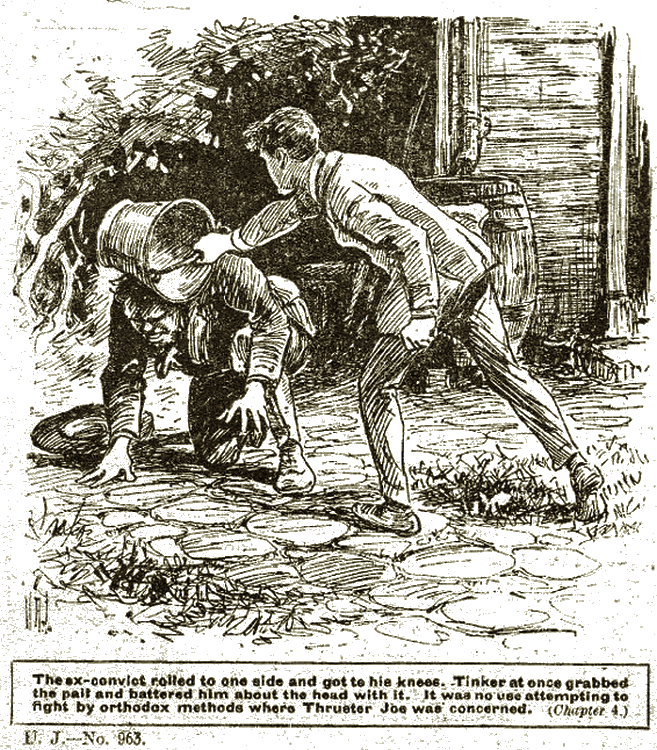
Tinker knew if he managed to do so it was either a case of flight or capture. He leaped in the air, and landed with both feet on Thruster Joe's ribs. The ex-convict went back to the ground gasping for breath, and spitting out curses and threats. He rolled quickly to one side, and got to his knees, Tinker grabbed the pail, and battered him about the head with it.
There was no use of attempting to fight by orthodox rules with Thruster Joe, It was a case of get him, and get him quick.
The force of Tinker's attack drove Thruster Joe sideways; but, flinging the pail aside with a powerful sweep of his arm, he staggered to his feet. He turned, his face livid with rage, to hurl himself upon the lad. Tinker squared up, and prepared to meet him as best he could, although Thruster Joe weighed a good two stone more than Tinker.
The ex-convict came on with a rush, and then, just as his great fist shot out, something happened. The pail, after all, was his undoing, for, as his foot came forward, it struck the pail, which lay on its side.
He almost lost his balance, recovered for a second, then, with the impetus of his rush carrying him completely past the point of pivot, he fell forward with terrific force. His head struck the edge of the slate step at the cottage door, and, as Tinker jumped to one side, he saw the grey stone suddenly begin to turn crimson.
Thruster Joe lay quite still, Tinker bent down, and saw a jagged gash where the ex-convict's forehead had struck the stone. At first he thought the other was dead, but a brief examination revealed that Thruster Joe was only unconscious. He was bleeding freely, and, even while Tinker bent over him, began to groan.
Tinker caught him by the shoulders, and dragged him inside the cottage. Allowing him to lie on the floor by the bed, he searched about until he found some bits of rope. With these he firmly secured Thruster Joe's wrists behind his back. Tinker did not much like trussing up his man before attending to his wound, but the increased noise of the groans told him that his late antagonist would soon regain consciousness.
Next he tied the ex-convict's ankles, and when that was done to his satisfaction he managed to get the unconscious form up on to the bed.
Tinker picked up the pail, and made for the door. He searched about until he found a small spring about ten yards from the north side of the hut. That explained why Thruster Joe had returned so soon.
Tinker filled the pail, and went back to the cottage. He took a towel, and bathed Thruster Joe's forehead, disclosing, as he cleansed the wound, a long, jagged cut, which bled freely, but was not deep. And, as far as Tinker could make out, the skull had not been fractured.
He bound the wound with the towel, and then carried the pail to the door. Sluicing the remaining water about until most of the bloodstains had been washed away, he went back to the spring, and refilled the pail. On returning this time to the hut, he found a second pail, into which he poured some of the water. This he placed just inside the door of the rear room.
When he had closed and latched the small door he poured some water into a mug, and forced it between Thruster Joe's lips. The latter showed signs of regaining consciousness, but before he became so Tinker had seized a second towel. Tearing this in two he made a ball of the soft cotton, which he jammed between the ex-convict's teeth. With the other half he made a firm bandage, which held the gag in place. He tied the bandage firmly at the back, and rolled Thruster Joe over on one side. That done, he stood up, and surveyed the room.
"The woman might come back!" he muttered, "But that is a risk I shall have to take. I don't quite know what to do about that Thing in the back room. If it should get in here, and found Thruster Joe helpless, then it would tear him to pieces! If the woman comes back, she will give the alarm. Otherwise, I would leave Pedro on guard. But if she doesn't come back—and if she is going to obey the instructions I heard given her, she won't have time—then Thruster Joe should lie here undiscovered until I report to the guv'nor, I'll tie a string on the latch of the door leading to the back room. That ought to hold it until the guv'nor decides what we had better do."
Tinker suited the action to the word. He found a piece of strong cord, with which he made fast the latch. Then, as he turned towards the bed for a last glimpse at his prisoner, he saw that Thruster Joe's eyes were open. Tinker went across, and bent down.
"Listen, Thruster Joe!" he said. "I know you all right, and I know what you are up to. It will be better for you if you take things as they come. You might manage to get free before I get back, but, take it from me, that, if you do, I'll have every police-station in Devonshire and Cornwall warned by to-morrow morning!"
With that Tinker grinned at the ex-convict, and left the room. He closed the door of the cottage after him, and walked along to the thicket where he had tied Pedro. He found a very disgusted bloodhound waiting for him.
"Sorry; old fellow!" said Tinker, as he patted Pedro's head and released him. "You were on the right trail all right. But it was no place for you, as things have turned out, although there was one time when I wanted you there badly. Now come on, old fellow. It's no use looking back towards the hut. The fun is all over. We have got to make tracks for Abmoor as fast as we can go!"
Tinker broke into a trot as he made for the road, and, after one more glance back at the hut, Pedro followed.
Reaching the road, Tinker turned towards Abmoor, and, still keeping to the trot, began to reel off the intervening miles at a steady rate.
BLAKE listened gravely to the detailed report which Tinker gave him on his return to the inn. But not until the lad had finished did he make any remark.
"What you have discovered is of the utmost importance, my lad," he said. "And the way you have left things at the hut is just as I myself should have done. I have no doubt that the man you heard speaking to Thruster Joe was Stephen Curley. If Thruster Joe and his wife are in Curley's employ, then it looks more than ever as if his purpose is criminal.
"It is lucky you recognised Thruster Joe, and remembered the case in which he and his wife were sent to trial. You spoke of Curley—we will assume that it was Curley, for he passed me on the road in his car while I was on my way back to Abmoor—mentioning the housekeeper by name. Mrs. Brunton, I think you said."
"Yes, guv'nor."
"In that case Thruster Joe's wife is not the housekeeper. But she may be the companion. As I remember, she was a hard-featured woman, such as would fit Yvonne's description of the companion; and, at the time of the trial, I recollect that she showed considerable signs of education. If she is the companion, then it looks like a deliberate scheme on the part of Curley to surround Eleanor Hilyard with a criminal hedge which would shut her in entirely. Also, from the remarks which you overheard, it would seem that the housekeeper is in the plot as well.
"But I am greatly puzzled over the Thing which, you say, is being kept in the hut. You are quite sure it was a human being of sorts?"
"Yes, guv'nor, quite sure. But it was a terrible deformity. It looked like some of the types we have seen in parts of India and Borneo. The features were of that sort, and the hair and skin. But what made it so—so grotesque, if you understand my meaning, guv'nor, was the fact that, instead of its knees bending, as yours or mine bend, the joints were placed the other way, so that it was forced to get about on all fours, just like an animal."
Blake nodded.
"I begin to understand now, Tinker. I remember seeing a Hindu beggar once, in Jeypore, who was deformed in the same way. It is not unusual to find such a variety of hideous deformities among the bush people. It is just possible this creature may be some jungle freak which Curley has brought back from one of his expeditions, and which he has subdued to his own criminal purposes. We don't know what that purpose is, but, from what you have discovered this afternoon, we do know that it is full of danger for Eleanor Hilyard, and possibly Yvonne, as well."
"It certainly looks like it, guv'nor. What will you do?"
"Firstly, my lad, we shall go down to our evening meal. Afterwards I shall tell you what I propose doing. I think you said that Thruster Joe was to be in some oak-tree before nine o'clock?"
"Yes, sir."
"In that case, what we have to do must be prepared before that hour."
They descended to the small dining-room, where they ate a well-cooked meal almost in silence. Only when the buxom landlady was fussing about the room did they converse on casual topics. When they had finished, Blake lighted a cigarette and led the way out to the little green in front of the inn. The sun had now set, but it was still light in the west.
"Another hour or so before it will be dark enough for our purpose," murmured Blake, as they paced up and down the green. "Is the car all ready for use?"
"Yes, sir. If we are going far I had better put in a little more petrol, though."
"You might do so. If you will attend to that now, I shall walk along to that house on the right. I see that it is the local police-station. I want to have a talk with the village constable."
Tinker was curious to know what Blake could have to say to the constable, but he asked no questions. He made his way into the yard of the inn, while Blake, without bothering to get his hat, strolled down the road.
The village constable proved to be a youngish man of considerable intelligence. When Blake had revealed his identity, and the constable had recognised from photographs he had seen that it was really the great London criminologist, he grew nervous. It was rarely indeed that an event of so much importance in his life happened.
He was soon put at ease by Blake's manner, and when he found that the criminologist actually had a professional matter to discuss with him he ushered his guest into the little parlour of the cottage.
He introduced Blake to a ruddy-cheeked young woman, who was his wife, and to a couple of children who showed sturdy health. It was a happy little sight, which Blake appreciated more than the young constable dreamed.
When the young wife had left the room, taking the two children with her, Blake seated himself and began to speak in low tones.
As the constable listened his eyes grew large with interest, and when Blake had finished he nodded his head quickly.
"I'll do just as you suggest, Mr. Blake," he said. "I will wait here until you come, and you can trust me to look after what you say. Is there nothing more I can do tonight?"
"Not tonight," responded Blake. "But there will be work for you to do to-morrow, when I return from Exeter. And if things go as I hope they will go, this affair will give you a big boost, Braund. I'll see to that."
After a few more minutes' conversation Blake rose and strolled back up the road. Any who noticed the distinguished-looking stranger would have thought he was just out for a brief stroll in the lovely evening. They would not have dreamed that behind those kindly eyes a steel-trap mind was working towards the undoing of one of the most ruthless criminals of modern society.
About eight o'clock that evening the Grey Panther, with Tinker at the wheel, moved out of the inn yard and drove slowly along to the cottage where the village constable lived. The constable had doffed his uniform, and had put on plain clothes. He climbed into the back seat, where Blake sat, and as the door slammed Tinker turned the car and drove slowly through the village.
Ones on the outskirts, however, he let the car out, and it took only a few minutes to cover the distance between Abmoor and the wood where Tinker had had such an extraordinary experience that afternoon.
He pulled up the car just near the spot where Tinker had taken the wall. They got out, and, guided by Tinker, made their way along the path until they came in sight of the hut.
Blake and the constable waited, concealed by a thicket, while Tinker reconnoitred. The lad came back in a few moments, to announce that the coast was clear. He led them to the hut, and, opening the door, peered within.
On the cot lay Thruster Joe, just as he had left him. The bandage round his mouth was slightly disarranged, showing that he had made desperate efforts to slip it off and get rid of the gag, but his attempts had been unsuccessful.
Blake bent over him, while Tinker lit a lantern and brought it close. Blake waited until Thruster Joe could sea his features, then he spoke.
"Well, Joe," be said pleasantly, "you seem to be getting fond of Dartmoor. What is the idea at present—trying to get behind the grey walls again?"
While he was speaking Blake was loosening Thruster Joe's gag. It was plain from the expression in the latter's eyes that he had recognised the great detective, but his only reply to Blake's remark was:
"Well, what are you going to do with me?"
Blake signed for Tinker to untie the rope round his ankles.
"We are going to take you for a little visit to Abmoor with the constable here. He isn't in uniform at present, Joe; but he is the village constable, all the same."
"What do you mean? I ain't done nothing!"
"It isn't what you have done, my friend," responded Blake. "It is what we are going to prevent you from doing. And take my advice, Joe—just one yelp out of you, and——"
Blake finished with an expressive shrug.
"Now then, Tinker," went on Blake, "we will deal with the other matter. Braund, you stay here and keep watch over Thruster Joe. Bring the lantern and lead the way, Tinker."
Tinker approached the small door leading to the rear room. He lifted the latch gently and pulled the door open a little. He held up the lantern as he did so, and, peering over his shoulder, Blake saw the Thing crouching in the corner. He studied it in silence for some minutes. The creature, on its part, blinked back at them, but made no hostile move. At last Blake spoke.
"I think I have it, Tinker. I thought so back at the inn. From the features and the shape of the forehead, I fancy the poor creature is from some part of Northern Patagonia. He must be half demented. I'll see what I can do."
"Be careful, guv'nor!" warned Tinker, as Blake stepped into the room. "He fights like a wild cat and snaps like a fox."
"I will be on guard, my lad."
Blake advanced slowly until he reached the middle of the small room. The deformed creature drew back a little, and, although his eyes wavered, they kept returning to the compelling force of Blake's gaze. In the middle of the room Blake stopped.
Then he began to speak slowly and evenly in a guttural language, which Tinker knew to be the primitive Ecuave tongue of the northern tribes of Northern Patagonia.
At his very first words the deformed being gave a quick movement, then the shifty eyes fixed themselves more steadily on Blake.
Step by step Blake advanced, still keeping up a reiteration of the phrase with which he had begun. He was, in fact, simply telling the creature that it had no cause for fear; and, from the manner it exhibited, Blake knew that it understood.
Blake was allowed to approach until he could almost touch the Indian. He took another step, and put out his hand. The deformed creature gave vent to a low, guttural snarl, and drew back, but did not offer to attack.
Blake persisted until his hand touched the other's shoulder, then he gave it a few gentle pats, much as one would pat a dog. He changed his words now, and talked for some minutes in a gentle strain, until, suddenly, with a queer, choking cry, the poor twisted creature fell forward and clutched Blake about the knees, Blake knew that he had conquered. He took one of the clinging hands in his, and as docile as a dog, the Indian twisted his deformed body along as Blake led it towards the door.
In the outer room the Indian's eyes suddenly encountered the figure of Thruster Joe. He drew back, with a whimper, but Blake's firm hand restored confidence. The Indian looked from Blake to the man on the cot, and his shattered mind seemed to grasp that there was hostility between this man who spoke to him in his own meagre language and in tones that inspired trust, and the other, who had controlled him by brute force.
Blake signed for the constable to get Thruster Joe on his feet. Himself, he led the Indian to the door, and went down the path leading to the road. Tinker waited until Braund had followed with Thruster Joe; then he put out the lantern, and, closing the door of the hut, followed.
Blake, the Indian, and the constable sat in the back, while Thruster Joe was given the seat beside Tinker. Blake had little fear that the ex-convict would try to escape. In the first place, any such attempt would have had small chance of success, and, in the second place, Blake knew Tinker would drive so fast that Thruster Joe would not dare to make a jump for it.
And Tinker fulfilled Blake's expectations. Once he had turned the car Tinker let her out recklessly. In the back the deformed jungle creature crouched on the floor at Blake's feet. Blake had thrown a rug about him, for, although it was now dusk, he did not want to run any risk of the villagers seeing the strange creature which Braund was going to keep in the lock-up for the night.
They arrived at the little cottage without incident. The ex-convict was hustled in first by Braund, while Blake and Tinker waited in the car. Then, when Braund returned, Blake took the Indian by the hand and led him through the gate. He took him to the lock-up adjoining the cottage, and remained there until Braund had brought some blankets.
Blake seemed to have quite gained the creature's confidence now, and this confidence was extended to the constable, but not to Tinker. It undoubtedly remembered the fight it had had with the lad.
The constable was to prepare food, so, knowing that both Thruster Joe and the deformed Indian would be safe until he required them again, Blake and Tinker returned to the car. They stopped at the inn for a few minutes while Blake wrote a note. This he put in his pocket without comment. He had not bothered to question Thruster Joe, for he knew that the ex-convict would probably only lie to him.
Yet, out of all the trees in the walled grounds of the Grange they had to find a certain large oak-tree before nine o'clock. It was now nearly a quarter to nine, and quite dark. Tinker had switched on the road-lamps, and as Blake climbed in beside him the lad threw in the clutch.
The Grey Panther sprang forward, and went tearing out of the village at ever-increasing speed. Blake had helped himself to one thing from Thruster Joe's pockets, and as Tinker drew up at the spot where they had entered the wood Blake took it out. It was a bunch of keys.
"Now then, my lad," he said briskly, "out with your lights. We will leave the car here. Lead the way. We only have a few minutes."
Tinker obeyed, and, running towards the wall, disappeared from view. Blake followed, and together they went at a slow trot along the path until they came again to the hut. Tinker kept on past this until he reached the high wall surrounding Highmoor Grange. He passed along the wall, and came to a stop before a door which was secured by a heavy padlock.
Blake then stepped forward, and, working quickly, found the right key. They entered the grounds stealthily, and closed the door after them. They found themselves at one side of the house and thirty or forty yards from the stables.
The house was brightly lighted, both upstairs and down. In a room on the ground floor, where the curtains had not been drawn, they could see several figures seated at a white-covered table. They stole closer, and made out Yvonne, another young girl, a man, and a hard-featured woman. A maid was serving some dish. Blake's eyes rested on the man.
"Stephen Curley!" he muttered. "And you were quite right, Tinker. That woman is Thruster Joe's wife, who was convicted with him. She must be the companion of whom Yvonne spoke. Her presence there is enough in itself to tell us that some devilry is afoot. And Stephen Curley is at the bottom of it. But come on! We must find that tree before they come out!"
They made their way round to the front of the house and into the miniature park which had been planted inside the wall. It was of very small extent, but as most of the trees were oaks it did not appear to be an easy matter to find the one for which they were seeking. In front of the house Blake came to a halt.
"Let's see now," he whispered. "If Curley persuades Miss Hilyard to come for a stroll they will come out by the front door. Then they will probably walk down the drive towards the gates. Let us try that way, Tinker. There may be a side path from the drive."
As it was only about a hundred yards to the gate, it did not take them long to cover the distance. Or, at least, it did not take long to traverse half the distance, for when they had gone that far they came to a side path such as Blake had imagined might exist. They turned into this, and while Blake kept to the right, Tinker went to the left. In a few minutes Blake heard a low whistle. He followed its direction, and found Tinker bending over something that lay on the ground beneath a large, wide-spreading oak. Blake bent down, too, and saw that it was a short ladder. He then glanced at the thick spread of branches overhead. Close to the tree ran a narrow path.
"I believe you have struck it, Tinker," he said. "We will chance it, anyway, Let us get the ladder up."
They fixed the ladder against the trunk. and Blake prepared to mount.
"I will remain hidden in the tree," he said. "You, my lad, must keep concealed up near the house. Here is a note which I have written to Yvonne. If you can get a chance to pass it to her, do so. While Curley and Miss Hilyard are strolling she may come out on to the terrace. In any event, if you do not see her, make for the gate by which we entered as soon as you see Curley and Miss Hilyard return to the house. If a very long time passes and they do not appear, then listen for my whistle."
Tinker took the letter and stole away. He was almost at once lost in the deep shadow of the big trees. Blake climbed the ladder, and, just before swinging himself into the lower branches, kicked the ladder back so that it fell on the grass. He climbed to a branch above, and settled himself so that he was facing towards the drive. It was from that direction he anticipated his quarry would come—if at all. He had found one large branch, with another just a little beneath, and by using the two he was able to make himself fairly comfortable.
Blake had been unable to see just how far the dinner within had progressed, but he fancied he might have a considerable time to wait, so he resigned himself to a smokeless period. The minutes dragged slowly by, and as his eyes became more accustomed to the gloom, he was able to make out a few objects near at hand. He reckoned that nearly half an hour must have passed, when, suddenly, the low murmur of voices reached him.
Sexton Blake lay close to the branch and waited. He had already taken the precaution to turn up the collar of his tweed coat in order to hide the white line of his collar. His motoring-cap was pulled well down over his eyes. His face was completely in shadow. To a casual observer he would have been only part of the big limb on which he lay.
What had at first sounded as the distant murmur of voices now became distinct—distinct enough for Blake to make out the high treble of a woman's tones, and the deep timbre of a man's. Nearer and nearer the sounds came; then a sudden silence followed.
It was broken almost startlingly by a nervous laugh only a short distance from where Blake lay concealed. There followed the deep, earnest voice of the man, lifting and falling in a steady cadence. Another silence, then a quick, sharp outburst of the treble tones, clean-cut and decisive.
Silence once more.
A faint night-breeze stirred through the leaves of the oaks. Blake was puzzled. If what Tinker had told him was right, then things should have moved more swiftly. Why this long delay? What had followed on the speech of the woman? Those tones, Blake felt positive, had belonged to Eleanor Hilyard. And the man's voice, he was equally certain, was the voice of Stephen Curley.
Even in the midst of his uncertainty the near darkness was broken by a tiny flare of light. The glow rose and fell in regular beats for a dozen times or so, then was extinguished as quickly as it had come. The signal! The lighting of a cigarette, which had been agreed upon! Blake shifted his position a little, and tried vainly to pierce the blackness beneath.
The murmur of voices broke the silence again, this time even nearer than before. Blake knew that the strollers were approaching the tree in which he lay, Dimly at first, but soon clearly he was able to make out a steady, regular glow and fading, glow and fading, like the winking of a very distant light.
Whoever was smoking that cigarette was puffing deeply and methodically. Once more the man's voice sounded, and the next moment the two who strolled had come to a pause beneath the tree in which Blake lay.
"But I cannot take that as final," the man was saying. "You know that I have built all my hopes on this, Eleanor. I have loved you for years. I have been patient. I have waited, hoping that, when the first pains of your sorrow had passed, you would listen to me. Apart from the fact that I am your guardian, I am not so very much older than you. I ask you once more, will you reconsider your decision? Or will you give me some hope?"
"I am sorry, Mr. Curley, but that cannot be. If it were possible I should have told you before. But it is not. I have already told you that my love is already given. Believe me, I am sorry, but—"
"You mean that, Eleanor, absolutely?"
"Yes; I mean it."
"You are sure you will never change?"
"I am sorry—no."
"Then so be it."
With those words the man standing at the foot of the oak-tree lifted his hand and flicked his cigarette up into the tree. It struck the branch on which Blake lay, and, with a tiny shower of sparks, dropped back to the turf. Blake lay as motionless as the branch which supported him. Beneath there was a short, indeterminate silence, broken by a harsh coughing on the part of the man.
Blake knew how puzzled he must be.
He had laid his plans so carefully. He had given Eleanor Hilyard her chance to live by paying a price. Little had the girl realised that, as she finally and definitely refused his advances. But Blake knew that, according to Stephen Curley's schedule, the next act, while they paused under the tree, should have been the wild and savage descent upon the girl of a drug-maddened, deformed, demented creature from the wilderness of Northern Patagonia.
It was a bizarre plan, but therein lay its real chance of success, as Blake well knew. He had deduced, with extraordinary precision, what it was Stephen Curley had planned. Isolated words and phrases which Curley had spoken to Thruster Joe, and which Tinker had faithfully repeated to Blake, had enabled Blake to reconstruct the main essentials, if not the detailed steps of Curley's plan.
And who could have been found to raise a voice in disbelief? How would it have looked to the world—to a coroner's jury—to the police?
Stephen Curley, a well-known and popular explorer, guardian of Eleanor Hilyard, intimate friend and confidant of her father, had been walking in the grounds with the girl after dinner. They had paused for a few moments under an oak-tree. Without the slightest warning, something had hurled itself from the tree upon them. It had landed upon the girl, and, before Stephen Curley could come to her assistance, had torn her throat open with his teeth. As soon as he could do so Stephen Curley had drawn a revolver, which he had happened to have with him, and had shot the creature dead.
But it would have been too late. A terrible, a most tragic, and regrettable accident would have been inscribed in the hungry Press.
Stephen Curley would have been desolated with grief. He would have taken great blame to himself.
He would have explained to the coroner's jury how the attack had been made by a deformed jungle creature which he had brought back from his last expedition to South America. Most probably he would have explained further that he had brought it back to use in his ethnological studies of the tribes of that region.
Who would doubt—who could doubt the word of the famous explorer? In his great grief, in the depth of his self-blame, in the vigour of his self-condemnation that the creature had not been kept closely guarded, the public, the Press, and the police would not pause to think that, on the death of Eleanor Hilyard, Stephen Curley came into full and complete possession of all the Hilyard estate.
And who was to know that he had already tried to get possession of that estate by offering his hand to Eleanor Hilyard?
That was what Sexton Blake had deduced from his analysis of the conversation which had taken place in the keeper's hut in the wood, and from his own knowledge of Stephen Curley, both of which had given him a criterion whereby he was able to weigh or discard the suggestions of the hypothesis he was forming. But not even Blake, himself, knew how deadly true had been his deductions.
With the falling of the cigarette-end to the ground Blake had been able to discern a movement on the part of the girl to leave the spot. Her light dinner-frock made it easy to locate her. But evidently Stephen Curley was determined to delay things if he could, for again a match flared, and Blake could clearly see his features as he puffed with the end of a cigarette at the flame.
Blake could see, too, that surreptitiously, Curley's eyes were searching the tree above where he stood. Blake lay still. He knew that Curley was looking for Thruster Joe. He knew that the man was using every artifice to delay things. He was perfectly aware that Curley thought something had prevented Thruster Joe from acting on the signal.
And Blake experienced a grim amusement while he watched the would-be murderer silently fuming below while his victim-to-be talked in slightly-veiled impatience. At last Curley could find no excuse for lingering, and, at Eleanor's rather sharp suggestion that they return to the house, he muttered acquiescence.
They moved away, but before they had gone a few yards Curley had found some excuse to come back, leaving Eleanor standing on the path.
"Fool!" he hissed up into the tree. "What is the matter? Why haven't you acted?"
He dared not wait to say more, and Blake laughed softly to himself as Curley rejoined the girl. At the same time Blake knew that Curley would be back to investigate as soon as he had left Eleanor at the house. Therefore, as soon as the sound of their voices had died away Blake caught hold of the branch and, after hanging by his hands for a second or so, dropped softly to the ground.
By a roundabout way Blake reached the door in the wall. He opened it and stepped outside. Crouching close against it he came upon Tinker.
"Well, what luck, my lad?" asked Blake, as he worked the padlock into place.
"All right, guv'nor. I saw mademoiselle. She came out for a second. I had to whistle, but I don't think anyone heard. I had just time to give her the note when someone came along the terrace. I fancy it was Thruster Joe's wife. I didn't wait to see, but made tracks. I came straight here, and have been waiting ever since. How did you make out, guv'nor?"
"Things went remarkably well, Tinker," answered Blake, as he turned the key in the padlock, "We struck the right tree without a doubt. Our man walked right into the trap, and I heard enough to enable me to fit all the pieces of the puzzle together. I think—yes, I am sure we have at last got Mr. Stephen Curley just where we want him."
"Then it was as you thought, guv'nor?"
"Yes, thanks to the information you brought me. I will tell you more when we get back to the inn. We had better lose no time. Unless I am very greatly mistaken, Curley will be scouring the grounds and this wood inside the next half-hour, looking for Thruster Joe and his Patagonian Indian."
They stole back stealthily the way they had come. The car still stood where Tinker had left it at the side of the road. He turned on the road-lights, and a few moments later they were speeding back towards Abmoor at a steady pace, the powerful engine throbbing rhythmically in the still night which blanketed the moor.
THE detective was not wrong. Shortly after their departure Stephen Curley, after a secret but heated interview with Thruster Joe's wife, had begun to scour the grounds. He continued his search to the hut in the wood, but though he fumed and cursed and swore, he found not the slightest trace of either Thruster Joe or the deformed jungle creature which he had intended using as an instrument of murder. Only one person in Highmoor Grange that night could have told him why his search was unsuccessful. That person was Mademoiselle Yvonne, who read and re-read a short note, which had been slipped into her hands under cover of the darkness on the terrace—a note which said little in words, but which was pregnant with meaning for her.
TINKER and Blake left Abmoor for Exeter at six o'clock the next morning. As they had plenty of time to cover the distance and arrive before there was much likelihood of the late Martin Hilyard's solicitor being at his office, Tinker did not press the Grey Panther. It was a lovely morning, and between periods of admiring the bold, rugged view, Blake discussed the case with his assistant.
The events of the night had worked out so exactly to the theory Blake had formed that, unless there was some hidden flaw in his reasoning, he took it as fairly safe to assume the correctness of his hypothesis. More to bring the various points into cohesion, he reviewed events aloud as they drove along.
"There seems no doubt that Miss Hilyard's instinct was right," he said, when he had lighted a cigar and settled back. "I do not think for a moment that Stephen Curley had planned matters in the lifetime of Martin Hilyard. But the capacity to do so was only lying dormant, and accident placed the temptation before him.
"His record as an explorer proves that, in all things, he is the type that will take at the expense of another if he can do so and get away with it. Probably he cultivated Martin Hilyard in the first place for the reason that Hilyard was a very wealthy man, and Curley thought such a friend might come in very useful to him some time.
"It is also quite likely that Hilyard hinted to Curley that he had put him in his will. Then, with the death of two sons in France, there would come the first glimmerings to Curley of how greatly the family had been cut down. Things must have been moving vaguely in his mind when Martin Hilyard collapsed, and the discovery of the will with the codicil crystallised Curley's ideas. I have a theory of his actions then, but before making any definite statement I want to have a look at the original will, if possible.
"Thorne, Hilyard's solicitor, may have it still in his possession, or it may be at Somerset House. If the latter is the case, then we shall have to wait before proceeding with that part of the affair. But even without that we have enough to tie Curley's hands.
"I am convinced, from recent events, that Curley did try to bring about Rupert Hilyard's death. The success of that move placed only one person between him and the enjoyment of the whole estate. And he could afford to go slowly, for he was then sole executor and manager of the property, with a very substantial income from it. Sizing up the situation, he saw that there were two ways in which he might achieve his ends.
"One was to marry Eleanor Hilyard, or, in the case of her refusal, to see that she became the 'victim' of a regrettable 'accident.' In either case he would win. We know that she gave her affections elsewhere. I got further particulars of that from Mademoiselle Yvonne yester-day. I sent a telegram last evening to a friend of mine in Whitehall, and I expect an answer when we get back to Abmoor.
"Further, we may take it as certain that, while in London, Stephen Curley knew pretty well everything that Eleanor Hilyard was doing, even though he might not have been in evidence much. Then came his proposal. She refused him, as we know.
"I believe that Yvonne is right, and that his gift to his ward of a new horse was a deliberate attempt to secure her death. It would have been impossible to bring the thing home to him. As that failed—and he has probably wondered exactly what happened—he determined to try again. He had engaged Thruster Joe and his wife. He probably knew of their criminal record, and, with this as a weapon, could force them to do his bidding.
"I fancy, when we bring things to a head, we shall be able to make Thruster Joe talk. The poor deformed jungle creature which you found in the hut was probably brought home from his last expedition by Curley. If so; then he would have secured it for the purpose of making an ethnological study of the type. He would know how savage the demented creature would be, and then, in my opinion, conceived the idea of turning it to his own purposes.
"He probably brought the captive to Highmoor Grange by motor secretly. I fancy he would choose the time when Eleanor Hilyard was in London. Then he installed it in the hut under the care of Thruster Joe to await events.
"What he planned we know. He was to make a final attempt to get possession of the estate by marrying Miss Hilyard. He planned to do this in the grounds after dinner. If she again refused, then he was to signal to Thruster Joe, who was to lie concealed in the oak-tree with the crazed captive. Thruster Joe would release his charge, and the next thing would have been a savage attack upon Miss Hilyard.
"It stood every chance of being successful, Curley, of course, would pull a revolver, and when the attack had proceeded sufficiently, would kill the creature.
"It was cunningly planned, and nothing could have been brought home to him as long as Thruster Joe and his wife kept silent. But last night, when Curley thought his accomplice had muddled things, he whispered a remark that will convict him of that intention if it ever comes before a jury.
"He must be a very puzzled man this morning, and he will be even more puzzled when he fails to find any trace of either Thruster Joe or the captive. He will begin to realise that someone suspects him, and is playing the game against him. Then he will become afraid, and may lose his head. It is up to us to finish things before he does that, for if he goes off the rails, he may turn doubly dangerous."
On reaching Exeter, they drove first to the offices of the late Martin Hilyard's solicitor. On sending in his card, Blake was received without any delay. After a few preliminary remarks to explain his request, he found, to his satisfaction, that Martin Hilyard's will was in the solicitor's possession.
The latter made a little difficulty a first about handing it over to Blake for examination, but, on the criminologist mentioning that he would then apply formally to the courts for permission, the solicitor waived his objection. With the will in his possession, Blake retired to a private room and went to work.
He had given no hint of his real reason for desiring to make the examination, nor, when he had finished half an hour later, did he explain.
He simply thanked the other and took his departure.
From there they drove to the county police-station, where, as soon as his identity was known, Blake was received warmly. The inspector came in a few minutes after his arrival, and, taking him aside, Blake had a long, confidential conversation.
Following that, Blake secured a warrant for the arrest of one Stephen Curley, and, accompanied by Inspector Grigg, started back for Abmoor. On reaching the inn, they found the village constable, Braund, anxiously waiting. After saluting the inspector, he blurted out.
"I am very sorry, Mr. Blake, but this morning, at seven' o'clock, when I went into the lock-up, I found that the Indian you placed in my charge had escaped. He must have got away by a window high up near the roof, I never thought such a thing could be possible, as it is over ten feet from the floor and there is nothing to get up by."
Blake frowned.
"I am sorry to hear that, Braund, as, if he is roaming the countryside, he may be dangerous. But you are not to blame. You could not know that he was as able to leap and climb as an ape. It would not be difficult for him to spring that high. You have heard nothing of him?"
"Not a word, sir. I came at once to the inn, and found you had already left for Exeter. I have been scouring the country on my bicycle, but have seen nothing of him."
"Do you think he would make back for the hut?" asked Tinker. "That is the only place he has known as a haunt down here, and he might go back."
"That is certainly an idea worth following, my lad. We will investigate it at once. Get in, Braund, and come along with us."
The constable climbed in, and, throwing in the clutch, Tinker drove through the village. Once on the outskirts, he increased the speed, and in a very short time they had reached the spot where they had previously drawn up.
All four got out. Tinker led the way over the wall and along the path towards the hut. As he neared it, he saw that the door was wide open, and then, as he reached the threshold, he pulled up with an exclamation of horror.
The place was in a terrible state of confusion. Everything movable has been hurled about as though a cyclone had struck the place. And lying in the very midst of the wreckage was the body of Stephen Curley, a great, gaping wound in his throat showing where his life blood had spilled upon the floor. His clothes had been torn almost to shreds, and where the flesh of body and arms showed there were revealed long, jagged gashes as if some animal had mauled him.
The bed had been overturned, and, lying behind it, they came upon a second horrible discovery. Crumpled up in the corner was the demented jungle creature, dead, with three bullet-holes in the body, showing how death had come. On the floor lay an automatic pistol, which they knew must have been Curley's.
What time that terrible struggle must have occurred it was impossible to say, but that it had been of almost unbelievable violence and doubly fatal was plain.
"Your warrant is now useless, inspector," said Blake, in a low voice. "Curley must have come to the hut, looking for Thruster Joe. The crazed Indian found his way back here, as Tinker suggested might be the case. They met here, and this is the result.
"Well, Curley has paid a terrible price for his sins. I think, if you will remain here with the constable for a little, I shall go on to the Grange and break the news to Miss Hilyard. We can discuss later what formalities will be necessary. I would suggest, however, that, in view of what has happened here, no good can come of making public the fact that part of the codicil of the will had been forged by Curley."
The inspector nodded his agreement, and Blake and Tinker started for the Grange.
"Then he did forge part of the will, guv'nor?" asked Tinker, when they were well away from the hut.
"Yes, He forged the part of the codicil which placed him in such a position of control of the estate. It was cleverly done, but not at all difficult to detect. Had any question been raised when the will went for probate, it would have been discovered then. But no suspicion was held, so it was accepted. I shall tell Yvonne, and leave it to her to tell Miss Hilyard if she thinks it wise."
They passed into the grounds by the same gate they had used the night before. It was open now, showing that Stephen Curley must have come that way to the hut. As they went towards the front of the house, they saw Yvonne coming towards them. In a few words, Blake told her what had happened.
"I will leave it to you to tell Miss Hilyard as much as you think best," he said. "In the meantime, I want to have a talk to both the housekeeper and to the woman who calls herself Mrs. Harrison. Can you manage that?"
"Yes-at once, if you wish."
"If you will, please!"
Blake and Tinker waited in the study, while, first, the housekeeper—Mrs. Brunton—and then Thruster Joe's wife were sent to them. It took only a few minutes for Blake to discover that the housekeeper, a nondescript, mouse-coloured woman in the late thirties, had been a passive tool of Stephen Curley's. Under Blake's questioning she broke down, and confessed the part she had played. Blake's probing mind went straight to the solution.
"Did Stephen Curley ever say he would marry you?" he asked.
"Yes," she sobbed. "He said as soon as things were over that he would, but that I must help him."
Blake nodded his understanding and dismissed her. But to Thruster Joe's wife he spoke in very different terms. As the hard-featured woman came in with a defiant air Blake said sternly:
"You are going to get one chance and one chance only to make a confession. You know who I am, and you know that your record is on the file with me. Thruster Joe is at present in the hands of the police, and Stephen Curley's plot is known to us. Unless you want to go back to prison for a longer term than the last now is your time to speak."
"What do you want to know?" she asked sulkily.
"The truth, and all of it!" answered Blake curtly.
And he got it.
That finished, Blake and Tinker rejoined the inspector and the constable at the hut. Blake communicated the result of his visit to the Grange to the inspector, who determined to make no arrests, but to hold up matters until the inquest. He had little fear that Thruster Joe's wife would try to escape while they held her husband; and as for the housekeeper, she would be of use only as a witness. The hut was closed, and Braund was left in charge until a doctor should arrive. As they were making back for the car Yvonne came hurriedly towards them.
"Eleanor wants to have a talk with you," she said to Blake. "Will you and Tinker come back to dinner tonight?"
"Yes, with pleasure. I may have a slight surprise for Miss Hilyard by then," added Blake, with a smile. "But don't say anything to her yet."
It was after two o'clock when they finally got back to the inn. They had a late lunch and afterwards walked along to Braund's cottage, where Blake wanted to have a talk with Thruster Joe. On the way they stopped at the post-office, where Blake found a telegram waiting.
Tinker read it, and grinned.
"How did that occur to you, guv'nor?"
"Observation, my lad. I remembered reading the other day that a number of officers were being invalided home from Mespot and Palestine. I was sure I had read Captain Farnham's name in the list, so I simply sent a telegram to Whitehall to make sure if it was the same one whom Miss Hilyard is interested. We shall get a telegram away at once, and divert him from Plymouth, when he lands to-day, to Exeter. I think it would be a good idea if you drove in the car and brought him out."
THAT evening Sexton Blake arrived at Highmoor Grange in a pony-trap which he had secured in Abmoor. He was without Tinker, and, beyond saying that he hoped the lad would be along a little later, gave no explanation. They had just sat down to dinner when a commotion in the main hall attracted their attention. The next instant the door opened, and Tinker appeared, followed by a bronzed officer, who limped slightly. Eleanor Hilyard gazed with startled eyes. Then she went deathly white, and Yvonne was just in time to catch her as she slipped to the floor in a faint.
But as Eleanor opened her eyes and saw that the "apparition" was very real she smiled tremulously, and a flood of happy tears came, which swept away all the terror and unhappiness of the past months.
It was a very happy dinner that evening, and before Blake, Tinker, and Captain Farnham left for Abmoor that night it had been arranged that all five would go up to London the following day. And as soon as the necessary arrangements could be made Eleanor Hilyard was to be married from Yvonne's flat.
Which; so Blake said, was a thoroughly satisfactory ending to Yvonne's first case, although Yvonne insisted that it had turned out to be more Blake's case than hers.
Roy Glashan's Library
Non sibi sed omnibus
Go to Home Page
This work is out of copyright in countries with a copyright
period of 70 years or less, after the year of the author's death.
If it is under copyright in your country of residence,
do not download or redistribute this file.
Original content added by RGL (e.g., introductions, notes,
RGL covers) is proprietary and protected by copyright.