RGL e-Book Cover©
Roy Glashan's Library
Non sibi sed omnibus
Go to Home Page
This work is out of copyright in countries with a copyright
period of 70 years or less, after the year of the author's death.
If it is under copyright in your country of residence,
do not download or redistribute this file.
Original content added by RGL (e.g., introductions, notes,
RGL covers) is proprietary and protected by copyright.
RGL e-Book Cover©

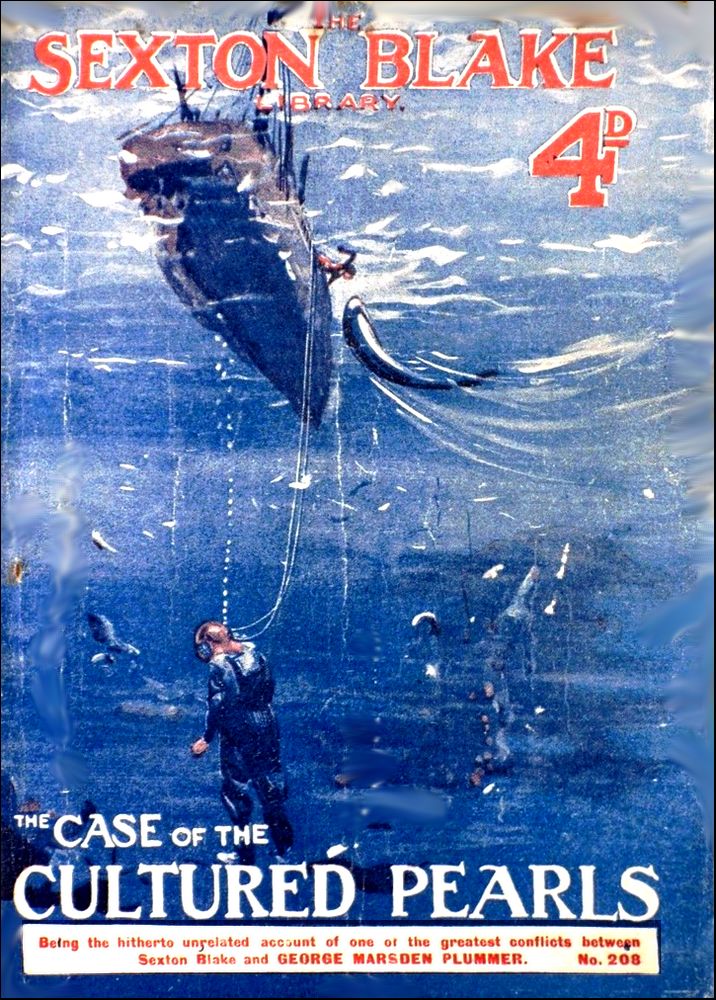
I.—The Beachcomber.
A SMALL skiff, which had left the side of one of the many outlying pearling luggers, was heading towards the sandy beach of Thursday Island.
The morning sun blazed out of a tropically blue and cloudless sky with no blistering, scorching vehemence, and the air was oppressive, etifling.
What little breeze there was came off-shore, and was laden with the stench of beach scatterings and the smell of poogie tubs.
A "flare-up" was going on at the shanty upon the sea front, where French John sold bottled poison he called "whisky," and snatches of a song, sung in maudlin voices, floated faintly to the beach.
The yields from the pearl beds had been exceptionally good of late, and money with some was plentiful.
Running the skiff in at the beach, the solitary occupant shipped his oars, waded ashore, and pulled the little craft out of reach of the tide.
He was a strange specimen of humanity, was this man who had just come in from the sea—more like an animated scarecrow than anything else.
His suit of "white ducks" was soiled and ragged, his feet bare, and his hair and beard long and unkempt. His face was blotched and swollen, and his eyes bloodshot from far too frequent visits to French John's, and he looked as near to being "down and out" as a man could get and still go on existing. Yet, wreck though he was, there was much about the man that would have held the gaze of a student of human nature.
When one looked into him, it was possible to realise that, at first glance, his matted beard, moustache, and hair concealed finely moulded, even aristocratic, features; and, in very truth, the man was an aristocrat by right of birth.
For he was George Marsden Plummer, ex-detective-sergeant of Scotland Yard, who had blue blood in his veins and an instinct for crime that had more than once caused his name to ring from one end of the civilised world to the other.
Bitterly afraid of Sexton Blake, the famous detective of Baker Street, Plummer had given England a wide berth after his last encounter with his arch-enemy.
There is no need to recount how he had drifted from place to place abroad until finally he had found himself on Thursday Island. Here he was, and Plummer was at last beginning almost to admit that crime does not pay.
He had gone from bad to worse, and was now reduced to the lowest depths to which he had ever sunk in his misspent life. He had been on Thursday Island for several months now, picking up what he could from time to time and disappearing for weeks at a stretch along the beach, or from the island by means of a little pearling lugger which he had won from a Chinese half-caste in a game of fan-tan.
Very naturally he did not call himself George Marsden Plummer here. George Gale was the name he had assumed, and it would serve him for the time being as well as any other.
What he did in his long absences no one knew, but there was a suspicion among the traders on the island, and the captains who from time to time put in at it, that he was after bêche de mer.
If the truth be told, the guessers were not far wrong. By industrious beachcombing Plummer had just managed to exist since the lugger had become his property. But never a day went by without the keen brain behind the inscrutable eyes was busy in endeavouring to find some scheme by which he could enrich himself to an extent that would be worth while at the expense of others, and say good-bye to Thursday Island for good.
The formation of the island at the spot where Plummer had landed formed a coral-fringed lagoon. On the bottom of the sweeping, shallow sheet of water was much pearl shell, and, near a schooner that lay out beyond the coral reef, Malay divers could be seen at work.
Inland were a few starved looking palms, then, away to the right, the sea front and the town, where men of all nationalities—Malays, Chinks, Japs, and whites, the latter of whom were made up of almost every shade and breed under the sun, which could by any stretch of imagination come under that category—congregated, and the chief attraction was the store presided over by French John.
As he thought of his present lot in life, Plummer's lips curled savagely, and a curious change came to his bold, steady eyes. From a dark grey they gleamed with a furious tint of agate-green, with the pupils contracting like those of a cat—a peculiarity that more than once in the past had betrayed Plummer, when, in one of his super-clever disguises, his and Sexton Blake's paths had crossed.
The criminal had turned and was gazing now towards the schooner and the divers who, with stone-weighted feet, were plunging to the ocean depths to wrest from it its treasures.
Always since he had been on the island, George Marsden Plummer had been on the look-out for some unwary person who had made a rich haul from the pearl beds. Once let him get his hands on such and London should know him again, and he would live as befitted one of his gentle birth, he told himself.
Plummer walked up the sloping white beach, presently coming in sight of a small thatched and verandahed house which nestled in the shadow of a row of palms.
It belonged to a missionary, the Rev. John Hamilton, who resided there with his daughter Rosa.
When Plummer had come to the island he had been very near to starving, and his low state of health had brought about a complete collapse tended with fever, in which for days he had raved in delirium. But for Rosa Hamilton and her father, who had taken him in and cared for him through his illness, he would most certainly have died, and what little gratitude the ex-detective-sergeant was capable of had been aroused by their kindness to him.
As Plummer approached the missionary's house, through the tropical vegetation in his small garden, his keen eyes caught the flutter of a white dress.
Rosa Hamilton next moment was at the gate, and, somewhat to his surprise, Plummer saw that the girl was beckoning him.
He quickened his step.
Her slender grace and fresh young loveliness never failed to appeal to the master-criminal: besides which he was filled with curiosity to know what she could want of him.
Rosa Hamilton was scarcely twenty. She looked alluringly girlish and charming as, in her filmy white dress, she stood by the gate of her home, with the sunshine lending rich glints of gold to her soft brown hair. Plummer saw, however, as he approached that her deep azure eyes were clouded and troubled as if from some poignant anxiety.
Instinctively, Plummer raised the battered slouch hat he wore, and for a moment he had forgotten the wreck of humanity he had become, his uncouth appearance and the fact that he did not now appear as the handsome, well-groomed man who seldom failed to appeal to the opposite sex.
"You wanted to speak to me, Miss Hamilton?" he asked; and as she had done many times during the criminal's period of convalescence in her home, Rosa found herself wondering whom he could really be and what had brought a man of obvious refinement and education to so sorry a pass.
"I did wish to speak to you—yes, Mr. Gale," the girl answered, "I—"
She hesitated; then:
"Oh, I am in great trouble," she added impulsively, her lash-shadowed blue eyes filling with tears; "and you are a Britisher, and—and, somehow, different from the other white men who come here, and I felt that you might help me."
In a moment all the chivalry that was in Plummer was uppermost—at least, for the time being.
The distress in her eyes, the trembling of her lips were irresistible, apart from the fact that he owed her a very real debt of gratitude,
"If I can be of any assistance to you, Miss Hamilton—" he murmured.
"I think perhaps you could, and yet—oh, I don't know! Perhaps, after all, I am worrying myself needlessly."
"But won't you tell me what is distressing you?" Plummer urged, his interest roused: and, after a moment's hesitation, the girl drew open the gate and motioned to him to enter the garden.
Just inside, in a little alcove of tropical, blossoming creepers, was a garden seat. Rosa sank upon this, and, as for a moment her head was half turned away from him, Plummer saw that the tears glistened like jewels upon her long lashes.
Again forgetting to what he had come, he stretched forth a hand and laid it gently upon her arm.
"Give me your confidence," he said; "you can trust me as you thought. I do not forget how much I owe to you, Miss Hamilton, and your father, and I swear that if it is humanly possible to aid you, I will do so."
The girl turned and looked long and searchingly into his bearded face; then seeming assured that her confidence would not be misplaced, she plunged into her troubles.
"For the past four months," she said. "I have been driven to the verge of madness with doubt and anxiety. Do you know Napang Island?"
Plummer nodded. She referred to a small island lying next to Thursday Island in a southerly direction.
"It is owned," he said, "by a young American, named Clifford Van Housden, if what I have heard about it is correct."
"It was," the girl corrected.
"Was?" Plummer repeated interrogatively.
Rosa Hamilton gave a quick inclination of her lovely head, and to Plummer it seemed that she choked back a sob.
"If he is there now, it is not as owner and master of the island as is his right," she said in explanation. "I fear—I seem to know that he has met with foul play."
There was no question of Plummer's interest now, and he had speedily put two and two together.
"You love this man, Miss Hamilton," he said quietly; and, dully, she nodded,
"I met him with my father when we visited his island just over a year ago," she answered, "and"—a soft flush stole into her delicate cheeks—"we conceived a mutual affection for one another almost at first sight. My father and I stayed on his island as his guests for upwards of a month, and at the end of that time Clifford—Mr. Van Housden—and I were engaged, and it was arranged that we should marry as soon as my father and I returned from a six months' stay in London, for which we were about to sail.
"Frequent letters reached me for some four months, after my father and I had reached England, then they suddenly ceased, and no replies came to the letters and cables I sent to Napang. I cabled, you understand," she added, "when I became alarmed at his mysterious silence, and thought he must be ill or have met with some serious accident. My father grew angry and declared that Mr. Van Housden's affection for me had waned. This, however, knowing and understanding him as I did, I would not believe; and as soon as possible after arriving back here, without saying anything of my intention to my father, I engaged the owner of a pearling lugger to take me to my fiance's island."
She paused and sighed deeply.
"There I found everything changed. Where, in the past, it had been quite easy to gain admission to the rather fine grounds surrounding the house Mr. Van Housden had built for himself when he first bought the island, they were now strongly guarded by armed Malay servants, and I was refused admission at the gates.
"Through the railings I caught a glimpse, too, of several savage dogs of the mastiff type, which it seemed evident had been called into use to supplement these guards in their vigil."
Plummer's eyes had narrowed, and unconsciously he had raised a hand to his lips and was indulging in the habit that was his when he was thinking deeply—the gnawing of his finger-nails.
He scented a mystery here of a deep and perhaps even sinister nature, which he might, perchance, turn to his own advantage. Where dark doings and deep plotting was going on, a profitable counter-plot was often possible.
"What happened, Miss Hamilton?" he asked quickly.
"On my persisting in my request to be allowed to see my fiance, a huge, bearded Dutchman named Hans Paulig, whom I had known for Mr. Van Housdon's chief overseer, came to the gates and told me curtly that my fiance was not there, and was at the time thousands of miles away in New York."
"But you did not believe him?" Plummer asked.
"No," the girl returned vehemently. "Mr. Gale"—she had sunk her voice impressively, and it was trembling —"I believe that my lover was there all the time, and a prisoner in that man's hands, unless—"
She broke off and shuddered.
"Unless?" Plummer prompted.
"He has been murdered by Hans Paulig," she concluded with a sob, "for some ends of his own; and, in that case, I do not think they would be far to seek, for around the gate and included in my fiance's property, are extensive beds which from time to time yield valuable harvests of pearls."
"Ah? Plummer murmured, with a quick indrawing of his breath; and, for a moment at least, he was once again the criminal who thought only of himself.
What if the suspicions of the girl were correct? What if this Dutchman, Hans Paulig, had either murdered or made a captive of his young employer and intended to rob him on an extensive scale? If he could gain proof of this, and thus place the Dutchman in his power, there was every chance that he could soon leave these parts with the coup he had for weeks been seeking, and—
Plummer started, realising that the girl was again addressing him.
"Oh. I know it is a lot to ask of you, for, if I am not making a mistake in what I think is going on in my fiance's house, these men will be desperate, and there will be danger for you," she had said. "But, somehow I cannot help feeling that you are a brave man and that, for the sake of a girl who is torn with suspense and uncertainty, you will do your best to get at the truth."
"What does your father think of the strange things that are apparently going on there, Miss Hamilton?" the criminal asked.
"He thinks my imagination has created my fears for Clifford—Mr. Van Housden's safety," Rosa returned, sadly shaking her head. "He believes that I mistook servants who chanced to be about the grounds for these men, whom I am sure were nothing more or less than armed sentries.
"And he puts your fiance down as a heartless scoundrel who has amused himself by tampering with your affections?" Plummer suggested.
The girl nodded. For a moment she was too choked with emotion to reply; then, as she recovered herself, she stoutly defended her lover.
"He is not that, Mr. Gale—I feel it—I know it!" she protested with conviction. "I feel certain that when his letters to me in England suddenly ceased, it was because he was unable to write—unable to write because Hans Paulig, helped by the Malays who were once Mr. Van Housden's servants, had him in their power, and either done him to death or were keeping him a prisoner, as I have already said I suspect.
"Oh, it is the uncertainty that is so terrible!" she cried, breaking down and convulsively weeping. "It is killing me.
"You must try to be brave, Miss Hamilton—brave and patient for just a little longer," Plummer said. "I promise you that I will go to the island and try to find out whether or no harm has befallen this man whom you love."
A little cry of gratitude escaped the girl as she raised her tear-stained face and caught impulsively at one of the criminal's hands.
"Oh, you are good—good as you are brave!" she said. "I thank you from the bottom of my heart."
Plummer looked into her tear-dimmed eyes, and perhaps for the first time in his life he felt ashamed.
It was almost roughly that he disengaged his fingers from hers, rose from the garden-seat, and, with a lifting of his hat, turned towards the gate.
When his lugger left Thursday Island that evening for Napang, it would be mainly in the interests of George Marsden Plummer, and not those of the missing American, Clifford Van Housden.
If, as Rosa Hamilton suspected, there was foul play, and a big conspiracy was afoot to rob the Housden pearl fisheries, by hook or by crook, the master-criminal determined, he would learn the ins and outs of it, as he had promised.
Again, supposing Clifford Van Housden was still alive and a prisoner, he should be rescued, and it would be only after he (Plummer) had gained at least a half-share of the Dutchman's haul.
II.—At Napang—Thrilling Moments—The Truth!
THE clinging silence of the tropical night was broken only by the murmuring of the phosphorescent sea as it broke over the coral reefs.
The island of Napang lay bathed in the silver glory of a bright, full moon, but the beauty its soft light lent to the scene failed to appeal to George Marsdon Plummer as he brought in his lugger as near as he dared and curtly instructed his Malay boy to cast anchor.
Indeed, Plummer cursed the moon heartily, for it made the night almost as light as day, and did not fit in with the work that lay before him.
"You fella," he said, in the dialect of Torres—"you fella, bring long a skiff."
The Malay boy went to the stern of the lugger, where Plummer's skiff had been towed. He brought the small boat round to the side of the vessel where his employer stood, and Plummer, after gazing long and earnestly towards the island's sandy beach, and making sure there was no one about to see, slipped over the side and into it.
A moment later he was rowing towards the shore. He gained it, and dragged the small craft high and dry. Then he started up the beach towards the stretch of bush and jungle that lay between him and the house of Clifford Van Housden.
Napang was quite a small island, being some five miles in length and three in breadth. In the drinking dens back on Thursday Island, Plummer had often heard men discussing the smaller isle, and knew that Van Housden's residence stood as near as possible in its centre.
Plummer had been giving a good deal of thought to Rosa Hamilton's story since he had left her that morning. In a guarded way, too, he had asked questions concerning both the young American and the small island which he owned.
In every case Von Housden was spoken well of, and Plummer had judged that he was not the kind of man to be fickle or treat a women badly in an affair of heart. It therefore seemed to the master-criminal that there was little doubt Ross Hamilton's suspicions were near the truth, more especially as all the information he had been able to glean assured him that the Housden fisheries were profitable.
Plummer's hands dropped into the pockets of his ragged jacket, and rested or a moment on the brace of automatic pistols that were there. He had supreme confidence in himself. and once he had proof that Hans Paulig was playing a crooked game, he would, he decided probably beard him in his den and find a means either of somehow tricking him out of the whole of his ill-gotten gains, or of blackmailing him for a bulky share of them.
Apparently there was not a soul about upon the sea-shore, and Plummer reached the tangle of undergrowth and vines and creepers that lay beyond it.
He pushed his way into this jungle, and finding what was evidently a recognised track between the more cultivated part of the island and the beach, he pursued it for some quarter of an hour. Then, suddenly, Plummer halted and stood tense, his ears strained and every nerve in his body on the alert.
Sounds had reached him that told him he was not now alone in the bush.
Only some dozen yards ahead of him, he could hear someone crashing at a hurried pace through the undergrowth, and in case the presence of this someone should offer danger to him, his hands again drooped to his pockets and closed about the butts of his revolvers.
Plummer drew back into the shadow of a spreading tree, and stood waiting, for the unknown was heading unmistakably towards where he stood in a small clearing he had reached when he first heard the hurrying footfalls.
There was the sound of the runner bursting his way through a dense patch of vines and tropical growths. A second passed—two—then into the moonlight that filtered through the foliage overhead there stumbled a sorry figure.
It was that of an old negro with almost snow-white hair, who was sobbing for breath, and who appeared at his last gasp. He was attired only in shirt and trousers. His feet, which were bare, and his arms and face were streaming with blood, where, in his rush through the jungle, he had lacerated them on thorns and brambles.
In a glance Plummer saw that the old man was the victim of a very real terror. His black face must have been cheerful and kindly in normal times; but now it was working and contorted, and his eyes were desperate and dilated.
Just as he came in view of the master-criminal, the old man caught his toe in a rut in the ground, and pitched heavily to his face.
He made an effort to struggle up, but he seemed partially stunned, and it was only once again to fall prone.
Plummer took two sharp strides that carried him to where the old man lay, and, falling on one knee, the criminal rolled him over and helped him to a sitting posture, in which he supported him.
"What are you running from—what's wrong?" Plummer asked sharply, gently shaking the aged negro to pull him together.
The old man tried to speak, but as yet was too breathless. Then, as if in answer to the question Plummer had asked, from away in the jungle rang out a sound that sent a thrill of dismay stabbing through the master-criminal's breast.
There was no mistaking its nature. Plummer had heard it once to his cost, thousands of miles away in England. when he had been fleeing from Sexton Blake.
It was the mournful, long-drawn-out baying of bloodhounds, hot on the scent!
"Quick—tell me! Why are they tracking you with those dogs?" Plummer demanded.
The old black made an effort, and though he still panted gaspingly, this time he contrived to speak.
"I am Massa Van Housden's servant," he said feebly. "De wicked men who want to catch me hab kep' me an' de master prisoners fo' many weeks. To-night I escape and I tried to reach de sea and get away, so that I could bring rescue to Massa!"
As he listened to the gasped out words, Plummer could have shouted aloud in an exultant excitement. So Rosa Hamilton had been right in her suspicions, as he had thought. The unfortunate old negro's words now left no room for doubt.
"Quick—up with you!" Plummer ordered, remembering the bloodhounds that were on the black's track. "I have a skiff on the shore, and a lugger lying out just beyond the reefs, and I'll help you to escape them if I can."
The old negro uttered a cry of mingled joy and gratitude, but he was so exhausted that when he attempted to rise to his feet it was only to reel and fall to his knees.
If he could get this old man away from his pursuers, he would not only be able to question him and find out exactly what had been happening in Van Housden's house, but very probably gain a good inkling of the Dutchman Paulig's motives in attacking his master and his servant and holding them captive.
Of course, he had little doubt of them now, but he wanted to know exactly on what lines the Dutchman was working.
"Look sharp!" Plummer urged again. "Heavens, man, can't you stand?"
Again the old fellow tried to rise, but it was useless. He must have been fully sixty, and his age, to say nothing of loss of blood from his wounds, had told upon him.
"It's no good, Massa," he said hoarsely. "You get away an' bring back help for my master. He will be grateful to you an' see dat you are rewarded."
Plummer realised that the old black's eyes had taken in his unkempt appearance, and that he had weighed him up for the poor wretch he had become.
For a moment the master-criminal's eyes agate-green with a savage anger, for his dignity and vanity, strong factors with him even now, were hurt.
He resisted a desire to crash his fist into the negro's face and send him down his back, and thought only of saving him, for again the baying of the bloodhounds had rung out, and from the sounds Plummer knew that they were nearer—terribly nearer.
"Come! You must get up and run!" the master-criminal snarled impatiently; but the task was beyond the exhausted negro.
"I can't," he gasped, "You go, Massa, an' bring help."
"No," Plummer said through his teeth, for such an arrangement did not, of course, suit his book.
Just for a moment the ex-detective-sergeant of Scotland Yard stood looking down at the old man, as he half-lay, half-crouched at his feet. Then, though he hated exertion and all his blue blood rebelled at the thought of what he was about to do, he picked the old nigger bodily up in his powerful arms and slung him over his shoulder.
For the third time the menacing baying of the hounds reached Plummer's ears, and, in spite of his heavy burden, he wheeled like lightning and dashed back at a fast run along the track he had followed from the sea-shore.
On through the moonlight Plummer sped, but it was soon plain to him that the bloodhounds, and the men who were with them, were gaining upon them.
Though the dogs would lose the scent, and would be bound to pause when they reached the spot where he had commenced to carry the black, those who were with them would know that their quarry's objective was the beach, and they would make all speed in that direction.
Could he outdistance them, reach his skiff with his human burden, and gain his lugger before they drew near enough to be troublesome?
Plummer set his teeth hard and quickened his pace to the utmost limit, though his recent illness had left him far from the fit man he once had been, and he was rapidly growing breathless and exhausted.
In the moonlight ahead of him Plummer could see where the track ended at the white, sloping beach, and, though he was ready to drop, he made a last almost superhuman effort.
As he ran he swung the old negro from one shoulder to the other, and, with a rush, went stumbling on to the soft, yielding sand.
Now it was a breakneck dash for his skiff, which, abreast of the lugger as she lay out beyond the reefs, he could glimpse by the water's edge a little to the right. But before he had covered half the distance that lay between him and the tiny craft, there came a vicious crack from the rear, and a bullet sped unpleasantly near.
The master-criminal heard next instant a pattering of feet almost at his heels, and turned to find that the negro's pursuers had loosed one of the dogs upon him.
Had he delayed his wheeling movement a second longer, he would have gone down beneath the dog's spring and probably found its teeth at his throat. As it was, he only just managed to jerk one of his revolvers from his pocket and fire a quick shot as the animal rose in the air with extended jaws.
Despite his haste, however, Plummer's aim was true, the bullet entered the dog's mouth and must have come to rest in its brain, for it crumpled up, pitched to the sand and rolled over, dead.
Fierce cries of anger greeted the animal's action, and a positive fusillade of lead whistled about his ears.
Just before he turned to continue his dash for his skiff, he flung a glance at his foes, who were now speeding towards him down the sloping beach.
They were led by a herculean man, who wore a long grizzled beard and a wide-brimmed slouch hat. Plummer took him to be the Dutchman, Paulig, and was afterwards to find out that he was correct.
The man's companions were evil-looking, brown-skinned Malays. There was at least a dozen of them, and in the quick glances he shot at them, Plummer was almost certain that they had with them two more bloodhounds. Apparently, however, they did not intend to risk the lives of these other two valuable dogs, for the men who held them did not free them from their leashes.
With the black still slung over his shoulder, Plummer gained his skiff, but there was no time to push her off before his foes were at his heels.
Heaving the old negro unceremoniously into the bottom of the boat, Plummer swung round on his heels, his second revolver flashing out with a lightning rapidity that would have compared well with the smartest, quick-shot cowboy in existence.
From one of Plummer's weapons belched a red spurt of flame, and the Dutchman, Paulig, uttered a gasp of fear and dismay as the bullet sent his wide-brimmed hat spinning.
A Malay, who was about to swing up a rifle he carried, went down with a bullet in his shoulder from the master-criminal's other weapon, and now Plummer stood momentarily at bay.
"Keep back!" he snarled, "Keep back, all of you, if you value your lives! If a man of you attempts to raise his weapon, I'll drop him—and I'll shoot to kill!"
"Who are you?" the Dutchman growled. "Und by what right do you poke your nose into our business, ain't it? You cursed beachcomber, don't you realize dot ve are twelve to you, and dot if ve rush you, you stand no chance."
"I guess I could shoot at least four of you before you disarmed or killed me, my friend," he retorted grimly, "and as sure as you give an order for your men to do any rushing business, my first bullet will fly straight for your heart."
The Dutchman ground his teeth in rage, but for the moment he could only stand and glare murderously at the amazingly cool man who faced him at the water's edge.
The two bloodhounds were straining at their leashes, and growling and baying menacingly. But out of the corner of his eyes Plummer watched them as a cat watches a mouse, and the men who held them in check knew very well that to release them would sign their death warrant.
Plummer did not fail to notice this fact, and a grim smile curled his thin lips. He noticed another point, too, that was in his favour.
Only three of the eleven Malays, who were with the Dutchman and still on their feet, were in possession of firearms.
Plummer judged that these three men had been on guard in the grounds of Van Housden's house at the time the old black had somehow contrived to make his dash for freedom, and that the others were merely servants, who had accompanied Hans Paulig when the hue and cry had been raised and he had doubtless dashed helter-skelter from the house, to form a search-party to track down and bring back his prisoner.
On his part, however, the Dutchman had no intention of allowing Plummer to escape in the skiff with the negro.
Hans Paulig was playing too desperate a game, and had a secret of far too great a value to take risks.
His brain was working at a lightning speed as he stood staring at this beachcomber who was setting him and his hirelings at defiance.
For all he knew, the old negro, whose name, by the way, was Sambo, might have let drop enough to wrest from him the colossal fortune he was staking for and clap him into jail into the bargain, and it behoved him to see that both men were kept silent. Therefore, they must both be either killed or carried back as prisoners to the house inland.
With all his faults, George Marsden Plummer was a brave man, but even he found the present situation straining his nerves to breaking point, and as one of the bloodhounds gave a sudden furious bay, and fought with the man who held it, to break free and fly at him, for just the fraction of a moment he could not help allowing practically his whole attention darting in the dog's direction.
It was Hans Paulig's opportunity and he did not fail to grasp it.
Quick as a flash, his hand fell to the pocket of his white drill jacket. Quick as thought, it came out again, clutching at an automatic pistol. But Plummer was not to be caught napping, after all.
One of his weapons and that of the Dutchman seemed to speak simultaneously, but in reality Plummer had fired just the fraction of a second before his enemy.
Hans Paulig's "automatic" fell from his nerveless fingers. He let out a sharp yell of agony and went reeling back, clutching at a shattered wrist, whilst Plummer stood unharmed—then grew active.
With the Dutchman put out of action, at least for the moment, he had but three men who carried firearms to overcome.
Plummer did not hesitate. It was one of the tightest corners he had ever been in in his life, and needed desperate measures to cope with it.
So rapidly that he appeared to take no aim, he fired three shots, and the three Malays who had guns, howled with pain and dropped them, for two had bullets buried in the fleshy part of their right arms, and the third had collapsed to the sand with a leaden pellet in his shoulder.
So unexpected had been the master-criminal's attack that, for second or two, the other Malays stared, inactive as he wheeled about, pushed his skiff with its black occupant into the sea, ran along himself beside it, leapt into it and seized the oars. Then, yelling with fury at the injuries he had inflicted upon their master and their comrades, the other Malays came rushing into the sea.
Plummer felled the foremost of them with a terrific blow from one of his oars, then, with it, he punted his craft further out, but was in time to swing up the oar and give the second Malay who came at him a prod in the chest which caused him to lose his balance and make a temporary disappearance beneath the waves.
"Rouse yourself, man, and keep them off!" Plummer rapped, driving the handle of one of his oars into the back of old Sambo, who, in a state of semi-coma, sat with his head drooping between his knees at the bottom of the skiff. "Here, take this revolver, and let fly at them like blazes!"
With an effort of will-power, the negro flung off the dazed exhaustion that had held him in its grip. His black fingers closed about the weapon the master-criminal was thrusting over one of his shoulders, and as, now waist-deep in the water, the Malays who were not put out of action came wading after the boat, with the two dogs, the black fired point-blank into their midst.
None of them were hit. Sambo's hand was too unsteady, and his old eyes too blinded with fatigue to allow of his aim being accurate; but the shots served to scare the brown men, and they wavered and fell back.
Now Plummer bent to the oars and sent the skiff fairly leaping out to sea. He and Sambo, however, were far from being out of the wood just yet.
As the Malays returned to the beach, Hans Paulig raved furious orders at them, and three of them grabbed up the guns which lay on the sand. With them they poured after Plummer and the nigger a withering hail of lead.
The master-criminal kept his head low, and pulled with all the strength that was left to him. But even as it seemed that they were getting out of range, a more than usually accurate shot brought disaster to Plummer's companion.
The criminal heard Sambo utter a curious choking cough, and saw him pitch in a huddled heap to the bottom of the skiff.
"You're hit!" he said, ceasing to row for a moment, and laying a hand on the old man's shoulder. "Where's it got you? In the chest, hasn't it?"
But Sambo did not reply. He remained where he had fallen, and Plummer bit back an oath of bitter disappointment, thinking at first that the man for whom he had risked his life, because he deemed he would gain from him much useful information, was dead.
As the master-criminal rested his hand over the old man's heart, he gave a quick little sigh of relief, for Sambo was not dead—at least not yet, though he was possibly very seriously wounded.
Again Plummer plied his oars, making the fastest possible pace he could for his lugger. As he gained it, he gave a shout that brought his Malay boy craning over the side, and the lad held the boat steady while Plummer lifted the black on to the lugger's deck, and himself followed.
Snapping out orders for his boy to make fast the skiff, and weigh the anchor with all possible speed, Plummer carried the negro to the tiny cabin and laid him on his bunk.
He then returned to the deck, got the lugger running swiftly back in the direction of Thursday Island before a stiffish breeze that was blowing, then, leaving her in charge of the Malay lad, returned to Sambo.
He ripped away the negro's shirt, so as to reach the ugly wound that was in his chest. Then, as, having adjusted the wick of the smoky lamp that hung from the ceiling, he stooped over the old man to examine his wound, Plummer caught sight of a small bag that hung from a piece of tape passed about his neck.
The criminal took it between his finger and thumb, and as he felt the small, hard, round objects it contained, he uttered a low exclamation of mingled surprise and excitement.
Forgetting for the moment about the negro's injury, he carried his find beneath the light, opened the neck of the bag, and shook its contents into the palm of his hand.
A gasp of stupefied amazement left the lips of Plummer then, and he resisted a desire to rub his eyes and pinch himself, to make certain he was awake and not in the midst of a wild and fantastic dream.
For the bag had held a dozen pearls, which the master-criminal calculated would represent quite a fortune when turned into hard cash.
All the gems were comparatively large, and of an apparent peerless purity, whilst one stood out by itself as one of the most beautiful pearls Plummer had ever seen, and he estimated that it ought to fetch at least five thousand pounds. It was a magnificent pearl, which seemed endowed with living fire. It appeared to have all the colours of pure flame within it, and as it caught the light and glowed and winked dazzingly in the sickly yellow rays, it brought a glint of greed to Plummer's hungry eyes.
A movement from the bunk broke the silence, causing him to start so badly that he almost dropped the treasures he held.
He trickled them back into the bag and swung round towards the wounded man in the bunk with an ugly snarl upon his lips.
He saw that Sambo had regained consciousness, and, although he was fighting for breath, and his eyes seemed already to hold the glassiness of approaching death, he was endeavouring to raise himself upon his elbow, and to speak.
"What does this mean, my friend?" Plummer asked, with well-feigned sternness, "It seems I have risked my life to save a thief from getting his deserts."
He went to the negro and supported him, as again Sambo's lips moved, and he tried to speak.
"I'se no thief, massa," he protested, in a thin, gasping voice.
"Then what are you doing with a fortune—quite ten thousand pounds worth of pearls upon you?" the criminal asked.
At first he did not understand the wan smile that came to the sorely injured man's lips.
"Dey are not worf dat, massa," the old man protested, with a shake of his head. "Dey am not real pearls, and my master said dey would bring me 'bout two-tree hundred pounds when I sold dem."
Plummer stared at him. He saw that the man was dying, and thought that the nearness of death was affecting his reason. Then the earnestness that was in Sambo's eyes, and the absence of anything about him suggesting delirium, caused Plummer to lower him to the coarse pillow, yet again to stride beneath the light and turn the gems out into his hand. Quickly, yet closely, the ex-detective-sergeant examined them, and a puzzled frown came to his brow.
The investigating of many jewel robberies and mysteries while he had been attached to the Criminal Investigation Department, of Scotland Yard, had given him a wide experience, and he was a good judge of any sort of gem or precious stone. But he failed entirely to find any signs that the pearls were not what they had seemed.
He jerked from his pocket a powerful magnifying-glass, which he screwed into his eye. He subjected the shining globular objects to yet another searching scrutiny under the lens, but still could not detect the least thing wrong with them, save in one.
It was the pearl that, in his mind, Plummer had already christened and thought of as the "Globe of Fire," and under the glass it was possible to detect the very faintest tinge of green in its depths, which might mean a flaw that would lessen its value.
But apart from this one very slight defect in the one stone, the master-criminal could see nothing wrong whatsoever with the parcel of gems. They were pearls, genuine pearls, and worth a fortune at that.
Having restored them to their bag, and pocketed that, as well as the magnifying glass, Plummer returned to the side of the bunk and again supported the old nigger.
"Look here, my black friend," he said curtly, "you can't take me in with a yarn of this sort. Those gems are genuine, and I don't believe your master gave them you to sell. You stole them!"
"I didn't, massa—I didn't steal dem!" the old man protested weakly. "Listen an' I will tell you what hab been happening it my poor young massa and me. I will tell you before I die—fo' I am a gone coon, massa. I—I—know it, massa!"
Plummer did not disagree with him, knowing that perhaps the old man's very minutes were numbered, he did not hinder him by speaking.
"Fo' years, massa," Sambo said an effort, and rallying a little, "my massa hab been what him calls 'experimenting' wid de oysters which lay in de small bay on de far side of de island, I dunno how he has doe it, but he has made dem oysters make pearls whether dey liked it or not."
Plummer drew a quick breath. Amazing though it was, he thought he was beginning to understand now why Sambo had declared the gems he had were worth only two or three hundred pounds, and so vehemently protested that they were not real.
He knew that in China, for instance, artificial pearls are obtained from a fresh-water mussel by the process of inserting small foreign particles between the shell and the flesh of the fish, when these become covered by layers of nacreous substance and acquire the appearance of true pearls. Similarly, by inserting tiny metal images of Buddha into the shell, the fishers obtain an imitation cameo in mother-of-pearl.
And yet, was it possible that Clifford Van Housden had not only discovered a means of producing pearls from his oysters, but had brought his experiments to so fine and complete a stage that he could cause the shellfish to produce what were apparently true and peerless gems, similar to those which had hung about the old nigger's neck? The very idea, the possibilities that such a discovery held out for a colossal swindle, caused Plummer's brain to reel.
He could scarcely credit that the gems in the small bag in his pocket were merely pearls that had been artificially cultured, and yet—well, what else was there to do but believe it? Clifford Van Housden would certainly not have instructed his servitor to sell the gems for two or three hundred pounds had they been genuine.
Eagerly, Plummer listened, as, after a fit of coughing that brought a flow of blood to his lips, old Sambo continued his narrative.
It appeared that Clifford Van Housden's experiments had been going on for the past ten years, but it was seven years ago when he had brought them to perfection, and he had then been engaged for two years in "planting" his "seeds" in whatever form they took, in the shellfish. Thus in a certain part of his fisheries practically every oyster had for from seven to five yeara been engaged in forming what, even to an experienced eye, would seem like a wondrous gem, yet which, because it was "cultured"—produced by artificial means—was in reality worth only a thirtieth part of the amount that would have been its market value had Mother Nature caused the mollusk to form it.
Hans Paulig, who acted as the manager of the young American's plantations and fisheries, had come to learn of these experiments, and of the immense haul in "cultured" pearls that could be raised from the bay at any moment Clifford Van Housden gave the word. He had seen some of the stones his employer had caused the oysters to produce, and had been amazed by them, realising that, with the majority of them, even an expert of long experience would almost certainly fail to detect that they were not the genuine article.
Sambo's information was at times very vague, but Plummer understood that Paulig had then proposed to his employer that they should make a coup out of the American's secret.
He had suggested that by placing the artificially-produced gems in the pearl markets of various countries through agents at a simultaneous given time, they could dispose of all the cultured stones they held before anyone found out the deception—in other words, that Clifford Van Housden come in with him in a huge fraud which would bring them upwards of a million pounds.
Old Sambo's master had indignantly refused, declaring that when he sold the gems it would be simply as what they were— and that he would be quite satisfied with the profit he would make over the deal.
Then Van Housden and his manager had quarrelled, and the former had knocked the Dutchman down; but Hans Paulig had evidently anticipated that his master's instincts might be those of a strictly honest man—that he would refuse to listen to the scheme he had for netting a gigantic illicit gain—and had made plans accordingly.
That night, while Sambo's master was seated in his library, a sudden and unexpected attack was made upon him by Paulig and a certain section of the Malay servants and employees who were engaged about the house, the surrounding grounds and properties.
"Dey put my massa down in a cellar under de house," Sambo concluded, "and about six Malays are always there wid rifles to see dat he does not escape, Dey hab not let dis child out ob de grounds since dat night, but dey did not make him a prisoner in do cellar, an' let him wait on de massa to bring him his meals an'—an'—look—after—him."
Again Sambo was wracked by a fit of coughing, and it left him so weak that he could hardly finish his story.
Anxious to hear the rest of it, Plummer held to his lips a flask which contained a few drops of indifferent brandy from French John's. The spirit revived the old man a little, and Plummer eagerly plied him with questions, lowering his head and holding his ear near to Sambo's lips, that he might not miss one feebly-whispered word that came from them.
"Paulig and the Malays are fishing for these pearls every day, eh, Sambo?" the master-criminal asked.
"Yes, massa," the old black breathed gaspingly, "and—in—in—de night, too. Dat wicked man, Paulig, wants—wants to get all de gems an' sell dem before anyone finds out 'bout him hating the master—a—a—prisoner."
"Ah!" Plummer ejaculated. "And he has sold a good few of them, I suppose?"
"He told de massa dat he had sold some in de bazaars of Egypt and India, where dey not likely to find out dat dey not real, and one big gem to a rajah fo' t'ree t'ousan' pounds. Him sneer at—at-de master and strike him in de face, while de Malays held his arms so dat Massa Van Housden—couldn't—couldn't hit—back."
Dying though he was, the glazing eyes of Sambo held a light of anger and indignation at the recollection.
"I—I make up my mind to escape, den, as—as de massa an' me had talked ob, when de Malays had not—not been listening—to escape a bring people to—rescue—him." Sambo gasped. "I'se gettin' weaker, Massa, an' I—I sha'n't be able to—to—say much more."
He fought for almost his last breath.
"De massa—him tell me—dem pearls yo' find round Sambo's neck—dey in—secret drawer—massa's desk. Him—tell me—take dem when—when I go, in case—want money—"
"Yes, yes," Plummer urged, forcing the last drop of brandy the flask held between the nigger's blood-flecked lips.
"Massa Van Housden—tell me—hurry back wid help," the old negro whispered hoarsely, haltingly, "or too late stop de swindle Paulig—Paulig planning. Him goin' to—to Lunnon soon—sell all de pearls dere him hab brought up, an'—"
His painfully whispered words ceased, and for a moment Plummer thought the end had come. But for the last time Sambo rallied, and, with an expression of pleading in his eyes, and one of his hands clutching supplicatingly at Plummer's, he gasped:
"Sell de pearls I—I had—if yo' want money, massa. But—take rescue—to—Massa Van Housden. Yo' Promise? Yo'—"
His speech ended abruptly. There was a hoarse rattling in his throat, and he fell back inertly in Plummer's arms.
With a shudder, the master-criminal detached his hand from the dead black's stiffening fingers and lowered him to the bunk.
He drew the blanket over old Sambo's face and stepped back, his hand going into the pocket where lay the bag of cultured pearls.
"I did not promise," he muttered to himself, as if to ease his conscience, "and I will see that Van Housden is rescued—at my own time. So Hans Paulig means to plant these artificial pearls on the London market, does he! Well, Mynheer Paulig, I fancy you are in for the disappointment of your life. By the time reach England and London, I; George Marsden Plummer, shall be there to meet you, and it will be I who will net something like a million out of these gems—not you!"
Plummer returned to the deck, and going to the stern of the lugger, with his keen eyes he swept the moonlit sea.
Napang was now almost out of sight, and there was no sign of a sail upon the phosphorescent expanse of water to suggest pursuit.
Probably, Plummer thought, the only available craft in which Paulig and his hirelings could have given chase had been lying at the further side of the island, and he chuckled softly.
He had most certainly won the first move in the game!
On the following morning Plummer disposed of his lugger for a few pounds and went aboard a tramp steamer bound for England. He had arranged with the mate, whom he had met in French John's, to work his passage to London.
Once, after the vessel had weighed anchor that afternoon, and Thursday Island was beginning to fade in the distance, the master-criminal's mind went to his old enemy, Sexton Blake, and he wondered if the strange fate that in the past had persistently caused their paths to cross, would again serve him a scurvy trick when he reached London.
For a moment ell his old terror of the famous detective was upon Plummer, and he almost wished that he had not left his beachcombing back on the island. Then, as he hurried to obey some hoarse, oath-accompanied command of the mate, he laughed to himself.
There was nothing to fear, he told himself. He had altered greatly since England had last known him; and if he retained his beard, even the keen eyes of Sexton Blake could hardly succeed in recognising him.
There was but one thing that troubled Plummer—the promise he had given Rosa Hamilton, and practically broken.
Many times during the long voyage that lay before him, the sweet face of the girl was to rise before him and trouble what little conscience he possessed.
When it did so, Plummer forced himself to forget her, and to let his mind dwell only on the great haul he was scheming to make.
Baker Street—and Gustav!
WHISTLING cheerily, and glowing from the effects of a cold bath and a vigorous towelling, Tinker came nosily into the, consulting room.
He patted the great bloodhound, Pedro, as he came forward to greet him, with wagging tail. Then Tinker's whistle ceased, and he pulled up with a start of surprise as he saw that Sexton Blake was already up and seated before his roll-top desk by the window.
"I never knew such a chap for being energetic as you, guv'nor," he said; for it was only just after seven in the morning, and Sexton Blake had been out with Detective-Inspector Martin, of the Yard, engaged upon an intricate murder mystery until nearly two.
"Pooh! One doesn't want to lay in bed on a lovely morning like this," Sexton Blake answered, as he lit a cigarette and turned from his desk.
"Lovely morning—I don't think!" ?Tinker exclaimed in disgust, as he gazed out into Baker Street, where a recent fall of snow had left much mud of the kind a Londoner knows as "slush." "It may be one of those sort of days the poets talk about as clear and crisp, but look at it underfoot! I am glad there are all those cuttings to paste up and index, and that I haven't got to go out this morning."
"That's just where you are wrong, my lad." Blake objected. "You have to go out—and pretty smart at that. Have you forgotten the date?"
"Why, of course, it's Yvonne's birthday," Tinker exclaimed. "Do you want to go round and take her a present or something?"
Sexton Blake shook his head.
"No, you are a day too soon, Tinker," he answered, "Yvonne's birthday falls on the sixteenth—to-morrow. But there is an errand for you that might prove of a far more important nature even than the paying of our compliments and the wishing of many happy returns to Mademoiselle Yvonne. You have reminded me, though, that I must think about buying her some little present."
Tinker smiled to himself. He knew that the intrepid girl, who, in the first instance, had forced Blake to wage war with her, but afterwards frequently worked with them as a staunch and valuable ally, was the one woman in existence who ever came into his master's thoughts other than in a coldly businesslike way. Sexton Blake's "little present" would doubtless run into four figures, and be an object of charm and beauty that would harmonise with the girl's young and peerless loveliness.
"You've got me guessing, guv'nor, about it being some particular date," Tinker said. "Is this the day when I ought to pay my giddy income tax, or something?"
Sexton Blake pointed meaningly to the diary that lay open on his desk, and Tinker crossed to it.
As he glanced quickly at an entry for that day, a sharp cry of understanding broke from him.
"My aunt, this is the day for the release of Gustav!" he exclaimed.
"Precisely," Sexton Blake returned, his lean and handsome face going a little grim. "He has served the sentence he got for being concerned with George Marsden Plummer and John Marsh in the affair of the Nyangwe rubber swindle five years ago, and should step from Pentonville, where he has been sent for formal identification and release, at eight o'clock, this morning."
"Of course, you think, guv'nor, that, considering the valuable accomplice he always was, Plummer might try to get in touch with him again," Tinker suggested.
Sexton Blake flicked the ash from his cigarette and nodded.
"It is possible, though improbable, for I imagine Plummer must be thousands of miles away abroad, for him not to have shown his hand for all these months," he replied. "Still, with Plummer, the very thing that seems improbable has often happened in the past, and although we have not been troubled by him for a very long time now, I have not forgotten the vow I made, that one day Bleakmoor should again swallow him up. At all events, I want you to keep an eye open to see if any one approaches Gustav when he comes from the gaol."
Sexton Blake's keen eyes had gone hard and grave as he had been speaking, and Tinker knew that his friend's mind had been running over the many bitter battles of wits he had fought out in days gone by with the master-criminal.
Their fights had been grim, relentless things, in which one great mind, using all its subtlety, all its craft and cunning, had been pitted against another, and in which each man had strained every nerve to defeat his opponent.
At no time was quarter asked, at no time was it given, The combat would go on mercilessly until the end.
And so far, that end had always come in but one way.
The extra ounce of grey matter possessed by Sexton Blake had counted, and, empty handed, Plummer had had to fly to keep his freedom.
"Supposing Plummer has died abroad, guv'nor?" Tinker suggested. "You never know, he may have done, and it's strange he has kept away from London so long. We know from past experience that it acts like a magnet to him, and, somehow I can't help feeling that, if something has not happened to him, he would have returned to it before this."
But Blake did not share his views.
"I shall never believe Plummer dead until I see his lifeless body, lad," he answered. "Ay, and not even then will I be satisfied, until I have made sure it is he, by feeling for the trepanning of his skull. But hurry up and have some breakfast. You will, of course, have to get into a disguise before you slip along to see Gustav step back into the free world."
"Right-ho, guv'nor!" Tinker answered. "Talking about breakfast reminds me that I have an appetite this morning like a frisky ostrich."
"Is that anything unusual?" Sexton Blake remarked drily, as he sank into his favourite chair and drew towards him the several morning newspapers, which his housekeeper, Mrs. Bardell, had not long ago brought into the room.
"I am afraid you've misjudged me," Tinker retorted. "As a rule my appetite is one of the daintiest little things on earth." And forthwith, he lifted the cover from the several dishes upon the table and piled his plate with eggs, bacon, and deviled kidneys to an extent that might well have caused a healthy navvy to open his eyes in admiration.
Having satisfied his "dainty" appetite with these delicacies, to say nothing of a few new rolls and a couple of cups of coffee, Tinker sprang up from the table and disappeared into the adjoining dressing-room. He was absent for about a quarter of an hour, but when he returned his best friend would not have known him. In appearance he was now a stout and affluent Hebrew of thirty-five or so.
The rather too-immaculate clothes were skillfully padded to give him a portly look, and his own crisp, short hair was concealed by a curly and oily jet-black wig. His brows were blotted out by a pair of false, bushy ones. His face and the false nose he wore were fresh-coloured, and a "Charlie Chaplin" moustache ornamented his upper lip.
Sexton Blake could not repress a smile as he glanced round and saw him, though there was also a quiet admiration and pride in the detective's eyes.
He could not have had a more apt pupil than Tinker.
Sexton Blake would have been ready to admit that, master of make-up though he was, even he himself could not have accomplished a better, or more complete disguise.
Tinker adjusted one of his spotless white spats, grinned, then raised his shiny topper to his master.
He slipped hurriedly from the consulting-room, banging the door in the face of Pedro, who had tried to follow him, much to the huge bloodhound's disgust. Tinker walked to the garage across the road, where there was always a taxi ready for the use of Sexton Blake or himself, when, for fear it might be recognised, they preferred not to use the detective's own car.
"Jerk out t'e old 'bus, Charlie, my poy!" Tinker instructed, with a Hebraic posture of his beringed hands, addressing one of the hands, who was cleaning a ear. "I haf to see my prother Isaac on important pusiness."
"Here, you can"t use that taxi, sir," exclaimed the man. "It's kept special for one of our regular clients."
"Well, aren't I regular client, my lad," Tinker demanded; in his own, well-known voices and the many-accustomed though he was to meet both Tinker and his master in disguise, positively gasped in surprise.
"Well, I be blowed! If it ain't Mr. Tinker!" he exclaimed, staring at the apparent Hebrew in almost stupefied amazement. "By jingo, young sir, this is one of the cutest make-ups I've ever seen you in. What's the game this time?" he added, in a hoarse, confidential whisper "After some murderer, or something like that, are you?"
"Sure, Charlie! A chap who has ,killed no less than nineteen people," Tinker declared, with owl-like seriousness.
"Nineteen! You don't say!" the garage man gasped, in awe. "Look after yourself, Mister Tinker, or the brute might make it twenty!"
Tinker grinned and entered the taxi.
"I'll keep my eye on the jolly old assassin, never you fear, Charlie," he said, poking his head from the cab window.
A chauffeur came forward, took his sent at the wheel, and waited for the lad's instructions.
"Pentonville Road." Tinker said, "and drop me near—not too near—the prison."
The man was the usual chauffeur who drove either Blake or his assistant when they made use of the taxicab, and he understood perfectly well what was required of him.
When they reached the Pentonville Road, which, as usual, was thick with traffic and pedestrians, he halted the cab some short distance from the well-known prison upon the opposite side of the road.
Tinker alighted and strolled away. There was no need to stop to pay for his ride, as the garage people did considerable business with Sexton Blake, and rendered him a monthly account.
Almost opposite the prison Tinker took up his stand. The hands of a near-by clock pointed to five minutes to eight, and Sexton Blake's assistant did not have long to wait for the coming of his man.
Just as the hour was striking, one of the great gates of the prison swung open, and a warder stood aside to allow a short, pale-skin man, foreign-looking man to pass out.
"S'long, mate," the guard said good-naturedly. "Don't come our way again, if you can help it."
The man, who had been sent here for release after serving his sentence of penal servitude away on the bleak, grey moors of Portland, did not reply.
He seemed dazed to find himself once again in the free world, and stood blinking in the cold sunlight of the early morning.
From the other side of the road Tinker had instantly recognised him. He was Gustav right enough—Gustav, one-time valet to John Marsh, the notorious Stock Exchange swindler, and accomplice to both he and George Marsden Plummer in many of their daring frauds.
Prison life had changed him but little, perhaps he was a little thinner than when Tinker had seen him last, and his face a little grey and drawn. As he watched him walk to the kerb and stand as though hesitating which direction to take, Tinker's pulses were quickening in excitement.
The next few seconds would decide whether or no he and his famous master were again to get upon the track of their arch-enemy who had at one time been a shining light at Scotland Yard.
Tinker found himself almost wishing that Plummer was in England, that in some clever disguise he would suddenly appear and accost his old accomplice, and that he and Sexton Blake would soon find themselves pitted once again against the master of criminals.
Tinker loved excitement, especially when it held a spice of danger, and there was always both excitement and danger with a vengeance when their tracks crossed with that of Plummer.
Ah! Tinker drew his breath sharply, a man in the garb of a clergyman had disentangled himself from among the numerous passers-by, had stepped up to Gustav and touched him upon the arm.
For a moment, as he keenly watched, Tinker's hopes ran high; then they were dashed.
The man in clergyman's dress, who had accosted the freed ex-valet, stood little more than five feet and, though much of his features were hidden by a neatly trimmed brown beard and moustache, he could not possibly be Plummer.
The latter was six-feet in his socks, and clever though he was in the art of disguising himself, he could not at will dispense with some twelve inches of his stature.
Tinker waited for a moment and saw the clergyman engage the valet in almost eager conversation. The minister was doubtless occupied upon rescue work, the lad decided, and he was about to turn away and make his way back to Baker Street, when a sudden thought struck him that caused him to pause.
What if this man in clerical dress was really no clergyman at all, but an agent engaged by George Marsden Plummer to act as intermediary between himself and Gustav?
"One never knows," he thought, "and it's not unlikely. Come to think of it, Plummer would realise that the police or ourselves might be inclined to watch Gustav when he came out of quod, and he would hardly risk coming himself and perhaps being arrested. I'll keep my eye on the pair of them, anyway."
For a few minutes longer, the man who might or might not be a minister, and the released Frenchman, continued to talk together. Then, in a kindly way, the man in ministerial garb linked his arm through that of Gustav, and they walked away together down the road.
Tinker kept them in sight at a respectful distance, followed the pair to the Holloway Road, into which they turned, but here he was doomed to a fresh disappointment.
Suddenly the two men wheeled into a side street, and, having quickened his step, Tinker was just in time to see them turn into a building on the left. And over it appeared the legend "The Holloway Mission."
With a shrug of his shoulders, the lad turned away.
He made his way to a call office and rang through to Baker Street.
"That you, guv'nor?" he asked, as he was connected, "There's nothing doing. The only chap who has spoken to Gustav was a clergyman—a mission worker—who was evidently waiting to get in touch with anyone who was released from the prison."
"You are sure your clergyman was not Plummer?" Sexton Blake asked sharply, realising the possibility in a flash.
"No, guv'nor, he was genuine enough. I followed him and Gustav to a mission, off the Holloway Road," the lad answered.
"Right-oh," Sexton Blake rejoined; and, as he rang off he looked as though he might share at least a little of Tinker's disappointment.
If he could only have guessed the truth—that a link did exist between that innocent and earnest clergyman and the man who had surely proved himself one of the greatest criminals of modern times! How differently would he have acted.
As it was, Sexton Blake's mind was almost immediately switched from Plummer and went again to a girl, who had been in his thoughts when Tinker had 'phoned—Mademoiselle Yvonne.
If the truth be told, Sexton Blake was in something of a quandary. He wanted to give the girl some present that would please her on her birthday on the morrow, but could not decide what shape it should take.
As a man will, when so placed, Sexton Blake glanced about him for inspiration, and, although the detective had not the least premonition of the fact, there occurred then what was soon to prove perhaps one of the strangest and most fateful coincidences that could possibly have happened.
The telephone directory lay open upon the desk at which he had sat to answer Tinker, and Sexton Blake's eyes fell upon the name of a friend named Porlock, who was a dealer in precious stones and had offices in Hatton Garden.
With a quick making-up of his mind, the detective again raised the telephone receiver.
"Is that you, Porlock? the detective queried a few moment later, when, knowing his friend would not yet be at his place of business, he had rung up his private house, "Sexton Blake speaking. Will it be possible to see you some time this afternoon at your office. I want to select something from your stock for a birthday present for a lady."
"Certainly, old man," came back over the wire, "About two o'clock suit? Good! What do you fancy—diamonds or pearls?"
"Pearls, I think," Sexton Blake returned, remembering they were Yvonne's favourite gems.
"Then I can show you one that will make you hold your breath' in admiration," Porlock declared.
"A single gem?"
"Yes; but a beauty and one that would make a plain woman beautiful and a beautiful one queenly, if worn in a pendant."
"I should like to see it, Porlock." Blake rejoined. "What sort of a gem is it?"
"It's a pearl with all the colours of pure flame flashing in it," was the dealer's reply. I bought it recently from a fellow who had come from the Thursday Island fisheries, and he had christened it the 'Globe of Fire!""
Gustav's "New Start in Life."
"GIVE me back the old days with my dear master and Monsieur Plummer, and I would ask for nothing else. But to take to crooked ways again on my own account—ma foi! I have not the brains to be really successful, and it would not be worth the risk!" Gustav's thoughts as he had stepped from Pentonville.
He had had enough of prison life, and was firmly determined that it would be a very big inducement that would cause him again to jeopardise his freedom.
Thus, instead of shaking off the parson who addressed him, he paused to listen to what he might have to say. He saw in the minister a chance, perhaps, of gaining some sort of employment that would enable him to make a new start and lead an honest life.
As Tinker had finally decided, the clergyman was genuine enough—just one of those earnest workers who toil daily to do good by uplifting the fallen.
"May I speak to you, my man?" he said to Gustav kindly, "I saw where you came from and, perhaps, the mission I belong to might give you a helping hand."
"You are very kind, monsieur," Gustav had murmured. "If I could find come sort of employment that would bring me a living I swear that the gates of a prison should never close upon me again."
The clergyman had given an exclamation of surprise as he noted Gustav's accent. "You are a Frenchman, are you not?" he asked quickly. And on Gustav replying in the affirmative, the minister had declared that he believed that the mission had a suitable situation that "might have been made for him."
The little clergyman was with Gustav now in one of the rather bare rooms of the mission.
His kindly eyes were beaming upon the ex-valet, who sat opposite him at the table where the Rev. Thomas—that was his name—did his office work.
"It is a fellow-countryman of yours to whom I intend to send you," he was saying. "A fellow countryman and an invalid, who lives quite near here, and who requires a male nurse. Dear me, it is rather a wonderful coincidence! He specially states that he will give preference to a Frenchman. What work did you do, my friend, before you—ahem!—took the wrong path?"
"I was a valet, monsieur," Gustav answered.
The Rev. Thomas declared that nothing could be better.
The Frenchman, who had made the application to the mission for someone who could act as his nurse and personal attendant, had explained, he said, that as long as he could find a suitable fellow-countryman to fill the vacancy, he did not mind how down on his luck the applicant might be. Indeed, he was open to give a helping hand to any Frenchman who was stranded in London and had fallen upon evil times.
"I will give you a letter to this French gentleman," he concluded. "Just wait a few moments while I write it. If he can overlook the fact that you have made a slip and been in prison, I honestly believe you are the very man for the position."
Gustav thanked him, and waited whilst the Rev. Thomas, after asking him soma further particulars regarding himself, quickly penned the necessary epistle and placed it an envelope, which he sealed.
"There you are, my poor fellow," he said in his kindly way, and he gave the letter to the one-time valet. "I hope you get the berth. If not, come back to us, and we will do our utmost to enable you not to go wrong again"
He shook hands and saw the Frenchman to the street, standing and watching him, with a sad little shake of his head, as Gustav walked back towards the Holloway Road. Gustav saw that the envelope was addressed to "Monsieur Jean Lanvaux," and that the address was 36x, Oakley Square.
He made his way to that quiet residential quarter near Euston, and found the flat—for such Monsieur Lanvaux's residence proved to be—upon the first floor.
When he rang the bell, his summons was answered by a rather seedy-looking person, who proved to be the doctor in attendance upon the invalid.
Dr. Samuel Parkinson was quite a young man, who had experienced all the heart-aching disappointments and tragedies that befall a young medico who, without capital, sets up in practice for himself and waits for patients.
For month after month the latter had been conspicuous by their absence, and the young doctor had grown deeper and deeper in debt to his landlord and the tradesmen, and had been thinking of giving up his fight altogether when he had received a message to attend Monsieur Lanvaux, and had quickly found him a gold-mine.
Try as he would, Dr. Parkinson had failed to find anything serious the matter with this elderly French patient, save that he was abnormally short-tempered and querulous. But as Monsieur Lanvaux had paid his fees regularly. seemingly believed himself gravely and chronically ill, and promised to be something of a mainstay, Dr. Parkinson had not felt it his duty to acquaint him with the fact.
The doctor glared at Gustav in no friendly manner. His patient had told him that he intended engaging a male nurse. Dr. Parkinson guessed that Gustav was an applicant for the post, and probably wondered if, with his coming, the need for him might not be less frequent, and his "pickings" therefore reduced.
"Well?" he snapped, unamiably.
"I have a letter for Monsieur Lanvaux," Gustav returned, showing it.
"Male" nurse, eh?" the medico queried curtly; and upon Gustav bowing in a manner essentially French, the doctor stepped aside to allow him to enter the flat, though with a rather bad grace.
"Who is that, Parkinson? a thin voice, with a distinct French accent, asked from a room on the right of the hall.
"An applicant for the berth as nurse," the doctor replied; and the feeble voice, which obviously belonged to the ailing Monsieur Lanvaux, demanded that Gustav should be brought to him.
As the doctor conducted the released convict into the room, the latter could not at first see anything very clearly, for the curtains were drawn almost entirely over the windows, filling the room with a clinging gloom. But as his eyes became accustomed to it, Gustav made out a bed standing against the opposite wall, and propped up on numerous pillows was a gaunt, grey-haired, grey-bearded man of apparently sixty to sixty-five.
The invalid stretched out his hand for the letter Gustav held, and, ripping away the envelope, he took a box of matches from a table beside his bed, and struck one of the lucifers to read the epistle.
As the match flared up, and its light fell upon the lined and sallow face of the man in the bed, Gustav was given a better opportunity oF studying this fellow-countryman who might become his employer.
He saw that Monsieur Lanvaux was seemingly a man of refinement. What little of his features were left revealed beneath the towsled white hair that fell upon his forehead, and his beard and flowing moustache, were clear-cut and handsome. His teeth were curiously perfect for an elderly man and an invalid, supposing they were his own, and his hands were long, white, and well cared for.
"Ma foi! So you are a Frenchman!" the man in the bed exclaimed. "This would indeed be fortunate, if you had not been in prison."
Gustav intercepted a look almost of horror from the doctor, and a spot of pink blazed on either of his cheeks.
"If you engaged me, monsieur," he said quickly, in French, "I vow you should never have cause to regret it. I wish never to go back to prison, and I will work faithfully and honestly for you. Mon Dieu, I swear it!"
With nothing before him, save early poverty and starvation, which would mean that he would slip back into crime, and eventually find himself once more behind prison bars, Gustav waited in suspense, as Monsieur Lanvaux appeared deeply to consider the advisability of engaging him or otherwise. Then, to the ex-valet's relief, he gave a quick nod.
"Very well, my friend," he said, speaking in English, so that the doctor should understand, "I will give you your chance of leading a better life. You shall come to me and begin your duties at once."
"Is this wise, sir?" the doctor interposed quickly, with a cold glance at the released convict.
"Is it for you to question me, monsieur?" the invalid snapped haughtily. "Be satisfied that I engage you as my medical man and never question your fees. If it is my whim to stretch out a helping hand to a fellow countryman and take the risk of his robbing me, surely that is my look-out."
"My dear Monsieur Lanvaux, please don't take offence," Dr. Parkinson protested hastily. "I spoke only with your welfare at heart."
The man in the bed shrugged his shoulders.
"Somehow I feel that this man will not betray my trust in him, monsieur," he said coldly. "You may leave me with him. He will give me my medicine and do anything I require for the remainder of the day.
Thus rebuked, the doctor could do nothing save wish his patient "Good-morning," and take his departure. Already falling into line with his old training as a gentleman's servant, Gustav saw him to the front door and bowed him from the flat.
"Let me see—what is your name?" said his new master, as the valet returned to the sick-room.
"Gustav, monsieur," the freed prisoner answered, in the toneless, respectful voice he had been wont to use five years ago in the service of John Marsh. "Is there anything I can do for monsieur?"
"Of a certainty." returned the invalid, in French, "Look in the bottom drawer yonder, Gustav. You will find a bottle of champagne. Open it and pour two glasses, and we will drink to La Belle France and to our long and friendly associations."
Gustav suppressed the surprise he felt at his now master's suggestion. He went over to the chest of drawers, found the wine, and poured two classes of the foaming, bubbling liquid as he had bean requested. He stood them upon the dressing-table whilst he looked round for a tray.
It was then that a laugh came from the bed—a soft, grim chuckle that to Gustav was somehow strangely familiar.
He swung round on his heels, then uttered a positive shout of blank amazement.
For, in the half-light, the "invalid's" grim amusement was causing his eyes to glow agate-green like those of a cat, and his white hair, his beard and moustache, the very sallowness and tired-looking lines of his face were now palpably a disguise, from behind which his own clear-cut, virile features peered out nakedly.
Gustav took a reeling step backwards, and his hand sent one of the glasses of champagne to the floor with a crash.
"Monsieur Plummer!" he gasped, as one who doubted the evidence of his senses.
Plummer's Programme.
"MONSIEUR PLUMMER!" Gustav repeated, a hand pressed on his temple. "Mon Dieu! Do I dream, or is it really you?"
"It is I right enough, my friend," the man an the bed chuckled; for he was none other than Plummer. "Did you imagine you were 'seeing things'?"
Gustav came towards the bed, still looking bewildered, dazed. He was continuing to stare at the disguised criminal in almost incredulous amazement.
"Seeing things!" he repeated. "Ma foi! But prison fare is not apt to rise to the head, monsieur!" he added, with a rueful smile.
"It is not!" Plummer said savagely, shuddering as he recalled his own sojourns in Bleakmoor. "Don't stand staring at me as if I were a ghost, man! Fill another glass, and let us drink to our reunion. I think we can pride ourselves that it was managed remarkably well. You will find a loose board beneath the chest of drawers, and under it a box of Green Larrañagas. Produce them, my dear fellow. I smoke them only when I am quite alone in the ordinary way, but, of course, with your good self, it is different."
Now somewhat recovering from the shock of this totally unexpected meeting, Gustav did as he was ordered.
He filled another glass from the bottle of wine, and brought both glasses upon a tray to the bedside.
Plummer had now swung his legs to the ground, and, still grinning at his companion's surprise, was seated on the edge of the bed in his pyjamas.
He watched the silent-footed Gustav as he went back to the farther side of the room, prized up the loose board beneath the chest of drawers, and secured the box containing the master-criminal's favourite cigars, which he brought to him.
"But, monsieur, it is of the things wonderful!" the ex-valet protested, spreading out his hands in a gesture typical of his race, as he noted Plummer's grin. "A padre—a minister addresses me and asks me if I wish the work that will let me be honest. I say 'Yes,' and he sends me here, where a male-nurse is wanted, and I find— Mon Dieu!—I find you, the last person in the world I expected ever to see again! But, tell me," he added anxiously, "is monsieur really ill?"
George Marsden Plummer's smile broadened, as he lit one of the cigars.
No—it's just a blind. You might know that," he answered. "But, to play the chronic invalid, as I have been doing for some weeks, is an excellent way to hide from the police, mon ami."
Gustav started badly.
"Monsieur is not in danger from them?"
Plummer shrugged his shoulders.
"I don't know—I think I might have been some three to four weeks ago," he returned. "I had then only just returned from a long stay abroad, and had a beard and a mop of hair which made me look like a gorilla, and which I thought safely disguised me. But I was startled when, twice in one day, in the West End, I ran into our mutual friend—or should I say enemy?—Detective-inspector Martin, of Scotland Yard."
"Ah!" Gustav breathed. "You thought, monsieur, that he suspected your identity, and was shadowing you?"
"Yes," Plummer admitted; "and I hastened me from the spot pretty slickly, I can tell you, Gustav. Of course it might have been pure coincidence that I should run into him twice in this way, and he might not have given me a second thought after his casual glance as we passed each other. But—well, there is an old saying about 'Prevention being better than cure,' my friend.
"I thought of you, recollecting that you were soon to be released, and I decided to kill two birds with one stone.
"I secured this flat by a lucky chance and made up my mind to play the part of a chronic invalid here in the neighbourhood of Pentonville, where I guessed you would be sent for formal identification and release. It enabled me to lay low, in case the police were looking for me, and also made it possible for me to put into operation a scheme I had formed which gave me a sporting chance of getting into touch with you.
"I purposely adopted an old and favourite disguise of mine—that of a Frenchman; then wrote to the mission people off the Holloway Road, and informed them that I required a male-nurse, and that would give preference to a fellow-countryman no matter how down on his luck he might be."
"You knew, monsieur, that these people watch the prison in order to give a helping hand to those who, having served their sentence, are sent there for release and thought—"
"That, being a Frenchman, they would almost certainly send you along, and see if I would give you a fresh start in life by engaging. you—exactly," Plummer agreed. "It was a plan that could hardly fail to succeed. But, drink your wine, refill your glass, and have a cigar, Gustav. These things should come as luxuries to you, after five years in one of those hells upon the moors."
"Ma foi—yes!" Gustav admitted, with more feeling than Plummer had seen him express.
The ex-valet sipped his champagne, rolling the rich and sparkling wine over his tongue, as though to wrest from it all its delights. Then he lit one of the Larrañagas and deeply inhaled the smoke, with obvious enjoyment.
"But, I live again!" he murmured.
"By the way," Plummer said, his strange eyes a little narrowed, "did you notice if anyone, who might have been watching you, was in the neighbourhood of the prison when you came out?"
Gustav shook his head.
If he had noticed Tinker at all, as he stood on the opposite side of the road, the lad's disguise had been so good, and his manner so casual, that the Frenchman had had no reason to pay any especial attention to him.
"It is the old fear that troubles you—the old fear of him?" he suggested meaningly.
"Of Sexton Blake—yes," Plummer confessed, "I thought it probable that he or that brat of his might watch for you to be freed, with the idea that I might join you outside the prison. Hence my plan to get at you in a roundabout way through the mission people. I dare not risk meeting Sexton Blake, even when wearing the most complete disguise—especially just now, when I have every reason for wishing him to believe me out of England and forget me."
Gustav darted a quick, inquiring look at his old associate in crime.
"Precisely," Plummer replied; and one of the biggest things, too, to which I ever turned my mind. That, apart from the fact of your being the one accomplice I ever had any regard for, Gustav; was why I was so anxious again to get into touch with you when you once more became a free man. I need your help."
"I am entirely at monsieur's service," Gustav assured him. "By myself, I would prefer to be poor and honest; but, to work with a man of the brains of monsieur—oh, là, là! it is a very different matter. From past experience I know that the risk is small and the prize great."
"The prize is great enough in this case, my dear Gustav," Plummer declared cordially, his innate conceit appealed to by the ex-convict's remarks, which were plainly sincere.
He chuckled, and his eyes gleamed for a moment with greed.
"If all goes well," he said quietly, "I should come out of the scheme I have with a solid million, or little short of it. But listen, and I will tell you all about it."
Gustav flicked the ash from his cigar, and was instantly all attention. For the next quarter of an hour he was drinking in a story that caused his pulses to quicken and his eyes to widen in wonder—the account of George Marsden Plummer's adventures on Thursday Island and the adjoining isle of Napang.
"But the pearls, monsieur, about the old negro's neck—you say that they were not genuine?" Gustav remarked, when Plummer had reached that point in his narrative.
The master-criminal smiled curiously.
"In one way, yes; in another, no," he said. "They were what is known as 'cultured.'"
Quickly he entered into an explanation, telling Gustav how, to give an instance, the Chinese insert an irritant between the flesh and the shell of a river mussel and cause it to build a pearl.
"In this case," he went on, "this American, Clifford Van Housden, has accomplished the same feat with the oysters in a certain part of his fisheries. But he has brought the art to so fine a pitch that the gems he causes his oysters to produce are so like the genuine article made solely by Nature, that they cannot be told apart. As a matter of fact, I arrived in London with only a few pounds, and to raise funds, I took five of the pearls to a dealer of Hatton Garden, and sold them for seven thousand five hundred pounds."
"You sold them as real pearls, and he did not detect anything amiss with them?" Gustav exclaimed, almost incredulously.
Plummer shook his head.
"He bought them without the least question, so far as their genuineness was concerned, though he seemed to be doubtful as to the yarn I spun him to account for being possessed of them."
"Yet a dealer, before he purchases gems, will examine them most exhaustively, monsieur."
"He did all that." Plummer replied grimly, "He was poring over them with a lens for quite twenty minutes—twenty minutes that seemed like treble that time to me. For there was one pearl amongst the five I took to him which did hold just the slightest greenish tinge that might have been noticed by the trained eye of an expert, and have made him question it.
As I watched him sitting at his table inspecting this particular pearl, I began to regret that I had included it with the others. But evidently this slight flaw—which I should never have noticed had that dying negro not sworn that the pearls were 'fakes' and made me look for something of the kind—also escaped this dealer. He made me an offer for the gems separately, and paid me almost half its total for this particular gem, which looked to be a wonderful pearl, and had all the shades and gleaming lights of living fire in its depths.
"Now, he continued, "having finished my tale, let us come to more recent happenings."
He tossed away his half-smoked cigar, and drew from beneath the mattress upon his bed a newspaper clipping, which he handed to the ex-valet.
"Read that," he said. "It is a cutting from the columns dealing with the money market in one of the leading dailies. It says, as you will see, that by the S.S. Kangaroo, one of the Auckland Line of steamers which touches at Thursday Island, an accredited representative of Mr. Clifford Van Housden is sailing for London, and remarks that the fact will be of especial interest to those connected with the pearl market.
"It appeared some weeks ago, and no further reference has been made in the Press to the visit of this said representative of the owner Napang, but I should not be surprised if it has not caused a good deal of speculation in Hatton Garden. Van Housden, if my information is correct, is known both here and in America as a keen financier, and pearl merchants and dealers here will wondering just why Van Housden is sending this man to England.
"Just now pearls are booming, and they will speculate as to whether this American representative is here to take advantage of the fact, to offer the Isle of Napang and its accompanying valuable fisheries for sale at an inflated price, or whether his coming means nothing more than an attempt to make the market shaky for Van Housden to grab what he can in the event of a slump."
He paused and finished his wine.
"Now, my dear Gustav, I can claim to be the one man in London who does know the exact truth. Firstly, I am aware that the man who is coming to London by the S.S. Kangaroo is, without much doubt, Mynheer Hans Paulig, the rather bloodthirsty Dutchman whom I got the better of that night on the beach at Napang. And I am also aware that he is not really an accredited representative of Van Housden at all, but a rogue who is acting entirely in his own interests, and means to swindle the London pearl dealers of roughly a million sterling by selling them 'cultured' pearls for real.
"Whilst Van Housden is being kept a prisoner in his own house on Napang, Hans Paulig has been clearing the beds of the thousands of oysters which have for the last five to seven years been 'culturing' gems, and Hans Paulig means to plant the best of them here."
"Then he will have with him this huge fortune in pearls, monsieur?" Gustav exclaimed, drawing in a quick breath of excitement.
"Well, he will have with him what would be a huge fortune, if they were really pearls," Plummer corrected, grinning. "For that matter, however, so far as we are concerned, they do represent a mint of money, for we shall sell them as the real thing."
"We!" Gustav repeated. "Then you mean, monsieur, that—"
"That the S.S. Kangaroo is due to arrive to-morrow evening, and is expected to berth in the East India Docks at about 6 p.m. Hans Paulig, whom I, of course, know by sight, will naturally travel up to Fenchurch Street, and then—well, what do you think, Gustav, would be the most natural thing for him to do then?"
"I should say, monsieur; that, having with him what is to all intents and purposes a colossal consignment of pearls, he would be more than anxious to get safely to some hotel, and his first action would be to look round for a taxi."
"Precisely!" Plummer laughed softly. "I figured it out in exactly the same way, and I have bought a taxicab, which is standing ready for use in a garage near here, also a uniform suitable for a taxi-driver, which you will find if you unlock that cupboard over there, and which I think will fit you."
Again Plummer laughed.
"You see, mon ami, how the wind is blowing now?" he said.
"I think so, monsieur," Gustav agreed, with an admiring whistle, "We shall take charge of Hans Paulig whilst—"
"Whilst we sell his pearls' for him—and keep the proceeds," Plummer finished complacently.
At 6.40 on the following evening, a train pulled up in Fenchurch Street station, which proved to he unusually crowded. "The fact was easily explained, as it had carried a vast number of people to London who had some half an hour ago landed from a vessel from Australian ports.
This ship was the S.S. Kangaroo, of the Auckland Line, and amongst the crowd, who, after seeing to the safety of their luggage, streamed from the station, was herculean man with a long grizzled beard and wide-brimmed slouch hat, who spoke with a guttural accent that caused a porter, not satisfied with the tip the man gave him, to designate him as "a stingy German."
The porter, however, was not quite correct.
As a matter of fact, the burly man was of Dutch origin, and we have already made his acquaintance. For he was Hans Paulig, late of Napang, who had somehow contrived to let a hint reach London that he was the accredited agent of Clifford Van Housden, the owner of that small though rich island.
Hans Paulig had seen his luggage taken to the cloak-room, and he carried with him only a grip-bag, though that was of generous size, and to a close observer it wold have been noticeable that his hand clutched so hard upon the handle that his knuckles gleamed out white through the flesh.
The Dutchman muttered a guttural oath under his breath. On stepping from the station and looking for a cab, it was to see no small number of taxis, but not one that was not just in the act of gliding away with a fare.
Then, as he stood on the kerb, glancing about him in the hope that an empty cab might come into the approach, a taxi stopped almost before him, and a tall man with a heavy black beard and moustache stepped out and made to pay off the driver.
Hans Paulig quickly clutched at the door of the cab to claim it, and addressed the chauffeur, as the man with the black beard moved away.
"Der Magnificent Hotel, Strand," the Dutchmen ordered, having been in England some years before, and knowing this to be a noted and highly respectable caravanserai.
"Right, sir, responded the driver, in a servile tone, which somehow struck Paulig as un-English.
But just as the Dutchman had taken his seat, and the cab appeared to be on the point of moving from the kerb, he found a face peering in at the window, and saw that the late fare—the man with the black beard—had returned.
The latter was screwing up his eyes as he looked into the vehicle, in the manner of one who was short-sighted.
"Pardon me, sir," he said politely, "but I have just missed my spectacles, and fancy I must have left them in the cab. Would you permit me to look?"
Suspecting nothing, the Dutchman growled out a somewhat surly assent, and moved into the far corner of the cab, as the person who was apparently of weak sight opened the door.
The latter stepped into the cab. He produced a box of matches, and, as though about to scan the floor for his lost glasses, he sank upon the seat beside Paulig.
Then, in a flash, his manner changed. Quick as thought, he had swung half-round, and something round and hard was thrust painfully into the Dutchman's stomach.
"Utter a sound," the stranger hissed, "and you are a dead man, or as good as such. I warn you I am desperate, and will stand no tricks!"
Hans Paulig gasped in mingled surprise and fear, and his heavy face went grey under the tan his long sea voyage had given it.
His brain whirled as the awful truth sank into it, and he realised not only that somehow his identity and what he carried was known, but that he was the victim of a daring hold-up, and in danger of losing every iota of the vast coup he had for months been anticipating.
He felt the taxi moving, and felt almost certain that the driver must be in the plot. He tried to speak, but his tongue clove to the roof of his mouth, and only an inarticulate sound issued from his lips.
The round, hard thing that instinctively he knew to be the barrel of an automatic was pressed harder into his side, and the horror and self-pity that had been his at the thought of losing the gems he carried in his grip. was changed to blue funk for his personal safety, and a cold sweat broke out upon his brow.
At a rattling pace, the taxicab was making for Whitechapel. It reached that neighbourhood, and glided into the mouth of a dark side-street. Then it suddenly stopped with a skidding of its tyres, and the dilated eyes of the Dutchman made out the head and shoulders of the driver at the near window.
The next instant the man was in the cab, and again the grim, hard thing held by the individual with the black beard was thrust forward warningly into the flesh of the frightened man.
"Keep still!" the former snarled; and whilst he thus threatened Hans Paulig, the driver of the cab leapt at the Dutchman and clapped a drug-soaked pad over his mouth and nostrils.
Hans Paulig forgot even the menace of the black-bearded man's revolver then, and, with a blind rage seizing him, he struggled like a madman to break away from the sense-stealing chloroform he was being forced to inhale.
Both men sprang at him, and the one with the black beard clutched his wrists in a steel-like hold from which there was no breaking away. A heavy blow in the chest from the taxi-driver hurled the Dutchman flat on his back on the seat of the cab, and yet again the pad was clapped over his face.
Hans Paulig's struggles lessened, then ceased altogether, and he lay inert. With a triumphant chuckle, the bearded man released his victim's nerveless hands, whilst his accomplice removed drug-saturated cloth from Paulig's face.
Between them the two then propped the drugged Dutchman in the corner of the taxi, picked up his hat, put it upon his head, and pulled it forward over his eyes, so that he looked as though he might be indulging in a nap.
Both conspirators then quitted the cab, with the beard taking with a wallet and all the papers he could find in Paulig's pockets, and the grip-bag.
"Get him to Tiger Bates' place as quickly as you can, Gustav," he ordered; and with a word of assent the man in taxi-driver's uniform climbed back into the seat before the wheel.
Some half an hour later the black beard—or, to be more exact, George Marsden Plummer—entered the Elsinore Hotel, off Piccadilly, and registered himself as Hans Paulig, of Napang.
Alone behind the bolted door of the bedroom to which he was presently shown, the ex-detective-sergeant of Scotland Yard unlocked the grip-bag with the aid of a key he found in the real Hans Paulig's wallet, and turned out upon the bed the many, varied-sized washleather bags it held.
One by one, he loosened their mouths and, in turn, their contents were deposited upon the bedspread.
Plummer caught and held his breath as he gazed down at the result, thousand of what looked to be peerless pearls of all sizes and values lay there before him.
"It would mean a million, if they were what they look to be—and they will mean that to me!" he muttered; then he seated himself in a chair, and shook with silent laughter.
He was wondering what he de intended to victimise would say, huge fraud were ever discovered both Hans Paulig and Clifford Van Housden would disentangle themselves from the hornets' nest that would mean for them.
Plummer had forgotten the possibility that, however remote, ought always to have found a place in his calculations—the chance that suspicion that all was not right with the gems might arise ere he had disposed of them all and bolted with the—
Filled with triumph at the success, so far, of his conspiracy, intoxicated with greed, and supremely confident in his own colossal conceit, he was allowing himself to forget that every plot has a chance of failing before it actually succeeds—to forget even Sexton Blake.
"The Globe of Fire."
"WHY, Graves, old man, how are you after all these months?"
"Hargreaves, by all that's wonderful! Where on earth have you been hiding yourself?"
With outstretched hand Graves, Mademoiselle Yvonne's immaculate, silver-bearded uncle, sprang out of the chair he had been occupying in the smoke-room of the Junior Ajax Club.
He and the keen-eyed, deeply-bronzed man who had just entered, gripped warmly.
Then, while Graves resumed his chair, still regarding his old club friend with delight, the latter took another and beckoned the waiter.
"It's good to see you again, Graves," he said. "Have a drink. What shall it be?"
"Oh, my usual poison—Scotch and soda!" Graves smiled; and his friend held up two fingers to the waiter to signify that the order was required in duplicate.
The two old cronies beamed at one another, Yvonne's uncle and Harold Hargreaves, well known both in clubland and in Hatton Garden, and perhaps one of the greatest authorities where the judging of precious stones was concerned, had not, as Graves' words on greeting him suggested, met for nearly a year.
"You have not answered my question, old man," Graves reminded him, as the waiter returned with the drinks, and they nodded to one another over their glasses.
"Oh, I have been away on business," Hargreaves replied. "As a matter of fact, I have been collecting some of the finest pearls even I have ever encountered to the order of her Majesty—well, just who she is does not matter. But the necklace these gems will make will grace a royal neck. I only landed at six o'clock to-night from the S.S. Kangaroo; for the last of the gems I collected came from Thursday Island."
"Only just set foot in England, eh, and at the club already! I wonder Mrs. Hargreaves allowed that," Groves grinned.
"To tell the truth,". Hargreaves returned, "I found my wife away on a holiday in Scotland when I went to my home to-night. I can only suppose that she has made some mistake in the date I was due to arrive home, or, without doubt, she would have been there to greet me. I shall dine here. Will you join me?"
"No, I am not at liberty, Hargreaves, and I can suggest a much better plan," Graves objected, "Come home and meet my niece, and dine with us. I simply must go home, and within the next few minutes at that, as it is her birthday, and she is entertaining a few especial friends."
"You are very kind," Hargreaves murmured. "You have so often spoken of Mademoiselle Yvonne, and I am most anxious to meet her. Then, to be candid, old chap, I am as hungry as the proverbial hunter."
"Come along, then," Graves rejoined, tossing off the remainder of his drink and rising to his feet. "We shall just be in time for dinner."
The two old friends obtained their hats and coats, and the commissionaire whistled them a taxi.
Within a quarter of an hour a footman in sober livery was admitting them to Yvonne's residence in Queen Anne's Gate. They crossed the entrance hall, which was big and square, and struck a restful note. Graves ushered his guest into a reception-room.
The curtains before an inner door were drawn aside, and Hargreaves so far forgot himself as literally to stare at the beautiful girl who entered the room. Then, with an embarrassed flush, he hastened to bow.
Mademoiselle Yvonne Cartier—the girl was she—smiled and held out her hand as Graves introduced them.
Graves explained that Hargreaves was an old friend of his, and that he had only just arrived back in England from a long tour abroad. Then, as they chatted banalities, the clubman, who was also a prince of Hatton Garden, had a further opportunity of surreptitiously studying and admiring the girl who was such a strange mixture of quixotic wilfulness and yielding tenderness.
Yvonne was wearing a gown of some shimmering, gossamer-like material that fell sheerly away from her slender white shoulders, and suited her to perfection.
Usually unimpressionable enough, Hargreaves found himself likening her eyes to mystic violet pools. He felt, too, that not even a Rembrandt could faithfully have portrayed the wealth of glorious bronze-gold hair which fell about her head in great coils and stamped her as distinctive over any woman he could remember knowing, as a flaming orchid stands supreme over the ordinary flowers of the field.
The few guests Yvonne had invited to the little informal birthday-party she was holding began to arrive.
There was Captain Vaughan, the skipper of the girl's yacht, the Fleur-de-Lys; a famous actor and his young and charming wife; two girls from Australia, who had been school friends of their beautiful young hostess and their father; and a well-known K.C.
While the ladies chatted, Graves carried off the men to a far corner of the room, where he displayed his skill as a mixer of cocktails. Then there came a rat-tat at the front-door, which caused Yvonne to come sharply to her feet, make a hurried excuse to her friends, and quit the room.
Her footman had just admitted Sexton Blake and relieved the detective of his hat and slip-coat.
With a welcoming smile, Yvonne met him in the shadows of the hall and gave him both her hands.
"I wondered if you would forget," she whispered, as she drew him into the porch of a small conservatory.
"As if I could, Yvonne," Blake murmured back, smiling into her shining eyes. "Many, many happy returns!"
She gave him one of her alluring, fugitive smiles. "How fine it is to see you again, dear friend," she said. "I can only presume, sir"—with mock severity—"that your excuse for letting week after week go by without coming near old friends is press of work at Baker Street?"
"Why, yes; both Tinker and I have been hard at it almost day and night," Blake answered.
"And Pedro, too?"
"And Pedro, too," the detective laughed.
He fumbled in his pocket and produced a small black-leathern case; which he snapped open. Fitted into a bed of cream-coloured velvet lay, in a tasteful gold pendant, a large pearl, which gleamed and scintillated with all the rich, warm colours of flame.
"Oh, how beautiful Yvonne cried involuntarily, taking the case in her hands, as he held it out to her.
"I thought you would like it," Sexton Blakes said.
"Then it is for me?" Yvonne murmured, though naturally she had guessed as much. "What a perfectly sweet present."
Sexton Blake took the pendant from its case. He unclasped the slender gold chain and adjusted it about her neck. Against her fair skin the flaming gem glowed like a thing of life. It was just the last touch necessary to throw off the perfect whiteness of her full young throat and made her beauty ravishing; and for a moment, as he gazed at her, Blake caught and held his breath.
Having thanked him prettily, Yvonne slipped her arm through his and led him into the reception-room, where Blake renewed his acquaintance with Graves and Captain Vaughan, and was introduced to those of Yvonne's guests he had not previously met.
Harold Hargreaves was particularly pleased to meet the famous detective. He had heard glowing accounts of Blake's powers from a friend of his in the diamond market, for whom, not so long ago, the detective had recovered a very valuable parcel of stones which had been stolen.
As was always the case when Yvonne entertained, the dinner that followed proved a great success.
The girl had placed Sexton Blake on her right, and Hargreaves was on the opposite side of the table. He could not fail to notice Blake's present, as under the electric lights it winked and glowed against the girl's white flesh, and more than once Yvonne surprised him with his eyes upon it in admiration.
The men very soon, followed the ladies after they had retired to the drawing-room.
Blake urged Yvonne to sing, and accompanying herself upon the piano, she rendered two old love ballads in a manner in which only she was capable, and which brought involuntary applause from all her listeners.
Graves followed her with a rollicking sea-song. He had a fine bass voice, and knew how to use it to good effect. Then the guests fell to chatting together, and presently Yvonne found herself in conversation with Hargreaves.
Again his eyes went to the flashing gem she wore, and he remarked upon its beauty.
"It was Mr. Sexton Blake's birthday present to me," the girl said, smiling. "We have passed through many thrilling adventures together, and are very old comrades, you know."
She unclasped the chain of the pendant and held the gem in her palm.
"Would you care to inspect it more closely?. Of course, you are interested in such things from a professional point of view."
"Yes! Hargreaves answered, taking the pendant in his hands. "It appears to be a most wonderful gem, Miss Cartier."
Hargreaves did a thing that afterwards he realised might have been taken for excessive rudeness, though, as a matter of fact, it was nothing of the kind, but merely force of habit.
He had with him the very powerful lens he was accustomed to use when examining precious stones in the way of business. It was second nature to him to screw this into his eye when he looked at the gem, and he did so now, and with it closely studied Sexton Blake's present.
Yvonne at the moment was called away by her uncle, and Hargreaves was left poring over what he had at first taken to be a pearl of the most peerless value and purity.
Suddenly he started and drew an incredulous breath.
"By heavens, it's impossible!" he muttered half aloud, and in a tone of suppressed excitement.
He snatched the glass from his eye, gave the lens a quick polish, and again keenly examined the gem with its aid.
No one chanced to be taking notice of him, Yvonne's other guests had congregated at the further end of the room, where they were examining a rather unique image of Buddha, with jewelled eyes and fingers.
Captain Vaughan had brought it back with him after a voyage he had made some years ago to China, and Yvonne, having recently seen and admired it, the skipper had presented it to his charming young mistress as his birthday offering.
Removing the glass from his eye, Hargreaves slipped it into his pocket and drew another breath of only partially suppressed amazement. He looked bewildered, almost dazed, and for the few minutes that he was left sitting alone he stole covert glances at the gem he held, staring at it like a man who could scarcely credit the evidence of his senses.
"Blake can't know! He can't—he can't!" he muttered once. "I wonder where he got the thing from?"
Yvonne returned to him.
"Isn't it just sweet?" she said referring to Blake's present.
"It—er—why, of course, Miss Cartier," Hargreaves returned, seeming to start out of a reverie and to be curiously confused. "It has really wonderful colourings," he added guardedly, as he gave it back to her.
Yvonne was quite Bohemian in her tastes. She presently lit a tiny scented cigarette and insisted upon the men smoking.
The rest of the evening passed pleasantly, and it was with more than one sigh of regret that the guests realised at length that the hour was growing late, and prepared to take their departure.
Sexton Blake and Hargreaves found that their ways were similar. The night was moonlit and fine, if a trifle cold, and on Blake announcing that he intended to walk home "to stretch his legs," Hargreaves asked to be allowed to accompany him.
The two men took leave of Yvonne and Graves and the others of the party, and set off on their moonlight tramp. Blake was a little surprised when Hargreaves, instead of leaving him and taking what would have been a short cut to his home, walked on with him until he reached his house in Baker Street.
"May I offer you a drink before we part?" the detective asked out of politeness, as he produced his latchkey.
"I will not say no, Mr. Blake." the clubman answered, "As a matter of fact, there is something of very pressing importance I have been wanting to say to you, but up till now I haven't been able to pluck up the courage to broach the subject."
Blake laughed.
"Is the subject an unpleasant one, then?" he inquired lightly; and he was not a little astonished at the earnestness and gravity with which his companion replied.
"To tell the truth, it is a most unpleasant thing for one man to have to say to another on their first meeting," Hargreaves said. "Shall we go inside? If you promise not to be offended, I will get it off my chest."
"Come in, by all means, and let us both face the ordeal," Sexton Blake urged, in the same light tone, though now there was a puzzled line between his brows.
Not for a moment did he anticipate that what the dealer and expert in precious stones had to say would affect him adversely, and he was wondering what sort of trouble Hargreaves could be in.
The two men were now on the steps. Sexton Blake gained admittance to the house with his latchkey, and conducted Harold Hargreaves to the consulting-room, which they found in darkness, as Blake had told Tinker not to wait up for him, and the lad had gone to bed.
Sexton Blake switched on the lights, removed his hat and slip-coat and offered to take those of his visitor.
Hargreaves, however, waved the offer aside.
"You'll probably want to kick me out, when you hear what I have to say," he declared, "though I assure you. I only decided to speak as I think it is highly probable that you have been swindled."
Sexton Blake's puzzlement increased now with a vengeance.
"I have been swindled," he repeated, as he pushed a decanter and a syphon of soda towards his guest. "I am afraid I don't understand."
Hargreaves mixed himself a Scotch-and-soda, took a sip of it, then leaned a little forward in his chair, facing Blake, who, with his hands thrust deep in his pockets, was now standing with his back to the fire-place.
"Mr. Blake," he said, "do you know me other than just a friend of Mademoiselle Cartier's uncle?"
Blake gave a nod.
"There are few people of note in London whom I do not know, at least by reputation," he said smiling. "You are the senior partner in the firm of Hargreaves, Hargreaves and Company, of Hatton Garden, reported to be one of the most expert judges of precious stones to be found in the neighbourhood, and, incidentally, a well-known man-about-town."
Hargreaves gave a sigh of relief.
"Thank heavens you are aware that I have gained something of a name for being able to judge a gem or precious stone!" he said. "In that case you will realise that I know what I am talking about and that I am not just a busybody with a bee in my bonnet."
He finished his drink, and again leant towards the more and more perplexed Blake.
"You are a rich man, I take it, Blake," he continued, "and because I am fairly sure of that, I should say that in making a present, such as you gave to Mademoiselle Cartier to-night, you would pay a good price for it—probably several thousand pounds. Do you mind telling me to what figure you went for the gem in that pendant the niece of my old friend Graves showed me to-night?"
A flush leapt into Sexton Blake's usually rather pale cheeks and just for a moment, an angry light flashed into his keen eyes.
Then, he realised that Hargreaves was very much in earnest, and that he had some good reason for asking him what had at first appeared a question in the worst of bad taste, and he stifled his resentment.
"As a matter of fact," he said quietly "I paid a trifle over four thousand pounds for it."
"I thought so; you have been defrauded, Mr. Blake!" Harold Hargreaves cried, in his excitement bringing a clenched fist thudding down upon the table. "There is a big flaw somewhere in that pearl. I doubt if it is worth so many hundreds."
Sexton Blake was usually the coolest of men, but his surprise now was so great that he stared at his visitor in the most blank amazement.
"Impossible!" he ejaculated. "My dear fellow, I purchased it from a man who is both a friend of mine and as highly respected in Hatton Garden as yourself."
"Then he has been duped too, and, in all innocence, sold the gem to you for what it appears to be at first glance—a pearl of the utmost rarity and peerlessness."
"But that is not to be credited, Mr. Hargreaves," Sexton Blake protested, a trace impatiently. "Although he may not have so high a reputation as a judge as you enjoy he has dealt in pearls and other precious gems for many years, and would hardly be taken in by an imitation."
"Wait," Hargreaves said, "I have not alleged that the pearl is an imitation gem in the sense that the word 'imitation' is usually accepted."
"Then what do you allege?" Sexton Blake demanded, somewhat curtly.
"That it may be a pearl produced by artificial means, in other words, a cultivated pearl, such as you have doubtless heard of."
"Of course I have heard of such," Blake admitted, "They come from Japan mostly and the industry there of producing them is quite an important one. A bead of mother-of-pearl is introduced into the oyster, which is then placed back in the water, the bead sets up an artificial irritation—a disease, in fact—and the oyster begins to build round it the outer, glistening case of a pearl, which is ready for the market in two or three years. But you will know as well as I do Mr. Hargreaves, that this fragment of shell which has been introduced into the oyster by human hands, always shows at the back of such a gem, and by this sign it is known. There was nothing of the sort visible in the pearl which I bought with the intention of presenting to my friend Mademoiselle Cartier.
"No, and that's what puzzled me," Hargreaves confessed. "These cultivated pearls have never, to my knowledge, been produced without this tell-tale defect, but in that pearl Mademoiselle Cartier showed me to-night there was a slight greenish colour just sufficient for a highly-trained eye to detect, the like of which I have often noticed in pearls which have been produced by the man-invented means we have been speaking of.
"I sincerely trust, Mr. Blake, that I have not offended you," he said with a gesture of apology. "But when I examined that gem at close quarters to-night and realised what it almost certainly was, I thought it my duty to speak.
"Mademoiselle Cartier evidently took it to be a peerless gem of intrinsic value; you had apparently given it to her as such, and I felt assured that you had paid a fairly heavy price for it. This meant that you had been deceived even if the dealer whom you brought it from was also deceived and acted innocently, as you seem inclined to believe. Again, we'll think of Mademoiselle Cartier's feelings in the matter, supposing she eventually discovered the comparative rubbish your present really was. I took it that you would far sooner go to her and admit what had really happened right away, and investigate the circumstances under which it was sold to you."
"Are you positive, Mr. Hargreaves, that you have made no mistake?" the detective asked, looking mystified and troubled. "Remember that long years of experience and study have made me no poor judge of pearls and other gems, and that I thoroughly examined this pearl, which is known as the 'Globe of Fire,' and failed to find anything wrong with it."
Harold Hargreaves shrugged his shoulders.
"And may I remind you, Mr Blake," he said with a smile, "that I am known in Hatton Garden as the expert among experts, I am prepared to stake my professional reputation upon the statements I have made to you to-night."
He said this with not the least touch of vanity or conceit, Sexton Blake realised this. It was merely the quiet, unshakeable confidence of a clever man in his own ability; and the detective looked thoughtful.
"Good heavens, Hargreaves!" he exclaimed suddenly, "if what you believe is correct, there is a far more serious aspect to the affair than my having to admit do Mademoiselle Cartier that I have been deceived, asking her to return my present, and replacing it with another!"
Hargreaves inclined his head, and his face was very grave.
"You are right, Mr. Blake," he answered. "If some one, who is unscrupulous, has discovered the secret of how to 'force' pearls and not leave the usual sign that they are 'forced'—if these gems can be cultivated so that they deceive experts—then it means that millions of money locked up in pearls, hitherto the most prized and valuable of gems, are in the balance. Once let a whisper of such a thing get abroad, and the whole trade will be flung into the wildest panic. Pearl owners and pearl buyers throughout the world will be affected. No dealer will know how he stands, whether the stock of pearls he holds is worth thousands, or only a few pounds, and countless people will find ruin staring them in the face."
Sexton Blake's mind had been running in exactly similar channels, and his expression was as serious as that of his companion.
"How can we make certain whether or no the pearl is 'cultured'?" he asked.
"Only by cutting it in two, when we should see the fragment of pearl shell, or whatever other irritant was used, embedded in it," was Hargreaves' reply.
"Would not the X-rays be just as effective?" the detective queried.
"I had not thought of that, but I expect it would," Hargreaves rejoined.
Blake nodded, then held out his hand.
"See this through with me, Hargreaves," he urged. "I shall set out to make the fullest investigations early to-morrow morning."
"I will be here at ten o'clock sharp, if that will do." the expert answered, and, upon Blake assenting, he prepared to take his leave.
When he returned from seeing his visitor to the door, Sexton Blake changed his dress-coat for his dressing-gown and, lighting his favourite briar, he curled himself upon the sofa to think.
He was never a man to boast, but probably he was as infallible a judge of a pearl, or, for that matter, any other gem, as nine out of ten men in Hatton Garden, and closely though he had examined the "Globe of Fire" in the office of his friend Porlock on the preceding day, when he had gone there to purchase the gem, he had been of the opinion that it was flawless. And yet the judgement of such a well-known expert as Hargreaves had to be respected.
If the pearl was the cultivated gem he declared it to be, there was a big mystery to be solved.
Where had it come from in the first place? Who was the holder of the secret of how to produce these gems to such perfection that a man who had been in the trade, like Porlock, all his life, could be taken in—how many hundreds, perhaps even thousands of similar cultivated gems had been placed upon the market without detection?
And, above all, who was the man who had declared he had come from the Thursday Island fisheries and sold the pearl to Porlock? If Hargreaves isn't wrong for once in his life, and if the whole thing doesn't prove to be a myth," Blake muttered, "this fellow from Australia is the key to the puzzle, and I'll find him—yes, I'll find him!"
Plummer Begins Operations—A Bad Scare!
GEORGE MARSDEN PLUMMER awoke on the following morning with traces of an unpleasant headache.
During the weeks he had been posing as a Frenchman and an invalid in the flat at Oakley Square, for appearance sake, he had had to deny himself the choice wines he loved to indulge in when in funds, and the unaccustomed quantity of champagne and liqueurs he had partaken of when he had dined in the Hotel's restaurant on the preceding night, was now making itself felt.
After a bath and a cup of black coffee, however, the ex-detective-sergeant of Scotland Yard was again almost his old, alert, virile self and he turned his mind both to the personal safety and to the daring conspiracy he had on hand for the netting of a million sterling.
Firstly, he bolted the door of his bedroom, and, going over to the dressing-table, he peered long and earnestly into the mirror to make sure his ablutions in the bathroom had not disturbed his disguise.
The latter was both skilful and, when he had donned it, that he had worn when posing as Monsieur Lanvaux, of Oakley Square, he had borne in mind that he was going to take the place of Hans Paulig.
To have made up to impersonate the man from Napang, that is to say to become his absolute counterpart, would have been beyond even Plummer, with all his skill in the art of disguise. Their heights were very similar, but in build they were as opposite as the poles.
Whilst Plummer was lean with the lissom strength of a panther and his features, if cruel, handsome and clear-cut. Paulig was inclined to a gross stoutness that no amount of padding could have given to the figure of the ex-detective-sergeant, and his face was round and expressionless and given a flat appearance by reason of a snub nose.
Plummer, however, counted upon no one in Hatton Garden knowing the Dutchman by sight, and deemed it sufficient, whilst playing the part of Clifford Van Housden's manager, merely to look Dutch. With this end in view the false beard and moustache, which, together with the aid of added lines and wrinkles and a beautifully made wig—he had chosen to hide his own features—had a cut about them that was typical of the Hollander. He had gummed a pair of bushy false brows over his own, sallowed his skin by the aid of pigments, and wore foreign-looking clothes.
Having satisfied himself that his "make-up' was in order, Plummer turned his attentions to the papers he had found in the Dutchman's pockets.
In Paulig's wallet, he had discovered some three thousand pounds in banknotes, which had pleased him.
As a rule, he hated to sink to what he considered petty theft. But, in the present circumstances, he had no such qualms. In the first place, Paulig had probably stolen the money from his employer, Clifford Van Housden, and—well, it would be a handy addition to his working capital, Plummer decided.
Then amongst the Dutchman's documents was a letter signed "O. Israel," which was evidently in reply to a communication the real Hans Paulig, posing as the accredited agent of the employer he held a prisoner, had sent the writer from Napang.
It had caused Plummer no little interest, as he knew that "O. Israel" stood for Otto Israel, one of the best-known and largest importers and dealers in pearls to be found in Hatton Garden, who was reported to be a multi-millionaire.
It ran:
33k, Hatton Garden, W.C.
20th August, 19—
To Hans Paulig Esq., Manager, Napang Pearl Fisheries, Napang.
Dear Sir,—
Thank you for your letter of the 1st July, advising me that you will shortly be sailing for London with an unusually large parcel of pearls for disposal.
I shall be glad to meet you at my offices when you arrive in England, and be given first refusal of these gems, as you suggest.
—Faithfully yours,
O. ISRAEL.
Plummer knitted his brows, and for some minutes thought the letter over.
He determined that he would telephone to Otto Israel after he had breakfasted. It struck him that there was just a chance that he might be able to make a quick sale to him of all, or at least the greater part, of the spurious pearls of which he had relieved the Dutchman.
Plummer replaced the letter in his pocket, completed his toilet, and with another last look at his reflection in the mirror of the dressing-table, he took up the grip-bag containing the pearls and strolled downstairs to the salle-à-manger.
Already his taste in the selection of both dishes and wine had gained the admiration of the head waiter, and that individual came forward, and bowed Plummer to a table in one of the windows which was somewhat removed from the rest of the guests, who were scattered about the room.
Plummer felt fit enough now, and, placing the grip-bag between his feet, he made a good breakfast. Then he strolled down to the hall, where he had noticed a telephone booth, preferring that to any other instrument the hotel might possess, because of its privacy.
The telephone number of Otto Israel was upon his letter-paper, and Plummer gave it to the Exchange. Half a minute later he was through to the millionaire pearl dealer's offices in Hatton Garden, had learned that Mr. Israel himself had just put in a appearance, and was switched through to his private room.
"Hallo?" a fruity voice exclaimed.
"Good-morning, Mynheer Israel. Mein name is Paulig—Hans Paulig, of Napang. I arrived by der S.S. Kangaroo late yesterday afternoon," Plummer said, in guttural tones, such as might have been expected from one of Dutch origin.
"To me you wrote a letter on der 20th of August last, und—"
"Oh, yes, Mr. Paulig, I remember quite well," the voice of Mr. Israel came back over the wire, and, somehow, it struck Plummer that in it was a forced cheeriness and politeness. "When do you propose to come along to show us those gems you have?"
"I thought, mynheer, of calling this morning, if dot vill be convenient to you."
"Want a moment. It is now a quarter to ten, I can see you at ten-thirty. Should we make that appointment?"
"Id vill me suit," Plummer returned, "Goot-bye!"
"Stay a moment," Otta Israel cried hastily, "In your letter, Mr. Paulig, which I need hardly to add we have kept quite confidential, as you requested, you spoke of bringing with you to England a very large number of pearls. Have you a parcel of gems really out of the ordinary?"
Just for a moment Plummer hesitated. Then, still speaking in the grunting accents a Dutchman might have used, he answered in the affirmative.
"Id iss so, mynheer." he said. "I haf dousands and dousands of pounds' vorth."
Then, "pumping," in an endeavour to find out how the land lay, he added with a guttural laugh:
"You vill dake der lot vrom me diss morning, eh?"
Mr. Israel laughed back, but again it occurred to Plummer that his manner was forced, and that he saw no joke in what had been said.
"Well, well, Mr. Paulig, we will do our best," he returned, in what might have been taken for a jocular tone. "At all events, I dare say we can make some arrangements with you to take the gems in bulk, if they are really as large and peerless as your letter gave us to understand. We are always open to buy any stones that are exceptionally fine, and if we did not see our way ourselves to take the whole parcel of gems, we could probably arrange with other dealers, with whom we sometimes co-operate, to come in with us over the deal."
"Dank you, Mynheer Israel, I vill be at your office at der time you suggest," Plummer said, ringing off; and as, with the grip-bag in his hand, he came out of the telephone booth, his curious eyes were gleaming with satisfaction.
There was no doubt in his mind now as to the position of affairs.
Otto Israel was afraid of him—or, rather, afraid of the huge consignment of supposed pearls he, as Hans Paulig, declared he had brought with him from Napang.
Just as is the case with the diamond market, pearl prices are most sensitive, and if any large stocks suddenly become available for sale, values will drop at an alarming rate.
Plummer was well aware of this. He also knew that, as he had confided to Gustav, at the present moment pearls were booming," and, of course, it was to the advantage of a man like Otto Israel and other large dealers to keep them so.
For that reason Plummer was ready to wager that Otto Israel was anxious to keep secret the large supply of peerless pearls—or, rather, what he as yet believed to be peerless pearls—Hans Paulig had brought with him into the country.
His one way to do this was to buy up the whole stock; and if he could do this unaided, he would doubtless communicate with other large dealers whom he could trust, and form a kind of syndicate to purchase the gems.
They could then be sold in small quantities, or even singly, from time to time, and in such a way that the present high prices that were being obtained would not be affected.
This suited Plummer's book to a nicety.
He knew that the real Hans Paulig, the man whose identity he had stolen pro tem, would be kept perfectly safe in the den down East, where Gustav had conveyed him on the preceding night. But, for all that, the more quickly he could dispose of the "cultured" pearls he held, obtain the huge sum they would bring, and bolt from the country, the better he would be pleased.
If he were forced to sell the gems in dribs and drabs amongst various dealers, it would take a considerable time, and in that time there was danger that some dealer might by chance detect that the pearls were not what they seemed, and bring the castles he was building in the air tumbling about his ears like an over-balanced house of cards.
Plummer went back to his bedroom, where he had left his overcoat and hat. He donned them, then sat on the edge of the bed, and gave a little thought to the coming interview until it was time for him to leave for Hatton Garden.
A page boy, whom he had lavishly tipped—as was his custom with hotel servants—inquired if he wanted a taxi, as he regained the entrance-hall, and on Plummer curtly nodding, the boy hastened to find one,
It a minute or two a cab was at the door, and Plummer carried his grip-bag to it, entered, and, leaning from the window, give the driver his instructions.
The taxi was a good one, and it whisked the master-criminal to his destination in excellent time. He had found some visiting-cards in Hans Paulig's wallet, and after telling the taxi-driver to wait, he jerked one of the slips of paste-board from his vest-pocket in readiness to send in to the man he had come to defraud.
33K, Hatton Garden was one of the most imposing buildings in that somewhat drab and gloomy business centre.
On the ground-floor windows lying to the left of the doorway appeared the name of the man he had come to see—Otto Israel. On the right, the ground-floor offices were occupied by the firm of Horace Porlock and Son; and as he glanced at the latter name he was mindful of an interview he had had in these self-same offices soon after he had landed in England, when, to gain funds to carry out the scheme his criminal brain had been forming, he had sold the "cultivated" pearls he had obtained from the dying negro, Sambo.
Plummer passed into the building and entered the general office of Otto Israel.
Although three clerks were employed, and all of them looked busy, unless the person entering knew to the contrary, this room would never have been taken for part of the place of business of a millionaire. But there was a vast difference in the sanctum of Mr. Israel himself, into which Plummer was shown by the chief clerk, after the latter had taken in one of Hans Paulig's cards.
It was more like a drawing-room than a office. A costly carpet, into which one's feet sank pleasantly, covered the floor, there was a luxurious divan and several easy-chairs, and some really good pictures adorned the walls.
The only signs that business was transacted here were a massive safe built into a recess in the farther wall, and the usual glass scales of the dealer in precious stones, which stood on the mahogany table in the centre of the room.
At this Otto Israel was seated, engaged in answering the more private of his correspondence. He laid the letter he had been penning face downwards upon his blotting-pad, arose to his feet, and gave a half-nod, half-bow as Plummer entered.
He was a short, stout man of fifty or thereabouts, with an olive-tinted skin, hair that had once been raven black, but which was now greying at the temples, and a small, neatly-waxed moustache. His features were Hebraic, he was immaculately dressed in morning-coat and beautifully creased striped trousers, and his patent-leather boots were things to admire.
"I am pleased to meet you, Mr. Paulig," he said, eyeing Plummer keenly, and offering a well-cared-for white hand, on which gleamed a magnificent diamond ring. "Pray take a chair. and we will get to business. We have to work hard in these days to make our sort of business pay, you know," he added, with a smile.
Plummer placed his grip-bag upon the floor, and took the chair by the table to which the merchant waved his hand.
"Oh, come, come, mynheer, der prices of pearls are simply soaring in London, and you choke—ja!" Plummer grunted, with a guttural chuckle. "You vill inspect mein gems, aindt it?"
The millionaire dealer nodded, his eyes still alertly scrutinising the face of his visitor, as if he was endeavouring to read just what was passing through his mind.
Plummer had at all times an eye for effect, and, clearing a space upon the table, he picked up his grip, unlocked it, and turned the many washleather bags it contained bodily out before Mr. Israel.
The next moment the master-criminal was busily releasing the tapes at their necks and depositing heaps of what appeared to be glistening, peerless pearls upon the merchant's blotting-pad.
As he stared down at them, noting their wondrous size, their apparent flawlessness, and, most of all, what an immense quantity there was of them, the keen black eyes of the dealer grew wider and wider, and, try as he would, he could not suppress his surprise.
"Good heavens, where have they all come from—I mean for you to have them in such numbers and at one time?" he gasped. "Surely they have been accumulating for years!"
Plummer nodded, assuming a somewhat grim smile.
"Dot iss so, mynheer," he declared, shrugging his shoulders. "Mein employer is a very vealthy man, and he has had no need to dispose of his pearls in any hurry. He haf shust let dem lie in his safe on der Isle of Napang, and as der years haf gone by and vrom time to time dey haf peen brought up by der divers, dey haf grown into der fine collection you see pefore you."
Otto Israel continued for some moments to gaze at the gems, and mingled excitement and agitation were causing the colour to come and go spasmodically in his smooth cheeks.
Plummer had been right in thinking that the merchant held him in a rather fearful respect.
At the moment, when he had first heard of this man, whom he took to be Hans Paulig, the manager of the fisheries of Napong, and of the immense stock of pearls he was bringing to London for disposal, Israel himself had held considerable quantities of similar gems, and if prices were brought down with a run by this man from abroad selling ad lib, wherever he could, and suddenly flooding the market, he would stand to incur very heavy losses.
At any cost such a thing must not he allowed to happen, he decided.
"What is your price for the whole parcel—every gem of it, cash down within four days?" he asked suddenly.
"Mein employer haf instructed me to ask for it von million pounds," Plummer answered, as coolly as if he had been mentioning a few shillings.
"A million!" Mr. Israel muttered, and whistled softly, "By Jove, it's a big sum!"
"But der gems vorth it are, mynheer," Plummer pointed out, "Sold mit care and in small quantities, you vill a huge profit make."
Otto Israel took up from the table powerful magnifying glass, and knowing what he was about to do, Plummer was gripped with a very real suspense.
When the merchant closely examined the gems through the glass, would he detect some minute flaw in one or more of them that would cause him to become suspicious that they were not what they seemed?
Plummer himself had sat up until a late hour, closely scrutinising these cultivated pearls from Napang, with the aid of a lens, and had failed to discover as much as one gem in which any sign was apparent that it was "forced" and not a product of Mother Nature. But this man had probably examined and judged pearls, amongst other precious gems, for the greater part of his life, and his trained eyes might see in some of these pearls he was now taking up and inspecting, some very slight defect that had escaped him.
Plummer caught and held his breath, and his hand dropped to the pocket of his overcoat in which was his automatic pistol, as over one particular gem Otto Israel seamed to spend an unusually long period of time.
Was he even now guessing at the truth? Was he about to become sure of it, Plummer asked himself, and on the point of leaping to his feet, calling him a swindler, and shouting for the police to have him arrested?
Plummer's pulses raced, and the blood drummed painfully beneath the trepanning of his skull. His free hand was clenched until the nails bit into the flesh of his palm. Would the man never cease to quiz at the fine large gem he was holding between his highly-manicured fingers?
Ah, at last! Plummer could have shouted in relief, as Otto Israel nodded with obvious satisfaction, and returned the pearl to the heap whence he had taken it.
The merchant examined some twenty or thirty more, taking them at random from the various piles before him. Then he laid aside his glass and fell to weighing gem after gem.
At length, however, he sat back in his chair, and Plummer's ordeal was over.
Again the master-criminal breathed freely, though it was only with difficulty that he was curbing the excitement he felt. Just as had been the other expert, Otto Israel had bean duped by these "cultured" gems.
Plummer felt that his haul was as good as made!
"Well, mynheer, you dink der gems are vorth vot mein principal asks for dem?" the ex-detective-sergeant suggested.
Otto Israel pursed his lips and made a pretence of looking doubtful, as he pushed towards Plummer a box of cigars.
"In a way, yes; in away, no, my dear sir," he answered. "If we gave you the million you asked and could sell them separately, or in small parcels, at present prices and at once, we should, of course, make a very handsome profit; but that, Mr. Paulig, as you will doubtless know, is an impossibility."
He gave a gesture of his hands to emphasise his words.
"Even if we could find the buyers at short notice, to place so many gems upon the market at one time would bring the value of pearls simply toppling down, and we should very likely find ourselves at a considerable loss. Therefore, supposing we take the whole of this unusually large parcel you have, we dare only let the gems out singly, or in comparatively small quantities, which will mean spreading the sale of them over at least a year or more, and for that time the large sum we have expended upon them vill be dead."
He paused again, and abstractedly took one of the cigars from the box upon the table. He applied a match to it, then, between the pulls, said:
"But let us try to deal with you. Will you take, let us say, eight hundred thousand pounds, cash down within a few days, for the whole parcel?"
For an instant Plummer was tempted. His innate greed, and a shrewd assurance that Mr. Israel would take the gems at the higher figure he had asked, caused him to give a decisive shake of the head, however.
"I am sorry, mynheer," he objected, "but remember I am shust an agent, and mein employer haf instructed me dot I must dake no less dan a million pounds net for der gems in von lot."
"And failing being able to find a purchaser to take the whole parcel at this figure?" Otto Israel asked quickly.
"Den, mynheer, I am to sell der pearls singly and in small lots vherever I can find puyers," Plummer answered. "Dot, as you haf yourself intimated, vould greatly upset der market, and cause—vot you say?—a slump, aindt it? But dot no concern of Mynheer Van Housden vould be.
The master-criminal had accepted one of the cigars the pearl merchant had proffered, and lit up, and through the blue smoke of the weed he was keenly watching Otto Israel's face.
He did not fail to sea the momentary hint of alarm that sprang into the millionaire dealer's dark eyes, and could have grinned in triumph, knowing that he had won the stake for which he had thrown. "Very well, Mr. Paulig, we must agree to your principal's figure, if we want these gems, I suppose," Otto Israel said, with the best grace he found possible, 'I will communicate with three friends of mine, who are interested in the pearl trade and whom I have in mind, and I think, if you will call again with your pearls on Monday morning next, at about the same time, these men, whom I am hopeful of bringing into the deal with me, can be here to meet you, and that the transaction can then and there be completed. It is hardly necessary for me to warn you, Mr. Paulig, that it will be wise to let no one else know of the existences of this large parcel of gems you have brought to the London market."
Plummer rose from his chair and replaced the gems in their various bags, which in turn he locked in his grip.
"I quite understand, mynheer," he said. "Dank you. On der day and at der time you mention, I vill again on you vait."
Mr. Israel offered his hand, which Plummer cordially shook. The master-criminal bowed, and, carrying with him his spurious pearls, he passed from the private room, checking a desire to laugh long and loudly in exultation.
"On Monday—four days from now!" he thought. "The other dealers he'll call in to help take and hold these supposed pearls will be duped by them as he has been, and I shall leave this office the thing I have aimed at being for the past ten years—a millionaire!
"Then, bravo for Buenos Ayres, or some such distant country, where I can live in the height of luxury for the rest of my days, and—"
Plummer's thoughts were broken with a snap and sent into other chaotic channels, and he stood with dropping jaw and bated breath.
Beads of perspiration had started to his brow, for as he passed through the general office and stepped out into the entrance-hall of the building, he received a shock that almost caused him to drop his grip-bag, and urged him, to rush back into Otto Israel's office, out of sight.
Just quitting the offices of Horace Porlock and Son on the opposite side of the hall were three men—and one of their number was Sexton Blake!
At Yvonne's House Again—Plummer Makes
Deductions and Takes Desperate Measures.
IN order to explain how Plummer and Sexton Blake came face to face in the hallway of the building in Hatton Garden, we must pay a short visit to Baker Street, and recall the appointment the famous detective had made on the previous night with Harold Hargreaves.
The latter was punctual. On the stroke of ten he was at Baker Street, and Tinker, to whom Blake had given a crisp summary of what looked like a baffling mystery surrounding the pearl now in the possession of Yvonne, showed the man, who spent his time between Hatton Garden and clubland, into the consulting-room.
"Ah, Hargreaves!" Blake said, rising from the easy-chair in which he had been sitting, carefully perusing the morning papers, as was his custom. "We'll lose no time. We'll get straight away on our quest, and shall just about be in time to catch my friend as he comes to his office."
"The dealer, of course, from whom you bought the pearl?" Hargreaves returned. "This is rather an awkward position for me, Blake; but I'll stick to my guns and repeat my assertion with regard to the gem. Who is he, by the way?"
"Porlock, of Hatton Garden."
"Porlock? Good heavens! One of the cutest men in the game!" Hargreaves ejaculated. "I must admit surprise that he was deceived by that gem, although, of course, the one sign that it is not what it appears is really infinitesimal."
"It would be, for the guv'nor to miss it," Tinker put in loyally. "I can't believe myself that there is anything wrong with the blessed thing at all,"
"I think, my lad, you will have reason to change your opinion," Hargreaves retorted, a little coldly. "I am not accustomed to make mistakes."
"Humph! He appeared to bite that!" Tinker muttered, as he stood a few moments later at the front door and watched his master and Hargreaves enter the former's car, which was drawn up outside the house. "This is a mystery if you like, Tinker, my lad. If the guv'nor has been taken in over a precious stone—or rather a gem—it will be for the first time."
Tinker closed the door, and went back to the consulting-room.
He seated himself, and, stroking the noble head of Pedro, as the hound approached and rested his muzzle upon his young master's knee, he fell to thinking over the strange problem which—supposing Hargreaves was right—was presented by the "Globe of Fire."
Meanwhile, Blake and Hargreaves were on their way to Hatton Garden, the latter seated beside the detective, who had taken the wheel.
Arrived in the dingy thoroughfare which is the home of London's dealers' in precious stones, Blake drew up his car outside one of the largest of the block of offices there, on the ground-floor windows of which appeared the legend "Horace Porlock and Son," little dreaming that his greatest enemy—Plummer—was even now on his way to the self-same building, and that he was behind the mystery that had arisen.
A couple of minutes later Sexton Blake, accompanied by Hargreaves, stood in the general office of the dealer, who was also a personal friend.
"Porlock—he was the "son" of the firm, his father having retired some years ago from active business—proved just to have arrived, and upon a junior clerk conveying his visitors' names to him, he himself came out to greet them.
"Morning, Hargreaves! Hallo, Blake!" he exclaimed. Come right in! What can I do for you, Blake? Want to look at some more pearls?"
"No, thank you, Porlock," Sexton Blake answered, a little grimly, as they entered Porlock's private office, and he closed the door; and Hargreaves could not suppress a smile. "But you might show me some diamonds. I want to make a present to replace that pearl you sold me on the day before yesterday."
"To replace it! Porlock exclaimed, looking puzzled, then concerned. "Great Scott, man, you don't mean to say you lost it, or anything like that?"
Sexton Blake shook his head.
"No; though since last night I have been inclined once or twice to wish that I had. Porlock, if the opinion of Hargreaves here is not for once seriously at fault, that pearl was—well, not to mince matters—a 'did.'"
Porlock stared from Blake to Hargreaves in the most profound astonishment; then he looked angry.
"Will you please be a little more explicit?" he asked, in an icy tone.
Blake was. As quickly as possible, he told Porlock of the discovery Harold Hargreaves not only alleged he had made, but upon the accuracy of which he was ready to stake his professional reputation.
Porlock listened without interruption, but the while it was obvious that he was battling with an ever-increasing incredulity.
"This is absolute nonsense, gentlemen!" he declared, when Blake had finished, glaring unutterable things at Hargreaves. "A 'cultured' pearl be hanged! Do you think I have been in the business since I was a mere lad without learning how to judge a gem, and to tell the real thing from the spurious? And what of yourself, Blake? You had every opportunity of examining the pearl, and I have always found you in the past a most expert judge."
"Hargreaves' contention is that the signs that this gem is not a pearl produced by natural means are so small that they might escape a trained eye, but that they are there all the same," Sexton Blake pointed out.
"That is so," Hargreaves confirmed, nodding. "But our object in coming to you, Porlock, was that you might come with us and see my statements proved or disproved. We are about to put them to the test right away. You will come, of course."
Porlock sprang from the chair in which he had been seated, and snatched up a black felt hat from where it lay upon his office table.
"I will most certainly come," he answered grimly, "and I think before the morning is out you will owe me an apology."
"We shall see," the other precious atone merchant returned quietly, shrugging his shoulders. "But unless I have been guilty of an error of judgment, such as I have never made in the whole of my long experience, I do not think so."
"Stay a moment," Sexton Blake protested, "I want something in the way of diamonds, remember, Porlock."
"I don't know that I am anxious to sell you any," Porlock retorted curtly.
Sexton Blake clapped him upon the shoulder and laughed softly.
"My dear fellow, don't be an ass," he protested, "Neither Hargreaves nor I think for one moment that, if the gem is really not what is seems, you were aware of the fact."
Only somewhat mollified, Porlock went to the large safe that stood in one corner of the office. He unlocked it and drew from it a tray-like drawer, in which was displayed a fine assortment of diamonds, both unset and made up into various ornaments.
He carried it to the table, and Blake for the next few minutes was poring over it. The detective selected a necklace he thought Yvonne would like, and drew from his pocket his cheque-book. Seeing it, Porlock gave a protesting wave of his hand, however.
"Those stones are four thousand five hundred pounds to you, Blake," he said. But please don't think of making any payment for them until we find out the rights of this question about the pearl."
The detective shrugged his shoulders and returned the cheque-book to his pocket.
Porlock took up the tray of diamonds, returned it to its place, and relocked the safe.
"Now, gentlemen, if you are ready, I will accompany you," he said, though he was still unable to conceal the ill-feeling he had conceived towards Hargreaves, "How do you propose to test the gem when we get it back into our hands? I hope you don't expect me to cut it in half and bear the loss, whether Mr. Hargreaves' assertions are correct or otherwise."
"Why, no, Porlock," Blake answered. "I think the Roentgen Rays will answer our purpose, and I know of an instrument a friend of mine, who is the house-surgeon at a certain hospital, will allow us to use."
Porlock nodded, and the three men left his private sanctum, passed through the general office and stepped into the hallway of the building.
As the reader already knows, it was precisely at that moment that George Marsden Plummer, having completed his interview, came from the offices of Otto Israel across the hall.
Little thinking how the sight of him had filled this black-bearded, foreign-looking man with both terror and consternation, Sexton Blake did not more than glance quite casually at the master-criminal as, with Hargreaves and Porlock, he passed him.
Fate plays such tricks at times. Could Blake but have known, the explanation of the mystery he was investigating was within arm's reach at that moment, and he had been face to face with "the man from Thursday Island," who had sold Porlock the gem which was under suspicion and which had found its way into the fair hands of Yvonne.
But, wonderful man though he was, Sexton Blake was not gifted with second sight, so could not realise these facts. Neither did any instinct stir within him to warn him that his greatest enemy, Plummer, was within a few feet of him.
The master-criminal stood like a figure carved in stone, as he stared after the detective and his companions.
Dismay, doubt, terror for his very freedom, to say nothing of the success of the conspiracy he had on hand, were positively rooting him to the spot, and under its paint, his face had gone ashen grey.
"Blake! What is he doing here?" was racing again and again through his whirling, fevered brain; and it was in vain Plummer told himself that the detective must have called at the offices of Horace Porlock on some matter in no way connected with the spurious pearls he had deceived that dealer into buying several weeks ago.
All Plummer's old fear of Blake was upon him, playing havoc with his nerves, momentarily robbing him even of the power of reasoning with common sense.
A dozen different wild theories crowded into the master-criminal's mind. Was it possible that Sexton Blake knew he was back in England, knew of his kidnapping of Hans Paulig perhaps; even had some inkling of the plot he had for gaining a huge fortune by fraud.
Was he, as he had done before, playing with him as a cat will play with a mouse, giving him sufficient rope to hang himself, and waiting only for the supreme moment of his triumph to pounce upon him, wrest from him his ill-gotten gains, and send him back to the quarries of Bleakmoor?
With an effort, Plummer somewhat recovered himself and tried to think more rationally.
It was nonsense, he told himself. How could Sexton Blake possibly know of what he and Gustav had achieved last night? How could he possibly know of the plotting of Hans Paulig and the quantity of "cultured" pearls the Dutchman had brought from Napang to England, with the intention of selling as genuine?
And, yet, why was he here at the offices of Horace Porlock? Did it mean that the pearls that he, Plummer, had sold to the dealer, to gain working capital, had been questioned: had perhaps by this time been proved to be what they were—*forced"—and that Porlock and, perhaps, other pearl merchants and dealers in precious stones had realised the danger of the market being flooded with other such spurious gems, and had called in Sexton Blake that he might endeavour to find out where the gems had originated?
Plummer determined that, at all costs, he must try to find out if this were so. If a scare concerning the possibility of cultivated gems being put on the market and sold as real occurred now, all his carefully thought-out schemes, all the risks he had taken, would be for naught, and the million sterling he had imagined as good as in his possession would vanish into thin air, and he would be left merely with a bagful of gems upon his hands worth only, at the outside, a thirtieth part of that amount.
Plummer did not stop to think that even this would form a very comfortable sum. He had started out for the coup of his life—the haul that would make him a moneyed man for the rest of his days, and nothing short of that would satisfy his greedy nature.
He was the sort of man to stop at nothing when once launched upon an exploit that would bring him profit. He decided that if there was a danger of news of these wonderful cultured gems leaking out, Porlock or any other dealers who knew of the pearls he had sold the former, ay, even Sexton Blake himself, if necessary, must be dealt with in some way that would ensure them being kept silent until after his haul was made and he was safely on the high seas.
Mastering for the time being at least his fear of the famous detective, Plummer moved from where he had been standing outside Otto Israel's offices and went sharply after Blake and his companions, who had now reached the steps leading from the hall to the street, where the detective was pausing to light a cigar.
It caused the master-criminal's heart to beat hard at the thought of brushing past his old enemy, but he did so, and while he strained his ears to catch anything either of the three men might say. His daring was rewarded.
"—can't believe the pearl that fellow called the 'Globe of Fire' was anything but the peerless gem I took it to be," he heard Porlock saying; and, as he gained the pavement, Plummer could not suppress a positive gasp of dismay.
So it was to do with the "cultured " gems he—Plummer—had sold, that Sexton Blake had visited Porlock's offices!
His bitter hatred for the famous detective surged up within him, and, for the moment, made him "see red." The hand that was in his overcoat pocket closed about the barrel of his revolver, and he was assailed by a somewhat overwhelming temptation to drag out the weapon, wheel about and make an end of Sexton Blake for all time.
The next instant, however, discretion had asserted itself. Once again he was his old; cool, calculating self, and trying to devise some means by which he might find out how far Sexton Blake had got with his investigations, and exactly just what he knew.
Plummer walked to his taxi and spoke quickly to the driver.
"I am a detective from Scotland Yard," he lied glibly, dropping the Dutch accent with which in the first place he had addressed the man. "I am watching some crooks. Don't look round, but they are just getting into the grey car behind you. I want you to follow it wherever it goes."
"Very good, sir," agreed the man, swallowing his surprise. "It looked fast to me when I had a squint at it just now, but it can't go very quickly whilst it keeps where the traffic's thick, and I'll do my best."
"Do so," Plummer ordered curtly. "There'll be a couple of pounds for you over your fare if you don't lose it."
Blake and his companions had now entered the detective's automobile, and the cab went after the car as Blake sent it swiftly along Hatton Garden and out into Holborn.
The taxi was one of the newest type, and its speed enabled the driver to manage just to cling to the motor-car, as, going by Chancery Lane, the Strand, and Whitehall, it eventually rolled smoothly into Birdcage Walk.
The taxi-driver used admirable discretion, from Plummer's point of view, and when Blake's car stopped outside Yvonne's house in Queen Anne's Gate, the man took the taxi at a crawling pace well past it before he showed any sign of slowing down. And he did not actually stop until he was some distance up the road.
Plummer had been looking from the window, and his quick eyes had seen two things—firstly, that as the footman had opened the door to Blake and his companions, who had left the car and mounted the steps, a silver-bearded man, who seemingly had been about to quit the house, had met them there; secondly, that a mechanic in the uniform of the Electric Light Company of the district was at work in the hall.
The master-criminal had been enabled easily to note this second fact for the simple reason that, although if was daylight, the hall, which might otherwise have been gloomy, was ablaze with light.
The workman, who was standing on a pair of steps, had evidently been making some repairs to a large cluster of electric bulbs connected with the ceiling, and had just got his job to the stage when he had been able to switch on the lights and test his work.
Plummer had noticed the number of the house as the cab crawled by, and had made a mental note of it. He ordered the taxi-driver to go on slowly, whilst he thought hard and quickly. Then, espying a policeman approaching, he abruptly stopped the cab and beckoned the officer.
"Constable," he said, slipping a tip into the man's hand, "I am looking for a friend of mine, but fancy I must have made a mistake in the number of his house. Do you chance to know the name of Greening?"
The policeman looked thoughtful, then shook his head.
"'Fraid I don't, sir," he answered respectfully. "Is it Queen Anne's Gate you want?"
"Yes," Plummer returned, "I was given the number as 13D, but I think that must be wrong."
"Yes sir, it would be," the constable said promptly. Then, quite naturally, he added the information the astute criminal was seeking. "A gentleman named Graves lives there with his niece, a young lady named Cartier," he said.
"Thank you, officer. It doesn't matter. I will go to a post-office and get them to show me a directory," Plummer said, sitting back in his cab.
Cartier! Plummer felt that not only at some time in the past he had heard the name, but also that it was in some way connected with the exploits of his arch-enemy, Sexton Blake. The driver of the taxi was looking round for fresh instructions, but as yet the master-criminal gave him none. If the truth be told, Plummer was oblivious to the man's presence, even to the fact that he was seated in the cab.
His brain: was wrestling with this name the constable had mentioned.
"Cartier... Cartier," he muttered. "Where have I heard of a woman named Cartier before I Then suddenly a chord of memory was stirred.
His mind had flashed back to the end of 1914, when the great war had been raging, and he remembered a case where some scoundrels in the pay of Germany had supplied shoddy material in uniforms for the British troops, which all the newspapers had referred to at the time as "The Army Contract-Scandal."
"By Jove!" Plummer muttered. "This girl, Cartier, will be Yvonne Cartier, who was concerned in the clearing up of that case, and the exposure of the pro-German contractors mixed up in it. She worked hand in glove with Blake in the affair, and the Press urged, at the time, for Scotland Yard to seek to attach both she and Blake officially to the C.I.D. Bah! Where's my memory gone? I ought to have recognised the name at once. This girl has often been concerned in Blake's cases, and has acted as an ally to him. This means, of course, that they will be very good friends; but what the deuce has this Mademoiselle Cartier to do with that pearl I christened the 'Globe of Fire'?"
He thoughtfully lit a cigar.
"Humph! "It behoves me to find out, at all events," he mused determinedly.
Plummer took up the bag holding the cultured pearls, and, alighting from the cab, he paid off the man, adding the additional remuneration he had promised him.
As soon as the taxi had driven away and passed out of sight, the master-criminal crossed the road and sauntered back on the opposite pavement towards Yvonne's house.
He used the greatest caution, being most anxious that Sexton Blake should not glimpse him, perhaps recognise him as the man whom he had passed in the hall of the building in Hatton Garden, and probably become suspicious that he (Plummer) had dogged his footsteps here. When he came in sight of No. 13D, however, it was to find neither Sexton Blake nor his two companions in sight.
Plummer wondered if they were now in the house, and as the front door suddenly opened, he made to swing round on his heels and walk away, but checked himself as he saw the man belonging to the Electric Light Company emerging.
A sudden idea come to Plummer, which he lost no time in putting into execution.
This man from the electric light people had been standing on his step-ladder quite near where Sexton Blake, Porlock, and the detective's third companion had stood and talked to the grey-bearded man, who was probably the person the constable had referred to as "a gentleman named Graves," and in all probability, too, the electrician had overheard a good deal of what had been said.
George Marsden Plummer went sharply after the electric light company's employee, as, with a coil of wire and his bag of tools slung aver his back, he walked away in the direction of Bird Cage Walk.
"My man," he said, overtaking him and touching him upon the arm, "just a moment!"
The electrician halted and turned.
"Yes, sir," he inquired, regarding this foreign-looking stranger who had addressed him in some surprise.
"I want to speak to you," Plummer returned. "Dry work, yours?"
The electrician grinned and passed the back of his hand over his lips-in a suggestive gesture.
"It is rather, sir," he agreed, his grin broadening.
Plummer nodded, and led the way to the nearest hostelry, the doors of which were just being opened. He strode into the saloon-bar, with the workman at his heels, bought himself a liqueur brandy and the electrician the glass of bitter he chose.
"I suppose," Plummer said, when the man had wished him health, "that you fellows are none too well paid in these times of high prices?"
"That's a fact we ain't, guv'nor," the man agreed, vehemently; and he would have gone into a long rigmarole to air his grievances had not Plummer produced his pocket-wallet and took from it a roll of rustling banknotes, which caused the fellow to stare in envious surprise
"Look here, I want a little information," the master-criminal said, detaching a five-pound note from the others, and fingering it thoughtfully. "You were working in the hall of No. 13D, Queen Anne's Gate just now when the tall, dark man, and the other two fellows who were with him, called, and met the man with the grey beard who was just coming out. What happened? Did he invite the three men who called inside?"
"He did, guv'nor, after they talked for a moment, but they wouldn't go in, as the young lady of the house—it was her they asked for, and, blow me! she's a peach, if I tell yer—wasn't at home."
"Ah! Plummer murmured. "But they talked for a little while, and you heard what they said, eh? What was it they were saying?"
The electrician became cautious, though he still hungrily eyed the five-pound note, which Plummer was fingering.
"Look here, sir," he said, "what's the game? It's one of the rules of our company that we chaps are not to go away and talk about what we see or hear in the houses we work in."
"Pooh! Rules are made to be broken," Plummer laughed. "Have another drink—something better this time. Then earn this fiver I have here. As a matter of fact, I particularly wish to know what passed between those four men, and am ready to pay well, as you see, for any information you can give me."
Wistfully the electrician looked again at the banknote, was tempted and fell.
"Well, I don't see there's any harm in me repeatin' what I heard," he said. "After all; it weren't much they said. If you promise not to go a-blabbing to the company that I told you, I'll let you know all I heard."
Plummer could be genial when he liked. After having the man's glass refilled—he refused to change his drink—the master-criminal wetted his finger, drew it across his coatsleeve, then, grinning, passed it expressively over his throat.
"Fire ahead, I'm mum," he said, slipping the five-pound note along the counter towards the man, but still keeping his hand upon it.
"Well, it was this way, guv'nor," the workman said, "Just as the old toff was a-going out, there come a ring at the bell, and when the flunkey opened the door, the three blokes you speak of were standing on the doorstep. One of them says, 'Hallo, Graves, old chap,' he says, an' held out his hand, and the old bloke with the grey beard shook it and says 'Hallo, Drake—'"
"Blake," Plummer corrected
"Well, it might have been Blake, but I suppose that don't matter much," the electrician rejoined. "Then the old bloke says to the man he called Drake or Blake, as you say it was, 'Yvonne's out,' he says, 'Did you want to see her?'"
"Yes, and then?" Plummer prompted, as with exasperating slowness the man paused to sip his drink.
"Well, then, the man you say he called Blake, guv'nor, said, 'Ah, that's unfortunate. I wanted to see her urgent,' or words like that there. 'When will she be in, Graves?! And the old bloke laughs and says, 'Heaven only knows, Blake. When I tell you she's gone to keep an appointment with her dressmaker you can understand how uncertain I am.' Then he asked the fellow he called Drake—Blake, if anything was wrong, and this fellow Blake says 'Yes' and asks him if he could lay his hands on the pearl he give her last night."
Plummer started and almost dropped his tiny glass of liqueur brandy, which he had been raising to his lips.
"Yes," he urge. "Go on."
"The old bloke seemed surprised and asked him why he wanted it," the workman continued, "and the tall chap told him as 'ow there was some question about it not being what it looked like, and said something about it being captured, or at least that's what I thought he said."
Plummer did not correct him. He thought it wise not to. He wiped away the beads of perspiration that had started to his brow as he had to realise the truth—the grim trick that fate had played upon him.
"What else did you hear?" he asked, and although usually he had complete mastery over himself, dismay made his voice husky.
"The old toff shook his head after they had had a chinwag that was all Dutch to me, and said that the pearl was locked in his niece's safe, and that she had the key with her."
"That was all?" Plummer asked quickly.
"Yes; 'cept that the tall chap—Blake—said he'd call again in the hope of catching Yvonne 'in' this afternoon."
Plummer thrust the five-pound note into the mechanic's hand and, abruptly turning upon his heel, strode from the bar leaving the man clutching the banknote and gasping in surprise.
Once in the street, the master-criminal walked swiftly away, his bag of cultivated pearls clutched in his hand. His brain, though it seemed to be on fire, was working at lightning pace.
So Sexton Blake had bought the 'Globe of Fire' and given it to Mademoiselle Yvonne Cartier! It was almost unbelievable, it was true, that the one man he feared, out of all London's millions, should have bought this particular gem with which to make a present. Yet there it was.
From the information he had gained nothing else could be deduced. Was there ever before such a strange and sinister destiny as that which persistently caused Sexton Blake's path to cross his when he had something big on hand?
Again Plummer took out his handkerchief and passed it across his brow. At this moment he was as near to experiencing an attack of "blue funk" as he had ever been in his life. Then he cursed silently and set his teeth.
By heavens, he would not give up all thought of his haul now at the eleventh hour, and cut and run like a coward!
He would stick to his guns and fight Sexton Blake tooth and nail, and his first step would be to regain possession, not only of the "Globe of Fire," which, if what the electrician had heard was correct, was now locked in Mademoiselle Yvonne Cartier's safe, but also the other four cultivated pearls he had sold to Porlock to make working capital for his greater scheme.
He must do this at all costs. It was the only way to checkmate Sexton Blake.
Obviously the detective was now earnestly endeavouring to investigate some suspicion that had arisen that the gem he had given to Yvonne was "cultured." When he returned to the house that afternoon there mush be no gem for him to examine, nor must the other four pearls he had sold to Horace Porlock be left available for Sexton Blake to turn to.
To the surprise of the passers-by, Plummer suddenly stopped in his stride and whistled. What if Blake had already probed these other four pearls? The thought caused Plummer to draw in his breath in fresh consternation. Then he reasoned that this, with a little luck, would not be so.
With no thought that he would have any trouble or meet with delay in getting the "Globe of Fire" from Yvonne, to put it to whatever test he proposed to employ, he would make for that first, Plummer decided.
Well, it was not yet midday, so there was an hour or so, he judged, to get that from Yvonne's safe. For the present, he must give attention to the other four pearls he had sold Porlock, supposing the latter still had them in stock.
Plummer looked about him for another taxi, saw one, and hailed it. Climbing in, he instructed the man to drive as fast as he could to Hatton Garden, and he tapped the window For him to stop when the cab drew abreast of the building where Porlock had his offices.
Taking with him the bag in which reposed the huge consignment of cultured gems, the master-criminal alighted, told the man to wait, and strode into the hall.
It needed all his courage to enter Porlock's offices as it struck him that, having failed to lay hands upon the large flaming gem in Yvonne's possession, Sexton Blake might have come straight here with Porlock and the third man who had been with him, and be even now in the office, poring over the pearls he—Plummer—had come to buy back.
Good though his disguise might be, Plummer hesitated to meet Blake at close quarters, for fear those keen, alert eyes of the detective should pierce it. He, however, steeled his nerves and strode in, and Porlock's confidential clerk come to the counter to attend him.
"Is Mr. Porlock in?" Plummer sat; and to his relief the clerk replied in the negative, and added the information that his employer had just telephoned to say he would not be in until the afternoon.
"Would you like to come back, sir," he asked politely. "I have no doubt that if you leave it till after three o'clock Mr. Porlock will arrange to be in to see you."
"No, thank you," Plummer answered, shaking his head, and, inwardly, he was thinking that no doubt Porlock, the other man and Blake were lunching together to pass the time until they went back to Mademoiselle Cartier's house, and he was filled with elation at his luck. So for it was holding good.
"Though it means I haven't much time, and I'll have to bustle as soon as I get away from here," he thought. "It looks as though they mean to be back at Queen Anne's Gate promptly."
"I think you'll be able to deal with what I want," he added aloud to the clerk.
Then he told him that he wished to buy a few pearls to replace some an imaginary daughter had lost from her necklace, and taking out his wallet he produced from it Hans Paulig's three thousand pounds in banknotes, together with those he had left from his deal in these self-same offices a few weeks ago. The clerk became all politeness.
Plummer was invited into the office, and in a few moments a tray containing pearls of various values and sizes had been taken from Porlock's safe and brought to the table.
Plummer stooped over it. He had a keen eye where gems and precious stones were concerned, and was pretty certain, as he examined the collection of glistening, white gems before him, that he could pick out for certain two of the "cultured" pearls he had sold to Porlock, whilst he was almost as positive with a third, He selected these three gems and laid them on one side, then went carefully over the assortment once again, searching for the fourth; but this was certainly not there.
"Have you any other pearls you can show me?" the master-criminal asked.
The clerk shook his head, however.
"I am sorry—no, sir," he answered. "At the moment our stock is rather small. But we can obtain a better assortment for you to see, if you will make an appointment for—say to-morrow."
Plummer declined the offer. He had to come to the conclusion that the fourth of the gems he had sold Porlock must have, in turn, been disposed of by the dealer to some customer.
The master-criminal paid the price asked by the clerk for the three gems and pocketed them—and, incidentally; made a hole in his stock of money. He was uneasy of mind as he left the office.
Supposing that the pearl which Porlock must have sold could be traced by Blake and examined? He fell to reviling the almost incredible ill-fortune that had occasioned Blake to take an interest in the question of "cultured" gems. Why could not Fate have treated him a little more kindly and delayed the detective's buying of that confounded red pearl until after he had made his haul and got clear of the country to enjoy it?
Plummer realised next moment that he must waste no time in idle regrets. Once in the street, he leapt into his taxi and put his bag on the seat beside him.
He drove to a nearby safe deposit, and, for safety, rented a safe and left his grip and its precious contents locked therein. Then, rather to the taxi-man's surprise, he ordered him to go to Whitechapel as fast as he could, and promised him double fare if he avoided delays.
Near Whitechapel station, Plummer paid and dismissed the cabman, Then, showing a wonderful knowledge of the district, he dived into a network of narrow streets and alleys, until finally he arrived at a narrow turning beside a tall, smoke-grimed block of factory buildings.
Down this street Plummer went. It was of the "blind" variety, and ended in a high wall which shut off the yard belonging to a warehouse.
It was a most unsavoury vicinity, Slatternly women stood and gossiped or quarrelled on their doorsteps, and crowds of ill-clad, half-starved-looking children played and squabbled in the garbage-littered gutters.
Plummer's aristocratic tastes came near to being appalled by his surroundings; but he kept straight on until he reached the last building on the right-hand side by the yard wall.
It was a shop where ostensibly groceries and the like were sold, and above the façade, on which appeared the name of the proprietor, "S. Bates," reared two more tumbledown floors, capped by a tiny window, suggesting an attic under the tiles.
Old Samuel Batea did quite a roaring trade in the little shop, which was the only one of its kind for some distance around; but Plummer could have told you that Mr. Bates had other and far more profitable interests in life than selling quarters of tea and sugar, paraffin-oil, etc. Not to mince matters, he was a 'fence' (receiver of stolen goods), and, just as Plummer held the old man in the hollow of his hand, so did he have beneath his thumb the hoary-headed old scoundrel's son, one of the worst characters in the district, and known both to his particular pals and the police as "Tiger."
It had been so from Plummer's Scotland Yard days, but, for his own ends, he had allowed both father and son to escape the consequences of their crimes and misdemeanours.
It had been a terrible shock for both Samuel Bates and his burly offspring, "Tiger," when Plummer, whom they had not seen for years, and fervently hoped was dead, had suddenly turned up a few days ago, disclosed his identity and told them that in the near future they would have to help him in certain plans he had, or take the consequences, which would be unpleasant.
George Marsden Plummer entered the shop, and as he had not before seen him in his present disguise, old Bates, who was unclean of face and hands, unkempt of hair and beard, and bent and wrinkled with age, failed to recognise him, and glanced at him suspiciously from the other side of the counter.
His son "Tiger," who had been lolling in the doorway of the shop-parlour smoking a cigarette, straightened up, and also gazed at the master-criminal furtively.
Tiger Bates looked the ruffian that he was. When in drink he was always aggressive, always ready to start a brawl, and was a terror with both fists and feet. He stood a good six feet in his socks, had a cauliflower ear and a broken nose, an ugly, heavy jowl and a beetling brow, over which his black hair was drawn in a greasy "quiff."
There were times when Tiger Bates turned his hand to burglary, and Plummer could have given the police sufficient evidence to send him to the gallows, had it suited his purpose, for a "job" at Surbiton in which a footman had been shot through the heart.
There chanced to be no customers in the shop at the moment, and Plummer leant quickly over the counter towards the pair.
"It's all right; it is I—Plummer," he said tersely, "Come upstairs with me, Bates," he ordered, addressing the younger man, "You've got the man I sent you safe, I suppose? Don't glare at me like that, you ill-natured brute. Remember two things—what I know about you, and the fact that you'll be well-paid for helping me—when I send you word that your prisoner can be drugged and left late at night in some dark alley."
"I weren't glarin', as I knows on, guv'nor," growled young Bates, who had paled; for he held the domineering Plummer in the most awed respect. "You bet we've got 'im O.K. He's nice and comfy in the hattie."
"Right! Lead the way," Plummer rapped, lifting the flap and passing behind the counter with as much assurance as if he owned the place.
Tiger Bates conducted him through the shop-parlour and up three flights of rickety stairs, the last of which led to the garret the ruffian had mentioned.
The "Tiger" knocked upon the door three distinct times. There was the sound of a bolt being drawn and a key turned in the lock. Then the door was opened by Gustav, who had changed his taxi-driver's uniform for a ready-made suit of a quiet, grey cloth.
Plummer followed young Bates over the threshold and stood just inside the room, with a sinister smile upon his lips.
In the farther corner lay Hans Paulig, his ankles lashed together, and his hands manacled behind his back. The lower part of his face was swathed in an unclean towel, which had been used to gag him, and over it his little pig-like eyes gleamed murderously at Plummer, as he recognised him as the supposedly short-sighted man who had tricked him, held him up and robbed him of his ill-gotten gains on the preceding night.
"Is there anything wrong, monsieur?" Gustav asked quickly; for he had not expected a visit just yet from his master.
"Yes, something is very wrong, Gustav," the master-criminal answered grimly. "That fiend Blake has got wind that the big, red pearl I sold to Porlock is—well, not what it seems; and there is the very deuce to pay."
"Ma foi! Blake! Blake knows about the pearl! But how—how, monsieur?" Gustav cried with alarm.
"There is no time to tell you now, my friend," Plummer objected. "There's work for you to do—work that you must set about at once. You brought those several disguises here, which I ordered you to have handy in case of emergency?"
Gustav nodded, his dark eyes questioning.
"Get into one," Plummer instructed. "I want you to watch Blake, and to report to me, at the Elsinore Hotel, from time to time as to his movements. Within an hour or two you will find him at No. 13D, Queen Anne's Gate. You will also probably see me there, too; but I need hardly warn you that you must neither attempt to approach me or speak, or, for that matter, take any notice of me whatsoever."
"I understand, monsieur," Gustav responded, though he looked both puzzled and concerned. "If it is humanly possible, I will not let Sexton Blake out of my sight once I begin shadowing him."
Plummer gave a nod of satisfaction, knowing from past experience that there was no better "shadow" than Gustav, and that he could place every reliance in him.
"Bates," he said, turning to the fence's son, "I want a set of tools. You understand," he added significantly.
Momentarily, Tiger Bates looked surprised, then he winked expressively, and went to the opposite corner of the attic to that in which lay the captured Dutchman.
Prising up a loose board, from under it he lifted a neat brown bag. With a small key which he took from his pocket, he unlocked it and held it open so that Plummer could inspect its contents.
The master-criminal's long, white fingers touched the "jemmies," the centre-bit, and other burglarious kit it contained, almost caressingly.
"Thanks, he said curtly. "You're a handy man to know, Bates. One of these days your untiring energy and brightness will carry you far. I'll be off now. I will return these things to you as soon as I've finished with them."
Plummer left the premises, carrying with him the bag of burglar's tools. He muttered an oath under his breath as he glanced at his watch and saw how the time was flying.
He made all haste to Whitechapel station, whence he travelled back to St. James's Park. He walked up Birdcage Walk, and again turned into Queen Anne's Gate.
To Plummer's satisfaction the day was growing gloomy, and when, on the opposite side of the road, he came in sight of Yvonne's house, the only persons in sight were a telegraph-boy, who had his back towards him, going in one direction, and several pedestrians, also moving away from him, in the other.
Plummer's eyes were fixed upon the low balcony which ran before the windows on the first floor of Yvonne's residence.
Long experience had taught the master-criminal that the more daringly and impudently an adventure of the kind he had in mind was carried out, the more chance there usually was of success.
On the handle of the bag containing the cracksman's kit he had borrowed from Tiger Bates was an elastic loop. He slipped his hand through this, so that the bar hung from his arm and left free both his hands.
Then he mounted the steps of Yvonne's house, an excuse ready upon his lips should he be seen from the lower windows and find her footman, or some other servant, opening the front door.
He peered through the panels of coloured glass into the hall, and smiled grimly, as he found it deserted. One glance behind him Plummer gave, to make sure he was not observed by anyone who might have chanced to come from the houses opposite; then, next instant, his foot was in Yvonne's letter-box, his left hand on the lintel overhead, with all his weight flung upon the lissom fingers.
His right arm stretched outwards and upwards to its full extent, and the base of the low, projecting balcony was securely caught. Another couple of seconds saw Plummer drawing himself up.
He gripped the balcony rails, drew himself higher still, then got a foot between them and swung himself over them.
Three windows faced him, all of the French variety. Risking Yvonne herself or servant being in the room beyond Plummer peered in at the first of them, and found his luck still with him.
No one was in the room, which proved to be Yvonne's boudoir, and right facing him, built into the wall, was the safe he was seeking—a small affair with polished brass fittings, which, however, looked as though it might prove a hard nut to crack, even to one of his experience.
It was the work of a moment for Plummer to force the flimsy fastening of the windows, and, pushing one open before him, he stepped into the room, crossing it with catlike tread, he approached the door, with the intention of locking it: but, to his chagrin, the key was missing from the lock, and, as there was no bolt, he was without the means of fastening it.
As he jerked his bag free from his arm, unlocked and opened it, and set it down upon the floor, whilst he made a rapid inspection of the safe-door, he fervently hoped no one would take it into their heads to come to the room and disturb him.
Another moment, and Plummer was proceeding to "break" the safe. With the centre-bit, which had been included in the tools in the bag, he was slowly but surely boring a hole through the steel door in the region of the lock.
For five minutes he worked rapidly at his task, tiny beads of perspiration beginning to glisten upon his forehead. Then, suddenly, Plummer jerked the tool from the safe and stood rigid, with his breath indrawn.
Someone was mounting the stairs—now they were approaching the room!
Noiselessly, the criminal placed the centre-bit back in the bag; then, on tip toe he stole to the door of the room, and stood waiting.
His painted face was set in harsh, grim lines, his fingers crooked, and he was poising himself on his toes, ready to make a panther-like spring.
A Shock for Yvonne—Pedro at Work—The Truth!
MADEMOISELLE YVONNE CARTIER alighted from her smart landaulette, which had just sped up and halted before her house in Queen Anne's Gate, and of which her uniformed chauffeur had just respectfully opened the door.
Yvonne looked more than usually charming in the set of skunk furs the recent nip in the weather had caused her to wear, and just now her dark-lashed violet eyes were shining, and her cheeks flushed with the pleasure she had derived from her visit and somewhat prolonged stay with her dressmaker.
Just as the girl could be stern and unbending when it came to entering upon some hazardous adventure, in which those who followed her had to be led and guided, so could she at other times be very, very feminine, with all a woman's whims and caprices. In this fact, perhaps, lay her greatest charm.
"Yvonne!"
As the girl was about to cross the pavement towards her house, a well-known voice hailed her, and she turned. With a smile of delight she found Sexton Blake approaching, raising his soft hat. She saw that his car was drawn up in the kerb.
"Why, Mr. Blake, this is quite an unexpected pleasure," she said, as she gave him her hand. Then she looked askance at Hargreaves and Porlock, whom, as Plummer had suspected, had been lunching with the detective and still accompanied him.
She shook hands with Hargreaves, and, as Blake quickly introduced Porlock, she waited for an explanation of their presence here.
"Something very curious has happened, Yvonne," Sexton Blake said. "May we come inside with you, so that I may explain?"
"Why, of course," Yvonne answered, leading the way and ringing the bell. And after her footman had responded, she conducted them into the reception-room where Blake and her other guests had gathered on the preceding night.
With a rather rueful little smile twitching at the corners of his mobile lips, Sexton Blake took from his pocket the diamond necklace he had that morning purchased from Porlock.
"I may want you to accept this, Yvonne, as my little remembrance of your birthday, instead of the pearl pendant I gave you last night," he said, and smiled at the surprise that crept into her lash-shadowed eyes. "Unless Mr. Hargreaves here has made a mistake for, I suppose, practically the first time in his life, there is something very wrong with that flaming gem."
"But surely not!" Yvonne protested incredulously. "I thought it one of the finest pearls I have ever seen, Mr. Blake. You cannot mean that it is a 'fake'—an imitation?"
"Not an imitation in the sense the term is used when applied to gems," Blake replied; and, then, as quickly as possible, he explained the position to the girl.
"But I thought," she said, "that in these cultured gems the tiny bead of mother-o'-pearl, which has been introduced into the oyster to cause it to form them, is always left visible."
"Ah, that is what not only puzzles us all, but alarms my two friends here who are intimately concerned in the pearl market," the detective responded. "You see, Yvonne, if these 'forced' gems are now being produced so that they can not be told apart from real pearls produced by nature, it will mean such an upheaval as the pearl market has never known before. In any case, please accept this necklace, I can see," he added, his voice softening and ever so, slightly betraying his fondness for her, "that you have fallen in love with the 'Globe of Fire,' and if we prove to be mistaken and engaged upon a wild-goose chase, I promise you that you shall have it back immediately."
"These are lovely diamonds. But I ought to be very cross with you for being so extravagant," Yvonne said, flashing him one of her bewitching smiles, as she accepted the stones. "The pearl is in my safe in my boudoir. If you will wait for a few moments I will fetch it."
She left them and they heard her mounting the stairs.
A few seconds passed, then a startled cry floated down to them and brought Sexton Blake sharply to his feet. The next instant he was in the hall, for Yvonne was calling agitatedly to him from the top of the staircase.
"Mr. Blake, Mr. Blake! Oh, please come up!" she cried; and, as Blake started up the stairs, followed by the alarmed Hargreaves and Porlock, who had by this time followed him from the Reception-room, Yvonne turned and hastened back to the room she seemed to have just quitted after receiving come description of shock.
It was a startling sight that met the eyes of the famous detective and his companions as they entered the dainty blue-and-silver apartment into which they had caught a glimpse of the girl vanishing.
The door of Yvonne's small, stout safe stood wide, but as yet they hardly gave that a thought. For, upon the floor lay the prostrate figure of a man, beside whom Yvonne was kneeling with her girlish face white to the lips, and her eyes filled with anxiety and alarm.
It was Graves, and he was in a pitiful plight. His hands and ankles had been lashed together with what looked to be cords ripped from the window blinds. A white scarf had been rolled into a ball and forced between his teeth to gag him, and apparently he had come near to being choked by it; for his eyes were closed, his face discoloured, and he was totally unconscious.
As they dashed into the room, Yvonne was removing this, and in a moment Sexton Blake was on his knees on the other side of his unfortunate friend and cutting through his bonds.
"We must have brandy—quick!" he rapped. "Look sharp, Hargreaves—or you, Porlock. One of you ring for a servant, or, better still, run downstairs yourself!"
Neither Hargreaves nor Porlock lacked presence of mind. Both sprang to do the detective's bidding, but it was Hargreaves who went, as he was nearer the door.
He returned within a couple of minutes with a decanter and a glass, and accompanied by a frightened footman.
The precious-stone expert found Sexton Blake supporting Graves, whilst Yvonne, with tears of distress trembling upon her long lashes, was frantically chafing her uncle's hands.
As he saw Hargreaves return, Sexton Blake picked Graves bodily up in his arms and carried him to a divan, upon which he half-lay, half-propped Graves with some cushions at his back.
The detective almost snatched the glass from Hargreaves's hand, as the pearl merchant poured into it some of the spirit from the decanter. To Blake's relief, as he succeeded in forcing a little of the liquid between Graves's teeth, the latter drew a gasping, quivering breath, and the detective's chief aim was gained.
He had wanted to hear that renewal of breathing, which meant life for the half-asphyxiated man.
In a few minutes Graves was breathing almost normally, and his face began to lose its puffed, discoloured look.
"Thank Heaven we were in time!" Sexton Blake said fervently; for a strong bond of friendship existed between him and the bluff and jovial uncle of Yvonne. "Five minutes longer and we might have found him too far gone to drag back from the border. As it is, he should pull round all right, and soon regain his senses. A doctor had better be sent for, however."
Yvonne still remained pale, and it was plain that she had been badly shaken by what had happened, though her nerves were strong enough as a rule. Her voice was unsteady as she 'phoned for their medical man.
Blake sent the footman for a glass of wine and insisted upon her drinking it. As he saw the colour beginning to steal back into her cheeks, he left her side and turned his attentions to the safe.
"By Jove! Look at the hole that has been bored through the door near the lock!" Porlock exclaimed, pointing to it in excitement.
"A burglars been at work!" Hargreaves declared, somewhat superfluously. "Look—the windows are open! He must have got in by the balcony. But, fancy coming into the place in broad daylight. What a cheek!"
"The scoundrel must certainly have had some nerve!" Porlock nodded, astonished, and like the other pearl merchant, still excited.
Sexton Blake was looking into the safe, his brows knitted, and his keen eyes narrowed.
"The question is—is it a case of ordinary housebreaking, or is there something deeper behind it?" he murmured. "Where was the pearl, Yvonne?"
"In the left-hand drawer, Mr. Blake," she replied. She took a grip upon herself, rose to her feet and joined him before the safe.
"It has gone!" the detective snapped, as he jerked open the drawer in question and found it empty. "Was there anything else of value in the safe?"
"Yes. There was a considerable sum in banknotes, Mr. Blake," Yvonne said; "also a good deal of jewellery, though not my best, as I keep that at my banker's, Well, there is no money or jewellery here now. Perhaps, after all, it is just a chance burglary."
Sexton Blake shrugged his shoulders and looked thoughtful, as he produced his lens.
"Should I inform the police, ma'm'selle?" asked the footman, who was still standing in the background with Hargreaves and Porlock.
"No, Charles—not yet," Yvonne objected. "Any impressions, Mr. Blake?"
"Not the ghost of one," answered the detective, who had been going carefully over the surface of the safe-door with the powerful magnifying-glass.
"Whosoever was responsible, probably polished the door with their coatsleeve or handkerchief to make sure of leaving no clue behind that might establish their identity," the girl suggested.
"Yes," Blake admitted, nodding.
With a thoughtful line still between his brows, Sexton Blake went back to Graves, gently raising one of his old friend's hands and pointing to the knuckles, which were cut and smeared with congealed blood.
"Your uncle made a fight for it, Yvonne," he said. "Those knuckles look as though they might have struck against the cracksman's teeth. Ah, this scarf, which was used to gag him, no doubt it belonged to the burglar. His making use of it and leaving it behind may prove a slip that costs him dear. Porlock, old chap, be so good as to get through to my rooms at Baker Street, and ask Tinker to bring Pedro here as fast as he can."
"Right, Blake," the dealer in precious stones agreed, glad to have something to do to help; and, with a glance towards Yvonne for permission, he strode over to the telephone which stood upon an occasional table.
"Your assistant is bringing the dog right away, Blake," he announced a few seconds later; and Blake, who was again at the safe, inclined his head to show that he heard.
"Humph! What do you make of this, Yvonne?" he asked. pointing to the neat, round hole that had been drilled in the door so that the wards of the lock could be forced back.
"It is the work of an expert," the girl answered, with conviction, "The man, whoever he was, was no bungler."
"You are right," the detective agreed. "Porlock, there is something else you can do, if you don't mind."
"What is it, Blake? I'll do anything for you I can. This mystery is beginning to grip me, and I am growing more than interested."
"Then take my car and go to your offices in Hatton Garden for the other pearls I think I understood you to say you bought with the Globe of Fire from the man who said he was from Thursday Island—that is, if you have not sold them all. As the pearl that was here is no longer available, we must examine them, if it is possible."
"It is—three out of the remaining four are still lying in my safe," Porlock answered erroneously, "I'll fetch them, Blake. Of course, if we find they are 'forced' gems, we can be fairly sure the big red pearl was 'cultured' also.
"Exactly," Sexton Blake answered, a little grimly. "I scarcely think this was purely chance robbery, and your other valuables, Yvonne, were provably taken merely as a blind. I believe we are up against something even bigger then we at first supposed. Be as quick as you can, Porlock."
"I will," the dealer agreed.
Yvonne had gone back to her uncle, and was making fresh efforts to restore him to consciousness. He would perhaps be able to help them by describing his assailant, she thought.
Ten minutes elapsed, during which Sexton Blake keenly scrutinised the framework of the French windows, in the hope of finding there a finger or thumb print belonging to the safe-breaker. But it was without success. He heard a hail from the street, and saw Tinker waving his hand to him.
The lad, who had just jumped from a taxi, had the huge bloodhound, Pedro, on a leash.
"What's doing, guv'nor?" Tinker asked eagerly.
"A good deal that I do not quite understand as yet, lad," Sexton Blake answered grimly.
"Come here, Pedro." Sexton Blake ordered, and, as the dog obeyed, Blake took up the scarf with which Graves had been gagged from where it lay upon the table by the 'phone.
"Find, Pedro!" he instructed, holding the silken muffler to the hound's muzzle. "Good Pedro—find, boy!"
Pedro sniffed deeply at the scarf; then there happened an amazing thing.
The great dog let out a sudden bay that held a note of ferocity that was usually quite foreign to him.
But it was the muffler Pedro wanted—wanted it that he might tear and rend at it to relieve his mad rage that for some reason had gripped him.
Sexton Blake once more held the muffler to Pedro's nostrils.
"Seek Pedro!" he urged again.
This time the hound dropped his muzzle obediently to the carpet. He went towards the open window leading to the balcony, and Blake had to drag him back from the balcony by sheer force.
With Yvonne, Tinker, and Hargreaves following, Blake took the dog down the stairs and out on the pavement before the house.
But the trail was to prove disappointingly short. Hardly had the two men, the lad, and the girl—Yvonne had not removed her outdoor things—followed the dog into Birdcage Walk itself than Pedro abruptly halted.
"He's lost it, guv'nor!" Tinker exclaimed, in chagrin. "It means that the chap you are after found a taxi here and took it, or had one waiting for him."
"There's nothing for it but to return to your house, Yvonne, and see what we can further find out there," Sexton Blake said. "Perhaps your uncle will be able to tell his story."
Accordingly, they retraced their steps. But Graves still lay with closed eyes, unconscious. Yvonne had left him in charge of the maid who had showed Tinker to the boudoir, and the doctor who had been called in was now there and bending over him.
"Nothing to worry about, Miss Cartier, he said cheerily, as he heard their footfalls and turned. "He'll come to his senses in a few minutes now. But what has happened?"
Yvonne explained as much as she thought necessary; and she had hardly finished speaking when Porlock returned.
"Nothing doing, Blake," he said. "It's unfortunate, but my confidential clerk sold all three of the pearls I had left to a customer this morning."
"A customer whom you know—I mean, someone with whom you have done business before?" the detective rapped.
"No—why? Porlock rejoined, looking puzzled.
"The man was a total stranger to your clerk?"
"Yes. He paid cash, however, and took the three gems away with him—a fact for which I am more than sorry."
"So am I!" Sexton Blake returned drily, "though not because it is likely he has not got value for his money. I am of opinion he knew well enough what he was buying."
"You mean that—"
"That he bought them to stop their being examined and tested—just as he, or an accomplice, broke in here and took the larger gem from Mademoiselle Cartier's safe," explained the detective.
"You think, Mr. Blake," Yvonne put in, "that someone knows the gems are being questioned, and probably also that you are looking into the mystery surrounding them? Yet, once they had disposed of them and received their supposed value from their dupes, why should they trouble further?"
"Because they are most anxious that their secret—their wonderful secret that pearls can be 'cultured' to deceive experts—should not become known generally, Yvonne: They have worked on the theory of no cultivate pearls to test, no proof that they are cultivated, Sexton Blake replied. "Do you suppose that it can be a mere coincidence that this man who went to Mr. Porlock's office after we had left it this morning should pick those three particular gems of the many others he would have been shown, after someone—perhaps one and the some man—has taken the risk to break into your house in broad daylight, half-murder your uncle, and steal the fourth of the stones Porlock was sold?"
"Well, curious coincidences do happen, but I hardly think this could be one," Yvonne confessed, her interest in the case now deeper than ever. "What will you do—issue a warning to Hatton Garden that these extraordinary gems that are really 'forced' do apparently exist, and that more—perhaps even a huge quantity—may yet be sold as real?"
"Why, no," the detective answered. "No pearl merchant would thank me to make what I know, or, rather, surmise, public until I can give them more definite information than I have at the moment. It would bring the price of pearls would find himself at a grave loss. panic figures, and every dealer who held a stock of pearls would find himself at a grave loss.
Before I speak I must be certain who is behind the swindle, and sure, at least to some extent what quantity of 'cultured' gems have been already put upon the market."
"Yes, of course," Yvonne agreed. "The situation is one that needs delicate handling. The main thing is to run to earth the man who said he came from Thursday Island and sold Mr. Porlock the gems."
"If we find the man who burgled your safe I fancy we shall have come up with this mystery man from Thursday Island, Yvonne," Sexton Blake answered meaningly. "By the way, Porlock, you say you sold the last of the five gems this fellow sold you some time previously. You would have a record of that sale, of course. Do you chance to know this customer?"
To Blake's satisfaction, Porlock nodded.
"Oh, yes," he answered, "He was a gentleman who has come to me for gems on several other occasions. He is Major Ian McGrath, of Half Moon Street."
"Ah," Sexton Blake murmured, "We should doubtless be able to get the loan of his pearl to test. We will look him up or 'phone him presently."
Supported by the doctor, Graves was sitting up upon the divan.
Sexton Blake crossed to him, as also did Yvonne. "You are better now, uncle," she said, tenderly passing her cool, white hand over his brow. "You have been badly treated, and unconscious for quite a long time. Do you feel well enough to tell us about your fight with the man you must have surprised at my safe?"
"Safe! A man here!" Graves muttered dully, a hand to his temple. "By James! I remember now. I came in here to get my cigarette-case, which I think I left here when we were chatting this morning, Yvonne. I had no sooner set foot inside the room than I found a pair of hands that were like vices clasped about my threat from behind. I was taken completely unawares, and thought the fellow meant to choke the life out of me, so I kicked at his shins with my heel with all my force, and the pain made him let go.
"As I wheeled round and faced him," he continued, "we went at it hammer and tongs, and—'
"You had a good look at him, then, Graves?" Sexton Blake interposed. "You'll be able to describe him to us?"
Graves turned sharply towards the detective.
"Why, Blake! You here?" he exclaimed, in surprise. "Did Yvonne send for you. then?"
"No, I came of my own accord, but I'll explain later," the famous investigator answered "What was this man like Graves? He was not a burglar of the Bill Sykes type—eh?"
"No, that he wasn't," Graves answered. "He was quite well-dressed, though, somehow, in the glimpse I caught of them as we fought, his clothes, to me, looked to have a foreign cut. He was a tall man—about your height and about your build, Blake. He had a sallow face, and a dark beard and moustache, which also seemed to have a foreign look.
"Just before he got the better of me, I contrived to catch him a beautiful straight left in the mouth. He sprang at me like a tiger then, and I thought he meant to murder me.
"I do not think I have ever before seen such terrible anger to a man's eyes. It was murderous, diabolical—such eyes, too! They were the queerest you could imagine."
"Green, like those of a cat," Sexton Blake snapped, his expression very grim and hard; and Tinker, realising the surprising thing that was in his master's mind, uttered a positive shout of excitement he could not for the life of him have suppressed.
"Yes, they were green—green, and glowing like a cat's will turn when something has enraged it. You describe them exactly," Graves said, in amazement. "Then, you must know the scoundrel's identity, Blake."
"I do," Sexton Blake returned harshly. "It was George Marsden Plummer, ex-detective-sergeant of Scotland Yard, the most clever, the most dangerous criminal who ever defied the law."
"Thea man with whom you have fought so many strenuous battles, and who has more than once broken out of Bleakmoor Prison, Mr. Blake!" Yvonne exclaimed.
"The same," Sexton Blake answered quietly. "I guessed it some twenty minutes ago. Now I am sure of it. It is our old enemy, Tinker, who is behind the mystery that surrounds the pearls."
"But how the dickens did you cotton on to the fact before Mr. Graves mentioned about the brute's eyes, guv'nor?" Tinker wanted to know. Still almost quivering with excitement.
"Lad, lad, where were your eyes when Pedro was so carried away with anger at the scent he got from the muffler that he almost bit my hand?" Sexton Blake asked. "Have you not seen him act somewhat similarly before when he has been given Plummer's scent? He will never forget the thrashing Plummer gave him, even though it was years ago, and if he gets the chance of a leap at Plummer's throat—well, Heaven help Plummer!"
The detective turned sharply to Porlock.
"The last of the five pearls, Porlock—can we telephone Major McGrath at his house in Half Moon Street?"
"Yes, I will do so, if Mademoiselle Cartier will allow me to use her 'phone again."
"Why, of course," Yvonne agreed, nodding; and the man from Hatton Garden went to the table upon which stood the instrument.
Having found Major McGrath's number, he gave it to the Exchange. But, after the shortest of conversations, he replaced the receiver, and turned with a disappointed look.
"We draw blank again, Blake," he announced, shrugging his shoulders. "Major McGrath is in Paris, and not returning until three days from now. As I happen to know that he had the pearl made up into a tie-pin, it is ten chances to one he is wearing it, so I am afraid we can hope for nothing just yet in his direction."
Sexton Blake gave a gesture of disgust.
"I might have known something like this would happen," he said. "It is always the same with Plummer. The most amusing luck seems to go hand in glove with him."
He listened while Graves went on with his story.
After Graves had struck Plummer in the mouth, the criminal had borne him to the floor, choked him almost into insensibility, and bound and gagged him, as he had been found by Yvonne.
"What will you do, Mr. Blake?" Yvonne asked. "Is there no move you can think of that might put you upon Plummer's track?"
"At present I can see none." the detective answered, "unless I go to Paris, interview Major McGrath, and induce him to allow me to test his pearl by means of the X-rays."
He held out his hand to Yvonne in farewell.
"Will you let me help in the affair, if it is possible, when there is some fresh development?" she asked eagerly.
Sexton Blake hesitated, reluctant to allow her to take part in a case where she might by chance encounter so dangerous a man as the ex-detective sergeant.
"You promise," she persisted, with one of her most coaxing smiles.
"Yes," Sexton Blake answered. "If you can help, Yvonne, I promise I will send for you."
As, after Blake, Tinker, and their two companions had taken leave of Graves, Yvonne saw them to the hall, she little dreamed how soon she would be taking a hand in this fresh puzzle Plummer was setting the famous man who was her friend.
Yvonne returned to her boudoir, and walked out on to the balcony to watch Blake and his companions drive away in the detective's car, and, chancing to glance across the road. She was struck by the suspicious manner in which a medium-sized man, dressed in an obviously ready-made grey suit, was acting.
He was standing behind a taxicab, and as the girl watched him, she became firmly convinced that in his turn he was watching Sexton Blake.
To think was to act with Yyonne. In a flash she was of the telephone, and had rung through to the garage, where her chauffeur had taken her landaulette,
She had guessed that the man would be cleaning it, after its journey that morning through the muddy street, and asked for him. He came to the 'phone, and she told him to bring the motor round immediately to her house, no matter what condition it was in.
Whilst she waited, Yvonne stood just inside the window of her boudoir, and continued to watch the watcher.
It struck her that the man was a foreigner, probably a Frenchman, and as—as the reader has doubtless already guessed—the individual in question was Gustav, Yvonne's impression was right.
Plummer's accomplice was disguised by a false upturned moustache, and a small "Imperial," and he waited, peering keenly from behind his taxicab, as, prior to entering it, Blake and the others stood beside the detective's car in conversation.
A second of two later, they had all taken their seats, and, as the car started away from the kerb, Gustav sprang into his taxi which sped after the detective's motor.
Sure now that she had made no mistake, and that Gustav meant to shadow Blake, in the most tense suspense Yvonne hurried downstairs and out into the street to look for her landaulette. She gave a little sigh of relief, for her chauffeur had just sped up in the vehicle.
"The taxicab, Ernest—follow it!" Yvonne instructed tersely, as she leaped in.
Round into Birdcage Walk glided Sexton Blake's car, and after it went Gustav's taxi.
In its turn, Yvonne's landaulette clung to the cab, and in it the girl was sitting eagerly forward.
She fully realised the danger she might run by following this man whom she already shrewdly suspected was an accomplice of Plummer.
Could Yvonne have realised how the exploit was to end, however, even she, with all her sterling pluck, might have hesitated, and acted differently.
Back on Napang—The Rescue!
A TINY pearling lugger, smaller even than that which months ago had come to George Marsden Plummer through his successful game of fan-tan, crept towards the tiny isle of Napang, the property of the rich young American, Clifford Van Housden.
A bright, full moon floated in a cloudless sky and flooded the sea. It fell upon the faces of the two occupants of the lugger, and showed them both to be Malays—apparently.
One there was certainly no question about.
He was a brown-skinned, snub-nosed Malay boy of sixteen, and in his dark eyes was a dog-like devotion for his companion as he looked her way.
No, it is no slip of the pen, my reader. The second occupant of the small vessel was a woman—and, under the stain that dyed her face, hands, and arms, a young and very beautiful woman at that.
Week after week had slipped by without Rosa Hamilton receiving sign or word from the man she knew as George Gale, alias George Marsden Plummer, and she had grown weary of waiting.
Over and over again, she had reproached herself for inducing him to go to Napang with the object of finding out the truth regarding the fate of the man she loved, believing she had perhaps sent him to join her sweetheart in his imprisonment, or, worse still, to his death. Never for a moment did she guess at the truth—that, his gratitude towards her and her father entirely forgotten, "George Gale" had turned what she had told him and what he himself had found out to his own interests, and was himself plotting ruthlessly to rob Clifford Van Housden.
Rosa's father had gone upon a business trip to Cooktown, and left alone in their home on Thursday Island, the girl had hastened to put into practice plans that had for some time been vaguely taking shape in her brain.
The Malay boy, who was with her now, and whom she had nick-named "Jim," had helped her.
She had taken Jim fully into her confidence making him understand as well as she could what she suspected with regard to her lover.
Jim it was who had obtained her the suit of soiled white ducks and the stain, which she had employed for her impersonation.
Save that her features, when looked closely into, were too refined and clear-cut for those of a Malay, Rosa's disguise was excellent.
The lugger neared the coral reefs, and at Rosa's order the boy cast anchor.
He then dragged round to the side of the vessel the small skiff they had had in tow. Losing no time, Rosa slipped into this, and the boy promptly followed. Jim took the oars and, pulled steadily towards the island.
Several minutes later he and the girl were dragging the skiff on to the beach out of reach of the waves. Hurrying up the beach, Rosa and the Malay boy dived into the jungle that lay between them and Clifford van Housden's house, which stood in the centre of the isle.
The stained girlish face of Rosa Hamilton was set determinedly, and one of her small hands was thrust into the pocket of her soiled white jacket, where lay a revolver. There was another such weapon at her hip, and she also carried some partially-cooked meat, which had been sprinkled with poison, for she had not forgotten the dogs she had seen in her lover's grounds when she had made a pilgrimage here some months ago and had been refused admission at the gates of his residence.
She meant to stick at very little as long as her aim—the freeing of the sweetheart she was almost certain was held a prisoner—was carried out.
They came in sight of the high wall surrounding Clifford Van Housden's residence, without encountering a living soul, and they had been able to strike it at a point facing the rear of the house where no one was likely to be about.
Without even a word or sign from Rosa, the Malay boy shinned up a tree overhanging the wall, climbed out on to one of the extending branches, and dropped lightly to the other side.
Here, he swiftly unwound from about his waist a silken ladder. With a dexterous throw, he sent one end of it snaking over the wall to fall almost at Rosa's feet.
On his side of the dividing brickwork, the boy had fallen to his knees, and, with all his lithe, young strength, he dragged upon his end of the ladder whilst Rosa mounted it and gained the top of the wall.
She dropped to his side, and the two hurried into the shadows of a small plantation.
The ladder they left behind them. Rosa, before she had climbed it, had passed about the trunk of the tree which grew near the wall, a length of rope, the other end of which was fastened to one of the ladder's lower, silken rungs. They thus had a means of beating a hasty retreat should it become necessary.
Almost they had come to the fringe of the plantation, when Rosa warningly gripped the youthful Malay by the arm, they could see a group of figures squatting upon the ground.
They were Malays. With Hans Paulig away, his guards were enjoying life according to their lights, and this particular set were apparently engaged in some gambling game.
For some minutes Rosa and her companion watched them, crouching the while behind the trunk of a gigantic tree. Then, suddenly, the game appeared to pall upon them; for they ceased to play, and one of their number hurried away, presently to return with some gourds of wine which they fell to drinking.
This procedure was repeated several times, and it was evident that some of the half-dozen brown men were fast becoming intoxicated.
More wine was brought, and the result was that, when some half-hour later the party of brown-skinned revellers made to depart from the spot, one of their number was too far gone to stand, and the others left him behind.
No sooner had the five men disappeared, than the girl sprang up, her revolver out, and her small, rounded chin set almost doggedly.
The Malay, who was dropping into a doze, was abruptly roused by feeling something hard and cold pressed against his temple.
"You fella—you make no sound or you die plenty quick!" he heard a girlish voice hiss in his ear.
"Quick, Jim—bind him!" the girl ordered tensely.
The boy already had a length of rope in his hands. He snatched at the Malay's wrists, dragged his arms behind him and lashed his hands together. Then he passed the rope about the man's knees and ankles, and knotted it securely, gagged him with a knotted handkerchief.
The girl removed from their prisoner's head the mushroom-shaped native hat he had been wearing, and throwing her Panama into the shadows, clasped on the Malays headgear over her wig. Then she unbuckled his cartridge belt fastened the belt about her own waist, and took up his rifle from where it had been carelessly flung upon the ground.
"You, Jim," she said. "You stay longa him and look after him plenty much." Then turning, she boldly made her way towards the house.
As she neared the residence, she saw the five other Malays, who had been with the man who had collapsed under the influence of wine, gathered near the steps leading to the entrance.
With a quick flick of her hand, Rosa tilted the wide-brimmed hat forward over her eyes, so that it cast a shadow across her face. Then, with a reeling, uncertain gait, she approached the natives, her heart beating hard, and every nerve in her body strung up to concert pitch with suspense and repressed excitement.
Would her scheme succeed? Would the Malays mistake her for their companion, as she so fervently hoped?
Much was in her favour. The Malay she had captured and left in charge of Jim, was clean-shaven, of her height and build, and he wore a suit of time-stained white ducks which were the very replica of their own.
Further more, the Malays were fuddled with the drink they had consumed.
The girl caught and held her breath as she joined them. One or two of them turned and glanced at her, but it was only casually.
From somewhere in the house a bell clanged out, and falling into an apology for marching formation, in which Rosa instinctively joined, the Malays shouldered their rifles and made their way up the steps and into the dimly-lighted hall of the house.
Through the hall the Malays went, Rosa marching with them.
Down a staircase leading to the cellars beneath the house the brown men continued stumblingly. Then it was on along a white-washed passage, at the end of which Rosa could see a massive iron-studded door.
Six more Malays stood by it, the butts of their rifles resting upon the ground; and a thrill shot through her.
As the five brown men, with whom she marched, approached, the other six shouldered their weapons, and, dropping into single file, passed them.
The guard of the man, who had so long been held a prisoner here beneath his own residence, was being changed.
Then the leader of Rosa's party, a veritable giant with herculean limbs and a cruel, evil face, gave some curt orders to his companions, and they lined up before the cellar door.
Rosa's quick eyes had noticed that a large key, which was attached to a metal ring, had passed from the hands of one of the late guards to that of the big Malay, and, as she stood beside him before the door, she stared at the key with fascinated gaze.
Two of their number moved a little way from the door and squatted upon the floor, their rifles in their hands. A third presently joined them, standing his weapon against the wall, and the heads of all three began to nod.
The remaining two—the gigantic fellow in charge was one of them—leant against either wall, leaving Rosa alone before the door.
Already the intrepid girl's plans were formed, but it took her some time before she could summon up sufficient daring to make the initial step towards carrying them out. Then, abruptly—almost before she realised it—it was taken!
Her rifle was rested against the cellar door, both her automatic pistols were out, and she had them levelled at the two Malays remaining upright. Both men blinked at her in dazed amazement.
A couple of seconds later, as they stared into her face, they understood that they had been tricked, and that she was not the comrade who had collapsed under the influence of similar wine to that which was still clouding their brains.
"You fella, you drop that gun, and put up your hands," the girl rapped to the man on her left in the dialect of the Torres. "You"—to the man with the key—"open that door plenty quick."
The three other brown men who were seated upon the floor, half-dozing, started into wakefulness; but like their comrades, whom Rosa actually covered, they were too thoroughly taken by surprise to attempt any attack upon her—at least as yet.
The two men who were standing continued to gaze at her in hopeless puzzlement and rage at the manner in which she had taken them in. But, a threatening motion of her weapons intimidated them, and their rifles fell to the floor with a simultaneous clatter, Both slowly raised their hands above their heads.
Crack!
One of the men on the floor, who still retained his rifle, took a sudden shot at the brave girl.
The bullet struck the wide brim of her hat, sending it spinning. It carried with it, too, her home-made black wig, her hair falling about her shoulders. The men she was so daringly holding up gasped in fresh astonishment, as her sex was thus revealed.
The Malay who had fired at her speedily paid the penalty.
Quick as thought, one of the girl's automatics was whisked in his direction, and deliberately Rosa shot him through the shoulder; for it was no time for half measures.
"Open that door!" she ordered again, swinging the revolver back on a level with the heart of the big Malay, as he was about to risk a desperate spring at her.
"Plenty quick-now, you fella, or I shoot!"
With his face contorted in a snarl of hatred, and grinding his teeth in impotent rage, the giant brown man slowly lowered his hand in which the key dangled.
He turned towards the door. A motion of the girl's weapons caused the other man, who was erect, to back away down the passage.
It was a tense moment full of thrill, full of uncertainty for Rosa. The big Malay hesitated as he placed the key in the keyhole, reluctant to turn it and fling open the door.
The other four brown men watched the girl with evil, narrow eyes. It was as if they were trying to pluck up sufficient courage to make a combined leap and overwhelm her by weight of numbers.
A moment's hesitation on Rosa's part would have spoiled all. She fired a bullet over the giant brown man's shoulder.
"Be quick!" she breathed fiercely.
Frightened, he turned the key and thrust open the door. The girl's rifle, which had been resting against it, clattered to the floor.
Rosa kept one weapon levelled at him, whilst she snatched the key from the lock and pocketed it. Next instant, both revolvers were levelled once again, and after back-heeling her rifle behind her, she herself was backing into the cellar, whence had come an astonished gasp.
A young man, pale from long confinement in the underground prison, and who looked haggard and worn, rose sharply from where he had been sitting listlessly at a plain deal table, the only article of furniture in the place, save for a broken, backless chair.
His eyes were upon the wealth of brown hair that fell from the shapely head of the figure in soiled white ducks and in his eyes was an expression of half-doubt, half hope.
He came quickly round the table and peered into the girl's stained face.
"Rosa! Then it is you!" he cried, in mingled surprise and gladness. "You brave girl! Who would have dreamed of this?"
Clifford Von Housden—the young man was, of course, he was possessed of all the American's ability for quick action.
He grabbed down at the rifle the girl had thrust into the cellar with her heel, secured it, and held it ready to fire at the least sign of necessity. All the Malays in the passage were now upon their feet, save for the man Rosa had shot, and as one of them would have spun round on his heels and darted away towards the staircase, Van Housden fired, aiming low, and getting him in the thigh.
The man thudded down and lay on the concrete floor, groaning. But, that which the young American had taken drastic measures to bring about, was accomplished. The rest, that is to say the three who remained unwounded, were intimidated and stood still with their hands raised above their heads.
Rosa uttered a little cry of distress, as, by the sickly light of the oil-lamp that hung from the cellar ceiling, she saw how haggard and ill-looking her lover had grown since last she had set eyes upon him. He had been supplied with a safety razor and a supply of blades by the faithful old negro servant, who was now dead, and had thus been able to cope with the growth of his beard, but his hair was long and unkempt, a fact that attenuated the thinness and pallor of his keen prepossessing face. His suit of white drill was torn and soiled, his boots broken and thick with dust; for the cellar, since the death of old Sambo, had been allowed to go untouched.
"Quick, Rosa, take this and give me those revolvers!" Clifford Van Housden said sharply, yet with an admiring tenderness in his voice, as he realised the difficulties and dangers the girl must have overcome to reach him.
The exchange was made, the girl taking the repeating rifle, and the young American the more convenient automatic pistols. It looked as though he might have to make serious use of them, too, for the shots that had been fired must have reached the ears of the some score of other Malays who had been in the house.
In a body they came pouring down the staircase and into the narrow passage, and with his jaw set and his eyes hard, Clifford Van Housden strode from the cellar to meet them, forcing the three who were already near the threshold to back away from it.
One of the newcomers swung up his rifle, and without a moment's hesitation, Van Housden sent a bullet through the fleshy part of his arm, causing him to drop his weapon and go reeling back with a scream of pain.
The American knew that should he show the least hesitation in dealing with these natives who had at one time been his servants, all would be lost. His one hope of regaining control over them was to adopt a stern, even bullying manner and back it up by promptly putting a dose of lead into any who were inclined not to obey him.
"You dogs!" he thundered, in their dialect, as he stepped farther out into the passage with his weapons levelled at the motley crew. "You treacherous pack of scoundrels! Drop your weapons—plenty quick, now! I'll shoot any man who is holding a gun after I count three. One—two— Ah, just in time! More than one of you nearly met trouble."
Your Malay is a coward at heart, and a determined white man can usually dominate almost any member of his race, if he goes about it in the right way.
In the first place, Hans Paulig had found it difficult to convince the natives that they would not come to harm by defying the authority of their employer, who had the law on his side, by attacking him and making him a prisoner, and now that the Dutchman was no longer here to bolster up their courage with bribes and threats, it did not take them long to waver their legitimate master.
As he rapped out his order for them to throw dawn their weapons, rifle after rifle had clattered to the floor. Clifford Van Housden totally unarmed and in their power had been an entirely different proposition to this grim-faced, determined young man who was now levelling at them a brace of revolvers, and who without hesitation had already shot two of their number.
Van Housden took a quick step forward that carried him before the giant Malay whom Rosa had forced to unlock the cellar door. From the airs this man had given himself and his general manner, Clifford rightly thought that Hans Paulig, who, as he had not seen him for some days, he guessed had left the island, must have placed him in charge of other guards. The American slipped one of his revolvers into the pocket of his soiled drill jacket; then, after looking full into the man's eyes, very deliberately Van Housden struck him a blow full in the mouth with his clenched fist, which sent him back reeling against the wail.
"So, Tambi, you were foolish enough to listen to a scoundrel and turn against me—your master," he said sternly, "Do you know that if I am so willed I can have you and your comrades clapped into prison, where you will serve long sentences! You villain! I can hardly keep from shooting you."
"No, no. master!—no shoot!" the Malay gasped thoroughly cowed. "An' no send Tambi to plison! Me big fool to listen an' come longa Master Paulig to attack you. Me serve you plenty faithful as me did before!"
"Begin plenty quick, then!" Von Housden snapped. "Gather up those rifles and stack them in the cellar, and remember I've got you covered! You other fellas—you get back on the staircase—quick! It depends on how you obey me now whether or no I send you to gaol!"
He accompanied the order with a menacing movement of his weapons, and advanced upon them, after Tambi, as he slunk along the passage to do his bidding. Rosa, the rifle clutched in her hands, followed him, her girlish face set almost as sternly as his. The discomfited Malays turned and lost no time in crowding on to the stairs as he had commanded. A motion of the young man's hand towards the two who lay wounded had caused some of their comrades to pick them up and carry them with them.
Clifford Van Housden stood in such a position that he could keep a watchful eye upon both they and Tombi, on the latter collected up the rifles and, in armfuls at a time, carried them into the cellar, where he stacked them in one corner. When all the rifles were deposited there, Rosa went quickly to the door, locked it, and put the key back into her pocket.
"You, Tambi, remain here—you others, get back to your shanties on the plantation!" Van Housden ordered. "If I find any man of you making free of my house again without permission I'll shoot him dead! Quick—clear!"
In a disordered rush they scuttled up the stairs, and Van Housden sent a bullet over their heads to convince them he meant business. As the sounds of their footfalls above died away, he swung round upon the giant brown-man he had instructed to remain behind.
"Now, you, Tambi," he said curtly. "You tellum what's been happening here? Where is Master Paulig?"
"Him gone, master," Tambi declared. "Him go two-flee days 'go. Him say sailum on big ship.
"Ah! Van Housden murmured. "And makum you dive plenty much, while you keep me a prisoner, eh?"
"Tambi t'ink so but no sule, him been hele!" the Malay pointed out.
"Seeing that I was held safe, you dog." Van Housden nodded, his dark eyes stern. He suddenly advanced upon the brown man, his manner again threatening, "Say, get!" he ordered curtly.
The Malay turned and ran for dear life up the stairs. Left alone with Rosa, Clifford Van Housden turned and held out his arms.
She sprang into them, and for several moments, with her arms wound about his neck, she was sobbing a little hysterically. Now that she had successfully carried through her scheme to rescue the man she loved, reaction had set in and was making her weak.
He comforted her with tender caresses, even more tender words.
"Oh, Clifford, my dear, my dear," she whispered, at length, when she grew calmer, "from the first my instinct told me that you were in need of aid—a prisoner in the hands of that terrible Dutchman. I felt it—I knew it, though he vowed to me you were in New York."
"And you, you sweet, brave little woman, came here unaided, and forced those brown fiends to release me," Clifford said, a proud and tender light in his eyes, as he kissed away the tears that trembled like Jewels upon her long lashes. "Rosa, sweetheart, I'll never be able to be grateful enough. I guess you are just wonderful."
"It was not quite alone that I came," she objected; and she told him of her faithful ally, Jim, the Malay boy.
In his turn, he informed her of the secret he held by which he could cause the oysters in his beds to produce pearls, which in scarcely any case could be detected from gems that were formed purely by the hand of Nature in the ordinary way; of how Paulig, learning of this, had suggested a huge swindle being worked upon unsuspecting dealers, of his indignant refusal and the treacherous attack upon him that had placed him in the Dutchman's power.
"He has doubtless robbed me of all, or nearly all the gems which my shellfish have for years been making, dearest," he concluded. "But I guess we ought to be able to spoil his coup, bring about his arrest and get back the pearls, as he has but a few days start, and is only now on the sea. It is probably to London he has gone, and he will, of course, make for Hatton Garden. We must be sure though, and first of all, I must get right along and try to get wise to the extent of the scoundrel's diving operations."
They left the house, seeing no sign of any of the Malays.
Rosa led the way to where Jim guarded his fellow countryman. The latter was left lying, trussed up, on the ground, and the boy, the man, and the girl went down to the beach and rowed out to the lugger, which was then sailed round into the bay, which lay on the other side of the island.
By means of the skiff, Rosa and Clifford Van Housden landed, and the latter made a close inspection of the shore there. But, search though he might, he found no trace of diving operations having been carried out.
There was not as much as a single shell to be seen, no poogie tubs, nor a sniff of shellfish having been left to rot ere they were searched for their treasures.
Van Housden's face grew stern.
"I guess the scoundrel has been robbing the beds wholesale, Rosa," Clifford Van Housden said, "but I must be sure just how far he has gone, and I shall have to go down to take a look round. To-morrow I will obtain a diving dress from Thursday Island, and, with your help, will make a thorough inspection. Come, we will make for there now. Though those brown villains are cowed for the time being, they might suddenly turn upon us, and we should have little chance against them.
The lugger that Rosa Hamilton had used to make her journey to rescue her lover lay out in the bay on the far side of Napang. It was the following afternoon, and much had happened since Clifford Van Housden had regained his freedom.
On the preceding night the young American and the girl, together with Jim the Malay boy, had sailed back to Thursday Island, and Clifford had seen the girl safely back to her home.
On the following morning, however, both she and Von Housden had returned to Napang, and with them they took a fresh batch of Malays, upon whom they could rely. The American had also purchased a diver's outfit, with which to make his proposed inspection of his oyster beds.
He had packed off the brown men, who, tempted by the bribes of Hans Paulig, had turned upon him, and had installed in the fresh Malays he had employed in their place. Hans Paulig had not been able to keep his intentions entirely secret, and from a skipper upon Thursday Island, Clifford Van Housden had learned that the Dutchman had sailed to London on the S.S. Kangaroo, which had sailed four days previously.
Garbed in his diving dress, Clifford Van Housden was now at the bottom of the bay, and Rosa, and one of the two Malays who had been brought out in the lugger, were at the air-pump.
For a considerable time the young American remained below, and the second Malay took Rosa's place. The girl went to the side of the lugger whence her lover had descended into the blue-green depths, and as she gazed down, wishing she could see him, and follow his movements below, suddenly there flashed into her line of vision that which caused her heart to miss a beat.
It was a shadowy, black triangular shape, that cut the waters close. to the side of the lugger, and Rosa knew it to be the fin of the most deadly of fish—a shark!
Had the girl hesitated for a moment, the life of the man below would almost certainly have been sacrificed. Without doubt the sinister monster of the deep had been attracted in this direction by his presence, and was on the point of descending to attack him.
An axe happened to be lying near at hand in the bottom of the lugger. Rosa seized it, then herself leant far over the side of the miniature vessel, with the deliberate intention of attracting the shark to her. Her ruse was successful. The fierce, greenish eyes of the great fish sighted her as it swam near the surface, and it made a sudden dart towards her.
There was a silvery flash as the shark turned on its side, a glimpse of open jaws and white teeth as it leapt half out of the sea and snapped at the girl. Rosa jerked herself backwards just in time, then with all her lissom young strength struck downwards with her weapon.
The axe sped true, and with a dull thud it sank deep into the skull of the voracious monster. She had to let the weapon go, or she would have been pulled into the sea, but its purpose was answered. The shark floundered and threshed in agonised convulsions, churning the water to foam and staining it crimson, but it was only for a brief moment. All movement ceased, and it sank and Rosa heaved a sigh of relief as she became sure that her blow had proved fatal.
The plucky girl would have said nothing of her hair-raising adventure; when her lover presently gave the signal to be raised and regained the lugger. But the Malays were full of what she had done, and again and again he had to thank her—this time for almost surely having saved his life.
"Well, what have you found out below, Clifford?" the girl asked, as he sat, with his heavy copper helmet on the deck beside him.
"That he has raised practically every shellfish that had been 'planted,' and was forming a gem," Clifford Van Housden answered grimly. "I guessed as much, but I wanted to make right sure."
"What will you do, dear?" the girl asked quickly, with a sharp breath of dismay and indignation. "You know he has gone to London. Will you cable to Scotland Yard, and bring about his arrest?"
"No—at least, not by cable," the young American objected, shrugging his shoulders. "I guess I have a fancy myself to confront him just at the moment when he is on the point of raking in the shekels, and he is gloating in the belief that he is a rich man for life. There is a boat I can catch that is faster than the Kangaroo. She sails to-morrow, and will land me in London only two days after Hans Paulig sets foot there."
His eyes were flushing with a righteous wrath, and his firm jaw had gone forward aggressively.
"Apart from the fact that he is doubtless intending to pass himself off as my agent, and, in that capacity, will sell these 'cultured' gems as real to some firm with whom I have previously done business, and I have my honour to study, there is such a thing as revenge, Rosa, and—well, I guess I am just thirsting for it where this treacherous crook is concerned.
It was as well for the peace of mind of George Marsden Plummer that he knew nothing of these happenings out on the little isle of Napang, or of this conversation between the girl to whom he had broken his promise, and her lover.
Clifford Van Housden duly sailed by the boat he had had in mind, and on the very morning that the master criminal interviewed Otto Israel and left that gentleman's office with thoughts in his mind of netting a cool million, that boat was nearing London with the young American on board.
Yvonne's Plan—In the Hands of the Enemy—Plummer's Threat.
SEXTON BLAKE'S car glided from Birdcage Walk, and turned down into Whitehall, whence it made the Strand, and presently swung round into Chancery Lane, and thence passed into High Holborn.
Gustav's taxi had succeeded in clinging to it, and in turn Mademoiselle Yvonne's landaulette clung to the cab.
By the corner of Hatton Garden, Tinker, whom it will be remembered was driving, pulled up to allow of Porlock and Hargreaves to alight. A little in the rear the taxi also came to a halt, and, further still along the road, Yvonne's conveyance stopped too.
Then, as Blake, having taken leave of the two dealers in precious stones, Tinker turned the car, and, by way of New Oxford Street and Oxford Street, drove to Baker Street, the two other vehicles again followed, though Gustav ordered his taxi to stop at Baker Street's corner.
Plummer's accomplice had already arranged with the driver to keep him throughout the rest of the day and evening, if necessary, and as a sign of good faith had given him a substantial sum on account. He told the man to wait, and on foot went after the motor, feeling that Blake was as yet merely going home, but wishing to have the taxi instantly available should the detective return to the street, and again make use of his car.
As Gustav turned into Baker Street, he chanced to glance behind him, and suppressed the slightest of starts.
Although Yvonne had not been aware of this fact, Gustav had glimpsed her when she had walked out on to the balcony of her house, and because of her slim, girlish beauty, as well as the fact that she had come from the house at which Plummer had told him to watch for Blake, he had paid especial attention to her. As, however, he had not dreamed that she had suspected he was watching the detective, until this moment he had thought little more about her.
Now, as in his backward glance he saw Yvonne stepping from her landaulette, which, by her instructions, had been halted on the opposite corner of Baker Street to that where his cab waited, he instantly recognised her, and with a thrill of dismay and surprise guessed that she must have grown suspicious and followed him.
Gustav scarcely knew how to act—whether to carry out Plummer's instructions and continue to watch Sexton Blake, or whether to make off on foot and endeavour to give the girl the slip. Then he decided upon the former course, for, after all, he realised he stood in no personal danger, even if this girl, whoever she might be, warned Sexton Blake that he had shadowed him.
For one reason he was disguised, and the detective could not be apprised of whom he really was, though even had such not been the case, whatever Blake might suspect, he could bring nothing against him that would warrant his arrest.
Gustav saw Sexton Blake lead Pedro from the car and enter his house, and watched Tinker drive the car over to the garage across the road; but hardly had the lad returned on foot, and followed his master into the detective's residence, than Tinker came flying out again, went back to the garage, and once more brought the car back into the kerb outside the house.
Gustav turned and walked quickly back to his taxi, noting as he did so, out of the corners of his eyes, that upon his approach the girl whom he had come to suspect of shadowing him, turned, and re-entered her landaulette.
Quickly telling the driver to let the cab remain stationary until he gave him instructions, Gustav entered it, and took a cautious look out of the little window in its back. He saw that the landaulette also remained at a standstill, although its fair owner was now within, and he smiled a little grimly, if uneasily.
Between the two vehicles came Sexton Blake's car, with Tinker again at the wheel, and the detective sitting in the tonneau, with a very thoughtful and eager look upon his keen face.
What had happened was this: Hardly had Blake gained his consulting-room than a telephone message had come from Porlock to say that, after all, the last of the five pearls sold to him by Plummer was available, and could be tested.
When Porlock had returned to his office in Hatton Garden, he had been 'phoned by Major McGrath's wife. She had been out when he had telephoned from Yvonne's house; but, as he had informed the servant to whom he had spoken, that he had wanted to speak to Major McGrath on a very urgent matter, her woman's curiosity had prompted her to endeavour to discover what that matter of urgency could be. Upon Porlock inquiring about the pearl he had sold her husband, she had informed him that it was not with the major in Paris, as the dealer had thought likely, but lying in his safe in the library.
The dealer had eagerly explained the situation, and, gaining the lady's consent to have the gem tested, he had immediately communicated with Blake, asking him to come at once to Major McGrath's house in Half Moon Street.
Gustav spoke quickly through the speaking-tube.
"Follow the car again," he ordered tersely; and as the taxi started away after the detective's automobile, the Frenchman once more turned to the window in the back of the cab.
As he thought would be the case, the landaulette was also once again on the move, and, in its turn, following.
When Blake's car eventually stopped before one of the houses in Half Moon Street, both Gustav's taxi and Yvonne's landaulette were halted near at hand.
Gustav saw Sexton Blake joined by Porlock, whom the Frenchman had no difficulty in recognising as one of the men who had previously been with the detective in his car. Then both Blake and he were admitted by a footman to the residence before which the detective's car stood, presently to return accompanied by a fashionably-dressed, middle-aged lady, who was, of course, Mrs. McGrath.
Sexton Blake handed the latter into his car, and once more the double chase through the London streets began, Gustav's cab going after Blake's car, and Yvonne's landaulette following in its wake. This time the journey was somewhat longer, the detective's destination proving to be a large hospital in Bermondsey.
Twice on the way Gustav looked out of the window at the back of his cab, to see if the landaulette was still giving chase, and finding such was the case. A fact the Frenchman did not suspect, however, was that the keen eyes of Yvonne had caught sight of his face, as he peered though the tiny window, and that, with some annoyance, the girl had become aware that he knew she was following him.
Just as had happened, when Blake's car had stopped in Half Moon Street, Gustav's cab and Yvonne's conveyance were halted quite near when the detective made his halt in Bermondsey.
Guessing that Sexton Blake would be some little time upon whatever business had taken him into the great hospital, Gustav now, however, took the opportunity of hurrying into a call-office he espied across the road, where he 'phoned to Plummer at the Elsinore Hotel, told him of the girl from the house in Queen Anne's Gate who was following him, and asked how he should act.
He was surprised at the excitement his message caused to his master, whom he had, of course, asked for in the name of Hans Paulig.
"By heavens! It's Yvonne herself!" he heard the master-criminal ejaculate, half to himself. Then, as though with a quick making up of his mind, Plummer rapped out a series of instructions. "You say Blake is with a lady from Half Moon Street, and one of the men who was with him previously is with him again, and that they are all at St. Mary's Hospital, at Bermondsey. Humph! I know what this means, I think; in fact, I am next to sure. No need to follow Blake further, Gustav. Leave him, and turn your whole attentions to the girl. Entice her to Whitechapel—you know where. Leave your cab, and go part of the way on foot, so that she will be likely to dismiss her chauffeur and car, and be alone. I want her! You understand?"
"Oui, m'sieur, Gustav agreed; and rang off.
Meanwhile, much was happening in the hospital across the road, the house-surgeon of which was an old friend of Sexton Blake's.
The doctor was, with Sexton Blake, Porlock, and Mrs. McGrath in the X-rays room, and the lights were turned out.
Sexton Blake had explained the position, and gained his friend's consent to make use of this X-rays instrument, to put to the test the pearl which Porlock had sold to Mrs. McGrath's husband, and which was one of the batch suspected of being nothing more nor less than gems produced by artificial means. The lady had obtained the pearl from her husband's safe, and, at the request of Blake, brought it with her to the hospital.
As Porlock had thought; Major McGrath had had it made up into a tie-pin, and it was now suspended in such a position that it would be brought between the X-ray source and the fluorescent screen, which the doctor was preparing to hold up.
An assistant was also in the room standing by the instrument. It now began to work with its peculiar crackling noise, and the doctor's screen glowed as it came in contact with the current.
Mrs. McGrath stared towards it merely in curiosity. She knew Porlock to be an honest business man, and was certain that, if the pearl proved to be the comparatively worthless thing he and the famous detective suspected, the money her husband had paid for it would be immediately returned. On the other hand, Sexton Blake and Porlock, realising all that hung upon the result of the test, waited with bated breath.
The doctor shifted his position a little, and now the pearl, or, rather, its shadowy outline, was thrown upon the screen. Porlock's fingers suddenly gripped hard upon the arm of Blake.
"Look!" he cried in excitement. "It is cultured, just an artificially produced gem."
He was right; there could be one question of it. In the centre of the indistinct outline the gem itself caused to be shown upon the fluorescent screen could be distinguished a tiny dark speck.
It was the piece of mother-of-pearl, or other foreign matter, that human hands had introduced into the oyster to induce it to form what had appeared to be a valuable gem produced by Mother Nature.
The lights were switched on, and Blake shrugged his shoulders of his eyes met those of Porlock, and they exchanged a significant glance.
"Well, it's pretty certain that the whole five pearls I bought from that fellow who said he came from Thursday Island were cultured, just as is this gem," the dealer remarked ruefully. "Hargreaves was right about the gem the scoundrel called the 'Globe of Fire.' Confound him, I shall make a nasty loss over this deal. It would give me much pleasure to meet that man again," he said grimly.
"You probably will, if we succeed in running down Plummer," Sexton Blake returned in a meaning tone.
"You think the fellow who came to my office and sold me the pearls was Plummer himself?"
"I do," Sexton Blake replied, "and it was probably the truth that he told you when he said he came from the Thursday Island fisheries. It would explain why nothing has been heard of him in England for so long," As you say, it is fairly safe to assume that all the five pearls sold you were merely forced gems. The question now arise—and it is a very grave question at that—what further quantity of these wonderful 'cultivated' gems has he yet to endeavour to dispose of? We must lose no time in trying to find him."
Having thanked the house-surgeon for his aid, Sexton Blake and his two companions left the hospital and rejoined Tinker, who had waited in the car. Porlock, on the way, begged Mrs. McGrath to convey his apologies to her husband for what had happened regarding the pearl. He asked her to request Major McGrath to advise him immediately upon his return from Paris, that he might call and settle the matter by taking back the gem and returning the sum paid for it.
When, a few seconds later, Sexton Blake's car rolled smoothly from the approach to the hospital and turned back the way it had come, it was no longer followed.
In accordance with Plummer's instructions, Gustav had driven off in his cab, and Yvonne had gone after it in her landaulette, as both Plummer and Gustav had counted upon.
As soon as Blake was once again in his consulting-room, he seated himself at his desk and rang through to Scotland Yard. He asked to be placed in communication with his old friend—and often most useful ally—Detective-Inspector Martin, of the Criminal Investigation Department.
Although the methods of the Yard might not always appeal to him, Sexton Blake had an immense respect for the machinery it possessed for searching for and running to earth a wanted criminal.
"That you, Blake?" presently floated over the wire, in the worthy, if rather bulldog-like and short-tempered official's gruff tones, "What's up?"
"Plummer, my friend!" Sexton Blake replied laconically; and a whistle of excitement came from the inspector.
"That brute's not in England again, is he?" Martin jerked, almost startled; for, like Sexton Blake, Scotland Yard fully realised the powers for evil possessed by the master among criminals.
"He is, Martin," Sexton Blake assured him. Then, as concisely as possible, he told his friend of the Criminal Investigation Department of the mystery connected with the "cultured" pearls that could scarce be told from real even by the trained eyes of experts, and of how, from Pedro's behaviour that afternoon at Yvonne's house, and from Graves' description of his assailant, he had grown certain that the man behind it all was none other than their old enemy.
"I have rung you up to ask you to get every available man on the look-out for him, Martin," he explained. "Having been away from England so long, he may be a little less thorough than usual in the direction of a disguise."
"I'll get the net spread for him, though you know what he is. It will be only by luck we shall be able to close it about him," Martin answered.
"Good!" Sexton Blake ejaculated. "Don't forget Gustav is out of prison again now. I have reason to believe he and Plummer have not met, but I may be wrong."
"He's on ticket-of-leave, but doesn't have to report for nearly a month yet," Martin replied, "But if some of our chaps can spot him, he shall be closely watched."
Blake rang off and turned to address some remark to Tinker. But before Blake's lips could utter the words they had been about to form, the telephone-bell rang sharply.
"Is that Mr. Blake's rooms?" asked a voice he instantly recognised as Yvonne's.
"Yes, Yvonne—and it is I—Blake—speaking," he said, "Anything wrong?"
"On the contrary," the voice of the girl came back. "Everything is working out very right. Do you know that you were followed when you left my house this afternoon?"
"The dickens I was!" Blake exclaimed, his keen eyes filling with an eager light, "I confess I had no notion of the fact. What was my 'shadow' like—tall, and about my own build?"
He was wondering if Plummer had thought it necessary to watch him—Plummer in person.
"No, he was a short, rather pale man, with a dark moustache and an 'imperial.' He looked like a foreigner," Yvonne replied.
"Gustav!" Blake thought, "or I am badly mistaken. He and Plummer are working together, after all, then!" Aloud he said: "The man must have been a confederate of Plummer's, I think. I would give something to be able to find him now."
"You can, quite easily," Yvonne assured him. "You see, I did a little shadowing, too, and followed him. At the moment he is, I fancy, planning, for some reason, to kidnap me!"
"What?" Blake cried, in real alarm. "Explain yourself, Yvonne! Where are you speaking from? What makes you think this man has ideas of making you a prisoner?"
"Firstly, because while you were in the hospital at Bermondsey he went to a telephone call-office, and it was, I think, to ask for instructions regarding me. I am positive he had come to know I was following him. On two occasions I saw him peering from the little window in the back of his taxicab, his eyes upon my landaulette. Yet, since he 'phoned he has been behaving as if he had not the least inkling that I am dogging his footsteps. He has dismissed his cab, with a view, I imagine, to induce me to leave my car and follow him on foot, and alone, as I have done, and he has led me into one of the roughest parts of Whitechapel. To lend colour to his pose of being in ignorance of my interest in him, he has now gone into an eating-shop, and is making a leisurely meal. I can see him now, as I am using the telephone, which is in the shop of a newsagent across the road."
She laughed softly.
"Presently he will go on, keeping up his pretence that he has no suspicion of being shadowed. I feel confident of it, just as I am confident that he will lead me deeper and deeper into the slums until he is ready to have an attack made upon me."
"But, if you think this, you must give up the chase at once!" Sexton Blake cried, with unwonted vehemence.
"Why, I think not," the girl disagreed. "You see, I have every intention of letting him get me into his clutches. Do you not realise that, if he is an agent of Plummer, as you think, by my playing into his hands, and allowing him to kidnap me, you and the police can be led to Plummer himself?
"I have in my hand at the moment a silver pencil-case," she said. "It is chased and engraved with my initials, 'Y. C.' I shall continue to hold it concealed in my palm until I have followed the man over the road as far as he wants me to follow him, and the attack I expect is made upon me. I shall then drop the pencil-case, and you must have an advertisement in all to-morrow morning's newspapers, offering a reward for it. Do you follow me?"
"No. I do not!" Sexton Blake said sternly. "I—"
"But you do, of course," came the musical, wilful voice from the farther end of the live wire. "You will offer for it a ridiculous sum—say fifty pounds—and state that you value it for sentimental reasons, though it is really only worth perhaps a couple of pounds. It will be best to advertise in the name of a friend, so that, if Plummer sees the advertisement, his suspicions are not aroused. Whoever finds it are sure to return it in view of the handsome reward, you can learn from them exactly where they picked it up and will know within a little where I am. If you go to Queen Anne's Gate for a glove, or a shoe, of mine Pedro should be able to—"
"Yvonne, I forbid this thing! It is madness!" Sexton Blake declared, almost angrily. "If you knew the fiend Plummer can be, you—"
But a silvery laugh interrupted him, followed by a click announcing that Yvonne had replaced the receiver of the instrument she had been using.
"This is too terrible to contemplate!" Blake said, a little wildly, as he rose abruptly from before the telephone. "She means deliberately to place herself in Plummer's power!"
"Yvonne does, guv'nor? My aunt, you can't mean it!" Tinker gasped, his young face going white. "The brute might kill her! What the dickens is her idea?"
His voice a little husky and his face as pale as the lad's, Sexton Blake explained.
"Quick, lad! Type out an advertisement for the pencil-case. Take four carbon copies. We must get it inserted in to-night's papers as well as those of to-morrow morning, and there is none too much time."
Sexton Blake dictated the announcement that a pencil-case, similar to that Yvonne had described, had been lost that afternoon in East London, and, in the name of a friend to whom he knew he could explain matters, he stated that for sentimental reasons it was valued out of all proportion to its real worth, and offered fifty pounds reward provided it was immediately returned.
"Dash those copies round to the offices of the evening newspapers, lad," he ordered, as Tinker finished tapping down his crisply rapped-out words and jerked the copies from the typewriter. "Take some of my cards, and, if necessary, make special requests in my name for the advertisement to be got into the late editions."
Half an hour ago, Tinker had gone to bed, and Sexton Blake was restlessly pacing his consulting-room. On the table lay copies of four evening papers, in all of which Tinker, rushing to Fleet Street in his master's car and using the famous detective's name as a lever, had contrived to get the advertisement.
But hour after hour had gone by, it was now nearly midnight, and the pencil-case had not reached the hands of the friend in whose name the offer of the reward was inserted.
Sexton Blake would ever and ever cast a worried, wistful glance towards the telephone, for his acquaintance, to whom he had explained the position, had promised to communicate with him immediately anyone turned up at his house with the "lost" article to claim the reward.
Blake still hoped against hope that Yvonne's plans had miscarried, and that after all the attack she had expected had failed to be made, but when presently he telephoned her house—it was for perhaps the sixth or seventh time that night—it was only to learn that the girl had not returned there, and the detective's anxiety for her safety grew even more acute.
It was, however, as naught compared with what it would have been could he have known the truth. Yvonne had been led into the depths of the slums of Whitechapel—to the road, in fact, where the Bates' lived—and just as the short afternoon was on the wane and darkness was rolling down upon that unsavoury vicinity, Tiger Bates and Gustav had dashed from the shop, flung a cloth over her head to muffle a possible scream, and dragged her within.
But, when she had dropped the pencil-case she had been clutching in her small gloved hand, it had rolled from the pavement and vanished down a drain that chanced by the cruelest possible luck to exist in the gutter at this spot!
The telephone-bell rang sharply, and, with an exclamation of relief that was to prove premature, Sexton Blake sprang to the instrument and clapped the receiver to his ear.
"Is that you, Wheeler?" he asked eagerly, fully expecting to find that the pencil-case had reached his friend and that it was he calling.
Then, as the person at the other end of the wire answered him, cool man though he was, Sexton Blake almost dropped the receiver.
For the voice was that of George Marsden Plummer!
"No, my name is not Wheeler, though you can call me that if you wish, for it is as good as any other name." the mocking tones of the master criminal said. "Let me introduce myself as the individual interested, Mr. Blake, in 'cultured' pearls, and—"
"Why not say from the first that your name is Plummer—for I not only know that it is you, my friend, who is behind this affair of the forced gems, but that it was you who stole the 'Globe of Fire' this afternoon from Mademoiselle Yvonne Cartier's safe," Sexton Blake rapped.
"It looks as though we might both put our cards on the table, Blake," Plummer sneered back. "The woman you were with this afternoon was, of course, the person to buy the one pearl I could not get hold of, and you induced her to take it to that hospital in Bermondsey that you might test the gem by means of the X-rays. Quite clever deduction that, eh?"
"As Gustav was watching me and reported my movements to you, it was just a little obvious," Sexton Blake answered coldly. "I hope soon to have an opportunity of meeting and conversing with you, should I find the latter necessary," he went on grimly. "In the meantime, suppose you tell me your reason for telephoning."
"I have rang you up to warn you to get out of this pearl case and keep out of it, if you have the slightest regard for your friend, Miss Cartier," Plummer answered.
"You've got her, then, you scoundrel!" Sexton Blake found himself involuntarily exclaiming, with a dismayed jerking in of his breath.
"Precisely," Plummer assured him, uttering a harsh, triumphant laugh. "For perhaps the first time, I am in a position to dictate terms to you, Sexton Blake, and, by heavens, I warn you not to disregard them!"
Blake did not reply. He waited for Plummer to go on, his keen, handsome face drained of every drop of blood.
"Miss Cartier walked very obligingly into the trap Gustav set for her," the master-criminal continued, with another exultant chuckle. "She is at present a prisoner in my hands. I advise you, Mr. Blake, to pack a bag and go for a holiday, forgetting all about the little mystery of the 'cultured' pearls. If you do not, if you still persist in carrying on your investigations into the case—"
"Well," Sexton Blake queried, as he paused, "and if I don't get out—what then?"
"Then I shall administer to your dear friend, Miss Cartier, a certain drug I obtained from an old Japanese when recently I was upon Thursday Island," Plummer returned. "It is rather a terrible drug, Blake. "It is called 'Hari-kiri powder' because those to whom it is given are calculated sooner or later to commit 'honourable suicide.' It brings on creeping paralysis and there is no cure."
"You hound! You inhuman fiend," Sexton Blake cried hoarsely, for a moment conscious only of a mad desire to have his fingers about Plummer's throat. Then, in a voice that was terrible because of its very levelness and quietness: "Listen, Plummer," he said. "You have given me a warning. Let me give you one in return. As sure as you do this vile thing, from the moment that I know of it, I will work day and night to find you, and I shall carry with me a loaded revolver. When we meet, I shall shoot—to kill!"
"I'll risk it," Plummer snarled back over the wire. "Get away on that holiday I suggest, and Miss Cartier will be released, unharmed, in four days from now. Make one move that even looks as though you are still on the track of this pearl business, and—well, I send word for her to be given the powder!"
Sexton Blake's Clever Work—News from Martin.
THE grey light of dawn stole through the only partially-closed Venetian blinds of the consulting-room, and found Sexton Blake, in dressing-gown and slippers, huddled in his big easy chair. The carpet was snowed with the ash of innumerable cigars, and the stump of one—which had long since gone out—was clenched between the detective's teeth.
The lids were lowered over his eyes, but it was not because he had fallen asleep. He was thinking deeply, just as he had sat all through the silent hours of the night and thought of Yvonne and how she might be dragged, still safe, from Plummer's clutches.
Immediately Plummer had rang off after his terrible message of the preceding night, Sexton Blake had inquired of the Exchange what number it was to which he had been connected, but it was merely a telephone in the private room of a West End restaurant that Plummer had used. Thus, from this source there was no clue to where Yvonne might be, and all Sexton Blake could surmise was that she was hidden In some den in the East End, because it had been from Whitechapel that she had telephoned him.
It seemed at first that unless her pencil-case was taken to his friend during the coming morning and he got a clue to her approximate whereabouts through the finder, he was at a complete dead-end. For her sake, he dared not disregard Plummer's threat.
Then it occurred to Sexton Blake that through the very precautions Plummer would take to make sure he was not still probing into the mystery surrounding the "cultured" pearls, he might find a means, not only of rescuing Yvonne, but of bringing about the master-criminal's undoing at one and the same time.
Plummer would be sure to have a watch kept upon his house, and Blake set his wits to work to find a way of fooling that watcher and learning through him where the headstrong girl lay a prisoner.
The criminal's stipulation that if he wished for Yvonne's safety he must stay away from London for four days, convinced Sexton Blake that within two or three days Plummer intended to dispose of more of the wondrous cultured gems he had introduced into England. This was reckoning that he would give himself a day or two to get clear of the country after his haul. Well, he should make no haul! Sexton Blake decided, as he rose sharply to this feet and dusted the cigar ash from the front of his dressing-gown.
It was now quite light. Sexton Blake went to the window and cautiously peered through the blind. A little distance down Baker Street loitered a short, heavily-bearded man, who, in spite of his disguise, the famous detective felt sure was Gustav. A grim little smile curled Blake's lips as he drew back into the room and went to the telephone.
He looked up the number of Harry Dainley, the famous actor, who was, Blake felt almost certain, bound to be at his flat in the West End, as he was playing a leading park in a play at the moment being staged in London.
Dainley was a friend of his, and the detective had little doubt that the actor would do him the service he intended to ask of him. There was a considerable delay ere Blake could get an answer to the call he put through, suggesting that Harry Dainley was still in bed and asleep. But at last his friend's voice responded to the persistent ringings the detective urged the Exchange to make, and then, Sexton Blake held a conversation with the actor that brought from him many ejaculations of surprise and excitement.
"I am to come to you disguised as an elderly woman of the boarding-house-keeper type, then! Right-ho, Blake! Expect me in about an hour or a little longer. I have all the make-up, but I may find a little trouble in gathering together the togs I want."
Sexton Blake had scarcely rang off when Tinker entered the consulting-room.
"Why, you have not been to bed, guv'nor, he exclaimed reproachfully.
"No." Sexton Blake admitted. "Had I done so I could not have slept." And with growing horror Tinker learned of Plummer's telephone message and the dastardly threat it had conveyed. "Go and see if Mrs. Bardell is up yet, and if she is, tell her I wish to speak to her."
The housekeeper did prove to be up, and she was busy in her kitchen.
She came to Blake in his consulting-room, and there followed a short talk between the garrulous, yet motherly and kind-hearted old lady and the detective, that left Mrs. Bardell looking as though she longed to pinch herself to make certain she was awake, it resulted, however, in her bringing to Blake her best black satin gown, a severe-looking coat of alpaca, and a bonnet adorned with unreal-looking pink flowers.
Some three-quarters of an hour later a person who was apparently an elderly woman of about Mrs. Bardell's own age and type, but who was really the well-known actor, Harry Dainley, disguised by female attire, a very close shave, and a grey wig, rang the bell of Blake's house at Baker Street.
Mrs. Bardell received the actor upon the steps, and it was plain that both had been well instructed in the parts they were to play.
With many "Well, my dear, how are yers?" they kissed one another, and stood for some time seemingly gossiping as two old ladies will. Then Mrs. Bardell invited "her friend" into the house and closed the door.
No sooner was he in the hall than the actor gathered up his skirts and hurried to Blake's consulting-room. Blake's voice hailed him from the adjoining dressing-room, and, entering there, Dainley found the detective attired in Mrs. Bardell's prim-looking clothes.
"There's your change, old man," the detective said, pointing to lounge suit, overcoat and hat of his which lay on the table, and Tinker, who was busily packing a portmanteau, looked up and grinned as he took in Dainley's make-up. "It is more than good of you to come to me and help."
Harry Dainley was accustomed to quick changes. In the shortest space of time he had tumbled out of his women's garb and put on the suit and overcoat of Blake's over a shirt, collar, and the tie also belonging to the detective. With satisfaction, Sexton Blake noted that an impression he had had that Dainley was almost exactly of similar height and build to himself was correct.
"Mrs. Bardell," Blake called; and the landlady, who had been waiting in the consulting-room, came to him. "Just sit over there where the light falls upon your face. I will be ready for you in ten minutes."
During those next ten minutes Mrs. Bardell had further cause to become breathless with amazement. She saw Harry Dainley seat himself, and Blake, with many quick, searching glances at his own reflection in the mirror of the dressing-table, get to work upon him with pigments, eyebrow-pencil, and lining-in pencils and stumps, to say nothing of adjusting over his rather fair hair a dark, short wig. Beneath Blake's deft fingers, Mrs. Bardell saw the features of the actor slowly but surely disappear, and those of Blake himself begin to take their place.
No question that the detective was a master in the art of disguise! As he finally gave a sigh of satisfaction and stepped back from Dainley, the likeness between him and the actor was positively startling.
It was as if there were now two Sexton Blakes in the room!
Now Blake's own turn came. Seating himself before the dressing-table, he looked long and searchingly at Mrs. Bardell, and now grease-paints and pencils were taken up and applied to his own face. In something less than a quarter of on hour, as Sexton Blake clapped on a grey wig that was the exact counterpart of Mrs. Bardell's primly dressed hair, and crowned it with the bonnet and tied the strings beneath his chin, he might have been the good lady's twin sister.
"Lawks-a-mussey, Mr. Blake, it's wonderful!" the landlady gasped. "I do 'ope as 'ow you'll be careful what you're doing of whilst you are made up like that. You are—well, me, as it were—there ain't no gettin' away from it—an' I'm a respectable widow wot, who 'as 'er reputation to study."
"I promise you I'll act with decorum and dignity such as befits you, Mrs. Bardell," the detective vowed, smiling for a moment, in spite of the anxiety that gnawed at his breast. "You remember what we arranged over the telephone, Dainley. Give me an hour, then start for Paddington with the bag. Thank you again for what you are doing for myself and my friend. Mrs. Bardell, remember—on no account show yourself at the windows or front door until I telephone you to advise you that the necessity for caution is passed. Thank you, too, for your help."
He held out his hand and warmly gripped that which the housekeeper timidly put out; then, shaking hands also with Dainley, Sexton Blake passed from the dressing-room, made his way into the hall, and quitted the house. His rather shuffling walk was that of his housekeeper to the life.
Apparently the detective glanced neither to the left nor right as he ambled off in the direction of Oxford Street, but out of the corners of his eyes he saw that the bearded man, who was Gustav in disguise, was still on the other side of the road, and he could have laughed aloud in almost savage triumph as he noted the half-casual, half-amused glance Plummer's accomplice favoured him with.
As soon as he was in Oxford Street and out of sight, Blake quickened his step. Then, as he espied a 'bus bound in the direction of Regent Street, he hailed and boarded it, and, alighting at Regent Street's corner, he engaged a taxi, which carried him to the room of the Strand which he rented for use when he wanted to make a change in his appearance away from his own abode.
He left this dressed in a dark suit and overcoat, sombre black gloves, and trilby hat, and a flowing grey beard and moustache; tinted spectacles and a pronounced stoop disguised him beyond all recognition.
His next move was to Scotland Yard, whither a fresh taxi carried him within two or three minutes. He made his way to a private side-door connected with the C.I.D. and handed his card to the constable on duty there, asking for an immediate interview with Detective-Inspector Martin.
The policeman showed little surprise at Sexton Blake's appearance, for he had become accustomed to encounter the famous detective in amusing disguises. Within another minute Blake was shown in to his friend's private office, to find him in earnest conversation with a well-dressed young man, whose clothes and lean, alert cast of countenance at once suggested the American.
"Hallo!" Martin ejaculated, cocking a quizzical eye at Blake's disguise. "Something moving at your end, too, eh, Mr. Blake?"
"Yes!" Blake agreed, "and at yours?"
Martin nodded.
"Let me introduce you to Mr. Clifford Van Housden, the gentleman whom I am beginning to think was responsible in the first place for your cultured pearls, Blake, though how the deuce Plummer got hold of those he sold, then got back—how he comes to be mixed up with the affair at all, beats me."
"Please explain," Sexton Blake requested, a trifle impatiently, for even his from nerves had been set on edge by suspense and anxiety.
"Well, it's this way," Martin said. "This gentleman. here, who has just landed in England from Australian Seas, and who owns the little isle of Napang, situated near Thursday Island, has mastered the secret of how to produce pearls that are really cultured, yet do not show the bead of foreign matter which has always been visible in such gems in the past, and for a number of years he has had some thousands of shellfish manufacturing such pearls—only to be robbed of practically every gem by a dis-honest employee named Hans Paulig."
The worthy official then went on quickly to tell Blake of the Dutchman's villainy, of Rosa Hamilton's plucky rescue of her lover, and how the latter had come to England with the idea of snatching Paulig's spoils from him at the eleventh hour, and bring about his arrest.
"Mr. Van Housden," Martin went on, "gave me this list of dealers in precious stones which you see are lying upon my table. The firms mentioned upon it are all people of some importance in Hatton Garden with whom he has in the past done business in the way of selling ordinary pearls produced by nature, and to whom he thought it likely this absconding Dutch overseer of his might go with the idea of disposing of the cultivated gems he has stolen.
"Mr. Van Housden thought that without doubt Hans Paulig would endeavour to sell the gems as genuine pearls, and thus engineer a huge swindle. In the name of Scotland Yard I began to 'phone to these people in Hatton Garden; but with the second call I made—it was to a Mr. Otto Israel—there was no need for further action, for it was to him Hans Paulig went; and so deceived was this dealer by the huge consignment of supposed pearls that the Dutchman showed him, that he, in conjunction with other dealers, was intending on the day after to-morrow to pay Paulig no less than a million sterling for the parcel in bulk. Mr. Israel was wildly angry and excited when he heard how nearly he had come to being duped, and he is on his way here now. The Dutchman gave him his card, and scribbled on the back of it was the name of the hotel at which he is staying in London. Mr. Israel could not remember what hotel it was off-hand, but he promised to look out the card from among his papers and bring it with him.
"A million!" Blake murmured, with a soft whistle. "Great Scott! He played for high game, Martin! Like you, I would like to know where Plummer comes in, though. It must be some of these same pearls he got hold of."
"But you? Why are you in disguise? What has happened to make it necessary?" the inspector asked.
And then Blake told him everything—of Yvonne's reckless daring in allowing herself to be kidnapped by Gustav, of the advertisement that, up to the time of his leaving Baker Street disguised as Mrs. Bardell had failed to have any result, of Plummer's fiendish threat to endeavour to make him throw up his investigations, and the steps he was now in the act of taking to trick the master-criminal and bring about his arrest.
"The confounded scoundrel!" Martin cried. "Do you think he has really such a drug and would use it?"
"Knowing Plummer as I do, I am sure of it, old friend," Sexton Blake answered gravely. "Hence my elaborate measures to slip from my own house without Plummer being warned that I had done so, and my plans to deceive him into thinking I have thrown up the sponge and gone to Devonshire, as he as good as ordered me to do. My friend Dainley, who is, as I have explained, disguised to become my absolute double, will—or at least I pray it is so—fool Gustav, and I shall follow him, in the hope that he will lead me to Plummer—and Mademoiselle Cartier.
"You're a cute beggar, Blake!" Martin exclaimed admiringly. "Ah, here's Mr. Israel, I expect," he added, as footsteps sounded in the corridor leading to the office.
"Just one moment, Martin," Blake urged, speaking quickly. "Before you attend to him, I want you to arrange to send a strong force of plain-clothes detectives to Paddington Station to be on the look-out for me as I appear now, and to follow myself and Gustav at a respectful distance, in order that an immediate raid can be made when I find out where he goes and give the signal."
Martin nodded.
"It shall be done." he agreed, pulling his telephone towards him, and issuing rapid instructions to a subordinate, "Mr. Israel, I presume?"—to the Hatton Garden dealer, who, meanwhile, had been shown into the office.
The latter inclined his head. He laid before Martin a visiting-card.
"It is the Elsinore Hotel, Strand, as you'll see, Mr. Martin," he said, pointing to the pencilled words scrawled beneath Hans Paulig's printed name.
Martin nodded, glanced at the writing upon the slip of paste-board, and passed it to Blake, as the latter held out his hand. To the official those three hurriedly scribbled words had conveyed nothing, save that they were the temporary address of a man whom it would be his duty to have arrested. Not so with Sexton Blake, however.
No sooner did the detective's eyes rest upon the writing than he uttered a cry of unusual excitement.
"Plummer!" he almost shouted.
"What do you mean, Blake," Martin jerked, looking puzzled.
"That the man who wrote his address in London upon this card was he," Sexton Blake replied with conviction. "He counted upon no one save Mr. Israel seeing those pencilled words, and he did not even trouble to disguise the writing, which I could pick out from that of a thousand other men. It is the slip— the one foolish slip the most clever criminals always seem fated to make."
He swung round towards Clifford Van Housden.
"How long has this Dutchman—or rather this man you have taken far a Dutchman—been in your employ?" he asked.
"For several years," the American answered. "Why do you ask?"
"Because I wondered if Hans Paulig had been merely an alias for George Marsden Plummer, the notorious criminal who is mixed up in this affair. But if this Dutchman has been employed by you for as long as you say, such cannot be the case. What sort of man is Hans Paulig? Please describe him."
"He is burly and very stout and heavy-looking, I guess," answered the Yankee, and he would have said more, but he was interrupted by a sharp exclamation of surprise from Otto Israel.
"Then it could not have been he who came to me to sell the gems," he declared. "THe man who gave me that card and passed himself off as Hans Paulig, your accredited representative, was tall, quite six foot, and—"
"And Plummer," Sexton Blake finished meaningly: "It is plain enough now. By some means Plummer has made away with this man Paulig, stolen the pearls, and attempted one of the biggest frauds Hatton Garden has ever known."
"And he is staying at the Elsinore Hotel," Martin cried excitedly, again snatching at his telephone. "I'll order his arrest at once."
"Stay!" Blake objected sharply. "Take my advice and do not be in too great a hurry. It is almost a certainty that if you sent your men and arrested Plummer at this hotel where he is posing as Hans Paulig, it would be only to find that he has the pearls hidden safely elsewhere. Your best move, my friend, is to arrange With Mr. Israel here to telephone to the Elsinore Hotel when he arrives back at his office, to ask for Plummer in the name of Hans Paulig, to tell him that the huge deal can, after all, be completed almost at once, and request him to call this afternoon with the pearls to hand them over and receive the million for them."
Martin turned to Otto Israel.
"You will do this, sir?" he asked.
"I'll do anything to get a little of own back on this confounded crook who nearly did me in the eye," the millionaire pearl merchant answered, both grimly and expressively.
"Good, and in the meantime, I will leave no stone unturned to get Mademoiselle Cartier out of Plummer's hands," Sexton Blake exclaimed, coming to his feet with an alacrity that looked incongruous in one of his apparent age.
More Smart Work—The End.
NEAR one of the barriers of a departure platform at Paddington Station waited a grey-haired, grey-bearded old man—or, at least, a man who looked old; for he was really Sexton Blake.
A train for South Devon was within a few minutes of leaving, and intending passengers were swarming through on to the platform. The "old man" moved away sharply as he espied a lad with a huge bloodhound and a tall man who carried a portmanteau, and whom anyone acquainted with the famous detective, of Baker, Street, would have unhesitatingly taken to be he.
On to the platform went the man, the lad, and the dog, and a heavily-bearded individual—Gustav—approached the gates and, after watching them enter a first-class carriage, waited until the train had steamed out of the station upon its long journey. Then, with a satisfied smile, Plummer's accomplice turned and left the vicinity of the barrier.
He made his way from the station, and had no inkling that he was followed. Such was the case, however. Not only the disguised Sexton Blake went after him, but also quite a dozen burly men who, singly and in pairs, had been standing about near at hand.
They were not far behind him when he boarded a train on the Underground, and were still clinging to him when later he stepped into Whitechapel. Behind his tinted spectacles, Blake's eyes were gleaming eagerly, triumphantly. He was practically certain that Gustav was now bound straight for were Yvonne was being kept a prisoner. For had it not been in this direction that Gustav had led her shortly before she must have been attacked and kidnapped?
Gustav stopped to make a telephone call from a public call office, and Sexton Blake smiled grimly in his false beard. Had he been a betting man, he would have been ready to wager anything he possessed that Gustav was telephoning to Plummer at the Elsinore Hotel, to inform him that—as he confidently believed—there was no longer any need to worry about him—Blake!
It was to the shop of old Bates that Gustav finally led the private and official detectives. The latter had thinned themselves out cleverly now that they had reached less frequented streets. The first of them just kept Blake in sight from a distance, and this man was just kept in sight by the next, and so on.
No sooner did Sexton Blake see the shop into which Gustav disappeared, than he knew that the end of the chase was reached. He was well aware of old Bates' secret calling, he had quite a lot about the old man's son Tiger in one of his reference books, and knew the pair to be criminals.
Sexton Blake turned and waved his handkerchief to the nearer of the Scotland Yard men. Then, without waiting for the man to catch up with him, he went down the narrow street at a run, dashed into the shop, leapt the counter and, without ceremony, hurled old Bates on one side as, in alarm, he attempted to bar his way.
"'Ere, what the mischief do yer want, whiskers?" young Bates snarled aggressively, springing up from the table at which he had been seated, reading a sporting paper, in the shop-parlour. "You've got a sauce! I'll—"
He said no more. His teeth came together With a crunch as Sexton Blake's left swung up and landed beneath his jaw in a blow that felt like the kick of a horse. Tiger Bates went down like a log, and stayed down, his eyes closed.
Straight for the staircase, up which he guessed Gustav had gone, Sexton Blake dashed. Next instant he was taking the stairs two at a time, and he overtook Gustav just as he was opening the door of a room situated directly beneath the attic in which Hans Paulig lay a prisoner.
With a startled gasp, Gustav swung round on his heels, to stare in amazement at the seemingly aged man who had bounded up the stairs.
"Mon Dieu! What are you doing here, monsieur? Who are you?" he snarled.
"Sexton Blake, very much at your service!" the detective snapped back, tearing off his false beard and wig, and the manner in which Gustav's jaw dropped and he went reeling back, completely dazed for the moment with surprise, was ludicrous.
In a flash, however, the Frenchman had recovered himself and snatched from his pocket an automatic pistol. But Sexton Blake struck it from his hand before he could level it.
Blake had the foreigner by the throat next instant, and with thoughts of the terrible fate with which Yvonne had been threatened in his mind, and "seeing red," the detective shook Gustav until his teeth rattled, then hurled him headlong down the staircase.
By this time the Scotland Yard men had rushed through the shop and were following him. Gustav fell at the feet of the first of them, and they promptly seized and handcuffed him.
Meanwhile, Sexton Blake had hurried into the room on the landing, and there he found Yvonne, as he had hoped and more than half expected.
The girl was lying upon a worn and faded couch, gagged, and bound hand and foot, and as Blake leant over her, he saw that her wonderful eyes were filled with a haunting dread that was quite foreign to her courageous nature. It speedily changed to intense relief, as she recognised him.
"Yvonne, you knew—you knew what he had threatened!" Blake whispered, as he cut her bonds and took the gag from between her teeth.
She nodded, as she struggled with his help to a sitting posture. She was seized with a violent trembling. The next moment, as reaction came, she was a trace hysterical and, weeping convulsively, was clinging to him, as if she still feared the fiend incarnate in whose power she had been.
"He gloated over the powers of the powder, and how it would make me just the helpless husk of a woman, if you dared to defy him, and—and he forced me to—to take it!" she gasped, between her sobs. "Oh, thank Heaven, you found me and came in time!"
Sexton Blake held her tightly in his strong arms, as he might have done a terrified child, the while he could feel the wild fluttering of her heart. But, it was only the matter of seconds ere she was calmer; for it was only that her nerve had gone temporarily. Yvonne did not lack grit.
Though the tears still trembled upon her long lashes, she smiled, as she gently released herself and held out both her hands.
"Thank you, dear friend," she said, as he took them. "I owed you my life before. I owe you more than that now—to say nothing of an apology for not listening to you when you urged me to abandon my plan."
"You were reckless—foolishly reckless, Yvonne," Blake said gravely. "But, you are just you, and you will never alter," he added with a smile. "I, too, say thank Heaven I came in time."
"There's a man upstairs who speaks like the Dutchman Mr. Martin told us to be on the look-out for, sir," one of the official detectives announced at that moment, coming to the doorway. "He won't admit he's the wanted man, Paulig, but, as he was bound and gagged, as Mr. Martin thought we might find him—"
"He's your man right enough—hang on to him, Johnson!" Blake instructed tersely. "What about the two below?"
"Both under arrest, Mr. Blake," the C.I.D. man answered, "And we've got the Frenchie safe."
"Humph! Quite a little family party," the famous detective remarked drily, "We want only Plummer to complete the batch."
George Marsden Plummer alighted from a taxicab that had halted outside the offices of Mr. Otto Israel, in Hatton Garden, and with the grip-bag containing the cultured pearls, which he had collected from the safe he had rented at the Safe Deposit vaults, he swaggered into the building.
Entering Mr. Israel's general office, he sent in this name—or rather that of Hans Paulig—and waited for the clerk to return and usher him into the presence of Mr. Israel, himself and the other important precious-stone dealers he fully expected were there to receive the gems, and pay him over the one million sterling he had demanded for them.
Plummer had thought it a trifle strange that Mr. Israel had been able to arrange for the huge transaction to be completed so speedily. But he had seen no reason to suspect that anything was wrong, especially as Gustav had a few minutes previously telephoned to say that Sexton Blake, Tinker, and Pedro had boarded a Devon train.
"Will you please step inside, sir?" the clerk requested, coming to the door of the private office and holding it for him to pass through.
Plummer nodded and stepped over the threshold—to receive the most staggering shock he could ever remember being his. He found leaping at him the man he had thought to be by this time miles away in the country—Sexton Blake, to say nothing of Inspector Martin, and two other men, whom he instantly realised were "plain-clothes" detectives.
Thinking only of keeping his freedom, with a startled oath, Plummer hurled the heavy grip-bag full at Martin, striking the official in the face and sending him down in a heap. The Scotland Yard man's two subordinates stumbled over him and also came down, and Plummer had only Blake to face—at least, for the moment.
Plummer swung up his hands, feinting, and making as if to lash out with his left at the detective's face. Instead, however, he kicked at Sexton Blake's shin with all his strength. An involuntary gasp of mingled surprise and pain was forced from Blake's lips, and, losing his balance, he pitched forward. It was Plummer's opportunity, and he seized it, bringing up his right in an uppercut that would have knocked most men out of time.
It sent Blake reeling, and he went to the floor with a thud. He was up almost instantly, though his brain was reeling; but Plummer had swung round on his heels and, dashing through the general office and out of its doors, he tore like a hare through the hall and out into Hatton Garden.
Anxious for the fare to tick up, the taxi-man who had brought the master criminal here had left his engine running. Before the driver even guessed at his intentions, Plummer had seized him about the middle and sent him sprawling into the road. Taking his place, the ex-detective-sergeant of Scotland Yard sent the taxi leaping away from the kerb, and, as Sexton Blake raced from the block of office buildings, with Martin and the other two official detectives at his heels, Plummer had the cab humming swiftly towards High Holborn.
There, he sent it recklessly among the traffic, travelled along the busy thoroughfare for some distance at a breakneck pace, then, to the amazement of several passers-by, ran the taxi into the kerb, abandoned it, and leapt upon a passing 'bus, mounting to its top.
Almost at once, there was a block in the traffic and the 'bus, which Plummer occupied with only two or three other passengers who were occupying seats towards the front and had their backs to him, halted beside another, which was empty, and looked as though, for some reason, it was returning to its garage.
Plummer did not hesitate. Coming to his feet, he sprang to the seat he had taken and took a quick, clean leap that carried him to the top of the other vehicle. He dropped flat between the two rows of seats and lay there, panting—empty-handed again because of Sexton Blake, but free!
Yet, for how long? he wondered bitterly. All London would soon be ringing with his name once more—the hand of every decent citizen turned against him.
"Everyone gets what they deserve in the jolly old end, guv'nor," Tinker remarked philosophically, some months later, when he and his master were breakfasting one morning at Baker Street. "Gustav, old Paulig, and the Bates have got penal servitude, Martin has got a fat cheque as a present from Clifford Van Housden, and that rather nice young Yank himself, has not only got back his pearls, but, when he has sold them to the ring of dealers who are going to buy them and his secret, to keep it quiet or otherwise as they think fit, he'll be sort of skipping back to Napang to marry the girl who rescued him from the hands of the Dutchman's hirelings and saved him from being robbed. The question that occurs to me is, what the dickens you get out of the business! Though you've worked day and night, trying to get on his track, you have not even got Plummer."
"No, lad," Blake answered, shrugging his shoulders. "I have not even got Plummer. He has vanished as though the earth had suddenly yawned at his feet and swallowed him up, though both the official police and myself have scoured every nook and cranny for him. But there is one thing I have gained out of the case.
"What, guv'nor?" Tinker wanted to know, looking puzzled.
Just for a moment, Sexton Blake's keen eyes were almost wistful,
"For me there are memories, Tinker," he said, a trifle sadly.
Roy Glashan's Library
Non sibi sed omnibus
Go to Home Page
This work is out of copyright in countries with a copyright
period of 70 years or less, after the year of the author's death.
If it is under copyright in your country of residence,
do not download or redistribute this file.
Original content added by RGL (e.g., introductions, notes,
RGL covers) is proprietary and protected by copyright.