RGL e-Book Cover©
Roy Glashan's Library
Non sibi sed omnibus
Go to Home Page
This work is out of copyright in countries with a copyright
period of 70 years or less, after the year of the author's death.
If it is under copyright in your country of residence,
do not download or redistribute this file.
Original content added by RGL (e.g., introductions, notes,
RGL covers) is proprietary and protected by copyright.
RGL e-Book Cover©

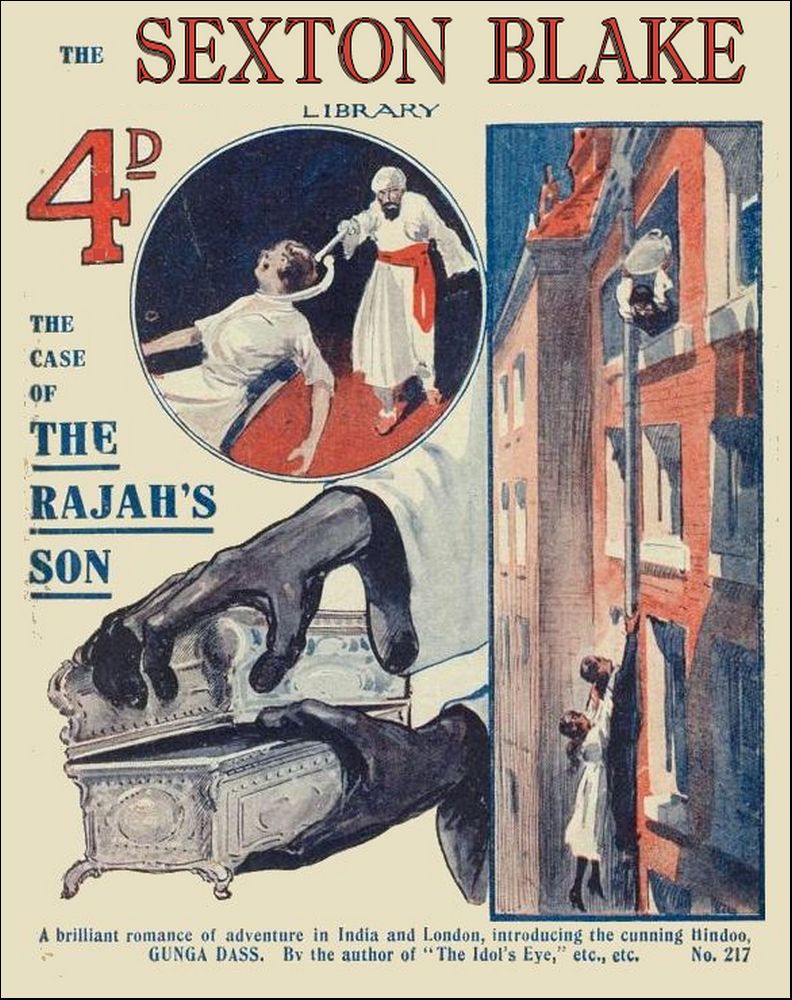
The Rajah's Son Starts on a Secret Mission—
The Plot Against Sexton Blake.
"RAJAH SAHIB, your humble servant trusts to be excused for thus breaking in upon your reflections, but—"
As the suave, cultured tones ceased the aged Rajah of Ghanapore looked up from his reverie with a start. The man who had entered the royal apartments at the palace at Ghanapore was salaaming low before the cushioned divan on which the ruler of the province was seated, in eastern fashion.
The rajah had not heard the entrance of his secretary and confidential servant, as Rahana Chatra had entered with his usual catlike and noiseless step.
"Well, Chatra?" The benevolent eyes of the old man gazed with a smiling and kindly expression at the interrupter of his day-dreams. "There are few things I could not excuse my faithful one, who once saved my royal life at the risk of his own! Speak out!" said the rajah. "What brings you to my apartments thus, at an hour usually sacred to my repose?"
The secretary salaamed again, low and reverently.
"Rajah Sahib, a bearer has arrived from the dak-khana at Rajabad with a telegram of import," replied the smooth tones of Chatra.
"Ha, news of Karim Buhl at last, I trust!"
The rajah half rose from his reclining position and eagerly took the telegram from his servitor's hand.
Drawing a jewelled dagger from his girdle, he hurriedly slit open the flimsy envelope and drew out the missive it contained.
And, as he read the contents, he uttered an exclamation of consternation.
"It is serious news, Chatra!" The old native ruler spoke in perturbed tones. "Karim Buhl is, it seems, lying seriously ill in a London hospital, and will be unable to return to India with the regalia of my house for several months—even if he should not die!"
A curious light flamed momentarily in the soft, dark eyes of Rahana Chatra.
"And what of the royal jewels, rajah sahib?" he inquired. "Was it not Karim Buhl whom you sent to London with them in order that they may be reset in more modern designs?"
The Rajah of Ghanapore plucked nervously at his beard. He was of the type upon which the civilisation of the west, rapidly growing throughout the great colony, has not yet set its seal, and was dressed in the gaudy robes of the east. His brown face, cleanly sculptured, and bearing in its noble stamp the haughtiness inseparable from the high-born of India, was crowned by a multi-coloured turban, ornamented by a glittering aigrette, the insignia of his rank. Yet in spite of his high rank and pride of caste he was beloved by the subjects of his popular state as a potentate kind and just in his ruling.
"Yes, Chatra; Karim Buhl was sent to England with the jewels three months ago—before you entered my household. This is a serious matter, for the gems are of immense value, and the London jeweller refuses to accept responsibility for their safety after his workmanship is finished. Read this somewhat lengthy cablegram and give me your advice, for you speak with the voice of wisdom."
Chatra took the flimsy sheet from his master and read the message carefully. His dusky brow, bearing the red-painted caste mark of the goddess Kali, became corrugated with thought. Cupping his bearded chin in his strong hands, he stared through the glassless window and out across the undulating expanse of mud-banked rice-fields, to which Ghanapore owed its prosperity. The rajah watched him anxiously; and it was apparent that the old ruler placed every confidence in his secretary's judgement.
Finally, Chatra turned to the rajah, and said:
"I suggest that your illustrious son, His Highness Prince Habib Bundra, journeys to the country of the 'White Emperor' for the jewels. As a past student of Oxford University, he is familiar with the ways of the white sahibs and their elaborate methods of business. His highness would welcome the opportunity, too, rajah sahib, for he speaks often and longingly of a dear friend of his University days, and would be glad to revisit him."
The proposal evidently met with the old man's approval, for the lines of anxiety left the haughty face. With a quick glance from his dark eyes Chatra noticed this, and a smile of satisfaction wreathed his bearded lips.
His was a pleasant face, clean cut, and of the hue of burnished copper. His eyes were dark and soft, and in their unfathomable depths lurked now no gleam of fierce cunning, but the pleasing hint of a roguish smile which presented a contrast to his dignified robes of a baboo, or native clerk. It was a face that, if it were a faithful index to character, spoke of friendliness and honesty of purpose, and one that inspires confidence and trust.
"Your words are wise, Chatra," said the rajah. "Although you have been in my house hold but three months, you have already proved yourself a faithful and invaluable servant. I bid you go to the prince's apartments and ask him to come to me."
Chatra rose to his feet and, after salaaming, left the room. Out in the passage he paused, and a startling change crept over the brown face. Gone was the friendly-looking man of learning, and in his place stood a cunning, harsh-featured rogue. The man was labouring under great excitement, and his well-knit figure, holding a swagger suggestive of the military, shook slightly.
"By Kali!" he muttered. "What a coup! It seems that my patience is to be rewarded at last. I was on the point of giving up when, after fooling the old man, I learned that the jewels had been sent to London, for the chances then seemed very remote. But now success may be very near! Yet there may be one obstacle; London is the home of that wizard of the West—"
The expression in the brown face became indescribably evil. He raised aloft his lean hands, the fingers clawing spasmodically, as if clutching a hated foe, while his lips twisted in a devilish grin, not of mirth, but remorseless rage.
It was the face of a fiend now, lusting for vengeance.
"And that obstacle is the thrice-cursed Sexton Blake and the chota-sahib, Tinker! Once they snatched victory and riches from me at the eleventh hour, and would have had my life forfeited to the English gallows! Curse him! May he endure the fiery tortures of Padalon! When I get to London I will strike as swiftly and silently as a snake—"
He paused as the gleam of a new idea shot into his blazing eyes.
"As a snake!" he muttered, "As a snake! The way is clear. The victory was yours a few short months ago, Sexton Blake, but soon it shall be mine. Gunga Dass never forgets!"
Gunga Dass!
To Sexton Blake, the celebrated criminologist, of Baker Street, the name would have conjured up visions of stirring adventures at home and in the great colony of India. He would have known the man as a one-time cashiered Subadhar of the Indian Army, whose offence had been the grave one of sedition. He would have recognized in Gunga Dass the chief actor in that dramatic case which he had labelled in his diary as the case of "The Idol's Eye."
Recollecting his mission, the secretary hastened to the section of the palace in which the rajah's son, H.H. Prince Habib Bundra, resided. He knocked at a door of richly-carved rosetta-wood, and a pleasant voice bade him enter.
The young potentate was languidly reclining upon a tapestried divan, situated beneath a swinging punkah, for the afternoon heat was intense. An expression of welcome occupied the dusky, intelligent face, and it was plain that the rajah's secretary had won as large a place in the heart of Prince Habib as in that of the old ruler himself.
"What is your mission, Chatra?" inquired the prince.
"Salaam, your highness! Your royal father desires an interview with you. He has received news of Karim Buhl, and wishes to discuss a matter of extreme urgency."
"I will attend upon my honourable father at once," said the prince.
They made their way to the rajah's suite, and as they entered the old man bade them seat themselves before him. Father and son each made an admirable foil to the other, a study in East and West. Unlike his father, the young prince was clad in a light grey which spoke loudly of Bond Street. His lank, black hair was brushed back from his forehead. When he spoke, his English bore the unmistakable accent of Oxford. His brown face was high featured, and a black moustache, fiercely upturned, gave the finishing touch to an undeniably handsome and pleasing countenance.
"Well, my father," he said in English, the language generally adopted by the highest castes. "Chatra tells me you have news of Karim Buhl. It is not good news, I fear, for his silence has been a matter of great anxiety to you lately."
"Karim Buhl lies ill in London, my son," said the rajah gravely. "It is my desire that you sail for England and recover the jewels as soon as possible. To you and you alone, must the regalia of our House and throne be delivered. I cannot trust but you for the mission."
"I shall be pleased," said the prince eagerly. "I have long since wished for an opportunity to visit an old university friend of mine, the Honourable Ronald Westways, only son of Lord Westways. We played that fine British game, football, together, and won our Blues in the same match. I will cable him at once, for he will be pleased to hear of my intended visit. It is seven years since we last met."
"And whom do you intend to take as a retinue, my son? Everything must be arranged at once."
"English customs differ greatly to ours, my father, and a retinue of servants is not welcomed in the houses of the English. Chatra, the faithful one, alone shall accompany me. Already he has proved his sterling worth."
"It is well, my son," said the rajah. "You could have made no wiser choice."
He turned to the secretary.
"Had it not been for your bravery, Chatra, Ghanapore would most probably be without its present ruler. The way in which you put to flight that gang of murderous Thugs who sought to murder and rob me three months ago in the jungle, has endeared you to us for all time. Your faithfulness and honesty are above reproach."
Chatra salaamed low and reverently; perhaps to hide a cynical smile.
"It was but the duty of your humble servant, rajah sahib," he said suavely. "What little service I was able to render you that day has many times been repaid by your excessive kindness to me. Although I was but a humble stranger you took me into your household, and all that I now am I owe to you and your son."
Again the Hindoo gave low obeisance.
"My life and my services are yours to command."
"Nonsense, Chatra. You are friend, not servitor. Please give me the 'Times of India.'"
Chatra rose and, crossing over to an inlaid, Moorish table, picked up the newspaper and handed it to His Highness, who quickly scanned the shipping intelligence.
"The S.S. Bandra, a P. and O. liner, leaves Alexandra Docks in three days' time," he said. "We have little time to spare. We had better pack at once. You will journey to Bombay this evening, Chatra, and book our passages. I will give you a letter to the shipping office."
They left the rajah's suite, and when the packing had been superintended, Chatra left the palace, with its gilded minarettes, and, crossing the courtyard, entered the village beyond.
Outside one of the daub-and-wattle huts he halted, glanced furtively over his shoulder, then entered the evil-smelling, dingy home.
Upon the refuse-laden floor was sprawled the half-naked figure of a fat, brown-browed Hindoo. As Chatra entered the man rose to his feet, and by the profoundness of his salaam it was evident that he held the secretary in fear and respect.
"What is your desire, master?" he said, in lowered and humble tones.
The rajah's servitor leaned forward and lowered his voice.
"You must journey to the "Mecca" Café in Bombay. Tell Muasuka to get the gang together as soon as possible, and to cable to Pete Raham, of the 'Lotus Flower,' in the East India Dock Road, London, to prepare for our coming. After that you will visit all the serangs of the Indian boats which are lying at the docks, and try to bribe one of them to sign on four of you for a trip to England. Malaam?"
The Hindoo nodded.
"I Malaam, master."
"I shall get into London Road station at midnight, so have a gharry there to meet me. Before you go, rig up some of the mosquito netting. Go down to the wells and take a stoppered lotah. Fill the lotah with water snakes, but do not let your movements be seen. You will find plenty of the reptiles on the swamps adjoining the wells. Use caution, for a bite means death!"
The Hindoo looked at Chatra from uneasy eyes.
"Padalon!" he muttered. "I care not for the task, master!"
Chatra eyed the man with a genial smile, as he picked up a tongawallah's whip tentatively. Uneasiness gave place to apprehension in the Hindoo's eyes, and he grovelled on the floor. Chatra spurred him lightly with his sandalled foot.
"Get up, you son of Yama," he said. The next time my orders are questioned I shall prove less merciful!"
Glad to escape, the Hindoo hurriedly made a rude net, and, picking up a stoppered lotah, left the hut.
For an hour the secretary waited, then the man returned and handed the lotah to him. A sibilant hiss, which arose from the interior brought a smile of satisfaction to the secretary's lips.
He left the hut, and returning to the palace, entered by the courtyard. To his annoyance, he met His Highness in the corridor. The hiss of the reptiles in the lotah arrested the young prince's attention, and he gazed at Chakra from amazed eyes.
"What have you there, Chatra? Surely, they are not snakes?"
Chatra lied promptly.
"They are water-snakes, Your Highness, I am taking them to England in order to present them to the Zoological Gardens, for they are exceptionally fine specimens."
The prince laughed.
"You are a peculiar fellow, Chatra! As long as they don't get out of the lotah and into my quarters, I don't trouble."
At dusk the young prince's car was loaded with their luggage, and Chatra was driven to Rajabad. From there he took the train to Bombay, and, arriving at London Road station, left the trunks in charge of an official and walked to the exit. Beneath the glass facade a gharry was drawn up. The gharry trotted smartly away when entered, and was soon bowling along Grant Road, the Whitechapel of Bombay's native quarters.
Before a dingy Hindoo café, bearing the imaginative name of the Mecca, it halted, and Chatra got out. There was nothing to distinguish the café from the dozens of others which dotted the thoroughfare, except that it was less brilliantly lit, and perhaps except that it was a little more evil-smelling.
A flickering kerosene lamp hung over the gaudily-painted doorway, and from inside came bursts of native songs, accompanied by the tuneless thrumming of stringed instruments.
Chatra parted the reed curtains and entered.
A dozen or so Hindoos of low caste and evil appearance were squatting upon wooden settees, smoking a friendly and communal hookah.
At Chatra's approach they rose to their feet, and his eyes roved comprehensively over the cutthroat assembly.
"Are they all here, Masuka?" he rapped out.
Masuka, a heavy-jowled Hindoo, shambled forward.
"Yes, master."
"Then we will get to business," Chatra said, addressing the gang. "I shall only require four of you. Rahal, you are a man of education and have been to England. I shall need you for one."
"England, master? Do you mean that some of us must journey there?" asked Rahal.
Chatra motioned him to silence.
"It is not wise to speak before all, as foolish tongues often wag. Whom do you suggest to make up the four?"
A selection was quickly made, and the chosen ones, no less evil-looking than the rest, if more intelligent, stood aside. Chatra paid some small sums of money to the remainder, and they left the café contentedly.
Masuka then led the way to a room at the rear, and native drinks and hookah pipes were prepared.
"What is the news, master?" one of the men asked eagerly, when all were seated.
"I think we shall soon accomplish our object," replied Chatra, in low tones. "So far, the luck has been dead against us. I will tell you all that happened during the last three months. After we planned that fake attack upon the rajah, and I so heroically rescued him, things seemed very promising. I was made much of, and after telling the old fool a pitiful story, was taken to the Palace of Ghanapore and treated as an honoured guest."
"And the jewels?" inquired Masuka, his pig-like black eyes illumined with greed. "The rajah's jewels, that we have laid this plot to gain! Master, what of them?"
"The jewels were not there, and for some time I was unable to make casual inquiries, in case my questions should arouse suspicion. Finally, I learned that Karim Buhl, the aged and trusted major-domo of the palace, had been sent to London with them in order that they may be reset. I was on the point of taking what other valuables I could lay my hands on, and then vanishing, when I heard this. Luckily, however, I decided to await Karim Buhl's return."
"When will that be, master?" enquired Masuka.
"Not for some time, my greedy friend. He is ill in London, and as the jewels must be recovered within a certain date, I arranged that Prince Habib should go to England and recover them, I shall accompany him. Did you send a cablegram in our secret code to Pete Raham, of the Lotus Flower, in London?" he asked, turning to the Hindoo who had procured him the snakes.
"Yes, master," the man replied. "I was also successful in bribing the serang of the S.S. Karatchi, a fast passenger boat, to include us amongst his crew. She sails at dawn."
"Excellent!" exclaimed the treacherous Chatra, in high glee. "With two days' start, she will arrive in England about the same time as the boat by which the prince and I travel. Listen! These are my plans."
"You will get aboard the S.S. Karatchi before dawn, and work your passages to England. When you arrive, go straight to the Lotus Flower, for I shall already be there. I intend to drug Prince Habib, to impersonate him, obtain possession of the jewels, and also take advantage of my assumed identity as his highness to perpetrate other robberies in London."
A gasp of amazement left the lips of his hearers of the audacious scheme. Chatra surveyed them with a smile of amusement.
"You look startled," he said calmly. "The task will be quite easy, my friends. It is seven years since Prince Habib was last in England, and we are of the same build. I can shave off my beard, fix my moustache in imperial fashion, and, attired in the prince's clothing, none will suspect. The English sahib whose guest he, or rather I, will be has not seen the prince for so many years that if I use ordinary care he will be easily deceived."
Chatra laughed softly!
"No, it will be simple to fool them. Hindoos are much alike to the cursed white races. A little care in make-up, and the thing is done. I shall make of this the coup of my life."
"But what of Sexton Blake?" Masuka said, in uneasy tones. "You have spoken of the great detective who once before thwarted your plans. He has the eyes of a cheetah. You are familiar to him, master, and should you have the ill-luck to meet him, it is possible he may see through your disguise."
Chatra flung a curse at the Hindoo.
"Padalon! Am I always to be reminded of that cursed Englishman?" he cried angrily. "Sexton Blake shall not live to thwart my plans again. By Kali, I swear it."
There was a moment's silence, caused by Chatra's terrible fury.
"Then you will be wise to put him out of our path as soon as we arrive, master. He may know us all by sight, for it is but a few months since he visited the Lotus Flower in the guise of a Dhermer Rajah of Kali!"*
*See "The Idol's Eye," No. 193 of the "Sexton Blake Library."
One of the gang tenderly fingered a half-healed scar upon his cheek, and swore softly. It was a souvenir of Blake's visit, when, together with Tinker, the detectives had fought for their lives in this disreputable hovel when on the trail of Gunga Dass.
"I shall present Sexton Blake with a few snakes, Chatra said, with an evil smile. I fancy they will cause a slight sensation when received. Still, that is all arranged, and I still have other things to settle."
He turned to Masuka.
"Do you know a madah, one highly skilled In the art of herbal drugs and vaccines, who would supply me with dope, and afterwards keep his mouth shut?" he asked.
Masuka puckered his low brows in thought.
"There is Ali Ghatna, master, who lives in the bazaar," he said, at length. "Once he was a surgeon in the Indian Medical Service, but was cashiered. Drugs, on account of the cursed English restrictions, are difficult to procure in Bombay, but he deals in them under the rose, and will probably let you have what you require."
Chatra rose to his feet and glanced at his watch.
"While you are packing your kits I will drive to the bazaar and see this Ali Ghatna," he said. "I shall be back within an hour, and will then arrive with you to the docks, as there may be some difficulty in getting you past the captain of the Karatchi. The serang's recommendation will be helpful, but it will require more bluff than that."
He walked through the dingy café to the street. Although the bells on the Parsee Tower had long since struck the hour of midnight, the ill-reputed thoroughfare was far from being deserted.
Drinking-booths, eating-houses, and small temples were ablaze with evil-smelling kerosene-lamps, and the still hot pavements were thronged by a picturesque crowd—the "night-hawks" of the great city. Native police, resplendent in their gaudy robes of blue and yellow, strutted like peacocks in patrols of four.
Bobajees squatted in the garbage-laden gutters, making the night odoriferous with the vile reek of the frying of curried fish. The scene was as picturesque as the East alone can be—and as sordid.
Chatra chartered a gharry, and was soon in the narrow streets of the bazaar, by day a blaze of colour and life, but now deserted, save for a few slumbering merchants, who lay upon their counters.
Before the glassless window, upon the shelf of which lay sprawled a sleeping figure, the cab halted. Above the store was the faded legend, "Ali Ghatna, Surgeon, Bone-setter, and Dealer in Drugs." Chatra aroused the slumbering man.
The madah opened drug-dulled eyes, and stared vacantly at the disturber of his slumbers.
"What do you want?" he demanded thickly, his hand slipping instinctively to the knife at his girdle.
"I come as a friend, Ghatna," Chatra said, in low tones. "Get up and take me to a place where we can talk in greater safety. I have business to discuss with you which will bring you many rupees."
The drink-ravaged face became more amiable, and, with a grunt, Ghatna, once medical officer of the I.M.S., now illcit seller of Eastern drugs, rose to his feet.
"I have a room at the back, but on account of this cursed heat I prefer to sleep where you found me," he said.
Opening a door, Ghatna led the way into a sparsely furnished, cell-like room. He motioned Chatra to a bamboo charpoy, and upon its dingy covering they seated themselves. A few tarnished brass lotahs ornamented in ash-littered range, and the ugly stone walls were void of decoration. It was a typical hovel of the Eastern slums.
"Well, what is your business?" he asked, glancing keenly at his nocturnal visitor.
"I want you to prepare me some drugged cigarettes, the effect of which must last for at least one hour, Chatra said. "But, most important of all, I require a vaccine of bacteria that will have a deadening effect upon the brain, rendering the victim incapable of thought."
Ghatna shrugged his shoulders and laughed.
"You speak in riddles," he said, eyeing the secretary with suspicion: "How should I possess these devil-god potions?
Chatra laughed in frank amusement.
"Don't bluff, Ghatna, and don't get nervous," he said. "I am safe to have dealings with, and will not divulge your name, should things go wrong. Will this help to solve the riddles you and I talk in? You will find they total a hundred rupees."
He handed a roll of Indian bank-notes to the druggist, and his own eyes filled with satisfaction as he noted the light of greed which flickered in the heavy eyes of Ali Ghatna.
"I will get you what you ask," Ghatna said, stuffing the notes into a mysterious pocket of his tattered dhoto. "Stay here, and I will bring them to you. What type of cigarettes do you require?"
"Egyptian. They will disguise all taste of the drug."
Ali Ghatna nodded, and left the room. A few minutes later he returned and deposited a small box of the charpody.
Taking it up, Chatra opened it and examined the contents. There was a packet of harmless-looking cigarettes, a hyperdermic syringe, with spare needles, and a glass tube, filled with a colourless liquid, and sealed at the end by a drum skin black rubber.
"You will find them effective," Ghatna said. "The cigarettes will act immediately, for they contain a herbal weed of strong anaesthetic properties. The vaccine is composed of a virulent bacteria which attacks the cattle of the south, rendering them comatose for several weeks. Of late years it has been much used at our hospitals as a curative for brain disorders, as it produces complete lapse of memory, and therefore complete brain rest. The reaction is entirely harmless."
Chatra slipped the articles into his pocket, and, after taking a brief farewell of the druggist, went out into the street. Chartering a gharry, he ordered the driver to convey him to the Mecca Café.
The gang had already packed their seamen's kitbags when he arrived, and, clambering into the gharry, they were all driven to the Alexandra docks.
A half-caste Customs official at the main gates admitted them without question when he saw the businesslike kits, and they were soon at the moorings of the S.S.Karatchi, which flew the British India Company's flag.
After questioning them, the quartermaster on the gangway allowed them aboard, shouted in a stentorian voice for the serang, the native officer in charge of the coloured crew. When the serang arrived, after a hurried discussion, he led them to the captain, a bluff old British mariner.
"These are the men I told you of, captain sahib," said the serang. "They are good seamen, and, as we are short-handed, I thought they would suit. Two will be required as trimmers, the other two as deck-hands. This man"—he indicated Chatra"—is well known to me. He runs a mission for coloured seamen in Grant Road, and will vouch for them."
The captain eyed the men keenly, but was apparently satisfied.
"Where are your discharges?" he asked.
Chatra stepped forward. It was the question he had feared.
"I am the secretary of a seamen's mission in Bombay, sahib," he said quietly. "These men have been living at my mission for some time, and although they have no discharges, I can safely answer for them. They were the crew of a small coaster which foundered off the coast of Ceylon, and only managed to escape with their lives, losing kit and papers. You will find them willing workers."
The captain was visibly impressed by Chatra's educated voice and appearance. He was due to sail at dawn, and could not spare the time to go around the missions to sign on the men he needed. The serang had seen to the fact that the vacancies had been left open.
"Very well," said the old mariner briskly. "They are not exactly a beauty chorus, but I will take your word as to their honesty."
The unsuspicious captain left the cabin. With the help of the serang, the crew sheets were filled in correctly. Chatra gave a sigh of relief, for an awkward ditch had been successfully negotiated.
"I will leave you now," he said, addressing the men. "Lose no time in getting to the Lotus Flower when you arrive in England. Work well during the journey, or the captain may hand you over to the English authorities if you are troublesome. You will receive ample reward for your patience, for soon we shall be rich. Good-bye, and remember my words."
"Good-bye, master!" came the gruff chorus; and, after handing a roll of notes to the rascally serang, Chatra left the ship.
On the quayside he halted. Dawn was beginning to streak the Eastern sky with ragged bars of silver and crimson. After a few minutes the signal lamp on the lofty Customs House flashed its message to depart. The anchor chains rattled to the snorting accompaniment of the donkey boiler, and a shrill scream sounded on the "blow off" siren.
"The first step!" Chatra muttered. The captain was easier to fool than I thought!" He laughed. "Masuka and Co, too. Their share of the jewels will be the risk only, I fancy. They will be useful for a time, and then—"
He shrugged his military shoulders, and walked away.
Doped!—At the Lotus Flower—
Gunga Dass Carries Through His Daring Scheme.
"ENGLAND!" exclaimed Prince Habib Bundra. "It is good, Chatra, to see once again the country I love so well! How the sight of that bit of shore recalls the happy, if foolish, exploits of my University days—escapades sometimes shared by my chum, the Honourable Ronald Westways! I shall be glad to clasp his hand once more in the land where many of my happiest hours were spent."
The prince sighed. Perhaps the West had held a glamour of its own for the young Indian, which his return to the East, its pomp and vividness, had never dissipated. The Bandra, after an uneventful voyage, had glided into the choppy waters of the Channel, in sight of the rocky prominence of Land's End, and he and his secretary had joined the group of passengers on the saloon deck, anxious as they were to get the first glimpse of Britain's shores.
"Will the Honourable Ronald be awaiting the boat-train at Waterloo?" Chatra said, in those oily, smooth tones of his. "We should reach Southampton in time to catch the late boat-train, which, however, does not arrive in London until midnight."
The prince shook his head.
"I think not, Chatra. Thinking we should be late, I did not wire the time of our arrival, and we shall not be met at the station. I did not wish to inconvenience my English friends."
He was silent and thoughtful for a moment, and did not notice the gleam of satisfaction which leapt to the servant's eyes.
Then the prince said:
"It is more than likely that I shall meet again the beautiful young actress, Miss Dora Bathurst, at the house of Lord Westways, Chatra."
"Miss—Bathurst? I am in the dark, your Highness," said Chatra quickly. "But stay! The name seems familiar. Was there not an American actress of that name recently touring India, and who made a great success?"
"Yes. That is the lady I mean."
"But then—" Chatra paused; a look of uneasiness had replaced the satisfaction in his dark, slumberous eyes. "Your Highness says that you are known to this Miss Bathurst—that you have met—"
"Yes. I will tell you of a romance, Chatra, and a curious coincidence. But let us return to the saloon."
The secretary led the way, and they seated themselves beneath the sweeping branches of a palm. Chatra's eyes were peculiar in expression, as those of one who saw suddenly an unexpected obstacle to his plans.
"Miss Dora Bathurst is an American mem-sahib of great charm and beauty, Chatra, and once performed at my father's palace at Ghanapore," said the prince.
"Then you would be well known to her, your Highness?" interposed Chatra quickly, his hands gripping tightly the arms of his chair. "She—" He paused. "The mem-sahib will, perhaps, recognise you again?"
"Yes, quite well," the prince smiled. "It was but a year ago when we met. My father was entertaining some of the British governors, who paid a visit to our state. He decided to give a theatrical performance, and one of the musical comedy companies that were in Bombay at the time came. The leading lady was the mem-sahib Bathurst. I was agreeably surprised to hear, a few months back, of Ronald Westway's engagement to the charming American soubrette. They met in London."
"Then, your Highness, as you have not seen your English friend for some years, the mem-sahib will be even more familiar with your appearance than Lord Westway's son will be."
Prince Habib was slightly puzzled by the anxiety in the man's tone.
"Of course, Chatra. But then, what of that? My friend may have forgotten my appearance, somewhat, perhaps, but he will know that I am his former college friend, the Prince Habib Bundra."
Chatra lapsed into silence, and his dark eyes seemed intently focussed upon the distant English coastline, visible through the saloon windows. But behind that dusky, inscrutable face the cunning Oriental brain was working at express speed. He feared the American girl!
"When I assume the identity of the prince," he murmured, "this fiancee of Lord Westway's son will be my greatest danger! The young Englishman I do not fear—it is seven years since they met. But this accursed girl! How to remove her from my path?"
A few hours later the stately liner, her white paint scarred and blistered by tropical suns, threaded her way through the anchored craft which studded Southampton harbour, and dropped anchor in the fairway. Small steamers put out from the quay, and after the passengers' credentials had been examined, the prince and his secretary entered one, and were soon within a first-class compartment of the boat-train, and speeding Londonwards through the gathering dusk.
As, in due course, they entered the outskirts of the great metropolis, the prince threw aside his illustrated paper, and yawned.
"Is it your Highness's intention to go to the house of the Westways to-night?" Chatra asked, "It is very late."
The prince looked doubtful, and, seizing his opportunity, Chatra said:
"I think it would be the better plan to stay at a hotel for the night, your Highness. It might possibly disturb the household were we to go at this late hour."
"I think you are right, Chatra. I have no wish to inconvenience my friends. When we get to Waterloo, charter a taxi, and give the driver instructions to convey us to the Regent Hotel, in Piccadilly. I am familiar with the place, and we can go to Lord Westway's house in the morning."
Chatra nodded. The arrangement fitted in with his plans, and he secretly congratulated himself. He had known that the prince had a horror of causing trouble to his friends. One difficulty now remained, but he hoped that the drugged cigarettes would account for that. It would be almost impossible for him to overpower the prince in the hotel without arousing suspicion, and then get him to the Lotus Flower undetected. It would have to be done in the taxi, under cover of the darkness. The driver would have to be drugged also.
Soon they glided into the station, and when their luggage had been piled on the roof of the taxi, Chatra ordered the driver to take them to the Regent.
As they were bowling along the deserted purlieus of York Road, Chatra took out his cigarette case, and proffered it respectfully.
"These London cabs always seem to reek of petrol, your Highness. Perhaps smoking will help disguise it."
The prince accepted with a smile, and was soon inhaling the fragrant smoke of the Egyptian cigarette from Chatra's case. Suddenly the cab seemed to grow dark, and a feeling of dizziness assailed him. His eyes lost their lustre; as through a mist he saw vaguely the dusky face of the "Faithful" Chatra.
But was it Chatra? He felt doubtful, for gone was the smiling light from the dark eyes, the deferential geniality from the features! The man before him, leaning forward, with sinister purpose showing markedly in his derisive stare, seemed an incarnation of evil!
Then the prince understood—too late!
"Chatra, what is this?" he gasped, with the nausea. "You—you—"
He fought desperately against the deadly stupor. His lips framed a cry for help. Chatra clapped his brown hand over his victim's mouth.
The brown eyes of Prince Habib looked dreamily into his. Then they dulled, the twitching lids dropped, and without further effort the young potentate collapsed against the padded seat.
Chatra bent over him. Satisfied that the drugged cigarette had faithfully served his purpose, he glanced through the glass partition which separated them from the driver. The man's back was turned towards his passengers, and he was intent upon his driving. Chatra dragged the unfortunate prince lengthways upon the seat, and then rapped smartly on the glass partition.
The driver pulled up, and Chatra, after alighting and closing the door behind him, walked towards the front of the cab.
"Wot's up, sir? We ain't at the Regent yet by a long chalk!" said the surprised driver. "Wot's wrong?"
Chatra swayed slightly in his gait as he approached.
"I am sorry to have pulled you up, but I feel rather faint. Do you mind if I ride beside you? The cool air may help to revive me."
The driver looked at the brown man with some doubt. He did not relish a "nig" on the box beside him. But these seemed to be wealthy "nigs," as their destination was the Regent. He buried his principles, and concentrated upon hope.
"Not at all, sir. Step up and welcome," he said heartily. And to himself muttered: "Might mean a quid, this might. That young 'un is the nibs! Got some style, 'e has! I might 'a' stumbled acrost the Hemperer o' Timbuctoo!"
Chatra thanked him, with a wan smile. The man was a superb actor.
"Will you have a cigarette, my friend?" he said, as he seated himself beside the driver. "These are very special ones."
Under cover of the darkness he grinned evilly at his joke. Knocking the cold ashes from his pipe, the man slipped it into his pocket.
"I mostly smokes shag myself, sir, but—"
"Try one," smiled Chatra. "You do not often obtain the offer of a prince's cigarette-case, my man!"
"Joopitar!" exclaimed the driver. "Not 'arf, then, your Highness! Don't mind my rough togs. I'm the Dook of Seven Dials, reely, but had to tyke this job on to pay me sopper-tax! What-ho!"
He took one of the drugged cigarettes with a grin. If this "nig" was pulling his leg—well, he'd sample his smokes, anyway!
Chatra's eyes flamed as the man lit up. The driver started up, and soon they were going at a smart pace. A gradient showed ahead, and the unfortunate man reached down to change gear.
Then something happened. His brain seemed to suddenly fog, his fingers to clasp the gear lever with the strength of a babe. An uneven bit of road jolted him, and he slid forward across the wheel, his eyes closed.
Chatra's hand shot out and grasped the edge of the wheel firmly, and only just in time, for the car had lurched violently across the road, and was making for the kerbstone. His other hand fled to the dashboard, and he switched off the current from the magneto. The car ran for a few feet under its own impetus, and then gently came to a halt.
The City thoroughfare at that hour was almost deserted. Picking up the drugged driver, Chatra carried him into the tonneau. After stripping the man of his great coat and peaked cap, he rapidly changed into them, pulling up the storm collar in order to hide his dusky face. Then he got out, closing the door behind him.
"It has proved simpler than I thought," he muttered, cranking up. "Now for the Lotus Flower, and the fools who will be now be awaiting me."
Entering the driver's seat he started off, and the taxi was soon bowling towards the East End. Later, the reek of London's dockland assailed his nostrils, and he entered the East India Dock Road. He traversed a few hundred yards along this main artery of London's shipping, and then, turning to the left, entered the gloomy precincts of Palm Tree Grove, a slum street inhabited by the scum of the seven seas, in which was situated that den of Hindoo intrigue, the Lotus Flower.
As he halted outside the café. its garish paintwork vulgarly advertising the doubtful pleasures within, a fat, greasy-skinned Hindoo, his legs wrapped in a gaudy dhoti, detached himself from the shadows of the doorway, and came forward.
"Is that you, Dass?" muttered the native, in low tones.
"Yes. Greetings, Pete Raham! Have the others arrived in England safely?"
"They arrived here this morning. I see there has been no hitch. Shall I help you carry his Highness in?"
"One moment. I want that small attaché-case from the roof of the cab. That's it. Thanks! Now we will get him indoors," Chatra said.
They carried the limp figure through the Oriental-looking café to a room at the rear. Here were gathered Musuka and the rest of Dass's villainous gang. The prince was laid upon a bamboo charpoy.
Opening the attaché-case, Chatra took out the hyperdermic syringe and the rubber-sealed tube containing the vaccine. He screwed the curved, hollow needle into place, pushed the plunger forward, and then stabbed through the rubber drum skin. As he pulled back the piston, the glittering syringe filled with the solution containing the mind-stealing bacteria. He ordered Masuka to turn down the prince's coat and shirt and expose the spinal column—that short cut to the brain.
This done, he plunged the needle into the spinal cord of the unconscious prince, and gently pushed home the plunger.
"Take him away," he said callously, his villainous task completed. "Bring me the clothes he is wearing, and dress him in rags. He will know nothing of himself for some weeks. By that time we shall have made a haul which will stagger even that cursed Sexton Blake."
As they carried out the limp figure, Chatra took a razor from the case and stropped it, Hindoo fashion, on his forearm. Next he proceeded to shave off his beard, and, that done, fixed his moustache in imitation of that of the unconscious prince. As he surveyed himself an hour later in the fly-spotted mirror over the mantleshelf, he felt confident of his ability to deceive Ronald Westways. As to the disposal of Dora Bathurst he had already made his plans.
The gang returned and handed the prince's papers to their master. A smile of satisfaction wreathed Chatra's lips as he glanced at the documents which made it possible for him to obtain the jewels from the designers. A considerable sum of money, too, had been placed at the prince's disposal at a well-known firm of bankers, all of which would soon be in the rascal's possession, and provide funds until such time as he could dispose of the gems.
"Rahal," he said, stripping off his clothes as quickly as possible. "You will act the role of prince's secretary. This is unavoidable, as in his letter to Ronald Westway his Highness stated he was bringing his secretary!"
Rahal, an intelligent-looking Hindoo, carried out his master's instructions.
When they were fully attired, Chatra, in his master's clothing, accompanied by his pseudo-secretary, left the café. After they had taken farewell of the others, the two entered the taxi. There was no time to lose, for the driver showed signs of recovering consciousness.
"Now, Rahal my friend, for the great adventure! I have, for the purpose of fooling these cursed English, become his Highness, Prince Habib Bundra!"
Chatra slipped on the great-coat and peaked cap belonging to the driver, and drove the taxi rapidly to the part of the York Road where the driver had last been in possession of his faculties.
When he arrived at the spot he halted, took off his coat and hat, and replaced them on the faintly-stirring figure of the driver. Soon the man opened heavy eyes.
For a moment he stared blankly at the dusky faces bending over him in the gloom: then intelligence dawned in his pallid face.
"Love a duck, wot's 'appened? I feel as if it's the mornin' arter the night afore! I remember goin' faint, an' that's all. Whose funeral is it, guv'nor?"
Dass bent over the man and assisted him to his feet. It was plain, as the Hindoo, past master in the subtle Eastern drug he had used, had suspected that the man had an inkling of what had occurred.
"My friend here was riding beside you, if you remember. He states that you suddenly fainted, and it was only his presence of mind which averted a serious accident. How do you account for it?"
The man scratched his head and blinked dazedly.
"I only 'ad four glasses, streuth, sir. I've drived this ole 'bus for years, an' never done such a thing afore. 'Ow long 'ave I bin like this?"
Dass smiled at the success of his ruse. To him the situation was not without humour. The blank expression on the stolid face of the driver was ludicrous when he said:
"An hour, roughly. We tried to find a doctor, but were unable to do so. Do you think you are well enough to get us to the Regent after this unfortunate loss of time? It is late, and we may be unable to get another taxi."
"Yes, sir. I'm sorry, if I've delayed your Highness at all, and I'm glad as it ain't more serious. There ain't no such thing as 'aving fainted when you'm 'auled up in front of the beak for an accident. If the copper says you'm drunk, drunk it is, an' all the argufyin' in the world won't save your licence! I 'opes you gents will unnerstand, and not take my number?"
"Have no fear, my man. It was a pure accident," Dass said, and smiled his wily smile.
Relieved, the man started off, and they were soon halted beneath the brilliantly-lit facade of the Regent. Night-porters hurried forward and took their luggage. One of them caught hold of the box of reptiles, but the sibilant hiss which arose from the interior made him hand it quickly to his mate.
Dass paid the driver a liberal fare and entered the hotel lounge. Behind the steel grille the booking-clerk bowed.
"Have you a private suite?" Dass drawled in an excellent imitation of his master's Oxford accent.
The clerk looked askance. Dass had assumed a princely bearing, and Rahal one of deferential obeisance to the other's rank. It was Rahal who came forward and made the introduction.
"My master," he said in good English, "is his Highness Prince Habib Bundra, son of the Rajah of Ghanapore. Prince Habib is on a visit to England to meet his former college friend, the son of Lord Westways, of Westways House, Mayfair. My master, the prince, is travelling without suite, and merely desires apartments at the Regent until, in the morning, we can call upon his lordship."
The pseudo-secretary handed to the clerk certain papers and credentials from the Rajah, and after the few formalities, Gunga Dass and Rahal were duly entered upon the hotel books in the characters they had assumed.
And upon London was launched a scheme which had for its sinister object the stealing of the royal jewels of Ghanapore, and also a series of coups which would stagger the aristocratic circles which opened their hospital doors to his highness the Prince Habib Bundra!
Lord Westways Receives a Royal Guest—The Missing Pendant—
The Evidence Against Dora Bathurst—A Trap for Blake.
"HIS Highness Prince Habib Bundra of Ghanapore, and his highness's secretary, Mr. Rahana Chatra."
Lord Westways, elderly, and semi-bald, with a proud and somewhat austere cast of face, crossed the polished oak floor of his town house with a smile of welcome, as his butler made the above announcement. He had been expecting the visit, although the exact time of the arrival had not been known.
After greeting the prince cordially, and welcoming him to England, he said:
"My son was delighted to receive your cable, and to hear that you had decided to visit us whilst in England." He paused, and glanced inquiringly at the secretary, an intelligent-looking Hindoo, wearing the head-dress of a native Christian.
"Rohana Chatra," said the prince, "is my secretary, the only attendant I have brought with me, as my mission here demands a certain amount of secrecy. For many years, my lord, have I anticipated meeting once again the dear friend of my Oxford days, the Honourable Westways. Is he not here to greet me?"
An annoyed frown wrinkled the forehead of the old peer. The prince motioned haughtily to his servant, and the secretary left the room, to be shown by the butler to the apartments reserved for his master and himself.
"Ronald is at the Rex Theatre, prince," said Lord Westways, when his Highness had been seated, and had selected a cigar from the proffered box. "Miss Bathurst is at present leading lady there, and he has gone to bring her home, as the young lady is my wife's guest for a few days. Ronald would have made different arrangements had he known for certain that you would arrive to-night."
"I understand, Lord Westways, I must apologise for not calling on you sooner. Pressure of business in London, which I am transacting for my honourable and beloved father, detained me."
Lord Westways smiled as he himself lighted a cigar. Perhaps the flowery language of Prince Habib amused him. Certainly he could not imagine his own son speaking of him as "honourable and beloved," At the moment Lord Westways and his only son were not the best of friends.
For a time they talked of India—a topic on which his Highness was enthusiastic and well informed. Lord Westways was charmed by his guest, whose dark, slumbrous eyes admired the packed shelves of books set against the old oak paneling.
It was a pleasant room, furnished with tasteful simplicity. The prince leaned back in his chair and a faint sigh of contentment left his lips.
"I hope your stay with us will be a long one," said the old peer. "May I ask, prince, your plans?"
The son of the Rajah of Ghanapore shook his head regretfully.
"I cannot enjoy your esteemed hospitality for long," he replied. "My mission to England is of vital importance. I must return to my honourable father as soon as that task is completed. When I explain, my esteemed lord, you will better understand. The jewels of Ghanapore are at present in London, for my father sent them over three months ago by a trusted servant, so that one of your big London designers should reset them. The servant was taken ill some weeks ago, unfortunately, and my father's anxiety was so great that I decided to journey to England for the jewels of our dynasty and throne."
Lord Westways nodded.
"But surely you will he able to spend a few days with us, prince? The jewels, I am aware, must be of immense value, but I could offer you the security of my family safe. It is one of the strongest and most cunningly contrived in London, and would defy the efforts of the most skilled cracksman, he added, with a confident smile.
A curious gleam lurked momentarily in the dark eyes of Prince Habib.
"In that case I will prolong my stay a few days longer than I first anticipated. Your kind offer has considerably relieved me. I would much rather have the same jewels under the same roof as myself than in the Deposit Vaults. I promised my honourable father that, on obtaining them, I would not again relinquish them until they were safe in the royal palace."
The door opened to admit a middle-aged lady with whom time had been lenient. Her sweet, pensive face still bore traces of a former girlish beauty. With a friendly smile she advanced and welcomed the royal guest, who bowed low over her extended hand, as Lord Westways presented his wife to the prince.
"I am more than pleased to see you, Prince Habib," she said. "My son has talked of you so much, and was so pleased to hear of your intended visit. He often refers to your past friendship during your University days."
"Ah, yes," smiled the prince. "Ron and I were once great chums."
As he straightened himself his eyes became intently fixed upon a curiously shaped pendant of filigree gold which was suspended by a chain from her ladyship's neck.
"You are kindness itself Lady Westways," he said, with a charming smile which revealed his glistening white teeth. "I, too, have long looked forward to the time when your son and I should meet once more."
Dinner passed pleasantly. The charm of the young prince, his brilliant wit and entertaining conversation, charmed Lord and Lady Westways. When, later, the men joined Lady Westways in the drawing-room, her ladyship said:
"No doubt, prince, you will be a judge of the antiquity and value of Indian jewellery." She unclasped the pendant from its chain and handed it to his Highness. "This is not of great value, I know, but I have often wondered whether it is a genuine antiquity, or simply a Birmingham-made imitation. I bought it at a jewellery auction several months ago, as its unique design appealed to me, and I saw you looking at it with some interest just before dinner."
Smilingly the prince took the pendent and examined it. It was a triumph of the Indian gold-beater's craft, but, being unset with gems, was of comparatively little worth.
"It is quite genuine Lady Westways, and by its design I should classify it as belonging to the seventeenth century. At a rough calculation it is worth a hundred pounds. My country contains much of this class of work, and quantity lowers value. Hardly worth keeping in the wonderful burglar-proof safe which Lord Westways has so kindly offered me the use of."
"I knew that its value was not great, so have never worried as to its safety," said her ladyship, with a smile. "As a matter of fact, it lies quite neglected in casket upon my dressing-table most of the time."
A swift glance passed between the prince and his secretary, who had at that moment entered the room. The latter commenced speaking excitedly in a soft, native dialect. Silencing him with a quick gesture, the prince turned to their host.
"My secretary desires instructions for to-morrow's duties. You will, perhaps, excuse us for conversing in our own language for a few minutes."
"By all means," said Lord Westways; and the two Hindoos carried on a short, low-toned conversation. Finally, the man rose to his feet, salaamed before his Highness, and, taking his leave of Lord and Lady Westways respectfully, left the room.
"He has gone to unpack," said Prince Habib. "I fear that my journey has so greatly fatigued me that I, too, must soon leave you. Ronald and Miss Bathurst will, I am sure, excuse my not remaining up to meet them to-night."
"Certainly, prince. You have met Miss Bathurst, I believe?"
"Yes; several times in far-off India, and quite recently. She is an exceedingly beautiful and accomplished young lady. I trust they will both meet with the happiness they deserve."
"Umph! I am not so—"
The remark came from Lord Westways; but, meeting the reproachful eyes of his wife, he lapsed into grumpy silence. Proud old aristocrat that he was, the coming union between stage and peerage had hit him hard. Lord Westways could not regard the match in any light but that of a mésalliance, and Ronald was his only son.
A curious smile was playing around the mobile lips of Prince Habib as he rose to retire to his rooms.
"So I am the first!" exclaimed the musical, girlish voice, and the exclamation was followed by an equally musical laugh. "What a lot of lazy ones to be sure! I wonder if Ron is down yet! He vowed he would be first down this morning to greet his charming friend, Prince Habib!"
Miss Dora Bathurst was, however, the first arrival in the handsome morning-room of Lord Westways' town house. She was a very charming girl of two-and-twenty, with an abundances of chestnut hair, flecked with the tints of burnished copper, and a charming face, now delicately flushed by a brisk walk in the grounds. But best of all, her charms. Perhaps it was the frank sincerity of her brown eyes and the sunshine of her smile, when the tender, womanly lips relaxed into such bewitching curves as they did now.
For, from the passage had come the sound of a masculine voice, raised in joyous, if somewhat tuneless song. Her eyes turned expectantly towards the door, which opened to admit the well-proportioned figure of the Hon. Roland Westways, who at once caught the laughing girl, whirled her round until her flushed face looked half-shyly, half-daringly into his own, and then audaciously kissed the lips that made the flimsiest pretence at evasion.
"Morning, darling! Thought I was going to create a record by being first down; but you are the early bird. Did the thought of Hindoos being in the house disturb your slumbers?" he said teasingly.
"Don't be quite so boisterous, you dear old boy! I liked the prince very much when I met him at the Rajah's palace at Ghanapore. The Rajah and he were very kind to our company, and we were all charmed by Prince Habib's hospitality and courtesy." And Dora smoothed her rumpled hair.
"Prince Habib is a fine chap," Ronald said. "After breakfast we will take him for a run in the car. Strange that you should have met him in India, dearest. It's about seven years since I saw old Habib, and I've nearly forgotten what he's like. But that's the mater's step! We don't mind mater, do we, sweetheart? My darling old mother is on our side?"
Lady Westways kissed the girl so tenderly that it was evident she did not share her husbands pride-born prejudice against her. Something in the sweet, pensive face of Ronald's mother, however, arrested the girl's attention.
"You look worried, Lady Westways, she said, in concerned tones.
"I am rather upset, my dear. I am a bit worried about my pendant—the Indian one. When I went to look for it this morning it was missing!"
"Your Indian pendant—missing, mater?' Ronald, who had approached them, had caught the last words. "But you were wearing it last night!"
"I know, Ronald. It was late when I retired, so I did not trouble my maid, who usually replaces what jewellery I have been wearing in my casket. But last night, or early this morning, rather, I did this myself. I can distinctly remember replacing it in the casket. Yet, from inquiries I have made, not one of the servants has been in my room, since I retired last night."
"Is anything else missing?" asked her astonished son.
"Nothing. That makes the affair all the more mysterious. My rings, and a few other articles, which are of far greater value then the pendant, are untouched. The ring-tray is on top, and anyone who wanted the pendant would first have lifted out the tray. Why should anyone take the pendant and leave the other articles?"
"It must be found," Ronald said sternly. "If there is a thief in the house—and Prince Habib here! Good heavens! They say his father's jewels are worth a king's ransom. And the pater said last night that Habib has arranged to bring them here and keep them in the house till he sails!"
"Are you quite certain, Lady Westways, that you replaced the pendant in the casket?" Dora asked anxiously.
"Quite! But here is my husband. Perhaps he will he able to solve the puzzle."
Lord Westways entered the room. Something in their attitude told him that things were wrong, and after greeting Dora with somewhat frigid courtesy, he raised questioning eyes to his wife. Briefly she told him of the disappearance of the pendant.
"H'm! Peculiar! And confoundedly annoying! Are you quite sure you replaced it in the casket?"
"I am positive," Lady Westways declared. "What do you suggest, Edward? The pendant cannot be called valuable, but I do not like losing it. Can it be possible that we have a thief among the servants? That is the real disturbing thought, as we have Prince Habib staying here."
Lord Westways frowned. The idea worried him, for the Rajah's son had mentioned that soon he would be bringing his father's regalia to the house and accept his host's offer to place the jewels in the family safe. Like many who have a large staff of servants, he had suffered occasionally in the past by engaging dishonest persons.
"It is very worrying," her ladyship said. "What had we better do?"
"I will 'phone through to the police. We must get to the bottom of this mystery, even though the pendant is of small value. It is the principle—"
Lord Westways crossed to the 'phone in the hall and got into communication with the nearest police station.
Immediately after breakfast, the butler announced, "Inspector Grimson." Prince Hahib, still pleading fatigue, was breakfasting in his room.
They went to the library. Inspector Grimson, burly, and bearing the ineffaceable stamp of the police, rose to his feet and saluted. Lord Westways briefly explained.
"Humph!" grunted the inspector. "May I have a look at the room?"
His lordship promptly led the way to Lady Westways' private suite. As they entered the inspector's eyes roved comprehensively around the luxurious interior. It was, an the face of it, a simple case. Some person had entered the room secretly whilst her ladyship slept, and had stolen the pendant. Grimson began to look for any clue that "person" might have left behind.
He crossed to a far corner, and, stooping down, picked up a tiny silver buckle set with brilliants, the glitter of which, in the morning sunshine, at once had arrested his eye.
"A shoe buckle! Lady Westways, does it belong to you?"
"No, it is not mine," she replied.
"Yet you told me, your ladyship, that no one visited your room last night—not even your maid—after you retired! It isn't likely this would have been unnoticed by the cleaning maids yesterday, so the presumption is that it was dropped here by some clandestine visitor to your apartment, either very late last night, or early this morning."
Lady Westways shook her head as she examined the glittering object. But into the brown eyes of Dora Bathurst had crept a look of bewilderment, which the keen-eyed police officer was quick to notice.
"Have you seen this before?" he asked sharply.
"Ye-es," the girl said.
"It is a buckle from one of your shoes, then!"
"Yes! It certainly belongs to me," Dora said slowly. "How it got here I can't think. I was wearing a pair of suede court shoes last evening, and I noticed this morning that the buckle from the right shoe was missing. It is the buckle you have there!"
"Then you must have visited her ladyship's room last night!"
"I have not been near Lady Westways' room for several days," Dora said, a slight hint of defiance creeping into her voice at his hectoring tone.
"Come, inspector," interposed Ronald. He laughed. "Anyone would judge by that basilisk stare of yours that you suspect Miss Bathurst!"
Grimson did not answer. Crossing over to the dressing-table he bent over a plain casket of engine-turned silver, and, without fingering it, examined it carefully. Apparently his close scrutiny was rewarded, for a sharp cry of satisfaction left his lips.
"The casket from which the pendant was stolen!" he said. "Has it been cleaned by the servants since the theft was discovered?"
"No! Everything has been left untouched," said Lady Westways. "I should explain," she added, rather nervously now, "that I attach little value to the pendant. But, as we are entertaining wealthy guests, the possibility of having a thief in the house was so worrying that we thought it advisable to call in the police."
The inspector took a magnifying glass from his pocket, and, screwing it into his eye, examined every inch of the polished surfaces. Finally he straightened himself with a peculiar smile.
"I am afraid I must ask you rather a personal question, ladies! Do either of you use henna for your finger-nails?"
As he spoke his gaze was fixed upon the left hand of Dora Bathurst, that was resting idly upon the polished surface of the dressing-table. The manicured nails were stained a deep pink, and the inspector's eyes grew cold.
"I have been using henna quite a lot lately," Dora said quietly, although an icy hand seemed to clutch at her heart, for there was suspicion in the inspector's eyes. "I am an actress, and am at present playing in a harem seen at the Rex! Henna is used throughout the harems of the East, as you know. For that reason we include it amongst our makeup. Why do you ask?"
"Because I find traces of what appears to be henna on the casket," answered the inspector, in measured tones. "Also several fingerprints which are smeared with the stuff."
An awkward silence fell. Ronald was the first to break it.
"Hang it all, Grimson. What are you hinting at? You can't mean—"
"I think you had better let the inspector resume his investigations. This is becoming quite interesting!" said a hard and changed voice.
It was Lord Westways who spoke. The clean-cut, austere features were cold, the cultured voice stern. Dora, her face flaming crimson stood silent.
Ronald paled as he saw the expression on his father's face. He knew only too well that Lord Westways had always writhed a little under the barb of pride since his son's engagement to a "stage girl."
"But, pater. Surely you don't think that Dora—"
"I don't think anything—yet," cut in Lord Westways coldly. "Continue your search Grimson. I am determined, as we have Prince Habib Bundra staying here, and as he will shortly be in the possession of the jewels of his father, the Rajah of Ghanapore, that this affair shall be fathomed to the bottom."
"I'd like a look outside, my lord," Grimson said. "On that veranda. Like enough the thief would have got into her ladyship's room that way. Is the veranda much used?"
"No," said Lord Westways.
"Good. There may be footprints."
With a new importance in his bearing he drew aside the half-closed curtains of the French window, and stepped out on the veranda which ran along that side of the house.
Examining every inch of the ground, the man walked slowly along. Suddenly he halted, and, dropping to one knee, minutely examined a small patch of dust in front of another French window, belonging to an adjacent bedroom.
"Whose room is this?" he asked sharply.
"Miss Bathurst's," said Lady Westways hesitatingly.
"There is the impression of a lady's shoe in the dust. Left one, size four, Louis heel, pointed toe," said the inspector, stooping low. "Whoever made this footprint was evidently gaining admission to your room, which you say is occupied by this young lady. The toe points directly towards the window, you will observe."
Rising, Grimson brushed the dust from his knee. His eyes glanced down at the neat shoes of Dora Bathurst. They were size four. He turned to Lord Westways with a questioning glance in his keen eyes.
"Am I to proceed with this case, my lord?" he asked awkwardly.
There was complete silence for a time. Dora drew a little away from Ronald, and raised her puzzled and beautiful eyes to the now hard ones of the old peer.
"Why don't you give the inspector his answer, Lord Westways? I have nothing to fear," she said calmly. "I certainly was not on the veranda, nor in Lady Westways' room, last night."
That calmness was but on the surface. Her mind was whirling with the harsh facts which confronted her. Slowly she scanned the faces of those around her. Ronald alone was loyal: no cloud of suspicion dimmed his eyes as he glanced at her affectionately.
"Let us end this farce," he said quietly. "Inspector Grimson's inference is painfully obvious to us all. Dora is suspected of stealing your pendant, mater. Dora, will you fetch the shoes you wore last evening, so that the inspector may compare them with this imprint?"
Dora read the message of trust and confidence in his eyes.
"Certainly, Ronald. The inspector gave a very accurate description of them a few minutes ago. Perhaps you all will come to my room. My luggage is also open to the inspector's investigation, should he so desire," she added, with bitterness. "It is already packed for my departure, but I can easily pack again."
In silence they followed her down the veranda. Gaining admittance to Lady Westways' room by way of the French-window, they reached the corridor and entered the room occupied by Dora. The girl crossed over to a small shoe-rack, and, selecting a pair of suede courts, handed them to Grimson.
The buckle of the right shoe was missing, and, in every way, they tallied with the descriptive reading the police-officer had made from the footprint.
To make certain Grimson opened the window and stepped out on the veranda to compare the left shoe carefully with the impression.
"This is undoubtedly the shoe which made that imprint," he said, holding out the left one. "The wire slugging on the top lift of the Louis heel corresponds exactly. He broke off and looked awkwardly at Lord Westways.
"I think the time has come for plain speaking. What is your opinion of the affair, inspector?" asked the old peer firmly.
"Well, my lord, whoever robbed her ladyship used henna, wore these shoes, and afterwards entered this room! I will have the fingerprints on the casket photographed Some of them may belong to Lady Westways, the others will, I hope, be those left by the thief."
His keen eyes rested briefly upon the white, but proud face of Dora.
"In other words, inspector, I am, in your opinion, the thief," Dora said quietly. "All I can say is that I did not enter Lady Westways' room last night, neither did I go on the veranda. You seem to be forging a chain of evidence against me; so, in fairness to myself, I ask you to search my belongings. If the pendant is not found in my possession, I shall ask you to remove your offensive suspicion from my humble self."
"But this is absurd, Dora. No one believes you guilty," Ronald said indignantly.
She crossed, without answering, to a small trunk, unlocked it, and threw back the lid. The inspector pursed his lips. He had seen this sort of cheap bluff before, and it was not going to put him off now! He went to the trunk, examined its contents with a practised hand, turning out carefully each article it contained, whilst Ronald stood frowning, but helpless.
Suddenly the expression on Grimson's face changed. Swinging round, he held out something he had found hidden in the extreme bottom of the trunk, carefully rolled up in a pair of silk stockings.
There came a startled cry from Dora, for she had recognised Lady Westways' Indian pendant!
"Is this the missing pendant, Lady Westways?"
"Good heavens—yes! Dora—my dear—why did you do this?" said Lady Westways brokenly. "I—oh! I can scarcely believe it, even now! I would willingly have given you the wretched thing, and now—"
Dora stood mute, helpless, dazed.
Ronald turned to his father with a gesture of appeal, but he averted his eyes.
"Pater, tell Grimson you do not wish the case to be proceeded with!" he cried. "Dora is no thief! Why, the whole affair is impossible. The obviousness of it all proves that. Why should Dora have demanded that her trunk be searched if she had known the pendant was there?"
"Sheer bluff!" was the bombshell from Inspector Grimson, and the man grinned triumphantly.
Lord Westways was silent. In that moment he saw Dora Bathurst as a dishonest, scheming adventuress. It was for his son's sake, and the honour of the Westways, that he steeled his heart. To do him justice, he was confident that the girl was a thief—that her confidence had been crude bluff, as Grimson had said. He motioned the inspector to leave the room, then said:
"And if I call the inspector off—what then, Ronald? Are you willing to give this girl up? Her crime is a mean and despicable one. A guest in our house, she has meanly robbed your mother! Love is perhaps blind—but not so blind that you cannot see her now for what she is! Let this girl pass out of your life, and I will not press the charge against her. She can go free!"
Ronald was silent. That Dora could be a thief, an adventuress, he refused to admit. That every look of love from those frank, brown eyes had been an artifice to lure him, so that his position and wealth might one day be hers, he could not believe.
"What you ask is impossible, pater. I refuse to give her up! I love Dora, and believe in her—and she shall be my wife." The old man's face grew cold again. If Ronald could not see this "hussy" in her true colours, then it was up to him to prevent the marriage. He saw the power now in his hands! It was the paternal instinct to protect his son which made him recall the inspector, and say furiously:
"Inspector, I give Miss Bathurst in charge for stealing the pendant! Do your duty!"
"Stop!" Ronald cried. "You can't realise what you are about to do. Our whole future will be wrecked—Dora's reputation ruined! For heaven's sake, call Grimson off the case before it is too late!"
Lady Westways crossed over to her husband, but the old peer shook off her appealing hand.
Ronald should have his eyes opened by seeing this "hussy" stand, ashamed, in the dock of a felon. Then he would understand, and be saved!
He turned coldly and furiously to the inspector.
"Why are you waiting Grimson? Arrest this young woman. I charge her with violating my hospitality and robbing my wife."
"You'll have to come with me, miss, I'm afraid,' Grimson said, as he stepped to the girl's side. Then, as Ronald made a quick step towards him. "Steady, sir! I've got my duty to do."
The beautiful face was white and strained. If remorse gripped Lord Westways in that moment; he did not show it.
"Perhaps you will be good enough to ask your butler to call a cab my lord," said the inspector, moving with his charge towards the door. We shall require you at the police-station some time to-day to make the formal charge."
A taxi was soon found, and, placing his charge inside, the police-officer told the driver to proceed to the station. The departure was witnessed by a pair of dark, elated eyes that peered through the curtained windows of one of the rooms above. Prince Habib Bundra glanced after the retreating cab until it rounded the bend, and then he turned to his secretary.
"We have done well, Rahal said he, with that wily and inscrutable smile on his dusky face. "Even if we have spoiled a promising romance, it was necessary that the beautiful mem-sahib should be removed for a time from our path. Even should she escape prison, she will not again be received as a guest in this house, and I shall be safe from her prying eyes."
The smile broadened into an evil grin.
"She was a little too familiar, my dear Rahal, with the present appearance of the Rajah's son—"
"Hist!" whispered Rahal.
The man held up a warning hand, for his keen ears had caught the sound of rapid footsteps on the corridor outside the prince's suite. As the door opened to admit Ronald Westways, Rahal pretended to busy himself with the belongings of his master.
"Why, my dear chum—at last?" Prince Habib advanced with extended hand. "This is indeed an esteemed. pleasure, Westways. After all these years!"
Ronald gripped the lean, brown hand, and in warm tones welcomed the prince. Then, after a short silence, Habib said:
"But what is wrong, my chum? You seem to be greatly agitated. I hope nothing is—"
"Something terrible has happened, Bundra, old boy," Westways said, in broken tones. "A thing I can hardly yet realize. My fiancee, Miss Bathurst—"
Ronald paused. For a moment emotion had dimmed his eyes. His hands were trembling now with the rage and shame of it all. Dora taken to prison, charged with theft! it almost made Ronald at that moment hate his father.
Then, briefly, he related what had happened that morning. The dusky face of the prince assumed an expression of sympathy and concern.
"But surely it is all some great mistake, Westways. The estimable and charming Miss Bathurst—it is so hard to believe!"
Ronald looked at the young Indian from grateful eyes. It seemed that the prince alone shared his confidence in Dora!
He was thinking, too, how considerably Habib had changed in his appearance. His face was much leaner, sharper-featured. But the fierce, upturned moustache recalled an old memory, and much chaffing at Oxford. He had no very clear recollection of the prince's features after the lapse of years.
"Of course it is a mistake, prince. It is preposterous. The so-called clues leading to her guilt were discovered by a fat-headed police-inspector, who is endeavouring to imitate the methods of our great crime investigator, Sexton Blake—and without his brains."
A gleam of fire smouldered for a moment in the Hindoo's eyes at the mention of that name.
Ronald then told the prince the full story. When the agitated young man came to the end of his narrative the prince rose, and, placing his hands affectionately on the Englishman's shoulders, said:
"I am horrified. Miss Bathurst is known to me and my honourable father, and of her innocence I am convinced. You must not quarrel with your father, though, for I feel sure he has acted with every good intention. What do you propose to do? Can I help you?"
Ronald shook his head. What could he do? For several moments he sat in speculative silence. Then suddenly his face brightened, and he turned towards his Highness.
"By Jingo! Why not call in the great detective I mentioned—Blake, of Baker Street? Have you ever heard of Sexton Blake, the world-famous criminologist? But what's the matter, prince? Are you ill?"
A startling change had crept over the dusky face. It became convulsed, the dark eyes strangely bright. So great was the man's agitation that Ronald rose to his feet; but the prince waved him back.
"Pray don't worry," he said, recovering his composure. "I am not feeling fit this morning; the English climate, you know. But you were asking me of Sexton Blake. I don't know him personally, but quite well by reputation. Were you thinking of enlisting his services?"
"Yes! He is a member of the club I use, and will help me. I will go to him at once, before any real clues which that thick-headed inspector may not have noticed are destroyed. That this miserable affair is nothing against Dora I feel sure, and Sexton Blake is the man to unravel the tangle. You will excuse me now, prince. When I return I will have a good chat with you but if I prove but poor company you will let this bolt from the blue be my excuse."
As Ronald left the room the prince paced up and down. His face was evil, and the dark eyes flamed with a menacing light.
Sexton Blake! The man with the power to send him to the gallows! The man above all others he feared to meet.
He crossed to the dressing-table and surveyed his dusky features in the mirror. In his disguise, in the identity of the man he was impersonating, he bore but little resemblance to Gunga Dass, the name by which the wizard of Baker Street knew him.
But even that gave him little comfort. He feared those keen grey eyes which seemed to pierce the outer husk and read the mind beneath. Quickly he turned to Rahal, and his face was the face of a fiend.
"The snakes, Rahal! We must put an end to this cursed Sexton Blake, and the whelp, Tinker. Should he recognise me, my life would be at stake." It is imperative that we act at once."
Rahal nodded, and, crossing to a tin-lined trunk, threw back the lid. A sibilant hiss arose from the interior, as the lean, brown hands cautiously lifted out a small tin box.
"They must be made up into a very innocent-looking parcel, and sent to the thrice-cursed Blake by parcel-post! Fetch me my reed, and prepare the paper and a small cigar-box for making them up. The art of the snake charmer is well known to me, and I shall be able to transfer them to the cigar-box," the prince said.
The secretary placed a sheet of brown-paper on the floor, and put the cigar-box in the centre. Next he handed a small reed with silver mouthpiece to his master.
The prince squatted on the floor, and, placing the mouthpiece to his lips, blew softly. Gentle, flute-like notes came from the primitive instrument. The hissing ceased as the music went on.
Rahal open the tin box gingerly, and drew well back. Slowly, very slowly, a small shapeless head, the hood distended, appeared over the side. The forked tongue of the reptile darted with rapidity, and, with a worming, slithering motion the snake reached the floor, its beady eyes of emerald-green fixed upon the narrowed ones of the charmer.
At a quick signal from his master Rahal closed the box. The reptile slithered nearer. The green and drab body was now within striking distance, and the wicked tongue flashed in and out. The prince never flinched, and his dark eyes, brilliant and unwinking, were fixed upon the no less brilliant orbs of the snake.
Suddenly the loathsome creature coiled himself. The music grew wilder, and the shapeless, hideous head, swayed in rhythm to the weird tune.
Slowly the prince stretched forth his hand. The brown fingers caught the snake just below the hood, and his dark eyes narrowed to tiny pinpoints of light.
The beady orbs of the snake closed, the clammy body grew limp. With a laugh the Hindoo rose to his feet and placed the hypnotised reptile in the box.
Four times he went through the same performance, and the box was filled to its utmost capacity. When the lid was closed the prince blew again upon the reed. The music was now indescribably weird and evil.
A fierce hissing arose. The devilish tune aroused the serpents from the coma induced by the first soothing tune and the magnetic personality of the Hindoo; they were now awakened to angry life.
It was the wild tune played by the Indian fakir when he wishes his cobra to do battle with the lion-hearted mongoose. The evil, savage music was lashing the reptiles into a fury which boded ill for Sexton Blake and his young assistant, Tinker. Finally it ceased.
"Now wrap them up, my friend," he said with a fiendish grin. "Send them to Mr. Sexton Blake, at Baker Street. To-morrow we shall read his obituary Notice!"
Sexton Blake Decides to Investigate—Out of the Past—
Conflicting Evidence—Pedro's Strange Lapse.
RAT-A-TAT-TAT! Whir-r-r-r!
"Sounds like someone in a hurry, guv'nor. B-r-r-r-r! Who's trying to do the cyclone trick on our blessed knocker. He or she would make a jolly good one-man hand!" said Tinker in disgust.
Pedro, the magnificent bloodhound, growled and fixed his bloodshot eyes on the door. A thunderous tattoo, punctuated by the shrill note on the electric door-bell, had elicited Tinker's remark, and Sexton Blake, the celebrated criminologist, laid aside his morning paper with a slight frown of annoyance upon his lean, hard-bitten features.
"A client labouring under considerable agitation, young 'un. Even door-knockers make interesting reading. The income-tax and rate collectors, for instance, knock timidly, as if half ashamed of their exorbitant demand-notes, Blake said, with a twinkle in his keen grey eyes.
"Well, if it's a tax-collector," said the incorrigible Tinker, "he must have found he charged a tanner too little, and has come back to get it! Oh, stoppit! They've broke out again!"
Shuffling footsteps ascended the stairs.
"Here come Mrs. Bardell's fairy footsteps, so we shall soon know who our exuberant visitor is. Let's hope it's going to prove an exciting case, if a client. Since Miss Fluffy Frivols, of the Frivolity Theatre pinched her own paste necklace in order to get a cheap advertisement—and perhaps fool some swell into buying her a real 'un—things have been dull."
A knock sounded on the consulting-room door, and, in response to Blake's invitation, Mrs. Bardell, Sexton Blake's portly housekeeper entered.
She was a plump, of good-tempered-looking dame of uncertain age, and, judging by the smuts which disfigured her comely, apple-cheeked face, had been engaged in cleaning the kitchen stove when the somewhat agitated visitor had so forcibly announced his arrival.
"The Honourable Ronald Westways, sir. Looks very upset, an' all, which you'll excuse me pointing hout, sir; but you've dropt one of them pipe-cleaning feathers on the floor, which might be for all right for pipes, but ain't for carpits," she pointed, her exertions on the stairs having proved too much for her. "To say nothing," added the exasperated lady, "of that nickertene smell, which is worse than that blessed dog's bones a-lying on my best door-mat!"
Sexton Blake retrieved the fallen feather with an apologetic smile.
"Show the gentleman up at once, Mrs. Bardell." he said. "I believe I am acquainted with the young man—club acquaintance," he nodded to Tinker. "That is, if our visitor is the son of Lord Westways, of Westways House, Mayfair."
The landlady left the room. In a few minutes she waddled back, followed by Ronald, whom Sexton Blake greeted with surprise.
"Morning, Westways!" the detective said, rising and gripping the young man's outstretched hand. "What's wrong, old man? From the tune you played on my front door it is easy to deduce that yours is a professional, and not a friendly, call!"
After nodding across at Tinker, Ronald dropped into a chair. His face was white and strained, and the detectives keen grey eyes became puzzled. He had a warm regard for this young aristocrat, who was a member of one of his clubs, and, knowing the young man to be of a happy, care-free disposition, wondered what troubles had robbed him of his usually sunny smile and cheery words of greeting.
"I am in trouble. Blake, and am going to poach upon our friendship, and ask you to investigate a case which may appear to you to be trivial," Ronald said.
"Trivial"—Blake raised his brows—"and you upset like this?"
"It is on the surface only a case of paltry theft, Blake but my whole life's happiness is at stake."
"Give me the story," Blake said quietly. "It is not a case of poaching upon friendship, for if you are in trouble, I will do what I can to help you."
At Blake's kindly assurance the young man's face brightened. He knew the capabilities which lay beneath that placid exterior, and of the baffling and intricate mysteries which the wizard of Baker Street had so often unravelled by his shrewd logic and clever deduction.
"The trouble concerns my fiancee, Miss Dora Bathurst, whom you will probably know well by reputation. She is at present under police detention, charged with a paltry theft. The whole affair is absurd, Blake," Ronald said, in tones of rising indignation.
"Suppose you start at the beginning, old man?" Blake suggested.
"Sorry, Blake. When you have heard my story you will be able to excuse my feelings. My mother recently bought an Indian pendant. It is worth about a hundred pounds, roughly. Very late last night, or very early this morning, it was stolen from her jewellery casket, although baubles of far greater value were untouched. That is one of the amazing features of the affair."
The young man looked across at Blake, and his eyes lighted up with satisfaction as he noticed the interest his story had awakened.
"Suspecting one of the servants, my father had Inspector Grimson on the case. The net result of his investigations provided the strongest chain of evidence against Miss Bathurst I had ever heard of. Evidence which will ruin her reputation, even if it does not send her to prison. First of all, the police-inspector found the buckle from one of her shoes in my mother's bedroom, next her fingerprints—or, rather, some which will certainly prove to be hers—on the casket, and, finally, the imprint of one of her shoes on the verandah which leads to my mother's room!"
"What peculiarity is there about the fingerprints. Why do you say they will certainly prove to be hers? That is a point which only a Bertillon expert is capable of deciding," Blake said.
"Miss Bathurst is at present playing in an Eastern production at the 'Rex.' Blake. Part of her make-up includes henna, and the fingerprints are faintly smeared with the stuff."
The young man plunged into details and told the detective all he could.
Sexton Blake lapsed into a brown study for a moment. His keen brain was already working at express speed. The case appeared to be unconvincing on several points. It was all too obvious, and its very seeming of simplicity had aroused his suspicions, as Ronald had hoped it would.
"You say that the pendant has been discovered in her possession?" he said.
"Yes, Blake. Not in her possession exactly, but in the trunk which was packed ready for her departure. She could see the trend of Grimson's investigations, as we all could, from the first. Naturally, she was indignant, and demanded that the inspector should search her trunk. To our horror the pendant was found hidden there. Grimson considers her request to search her belongings as bluff!"
"But why did your father give her in charge? It was an unusual action, considering you are engaged!"
Ronald exclaimed bitterly:
"To save my future from being wrecked by marrying an adventuress!"
And Blake understood.
Tinker glanced inquiringly across at his master, and, meeting his glance, Blake rose to his feet.
"I will come round at once, Westways," the detective said. "Tinker, run out and fetch the car. Meanwhile, I will get properly dressed."
Ronald looked at Blake from grateful eyes.
"It's jolly good of you, old man," he said warmly. "I feel happier now I know that something is being done to prove my fiancee's innocence. It sort of knocked me all of a heap to think of her suffering under the disgrace of the rotten thing, and I powerless to do anything which might help to clear her name."
Sexton Blake hurried into his dressing-room and Tinker left the house. Soon the hum of a motor-engine came up from the street. Half an hour later they drew up before the imposing residence of Lord Westways' town house.
"Hallo, guv'nor! Grimson's just leaving. Who's that behind him?"
The burly figure of Inspector Grimson was coming down the steps, followed by a man of milder aspect, carrying a small camera.
"One of the official photographers of the finger-print department at the Yard, young 'un! The worthy inspector has recognised us!"
As they stepped out of the Grey Panther the police-inspector reached them.
"Morning, Blake! Shouldn't have thought there would have been anything to interest you here. Case is as plain as a pikestaff. It's been as easy as taking candy from a baby," said Grimson, with an elated air which made Ronald long to kick him forcibly.
"A trifle too easy, don't you think, Grimson?" Blake suggested quietly. "I know but little of the case as yet, but it seems to have several peculiar features."
"In what way?" demanded Grimson.
The inspector, like many of the official police, pretended to despise—whilst they secretly admire—the methods of the private investigator, whose clever brain had so often proved their most carefully-built theories to be at fault. It was not that the official police were fools, but they lacked that vivid imagination and power of deduction which had raised the Baker street man to the position of unchallenged head of his profession.
"Until I have verified my opinions I prefer to keep my own counsel, Grimson," Blake said. "When you have found the motive for the theft, though, I should be pleased to hear it."
The inspector stared, then laughed.
"Motive, Blake? Why does a pickpocket steal?"
"For gain, and, very often, to ease the pangs of hunger. You think that Miss Bathurst took the pendant for gain, I presume?"
"Certainly! For what other reason would she have committed the theft?" Grimson asked blankly.
"That is the key to the mystery, Grimson. When you have solved that question you will be much nearer the truth. To say that the pendant was stolen for gain borders on the ridiculous. It was the least valuable article in the casket, and Miss Bathurst's salary, as leading lady at the 'Rex,' equals its worth every week. Her future was assured. Why should she risk all for such a paltry gain?"
Grimson shrugged.
"It'll take the dickens of a lot of reasoning to confound the evidence against her," he said. "It isn't always the poor and seedy who steal for gain—if it was, there would be fewer of us needed in the force, and fewer meddlesome amateurs outside it! So-long, and I hope you have a dinky time!"
Swinging on his heels, the inspector marched off, but a twinkle entered Blake's eyes as he noticed that much of the jauntiness had gone from the cocksure official swagger.
"I see my mother in the hall, Blake. She will be pleased to hear that you are working on Dora's behalf," Ronald said.
They walked up the steps and entered the hall. Lady Westways, her face tired and sad, met them.
Ronald presented Blake and Tinker to his mother.
"I am very pleased to see you, Mr. Blake, Ronald told me that you might consent to look into the matter. In spite of the evidence against Dora, I share my son's opinion of her innocence and trust you will do all in your power, to clear her name."
The detective bowed. His keen eyes read the love in that gentle face which Lady Westways had for her son's actress fiancee, and he knew that one woman is seldom deceived in another.
If Dora Bathurst were the scheming adventures Lord Westways thought her it be, Blake secretly reasoned that her ladyship, her eyes made keen by a mother's desire for her son's welfare, would before now have discovered the fact.
They mounted the stairs and made their way to the bedroom. As they entered, the detective crossed over to the jewellery casket, and, taking a powerful magnifying-glass from his pocket; examined the fingerprints carefully, as Grimson had done.
"The impressions are very distinct, Tinker," he said, handing the glass to his assistant. "The whorls of the thumb are visible. But do you notice anything unusual, except the coloured smudges, which are certainly henna."
Tinker peered through the glass, but, after a careful scrutiny, shook his head.
"They are clear enough, guv'nor, and seem normal fingerprints to me."
"They are not in a position which would be the natural grip of a person who wished to pick the casket up," Blake pointed out. "The four fingers, bottom of the palm, and the thumb, are distinctly visible on this silver lid."
Tinker nodded.
"The fingerprints" continued Blake, "show that the person who opened the casket had the complete hand pressed on that lid. As it easily opens by a slight leverage of the fingers, why should anyone have pressed so heavily with the complete hand on the lid as to leave those clearly-defined prints?"
Tinker could not answer. Neither could Blake, for it was a curious feature. The detective then turned his attention to the floor. A thick Turkish carpet of tasteful design provided the covering, and was bordered by rose-wood.
A faint, misty smudge on the polished surface of the rose-wood arrested his attention. It was situated near the French window, and Blake dropped to one knee beside it.
"Hand me the glass, Tinker," he said, in tones of subdued excitement.
Tinker did so, and for several moments the detective examined the scarcely visible smudge.
"Take a look at that, young 'un," he said, his eyes gleaming. "Do you remember seeing a similar impression once before.
As Tinker bent down and examined the clue his lips pursed in a whistle of surprise.
"By Jingo, sir! It's similar to the footprint we found of Gunga Dass in the case of "The Idol's Eye!" What the dickens can it mean? The last we saw of Dass was when he escaped at Port Said while we were bringing him back to England to face his trial for the murder of Bhur Singh!"
"What on earth are you talking about, Tinker?" Ronald put in blankly. "I'm all at sea. What does the smudge tell you?"
"It is an impression of the naked foot of a low-caste Hindoo, Westways, Blake said. "If you will examine it, you will find that the toes are widely spread, and that if the big and second toes were placed together, a hollow circle would be formed between them. The peculiarity is caused by the wearing of a cheap wooden knob which fits between the big and second toes. Continual wearing of that type of cheap Indian footwear always brings about that slight deformity!"
"But it can't be Dass who is concerned in this affair, guv'nor!" Tinker said. "Any Hindoo of low caste could have made this mark. There are millions of them wearing that type of sandal to-day!"
"That is correct," Blake agreed. "But it is a curious coincidence, all the same."
He turned to Ronald.
"Have you seen any Hindoos in the neighbourhood lately?" he asked.
Ronald glanced at the detective from uneasy eyes.
"My friend, His Highness Prince Hahib Bundra of Ghanapore, is a guest here," he said slowly.
Blake's eyes filled with interest.
"And his servants?"
"He has only one, Blake. The man's name is Rahana Chatra, and he acts as the prince's secretary and companion. The prince's mission is to take back to India the jewels of Ghanapore, which are at present in the hands of a London jeweller."
"How long have you known his Highness?" the detective asked.
"For some years, Blake. We were at Oxford together. Any suspicions you may entertain against him you may immediately throw aside, for Prince Habib is one of the finest of sportsmen. We played in the Amateur Cup Final together, and are the best of friends. He is a staunch supporter of Miss Bathurst, too. They met while she was touring India last year."
"The prince is, of course, above suspicion," agreed Blake. "And, as a Hindoo of high caste, he would never have worn the type of sandal I have described. I should like to see his servant, though."
"But, Blake! It will seem an insult to the prince if you doubt his secretary," Ronald objected. "He treats the man more as a friend than a servant."
"The footprint may, nevertheless, be a great help in proving Miss Bathurst's innocence," Blake said quietly. "It is undoubtedly the imprint made by a naked Hindoo foot, and under the circumstances you owe it to your fiancee that no stone is left unturned to prove her innocence."
"Very well, Blake, I will send for Chatra at once," Ronald said, with a flush. "I don't like having to do this, but, as you say, it is only right to Dora that it should be done."
He left the room and during his absence Blake scanned the footprint once more.
"If you look closely, Tinker, you will find some slight particles of dirt dotted over the smear. It adhered to the foot when the owner walked barefooted down the veranda outside and entered the French-window. The spreading toes point directly towards the room, so it is fairly obvious that the intruder entered that way."
Ronald Westways returned, looking worried.
"The prince is out at present, Blake, and Rahana Chatra has accompanied him. They left word that they would be back soon, though, so perhaps you will wait?"
"Very well, Westways. Would you mind taking me out on the veranda, and pointing out the footprints which Miss Bathurst is suspected of having left behind her? Footprints, even those made by a shod foot, often make interesting reading.
Ronald led the way to the outside of the window which led into the room occupied by Dora the preceding night.
Blake carefully examined the imprint.
"Could you bring me the shoes worn by Miss Bathurst?" he asked. Ronald nodded, and left them. Soon he returned with the shoes. Blake smiled curiously as he examined the one which had made the imprint—the left one. "Another very puzzling feature, young 'un," he said quietly. "Read that imprint!"
Tinker bent over it.
"Left foot, size four, Louis heel," he said promptly. "Wearer treads over to the left. The imprint is much deeper in the dust on the left side."
"Exactly, my boy. Now look at this left shoe," Blake said, with a gleam in his eyes.
"Why, guv'nor, Miss Bathurst treads over the opposite way! Most people tread over one way, especially women who wear high-heeled shoes. But what can it mean? Miss Bathurst's shoe is worn very much more on the inside, when, according to this impression, it should be worn more on the outside!"
"I am just as puzzled as you are," Blake said frankly. "There can be no explanation, except that I am certain that Miss Bathurst was not wearing these shoes when that impression was made. The natural angle of a person's foot when walking, or standing, hardly ever alters."
"Dora was most emphatic in declaring she had never been on this veranda in her life before she came on with us this morning," Ronald said.
"And I am inclined to believe her," Blake said. "But let us see if the prince has returned."
They entered the house. As they were making their way to the prince's rooms Blake's eyes were arrested by several oblong packages which stood in the hall. Glancing unobtrusively, he noticed that they bore the address of a well-known shoe firm in the Burlington Arcade. Beneath the string of the top parcel was an invoice.
"Addressed to Prince Habib," he said. "Four pairs of new boots. Rather an expensive luxury in these days!' He bent closer. The fittings column seemed to interest him most. It read: "Size eight—extra wide."
Ronald glanced at the detective from puzzled eyes, but did not question his action, and in silence they continued their way. As Ronald knocked at the prince's door a pleasant voice bade them enter.
His Highness rose to his feet with a smile of welcome. His was a fascinating personality, which irresistibly drew all towards him. The soft, dark eyes betrayed nothing when Ronald introduced the great detective.
"I have heard, even in India, much of your cleverness, Mr. Blake, and feel honoured to meet you," he said warmly. "This gentleman will be your equally famous assistant, Mr. Tinker, I presume? But to what do I owe this visit?"
Blake smiled a trifle grimly.
"I hope that my errand will be taken in the spirit it is intended, Prince," he said. "I am investigating the charge which has been brought against Miss Bathurst. During my examination of the room where the theft was committed I came upon the unmistakable imprint of the naked foot of a low-caste Hindoo. As I am quite sure that the imprint was made by a man of low caste, my suspicions were naturally directed against your servant."
The prince looked grave.
"You are mistaken, Mr. Blake. Why should my servant enter Lady Westways' room? He is a faithful servant, and if you desire to question him, I will ask him to come to you. He is in the adjoining room."
"As Miss Bathurst's reputation and happiness are at stake, I feel sure he will take my demand to inspect his feet as merely a matter of form, and of justice to her, in a friendly spirit," Blake said.
The prince bowed and left the room. Blake's eyes roved around the apartment, finally coming to rest upon a rack of neat-looking boots. He crossed over to them, and, selecting a pair, much to the curiosity of Ronald and Tinker, examined them carefully. They bore the name of a firm of bespoke shoemakers in Bombay, but the most interesting feature to the detective was the fitting—"Size seven—medium."
As footfalls sounded along the corridor, Blake replaced the boots and quickly rejoined the others. The door opened, and his Highness, followed by Rahana Chatra, entered.
"I have heard from my honourable master that I am suspected of entering Lady Westways' room," said the secretary, in dignified tones. "The charge is, of course, absurd; but in view of the fact that any suspicions which may be entertained against me would tend to make my stay here an awkward one, I am content that you should examine my feet!"
There was a calm assurance in the man's tones, which immediately told Blake he was on the wrong track. The Hindoo pulled off his boot and sock, and placed his brown foot upon a chair for the detective's examination.
The most casual glance told Blake that this was not the man who had made the impression. The toes lay close together, and the foot bore the normal appearance of one which has been accustomed to the wearing of European boots.
"I regret the inconvenience I have caused you, Chatra," Blake said quietly. "You are not the man who made that footprint. There is one way, though!"
He turned to Tinker.
"Get into the car, my boy, and hurry round to Baker Street as quickly as possible for Pedro. The dog will follow the scent of that foot for miles!'
Had Blake's eyes not been turned from the prince as he spoke, he would have seen a startling change creep over the dusky face. The charming smile had given place to fear. With an effort he controlled himself, and when he spoke his voice was quite normal.
"Pedro will be your wonderful bloodhound, Mr. Blake, I presume. I am a lover of dogs, and shall be as delighted to see him as I have been to meet you and the chota-sahib."
"He's the cutest old bounder in the world, your Highness," Tinker said enthusiastically. He'll be on the man's track in no time!"
The prince revealed his white teeth in a smile.
"Pedro evidently has a staunch supporter in you," he said. "No doubt you are old and faithful friends! I trust, Tinker, that your wonderful hound and I may soon meet. I am a great lover of all dogs!"
The lad hurried from the room, and, at the Prince's invitation, Ronald and Blake seated themselves and accepted cigars. The Prince was a brilliant conversationalist, and an hour passed pleasantly. Blake felt the charm of the man, and, although something in his mannerisms was vaguely familiar, he was entirely unsuspicious that the Prince was other than he pretended to be.
The sound of a Klaxon warned Blake as the returning car rounded the bend. He rose to his feet. The prince walked to a small cabinet as Ronald and the detective left the room. He quickly overtook them, however, and they all met Tinker and the dog in the hall.
"What a splendid creature!" said his Highness.
The magnificent hound had rubbed his blunt nose against the detective's trouser-leg as the potentate gently stroked him. Pedro suffered the caress of the stranger for a moment. The stroker passed his hand along the broad neck. Then the dog uttered a low snarl, and sprang back.
"What's wrong, old boy?" said the prince, in caressing tones.
Pedro growled, and Blake glanced at the dog curiously. The bloodhound was by no means of uncertain temper, and his obvious dis-like for his Highness was puzzling.
"The hot weather, I expect, your Highness," Tinker said. The prince smiled, and the incident passed without further comment.
"There's a thumping big cloud coming up from the west, guv'nor, so we had better get Pedro on the scent at once," Tinker said. "If the rain comes before we get to the end of the trail we're done, as a heavy shower would wash the scent away in a very few minutes."
Blake nodded.
"Come, Pedro!" he called.
Pedro did not respond to his call, and Blake glanced at the hound sharply.
"Pedro! Pedro! Why, Tinker! What's wrong with the dog?"
The soft, brown eyes were fixed on his master's face unwinkingly, but there was no expression of recognition in their dulling depths.
"Pedro, old fellow!"
It was Tinker who called now. The dog only turned vacant eyes in the direction of the voice. It was uncannny.
The detective dropped to one knee and fondled the hound, but still that fixed and vacant stare was the only response.
"Pedro seems to have lost his faculties. Tinker," Blake said sharply, after a while, during which all his efforts had been in vain. "This is one of the most amazing things I have ever heard of. He recognises neither us nor his own name. Was he quite fit when you returned home for him?"
"Perfectly, guv'nor! Seemed as right as ninepence. What on earth can have happened to him? I thought something was wrong when he growled at his Highness!"
"I should get him to a veterinary surgeon as quickly as possible." suggested his Highness quietly. "In my own country I have known dogs lose their faculties during intense heat."
"But Pedro has been abroad a great deal, and has never been taken this way before," Blake said. "It is hot and muggy to-day perhaps, but hardly hot enough to cause this strange lapse."
Blake frowned with annoyance as he spoke. It was useless to take the dog to the footprint now, for the hound's helplessness was complete. Blake had heard of similar cases, and knew that the best thing to do was to get him to a vet's at once.
He went to the front steps and glanced up at the sky. It was heavily overcast now, and a few spots of rain were already falling. The owner of the deformed foot had now a clear get away, for the rain would soon wash away the scent.
Blake entered the car. A few minutes later they drew up before a section of the Cavalry Barracks, where Blake knew he would be sure to find a clever officer of the Army Veterinary Corps.
A corporal directed them to a small office at the end of a low row of stables, and there Blake told the officer of the dog's strange lapse.
"I can't tell you the exact cause of the trouble unless I take a blood-test," said the officer, after a cursory examination. "I suspect it to be some kind of virulent bacteria which has temporarily paralysed the brain, but until I have examined the blood under a microscope I cannot speak with certainty."
"Then take a blood-test by all means, captain," Blake said, with a glance of compassion at his canine friend.
The capable officer soon procured a test-tube, and a hollow needle with a rubber tube attached. Blake held the dog firmly, and the vet pricked the skin between the fore-legs.
A thin trickle of blood ran through the needle and tubing into the test-tube, and when half an ounce had been collected the officer withdrew the needle.
"If you will sit down, Mr. Blake, I will makes a Renault test at once," said the captain, smearing a little of the blood between two glass slides.
Blake and Tinker seated themselves. At the end of an hour the officer called Blake.
"Just glance through this microscope, Mr. Blake," he said quietly. "You may not recognise them, but there is present an as yet unclassified bacillus. I believe it to be the cause of your dog's strange condition."
Blake put his eye to the lens, and an exclamation of surprise left his lips. The powerful glass revealed scores of bacteria.
"There was a similar case in England not so long ago, Mr. Blake. A racehorse that had run in the Calcutta Cup was stricken with lapse of memory as soon as he arrived back here," said the vet.
"Then it is an Indian germ?"
"Apparently. Has the dog been out there recently?"
"About three months ago."
The vet looked puzzled.
"That is strange, for the germ in the former case acted more quickly. After the innoculation they act almost at once.
"Do you think that these germs have been introduced into the dog recently?" Blake asked.
"I should not like to say definitely, Mr. Blake, but I entertain that suspicion.
"How long will it be before the animal recovers?" Tinker asked anxiously.
"I will send to the 'Prevention of Cattle Disease' laboratory. The owner of the horse, a valuable one, had curative vaccines prepared there, and they will probably do the same in this case. The cure then will take about two or three weeks. If I can get it, I will call round to Baker Street, and there inject it."
And Blake and Tinker, entering their car, started for home, worrying about the faithful companion of their many adventures, who now lay at their feet in danger of death, or at least of a total loss of those fine canine faculties which had helped to bring many a dangerous criminal within reach of the law's long arm.
"Poor old chap!" muttered Tinker and his voice was hoarse and broken. "Guv'nor, if—if we are going to lose him—"
Sexton Blake did not speak; he sat back on his seat, his arms folded across his breast, the grey, fighting eyes holding smouldering rage against the man—if man it was—who had laid his faithful one low. At the moment he suspected that someone had gained access to the dog's kennel at Baker street.
And so to that home they returned, little dreaming of the trap which had been baited for them there by one of the most daring and desperate criminals who had ever crossed swords with the Baker Street sleuth!
In Deadly Peril—Tinker's Dilemma—Startling News.
"A PARCEL for you, sir, and I've got a nice bit o' supper for the poor dorg which he shall eat in the kitchen, and likewise stay there 'till he's better, though he hasn't no great respect for rugs when he gets a juicy bone! I hope this is somethin' nice, sir. Looks a bit like a present, if I may be so bold."
Pedro lay sprawled upon the hearth, his dull eyes staring into vacancy. The captain. who had been successful in obtaining the curative vaccine, had just called at Baker Street and injected it. Blake had warmly thanked the kindly officer, who departed, and a few minutes later Mrs. Bardell had entered, a small oblong parcel in her hand.
Blake took the parcel from his garrulous landlady, with a smile, and, taking Pedro firmly by the collar, Mrs. Bardell led the dog from the room.
"Bet it's a box of cigars, guv'nor," Tinker said, eyeing the box-like parcel with a curious and critical eye. "Flora-de-Cabardès, from a grateful client, perhaps! If they niff the last lot that dear old lady at Bayswater sent you'd better give 'em to Mrs. Bardell to deodorise the drains! I've noticed in my time, guv'nor," added Tinker, with a grin, "there are two things ladies usually fail in—choosing a man's neckties and his cigars!"
The detective laughed as he cut the string, uncovered the wrapping, and held to view a cigar-box.
"Right first time, young 'un! Not a bad brand, either! I don't see any message from the sender though," Blake said. "But it's a box of cigars, right enough."
"Perhaps there's a note inside?" suggested Tinker.
Blake, somewhat curious, took out his pocket-knife and prised up the lid. Then from the detective came a startled shout of horror.
"Good heavens! What infamy is this!"
Blake dropped the box and clutched wildly at his wrist.
Tinker gazed from horror-stricken eyes at his master. Twining around the detective's hand was a writhing, eel-like serpent, that struck swiftly and repeatedly at him.
"Guv'nor. Oh, Great Pip!"
Tinker sprang forward. He forgot that there might be deadly peril for himself. With a quick motion the detective flung the hissing reptile to the floor. His hand fled to his breast, where the reptile's head had struck him sharply, and then the colour slowly came back to his face.
"My strong, leather pocket-wallet has undoubtedly saved my life, lad," he said grimly. "Good heavens! There are more in the box! Look out, Tinker—we shall be bitten!"
With a sibilant hiss another of the deadly serpents had slithered from the cigar-box. The reptile that Blake had flung from him was now worming along the floor by the wainscoting. Tinker ran to the corner, and, snatching up a golf-club, struck savagely at the loathsome creature.
Raising high the long "driver" to get in a deadly blow, Tinker missed the snake, but the heavy backward swing of the club had fallen on the fuse-box of the electric lighting, and instantly the room was plunged into ebony darkness, as the fuse-wire snapped under the impact.
"Good heavens! I've done it now, guv'nor! Keep still, while I find my torch!"
Tinker began to fumble in his pockets in search of the small electric torch he carried. He broke off with a sharp cry of fear. Tinker had felt something entwining around his ankle in the inky darkness. A sinuous, gripping thing, that clung and coiled around his leg.
"What's wrong lad?" Blake cried fearfully. "You—you are not bitten?"
The detective had heard his young assistant's sharply indrawn breath.
"A light, guv'nor, quick!" gasped Tinker. "One of them is entwined around my ankle! Hurry, guv'nor!"
An icy hand seemed to clutch at Blake's heart; but when he spoke his voice was calm and encouraging. Tinker set his lips hard to control the impulse to put down his hands and tear the reptile from his leg.
"Keep quite still, lad! Don't move a muscle even! I'll soon get a light! Don't handle it!"" commanded Sexton Blake.
Blake's hand slipped to his pocket. A groan escaped his lips as he failed to find there his own electric torch. With agonized mind he remembered he had left it upon his writing-desk, whilst lightening his pockets after his return home.
Cautiously he moved forward in the darkness. The path to his desk was one of peril, for the room now seemed to be filled with the sound of fierce hissing.
Something slithered against his ankle. He paused, every nerve tense. It seemed an eternity until that horrible, slithering motion passed, and he was able to resume his way. Once or twice in the darkness he thought he glimpsed tiny pinpoints of green, phosphorescent light, and knew that there must be several of the reptiles in the room.
As he reached the corner where his desk was situated he heard lumbering footsteps along the corridor. Quick as lightning he sprang forward and locked the door, in the nick of time, for in another moment Mrs. Bardell would have opened it and set foot within that chamber of death.
"What's wrong with the lights, sir; and why are you lockin' me out?" came the wondering tones of Mrs. Bardell. "Looks as if there's a strike at the power-station!"
"You must keep out of the room, Mrs. Bardell," Blake cried warningly. "There are several deadly snakes on the floor. They are writhing all over the place!"
A startled gasp came from the horrified landlady.
"Which I'm surprised at you, sir! Me under the impression you was teetotal, practically, too. Though, to be sure, they do say the whisky has been mortal bad since the war—"
"Don't be foolish, Mrs. Bardell," Blake snapped, reaching for his desk. "The parcel you brought contained reptiles. I believe it to be a deliberate attempt at murder! Unfortunately, the fuse has got broken, and we are in darkness—"
A shriek came from Mrs. Bardell, convinced of the deadly peril of her master at last.
"Then I'm goin' for a lamp and comin' into that room," said she, in a shaking voice. "Serpints or no serpints, I'm goin' to 'elp!"
And, overcoming her usual nervousness at the thought of the peril of Blake and Tinker, the frightened woman hurried down the stairs in search of a lamp.
"Ah!" gasped Sexton Blake, in tones of relief.
His groping fingers had at last grasped the butt of his electric torch, and the next moment he sent a wide beam of light sweeping across the room. As Tinker was revealed in the glare, a grim smile curved the detective's lips.
Entwined round the lad's ankle was the broken end of the electric light cable. In smashing the fuse-box, Tinker had also shattered the beading conveying the wire, and the broken wire had, in the recoil, fallen and twined around the lad's leg.
"Well, I'm jiggered, guv'nor!" gasped Tinker, his white face glistening with sweat, breaking into a grin. "Talk about the Chamber of Horrors at Madame Tussaud's, across the street! Why, it's a birthday to what the last few minutes have been! I could have sworn that the cable was one of the snakes! Gee! But I had got the breeze up! Where are the pretty dears?"
"Get on the table, lad," Blake cried quickly. "It's the safest place."
They clambered on the table, and Blake sent the light searching every corner of the room. Soon one of the reptiles, which had slithered into the fender, stood revealed in the powerful beam. Blake drew his revolver and took careful aim.
Crack!
"Got him first pop, guv'nor!" cried Tinker, as the reptile, after writhing spasmodically, lay still. "What'll you have? Balloon or a cocoa-nut? Knock 'em up, my lucky lad!" The old irrepressible humour was returning now that the first deadly peril was passed. "Let's have the next pot, guv'nor. Don't be mean and selfish—wohoo!"
A loud tattoo sounded on the door, and Tinker nearly fell off the table.
"Let me in, sir," called Mrs. Bardell. "It shall never be said that Elizabeth Bardell deserted the best master she ever 'ad in his hour of peril! Snakes!" she added, through teeth that chattered with fear. "Who's afraid o' snakes?"
Tinker chuckled, but there was an unusual gentleness in his voice as he said:
"Don't worry, Mrs. Bardell. We're quite safe now. The guv'nor's putting in a pretty bit of shooting. It's a treat to watch him. Look out, guv'nor! I see one there!"
One of the deadly reptiles had turned around the leg of Blake's chair.
Crack!
A muffled shriek sounded from the corridor as the crash reverberated through the room.
"One for his nob, guv'nor!" Tinker said. "There's another slithering along near the fender. Great Jupiter! We seem to have got into the serpent-house at the Zoo!"
In ten minutes more four reptiles had been detected and despatched. After a careful search, in case there were more in hiding, the detective jumped to the floor, and Tinker followed him. The excitement over, they looked grimly into each other's eyes.
"I fancy that's the lot, young 'un."
Blake unlocked the door, and Mrs. Bardell, her plump face lacking its usual rosy tint, entered with the lamp.
"Thank goodness you'm both safe, sir," she gasped, gazing at the now harmless, but twitching, reptiles from starting eyes. "And I 'ope you'll forgive me for doubting you was sober. My uncle—the one as kept the Dun Cow, in the Mile End Road, was often took with seein' serpints and pink mice," she added apologetically, "and I may be hexcused for thinking—"
"Don't be absurd, Mrs. Bardell!"
Blake crossed over to the fireplace and picked up the tongs. His face was grim as he caught one of the reptiles in the grips and examined it by the light of the lamp.
"Great Scott, guv'nor! What peculiar-looking snakes! They're more like eels, with those small gills and fins!"
"Exactly, Tinker. They are a type of eel. Water-snakes of a most deadly kind, in fact. The species infest the flooded rice-fields of Southern India, and can live either on land or in water."
Tinker picked up the cigar-box and examined it critically, as Mrs. Bardell deposited the lamp on the table, and then left the room.
"An Indian brand, guv'nor. The label reads: Abdul Mahad and Co., Taj. Bombay."
Blake nodded.
"I intend getting to the bottom of this affair, Tinker," he said, with gleaming eyes. "It appears to be a dastardly and deliberate attempt at murder."
Tinker looked at his master from questioning eyes. From many of the crooks whose sworn foes they were he and the detective were in constant peril. Then an idea flashed into Tinker's brain.
"Can it be that chap Gunga Dass who is responsible for this, sir? I didn't like the look in his eyes when he swore vengeance against us at Port Said several months ago. He's a Hindoo—native of India—and just the dirty, cunning sort of scum to avenge himself this way. And these snakes coming from India, too. Well, it looks a bit like Gunga Dass anyway!"
"I am half inclined to think so," Blake said. "He is the only Hindoo we are up against at present. And that reminds me of the curious footprint we found at the house of Lord Westways. We found a similar footprint, you will remember, during our investigations of the case of the Idol's Eye, when we first ran up against Dass. Then Pedro is innoculated with an Indian bacillus, and, finally, we are presented with these loathsome creatures, that certainly come from Dass's country."
The sharp whirr of the telephone-bell cut short the detective's remarks, and Blake crossed to the 'phone.
"Yes! Blake, of Baker Street, speaking! Lord Westways—yes! What? Good heavens! You don't say!" gasped the detective into the 'phone. "Very well! I'll be round at once!"
Swinging round to Tinker, his eyes blazing with excitement, the detective said:
"The mystery thickens, my lad. I believe we are in for stirring developments. Get the Gray Panther round at once. Lord Westways' safe has been burgled and the jewels and regalia of the Rajah of Ghanapore stolen! And Lord Westways says that his Highness Prince Habib Bundra is nearly distracted with anxiety and grief!"
An Irreparable Loss—The Clue of the Oxy-Acetylene
Lamp—Blake's Clever Reasoning—Work For Tinker.
EVEN at that late hour the news of a great robbery, leaking out in some mysterious way, had caused a small crowd to collect outside the main portals of the Westways House. Guarding the entrance, with an air of importance that betokened a big case, stood a capable-looking constable, whose pronounced alertness became even more prominent as a blue-serged figure, bearing the unmistakable stamp of the Yard, descended from a taxi and hurried up the steps.
No salute passed, and, with a scarcely perceptible nod to the constable, Detective-inspector Rollings, one of the most capable and efficient officers of the C.I.D., passed inside.
An official photographer was the next arrival, and soon afterwards a powerful grey touring car drew up at the kerb.
"Dickens of a hullabaloo going on, guv'," said a youthful figure, alighting. "Wonder who the Yard will send?"
"Rollings, young 'un. I caught a glimpse of him as we came along. Just leave the side-lights on, and we'll get inside," Sexton Blake said, stepping out of the car.
"Evening, Mr. Blake," said the constable. "On the spot as usual, I see, sir, when anything big on. Detective-inspector Rollings has just arrived."
The private detective nodded. Follower by Tinker, Sexton Blake passed through the main doorway, and, pushing through the main doors, entered the wide hall. The news that Rollings had been placed in charge of the case gave him satisfaction, for the clever, and sometimes brilliant, C.I.D. man was one of the members of the official police with whom the private investigator could work in comfortable harness. In the past they had shared many adventures, and by reason of his high position at the Yard, Rollings had often rendered invaluable aid to the Baker Street man in his private cases.
As they entered the library Prince Habib and the Honourable Ronald Westways left a small knot of officials and hurried towards them.
"Thank the stars you have come, Blake," said young Westways in a troubled voice. "Prince Habib is horrified at this awful calamity. The whole of his father's jewels and regalia have been stolen!"
His Highness stood trembling and silent as though incapable of speech. Intense agitation shook the man, and he buried his face in his hands.
He had given a tremendous start as Blake and Tinker entered, and beneath the cover of these trembling fingers the dark eyes flashed with hatred and chagrin, for Prince Habib Bundra had never expected to see them alive again.
"It is an irreparable loss," muttered his Highness at last. "My poor father! This will mean death to him—the shock and terrible loss!"
"When was the theft discovered, Westways?" Blake said, turning to Ronald.
"An hour ago," Ronald said heavily. "Prince Habib's loss exceeds eighty thousand; our own, twenty thousand. My father's loss is mostly in easily negotiable bearer bonds."
Prince Habib lifted his grief-stricken face from his hands.
"I only obtained the jewels from a Bond Street firm, who have been working on them, this morning," said his Highness, his dark, slumberous eyes filled with despair. "Unless my honourable father's jewels are recovered, my life is ruined. The eyes of the East see through harsher spectacles than those of the West, and should I return to our state without the regalia of our throne, I should be dishonoured and disgraced. For centuries the royal jewels have graced the throne of my illustrious forefathers, and their history and magnificence is a by-word throughout India."
Blake dropped kindly hands on the quivering shoulders.
"I will do everything in my power to recover them, prince," he said reassuringly. "First, however, Mr. Rollings, of Scotland Yard, will want you to make out a complete and descriptive list of the jewels, in order that printed copies may be circulated to every dealer in precious stones in Europe. Are you insured against theft?"
The prince nodded gloomily.
"Yes! But the financial question is of little account. Our jewels could never be replaced," he said brokenly. "At Lord Westways' advice I went with him to his broker yesterday, and took out a policy against theft to the amount of fifty thousand. The premium was exceptionally high, of course, but the jewels are of far greater value.
The detective nodded. It was only natural that gems of such immense value should be so heavily insured.
"Come, Habib, old chap," Ronald said, "we will go to your rooms and prepare a list of the missing articles. You can be confident that Mr. Blake will do all in his power to recover them."
The young potentate bowed, and, followed by Ronald, walked from the room.
"Very good of you to get round so soon, Blake," said Lord Westways, approaching the extended hand. Of all the audacious affairs this surely caps the lot. After dinner the safe was intact—two hours later, attracted by the strong smell of acetylene, I entered the library and found this—"
The old peer pointed a hand, shaking with anger and emotion, towards his family safe, which was of the combination kind, and built into the solid masonry of the wall.
"Phew, guv'nor!" Tinker said. "Five-inch, case-hardened steel melted like butter! One of the experts, for a cert."
The detective glanced at the massive safe from amazed eyes. The great door, of the hardest-tempered steel known to metallurgical science, was a shapeless ragged mass which hung awry from one hinge. Upon the polished oak floor below were blobs of the still warm metal and a litter of documents which Blake speedily judged to be of no value except to the legal holder.
"And I thought it was burglar-proof!" groaned Lord Westways. "I—I'Il bring an action against the makers. The confounded thing isn't baby-proof!"
"Hallo, Blake! Cheerio, young 'un!" said a genial-faced man, who was kneeling before the shapeless door. "Come and have a look at this, old chap. About the prettiest example of what an oxy-acetyiene blowpipe can do I've seen!"
The detective and his assistant crossed over to the safe.
"So we are to work together again, Rollings!" Blake said pleasantly, gripping the big, outstretched hand. "Like old times, eh! What do you make of the affair?"
Detective-Inspector Rollings shrugged uncompromising shoulders.
"I haven't the foggiest idea, old man. One of the big gang, for a pension. This is not the work of amateurs. That's the only grip I can get of the affair, at present," he said, eyeing the safe a trifle blankly.
Blake knelt down and examined the gaping hole.
"Anything left behind?" he asked. "The apparatus which did this was no feather-weight. The oxygen cylinder alone; to carry enough gas, must have weighed a considerable amount."
"They found it too heavy, with all the swag." Rollings said grimly. "The blowpipe is lying on the table yonder. Not a fingerprint on it, though. Just a few smudges on the top of the brass air-pump to remind us that they were clever enough to use rubber gloves."
Blake gave a grave nod.
"H'm! What experts at this very artistic method of opening a safe are at large at present, Rollings?" asked Blake. I only want the names of the big men. The efficient way in which the job has been handled may prove to be the man's undoing. It has happened so before."
Rollings thought hard for a minute, then said:
"Only three. Thomas, Hardy, and Jake Symonds. Symonds was only released from Dartmoor on ticket-of-leave three months ago. He hasn't reported yet, and in spite of the Vigilance Squad's attempt to find him, he's still at large."
Sexton Blake rose to his feet and crossed to the table on which the blowpipe lay. He examined with interest the neat-looking apparatus which, with such speed and ease, had been able to convert that massive "safe" door into a molten, shapeless mass.
He picked up the heavy, fibre-matted cylinder containing the oxygen, and, as he examined it beneath the electric globes, a gleam shot into his keen grey eyes.
"Was not Jake Symonds foreman welder at the Pinnacle Motor Work, Coventry, before he turned crook?" he asked quickly.
"Yes! And a better tradesman never faced a bench, Blake!"
"Then get all the men you can spare after friend Symonds," Blake said grimly. "Have a look at this cylinder, Tinker."
Tinker bent over it.
"It's been welded, guv'nor," he said.
"Yes, and in such a manner that the man who did it must have been an expert," the detective said quietly. "At some time or other this cylinder has been broken clean in two. Yet, except for a very faint scar, its appearance is normal."
Rollings made quick examination of the welded cylinder.
"Jingo, Blake!" he said. "The man who welded that could make a comfortable living anywhere. It's Symonds work, for a pension."
"And your theory—mine also—that this affair is the work of a gang is almost substantiated," Blake said. "Symonds is a clever tradesman—but only a tradesman. He lacks the initiative which the man who planned this coup must have obviously possessed."
Rollings nodded in a agreement.
"That's so, Blake. Symonds was always the tool of a master-mind. He's never cracked a big crib on his own yet. I'll 'phone through to the Yard at once and get the Chief to set the Vigilance Squad at work. If we get Symonds the jewels won't be on him, of course, but he may turn informer."
Lord Westways austere features brightened at this promise of immediate action.
"You will find the 'phone in the hall inspector," he said.
As Rollings made his way to the hall, Blake turned to his assistant.
"Want a job, young 'un?" he asked, the twinkle in his eye showing plainly he knew what the answer would be.
"Bet your life, guv'nor," responded Tinker, with alacrity.
"Then get down East and keep your eyes skinned for Symonds. Ever seen him?"
"Once, guv'nor. At the Old Bailey. Just before he went in for his last 'stretch.' About five feet eight, stocky build, blue eyes, brown hair, tinged with grey, sallow skin, little finger missing from left hand," Tinker said. "I mugged up that description of him in our book of crooks."
Blake smiled. The lad had a memory that only found its equal in his own.
"You'll find his photographs: full face and profile, in the 'Rogues Gallery' in my bookcase," the detective said. Refresh your memory before you start. If the police get him, I don't think they will find him the man to turn informer. Because of that I want you to be his shadow for the next few days, for it is possible that from his movements you may learn where the gang's headquarters is situated."
Tinker nodded eagerly. This was a task after the plucky assistant's heart. Blake knew that he was placing the mission in capable hands, for no cleverer shadower existed than the boy-detective.
"Good egg! Where shall I hang out?"
"At 'Old Joe's' in the East India Dock Road. Communicate with me through Captain Everet, of the Salvation Army shelter near the docks. Report through him every day, and let caution be your watchword."
When Tinker had hurried off to Baker Street, in order to slip into a disguise, the detective made a minute examination of the library. His task was not without reward, Rollings returned in time to see Sexton Blake bend down and pick up a square of pea-green leaf.
"What do you make of this, Rollings?" he asked, after carefully examining his find.
"Bit of laurel, by the look of it," the Yard man said. "Most likely it caught on the boots of one of the gang as they came through the garden. That's the way they entered, for I found the French-window catch forced."
Blake's smile was not appreciative.
"Guess again, old man," he said. "You're miles out!"
Rollings glanced at the green fragment from puzzled eyes, then shrugged his heavy shoulders.
"Get on with it, Blake!" he said, in resigned tones. "If that isn't laurel, I'm heat. Looks all the world like a fragment of laurel to me, although it has been square, by the look of it."
"Which goes to prove that appearances are sometimes deceptive,' said Sexton Blake. "Ever heard of betel-nut?"
"The beastly stuff the niggers chew?"
"Exactly, Rollings. To those of the East it is what tobacco is to us of the West. Many of them chew it at every waking moment. The pavements of India glisten red with the juice of the vile stuff. To prepare a chew is a somewhat elaborate process. The leaf I have here is known as the sirrah-leaf. Do you see this pink paste with which it is faintly smeared?"
Rollings examined the part indicated.
"Go ahead," he said.
"It is pink lime, and is used to disguise the acrid flavour of the betel-nut," Blake resumed. "The betel-nut is cut into small chunks, and then wrapped in a piece of sirrah-leaf which has been faintly smeared with the pink lime. It is a habit belonging to the East alone, and this leaf should prove a valuable clue."
"You mean that there was a native amongst the gang," Rollings said. "I say, old man! We could do with a few like you at the Yard!"
The private detective laughed.
"Simply a matter of general knowledge," he said. "A very important clue, all the same. Have you heard of the arrest of Miss Dora Bathurst, the well-known actress?"
"Yes! Grimson of Z Division was on the case, I believe. I read the report he sent this morning. Evidence seems clear and convincing."
Blake smiled a trifle grimly.
"Inspector Grimson never made a bigger blunder," he said. "I investigated every feature of the case. I can prove nothing, because my chief clue, the print of a naked Hindoo foot, was rendered void of result by a dastardly attack on Pedro."
"The dirty skunks!" said Rollings. "Poor old Pedro. I'd like five minutes with 'em."
The detective then told the C.I.D. man of the day's exciting events. The genial blue eyes filled with amazement, and when the narrative was concluded, Rollings said:
"Well, I'm jiggered, Blake! Who on earth are we up against? There seems to be a bit of old India, and a dirty bit, too, mixed up with this affair. What's your theory? Think that some of his highness's own countrymen followed him from India in order to rob him? They might have got wind of his mission!"
The detective shrugged his shoulders.
"The whole affair is a puzzle, so far," he said. "Frankly, I cannot yet link up the obviously faked-up charge against Miss Bathurst with Jake Symonds and this robbery, although I can be pretty confident that at least one Hindoo was concerned in both affairs, and that both cases are merely different phases of one and the same plot. That connecting link—the motive for the attack on the reputation of Miss Bathurst is the crux of the mystery."
Lord Westways, who had caught the detective's words, came forward.
"What's that, Blake? Faked-up charge?" he said angrily. "Why, Grimson caught the girl red-handed! The pendant was found in her trunk. What plainer evidence of her guilt could be offered?"
Blake eyed the old peer steadily. He read the petty pride of the man, and knew that Lord Westways would be loath to believe in the girl's innocence because of the class prejudice he entertained against her.
"At times I find it useful to eliminate the obvious, Lord Westways." the detective said. "That is what I did this morning, for the too obvious does not always bear the stamp of truth. I made a thorough and unbiased investigation of the case, and found many pronounced flaws in the evidence against her."
Lord Westways flushed.
"Bless my soul!" he ejaculated. "Surely, Mr. Blake, you do not think that I arranged this faked evidence, as you call it, in order to effect an estrangement between Miss Bathurst and my son?"
If such an idea had entered the detective's mind he had instantly dismissed it, for he knew the proud old aristocrat to be the soul of honour.
"By no means," Blake said quickly. "Whatever prejudice you may entertain against the girl does not enter my theory of the affair. I believe there is some connection, however, between the burglary to-night and the stolen pendant of your wife—and that the evidence containing the latter was faked evidence. Are you aware that one of the main perpetrators of both affairs drugged my dog with a mind-stealing bacillus, and tried desperately this evening to end the careers of Tinker and myself with the aid of poisonous reptiles?"
Lord Westways looked startled, and Sexton Blake related the adventure of the water-snakes in detail, also explaining the discrepancies in the evidence against Dora.
"Good heavens, Mr. Blake! What villainous gang is responsible for such dastardly conduct?" the old peer then said, in tones of rising indignation.
The detective could see that a hard struggle was taking place in that prejudiced mind. Blake's version of the strange affair had given him cause to doubt the girl's guilt. It was hard to relinquish the petty victory he had won, and Lord Westways was, as the detective guessed, seeking a way in which he could be fair to Dora Bathurst, yet still effect an estrangement between the actress and his son.
"Do you give me your assurance that Miss Bathurst is innocent? If so, I will do all in my power to rectify the injustice I have done her. Grimson's evidence seemed so convincing at the time that the idea that she could possibly be innocent never entered my mind," he said at length.
"As yet I cannot prove the girl's innocence, Lord Westways, but I am firmly convinced that she is the victim of a rogue's cunning. If you consent to withdraw the charge when she appears before the Bench to-morrow, she will be discharged under the First Offenders' Act. Her reputation will be seriously damaged, of course, but, in due time, I hope to be able to clear her name of all suspicion."
The old peer hesitated for some moments.
"I will accept your assurance, Mr. Blake," he said finally. "But I cannot see my way to let this impossible engagement between the girl and my son still go on. Should your investigations on her behalf fail to result in her innocence being proved, our proud name would be besmirched by such an alliance. I will withdraw the charge against her, but that is the only concession I am willing to make."
The detective smiled grimly, To attempt to change the old peer's attitude would be hopeless, and for the present he was satisfied with the fact that he had, by means of his clever sifting of the evidence against the girl, prevented a grave miscarriage of justice.
"I shall do my best to clear Miss Bathurst's name, and, when I have succeeded, I trust you will consider their union in a more favourable light," he said.
Lord Westways bowed stiffly.
"I will go to Ronald and acquaint him with the fact that I have decided to withdraw the charge," he said, and left the room.
Rollings plied eager questions concerning the day's events, then said:
"Seems to me, Blake, that there's a nigger conspiracy to steal the prince's jewels. That would explain the doping of Pedro and the attack on you and Tinker. The mystery is, if this theory is true, how Symonds got into this Eastern gang."
Sexton Blake shook his head.
"There is a bigger mystery than that, old man, I refer to the strange case of Miss Bathurst. Her shoe-buckle was found in Lady Westways' room, her fingerprints on Lady Westways jewel-case. Miss Bathurst denies having been in that room, and I believe her."
"So I heard you explain to his lordship, Blake. But how—"
"It was manufactured evidence, Rollings, in all probability to get her out of the way. In some way, her fingerprints were conveyed to that jewel-case without her knowledge."
"Oh, come, old chap! That's a bit tall!"
"That is my belief," said Sexton Blake. "I am convinced that, could I lay hands on the scoundrels who faked that evidence against her, I could also lay hands on the gang who doped Pedro, sent me that box of snakes, and stole Prince Habib's jewels. That is the link in the evidence I am looking for—the gang's reason for wanting Miss Bathurst convicted of a crime which she is not guilty."
Blake rose and glanced at his watch.
"Great Scott, Rollings! It's two a.m. Well, I think we can do no more to-night, so I'm off to turn in. If poor old Pedro was normal, I might have found useful work for him here. As it is, all we can do is to get on the track of Symonds, if only to assure ourselves he was not in the case."
"I'll have his description circulated all over the country before morning, and a list of the jewellery despatched to every person it may concern," Rollings said. "The Amsterdam boats shall be especially watched, for that is the most likely place any agent of the gang will make for. It is the easiest place in the world in which to dispose of precious stones."
Blake nodded, and after wishing his official friend good-night, turned the Grey Panther in the direction of Baker Street.
"And I'll stake my reputation that Tinker will be first in with news," Blake muttered, with a smile, as he sent the powerful car gliding through the deserted streets.
But had he been present at an interview which took place in Prince Habib's rooms, an hour later, his smile would have lacked its confidence.
His Highness was sitting, with furious eyes, before his secretary, Rahana Chatra, who had been lurking unseen in the library during the time Blake had expounded his theory of the events to Rollings.
"So that accursed Blake has evaded once more the fate I planned," he snarled, his lean brown features working with rage and lust for vengeance. "This time I will strike at him through the brat, Tinker. You say you heard him giving instructions to the chota-sahib to go down to 'Old Joe's doss-house?'"
"That is so, master. He gave the youth instructions to make the doss-house his starting point," Rahal said.
His Highness thought deeply for some moments, then said:
"The whelp is clever at disguising himself. I doubt whether you would be able to single him out, even if you went down to Joe's, as he will adopt a disguise fitting to his surroundings. The best thing to do is to go at once to the Lotus Flower and warn the others. Should the brat get upon the trail of Symonds, that trail will, in time, lead him to our H.Q., and there we may trap him."
"And if we succeed in trapping him, master?"
"Then I shall accomplish one of my ambitions. I shall show him as much mercy as the English gallows, which Blake would dearly love to see me hang from, would show me," the pseudo prince said, an evil smile twisting his thin lips. "While this wizard of the West and his assistant lives, there can be no security for us. The velvet glove is not the weapon for us, Chatra—we want the tiger's claw."
"Old Joe's" Doss-House—"Solly's—
Amazing Developments—Tinker is Trapped.
TYPICAL of the many gutter-rats that haunt the dingy and questionable purlieus of the East Indian Dock was a tattered, slouching youth, who lurched unsteadily into dimly-lit entrance to "Old Joe's" doss-house that night.
And Joe himself, surveying his prospective lodger from a pair of beady, black eyes, set closely in a shrivelled face, on which long habit had firmly etched the lines of cupidity and cunning, saw nothing that aroused an ever-ready suspicion that a stranger was probably a "nark."
"Well, what is it? Kip?" grunted Joe, his ferrety eyes working smoothly in their sunken sockets, as he eyed the slouching one from head to foot. "Where from?"
The tentative lodger jerked a grimy thumb in the direction of dockland.
"Reckon so, mate. Fourpenny doss in the dormitory 'ull do. I ain't pertickler. Carn't run ter a tanner cubicle to-night."
The whining tones of the gutter-bred cockney, the pallid grime-stained foes and tattered suit, bearing the past glories of an extravagant Jewish cut, and reeking of stale cigarette-ends, were admirably suited to the sordid environment of "Old Joe's," and, after the beady eyes had drunk their fill, and caution was satisfied, a skinny hand turned over the dog-eared pages of a coverless ledger.
"Sign yer monika here. If yer want anything to-night, you'll find ma in the kitchen on the left," said the ferrety-eyed one, indexing the place where the youth was to sign with a claw-like finger.
"Carn't write, guv'nor. Jem 'Arris they calls me. Shall I put a cross, same as I does when I draws the outer-work dole?"
"That 'ull do, my lad. Bed seventy-four Second floor up. You'll find the deputy in the kitchen. He'll show yer."
Laying four pennies, extracted with difficult from various mysterious pockets, upon the grimy counter, the youth, after making his cross in the book, pocketed a battered tin check— handed him as a receipt—and slunk down the distempered corridor to the kitchen.
"Phew!" he muttered. "Joe's extra careful to-night. He took a pretty long stare, anyway, I suppose the police have been rattling him up since they took 'Larry, the Toff,' from here last week. Cunning old bounder! I'll bet he makes more out of this old flea-bag of a kip-shop in a week than some hotels make in a fortnight."
Which soliloquy goes to prove that the slouching one was not so innocent as his naive manner had led Joe to suspect; and, indeed, as he pushed open the door leading into the kitchen, the youthful eyes had a watchful intelligence very different from the cunning furtiveness, so typical of his apparent class, which had characterised them a few moments ago.
A blowsey-looking female was dispensing mugs of hot tea and slabs of bread-and-margarine at a not overclean counter, and the youth slouched his way towards her.
"Mug o' char an' two doorsteps, ma."
Again four pennies seemed equally evasive until laid in final triumph on the counter. Seizing his cracked and stained mug of the beverage which cheers in one hand, and the thick, unpalatable "doorsteps" in the other, the slouching one crossed the room and dropped into a vacant seat.
"Headquarters of the great unwashed," he muttered, warming his cold hands on the sides of the steaming mug. "What a niff! The only part they wash daily is the upper lip—when it gets buried in a pot of beer!"
The distempered, cheerless room was filled with a typical doss-house crowd, from whose persons emanated the typical odours of beer and stale tobacco.
Grey-beards—a few bearing the unmistakable stamp of past gentility—sat beside gutter-bred youths, their stock-in-trade, under the watchful observation of the owners, lying upon the bare tales before them.
By day many of these denizens of the underworld stood in the gutters of Ludgate Hill. Amongst the various articles were mechanical, quacking ducks, bladders of wonderful hues, and india-rubber faces, which, when squeezed by juvenile hands, gave expression to a smile of beatitude long since absent from the tired and gloomy faces of the vendors.
The door opened. A burly ruffian, lantern-jawed and beetle-browed, lurched into the kitchen, and dropped into a seat beside the slouching youth, who glanced at him shrewdly and speculatively.
"Take a swig, mate," said the youth at last, hospitably, as the newcomer permitted himself a longing glance at the steaming mug. "Down on yer luck? Yer are! Well, there's nothing like a drink o' 'ot char ter put new life inter a bloke. Yer can 'ave these doorsteps, if yer likes, an' all."
The burly one took the proffered mug and thick slabs eagerly.
"You'm a toff, young feller. I'm just out arter a six-monther, an' carn't get a footin' as yet," said he.
The youth nodded sympathetically.
"'Ard lines, mate. It's a twelvemonth since I was larst lagged. Touch wood, though,' he said, laying his grimy fingers on the table. "'Fraid that ain't much ter offer a 'ungry bloke. I'm a bit noo ter this part of the 'smoke.' Pennyfields is my usual Tom Tiddler's ground. If yer knows where there's a drink an' a bit o' decent grub agoin' at this time o' night, yer can 'ave a tuck in, an' welcome. I could do with a bite o' somethin' tasty myself."
The ruffian eyed the youth carefully.
"What abaht ole 'Solly's'?" said the youth. "I'd stand treat."
"Chuckin' yer dough abaht, ain't yer? grunted the burly one. "Ever bin ter 'Solly's'? Some o' the real boys 'ang cut there; but a bloke wants dough, an' hinterduckshuns afore 'e can get a footin' with the crowd."
The youth nodded, and smiled knowingly.
"I've 'eard of it afore, an' I'd like to go where there's decent grub an' good company. What'll it corst?" asked the slouching one cautiously. "I'm in funds, an' would like a little flutter. Come in with me, mate, an' it's a go."
"Couple o' quid. Maybe more, if yer get on the fan-tan," said the newcomer. "My motter is, leave the fan-tan alone at 'Solly's.' Mind yer, I don't say 'e's crooked, but"—one bleary eye winked suggestively—"it's serprisin' ow often the other bloke wins."
"Lead the way, then, mate. A few quid won't break me. Bit o' luck this evenin'. 'Snatched' a couple o' fat uns in Piccadilly."
And, as that somewhat cryptic remark indicated to the burly one that the youth was a "purse snatcher," and therefore eligible for admittance to the exclusive portals of "Solly's," the man nodded. Rising from the rude bench, they left the squalid precincts of "Old Joe's" behind, and a few minutes later entered a deserted cul-de-sac about five hundred yards further up the street.
"'Ere we are, young feller!" said the burly one in a hoarse whisper.
"Garn! Who yer kiddin'?"
There was an excusable incredulity in the youth's tones, for his companion had indicated a circular manhole situated near a dark and silent alley.
"Solly's a cute 'un, mate," chuckled the burly one. "'E's bin runnin' the show fer years, an' the 'peelers' are as far orf rumblin' the game as ever."
The pallid face of the youth expressed a suitable degree of amazement.
"Streuth! This is a rum go! Where does it lead to?" he gasped.
The burly one permitted himself another chuckle.
"It ain't bin used as a drain fer years, mate," he said. "Use ter be a branch sewer to the river, till they sunk an Underground station slap-bang through it up Poplar way. They couldn't use it no more then, so ole Solly—'e's a cute 'un is Solly!—took a crib abaht a hundred yards away, an' this ole sewer runs underneath it. Twig the game?"
The youth closed one eye.
"An' 'e bored down ter it, I s'pose? Cute ain't the name for it. Who'd think this ole manhole was the entrance to a posh 'otel!"
The burly one gave a grim nod.
"But keep yer lips shut," said he warningly, Solly's a bad man ter cross, an' if yer was mug enough to blow the gaff they'd be dragging yer out of the river one fine mornin'. Keep on 'is right wide, an' e's a useful man, fer if all the 'peelers' in London was arter a bloke, he'd be as safe as 'ouses as long as he'd enough dough ter pay Solly ter look arter 'im."
The youth scrambled down, and, following him, up the heavy lid of the manhole.
"Get in quick," said he. "You'll find some iron rungs leadin' down ter the sewer. Don't strike a glim 'till I've put the lid in."
The youth scrambled down, and, following him, his guide replaced the heavy cover from inside. For several feet they descended by means of the iron rungs, which were built into the clammy masonry of the shaft. Finally they reached the bed of the now unused sewer.
A match scraped and flared in the darkness. Shielding the fitful light in his cupped hands, the guide led the way down the dark tunnel, the walls of which were glistening like silver as the moisture, oozing from the bricks, reflected the light.
After less than a hundred yards had been traversed the sewer widened, and an iron ladder leading up into a wide shaft confronted them. From overhead came the faint murmur of voices, the chink of glasses, and an occasional burst of gruff-voiced laughter.
"Follow me," whispered the burly one.
Blowing out the light, he ascended the ladder. A trap-door, let into the roof of the shaft, opened to a heave of the thick shoulders, and a minute later they blinked dazedly in the strong light of a crowded room.
When the youth's eyes became accustomed to the glare, he looked about him with undisguised interest. Seated at a score of tables were men of almost every nationality. Some were garbed in the nondescript tatters of the gutter, others in well-fitting garments of good material, but on every face present was the indelible stamp of crime.
At the further end of the room stood a well-stocked bar, surrounded by a jostling, chattering crowd, while near by was a large range and grill, from which arose the appetising odours of excellent cooking.
"Well, cully! What d'ye think o' 'Solly's'? Some show eh? But 'ere the ole feller comes!" said the burly one.
The youth's eyes glistened like polished steel as they beheld the man who approached then. Solly was a fat little barrel of a distinctly foreign cast of features. From between his thick cherry-red lips protruded a fat cigar, and the hand that held it glittered with rings. The bright blue suit in which he was attired only found its equal in a shirt of startling pink, while the vividly yellow boots encasing his very small feet were by no means a bad match for the huge double-curb albert crossing his patterned vest, which, like Jacob's coat, was of many colors.
"Evening, mine friendts," Solly said, with an ingratiating smile. "You vos unlucky, ain't it, some time ago, Bill? I have nod had the bleasure of seeing you lately."
The youth's companion, who was evidently well known at the place, grunted.
"Unluck ain't the name fer it, Solly. Got a six months' stretch fer next ter nothin'. Don't mind me bringin' this young feller along, do yer? Pal of mine, an' as mum as an oyster. One of the real boys."
Solly turned searching eyes upon the youth, but seemed satisfied by Bill's testimonial.
"Nod at all," he said. "Velcome, mine friendt. Bill will see you right." And with that the fat little man rolled away.
"Well, cully, what's it goin' ter be? Grab an' a wet?" asked Bill.
"Sure thing, mate. This little paradise knocks me all of a 'eap. Order what yer like. I'll sit darn an' 'ave a look round. 'Ere, take this quid!"
"The youth produced a small bundle of Treasury notes, and handed one to his companion.
"Right, ole sport. You'm a toff!"
As the man walked to the bar the youth gazed about him with interest. In one man in particular did he seem to be interested. A stockily-built man of about forty, with the little finger missing from his left hand, as Tinker could see when he raised his glass—which was frequently.
He sat at a table with several others, and, judging by the quantity of empty bottles which littered the table, heavy drinking had taken place, and the party were in funds.
"Gee whiz!" muttered the youth, his eyes curiously bright. "Jake Symonds, as Rollings would say. I'm in luck! I wonder whether his pals form the rest of the gang? What a nest of 'em? I reckon Rollings of the Yard, will feel mighty bucked when he learns of the whereabouts of 'Solly's.' Half the men are badly wanted. I'll have some good news for the guv'nor soon, or my name isn't Tinker!"
It is doubtful if Sexton Blake himself would have recognised his pupil in that clever disguise. The youngster had excelled himself to-night. There were many in that sordid crowd who were familiar with the boy-detective, but no glance of suspicion was cast in his direction.
Tinker's job had been to find Symonds, and shadow him. The young detective knew that "Solly's" was an old resort of the man, but the exact whereabouts of the mysterious "Solly's" was not known either to Blake or the police. But by cleverly using his wits and skill in disguise, Tinker had found the place, and also his man.
"'Ere, mate! Catch hold!"
Bill handed the youngster a plate of steak and chips. Soon they were busily engaged in appeasing the inner man. A bottle of stout and a glass had been placed at the lad's elbow, but he made only a pretence of drinking it.
"Wot's up, cully? Stout flat?" asked Bill, eyeing the bottle longingly.
Tinker pushed the bottle towards him.
"Drink it up, Bill. I'm thinkin' of 'aving a flutter at fan—tan later, and want to keep a clear 'ead. But, say! See that thick-set cove yonder? The one with the little finger of the left 'and missin', I mean. His dial seems familiar. I've an idea he was doin' a stretch at Portland when I was there just over a year ago. Name of Jake Symonds, I believe?"
Bill turned his bleary eyes in the direction of the man indicated.
"That's right, cully! Jake Symonds is 'is monica," he said. He lowered his voice to a hoarse whisper. "An' a cleverer man with a blowpipe never breathed. Looks as if 'e's bin doing a job, too. There's enough empty booze bottles on the table, anyway."
Tinker's heart beat faster. He was on the right trail. His success gave the youth a thrill of professional pride that was pardonable.
The Vigilance Squad had long since known of the existence of this criminal's Mecca, situated in the heart of the underworld, but all efforts to trace it had met without success.
But the clever young detective had no thought to spare for the feather in his cap. Every movement of Jake Symonds was being unobtrusively watched by him.
Then his pulses quickened. The blowpipe expert, after looking hard at Bill for several seconds, had risen to his feet, and was crossing the room towards them.
"Why, if it isn't old Bill," Symonds said, stretching out a big hand. "Seen Luke lately, or any of the old boys?"
Bill shook his head as he gripped the man's hand.
"They're doin' time. That cursed Sexton Blake had 'em put away over the Hallam affair. Ferreted 'em out in no time, 'e did. I'm only just out o' chokey myself."
Symonds nodded and sat down.
"Who's your mate?" he asked shortly, looking at Tinker from questioning eyes, "I want to talk business that will be to your advantage, if you keep your mouth shut."
"Young feller I scotched up with in Old Joe's. "Is 'eart's in the right place. 'E's a "snatcher," Bill said. "Smart as they make 'em, too."
"Jem 'Arris by name," put in Tinker. "I was in Dartmoor with yer last year, Mr. Symonds, though circumstances over which I'd no control pervented me from callin' on yer an' leavin' me card!"
Symonds scowled at the recollections Tinker's remark had conjured up, then his face cleared, and the youngster's grin became infectious.
"'Ark at 'im," Bill said, with a hoarse chuckle. "Carn't be a day older than Solly's son. Got a good 'eadpiece, though, I'll wager."
"And there's always an opening for a lad with a good headpiece," Symonds said, with a wink. "Working on your own, my lad?"
"Yes, guv'nor. Piccadilly's my patch. Clicked for a couple o' fat 'uns this hevenin'. Nine quid in one, seven in the other."
"Like to come in with a gang, lad?" Symond's voice had dropped to a whisper. "I'm recruiting up a few promising chaps for a boss with more brains in his little finger than the Yard's got in all their fat heads. We've done a job to-night that will start them scratching their heads, too."
"I'm on," Tinker said eagerly. "Charnce I've bin lookin' for fer many a long day, this is."
Bill responded with alacrity.
"You're a real pal, Jake," he said. "I'm down an' out. Adn't 'ad a bite all day till this new 'un picked me up. 'E's. made o' the right stuff, if he is a fledging."
"Listen then," Symonds said, in low tones. "The cove that's running this show is a nigger. Know the Lotus Flower, in Palm Tree Grove?"
At the mention of that Hindoo den of intrigue, Tinker only suppressed with difficulty a gasp of amazement. The nimble brain was working swiftly as Tinker began to see light.
"Sort o' nigger café, ain't it?" said Bill. "I was in there some time ago with 'Darkey' Johnson."
Symonds nodded.
"But you are sure this kid can be trusted, Bill?"
"Certain sure, Jake. And he's the kind you're looking for."
"Well, that's where the gang meat."
"Who is this boss?" asked Tinker cautiously.
"Gunga Dass by name, and, in spite of the colour of his hide, a smarter chap never breathed. He's just come over from India, and he's started rattling the police up already.
The harsh voice died to a murmur, and the three-fingered man looked furtively around.
"You'll see the result of our first coup in the next edition out. Eighty thousand quids' worth of sparklers," added Symonds hoarsely.
Bill swore softly in astonishment.
"Eighty thousand quid! Oh, s'welp me! Who yer coddin'!" gasped Tinker, in well-feigned amazement.
"Makes you see a few stars, eh!" Symonds said, with a throaty chuckle. "That's nothing to what will happen when once he get's a reliable gang together an' sets the ball rolling."
"'Ow the dickens did 'e work the stunt," Tinker asked, pumping for information. "Luva-duck! I never thought there was eighty thousand quids' worth o' sparklers in an 'eap outside the Tower."
Symonds gave a tipsy laugh. The usually alert brain was fogged with drink, and it was a case of "when the wine is in the wit is out."
"According to what I've heard, he's been impersonating some Indian Rajah's son," he said. "Goes by the title of 'prince,' where he hangs out up West. The real prince is at the Lotus Flower, and clean potty. He don't know where he is, or what his name is. He's a cute 'un, Gunga Dass. This prince was sent over here to obtain his father's jewels—"
"An the swag you've cleared to-night is those jewels, I reckon," cut in Tinker, his heart going pit-a-pat.
Symonds nodded.
"But that ain't all. The boss, impersonating the prince, got possession of the jewels, and then handed them over to a swell called Lord Westways, with whom he is staying. This swell had a big safe in his library which he considered burglar-proof," Symonds said, with a chuckle. "I opened it inside half an hour."
"What did I tell yer, young feller," put in Bill admiringly. "A cleverer bloke with a blowpipe never lived than ole Jake 'ere. He'd make the Bank o' England as safe as a baby's money-box inside an hour."
"But I don't see no reason why this bloke Dass should steal them sparklers twice," said Tinker, in puzzled tones. "He got 'em, then set you on to pinch 'em again—"
"That where his cuteness comes in," said Symonds, with a tipsy laugh. "As soon as he got hold of the sparklers, he went an' insured them for fifty thousand. Having all the letters of introduction belonging to the real prince, he had no difficulty in taking out a policy for such a large sum. The insurance company will have to fork out to the "prince" of course, and the boss will clear a double haul. We'll have the sparklers, and the insurance money as well."
The young detective's heart was beating fast with triumph. His strategy in gaining admittance to "Solly's" had brought success beyond his wildest dreams. With the exception of the motive for the cleverly-faked evidence against Dora Bathurst, the whole mystery was laid bare.
"An' when are we agoin' ter meet the boss," Bill asked. "'Ow does 'e share?"
"Collars half, and splits the other half amongst the gang," Symonds said. "He's got his eye on another jewellery haul, and then we're clearing over to Amsterdam to get rid of the loot. Gave me a couple of hundred on account for opening that safe. You'll meet him some time to-day, for we'll have to get round to the Lotus Flower before dawn. Solly won't have anyone leave this place after daybreak."
Tinker hastily evolved his plan of action. He could not avoid going to the Lotus Flower, as to slip back to Baker Street with his information now would arouse suspicion. He decided to see the adventure through, and, at the first opportunity, to get into communication with Blake, who would make arrangements with Detective-inspector Rollings to have the place raided.
The men with whom Symonds had been previously sitting were called over, and after a hasty drink round they prepared to leave.
"Better go in relays," Symonds said, "for if we are seen walking along in a crowd we might arouse suspicion. This youngster, Bill, and I will go first. You chaps can follow in five minutes."
A few minutes later the three crawled up the innocent-looking manhole, and stood in the deserted cul-de-sac. Dawn was beginning to streak the Eastern sky with ragged bars of silver as they entered the East India Dock Road. Dockland was awakening to life, and the thick boots of the dockers clattered along the pavements as the early morning shifts proceeded to work.
As they entered Palm Tree Grove a different type predominated. A brilliantly-lit coffee-stall was thronged with copper-skinned Hindoos, yellow-skinned Chinese, with the pronounced Mongolian slant eyes, Malays, flaxen-haired Swedes, and a sprinkling of half-castes.
They halted outside the Lotus Flower, and a Hindoo slipped from the shadows of the doorway. Tinker recognised him as Pete Raham, the fat, low-caste proprietor of the questionable café.
"I want to talk to you, Symonds," he said, his heavy features expressive of fear. "Rahal, the man who is acting as the master's servant, is here with an important message. Who is with you?"
The black eyes, brooding and suspicious, had become intently focused on the youthful figure of the young detective. Tinker drew a sharp breath of fear.
What news had Rahal brought to the Lotus Flower at this early hour? Would the man recognise him? If so—
"Young fellow I roped in to join us. Pal of Bill's, here," Symonds said. "There's nothing wrong, is there? The boss gave me instructions to collect a few chaps who knew the ropes."
Raham did not answer, but motioned them inside. Tinker dared not refuse—to have backed out would have been fatal. He must adopt the bold course and bluff through.
The Hindoo led the way to a room at the rear of the café, and, when they were all inside, he turned the key in the lock. Rahal, who had been sitting at the table, rose to his feet.
"Who are you?" he demanded thickly, addressing Tinker.
"My monica's 'Arris," said Tinker defiantly. "An' not ser much blooming' swank, you dirty 'nig.'!"
The Hindoo swung round to face the others.
"I overheard that cursed Sexton Blake giving instructions to his young whelp to shadow you, Symonds," he said. "He recognised your handiwork in the opening of the safe! This cove is about Tinker's height and build!"
Symond's face paled as he recollected how his drink-loosened tongue wagged.
Tinker, determined to bluff, gave a loud guffaw.
"That's a good 'un, blowed if it ain't! You'll be takin' me fer the Prince o' Wales next, darkey," he said sarcastically. "Let's cut the cackle an' get to the 'osses. I'm here for a job—not to hear a 'nig' tell fairy tales!"
But his heart sank. Each face around him was dark with suspicion, and he knew himself to be in a tight corner. From past experience he knew Gunga Dass and his satellites to be without a vestige of mercy. His hand crept stealthily to his hip-pocket, and the cold touch of his automatic gave him reassurance.
"Leave 'im alone!" grunted Bill. 'E's orlright. Picked 'im up in 'Old Joe's,' an' a proper little sport 'es's bin!"
"'Old Joe's'!" screamed Rahal. "That's where the cursed Blake sent the brat! Padalon! Seize him!"
Realising that his last hope was gone, Tinker whipped out his automatic, hoping to frighten the men. But, Rahal, drawing a knife, leapt for Tinker, and he was forced to fire in self-defence.
Crack!
As he fired Tinker sprang to the corner, the blunt-nosed automatic gripped in a steady hand. Rahal, shot in the wrist, mouthed foul curses in Hindustani, and writhed to the floor.
"Get him!" he yelled. "It is Blake's whelp—Tinker!"
"Stand back!" Tinker cried. "I'll let daylight through the first skunk that comes one step nearer. Savvy?"
It was in moments of grave danger that the detective showed to his best advantage. Cool and collected he stood, his back wedged in the corner to prevent a rear attack, and the evil-faced party drew back. There was something in the young, determined face which told then that Tinker would not hesitate to carry out his threat.
"Now just unlock that door, friend Raham." he said. "You'd better hurry. The trigger on this little gun of mine has a nasty habit of going off unexpectedly."
"Streuth!? Are we agoin' ter be dictated to by this young whelp?" roared Bill, his bleary eyes glinting with fury. "I'll murder the brat fer suckin' me in—"
Crack !
Bill's dilapidated bowler hat, drilled neatly through the crown, sailed across the room as if plucked from his bullet-head by an invisible hand. His face paled, the ruffian halted suddenly in the middle of his mad rush at the lad, and swore forcibly and with great fluency.
"It'll be six inches lower next time, Bill." Tinker said sweetly. "Come now! Be sensible! Pack up this bluff and get that door opened in double-quick!"
His puffy brown cheeks quivering with rage and fury, Pete Raham inserted the key in the lock and opened the door. For a brief instant he looked out into the gloom of the corridor.
Then, unnoticed by Tinker, who had all his work cut out to prevent a surprise attack being made by the others, a light of cunning flamed in the dark, slumbering eyes.
The fat Hindoo had glimpsed a dark figure lurking in the shadows of the passage, and a quick signal passed.
"Now get into the corner yonder," Tinker said, moving cautiously to the door. "I'll send the police round in about an hour to rope you in. I know your little game from A to Z now. As for your bogus prince, he'll have a neat little surprise."
As he reached the door Tinker, still facing his prisoners, took the key from the lock and backed out into the gloom of the passage. Swiftly he turned the key.
"This door will keep you in safely until the police arrive. I'll soon n— What the thump!"
The young detective broke off suddenly, as a pair of sinewy brown hands flashed from the shadows and encircled his chest, pinning his arms helplessly to his side.
Dora's Sacrifice—Lord Westway's Promise—
A Puzzling Encounter—A Thug's Cunning.
"RONALD, is it wise to have brought me here? Although your father withdrew that cruel charge, he will be further than ever from being reconciled to me. I wish, dear, you had driven me to my rooms."
"I have brought you home, Dora, because I think it best to have this matter out with the pater, once and for all. His prejudice has caused you humiliation and suffering enough, and now that he no longer believes you guilty, after what Sexton Blake has revealed, there is no reason why he should not regard you as my future wife."
The Hon. Ronald Westways and Dora Bathurst were seated in the library of Westways House. Ronald had just motored the girl from the police-court, at which she had that morning appeared, and had been discharged. A flood of resentment against his father surged within the young man as he recalled the morning's events, and noted the ashen pallor of the girl's face, and her wet lashes quivering on the verge of tears.
Inspector Grimson's evidence had left little doubt in the minds of those present in the court, and, in those nightmare moments, Dora had suffered as only an innocent and sensitive person can suffer when wrongly accused.
Then, at the eleventh hour, had come a curtly worded intimation from Lord Westway, stating that, as "doubts" had arisen, he wished the charge he had made against the accused girl to be withdrawn.
"You will not quarrel with your father, Ron?" Dora said, reading the gathering tempest in her lover's face. "Not—not about me, dear?"
Ronald tenderly kissed the trembling lips.
"My poor little sweetheart! It's hard that you should be treated like this. I have no desire to quarrel with the pater, but he must see reason. Your reputation has suffered to such an extent that the Rex management will rescind your contract. You need my protection more than ever now."
Dora laid an appealing hand on the young aristocrat's sleeve.
"Ron, dear, promise not to quarrel. The thought that our love might estrange you from your people is unbearable. And we must remember that your father believed that he was acting for your own welfare."
The sweet voice faltered, and Ronald knew that the endurance that had enabled the girl to face her shame proudly was almost at an end. Impulsively he took her in his arms again.
"Dear old girl," he said softly. "Always a thought to spare for others! The pater ought to feel jolly well proud your coming into the family. He's a good sort, really, but as proud as Lucifer of the Westways' prestige. It's almost a mania with him. He'll come down with a rush, though, when he learns what a thorough little brick you are."
But Dora smiled wanly. She felt that it would be long before she could gain a place in that pride-bound heart of Lord Westways.
"And now, darling," said Ronald, as he placed her on a chair, and seated himself near to her, "can you throw any light on this mystery? I mean, as to how your fingerprints came to be on that confounded casket? You say you never touched the thing, and I believe you. But—well, they were there!"
Dora's pretty brows became knitted in thought.
"I have never given the happening serious thought until now, Ron." she said; "but one thing that occurred that night may have a connection with the mysterious "evidence." It was late, as you know, when I retired on the night the pendant was stolen. Your mother had ordered one of the maids to place a glass of hot milk in my room, and when I entered I found it on the table beside my bed. I have a suspicion that the milk was drugged!"
Ronald started violently.
"Drugged!" he ejaculated. "Good heavens! What makes you think that, old girl?"
"I will give you the full details," Dora said. "It was a moonlight night, and I crossed to the window, and drew aside the curtains. I must have stood there for some minutes under the spell of the night's beauty. Then, suddenly, my attention was attracted by what at first I thought to be something moving out side. Looking closely, however, I found it was the white door of my room, which was reflected in the glass of the window, being stealthily closed. I ran to the door, but no one was in sight. Puzzled, I prepared for bed. The milk by this time had sufficiently cooled, and I drank it, noticing a very faint but peculiar flavour. Then I went suddenly drowsy. I fought against it, but was soon soundly asleep."
Ronald's eyes blazed with anger.
"I see your suspicion, Dora," he said. "Some rotter must have entered your room while you were looking out of the window, and drugged the milk. Whilst you were under the influence of the drug, they could easily have got possession of the casket from my mother's room, and have pressed your unconscious hand against it, leaving your fingerprints. The pendant could then have been placed in your trunk, and the shoe-buckle which Inspector Grimson found in the mater's room pulled from your shoe, and placed there."
"Yes—yes," whispered Dora, "I believe you are right!"
"The footprint," continued Ronald, "discovered on the veranda, is accounted for quite as easily. The nocturnal intruder could have stepped out on the veranda, and pressed your shoe in the small patch of dust outside the window."
"Oh, don't!" Dora's eyes were sparkling. "I believe—I feel sure that's what happened. How foolish of me not to have mentioned it before. But I never dreamed—"
Dora paused. Now that a possible solution of the mystery had been found, she felt that Sexton Blake would have something tangible to work on in the task of removing the shadow of doubt which threatened to destroy her happiness.
A step sounded on the carpeted corridor outside, and, trembling a little, she rose to her feet.
"It's the pater," whispered Ronald. "Sit tight, and leave the talking to me, old girl. I told the footman to inform his lordship that we had arrived."
The door opened to admit the dapper figure of Lord Westways, his features wearing an expression that was cold and austere.
"What does this mean, Ronald?" he asked coldly. "I gave orders that Miss Bathurst was not to be admitted to the house!"
Ronald flushed. "Look here, pater," he said quietly, "don't you think your prejudice against Dora has caused mischief enough? You don't even give her a chance."
The old peer held up his hand.
"It is useless to argue, Ronald," he said. "Miss Bathurst is still under a cloud, and until her name is cleared I must forbid her to visit here in her former capacity as your fiancee."
"Very well, pater. The roof which cannot shelter her shall no longer shelter me. I leave here to-day. The quarrel is yours, not mine. Your pride has brought nothing but disaster, and I am determined that it shall not wreck the happiness of the only girl I shall ever love. For it is pride, that most hateful pride of all—class pride—which blinds you to the injustice of your attitude towards her."
Lord Westways' lips tightened grimly.
"And what will your prospects be if you take this step?" he said harshly. "The estates are not entailed, and I can cut you off with the proverbial shilling. Unless I am mistaken, that state of affairs would not meet Miss Bathurst's matrimonial plans."
Ronald's face paled with anger and Dora, seeing the approaching storm, hurried to his side and placed an appealing hand on his arm.
"Your sneer is unworthy of you, Lord Westways," she said, her face flushed. "However in a way you are right. An estrangement between Ronald and yourself, and his beggary would not meet with my matrimonial plans. Not because I am the mercenary person you suspect me to be, but because I love Ron too well to see him ruined through me."
She turned to Ronald, and her eyes suddenly filled. Putting her arms around his neck. she drew his face down, and kissed him with trembling lips.
"What I am going to say is going to hurt, old boy," she said unsteadily. "I am not going to marry you, Ron."
"Dora, what nonsense is this?" he cried. "The years ahead belong to us alone. Are we condemned to unhappiness because of the pater's foolish pride?"
"Those years don't only belong to us, dear; they belong to your father and mother, too. They have a right to demand that those years shall not be darkened by a shame that is mine alone—and which I mean to bear alone."
"Sensibly said," exclaimed his lordship. Then, his hard face softening: "Dora, if in my anxiety for my son's welfare I have done you an injustice, I am sorry. I am a proud man, child, and I have a proud name to uphold. If my son marries you while this cloud is upon your name, you will, I feel sure, realise what it would mean."
Dora bent her head.
"I think of it the same as you do," she said. "Until my name is cleared I am not going to be the wife his friends would sneer at, and of whom, noble as Ron is, he might one day feel ashamed."
Ronald stood silent. She went to him.
"It's going to be hard, Ron," she said softly. "But it's going to be for the best this way. Unless Sexton Blake succeeds in clearing my name, the coupling of it with yours would only bring unhappiness."
Ronald held her tightly for a moment. The beautiful face was pale, but there was a determination in it that he realised was unshakable.
"I hate to part from you like this," he said unsteadily. "I don't think it will be for long, though. Sexton Blake will soon get to the root of this wretched affair. But, whether he does or not, Dora dear, my perfect faith and love will always be yours."
Struggling to keep back her tears, Dora walked from the room. An attentive footman pulled open the swing-doors of the hall, and she descended the steps to the street.
A taxi had drawn up at the kerb, and from it two copper-skinned Hindoos alighted. One of them, a tall, military-looking man, faultlessly dressed in Eastern attire, and with a black imperial moustache, glanced towards her.
"Padalon!" he muttered under his breath. "It is the girl—the cursed mem-sahib!"
As their eyes met a gleam of fear flickered momentarily in his dark, slumbering orbs. Recovering his composure, he hurried forward, and taking off his hat, bowed with the easy grace of the East. The pseudo-prince had recognised Dora by the portrait at Westway House, and he realised that there was no avoiding her now.
"My dear mem-sahib Bathurst," he said, with a charming smile, "how delighted I am to meet you again. It must be over a year since you were at my father's palace at Ghanapore."
Dora's expression became slightly bewildered. The man before her bore some outward resemblance to that of the Prince Habib she had met in India, but an unaccountable feeling that she was in the presence of a total stranger possessed her. The man's personality seemed to be entirely changed.
"You—you are Prince Habib?" she said. "But how—how strange; you seem to have—have changed so, prince!"
There was suspicion in her voice, but his Highness—alias Gunga Dass—revealed his white teeth in a disarming smile. This was an absurd situation, but the man's amazing sang-froid was his ally still.
"I have been ill with fever since we last met, Miss Bathurst, and possibly that is responsible for any change in my appearance. Now I rejoice to meet you once again." He salaamed.
But there was still suspicion in the girl's face. Dass bit his lip with annoyance. This meeting, which he had used so much care to avoid, might possibly end in disaster for him.
Returning the prince's bow, and strangely puzzled, Dora hurried away. Her pulses were racing. Doubt grew into a conviction that she had stumbled across another mystery.
As she rounded the corner, Dass turned to Rahal, his secretary and chief accomplice. His dark eyes were flaming with rage and fear. The girl's frigid attitude towards him had told the story of her suspicion.
"Inshalla!" he whispered savagely. "The girl suspects us. The game is up unless we can silence her. I will follow her. Even now she may be on her way to the house of that accursed Blake."
After giving Rahal instructions to make some excuse for him to their host, Dass cautiously followed the girl.
Dora evolved her plan of action. Her suspicions were based for the most part on tuition, and she felt herself unable to cope with the situation alone. The brilliantly lit entrance of a tube station attracted her attention.
"The telephone!" she muttered.
Reaching the station, she found that several call-boxes stood in a row. She entered one, little suspecting that her movements were being followed by a pair of dark, vengeful eyes. Opening the directory at the B's, she soon found the number she sought.
As she rang up the Exchange, the dusky face of Dass was pressed against the glass of the door for an instant. Recognising the number the girl had asked for as being that of Sexton Blake, he slipped into an empty call-box adjoining the one occupied by Dora, and pressed his ear against the partition.
The sound of the girl's voice reached him distinctly.
"Is that Mr. Sexton Blake, of Baker Street? It is Miss Bathurst speaking! I have several important things to tell you. While leaving Westways House this evening I met Prince Habib Bundra."
"Ah!" she heard. "And you failed to recognize him as the prince you met in India?"
"How on earth did you guess that?" gasped Dora.
"I will tell you that later," came Blake's voice over the wire. "It is fortunate that you have met him, for it confirms a deduction I already formed. But I will ask you to keep your discovery a secret until I have seen you, and learned full details. We must be quite sure that the man is an imposter before we act. I will call at your rooms soon after breakfast in the morning.
"Good-bye, Mr. Blake!" Dora said. "I will expect you in the morning. Charlton Terrace, Bayswater, is the address."
She rang off and left the box.
Dass's lips twisted uglily. His cunning Oriental brain was working at express speed. He had not, of course, heard what Blake said, but Dora's words told plainly of his danger.
"I must silence the girl," he muttered. "She is my chief danger at present. Whatever Blake suspects, he can prove nothing without her. The letters of introduction, and the papers of the real prince, which I carry, would ridicule any doubts he might bring forward. The girl is the only witness in England who could prove me to be an impostor. Unless I am to lose the money for which the jewels were insured, I must keep up the role of prince until the insurance company settle the claim. The stake is worth the risk."
The closing of the door in the next call-box warned him that Dora had already left. He slipped out, and caught sight of her in a queue lined up before the booking-office. He was close behind her when she took a ticket for Marble Arch, and he booked to the same destination.
Dora had entered a lift, but, realising that it would be fatal for him to journey to the platform by it also, he raced down the spiral stairs, reaching the platform just in time to catch the Marble Arch train. As soon as their destination was reached he hurried from the carriage and walked up the stairs to the exit.
Dora had just stepped out of the lift, and, oblivious of the fact that she was being followed, walked from the station along the Bayswater Road. At a block of flats in Charlton Terrace she halted, fumbled in her bag for a key, then entered.
Dass crossed to the other side of the road and stood in the shadows. A light sprang up in one of the rooms opposite, and for a brief instant he saw the slim figure of the girl as she pulled down the blind. From his position it was easy to see where the room was situated. One row of windows was below, and the girl's was the sixth along the next row from the entrance.
"Sixth on the left, second floor," he muttered. "I fancy Sexton Blake will have another little mystery to solve to-morrow."
Crossing the road, he peered in at the hallway of the flats, and, evading the hall-porter, entered and stole stealthily up the stairs. On the corridor of the second floor he sank on one knee outside the sixth door facing the street, and peered through the key-hole.
Dora was seated at a small writing-desk with her back towards him. A faint sound of satisfaction left his lips. Taking a silk handkerchief from his pocket, he knotted it in a peculiar fashion at one end, enclosing several copper coins in order to lend it weight.
In his hand he now held the deadly weapon of the Thugs, the strangling-cloth as used by the Hindoo bhuttotes who practice Thugee. In the hands of an expert, simple as the weapon is, it can bring instant unconsciousness, or if the wielder so desires, quick death by strangulation.
Gripping the unweighted end in one hand he cautiously tried the door. It yielded to his touch. A gleam flickered in his dark eyes as silently he entered the room. Unconscious of the fate in store for her, the girl, her back turned towards him, was engrossed in the task of writing a letter.
Several quick, soundless strides brought Dass immediately behind her. His brown hand flashed out suddenly, and the weighted end of the handkerchief, thrown bola fashion, curled around the girl's slim neck.
The sharp cry of fear which left Dora's died in a croaking cry as Gunga Dass jerked the two ends tightly together.
Blake's Anxiety—Some Clever Reasoning—
The Mystery of Dora Bathurst.
"HAS Master Tinker sent us no word yet Mrs. Bardell? I despatched him on a quest down the East End, late last night, and I expected his report to have reached me hours ago."
The detective's tone was worried, and his step, as he paced the confines of the consulting-room, restless.
"No, sir. He's sent no message," said the housekeeper, her plump, motherly face equaling Blake's own in its anxiety. "I remember his last words, just before he went out, dressed in a way as no respectable scavenger 'ud like to be seen with, and a disgrace to a respectable house to leave it so. They was, 'Ta-ta old dear! Tell the guv'nor that if I don't report personally in the mornin'. I shall do so through Captain Everett of the Salvation Army shelter later!"
Blake nodded. That he had ventured into danger he felt sure. When possible, Tinker never omitted to send in frequent reports when working alone, so as to allay any anxiety his master might feel on his behalf.
As the housekeeper left the room, Blake crossed to the 'phone. and was soon in communication with Captain Everett. But he drew blank—Tinker had not been to the shelter.
The detective replaced the receiver and dropped into his favourite chair, his pipe between his clenched teeth. His regard for the cheery lion-hearted youth was that of a father for his son, and he upbraided himself now sending the lad on so dangerous a mission as the shadowing of so desperate a crook as Symonds.
His eyes rested upon the magnificent bloodhound lying sprawled upon the hearth.
"Pedro!" he called softly.
At the sound of his voice, the hound looked up with a start, but there was no intelligence in the velvety-brown eyes, as they rested on his master's face. Blake sighed. The dog-detective was incapable of helping him in the search for the lad. The dope had served no scoundrels ends only too well.
The whir of the front-door bell aroused him from his reverie, and a few moments later a frock-coated, dapper little man, with neatly-waxed moustache, was ushered into the consulting-room by Mrs. Bardell.
Blake glanced at the slip of pasteboard disinterestedly. He was not in the mood for callers.
"Well, Mr. Richards? I see that you are the chairman of the Universal Insurance Company," said Sexton Blake. "What is your business? Please be seated," he added. "I can spare you a few minutes only, so must ask you to be brief."
"I have called to see you concerning the theft of the jewels which were in the possession of Prince Habib Bundra," said Mr. Richards, carefully laying his silk hat upon the table and accepting the proffered chair. "I believe you are already connected with that case, Mr. Blake. The amount we shall be called upon to pay, should the jewels not be recovered, is a very large one—fifty thousand pounds. A special meeting of the directors took place this evening, and a unanimous vote was passed to the effect that we should enlist your services."
Blake's shrug caused a little of the complaisant smile that followed the chairman's words to vanish.
"My whole attention is already absorbed in the case," he said. "I shall be pleased to hear full particulars concerning the policy from you, though, Mr. Richards. It may help me in my investigation already undertaken on behalf of Lord Westways, who, as Prince Habib's host, feels himself responsible. His was also a heavy loss, as you are aware!"
The chairman's face expressed relief.
"The policy was somewhat unusual, Mr. Blake," he said. "and the business was transacted through Lord Westways' broker, who is our agent. The jewels were insured for a period of three months only. Our company saw nothing suspicious in this at the time, as his Highness was shortly to convey them all to India. Our valuers placed their worth at approximately eighty thousand pounds. The premium was heavy, but their immense value was such a tempting haul to thieves that we were forced to make it so."
Blake nodded.
"Why do you say you saw nothing suspicious in this somewhat unusual policy at the time?" he asked. "Do you now?"
"Well, not exactly—er—suspicious," in the chairman. "One naturally hesitated to use such a term in connection with a man of His Highness's position. We have a branch in Bombay as we transact a large amount of business in the Near East, and the Rajah of Ghanapore already holds a policy of ours issued from that office, as he has done for years, covering his jewels. The heavily increased policy, especially as it was only raised to its present amount two days prior to the theft of the jewels, seems to be a little—er—well, questionable.
"In other words your company suspects fraud," Blake said.
"To be frank, yes. His Highness called at our offices early this morning and asked for the money to be paid him. When questioned concerning the policy existent in India, which covers theft in any part of the globe, he merely said that this fresh policy was taken out on his father's instructions. His papers and letters oF introduction are unimpeachable. We managed with difficulty to postpone payment for a few days. We desired your advice first, you see."
"Postpone payment as long as possible, " Blake said. "There is some deep mystery here, which I believe I shall soon be able to solve."
The chairman nodded, but his lips pursed doubtfully. It was an awkward situation. If the rumour leaked out that his company were postponing payment in respect of what, on the surface, appeared a legitimate claim, their business might suffer. The Rajah of Ghanapore was a client, too. They hesitated to offend him by questioning his good faith, and that of his son.
"I can keep back the cheque for two days, possibly three," he said, "but no longer, Mr. Blake. Naturally, we hesitate to question the honour of a royal client."
"By which time it is possible I shall know the truth." said Blake, rising. "A telephone message, which reached me earlier this evening, may result in a very startling development. I will 'phone you immediately anything definite comes to light. Good-evening, Mr. Richards."
When alone, clad in his favourite dressing-gown, Blake poked the fire into a cheerful blaze, and filled a briar, afterwards placing the tobacco-jar within easy reach. His keen brain was searching for the theory which would elucidate the impalpable mystery situated around the theft of the Ghanipore jewels.
"If Miss Bathurst is correct in her suspicion that the man is not the real Prince Hahib, the mystery is solved." murmured Blake, "and it will verify my own deductions, too—that this Hindoo is not the real Prince Habib. He is an impostor, and fearing that the girl, who met the real prince recently in India, would recognise him as such, he faked that false charge against her to remove her from his path.
"That fits in with my own deductions. But if this man is not Prince Habib, who can he be, and where is the true prince?"
His grey eyes dreamily watched the blue smoke wreathing and curling from his pipe, but behind that impassive exterior the astute brain was slowly but surely giving the amazing happenings of the past few days their correct significance.
The resonant gong of Big Ben clanged out its message that a fresh day had commenced, but still the wizard of Baker Street sat, his lean body hunched up in the chair. The dying embers in the grate glowed redly against their white setting of ash and the pipe between his clenched teeth grew cold and neglected. The voice of the metropolis was hushed.
"To know the fact that Miss Bathurst had met the real prince in India, and that his friend, Ronald Westways was engaged to her, the impostor must have been well versed in the potentate's private affairs," he muttered. "Possibly he was a friend or trusted servant. It is not unreasonable to assume that. The long journey from India would give this man ample facilities to dispose of the Prince, take his papers, assume his identity, and gain possession of the regalia. His insuring the jewels has a simple explanation—he meant to steal them from the safe by the aid of an expert—Symonds—and so make a double haul."
He rose to his feet and drew the dressing-gown more closely around him. A few quick pacings of the room took away the chill the night air had brought to his limbs, and, filling his pipe, he lighted it again, and sat down.
"Now I come to the most interesting features of the case," he muttered, his brows corrugated with thought. "The clue of the sirrah-leaf is explained, also the doping of Pedro, and the attempt to murder Tinker and myself—the impostor's unprincipled plans to remove, as he hoped he had removed Dora Bathurst. But what is the mystery of the clue of the naked Hindoo foot?"
This peculiar feature baffled the detective for a time. The curious footprint, with the wide-spread toes, so closely resembling that found in the case of the "Idol's Eye."
He had examined the foot of the prince's secretary, and had found it to be normal.
A sudden gleam shot into the celebrated criminologist's eyes, and he sat bolt upright.
"Gunga Dass! By Heaven! I looked at the foot of the wrong man!"
For long Blake sat in deep thought, thrilled by that dramatic flash of mental light. The clock on the mantelshelf ticked solemnly away, and the voice of the city began its morning whisper. The Eastern sky paled, and the rumble of the first tube train faintly reached his ears from Baker Street Station.
"Gunga Dass!"
"I believe I've got it," he muttered at last. "It is the footprint of Gunga Dass! The scoundrel is a low-caste Hindoo of many attainments, and this would be a coup after his own heart. After he escaped me at Port Said, he could easily have returned to his own country. There he probably went into the service of the Rajah of Ghanapore. Being able to speak English, it is a reasonable supposition that Prince Habib chose the man as a sort of companion-secretary to travel with him to England. During the voyage Dass could easily have disposed of His Highness, and his plausibility and audacity would enable him to assume the identity of his master."
A clue, which would strengthen the clever theory, awakened in his memory.
"The boots!" he muttered, his lips emitting a cloud of smoke. "I wondered why the supposed prince had suddenly gone in for a boot a size bigger and wider! The boots I saw on the rack at Westways House were evidently the property of the real prince. Dass's foot, owing to the frequent wearing of a wooden sandal with knob-retainer in his less palmy days, is deformed slightly and the toes are widely spread. Thus it would be impossible for him to wear the narrow boots of the real prince, who evidently has a small foot. and he had to order a suitable size from that firm in the Burlington Arcade!"
His meditations were presently interrupted by the opening of the consulting-room door. Armed with broom and dust-pan, Mrs. Bardell entered. She coughed and spluttered as the strong fumes of tobacco assailed her nostrils.
"You're up early sir." she ventured. "I see as Master Tinker ain't returned yet. Leastways, 'is bed ain't been slept in. What can 'ave happened to 'im? I allus knowed 'e'd come to a sad end in this detective business." Her voice faltered, and the corner of her apron went to her eyes. "Himperdant as he was, sir, 'e had a heart o' gold. A better lad never breathed."
The detective rose and laid his hands gently on the old housekeeper's shoulders. He knew that Mrs. Bardell's anxiety was akin to his own, for the cheery youth occupied a big corner in her motherly heart.
"We must hope for the best, Mrs. Bardell," Blake said gruffly. "There are not many who dare harm the lad. They fear two much the retribution that would follow from me. Have breakfast prepared in half an hour's time. I have an important appointment this morning. If Tinker has not returned by the time I am through, I will go and search for him."
Mrs. Bardell nodded gloomily and retraced her steps to the kitchen in order to prepare the meal. Blake disappeared into the bath-room, and the splashing which soon arose from the interior betokened the fact that he was dissipating the effects of his all-night sitting with a cold tub.
Half an hour later he sat down at the breakfast table looking for all the world as if he had just awakened from a long and refreshing sleep. His amazing vitality was a valuable asset to him in his arduous career.
Breakfast finished, he ordered the Grey Panther to be sent round from the garage in Marylebone Road, and then drove to Charlton Terrace, Bayswater, to keep his appointment with Dora Bathurst.
Blake felt certain now that the girl was correct in her suspicion of the prince, and was anxious to secure all details at once. As he approached the block of flats, a small knot of people gathered before the entrance, attracted his attention. After guiding the powerful car alongside the kerb, he got out, and hurried into the hall, where he found the caretaker.
"Why are all these people here?" he asked, a sense of impending disaster gripping him. "I am a detective—Sexton Blake!"
The caretaker, whose ribboned coat spoke of long military service, stiffened to attention.
"There's been a rare going on, sir," he said. "One of the young ladies—Miss Bathhurst—who has rooms on the second floor, disappeared. Kidnapped she was, sir, according to what the police-inspector upstairs said."
Blake's lips tightened. He was beginning to realise the cunning of the man who seemed to checkmate his every move.
"When did this happen?" he asked grimly. "I had an appointment with Miss Bathurst this morning."
The caretaker pulled thoughtfully at his grizzled moustache.
"I heard her come in at about nine o'clock last night, sir. Me an' the missus was sitting in our rooms in the basement when we heard her unlock the door of her room. A few minutes later we thought we heard a chair go over, but as all was quiet afterwards we took no notice."
Blake thought rapidly. It had been about half-past eight the preceding night when Dora had 'phoned him the news that she suspected the prince to be an impostor. It sounded very much as if the girl had been shadowed from the call-box to her rooms and then attacked. Possibly, the pseudo prince, realising that the girl suspected him, had shadowed her from Westways House, and overheard the telephone message sent to him.
"That would provide ample motive for the affair." he mused. "Without the aid of the girl I am pretty well helpless to obtain proof that the man is an impostor. She is the only person in England familiar with the recent appearance and personality of the prince."
Mounting the stairs he hurried to Dora Bathurst's rooms. Through the open door he espied the burly figure of Inspector Marshall, a police-officer with whom he had a slight acquaintance.
"Morning, Marshall!"
"Hallo, Mr. Blake!" exclaimed the inspector. "I can't make head or tail of this business. I'm fed up with these cases. Half the people who disappear turn up a few days afterwards. Loss of memory! There is one clue. Looks as if someone has been tying money up in a silk handkerchief to keep it safe. Goodness knows why. They are only coppers, I found it lying beside that overturned chair."
Taking up the handkerchief, the detective examined it closely. The unknotted end was crumpled as if it had been gripped in a strong hand. On examination, the other end revealed the edges of several copper coins, which showed through the knot. The hem carried no initials, and it was a man's size.
Gripping the unweighted end in his hand, Blake swung the handkerchief tentatively. A gleam flickered in his eyes and a sudden chill gripped Sexton Blake's heart.
"This may prove to be a very valuable clue, Marshall," he said. "From it we shall be able to determine the nationality and religion of the perpetrator of this affair, which is not a usual loss of memory case, but a deliberately planned abduction, even if it is not one of murder."
The inspector started violently.
"Have you ever heard of the practice of Thugee?" asked Blake.
"Thugee?" Marshall said. "Why, yes! Isn't the name given to the crimes of a large, wandering criminal caste in India? But what on earth has that got to do with the case?"
"Very much," said Blake. "The man responsible for this affair was a Thug. This is an imitation of the roomal, or strangling cloth. A very deadly weapon, too, in the hands of an expert. By its aid a person can be rendered unconscious in a few seconds, and strangled in half a minute. Many thousands in India have died by it, although, thanks to the vigilance of the British authorities, the caste has been practically wiped out in recent years."
Inspector Marshall eyed the innocent-looking handkerchief in amazement.
"I say, Mr. Blake, that's piling it on pretty stiff! What connection could Miss Bathurst have with a Thug?"
The detective smiled enigmatically. It was not his practice to disclose his theories until they had become a certainty. Unknotting the handkerchief, he handed one of the coins with a grim smile to the inspector.
"A little proof to back up my statement," he said quietly.
The police-officer examined the coin.
"Great Scott! An Indian anna!" he said. "I reckon you've hit the right nail, Mr. Blake.
"Have you noticed the date, Marshall?"
"Yes, it's nineteen twenty-one. Issued late in the year, too, by the look of it. The edges are perfectly square, and the coin is unscratched."
"Which suggests that the man it belongs to has only recently left India," Blake said.
Inspector Marshall nodded in agreement.
"Let me reconstruct the affair," Blake said. "The clue of the improvised strangling cloth makes it simple. On the writing-table yonder is a half-finished letter, and before it, an overturned chair and dropped pen. Without doubt, Miss Bathurst was sitting writing at the table. In that position her back would be turned towards the door. The Thug is a very catlike person who has inherited from the Pathans the art of soundless movement. He crept behind the unsuspecting girl, threw the cloth about her neck, bola fashion, and, jerking the two ends tightly together, rendered her unconscious."
"Or strangled her," Marshall said, in the matter of fact tones of the police.
Blake shook his head.
"I fancy not, Marshall," he said. "Had he killed her he would have left her here. Abduction was his object. He would not risk taking a dead person through the streets.
"There's something in that," admitted the inspector. "Lets have a look round. There may be other clues. The letter she was writing has not the slightest bearing on the affair. I have examined it."
A minute scrutiny of the room was unrewarded. The kitchen and two bedrooms attached to the flat yielded the same result. Blake went out into the corridor. A faint smell of varnish caused him to examine the stained-wood border, which flanked a strip of carpet running the full length of the corridor.
"This has recently been varnished," he said, turning to the inspector. "As it is still tacky the intruder may have left a footprint behind. It would not be very clearly defined, of course; but, if such is the case, it will aid us in our investigations."
Marshall nodded, and they examined the varnished woodwork carefully. A murmur of satisfaction, which left Blake's lips, caused the inspector to cross to his side.
"As I surmised," Blake said quietly, indicating a faint but legible imprint of the sole of a boot and part of the heel on the tacky border in front of the door. "The imprint is pointing toe forward in the direction of Miss Bathurst's room."
Taking out his magnifying-glass, he examined the footprint with that care as to details which sometimes exasperated the official police, who apt to regard Blake's painstaking as "posing."
"Size eight, hand-sewn. A hand-sewn boot is an expensive one, so we may put down the man as one of good position. On the sole are the stamped initials of the firm who made them," he said. "They are artistically arranged and enclosed in an ornamental circle. It is a well-known trade mark."
The detective rose to his feet and handed the glass to the inspector. His investigations had been successful. He was convinced that the man who had abducted Dora Bathurst was the pseudo prince. The initials on the sole of the boot corresponded with the name of the firm of makers of the pairs which he had seen in the hall at Westways House, addressed to prince Habib Bundra. The initials stood for Albert Graham & Co—a well-known firm of bespoke makers in the Burlington Arcade.
The invoice which had been sent with the boots to his Highness had borne their letter-press heading.
Inspector Marshall rose to his feet, and returned the glass.
"This should prove a valuable clue," he said. "What firm do you think the initials represent."
"Graham's of the Burlington Arcade." Blake said. "You will know what inquiries to make there, Marshall. I must be off now. My assistant has been unduly absent, and I don't like the look of the affair. I am going in search of the lad."
He was loath to leave the case of Dora in other hands, but his growing anxiety concerning Tinker was becoming unendurable.
Marshall held out his hand.
"I am sorry about your assistant." he said, "and trust he will turn up safely. If the Yard can help you, Blake, call on us when you like. Meanwhile, I'll stick to this trail."
Blake returned to the car. As he was threading his way through the busy traffic of Oxford Street he resolved upon a bold stroke that night. To confront the prince with the charge of being an impostor would be foolish, for he lacked material evidence, since Dora had disappeared. There remained but one possible thing to do.
"I strongly suspect the man to be Dass," he muttered. Dass is a worshipper at the shrine of the goddess Kali, and many of them are true Thugs. The only way I can be sure is to enter his bedroom at Westways House, and by hook or by crook get a look at the feet of Prince Habib! If he bears the deformity of a low-caste Hindoo, I can at once arrest him. In the meantime, I must get on the track of Tinker."
A Fierce Struggle—An Amazing Encounter—A Thug's Revenge.
TINKER had struggled desperately to free himself from the powerful embrace of those sinewy brown arms that, flashing so unexpectedly from the shadows of the corridor, had snatched victory from his grasp. But in vain. The men he had imprisoned rushed forward from the room to aid in the attack.
"Blake's brat, eh!" roared Symonds, rushing at the helpless youngster with clenched fists. "Take that, you rotten nark!"
But the plucky young detective did not see why he should. He ducked swiftly, and the powerful blow, passing over his head, smashed with a sickening squelch full into the brown face of the Hindoo who pinioned him.
The embracing arms relaxed their grip, and with a quick movement Tinker's arms shot upwards, clutching with linked hands the back of the luckless native's neck. Then he stooped, bringing the half-stunned man across his back, and, with a well-known wrestling throw, heaved him well over his shoulders, full into the midst of his attackers.
Rahal and Symonds were bowled over like nine-pins. Taking advantage of the brief respite, the lad snatched up his automatic from the floor, and raced madly along the corridor to the café. The door leading into the restaurant was fastened, but his fumbling fingers soon found the catch, and a few moments later he had bolted it from the other side as a safeguard against pursuit.
He hurried to the door leading into Palm Tree Grove. As his fingers clutched the ponderous bolt he recoiled with a cry of dismay. The blurred shadows of a group of men were suddenly thrown on the frosted glass panels.
"That's done it!" he groaned. "These blighters must be the chaps Symonds told to follow on from 'Solly's.' I'm in an unholy mess, by the look of things!"
A low knock sounded on the glass panels, and Tinker glanced swiftly around the gloomy room. His fingers increased their grip on the butt of his automatic as he realised there was no avenue of escape. The floor vibrated under the shock of many racing feet, and the next moment the door leading to the rear premises was quivering beneath heavy and repeated blows. From the din, the men in the street gained the intelligence that something was wrong, and soon there was a determined onslaught on both doors.
The feeble rays of dawn had not yet lifted the shadows, and Tinker, hoping that the uncertain light would conceal his presence, crawled beneath a bamboo table. Next he drew a stout form alongside him to serve as a barricade, for he had little doubt that some of the gang would be armed.
"All together!" cried Symonds' voice.
Crash!
Splintered from lock and hinges the door collapsed, and into the café streamed shadowy forms. A violent crash of glass signified to the youngster that the street door had also yielded.
"Guard both doors," roared Bill. "Blake's brat is somewhere in the room. He can't have escaped. The lights, quick!"
The dusk dispersed as a dozen fantastically-shaped Oriental lanterns sprang into coloured life. Raising the blunt-nosed automatic, Tinker took careful aim at the beading running from the switch-board, which encased the electric wires.
Before the reverberation of the shot had died away a peculiar drone filled the air. The lights flicked spasmodically for a few seconds, then died away, leaving a dusk intensified by the former illumination.
"Good egg!" muttered Tinker. "Lucky shot, if you like! I must have bared the wires, and crossed them, forming a short circuit. I never hoped to get them all out at once."
"Inshalla!" screamed the voice of Rajah. "A light quickly! If the brat escapes we are lost! He knows all!"
A match scraped and flared in the darkness. The lad's heart sank, as, by its feeble illumination, he discerned the number of his enemies. The sounds of the shots had brought in an excited crowd of foreigners from the cosmopolitan district, and their dark eyes, reflecting the light of the match, gleamed menacingly.
Tinker's hand came in contact with a spittoon. Raising it above his head he flung it to the other side of the room. The ruse was successful. As it clattered against the far wall a rush was made in its direction.
This lessened the crowd that was clustered around the street door. Grasping the opportunity the lad crawled on all fours towards it. His pulses raced madly as he reached his goal. Springing to his feet he dashed forward, clubbing with the butt of his automatic the first man who attempted to bar his progress.
"Caramba!" cried the man, a dark-skinned Spaniard. "He is here, curse his eyes! Quickly, or by San Pedro he will escape you!"
There was a burst of crimson light, and the bark of a revolver as someone fired. The bullet whined menacingly over the lad's head, and he struck out desperately at the enclosing, shadowy figures.
"Put that gun up!" roared Symonds. his voice booming above the din. "There's been enough fireworks. You'll have the police here soon!"
As the light grew clearer the scene became more distinct. The Spaniard Tinker had clubbed snatched from his belt a thin dagger, and sprang forward with the agility of his race. The dark eyes glowered like coals, and the knife flashed forward like a line of silver light. It was no time for etiquette, and the young detective, springing aside, kicked out lustily.
But the heavy odds soon told, and Tinker, his knuckles raw and bleeding from the desperate blows he had dealt, was forced to the ground.
"Bind him securely, then clear," Symonds said.
"If the police come we can easily say there has been a fracas between some coloured seamen. The cops don't trouble this part much, though, so there is a chance that the shots have not been heard."
When the young detective was bound hand and foot, "Bill" threw him over his burly shoulders and carried him upstairs to a room at the rear, followed only by the original members of the gang. The others melted quickly away, disappearing into the mean hovels which flanked the dingy thoroughfare like rats returning to their holes.
"I reckon your boss 'ull be looking for a new assistant," growled Symonds, as Bill dropped the youngster to the floor. "You'll find we have a short way with narks around these parts!"
Bill glared at the youngster from baleful eyes, one of which was purpling rapidly, a testimonial to Tinker's gallant struggle.
"When I thinks o' the way the whelp sucked me in." he growled, "I could—"
He broke off and tossed up and down a life-preserver suggestively.
"Cut it out, Bill," Symonds said curtly. "The boss 'ull see to the brat. He might try to force some information from him first, so we'd best not harm him."
They withdrew, locking the ponderous door behind them. The lad's heart sank as he glanced around the bare, cell-like room in which he was imprisoned. Escape seemed impossible.
The walls were strongly built. The only window the room boasted was built high up in the wall, and heavily barred. A stout chair was the only article of furniture.
But that lion heart knew not the meaning of defeat. The lithe body squirmed and writhed in an attempt to slacken the bonds which bit so painfully into the flesh.
Tinker was an expert in the art of releasing himself from rope throngs. In company with his master he had spent many hours in practising the task. His hands were roped together behind his back, and, after a few minutes, he succeeded in working the bonds as far down his wrists as possible.
His next task was more difficult. It was impossible to break the ropes, and, in order to unknot the throngs binding his wrists, he would have to get his hands to the front.
Getting up he endeavored to draw his linked hands over his feet. The pain in the back which the exertion caused passed unnoticed in the excitement. Finally he succeeded, and with his teeth soon unknotted the ropes round his wrists.
"Phew!" he muttered, tearing from his mouth a filthy gag, "I'll make the blighters pay for this. I'm half out of the wood, anyway."
His fingers, at the expense of a few broken nails, soon untied the ankle ropes, and he rose to his feet. Crossing the room, he examined the heavy door.
"I'll have to wait developments," he muttered. "It would take Symonds himself half his time to get that door open. The windows just as hopeless, too."
Seating himself on the chair he waited for the gangs's next move. It was galling to think that he was helpless to convey the news of his discoveries to his master. The whole plot was revealed to him, yet he was powerless to stay Dass's hand.
The scream of a dockyard siren proclaimed the dinner hour, and soon he heard the scrape of footsteps outside the door.
"It's a chance!" he muttered.
Silently he rose, and raised the chair aloft. The key grated in the lock. A man entered, bearing a tray of food. Tinker leapt forward, and the chair descended with a heavy blow on the jailor's head. The man pitched headlong into the room, and lay still.
The fellow had taken no precautions, as he had expected Tinker to be securely bound. Tinker's heart raced madly as he examined the man.
"Only stunned. thank goodness." he muttered. "He's an Arab by the look of her clobber. That bernouse, with its big hood, will make a good disguise."
After stripping the man of the Arab bernouse, Tinker bound him hand and foot with the ropes he had himself recently escaped from. Then he changed into the garment, pulling the hood well over his face in order to conceal his features as much as possible.
The simple disguise was effective, and Tinker's hopes of escape rose. He tip-toed to the door, listening intently. All was silent. Locking the door behind him, he darted across the passage, and entered the open door of a room opposite.
It was furnished as a bedroom. A large and unbarred window looked out on a narrow alley some forty feet below. Tinker raised the sash and looked down.
A cry of satisfaction left his lips as he saw that a strong drainpipe ran alongside the window to the alley below, and a few moments later he was balancing himself precariously on the narrow sill.
His outstretched fingers entwined firmly around the pipe, and he swung himself from the ledge. Hand over hand he descended, his knees gripping the pipe after each movement.
He now found himself level with a window of the floor below. Swinging himself on the sill, he clutched the framework, and peered within.
A cry of amazement left his lips. Sitting on a chair, bound hand and foot, was a girl, whose face expressed mingled emotions as she became aware of his presence.
"Great pip!" muttered Tinker. "Here's a rum go, if you like! Miss Dora Bathurst? What the thump brings her here—and a prisoner?"
Wrenching a long nail from the wall, he inserted it between the two sashes in an attempt to force the catch. A sharp click told him that he had succeeded. Silently he raised the lower sash, and sprang into the room.
"What on earth brings you here, miss?" he asked, unfastening the gag from the girl's mouth. "It's a jolly lucky thing I saw you. I was legging it out of this thieves' kitchen as fast as I could, and happened to pass the window of this room."
The girl's Brown eyes lit up with joy. She had recognised Tinker, in spite of his disguise.
"Then you are a friend!" she cried. "Thank goodness you have come. This place terrifies me. Help me to escape, for I must get a message through to Sexton Blake at once. I'll explain all when we are safe."
Tinker busied himself with the girl's bonds.
"How did you come to be here?' he whispered. "What do you know of Prince Habib?"
"I know him to be an impostor," Dora said.
Tinker nodded grimly.
"And about a dozen things worse." he said. "I managed to get a grip on affairs last night, but was made prisoner before I could get back to my guv'nor with the information. You're free now. That's the last knot!"
With a sigh of relief, Dora rose to her feet. The agony, as the blood flowed through the weals caused by the tight cords was intense, and she sank down in the chair again.
"Take your time, miss," Tinker said, glancing compassionately at the white face. "I know what it is. The pain will soon go, though. Let me have your story."
"There is not very much to tell, Mr. Tinker, as you already know the true position of affairs," Dora said. "I was released from detention yesterday, and while leaving Westways House encountered the man who is posing as Prince Habib Bundra."
"What made you suspect him?" Tinker asked.
"I know the real prince quite well," answered Dora, "and I saw through his disguise, clever as it was, almost immediately. The shock was so great that I am afraid I concealed my discovery badly, and the impostor saw that I suspected him at once."
"Your suspicion hit the right nail on the head," said Tinker. "The man who is posing as Prince Habib is one of the most astute and dangerous criminals at large.
Dora drew a sharp breath.
"I excused myself as soon as I could," she resumed, "and hurried to the Marble Arch tube station as quickly as possible to ring up your master from a public call-box. My movements must have been watched, although at the time I suspected nothing. After acquainting Mr. Blake with my suspicions, and arranging an interview with him the next morning to go into details, I went to my flat in Bayswater. While I was sitting at my desk a few minutes after I had entered a cloth was flung suddenly around my neck, half strangling me. I must have lost consciousness then, for the next thing I remember is finding myself in this room, bound hand and foot."
Tinker clenched his fists.
"The dirty Thugs!" he said angrily. "They'll have a big reckoning soon. From the information I received last might I take it that the real prince is concealed somewhere in this building, and a prisoner. When you are fit we will make our escape, and get in touch with the guv'nor. He'll soon have the scoundrels rounded up.
"Hark, what is that?"
Dora stiffened, and glanced at Tinker from startled eyes. Loud cries of chagrin and rage sounded from the floor above.
"The window, quick!" whispered Tinker, "They have evidently discovered my escape. I was forced to knock out an Arab jailor who brought me some food, and I expect his undue absence has aroused their suspicions."
"Oh, Heaven!" moaned Dora. "If we are caught—"
"Come!" Tinker said. "We are free as yet, miss. Trust to me."
Dora staggered to the window. The painful malady known as "pins-and-needles" had followed the restored circulation, and Tinker saw that she was not in a fit condition to descend the perilous drainpipe. As she made an effort to clamber on the window-sill he held out a restraining hand.
"It's no use that way, miss," he said. "You'd only fall. Drainpipes are awkward things at the best of times. I'll have to carry you down. The pipe seems strong, and should bear our joint weight. Are you game?"
Dora nodded. She realised the truth of Tinker's remark. To climb unaided down the pipe would probably end in disaster.
"Right-ho! We'll beat 'em yet," Tinker said cheerily, in an attempt to revive the girl's failing spirits. "I'll get out on the sill first."
Clambering through the window, he balanced himself with the aid of the upper sash. The girl followed, and presently they stood side by side. A sheer drop of thirty feet to the hard flags of the alley yawned below, and, despite her courage, the girl's face paled.
"Shut your eyes and hold me tightly round the neck." Tinker said quietly. "When we reach the ground run for the street. The sooner we are out of these foreign quarters, the better it will be for our health. Ready?"
Dora nodded, and, releasing her grip on the sash, she clutched the lad with linked arms around the neck. A low crash sounded from the door, and, knowing every moment to be precious, Tinker grasped the pipe and swung himself off the sill. The wrench on his muscles caused his face to whiten with pain, but his grip on the pipe never relaxed.
Foot by foot they descended. The boyish face became tense with the strain of the weight of the girl as she hung limply down his back.
A rending crash of woodwork told them that the door had yielded. Another twenty-five feet and comparative safety would be reached. Could he do it? The lad set his teeth grimly, and forced his pain-racked muscles to the task. The pipe rattled ominously as their joint weight loosened the nails of the iron collars which held the pipe to the wall.
A hoarse shout from above made him look upwards. His face turned several shades whiter. A leering, brutal face glanced mockingly down, and the owner, a full-blooded Hindoo, poised aloft a heavy earthen jug.
"Jehanum!" cried the man mockingly. "So you thought to escape us, eh?"
Dora gave a sharp cry of fear as the brown arms flung the jug downwards with murderous force. Tinker drew a sobbing breath, and closed his eyes.
Crash!
The missile caught him a glancing blow on the shoulder, and, bouncing off, shattered into a hundred fragments on the hard flags below. The agony caused his teeth to bite into his lip until he tasted blood, but his pluck never failed him.
One arm was now numbed with pain and almost useless. Twelve feet of the perilous journey alone remained.
"All serene!" he gasped. "We'll soon be out of the wood!"
But his strength at last failed. His racked muscles bunched with the agonies of cramp, the desperately clutching fingers became nerveless. With a sob of despair, when twelve feet from the ground, Tinker's grasp relaxed, and they fell.
All the breath knocked from his body, bruised, and with an ache in every limb, Blake's assistant struggled gamely to his feet. His vision grew blurred, and he leant heavily against the wall, his breath returning in sobbing gasps.
A low cry of pain from the girl spurred him to further effort, and he staggered to where she lay.
"Are—you—hurt?"
"My ankle?' I think it is sprained," Dora said, her face deathly white. "But I don't think there are any bones broken. Leave me. Get to Mr. Blake at once. Look! They are descending the pipe! Go while you can, and bring help!"
Tinker's face set grimly as he saw the lithe figure of the Hindoo descend the pipe with monkey-like agility. Other faces, brown and vengeful, crowded the window.
"I reckon we're getting out of this mess together, miss, or not at all." he gasped.
"No, no! Leave me!" Dora cried. "Hurry, or it will be too late. You can aid me best by going, Tinker—you know it!"
But Tinker shook his head. He feared for the plucky girl's fate. After their attempted escape he knew that the gang would adopt sterner methods to ensure their silence.
Stooping quickly, he lifted Dora in his arms, and staggered down the alley towards the street.
Then, with a groan of dismay, he halted. Symonds and Rahal had dashed into the alley from the road, and were running toward them.
Laying the girl gently down, Tinker placed his back to the wall, and clenched his scarred and bleeding fists. If he was to go under, he would go under fighting.
But the fight was of brief duration. The over-taxed muscles dealt but puny blows, and soon the young detective was overpowered.
"Into the café with him!" commanded Symonds, wiping the perspiration from his red face. "The youngster's got the pluck of a dozen. I'll bring in the girl."
The cosmopolitan crowd in the street shrugged indifferent shoulders as the prisoners were carried in. The Free Masonry of the East, even amongst the coloured riff-raff of dockland, is a perfect brotherhood, and the stumbling-block to the investigations of the police in that quarter. Dacoits and parasites as many are, their motto of "honour among thieves" is untarnished.
"Take the girl to one of the cellars," Symonds said; "and see that she has no further chance to escape. The 'nark' shall wait here until the boss comes."
Dora was carried from the room.
"Sit down here, you young spitfire!" growled Symonds, motioning Tinker to a chair.
Resigned to his fate, Tinker obeyed. To attempt further escape was hopeless. He sat quiet, regaining his strength for any emergency which may later arise.
An hour passed. Then the door opened to admit the military figure of Gunga Dass. A lurking smile of derision on the thin-lipped mouth caused the lad's eyes to sparkle with anger.
"So we meet again, Tinker," said Dass mockingly. "It will grieve me to end such a promising career, but—"
"The scaffold will end yours before long, Mr. Swanking Dass." Tinker said steadily. "The arm of the British law is long, and the murder of Bhur Singh lives fresh in the memory of the Yard. By now the guv'nor will have solved the mystery of the Ghanapore jewels, and retribution will swiftly follow if you harm either Miss Bathurst or myself. In any case, your ultimate fate will be less pleasant than mine."
The dusky face grew savage under the taunt.
"Padalon! I will silence your tongue for good," he snarled, his dark eyes aflame. "You know too much."
Whipping out an automatic, he levelled it at the young detective's head.
"I know you for the murderous Thug you are," Tinker said. "My regret is that I cannot die by cleaner hands. But my death will not go unavenged. The guv'nor, the man you fear in your heart as only a coward can fear, will track you night and day until the account is squared."
"Seize him," cried Dass. "A bullet is too good an end for this son of Yama. Bind him, Rahal, after the manner of our caste."
Tinker made no attempt at resistance. His position was too hopeless. A noose was thrown over his neck, drawn tight, and after being passed down his back, the other end was lashed about his ankle. Next, his hands were lashed securely to the rope running down his back.
For centuries have the criminal castes of India, who practise Thugee, bound their captives so. The slightest struggle for freedom would cause a strain on the noose around the victim's neck, and strangulation would swiftly follow.
"Carry him to the yard at the rear," commanded Dass. "The sewer will prove a fitting tomb for the brat!"
Symonds slung the helpless youth over his burly shoulders and followed the "boss" into a walled-in yard littered with packing-cases. A manhole was let into a flagged square, and, lifting up the heavy grating with a crowbar, the man carried the young detective down the iron ladder to the sewer-bed.
"You'll have exactly two hours before the sewer is flushed out," he said, laying the lad at the side of a narrow rivulet of water which gurgled along a bricked trench.
Tinker shuddered, despite his effort to show his enemies an indifferent front.
"There's a flush of clean water comes through this disused sewer every two hours from a pumping-station higher up," said Symonds gloating over the lad's fear.
Tinker's face paled. His ultimate fate was clear to him. When the overflow from the pumping-station came he would be swilled along the huge pipe and into the Thames. Bound as he was, death by drowning would ensue.
"Better bring some weights down, boss, or he'll be floating in a couple of days," called Symonds. "It 'ull be best to fasten some sinkers to him to keep him under. We don't want the river-police nosing about."
"You're right, Symonds," answered Dass. "There is an old grating amongst the rubbish here. Strike a match and I'll join you.
Finding a stump of candle in his pocket, Symonds lit it. The air, heavy with the tainted odour of London's subterranean waterways, was dank and chill, causing the guttering candle to provide but a feeble illumination. Gleaming like a distorted ribbon of silver, the rivulet raced and gurgled between walls of mildewed green, and the indistinct murmur, as it splashed into the river some three hundred yards ahead reached Tinker's ears as a death toll.
Carrying a rust-encrusted grating and a coil of rope, Dass descended the iron ladder. A few minutes later it was securely lashed to the young detective's ankles.
The Hindoo's dark eyes glanced mockingly down at his victim for a moment, then, with an expressive shrug, he turned to his accomplice.
"Come!" he said. "The place is as eerie as a tomb. Leave the candle, for it will attract the sewer rats. The lad's funeral shall not be unattended."
Laughing at the brutal jest, they left him. The grating was heaved back into position, the metallic clang, echoing and booming along the tunnel, swelled into a thunderous roll, then gradually died away, leaving a silence broken by the eerie gurgling of the stream.
An icy hand clutched Tinker's heart. His eyes became fixed despairingly on the guttering candle which stood a few inches from his feet. Hope died, leaving a sickening horror which brought an unnatural brightness to his eyes.
He struggled madly at his bonds in a fit of desperation, but the sudden tightening of the noose about his neck caused him to cough chokingly, and he lay still.
His numbed brain lost all count of time. The scurry of tiny, clawed feet aroused him from his lethargy, and he stared dully in the direction from which the sound had come.
Into the fitful light of the candle crept a huge sewer rat, his eyes, black and beady, glittering like ebony jewels. The rat was a handsome fellow, but Tinker had no eye for its beauty. His horror-distorted brain pictured him as the advance-guard to a countless swarm, and many were the horrible stories concerning the corsair and cannibal habits of these needle-toothed denizens of the subterranean world that had reached his ears.
The rodent crept nearer, and sniffed with extended snout at the strange visitant to his underground lair. The moisture on his tawny coat glittered like diamonds, and the beady eyes glistened no less brightly as they surveyed the lad with an almost friendly curiosity.
Satisfied that Tinker's presence was harmless, the rat sniffed hungrily at the ground. A spot of candle grease was eagerly consumed, for the sewer rat is no epicure. To obtain food is one continual, hard-fought battle for them—as their lithe, lean bodies prove.
Nearer to the light the animal crept. Soon he was gnawing gingerly at the soft grease surrounding the base of the candle. Tinker rattled his heels vigorously on the floor. There was a startled squeal as the rodent scurried off into the shadows, knocking over the candle in its hurry to escape.
Then into Tinker's brain flashed an idea to escape, its hope of success being so remote, however, as to bring but little enthusiasm.
Would it be possible for him to utilise those needle-teeth as a means of freeing himself from the ropes which bound him?
It was his only chance. Squirming along on his back, his feet stationary in order to prevent the noose round his neck from tightening, he worked his way to the candle. In a minute he was lying alongside it, and, by turning on his side, his groping fingers managed to clutch it. His eyes lit up with relief as he saw that a few rays of light, percolating through the edges of the manhole, feebly relieved the darkness.
He gripped the candle between his hands, and the warmth from his body gradually softened it. When it was thoroughly pliable he struggled to a kneeling position, and attempted to plaster a little of the precious grease on a portion of the rope which ran down his back. The task was difficult, and a painful cramp seized his fingers as he strained them to the task. Finally he succeeded, and, laying face downwards on the clammy bricks, he turned his eyes in the direction the rat had fled.
A quarter of an hour passed without result. Then his heart beat fast. Two tiny pinpoints of green, phosphorescent light were slowly approaching.
He lay still, fearful of scaring the creature away. It crept nearer, sniffing hungrily at the warm reek of grease. Tinker's silence emboldened it, and it was now within a few inches of the fat-smeared rope.
Despite his tensed nerves the lad flinched as the furry body brushed against his hands, Then a faint gnawing, accompanied by a quivering of the rope, reached his ears.
His ruse might be successful yet. Tinker's heart leapt madly at the thought. Presently the gnawing ceased, and the rat retired a short distance away, his eyes shining greenly in the shadows.
Assuming once more a kneeling position, Tinker felt the rope. Hope rose high within his breast as his fingers encountered a frayed and ragged portion. As quickly as possible he smeared it with the remainder of the grease.
Ten minutes passed. Unable to resist the tempting bait, the rodent crept from the shadows. Soon the needle teeth were biting once more into the rope in order to get at the grease.
With mingled emotions Tinker kicked out his feet in an attempt to break the rope at its weakened portion. The noose about his neck jerked chokingly tight, then slackened.
The frayed portion had snapped with the sudden strain. A half-strangled gasp of relief left Tinker's lips, and the next minute his fingers were working feverishly at the knots securing his ankles.
An eerie, echoing murmur, muffled by distance, made him pause. His eyes, dull with horror, gazed down at the trenched rivulet. It was rapidly increasing in volume and speed. The murmur grew into a roar, and now the stream was lapping and swirling around him. The overflow was being released into the river from the pumping-station.
To remove the iron gratings lashed to his ankles was his first thought. Despite the chill atmosphere his face became bathed in sweat, and his fingers plucked desperately at the knots. As he freed himself from the weight the rapidly increasing torrent swirled him along, and it was with difficulty that he struggled to his feet.
His ankles freed, he struggled forward towards the manhole. His wrists were still lashed behind his back, and he was powerless to free them. Placing his back to the ladder, he clutched at one of the rungs with his fingers.
The roaring torrent now swirled about his waist. Inch by inch it rose rapidly to his neck. To stay there meant certain death. His only chance of escape was to let the current carry him into the river.
With a low cry he plunged forward. On and on the torrent swirled him, buffeting him from wall to wall, numbing his brain with its icy chill.
Then the thunderous roar ceased. He felt himself falling through space, and then the chill waters of the Thames closed over his head.
Verified Suspicions—Blake's Ruse.
"OF all the himperdent vagabonds! Hout of it, or I'll call the perlice! 'Ad you known this was the house of Mr. Sexton Blake, the crinolinologist, you wouldn't 'a' bin so fond of enterin'. I've got no bottles nor rags to sell, so 'op it!"
Mrs. Bardell, red-faced and arms akimbo, surveyed grimly the object of her scorn, a thick-set tatterdemalion, who, sack on back, slouched up the yard path in the half-light of the waning evening, a tattered cap pulled low down over a face that had missed its morning shave.
"Don't be absurd, Mrs. Bardell! Has Master Tinker returned yet? I have searched the East End from top to bottom, but with no success. I cannot find the slightest clue which enable me to trace his whereabouts."
At the familiar tones Mrs. Bardell's fat face expressed ludicrous astonishment, a tribute to Blake's clever disguise.
"I beg your pardon, sir. I didn't reckornise you in that get-up. No, sir. Master Tinker ain't bin near. There's no message from 'im, neither, poor lad! If he don't return soon I'll put on my bonnet an' go an' look for him myself. I remember when my Aunt Lizzie lost her 'usband once, I found 'im the next night. 'Anging about the yard, afraid to come 'ome, 'aving backed the wrong 'orse with the Co-op. dividend, which aunt had laid aside for—"
"Please get me some supper, Mrs. Bardell," interposed Blake, a note of weariness in his voice that brought an anxious glance from the garrulous housekeeper. "After that, you may retire. I have work before me which will keep me out until the early hours of the morning."
The detective's step was not so elastic as usual as he climbed the stairs to his consulting-room. The most subtle inquiries amongst the "narks" of the underworld had resulted in a blank. Dispirited, and with a gnawing anxiety at his heart, he sank down in a favourite chair, his mind trying vainly to find a plausible excuse for Tinker's absence.
Half an hour later Mrs. Bardell bustled in with a savoury supper. Not knowing what fresh energies his night's work might compel, the detective made a good meal.
Supper finished, he filled his pipe and puffed thoughtfully away. His mission that night was to enter the bedroom at Westways House, occupied by Prince Habib, and to examine the man's feet and features while he slept. By doing this Blake hoped that he would be able to determine the part the Hindoo had played in the mystery.
Should the man turn out to be Gunga Dass, it is possible that he is responsible for Tinker's absence," muttered Blake; "and that will give me definite grounds from which to start my search for the lad. I will enter the house quietly, for it is possible that my theory is wrong. It would prove awkward for the Westways should their royal guest be wrongly suspected. Until my suspicions are verified I will play a lone hand."
An hour later, still shabbily attired, Sexton Blake left the house by a rear exit, and turned his steps in the direction of Mayfair. The night was moonless and suited to his task. As the City Churches struck the hour of midnight he hailed a passing taxi and requested the driver to drop him at Pembroke Avenue, a thoroughfare lying a few hundred yards below Westways House.
Arrived at the avenue he dismissed the cab, and made his way through fashionable Mayfair to the Westways Town House. It was wrapped in darkness. The scarcely audible pat-pat of rubber-soled boots reached his ears, and he crouched amongst the friendly shadows until a constable on night duty had passed.
The coast clear, he climbed the gates and made his way to the lawns at the rear. The balcony offered the simplest method of entry. Gripping one of the iron stanchions supporting it he swarmed upwards, and a few minutes later was standing outside the French-window leading into the room his Highness occupied.
Taking a slim-bladed knife from his pocket, he inserted it between the vertical sashes. A gentle click told him that he had succeeded in forcing back the catch. A few moments later he stood in the bogus prince's room, the only audible sound being the deep, even breathing of the sleeping man.
Taking a small electric torch from his pocket, the detective sent a thin beam of light in the direction of the bed. His lips pursed with annoyance as he saw that the sleeper's head was covered by the top sheet, a habit familiar to all who have lived long in a mosquito-plagued country.
It was impossible for him to examine the man's features without the risk of waking him. He turned his attention to the foot of the bed.
The sleeper stirred uneasily as Blake gently untucked the blankets and sheet covering his feet. Switching off the torch, Blake remained motionless. Finally, the even breathing was resumed, and the detective continued his task. Soon the brown feet were uncovered.
"Ah!"
Blake uttered the word softly as he directed the torch upon them. The toes spread wide, and, on the insides of the big and second ones, were two half-circles, covered by rough and calloused skin.
That the man was an impostor was now certain. His Highness Prince Habib Bundra, a high-caste Hindoo of European education and thoroughly Europeanised in every custom, would never have worn a cheap native sandal, such as had caused this slight deformity.
But was the man Gunga Dass?
Determined to take a risk, Blake moved cautiously to the man's head. Gently he drew back the enveloping sheet.
The man started violently in his slumbers, for those of the East sleep lightly. The fluttering lids opened, and the dark eyes blinked dazedly in the light of the torch.
Blake's hand slid to his hip-pocket, withdrawing his automatic. The brown face, innocent now of disguise, was strongly similar to the features of Gunga Dass. The beard was missing, but the detective was confident that the man before him was none other than the Hindoo arch-criminal, whose clever scheming brain had once more brought him to grips with the law.
Fully awake, and alive to his danger, Dass sat bolt upright.
"Inshalla! What are you doing in my rooms?" he hissed. "Who are you?"
"I am Sexton Blake. The game is up, Dass," Blake said sternly. "I arrest you on the charge of impersonating his Highness Prince Habib Bundra, with intent to defraud. You are also wanted on a murder charge, Dass, and you know it. You will be wise to come quietly. I have you covered!"
The dusky features of the Hindoo turned a mottled grey. Fear was expressed in the glowering eyes and tense features. When he spoke, however, the tones were soft and silky.
"This is beyond a joke, Mr. Blake. I demand an explanation as to why you have forced an entry into my rooms, dressed as a ruffian, and made this absurd charge against me. It is an insult!"
The detective smiled grimly.
"Don't bluff, Dass," he said. "Come! Slip into your clothes. I am going to take you to Scotland Yard."
The game was up, and the Hindoo knew it. Keeping him covered with the businesslike automatic, Blake flung him his clothes, which lay at the foot of the bed.
"Look sharp! I've no time to waste," said the detective shortly. "What has happened to my assistant? If you have harmed him, the full penalty of the law will be exacted!"
Dass revealed his white teeth in a mocking smile.
"As even the law of the white sahibs, the Feringhees, cannot hang me twice, I may as well inform you that your brat is dead," he said derisively. "My only regret is that you did not share his fate."
Blake's face blanched. Unmistakable truth rang in the scoundrel's voice. The detective's finger trembled on the trigger of his automatic until the striker was at full cock. Dass was very near death at that moment.
"By heavens! I am tempted to shoot you as the rat you are," Blake cried, his eyes blazing with a light which caused Dass to recoil. "The truth, man, quick, or I'll send you to the jehanum your murderous caste sprang from!"
"The brat is dead," Dass said sullenly. He was taken prisoner while on the trail of Jake Symonds. I had him bound hand and foot, weighted with a heavy iron, and placed in a sewer. When the sewer was flushed he was swilled out into the Thames. Now do your worst! A bullet is quicker than the scaffold!"
"Tinker dead?"
Blake muttered the words dully. His face had suddenly aged.
"Dead as a doornail," Dass said brutally, the latent cruelty of the Eastern mind gloating at the anguish his words brought. "After the sewer had been flushed I inspected it. The brat was swilled into the river without a doubt. The victory has not been entirely yours, Sexton Blake."
The detective's expression changed. His features became convulsed with an irresistible desire to avenge his assistant's death. Usually master of his passions, the detective was now powerless to quiet the tempest within him. Flinging the automatic to the floor he sprang at the mocking Hindoo, his powerful fingers clutching the brown throat.
Locked in a desperate embrace, every muscle strained, their eyes glaring hatred, they fought primitively, obsessed with the desire to kill. The sound of the struggle must have awakened the household, for several lights sprang up. With every faculty devoted to the grim fight, neither of the combatants noticed a door leading into an adjoining room slowly open.
Rahal, Dass's accomplice, stealthily entered. In his brown hand he gripped a loaded cane. Cries of alarm. and the patter of hurrying feet, sounded from the landing.
Rahal crept forward. Blake was rapidly gaining the mastery. His passion had cooled now, and he was fighting to prevent the man's escape.
Then something in the dark eyes of the Hindoo warned him of approaching danger. They were fixed over Blake's head, and seemed to hold some hidden message. A catlike tread behind him made the detective try to fling himself sideways.
Something swished viciously through the air. A crushing blow fell on his unprotected head, and with a low cry of pain Blake stumbled face downwards on the carpet.
"Good man, Rahal. Your action shall not go unrewarded." whispered Dass, struggling to his feet. "Quick! There is no time to be lost. Take from his pockets everything which might prove his identity."
"But who is he?" asked Rahal, staring at the unconscious figure of the shabbily-dressed detective.
"It is Sexton Blake! He came here disguised in order to arrest me. Search his pockets, and leave all explanations to me."
A repeated knocking ended in a loud kick at the door.
"What on earth is the matter, Habib?" came the puzzled tones of Ronald Westways. "I thought I heard the sounds of the dickens of a scrap coming from your room. Are you all right?"
Rahal signalled to his master that the contents of the detective's pockets had been removed. Dass immediately crossed to the door leading to the corridor, and unlocked it.
"What the dickens—" cried Ronald, eyeing the dishevelled Hindoo in amazement.
"I surprised a burglar in my room, Ronald," said Dass. "There has been a fierce struggle, but the man is now captured. Rahal, my secretary, came to the room on hearing the din, and, in his excitement, I fear he hit the man too hard. He is lying here unconscious."
"Bless my soul!" ejaculated Lord Westways, his slender figure, wrapped in a sill dressing-gown, appearing at the door. "Another attempt at burglary! My house seems to have become a happy hunting ground for half the crooks in London!"
Dass switched on the electric lights, and after a domestic had been sent to ring up the police, they entered the room.
Blake lay senseless on the carpet. A thin stream of blood welled and trickled from an ugly cut on the forehead, and helped his disguise to further conceal his features. In the uncertain light he was not recognised. Ronald knelt down beside him, his hand feeling for the detective's pulse.
"Poor chap!" he said finally. "Your secretary didn't bungle the job, Habib! You had better have a doctor sent for, as well as the police, pater. His pulse is very faint."
"I wonder who he can be?" Dass said, eyeing Ronald closely.
Ronald peered into the pale face. Blake's features were only too well disguised, and no light of recognition was expressed in Ronald's eyes.
"Haven't the foggiest, old chap!" he said.
Dass gave a faint sigh of relief. The detective was likely to remain in his present condition for some hours, giving the Hindoo an excellent opportunity to make good his escape. None would recognise the features beneath that clever disguise, and Dass's statement that the detective was a desperate character, struck down in self-defence, would be accepted without question.
"Doctor Marshall, my lord," announced a man-servant.
The doctor, showing evidence of a hasty toilet, nodded to the occupants of the room, and then knelt beside the still figure.
"What's this I hear, Westways? Another robbery! So this is the burglar! Slight concussion!" he said, his practised fingers running over the wound. "Send for the ambulance, for it is a hospital case. I'll cleanse and stitch the wound in the meantime. Who is the man?"
"A stranger to us all," the prince said hastily. "He was struck down in self-defence. But here comes Inspector Grimson!"
The police-inspector, looking none too well pleased at being disturbed from his slumbers, strode heavily into the room. Pulling out his notebook, he scribbled down the evidence readily given by Dass.
"Patch him up the best way you can, doctor," he said, at last, replacing the book. "I'll have the ambulance sent for, and a bed got ready at the prison infirmary."
And half an hour later, the ambulance arrived, and the detective was borne away.
"I think number ten is regaining consciousness, doctor."
The house-surgeon at the prison infirmary nodded, and followed the nurse behind a screened bed, on which lay the motionless figure of an unkempt-looking man.
"Brought in early this morning, I believe, nurse," said the surgeon, reaching for the man's card. "H'm! Name unknown. Struck down in self-defence while being on the premises of Lord Westways, with felonious intent."
The white face began to show signs of returning animation. The eyelids flickered for a moment, then opened, to reveal a pair of heavy eyes, that stared vacantly at the whitewashed ceiling.
"Well, how do you feel, my man?"
At the sound of the surgeon's voice the man turned his eyes towards him. Slowly their dullness gave place to a brightness that betokened returning intelligence.
"Where am I? How long have I been here?" the patient said, making an attempt to rise, and staring around the bare and cheerless room. "What place is this?"
Gently, but firmly, the surgeon held him as he struggled to rise.
"You are at the prison infirmary. Brixton." he said. "Lie still, for you are not out of danger yet."
"Prison infirmary!" repeated the man dully. "My head! It aches enough to split. I can't think clearly yet."
The surgeon motioned the nurse to hand him a medicine bottle and glass which stood upon the locker. Pouring out a draught, he held it to the man's lips.
"Drink this," he said. "You were brought here by ambulance early this morning suffering from slight concussion. Thanks to a strong constitution, you have quickly come round."
"Morning, doctor! Prisoner's recovering, I see, Good! I shall be able to get a statement from him now!"
The doctor swung round with a slight frown of annoyance as Inspector Grimson came round the screen.
"Grimson. by all that's wonderful! Ah! I remember now! Someone struck me from behind. But why on earth was I brought to the prison infirmary?" demanded the patient, his hands fingering tenderly the bandages about his head.
Inspector Grimson stared down at the man in amazement.
"Who the dickens are you?" he asked. "You seem to know my name well enough. It is my duty to warn you that anything you may say will be taken down and used as evidence against you. You are charged with attempted robbery with violence at the house of Lord Westways."
"Don't be an ass, Grimson," said the man testily. "Don't you know me? I am Sexton Blake. I went to Westway House last night in order to make an arrest."
"Sexton Blake!" gasped the inspector. Then, with a smile of derision on his lips, "You're a cool hand at bluff, my friend. You're about as much like Sexton Blake as the man in the moon. Cut it out! That game's worn out!"
Blake glanced up at the inspector from amazed eyes. Then a light of understanding dawned.
"All right, Grimson! Don't lose your wool. I'm Blake, right enough. Quite a tribute to my disguise, this little misunderstanding. Will you fetch me a sponge and towel, nurse?"
The nurse looked askance at the surgeon, who nodded.
"There is more in this than bluff," he said, turning to the inspector.
Grimson nodded sheepishly.
"You're right, doc! I think I can recognise the voice."
He turned to Blake.
"If you are Sexton Blake, what the dickens were you doing at Westway House—in the bedroom of his Highness Prince Habib Bundra— like a common felon?" he asked.
"Prince fiddlesticks!" snapped Blake "The man is an impostor. Does the name of Gunga Dass convey anything to you?"
"Gunga Dass!" repeated Grimson feebly, hopelessly out of his depth. "Not—not the Dass who is wanted for murder?"
The nurse came to the bed, carrying a damp sponge and a towel. Thanking her, the detective briskly sponged his face. The well-known features of Sexton Blake were soon revealed.
"Are you satisfied now, Grimson?" said the detective.
"Quite, Blake, I'm sorry. The mistake was quite excusable, though. Prince Habib made a statement to the effect that he surprised you while pilfering articles in his bedroom, and that you offered a desperate resistance. Your condition was due to a blow his secretary had been forced to strike in self-defence," he said. "But what makes you think he is an impostor? I understand that the Westways have known him for years. The charge seems impossible, Blake."
"The man is Gunga Dass," Blake said grimly. "He is responsible for the theft of the Ghanapore jewels. Possibly for the murder of my assistant, Tinker, too."
He turned to the doctor, after a grim smile at the police-officer's gasp of amazement.
"Can I get up now with any degree of safety?" he asked. "I have much to do. One of the most dangerous and astute criminals in the world is at large, and unless I hurry I shall loose his trail. Already he has had several hours' start."
The doctor hesitated.
"You may get up as long as you take things quietly, Mr. Blake," he said finally. "It is a decision I should hate to come to were it not for your remarkable constitution.
Blake nodded with satisfaction.
"Then get on the 'phone to Detective-Inspector Rollings, Grimson," he said. "Ask him to come round here at once. Meanwhile, I will get dressed!"
An hour later Blake and Rollings were seated in a taxi, which was bearing them with all speed towards Westways House. To arrest Dass was their object. Believing Sexton Blake to be out of harm's way for a bit, it was possible that the Hindoo had not yet made his escape.
"Well, I'm jiggered, old man!' gasped Rollings, as the detective outlined the result of his investigations. "The whole affair seems impossible. Why, its very audacity—"
"Was a great asset to Dass's first success In posing as Prince Habib," interposed Blake. "Audacious bluff often succeeds. I fear the worst has happened to Tinker." He paused, and a twitching of his lips brought a nod of silent sympathy from his companion.
"Hope for the best, old chap," the inspector said, his voice none too steady. "The lad is a hard nut to crack, and it is on the cards that he has managed to escape."
But Blake shook his head gloomily. He feared that Dass, knowing his peril should Tinker escape and get back to Baker Street with a full account of his villainy, would be sure to leave no loophole.
"Here we are, Blake!"
As the taxi halted outside Westways House, Rollings unfastened a pair of handcuffs from his hip, concealing them in his great hand. Ordering the driver to wait, they left the taxi and pressed the push-bell. The butler who admitted them led them to the library, where Lord Westways was seated.
"Good-morning, Blake! 'Morning, inspector!" said the old peer, rising. "Have you brought us any good news concerning the robbery? Another strange thing happened here last night! Prince Habib surprised a thief in his rooms who—"
"Was none other than myself," cut in Blake, with a grim smile. "I am afraid you must prepare for a great surprise, Lord Westways. Detective-Inspector Rollings has a warrant for the arrest of the man who is here under the name of Prince Habib. His real name is Gunga Dass, one of the most astute crooks the East has produced."
Lord Westways recoiled in astonishment.
"Prince Habib a crook!" he gasped.
Blake gave the old peer a brief account of the man's villainy, which left his lordship a profoundly amazed and agitated man.
"Great Scott! How cunningly the scoundrel must have laid his plans. Never for one moment have I suspected fraud. What do you intend doing, Blake?" Lord Westways said.
"Is he still here?"
"I was chatting with him an hour ago," answered the old peer. "Shall I take you to his rooms."
The detective nodded, and they followed him to the apartments reserved for the pseudo prince. Drawing his automatic, Blake tip-toed to the door. No sound reached his attentive ear, and, suspecting the truth, he stepped inside.
"Too late, Rollings! The birds have flown! But as Lord Westways was with them an hour ago, they cannot have had much start," he said grimly.
"What do you propose doing?" asked the inspector, glaring with annoyance at the evidence of a hasty departure. "I see they have left most of their togs behind."
Into Blake's eyes shot a quick gleam.
"There is one chance left," he said, his features hardening into fighting lines. "Dass generally uses the Lotus Flower as a hiding-place. His chief thought now will be to get out of the country. It will not be easy, as he will be unable to get a passport if you circulate his description to every shipping office in London, and have every outgoing port watched. His only chance then will be to slip aboard some tramp where no questions will be asked."
Rollings nodded.
"Then the next move will be to raid the Lotus Flower, I suppose," he said.
"Ultimately, yes. But I have a different ruse to attempt first. I want to find where the loot is hidden. There is a chance that Dass has not gone straight to the café. He has left some clothes behind, and it will be a simple matter for me to disguise myself as the prince. I intend going to the Lotus Flower in that disguise, question the gang unobtrusively, and from them possibly find out where the loot is hidden."
"But what if Dass is there?" asked Rollings. "You would be pushing your head into a noose! These black scum don't hesitate at murder when their liberty is threatened."
"You will be there to back me up." the detective said quietly. "Get back to the Yard and take six of your best men into the café disguised as seamen. If they go in at reasonable intervals, and play their part well, none will suspect them. A good many merchantmen use the place, as it is near the docks."
Rollings nodded.
"Right, old man! I'll be there with my men in a couple of hours' time."
As the inspector walked briskly from the room Ronald Westways entered.
"Hullo, Blake!" he paused, and glanced puzzledly around the disordered room. "What on earth has happened to Prince Habib," he had added in amazed tones.
Ronald was then acquainted with the full story.
"Great Scott! Then the scoundrel is also responsible for the abduction of my fiancee," he cried angrily. "Have you any news as to her whereabouts?"
"It is possible she is being detained at the Lotus Flower," the detective said. "I believe her to be safe, but Dass would be sure to keep her a prisoner until he has made good his escape. Having met the real prince as recently as a year ago, she was the first to suspect fraud. Because he feared her from the first, he planned that faked robbery in order to get her out of the way. Her discharge from the police-court was dangerous to his interests, again, so he abducted her."
Ronald clenched his fists.
"The dirty skunk! I'm in this little stunt of yours, Blake, if you'll have me?" he said.
Blake glanced at the athletic figure with satisfaction.
"You'll be very useful." he said, "for there is sure to be a rough house. Help me sort out some of this clothing which Dass has left behind. Then we will get across to Baker Street and make-up. I can fix you up with a seaman's rig-out."
Ten minutes later Blake and Ronald were seated in a taxi, which was rapidly covering the distance to Baker Street. Mrs. Bardell met them in the hall, her red face beaming.
"Thank goodness you've come, sir," she said. "I've been worrited out of my life about you. Telephone bells never stopped neither. Master Tinker is safe, sir. The River Police rang you up early this morning. Poor lad! 'E was picked up by a patrol-boat in the river, 'alf drownded. They've just rung up again to say he's on his way here in a taxi."
Blake's face whitened a little, then flushed with joy. The sound of a taxi pulling up outside sent him hurrying to the door.
"Tinker? Thank Heaven, lad!"
"Cheerio, guv'nor!"
Pale, with his tattered garments covered with green Thames mud, the youngster climbed slowly up the steps. Mrs. Bardell her face wreathed in smiles, went to his aid. An embrace from the brawny arms was hastily dodged, much to the disappointment of a passing errand-boy, with whom Tinker had had many an encounter.
"Get a little brandy, Mrs. Bardell," Blake said, assisting the youth to the consulting-room. "You've had a rough time, young 'un. by the look of things. I've been searching the East End for you. It was only from that scoundrel Dass that I learnt—"
"Then you know, guv'nor?" Tinker said. "The chap posing as Prince Habib is Dass! I managed to get accepted as a member of the gang, and know everything. The real prince is a prisoner at the Lotus Flower. Dora Bathurst is there, too."
"Is she safe?" asked Ronald anxiously.
"I believe so," Tinker said. "She was when they placed me in the sewer. I tried to help her to escape, but we were re-captured."
Tinker then gave his master the complete story of his adventures.
"You have done splendidly, young 'un." Blake said. "How do you feel? At one time I feared that the worst had befallen you."
"A bit dickey, guv'nor. I was bashed about a bit in that blessed sewer. The River Police brought me round after half an hour's artificial respiration. Jolly lucky thing for me that one of the officers saw me being washed out into the river. They had me out on the end of a boat-hook in a jiffy. But what's the next move?"
"We have all our plans cut and dried for a raid on the Lotus Flower," Blake said.
"Good egg, sir. I'm dying to get a hit back at the rotters. I'd better slip into a fresh disguise," Tinker said, rising.
Blake looked at the youngster doubtfully. Dark-rimmed eyes set in a white face told the story that Tinker was in no fit condition to take part in the strenuous fighting which would be bound to follow the raid.
"I hate to disappoint you, laddie, but you're in no fit condition to take part in to-night's work," he said. "We shall be up against one of the stiffest struggles known even in the East End. It will be impossible to get more than half a dozen men there without exciting suspicion and warning them. The odds against us will be heavy, for the place teems with foreigners. I've another job for you, though, which may turn out equally as important, if less strenuous."
Tinker's face brightened. He hated to be out of the running.
"What is it, guv'nor? Any old thing, as long as I'm taking a hand at dishing friend Dass," he said eagerly.
"I want you to go down to the docks and watch-out for any of the gang trying to leave the country. Keep an eye on the Amsterdam boats especially. If we bungle affairs at the Lotus Flower, and Dass escapes, his next thought will be to get over to Holland, in order to dispose of the jewels."
The Cobra's Skin—Dass's Cunning—Tinker Takes a Hand.
DETECTIVE INSPECTOR ROLLINGS, thinly disguised in a blue jersey, and shabby blue reefer suit, stared in amazement at the lithe, dark-skinned native who approached him, and smilingly closed one eye.
"Great Scott! That you Blake? Another minute and I'd have clapped the "darbies" on you," Rollings muttered. You're as much like Dass in the guise of Prince Hubib as two peas."
They had met as arranged in a quiet thoroughfare leading off the East India Dock Road. Outside a gin-palace, its garish paintwork making a splash of colour in the drab street, lounged a group of men, each of the rough, seafaring type to the outward eye.
"Those are our men yonder, I suppose?" Blake said, eyeing their burly forms with an appraising eye.
"That's right, Blake. Six of the best, too. Are you ready to start? You'll get a run for your money if Dass happens to be absent from the safe. Your make-up is perfect!"
And so it was. It revealed the touch of a master-hand. Blake's skin held the rich, brown tint found only amongst the high-born of India. His eyes, usually grey and alert, were now darkened by the cautious use of belladonna. His false lank hair, and Imperial moustache held the blue-black tint found only amongst the full-blooded Hindoos, while the well-tailored suit, taken from Dass's trunk, fitted him to perfection.
"We'll get on then, Rollings. I'll just have a word with your men first," Blake said.
They crossed the road. The detective's eyes lit up with satisfaction as he noted the ribbon of Indian frontier medal pinned to one of the men's waistcoats.
"I see you have soldiered in India," he said addressing the man.
"Yes, sir. I did a few years in Hindustan and the Dukhun before joining the Force." said the ex-soldier, stiffening to attention.
"Good! You have a smattering of the language then?"
"I know a little Urdu, sir."
"You will take the lead then. The Lotus Flower is much used by seamen. If you have any difficulty in gaining admittance, spin the yarn that you and your friends are the white crew of a British-India boat, and that you want a feed of Kicheree, having taken a liking to the dish when in India. Bring in a few Urdu words to back up your story."
The men nodded. After a few whispered directions to his companions, he started off in the direction of the café, the others followed slightly in the rear.
"I'll get along there now,' Blake said, as the party turned the corner. "You will find Ronald Westways inside. I have stationed Tinker at the docks in case any of the gang try to leave the country. He's had a rough time, Rollings. I'll give you the story later. As soon as I give the signal for the raid have the rear and front entrances guarded. Follow me up in a few minutes time."
The detective walked briskly towards Palm Tree Grove, where be found the usual, hang-dog looking crowd lounging about the cosmopolitan backwater of dockland. Without hesitation he entered the café.
The police, in their roles as seamen, were already seated at one of the larger tables. Pete Raham, the proprietor, hurried towards the newcomer, after one quick glance which failed to penetrate Blake's disguise.
"I am glad you have come, master," his low, fat voice falling into the Ramasee, the Thug's slang dialect.
Raham had no suspicion that the man he addressed was other than Gunga Dass.
"Why?" asked Blake shortly. "What is wrong?"
"I am uneasy, master, for news has reached me that the chota-sahib of the cursed Blake—may Bhowanee's curse fall upon him!— was picked up by the river police, and is alive."
"Inshalla! The brat has the lives of a cat." Blake said, affecting to be perturbed. "Who told you this?"
"Ameer Ali a friend who is senang on a British-India cargo-boat which at present lies in the East India Docks. He saw the police-boat get the brat out of the river, and swears he was alive. What are we to do?"
Blake thought rapidly. Here was an excellent opportunity to get possession of the jewels.
"Let us go to the rear," he said, in low tones. "Since Blake's brat has escaped, the time has come for flight. We must leave the country. Call as many of the gang together as possible."
Raham summoned a greasy-skinned half-caste who acted as waiter, and gave him instructions to call the gang together. Then he motioned Blake to follow him, leading the way through a passage to a small room at the rear.
"What are your plans, master?" be asked, as the detective seated himself as deeply in the shadow as he could.
"We will get to Amsterdam with the jewels as soon as possible," Blake said. "Can you arrange for passages? Many seamen come here and the matter should be easy."
"A tramp steamer, the S-S. Durbar is lying at the docks," Raham said. "I know the captain well. He is an Eurasian, and will take us if you pay him well.
"Good. We must start at once. Fetch me the jewels, so that I may parcel them up safely, and apportion the spoils. How long will the rest of the gang be?" Blake was eyeing the Hindoo closely.
Raham's face however wore no look of suspicion. Under the circumstances the detectives request was natural. The man rose to his feet producing a key.
"Masuka and the rest will be here in a few minutes. They are over at "Solly's." The waiter has gone to fetch them. I will get the jewels!"
Blake's heart leapt with triumph as the Hindoo left the room. His ruse had succeeded. Soon the man returned, carrying under his arm a round, rush basket, his dark eyes glistening with greed.
"It was a cunning idea of yours master to hide the jewels so," Raham said. "The Amsterdam customs will never suspect, and we shall be able get them into the country with perfect safety."
As he spoke the man lifted the lid. Blake concealed his amazement with difficulty. A large, flat-headed cobra raised its hood, and peered with beady, glittering eyes over the edge of the basket.
Deftly catching hold of the scaley tail Raham lifted it out. The large reptile twined itself round the man's arm.
Blake glanced down into the basket. Lying coiled at the bottom was another of the reptiles. It was curiously still, and Blake glanced at it in surprise.
Raham bent down. Taking it out of the basket he handed it to the detective.
It was dead.
"Truly is Shar Doolah well versed in the arts of taxidermy," Raham said, glancing at the limp reptile from admiring eyes. "Who would think that such value lies inside that skin? Four snake-charmer's robes are all ready for you. Keep the live one on top, and I fancy that the Dutch Custom officials will not dare to inspect the contents very closely. Your statement that you are a wandering fakir—a snake-charmer—will be accepted without question."
Dass's cunning brought a grim smile to the detective's lips. Each encounter with the Hindoo arch-criminal revealed to Blake the resource which lay behind that clever, Oriental brain.
The door opened. Jake Symonds, followed by Masuka and other members of the gang, entered. They greeted Blake respectfully and seated themselves.
"Any orders, boss?" asked Symonds.
"We are to leave the country at once, Symonds," Blake said. "If it can be managed, we sail to-night!"
The time was now ripe to give the signal for the raid. Blake did not intend to wait until Dass arrived. The man was sure to return to the Lotus Flower for the jewels, and, after the gang had been arrested, Blake would await his arrival.
Taking a note from his pocket he handed it to Symonds.
"Go into the café and hand this to a friend of mine who is seated near the door." he said. "You will easily recognise him. He is dressed in a blue reefer suit. The message is in connection with the fresh coup I planned; but which must now be postponed as the country is getting too hot for us."
Symonds took the note, and Blake's heart beat fast as the man left the room. The note to Rollings was the arranged signal for the raid. Then the detective drew a sharp breath. From the passage came an exclamation of surprise, followed by the sounds of a whispered conversation.
A moment later Symonds entered the room followed by Dass, who had reached the café before Blake expected him, and had met Symonds outside the room. The two "princes" stood face to face.
"Hands up, Blake!"
The Hindoo uttered the command with a snarl of fury. Before the detective had time to realise his danger he found the business end of an automatic staring him in the face, and behind it, two implacable dark eyes gleaming with hate and fury.
"A clever move, Blake! How disappointed you must feel," said the Hindoo, his lips twisting ironically. "I happened to call at "Solly's" a few moments after my men left. Hearing that they had been called away by an apparent message from me, I came through the disused sewer to investigate."
"There must be a raid on, boss," growled Symonds. "The blighter gave me a note to deliver to a cove in the café. A signal, I expect!"
The crook's face become alarmed as he saw Blake's quiet smile.
"It is a raid, Dass," said Sexton Blake mockingly. "There is a net around this building from which it will tax all your ingenuity to escape. I observe that your boots, and a considerable part of your trouser-legs, are wet. That tells me that they are flushing the sewer. You will find escape impossible that way for the next half hour, as the flush will be at its full strength by now."
Dass smiled with a display of white teeth.
"You underestimate my abilities, Blake," he said, in a bantering tone. "I shall walk out of this place openly within the next five minutes"
He turned to the others.
"Seize him!" he commanded. Then, addressing Blake. "If you make as much as a whisper I'll let daylight through you. This gun of mine is fitted with a silencer."
The Hindoo's voice was menacing, the dark eyes, unfathomable, glancing along the squat barrel, were glowing like coals. Knowing that the man was capable of carrying out his threat, Blake suffered himself to be bound and gagged without resistance. When he had been laid in the corner Dass turned to his confederates.
"Stay here for a moment." he said. "I'm going into the café to bluff the police."
Symonds stared at the Hindoo in amazement.
"But they'll nab you, boss," he said.
"I don"t think so," replied Dass. "They won't know me from Blake. It's the only chance. As that thrice-cursed detective said, they are flushing the sewer, and I had a difficulty in getting here."
He left the room, the others staring apprehensively after him. Entering the café, he crossed over to Rollings, judging from his sturdy build that he was one of the police.
"Get your men clear for a bit," he said. "Only the small fry of the gang are here. I have learnt that Dass and the heads are at 'Solly's!" We will get them there."
The voice was a fair imitation of Sexton Blake's and Rollings' features expressed nothing of suspicion.
"Solly's!" he ejaculated. "Mean to say you know where the place is? Jingo! I'd give a year's screw to raid that place, Blake! Half my men have been looking for it for years without success."
An inscrutable gleam flickered momentarily in the Hindoo's eyes. The bait had been greedily taken. He knew who the man was now, for he had recognised the voice. In his role of Prince Habib Bundra, Dass had met the inspector twice.
"I can promise you that your men will be inside it in half an hour," Dass said. "We won't trouble about this show, It isn't worth it. Fooling about here, we may lose the bigger fish. Take your men out and wait for me at 'Old Joe's' doss-house. 'Solly's is only a stone's-throw from there."
Rollings nodded. Giving the signal to his men to follow him, he left the café. In a few seconds, except for bona-fide customers, the place was cleared. A minute later Dass had rejoined the gang.
"All clear," he said. "You and I will go first, Rahal. You others follow in a few minutes. First of all, stuff up the base of that chimney with paper, and close the window. Then get outside."
They obeyed him without hesitation. A born leader of men, Dass held them in unswerving service. If the white men amongst them had any compassion for their countrymen, none revealed it. When their task was finished they withdrew.
Standing on a chair, Dass wrenched down a gas-fitting. From a gaping hole in the plaster ceiling came a continuous hiss. Soon the room was filled with the nauseating odour of coal-gas.
"The account is paid," Dass said mockingly, and withdrew, locking the door behind him, and leaving Blake helpless, gagged and bound, in that chamber of death.
"I'm about fed-up with this blinking job." Tinker muttered, staring out disgustedly across the murky waters of the docks. "The guv'nor's having all the fun."
Tinker had not found his task congenial. The cosmopolitan maze of shipping, now that its first interest had passed, bored him. Always eager to be in at the kill, his mind wandered to the Lotus Flower.
"I bet they're having a glorious dust-up in that niggers nest," he muttered. "I'll take a stroll to the gates, and see if I can see Rollings come past with the gang under arrest. It'll be worth that little adventure of mine in the sewer to see the expression on Dass's ugly mug when he feels the 'darbies' on his wrists!"
Picking his way through the bales of merchandise which littered the jetties, he made his way to the main gates of the docks. The great basin of the Thames was congested with shipping which flew the flags of many nations.
Reaching the main gates, Tinker glanced up the road towards Palm-tree Grove. The entrance to the thoroughfare presented its usual stagnant appearance. He glanced at his watch, a puzzled frown wrinkling his forehead.
"Half-past three," he muttered. "The raid should have taken place before now, and it would certainly have drawn a big crowd. I wonder if things are all right?"
For several minutes he stood watching the street where the café was situated. Nothing unusual took place. A sense of uneasiness grew upon him. Was all well with his master and the police?
"I don't like the look of this," he muttered. "The best thing I can do is to nip up to the café and see if things are all serene. Dass is as cunning as a cartload of monkeys, and there's no knowing what trick he's been to. In any case, it won't do any harm to leave here for a bit. None of the gang were on the liner that has just left, and it's the only ship to-day."
With a rolling gait befitting his disguise as a dock-hand, Tinker made for Palm-tree Grove. As he approached the café his puzzlement increased. All was deserted and quiet. Then he drew back into an alley. A crowd of men were coming out of the Lotus Flower, and, after looking furtively round, they hurried down the street.
"Well, I'm jiggered!" muttered Tinker, in amazement. "I know most of those chaps as being members of Dass's crowd. What on earth's happened. There is no sign of the guv'nor or Rolling's men. I'm going to look into this!"
Leaving the alley, he crossed the road, and entered the café. The place was deserted and curiously still. Crossing the gaudily decorated room, he entered the passage beyond. Outside a door he halted. The nauseating reek of coal-gas assailed his nostrils.
"Funny niff here." he muttered, trying the door. "The blessed thing's locked. Must be an escape of gas!"
He bent down and peered through the key-hole. Suddenly his face paled and his eyes dilated. In the restricted view the key-hole afforded he saw the bound legs of a man, the body being out of his range of vision.
"Great Scott!" he gasped, flinging himself against the stout door. "The man will be gassed! The air inside that room is stiff with the beastly stuff!"
The door would not yield. He glanced hastily around for something which would serve as a ram. A heavy wooden form stood a few yards ahead, and, picking it up, he attacked the door with all his strength.
As a panel yielded the reek of the gas caused him to cough chokingly. Pausing to tie his handkerchief over his nose and mouth, he resumed his efforts. A few moments later the door collapsed with a splintering crash of rending woodwork, and Tinker staggered into the room.
"Great Scott! It's Dass!" he gasped, lifting the limp figure in his arms. Then, in a whispering, breaking voice: "Oh, Heaven! Guv'nor! Guv'nor!"
The false imperial had become slightly dislodged, and Tinker now recognised that ominously still face.
His heart sank within him, his lips became ashen with a terrible fear. The lad raised the bound figure and staggered with his burden to the window. The pain of a gashed wrist was unnoticed in that tragic moment as he drove his clenched fist through the glass.
A cooling breath of pure air blew in through the jagged hole. He pushed his master's head and shoulders through the aperture, his eyes watching hungrily for the sagging lips to lose their greyness.
The minutes passed, but no signs of returning animation rewarded his efforts, and Tinker's head began to swim dizzily with the effect of the gas he himself had inhaled. With an effort he supported Blake in his arms, and dragged him from the room, and along the passage to the café.
Laying his master down, he loosened the collar and tie from his neck. A pot of mustard stood upon one of the tables, and, taking it to the kitchen, where he found some warm water, he mixed a weak solution to serve as an emetic.
Returning, he held it to his master's lips, and poured as much as possible down the swollen throat.
The sound of footsteps entering the café caused him to turn towards the door, and he saw that a party of men had entered.
"Hallo! What's the game? said the foremost.
Tinker recognized the voice as belonging to Rollings.
"I'm Tinker," he said, knowing that the inspector would be unable to recognise him in his disguise. "Help me with the guv'nor! That fiend Dass has tried to gas him!"
Rollings uttered a startling exclamation, and dropped to his knees beside the still figure of his friend. His brow darkened with anger as he saw how nearly Dass's foul attempt at murder had succeeded.
The emetic began to work, and Blake vomited violently. When this had ceased the inspector resorted to artificial respiration with the object of clearing the lungs of the gas. The detective's face gradually became normal. The eyelids fluttered for a moment, and his breath came in great sobbing gasps. Not till Blake had opened lustreless eyes did Rollings relax his efforts.
"Feeling better, old man?"
Blake gave a faint nod of assent. His breathing became easier, but a fierce pain racked his temples, and his thoughts were hopelessly blurred.
"Thank Heaven, guv'nor!" Tinker said. "I had the wind up when I found you in that room!"
Blake did not answer, his thoughts were still tangled and confused. Finally, the swimming sensation in his head ceased, and mental clarity returned.
"We've all been very neatly dished, Rollings," he said weakly. "I suppose they have made a clean get-away?"
Rollings had not yet gripped the situation.
"What happened, old chap?" he said. "I've had my men waiting up at 'Old Joe's' this last half hour for the raid on 'Solly's,' but you did not turn up as arranged!"
Blake gave it a grim smile, and, rising unsteadily to his feet, sank into a chair.
"So that was the yarn Dass gave you," he said.
Rollings glanced at him from amazed eyes.
"Dass!" he said sharply. "Why, it was you who came into the café and told me that you had found the whereabouts of 'Solly's'! You also said that only the small fry of the gang were here, and that the big bugs were in hiding at Solly's show."
"The man who came to you was Dass," said Blake. "He arrived by the sewer entrance, and came into the place without my knowledge. I was helpless, as the whole gang had also arrived, and was taken prisoner. Dass, with his usual cunning, took my role, and so tricked you into leaving the place so that he and his gang might escape. It was a crafty move, and reflects no discredit upon you because it succeeded."
Rollings muttered something forcible under his breath.
"I saw the gang, with the exception of Dass and Symonds, walking down the street about half an hour ago," Tinker said. "I was in a quandary. If I followed them I might be leaving you in danger, so hurried into the café as soon as they left. Jolly good job I did. You were at about last gasp."
"You're right, young'un," Blake said. "Had it not been for you, Dass's evil plan would have succeeded. The next thing will be to release the prisoners. Miss Bathurst and the real prince are concealed somewhere in this building."
He rose to his feet. The sickening, reeling sensation soon passed, and, followed by the others, he led the way down the passage.
"There are some cellars underneath, guv'nor." Tinker said. "Perhaps they are imprisoned there?"
"It is quite likely, young 'un," assented Blake. "I expect that this flight of steps leads there."
Descending the steps, they found themselves in a dim, musty-smelling corridor, flanked by doorways, and Rollings, taking a bunch of skeleton keys from his pocket, unlocked the first one. He drew a blank. It was not until he had unlocked the third door that an exclamation of satisfaction left his lips.
Lying on a pallet of straw was a young Hindoo, who turned his eyes that held a fixed vacancy in their direction as they entered, then cowered down into the corner.
"It is my chum —the real Prince Habib Bundra!"
With a cry of compassion. Ronald Westways, who had entered the café with Rollings' party, hurried to his friend's side.
"Habib, old man! Don't you know me? It is I—Ronald Westways—who is with you!"
The dark eyes of the prince slowly lost their look of terror. That they were his friends his drug-dulled brain began slowly to comprehend. The dusky face was thin and haggard, the dark eyes deeply sunken. No light of recognition took away that unnatural stare as he turned them towards Ronald.
"The scoundrel has innoculated him with the same mind-stealing dope he injected into Pedro!" Blake said, eyeing the young Hindoo closely. "As a certain time must have elapsed since the bacteria was injected, there is every chance for a speedy recovery, for by now the germs will have lost much of their virile properties. I will get a curative vaccine prepared for him!"
Ronald turned to one of the plain-clothes men.
"Please get me a taxi," he said. "As soon as we have released Miss Bathurst, I will take them both to my home."
As the man left the room they continued the search. Two cellars further down the corridor they found Dora Bathurst, who turned despondent eyes towards the door as it opened to admit them.
"Dora!"
At the sound of her lover's voice Dora rose to her feet with a glad cry. She stared bewilderedly for a moment at the burly-looking seaman who had spoken; then understanding came.
"Ronald!" she cried breathlessly. "Thank Heaven, you have come!" she shuddered. "It has been hateful here!"
Ronald warmly pressed the tremulous hands. His brow darkened with anger against the man who had been the cause of their troubles, as he noted the dark-rimmed eyes and pale cheeks.
"Come, dear! I am going to take you home—to my home," he said gently.
"To your home, Ron? But your father—"
"Will welcome you," Ronald said. "Thanks to the efforts of Sexton Blake, the whole plot against you stands revealed. Our troubles now have ended!"
Dora smiled. The cloud which had so long hung over their happiness had at last dispersed, giving promise of brighter days.
"I managed to get a cab, sir. It's waiting outside," said the constable, returning.
Ronald thanked the man, and took the prince by the arm.
"Well, Blake, I don't think I can help you further," he said. "I'll push along home. Ring me up if there is anything I can take a hand in later. I'm jolly grateful, old chap!"
As Ronald, accompanied by Dora and the prince, left them in order to proceed to Westways House, Rollings turned to the detective.
"Well, what's going to happen next?" he said. "I've made an unholy mess of things."
Blake pursed his lips thoughtfully. Then an idea struck him. Would Dass risk going to the insurance offices in an attempt to obtain the cheque for the insurance policy? As yet the company were not aware that their "royal" client was an impostor!
"Dismiss your men, Rollings," rapped out Sexton Blake. "You, Tinker, and I will get to the office of the Universal Insurance Company. There we may get our man after all."
A taxi was quickly chartered, but upon arrival at the offices of the insurance company it was discovered that an open cheque had already been handed over to pseudo-prince in settlement of the policy he held for the jewels.
Undaunted by this, Sexton Blake hurried out of the building, followed by his companions, and, entering the waiting taxi, gave the chauffeur instructions to drive for all he was worth to the bank where Dass would tender the open cheque.
But here again Blake met with another reverse. The cheque had been met, the cash had been handed over, and Dass had once more beaten his pursuers.
"Get along to the East India Docks, Tinker," the detective said quickly. "Keep a sharp look-out, and report at Baker Street directly you see any clue worth following."
The Daring of Gunga Dass—Hot on
the Trail—The Sailing Ship Swallow.
SEXTON BLAKE sat despondently in the consulting-room at Baker Street. The police had failed dismally in an attempt to trace Dass, although "Solly's" and other criminal haunts had been raided. Rolling's men had scoured the East End, but each attempt to trace the gang had drawn blank.
His dejected thoughts were interrupted by the door being burst unceremoniously open, and Tinker, his youthful face flushed with excitement, appeared on the threshold.
"I reckon I've hit the right trail, guv'nor," cried the lad. "I'm on Dass's track, for a million!"
The detective's expression of acute despondency vanished, and the fighting light returned to his keen grey eyes.
"Out with it," young 'un!" he said tersely.
"Well, guv'nor, there isn't a fat lot to tell. I was in luck's way from the start, and my first inquiry put me on the scent. I went straight down to the docks, as you instructed, and saw the Customs officer of the main gates who had just come off night duty. I asked him whether he had seen a party of Hindoos hanging around during the night.
"He had, and a description of one of the party fitted friend Dass. What makes me sure that it was Dass is the fact that this nig. was carrying a couple of cobras in a basket. That brown skunk seems unhealthily fond of snakes!"
"Did the Customs officer examine the snakes?" asked Blake.
"Not very closely, guv'nor," said Tinker, with a grin. "Don't blame him, either! He says that one of the reptiles looked pretty sick, and, thinking of the way Dass was going to attempt to smuggle the jewels over to Amsterdam, I instantly came to the conclusion that there was more in that snake than met the eye.
"Those Hindoos bluffed the customs chap that they were the crew of the Swallow, a sailing-ship which left for Amsterdam at high tide last night."
"Dass's gang, right enough," said Blake, with a grim smile. "Go on, young 'un."
"I went straight round to Lloyd's, and looked up the ship in their register. She is a four-masted brig, and is underwritten by them. Captain Marriott, an Englishman, is her owner, and she usually trades between London and 'Frisco with lumber. She carries wireless, too, so the rest should be easy!"
Blake lapsed into deep thought for some minutes. Then he rose and crossed to the 'phone. A minute later he was in communication with Rollings, of the Yard.
"Sexton Blake speaking! Tinker has brought news. We believe Dass and his gang left for Amsterdam aboard a sailing-ship late last night. Can you get your chief to ask the Admiralty for the loan of a T.B.D.? Good! Arrange for her to pick us up at Portsmouth. I'll expect you here in half an hour."
Replacing the receiver, he met Tinker's eager glance.
"So we're going to chase her, guv'nor?" the lad said excitedly. "There'll be some fun. A four-masted ship in weather like this can leg it. We'll be lucky if we catch her up."
"We must get into wireless communication with the Swallow at once," Blake said. "As Captain Marriott is owner of the ship, he will not hesitate to make the gang prisoners at our orders. He would be risking too much to refuse. We can then catch him up before he reaches Amsterdam; or at Amsterdam, for that matter, and take over the prisoners."
"I'll cut along to the Marconi House, in the Strand, and get the 'sparks' on duty to call up the Swallow at once, if you like, guv'nor," Tinker said.
"Very well, young 'un," Blake said. "Wireless Captain Marriott instructions to place the whole gang in irons, and to shorten sail so that we may catch up with the Swallow as soon as possible. Tell the captain that you are acting with the authority of Scotland Yard. He won't dare to disregard that!"
Tinker hurried from the room.
An hour later Rollings, of the Yard, was announced. He came into the room mopping his forehead, his face red with exertion.
"Phew, old man! I've been trotting around like a cat on hot bricks. Everything is fixed up. The Admiralty have placed the T.B.D. Highflier at our disposal. She'll be waiting for us with full steam at Portsmouth at two o'clock. It was some job to wake them up, but the regalia of the Rajah of Ghanapore did it. Now let's have the details."
Blake then gave the Yard man the result of Tinker's investigations.
Tinker returned to the room.
"We picked them up in ten minutes, guv'nor," he said. "The captain has agreed to clap the lot in irons. Pitched a cock-and-bull yarn that they stowed away on his ship. He's going to keep at six knots, so we ought to catch up with him before Amsterdam."
"Excellent, young 'un!" Blake said. "Now cut along for the Grey Panther. We shall reach Portsmouth by two o'clock easily."
The Swallow, with every stitch of canvas unfurled, glided swiftly through the heaving grey waste of the North Sea. On either beam great fan-shaped sheets of spume-flecked water rose from her cutting bow, flinging, as they met the rolling swell, a rain of spray high over the foredeck.
On the poop, his eyes sweeping across the fast-receding coastline of England, stood Gunga Dass, searching for any signs of a vessel in pursuit.
"Bah!" he muttered. flinging the butt of a cigarette into the swirling waters. "I'm getting nervy! Blake will have lost the trail completely. My movements have been too well covered for even his keen eyes and brain to pick up the scent—"
The Hindoo's musings abruptly ceased. High up on the wireless masts came a sharp crackle as a message was picked up. The dusky face became hard and set, and his hands increased their grip on the taffrail. To him the call had but one meaning—pursuit?
A few minutes later the wireless operator left his cabin on the "monkey island," and, after glancing searchingly around, made for the chart-room. When he had disappeared through the door, the Hindoo, noiseless of tread, followed.
Arrived at the starboard side, where his movements could not be seen by the rest of the crew, he crouched down behind an open porthole. A distinct voice reached his ears.
"Here's a message I've just picked up from Marconi House, sir. It concerns that gang of 'nig's' you shipped in London. A pretty bunch of scoundrels they seem to be."
There came the sound of a paper changing hands, a minute's silence, then the captain's voice reached Dass's ears.
"H'm! Looks as if we've shipped a fine crowd this trip. One of them wanted for murder, I see. Tell the operator at Marconi House, that I'll put 'em in irons right away, and shorten sail. Pitch the usual yarn that they were stowaways. Send the mate to me first, though."
The operator left the room. Soon afterwards the mate entered.
"You sent for me, sir?"
"Yes, Mr. Johnson. How many pairs of irons have we aboard?" said the captain.
"About half a dozen, sir. But what's wrong? There's good enough discipline aboard," the mate said.
"It isn't the crew. We shipped a fine bunch of cutthroats in London, though. The 'nigs,' I mean. Scotland Yard have just sent out a call through the Marconi agency about them. One of the scum is wanted for murder, and we have orders to clap them in irons, and shorten sail until they can catch us up. I didn't ask many questions when I took 'em aboard because they offered good money, but I didn't bargain for this. I put 'em down as Hindoo propagandists, and nothing worse."
The mate pulled thoughtfully at his moustache.
"About half a dozen of 'em, I believe, sir."
The captain nodded.
"And a tough bunch, too," he said. "They have a mess to themselves aft, so we'd better corner them there at dinner. Take the watch off duty with you. The second mate and I will keep 'em quiet, while you get the irons on, with our automatics. Meanwhile, shorten sail. Am I clear?"
"Yes sir. I'll lower the peak. That should slow us down to eight knots in this wind," said the mate.
As Dass heard the charthouse door close behind the mate he hurried to the forecastle. Rahal and the rest of the gang were squatting down, engaged in a game of chance. The watch off duty were snatching a few hours sleep in their hammocks.
"Rahal!" called Dass, in a casual undertone.
Rahal packed his cards and joined his master.
"Anything wrong, boss?" he asked.
"Very wrong! We must act at once. Scotland Yard has wirelessed the ship to clap us in irons. They are setting out in pursuit of us, and the captain has shortened sail. That means they will catch up with us by nightfall. By some means that cursed sleuth, Blake, has picked up our trail."
The brown, intelligent features of Rahal expressed consternation.
"What are your plans?" he asked, in low tones.
"We must get as many of the crew as possible in our pay," said Dass, in an undertone. "Money will buy them if we offer enough. With their help we can overpower the ship's officers, and take command of the vessel. After sending the officers adrift in the dinghy we will make sail for a quiet part of the Dutch coast, forsake the ship, and get overland to Amsterdam."
"Tumble up! Tumble up!" came the shout of the mate. "All hands on the peak! Slack away on the main halyards!"
"There is no time to lose." Dass said quickly. "Bar the fo'c's'le door. They are shortening sail!"
Rahal fastened the door. The sound of the bolts being shot awakened the burly Swede whom they had first met at the docks.
"What's the game?" he growled. "You're making enough row to waken old Davey himself!"
Dass crossed to his hammock, his dark eyes glittering.
"Like to earn enough money to keep you ashore for a couple of years?" he asked.
The Swede scratched his flaxen head.
"You're a rum cove!" he said. "Blowed if I can make head or tail of you or your pals. Well, out with it! I reckon I'm as fond of easy money as most."
Dass's teeth flashed in a smile of satisfaction. The man was popular with the rest of the crew, and he had little doubt that they would follow the Swede's lead. The Hindoo took out his wallet and drew out a bundle of Bank of England notes. He was prepared to be generous—it was his only chance.
"I'm in trouble." he said. "Some little scrape I got into in England may turn out awkward for me if I'm caught. The English police have just wirelessed the ship instructions to place me in irons. I have reason to believe that they are setting out in chase in a faster boat, too, and your captain is now making arrangements for my capture, as the message has frightened him. Alone, my friends and I would be helpless to resist arrest, but if you and your mates here came over to my side—a service for which you would be well paid—I could turn the tables on my enemies."
"In other words, you want us to mutiny," said the Swede, eyeing the man shrewdly. "What's going to happen to the old man and his officers?"
"I was thinking of putting them afloat in the lifeboats," said Dass. "I have maritime knowledge, and with the help of your friends, I can safely get the ship to a deserted part of the Dutch coast. We should reach our objective by morning. For your own services, I will pay a thousand pounds!"
The Swede stared.
"I'm your man!" he said hoarsely. "A thousand quid! Good enough, darkey, for me! There's to be no blood spilt, though. If we're caught, mutiny will be a serious enough crime, without having murder tagged to it. What are my mates going to get out of it? They'll want paying well, 'cause it'll mean the loss of their papers for them."
"Two hundred, apiece," Dass said, thinking his liberty cheap at the price.
"I reckon they're on your side already!" said the Swede, with a grin.
He roused his sleeping comrades with a few well-directed smacks on the bulging hammocks. They were a mixed crowd—Spaniards, Swedes, Belgians, and lascars. After a little grumbling at being disturbed from their slumbers, they slipped to the floor.
Briefly, the Swede told them the plan. Without exception they became sworn to Dass's cause. Scum of the world's ports as they were, no thought of loyalty to their captain entered their treacherous minds. Captain Marriot had shipped them because they were cheap and like most things cheap, they were nasty.
"Well, here's a hundred each on account," said Dass, handing each man a small bundle of notes—part of the proceeds of the insurance fraud. "The rest shall be paid you as soon as we reach the Dutch coast. How many men are engaged on watch now?"
The Swede made a hasty calculation.
"Eight," he said at last. "Including the cook and his mate in the galley. Then there are five ship's officers and the wireless operator. You can leave the officers out of it. They'll stand by the old man. The watch on deck will join us, though, when they see how the land lies."
Dass's eyes lit up with triumph. With every strip of canvas unfurled, and by steering a different course, he had every chance of escape. The Swallow was built on clean lines, and, given a stiff wind, was capable of doing fourteen knots. He glanced through an open porthole. A sharp north-east wind was whipping the water into small, white-crested waves.
Eight bells sounded from the poop deck.
"Turn oot the watch!" came a stentorian shout. "Show a leg there! All hands of the relief on deck!"
Holding up his hand for silence, Dass went to the door and withdrew the bolts.
"Tumble up! Tumble up!" came the voice of the mate. " I'm not stopping here all day!
Not a man stirred. The mate's face hardened, and he strode savagely to the fo'c's'tle.
"Mutiny, eh?" he said, eyeing the sulking crowd steadily. He clenched his huge fists. "Who's the ringleader? I'll have discipline aboard this ship."
Dass slipped his hand into his hip pocket. A few moments later the mate felt a ring of cold steel pressed against the back of his neck.
"What the—"
"Steady!" Dass said smoothly, as the irate mate swung round. "Keep quiet and you'll be all right!"
Realising that discretion was the better part of valour, the mate checked a desire to smash his brawny fist into the dusky, smiling face.
"So you've forestalled us, you black scum!" he said savagely. "This is your little game. Hang you, I—"
"Tie him up," said Dass curtly. "We'll collar the rest in the officers' mess.
A coil of rope was produced from the carpenter's shop, and soon the mate lay trussed and helpless on the forecastle floor. Footsteps sounded along the deck, and a few moments later the watch to be relieved entered.
Money is said to be able to buy most things. It certainly had the power to enlist the services of the rest of that cosmopolitan crowd to Dass's cause.
A gong sounded in the galley. It was the signal calling the ship's officers to mess. Dass tip-toed to the deck, and, when the last of the officers had entered the mess-room, he beckoned the others to follow him.
With his customary catlike tread, he reached the mess-room door. A clatter of plates and the buzz of a cheery conversation reached his ears. Flinging open the door, he stood on the threshold, automatic in hand.
"Hands up, gentlemen!" he said.
Captain Marriot swung round with a gasp of amazement at the harsh command. The remaining officers stared blankly at the sea of faces visible through the doorway.
"Make them fast!" commanded Dass.
"You treacherous hound!" roared the captain, recovering from his surprise. "I'm master aboard this ship! The first man that Jays his dirty paws on me, I'll—"
Dass's eyes flashed menacingly as he levelled the revolver.
"If you are a wise man, Captain, Marriot, you will keep a still tongue," he said harshly.
"It will be of more use to you than a dead one—and I am a desperate man!"
The captain lapsed into silence. A man who knew men, he realised that the Hindoo would not stop at murder should his safety be in jeopardy. Quietly, but with his heavy features picturing his inward rage, he allowed the men to bind him. Ten minutes later the whole of the ship's officers lay helpless.
"Half a dozen of you get aloft and make full sail," Dass commanded. "You will taka charge of the crew, Rahal. Place one man as look-out, and immediately you sight a pursuing vessel let me know. The rest of you can carry these men on deck, and then lower the large dinghy. Place a supply of food in the boat and a cask of water. You may release Captain Marriot's bonds so that he may untie the others as soon as they are adrift."
Rahal and his party left the mess-room. The remainder carried the ship's officers to the port side of the deck. A large dinghy was lowered and provisions placed in her locker. The sea was running fairly calm, and, unless a sudden squall sprang up, there was every hope that the officers would keep afloat until picked up.
They had been placed in the dinghy, the rope holding the sturdy little boat to the halyards was cut, and the brig glided away.
"You'll suffer for this outrage, you dirty nigger!" roared the captain, shaking his fist at the receding vessel. I'll—"
His lips curved into an ironic smile, Dass turned his steps towards the charthouse, where he sat down at the captain's desk and studied the chart. A few minutes later he summoned Rahal.
"Steer a course between Relder and Camperdown on the Dutch coast," he said. "We should reach it an hour before daybreak to-morrow if all goes well. The coastline there is deserted and wild. We can anchor the ship a mile from shore and land by the other boats. It is not far from Amsterdam. Take the chart. You will easily find your bearings from it."
Picking up the chart, Rahal left the cabin. Dass crossed over to a cupboard, and, taking out a bottle of whisky, poured a first mate's peg into a tumbler.
"Here's a successful voyage to the good ship Swallow!" he muttered ironically. "I fancy that Sexton Blake will return empty-handed after all!"
Tinker's News—The Wireless Call—
The Chase—Mutiny Aboard the Swallow.
THE night was moonless and a strong north-east wind had sprung up, blowing the mist until it became denser in places and thinner in others in a most baffling manner. On the bridge of H.M.T.B.D. Highflier stood Sexton Blake, Rollings, of the "Yard," Tinker, and Lieutenant Carruthers of the R.N., bronzed, clean-cut of face, and keen of eye.
"Would you mind getting the searchlight to work, Carruthers?" Blake said. "According to my calculations, we ought to be sighting the Swallow by now."
A few moments later a powerful ray of white light stabbed through the darkness, revealing in its path ranges of foam-crested waves. For a sweep of several degrees it revealed nothing of importance, then lit fair and square upon a small, wave-tossed boat, which was evidently at the mercy of the growling, heavy seas.
"Good heavens!" exclaimed Rollings. "Did you see that, Blake? There! The searchlight has found it again! It means foul play, or I'm badly mistaken. No one in their right senses would venture in so small a craft in this sea!"
Blake slipped his hand into the pocket of his oilskin and brought out a pair of powerful night-glasses. As he focussed them upon the tossing dinghy, a cry of chagrin left his lips, for, by the aid of the glasses, he read—painted in white letters on the prow—"Dinghy to the Swallow."
"Foul play right enough, Rollings!" he said grimly. "There are five men aboard her, dressed in the uniform of the Merchant Service, and the dinghy is one of the Swallow's boats. It means that Dass, by some means or other, has taken command of the ship and turned the officers adrift!"
Carruthers rang down to the engine-room.
"I'll call for volunteers to try to get a boat to them, Blake," said the officer. "If will be a tough job, but if they can keep afloat one of our boats should be able to. We can't leave the poor beggars to drown."
Cupping his hands he shouted for a petty-officer. The man came to the bridge at the double, and, after instructions had been given him to man a boat with volunteers, he saluted, and withdrew.
A few minutes later one of the Highflier's boats, pulled by sturdy and willing hands, slowly forged ahead into the white beam of the searchlight. Heaving seas threatened to smash in her timbers, and swamp her, but, masters of their craft, the oarsmen slowly made headway.
Finally they came alongside the dinghy, and a rope was made fast to a ring in her prow. Captain Marriot and his officers, exhausted by exposure to the icy wind and spray, gamely took up their oars to relieve the strain of the tow back.
The intensely white glare of the searchlight, together with the strain of the grim struggle, lent to their faces an unearthly appearance. Forcing their muscles to the task, they decreased the distance of raging, spume-flecked water which separated them from the Highflier. A cheer went up from the officers and crew of the T.B.D. as finally the gallant party drew alongside.
Rope ladders were dropped, and, one by one, the party gained the deck. As the last man left the dinghy a mighty wave lifted the light craft stern upwards and smashed it against the iron plates; then scattered its broken timbers broadcast.
"Are you Captain Marriot, of the Swallow?" asked Blake, reaching that officer's side as he climbed on deck. "What has happened to your ship? I am Sexton Blake, and am in pursuit of the party of Hindoos you shipped at the East Indian Docks."
Captain Marriot glanced at the detective shrewdly. He did not intend to give himself away, and wondered how much Blake knew concerning the way in which Dass and his gang had been accepted as passengers.
Blake smiled as he read the purport of the keen glance.
"All right, captain," he said. "Better make a clean breast of the whole affair, I think the authorities will consider that you have been punished enough."
"Very well, Mr. Blake," said the captain, his weather-beaten countenance expressing relief. "I'll give you the yarn complete. The dirty skunks played it low, and although I took their money, I don't reckon I owe them any loyalty. But let us get down the stoke-hold and get dry."
Carruthers dispatched the petty-officer for some rum, and double rations were served out. Then the party climbed down the hot ladder to the stoke-hold, which was bathed in a ruddy glare from the roaring furnaces. Stokers and trimmers, stripped to the waist, their burly bodies glistening with sweat, were enjoying a brief respite, but a signal from the engine-room for full steam caused them to shovel with renewed energy the "black diamonds" into the insatiable furnaces.
A gentle tremor, increasing to a rattling vibration, shook the ship, and she cut through the water at full speed, once more on the trail of the stolen Swallow.
"It isn't a long story," said Captain Marriot, seating himself on a large piece of coal. "The nigs came aboard my boat an hour before she sailed out of London. One of them, evidently the leader, offered me big money to get them to Amsterdam. Had I known that they were such dirty scum I'd have handed them over to the port authorities at once, but I put them down as foreign propagandists, who'd made England too hot to hold them, and nothing worse.
"The same as most people, I've a fondness for easy money, so I shipped them. Then came your wireless message. I made arrangements with the mate here to clap them in irons, and shorten sail, as you instructed. The nigs must have got wind of my intentions, though, They bought over the rotten dago crowd I had as crew, and held us up in the mess. Then they sent us adrift in the dinghy with a handful of rations. The last we saw of the Swallow was that she altered her course slightly, and disappeared a few points westwards of the usual route."
"That means they won't put in at Amsterdam?" Blake said thoughtfully.
"I reckon they won't dare, Mr. Blake. Ten to one, they'll try to get ashore on a quiet stretch of coast lower down. They'll run a risk of going aground, though, in this sea without a pilot."
The detective turned to Carruthers.
"Can you alter your course slightly?" he said, "Captain Marriot is right. It would be too risky for them to face the port authorities at Amsterdam. They are sure to try to land somewhere down the coast."
"Very well," said the lieutenant, and climbed up the ladder to the deck.
"I reckon we'll get up top, Blake," said Rollings, wiping the sweat from his red face. "I like a fire, but it's a blessed inferno down here."
"What price a roast spud, guv'nor," said Tinker, grinning. "I saw a sackful of taters as I came past the galley."
Rollings, a poor sailor, grunted.
"I'll have you clapped-in irons if you bring one near me!" he growled.
They ascended the iron ladder to the deck. The sudden change from heat to cold caused them to shiver. Fastening up their coal collars, they made for the bridge.
For an hour or more they stood watching the searchlight as it stabbed the night in search of the Swallow. Then it lit fair and square upon the brig, a gallant spectacle in her snowy array of canvas.
She turned clumsily in the heavy water, trying vainly to elude the merciless light of the powerful beam.
"We've cut right across her course by luck," said Lieutenant Carruthers. "I'll put a shot across her bows. If she doesn't stop, we shall be in for a stiff chase, for she can do almost as many knots as the Highflier in this gale. Look! She's running up studding-sails to get a couple of extra knots."
Like a vast cloud of snowy whiteness, the brig swept proudly along.
"She's a gallant craft, sir," said Captain Marriot, who joined them on the bridge. His rugged face worked with emotion. "She stood by me for many years, and I'd not like to lose her, although she's fully insured. I hope your gunners won't make a blunder and hit her."
"There's no fear of that," said Carruthers.
Picking up the megaphone on the bridge, he gave the order for the forecastle gun to be manned.
"Fo'c's'le gun ready, sir!" came a stentorian voice.
"One round percussion!" returned Carruthers.
"Percussion load!" rapped the stentorian voice.
There came the clang of the closing breach. The twelve-pounder barked sharply; a vivid red glare sprang from the turret and the shell screamed and whined through the night air.
Still the brig sped on. The flag from the masthead remained aloft. She did not intend to surrender.
Quite suddenly the vibrations of the vessel's screw ceased, and with an exclamation of annoyance Carruthers sprang to the voice-pipe leading to the engine-room.
"What's wrong below?" he shouted, "Full speed ahead. Buck into it!" Then, as he stood listening to the reply from below, his face paled with annoyance.
"A thrust-block has worked loose," he said, swinging round to Blake. "It'll have to be adjusted before we can proceed."
Blake gritted his teeth. Was Dass to escape him after all?
"How long before it can be set right?" he snapped.
"It will take an hour at least, Blake. What rotten luck! We've been forcing the pace too much."
An hour! In the darkness Dass could elude pursuit by altering his course. The vessel had stopped, and was drifting on the swell. The detective clutched Carruthers by the arm.
"Can't you bring down her masts?" he said. his face grimly set. "An hour's delay will be fatal. The man is a pest to society, and if he escapes goodness knows what fresh villainy he will embark upon."
"Ay, do it," said Captain Marriot, with a groan. "She's my craft, and I'll be the only one who'll suffer. Please Heavens your gunners don't sink her. I'll teach the skunks to bring mutiny aboard my ship!"
"Tighten the thrust-block as soon as possible!" shouted the captain into the voice-pipe. Then, turning to Blake: "I've got the smartest gun-crew in the service aboard. They'll soon bring her masts down."
"That's the ticket!" cried Tinker excitedly. "Now we'll see some fun, guv'nor. Knock 'em up, lads! Four balls a penny!"
"Stand by, the gunners!" Carruthers shouted through the megaphone.
The searchlight held the brig well in view. With bellying canvas she slipped gracefully through the seas.
"Range on her masts!" cried Carruthers, as the gunnery officer gave the signal that the forecastle gun was ready for action again.
"Forecastle gun set and ready, sir!" came the stentorian voice.
"Three rounds rapid!" cried Carruthers. "Forecastle gun, fire!"
The twelve-pounder spoke with a thunderous voice. The first shell screamed its way to the proud brig, and the next instant a shower of red-hot slivers seemed to burst from the snowy sails.
"That's a balls-eye, guv'nor!" yelled Tinker.
The mizzen must tottered for a moment, then, in full view of the watchers, it slowly collapsed to the deck, bringing in its train a cloud of canvas. The Swallow heeled over with checked speed, righted herself, then sped away, trying to get out of range of the powerful searchlight.
"Boom!"
The forecastle gun spoke again, and again the aim was deadly. Down tumbled the main sail and mast. The glare revealed frenzied figures darting hither and thither. It reflected off the glittering blades of ship's axes, as the crew of the Swallow clashed through the tangled rigging holding the encumbering sails, which, dragging in the sea, listed the brig dangerously to starboard.
Boom!
The last shell hurried on its mission. Down tottered the remaining canvas. Like a swan with broken wings, the brig, only a few minutes ago a noble spectacle, drifted out of range, leaving in her wake a tangled mass of spars, rigging, and sail.
"Down with the helm!"
Dass gave the command briskly. It was in moments of danger that the Hindoo showed to best advantage, and, recognizing the authority in his voice, the startled crew of the Swallow braced themselves to their work.
Round came the ship in fine style, but it was clear that the swell lent her about two knots an hour only.
"What's going to happen, master?" asked Rahal. "According to the chart, we are about fifteen miles from the coast. Something must have happened to the vessel in pursuit. Watch her searchlight. She isn't moving."
"Stop the men cutting any more canvas adrift," Dass said. "Haul it aboard, and square it out. The ship's carpenter will have a spare mast aboard, I expect. Send for him."
Rahal hurried away, to return, followed by the ship's carpenter.
"There's a spare main in the for'ard hold," said the man. "It's badly cracked, but can be well roped."
"Take some of the hands and get it hoisted, then," said Dass. "I'll put the bobbin hands on straightening out the canvas that cursed gun has left us. One main and won't give us much speed, but it will enable us to keep our direction."
"As long as you don't give her too much sail, the mast will remain tight," said the carpenter.
Collecting half a dozen men, he hurried away. All hands, fearful of capture, worked with a will. Ten minutes later a main sail was ripped up, and the ship began to hold her own against the heavy seas.
Then, with startling suddenness, the wind changed from a gentle moan into shrieking gale, lashing the waves into fury. The gale increased, and with it occasionally bright flashes of lightning zig-zagged from the black clouds.
"Slacken the halyards!" cried Dass, as the mast creaked ominously.
'As the wind was let out of the sail the most straightened, but none could predict how long it could stand the terrific strain. Darker and darker grew the night; the vivid flashes of lightning revealing the strained faces of the crew, as they gazed fearfully by its light at the towering, foam-crested waves which threatened to swamp them.
Two hours passed. The fury of the gale had not abated, and the brig was pressed down to starboard, until her hammock-nettings were almost under water with the bellying sail. The mast had been strengthened by splints, and the impetus of the wind carried her along at about eight knots.
"We must be somewhere near the shore now," muttered Dass, his eyes trying vainly to pierce the gloom.
Suddenly his face grew mottled. The dull boom of breakers ahead rose above the shriek of the gale. At the same moment a more than usually bright flash of lightning, which darted across the whole northern sky, revealed the frowning rocks of the coast under their lee.
Rahal gripped his master by the arm.
"By Kali, we shall perish! cried Rahal. "Did you see? We have missed our direction. Those are the rocks off the Isle of Texel."
There came a loud crash. The fury of the wind tore the sail out of the bolt-ropes. Down came the mast with a crash to port, and floated quickly by towards the shore.
"Prepare to anchor ship!" yelled Dass, striving to make his voice heard above the storm.
It was a last resource. It was hoped that the anchor would hold the ship until the gale abated. The anchor was let go, the cable run full length out, and the ship held as, in ten fathoms, the hook caught the sea-bed.
"Does she hold firm?" shouted Dass.
"She is beginning to drag a little," was the ominous reply.
The minutes passed by in anxious suspense. Death in a terrible aspect threatened all on board. Dawn came at length, and revealed their terrible position. High cliffs and dark, rugged rocks, over which the angry sea broke in masses of foam, confronted them. Pale and unnerved, the crew stood at their stations.
Then, above the fury of the gale, the terror-stricken voice of Rahal was heard.
"Master, the cable has parted! We are doomed!"
On amid the foaming waters the brig, now a dismantled hulk, hurried to her fate.
One of the sailors struggled to Dass's side.
"I thought I caught a glimpse of sand when we were at the top of the last sea!" he shouted.
"Then it may be possible to beach her!" cried Dass, "Starboard! Starboard!"
Three men struggled to the helm. The spokes flew quickly round. A little sandy bay appeared which seemed under the ship's bow-sprit. Then she was enveloped in a thick cloud of foam, and the roar of the surf became deafening.
On she flew with the force of wind and waves. The roar of the waves as they dashed over the rocks about them, the howling of the wind, and the groaning of the hull at each successive blow she received from the seas, together with the cries and blasphemies of the crew, mingled in one chaotic and terrific uproar, which stunned and bewildered the senses. The brig had keeled over on her side, and the decks were exposed to the full fury of the sea. The crew hung on tooth and nail to prevent themselves from being washed overboard.
Then came a tremendous concussion, a violent rending of timbers, and the seas, rolling up with tremendous force, heaved the battered vessel broadside on the narrow beach, whilst the curling waves licked hungrily around her smashed keel.
Blake's Reconstruction—A Bitter-Sweet End.
"You amaze me, Mr. Blake!" exclaimed Lord Westways. I was never more astonished in my life. This amazing fellow, Gunga Dass! To have impersonated Prince Habib, and to have so deceived us all—even my son, who knew him years ago at Oxford! It seems incredible!
His Lordship paced the room, then paused.
In the library at Westways House, three days after the wreck of the Swallow, were gathered Ronald's father, Sexton Blake, and Tinker, and Inspector Rollings, of the Yard. Blake had just concluded, to the astonished ears of Lord Westways, the doings of Gunga Dass up to the moment of the wreck.
"And farther," continued his lordship, "this man, a native, a Hindoo, has accomplished a series of crimes that establish the—er—saying, Mr. Blake, that truth is stranger than fiction. Had I read this story you have just related in a novel, I should have turned up my nose at the unrestrained imagination of its author. Piracy on the Thames, mutiny on the High Seas—the capture of a whole ship by a handful of niggers, led by this amazing man. But—"
With an expression that was almost pathetic, he paused before he put the question uppermost in his mind.
"Blake, don't say that you failed to recover the regalia of the Rajah of Ghanapore? His Highness, Prince Habib Bundra—the real prince —is at the moment a guest in my home. The poor fellow is heart-broken. I dread the effect upon him in his low state of health should—"
"I have not failed in my main object, Lord Westways." said Blake, "I am coming to that portion of my narrative now.
"I have already informed you of what happened up to the moment of the wreck, when the Swallow was run ashore. The object of Dass and his confederates was, of course, to escape arrest, and they were prepared to leave the wretched crew whom they had bribed to mutiny to shift for themselves. In those dangerous seas the Highflier dared not venture so near to the beached vessel as to be able to prevent the flight of Dass and his crew, who had lowered a small dinghy, and were making for the mainland."
"And that scoundrel, of course, had the jewels—"
"In the hurry and excitement he had forgotten them. I heard him cry to the boat's crew to put back to the vessel. The basket—the snakes!" cried Dass. In vain he urged the rowers to return to the slip. They were wild with terror, and, breathing curses upon them, Dass was forced to accompany them, and leave his ill-gotten spoils aboard the doomed ship."
"Snakes, Mr. Blake? What on earth did the scoundrel mean by 'snakes'?" said Lord Westways.
"A dead snake—a cobra—was the cunning camouflage of the lost regalia," the detective answered, with a smile. "It was Gunga Dass's trick to get the jewels out of the country and through the customs unsuspected. He had in a basket, as I discovered when in disguise at the café I have named to you, the Lotus Flower, two cobra-di capellos, the most deadly serpent of India. One, the live one, was on top of the basket, the dead one, beneath him, was safe from prying eyes, naturally, as no man would venture to inspect the state of health of one snake when the topmost one was ready to strike! Dass, as a Hindoo, could easily assume the role of a travelling snake-charmer. And that dead snake contained the jewels of the regalia of the royal House of Ghanapore."
"A cunning trick, by Jupiter!" exclaimed his lordship.
"On boarding the wreck," continued Blake, "which was not possible until the following morning, we found all the crew missing. How many perished in that mad attempt to gain the shore we cannot say. But Lieutenant Carruthers wirelessed to the mainland, and the Dutch police were alert. They rounded up the whole of Dass's gang, and they are now awaiting extradition to England. Unfortunately—" The great detective paused, and his lips tightened almost savagely.
"Unfortunately, Gunga Dass and his chief confederate, the man who posed as his secretary here, have so far got clear. I am afraid, knowing the weird cunning and devices of that arch-criminal, Dass, they will slip through our fingers, after all. But the jewels—"
He motioned to Tinker, who unwrapped a brown-paper parcel which he had brought, and from that the lad took a dead snake, which he held up by the tail.
Blake laid it upon the table, and ripped it open with his pen-knife. And from the body, which was now merely a dried skin, poured a cascade of glittering emeralds and pearls. As they fell in that showering cascade, a glow of iridescent light seemed to shimmer from them as a halo.
The royal jewels of the throne of Ghanapore.
At that moment the door opened, and three people entered the room—Ronald Westways, Dora Bathurst, and between them, supported on either side, a brown-skinned young man, with the pallor of a sickness showing through the dark skin, but with wondrously attractive eyes, soft and dark, brimming now with emotion.
Blake had already met Ronald and Dora, to whom he had told his adventures before relating them to Lord Westways, and they in turn had told the prince.
"The jewels of your father, the Rajah, prince," said Sexton Blake, smiling as he took the others extended hand, "I regret that you will be at some loss, as, in order to so hide the stones, that scoundrel tore them from their new settings. But the jewels, I believe, will be found intact, every one. I am delighted at my good luck in being able to restore them to you."
"Luck!" exclaimed Prince Habib, and he held out both hands to the detective, whilst his deep voice throbbed. "I prefer to owe my deep debt of gratitude, not to luck, but to genius. You cannot imagine what this means to my father and myself. The loss of the setting is nothing. But the stones—perhaps seeming as but glittering baubles to you, to us are as a link of blood, binding us to the centuries of our dynasty."
"Prince, believe me, I quite understand."
"And this scoundrel, Gunga Dass—or, as I and my father knew him, Rahana Chatra?"
"Escaped!" Blake said. "To my everlasting regret."
"How did you find these wonderful things out, Mr. Blake? You seem to have divined everything. I would like to hear what your deductions were before I tell the story of this man's villainy. I am sure you will not be wrong in any single detail."
"We will see," smiled Blake.
Leaning back in his chair, the detective half-veiled his eyes, and brought together the tips of his lean, sensitive fingers—a pose characteristic of Blake when marshalling his thoughts.
"As you now know," he began, "I was first called in to this case by Lord Westways' son, Ronald, who wished me to clear his fiancee of a charge against her which he very rightly believed was unfounded. She was accused of stealing a piece of jewellery belonging to Lady Westways. That happen on the first evening of the appearance of Prince Habib Bundra, and his secretary, in this house. In investigating the evidence against Miss Bathurst, in whose innocence I from the first believed, I was struck by several facts. They are already known to you, so I need not detail them here. I believed that the presumed evidence against her had been manufactured; but for long the motive for such a seemingly motiveless piece of rascality eluded me."
"You could not, Mr. Blake, imagine why any person should have wished to injure Miss Bathurst's character?"
"No prince. With the exception, perhaps, of one man, and he was above suspicion, of course."
"Thank you, Blake," put in Lord Westways drily. "But I would like to say here that I have very humbly apologised to Miss Bathurst—"
"Dora, pater," said Ronald, smiling, and winking at Blake.
"I stand corrected, Ron," smiled his lordship. "As I am to be shortly honoured by the young lady becoming my daughter-in-law, I should have referred to her as—er—Dora. To speak in the vulgar vernacular of the times, Mr. Blake, I have climbed down, I deeply regret my suspicion—that, perhaps, of an obstinate and prejudiced old man—"
"No, dear—one who only thought of the happiness of his son," said the girl softly.
It was plain that Lord Westways and the beautiful young actress who was to be his son's wife were reconciled. A warm glance passed between them now, on her side one of tender forgiveness, on his one of remorse, tempered by affection. Dora's attitude in refusing to marry Ronald until her name was cleared had touched him. He saw in her now a high spirit, a golden heart—one worthy to bear his son's future title and name.
"I am delighted to hear this," Sexton Blake said quietly, and, rising, he held out his hand to the happy couple. "I congratulate you both."
"And we both thank you Mr. Blake," said Dora. "Ron and I will never forget that we shall owe our great happiness to you."
"To resume, my friends," he said. "I was seeking for a motive for fastening this crime upon, Miss Bathurst. For long it baffled me. But I never forgot the clue of the deformed foot; that clue which I traced to Gunga Dass in the case of the Idol's Eye, which I have before related to you. But why, thought I, should Dass be connected with this case? It seemed impossible. And, as my shrewd assistant pointed out, thousands of natives of India have worn those deforming sandals, I had to eliminate for a time the possibility of Gunga Dass having figured in this manufacturing of evidence against Miss Bathurst.
"Then came the series of events of which you know—the doping of my dog; the snakes sent to my rooms. The snakes were a species of Indian reptiles. India again! And in this house was Prince Habib of Ghanapore, and his secretary, Chatra! It seemed a tangle impossible of unravelling. The solution only came when Miss Bathurst, ringing me up on the 'phone, told me that she had been very much upset and surprised, when meeting the prince, to see how he had changed since her meeting with him recently in India! From that moment I saw the solution, and tried to reconstruct the case.
"Miss Bathurst, I discovered, was the only person in England who had so recently seen the prince. Ronald had not seen him for some years. Could it be possible that this recent meeting between Miss Bathurst and Prince Hahib in India had been the motive for the manufactured evidence against her—with the object of getting her out of the way of the prince?
"Everything pointed to it. The theft had happened on the night of the prince's arrival. Her arrest had prevented the young lady and his Highness from meeting. But, why should Prince Habib not wish to encounter the girl? For no reason, if he were the real prince; if he were an impostor, every reason in the world!"
"My Heaven, Blake!" gasped Lord Westways. "Why could not we all have suspected this!"
"To form suspicions and deductions is my business, but it is not yours, my lord. Hence we think along different lines. To you it seemed impossible that Prince Habib could be other than Prince Habib. But a sound motive for the imposture was apparent. The prince had come to obtain the royal jewels of his house from a dying man. The obvious question was: Had the young prince been waylaid, and his identity assumed by this man with the object of stealing the jewels?
"It occurred to me that it was quite feasible. The prince had left India with but one attendant—a secretary named Chatra. Suppose his Highness had been overcome, and Chatra, the servant, had assumed the role of the prince his master! From that moment I was never in doubt, I never looked back. Was I right?"
"You were amazingly right, Mr. Blake," said the prince. "But how did you discover that the man who was impersonating me was Gunga Dass—or Chatra—as he had been known to me?"
"It was a discovery of Tinker's," smiled Sexton Blake.
"It was, and it wasn't," put in Detective-inspector Rollings. "You had deduced it before Tinker turned up to say it was true!"
"You are determined I shall escape none of the honours," said the Baker Street man, a little wearily. "It was but a step, after convincing myself that the prince was an impostor, to assuming myself that that impostor was Gunga Dass. That would account for the clue of the deformed foot in this case. I had previously examined the feet of Chatra—the man who had assumed the role of Chatra—and found them normal. Hence, I concluded, in the light of later discoveries, that I had examined the feet of the wrong man. How I entered the prince's room and discovered that he was in reality Gunga Dass, I think you know. I tried to arrest him, but he was too smart for me, and escaped, making you all believe that I was a burglar—a clever ruse of his, in face of the fact that I had come in disguise. I think you know the rest. Prince, it is your story now."
"I can only repeat what you have said, Mr. Blake said the real Prince Habib, looking admiringly at Blake. "Everything is quite exact. Your reasonings are wonderful, I can only tell you that this Dass saved my father's life In India: that he was taken into our household in the name of Kohan Chatra, and chosen to accompany me to England. He drugged me, and when I recovered—or partly recovered—I was at that den of iniquity, the Lotus Flower. How I escaped, owing to the courage of your brave boy, you already know."
"You do not know the true name of the man who accompanied Dass here, in the name of Chatra?"
"I do not. A confederate, of course, had to be obtained to impersonate the secretary, as the secretary was to impersonate me."
"Then there," said Blake, rising, "the story is ended. I suppose, prince, you will not immediately return to India?"
"No," smiled Prince Habib. "I have two things to remain for, Mr. Blake—the resetting of the jewels, and the wedding of my esteemed friend and Honourable Ronald. I shall not leave England until he and the beautiful mem-sahib are man and wife. I have cabled to my royal father, and he will quite understand that I am well and the regalia safe."
"Then I shall hope to meet you at that wedding, and bid you good-bye," Sexton Blake said, "And now, with your good permission, I will withdraw. I am a somewhat tired man, and— Come, my boy! Let us to home and bed."
But they would not let him go until they wrung his hand again and again. Lady Westways, who had been calling on friends, returned at the moment and warmly thanked him for what he had done. Blake looked tired and grey when at last he and Tinker sat in the taxi which was bearing them to Baker Street.
"As you say, guv'nor, there the story ends," said Tinker. "So back up! Don't worry about the escape of old Cherry Boot Polish. We'll have his eboniness one of these fine days."
But the shadows did not leave the detectives face.
"I have a deep feeling that this is not the end of the story, my boy," he said. "A heavy shadow lies upon me. A shadow—"
"Why, guv'nor—dear old guv'nor——" Tinker was alarmed by the look on the older man's face.
Then Blake turned sombre eyes upon him.
"You and I, my lad, in our careers, have been pitted against many types of crooks—white, yellow—ay, even black. But this brown man of India is different. From that land of mysticism, of the worshipping of strange gods he comes, wily as a serpent, as deadly in his sting, knowing of strange drugs unknown to the Western world. He made my dog an imbecile—though, thank goodness, the old chap has recovered now. But this weird power, this occult weapon, one does not know how to counter, like the more open pistol or sword, Tinker. And, Dass, remember, has vowed revenge upon me at the shrine of his evil Kali, goddess of Thugee to whom he belongs! I—"
Blake paused, and then smiled.
"Tinker, I believe that I fear this man!"
"We may never meet him again, guv'nor," said the boy, and gave a little shiver.
"That remains to be seen," said Sexton Blake. "Something tells me that we shall—and soon!"
Roy Glashan's Library
Non sibi sed omnibus
Go to Home Page
This work is out of copyright in countries with a copyright
period of 70 years or less, after the year of the author's death.
If it is under copyright in your country of residence,
do not download or redistribute this file.
Original content added by RGL (e.g., introductions, notes,
RGL covers) is proprietary and protected by copyright.