RGL e-Book Cover©
Roy Glashan's Library
Non sibi sed omnibus
Go to Home Page
This work is out of copyright in countries with a copyright
period of 70 years or less, after the year of the author's death.
If it is under copyright in your country of residence,
do not download or redistribute this file.
Original content added by RGL (e.g., introductions, notes,
RGL covers) is proprietary and protected by copyright.
RGL e-Book Cover©

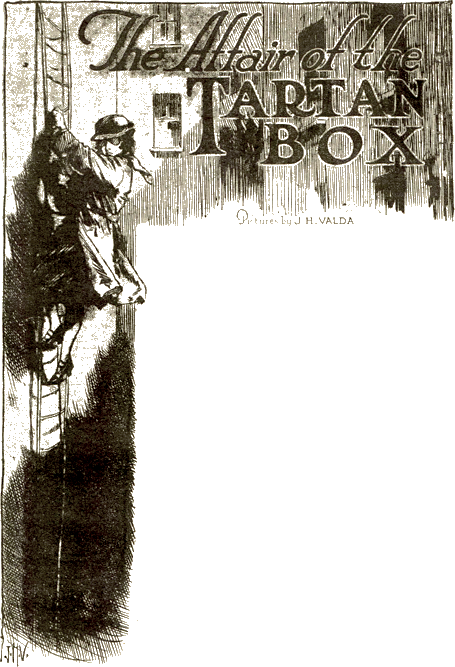
This story of Mademoiselle Yvonne Cartier and Sexton Blake takes us back to the period before she entered into her present friendly alliance with the great detective of Baker Street. It takes us back to the time when she was Mademoiselle Yvonne the Adventuress—fighting a lone-hand fight against her own foes, but nevertheless, taking up the cudgels at times on behalf of another such victim as herself. Her chivalrous nature led her into many adventures, not the least interesting being that which was recorded in the famous Index at Baker Street under the title which appears above, the story of which has hitherto been unpublished
"WELL, what luck, Bob?"
Mademoiselle Yvonne glanced up as her young brother Bob entered the cosy smoking-room in Yvonne's duplex flat at Queen Anne's Gate; and asked the question eagerly. Bob helped himself to one of her Russian cigarettes, and came across towards the cheerful open fire, where she and her uncle, John Graves, had been toasting their feet and carrying on a desultory conversation while waiting for tea.
It was a chill, rainy, wintry afternoon, and, as he drew near, Bob Cartier seemed to bring with him some of the drear atmosphere of the sodden-outdoors-a breath which made Yvonne shiver a little and lean closer to the fire. Just now her eyes were not on the cheerful flames, but were fixed on the countenance of her brother.
She could read it well, for she had been mother as well as sister to him ever since their own frail mother had gone to her grave, her strength and spirit broken by the scheming machinations of the group of so-called financiers who had swindled her husband out of a fortune in Australia, and who had not rested until the rich estate of Binabong had fallen into their hands as well. Thus Yvonne was left with a heart full of misery for the mother who had meant so much to her, and with a soul embittered against those who had wrecked their home-and brought both father and mother to the grave. She had tried to grasp the knowledge of how best to care for her brother until he should be able to fend for himself, and, most of all, to think out plans for being avenged upon the swindling circle from which all their misery had come.
At that time her uncle, John Graves (her mother's brother) had been in England. He had offered material help, as well as sympathy and a home. Yvonne had taken the sympathy; but that was all. Her proud spirit rebelled against accepting anything from anyone—even her uncle—and she was determined to carve out her own future according to the ideas which, even at that time, were forming in her mind.
Those who have read the previous records of Yvonne's early life will remember how she became avenged upon the eight men who had been behind the swindling of her father. Slowly but surely, and entirely through her own unaided efforts, she had built up a substantial fortune, and, in addition to buying back Binabong Estate in Australia, she had purchased the magnificent yacht Fleur-de-Lys, had taken the sumptuous flat at Queen Anne's Gate, and had purchased a place in the country as well. Nor did she rest there. She still went into action when the spirit moved her, and, in addition to her own financial interests, had made it possible for her brother Bob (by then grown to man's estate) to put his engineering knowledge to use in the City.
And it was apropos of Bob's affairs that Yvonne had met him with a question as he came into the room that chill afternoon.
In response to Yvonne's question, Bob shook his head gloomily.
"Nothing doing, I am afraid," he said. "I am most frightfully sorry, Yvonne, but it looks as if Marston has the whip-hand. I can't get him to listen to a word. When I tell him that I know the Malee Deep has plenty of paying ore in it, he only laughs. He flourishes the report of the consulting engineer whom he sent out, and says I can't get away from it as proof positive that the mine is a dud.
"What can I do? What can I say in the face of that? But I tell you I know the Malee Deep is a good mine. That engineer who furnished the report must be either a fool or a crook. Whichever he is, he has impressed Marston, and if Marston swings sufficient proxies with his own votes at the Extraordinary Meeting of the company which is to take place early in December, it means my finish. The shares are already going down, and Marston is doing all he can to hammer them lower. That is my private opinion, although I can't prove it."
"Do you think Marston is not playing honest?" asked Yvonne after a brief silence.
"I am dead sure of it," answered Bob
emphatically, "although I can't put my finger on anything definite. But I do believe that this whole business has been cooked up by Marston."
"How do you mean?" drawled Graves, laying down the paper he had been scanning.
"Why, it is too simple, uncle. Marston's tale is that the Malee Deep is no good. He says that as soon as this becomes general knowledge the shares will go out of sight because they will be worthless. On the other hand, he says he has given an option to the Broken Circle Mining Company (you know the crowd, Yvonne), at which they can exercise the option to buy before the end of this year at the price ruling on the London Stock Exchange on December 15th.
"Of course, this option is contingent upon the consent of the majority of the shareholders in the Malee Deep, and it is to get that consent he proposes calling an extraordinary general meeting for the first week in December. If the shares keep on the downward grade until then, the shareholders will be only too glad to sell them for what they can get. But I won't sell a single share I hold. I now that mine is a good one. I have been all over it, and I know what that reef will do.
"I have seen the most promising saddle formation there, and I am absolutely convinced that eventually a big strike will be made. I have been buying steadily on the open market, and am still doing so; but the shares are coming out more freely than ever, and as soon as Marston's opinion gets spread about the nervous shareholder will get in a panic and throw all they hold on to the market.
"I can't keep on fighting against a falling market, even if I do suspect it is being rigged, for, from what Marston said to-day, it looks as if he feels confident of securing sufficient proxies at the general meeting to carry the resolution he will put. If he does, it is going to break me."
"Just who are the people behind the Broken Circle company?" asked Yvonne.
"Oh, Marston and several others."
"Doesn't it strike you as a little odd that he should sell shares to himself and his friends which he claims' are practically worthless?"
"Of course. I touched him on that point, but he explained it by saying that the Broken Circle was wealthy (which is true), that they were paying enormous dividends (which is also true), and that, because he felt responsible for the flotation of the Malee Deep, he felt it incumbent upon him to try and realise something for the shareholders which he could. He added that the Broken Circle Crowd had so much money that they could afford to gamble on the Malee Deep, although he had given them to understand clearly that, in buying control of the Malee Deep, they were entering upon a sheer speculation. What can you say against that?"
"Not much," agreed Yvonne. "But if the Malee Deep is a good mine, as you think, then eventually you must come out all right, Bob, even if you do keep buying on a falling market."
Her brother shook his head.
"That sounds all right, and it might be all right if I had unlimited funds behind me and could afford to wait. But I haven't, and I can't.
"If I am right in my suspicions, then Marston and his gang might keep the shares down to next to nothing for as long as they wished—until I would have to realise. They could hold up all work on the mine indefinitely. And then, you know-well, I might be wrong, after all, but I am almost willing to stake everything I own that there is gold, and paying gold, in the Malee Deep. I can't understand how the engineer they sent out could have put in such a report."
"Perhaps he said in his report what Mr. Marston wanted him to say," remarked Yvonne. "I have more confidence in your opinion of what is in the Malee Deep than in that of any engineer sent out by Jacob Marston," she went on. "You were born and bred on the edge of that country where the Malee Deep lies. You know every stream and reef and type of soil for miles roundabout. The Gem and the Lucky Pebble almost adjoin the Malee Deep, and they are both big dividend payers. Therefore, it seems strange that the Malee Deep should be barren of gold.
"Stick to your guns, Bob—hang on to what shares you already hold and buy as many more as you can. At the meeting in December fight Marston's resolution for all you are worth. Get out circulars to the other shareholders—tell them what you think, and try to get in as many proxies as you can. You might wing more than Marston and his crowd, and beat him with his own weapons. That is what I should do if it we're my problem."
Bob shook his head.
"That sounds all right, but I can't do it, Yvonne. I haven't enough cash, and Marston and his crowd can influence too many proxies. I might swing a few shareholders to my side, but not enough to make the necessary difference. No, I can't see any way out, and it looks as if I would have to drop a good deal of money. It will just about make me penniless."
"You know that you can have as much money as you need," said Yvonne quickly. "I am quite willing to go into this thing with you and fight Marston to a finish. If we win, then you can pay me back. If we lose—well, we can make it up in some other way."
"No!" Bob shot out the word vehemently. "I will not take another penny of your money. You gave me a magnificent start in life, and if I can't hang on to it, or turn it into more. then I'll go broke and start all over again. I am in so deep now that I must follow this thing through as far as I can; but if Marston swings that meeting in December, then he holds me in the hollow of his hand. But your money—no, I won't touch another penny of it!"
"What do you think, uncle?" said Yvonne, turning to Graves.
"I think Bob is right," he said quietly. "You have given him a good start, and if he felt that whenever he got up against it he should call on you to pull him out, it would be bad for his character. He is a man now, and must stand on his own feet. Let him fight this fellow Marston to a finish. If he wins out, all credit to him. If he loses—well, as he says himself, he will have to start over again." Then he turned to Bob. "But I'll give you a tip, my boy," he said. "Take it for what it is worth. Watch Jacob Marston like a hawk. I have heard one or two things about that man, and they were most decidedly not to his credit."
Bob had dropped to his knees and was leaning against the side of Yvonne's chair.
Her lovely eyes were bent upon him just then with a yearning tenderness which he did not see. But because she did have such a wealth of maternal love for the boy she had watched grow to manhood, and because she wanted him to come out tried and true, no matter what he might have to face, she did not press her offer upon him.
In her heart of hearts she knew that Bob and Graves were right—that he must fight his own fight. But, at the same time, if there was some way of helping him without advancing him more money, she knew she would snatch at the chance.
Indeed, she would go farther than that—she would seek a chance to do so; and as her slim, warm fingers ruffled his crisp, rebellious hair, her mind was already active as she pondered over what he had told her.
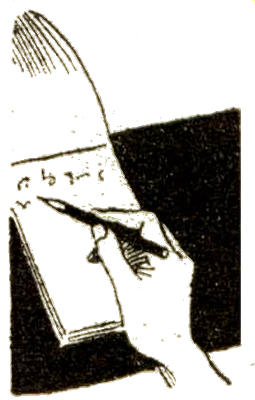
"THAT will be all for today, Miss Carter. When you have finished, please leave the letters on my desk, and I shall come back to sign them before I go home. You need not wait for me, but as soon as you have finished you may go. I don't know how long I shall be at the meeting."
Mr. Jacob Marston, the well-known financier and mining promoter, rose as he spoke, and the young woman whom he had addressed also got up and made her way to a small adjoining room, taking with her the book wherein she had recorded in shorthand the letters which her employer had been dictating.
Jacob Marston was a big, fleshy, handsome man of forty-odd years, and although he had only been in the City for some seven years or so (he had come from Australia), he was already prominent in certain mining and company circles, and was reputed to have piled up a very substantial fortune. Besides being the controlling factor in three mining companies, he was also a heavy shareholder in the Malee Deep Gold Mine, which had been promoted about eighteen months before.
He had not informed his secretary to what meeting it was he was going on this afternoon towards the end of the month of November, but from the knowledge she had of what business he had on at the moment, she knew that he intended proceeding to the offices of the Broken Circle Mining Company for a conference with Mr. James Creeve, the managing-director of that company.
While the Broken Circle was one of the mines in which Jacob Marston was largely interested, it was not one of the companies which he controlled, although he would have given a good deal to do so, for it was a rich mine and a heavy dividend payer.
The young woman whom he had addressed as Miss Carter was, as Marston himself had said more than once, one of the most efficient secretaries he had ever had, but no one, not by the most charitable stretch of imagination, could have pronounced her a beauty. In age, she might have been anything between twenty-four and thirty. It was difficult to guess. Her figure was good, and her manner alert and intelligent; but she possessed a prominent droop in her left eyelid, which was by no means improved by the large, round, tinted glasses which she wore. Her hair was black, and she could hardly have chosen a more unbecoming way of doing it, for it was dragged back close to her head and wound up in a small tightly screwed knot at the back.
On her right cheek was a large brown mole, which did not improve matters, and, to cap the young woman's facial afflictions, there was, on her upper-lip, a heavy line of black shadow which had the appearance of an incipient moustache. For the rest, she was invariably, neatly, though primly, dressed, after the fashion of some years ago. Her skirt was of light brown gabardine, severely cut, and instead of the usual blouse or jumper which most of the girls of to-day wear, Miss Carter invariably favoured a mannish type of blouse, with a high linen collar and mannish black tie.
One rarely took the trouble to study her in detail, but if one had done so it would have been seen that her ankles were extraordinarily shapely, and her little feet remarkably small and beautiful. But then, one rarely got that far in an inspection of Jacob Marston's secretary.
By the time her employer had taken his departure Miss Carter was already at work typing out the letters she had taken down. There were some eight or nine in all, two of them fairly long; but she turned them out with great rapidity. It had been fairly late in the day when her employer had finished dictating, and before she was finished most of the staff in the main office had gone. In fact, only an office-boy still remained; and just as the secretary entered Mr. Marston's room with her neat pile of letters and addressed envelopes the youth thrust his freckled face inside the door leading to the outer room.
"Anything I can do for you before I go. Miss Carter?" he asked.
The secretary smiled and shook her head. Whatever the rest of the world thought about her, no woman ever had more devoted slave than was the freckled-faced office-boy to her, though it would have been difficult to tell just what bond there could possibly be between them.
"No, thank you, Peter," she said, in a voice that was startlingly sweet. "I have just finished, and shall be going presently. Are you not waiting for Mr. Marston to return?"
"No, miss. He told me I needn't, so if there is nothing you want I think I'll push off."
She nodded again, and with a "Good-night!" the office-boy closed the door, and she could hear him whistling as he made his way through the outer office to the hall and the lift. She laid the letters on Marston's desk. Then, pausing there, she turned and fixed her eyes on the small, but very up-to-date, safe which stood in one corner, and which she knew was where her employer kept his private papers and confidential reports. The general books and papers relating to the business were kept in the big safe which stood in the outer office.
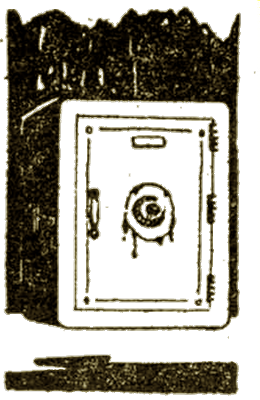
Presently she walked towards it. She kneeled down and examined more closely the heavy nickelled American-type combination. It was of a new "super-model," which had a knob for turning in the usual way, but which could not be operated until a special key had first been applied to a slot which was placed in the centre of the knob.
It would have taken a long time and much patience to secure an impression of the very complicated lock which the key controlled. At any rate, that was apparently the opinion of the young woman who knelt in front of it, for as she rose she shook her head.
"There is only one way in which it can be opened," she reflected. "With plenty of time it would be possible to get an impression, but time is too short, and my respected employer may take it into his head to remove the thing I'm after. One can't tell what he may do from now on. Judging from what I have seen of his correspondence with Creeve, and what I have overheard of his conversation with him, there may be a nasty passage-at-arms between them this afternoon.
"It is impossible to tell what is going to happen when two crooks try to double-cross each other. I think my other plan the better one; but it must be put into effect very soon, and I don't know that to-night wouldn't be the best time to try it."
She turned and made her way into the small room which she occupied, and, after making sure that the door was closed, again seated herself at her own desk.
It was already dark outside, and from where she sat Miss Carter could see lights in other offices across the light-well on which her room looked. As she noticed this she rose and drew down the blind. Then she resumed her seat, and, taking a bunch of keys from her bag which lay on the desk, she bent down and unlocked the bottom drawer on the left-hand side. From this she took a large brown-paper parcel which was a little over twelve inches in length and seven or eight inches thick.
She undid the cords which secured it, letting the paper fall to the floor, and held up what it had contained.
At first glance it seemed to be nothing but a bundle of cords, but as she unrolled it and examined it with critical eyes one might have seen that it was nothing more or less than a cord ladder, the vertical strands being of strong cotton rope and the cross strands of heavy, oiled-silk cord. At one end of each side rope was a cloth-bound hook which gave forth a soft thud as they touched the desk, revealing that under the cloth was metal.
When she seemed satisfied that these were all in order, Miss Carter drew up the other end, and, holding it in her lap, opened one of the upper drawers of the desk and took out a spool of heavy black thread. She unreeled a considerable length of this and broke it off. Then she returned the spool to the drawer and set to work to fasten one end of the thread to the bottom cross-strand or rung of the ladder. When she had tied that to her satisfaction, she re-rolled the ladder and laid it on the desk.
That done, she switched out the desk-light, and, stepping softly round to the window, lifted the blind. Next, she raised the sash about four inches, after which she felt about the desk until her fingers came into contact with the ladder. She took this and laid it on the windowsill. Then she adjusted it so that the two hooks at one end were gripped firmly over the ledge of the sash, while the rest of the rolled-up ladder lay on the stone sill outside.
Now she caught hold of the length of black thread which she had tied to the lower end, and collecting it in her hand, felt about the desk until her groping fingers came in contact with a half-length of lead pencil. She tied this to the free end of the thread, and, thrusting her hand well out through the opening and over the sash, she let the pencil drop down into the well.
Jacob Marston's offices were on the third floor of the building, and the square well outside gave light not only to the rear and side offices of the same building, but to the rear and side-rooms of the building opposite as well. Miss Carter had evidently taken opportunity previously to ascertain the distance from the window of her room to the ground beneath, for had she been able to see through the darkness she would have found the bit of lead pencil was swinging gently just about a foot above the concreted yard. But she did not even look, for when the list of the thread had run out she gave the ladder roll a little pat to make sure that it was not likely to tumble off the sill, and then she ended down the window until there was just about an inch of space showing. She drew down the blind again, and then groped her way to the door.
But Miss Carter did not immediately proceed to her own home. Instead; she walked briskly round the corner and entered another office-building. It was the same one which backed on to the other side of the court on which the windows of Jacob Marston's office looked; and it might seem rather curious that Miss Carter ascended in the lift to the third floor of this building, and walked along the corridor until she came to a room which, had one been curious enough one might have seen contained a window that was almost opposite the room where she spent most of her days. On the door was painted in plain black lettering;
"WOMEN WORKERS'
ASSOCIATION
E. CARTER, Sec't'y.
Miss Carter opened this door without knocking. Inside a young girl was seated at a desk, tapping away at a typewriter, and Miss Carter smiled upon her.
"Almost finished, Mary?" she asked in the same soft, pleasant tones she had used to Peter.
"Just this moment, Miss Carter," was the response. "I shall post the circulars on my way home. Do you wish to plan anything out for to-morrow?"
"You needn't wait for that, Mary," was the reply. "I shall write out a new circular before I leave which you might work on to-morrow. I shall be out all day, as usual, but I shall come back in time to see how it goes. You need not wait for me now. You look tired."
She then seated herself at a flat-topped desk, and, pulling a block of paper towards her, began to write. The composition was a circular which would be sent broadcast to the mailing list of women workers which the association possessed, and the subject matter was an appeal to those workers to organise their forces as the trades unions of men-workers had organised. She was still so engaged when the girl bade her good-night, but it didn't take her long to complete the job; for she finished a few minutes later. She laid the rough draft on the girl's desk, and then, stepping softly across, she locked the door.
Once more she had access to her bag in order to get out her bunch of keys.
Selecting one of these, she unlocked a corner cupboard and took out what was, to all appearances, a rather thick umbrella. She carried this across until she stood under the light, and began twisting the handle back and forth. After a few efforts it yielded, and she gave a pull. The handle came away, bringing with it, from the hollow rod of the umbrella, what looked exactly like a very thin, three-jointed bamboo fishing rod.
Miss Carter laid the umbrella on one side, and undid the strings which held the three sections of the bamboo "rod" together. They had been secured round a very thin steel stick that had been attached to the handle, and, after selecting the lightest top joint of the rod she put the rest of the outfit on the desk.
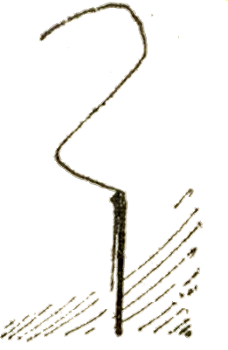
Still again, she rummaged about in her bag, and this time she brought out a small bit of wire which had been fashioned somewhat like the letter "Z," only that the lower part of it had an additional half inch attached to it which had also been cut with a screw thread. Holding the tip of the bamboo in one hand, she took the piece of bent wire in the other, and, putting the end of the screw to the top of the rod, she began to screw it in. When it was firm enough to satisfy her after a few tests with her fingers, she tied the bundle of rods up again and thrust them back into the hollow centre-stick of the umbrella. This she placed against the wall close to the window.
Her next act was to go to the wall cupboard again, and from it she took a brown paper parcel very similar in appearance to the one she had taken from the bottom drawer of her desk in Jacob Marston's office. She undid this, revealing a rolled-up cord ladder exactly like the one which she had left on the window sill of her room in the other building.
And now she did exactly the same with the second ladder as she had done with the first, except that she did not tie a length of black thread to the lower end. She affixed the cloth-covered hooks to the ridge of the window sill and left the ladder coiled no on the stone ledge outside. Then she drew down the sash until it was almost closed, after which she switched on the light—which she had turned off a moment or two before. That done, she crossed the room, unlocked the door, and, after switching off the light by the button there, closed the door, which automatically locked. And this time on reaching the street, Miss Carter secured a taxi—a strange thing for a working typist to do—and proceeded to her home.
She got out of the cab at Queen Anne's Gate, and entering the end block of mansions there, unlocked the door on the right of the ground floor hall with a passkey. She went along the beautifully-furnished hall inside until she came to the staircase leading to the floor above, for the flat was the duplex flat belonging to Mademoiselle Yvonne, the Adventuress. In a large bed-room there a neat maid came to her, and, under the latter's capable hands. Miss Carter was soon divested of her clothes, and was wrapped up in a soft blue robe. She followed the maid to a marvellously-fitted bath-room, and it was nearly half an hour before she emerged.
Or rather, it should be said that at the end of that time a very beautiful girl, clad in the same blue robe emerged. But she was very, very unlike Miss Carter. Instead of the tightly drawn-back hair which Miss Carter had affected, the girl who now appeared wore hers in wondrously soft coils which rippled over her white forehead and almost covered her little ears.
Gone was the drooping eyelid, and gone was the disfiguring mole. Gone,too, were the tinted glasses, and the black shadow on the upper lip. Instead, there was a skin as clear as milk and as soft as the down on a peach. The eyes were deep, shadowy, violet pools, and if it had not been that the hair was still black, one would have thought that this beautiful girl in the blue robe that clung, it seemed, lovingly about her soft body, was the beautiful owner of the flat herself —Mademoiselle Yvonne.
Indeed, despite the black hair, it was Yvonne, for beneath the black dye which she had applied was the lustrous red-gold sheen of her own hair which would become revealed again when the dye was removed. And at the end of another half hour the charming girl who tripped down the stairs, robed in some sort of filmy dinner frock of Empire green, was as much the complete antithesis of the Miss Carter who was employed by Jacob Marston as one could possibly find.
Yvonne's uncle, Graves, was in the smoking-room at the end of the hall when she came down, and when she had kissed him, she asked at once:
"Has Bob been here to-day?"
Graves shook his head.
"He hasn't been here, but I met him early in the afternoon in Piccadilly. He is still selling his Malee Deep shares, and, from what I can gather, is going to stand a very heavy loss before he finishes. They are down again to-day"
"Yes, I know. I saw the closing price at the office. Did you buy again?"
"Yes. My brokers are picking up every share they can, but there seems to be a good deal of quiet buying from other sources, despite the dropping price. I know, of course, that Marston has been buying, but I can't figure him as taking up all that has come on the market. My broker says the buying orders are coming from several directions, but at limits that keep just under the quotations."
"I think I know the answer to that," said Yvonne, but she did not commit herself further just then. "Let us go in to dinner," she added, and led the way out into the hall and along to the dining-room. In Yvonne's flat there was no need to guard conversation at the table, for every servant in her employ had been tried and tested, and there was no danger of a leakage, so, when the first course had come on, Graves took up the subject of their conversation where it had left off in the smoking-room.
"How are things progressing?" he asked.
Yvonne smiled.
"Not badly," she said. "I hope that to-night will bring things to a head."
"I hope you are not going to do anything too risky," remarked Graves, with a frown. "You are mixing up with a hard crowd, my dear, and if you get caught by Jacob Marston you will not find it easy to wriggle out."
"I can take care of myself," she replied. "You don't suppose I have been working for that horrid man all these weeks for fun, do you, uncle? Nor do you suppose that now, when I am ready to take the final step, I am going to hesitate? Why did I bribe Jacob Marston's former secretary to get 'ill,' and recommend me for the position? Why have my brokers and yours been buying up every share of Malee Deep that they could get hold of? Why have we kept the whole thing a secret from Bob, who for the last two weeks has been selling his holdings for whatever they would fetch, not dreaming that a large proportion of them have been coming to me?
"I'll tell you why—because Jacob Marston is a crook, and would have ruined Bob as he thinks now he is ruining him. Again, because I have seen enough since I have been in Jacob Marston's office to feel certain that Bob is right—that the Malee Deep is a good mine, and that Marston has been hammering it so he can get the bulk of the shares into his own hands. Because I am determined that he shall fail, and that the control of the mine shall eventually come to my brother.
"And there are going to be unforeseen complications before this game is played out, for just lately Marston and Creeve, of the Broken Circle crowd, have had a quarrel, and it is difficult to see just which way the cat is going to jump. But you know the old adage: 'When thieves fall out—'" And more than that Yvonne would not say.
But when they had finished coffee after dinner in the smoking-room, and she had smoked a cigarette, Yvonne rang for Anna, her maid, and sent word to Alec, her trusted chauffeur, that she wished the two-seater car to be in front of the house in half an hour. Then she ran up to her room to change, and almost to the minute, clad in a short dark skirt and long black coat, she took leave of Graves and stepped in beside Alec. Alec already knew whither they were bound, so as soon as his employer was settled he drove off.
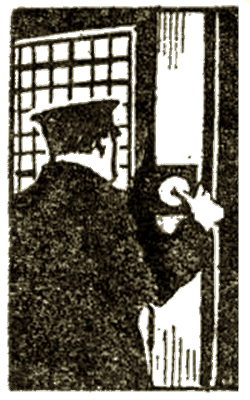
ALEC drove straight through the West End of London, and, by way of the Strand and Ludgate Hill, to the Bank. From there he took a way by Threadneedle Street into Bishopsgate, and about half-way up the hill into a narrow side street. He drew up before a small public-house there, and, with a word to Yvonne, climbed out.
He rang the bell at a side door, and after a minute or so the door was opened a little, revealing the head and shoulders of an elderly woman against a dim light beyond. Alec spoke a few words to her, and the woman then closed the door. Alec returned to the car and took the wheel. He had just done so when a pair of high wooden gates at the side of the public-house swung open, and a man with a lantern called in a low tone for Alec to come on. He guided the car through, and the man with the lantern closed the gates after him. Alec continued on into a sort of shed, and, jumping out, assisted his mistress to alight.
By then the old woman had come out into the yard, and, approaching Yvonne, greeted her with respectful solicitude; declaiming against the cold night and apprehensive lest Yvonne should take cold. But Yvonne only gave a soft laugh and reassured her, and then asked her if she had heard lately from her son, who, it may be mentioned here, was one of the hands on Yvonne's yacht.
The old woman had had a letter just a few days before, it seemed, and, as every man-jack on the Fleur-de-Lys would have gone through any mortal thing for the young owner, it isn't surprising that the old woman who kept the small inn was only too pleased to place the garage at the disposal of the one who had been such a kind mistress to her son. Nor did she worry her head as to why a young lady of Yvonne's type should wish to leave her car there in the deserted part of business London at that hour of the night.
They all entered the house by the door opening on to the yard, and then, after a few more words with the old woman, Yvonne led the way out to the street, followed by Alec. From there they walked side by side into Bishopsgate Street, and, turning to the left, continued down the hill until they reached the opening of a small court, which was surrounded by office buildings. Just before reaching it they passed the door of the building where Jacob Marston had his offices, and in the square on the left was the door of the other building, where the room of the Women Workers' Association was situated.
Yvonne had taken a swift look up and down Bishopsgate Street before turning into the square, but there was no sign of a policeman, and, on reaching the door of the building in which the Workers' Association was housed, she took a large key from the pocket of her coat and inserted it in the lock. She had already tested that key, and had no fear that it would not work easily. She entered, and Alec slipped in like a shadow after her. She closed the door and locked it from the inside, then, with a cautioning hand on Alec's elbow, she led the way along the hall until she passed the gates of the lift and came to the foot of the staircase. She started up these, and, with a guiding hand on the banister, Alec followed. They reached the first floor and climbed to the second. They passed the second and again mounted to the third. Then Yvonne again put her hand on Alec's sleeve, and led him along the hall until she came to the door of the room which was her objective. She took another key from her pocket and opened the door. She did not turn on the light but uttered a warning murmur to Alec and drew him inside. Then she closed the door, and in a whisper bade him stand where he was until she returned.
She felt her way across the dark room until she reached her own desk, Skirted this, and reached the window. She allowed the blind to run up on the roller, and very cautiously lifted the lower sash as high as it would go. Then she leant out and surveyed the blank windows surrounding the light well, inspecting those opposite first, those to the right next, then the windows on the left, and, finally, by bending out still farther, those above and below in her own building. Not a single glimmer was to be seen anywhere.
She drew in, and, still moving with infinite caution, felt along by the wall until she came to the wall cupboard. A touch of the hand had already assured her that the coiled-up ladder was still on the stone window-ledge just as she had left it, and the umbrella was standing close by where she had placed it. She unlocked the wall cupboard and knelt down. From a lower shelf she took something that seemed to possess considerable weight, for it took nearly all her strength to lift it up and carry it along to the window, where she set it on the floor. That done, she returned to the wall cupboard. locked it, and thrust the key in her pocket. Then she went to where she had left Alec. She bent close until he could hear her words when she barely breathed them.
"The cylinder is on the floor by the window," she whispered. "You will find a strap attached by which you can swing it on to your shoulder. There is not a light to be seen, and there is no night-watchman in this building; but there is one in the other, so be careful how you step. I shall go first, and you can follow. Wait until I reach the bottom, and I will signal by a tug on the cord. Now come along."
She took Alec's arm and led him across the room until they were close to the window. She took his hand and guided it to the heavy object which she had placed on the floor, and after a little exploring with his fingers Alec lifted it up and slipped the strap over his shoulders, so that the object hung at the back.
Then he stood by the window while Yvonne gave the coiled-up ladder a push that sent it unreeling down into the courtyard below. She did not hesitate. As lithely as a lad she went over the sill, and while Alec steadied the hooks she found a rung with her foot and began to descend.
It was only a few moments later when Alec felt a sharp tug on the cord, and he immediately followed Yvonne's example. On reaching the bottom he found Yvonne standing there clutching the umbrella which she had taken along with her. Again, she took his arm and guided him across the small court, until she was standing beneath the window of the room which "Miss Carter" used in Jacob Marston's offices. She passed her hand along the wall there until her fingers encountered the black thread she had dropped down. She gave it a little tug, and immediately the coiled-up ladder which she had left on the window-ledge above descended on their heads.
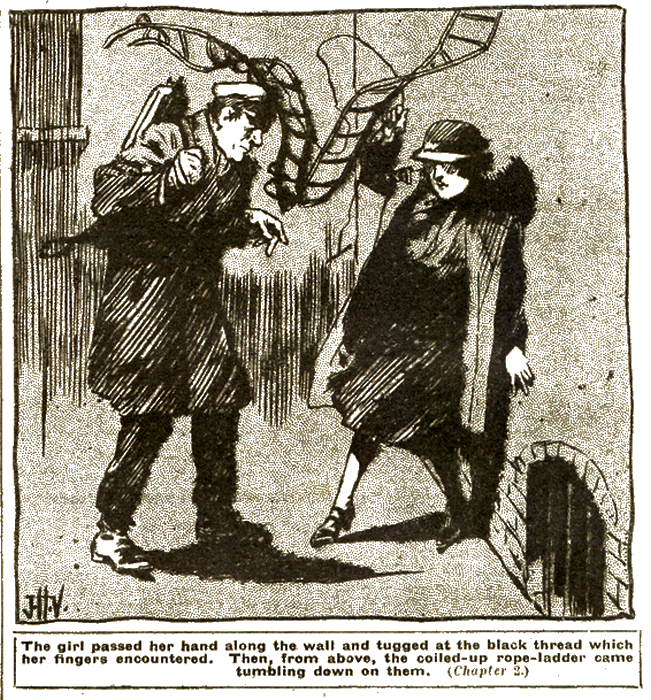
Yvonne again whispered instructions to Alec, and then, leaving the "umbrella" leaning against the wall, began to mount the ladder.
Alec stood steadying the cords until he felt the strain slacken, and a moment later came the signalling tug. He then began to climb, and, on reaching the window on the third floor, found Yvonne ready to guide his feet as he came over the sill.
Then Yvonne left him once more while she crept along to Jacob Marston's private room to investigate. She found the door leading to the outer office closed as she had left it, and satisfied of that, she returned to Alec. She guided him across her own room and into the other room, then along until she knew she was close to the financier's private safe.
And now for the first time she risked switching on a pocket electric-torch. She kept the beam trained on the safe while Alec dropped to his knees and studied the combination. Then, after a few moments, he nodded his head and looked up,
"You were right, miss," he whispered. "It would take too long to try and find the combination. Even with the cylinder it will take the better part of two hours to cut round it."
She nodded.
"That is about what I figured. Go ahead, Alec. I'll keep guard. We must finish the job to-night!" She glanced at her wrist-watch. "It is just half-past ten," she added. "Try and get through by midnight if you can." And, nodding, Alec slipped the strap from his shoulders and gently eased to the floor the highly polished object which Yvonne had referred to as "the cylinder" It was that and more. It was, in fact, the very last word in high-power safe-breakers, and had been surreptitiously brought from America for the very job on which it was being employed that night.
Nor could a better man have been found than Alec to handle the drill, for before entering Yvonne's employ he had been one of the cleverest safe-breakers in Europe. He did not need any telling how the flame should be brought into action, nor just which drill of the half-dozen attached to one side would be the best to begin with.
By the time Yvonne had drawn up a chair, from which she could watch the progress of the work and the door leading to the outer room at the same time, and had taken out a small blued automatic which she held loosely in her lap, Alec was ready, and there was a sudden white glare under the hooded guard of the cylinder as he brought the terrific flame into being.
Like most professionals, he began his drilling at the top of the combination, And it was a whole course of instruction in how the brains of crookdom are ever busy to try to keep just one jump ahead of the safe-makers to watch how the drill ate through the triple layer of battleship steel as if it had been a candle-flame into butter. Yvonne watched the metal melting into running tears, and when at last Alec leant back Yvonne could not suppress a little murmur of satisfaction.
After the first piercing of the outer casing the rest was easy. Shutting off the flame, Alec pushed the cylinder back, and, after a little manipulation, got the safe door open. The inner door presented no difficulty, and when it swung back he drew to one side to permit Yvonne access to the interior.
She dropped to her knees, and as her eyes fell on a certain object on the top shelf she gave a little exclamation of pleasure. She took it out and held it up for Alec to see, and what his gaze took in was a small box, about ten inches by four by an inch and a half in depth, completely covered in tartan cloth of a bright pattern.
"That is the prize," whispered Yvonne; but, just to make sure, she opened the box and peered inside. What she saw seemed to satisfy her, for she closed it and handed it to Alec. Then she delved once more into the safe, and this time she made a clean sweep of all the banknotes and currency-notes she could lay her hands on. She also handed these to Alec, and on her next incursion into the safe brought forth what looked like a bundle of bonds or share certificates, and a packet of papers which were held together with a rubber band. These she thrust into the inner pocket of her own coat. Then she turned to Alec.
"That will do, I think. It will be best to take the money and the other stuff to cloud the motive. We will leave the door just as it is. Get the cylinder on your shoulder, Alec, and we will get away at once. It was a neat job, and I got just what I wanted."
She made to rise, then, but in the very act of doing so she grew rigid, and gazed at Alec with distended eyes, for at that moment there came, it seemed from the outer office, the sharp crack of a pistol, followed by a high-pitched scream, then a heavy thud, and, following that, dead, sinister, menacing silence.
MR. SEXTON BLAKE had received a telephone message from Mr. Jacob Marston, the well-known City financier, asking him if it would be convenient for him to come to the City at once; and as the detective's engagements for the day permitted him to do so, he had driven through in the Grey Panther soon after breakfast.
He had found Mr. Marston seated in his private room, and the financier explained that he, on his part, had been summoned early that morning by telephone from his office. And now Sexton Blake was seated by the desk with his ears attending to what the financier was saying, but his eyes fixed on the safe in one corner which, he had already been informed, had been burgled the previous night, and the door of which was hanging half open, revealing only too plainly how it had been forced.
"The police have already been here," he was saying. "I have made a statement to them, and have given them a list of what is missing; but for reasons of my own I prefer that you should take up the inquiry along independent lines, Mr. Blake. I shall give you all the facts as I know them.
"To begin with, you may have noticed as you came in the building that the police are still about the ground floor—or, at least, the inspector who interviewed me said he might wish to see me again before he left, and that he would be busy in the offices on the ground floor, where there was also a burglary last night.
"Now this, according to the police theory, is what happened. Some person, or persons, gained access to the offices on the ground floor (they are occupied by a small marine insurance company) by one of the front windows, which they forced. Once inside, they soon set to work on the safe, and managed to gain the secret of the combination. They rifled it of all the cash they could find—something in the neighbourhood of fourteen hundred pounds, I understand—and afterwards it appears they ascended to this floor. They evidently found the safe in this room too hard a nut to crack without using more effective tools, for you will see when you examine it, that the combination was cut round by some sort of powerful blowpipe drill.
"From this safe they took cash to the amount of a little over three hundred pounds, some private papers, and, what I value far more highly than all the rest, a small tartan-covered box containing some company proxies which I intended using at a meeting about ten days hence. Among the private papers were some shares, but those I can protect against sale.
"Now, after rifling the safe here, the thief, or thieves, evidently started to leave, and had got as far as the outer hall when they were surprised by the night-watchman of the building. I cannot tell you why he did not discover them when they were at work in the insurance offices on the ground floor. At any rate, they were of the most desperate type, for the watchman was found early this morning lying on the floor just by the outer door of my offices shot through the heart.
"After killing him the thief, or thieves, had escaped by the way they had come. Those are the bare facts of the case, and as soon as I finished with the police I determined to telephone and ask you to look into the matter for me. I am deeply regretful over the murder of the night-watchman, but, apart from that, it is of the utmost importance that I regain that tartan-covered box inside the next ten days. The control of an important company depends on them, and I need scarcely add that if you recover the box with the contents you may name your own fee."
Sexton Blake nodded absently, and, rising, crossed the room and dropped to his knees by the safe. Before examining the main door he investigated the interior, and soon discovered that the inner door of wood had been forced by some sort of sharp instrument—probably a chisel, he thought. Then he gave his attention to the main door, and spent a considerable time studying the marks of the blowpipe and the circle cut round the combination. Then Blake bent still closer, took out a powerful pocket-glass, and began to go over every inch of the carpet in the vicinity of the safe. The financier attempted to do some work while waiting, and once put through a telephone call; but it was plain that he was too much upset over his loss to give his mind to business, and he wound up by rising and standing where he could watch Blake.
When Blake had finished his examination of the floor he rose and resumed his seat. Then, as he helped himself to a cigar from the open box on the desk, he said:
"You say the safe in the insurance offices on the ground floor was also robbed during the night?"
Yes."
"From your words. I gathered that it was not opened by the use of a blowpipe but that they succeeded in solving the combination."
"That is what Inspector Thomas of Scotland Yard said."
"Ah! Thomas is on the job, is he?" murmured Blake. "I shall have a word with him." Then to the financier: "Is this the only safe you have in your offices, Mr. Marston?"
"Oh, no! There is a much larger safe in the outer office."
"Which they did not touch?"
"I asked my chief clerk. I had seen that it was apparently just as it had been left on closing the office last night, and my chief clerk has since checked up the contents, finding everything all right."
"Did you keep all the funds in here?"
"No, not by any means. There were over a thousand pounds in the big safe last night."
"And the thieves passed it over for this one? Um! I should like to have a look at it presently, but you might tell me now—where is it situated? Is it concealed from view?"
"Not at all. It is visible from the door as one enters the office."
"What type is it—is it very modern? Would it be more difficult to open than this one here, which I see is of the very latest type?"
"I am not a safe-breaker, but I should think it would be much easier to force the safe in the outer room. It is not unlike the one which was robbed downstairs, and is not of a very new pattern. I bought it with the rest of the furniture when I took over these offices about seven years ago."
Blake pondered that for a few moments, then he said:
"I should like to know who was the last to leave your offices last night."
"I was," came the prompt reply. "I left just before five for a meeting, but I had to return to sign some letters. When I went to the meeting my private secretary was still here, typing the letters, and the office-boy was in the outer room. But they were gone when I returned."
"Can you remember how you left the doors—of this room and the outer?"
"I am almost certain that I closed the door of my own room, and I know that I did so in the case of the outer door, for I distinctly remember glancing at the spring lock before doing so."
"Who made the discovery of the murder of the night-watchman?"
"One of the charwomen when they came to clean up this morning."
"They do not do the cleaning at night,as in some offices?"
"No."
"And then?"
"They called in a constable from the street, and he telephoned through to Scotland Yard. My chief clerk arrived soon after, and tells me that two men arrived from the Yard, and that the divisional surgeon came a few minutes later. The body of the watchman was taken into a room in the basement, where it still lies, I believe. By this time the robbery in the insurance offices had been discovered, but it was not until the charwoman came in here to clean up that she found my safe open. My chief clerk telephoned to my house at once, And when I got here I found the police in occupation."
"Is there anyone who would be very strongly interested in getting possession of the proxies of which you spoke?" asked Blake.
The financier hesitated, then he replied:
"Well, yes, I suppose so, in a way, but not to the extent of committing murder for them. They would be of considerable value to the person with whom I had the meeting yesterday afternoon, and a short time ago would have been equally valuable to another person, but he can now be ruled out, for he has been disposing of his shares in the company in question for some little time past. I do not think either of those persons had anything to do with the robbery, for you see, the safe in the insurance offices was robbed as well."
"Quite so. You say you wished to make use of the proxies in about ten days?"
"Yes."
"Cannot you write to the persons who gave them to you and get new ones, explaining what has happened?"
"I can in the case of those persons living in England and Scotland, but, unfortunately, the majority of the proxies came in from shareholders living in Australia, and I could not get new ones under a month, even if I cabled to each individual."
"That does complicate matters," agreed Blake. Then he rose and walked to the window. He stood gazing out into the courtyard for some time, his eyes travelling from window to window, and from floor to floor of the buildings on the other three sides. Then he came back and, pausing by the desk, said:
"I should like to make a complete tour of your offices first, Mr. Marston. After that I shall go downstairs and try to catch the inspector from the Yard before he leaves. I should like to have a look at the safe there, and also at the body of the night-watchman. I can form no opinion at present, but something may occur to me. By the way, did the inspector make a search for fingerprints?"
"He said that he could not tell about that until he made copies of those which he found and compared them with mine and those of anyone else here who might have had access to the safe. But there should only be mine, for I was the only one who ever opened it,"
"If they were clever enough to get into it, they were probably careful enough to use gloves," remarked Blake "Still, we shall see what the inspector has to say when he has made photographs. What is that door there?"
"That is my secretary's room. Do you wish to have a look round there?"
"It might be as well. I wish to get the lay of the rooms clearly in my mind."
The financier rose, and with a word led the way across to the closed door which Blake had indicated, and from behind which he could hear the click of a typewriting machine. After knocking, his client opened the door and ushered Blake in.
As he stepped into the room Blake's eyes took in the single human being it contained, and then, swiftly, the furniture. He noticed that Jacob Marston's secretary was an extremely plain young woman, and when the financier said something about being sorry to disturb her, mentioning as he did So that his visitor was Mr. Sexton Blake, who had come to investigate the robbery of the night before, the secretary got up and bobbed stiffly in acknowledgment, while Blake inclined his head and murmured something conventional.
Then he turned to the window, and a moment later the clicking of the machine sounded again as the secretary resumed her work. Blake stood looking out into the courtyard, finding that this window was at right angles to the one in Marston's private room, and that from where he stood he could see a portion of the apartment. The window was up a little, and, putting his fingers under the sash, he lifted it as high as it would go. He leant out and gazed down into the courtyard, but seemed to find no inspiration there, for a few moments later he lowered the sash and again stood examining the windows opposite.
It was while he was standing thus that he found that the heavy plate glass of the window made a mirror of sorts, and, standing as he was, he could see the figure of the secretary where she sat at her desk typing. The reflection was blurred, but it was clear enough for Blake to feel almost certain that, while she was typing, she had her eyes fixed on his back.
He could not be absolutely sure, but he thought, if it was so, that the young woman must be an extremely efficient touch-typist, for her fingers were flying over the keys without faltering. Why should she be interested in him he couldn't guess, although it was not a new experience to find himself the object of curiosity on the part of others, and particularly of the other sex. But whether she had been gazing at him or not, when he turned round her eyes were bent on the machine, and she paid no attention as he walked slowly round the room.
He passed behind her desk, and at that moment the secretary apparently finished the page on which she had been occupied, for she whipped it out of the machine, and bent over it with her pencil poised, as if seeking for errors. Blake continued his way, and then, with an inclination of the head, led the way back to the other room. He walked across to pick up the half of cigar which he had left in the tray on the desk, and then, as he lit it, he said in a casual tone:
"Would you mind asking your secretary if she would go down to see if the inspector from the Yard is still there, and, if he is, give him my compliments, and ask him to wait until I come down?"
"Certainly. I will ask her at once."
Marston opened the door again, and made the request of his secretary, Blake noticing that he addressed her as Miss Carter. She rose at once and proceeded on her errand, and as the door of the room closed after her, Blake walked to the window again, and stood until he had deliberately counted twenty. Then he turned, as if something had just occurred to him, and said quickly:
"Oh, I am sorry, Mr. Marston, but perhaps it would be better if I had a talk with the inspector up here. Would you mind overtaking your secretary and asking her to say that if he prefers to come up here I shall wait for him?"
The other nodded and hastened after the girl. As the door closed after him, leaving Blake alone, he turned swiftly and hastened back into the secretary's room. He bent over her desk, and scanned the typed pages there, but saw nothing to hold him. Then he looked into the waste-paper basket, and, reaching down, took out a crumpled piece of paper. As he opened it up and gazed at it his eyes grew puzzled. He held it as if undecided to take it with him or not, but then apparently decided not to, for he crumpled it up again and dropped it back in the basket. Nor did he notice as he did so that a trifle of ash from his cigar also dropped into the basket.
He turned swiftly, and had just reached the other room when the door opened and the financier came in to inform him that he had given the additional message to Miss Carter.
Blake then began his tour of the outer office. He had not glanced by the direction of the safe there as he had entered, but now he saw that, standing by the door, it was in plain sight, and certainly, one entering, at night with an electric torch (which it was to be assumed a burglar would be provided with) could hardly have missed it in an inspection of his surroundings. He knew nearly as much about the various types of safes and vaults as the men who made them, or those who would rifle them, for it was part of his business to know, and it did not take him long to come to the conclusion that it would have been a very much easier job to open the safe in the outer room than the small but very modern one in Jacob Marston's private office.
He gave a brief scrutiny to each of the clerks there, and, at his request, the chief clerk gave him a detailed account of what he knew of the affair, and what had happened after his arrival earlier in the morning.
Blake had just finished when the door opened to reveal the round, red countenance of Detective-Inspector Thomas of Scotland Yard. Blake greeted him, and explained that he had been called in in private consultation by Mr. Marston. The inspector was quite agreeable that Blake should have a look at the safe in the insurance offices; and, saying that he would be back before he left, Blake accompanied the inspector downstairs. He found that the robbery on the ground floor had been just as stated, and when he examined the front window he agreed with the inspector that the thief or thieves had undoubtedly entered and left that way, for the signs were plainly to be read.
From the insurance offices he descended to the basement, where the body of the unfortunate night-watchman was lying. The surgeon was gone, but the inspector uncovered the wound, which was a small hole just over the heart. The inspector said the doctor did not yet know what calibre of weapon had been used, but he promised to let Blake know as soon as possible. Then he began to question Blake about the robbery in the Marston offices, but he found Blake non-committal, for he told the plain truth when he said that he was by no means ready to advance any theory other than that already put forward by the inspector; a sentiment with which Inspector Thomas was not slow in agreeing.
Then they ascended to the floor above, and Blake stood by the door until the inspector had re-entered the insurance offices. But he did not return to the third floor just then. Instead, he waited until the liftman came down and then asked to be shown the door leading to the courtyard at the rear.
As the liftman had seen him in the company of the inspector, he took him for someone from the Yard, and at once led the way along a corridor and unlocked a door at the far end.
Blake thanked him, and informed him that he need not wait; then, when the man was on his way back, Blake opened the door and stepped out. He began to make a slow tour of the court, beginning at the right and walking round that way. His eyes studied the cement paving as he went along, and now and then he caught curious eyes bent on him from windows above. But if he had expected to find anything on the paving of the court he was disappointed, for there was nothing which was of any interest to him.
He did pause once, though, in order to pick something off a window-sill which was just under Jacob Marston's offices, and as he dropped it into his pocket he chanced to glance up. As his eyes swept the windows above him he was almost sure he had seen the flash of something white at the window of the room which he now knew was occupied by Marston's secretary, but the impression was so fleeting he could not have sworn to it.
He re-entered the building then, and this time he returned to the third floor. Jacob Marston was waiting with an eager expression, as if he expected Blake, like some wizard, to read him the answer to the riddle there and then. But, if so, he was disappointed, for all Blake said was:
"I forgot to ask, Mr. Marston, was the tartan box of which you spoke locked?"
"No. It was just an old box that I used formerly for gold pieces. Since they have been out of circulation it has lain in the safe, and I thrust the proxies in for convenience."
"It seems odd that the thief should carry it off—unless he did not take the trouble to open it and examine the contents until after he left the building. Perhaps when he discovers the nature of them he will return it, or might be reached by an advertisement in the agony columns of the papers. It might be worth trying that, anyway. In the meantime, I want to think things over. I shall take the case, and you will hear from me at the earliest possible moment; but it must be understood that I work according to my own methods."
"Certainly, Mr. Blake—certainly. All I ask is that you recover that tartan-covered box."
Blake assured him that he would do his best in the matter.
But he would have been still further intrigued concerning the financier's secretary could he have seen her at that moment, for it was only while he had been speaking with her employer that she had taken the crumpled piece of paper out of the waste-basket by her desk, and in opening it had found the minute flick of cigar-ash which had dropped on it while Blake was examining it. And now she was sitting rigid in her chair, her eyes fixed on the closed door as if she had gone into a sudden trance.
SEXTON BLAKE returned to Baker Street after leaving Jacob Marston's offices in Bishopsgate Street. Tinker, who had been driving the Grey Panther and had waited outside while his master had his preliminary interview with the financier, drove the car round to the garage, and then joined Blake in the consulting-room, where he was already hard at work jotting down notes of his conversation with Marston, and tentative observations which he wished to make regarding his examinations there.
Tinker busied himself at his own desk until Blake threw his pencil down, and, rising, began to fill his pipe. And when the pipe was going he gave the lad the details of what had been told him and what he had seen, from the time of his arrival in Bishopsgate to the moment when he had taken his departure. Then he paced up and down the room in silence for some minutes.
"It bears all the earmarks of being a double job," he went on, "brought off on the same night. To my mind, there is not the shadow of doubt that the inspector is correct in his theory of the robbery on the ground floor. The front window was unquestionably forced by some instrument—probably a chisel or jemmy, and access was gained in that way. Whether there was only one person is a question yet; but whoever opened the safe in the insurance office knew his business. It was a good job.
"But now we come to the robbery on the third floor in the private office of Mr. Marston. That presents an entirely different phase, in my opinion. Firstly, take the case of the unfortunate night-watchman who was shot dead. As far as I can gather, no one seems to know exactly where he was while the thief or thieves were at work in the insurance office on the ground floor, and that never will be known. But the inspector seems to think the man must have been either in the basement, attending to the fires, or else on some of the upper floors, making his rounds, and I agree.
"At any rate, it seems fairly certain that the thief or thieves who robbed the safe in the insurance office decided to make even a bigger haul, and apparently thought themselves comparatively safe. Anyway, it appears that they started to investigate things above.
"Now, on the first floor are the offices of a real estate company, and it seems that the burglars must have thought there would be poor pickings there, for they passed it by. On the second floor there are two or three small produce, import, and export firms, and these, too, seem to have been ignored. But on the third floor the word 'Financier' under Jacob Marston's name on the door must have attracted them, or else they were intending to go still higher, and we must not lose sight of the fact that it is just possible they may have been looking for some means of escape by the roof. Something in the street outside may have alarmed them while they were still in the insurance offices. At any rate, whatever the reason, they had got as far as the third floor when they met the watchman. We can take it that he would immediately try to raise an alarm, and there before he could do so they shot him dead in his tracks. Then they made good their escape. So much for that.
"Now we come to the offices outside which the shooting took place. Inspector Thomas' theory is that the thief or thieves were emerging from the Marston offices When they were surprised by the watchman. In other words, he maintains that after robbing the safe in the insurance office they entered Jacob Marston's private room and broke into his. But I do not agree with that, and I will tell you why.
"Firstly, I made a close examination of the lock on the door leading to the financier's offices, and I cannot find any marks that would seem to indicate that the lock had been forced. Of course, they may have been provided with a key that would operate the lock, although that is doubtful, for it is a Yale lock, and, unless the robbery had been planned some time before, it does not seem reasonable to suppose that they would have a duplicate key. If they used some sort of instrument, then there should have been marks.
"But, more than on that point, I base my opinion on the fact that on entering the outer office the big general safe there is plainly visible from the door, and persons entering for the purpose of robbery could not possibly miss it. Further, it is very similar in type to that in the insurance office, which they found little difficulty in opening. And yet, they passed it by, although Mr. Marston informs me that there were something like fourteen hundred pounds in cash inside.
"But this is what the inspector claims they did. He maintains that, for some reason-which he does not yet attempt to name—they passed that safe by and entered the private room, where they attacked the financier's private safe. But look at this point. For the first time they are supposed to have brought into use a very powerful blowpipe in order to cut round the combination. But I can't accept that. If they had brought such a safe-breaking outfit into the building with them, then it must have been for the sole purpose of tackling just such a safe as that in Marston's room, for they did not need to employ it in the other instance. It might be argued that they tackled the safe on the third floor first and robbed that in the insurance office on their way out; but that would not hold water, for if that had been the case, then the shooting wouldn't have taken place on the third floor—or, if it had, then they would not have been able to rob the safe on the ground floor, because we can take it for granted that they did not remain in the building a second longer than they had to after killing the night-watchman.
"Therefore, I advance the tentative theory that not only did the thief or thieves who robbed the safe in the insurance office not enter the Marston offices, but that the 'job' there was an entirely independent one which, by sheer coincidence, was carried out the same night. How the thief or thieves who operated there entered the building is to be discovered.
"It is, of course, possible that they were in league with those who did the work on the ground floor, and the two groups may have come together. We can't tell that yet. But just because the big safe in the outer office was ignored, I am inclined to think that there was no connection between the two.
"And for those same reasons I am not at all sure that Inspector Thomas is right in thinking that the person or persons who robbed the safe in the insurance office killed the night-watchman. Why, isn't it possible that the killing was done by those who robbed the safe in Marston's private room? We have not a shred of proof that the thief or thieves who operated on the ground floor mounted even to the first floor, let alone the third, and the two groups may have been in the building at entirely different hours of the night.
"The thieves in Marston's office may have heard the watchman moving about, may have surprised and killed him even before the other group entered the place, and they in their turn may have carried out the burglary on the ground floor while the night-watchman lay dead on the third floor. There are so many different things that may have taken place, that we must be very careful to examine every single shred of evidence that offers."
Blake broke off then, and Tinker, knowing that his mind was working out tentative hypotheses even as he talked, forbore making any comment, for he knew it would but tend to upset the trend of Blake's thoughts. And just as he thought, Blake began to speak again.
"The three basic facts are that, firstly, we have the undoubted murder of the night-watchman; secondly, the robbery of the safe in the insurance office; and thirdly, the burglary of Jacob Marston's private safe. In the Marston's instance, we are faced with a very puzzling circumstance which is not existent in the robbery on the ground floor. There it was simply money which was the motive. But as regards Marston's safe, in addition to money being taken there are also missing share securities and private papers, and a tartan-covered box, containing not money, not securities, but voting proxies for the Extraordinary Meeting of a mining company in which Jacob Marston is deeply interested.
"That box—that tartan-covered receptacle is what the financier values far more highly than anything else. From what I can gather, Marston considers it of the utmost importance that he should recover those proxies before the meeting takes place about ten days hence, and it is entirely on their recovery that he has engaged my services. Therefore, we must concentrate on that; but at the same time bear in mind that the murder of the night-watchman may be very closely involved with it, even if the robbery on the ground floor is not.
"If the job in Marston's private room was distinct from the other (we shall leave aside the responsibility of the murder of the night-watchman for the moment) then how did the thieves there gain admittance to the building? "On the ground floor here are only three methods of doing so. One is by the main door, a second through one of the two front windows of the insurance company offices, and a third by a door at the back which opens on to a courtyard or light-well, which is entirely surrounded by walls, two belonging to the building of which I am speaking, and which fronts on to Bishopsgate Street, and two belonging to another office building, which fronts on to a small square round the corner from the other, and just off Bishopsgate Street.
"In order to enter the building that way, it would be necessary to come either from a window of some office on that courtyard, and we can therefore eliminate any of the rooms of the building where the burglaries took place. The other building we can keep in mind. Those are the three methods of entry on the ground floor, but there is a fourth means, and by this I mean that it would be possible to get from the courtyard direct into Marston's offices by means of a ladder. A fifth means might be by the roof, but that is unlikely. That gives us four different modes which we must examine.
"And that brings me to a curious incident which occurred while I was with Marston. I was engaged in making a tour of the offices, and in the course of doing so I entered a room adjoining his own which is occupied by his secretary—a young woman of extremely plain and severe appearance. I was standing at the window looking down into the courtyard, weighing the chances of one gaining entry to the building from there when, in the thick plate glass, I happened to see a blurred reflection of the secretary, who was busily typing. It seemed to me though as if she were gazing at my back while she was at work, and I thought that she must be a very expert touch typist to be able to concentrate on her work and our movements at the same time.
"I was mildly curious, and in my tour of the room managed to pass behind her. I glanced at the page on which she had been at work, but at that moment she whipped it out of the machine and I could not see it.
"However, I managed to get her and her employer out of the room. In this way I was left alone, and I took the opportunity to dodge into the secretary's room. I found a crumpled piece of paper in the waste-basket, and while he upper half was undoubtedly the typed portion of a letter the lower part was a mere jumble of letters. I am perfectly certain that those jumbled characters were typed there while the secretary was watching me at the window, and that she was by no means the expert touch typist she had appeared. Now, is there anything worth considering in that? Or was it simply an exhibition of the exaggerated bump of curiosity which a great many women are supposed to possess?
"And another thing, my lad. When I had got rid of both the inspector and Marston, I got the liftman to let me into the courtyard and I made a tour there. I did not find anything of any interest except one thing which I picked from a window sill almost under the window of the room used by Jacob Marston's secretary. I don't know what it is. I haven't an idea how it got there, or when. But as it was the only thing I saw out of the normal. I brought it along, and here it is. See what you can make of it when you have time?"
As he spoke, Blake took from his pocket a small object which he handed across to Tinker, and the lad, on looking at it, saw that it appeared to be a small tip of bamboo about two inches long, in the thinnest end of which was screwed a piece of bent wire shaped somewhat like the letter "Z." He took it and laid it on his desk, as Blake said:
"I am first going to concentrate on our current list of criminals at large. I may get a suggestion from that as to the possible identity of the person or persons who robbed the safe in the insurance office. That was a professional job, and the motive was undoubtedly simple robbery. As for the other, I'm not at all satisfied that plain robbery was the motive, but if we clear up one point we shall be nearer to the others in the problem. I shall devote the afternoon to this end of the case.
"In the meantime I have a job for you. I want you to leave here presently and return to the City. You will be able to get to Bishopsgate before twelve o'clock. I do not know at what hour this young woman will go to her lunch, but it will probably be between twelve and two at the outside. At any rate, when she emerges I want you to follow her and mark her every movement. When she returns to the office you can telephone a report to me, and I shall then give you fresh instructions.
"On second thought, you had better leave that bit of bamboo here. Something has just occurred to me—something which I recall from a case some years ago, I shall make a further examination of it myself. And take good care that the young woman does not discover you are shadowing her."
With that Blake reseated himself at his desk, and, a few minutes later, Tinker took his departure, neither of them dreaming then that a good many things were to happen before the lad returned to Baker Street.
TINKER reached Bishopsgate Street about half-past eleven, and after a brief survey of the outside of the building where the Marston offices were situated he made his way into the courtyard and examined the fronts of the buildings on the left-hand side of the court until he picked out the one which he figured must back on to the light well of which Blake had told him.
He had no particular reason for doing this, except that he wished to get a clear impression of the whole locality in his mind. In this way he managed to put in some twenty minutes or so, and then he returned to Bishopsgate Street, where he took up a position on the side of the street opposite to the building which he was keeping under surveillance.
Of course, Tinker had never seen Jacob Marston's secretary, or, at least, not in her present guise—but Blake had given him a detailed description of the young woman, and he hadn't the slightest doubt that he would be able to spot her the moment she should emerge. And he did, without the slightest difficulty.
She came out a few minutes after twelve, and as Tinker picked her out from among the others who were emerging at the same time, he darted across the street through the traffic, and was just in time to catch sight of her again as she turned into the square which he had just left. Considerably puzzled, for he was pretty sure there was no lunch restaurant in the little square, Tinker swung the corner in pursuit and saw her just ahead. He kept an even distance between them, until suddenly she turned and entered the building which he had picked out as being the one which backed on to the light well at the back of Marston's offices.
Tinker was considerably intrigued over this unexpected action. But then it occurred to him that it was altogether possible that she had a friend working in the other building for whom she might be calling to have her accompany her to lunch, and he hesitated to enter the place after her. But then, as he recalled that he had been sent the whole way to the City to watch her movements and nothing else, he quickened his steps, and as he also passed through the doorway was devising what he should do next. In the lower hall there was no sign of her, but at that moment the lift appeared coming down, and when it had emptied Tinker approached the liftman, and, panting as if he had been hurrying, he said:
"A young lady with glasses just came in. Want to catch her. Important. Can you remember where she went?"
The liftman nodded.
"You mean Miss Carter, I think," he replied. "I just took her up—third floor—Women Workers' Association, along on the right."
By that time Tinker was in the lift and the cage shot up, stopping at the third floor. There was nothing for it now but to get out, and as the lift door slammed he walked along the corridor, thinking that, now he had come so far, he might as well have a look at the office where she had gone. He was a little puzzled, too, at the liftman's ready recollection of her, for he had used her name as if he knew well who she was, and it was the same name Blake had used when referring to her. Hence Tinker figured she must be a very frequent visitor to the office where the liftman said she had gone.
And it was just at that point that he saw the door of the Women Workers' Association room, and saw that a Miss Carter was the secretary.
He passed the door and continued on for a few yards, then he turned and walked back towards the lift. Nor did he know that acute ears had been listening inside the room to the sound of his footsteps as they had passed the door, then had turned and repassed, nor that just before he reached the staircase the door of the Women Workers' Association room was opened silently and a pair of bespectacled eyes was studying his retreating back.
Tinker had come to the conclusion that the Miss Carter who worked for Jacob Marston must be a sister or other relative of the Miss Carter who was secretary to the Women Workers' Association, and that they probably made it a practice to take lunch together. He decided he would be just as far ahead if he waited until they emerged, and so on reaching the ground floor he passed out into the square and sought on the opposite side a point of vantage from which he could keep watch.
But little did he dream that at that moment his quarry, who had recognised him as he walked towards the lift, was even then engaged in telephoning to a certain flat in the mansion at Queen Anne's Gate. Had he known that he would have altered his tactics without loss of time.
It was nearly half-past twelve when his quarry emerged, and Tinker noted with surprise that she was alone. She walked at a brisk pace into Bishopsgate Street, and turned up to the right, with Tinker at what he considered a safe distance behind her. She paused before a white-fronted shop whose sign announced that it was a branch of one of the big restaurant firms whose shops are dotted all about London, and, sharp as he was, Tinker did not know that in a mirror there she had a clear view for some distance down the street, and that she had not the slightest difficulty in picking him out in the crowd as he came along.
Then she entered the restaurant, and Tinker again dodged through the traffic to take up his post on the opposite side of the street. It was just one o'clock when the young woman appeared again, and, with neither a glance to right nor left, she walked back to the building from which she had first emerged and entered there.
Tinker, from where he stood, could see her enter the lift, and, thinking that she had undoubtedly returned to her work, he made off to the nearest post-office in order to telephone a report through to Blake. He gave the latter an account of what he had done and what he had seen, and, somewhat to his surprise, Blake did not seem to consider it as unimportant as he did. On the contrary. Blake told him to hold the line, and it was nearly a minute before he again heard Blake's voice over the wire.
"You had better get some lunch now," he said. "But as soon as you have finished, go to that building in the square and get some information from the liftman. Better tackle him after two o'clock, when he won't be so busy. Give him some money to loosen his tongue, and find out from him how long the Women Workers' Association has occupied the office there. Also find out from him if the Miss Carter you saw enter the place is the secretary of the association, or if that official is another person.
When you have finished there I want you to make a careful tour of Bishopsgate Street, and keep a sharp look-out for every Ironmonger's, plumbing shop, electrical fittings shop, and any other place of a nature where one could secure a piece of heavy wire such as, you will remember, was screwed into the broken tip of bamboo which I showed you before you left. Make inquiries at every likely place, and see if you can discover if such a piece of wire was bought at any of them, and, if so, the name of the person who left the order, or, failing that, a description if possible. Do you understand?"
"Yes, sir. Shall I keep my report until I return to Baker Street, or shall I telephone it through?"
"Phone me as soon as you have anything to report. I am still busy putting certain agents to work, and I shall be busy most of the afternoon with another phase of the matter which I have decided to follow up.
You will find me here up to five o'clock, anyway. and afterwards I want you to keep on the track of that person and find out where she goes and what she does when she leaves the office this evening. If you can, run her to earth, then come back to Baker Street." And with that Blake rang off.
Tinker followed out the first part of his new instructions without delay. He made his way to the nearest restaurant, which happened to be the same one where his quarry had lunched, and after making a brief but satisfying meal, he walked back to the square.
It was not yet two o'clock, but as there seemed to be few persons passing in and out, he made up his mind to tackle the liftman then and there. He prefaced his remarks by slipping a ten-shilling note into the man's hand, and then put his questions.
The liftman, as Blake had anticipated, loosened up at the touch of the note, and probably, too, because it was impossible to connect the frank-faced lad who was inquiring with anything of a shady nature, and so he gave Tinker what particulars he could. Tinker thanked him and took his departure, and, once more back in Bishopsgate Street, he began a systematic hunt for every shop which would be at all a likely place where one might buy a heavy wire hook such as had been screwed into the tip of the piece of bamboo which Blake had found on a windowsill in the light well at the back of Marston's offices.
It was a slow bit of work, for there were several odd shops of sorts where one might think such an article could be procured, but which, Tinker soon discovered, stocked nothing at all of that description. Still, he kept up his hunt slowly, and taking care to pass nothing by that looked the least bit promising; for he figured he had the whole afternoon before him, and he was determined to miss no single possibility in the whole length of the street.
He hadn't the remotest notion what had inspired Blake to start him on this hunt, or what he expected to gain by it. But he had worked under Blake's direction too long to dream of questioning anything his master might instruct him to do, for he had seen extraordinary results achieved from vague items which would have appeared quite meaningless to him.
And on this afternoon Tinker was to get just one more of a great many wild shocks which he had received in the past few years. It was when he had covered one side of Bishopsgate Street and was on his way down the other that he came to a small shop where electrical fittings could be purchased, and, in accordance with his plan, entered to pursue his inquiries. He discovered that he could buy just such a piece of wire as he described, and the clerk who served him seemed to know exactly what he wanted, for he produced a length of heavy wire which looked to Tinker almost the exact gauge of the bit which had been screwed into the bamboo tip.
"Could I have that cut off about here "—and he indicated a point on the wire—"and bent into the shape of the letter 'Z,' with a small bit at right angles to the lower leg of the 'Z,' and a screw thread on that bit?" The clerk looked at him for a moment. Then he said:
"Does it happen to be for the same lady who got the other piece like that? Wasn't it suitable for what she wanted?"
Tinker hesitated for a moment, then he took a plunge.
"You mean the lady with the big spectacles?" he asked.
"Yes; the lady who bought a piece of this wire and had it shaped like you want it."
"Oh, yes, hers was quite satisfactory," answered Tinker quickly, but I want another just like it. How long will it take?"
"I am busy now, but I can manage it later if you come back. How would five o'clock suit you?"
"That will be satisfactory. How much will it be? I'll pay for it now."
"Say one-and-three. I think that is what we charged for the other bit."
Tinker paid over the money, and, assuring the clerk that he would try to get back later in the afternoon for the wire, he took his departure. As he reached the street he turned down in the direction of the post-office, and as he went along he muttered: "Now, what about that? What ever put it into the guv'nor's head to think I would discover in Bishopsgate Street the very shop where that piece of 'Z'-shaped wire was bought, and that by a person who, in one respect, anyway, answers to the description of the person I have been trailing to-day? I just mentioned a young lady with big spectacles on a chance shot, and, by ginger, that clerk didn't bat an eye!
"I am willing to bet something that the person who bought that bit of wire which the guv'nor brought back, with the bamboo tip, was Miss Carter. The more I find out about her the more of a puzzler she is. But how the dickens did the guv'nor guess it? That is what gets me! Well, perhaps he will tell me to-night."
He reached the post-office just then, and when he got through to Blake on the phone his report was brief and to the point. It dealt first with the result of his inquiries at the building in the square.
"The Women Workers' Association has occupied that room for about six weeks," he informed Blake. "The liftman says hardly anybody ever calls, and that the person I followed from the other place into that building is the secretary of the association. They also have one young girl as a typist, and seem to send out a good many circulars. She came out of the place at half-past twelve, had lunch in Bishopsgate Street, and then returned to the other offices where she works.
"With reference to the other inquiry, you certainly struck a winner there, guv'nor. I have found a little shop which sells electrical supplies, where, a few days ago, they sold a piece of bent wire exactly similar to the piece in the tip of that bamboo, and it was sold to a young woman who wears big spectacles. That is all so far, sir."
"Very good! Very good indeed!" came the reply. "That is more than I had hopes for. Keep on with the good work, my lad. Pick up her trail again when she leaves Marston's, and find out where she goes! Don't leave the trail until you feel certain she has gone to earth, then come back here. If I am out, wait until I return." And again Blake rang off.
By the time Tinker had finished his telephoning to Blake he discovered that it had just gone four o'clock, so, after getting a cup of tea, he once more took up his vigil. As five o'clock approached he drew nearer to the door of the building which he was keeping in view, and as a neighbouring church clock struck the hour he would have been deeply interested if he had known that at that same instant Miss Carter had just entered her employer's private room and was saying to him:
"You will be glad to learn, sir, that Miss Weldon will be able to resume her duties here to-morrow. I shall therefore be leaving this evening."
Jacob Marston, who had had a most harassing day in more ways than one, still had time enough to attend to what his secretary was saying, for the very simple reason that he would have been more than satisfied if the absent Miss Weldon had not returned at all. And he said as much to Miss Carter.
"You are the best private secretary I have ever had," he added, "and if you will stay on I shall find something else for Miss Weldon."
"You are very kind, sir, but I am afraid that would be impossible," she replied. "It would hardly be fair to Miss Weldon."
"Very well," he grunted. "Only remember, if you ever want to come back you have only to let me know. I shall tell the cashier to let you have your money before you go."
And that is what Sexton Blake would have liked very much to have known, but, unfortunately, Tinker was not in a position to overhear the conversation. But he did see Miss Carter when she emerged, and he didn't know that Miss Carter had also seen him almost the moment she came into the street, even though it was now full nightfall.
She was carrying a fairly large despatch-case, and when she had got a little distance down from Bishopsgate Street she signalled a taxi. As he saw that she was entering it, Tinker cast round with scarcely a hope that he would find another close at hand at that rush hour of the evening, but to his great satisfaction there was one coming along slowly, close to the kerb, directly behind him, and as it came to a halt at his signal, he indicated the taxi ahead and said:
"Ten bob over your fare if you keep that other taxi in sight."
"Jump in!" was the reply. And before the door had slammed the driver had started with a jerk. Tinker tried to follow the progress of the chase through the City, but from time to time the traffic got in front, and he was not altogether sure just which was the cab they were chasing! But the driver seemed to be under no such uncertainty, for he whipped along at a steady pace until they had passed the Bank, had covered the length of Cannon Street and St. Paul's Churchyard, then down Ludgate Hill and across the Circus, and so on up Fleet Street to the Strand.
From there the chase led steadily west-wards, until Tinker suddenly saw that they were pulling in towards Queen Anne's Gate. Leaning forward, he now saw that the other taxi was stopping at the kerb in front of the corner block of mansions, and he was just in the act of tapping on the window in order to signal his own driver to keep on for some distance farther when the cab gave a terrific jerk and almost upset as it swung sharply to the right and hanged down a narrow lane close to the high wall which separated the building from the lane.
The shock had thrown Tinker sprawling in one corner, and by the time he had recovered himself and was again in a position to signal to the driver, who, he thought, must have suddenly gone crazy, they were round the end of the lane, almost on two wheels, and then they banged and crashed into the entrance to a garage.
As they came to a jarring stop Tinker caught hold of the door and kicked it open. He came out on the cement floor of the garage, hot with anger and a violent protest on his lips; but the second his feet touched the cement it seemed to him that he was rushed from half a dozen quarters at once; and even as he realised that he had been driven straight into a trap something hit him with terrific force behind the ear, and he went down in an unconscious heap.
And just then, out of the gloom beyond the open, appeared the severely clothed figure of Miss Carter.
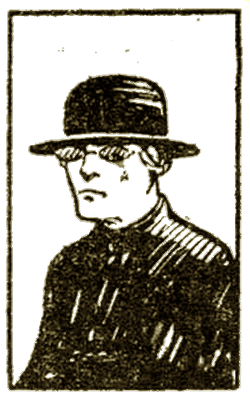
SEXTON BLAKE had two visitors at Baker Street late that afternoon.
One was an immaculately clad gentleman with the ineradicable stamp of the City on him. He might have been lawyer, banker, or captain of industry, and, as a matter of fact, he was a little bit of each, and, again, all three combined. He was one of the persons with whom Blake had been in telephonic communication during the day, and he apparently had information of considerable importance to give to Blake, for, before settling down to a confidential conversation, Blake took the pains to lock the consulting-room door, a proceeding he rarely indulged in.
His visitor was with him until nearly six o'clock, when, after accepting one of Blake's whisky-and-sodas and a cigar, he took his departure.
As soon as he was gone Blake reviewed with great care the notes he had made during the course of the palaver, and he had just finished this when a second visitor was shown in. and it would have been difficult to find two persons more in contrast than the new arrival and he who had just departed.
He was a small, ferrety-looking man of shabby clothes and furtive manner. He seemed to slide into the consulting-room with the movements of a night-prowling weasel, and not until he heard Mrs. Bardell's footsteps retreating down the hall did he attempt to speak. When he did his voice was a low, cautious whisper, breaking at times into a hoarse sort of croak, which he quickly suppressed.
But Sexton Blake appeared to find nothing odd in the little man or his manners. He listened most attentively to what he had to say, and when he had finished he nodded his head as if in satisfaction. Then he took a brown-paper parcel which the other suddenly produced, and, opening it, revealed a blunt and blued revolver.
Blake "broke" it and glanced at the cylinder. Five of the chambers were loaded, and one contained a cartridge which had been exploded. Blake slipped out one of the loaded cartridges, while the little man again began to talk: and then, as his visitor finished, Blake replaced the cartridge and closed the weapon. He placed it carefully in one of the middle drawers of his desk, which he locked. Then he opened his cashbox and took out a sheaf of notes, which he handed to his visitor. The latter stuffed them away, and after a few more whispered words stole off as silently as he had come.
When he was once more alone, Blake drew the telephone instrument towards him and put through a call to Scotland Yard. He was successful in getting hold of Detective Thomas, and what he had to say to that official was the cause of considerable amazement to him. For this was the tenor of the conversation.
Blake: "This is Sexton Blake speaking, inspector. Have you had a report yet from the surgeon who was to make a further probing of the wound in the body of the night-watchman who was killed in Bishopsgate Street last night?"
The Inspector: "Oh, it's you, is it, Blake? Yes, I got a report this afternoon. He found the bullet."
Blake: "Ah! Will you tell me the calibre?"
The Inspector: "It was a .38."
Blake: "Long or short?"
The Inspector: "Short. Why do you ask?"
Blake: "Because I have the weapon in my possession, and if you want to arrest the murderer and the man who was with him I can take you to him this evening—if the birds haven't flown. Will you have a couple of warrants ready?"
The Inspector: "Yes. But, good heavens, Blake, how is this? Who is the man?"
Blake: "I cannot go into details over the telephone, inspector, but if you want to make the arrest I shall take you to the place where the two were in hiding as late as five o'clock this afternoon, if you can be ready about half-past eight it will give us a chance to get some dinner before we go; and, besides, I am waiting for Tinker to return. Can you pick me up at Baker Street?"
The Inspector: "Yes, of course."
Blake: "Well, I shall be ready at that hour. And, by the way, Inspector, I think we should have about four extra men in another car to come along. You will recognise the two birds we are after soon enough when I tell you their names; and they are not likely to surrender without a fight." And more than that Blake would not say.
Inspector Thomas hadn't the faintest idea what Sexton Blake had been up to during the day, nor how he had managed to get hold of what he claimed was the gun that had been used in the killing of the night-watchman in Bishopsgate the night before. But it never occurred to him for one moment to question Blake's statement, for he knew from past experience that if Sexton Blake said a thing was so, then he had good reason for believing that it was so; and if he also said he could take the inspector and his men to the place where the murderer and his accomplice were even then in hiding—well, the inspector was quite ready to place himself in Blake's hands, and although he was now afire with curiosity as to the identity of the murderer, he knew it would be useless to force Blake's hand before the detective was ready to show it.
But at half-past eight that night two long, big-powered motor-cars drew in to the kerb in front of Blake's house in Baker Street, and from the leading one sprang Inspector Thomas. He was in the house less than ten minutes when he emerged with Blake, and from the way in which the inspector moved it was plain that Blake had "loosened up," to use the inspector's phrase. And, although Tinker had still not returned, Blake had decided to accompany the police on the raid, for there were several reasons why he was now as keen as the inspector to lay by the heels the man who had done the killing the night before.
Blake and the inspector, in the leading car, led the way through the West End and on towards the East End, their first objective being the Angel at Islington. They did not pull up directly in front of that famous building. But at Blake's direction the car swung round the corner and drew up in a narrow street round at the back. The other car followed close behind, and then, while the two stood by the kerb, Blake climbed out and proceeded on foot to a small public house on the next corner. He disappeared inside the swing doors of this dilapidated and unsavoury establishment, but emerged almost at once, accompanied by the same little ferret-faced man who had visited him at Baker Street earlier in the evening.
They walked along to the first car, and then, keeping well in the shelter of Blake, as if he was nervous of getting too close to the arm of the law, the little man wheezed out the information that they were waiting for.
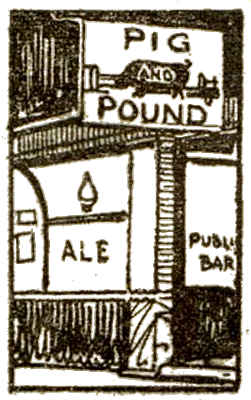
"They're in the Pig and Pound in Bull Lane," he said. "And look out, for they have been drinkin', and they will shoot." Blake nodded and gave his arm a slight push. "All right, Joe," he said. "You had better get out of sight now. We will attend to things now, and I shall communicate with you later through the usual channel." The little man, who was one of Blake's most dependable agents, but who nevertheless had no desire to be spotted by anyone in the district while in conversation with strangers, lost no time in obeying, and as he disappeared round the nearest corner Blake signed to the inspector to get out. The inspector did so, and four men followed from the other car.
The inspector said a few words to his men, and then all six started to walk in the direction of the public-house where the little man said they would find their quarry.
Every man in the Police Force knew of the Pig and Pound public-house in Bull Lane, and knew that it was a notorious rendezvous for the denizens of the underworld and old lags who were enjoying a temporary spell of liberty between seasons in prison. They knew, too, that not only must they count on armed resistance on the part of the two men they had come to take, but also on the part of any friend of the pair who might be desperate enough to join in.
They had already agreed that the best plan was to rush the place in a body and grab their men, if possible, before any organised resistance could be made effective, and as they approached the place Inspector Thomas, who had now taken command, told off his men, two to one door on the corner, two to another round the corner, and two more with himself and Blake for the third door leading to the bar, in which they anticipated finding their men.
Then they divided, and, with the inspector and Blake in the lead, the whole body crashed into the place as one man.
The interior was thick with smoke and rank with the smell of spirits. But even as they sent the swing-doors crashing inwards, Blake and the inspector saw the two men whom the little agent had told them they would find, and each jerked up his right arm, holding an automatic pistol levelled as he did so.
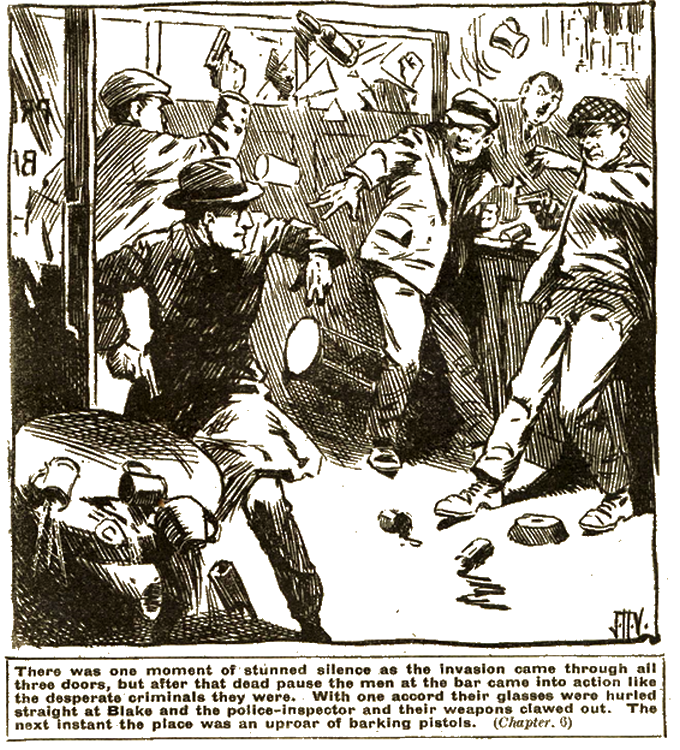
There was one moment of stunned silence as the invasion came through all three doors, but the two men who stood against the bar could read only plainly in the stern eyes boring into them who was wanted, and after that dead pause they came into action like the desperate criminals they were.
With one accord they hurled their glasses straight at Blake and the inspector, and then, as the pair dodged, they clawed out their weapons. The next instant the place was an uproar of barking pistols, yells, screams, curses, and smashing bottles and glasses. In the other bars all the customers seemed to be taking a hand; but Blake and the inspector, with their two assistants, concentrated on the pair they had come to take away, and as the pistols crashed out they shot, just once, then they rushed their men.
Half the bar counter went in under that first rush, and the two desperate criminals leaped over the sagging end with extraordinary alacrity, shooting as they went. But the police covered the hurdle without a pause, and from the other side the rest of the raiding party was now coming. The two crooks had backed up into one corner, and each took a snap shot as the police overwhelmed them, and it was not until they had beaten the pair down to the floor and had slipped the handcuffs on to them that the panting inspector noticed that Blake was no longer beside him.
And then, as one of his men took him by the arm, he gave a sharp exclamation of deep concern as he saw the famous detective lying on the floor, his eyes closed, and, a growing stain of crimson showing on the white of his shirt just above the "V" of his waistcoat.
IT was just eleven o'clock that same evening when John Graves happened to pause in front of the tape machine at his club in Pall Mall, and thereon read a bit of news which was just coming through, which caused him to look grave and then to make for the cloak-room to secure his coat and hat. He secured a taxi in front of the club, and instructed the driver to take him to Queen Anne's Gate.
As he entered the smoking-room he saw Yvonne seated pensively in front of the fire, her lovely red-gold head bowed on one hand—for now that Miss Weldon was resuming her duties the black stain had been removed-and apparently in deep thought, for she did not appear to hear him as he came in. But when he drew up a chair near her, and, after fumbling with a cigar, coughed, and made several times as if to speak, she finally glanced up and smiled at him.
"What is it, uncle?" she asked.
Graves regarded his cigar for a few moments; then, without looking at her, he said abruptly:
"Saw an item of news on the tape at the club just now. Thought you would want to know. Don't know how much truth there is in it, but it said that during a police raid in the East End of London to-night, Sexton Blake, who accompanied the police, was shot and dangerously wounded. Report adds that the police succeeded in arresting the men, one of whom is thought to be the one who killed the night watchman in the Central Insurance building in Bishopsgate Street last night. You have the evening papers there, so I suppose you have read about the burglary which took place, and—Good heavens, I'm a clumsy fool!"
And as he uttered the words Graves threw his cigar into the fire, and was just in time to catch Yvonne in his arms as she went as white as a sheet and fainted dead away.
For Graves had not seen Yvonne since the previous evening, and he had not known where she had been bound, nor just what she intended doing when she had driven off in the car with Alec.
YVONNE opened her eyes, half-conscious that the front doorbell was ringing, and at the same moment became aware that Anna was bending over her, holding a bottle of smelling-salts under her nostrils.
She saw Graves standing close by, and then heard him say something to Anna as he went off, she guessed, to see who was at the door. While he was away she sat up, and, despite Anna's entreaties, insisted on standing up.
She had just done so when Graves returned, and a single glance at his face told Yvonne that something disturbing had occurred to upset him. Her thoughts flew at once to Sexton Blake. Was he—could it be that his wound—And at last she found strength to voice the question.
But Graves shook his head, and said it was nothing to do with Blake. Only Yvonne's insistence made him at last heave a sigh, and take an envelope from his pocket. "I don't know what it means," he said, "and I would rather have waited until the morning before showing you this. However—"
Yvonne took the envelope and extracted the folded sheet of paper which it contained. As she read the contents her hand flew to her throat, and Graves and Anna thought she was going to faint again; but she recovered herself, and for a second time scanned the letter carefully. It is little wonder that the contents were a shock to her, for they ran as follows:
"Dear Uncle,—This is to let you know that I am at present at Vine Street Police Station, where I have been taken by the police from my chambers in Jermyn Street. I do not know why I have been detained, but have secured permission to let you know what has happened. I am innocent of any wrong-doing against the laws of the country, and I think some mistake has been made. Please take the matter up at once, and see what you can do. Use your judgment about telling Yvonne. BOB"
Yvonne Motioned for Anna to leave the room, and when the door had closed after her she said:
"I think I know from what source this blow has come, uncle. It is the work of Sexton Blake."
"Of Sexton Blake!" he exclaimed. "How on earth has he had anything to do with this—and why? Bob himself says he has done no wrong, and he wouldn't say that unless it were the truth."
"I know. Nor has he. But I think I see Sexton Blake's hand in this."
And as she spoke the name, Yvonne's eyes grew hard in sharp contrast to the expression they had held when Graves had first announced that Blake had been dangerously wounded.
"Listen, uncle," she went on. "I will tell what has happened since I left here last night."
Then, briefly, she related what had taken place at the building in Bishopsgate Street the night before, and when she had finished that recital she spoke of the events of the day.
"Something made Sexton Blake suspicious that what took place in that building was not all the work of one person or group of persons," she said. "He is almost uncanny; but while he sent me off on an errand to Inspector Thomas, he took the opportunity to examine the crumpled piece of paper which was in the typewriting-machine while he was in my room. I know that, because there was cigar-ash in it, and he was smoking a cigar at the time.
"He was suspicious of me, and when I was watching him out of the window, when he was at the bottom of the light well, I am certain he saw me. Then when I went out at midday I discovered that Tinker was following me. He tracked me to the room in the other building, and when I heard footsteps pass the door, then stop and re-pass, I grew suspicious, and was just in time to see Tinker disappearing towards the lift.
"Well, the lad stuck to me the whole day, but before I returned to the office I telephoned here, and gave Alec instructions to be in Bishopsgate Street this evening with a taxi. As I anticipated, Tinker was waiting for me, and when I entered a taxi he did the same, but he didn't know it was the one which Alec was driving.
"Well, he fell into the trap, and at this moment he is strapped to an iron cot in one of the rooms above the garage. I was debating what I should do with him when you came in. But now I don't know what to do. I have a feeling that Sexton Blake is somehow behind Bob's arrest, but why I can't tell; and if he is dangerously wounded, then we may not he able to find out.
"In that case Tinker is the only card we hold, and he will have to be used as a hostage for Bob. Of course; Bob doesn't know why he has been detained, for he knows nothing of what I have been doing in the Malee Deep matter. But—but I don't know just, what is the best thing to do now. I Must think—I must think!"
Graves, knowing her so well, did not speak again, but sat smoking and watching her, with no little anxiety, for he knew that, when she did make up her mind what to do, she would do it, and nothing he could say would stop her.
She paced the floor feverishly, and slowly the minutes passed. Then suddenly she whirled, and without a word left the room. Graves heard her run upstairs, and then, a little later, heard her come down. She came into the smoking-room a few moments later, and he saw that she had thrown on a green velvet evening-cloak.
"I am going out," she announced briefly. "A plan has occurred to me; it may work, or it may not. It all depends on how badly wounded Mr. Blake is, and, to a certain extent, on Tinker. But I am determined to pull every string to free Bob, and if we have to suffer, then others must suffer as well! I shall probably be late, uncle."
"Can't I go with you?" he asked. "I should like to do something."
"No, dear. I must handle this thing alone. It is I who am responsible for Bob's predicament."
And with that she was gone.
Yvonne first hastened round to the garage at the back and rang the bell there. It was a few minutes before she heard footsteps inside, and then Alec opened the door. He drew back as he saw her, and she entered. "Take me to the room above!" she ordered briefly.
And the man led the way.
As he opened the door and turned on the light, she stood just inside the door gazing at Tinker, who lay bound and gagged, on an iron truckle-bed. Yvonne motioned to Alec to loosen the gag, then she sat down on the edge of the cot.
"Listen to what I have to say, Tinker," she said. "It is past eleven o'clock, and my uncle has just come back from his club, where he saw on the tape-machine that Mr. Blake was wounded in a police raid in the East End of London to-night. Now, I know all about how you tracked me during the day, and I laid this trap for you while I was out at midday. But things have happened since then, and I am going to give you a chance to go to Baker Street, or wherever they have taken Mr. Blake, on two conditions."
"What are they?" asked Tinker thickly, his eyes dark with anxiety.
"Firstly, that you will give me your word of honour that you will return here as my prisoner if I demand it, and not tell Mr. Blake where you are going."
"You mean to parole me?"
"Yes."
Tinker hesitated; then he nodded his head. "I agree," he said shortly. "What is the other condition?"
"My brother Bob has been detained by the police, and I have reason to believe that Mr. Blake is behind it. I want your promise, if 1 parole you, that you will find out what the charge is to be against him, and to use your best efforts to get Mr. Blake to call it off. You may tell him for me that I think I know his reason, and that I hold you as hostage, and, if necessary, will take, full advantage of that fact. On top of that, are you prepared to give me your word of honour to return here?"
"I have already said so, and I will," responded Tinker. "Just get these ropes off me. If the guv'nor is wounded I can't get to him too soon. And I don't care what happens after. But why don't you come along with me and give him the message yourself, if he is able to see you?"
Yvonne looked thoughtful at the suggestion. Then suddenly she looked at him.
"That had not occurred to me, Tinker. I thank you for it, and I think I shall do as you suggest."
She signed to Alec to release the lad, and ten minutes later Yvonne's two-seater car was speeding towards Baker Street, with Yvonne herself at the wheel and Tinker gazing anxiously ahead into the night.
YVONNE had been waiting in the consulting-room for about a quarter of an hour when Tinker came back from Blake's bed-room. She started up quickly as the lad appeared, and there was a little catch in her voice as she questioned him.
"It's not so bad as they thought," he answered in tones which told her that he was satisfied that this was indeed so. "The bullet struck a rib and travelled round it. He's lost a lot of blood and has some temperature, but he insists on seeing you alone. I have told the nurse to come out, and I will take you along. Here he is now. Will you come?"
Yvonne followed him as a male nurse entered the room, and when Tinker had opened the door of Blake's bed-room for her he closed it quietly, leaving her alone, gazing at the chalky white face on the pillow, which came just within the zone of the shaded light on the night table. Yvonne stole softly across the room, and, dropping Into a low chair beside the bed, touched Blake's hand. Instantly his fingers closed over hers, and he opened his eyes for a moment to look at her. Then his lids fluttered down, and he began to whisper; and so close did Yvonne have to lean to hear him that her breath mingled with his while he talked.
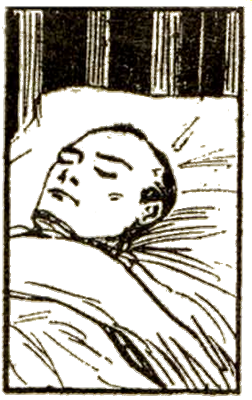
"Glad you came," he said. "Want to say few things. Won't take long. Hadn't been in Marston's office half an hour before—knew had been—double job—night before. Got suspicious of you when discovered you had been bluffing at machine. Didn't suspect identity until this afternoon. Had friend of mine in City make full investigation Marston and his affairs. Know all about Malee Deep and Broken Circle mines now. Found your brother Bob had been mixed up in Malee Deep. Then suddenly knew you were the Miss Carter in Marston's office. Down in light well found broken tip of bamboo, and, later, Tinker found person your description had bought heavy piece of 'Z'-shaped wire in same street. Had seen that trick worked before, and guessed you had used long bamboo pole to slip ladder hooks off window ledge after you had descended from office. Point must have broken and you couldn't find it. Is that right?"
Yvonne uttered an almost inaudible agreement. and Blake went on.
"Wasn't difficult after Tinker tracked you to office in other building. Knew how the whole thing could have been worked then. Was just coincidence other robbery on ground floor and killing of night-watchman. Were you there then?"
"Yes," she whispered.
"Thought it possible," he went on after a little. "Knew would have to bring you out into open, so asked Inspector Thomas arrest your brother Bob and detain him. Knew that would bring you out, if anything would. Knew you had nothing to do with killing, but know you took tartan-covered box of proxies from Marston's private safe. Want that box. Tinker told me all about being free on parole, but can make things nasty for both you and your brother. Anyway, not necessary keep tartan-covered box. Know all about Marston. Creeve of the Broken Circle, too. Marston been trying double-cross Creeve. Creeve been trying double-cross Marston. Two now at odds. But must hand back proxies to Marston. Intend telling him when do so that I know all about his scheme, and if he goes ahead with it leaves himself open to prosecution for conspiracy. Think he will hesitate. Then you have your chance. With him and Creeve working against each other you can jump in and control meeting next week. But must have tartan-covered box of proxies and other things you took from safe. That is all. What is your answer?"
"I—I will do what you wish," she whispered brokenly, as she gazed at his white face. "I promise you that I shall put everything in Tinker's hands in the morning. Don't worry more now."
His fingers again tightened on hers as he murmured:
"Thank you! Thought you would. Tinker has already telephoned to Inspector Thomas to have your brother released."
Then he grew silent, and, with a deep sigh, he murmured something which Yvonne could not distinguish. But he would not release her hand, and it was not until he had passed into a restful sleep that his fingers slackened and she was able to rise.
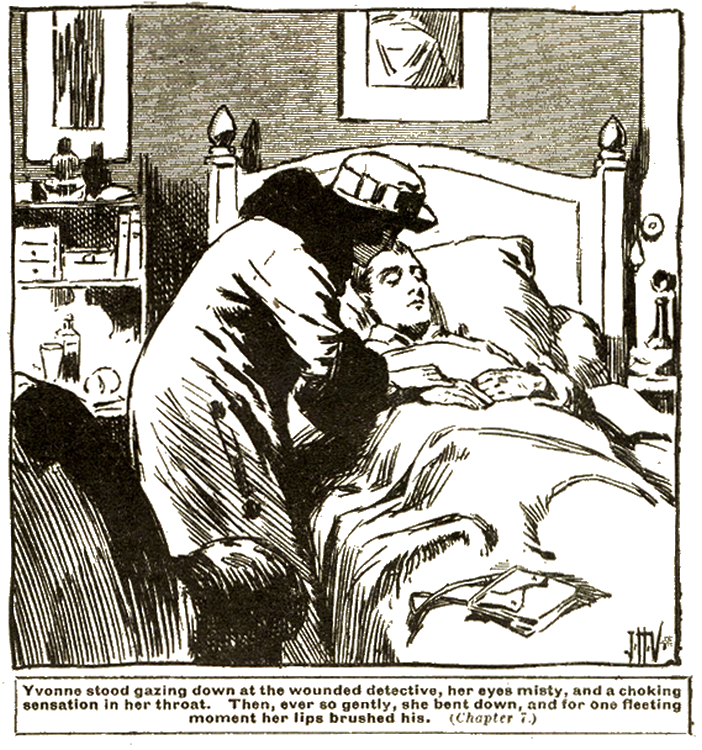
She stood gazing down at him, and as she studied the strong but now helpless-looking man beneath her, her eyes grew suddenly misty, and a choking sensation came into her throat. Ever so gently she bent down, and for one fleeting moment her lips brushed his. Blake stirred, and in a sudden panic lest he should awake she turned and stole from the room. Nor did she notice that Tinker's gaze was curious as his eyes fell on her flushed countenance.
"I don't hold you to your parole, Tinker," she said, laying her hand on the lad's shoulder. "Mr. Blake will need you here, but I want you to come to Queen Anne's Gate in the morning. I have a packet which I wish to give you."
"I know all about it, mademoiselle," he said, "and I have already phoned to Inspector Thomas about your brother. That was a bluff of the guv'nor's."
"And it worked just as he thought it would," she murmured softly, as she thought again of the man in the sick-room.
JACOB MARSTON called at Baker Street the next afternoon and received from Tinker all the property which had been taken from his safe. He was also permitted a few minutes' interview with Blake, who did not mince matters in telling him just where he would stand if he went ahead with the plot he had been building.
So Marston had no choice but to call off his scheme.
As for Bob Cartier, equipped with the shares which Yvonne and Graves had been steadily purchasing for some weeks past, he was the controlling force at the extraordinary general meeting of Malee Deep, which was held some days later. And someone must have whispered a cautioning word into Creeve's ear as well, for that gentleman, like Marston, thought discretion the better part of valour, with the result that by an overwhelming majority the shareholders turned down the proposal to sell the property to the Broken Circle group, and finished the day by unanimously electing Bob Cartier managing director of the company.
As for the two men who had been arrested In the raid in the East End, the leading spirit, an old lag known as Dover Joe, was convicted on the confession of his mate of the murder of the night-watchman, while his accomplice got off with fifteen years' penal servitude.
It was a conviction that gave great satisfaction to Detective-Inspector Thomas, for that official had been trying to lay Dover Joe by the heels for some time.
But the inspector never did rightly understand about the burglary in Jacob Marston's office the same night, and by the time Sexton Blake was well enough to enlighten him—which he had no intention of doing—they were both engaged on other cases, and the incident of the tartan-covered box then existed only as a record in the famous Index from which this relation has been transcribed.
Roy Glashan's Library
Non sibi sed omnibus
Go to Home Page
This work is out of copyright in countries with a copyright
period of 70 years or less, after the year of the author's death.
If it is under copyright in your country of residence,
do not download or redistribute this file.
Original content added by RGL (e.g., introductions, notes,
RGL covers) is proprietary and protected by copyright.