RGL e-Book Cover
Based on an image created with Microsoft Bing software
Roy Glashan's Library
Non sibi sed omnibus
Go to Home Page
This work is out of copyright in countries with a copyright
period of 70 years or less, after the year of the author's death.
If it is under copyright in your country of residence,
do not download or redistribute this file.
Original content added by RGL (e.g., introductions, notes,
RGL covers) is proprietary and protected by copyright.
RGL e-Book Cover
Based on an image created with Microsoft Bing software


Adventure, 1 March 1932, with, Chullunder Ghose the Guileless"
THE "King's Regulations" are less elastic than a bronze tablet; there is the devil to pay for the least infraction of them. So when Sergeant Sam Trelawny killed in cold blood, with the butt end of a rifle, Captain Eustace Laidlaw, and they locked him in the regimental cells, he was provided within the hour with a postage stamp, pen, ink, envelop and paper. He had the right to summon an attorney or his next friend. No one doubted why he had killed Laidlaw, although no one saw him do it. Laidlaw was the kind of officer whose insolences always lead to something ugly in the long run. He had a fixed idea that success depends on self-assertion and on snubbing one's inferiors. No one was sorry for Laidlaw.
On the other hand, the regiment was shocked on Trelawny's account. He was much the most popular sergeant—perhaps a shade too popular. He could box, and he was captain of the cricket team as well as football center forward.
He never nagged, but he had the trick of teaching duffers how to shoot straight and to keep out of trouble. He was known as a patient man, a good sport and a reasonably tactful blinker at offenses if offenders also used tact. But there was always a light in his blue eyes that suggested a terrific temper if one vexed him hard enough. They were the eyes of a killer, and he had rather high cheekbones under them. There was pride on his lips, beneath the neat mustache—a kind of gambler's pride, that equally delights in self-control and in daring life to spring surprises.
All the officers, of course, were forced by their position to show indignation; but the men were almost openly in sympathy with the sergeant and there was talk, the very first day, of a subscription fund for his defense, and of the names of suitable attorneys. It was agreed on all sides that Trelawny's only possible chance to escape hanging was to be committed as insane.
They began really to believe him insane when it was learned, from the orderly who mailed the prisoner's uncensored letter, that the "next friend" to whom he had written was not an attorney at all, but Chullunder Ghose, an obese Bengali babu, who notoriously made his living doing odd jobs for the secret service, and by means of any other subtleties that agreed with his curious disposition. Chullunder Ghose was rumored to have been in Tibet two or three times; he was known to be familiar with all the byways of the mountains that guard India's northern frontier; and nobody pretended he was not a master of evasion and peculiar resource. But he was not, in the opinion of the rank and file, the sort of person to depend on in this case.
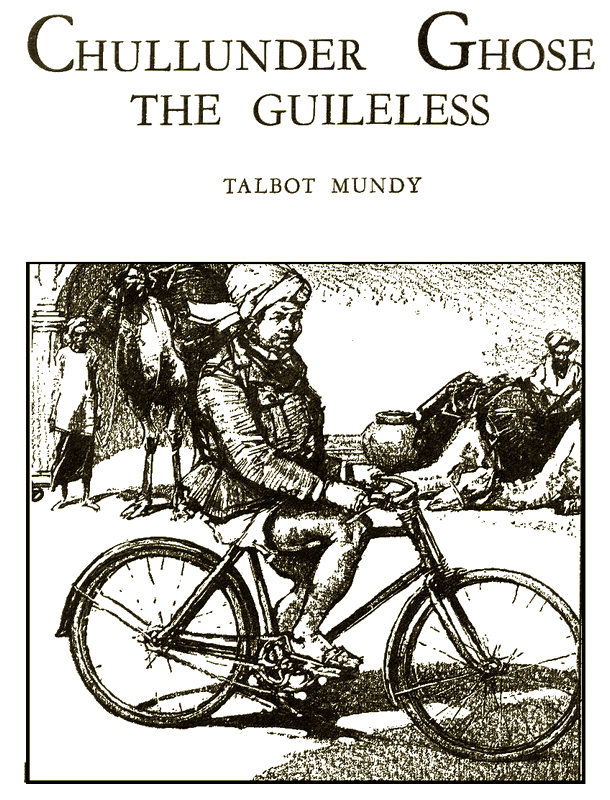
He arrived on his bicycle—so huge it was a wonder the machine could bear his weight. He leaned the bicycle against the wall of the orderly room, in flagrant defiance of regulations, produced his letter, was searched for contraband and presently waddled away toward the cells that looked out on the barrack yard with their backs to the mountains. There, in full view through the cell bars, but out of earshot of the sentry, he sat on a four legged stool and faced Trelawny, who sat on the cot with his chin in his hands. They were opposites—as opposite as two men can be, racially, in temperament, habit, appearance and attitude toward life.
"Did you kill him?" asked the babu, with his head to one side. It was an enormous head, wrapped in a purple turban that was out of harmony with his English tweed shooting jacket and white Hindu loin cloth.
"Yes."
"Why?"
"Because," said Trelawny, "he had baited me and sneered at me until he wore away the screen o' convention between us. He never could rest until he'd seen my thoughts raw-naked and they weren't good even for myself to see. He peeked and he pecked till something popped out through a hole in my hide; and, next I knew, he lay there with his head stove in, and my gun butt bloody."
"Why me? Self am penurious person uncontaminated by a legal viewpoint," said the babu. "Furthermore, am said to be a reprehensible and dissolutely minded dealer in opprobrium. So, should I even sit beside you at your trial, judge and jury would—"
TRELAWNY'S voice sounded hollow, as if it came from the cavernous depths of his being.
"There's going to be no trial," he said.
"Unless they find you mad before your trial," said the babu. But again Trelawny interrupted:
"I'm as sane as you are. I'd never have killed him if he hadn't blown his nose contemptuous and promised to have me reduced to the ranks for being impudent."
"No witnesses to what he said?" the babu asked him.
"No. None. It's a case of hanging."
"You should engage an attorney, sahib."
"Hanging is no way to die," Trelawny answered. "You remember when I saved you from a Hillman's tulwar, that time when you may—or may not have been selling ammunition to 'em? I never asked no questions."
"Sahib, I was engaged on a little espionage on that occasion."
"Did I save your neck?"
"Yes."
"Save mine."
"Sahib, this babu is ninety-nine decimal ninety-eight per cent pure opportunist, and the other two hundredths per cent consist of disrespect for justice as the world delivers it to persons such as you and me. But how shall I save your neck unless I bribe the hangman to provide a rotten rope?"
"Help me out o' here. I need a hacksaw."
"That is simple."
"And maybe a short crowbar."
"Can be managed."
"I shall also need disturbance o' some sort to draw away attention when I'm ready to get through that window. I've no watch. I'll have to figure midnight as the moment when the moonlight hits that drain in the cell door. That's when I'll make my getaway—the next night after you deliver me the hacksaw."
"But where will you go? Be thoughtful. Who will hide you in Peshawar?"
"You will."
The babu smiled.
"Am convinced that self-amusement is divinest human faculty, and all that. Thought of entertaining you is exquisite. But he who laughs last is the one who gets away with something. Verb. sap. They would find you. They would hang you. They would give me ten years in the prison. I should not smile."
"All I ask is half a chance."
"To do what, sahib?"
"Die some other way than hanging. Dammit. I've lived clean, Chullunder Ghose. I've done right in the line o' duty, and there's many a recruit has learned from me to take his physic standing up. But I've killed an officer, and that's the end o' me. I'm asking you, as one man to another, to give me a chance to die respectable. Hanging's no death for a man. There's dirty sneaking murderers who kill for money—"
"Truly, sahib. Only last night three soldiers and two policemen were stabbed in the back for their rifles and boots; and when you sent for me I had already offered to detect the culprits. There will be a big reward. I think I know who did it."
"Let 'em hang that kind if they can catch 'em " said Trelawny. "Did or did I not risk getting killed to save your fat old neck, Chullunder Ghose?"
"This babu's blood runs cold again to think of it."
"Then are you going to help me?"
"How? Am pauper without influence. Am coward, totally devoid of bloody-mindedness. Am mountain of obesity, whom any one could see if I should play at hide-and-seek. Am—"
"Listen. You're the downiest, artfulest dodger I've met in a lifetime," said Trelawny. "What's more, you're a brave man, even if you do get the wind up your spine. And you're on the level, even though you are the damnedest liar in the universe. You never in your whole life let a friend down. I'm your friend; I've proved it. Now what?"
"Shall I go to prison for you? Oh, well—"
"No. Keep out o' prison. Use that great fat head o' yours that's as full o' bright brains as a nest is o' hornets. Think me up a chance to die a white man's death and, if I've no time to say thank you, I'll die knowing I made anyhow one friend in a lifetime. Will you do it?"
"Sahib, it is contrary to my religion. It is conspiracy, which is against the law. It is unwise, probably impossible and very risky, to say the least. It is ridiculous, and it is also incredible. Besides, I have other important business."
"So you won't?"
"Yes, I will—and for those reasons. Business and pleasure, sahib, sentiment included. You must have a wakil—an attorney."
"What for?"
"To allay suspicion. I will send you an attorney. Tell him nothing."
"Right-o. Will you shake hands?"
CHULLUNDER GHOSE, who almost never told the plain truth except to those who understand it (and who are they?) lied in declaring he had no influence. He had a lot of it, as any one must have to whom a steady job is absolute anathema but affluence is heaven. It was backstairs influence; and it was based on intuition, incredulity, observant wits, and knowledge.
"Justice cheated of a victim must have substitutes, or it will substitute this babu. As a martyr I am not good sport," he muttered.
He easily obtained a hacksaw with a spare blade from a blacksmith in Peshawar bazaar; and the same man made him a small crowbar that could be slipped up a sleeve or down a pants' leg. Also, very easily, he bribed the brother of the sweeper whose duty it was to clean the cell in which Trelawny was confined. The brother agreed to give the implements to the sweeper, who was to hide them under the mattress in the cell while Trelawny was having his exercise out in the yard. There was almost no risk of failure in that part of the plot.
"You are to tell that sweeper person," said the babu, "that unless he succeeds, he shall himself be whipped and sent to prison; because I will tell to a magistrate all I know about him."
There was also sweet simplicity about the next step, although it was based on intricate familiarity with men and habits that are not more simple than the differential calculus. He knew Peshawar—understood it. So he visited a man from Kandahar—a bitter-faced Moslem with a boil on his nose, who was lodged among the horse and camel traders at the back of the crowded bazaar, and who camouflaged cupidity by looking as if no sympathy, and nothing but the stings of bad luck, ever entered his experience. Ali Ahmed sat cross legged on a pile of sacks beneath the tin roof of a ramble-shack veranda, very displeased by an Afghan's comments on the dissolute condition of his nose. It was plain he expected mortifying humor from the babu, and his lip curled in anticipation.
"One of these days," he remarked by way of greeting, "that cheap bicycle will buckle beneath your weight. That will be funny. I hope I may live to see it. Why did you say you would be here two hours sooner? You have kept me waiting."
The babu leaned the bicycle against the side of the veranda.
"I was interrupted, sahib."
He sat down on another pile of sacking, perfectly aware that the man from Kandahar suspected him. A reputation for doing odd jobs for the secret service soon spreads. It needs guile to overcome that.
"How is business?"
"Allah! Business? There is none."
"I suppose not," said the babu. "I should dread to be in business—with all these murders going on." He looked straight in front of him, avoiding Ali Ahmed's eyes, and then suddenly changed the subject. "But I have heard you have bought a dozen camels."
Relief from sudden strain betrayed itself in the change of Ali Ahmed's tone of voice. Apparently he was not pleased to speak of murder. Business was less embarrassing.
"Nine-and-twenty vicious brutes that eat their heads off—and no market for them," he answered.
"Why not sell them to the government?"
The man with the boil on his nose made a noise such as camels do when irritated, only his noise was sharpened a bit by sarcasm.
"There are no brains in all that fat carcass of yours. I bought them from the government."
Chullunder Ghose suppressed the obvious retort. He wished not to appear to have too many brains. His eyes managed not to reveal a glimpse of the humor that lurked within him—based on triumph.
"T am sorry for you," he said in the courteous tone that stirs no animosity. "I think it is a scandal that the government should sell unmanageable camels to an unsuspicious dealer. Who would buy such brutes if he knew they were vicious?"
All those camels had been bought at auction "as is," after being advertised as "unsuitable for government use." Chullunder Ghose was perfectly aware of that. He knew they were intended to be resold, someday, somewhere, as perfect specimens.
"I was very badly cheated," said Ali Ahmed. "It is not a wonder that the people are rebellious against this government, which deals so scurvily with honest men."
CHULLUNDER GHOSE exuded sympathy.
"And furthermore," he remarked, "the courts are useless in such circumstances. Self can think of scores of instances where suits against the government have ended only in humiliation and the court costs mulcted from the plaintiff."
"Too true," said the other. "We are cheated on every side. One can not even gamble without being cheated."
Chullunder Ghose pricked up his ears at that last remark and made a mental note of something. Any one who knew him intimately might have guessed now by the smile in his mild brown eyes that he had stumbled on a hot scent. Murder and gambling are usually closely associated in Peshawar.
"Therefore, there is nothing for it but to use such wits as God provided," he remarked. "It is a mystery to me that Ismail—at whose house I also sometimes gamble and get cheated—was not long ago knifed in the liver."
"Inshallah, that might happen to him yet," said Ali Ahmed.
"But, let us hope, not yet," Chullunder Ghose suggested, catching the thought behind the words. They were pious words. They were calmly spoken.
But the babu knew he had guessed rightly that the reason why a knife had not yet found its target in the lungs of Ismail the gambler was that Ali Ahmed needed him. Why did he need him? Once more he switched the subject.
"Some Pathans have started again stealing rifles. Did you hear that two policemen and three soldiers were slain —by Pathans—last night, for their weapons and boots?"
"I heard it," He paused and Chullunder Ghose noticed the pause. "But who knows that was done by Pathans?"
"True, who knows? I have heard that orders have been given to the troops to shoot at the first provocation, after sunset. I am thinking, if those camels should be caused to stampede through a barracks in the darkness, they would certainly be fired on. If it could be shown—by the mouths of reliable witnesses—that some one in a uniform was seen to cause the camels to stampede by making terrifying noises, then the government would have to reimburse the owner of said camels. Not too many people in the secret. And no money for the witnesses until after the case is won and compensation ordered by the court."
"You are a genius," said Ali Ahmed. 'T desire to leave Peshawar, but I do not wish to take those camels with me. I would rather buy other, more suitable camels. But what do you expect to get from this?"
"Your honor's good will. Who knows how soon he may need a friend?"
Ali Ahmed covered the boil on his nose with his hand, perhaps to soothe the inflammation. Or, it may have been he did not wish to let his smile be noticed. It was a mean smile.
"I am a true friend when it pleases me," he answered.
"And it happens," said Chullunder Ghose, "that I know this: Tomorrow night, at midnight, there will be a murderer confined in the cells at the back of the barracks in which the Queen's Own Loyal 88th Light Infantry are quartered. Do you know them? They will be particularly nervous, since there is a rumor of conspiracy to rescue the prisoner. There will be a double guard undoubtedly. And should an avalanche of camels suddenly descend upon them they will very likely turn out a machine gun. Have you ever seen a camel shot by a machine gun? It converts a camel into something that not even expert witnesses could asseverate has any value."
"It is worth thought." said Ali Ahmed. "It might be managed."
"Think swiftly then. Tomorrow is the only night that is suitable. I can see to it that half a dozen soldiers shall be treated by a friend of mine to more beer than is good for them. They shall be sent home close to midnight in time to escape arrest for absence without leave. Any one can say, without incriminating them, that their hilarity was what alarmed your vicious brutes and made them stampede."
"Are you sure you can do that?"
"Yes. And let me tell you that the way to bring those camels silently is to follow the road that leads around the barracks, because that is a lonely road at night; moreover, it is inches deep in dust, so that the camels' footfall will be unheard. Turn them back when they are past the barracks, and then stampede them through the gate that is kept open for officers' motorcars. It is simple. It is easy. But select your witnesses and be on time—at midnight to the minute."
He with the boil on his nose demurred a moment and his normal distrust stole into his eyes, that had been flinty with the hope of profit. Nobody would know the camels were the same ones that the government had sold him; he could demand a high price for the dead ones; it would hardly matter if a few survived the midnight butchery. But what about the babu?
"Later, you will come to me," he said. "and threaten to tell tales unless I pay you handsomely."
"If I should do that," said the babu, "I should certainly expect to get a long knife in the belly. This babu has several ambitions. None of them includes a funeral for having danced on dynamite or for having made threats to one who has as many scoundrels in his pay as you have."
"True. It would be dangerous," the other answered. "Nevertheless, you do expect to make a profit for yourself. What is it?"
"Profit?" said the babu. "Why, yes, I must live; am sole support of wife and offspring. I expect to introduce to you a pleader who will take your case before the courts; and he will pay me for the introduction."
"How much?"
"Twenty per cent of his fee," said the babu, guessing wildly.
"You must split that with me."
"I expect to. Why not? Business is business. Then you will be there with the camels?"
"Yes. At midnight."
CHULLUNDER GHOSE called next on Kangra Khan, a wakil with gold rimmed spectacles and a nose which suggested that other men's troubles are sometimes entertaining as well as profitable.
"Who will pay me?" he demanded.
"I am curious to know that also," said the babu, "but I think the other sergeants may raise a subscription, and perhaps all the men will contribute. Go and see Trelawny and then get your money in advance. Did you ever know me to bring you a bad case?"
"Yes," said the attorney, "very bad ones. But they are sometimes funny."
"Self am of opinion that being hanged is neither good nor funny," said Chullunder Ghose. "Am full of mockery of what is known as justice. I will come and see you after you have seen your client."
Then he pedaled his bicycle through the dust, in the teeth of a wind that made his fluttering loincloth look like linen on the line. But he was not too occupied with the exertion to observe a couple of policemen pasting notices on walls, announcing in two languages a big reward for the assassins dead or alive who had slain two constables and three British infantrymen.
At last he reached the outskirts of the city and turned down a narrow alley between walls of mud and corrugated iron. He was seen approaching. Evidently he was known there, if not expected. A door in a wall swung open and he wheeled in, dismounting in a smelly yard where chickens picked amid the refuse of untidy generations. A disreputable looking Hillman shut the door and locked it.
"Ismail, why this thusness?" asked the babu. "Whom have you killed? Why do you look like a dead bellyache that some one slew with paregoric? What are you afraid of?"
"I fear only Allah!" the man answered. "But His peace resides in wisdom. Therefore, there will be no gambling here this afternoon."
"Who spoke of gambling?"
"Why else should you visit me?" the owner of the place demanded.
Impudence was too much for his spirit to attempt just then, but he could be surly. His long earlocks, oily black and curling upward, hung like inverted question marks. His yellow teeth showed in a crooked slit that might be either smile or sneer. His eyes were sulky—almost smoky—with suppressed anticipation—of what? The babu shrewdly diagnosed it.
"Big game last night? Who got cheated? Who has threatened to inform against you?"
"Babu-ji, as God is my witness, nobody but I was cheated."
"Your God is a long way off and you can lie to him safely until you are dead," said the babu. "But to lie to me is different. I take more notice of it than your God does. Do you think I fill this belly by keeping the secrets of fools who reward my discretion with lies in reply to a civil inquiry? Do you think I want to know for curiosity? And do you think I care that somebody gets cheated? How, though, shall I mystify the constables and save you from a fine, and perhaps imprisonment, unless I know the circumstances?"
"Sahib, who has talked against me?"
Chullunder Ghose, as confidently as the pious pray, and as the builders build on bedrock, summoned the gods of probability to guide him. He had not much else to go on than his intuition and his knowledge of the customs of Peshawar. But he hesitated no more than a man in ambush dares to who takes a pot shot at a sound in darkness.
"He who bought the nine-and-twenty camels from the Sirkar—he whose nose is like a red hot rat that gnaws him—he who—"
"Ali Ahmed? That Kandahari dog? That unbelieving mongrel whelp of a shameless mother? Sahib, you astonish me!"
"Then why not look astonished, instead of scared out of your wits?"
"What did he say, bahadur?"
"Now I know you lie to me! How often does a Hillman call a Hindu by a title of respect unless he intends to deceive the Hindu?"
"But what did he say, sahib?"
"It is on what you say to me that destiny depends. It is a simple little matter to silence Ali Ahmed if I know the truth about him."
"Not so, sahib. He has many scoundrels in his service, bold ones—as indeed he must have who proposes to sell rifles to the Hillmen on his way home. Ali Ahmed needs to say but 'Basta!' and his enemy lies dead before tomorrow's sunrise."
"How do you know?"
The Hillman avoided the question, blurting scraps of truth to cover other truth he wished to hide, and adding flattery to make, the truth he did tell seem untruthful.
"Sahib, it was not I, it was he who cheated. Ali Ahmed always cheats, but who dares to accuse a man whose servants murder at his bidding? As an honorable babu, to whom treachery is impossible, you are trusted by all and sundry. Nobody is fool enough to doubt your honor. But your honor knows that there are other men of unspeakable character, whose treacheries enable them to plunder people like ourselves."
"He does a rifle business, does he?"
"Sahib!"
"How do you know he does a rifle business?"
"By the beard of the blessed Ali, I know nothing."
"Yes you do. You know this: If I choose to, I can tell the name of who slew Mahommed Tirah, whom the constables found in the street three months ago."
"That was a fair fight, sahib. He had sought to make my young wife run away with him."
CHULLUNDER GHOSE, who had not known who slew Mahommed Tirah, but who knew now, restrained himself. "I was seen to come here," he remarked. "I am expected elsewhere. I should be looked for if I did not turn up."
"Allah! It is wisdom to trust a tiger rather than a babu!"
"Then let me tell you, Ismail, there is a difference between men and tigers. It is a big difference. For if you let a tiger escape from a trap, he will turn and. devour you. But a man who is spared by one who might, if he chose, betray him to the prison and the hangman—if he is at all a wise man—offers proof of gratitude. Am personally of opinion that gratitude is trash unless gratitudee can use same. What do you say?"
"Sahib, I have hardly any money. I have told you. I was badly cheated by that Kandahari scoundrel, Ali Ahmed."
"How do you know he does a rifle business?"
Terror struck Ismail.
"No, no, sahib. To betray him is too dangerous. Allah! I would love to slap him on the sore snout and to enjoy his smarting before seeing him dragged through the streets by Sikh policemen. Dearly I would love it. But I dare not. He is valuable to his rogues. They would avenge him. Allah! It is not amusing to be tortured in the wav they do it-"
"True," said Chullunder Ghose. His own bulk shuddered at the mere thought. "Should Ali Ahmed learn that you have talked about his cheating, and about his business in rifles, how long would it be before those men of his descended on you? Yours is not a comfortable prospect. That is to say, unless you take me into confidence. I am an expert confidee, to whom it is safer to tell secrets than to leave me to discover them. And how about a thousand rupees?" "Allah! Whose?"
"Mine, Ismail. You shall have a thousand rupees on the day when Ali Ahmed hangs."
"You will dare to do that?"
"Where do they hide the stolen rifles?"
"Allah! Nay. I know not"
"If you do not know, then why so afraid of Ali Ahmed? You know where the rifles are hidden. You tremble whenever you think of what might happen to you if you told the secret. You had better tell me."
"Sahib, I do not dare to tell you."
"So you do know. Very well then, I shall have to use my own wits and omit you from the list of fools whom it amuses me to spare. Open that door. I am going.
"Nay, nay. Stay and talk this over, sahib."
In Ismail's eyes there lurked the wish to plunge his knife into the babu. And again, his hesitating hand was even more suggestive than his eyes. But the babu had a whistle. It was a police whistle. He was playing with it. And besides, enormous though he was, and timid though he might be in the face of steel, he had a reputation for astonishing skill in self-defense. What looked like fat was the same sort of bulk that Japanese wrestlers cultivate.
"Either open that door, or else open your thought." said the babu.
He was watching Ismail's chest—the telltale movement of the loose, untidy shirt that would reveal what the man's eyes might deliberately mask. The sinews underneath the shirt relaxed. That danger vanished. Instantly the babu took advantage of the vacuum it left behind it. He sprang like something shot forth from a crater. Weight, strength, suddenness, determination, skill—all concentrated on the one objective—struck. There was a fluttering cackle and scream of frightened chickens as Ismail fell, writhed, tried to struggle against a grip like a gorilla's; then he lay breathless, staring upward at the bulge of the babu's belly and at the blade of his own knife, stolen from him by a hand that looked able to use it. The chickens resumed their rather hopeless scratching in the compound dirt.
"You attacked me," said the babu. "I am wondering why you did that. If I were vindictive I could kick you in the liver. I could slit your gullet with your own knife. I could cut out that useless tongue that fears to talk to me."
"Let me up. I will tell," said Ismail.
But the babu accurately gaged the value of a Hillman's promise.
"Tell first," he retorted. "Self am also opportunist, to whom bird-in-handish-ness is better than a meal next week. Make it snappy."
Ismail surrendered.
"Allah! I will not tell. But let me show you."
"Thought so. Get up. Is this your knife? Take it. Now attempt to kill me with it. Come on. Are you timid? Lesson will cost you nothing except pain and humiliation; they will charge you nothing at the mission hospital—all free, including use of hymn book and admonishment. You are afraid to stab me? Or, you are ashamed to do it? Or, you think it unwise? You know nothing about wisdom, let me tell you. Nothing. Absolutely nothing. Had you any, you would kill me. Because otherwise you will have to obey me. And obedience is pleasant only to the obeyee. You dare not kill a chicken. No, you dare not. Liar, am I? Let me see you kill one."
ISMAIL caught a chicken, trotting after it in circles until the bird grew too bewildered to escape. He killed it by the Moslem halal process, which is sanguinary, if effective. Chullunder Ghose seized the dead bird, swung it and splashed Ismail with the blood; he made a merciless mess of his shirt and trousers.
"Now you look like what you are: a murderer, a brawler, a disturber of peace. If a policeman saw you there is blood on you, blood on your knife, fresh blood—whose? Who knows? But he would take you to the kana for investigation. And how long would it be before Ali Ahmed heard of that? And when it had been proved—tomorrow, maybe—that it is only chicken's blood, and you have been released—then what? How much of your story will Ali Ahmed's men believe? Not one word of it, except that the police have locked you in a cell.
"They will say you have told the police their—his—Ali Ahmed's secrets. They will cut your toes off, one joint at a time; then your fingers and thumbs; then your ears; then your nose. They will tear your tongue out. They will put out your eyes with the points of their knives. Nor is that all. And what is left of you they will throw down your well and befoul it forever. You desire that? Very well then. Take that smock off the line. It is not yours? What do I care. Take it down and put it on. Then lead the way to where those stolen rifles are. And if you try to play a trick on me, I will immediately summon a policeman to whom I will denounce you as a man who has blood concealed under his smock. I will ride my machine. Lead the way."
No less bewildered than the chicken had been, Ismail led the way, through the door and down the alley, to an old barn in an abandoned compound. There was a litter of dismantled, almost prehistoric motor cars, some useless lumber and a ton or two of trash in damaged barrels—nothing that even a pariah sweeper could convert into money.
"They are under the floor in that barn," said Ismail.
"Prove it to me. Krishna! Do you take me for a small boy at a cinema? Because you say so, do I think so?"
"Sahib!" They were in the shadow of the mud wall, face to face, the babu's hand laid flat against the wall to keep him upright on his bicycle. "If we were seen to enter that places—"
"Very well then, I will summon a policeman."
"It is all very well for you. You have a bicycle. By Allah, if any one saw you, you could ride away. But what can I do?"
"Idiot! Abominable foundling from a thrice contaminated mother! You shall have my bicycle."
"I can not ride it, sahib."
"Yes, I know that. If I knew you could, I would not let you have it. Take it. Lead on. Lift it. Carry it inside and set it down for me against the barn."
"But I dare not."
Cows kick suddenly, but not with the speed nor the unexpectedness that lurk in Chullunder Ghose's right foot, used to tramping under his enormous weight and to hoisting him easily over obstacles. It shot forth and was back beside the other foot so swiftly that the degenerate Hillman only knew his stomach hurt him, and that the earth had risen unexplainably; it had hit him as a bat hits a ball, from underneath with a thud. It jarred his teeth. He had no breath with which to name the name of Allah.
"Lead on," said the babu. "Lead the way in. Crawl in. If your ancestors should see you they will recognize you down on all fours. No one else will. I will bring the bicycle."
So Ismail crawled into the compound, and the babu carried his precious machine for fear of rusty nails that might puncture the tires. There was enough of the heaped up litter to provide cover for Ismail.
"They will kill you if they see you," he whispered from behind the ruins of an old Ford body.
"If they should, the police would accuse you," the babu answered. "Do you think I was absurd enough to enter your back yard without informing the police where I was going? You had better pray to Allah for my long life. Go into the barn and see if any one is in there. Should there be—and if he kills you—count on this babu to weep a little; such a good scheme will have gone wrong."
Ismail obeyed. He whispered from within the barn. He stuck his head out of the hole in the wall he had crawled through, after moving away a broken crate.
"Come, sahib, there is no one in here."
"Who are you to give me orders? Are the rifles in there?"
"Yes, sahib. They are under the timbers of the barn floor. Come and see them."
"Show me one. One is enough. Stick it out through the hole. If you don't, I will call a policeman and say I saw you put the rifles in there."
PRESENTLY the butt end of a British service rifle was thrust through the hole for the babu's inspection. He was careful not to touch it with his fingertips. He let it rest on the sleeve of his coat while he examined it to make sure it was new and had been stolen recently. Ismail was quite capable of having brought him to an ancient cache, for the sake of only Allah knew what treachery.
"Put it back and come out," he commanded. Then, as Ismail emerged, "How many rifles?"
"Many."
"Ammunition?"
"Much of it."
"Um-m-m. Each rifle and each cartridge worth its weight in silver—plus a premium for distance—plus another premium for local competition. Krishna! If I could depend on you to hold your tongue, I might remove those rifles to a safer place. I might sell them. I might pay you a percentage."
Ismail, on hands and knees again, led the way out of the compound. He peered long and cautiously in every direction before he stood up in the shadow of the wall. Then, tempted for the moment to forget he had been kicked by a despised Bengali, he asked—"How much percentage?" Chullunder Ghose promptly insulted him.
"Dog! Unbeliever in your own religion! Belly crawler! Such percentage as you earn, and no more! I will pay by results—by results, do you understand that? And now listen. Tomorrow, two, or it may be three hours after midnight, I will come and take away those rifles."
"Where will you put them, sahib?"
"Fool. In your house. Where else?" He avoided Ismail's eyes. There was no need to see the indications of panic; he could feel them. "All you have to do is get that barn door open for me. If I find it unlocked, I will enter and remove the rifles. If not, I shall know you are more worthless even than you seem, so I will go away. And since the fault will be yours, and I shall in that case have lost my profit on those rifles, I will betray you to the police as having stolen them. Now, do we understand each other?"
Ismail nodded. Hatred had him by the throat. He hardly dared to speak for fear the babu might detect the thought behind the words. However, he needed information.
"How will you carry all those rifles, sahib?"
"I will bring two strong men."
"Only two men?"
"Idiot. Should I bring a caravan of camels? Should I bring a brass band? It is no distance from here to your house; two men and myself can make, if necessary, two or three trips. As for you, I advise you to go to Ali Ahmed and suggest that, though he did not cheat you at the gambling, nevertheless he made a slight mistake. Request that he should rectify same."
Ismail let a smile escape him. It was plain to him that after all the babu was a rather simple minded person.
"Has your honor ever dealt with Ali Ahmed?"
"Seldom. But I think I understand him. If you go to him and air your grievance, that will quiet his suspicion; he will not imagine you are bent on vengeance. Oh, but what a vengeance you shall see when we have taken away those rifles! We shall leave one rifle in there. Some one else shall tip off the police, who will discover it and pounce on Ali Ahmed. They will hang him and his whole crew. Now remember, all you have to do is have that barn door open, tomorrow, two hours after midnight. I will attend to the rest of it."
He rode away, not glancing backward, but his mirror on the handlebar showed Ismail standing near the corner of the compound wall, and Ismail's gestures were as satisfying as the feel of money in the hand. Chullunder Ghose subdued a chuckle that might have betrayed him, because his back might be as indicative of emotion as was Ismail's face. Ismail would reveal the plot to Ali Ahmed; he felt confident of that much.
"This babu looks like what U.S.A. Americans call sucker," he said to himself. "Let us hope so—not that hope is any good to bet on."
As he pedaled back toward the crowded streets he looked incompetent, enormous, timid and incapable of humor or of facing life's emergencies with anything but panic. He could clown that perfectly. As he paused by the ramshackle shop where Ali Ahmed sat to watch the world go by, he looked like nothing but a fat fool on a pair of dangerously overloaded wheels. And Ali Ahmed nodded to him, knowing that the All-wise puts ideas, sometimes, into fools' heads, but it takes ability to put them into practise.
IT was as difficult to miss Komahta Singh as if he were wearing a uniform. A Sikh policeman who has been cited half a dozen times for valor and a few more qualities is noticeable, even when in plain clothes on a tour of observation of Pathan delinquency.
Nevertheless, he was serving his purpose. The Pathans, who saw him coming, saw the point of being reasonably well behaved until he passed. Chullunder Ghose bumped into him, upset the bicycle and saved himself by seizing the policeman's shoulders.
"I must talk to you," he whispered.
So Komahta Singh arrested him for reckless riding. There was a sort of kiosk nearby containing a telephone for police use, and there was room inside to detain a prisoner or the victim of an accident awaiting a summoned ambulance. They entered that and shut the door.
"What is it?"
"Is it true, Komahta Singh, that you expect promotion?"
"No," said the Sikh. But he brushed up his beard with the palms of his hands; it was plain that only modesty prevented him from saying he had earned promotion long ago. "But who knows?" he conceded.
"You would be promoted if you caught the devils who slew the police and the soldiers for the sake of their weapons and boots? And if you found the weapons?"
"That may be," the Sikh answered. "But at least I should get the reward. And I would share that with you."
"You ask too much," said the babu. "The reward is mine, if I supply the clue. You Sikhs are gluttons. You get the promotion, which is plenty."
-Maybe—if I did it single-handed—" The Sikh grew thoughtful. "How many criminals are there?"
"Many."
"I had better have help."
Chullunder Ghose studied him.
"I am not sure of my information." The remark was insolently pointed; it meant he would tell what he knew in his own way and only on his own terms. "Tell me, would you like to die by hanging?"
"May my soul forbid it!"
"If you knew a man who was to die by hanging, if you knew he was a brave man, who had only killed in anger; if you knew that all his officers would be delighted should he die some other way and so avoid an ugly trial and a gruesome execution; if it cost you nothing to help him to die gallantly; if, on the other hand, that gallant death should make it easier for you to win promotion by arresting savage murderers—what would you do?"
"Who is he?" asked the Sikh.
"Trelawny, of the 88th."
The Sikh grinned.
"It was he who taught me boxing. See that? It was he who knocked that tooth out. He and I have drunk strong liquor from the same flask. That is the .English way of eating salt together. It is not good he should die by hanging like a sneak-thief who stabs in the dark. But he should die. He slew an officer. He must die."
"As to that, he agrees," said Chullunder Ghose.
"He agrees, eh? Has he said so?"
"He said so to me."
"Then he speaks like a man. But what of it? Will his religion let him kill himself?"
"Would yours?" the babu answered. "His religion is that of a soldier. Let him die in battle."
"How then? Who are you to talk of battles—you who are a Hindu? Were you ever in a battle?"
"This unfortunate babu was never out of one, Komahta Singh. Am punching bag of Bad Luck. Was cursed with brains at birth and also with a sense of the ridiculous. In other words, am subject to a mortgage on which the interest is always in arrears. It is only the fools who are fortunate. Trelawny is consistent like myself. I would have killed ten officers, not one, if I had been disciplinee. I pity him."
"I also pity him," the Sikh said solemnly. "Nevertheless, I would slay him myself, although I like him. He who slays his officer is self-condemned."
"True. Also, he who talks of pity, and of friendship, but who acts as if justice were unjust, that one is certainly self-estimated. He has lice in his heart. He may talk like a Sikh, but he lives like a politician. I insult you. I will get the hell from here, as U.S.A. Americans observe when the baloney nauseates. You may open the door."
THE Sikh brushed up his beard again.
"You speak in riddles, babu-ji You wish—"
Chullunder Ghose pouted his lower lip and looked scornful.
"Wishing butters no chupatties. I have offered you a chance to win promotion, while you do an act of mercy for a man who must die for his dreadful mistake. I see I made an error in selecting you."
"So? Did you? Tell me more of this."
"Trelawny will escape," said the babu—suddenly and looking straight into the Sikh's eyes.
"I will have nothing to do with it."
"You fool, who asked you to ruin your own life? Should you see him escape, would you follow him? Yes! If he should lead you to the lair of murderers, and to the store of rifles they have stolen; if they should attack him; if he should resist them—would you take sides with him or with them?"
"I would do the most difficult first. That is an easy riddle."
"There will be two weapons needed," said the babu. "He will have none."
"Nevertheless," said the Sikh, ironic humor slowly dawning in him, "there would be a devil of a lot of questions to be answered afterward if some one should lend him a government weapon. Can he fight with a tulwar?"
"He wishes to die," said the babu. "If he had a pistol he would very likely shoot his way back to the gallows by killing all his opponents. Worse still, he might shoot himself. If he should do that first or last there would certainly be an inquiry as to where he got the pistol. Whereas—"
The Sikh interrupted:
"If he fought well, and perhaps were not slain, who would hang him afterward? He will have a chance for life as well as death. I will get him a tulwar."
Chullunder Ghose noticed the change of tense but made no comment on it. He accepted what the gods of fortune gave and drove his bargain home.
"You may depend on me to be an expert witness when it comes to the matter of your promotion. I get the cash. You get the credit, the praise and the increase of pay that will go with your new rank. That is understood between us. Very well then. Two hours after midnight, tomorrow, be outside the wall behind the row of cells where Trelawny is. Then, when the camels—"
"Camels?" the Sikh objected.
"I said camels. When the camels stampede and the guard turns out to stop them milling through the barracks, you will see Trelawny climb out through the window of his cell. If you are watchful, you will also see me—or you may not; that depends on circumstances. Follow him."
"But are you sure," the Sikh demanded, "that the murderers will be where you imagine that they will be?"
"You insult me," said the babu. "What am I—a blind man trusting to a deaf one to deliver me from din? I am efficiency expert. Listen. I have made it understood that I will go tomorrow night to steal that cache of rifles; and my confidant is no good. He is so no-good that he will go inevitably to the criminals and tell them. He is so no-good that there is no need to exterminate him. And besides, we shall need him afterward as a witness to convict the master criminal against whom he will turn like a rat in a trap when the others are slain. The master criminal will have an alibi. He is a fool who thinks that camels are an alibi and not a lot of crabs on crooked stilts. You may believe me—"
"But I do not," said the Sikh. "It will astonish me if you are not a liar, or a dreamer, or else a lunatic."
"Am all three. Also acrobat. You should have seen me kick that dissolute informer in the belly."
"Nevertheless, I will pretend to trust you—this once—just in case you may be right by accident."
"Myself am accident of nature. Should have been a cabinet of statesmen solving problems of at least two hemispheres. However, God is evidently willing that the world should stay in trouble.
"As I was about to say, after you have put your prisoners and corpses in the kana, same including Sergeant Dick Trelawny, dead or living, and with genuine Sikh modesty, avoiding discussion, you make your report and apply for temporary leave of absence to recover from exhaustion, you follow me; and, tactfully observing whom I indicate, you pounce on and arrest the master criminal, with whom you presently return to make a fresh report. You may believe me, you will be promoted."
"Swiftly. Why not?"
"Verb. sap.," said the babu. But the Sikh thought that was a Hindu magic charm-word and was puritanically upset.
"You should clean your mouth," he answered.
"Clean your pistol, if you have one," said the babu. "Self am noncombatant; am general in brass hat ordering the sons of other people's mothers to behave like wild beasts. Rome was nothing to it; Nero was an amateur—but you probably never heard of him. Am super-Nero—Caesar, salutamus—go ahead, salute me—let me out of here—am busy. But remember, if you wish to be promoted, be there, with two weapons, tomorrow, two hours after midnight."
THE attorney blinked through his gold-rimmed glasses at Chullunder Ghose, who had invaded the dark little office with all the self-assurance of a Roman emperor.
"And you call this case a good one?" he suggested. "There is neither fame nor money in it. I have seen Trelawny. He confesses he has no chance."
"Did you get your fee?" the babu asked him.
"I received a small fee, yes. A sergeant paid it. I believe I will pay it back to him. By Allah, there is nothing to be gained by defending a man who killed his officer, and who hasn't even evidence of provocation. Let the government provide him an attorney. There is nothing in it for me."
"I said it would be profitable, did I not?" Chullunder Ghose asked.
"Yes, you did. You were a liar."
"Certainly. But not that sort of liar. Am, as you know, expert witness, telling truth and nothing but the truth in properly synthetic doses. I said profitable, but I did not say how. Did Trelawny tell you anything?"
"He did not. He sat with his head in his hands on his cot and said he hopes to die as soon as possible. I could get not another word out of him, except that I should talk to you. In the name of the most high, what do you know that can save him?"
"That you have a good excuse to see him once more. You should tell him he will not hang. All is ready as per stipulated settlement of account between him and me. They will let you see him. It is not wise for me to be seen there."
"Ilhamdulillah! I am not mad, but I surely shall be if I let you manage me," the lawyer answered. "Not hang? Settlement of what account? Explain it."
"That man saved my life once," said the babu. "So I tell you, he shall not hang. But unless you take my message to him, I intend to find another lawyer who shall pouch a nice fat fee that you are too much a Pathan to see around the corner. Pathans are afraid to look around a corner, lest an enemy should chop their nose off, or another enemy should shoot them from behind."
"Talk business," said the lawyer.
"Not unless you promise me to take that message."
"I will take it."
"When?"
"Now. On my honor, I will take it."
"Very well then. If a camel thief, who does a business in stolen rifles that his men obtain for him by killing sentries and policemen in the dark, should be arrested and the evidence against him were as black as his own black conscience, would he hang, whoever might defend him at the trial? Yes. But would he pay a fat fee to his lawyer? Would he not! And would his lawyer not have opportunity to make a great speech in the court-room—a speech that would bring him much criminal business? I demand twenty per cent commission."
"By the Almighty, that is extortion."
"Nevertheless, you will pay it?"
"Can you get me the case?"
"I doubt it. You Pathans are sleepy people. Even for a profit you object to being out of bed between one in the morning and daybreak."
"Try me. In the Name of Names, what ails you? Why this mystery?"
"No mystery at all. But deliver that message. Then, if you are in the Street of Abdurrhaman tomorrow night, between three and three-thirty or thereabouts, or perhaps even later than that, I will get you that case on a basis of twenty per cent commission?"
"I will be there."
"You will pay me the commission?"
"Yes, I promise."
"Since you always keep your promises, then I will tell you a little secret," said Chullunder Ghose.
"Allah! Your secrets all have teeth in them!"
"Not this one. This has honey. That commission should amount to what the sergeant paid you to defend Trelawny. I will pay it to the sergeant. Thus nobody who matters shall be mulcted."
"Allah! You are growing sentimental?"
"Me? Am sentimentalist to Nth. Am masculine sob sister, suckled on the two breasts of Adversity, whose names are Hope and Realism. Both give sour milk, skimmed before you get it. Nevertheless, am addict to the grim stuff. This babu would rather feel he is the friend of gentlemen with guts, than be an emperor. Verb., very extra special sap. indeed. Now let me see you start off with the message to Trelawny."
CIRCUMSTANCES, always undependable, appeared to favor Chullunder Ghose, this time at any rate. But he overlooked nothing. All next day he was ubiquitous on his bicycle, observing this and that;, and clowning sheer incompetence or frazzled nerves when any one asked his business.
"Tell me, where is any? Must do some business or starve. This belly needs emolument."
He was at great pains to excite the suspicion of Ali Ahmed by passing him several times without stopping to speak. But he spoke to many other people, and he found an opportunity, near noon, to have a short talk with Komahta Singh in a horse stall in the back of Abdul Mirza's sale yard.
"Yes," he said in answer to the Sikh's abrupt, mistrustful question, "insolence of Providence is with us this time, since it can't take both sides. Self am no believer in the gods, who seem to me to need a Henry Ford or else a Roger Babson to explain to them some economics. Nevertheless, I have given rupees twenty to a mullah, who is praying for me—so he says."
"To a Moslem mullah? You, a Hindu?"
"Why not? Am convertible, like bonds of companies that pay no dividend. I know more about his religion than he does, but he wishes to convert me to it. So I learned, because he is a simpleton, that some one had instructed him to find out what my plans are for tonight. Can you imagine such a suchness? Lying like a white man's servant, I permitted him to guess that it is true that I intend tonight to steal some stolen rifles.
"Mutually basking in each other's confidence, we hinted darkly to each other. He permitted me to learn that some one, not named, actually means to drive a herd of camels into the barracks of the 88th, that mullah's purpose doubtless being to persuade this innocent babu that, somewhere around midnight, owner of said camels will be elsewhere than in the neighborhood of rifles.
"So he will be. Am I not a danger to him, since he knows I know where stolen rifles are? Ought I not to be assassinated? Certainly. His men must do it. How, then? I should be encouraged to believe that nobody suspects me, so that I shall go ahead and try to steal the rifles. Such a trap is simple. His assassins wait there. I am spifflicated. What to do then with a dead babu who weighs as much as two men? That is the assassins' business.
"Does their master choose to be associated with that problem? Not he. Like a famous general he gives his orders, then retires strategically out of range of big guns in the form of accidents that sometimes happen. Alibi is perfect if he drives his camels into barracks about midnight. There he is. They shoot the camels and he remonstrates. He gives his name. He can prove by a hundred military witnesses that he was there at time when this babu is being carved up. He is very careful person. But the funny part of that is that this babu has been much more careful. You shall see soon. When you are promoted you must give me little privileges."
"I am trusting you more than I should," said the Sikh. "The odds are ninety-nine to one against you."
"Truly. But the one time I am right is more than worth the ninety-nine mistakes. And let me tell you, that for one man who succeeds because he dares take chances there are ninety-nine who fail because of prudence. Bet on this babu and see life."
"See death," said the Sikh.
"What of it? Life and death are two sides of the self-same penny that the gods toss for their own amusement. Heads they win; tails we win. Does it seem to you silly? Then laugh—but be there at midnight!"
IT was almost midnight, and a full moon cast long shadows on a dusty road; the white wall at the rear of the barracks glistened, and a row of small square windows in it looked like black teeth in a white face, when Chullunder Ghose descended like a fat ghost from a covered two-wheeled cart that passed on and left him standing.
Presently he sat down in the shadow of a buttress, hardly visible. There were almost no sounds. In the distance he could hear the singing of a group of soldiers in time to their stride as they hurried to be back by midnight. He chuckled. They sounded drunk. He knew they were not.
Then he chuckled again. The stealthy, soft, elastic stride of nine-and-twenty camels coming in a hurry stirred a storm of dust that made them look like phantoms. They filled the narrow road from wall to wall and nothing but the buttress saved him from being trampled as they strode past, going as if devils were behind them. But he recognized the figure of Ali Ahmed on the leading camel; the moonlight spotted him clearly as he swung the cavalcade around the barrack wall, and vanished.
THERE was one glimpse of Komahta Singh, in uniform, as he stepped from shadow into shadow, crouching where he could observe the window of the end cell. Then, again, a sort of silence broken by the steady footsteps of the sentry on top of the wall, who tramped the full length of it, halted, paused and tramped back, then repeated. It was calculable that the sentry could not see the sheer face of the wall, or three feet of the road at its foot, unless he leaned over to look. He looked the other way, toward the barrack main gate, when the plan leaped suddenly into being and the night grew alive with noisy riot.
Thirty seconds, and an iron bar dropped in the dust at the foot of the wall; then another. An elbow appeared at the window; head—neck—shoulders. Sergeant Trelawny scrambled through and dropped down by a rope made of torn-up sheeting.
"That way," said the babu, pointing. "Walk along this wall until you reach that shadow. Cross the road then, slowly; don't run, or the sentry may give the alarm. There's a gap in the wall on the other side of the road. Go through that and wait. I will follow."
There was plenty of time. Commotion at the barrack gate was increasing and the sentry on the wall stood on tiptoe, straining to see what the trouble was. It sounded as if the guard had turned out in a hurry to put half a drunken regiment in clink. Trelawny waited in the field beyond the gap, Chullunder Ghose bestowed an Afghan blanket on him.
"You're a white man," said Trelawny. "Now what?"
"Follow me, but keep your distance. And if you are followed, take no notice. There will be a weapon for you, all in good time."
"Weapon?" said Trelawny. "I don't want a weapon. Fix me up a decent way to cheat the gallows. Me—I wouldn't raise a hand if I was overtook."
Chullunder Ghose shuddered perceptibly.
"It is arranged that you shall fight the men who murdered many soldiers for their rifles."
"So? That's different. You in on it?"
"Noncombatantly—absolutely. Let us hurry."
"Lead on."
So the babu led by devious, deserted byways to the alley where the gambling house of Ismail showed one dim light in the corner of a shuttered window. It was only then that a big policeman gained on them. Komahta Singh had followed with a scouting stealth that very few big men can master, but he thought it time now to assert himself.
"Don't speak to him," Chullunder Ghose commanded as the Sikh drew nearer and the babu waited, so that all three came within one shadow.
"What now?" the Sikh asked gruffly.
"Big fool!" said the babu—obviously nervous. "Did I need to tell you not to wear a uniform, you mutton eating Jat? Oh, Krishna! Take my cloak and hide your imbecility! Is that a tulwar in your hand? Then give it to my friend here, who is nameless. Both of you follow the wall to that gate on the right near the end. Beyond the gate is a littered compound. At the far end of the compound is an old barn. In the barn your hosts are waiting for you. I will wait here."
"Come and show us, babu-ji."
"I will not. Am noncombatant." The Sikh grew truculent. Foreknowledge of a fight in store had drawn to the surface other than the civilized emotions.
"I will make you show us!"
Then Trelawny forgot to be silent. He reached out his hand for the tulwar:
"Dammit, I'd as lief fight you as any one. He's my friend. Come on—show me what we're here to do. He may do as he pleases. Goodby, babu-ji, and thank you kindly for the good turn."
Komahta Singh grunted and followed the wall. Trelawny shadowed him. Chullunder Ghose tiptoed after them in sudden panic.
"Wait!" he almost screamed, although it sounded like a whisper. "I have not told you. You should find the barn door open, but the yard is full of obstacles, and there is no knowing whether the Pathans will be lurking behind those or inside the barn. Have you a flashlight?"
"Do you take me for a babu?" the Sikh answered. "Silence, you fool!" He led on again.
The babu crouched against the wall and bit his sleeve to keep his teeth from chattering.
"This being anybody's friend is sillier than gambling! Nevertheless, I gamble always. I am always being damn fool friend to some one. This is detestable. As racketeer I am a first rate bellyful of squeams. Oh, Krishna!"
He heard sounds. Curiosity compelled him to creep nearer.
"As a coward I am a first rate trouble hunter. Fat fool, but I love it. Life is like this."
Suddenly it dawned on him that in common with all conspirators and captains of intrigue he had forgotten something. The Achilles heel is universal, nothing in the realm of thought or action being perfect.
"Am imbecile, dammit to hell! I forgot that hole behind the packing case! Must block it; must do my part; come on!"
IRON in him mastered nerves that tortured like a toothache. Even his teeth ceased chattering as he compelled himself to creep into the yard and stoop there, peering around the broken body of a motor car. He saw Trelawny and the Sikh like shadows stealthily approaching the door of the barn, which stood slightly ajar, the opening showing like a broad, mouse-colored pencil stroke. Then he heard the Sikh's voice:
"Who is in there? Come out!"
There was no answer, except Trelawny's sullen:
"Stay here if you want to. I'll go in and—"
He was swifter than his words. The door opened inward as he kicked it—just enough to let him pass through. Some one tried to shut it after him. Komahta Singh was caught against the jamb and had to struggle to force his way in. Then the door did slam shut.
"Krishna! Oh, why was I born without a thirst for blood!"
Chullunder Ghose leaped from the shadow and fled. His legs went one way and his heart the other. Suddenly the heart within him triumphed. He stopped—turned back. His legs obeyed him.
"Trelawny said it. Yes he did; he said I never let a friend down. Here goes!"
He went like a ton of calamity, cantering because emotion rose and fell within him like the pulsing of reagents in a chemical retort. He reached the packing case set close against the barn wall, sat down, his back against it, and stuck his heels into the dusty earth.
"O my liver! O my soul, but this is awful!"
Noises like the thumping in a shambles and the terror-stricken grunting of brutes in the panic of death came through the barn wall. There were muffled oaths.
"Imagination, O you miscreant! Why was I born with imagination?"
The babu shuddered at each thud that told a blow had gone home, probably in darkness. Probably Komahta Singh had kept his flashlight in reserve, not daring to betray his own outline, even for a second, until certain that the enemy would not use firearms. Some one inside there had a heavy weapon and was whirling it; it struck the barn wall—shook it.
"Will they break out? Krishna!"
Full in the moonlight lay a heavy baulk of timber that would serve to hold the packing case against the wall far better than human weight and muscle.
"It would also leave me free to run if they should break the wall down!"
Chullunder Ghose leaped at the timber, got his arms around it. It was heavier than he had guessed. Even his abnormal strength could hardly move it, although he strained and strained in terror aggravated by the shouts inside the barn—and at last by a pistol shot.
"No use. Must face music. Oh, my Karma—what a criminal I must have been in former lives, to have such fear in this one!"
He returned. He almost froze midway. The packing case had moved—was moving, jerkily. It toppled forward.
"A Pathan! Oh, Krishna! Goodby!"
But the sturdy legs obeyed. He sprang. He landed, both heels forward, on the back of a Pathan whose feet were still within the hole. As sudden as a struck snake the Pathan writhed clear of him. The babu, screaming in an agony of horror, jumped him before he could get to his feet and rolled him over, struggling for a headhold. He got it, locked it in a grip like a python's, used his free hand to reach for the rifle that encumbered the Pathan and wrenched that from the man's grasp. He tossed it away. The Pathan, unencumbered, broke the headhold. Face to bearded face, they clutched each other, speechless, the Pathan's wrists twitching for his long knife and the babu, perfectly aware of it, straining with muscle and cunning and weight to crush his adversary's life out.
THE Pathan groaned, writhing in a scissors hold that tortured him and took the breath out of the scream that agony forced through his throat. His frenzied eyes turned bloodshot. With his fists he beat the babu's face. He grabbed his hair. He tried to bite him. But Chullunder Ghose knew arts that no Pathan has ever studied—arts that intuition summoned to his aid—and art is nothing if it fails us in the face of frenzy.
Strength, skill—those were mere ingredients. The art was in the almost absolute emotion that the strength and skill obeyed. He groped for a toe hold—lost it.
"You devil," he grunted. "You think with your head!"
So the head was the target. He had to let up on the scissors hold. Swift as a snake in a rat pit, the Pathan reached for his knife. But the babu got a double-nelson on him and the yellow fanged, wild eyed face bent downward—downward, while the body writhed and the feet did a frantic dance on nothing. Useless fists unclenched and clenched again, striking impotently. The strained neck cracked like a dry stick, twisting side-wise in a spasm that the babu's strength could not resist, then cracked again; suddenly the enemy lay still.
"Have alibi," the babu muttered. He was almost breathless. "Was in paroxysm. Can not be in paroxysm and the same place at the same time. Did not kill him. Suicide; that was it, suicide. He should have had his dagger in his right hand."
Suddenly a flashlight framed him in a pool of silver. "Killed him, did you?"
"No, no!"
Feet well straddled, Komahta Singh stood smiling, showing milk-white ivory within the shadow of a curled black beard.
"Did he hurt you?"
"No, no. I was looking for his wallet. Can a dead man hurt one? It was you who slew him," said the babu.
"Nay, nay. I have slain my number. Three I slew. And three fell to Trelawny. This one hit Trelawny with a butt-end and I missed him with a pistol shot."
"But Trelawny—?"
"Dead," said the Sikh. "He is long past hanging. How did you kill that Pathan?"
"I did not. It was you who did it. I will swear you did it," said the babu. "Self am absolute noncombatant."
"Are you afraid of vengeance?"
"No, I am afraid of me, I tell you. I have a conscience. But Trelawny—?"
"Splendid. I have never known such fighting. It was dark, and the light was knocked out of my hand. Trelawny went in like a reaper with a scythe, and the darkness was full of his tulwar. I had to duck, or he had slain me. By the time I found the flashlight there were three down. Then a fourth man—this one—struck him with a butt end and he fell dead. There were three left."
"Well, what happened to them?"
"I did."
"This one died, I think, from looking at you," said the babu. "You will say you slew him—and I hope you get a medal for it. Are you wounded?"
"Not much. I am hurt a little."
"In the feelings? Let me tell you that unless you say you slew this person, I will say Trelawny slew the others—all the others. How would that be? That would take down your pomposity a little. Now, then, what next?"
The Sikh blew his whistle.
"Ambulance," he answered. "There are thirteen rifles underneath the barn floor, babu ji. This is a good night's work."
"You—you think with your belly," the babu retorted. "Are you satisfied to chop the tentacles and let the bug live? I am going. Do you know the shop where Ali Ahmed sits all day on the veranda? Very well then, I will be there. After you have turned in your report, come swiftly. Come in plain clothes. And try not to look like a steer in a bull ring who has just tossed twenty matadors."
TWO hours later, in the raw, cold darkness that foreshadows dawn, insisting there shall never be another sunrise, Chullunder Ghose, cleaned, re-turbaned and his bruises hidden beneath grease-paint, rode his bicycle in midstreet through the silent, slumbering bazaar. He went deliberately slowly past the street lights, taking care that the police should recognize him, because after midnight, in Peshawar, if a policeman shoots before he challenges, the verdict will be "death by accident."
"And accidents always happen just when this babu is turning corner between indigence and wealth! Rupees ten thousand—all mine! No one to divide with, unless Ismail turns state's evidence; he gets a thousand. Corpses all dead. Only got to catch the king rat. Where is Ismail?"
He dismounted in a pool of lamplight. The Pathan attorney, talking to a Sikh policeman, saw him and came in a hurry. "What now?"
"Twenty per cent," said Chullunder Ghose.
"Allah! I am sick of waiting for you. Where is this mysterious client?"
"He is feeling much more sick than you are, and more mystified," the babu answered. "A burning boil on his nose is the least of his troubles. Hold my bicycle."
The attorney would have liked to refuse. He resented acting lackey to a Hindu. But the babu thrust the bicycle against his legs and left him standing there, peering into shadows and down dark passages, until a sleepy small boy crept out of a hiding place, tying his dirty, disheveled turban in haste.
"You have been sleeping?"
"No, sahib."
"How often have I told you that the only profitable lie is truth told suitably? I will disband you if you are going to turn out clumsy. You will be fit for nothing but the police force. Where is Ismail?"
"With Ali Ahmed, sahib. He was watching the street from a corner window when your Honor passed his house with those two others shortly after midnight. He followed in great fear. I saw him pause and listen. Then he ran, and I followed him. He ran to the shop where Ali Ahmed stays, and waited until Ali Ahmed came."
"Was Ali Ahmed at all disturbed?"
"He was angry, sahib. His nose pained him. He and Ismail spoke within the house, so I could not hear them. Then they came out, looking furtive, and they both sat down together on the pile of sacks where Ali Ahmed always sits, on the veranda. They are afraid of something."
"Afraid to run, afraid to sit still," said the babu. "Here is your money. Go home."
The equivalent of ten cents changed hands. The urchin wrapped the treasure in his loin cloth, grinned and vanished into the hole beneath some steps that was his lair by right of conquest. Presently the big bulk of Komahta Singh came striding downstreet, just a trifle lame but very chesty and as undisguised as a disguise could make him.
"Boy Scouts are annoying—sometimes. But policemen are an irritant that God provides to make us overcome impatience," said the babu. "Come on. Walk beside me."
He and the attorney hurried—too fast for the attorney's comfort, too fast for Komahta Singh to keep pace; he was more lame than he looked; the pride in him mastered the pain of a stab in the thigh that had been bandaged by the staff surgeon.
"I will bet you that the fool has ten policemen following him. No matter. Some men," said the babu, "must have audiences. Self, am fond of solitaire... Now, let me see you act the innocent attorney. And remember, unless Ali Ahmed lands in prison, you will."
"Allah!"
"Prison and disbarment for conniving the escape of Sergeant Dick Trelawny! So be circumspect."
THE attorney bad no time to argue with him. Ali Ahmed saw them coming. So did Ismail, on the heap of sacks beside him. The hurricane lamp that hung from a veranda rafter threw soft yellow light on the head of a camel kneeling at the curb of a narrow side street; and it showed their faces—anxious, irritable.
"Is your Honor well?" Chullunder Ghose asked, leaning on his bicycle.
"I am feverish. I sit here for the cool air," Ali Ahmed answered.
"May it refresh your Honor. I have brought the best attorney in Peshawar to receive instructions in the matter of your Honor's camels that I understand the military have shot dead."
"Allah! Then your understanding is at fault. Some drunken soldiers, who had scared my camels, herded them and took them to the pound. There was no shooting at all. I will make you repay me the pound fees. It is you who will need an attorney, you treacherous dog of a babu. One of the soldiers mocked me, saying it was you who—"
"Treacherous?" said Chullunder Ghose. "I pray your Honor's nose is not so painful that it—"
"To the devil with you—you and your attorney!"
But the babu beckoned up the devil in the form of a policeman so disguised that not a baby could have guessed he was anything else. Ismail started to run. He leaped from the veranda. But the babu's bicycle, apparently bedeviled by an evil spirit, shot into his path and he became a thing of legs and arms and wheels that wallowed in the dust and fought with rat trap pedals that danced a tatoo on his nose. The camel got up and removed himself—a kicking phantom only to be calmed by distance from the scene.
Komahta Singh pounced on Ismail—snapped handcuffs on him.
"So. He is arrested."
The Sikh glanced upstreet to assure himself that five policemen, gathered by a lamp post, had remarked his swift efficiency.
"As a strategist you are a very good policeman," said the babu. "That is principal Crown witness. This attorney now will interview a client. Ali Ahmed may instruct him to issue a summons against me for having stolen his store of rifles. Yes, the rifles are all gone, Ali Ahmed!"
"Allah!" Suddenly the man from Kandahar moved, shifting his balance to reach for a weapon in the folds of his cloak. "You treacherous dog!"
He was swift, but the Sikh was swifter. Letting go his prisoner, he sprang; and a revolver shot echoed, harmless, side-swiped by the Sikh's fist as he seized the man's throat. Five policemen left their post of observation by the lamp post and came on the run. Two of them seized the handcuffed Ismail.
"I will tell all!" Ismail whimpered. "Do not beat me! There is no need to apply the rubber hose."
"He will tell all, and a lot more," said the babu. "I keep promises, and he will tell twice what he knows for a thousand rupees."
The attorney sprang to the veranda.
"Ali Ahmed is my client," he announced. "He will plead guilty to using firearms, but to nothing else. I will accompany him to the kana—"
Ali Ahmed found speech.
"Yes," he said, grabbing at straws, "it is forbidden to use firearms. But I hurt no one. I will pay the fine. You saw. Yes, yes, you are my attorney."
The police formed up around their prisoners and marched away up the street. Peshawar seemed to wake up suddenly and pour its people from a thousand doors to shout excited questions. The attorney, waiting for Chullunder Ghose to pick up his bicycle, whispered to him—
"What have they against him?"
"I won't tell you'," said th£ babu. "And I won't tell any one. Let that be Ismail's business. Ali Ahmed is a dirty Afghan blackguard who has kept a corps of murderers to kill men for their rifles, and I hope he hangs. However, it is he who provided Trelawny a chance to escape. He and his camels saved Trelawny from a hanging. So he shall also have a chance. He has a smart attorney, hasn't he? Self am very expert witness in a law court. Laws of evidence are—"
"What is this about Trelawny?" the attorney asked him.
"He escaped. He is dead. He was not found guilty, so he was presumably innocent before the law. He died the way he wished to,-and I owe him nothing," said the babu. "They will have to bury him with proper ceremony. You, as Sergeant Trelawny's attorney, are to see he gets that."
"And unless you give good evidence for Ali Ahmed," the attorney answered, "I will charge you with plotting Trelawny's escape."
"A Pathan is a child," said the babu. "Cease your silly cackle. It was I who warned the military to expect the camels that afforded that poor man his chance to die as you would never have the guts to think of dying. Pay me my twenty per cent, and do your duty by your new client. Self am innocent, noncombatant and absolutely guileless babu, pacifist by disposition, philosophically neutral, intellectually sentimental, morally incredulous—and presently about to get as drunk as Bacchus, if you know who he was. Good night."
Roy Glashan's Library
Non sibi sed omnibus
Go to Home Page
This work is out of copyright in countries with a copyright
period of 70 years or less, after the year of the author's death.
If it is under copyright in your country of residence,
do not download or redistribute this file.
Original content added by RGL (e.g., introductions, notes,
RGL covers) is proprietary and protected by copyright.